The Grand Budapest Hotel (2014) ☆☆☆1/2(3.5/4) : Welcome to the Wes Anderson Hotel

thegrandbudafesthotel01 In last year, I purchased “The Wes Anderson Collection” written by my acquaintance Matt Zoller Seitz, the book which is still looking upon me in the bookcase above my laboratory desk. I have not delved into this big, lovely hardcover book yet, but I admired the fabulous job by Seitz and his co-workers as I scanned through its pages. That charming aesthesia shown in those whimsy movies by Wes Anderson is nicely presented through their bountiful details and precise compositions on every page, and that naturally reminded me of why I came to like his films despite my reservation on some of them(I’m not a big fan of “Bottle Rocket”(1996), for example).

Anderson’s new film “The Grand Budapest Hotel”, which recently received the Jury Grand Prix Silver Bear award at the Berlin International Film Festival in last year, is another whimsy and stylish work which has lots of goodies as enjoyable to look as Seitz’s book. Decorated with the debonair attitude reminiscent of Ernest Lubitsch’s classic comedy films, the movie is as amusing as you can expect from Anderson’s movie, and we gladly go along with its colorful characters who sometimes reveal genuine feelings behind their comic fantasy world brimming with amiable quirkiness.

Its bittersweet story is told through the Author(Tom Wilkinson), who is, as Anderson said in the recent interviews, inspired by Austrian author Stefan Zweig(I have never read any of his works except his biography of Marie Antoinette, by the way). In the opening scene, we see a young girl visiting the cemetery where the Author is honored, and, as she reads one of his works, the Author begins to tell directly to us about how he happened to encounter its inspiration when he was younger during the late 1960s. During his trip in some eastern European country named Zubrowka(it is a fictional one, of course), the Author(played by Jude Law at this point) spent several days in the Grand Budapest Hotel, which was not so impressive to him in many aspects at that time. While there are little remains of the grandeur it had once, the mood of the hotel is not very cheerful, and there were only few guests besides the Author – and they mostly prefer solitude to companionship.

And then the Author comes to meet Zero Moustafa(F. Murray Abraham), who worked as an employee in the hotel a long time ago and has been its owner for many years. They soon have a private dinner in the big dining hall of the hotel, and Moustafa tells the Author about how he came to own the hotel even though he was a mere lobby boy in the beginning.

thegrandbudafesthotel06 Moustafa’s old story mainly revolves around him and his boss M. Gustave(Ralph Fiennes), who was the concierge of the hotel in 1932. As an unflappable man of manner and sophistication, Gustave has managed his hotel with style and efficiency, and he is particularly good with his old, rich female guests. Whenever they want him, he is always ready for giving them whatever they desire, and, as far as we can see, he does not feel that bad about his personal room service, probably because he believes that is a part of his job for keeping his hotel in its glorious style.

One of his old ladies is Madame D(Tilda Swinton, who gamely immerses herself in full aging make-up)., and his long, intimate relationship with Madame D. puts Gustave and his world in a serious trouble. Not long after her another staying at the hotel, Madame D. is found dead at her residence under a suspicious circumstance, and her mean, greedy son Dmitri(Adrien Brody, who does everything for looking villainous except twirling his mustache) is not pleased to know that Gustave is going to get a valuable painting, though he is going to inherit nearly everything from his mother. While Gustave manages to get the painting and keep it in a safe place, he soon finds himself framed up for murder and then arrested and incarcerated in jail.

Not only getting out of this problem but also trying to prove his innocence, Gustave and young Moustafa(Tony Revolori) go through the series of perilous circumstances, and the movie tickles us with a number of humorous moments popping out here and there in their hilarious adventure. In case of the sequence involved with their secret rendezvous with a certain character at the top of a snowy mountain, it is accompanied with several absurd moments as they are trying to meet that guy, and then it eventually culminates to a funny winter sports action scene which merrily does not care much about how unrealistic it looks to us. Following the time-honored tradition of screwball comedies, the movie gives us the climax scene where a big farcical clash happens between many characters, and we get some unexpected laughs as observing the inherent silliness inside their chaotic situation.

thegrandbudafesthotel05 The movie sparkles technically and artistically. Shuffling between three different screen ratios for each time point in the story, the cinematography by Robert Yeoman is smooth and exact in its movements and compositions, and the gorgeous production design by Adam Stockhausen always provides something nice to appreciate and savor on the screen. Even in the 1960s part where the hotel looks relatively drab compared to its prime, the movie shines with its quirky elegance, and Alexandre Desplat, who previously collaborated with Anderson in “Fantastic Mr. Fox”(2009) and “Moonrise Kingdom”(2012), composed a jaunty score bouncing around the characters as delighting us.

Anderson assembles an impressive array of talented actors for his film. Ralph Fiennes keeps the movie floated along its plot with his rich comedy performance full of nuances, and he and his co-actor Tony Revolori have a nice comic chemistry between them. William Defoe is Dmitri’s sinister(and murderous) henchman, Jeff Goldblum is a lawyer who belatedly realizes that he is handing a very, very tricky case, and Saoirse Ronan is a bakery girl who falls in love with Moustafa and comes to help him and Gustave. Besides aforementioned actors, the movie is packed with good actors like Bill Murray, Owen Wilson, Jason Schwartzman, Bob Balaban, Mathieu Amalric, Léa Seydoux, Edward Norton, and Harvey Keitel, and they all bring each own color to the film regardless of whether their roles are small or big.

On the whole, “The Grand Budapest Hotel” is a fun experience to be cherished. I was not that enthusiastic about Wes Anderson’s movies around the time when I began to be a little more serious about movies, but I slowly started to enjoy his quirky style as the time went by. His characters may be no more than caricatures living in artificial world, but they are usually delightful to watch as they bump around their story, and they sometimes surprise us with the sad, melancholic moments of real emotions. As bitterly reflected both in the beginning and ending of the film, that wonderful time in the past eventually becomes something never to be regained because of that irreversible passage of time, but it is also something worthwhile to be remembered at times, even though it is gone forever.

thegrandbudafesthotel02

Posted in Movies | Tagged , , , , , | Leave a comment

Noah (2014) ☆☆(2/4) : The Deluge reimagined by Darren Aronofsky

noah01 While trying to sort out how I felt about Darren Aronofsky’s ambitious new film “Noah”, I came across one article from the Hollywood Reporter. At the world premiere held in Mexico City on last Monday evening, Darren Aronofsky forthrightly warned to his audiences about what they should not expect from his movie before watching it. “It’s a very, very different movie. Anything you’re expecting, you’re f—ing wrong.”

He was not kidding at all, for he surely made a very different movie some of you may not like. Relentlessly gritty, brooding, and ponderous with its grim spirit, this is not a comfortable Sunday bible movie at all. Its harsh world looks so stark and ugly that the end of the world feels like an acceptable option for the Earth if not for the humanity, and even its hero finds himself driven to an extreme point for what he has believed for years. I was initially intrigued by its attempt to tell its own dark story rather than being a typical biblical epic, and the movie has several good visual moments along with some though-provoking story elements to muse on after watching it, but, strangely, I remained rather unenthusiastic about all these things unfolded on the screen during my viewing.

The story begins with the prologue familiar to most of us. After Adam and Eve were expelled from their paradise on the Earth after eating that forbidden fruit, they had three sons: Cain, Abel, and Seth. There is a brief, stylish depiction of Cain killing Abel, and then we see how Cain’s descendants have spread their civilization all over the Earth with the help of the fallen angels, who fell to the Earth with a good intention but were ultimately betrayed by the corruption of humanity. The movie never shows the creator, but he is mostly regarded by the characters in the film as some dude of higher existence who has overseen everything from the Big Bang to the evolution of species on the Earth. As far as I remember, this is the first biblical epic film decorated with the Big Bang theory and the evolution theory, and I must confess that its rapid montage sequence telling the history of the universe and the Earth is one of few amusing moments in the film.

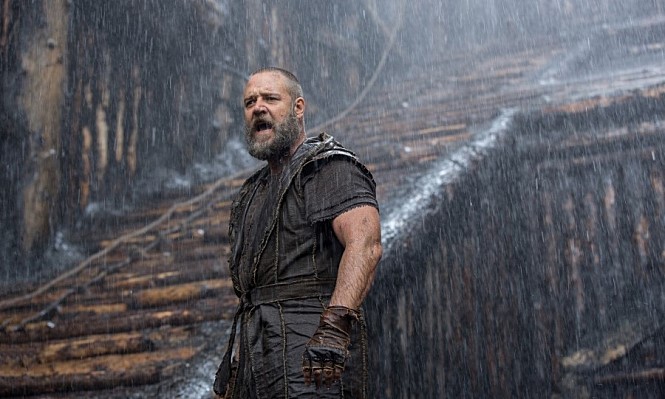
noah02 While Cain’s descendants have become corrupted beyond redemption in the ruthless advancement of their exploitative civilization and the world has been turned into a little more realistic version of Mordor as a result, Seth’s descendants have been faithfully devoted to their belief and their creator. Although he unfortunately lost his father when he was very young, Noah(Russell Crowe) grows up to be a good, faithful man with loving wife Naameh(Jennifer Connelly) and his three sons. Considering how barren their world looks with no edible animal or plant on the screen, I wonder about how they get their nutrition source, but I guess that is not the question I can ask while watching a fantasy film based on a biblical myth which is actually one of countless tales about deluge from ancient civilizations.

During one night, Noah gets a message from the sky above through his disturbing dream, and he and his family immediately start their journey to the holy mountain where his legendary grandfather Methuselah(Anthony Hopkins) lives. Methuselah is not as old as the Bible says, but it seems that he has some supernatural power. When he was younger, he simply wiped out his enemies with his fiery sword. Don’t ask me how he could do that.

We are also introduced to more supporting characters. Noah and his family came upon an injured little girl who managed to survive from a slaughter, and the girl, named Ila, soon becomes their daughter as being taken care of by Noah and Naameh. After meeting Methuselah, Noah begins to build the Ark, and the surviving fallen angels, who look a lot like the rocky version of Transformer robots, are willing to help Noah once they see that he is following the message of the creator. Although they were rather mistreated just because of their disobedience, they are still loyal to their former boss with no ill feeling, and they become Noah’s workers and protectors.

Several years go by, and Noah’s sons and Ila grow up to be played by Douglas Booth, Logan Lerman, Leo McHugh Carroll, and Emma Watson. While that fateful moment is approaching, the Ark is nearly completed, and we see many kinds of animals go aboard the ship in pairs(the movie does not care much about plants, by the way). Not so surprisingly, other men see that the end is near, and Noah and his mission is soon threatened by Tubal Cain(Ray Winstone) and his army.

noah04 The middle part of the film has gritty action scenes peppered with big CGI effects, and that was the part I began to lose my interest during my viewing. Russell Crowe and Ray Winstone convincingly bring tough stubbornness into their respective characters as going through these action scenes, but their battle of will is overshadowed by the CGI effects which feel bland and uninspired under gloomy and rainy ambience. The movie delivers the flood as promised in the end, but I have seen better ones, and its third act after the flood, which is supposed to generate a powerful psychological drama revolving around the extreme conflict between belief and love, feels stuffy and unconvincing because of the weak story and its half-baked characterization.

Besides Crowe and Winston, the other actors in the movie get the thankless job of playing underdeveloped characters, though they did their job as much as they could. Jennifer Connelly brings some warmth into her role although her character’s function is mostly 1) dutifully following her husband or 2) tearfully protesting against her husband’s fanatic decisions, and Emma Watson shows again that she is a good actress who can easily separate herself from Harry Potter movies. Compared to his co-actors Douglas Booth and Leo McHugh Carroll, Logan Lerman has more things to do as the son with growing conflicted feelings toward his father, and that leads to another interesting moment around the ending, though it is not as effective as it intends to be.

The director/co-writer Darren Aronofsky has made a number of interesting films about characters driven to extremes such as “Requiem for a Dream”(2000), “The Wrestler”(2008), and “Black Swan”(2010), and I understand more about his intention behind “Noah” as more musing on its disappointing third act. While watching Noah becoming more harsh, extreme, and single-minded for his holy mission, I was reminded of the obsessed hero of Aronofsky’s first feature film “Pi”(1998), who, like Noah, is driven to do something grand while pushing himself into a dark pit of madness. At one point, Noah is so driven by his belief and his disgust with humanity that he is ready to kill his latest family member for completing his mission, but I seriously want to ask him whether that is reasonable, considering that 1) there seems to be no human being alive outside the Ark and 2) his family will probably not welcome inbreeding.

I heard about how much Aronofsky defended his own vision from Paramount studio people during the post-production period, who even made three alternative versions to draw potential Christian audiences and then eventually gave them up after getting the lukewarm reactions at several test screenings. Although I think “Noah” is a misfire as a SF fantasy film like his another failure “The Fountain”(2006), I admire Aronofsky’s integrity, and this movie does not change my opinion on him at all. He is a brave, ambitious, and talented director who takes chances as he wants, and even his disappointing work like this is glimmering with ambition and challenge. Sure, there were many moments too tedious and solemn for me, but I must point out that I was rather amazed that his Ark did not sink to the bottom even when I got bored.

noah03

Posted in Movies | Tagged , , | 2 Comments

Owning Mahowny (2003) ☆☆☆1/2(3.5/4) : His eyes are fixed on his next gamble

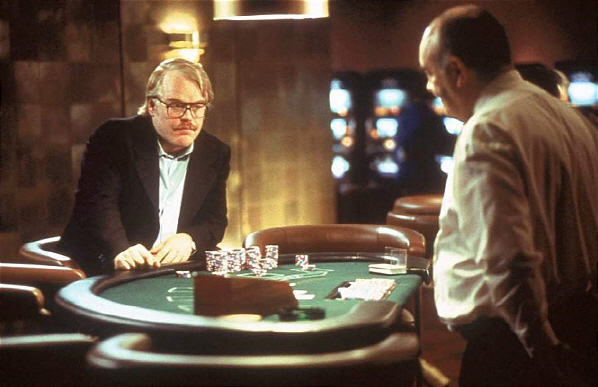
small_owning mahowny03  If I have to choose one definite moment in “Owning Mahowny”(2003), it is the one which shows its hero’s face in a close-up shot when he is going through his another gambling. His face looks blank on the surface, but his eyes are fixed on the table, busily looking for the next shot of thrill he is craving for. He may be aware of the risk and the consequence somewhere in the corner of his mind, but he cannot help himself, and he will go on and on, until he finally reaches to a certain point where he can be stopped by something stronger than his insatiable urge.

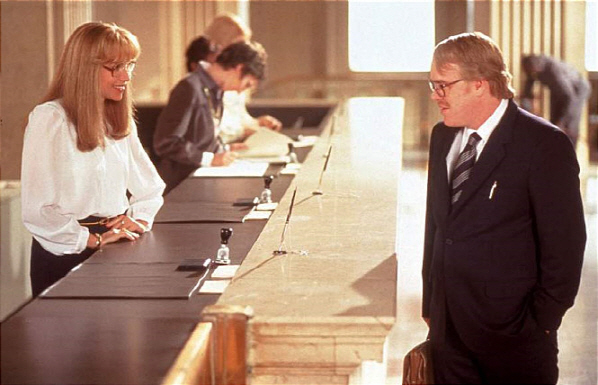
To many people around him, Dan Mahowny(Philip Seymour Hoffman) looks like an average good guy who works hard in some prominent bank in Toronto, Canada. Recently promoted to assistant branch manager, he is mostly regarded well by his bosses for his impeccable work record, and they trust him enough to let him handle several accounts of their wealthiest clients. He also has a caring girlfriend who works in the same bank, and Belinda(Minnie Driver) has seriously thought about marriage, but her man does not seem to think a lot about that even when they are about to live together. With his anonymous clothes, big glasses, and shabby car, this nerdy guy looks even plainer than his plain-looking girlfriend, and it looks like he does not have much space for his private life.

However, as told in the opening scene, Mahowny has a secret problem he has managed to hide from others. He is an addicted gambler, and he must take care of his large debt to be collected by his bookie Frank Perlin(Maury Chaykin) right now. Perlin is a sleazy guy who would welcome any money he can get from his gamblers, but he does not like to do an inconvenient job of visiting and pressing Mahowny. As a matter of fact, he is so sick of Mahowny’s increasing gambling debt that he even considers suspending his dealing with Mahowny for a while.

Of course, Mahowny does not want that, so he resorts to stealing the money from his bank for clearing his debt. He steals only $10,300 through fake loan application at first, but, once he sees how easily he can steal money from his bank without getting any suspicion from others, his mind follows the next logical step; he steals more money and then flies to Atlantic City during weekend for bigger gambling and bigger thrill, and this soon becomes his weekend routine as he steals and gambles more and more.

small_owning mahowny01 Based on a real-life story of a bank manager responsible for the biggest one-man bank fraud in the Canadian history(as mentioned in the film, he stole $ 10.2 million in total for his gambling), the movie is effective as a close, realistic look at gambling addiction, and it keeps itself sticking tightly to its hero’s view for giving us the clear understanding of his addicted mind. Like any other kinds of addicts, Mahowny is constantly dominated by his vice, and we see how his daily life virtually revolves around it. At one point, he cannot afford to spend more time with her girlfriend just because of his another weekend in Atlantic City, and we also get an absurd moment when he hurriedly asks a bookie to bet on all the home teams in one league and all the away teams in the other league because he does not have enough time for betting on each game.

Philip Seymour Hoffman, a great talented actor who left us too early in last month, masterfully holds our attention through the effortless embodiment of his compulsive character. Never stepping back from his character’s many negative sides, Hoffman subtly reveals the urge and the thrill pulsating behind his character’s low-key appearance through small gestures and movements in his finely tuned performance, and we fully understand what drives his character into such self-destructive behaviors. Once he begins, Mahowny cannot stop himself until he is confirmed again that he is completely defeated with no chip in his possession. Sometime he wins, but then it leads to another gamble he cannot simply resist. To him, the matter is not whether he wins or loses but how much more he can gamble, and that is all he care about in his gambling.

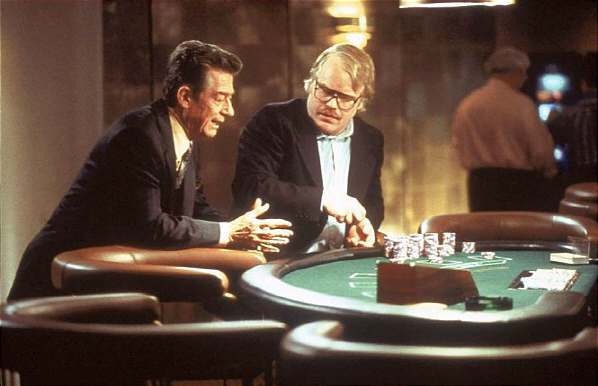
With his withdrawn appearance, Mahowny initially did not draw much attention on his first day in Atlantic City, but, as he brings more money into the casino, he gets noticed by Victor Foss(John Hurt), the wily casino manager who recognizes the type while observing Mahowny through his security cameras and is ready to suck all the money from Mahowny(“he’s a purist!”, he exclaims with amused delight). As a guy with lots of experience in his business field, Foss has probably seen guys like Mahowny, but, like others, he cannot help but be fascinated with that intense single-mindedness of his lucrative prey, who concentrates on gambling for hours and hours while never minding about anything Foss willingly offers to him – except barbecued ribs without sauce, perhaps.

small_owning mahowny04 While all these things happen, Mahowny manages to cover his crime from others, but Belinda begins to realize that her man has a really serious problem. At one point, he takes her to Las Vegas, and she is impressed by a big hotel room reserved for them, but, what do you know, she is left alone in the room for a long time while he is gambling at the casino. She later finds him at the casino and asks him to go back to their room with her, but his mind is so occupied with his gambling that he does not seem to be conscious of her or passing time at all.

With Maurice Chauvet’s screenplay based on Gary Stephen Ross’ non-fiction book “Stung: The Incredible Obsession of Brian Molony”, the director Richard Kwietniowski made an engaging character study not entirely without humor in its unflinching depiction of the hopeless downward spiral experienced by its hero. Sometimes we cringe at how blindingly Mahowny is driven by his impulse while ruining his life and career step by step, and sometimes we are amused by how far his problem goes beyond his control. When he is approaching to the final destination literally waiting for him, he is so consumed by what he experienced hours before that he is unbelievably oblivious to what’s going on around him – and he is still mired in that pathetic self-denial of his(“I have a… financial problem. A shortfall.”).

With Hoffman’s gripping performance as its central force, the movie is as single-mindedly focused as its hero, and the main task of the supporting actors surrounding Hoffman is more or less than responding to Hoffman’s character. Among them, John Hurt has the most fun with his deliciously amoral character; Foss may have some pretty good idea about how the hell an ordinary bank manager from Toronto can gamble with such a large amount of money, but he does not mind as long as money is rolled into the vault of his casino, and he even provides Mahowny a more convenient way of transferring money to his casino.

small_owning mahowny02 Although her character feels like a functional role, Minnie Driver has a couple of crucial scenes with Hoffman. Belinda tries to accept her boyfriend’s gambling habit as a minor diversion, but there comes an inevitable point when she decides that enough is enough, and Hoffman and Driver have a painful moment when Belinda confronts Mahowny to have some serious talk about his gambling habit. Maury Chaykin and Vincent Corazza are small-time bookies who unintentionally lead Mahowny into his eventual downfall, and Chris Collins is Foss’ expendable employee who gets a little friendly to Mahowny and tells him(and us) about how casinos manipulate their customers in rather sneaky ways(yes, folks, as said by others many times before, the house always wins).

As a small gem which has been somewhat overlooked since its theatrical release in 2003, “Owning Mahowny” has one of best works in Philip Seymour Hoffman’s illustrious career, which is one of several good reasons why it is highly recommendable. Mahowny is not a good man, but Hoffman makes him into a memorable case study with recognizable human behaviors, and he and the movie give us a sober, uncompromising presentation of an addicted mind. Whether it is alcohol or drug or any other kinds of addiction, addicts are driven to get it by any means necessary, and they can be quite reckless and thoughtless for their pursuit for the next fix – and they are usually helpless in their repeated cycles.

Later in the movie, Mahowny’s psychiatrist asks him how much excitement he can get from gambling on a scale of 1 to 100, and Mahowny promptly answers 100. When the psychiatrist asks him about the most excitement he has ever experienced outside of gambling, he answers 20. As told in the epilogue, he eventually learns to live only with 20 for the rest of his life, but he pays a very big price for that.

owning mahowny07

Posted in Movies | Tagged , , , | 1 Comment

Manshin (2013) ☆☆☆1/2(3.5/4) : A shaman with ten thousands spirits

manshin03 South Korean documentary “Manshin” vividly presents the cultural value in Korean shamanic rituals through its haunting images which lingered on my mind for a long time after watching it. Looking around the long, dramatic life story of a woman who has persistently adhered to her ‘destiny’ and craft, the documentary beautifully dances around archival footage, interviews, and recreated personal moments, and its gorgeous dance ultimately comes to us as a vivid, uncanny incantation to draw us into the folk tradition worthwhile to observe and value.

Its subject is an 82-year-old shaman named Kim Geum-hwa, who was officially recognized as a national treasure after enduring so much oppression upon her and her craft for many years. Born in 1931 in a small town of Hwanghea-do area which now belongs to North Korea, she was destined to become an outsider even when she was very young. Besides being an unwelcomed child right from her birth, she already began to experience ‘Shinnae-rim’, or ‘possession’, during her childhood years, and that certainly made her look like a freak to other kids and their parents. Not long after running away from the abusive marriage during her adolescent years, she followed the footsteps of her maternal grandmother who was a prominent shaman, and the movie gives us the recreated scene of her admission test ritual which her grandmother presides over with strict solemnity.

Mainly because there is virtually no footage or record from that period, the documentary, which is based on Kim Guem-hwa’s published memoir, mainly depends on the recreated/imagined scenes to depict her early years. Three well-known South Korean actresses(Kim Sae-ron, Ryoo Hyeon-kyeong, and Moon So-ri) respectively play Kim Guem-hwa in different ages, and their good performances in the documentary are naturally mixed together to give us the whole portrait of its human subject. At one point, Kim Geum-hwa herself looks at one of the important moments in her life being recreated right in front of her, and this oddly compelling juxtaposition of past and present, or fiction and reality, feels sad and poignant even though she just watches her younger self without saying any word.

manshin04  Her grandmother(played by Baek Soo-ryeon in the recreated scenes), who was revered as ‘Manshin’(it means a shaman with ten thousand spirits), never wanted her granddaughter to follow her footsteps because her granddaughter would inevitably lead a life of many ill-treatments just like she did. Although class distinction was almost gone in Korea around the 20th century, shamans were remained in low social status while still being disregarded by others, and they were also shunned and oppressed by authorities as the Korean society going through modernization.

Not long after Kim Geum-hwa started her career as a new Manshin, the Korean War broke out in 1950, and things became pretty rough for her as well as others. While losing her grandmother and directly witnessing the horror of the war, she had to go through many risky moments as targeted or used by both sides. We hear from her about how she narrowly escaped from death in front of muzzles aimed at her, and we also get a symbolic scene featuring her younger self stuck in the middle between a North Korean soldier and a South Korean soldier played by the same actor.

She managed to survive through the war, and she safely went to South Korea after leaving behind her hometown, but there were more hardships even after the war was over. Shamanism was still regarded as superstition to be expelled, and that tendency became harsher especially during the 1970s when the South Korean government was determined to modernize everything in rural areas. She could have been arrested by the police for doing her rituals, and she was also mistreated by Protestants who mostly regarded her and other shamans as demonic influence. During one amusing scene, she and her co-workers are ‘ambushed’ by hymn-singing Protestants, and, not so surprisingly, there comes that familiar silly phrase I heard from many South Korean Protestants who sometimes look like third-rated Christian shamans: “Satan, go away~”
manshin06

We also meet her family including her niece, her stepson, and her second husband, who had to be divorced from her because of an understandable reason. He had no problem with living with her, but, as her stepson also points out, being shaman’s family was a social stigma he could not hide, and he tells us about how it was not so good for his business during that time. When he later meets his ex-wife again after long years of separation, there is no hard feeling between them, and it is touching to see them warmly talking about their shared past as two people at the end of their respectively lives.

In the end, Kim Geum-hwa and her tradition survive intact with the happy ending for both of them. As the interest in folklore was increased during the 1980s, she found herself valued and respected as a performance artist in public, and we see her dramatic comeback process through a bulk of TV clips and other various video clips, which triumphantly culminate into one dizzy, elevating sequence to behold. Although she is over 80 now, this old lady still looks spirited in her colorful spiritual performances for ghosts and spirits, and it is not so easy to reject the excitement inside them even if you do not believe that she is possessed as she claims(As a biology major, I think her mental state is just a lot more sensitive and receptive than ours to neuronal stimuli).

The director Park Chan-kyong did a terrific job of making his documentary both informative and beautiful as melding different elements together into a wholly mesmerizing experience you should not miss at any chance. I remained skeptical about all those spiritual things at the end of the film, but I observed it with full curiosity throughout its running time, and I was also touched by many sublime moments including its memorable finale scene, which ends with a quote suggesting that movies are actually not that different from those shamanic rituals summoning spirits. After all, when we watch movies, we are sort of conjuring up the spirits inside them, aren’t we?

manshin01

Posted in Movies | Tagged , , , , , | 4 Comments

Non-Stop (2014) ☆☆1/2(2.5/4) : You don’t mess with Liam Nisson

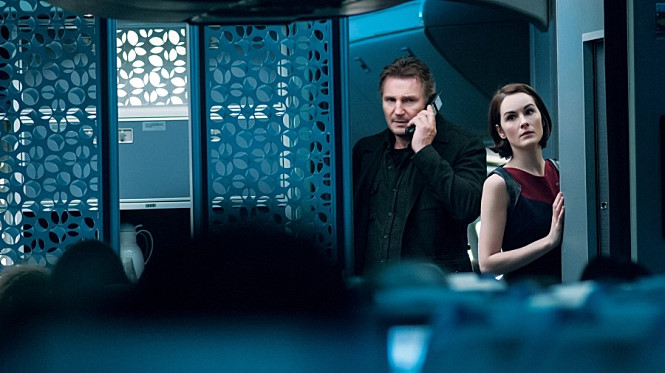
nonstop01 One thing I miss about Roger Ebert is his witty amusement with action thriller movies which are full of preposterous plot holes big enough for a Boeing 777 plane to fly through. He did not point them out just for blasting them in his reviews; he was sometimes entertained by their dumb plot devices and typical clichés even when he did not like them enough, and he frequently made fun of them with sharp wits in his reviews. I savored many of them whenever I encountered them, and I actually wanted to watch those films to share the fun with him as a fellow movie audience(and I usually did, by the way).

“Non-Stop” is one of such outrageous action films, and I believe it would tickle him to some degrees because of its breathless preposterousness decorated with many colorful goodies from his little movie glossary. Besides a bunch of stock characters who would be at home in Airport movies, we also have a typical flawed hero struggling with his personal demon and bound to be fallen into a deadly trap waiting for him, an insidiously goofy scheme which does not make lots of sense at all as you think more about it, an obligatory third-act scene which was once termed ‘underlying reality speech’ by Ebert, and, above all, that infamous thriller cliché which will amuse any seasoned movie audience in the world – RED DIGITAL READOUT!

And, believe or not, there are more than one digital readout in the movie. At one point, the hero is notified through a smartphone that the bomb will explode after 30 minutes, and then the digital readout kindly appears on the screen and is immediately activated. So, I guess it is never expected that our hero will find the bomb hidden in the plane, but then why does it have to be equipped with that red digital readout from the beginning? As a matter of fact, even we do not need that at all because our hero has a digital wristwatch which can function as a timer as well as mine.

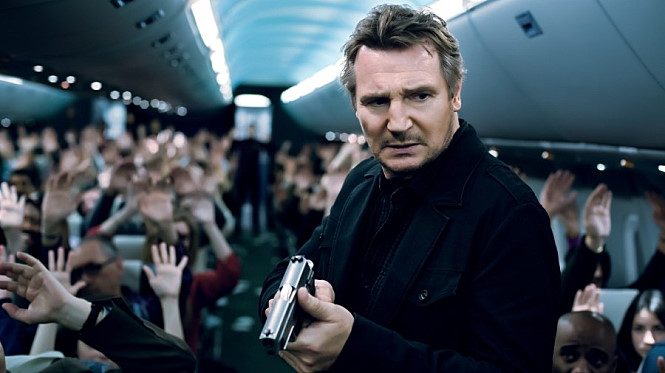
Let’s talk about the story itself, which is not so convincing even if you are willing to suspend your disbelief which will rapidly be accumulated minute by minute. Our hero is a federal air marshal named Bill Marks, and we instantly see that this gloomy tough guy is going through very, very hard time thanks to the natural gray gravitas exuded from Liam Neeson’s performance. Neeson has recently been our man for all those gritty B-action flicks since he appeared in “Taken”(2008), and you may admire how this talented 61-year-old actor still looks believably forceful and vulnerable even in his routine paycheck roles like this. You can’t possibly mess with Neeson under any circumstance, you know.

nonstop03  While getting to know a bit about his personal problems including alcoholism and his young daughter, we are also introduced to several supporting characters who board on a plane to London with him, and lots of possibilities are spread around them even before the plane takes off. When you have a prominent actress like Julianne Moore as a woman who just happens to sit next to Neeson, it does not take a second for us to guess that her character will be one of the crucial elements in the story no matter what happens in the end, and there are some recognizable performers including Scoot McNairy, Michelle Dockery, Corey Stoll, Nate Parker, and Lupita Nyong’o, a beautiful newcomer who worked in this film right after her heartbreaking Oscar-winning performance in “12 Years a Slave”(2013) and will probably not get roles more inconsequential than this in her bright future career.

Everything looks like his ordinary work day to Marks at first, but, around two hours after the takeoff, he receives suspicious text messages through his secure smartphone. According to the messages, a passenger will be killed right after 20 minutes, and that will happen again every 20 minutes unless $150 million is transferred to a certain bank account. The others including the pilot do not take this anonymous threat seriously, but Marks intuitively senses that he and others are placed in a very dangerous situation, and, of course, he is right about that.

The director Jaume Collet-Serra, who previously collaborated with Neeson in another highly improbable action thriller film “Unknown”(2011), maintains the tension fairly well during the first two acts despite many illogical aspects nearly making his film crash into the ground. As announced through those ominous texting messages, some of the characters on the plane meet unfortunate end as the clock is ticking, and we even get a classic case of closed-room mystery which looks quite impossible if we rule out a person sitting right next to the victim at the time of the death.

nonstop02  And Marks finds himself cornered into a very difficult situation as realizing that he is being manipulated and framed as a key part of the plan. The bank account turns out to belong to none other than Marks himself, and he is soon labelled as a dangerous and unstable hijacker by the media, and the passengers do not trust him much mainly due to his abrasive and coercive approach in the investigation, though many of them temporarily drop their suspicion when Marks promises them one-year free pass for international lines from his airline company.

Around its third act involved with the aforementioned bomb and predictable action climax(this is not a spoiler at all if you have watched its trailer), the movie eventually gets messy as going through its crash course along with the plane, and even its ‘underlying reality speech’ moment does not do much of service to us except 1) revealing a shaky plan depending a lot on coincidence from the beginning to the end and 2) giving Marks more chance to prevent the approaching moment of doom for him and his fellow passengers as a certain character wastes precious remaining time on confessing a motive behind the plan.

“Non-Stop” has some good scenes which work well, and I often found myself amused by its brash attitude to its sheer ridiculousness peppered with clichés, but it is not engaging enough for me to embrace its implausible aspects. I have always thought Liam Neeson was too good for his recent B-action movies, but it goes without saying that he brings some class to them, and he is dependable as before while effectively selling many scenes in the film including Marks’ sincere interaction with a little sick girl. As shown in his absolutely hilarious voice performance in “The Lego Movie”(2014), this Irish trouper is still capable of many other things, and I sincerely hope he will get more chances to do far more acting than he did in this passable action film.

nonstop04

Posted in Movies | Tagged , , , , , | 1 Comment

The Monuments Men (2014) ☆☆1/2(2.5/4) : Saving artworks during World War II

small_monumentsmen01  As the biggest war during the 20th century, World War II still has many interesting stories to be told even after so many books and movies about it came out, and the story told in “The Monuments Men” is surely a curious one. Inspired by a real-life story about the special military unit which tracked down and saved many valuable artworks from being stolen or destroyed during the war, the movie follows the several fictional main members of that unit, and its episodic narrative gives us some enjoyable moments as they roll around the Europe continent for their duties. Although the story feels flat and unfocused at times mainly because it tries to deal with too many things within 2 hours, its subject is still an interesting one deserving to be told, and the movie accomplished its mission to certain degrees at least while managing not to make us bored.

The story begins around 1943, when the Allies were beginning the first forward step against Germany and Italy in Europe. As the amount of collateral damages resulted from the war is increased along with more battles around the Europe continent, Frank Stokes(George Clooney), an American art conservation specialist who is loosely based on George L. Stout, has a reasonable concern over many important artworks in Europe which can be lost forever during the ongoing war. They have a good chance of winning the war, but, as Stokes points out during his private presentation in front of President Roosevelt and his advisors, they may permanently lose invaluable cultural assets even if they get the victory in the end, and he passionately emphasizes the need to protect them for human civilization.

After getting the permission for his proposed operation, Stokes brings various experts into his special military unit. His colleague James Granger(Matt Damon) is the first guy to join the unit, and then we meet the other members one by one as they are recruited by Stokes: Walter Garfield(John Goodman), Richard Campbell(Bill Murray), Preston Savitz(Bob Balaban), Jean Claude Clermont(Jean Dujardin), Donald Jeffries(Hugh Bonneville), and Sam Epstein(Dimitri Leonidas), a young private who later comes to work for Stokes as his driver and German translator.

small_monumentsmen03 They arrive in France not long after the invasion of Normandy in 1944, and they soon find that their missions are not so easy to be accomplished. While the combat units on their own side are not very cooperative because securing artworks is not their first priority on battlefield, the German army takes away a huge amount of valuable paintings and sculptures during their retreat, and, to make the matters worse, Hitler orders his men to destroy all of these priceless artworks if Germany loses the war. During one brief moment, we see some of them burned together by German soldiers, and their remaining ashes sadly remind us of how much damage war can inflict on human culture.

Stokes and his men, nicknamed “The Monuments Men” by others, try their best as respectively doing their assigned missions. In case of Granger, he goes to Paris as soon as the city is liberated, and he meets Claire Simone(Cate Blanchett), a gallery curator who was forced to oversee the looting by the German Army during the occupation. Although she may help Granger through her personal records she has been keeping just in case, she is understandably suspicious of him due to her difficult experience during that time, and it is his job to convince her that he and his unit really want to track down those stolen works for having them returned to their original owners.

Meanwhile, Campbell and Savitz work together to track down the Van Eyck altarpiece looted from Ghent cathedral, and we see comradeship gradually growing between them despite their personality differences. While Bill Murray is amusing as usual in his typical detached mode, Bob Balaban is a good counterpart to Murray, and they have a nice scene when their characters happen to find themselves in an unusual situation during one dark night.

small_monumentsmen04 As a jovial beefy sculptor and your average merry French guy, John Goodman and Jean Dujardin, who previously worked together in Oscar-winning film “The Artist”(2011), also bring some humor to their scenes. Although Garfield and Clermont are mostly not around the front lines, they are still within the war zone like their colleagues, and there is an amusing moment when they finally confront a sniper who scared the hell out of them through his sudden ambush.

Based on “The Monuments Men: Allied Heroes, Nazi Thieves and the Greatest Treasure Hunt in History” written by Robert M. Edsel and Bret Witter, the screenplay by the director George Clooney and his co-screenplay writer/co-producer Grant Heslov somehow keeps its balls rolling along their separate plot lines, though it eventually loses its momentum and interest during its second half. The story feels loose and jumpy as it frequently shuffles between too many things including the Soviet Army unit eager to grab the stolen artworks as their loots, and its ‘climax’ part feels a lot like an obligatory scene inserted to finish the story with some action and thrill.

While it remains disappointing as a passable film which does not hold its nice elements together well, “The Monuments Men” is not a boring experience, and it has good moments including a big surprise the characters come across in one of the mines where many stacks of art treasures are hidden by the German Army. I liked how Blanchett finds a way to play her functional character engagingly, and I also enjoyed Alexandre Desplat’s colorful score which ably supports different moods in the film(he also appears as a minor character in the movie, by the way), and the other technical aspects of the film are as good as you can expect from a Hollywood period drama movie. You will not have a bad time with it, but I think you will soon forget about most of it – even while appreciating an interesting historical fact reflected in the film itself.

monumentsmen05

Posted in Movies | Tagged , , , | 1 Comment

My prediction on the 86th Annual Academy Awards

12yearsaslave01 The Oscar season in this year is heading toward its finishing line, and I miss my late friend/mentor Roger Ebert more than before. Even when he could not attend the Academy Award ceremony any more due to his health problem which ambushed him in 2006, he usually had something to talk about Oscar, and we always checked his Oscar prediction as trying to outguess him. Now he is no longer with us, and, as going through the first Oscar season without his presence, I sometimes wonder about what he would think of its major contenders.

As I look around the Oscar-nominated films of this year, I can only imagine how much he would be enthusiastic about many of them if he were still with us. “Gravity” takes us boldly into a new area we have never experienced before, and “12 Years a Slave” strikes us hard with its vivid and powerful depiction of the American slavery during the 19th century, and “The Wolf of Wall Street” is a dizzy hedonistic ride which ultimately resonates with a problematic mentality deep inside the American society. Other Best Picture nominees including “Nebraska”, “American Hustle”, “Her”, “Dallas Buyers Club”, “Philomena”, and “Captain Phillips” are also good in their own distinctive ways, and each of them gives us satisfying experience to talk and think about.

So far, “12 Years a Slave” has been the leading contender in the race from the start, but “American Hustle” also appears as a serious competitor, and then “Gravity” gains the momentum mainly through its awesome technical achievement which will certainly sweep many technical categories. Now the other major awards including Golden Globe, SAG, PGA, DGA, WGA and BAFTA have showed their answers one by one during last six weeks, but there is still considerable amount of uncertainty around several major categories, and we can only guess which movie will get the last laugh at the end of the 86th Academy Awards ceremony.

I have been fairly correct in my Oscar prediction since I actively began to focus on Oscar season in 2003, but I must tell you again that I have never been wholly correct about eventual winners. I am quite certain about some of the categories, but there may be some surprise on March 2nd, and, again, my prediction will probably turn out to be less accurate than your prediction. Here is my prediction, and I sincerely hope you can outguess me, though there will be no reward or prize for that.

Continue reading →

Posted in Movies | Tagged | 3 Comments

Cutie and the Boxer (2013) ☆☆☆(3/4) : Two different artists as life partners

cutieandtheboxer02 They fell in love with each other as artists, and they have been inseparable from each other as life partners for 40 years. The documentary “Cutie and the Boxer” is a quirky love story between two artists complementing each other through their contrasting personalities, and it looks closely inside not only their artistic activities but also the long, dynamic relationship between them. They went through many difficult times, but now they arrive at an equilibrium point, and they are still happy to be together along with the artistic satisfaction for both of them.

Noriko and Ushio Shinohara are living at their small, shabby, but cozy home in New York, and the opening scene begins with Noriko waking up her husband in the morning. It is his birthday, and they celebrate it in the kitchen in a rather modest way, and then we see Ushio doing his work at his studio. Reminiscent of Jackson Pollock’s action painting, he wears gloves strapped with foam rubber pads which are soaked with black paint, and then punches into the canvass as he is moving from right to left. Like many modern artworks both baffling and fascinating me, I do not know whether the result is profoundly simple or simply profound, but I can say the process itself is interesting to watch at least.

Anyway, Ushio has some reputation as an avant-garde artist since he came to New York during the early 1960s. Although he has been not as successful as other famous contemporary New York artists, there was a time when he drew lots of attention as a new talent to watch through his ‘boxing painting’ and odd motorcycle sculptures, and we see the photo of him sitting with Andy Worhol at one point. He is 80 now with no big commercial success, but he keeps working, and he is still visited by several people interested in his artworks, though he sometimes sells them for himself to earn money to support him and his wife.

cutieandtheboxer04

Noriko has been not only his wife but also his assistant and housekeeper for many years since they married. Not long after she came to New York with her own artistic ambition in 1973, she came across Ushio by chance, and they quickly became lovers despite considerable age difference(she was 19 while he was 41). They soon married, and Noriko was happy to have her artistic talent encouraged by someone who loved and understood her as a fellow artist.

But she eventually found that she had very little time for her art because she was usually busy with taking care of everything in their household. While her husband was mostly occupied with his work or drinking, she was the one who had to support the household, and that task was not so easy for her – especially when her parents stopped sending money to her. Noriko says with regret that they were not good parents for their young son Alex because they did not provide him good environment for growing up, and their home video footage provides some glimpses into that messy time. While Ushio is drunken as usual with his friends, his son is quietly taking a bath alone in the bathroom, and then we see him sneaking into his bedroom while his father keeps talking and drinking.

We meet adult Alex when he comes to his parents’ home, and he is certainly the apple who does not fall far from the tree. While less outgoing than Ushio, he drinks too much just like his alcoholic father once did(Ushio no longer drinks due to his recent allergy problem), and he is an artist like his parents. At one point, he shows his self-portrait to his mother along with his other recent works, and I think that self-portrait tells a lot about how this introverted guy has felt about himself.

cutieandtheboxer03 Meanwhile, Noriko recently takes the first important step for her dormant career, and we see her working on drawings in her private place. Inspired by her difficult married life with Ushio, she has made a bunch of drawings for her comic book work titled “Cutie and Bullie”, and these lovely drawings shining with humor and wits are effectively used for the animation sequences in the documentary, which give us some insights into how the relationship between Noriko and Ushio has managed to work despite their many problems. He was more or less than a wilful child in the need of being taken care of, and she was the right one to take care of him with lots of love and patience, and they were bonded together through their love as well as their passion toward art in their good times and bad times.

Ushio, who still shows his immature side although he looks softened compared to his wild years, and Noriko, who still retains her girlish side represented by her braided hair, bicker with each other at times in front of the camera, but it is clear that they cannot possibly imagine the life without each other. Their conversations are always surrounded with warm affection and understanding between them, and now their relationship is being changed as Noriko is gaining her own artistic position. When she sees her husband’s latest work, she honestly tells him it is not good, and he agrees with her reluctantly. After more struggle and efforts, he makes a new picture later, and that looks better at least in my view.

The director Zachary Heinzerling, who was recently Oscar-nominated for his documentary in last month, gives us an intimate look at one interesting and lovable artistic couple, and it is alternatively funny and poignant to watch as we observe them moving on with their life as before. He may be approaching the end of his career now, and she is blossoming in her career in contrast, but Cutie and Bullie will stick together as usual till the end – and they will continue to box with each other as they did many, many times.

cutieandtheboxer05

Posted in Movies | Tagged , , | 1 Comment

Lone Survivor (2013) ☆☆1/2(2.5/4) : Gritty as required but questionable as predicted

Lone-Survivor-ss-18b “Lone Survivor” does as much as an average gritty modern war film can do. It has several intense combat scenes to talk about, and it is sometimes grueling to watch its military characters struggling through their increasingly perilous situation which harshly tests their physical and psychological strength. There is a particular scene in which they rapidly tumble down a stiff slide after being flown off by another explosion during their combat, and it is rather amazing that they manage to survive and then keep moving on even though their bodies kept crashing hard into rocks or trees as they tumbled down and down along the slide.

I do not know whether that is possible or not, but I guess that really happened during the Operation Red Wings, a failed Navy SEALs mission in Afghanistan in 2005. Recognizing and honoring those brave men sacrificing for their country as doing their duty, the movie intends to be a passionate tribute to them from the beginning, and it does its job well in technical aspects, but it does not bring anything new or insightful to its genre in comparison to other more thoughtful movies and documentaries about warfare.

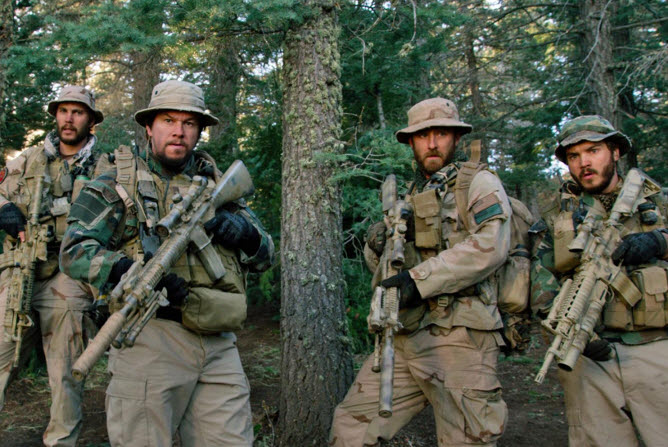
As reflected in the montage of real Navy SEALs in training shown during its opening scene, the movie sticks to the viewpoint of its characters from the start, and it looks no further than that. Before the mission begins, we are introduced to four members of SEAL Team 10 one by one, and then we get to know a bit about them while observing how they and other team members get along well with each other as the band of brothers who would watch for each other’s back on their battlefield.

These four guys are Marcus Luttrell(Mark Wahlberg), Michael Murphy(Taylor Kitsch), Danny Dietz(Emile Hirsch), and Matt ‘Axe’ Axelson(Ben Foster). After the briefing of their latest operation, they are sent together as a reconnaissance/surveillance team to track a vicious Taliban leader named Ahmed Shah(Yusuf Azami) in Afghanistan’s eastern Kunar Province. Not long after they begin their reconnaissance, they succeed in spotting their target in some village while hiding in the forest, but the situation is not exactly ideal for them for several reasons including the radio transmission problem due to their location surrounded those rocky mountains of the Hindu Kush Mountains.

Lone-Survivor-Image-3 The director/writer Peter Berg, who adapted the nonfiction book written by Marcus Luttrell and Patrick Robinson, keeps the tension slowly rising as the mission continues. Always watchful and careful as trained, these soldiers sometimes let themselves relax a little during their small conversations, and the main actors are believable on the screen as the team members who have been through many things together.

Despite their caution, Luttrell and his comrades get themselves into an unfortunate circumstance. They happen to be exposed to three goat herders from the village, so they retreat after releasing these herders, but then they are soon ambushed by Shah’s Taliban guys, who were probably informed by one of the released herders. The movie is not exactly clear about that, but it is so blatant in its suggestion through that minor character’s wordless spite on his face that the brief discussion between Luttrell and his comrades on what they should do with their temporary prisoners naturally feels contrived and superficial.

As soon as the first shot is fired, the movie becomes more intense with lots of bullets and explosions, and it relentlessly pushes its characters into the grim situation which gets worse and worse as their bodies are injured and smeared with blood. The action scenes in the film are as gritty and urgent as required, and its effective sound effects on the soundtrack will make you squirm as you hear the sound of bullets scratching clothes and skins or penetrating into flesh and bones.

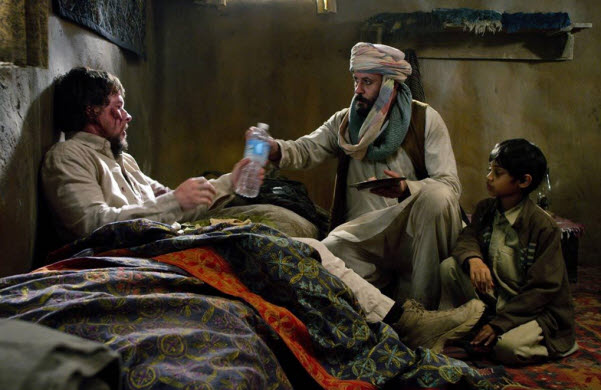
Mainly because of its title, it is not much of a spoiler to tell you that only Luttrell survives around the end of this terrible circumstance. He is later helped by some nice villager(played by Ali Suliman from “The Attack”(2012)), and then the movie sinks itself into a standard shoot-them-up action mode which does not mesh well with the punishing realism brandished during its middle part. Despite the language barrier between them, enough mutual understanding is exchanged between Luttrell and that villager just because they both are good guys against the Taliban guys, and that took me back to Berg’s previous film “The Kingdom”(2007), which also sets its ‘balanced’ view through a number of native characters helping and bonding with its main American characters(Suliman also appeared in that film as one of them, by the way).

2587982-lonesurvivor1 And then we get the climactic action scene which can only happen in movies, not in real life. I later did some search on Internet out of curiosity, and I learned from Wikipedia that Luttrell was really saved by the kindness of a stranger as depicted in the film, but his eventual rescue was in fact far less dramatic, though the man who rescued him and others in his village did protect Luttrell from the Taliban guys as following their code of traditional honor.

Even if you can overlook that exaggerated fictional aspect and its other problems including weak characterization, “Lone Survivor” still looks rather questionable in its intent even though I appreciate its good technical aspects and performances. With Mark Wahlberg as the inevitable center, Ben Foster and Emil Hirsch give engaging supporting performances as we can expect from them, and Taylor Kitsch also is solid as the on-ground leader of the team. At the end of the story, the movie sincerely salutes to not only four men depicted in the film but also the other guys of their Navy SEALs team who participated in the operation, but it does not look deep into warfare while unabashedly looking up to their noble act of valor, and it does not resonate like “Platoon”(1986), “Black Hawk Down”(2001), and “The Hurt Locker”(2008).

Maybe because I am a foreign audience outside US, “Lone Survivor” feels to me more like a recruitment film rather a realistic war film. I will not deny that Peter Berg made his movie with all the passion and respect he had in his heart, and this is a well-made war movie which is dynamic and exciting during its action scenes, but I could not help but notice how its good elements were packaged in a typical jingoistic tale of bravery. Yes, these brave young men deserve recognition for their service no matter what you think about the current situation in Iraq and Afghanistan, but I have seen better films about warfare and people, and they accomplished that mission a lot better than this standard stuff.

Lone-Survivor

Posted in Movies | Tagged , , , | Leave a comment

Nebraska (2013) ☆☆☆1/2(3.5/4): A fading man reaching for his delusion

nebraska03 Nine years ago, I visited an apartment complex area in Seoul simply because of a sentimental reason of my own. I used to live there only during 1989-91, but the memories of that time are remained vividly in my mind, and it was a little depressing for me to see how much my old neighbourhood looked different compared to my memories. Some buildings such as my former elementary school remained same just like an apartment building my family lived in, but lots of things were changed, and my brain kept making comparisons between now and then. In the end, I sat down on a bench in the schoolyard belonging to the other school in the neighbourhood, and I mused for a while on the time never to be regained as sensing wistful nostalgia growing in my heart.

In Alexander Payne’s new film “Nebraska”, there is a memorable scene which somehow reminded me of that personal experience of mine during my viewing. Around the middle of the story, its hero and others drop by an old house he lived in the past, and he reminisces about his old time as he and others look around the house which is now empty and desolate with no one to live in. The past still remains in his memories, but almost everything is gone now, and he is not young any more while things have been changed a lot in his life.

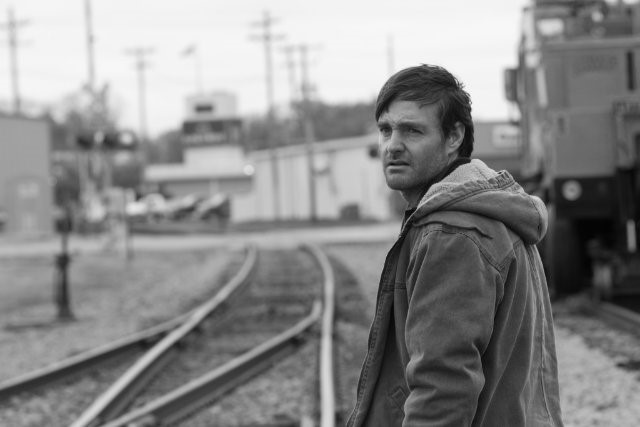
Woody Grant(Bruce Dern) is an old guy who has been living in Billings, Montana for many years since he moved from his hometown in Nebraska a long time ago, and it is clear to us right from the opening scene that he has some serious mental health problem besides aging. He wants to go to Lincoln, Nebraska for himself just because he received a letter notifying to him that he won $1 million sweepstakes prize, but, as his caring son David(Will Forte) soon finds out, it is one of those mail scams which actually promise nothing while making receivers purchase magazine subscription instead.

nebraska02 But Woody is stubbornly oblivious to that in his mind which sometimes seems to be pretty foggy and delusional, and his continuous attempts to go to Lincoln for collecting that false sweepstakes have driven others around him crazy. His sarcastic wife Kate(June Squibb) does not tolerate this foolishness at all, and the same thing can be said about Woody’s other son Ross(Bob Odenkirk, who looks less brash than he did in TV series “Breaking Bad”), who, like his mother, thinks sending Woody to nursing home may be the best option for both him and the family.

David, who feels rather sorry about his father although their relationship was not so good even when he was young, decides to help him on one day. After all, there is nothing harmful about driving his father to Lincoln just for satisfying his futile delusion, so David leaves for Lincoln with him, but he only finds again that his father is a difficult man to deal with. During one night, Woody somehow gets injured on his forehead while losing his denture somewhere, and that leads to one of many amusing scenes to come in the movie.

Now it sounds like a typical road movie to you, but the director Alexander Payne and his screenplay write Bob Nelson takes a detour early in their first act, and the result is an observant character drama depending on mood and characterization rather than plot. Woody and David eventually go to Woody’s hometown in Nebraska for an imprompt family meeting while Kate and Ross soon follow them, and we meet various people in the town including his family members and several town people he knew. After Woody unwisely mentions about his sweepstakes prize, they all hang around him like vultures for getting some money from him, and the most notable one is Ed Pegram(Stacy Keach), a bullying obnoxious prick who has not yet returned an air compressor he borrowed from Woody many years ago.

Going deftly back and forth between humor and pathos as he did in his previous works such as “About Schmidt”(2002) and “Sideways”(2004), Payne depicts his characters as flawed people with understandable human behaviors, and they feel as real as his melancholic version of faded Americana unfolded on the screen. Through the black-and-white cinematography by Pehdon Papamichael and the old-fashioned logo of Paramount Pictures at the beginning, the movie evokes the ambience of American films made during the 1960-70s, but it also feels contemporary as reflected by several small details including a flat screen TV and a Kia car(the movie was shot by digital camera instead of film camera, by the way).

nebraska06 With this contrast between the old and the new on the screen, nostalgic feelings are amplified around the characters whenever they come upon the remains of lost time. In one poignant scene, David encounters a woman who was once Woody’s girlfriend before he married Kate, and he came to learn about his father more than before as spending some time with her at her workplace. She tells him she is satisfied with her life which has been pretty good to her, and she really looks happy and contended, but you may sense that she is wistfully wondering about what her life could have been as she is kindly showing Woody’s forgotten past to David.

The scene in which Kate and Woody visit the town cemetery with their sons is also filled with the wistful nostalgia toward a bygone era. As Kate recognizes more names on tombstones, we observe an undeniable truth in the closing chapter of their life; many people in their life are gone now and they may be the next ones to go gently into darkness someday. While earnestly recognizing that depressing fact of life, the movie does not lose its sense of humor, and we are amused to see that Kate still retains some of her wild spirit despite her age.

And Bruce Dern, who received Best Actor award at the Cannes Film Festival in last year and then was Oscar-nominated for one of the best performances in his long career, gradually takes the center. Besides his many other negative aspects, Woody is a pathetic and delusional guy who is not changed much even in the end, but, thanks to Dern’s unaffected performance, he comes to us as a sad, broken man who is left with nothing much to do after used by not only others but also himself. There are many moments when we are not so sure about what is exactly going on inside Woody’s rather elusive mind(it is possible that he is going through the early stage of dementia), but, while never reaching for pity or sympathy, Dern and Payne make us understand that this unhappy man desperately holding onto a false hope deserves a little kindness at least.

nebraska01 Like Dern, the other actors smoothly slip into the story and its background through their natural ensemble performance. The movie is about David as much as it is about Woody, and Will Forte, who is mainly known for his comic performances in “Saturday Night Live” and “30 Rock”, is commendable as the main voice of common sense in the movie. Quite different from his loony turn in several episodes of “30 Rock”, Forte dials down his comic side to considerable degrees, and his earnest performance effectively functions as the solid ground for Dern and other supporting performers.

As Woody’s acerbic wife, June Squibb, an 84-year-old veteran actress who previously appeared as Mrs. Schmidt in “About Schmidt”, has deservedly received lots of acclaims and attentions along with her recent Oscar nomination for her enjoyable performance. Wearing her feisty heart on her sleeve as she probably did before, Kate has no hesitation in showing her frustration and annoyance toward her husband, and we can only imagine how much she has endured him during their married life, but one brief scene quietly implies that she still cares about her incorrigible husband as the life-long partner who has spent many years with him.

Alexander Payne, who was born and grew up in Nebraska, has made a number of fabulous works which were praised for sharp storytelling and good performances, and “Nebraska” is another terrific work from a talented director who has been steadily establishing himself as one of the leading American filmmakers since his debut through “Citizen Ruth”(1996) and “Election”(1999). Like many films about journey, the journey itself in the movie eventually becomes more important than its destination, and it serves us with a rich experience filled with drama and humor as its pathetic hero trying to grasp something utterly unattainable from the start. In the end, you won’t be surprised to see that nothing much is changed for Woody and others, but, after knowing a bit about him through his trivial journey, you will probably agree to the ending which allows him something to remember, though I think it won’t matter to him sooner or later.

nebraska05

Posted in Movies | Tagged , , , , | 1 Comment