Beyond the Reach (2014) ☆☆1/2(2.5/4) : A survival game in the barren wilderness

beyondthereach03
“Beyond the Reach” works best when it focuses on a deadly cat-and-mouse game between its two contrasting main characters. While one ruthlessly pushes the other into an extreme condition, it is compelling to watch both of them trying to outwit each other in their dangerous situation, and that is why it is disappointing that the movie comes to lose most of its tension during its last minutes.

Jeremy Irvine, who has been more notable since his breakout performance in Steven Spielberg’s “War Horse” (2011), plays Ben, a taciturn young guy who works as a guide/deputy sheriff in a remote rural town near the Mojave Desert. Since his longtime girlfriend Laina (Hanna Mangan-Lawrence) recently left him for her college education, he has been rather dismal and detached, and he is reluctant when he is asked to guide for a man who has just arrived in the town for his hunt.

As shown from his $500,000 vehicle and an expensive European rifle he is going to use for his hunt, John Madec (Michael Douglas) is a very rich business man, and you can clearly see that he is a guy who always gets what he wants by any means necessary. While being eager to hunt a big game which will be his trophy to brandish, he often talks with his business partners via his satellite phone for some important business deal, and Douglas brings both slick charm and steely intensity to his character who is probably not so far from Gordon Gekko, his Oscar-winning role in “Wall Street” (1987).

Although Ben does not like his client much, the awkward mood between them is quickly loosened after John’s funny attempt to break the ice during their drive to the Mojave Desert. As they spend their first night in the wilderness, the mood becomes a bit friendlier, and Ben comes to tell John a couple of things about his personal life, though there is still a gap between these two guys from different classes.

beyondthereach04When they wake up early in the next morning, it seems everything will go smoothly during their hunting time, but then a very serious incident happens because of John’s hurried judgment. Devastated by what has just happened, Ben thinks they must report this to the town sheriff, John cannot allow this problem to jeopardize the ongoing process of his business deal, so he thinks of the other way. They can cover up this incident because nobody witnessed it besides them, and, of course, he can pay enough money Ben for keeping his mouth shut.

To a poor guy like Ben, that is surely a tempting offer he cannot easily refuse, but then he finds himself becoming a target in the middle of the vast desert field. To make the matters worse, he is forced to be stripped of most of his clothes and his shoes while being constantly followed by John’s vehicle. He may avoid John’s rifle for a while, but he will be driven to certain death as scorched and dehydrated in the desert, unless he tries as much as possible to earn any slight chance for his survival.

As Ben is cornered more by John’s sadistic pursuit as well as his increasingly exhausting circumstance, the movie effectively builds up suspense under the taut direction by Jean-Baptiste Léonetti. While wonderfully capturing the harsh beauty of barren landscapes on the screen, the cinematographer Russell Carpenter gives us the vivid sense of not only the searing sunlight from the sky but also the simmering heat on the field, and we cannot help notice how Ben begins to look worse and worse with many scars and burns on his reddened body as he struggles through many grueling hours under the glaring sun.
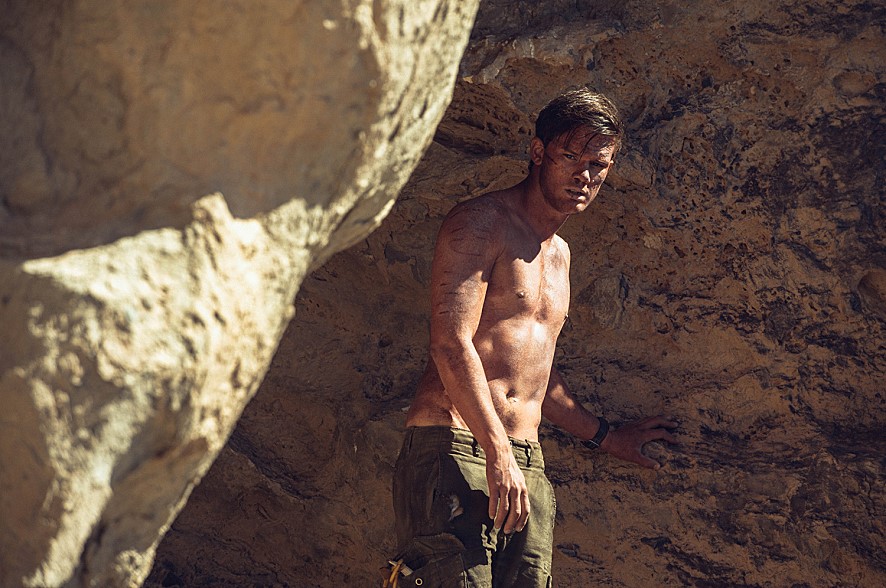
beyondthereach02The movie depends a lot on its two main actors who have to carry their movie together for most of the running time. While less showy compared to his co-star, Jeremy Irvine diligently puts himself into a number of physically demanding scenes in the film. Although we do not know much about Ben except his strained relationship with his girlfriend, we come to root for this ordinary working class lad as he faces more plights to test his will and strength, and Irvine looks believable in his character’s desperate attempts for survival.

On the opposite, Michael Douglas has lots of fun with his juicy villain character who will not mind getting extra entertainment from getting rid of an annoying problem standing on his way. As relentlessly going after Ben, John casually enjoys all the comfort and leisure he can get from his luxurious vehicle equipped with many things including minibar and coffee brewing machine, and he does not even try to hide that while Ben toils in the most hellish moment in his life. In the other words, John is your average 1% guy to despise, and Douglas is entertaining to watch whenever his loathsome character cruelly reminds Ben of who has the upper hand in their situation.

Based on Robb White’s novel “Deathwatch”, “Beyond the Reach” is a slick thriller with nice suspenseful moments, but it eventually suffers what I call “the third act syndrome”. During its third act, the movie makes a contrived shift not long after a certain plot point where it could actually make a decent exit, and, to be frank with you, I do not believe at all what follows after that because of several unbelievable things to make your eyes roll for good reasons. This is a passable thriller film on the whole, but, considering its several good things to mention, you will probably enjoy it especially if other movies better than this are beyond your reach during your free time.

beyondthereach01

Posted in Movies | Tagged , | Leave a comment

Inside Out (2015) ☆☆☆☆(4/4) : Inside the state of mind

movie_imagePixar has done it again. Their new animation film “Inside Out” is a simple but sublime work which not only delights us with its boundless imagination but also touches us with its dexterous storytelling. At first, you will be amazed and amused by its witty and wondrous visual presentation of the inner workings of mind. And then you will be touched by its heartfelt drama glowing brightly and tenderly from the psychological areas you have experienced or will experience during your life.

Its story mainly alternates between two realities. One is the life of a 11-year-old girl named Riley Anderson (Kaitlyn Dias), and the other is the inner world inside her mind, which was formed shortly after she started the first day of her life. In the middle of this world, there is the main control center where five basic human emotions operate: Joy, Sadness, Fear, Disgust, and Anger. While Joy (voiced by Amy Poehler, who imbues her character with that irrepressible pluckiness we saw from her TV sitcom series “Parks and Recreation”), a bright, ever-optimistic figure in the glowing appearance of a blue-haired yellow girl, usually takes the charge along with Riley’s many joyous childhood moments, other emotions also can take the control whenever it is judged to be necessary in Riley’s young mind. Fear (voiced by irreplaceable Bill Hader), a constantly high-strung figure in the appearance of a thin purple guy, makes it sure that Riley is conscious of any possible risk or danger if she has to be, Disgust (voiced by Mindy Kaling from TV sitcom series “The Office”), an aloof, haughty figure in the appearance of a sassy green girl, lets Riley be mean or cranky when she feels like that, and Anger (voiced by Lewis Black, who is as aggressive as you can expect from him), a belligerent figure in the appearance of a red stocky guy, rages with fire as Riley gets angry or furious.

In case of Sadness (voiced by Phyllis Smith, who appropriately channels that daunted passivity we saw from her character in “The Office”), a sad, melancholic figure in the appearance of a blue chubby girl, she has been a burdensome presence for Joy to deal and live with since their first day with Riley. Joy simply wants Riley to be happy and joyous all the time, but Sadness often disrupts the mood with her blue aura. She knows what she causes, but she cannot help herself, like we often cannot help ourselves as dealing with our strong feelings.

Insideout02As Riley grows up under her good parents somewhere in Nebraska, these five emotion characters have mostly worked nicely together in their control room, and we see how the control room is operated as developed bit by bit. When Riley was very young, the control room looked blank and simple as we can expect from babies, and then it becomes more sophisticated and colorful as her mind absorbs many things from her life day by day. Various memories are respectively stored in the glass balls individually colored with associated emotions, and most of them are sent to the storage area for memories while several crucial ones are stored in the control room as “core memories”.

Watching this process, I was reminded of how we can be regarded as biological computers in neurological view. In fact, our mental activities are virtually based on millions of tiny electrochemical signals transferred throughout our body at every second. Our mind is shaped by not only the development of a hardware called brain but also the upgrades we receive from our daily life experiences. We expand our mind as it is gradually and constantly shaped by our life, and, as amusingly shown in the film, we all have our own special places in our mind. They can be for your family or your best friends – or your major interests.

On one day, Riley’s life faces a major change. Her parents, voiced by Kyle MacLachlan and Diane Lane, decide to move to San Francisco for the father’s business opportunity, and that means Riley will be separated from many things in her life. She tries her best after she and her parents move to their new home in San Francisco, but it is not easy for her to adjust to her new environment. She begins to feel sad and unhappy, and she comes to miss what she had to leave behind.

Insideout03Meanwhile, Riley’s mind is put into an emergency situation reflecting her troubled emotional condition. Along with Sadness and a bunch of core memories, Joy happens to be sucked into the tube system for transferring memory balls to the storage area, which consists of the endless stacks of memory balls. This area and the other areas of mind have the workers who mostly look like colorful jelly beans, and we also see the dark pit of oblivion, into which many past memories being forgotten are thrown away (I’d love to see what will possibly happen there during hypnosis).

While Fear, Disgust, and Anger try to handle this serious circumstance for themselves in the control room, it is pretty clear to Joy and Sadness that they must bring back the core memories to the control room before it is too late. As Riley becomes more troubled and depressed, many parts of her mind lose their vibrant colors and then are collapsed into nothingness one by one. As a guy who is still struggling to adjust himself to the first real job and the accompanying new environment, I know one or two things about feeling bad or depressed, and, in my humble opinion, those alarming moments in the film depict well a depressed state of mind. During one of my recent bad days, I felt like nothing but a void not so different from that dark pit of oblivion in the film, and the impulse to erase everything in my life began to pulsate inside me as I went down and down – until I managed to survive that short but gloomy period.

Literally dragging Sadness at times, Joy searches for any possible way for them to return to the control room as soon as possible, and the director/co-writer Pete Doctor, who won an Oscar for his classic Pixar animation film “Up” (2009), and his animators throw many various goodies into their bountiful mix of glorious style and creative imagination. Probably because of my dark sense of humor, I particularly enjoyed the spooky but hilarious sequence involved with the area of subconscious where our deepest fears reside. I and the other audiences always laughed at a certain running gag in the film, which is very funny for its precise comic timing while also being very revealing for its insight on the susceptibility of human mind. In case of a zone associated with abstract concepts, the movie gleefully pushes one zany idea to the extreme, and the result is another spirited moment you have to see for yourself. Michael Giacchinao’s score deftly swings around multiple tones and moods, and it works as a fabulous sonic accompaniment to the film.

Insideout04

And all these fantastic moments and many other ones are grounded well in the strong sense of connected realities, which makes us care equally about what is happening inside and outside. Busily juggling many ideas and jokes, the screenplay by Doctor and his co-writers Meg LeFauve and Josh Cooley, based on the story by Doctor and his co-director Ronaldo Del Carmen, maintains the dramatic connection between two worlds through their effortless storytelling which trusts our intelligence and sensitivity. Through her bumpy adventure, Joy comes to realize that she and Sadness are not far from each other as being the equal parts of who Riley is. Through Joy, Sadness eventually finds her own value in Riley’s mind. Through Sadness, Riley learns a lesson about her feelings as well as her parents’. The movie wisely lets us see for ourselves how much she is emotionally matured inside in the end, and young audiences might get their first grasp of the complexity of life from that.

One of the most touching elements in the film is the character voiced by Richard Kind, a veteran actor whom I came to notice through his supporting turn in the Coen Brothers’ “A Serious Man” (2009). While making his character endearingly goofy right from the first appearance, Kind brings considerable poignancy to his voice performance, and I remember well how some of the audiences around me strongly reacted to the scene where his character accepts what has been destined to happen someday since the very beginning. Sentimental you might say, but it comes with genuine sentiments mixed with a bittersweet truth of life.

Starting with “Toy Story” (1995), a groundbreaking work which brought me and others into the new era of animation feature film, the Pixar Animation Studio has continuously advanced while never looking back. Although its recent works such as “Cars 2” (2011), “Brave” (2012), “Monster University” (2013) felt mild compared to its supreme works including “Wall-E” (2008) and “Up” (2009), they were better than many other lesser animation films none the less, and now “Inside Out” shows us that Pixar has lost none of its magic yet. Smart, insightful, empathetic, and entertaining, it succeeds in many ways as reaching to various audiences who will process it in each own mind. In short, this is the best animation film of this year.

Sidenote
1. I watched the film in 2D. This is a bright, colorful animation film, and you don’t need 3D glasses to appreciate that.

2. Short animation film “Lava” is shown before the movie begins. It is a simple musical love story about one lonely volcano island yearning for his true love in the middle of ocean. It is told entirely through its title song, performed by Kuana Torres Kahele and Napua Greig.

Insideout01

Posted in Movies | Tagged , | 3 Comments

The Guest (2015) ☆☆1/2(2.5/4): A piper comes to the village

theguest02On one day during my miserable graduate school years, one of the seniors in my advisor professor’s biology laboratory told me about his personal aversion to rodents. As a guy who grew up in a farming village, he had vivid memories of how rats used to scurry above the ceiling whenever he was trying to sleep at night, and that was why he did not want to handle even those relatively clean rodents to be used as test animals. Fortunately for him, our laboratory mainly used microorganisms instead of animals, so there was not much problem in his steady progress toward a doctoral degree.

He also did not like to watch any movies associated with rodents for the same reason (he even refused to watch “Ratatouille” (2007) in spite of my recommendation), and that is why I am sure that he will definitely cringe at the synopsis of South Korean film “The Guest”, which incorporates the elements of “The Pied Piper of Hamelin” into its dark horror story. Besides many other disturbing moments in the film, the movie has a couple of creepy sequences featuring countless rats scurrying here and there around the screen, and that will be more than enough to trigger his good old muriphobia.

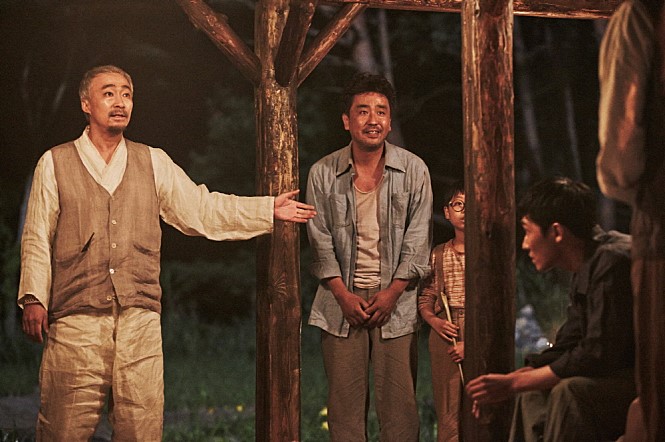
It is around the time shortly after the Korean War was over, and Woo-ryong (Ryoo Seung-ryong) and his young son Young-nam (Goo Seung-hyeon) are on their long journey to Seoul. While he looks all right in his lively appearance, Young-nam has been seriously ill, and Woo-ryong, a caring father who has earned his living as a vagabond entertainer, hopes that his son will get a proper medical treatment at the US Army hospital in Seoul. They are still far from their destination as they slowly walk through mountain forests, and Woo-ryong is not very fit to travel long on feet due to the leg injury he sustained during the war, but he keeps holding onto his small hope while staying close to his sick son with care and love.

theguest06After spending their another night on the road, Woo-ryong and his son come across a gate leading to somewhere on the next day, and they soon enter a remote mountain village when its people are about to celebrate a baby’s first birthday. For some unknown reason, they are not very eager to welcome Woo-ryong and Young-nam despite their celebratory mood, but the Mayor (Lee Sung-min) lets Woo-ryong and Young-nam stay in the village for a while as their guests, and Woo-ryong provides some entertainment using his pipe.

Though the Mayor, Woo-ryong learns about the ongoing problem in the village. Although the village luckily remained safe and intact during the war, rats suddenly began to appear around the village at some point, and these rodents have been continuously increased in their number while no one has any effective solution to exterminate them once for all.

While he does not have a magic pipe like the Pied Piper, Woo-ryong has considerable knowledge on rats, and he has a good idea for getting rid of them. Once the Mayor promises him handsome payment for this job, he instantly begins to work on his plan while Young-nam is taken care of by Mi-sook (Cheon Woo-hee), a young village shaman who experienced a very disconcerting thing right after Woo-ryong and his son arrived at the village.

As implied by that striking moment, something is not right about the village besides its rodent problem, and the movie slowly starts to build up the ominous aura around its seemingly normal and peaceful rural background. Something bad did happen in the past, but it looks like the villagers do not tell everything to Woo-ryong. While being nice to Woo-ryong and his son, Mi-sook often looks worried about some matter she would rather not tell them, and that is probably why she starts to consider leaving the village along with them. The Mayor, who turns out to be as untrustworthy as the Mayor of Hamelin, starts to regard Woo-ryong as another problem to be taken care of, and it is not much of a spoiler to tell you that there will be the inevitable moment of betrayal and double-cross later in the story.

theguest01And it is around that point where the movie begins to stumble and never recovers from that. The movie is equipped with good atmosphere to draw our attention, and I enjoyed its highlight moments including an impressive sequence in which Woo-ryong executes his clever plan all over the village, but its story and characters are too thin to maintain our interest. When the villagers show that they can be as vicious as the town people in “Dogville” (2003), it is already a foregone conclusion that there is only one possible ending waiting for them, and you do not have to be familiar with the Piped Pier story for guessing what that will be. The climax part feels choppy and half-baked while not giving enough emotional payoff to satisfy us, and I personally think the final scene is merely heartless and pointless.

It must be pointed out that Ryoo Seung-ryong and the other main cast members are good actors, but most of their talents are not fully utilized in the movie. Ryoo manages to carry the film with his own presence, but his character often feels bland and uninteresting in spite of his efforts. While Lee Sung-min is effectively duplicitous, Lee Joon is rather flat as the Mayor’s sullen son, and Cheon Woo-hee, who was unforgettable in “Han Gong-ju” (2013), is wasted in her underdeveloped role.

While being a sort of cross between “Welcome to Dongmakgol” (2005), “Moss” (2010), and “Bedevilled” (2010), “The Guest” is an interesting attempt as the variation of a well-known western folk tale, but it is unfortunately hampered by its weak plot and characterization. I watched along with a certain amount of interest during its first half, but then I began to observe it from the distance as distracted by its flaws, and I eventually became disappointed during its lackluster second half. Of course, my senior guy will never watch this movie at any chance, but I do not feel like recommending it to him anyway.

theguest03

Posted in Movies | Tagged , , , , | Leave a comment

Rudderless (2014) ☆☆☆(3/4) : Coming out of his grief through his son’s music

rutherless05
“Rudderless” plays familiar tunes we have heard before. Devastated by a sudden tragedy which turns his life upside down, its hero lets his life drifted away aimlessly as trying to look away from his personal grief, but then he gets an unexpected chance to come out of his shell. This is a typical character drama about grief and sadness followed by feel-good healing process, but the movie handles its story with enough care and sensitivity, and it is also supported well by its good music to enjoy.

When Sam (Billy Crudup) calls his son Josh (Miles Heizer) during one afternoon, he never imagines that will be the last conversation with his son. When he is waiting for Josh at a place near the campus where Josh currently studies, he sees a TV news report on an incident which has just happened in the campus, and he and his ex-wife Emily (Felicity Huffman) soon find themselves overwhelmed by not only their son’s tragic death but also the shocking circumstance surrounding it.

As he agonizes over why that terrible incident happened, Sam’s life and career are quickly flung into downward spiral mainly due to his heavy drinking. Two years later, he is living alone on a big sailboat anchored in a lake, and now he works as a daily worker painting houses. He still drinks a lot whenever he can, and that certainly does not make him look good to his annoyed employer or Alaird (Peter Spruyt), a fastidious local administrator who is not so pleased about Sam’s frequent careless behaviors including public urination.

rutherless04On one day, Emily, who has been trying to make a new start unlike her ex-husband, visits Sam for his agreement on selling their house. Before leaving, she gives him several things belonging to Josh, including his guitar and demo CDs. He does not want them at first, but he eventually takes them into his boat, and he begins listen to the songs written and performed by his son. It is clear that Josh had considerable talent in music, and, after some practice, Sam comes to perform one of Josh’s songs at a local bar where amateur musicians can freely perform their music in front of bar customers.

Although Sam’s earnest performance does not make much impression on the audiences, he happens to draw the attention of a young aspiring musician named Quentin (Anton Yelchin). He senses something special from the song and Sam’s performance, and he wants to know whether Sam has other songs. Sam is understandably reluctant at first, but, mainly because of Quentin’s persistence, he comes to share his son’s songs with Quentin while not telling him who actually wrote them.

As they spend more time together, we get a series of conventional scenes easily expected from its genre. Quentin and Sam form a band along with Quentin’s several friends, and they are also helped by Dell (Laurence Fishburne), the no-nonsense owner of a local music supply shop who is planning to sell his store and enjoy his retirement life with his wife. Not so surprisingly, their first official band performance gets lots of positive responses, and Quentin is happy to get a breakthrough he has yearned for, but Sam keeps wondering whether this is good or not. As getting to know a little more about Quentin and his rather unhappy life, Sam becomes a sort of mentor figure to this young man who reminds him a lot of Josh, but the truth behind the songs still remains a secret he keeps to himself as the popularity of their band is rapidly increased through word of mouth.

rutherless06The screenplay by Jeff Robinson and Casey Twenter becomes more predictable and contrived during its third act, but the director William H. Macy, who also plays a minor supporting character in his film, keeps the low-key tone of his film intact under his competent direction. There are several parts which do not work as well as intended (the supporting character played by Selena Gomez is more or less than a plot device, for instance), but they are mostly compensated by small nice character moments which feel intimate and sincere while accompanied with mild humor at times. The main songs written by Simon Steadman and Charlton Pettus are effective as a crucial part of the story, and the music performance scenes in the film are handled well with an appropriate amount of realism and spirit.

While performing the songs for themselves, Billy Crudup and Anton Yelchin are credible in their acting. Usually looking laid-back in the film, Crudup gives a nuanced performance as a man tentatively groping for the possible way to deal with his unresolved grief, and Yelchin, who will probably follow the footsteps of Brad Dourif and other offbeat character actors, is suitably cast as a shy, awkward young man unsure about his own talent. The development of Sam’s relationship with Quentin is both engaging and convincing thanks to Crudup and Yelchin, and that is the main reason why their certain scene around the finale works even though we can clearly see it coming from miles away.

Like many of you, I noticed William H. Macy for the first time through his Oscar-nominated turn in “Fargo” (1996). Since that film and “Air Force One” (1997), I have constantly been impressed by this talented character actor who provided many wonderful performances in various films including “Magnolia” (1999), “The Cooler” (2003), “Cellular” (2004), “Thank You for Smoking” (2006) and “The Sessions” (2012). “Rudderless” is a modest mix of character drama and music film, but Macy did a fairly good job here as a first-time director, and this is surely a solid start regardless of whatever will come next in his nascent filmmaking career. As I said, the tunes are familiar indeed, but the movie plays them well.

rutherless01

Posted in Movies | Tagged , | Leave a comment

Woman in Gold (2015) ☆☆1/2(2.5/4) : A family history behind one famous painting

womaningold02“Woman in Gold” tells us a story behind one of the most famous artworks from the 20th century. Painted by Gustav Klimt, “Portrait of Adele Bloch-Bauer I”, which is also known as “Woman in Gold”, was one of the most valuable paintings owned by the Austrian State Gallery, but this treasured painting and other notable artworks in the gallery were actually pillaged from their original owners by the Nazi Germany around the World War II, and the movie presents that dark, shameful past through an old woman with painful family history and a lawyer who comes to be passionate about his client’s case.

When we meet E. Randol “Randy” Shoenberg (Ryan Reynolds), this young Californian lawyer is almost near the bottom of his career after his recent failure with private practice. He manages to get employed at a respectable law firm in LA, but he and his family are still struggling under their difficult economic situation, and he is not very willing to look into a legal matter of his mother’s old friend.

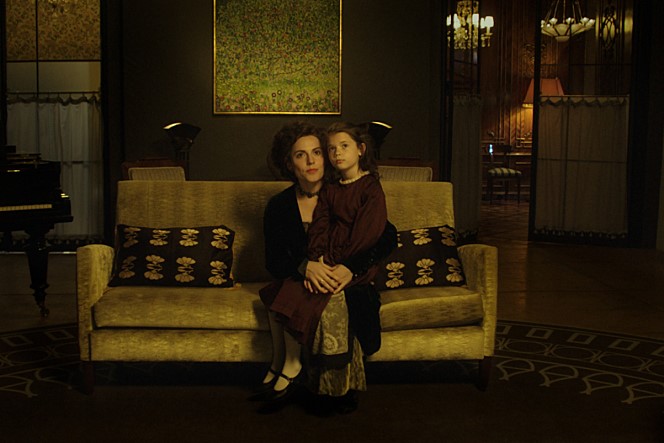
She is Maria Altmann (Helen Mirren), and this old Austrian lady is interested in recovering several artworks which originally belonged to her family. During the 1930s, Maria and her recently diseased sister were the daughters of a very wealthy Jewish family living in Vienna, and her family was a well-known patron of many prominent artists including Gustav Klimt, Richard Strauss, and Arnold Schoenberg, who was, yes, Randy’s grandfather. Her family naturally owned many valuable artworks during that time, but they were all pillaged by the Nazi Germany after the annexation of Austria in 1938, while Maria and a few lucky family members of hers managed to escape from their homeland.

According to a letter Maria found from her sister’s belongings, her sister made an attempt to recover their artworks during the late 1940s. One of them is “Woman in Gold”, and this iconic painting, which is a portrait of Maria’s beloved aunt, has been regarded as the Mona Lisa of Austria since it was taken to the Austrian State Gallery along with Klimt’s other works owned by Maria’s family. It seems impossible to win a lawsuit against the Austrian Government, but Randy eventually decides to work on the case even though restitution law is not his expertise.

womaningold05As soon as they arrive in Vienna for making a claim to the art restitution board, Maria and Randy find themselves impeded by Austrian authorities from the very start. Besides Maria, many other people come to the board and tell sad stories about how their precious family treasures were looted or pillaged during that dark period, but it is apparent that the art restitution board is just a superficial gesture for making peace with the past – and the Austrian government certainly has no intention of giving those valuable artworks back to their original owners.

Fortunately, Maria and Randy are helped by local journalist Hubertus Czernin (Daniel Brühl), and they eventually find several documents good enough to be the basis of their lawsuit. Becoming more passionate about his case, Randy decides to take a big risky step which will surely affect not only his career but also his family, and that is just the beginning of a long, difficult legal process he and Maria will have to endure.

And we get the occasional flashback scenes showing Maria’s family life in the past. She and her sister happily grew up in their affluent household while loved much by their parents as well as their uncle and aunt, who were pretty much like another parents to Maria and her sister. Not long after Maria married her husband Fritz (Max Irons, who is the son of Jeremy Iron) in 1938, the life she and her family knew was completely shattered as the Nazi German soldiers marched into the streets of Vienna, and there came a sad moment when Maria had to make a difficult choice for running away from the imminent danger which would ultimately kill many people she had known.

womaningold03With a solid performance by Tatiana Maslany and its good period atmosphere, this part mostly works well, but it also makes the other part in the movie look weaker in comparison. The relationship between Maria and Randy goes through several predictable dramatic turns as they are respectively frustrated with their long legal battle against the Austrian Government and its smug officials, and Alexi Kaye Campbell’s screenplay feels dragged especially during its second half as their lawsuit slowly trudges through a number of different places including the Supreme Court of the United States, which turns out to be not their last battleground, by the way.

Helen Mirren and Ryan Reynolds do what they can do with their respective characters. Mirren is dependable as usual, and she imbues her character with dignity and personality as much as we can expect from one of the great actresses in our time. While his character is relatively bland, Reynolds acquits himself well in the film, but I must point out that he was more interesting in “The Voices” (2014). Most of the supporting performers in the film do not have many things to do except filling their roles; notable actors like Charles Dance, Jonathan Pryce, and Elizabeth McGovern briefly appear in small roles, and Katie Holmes, who plays Randy’s concerned wife, is virtually wasted in her thankless role.

The director Simon Curtis previously directed “My Week with Marilyn” (2011), which was also inspired by a real-life story. Compared to that charming film, “Woman in Gold” is less engaging due to uneven narrative pace and flat characterization. It goes without saying that it is sincere and respectful in its attitude, but there should be more than that for interesting us, and the movie does not have much in case of that.

womaningold01

Posted in Movies | Tagged , , , , , , | 1 Comment

Madonna (2014) ☆☆☆1/2(3.5/4) : The Passion of Madonna

madonna04South Korean film “Madonna”, which was shown at the Cannes Film Festival in this May and is now currently being shown at South Korean theaters, is a tough stuff packed with stark power and harrowing emotions. It is often very uncomfortable to watch, but we are gripped by its compelling presentation of sad, gloomy human conditions, and then it strikes us with powerful moments which lead to a small but precious glimmer of life and hope around its quietly moving finale.

The story is mainly told through the viewpoint of Hae-rim (Seo Yeong-hee), a young nurse who has just been employed at a big hospital. As briefly shown during the scene of her shabby residence where she lives alone, she has been struggling with her difficult economic situation, and it is fortunate that she gets a job which may give her more chances for a better life. She is assigned to a special ward reserved for its VIP patients who can afford many expensive services including medical ones, and its luxurious environment feels like a completely different world to her. Patient’s rooms look more like five-star hotel room at times, and we are not surprised to hear later that the patients in this ward pay at least around 2,500 dollar per day.

One of the patients in this ward is the wealthy owner of the hospital, who does not have much time to live in his nearly comatose state. His son Sang-woo (Kim Yeong-min) is determined to keep his father alive by any means necessary just because he will lose his father’s wealth if his father died. Under Sang-woo’s order, his frail father is always revived by doctors whenever it is necessary, and he even received organ transplant surgeries just for lengthening his remaining short life a bit.

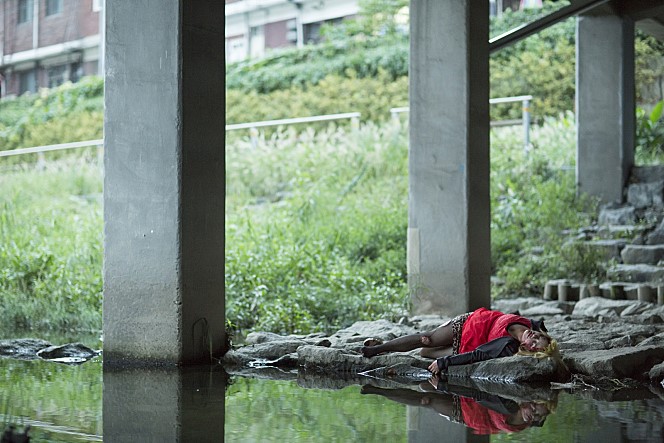
When the old man’s body is in the need of a new heart, the hospital happens to receive a possibly ideal donor. A young woman was recently found under a bridge after she was brutalized and then left in unconscious state by someone, and there is no one looking for her. While she does not have much chance for regaining her consciousness, she has been pregnant for months, but that is not much of a concern to Sang-min, who orders Hae-rim to find any family member of this unfortunate woman and gets the sign for the organ donation agreement document as soon as possible.

madonna01Starting from a cellular phone and a calling card belonging to the woman, Hae-rim gradually learns more about her as meeting several people who knew her. Before being brought to the hospital, Mi-na (Kwon So-hyeon) worked as a prostitute named ‘Madonna’, and it was just the last chapter of her poor life full of pain and misery. During her school years, she was a lonely girl who did not get along well with her schoolmates, and her only family member was her grandmother, who now becomes too senile to recognize her dear granddaughter while living in a facility for old people. After her school years, Mi-na tried to earn her living while supporting her grandma, but life was not very good to this shy, vulnerable woman. She had to go through very terrible experiences due to some horrible guys she encountered, and her life and spirit kept falling down to the bottom as a consequence while there was no one to help or protect her. Now she is soon going to be exploited and discarded again at the end of her miserable life, and there is a cruel irony in that she is treated a lot better than she ever was in her whole life.

As the pieces of Mi-na’s life story are revealed to us and Hae-rim one by one, the movie also focuses on the growing conflict inside Hae-rim. She has been emotionally numbed and exhausted by her hard life for years, but Mi-na’s story touches something she has kept inside her hardened heart. Maybe she can just go along with the other hospital employees as following their boss’ order, but she finds herself digging more into Mi-na’s life, and she comes to care about her more than before, though that is the last thing to do if she wants to keep her job.

The movie is the second film directed by the director/writer Shin Su-won, who previously made an impressive feature film debut with “Pluto” (2012). That movie showed me horrendous high school kids who only cared about higher test score and better college entrance, and I noticed how chillingly its dark revenge story reflected the cutthroat reality in the South Korean education system. As absorbed into that film during my viewing, I came to recall some of my unpleasant high school memories, and I had no hesitation when I chose it as one of the best South Korean films in 2013.

With her second feature film, Shin proves again that she is a very gifted filmmaker to watch. Indirectly pointing out social matters including class and sexism, her story goes back and forth between present and flashback scenes without any awkwardness, and both of its two storylines are engaging enough to hold our attention with each own dramatic weight. While its main characters are established well along its narrative, the movie also gives considerable attention to its supporting characters, and Sang-woo’s father, who is sometimes conscious of his condition, has a poignant moment when he tries to give his answer through his small wordless gestures during one crucial scene.

madonna03The movie depends a lot on its two lead actresses, who ably carry it with their terrific performances. Although her character is mostly presented through flashback scenes, newcomer Kwon So-hyeon gives an unforgettable performance which will be a breakthrough for her burgeoning career. While effectively embodying Mina’s aching vulnerability, she does not stay away from her pitiful character’s troubled side, and her performance is more devastating to watch as her character is approaching to the bottom waiting for her. Kwon also handles well several emotionally grueling scenes in the film, and these difficult scenes never look exploitative or gratuitous under Shin’s thoughtful direction while fully conveying us the pain and horror inside them.

On the opposite, Seo Yeong-hee, who once suffered a lot in “The Chaser” (2008) and “Bedevilled” (2010), complements her co-actress with her restrained but equally interesting performance. The movie is as much about Hae-rim’s emotional journey as Mi-na’s plight, and Seo’s nuanced acting subtly suggests the emotional turmoil inside Hae-rim as she feels closer to a woman she never knew before. Through Mi-na, Hae-rim sees a possible chance for redemption she has never thought about, and there eventually comes a moment when she must make a certain decision for her as well as Mi-na.

In case of supporting performers, Kim Yeong-min is totally loathsome in his dastardly role, Yoo Soon-cheol holds his own small place as a dying man cruelly tormented by his greedy, heartless son, and Byeon Yo-han, who recently appeared in “Socialphobia” (2014), is a young doctor who becomes conflicted about his job. Ko Seo-hee is a frigid nurse who does not mind giving whatever her boss wants, and Park Hyun-young is Mi-na’s former co-worker who cared about Mi-na but regretfully failed to help her.

South Korean independent films, “Madonna” is another wonderful South Korean film to remember in this year. This is not a very pleasant movie to say the least, but it is still a recommendable one worthwhile to watch for its powerful story and excellent performances. Nothing is changed much in its characters’ reality in the end, but the movie touchingly shows the value of human compassion and kindness among the weak at the bottom of the society, and you will agree that Mi-na really deserves her nickname.

madonna05

Posted in Movies | Tagged , , | 1 Comment

Timbuktu (2014) ☆☆☆1/2 (3.5/4): A sad, graceful tale of nature, people, and religion

timbuktu01Serenely beautiful and heartbreakingly tragic, “Timbuktu” gives us a somber but ultimately compassionate look into the world most of us are not very familiar with. As our eyes are drawn to its vast, beautiful desert landscapes to behold, we come to look closer to the people living in this unfamiliar world whose life is now being trampled by the oppression and brutality committed in the name of religion. While never breaking away from its calm, reflective attitude, it quietly observes the resulting human sufferings with silent sadness and indignation, and that makes it all the more haunting and harrowing in the end.

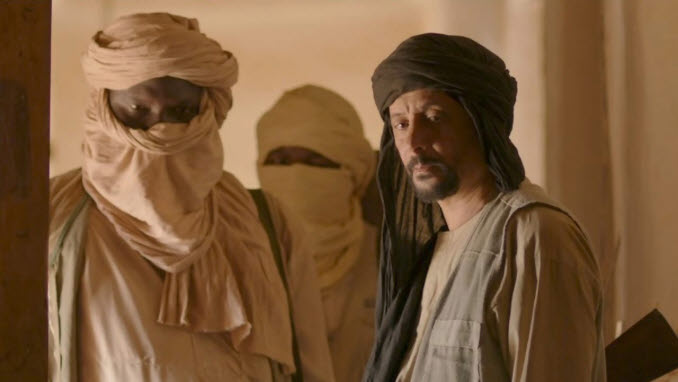
In the opening scene, a desert animal is running away from a bunch of militants chasing after it by their truck. We notice their turbans covering their faces, the guns they are ready to use, and that recognizable Islamic flag we often see from TV news nowadays. It is not long after the Northern Mali conflict began in early 2012, and Timbuktu, one of the main cities in the region, has been occupied by an Islamic militant group for a while. We see several ancient masks and statues destroyed by them for being ‘idolatrous’ objects, and this bleak, wordless scene in the dessert succinctly conveys the damage being done to Mali and its culture and people.

The Islamists have strictly imposed the Sharia law on Timbuktu and its surrounding area. While music is absolutely forbidden along with soccer and many other things, men are demanded to roll up their pants’ legs enough to show their feet and shins, and women are ordered to wear hijab, socks, and gloves all the time whenever they are outside their houses. During one scene, a woman selling fishes protests that she cannot possibly handle her fishes while wearing gloves, but there is not much she or others can do in front of those fundamentalists with guns.

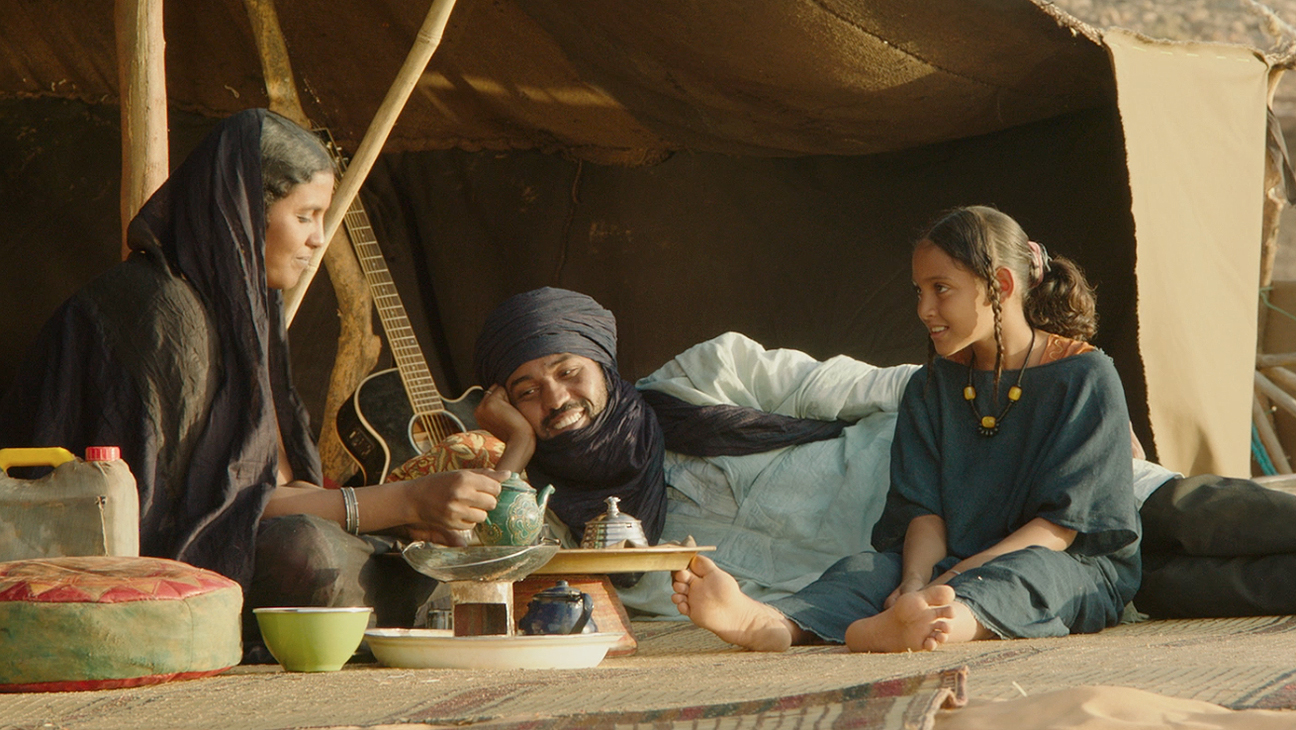
Many people already left Timbuktu, but others remain as trying to endure this oppressive occupation which may end someday as they hope. Kidane (Ibrahim Ahmed dit Pino), a cattle herder living outside Timbuktu, is one of such people, and he and his family are relatively free from the Islamists’ control compared to others living in the city. When he is with his wife Satima (Toulou Kiki) and their young daughter Toya (Layla Walet Mohamed), it is clear that they are happy to be with each other despite their poor environment, and it looks like nothing can disrupt their modest happiness as they spend afternoon together in their tent.

timbuktu07But the Islamists’ occupation is still a fact of their daily life. On one day, Abdelkerim (Abel Jafri), one of the high-ranking guys in the Islamist group, visits while Kidane is absent. When he comes across Satima, he points out that her appearance is not proper at all. Satima, a silent but resilient woman, does not step back while being tactful and courteous, and Abdelkerim, who turns out to be infatuated with her, overlooks her transgression which could get her punished according to their law.

Meanwhile, Kidane gets himself into a very serious trouble. When Issan (Mehdi Ag Mohamed), an orphan boy working under Kidane, is taking care of Kidane’s herd near a local river, one of the cows happens to get entangled with a net belonging to a local fisherman named Amadou (Omar Haidara), who instantly kills the cow with a spear (It is implied that there has been some tension between him and Kidane, though it is never specified in the film). After hearing this news from devastated Issan, Kidane decides to take care of this matter for himself, but, unfortunately, that leads to an irreversible outcome he never imagined. He is soon arrested then jailed by the Islamists, and they will put him on a trial within a few days.

The movie surely has lots of sympathy toward Kidane and his family, but, interestingly, it does not present its Islamist characters as one-dimensional villains. They are indeed violent bullies who use religion as their convenient excuse for cruelty and violence, but we sometimes get the glimpses of the humanity locked behind their extremism. In a humorous scene which took me back to a similarly amusing moment in Palestinian film “Paradise Now” (2005), one of young Islamist members tries to declare himself as a jihadist in front of the video camera, but, despite his effort and his comrades’ help, he keeps bumbling throughout the shooting process. The more he tries to look resolute and determined, the more it is apparent that he has never had any serious thought on why he decided to join his group.

In case of Abdelkerim, he has his own foible to hide behind his hypocrisy, and he cannot even fool his young driver, from whom he is currently learning how to drive. Fundamentalists are usually lenient on themselves while strict on others, and he and his fellow Islamists are no exception. Their restrictions on local residents are nothing but means for rule and oppression, and they can always be exception because, well, they have the power. When a local girl happens to be forced into marrying some thuggish Islamist, a local imam meets the Islamist leaders and tries to find a sensible solution for this problem, but, not so surprisingly, his reasonable argument falls on deaf ears while the Islamist leaders adamantly insist that it was a proper and legitimate marriage.

timbuktu02While the streets and alleys of Timbuktu are constantly under the Islamists’ watchful eyes and ears, they still cannot suppress life entirely. When local boys play with their imaginary soccer ball on the field, you will be amazed by how well they play together and then saddened by this absurd circumstance they are pushed into. There is a woman who looks a bit crazy but feels like the force of nature as she flaunts her brash, colorful personality in front of the Islamists, and we get a strangely poetic scene when one of the Islamists happens to get a chance to express his hidden artistic spirit at her residence.

But then the movie also looks at heartless cruelties inflicted on common people, which are presented with considerable restraint and power. When a young woman is sentenced to receive lashings in public just because she enjoyed music with lads, her small defiance against savage punishment generates one of the most powerful moments in the film. During one chilling scene which is actually inspired by a real-life incident, an unmarried couple is executed for their transgression as their neighbors helplessly stand by, and the camera lingers on the gut-wrenching aftermath with the immense sense of unjust tragedy.

It goes without saying that there is the grim inevitability in the plight of Kidane, who has already accepted it as a plain good man with faith and dignity. Feeling guiltier about what he inadvertently caused, he calmly speaks about his position and his family in front of the people who will determine his fate. He does deserve some compassion considering his unfortunate circumstance, but they will not consider that much as delivering their final judgment on him.

timbuktu03The director/co-writer Abderrahmane Sissako, an acclaimed Mauritanian director who received the Prize of Ecumenical Jury for this film at the Cannes Film Festival in last year (the movie was also Oscar-nominated for Best Foreign Language Film early in this year), simply lets us involved in his simple human story. He depicts his characters with care and understanding, and the actors are natural and believable in their earnest performances as the human beings occupying or living in their world. Although their life mostly look shabby and backward, they are also familiar with modern technology as reflected by their use of cellular phones, and I was especially amused by the name of one of Kidane’s cows.

Shot in Oualata and Nema in Mauritania, the movie is filled with vivid local atmosphere under Sissako’s masterful direction. The cinematography by Sofian El Fani is frequently breathtaking for its gorgeous presentation of wide landscapes. During one certain scene shown from the distance through a static wide shot, the camera looks at two tiny figures slowly being apart from each other in the vast background, and the lyrical beauty of this moment further accentuates the sense of tragedy slowly and devastatingly growing inside it.

“Timbuktu” is a sad, grace tale of nature, people, and religion, and it will stay with you for a long time for its mesmerizing beauty and profound humanism. Blinded or driven by their virulent religious self-righteousness, some of the people in the movie bring only unhappiness and misery to others, and they come to cause another sad moment of despair and sorrow as the movie eventually arrives at its heartbreaking finale. I am now reminded of one memorable line from “Angel Heart” (1987): “They say there’s enough religion in the world to make men hate each other, but not enough to make them love.”

timbuktu04

Posted in Movies | Tagged , , , | 2 Comments

Minority Opinion (2013) ☆☆☆(3/4) : It’s a fiction indeed – but it reflects the reality

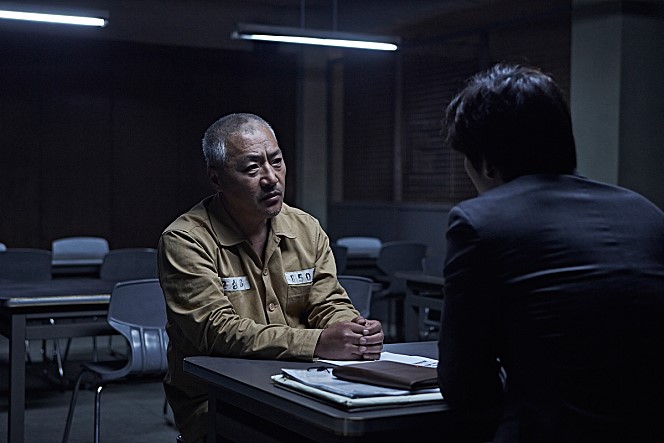
minorviews01At the beginning, South Korean courtroom drama “Minority Opinion” emphasizes that it is entirely fictional, but I and others in the screening room knew well that its angry story reflects the reality we all are very familiar with. After all, it is clearly inspired by a real-life incident which happened several years ago, and most of us could already see that its characters would go through a long, difficult fight as struggling against the powerful and corrupt system. They want justice, but they are only reminded of how hopeless their small fight is – and how much they will pay for that.

Everything begins from the big clash between a riot police unit and a group of defiant people refusing to be evicted from their neighbourhood which is being ready for redevelopment. The authorities are determined to drag out these people from their place by any means necessary, and they even allow hired goons to participate in this police operation. The demonstrators led by Jae-ho (Lee Kyeong-yeong) are also quite determined to hold their position, and we see bottles of Molotov cocktail when the movie looks into their place.

While many reporters are already around the site, the police eventually begins its riot suppression operation, and the situation becomes very violent and chaotic. All of the demonstrators are arrested as planned in the end, but the police find that they have a very serious problem. Jae-ho’s young son died during the operation, and one young policeman was killed by Jae-ho around the same time. Jae-ho claims that the dead policeman killed his son, but the police say his son was killed by one of the hired goons.

minorviews03His lawyer Jin-won (Yoon Kye-sang), a small-time lawyer who reluctantly agrees to be Jae-ho’s public defender, has lots of good reasons to be cynical about his client’s upcoming trial. Jae-ho admitted his killing, but there is nothing to prove that his claim is true. The prosecution already gets the confession from that hired goon in question, and the prosecutor assigned to the case is fully ready to punish Jae-ho hard for his manslaughter.

Jin-won tries to do as much as he can as his client’s lawyer, but he begins to see how unfair the system can be to a targeted individual. He requests a permission to examine the police record several times, but his requests are always denied by the prosecutor and other legal authorities. There is also an absurd scene where the police commissioner is virtually exempted by the prosecution from any responsibility for whatever happened during the riot suppression operation. Everyone in the system is connected with each other in one way or another, and they are surely good at covering each other if that is required.

Though a young reporter named Soo-kyeong (Kim Ok-bin), Jin-won comes to see more of the big picture surrounding his legal defense. It seems that the government is heavily involved with some big construction company behind the redevelopment project, and we are also told about how the government can distract the public attention through a media tactic which has worked pretty well on many people in South Korea. Whenever something scandalous happens in the government, it is usually followed by heaps of reports on some other sensational case, and that tactic becomes more effective especially in our digital era when everything is quickly read and discarded hour by hour.

While it looks like he is up against the wall, Jin-won gets a good idea. First, he requests that the trial should be a public one with jury. Meanwhile, he and his partner/senior Dae-seok (Yoo Hae-jin) file a lawsuit for damages against the government, and they demand the government the public apology along with the indemnity no more than 100 won (it is less than 10 cent, by the way). They receive lots of attention from media and people as a result, and that gives the prosecution major headaches although that side is still the one with power and influence.

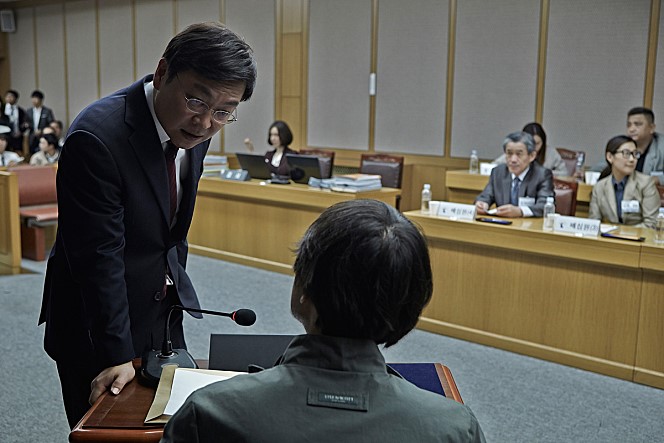
minorviews02The courtroom scenes in the movie are infuriating to watch at times for many absurdities to behold. Even when it becomes quite clear to everyone in the court that everything is set in advance, the trial continues with the judge’s passive consent while the prosecution can get away with many things. Jin-won succeeds at throwing several good jabs at his opponent during the trial, but he finds himself more cornered both inside and outside the court, and even his client lets him down at one point.

The adapted screenplay by the director Kim Seong-je and his co-writer Cheon Seong-il, which is based on Son Ah-ram’s novel with the same name, often stumbles in its attempt to draw its big picture of social injustice and corruption. There are a number of moments when the characters make unwise choices just because it is demanded by the plot, and the story feels dragged especially during the middle part. Fortunately, the movie begins to regain its momentum during its third act, and it gives us several strong dramatic moments while never pushing them too far. The occasional moments of humor are mixed well into the film to lighten up the mood a bit for the audiences, and I especially like a funny scene involved with the hearing on Jin-won’s ‘misconduct’ by the Korean Bar Association.

Kim also assembled the impressive cast for his film. While Yoon Kye-sang is the reliable center of the story, Yoo Hae-jin steals the show with his another likeable supporting performance, and Kim Ok-bin brings some feisty spirit to her colorless character even though she frequently seems to be wasted in the movie. The other notable actors including Lee Kyeong-young, Kim Ee-seong, Jang Gwang, Park Tae-min, Kwon Hae-hyo, Eom Tae-goo also have their own moments in their respective supporting roles, and they work together well as parts of the ensemble performance in the film.

Although it was made in 2013, “Minority Opinion” somehow did not get the chance of being released in South Korea until this year, and some speculated that its distribution company had shelved it because it did not want to anger the government. While it is not successful in some parts, the movie is an engaging courtroom drama with the sharp social criticism on the South Korean legal system, and it certainly leaves us something to think about when it is over.

minorviews05

Posted in Movies | Tagged , , , | 1 Comment

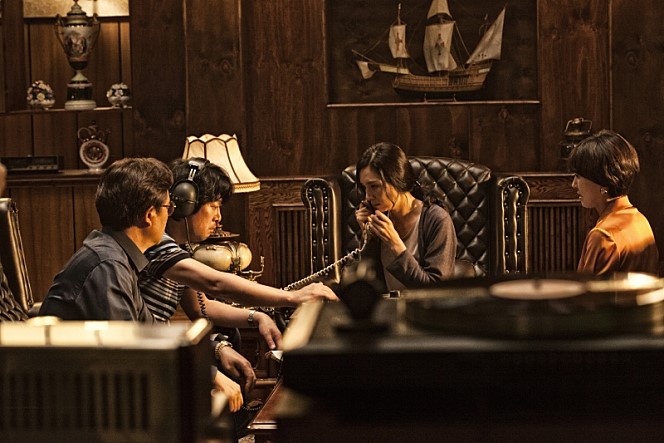
The Classified File (2015) ☆☆☆(3/4): A police investigation assisted by fortunetelling

theclassifiedfile06I remember when my parents asked a Buddhist monk to tell my fortunes in the future. I do not remember well what he told me and my parents after he checked some book and then did some sort of calculation on paper, and I remember that he assured my parents that I would be all right and successful in the following years. My parents seemed satisfied, but I was skeptical for the reasons many of you can understand.

And that was why I did not have much expectation on South Korean movie “The Classified”, a police procedural about a cop and a fortuneteller who happen to work together in a very urgent investigation. This is indeed an odd buddy movie combination which could have been pretty ridiculous, but the movie believes in its story and characters as steadily pushing its thriller plot, and I could put aside my skepticism for a while as enjoying its good moments.

On one summer day of July 1978 in Busan, a young girl is suddenly disappeared not long after she leaves her school, and it is apparent that she is kidnapped for ransom. Her parents wants to get their daughter returned as soon as possible, but the kidnapper in question has not yet attempted any contact for some reason, and they become more desperate as days goes by without any news on their missing daughter. The police assure the parents that they will do anything necessary for finding the girl, but they have no progress in their sloppy investigation while not getting any valuable clue on the kidnapper’s identity or where the girl is being kept.

Eventually, the girl’s parents, who are rich and well-connected enough to influence local authorities, decide to pull some strings for getting a right guy for the investigation, and that is how Detective Gong Gil-young (Kim Yoon-seok) comes into the picture. Despite his successes with many big cases, Gil-young was recently relegated to a riot control unit mainly because he brought the ire of some of his superiors, and he is reluctant to take the case, for he knows too well that he will probably get all the blame if that is deemed necessary by his superiors.

theclassifiedfile03However, as a family man, he cannot ignore the pain and desperation he sees from the missing girl’s parents, and he soon begins to work on the case with their full support. As waiting for the kidnapper’s contact, Gil-young insists on keeping the investigation hidden from the public for increasing the chance of the girl’s survival, and that makes him pretty unpopular among the cops assigned to work with him. To them, catching a bad guy is more important than saving a girl who might not return forever, and they and Gil-young constantly clash with each other over the direction of their investigation.

Meanwhile, the girl’s mother and aunt go to Kim Joong-san (Yoo Hae-jin), a local fortuneteller who might give them the answer on whether their dear girl will be returned alive. He does not have a definite answer for that, but he tells them that there is still hope considering the girl’s fortunes – and he also predicts that the kidnapper will soon attempt a contact on a certain day.

When Gil-young hears about Joong-san’s prediction, he does not believe it much like most people, but the kidnapper really calls the girl’s parents on the very day predicted by Joong-san. Joong-san also makes another correct prediction not long after the focus of the investigation happens to be moved from Busan to Seoul, and it seems he is not a fraud at all. There is a scene in which he clears his mind to get any information to help the investigation, and he does get several possible clues during his trance state.

How is this possible? While the movie does not go deep into details, Joong-san comes to us as a decent ordinary guy willing to help the investigation as much as he can through the ability he sincerely believes in. He and Gil-young naturally do not get along well with each other due to their different approaches, but we come to see that they are not so different from each other in many ways. While not appreciated enough by others, they do not stop trying their best as professionals in their respective positions, and they eventually become unlikely partners when it is clear to both of them that they must work together before it is too late for the girl they really want to save.

theclassifiedfile04The director/co-writer Kwak Gyeong-taek, who recently directed the sequel to his previous film “Friend” (2001), keeps the narrative momentum intact as gradually building tension along his story. The telephone conversation scenes between the kidnapper and the girl’s parents feel both tense and frustrating as the camera looks at their distraught faces, and what is at stake for them is always palpable to us. Gil-young gets a fair share of his own frustration due to his uncooperative and ineffectual colleagues, and there is a suspenseful sequence where he happens to act alone in a very tricky situation which may lead to an irreversible outcome if he is not very cautious.

The movie also gives us a vivid look into Busan and Seoul during the late 1970s, and I enjoyed a number of nice period details my parents will instantly recognize. The actors in the movie look convincing as the people inhabiting in that era; Kim Yoon-seok and Yoo Hae-jin, dependable South Korean actors who previously appeared together in “Tazza: The High Roller” (2006), ably carry the film with their engaging lead performances, and the other performers in the movie nicely fill their functional roles as required.

I am still skeptical about fortunetelling, but “The Classified File” entertained me enough with its efficient thriller plot and good performances. Believe or not, the movie is actually inspired by a real-life case, and you will be more amazed or amused by another unbelievable thing told to you during the epilogue part. The ending is a bit overlong, and I still do not understand well the logic of Joong-san’s fortunetelling (my parents probably know better than me in this case), but the movie is better than I expected as a solid crime mystery drama.

theclassifiedfile01

Posted in Movies | Tagged , , , , , | Leave a comment

Tomboy (2011) ☆☆☆1/2 (3.5/4) : Summer days of a tomboy

tomboy01

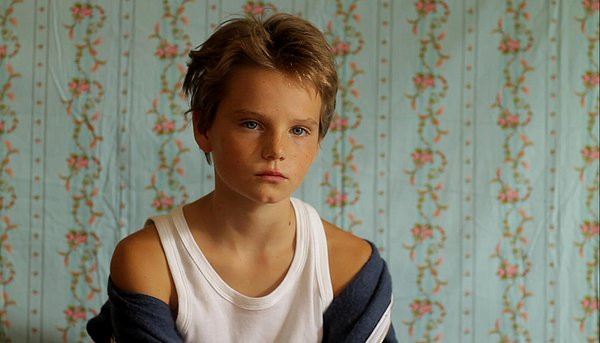
If you do not have any information about “Tomboy”, you may mistake its young main character for a boy during its opening scene. With short hair style and boyish attire, this young girl nearly at the end of her pre-adolescence years is easily accepted by other kids as a new boy in the neighborhood, but it goes without saying that there will be the inevitable point where her disguise cannot be maintained any more. She is surely happy to hang around boys, but does she have any idea about the consequences of her action?

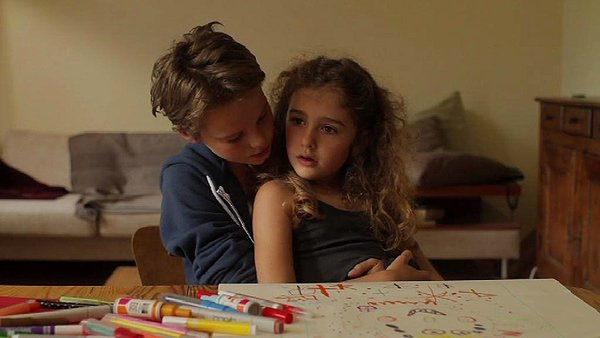
When we meet Laure (Zoé Héran) and her family, they are moving to some suburban apartment building, and we get to know more about this loving family as they settle in their new residence. While he is usually busy due to his new job, Laure’s father (Mathieu Demy) is a kind and generous dad to his two daughters, and there is no constraint between him and them when they spend time together. Laure’s mother (Sophie Cattani), who is going to give birth to their new family member, does not mind about Laure’s tomboy appearance, but she sometimes wants her daughter to hang around with girls rather than boys. For her little sister Jeanne (Malonn Lévana), Laure is always someone to lean on, and some of the warmest moments in the movie come from the affectionate sibling interactions between them.

When Laure meets one of the kids in her new neighborhood, she makes an impulsive decision of disguising herself as ‘Mickäel’. Lisa (Jeanne Disson) a pretty girl who looks more mature compared to Laure, quickly becomes her new friend, and then ‘Mickäel’ befriends other boys in the neighborhood through Lisa. Laure is initially a bit reluctant to join boys as watching them playing together, but, once she sees that her lean, immature body does not look that different from boys’ bodies except one certain body part, she takes further forward steps in her disguise as having more fun with boys. When she needs a swimming suit, she prepares it for herself, and we get an amusing moment when she tries a chunk of toy clay for another part of her disguise.

tomboy03However, Laure does not tell her parents about her deception while maintaining her false identity in front of other kids. Her parents, who understandably remains occupied with each own matters, think their daughter is doing all right in her adjustment to a new environment, but then her little sister happens to discover what is going on when Lisa visits Laure’s house to see Mickäel. Young actress Malonn Lévana is wonderful in this very brief but crucial moment, as her silent confused face tells us everything about how Jeanne feels about her sudden discovery.

Meanwhile, Laure and Lisa become closer to each other. Lisa seems to want something more than friendship from her new friend who looks prettier than other boys, but Laure’s secret is bound to be exposed sooner or later. Their summer is being nearly over, and they and the other kids will soon be back in school again. At one point, Lisa wonders why she could not find Mickäel’s name in the student list of her school – and her school is only school in their neighbourhood.

While there is a certain amount of suspense below the surface, the movie smoothly flows with its warm, joyous mood of summer days thanks to the sensitive direction by the director/writer Céline Sciamma, who won the Teddy Jury Award for this film at the Berlin International Film Festival. Her young performers look natural and spontaneous on the screen, and most of their outdoor scenes are filled with the vivid sense of joy and freedom as they play around each other with bright summer sunshine above them. We were once such kids like them, and these scenes may remind you of when those summer days seemed endless for you and your friends until school days returned with autumn.

tomboy04

As the center of the film, young actress Zoé Héran is terrific in her remarkable nuanced performance as a girl who simply behaves according to the need she does not fully understand yet. Although she does not have a very clear idea about what she wants, Laure gropes for her burgeoning sexuality bit by bit through her rather reckless attempt, and Héran is compelling to watch as Laure manages to maintain her disguise with the constant possibility of getting herself exposed. As a smart girl, she probably knows from the beginning that her deception will not last long, but we understand how she inadvertently gets herself into complications, and we become more worried about what might happen in the end.

One notable thing about the film is how much Laure’s family is at ease with Laure’s sexuality. Her parents have accepted her as who she is, and we notice that Laure’s bedroom looks more like a boy’s while nobody in her household has a problem with that. There is also something touching about her little sister’s decision on how to deal with Laure’s masquerade. Jeanne does not mind having a big brother instead of a big sister, and she helps her ‘brother’ directly and indirectly as having her own good time outside. Kids may be pretty innocent, but they sometimes perceive matters more clearly than us with better judgment.

With its simple but sublime storytelling and excellent performances, “Tomboy” is a superlative coming-of-age drama which depicts its young heroine and other characters surrounding her with lots of care and affection. It will not be much of a spoiler to tell you that there will be several hard moments later in the story, and, like many boys and girls in coming-of-age drama, Laure comes to learn something from her summer days to remember. It remains uncertain how her experience will influence her ongoing progress to adulthood in the following years, but we all know that her family will stand by her no matter who she grows up to be.

tomboy02

Posted in Movies | Tagged , , | 1 Comment