Mission: Impossible – Rogue Nation (2015) ☆☆☆(3/4): Cruise strikes again

missionimpossibleroguenation01“Mission: Impossible – Rogue Nation”, the fifth film of the franchise which was started almost 20 years ago, is packed with action sequences to thrill and excite us. Considering all the exhilarating fun we had with the previous films, that is hardly a surprise, but the movie does a good job of maintaining the high level of tension and excitement as driving along its dizzy, convoluted plot full of danger and intrigue, and it is also firmly held by the undeniably enduring star presence of its lead actor who strikes again with commendable results.

The movie begins at the point not along after the closing scene of “Mission: Impossible – the Ghost Protocol” (2011). While Ethan Hunt (Tom Cruise) puts himself into another daring secret operation as shown during the prologue sequence, his agency, the Impossible Missions Force (IMF – please don’t confuse it with the International Monetary Fund), is in a serious trouble mainly because of what happened in the previous film. The CIA director Alan Hunley (Alec Baldwin), who believes IMF has caused more troubles than successes for the US government, wants IMF to be disassembled and then absorbed into his agency, and IMF Agent William Brandt (Jeremy Renner), representing the currently vacant IMF secretary (you will know the reason if you have seen the previous film), is helpless as Hunley makes his strong argument in front of the Senate oversight committee members.

This is not a very good news for Hunt, who is finally getting closer to a shadowy organization called the Syndicate. Being a sort of ‘anti-IMF’, the Syndicate mostly consists of former government agents presumed to be dead or missing in action, and it is revealed that this organization has been involved in many bad incidents around the world. Their leader is Solomon Lane (Sean Harris), and his brief but striking appearance at the end of one certain scene is more than enough to show us what a ruthless badass this former British Intelligence agent is.
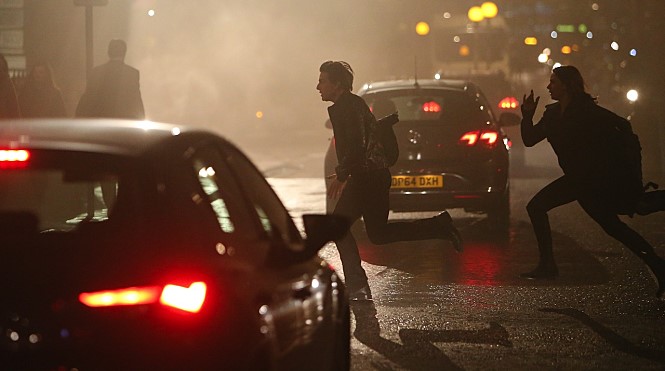

missionimpossibleroguenation03While becoming a rogue agent being pursued by CIA, Hunt keeps tracking down the Syndicate, and some of his colleagues subsequently come to join his independent operation even though they are well aware of the risk of their unauthorized action. Hunt is also helped a lot by a British undercover agent named Ilsa Faust (Rebecca Ferguson), but Faust is not entirely trustworthy as a double agent tiptoeing between both sides, though she saves him from Lane’s henchmen during their first encounter. Is she just pretending to be loyal to Lane as a part of her mission? Or is she using both Lane and Hunt for whatever scheme she has behind her back?

As Hunt and other characters move around various locations including London, Vienna, and Casablanca, the movie serves us with a number of terrific sequences equipped with each own thrill and suspense. In case of that well-known action sequence in which Cruise actually clings to a big cargo plane leaving the ground (well, how can we possibly expect anything less than that from him?), that moment is as thrilling as expected, but it is just a small portion of what the movie is going to provide us. The sequence in which Hunt should carefully move within the Vienna State Opera during the performance of “Turandot” steadily accumulates tension as he comes to discover the Syndicate’s latest operation, and there is a nice Hitchcockian touch reminiscent of “The Man Who Knew Too Much” (1934) and its 1956 remake version. During the sequence unfolded at a covert facility which is so heavily guarded that you may wonder how the hell a certain piece of secret information could be allowed into that facility in the first place, Hunt must succeed in his another nearly impossible task, and I can only tell you that it requires him far more than jumping down into a big hole gaping below him.

The director/screenplay writer Christopher McQuarrie, who wrote the story with Drew Pearce, previously directed “Jack Reacher” (2012), where Cruise played your typical stoic tough guy you cannot mess with. I did not like it enough, but I admired its several good things including Werner Herzog’s uncanny villain performance and an impressive vehicle action sequence reminiscent of those dry, gritty American action films made during the 1970s. While “Mission: Impossible – Rogue Nation” is more rapid and explosive in comparison, its action sequences seldom feel disorienting even when lots of things happen on the screen, and they are taut, gritty, and propulsive in the confident execution mixed with style and energy. The editing by Eddie Hamilton is precise and efficient, the cinematography by Robert Elswit makes good use of different locations with slick touches, and the music by Joe Kraemer stands aside whenever it is necessary to use other pieces of music including that famous TV series theme composed by Lalo Schifrin.

missionimpossibleroguenation02Although he is 53 in this year, Tom Cruise shows here that he is still a dependable action movie star as he was in “Mission: Impossible” (1996). Besides doing most of the stunt actions in the film for himself, Cruise is always believable whenever Hunt hurls himself into enormous risk without any hesitation, and he is good enough to make us believe many unbelievable things accomplished by his character and then amused by their improbable aspects later. In “Mission: Impossible – the Ghost Protocol”, I was tickled by how Hunt could draw quite a detailed sketch of his suspect’s face within a very short time, and I can assure you that you will be amazed here by how quickly he can memorize a bunch of long serial numbers – or how he can manage to hold his breath in water during no less than 3 minutes.

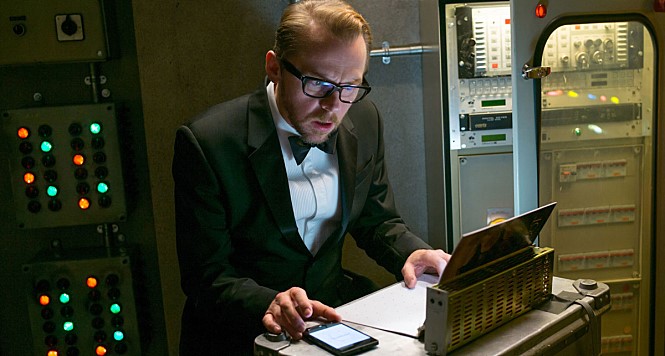
Cruise is surrounded by an enjoyable array of supporting performers. As a nerdy computer expert who again finds himself doing more actions than he expected, Simon Pegg is entertaining to watch as usual, and he is particularly convincing when his character gets himself stuck in a dire situation in which he and others around him can be killed instantly if they are not careful. Jeremy Renner and Ving Rhames are competent as the other returning supporting characters in the film, and Alec Baldwin relishes his uptight bureaucratic character who gets outsmarted by Hunt at every turn. While Sean Harris exudes understated menace with his cold stare and coarse voice, Tom Hollander and Simon McBurney play two small but crucial supporting characters later in the story, and Rebecca Ferguson is a standout in her breakthrough performance both sassy and feisty. Hunt and Faust may be drawn to each other as seeing an equal from each other, but they must also stay in line due to the constant mistrust between them, and that certainly gives an extra spark to the scenes between Cruise and Ferguson.

As another highlight point of the franchise, “Mission: Impossible – Rogue Nation” is one of the better blockbuster action films in this year. I wonder how long Cruise will be able to carry the franchise with the same strength and commitment we have observed from him, but the movie gives us a strong assurance that he can handle his continuing mission at least for a while (the production of the next sequel has already been green-lighted at this point), and I come to appreciate more of his star quality which has not been faded yet at all. He was a big bankable star when I was merely a 10-year-old boy, and he still retains his status even after more than 20 years. Not many star actors can do that, you know.
missionimpossibleroguenation05

Posted in Movies | Tagged , | Leave a comment

Far from the Madding Crowd (2015) ☆☆☆(3/4) : A woman and three men around her

farfromthemaddingcrowd01“Far from the Madding Crowd”, based on Thomas Hardy’s 1874 novel of the same name, is a solid adaptation to admire and appreciate. As a period drama, it looks both natural and gorgeous in its realistic presentation of a peaceful rural area surrounding its heroine and three different men who happen to circle around her. As a romance drama irreversibly driven by fate and coincidence, it engages us through the quiet emotional conflicts among its main characters who are stuck in their complicated circumstance in one way or another, and it certainly helps that the movie is supported by the strong performances from most of its main cast members.

It is 1870 in England, and we are introduced to Bathsheba Everdene (Carey Mulligan) and Gabriel Oak (Matthias Shoenaerts), two young people living in a small country town in Dorset. When Gabriel proposes to Bathsheba, it seems they can be a good couple with stable income considering Gabriel’s promising economic status, but marriage is the last thing Bathsheba wants for her life. While she probably knows well that she has considerable social disadvantages as a woman living in the 19th Century, she is determined to lead an independent life of her own none the less, and you will not be surprised to learn that the surname of the popular heroine in the Hunger Games trilogy actually came from this spirited young lady ready to step forward on her own terms.

Not long after Bathsheba rejects Gabriel’s proposal, they find themselves in completely reversed social positions. Due to a sudden terrible incident caused by his new shepherd dog, Gabriel loses almost everything including his herd. As a result, he leaves his town for a new start, and he soon gets employed at a farm in the other town. The owner of the farm turns out to be none other than Bathsheba, who inherits it from her recently deceased uncle.

farfromthemaddingcrowd03Gabriel has no problem with working under the woman who could have been his wife, and Bathsheba is glad to have him near her although there is a social barrier between them due to their changed situation at present. While Mulligan instantly holds our attention with her unadorned performance which effortlessly reveals vitality and determination behind Bathsheba’s seemingly docile appearance, Shoenaerts, who has been more notable since his superlative performances in “Bullhead” (2011) and “Rust and Bone” (2012), makes a right balance between roughness and softness for his humble, earnest character, and their scenes are always accompanied with palpable emotional undercurrents thanks to their low-key chemistry on the screen.

With Gabriel as one of her most trusted employees, Bathsheba begins to take care of the farm business for herself, and she makes it clear to her employees that many things are going to be different under her management. She immediately draws attention when she appears along with her maid at a local dealing place full of men, and her forthright attitude in price negotiation surely does not escape the attention of William Boldwood (Michael Sheen), an affluent bachelor farmer living next to her farm.

Bathsheba still does not have much interest in marriage, but, out of mischievous impulse, she sends a card to Boldwood on Valentine’s Day, and, unfortunately, that careless act of hers stirs something inside the heart of this lonely middle-aged man. Sheen is heartbreaking at times as his character becomes miserable and frustrated in his undying passion toward the woman he may not win in the end, and he and Mulligan have a sad, poignant moment when they happen to sing together during a barn dinner held at Bathsheba’s farm. As they look at each other from the distance, Bathsheba clearly sees how hopelessly her neighbor carries a torch for her, but she cannot honestly promise him anything, and that leads to more frustration for him.

farfromthemaddingcrowd04And then there comes Sergeant Frank Troy (Tom Sturridge), a dashing lad who comes into the town for his private matter. After coming across Bathsheba during one evening, he begins to hang around her, and she cannot help but attracted to him although it is apparent that he is an untrustworthy cad. When she is taken to a nearby forest by him, he gives her one hell of presentation of his swordcraft, and she feels enthralled as he swiftly wields his sword right in front of her without hurting her. She eventually makes a regretful choice, and that ultimately results in an outcome which will affect her as well as her men.

Being the straightforward adaptation of a British literature work, the movie looks like an odd choice in the career of the director Thomas Vinterberg, who has mainly been known for the Dogma 95 movement initiated by him and Lars von Trier. Compared to the raw emotional power of his previous film “The Hunt” (2012), “Far from the Madding Crowd” feels more gentle and polished, but that does not mean it is one of those stuffy, lifeless period drama movies. Its period background is imbued with vivid realism to put us into the world inhabited by its characters, and the cinematography by Charlotte Bruus Christensen shines with lush beauty whenever the camera looks at the sky and the wide rambling landscapes below it during early morning or late evening.

farfromthemaddingcrowd02On the whole, the movie is a better film compared to the 1967 version directed by John Schlesinger, which is also a handsome period film but riddled with several problems. While it is supported well by its main cast members including Julie Christie, Alan Bates, Peter Finch, and Terence Stamp, the 1967 version is overlong in its bloated narrative, and Bathsheba in this version feels rather superficial as the movie focuses more on her romantic entanglement with the other three main characters than her social struggles. In the other words, she looks more like someone to inspire Bella Swan than Katniss Everdeen.

The 2015 version has its own imperfect aspects. The adapted screenplay by David Nicholls is efficient in its economic handling of plot and characters, but it stumbles a bit during its last act which could be more powerful under slower plot progress. Lacking that magnetic intensity of Terence Stamp, Tom Sturridge is the weak link in the main cast despite his efforts, and Juno Temple is underutilized as a woman as ill-fated as Tess of the d’Urbervilles.

But these flaws are minor problems, and “Far from the Madding Crowd” remains as a well-made period drama film to enjoy not only for its engaging human drama but also for its authentic period atmosphere. I came to feel lots of sympathy for Boldwood, I began to admire Gabriel’s quiet dignity, and, above all, I cared about Bathsheba and her difficult circumstance she must handle for herself. At one point, she is advised to do what she thinks is right, but does she really know what is right for herself? When she later makes a decision on what she should do, you will be glad to see her going forward without sacrificing her integrity at all.

farfromthemaddingcrowd05

Posted in Movies | Tagged , | 1 Comment

Cat and her kittens during one summer day (2015/07/30)

Please get out of the building, will you? I need to work.

Posted in Photos | Tagged , | 1 Comment

Minions (2015) ☆☆1/2 (2.5/4): More Minions, shall we say

minions01Are you familiar with those silly yellow creatures called Minions? If you have seen animation feature film “Despicable Me” (2010) and its recent sequel, you cannot possibly forget their many scene-stealing moments. In “Despicable Me”, they were the goofy workers/cheerleaders of their ambitious master, who was about to commit the greatest crime of his villain career but came to discover something more fulfilling than being bad. And then they became more active in their master’s another adventure in “Despicable Me 2” (2013), where some of them were turned into something purple, hairy, and nasty for our amusement.

Now, like those troublemaking penguins in the Madagascar series did in last year, our nutty minions also get the spotlight of their own in “Minions”, which gives us entertainment as much as we can expect from it. Mainly driven by jokes and actions, this mildly entertaining animation film is often hampered by its thin plot, but that will not be much problem for its target audiences, who will simply enjoy watching Minions’ slapstick misadventures or their nearly incomprehensible dialogues.

The opening scene depicting Minions’ biological origin with the deadpan narration by Geoffrey Rush is one of the funniest parts in the film. They originally lived in the sea at least 500 million years ago, and they have always been around any dominant species to serve and follow since that. After they entered the era of Homo sapiens, they began to follow anyone with power and ambition for domination, but, as shown from many hilarious cases, their bumbling clumsiness always led to mischief and disaster, and now they have settled alone in a wintry cave since their latest failure.

minions06Life has been good in their cave for many years, but then the Minions soon become bored and lethargic mainly due to the absence of a master to follow and serve. One of them, named Kevin (voiced by the co-director Pierre Coffin, who also provided the voices of other Minion characters in the film), decides to go outside to find a suitable villain to lead him and others, and Kevin is joined by other two Minions named Bob and Stewart. I have always found it quite difficult to distinguish one Minion from other one, but these three Minions are a bit easier to recognize. While Kevin does not look that different from many other Minions who all wear similar clothes and goggles, Bob is shorter in comparison, and Stewart has only one eye, though that feature is common among Minions. Seriously, I’d love to get the biological explanation on how Minions can look same or different from each other, but, what the heck, the movie does not even tell much about how they reproduce (considering their possible absence of sex, my best guess is that they reproduce asexually like those monocellular organisms).

At the end of their long bumpy journey, Kevin and the other Minions finally arrive in New York of 1968. After getting some taste of the American culture during the 1960s as going around the city, they come upon the news about the International Villain Convention to be held in Orlando, Florida, so they immediately leave for the convention where they may meet their new master. Thanks to a traveling family who is not as ordinary as they look on the surface (Michael Keaton and Allison Janney give spirited voice performances in their respective roles), the Minions arrive at the convention faster than expected, and, like many other bad guys attending the convention, they are eager to meet Scarlett Overkill (voiced by Sandra Bullock), an infamous villainess with considerable fame and reputation in her field.

With the technical assistance of her sidekick husband Herb (voiced by John Hamm), Scarlett has another diabolical plan to distinguish her notorious criminal career, and she needs someone willing to do anything under her command. While many attendees cannot possibly be more willing to volunteer, she comes to recruit our goofy trio by coincidence, though you may wonder what kind of potentials she could possibly see from them. They are quickly taken to her big castle which sticks out like a sore thumb near London, and then we get to learn more about her ambitious plot which involves with stealing the Crown belonging to Queen Elizabeth II (voiced by Jennifer Saunders).

minions07As Kevin and the other Minions inadvertently cause many silly moments in their clumsy attempt to serve their new master, “Minions” keeps throwing gags into its plot as the story becomes more absurd and outrageous. While that uptight British attitude certainly functions as the main backdrop for many jokes in the film, we get an amusing moment in which Elizabeth II shows her rather feisty side among her common people at a pub, and there are also several scenes involved with the Minions left in the cave, who eventually have to flee from their lair after their another disastrous happening.

Like many other Hollywood blockbuster animation films, the movie goes for a big action climax sequence with lots of bangs in the end, and that was the point where it became less enjoyable. While Sandra Bullock clearly has a fun with her mean villain character, Scarlet Overkill is not as memorable as the Minions’ future master, and that aspect is further emphasized around the ending (Too bad the Minions were not impressed much by Richard Nixon when they arrived in New York, by the way). The Minions are lovable as before, but I cannot help but feel that they are more effective as sidekicks rather than as lead characters. Maybe I can enjoy 10 or 20 minutes of them, but more than one hour is far more than enough.

Anyway, “Minions” will definitely satisfy you 1) if you enjoyed watching “Despicable Me” and its sequel and 2) if you cannot possibly get enough of these yellow creatures. I gave “Despicable Me” 2.5 stars, and I had to give the same rating to “Despicable Me 2” despite my enjoyment, for I judged that it was no better than the previous film. “Minions” is a lesser work compared to these two films, but it is not without fun, so I gave it 2.5 stars instead of 2 stars. It is not a bad animation film at all, and I will not stop you from watching, but why do you have to watch it when there are better animation films like “Inside Out” (2015) and “Shaun the Sheep” (2015)?

minions02

Posted in Movies | Tagged , , | Leave a comment

Shaun the Sheep (2015) ☆☆☆1/2(3.5/4) : The Sheep in the Big City

Shaunthesheep01I remember well when I encountered those lovely stop motion animation works from Aardman Animations for the first time during late 1990s. Three short animation films featuring Aardman’s iconic characters Wallace and Gromit, “A Grand Day Out” (1999), “The Wrong Trousers” (1993), and “A Close Shave” (1995), were belatedly introduced to South Korean audiences in 1997, and I could get a chance to watch them all when they were later released together on VHS. They were very funny indeed with many quirky touches to savor and appreciate, and even my mother, who is usually not interested much in animation film, was entertained a lot by that insanely exciting model train sequence in “The Wrong Trousers”, which deservedly won Best Animated Short Film Oscar in 1994.

If you have seen “A Closed Shave” (it also won an Oscar in 1996), you surely remember a scene-stealing supporting character named Shaun, a small but smart sheep who heroically saved the day when Wallace and Gromit and other characters were literally running from a grave (but hilarious) danger during the climax scene. He returned in 2007 with his own TV animation series “Shaun the Sheep”, and the enduring popularity of the TV series led to the production of its movie version.

The movie version of “Shaun the Sheep” is essentially a series of comic slapstick situations following one after another. Shaun, who has been the leader of his herd in a rural British farm named Mossy Bottom Farm, is bored as usual while he and other sheep are taken care of by the Farmer, a slow-witted guy who is pretty oblivious to what his sheep are doing behind his back. On one day, Shaun comes upon a nice idea for having a break while not hindered by the Farmer or his fastidious dog Bitzer, and he and his friends quickly embark on his rather mischievous plan.

Shaunthesheep02Shaun’s plan seems to work well at first as they successfully put their owner into sleep in a clever way you must see for yourself, but then it unexpectedly results in a very messy circumstance. Not long after they put the Farmer in a trailer in the farm, the trailer happens to slide away from the farm, and it takes him to the Big City in the end. Although Bitzer instantly goes after his master, Shaun comes to decide that he should also go to the city for finding the Farmer, and then he finds himself accompanied by his fellow sheep shortly after he arrives in the city.

Many moments during the rest of the movie are too funny and entertaining to describe to you in details, so I will tell you mostly about the problematic circumstance which Shaun and the other characters in the film fall into. The Farmer unfortunately suffers memory loss at the end of his bumpy ride to the Big City, and he is taken to the hospital while still having no idea on who he is. Bitzer, who may be less intelligent than Gromit but is a pretty resourceful dog none the less, attempts to take his master out of the hospital, and there is a very hilarious moment when he happens to be tasked with a job not licensed for any dog in the world.

Meanwhile, Shaun and his fellow sheep unluckily comes to draw the attention of Trumper, a guy from the Animal Containment Center. Thanks to Shaun’s another clever idea, he and other sheep manage to hide themselves from not only Trumper but also other people in the city as keeping searching for the Farmer, but there is always the danger of being exposed in public, and Trumper, who is as mean and cantankerous as Mrs. Tweedy in “Chicken Run” (2000), is always ready to catch and then throw them all into his prison where other unfortunate pet animals are incarcerated.

Shaunthesheep05It is exhilarating to watch how this comic adventure story keeps rolling with more jokes and laughs for us, until it finally reaches to the climax sequence preceded by an amusing reference to a certain famous Monty Python joke. All animal and human characters in the film do not speak while only making sounds when they ‘talk’, but everything in the story can be clearly conveyed even to young audiences through facial expressions and body languages (this is an animation film where you do not need subtitle at all).

While it is partially assisted by CGI, “Shaun the Sheep” is still a traditional stop motion animation film, and its clay figure characters are imbued with each own personality through those tiny details in their appearances and wordless expressions. Making a stop-motion animation work in feature film length is surely not an easy job at all, and you will admire its clay figure characters’ seamless physical movements if you are familiar with that slow, painstaking process in the making of a stop motion animation film (According to its IMDB trivia section, 20 animators worked on the film, and each of them produced 2 seconds of footage per day). Besides our lovable woolly hero, many of the other animal characters in the film are likable in each own colorful way, and the same thing can be said about the Farmer, who gets his own funny moments when he unwittingly causes a trend which goes viral on the social media.

Although “Shaun the Sheep” often feels like being more or less than a special TV episode, that is just a minor complaint considering its effortless charm and bouncy spirit. Like “Chicken Run”, “The Curse of the Were-Rabbit” (2005), and “The Pirates! In an Adventure with Scientists” (2011), this is another enjoyable work from Aardman Animations, and I certainly hope for Shaun and his friends’ next adventure.

Shaunthesheep04

Posted in Movies | Tagged , , , | 2 Comments

Assassination (2015) ☆☆1/2(2.5/4) : Too many shooters

theassassination01
South Korean film “Assassination” wants to juggle lots of things at once. Besides attempting a busy mix of action and comedy in the context of history drama, it shuffles between many various characters bound to converge on a certain point for its expected payoff moment. This could be entertaining if “Assassination” were more balanced and focused. Due to the lack of the central narrative momentum to support its sprawling plot, the movie fails to generate enough energy between its characters who are simply moved here and there as demanded by plot mechanism. It is incoherent and overlong with many plot holes, and I could just admire its good elements which are not utilized well to my dissatisfaction.

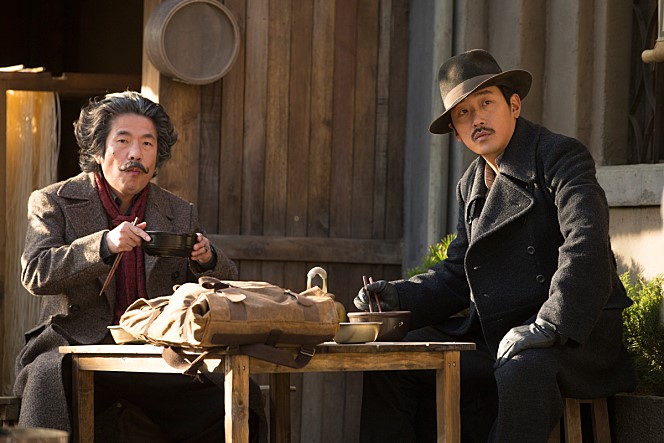
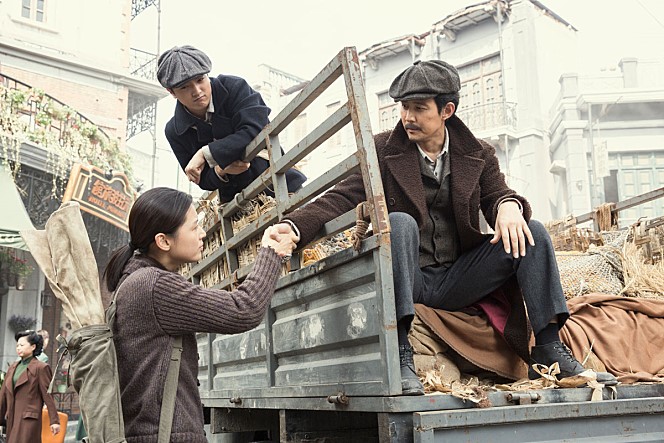
Its story revolves around one fictional assassination attempt planned by the leaders of Korean Independence movement as another act of resistance against the Japanese Occupation. It is 1933, and Kim Koo (Kim Hong-pa), the highly respected head of the Korean interim government in Shanghai who is incidentally one of a few real-life figures in the film, decides it is the time for another assassination operation against Japan, so he instructs Yeom Seok-jin (Lee Jeong-jae) to recruit suitable people to carry out this dangerous mission.

Secretly going around China, Seok-jin quickly gathers three members for the mission: Rapid-fire (Jo Jin-woong), Hwang Deok-sam (Choi Deok-moon), and Ahn Ok-yoon (Gianna Jun). As reflected by his name, Rapid-fire is a rambunctious guy with considerable military background, Deok-sam is an explosive expert who happens to escape from prison along with Rapid-fire, and Ok-yoon is a skilled sharpshooter with remarkable precision and efficiency.

Their targets are two men heavily involved in the ongoing Japanese occupation of Korea. One is the Commander of the Japanese occupation force in Korea, and the other one is Kang In-gook (Lee Kyeong-yong), a wealthy Korean business man who has closely collaborated with Japan for many years. As shown during the prologue scene set in 1911, this despicable traitor of his country is willing to do anything to protect his beneficial relationship with Japan, and now his young daughter is going to marry the Commander’s son shortly after she returns to her home in Gyeongseong (it is the old name of Seoul during that period, by the way). Around that time, there will certainly be a chance for assassinating the Commander and In-gook at once.

theassassination03Everything seems to be ready for the assassination team members when they leave for Seoul after holding a small ceremony for their mission (watching them being photographed along with their written resolutions, you may be reminded that they are regarded as terrorists by their enemies), but there is a problem which will jeopardize the whole operation. A spy inside Kim Koo’s inner circle informs Japanese authorities of the assassination plan and then hires a Korean guy nicknamed Hawaii Pistol (Ha Jeong-woo), one of the most fearful bounty hunters in the town. Hawaii Pistol accepts the request with no hesitation because he is told that his targets to be eliminated are traitors, and he also leaves for Seoul with his loyal sidekick Old Man (Oh Dal-soo).

Right after arriving in Gyeongsong, Ok-yoon and her two comrades work further on their assassination plan while Hawaii Pistol is tracking them down step by step. As their D-day is coming, Japanese authorities become more watchful especially after receiving the information on the assassination plan, and, for a reason I will not reveal to you at any chance, the situation becomes more complicated when In-gook’s daughter finally arrives in Gyeongseong.

Besides a number of well-made action sequences including the vehicle action scene reminiscent of Indiana Jones movies, “Assassination” has several surprise plot turns, but the movie is too busy with handling its individual plotlines to pay enough attention to the development of characters or their interactions. The story merely moves through predictable plot points especially during the second act, and then it comes to lose more of its steam as the characters’ circumstance becomes more serious during the third act. The movie tries hard with a lot of bullets and explosions during what is supposed to be its grand finale, but this part is deficient in dramatic impact due to the scattershot treatment of story and characters, and the movie ultimately feels dragged as eventually arriving at its lackluster epilogue sequence set in 1949.

theassassination02Anyway, the movie is impressive in technical aspects. The cinematography by Kim Woo-hyeong effectively generates the stylish period mood taking us to Shanghai and Gyeongseong during the 1930s, and the production design and costumes in the film are gorgeous to say the least. I particularly enjoyed the scenes looking around the sumptuous interior of a big, luxurious department store located in the downtown area of Gyeonseong, and I also liked a lively bar dance scene in which Ok-yoon loses herself a bit along with her comrades and other customers.

The actors are well-cast in their respective roles, though they are not used well in most cases. Gianna Jun is believable as a tough, beautiful woman determined to accomplish her mission by any means necessary, and it is rather a shame that the movie does not delve more into the situation in which her character unexpectedly faces her old past. While exuding his dependable star presence, Ha Jeong-woo mostly stays on neutral mode, and Lee Jeong-jae has his own moments as an activist who becomes involved in the assassination plan more than he initially expected. Jo Jin-woong and Oh Dal-soo are fun to watch in their enjoyable supporting performances, and you may notice other notable South Korean actors including Choi Deok-moon, Lee Kyeong-yeong, Kim Ee-seong, Jo Seung-woo, and Kim Hae-sook.

Although “Assassination” is not a total failure, but this is two or three steps down from the director Choi Dong-hoon’s previous films “Tazza: the High Rollers” (2006) and “The Thieves” (2012), which have more fun and excitement in comparison. I was not that bored, but I was not interested enough while trying to hold onto its rambling plot. There were too many shooters, and I only watched with no particular care to anyone.

theassassination04

Posted in Movies | Tagged , , | 1 Comment

Camp X-ray (2014) ☆☆☆(3/4) : A guard and a detainee in Gitmo

campxray01The Guantanamo Bay detention camp has been one of the most unjust things during the War on Terror, which is still being continued around the world with no end in sight. Because the people held at this camp are technically not war prisoners but detainees, the Geneva Conventions cannot be applied to them in the viewpoint of the US government and military, and the camp has subsequently gained its notoriety along with many alarming reports on the serious violations of human rights committed in this isolated place in Cuba.

Clearly intended to give us a close, intimate look into the injustice inside the Guantanamo Bay detention camp, “Camp X-Ray” focuses on a strained relationship developed between its two different characters who happen to come across each other in their opposite positions. As they gradually form a small human connection between them despite their differences, we come to identify with their respective viewpoints, and the movie tactfully lets us observe and reflect on their frustrating circumstance while never hammering its messages on us.

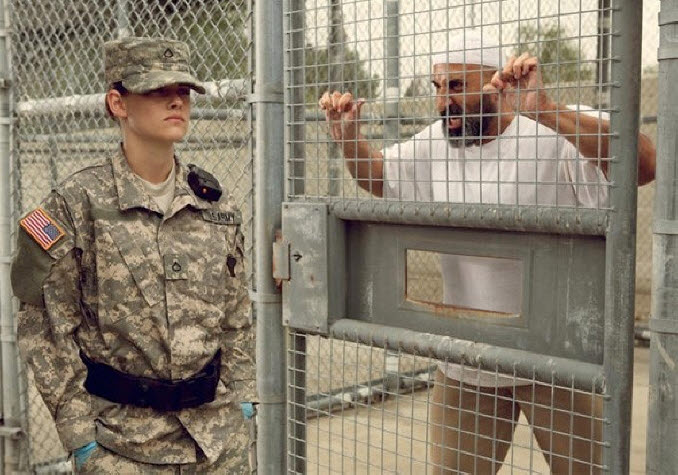
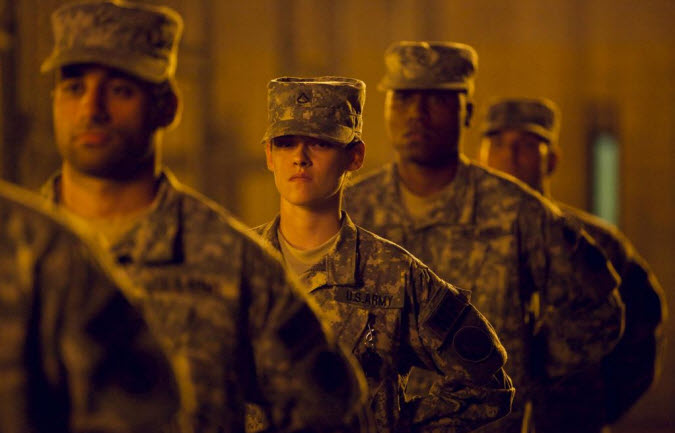
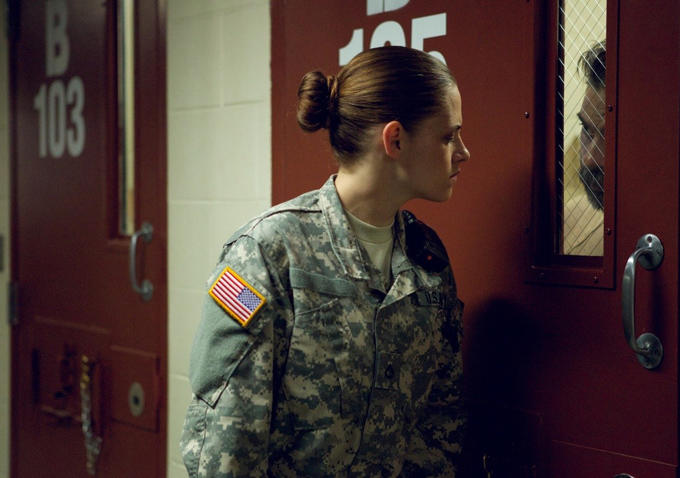
Kristen Stewart plays Private Cole, a young female soldier who is about to begin her first day at the Guantanamo Bay detention camp when we meet her for the first time. The main duty of her and other young soldiers sent here is to monitor a group of non-cooperative detainees incarcerated in Camp Delta (the title of the movie comes from the name of a temporary camp before Camp Delta), and she soon sees that her job will not be easy at all. The detainees, who are mostly Islamic fundamentalists, certainly do not welcome her presence, and she gets hit hard by one of them when she and others attempt to suppress his violent tantrum.

campxray03Furthermore, as one of a few female soldiers in the base, Cole always has to prove to other soldiers around her that she can be as tough as them. She dutifully goes through her rather rough first day without complaint, and she counters well when her immediate senior Corporal Ransdell (Lane Garrison) throws a rude ribald joke at her. When she returns to her private room after her duty hour is over, she becomes more relaxed with her hair loosened, and we see her having an online conversation with her mother.

Occasionally giving her and other guards troubles to handle, most of her detainees are not very communicative, but Ali (Peyman Moaadi, who previously appeared in Asghar Farhadi’s “A Separation” (2011)) is willing to start a conversation with Cole. When she brings in a library cart, he asks her whether she has the last book of the Harry Potter series he has been waiting for two years, and then he keeps talking to her whenever he can. Their initial interactions are not very friendly, and Cole experiences another unpleasant incident because of Ali, but they eventually become less hostile to each other along with more interactions between them.

The movie is the director/writer Peter Sattler’s first feature film, and he did a good job of establishing that stuffy feeling of confinement on the screen. Mainly shot at an abandoned prison facility in Whittier, California, his movie mostly revolves around a few places in the detention camp, and we often watch Cole going around her small, narrow area with her partner to check their detainees every 3 minutes (Corporal Ransdell cynically tells his soldiers at one point, “You’re not here to keep these men from escaping. The walls do that. You’re here to keep them alive.”). With small realistic details including the preparation of the meals for detainees or the erasure of women’s photos in newspapers to read, the movie draws us into the mundane routines Cole and other guards go through in their closed environment, and the cinematography by James Laxton constantly evokes the limits surrounding them and detainees through austere scene compositions and frequent close-up shots.

campxray04The two lead performers in the film are very good in their nuanced performances. Although she may be associated forever with those disposable Twilight movies, Kristen Stewart is a talented actress with the star quality of her own, and her commendable performances in this film and Olivier Assayas’ “Clouds of Sils Maria” (2014) confirm that she is on the next level of her promising career. There are several crucial moments when she has to convey us Cole’s conflicted emotional state behind her guarded appearance, and Stewart ably holds our attention even when her character does not say a lot. As Cole realizes more of the inhuman condition Ali is put into, she also becomes more aware of her disadvantageous position, and there is a hurtful moment when she is reminded again of how powerless she is in the male-dominant military system (As the soft-spoken officer who does not want any trouble under his command, John Carroll Lynch is subtly intimidating during this scene).

On the opposite, Peyman Moaadi complements his co-star’s restrained acting with his nervous intensity barely hiding his character’s accumulating despair. The movie does not tell us much about Ali’s personal background except the opening sequence depicting how he is suddenly captured at his home and then promptly transported to Guantanamo Bay, but he comes to us a smart, talkative guy with defiant streak, and we see how Cole comes to like him with care and respect. A certain scene during the latter half of the film feels like an obligatory climax, but Stewart and Moaadi hold this scene together tightly with conviction, and we do care about how it will be resolved in the end.

“Camp X-ray” is a somber but provocative film worthwhile to watch for not only its political subject but also for its thoughtful direction and strong performances, and it will leave you something to talk and discuss about. Although President Obama issued a request to shut down the Guantanamo Bay detention camp in 2009, the detention camp remains maintained even at present while holding 116 detainees. As reflected by the long ending scene of the film, it is still a problem with no closure yet on the horizon.

campxray02

Posted in Movies | Tagged , , , | Leave a comment

Blackhat (2015) ☆☆☆(3/4) : Style over keyboarding

blackhat01

At some point during my viewing of “Blackhat”, I began to focus on how it looks rather than what it is about. As a ‘cyber-thriller’, it surely has an interesting topic which has been more relevant along with those frequent computer hacking incidents around the global community, but it does not tell you anything new about computer hacking, and its thriller plot often suffers from implausibility and bland characterization. The movie is problematic to say the least, but it comes with distinctive style and mood, and I enjoyed it just for being a typical case of “style over substance”.

The movie begins with the chilly opening sequence which may take some of you back to the memories of “Tron” (1982). After the movie smoothly moves from the overview of countless Internet networks covering the Earth to the inner workings of the mainframe in a nuclear power plant in Chai Wan, Hong Kong, we see the hacking process which is about to be initiated by a mysterious hacker. Once a loophole is found somewhere in the mainframe, all needed to be done is pressing the enter key, and then a computer virus is instantly, and insidiously, spread throughout the mainframe as we see the rapid streams of electronic lights passing through an intricate system of circuits.

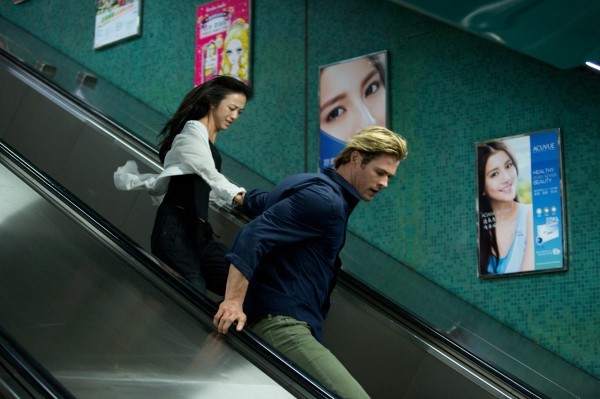
After this hacking results in a disaster as serious as the Fukushima incident, the Chinese government immediately starts an investigation, and the US government comes to collaborate with the Chinese government in this investigation after the same hacker drives the Mercantile Trade Market in Chicago into full panic through causing a sudden sharp rise in soy market price. Chen Dawai (Leehom Wang), a hot-shot captain of the cyber warfare unit of the Chinese military, recognizes that the hacker’s virus is originated from the one he and his old collegemate Nick Hathaway (Chris Hemsworth) created just for fun a long time ago, and he requests FBI special Agent Carol Barrett (Viola Davis) the temporary release of his friend, who has been incarcerated since he was found guilty of his computer crime 4 years ago. blackhat03Hathaway, a tough guy who does not conform easily to authority as shown from his minor prank on prison officers, agrees to help the investigation, but he has one demand; if he succeeds in catching the hacker in question, he should get a full pardon for his previous crime. As soon as his demand is accepted, Hathaway joins Chen’s investigation team members including Chen Lien (Wei Tang), a computer network engineer who is recruited by her brother as someone he can trust under any circumstance, and Deputy US Marshal Mark Jessup (Holt McCallany), whose main job is monitoring Hathaway during the team’s global search for any trace or clue which can lead them to their opponent.

In many scenes, they often look into computer monitors or type on keyboards for getting anything useful for their investigation, and I must point out that this is not particularly exciting to watch. Several technical terms like malware, proxy server, and RAT (remote administration tool) are frequently mentioned as the characters explain to others (and us) on what is going on or what they are going to do next, but you will not get much understanding on their computer work. In one brief scene, a character looks at those complicated arrays of computer codes on the screen for a while and then gets frustrated for some reason, but we do not know why until it is explained later.

Anyway, the heroes of the director Michael Mann’s films are always men of actions, so Hathaway and the other characters he works with get themselves into a number of action scenes as it turns out that their bad guy has a lot more than his computer. When he and Lien come across a trouble at a Korean restaurant in LA, Hathaway shows that he has the other particular sets of skills besides his programming/hacking skills. Both Hathaway and other team members want to get their job done as professionals, and they are not easily deterred from their mission even when they come to face more dangers and difficulties as they approach closer to their target bit by bit. blackhat02While they run or move around many different places over the world, Mann keeps his film rolling even when the screenplay by Morgan Davis Foehl stumbles or trudges. Although his raw digital camera shooting makes several scenes feel a bit too rough, the cinematographer Stuart Dryburgh wonderfully captures the beautiful night skyline of Hong Kong on his camera from time to time, and he also makes good use of various locations. The climax sequence, which is unfolded in the middle of a big local festival held in Jakarta, is visibly awkward in its editing especially when Hathaway finally confronts his opponent (it feels as if the actors had been shot separately in different places), but this sequence looks visually impressive none the less as Hathaway wades into the endless stream of crowd moving in the opposite direction.

Although some of them are not very convincing, the actors in the film are fine on the whole. Probably because of “Thor” (2011) and other associated Marvel Comics movies, Chris Hemsworth is not that believable as a smart, intelligent hacker, but at least he looks as moody and tough as required whenever that is necessary. Leehom Wang is solid as Hathaway’s friend and supporter, and Viola Davis, a wonderful actress who is always good at making seemingly thankless roles look interesting, fills her character with a quiet but authoritative sense of responsibility. In case of Wei Tang, the relationship developed between her character and Hemsworth’s feels forced without much spark, and that is one of the least successful parts in the film despite Tang’s good efforts.

“Blackhat” feels overlong in its uneven narrative which may test your tolerance of implausibility, and there are parts which do not work as well as intended, but this is not as messy and boring as “Ali” (2001), which remains to be an aimless misfire even after Mann gave us his director’s cut. Compared to “The Insider” (1999) and “Collateral” (2004), “Blackhat” is not the highpoint of Mann’s career, but it is an interestingly flawed work which shows that he is still sticking to his own style as continuing to hone it as before. blackhat05

Posted in Movies | Tagged , , , , , , | Leave a comment

Phoenix (2014) ☆☆☆1/2 (3.5/4) : The past is still there for her and others

Phoenix01The war is over, but the past is still there for her and others. Christian Petzold’s “Phoenix”, a quiet but compelling period drama revolving around disguise and manipulation with a touch of film noir, is reticent about the dark period its heroine and others went through, but their inconvenient past becomes more palpable as we observe their gloomy post-war world barely recovering from it. Still confused and traumatized inside her new appearance, its damaged heroine cannot help but be drawn to what may be a good chance to restore not only who she was but also a precious relationship in her past, but can she really forget whatever she endured during that terrible time? And can she possibly overlook that she might have been betrayed by someone she loved and trusted?

In the opening scene, we see two women in their car, who have just been stopped by American soldiers at a checkpoint. When one of the American soldiers notices that one of these two women is heavily bandaged on her head, he understandably becomes suspicious, so he demands her to unbind her bandage despite her companion’s protest. The camera does not show her bare face directly, but the soldier’s horrified face is more than enough for us to guess how terrible she looks in her injured state.

It is not long after the World War II was over, and Nelly Lenz (Nina Hoss) is being taken to Berlin by her friend Lene Winter (Nina Kunzendorf) mainly for her treatment and recovery. After arrested in late 1944, she was sent to a concentration camp, but she managed to survive and then escaped from the concentration camp later, and it is implied that she sustained her serious facial injury during her escape. When she is examined by a skillful plastic surgeon shortly after she and Lene arrive in Berlin, the doctor says that he cannot restore her original face but can construct a new face for her instead, though it may take some time for her to get used to her new appearance which will not be wholly different from the former one but will still look different to her and others.

Phoenix02After the successful reconstruction surgery on her face, Nelly starts adjusting herself to her new face and environment with Lene’s help. They have a nice apartment as their temporary staying place, and they also hire a resourceful housekeeper who can always prepare decent meals for them in spite of the poor supply of many cooking ingredients in post-war Berlin. Lene, who works at the agency for retrieving the Jewish survivors’ confiscated assets, is planning to get a place in Palestine for the new beginning for her and Nelly, but Nelly is not so sure about whether she really wants that or not.

Meanwhile, Nelly searches for her pianist husband Johnny (Ronald Zehrfeld, who appeared along with Hoss in Petzold’s previous work “Barbara” (2012)). Before their life was disrupted during the war, she was a singer who worked with her husband, and he helped her hiding from the SS for a while, but it seems that he was directly responsible for her arrest. According to an official document on him, Johnny was arrested and then released shortly before she was arrested, and that clearly suggests his betrayal.

She eventually finds her Johnny, but he no longer works as a pianist. While working as a mere employee at a seedy nightclub named Phoenix, he now prefers to be called Johannes instead of Johnny, and he does not even recognize his wife. To him, Nelly in her new appearance is merely a woman who happens to closely resemble his wife, and he believes she was dead after being sent to the concentration camp.

It turns out that he has a scheme in which she may be useful. Nelly is actually the sole recipient of a considerable amount of family fortune because all of her Jewish family members died during the war, and Johannes wants her to disguise herself as Nelly for getting the money for himself. While not revealing her true identity, Nelly becomes her husband’s willing accomplice mainly because she still has feelings for him despite the possibility of his betrayal. She begins to live with him at his shabby residence, and he coaches her with various details on how she is supposed to look and behave as “Nelly”.

phoenixThis looks like an easy job for Nelly at first, but she soon realizes how much she is changed from her former self, and there is a dark, twisted irony reminiscent of Alfred Hitchcock’s “Vertigo” (1958) in her struggle to satisfy her husband. Driven by each own motive, Johannes and Nelly try to restore the image of a woman gone from their life, and it is simultaneously unnerving and poignant to watch them preparing and rehearsing for the illusion they both desire for different reasons. While never imaging that the woman to be used by him is actually his wife, Johannes becomes uncomfortable as shaping her into his supposedly dead wife step by step for his deceitful plan. Although it was pretty awkward during her first clumsy trials of playing herself, Nelly gradually becomes more comfortable and confident in her ‘performance’, like an actress getting accustomed to her role. She is supposed to leave Johannes once they succeed with their deception, but she might be able to live with him as “Nelly”, if not herself.

As shown from “Barbara” (2012), the director/writer Christian Petzold is very good at establishing a quiet but nervous mood to engage and intrigue us, and “Phoenix” is also equipped with impressive visual touches while never breaking its calm, reserved tone. The sights of ruined buildings and barren streets evoke the glum, down-trodden atmosphere hanging around post-war Berlin and its moody inhabitants, and the cinematography by Hans Fromm further accentuates it through the effective use of high contrast in the night scenes. Usually suffused with dark red lights during its opening hours, the Phoenix club is literally drenched in that pulpy ambience of film noir, and we even get a gaudy German rendition of Cole Porter’s “Night and Day” at one point.

With her expressive face and subtle body languages, Nina Hoss masterfully depicts each nervous step her confused character takes along the story, and she is especially terrific when Nelly indirectly reveals herself during her conversation with Johannes on how they should make her look more authentic as “Nelly”. She virtually tells him what she experienced during that despairing period of hers, but she disguises it as a part of her preparation for playing “Nelly”, and Hoss’ superb performance deftly tiptoes on a thin line between deception and sincerity during that moment.

Phoenix06It is also interesting to watch how Hoss and her co-star Ronald Zehrfeld interact with each other in a mode completely different from what we saw from their previous performances in “Barbara”, where Hoss played a stigmatized East German doctor who will not let others including Zehrfeld’s sympathetic character come too close to her for good reasons. In case of “Phoenix”, Hoss is the one who tries to come closer to the other, and many scenes in “Phoenix” depend solely on the dynamics generated between the performances by Hoss and Zehrfeld, who always click together well with their shifty chemistry on the screen.

As another crucial part of the story, Nina Kunzendorf is equally good in her supporting performance. Lene looks determined to detach herself from the past through her possible future in Palestine, but she eventually turns out to be haunted by the past as much as her friend and others, and there is a sad scene where she reveals her own pain through her personal letter to Nelly, which is accompanied with one important piece of information for her friend.

While a certain degree of patience is required for us to get absorbed into the story due to its dry, restrained storytelling, “Phoenix” eventually strikes us with the haunting finale to reflect on for a long time after it is over. After slowly and carefully building its narrative momentum during most of its running time, the movie finally arrives at the point where something seems to be bound to happen, and you will be captivated by what Petzold, Hoss, and Zehrfeld present on the screen. As the characters in this undeniably powerful scene will come to learn, truth always finds a way to get itself revealed in the end, no matter how much they let themselves blind and silent to it.
Phoenix05

Posted in Movies | Tagged , , | 1 Comment

Big Game (2014) ☆☆1/2 (2.5/4) : No game is too big for this kid

biggame01One of many entertaining parts in late Roger Ebert’s memoir “Life Itself” is the story about how he participated in the production of Russ Meyer’s “Beyond the Valley of the Dolls” (1970) as its screenplay writer. While Ebert’s screenplay was intended as a wild, outrageous mix of various genres including satire, melodrama, rock music musical, and violent exploitation film, Meyer approached to the story and characters with absolute seriousness even at its most ridiculous moments, and that odd approach resulted in an immortal trash worthwhile to watch at least for appreciating another side of a great film critic with whom I luckily corresponded for a few years before his death (my short twitter comment on the film: “My initial reaction on “Beyond the Valley of the Dolls” was like a kid finding the naughty photos from his grandpa’s wild years.”).

In case of “Big Game”, the people behind it did know how outrageous their film is, and they admirably maintain enough amount of seriousness like Meyer did in “Beyond the Valley of the Dolls”. The actors in the film all look serious in their acting while never winking at the audiences, and the soundtrack surely sounds very grave with no hint of sarcasm. This is certainly an effective approach for its intention, but the movie does not have enough craziness to play against its serious attitude, and, unfortunately, that deficiency eventually prevents it from being a genuine guilty pleasure to be cherished.

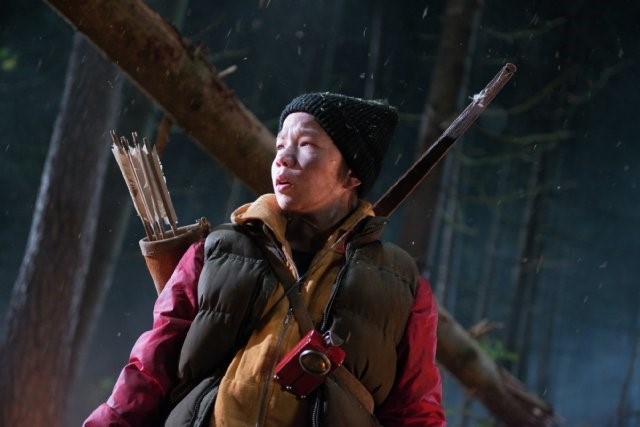
Onni Tommila, who has grown up a lot since we saw him for the last time in “Rare Exports: A Christmas Tale” (2010), plays Oskari, a Finnish boy who will have to go through a coming-of-age hunting ritual for proving his manhood to his father Tapio (Jorma Tommila, who is Onni Tommila’s father and also co-starred with his son in “Rare Exports: A Christmas Tale”) and others. Oskari will go for hunt alone on the day before his 13th birthday, and then he must return on the next day with any game he catch for being officially recognized as a man. Although he does not seem quite ready for this while his father’s reputation puts another burden on his shoulder, he is determined to try hard as much as he can, and he soon enters a remote mountain forest area as his father and others watch his departure.

biggame02Oskari hopes to catch anything as big as a bear his father once caught when he was at Oskari’s age, but then he comes across a game bigger than he has ever imagined. A plane suddenly crashes from the sky, and then he comes upon the escape capsule, which carries none other than the President of the United States. President William Alan Moore (Samuel L. Jackson) was going to the Summit to be held in Helsinki, but then Air Force One was shot by the missiles launched by a group of terrorists, and now he has to depend on Oskari because it seems there is no one surviving from the crash.

Meanwhile, the Vice president (Victor Garber) and other high-ranking officials immediately gather at the situation room in the Pentagon for this emergency situation, and it becomes clear to them that they must find President Moore as soon as possible before it is too late. It looks like Hazar (Mehmet Kurtulus), the leader of the terrorist group in question, wants to catch President Moore alive for some crazy purpose, and Morris (Ray Stevenson), one of the Secret Service agents, turns out to be an accomplice in Hazar’s operation (This is not a spoiler at all, for you can instantly sense that right from the instant when you see Stevenson’s sullen badass face for the first time). With Morris’ helpful assistance, the terrorists track down President Moore and Oskari, and, as the people at the Pentagon begin to realize there is really nothing they can do for rescuing the President or stopping the terrorists, it is apparent that Oskari is President Moore’s only hope.

Now everything seems to be ripen for a ridiculous romp, but, as often spinning its wheels, the movie hesitates to fully embrace its silliness. I appreciated its efforts to make itself look like your average serious B-action film, and I also enjoyed its tongue-in-cheek homage to “E.T. the Extra-terrestrial” (1982), but the movie is visibly deficient in the loony energy required to elevate itself to the level of goofy entertainment. While I certainly laughed at that silly action sequence featuring a helicopter and one certain refrigerator which turns out to be a lot more durable than it seems at first, the movie does not have many amusing moments like that, and that makes the story feel dragged especially during the middle part, which dully goes back and forth between the terrorists searching for their target and President Moore reluctantly spending some time with Oskari as demanded.

biggame03Mildly amused to some degrees, I observed how the actors managed to keep their faces and performances straight and intact on the screen. Onni Tommila deserves commendation for holding the center well with his engaging lead performance, and Samuel L. Jackson wisely dials down his intense screen persona for supporting his young co-star. I have no idea on how Jackson came to accept his role, but he did his thankless job with good spirit as a professional actor, and the same thing can be said about many other recognizable actors in the film including Victor Garber, Ted Levine, Ray Stevenson, Felicity Huffman, and Jim Broadbent, who occasionally steals the show with his avuncular presence as a veteran CIA analyst.

“Big Game” is not entirely a dud, but it remains a letdown compared to the director/writer Jalmari Helander’s previous work “Rare Exports: A Christmas Tale”. That offbeat fantasy adventure film also looks serious in its dark, creepy tone, but it is also quite amusing at times in its horror variation of a Santa Claus myth, and I still remember many of its naughty moments including a bunch of naked bearded figures running wild in the blizzard or the surprisingly humorous closing scene which cheerfully reveals the meaning of the title of the movie. “Big Game” could go more actively for such an outrageously enjoyable fun like that, and it was disappointing to see that it turned out to be not as entertaining as it could have been with its ludicrous premise.

By the way, as I was preparing for this review, one of Ebert’s old reviews somehow came to my mind. In his amused three-star review on “If Looks Could Kill” (1991), Ebert noted that the movie is “the only film I can recall in which a mad economist traps an entire Detroit high school French class in an iron cage suspended above a cauldron of boiling gold.” Too bad “Big Game” does not have anything as memorable as that for our amusement.

biggame04

Posted in Movies | Tagged , , , | Leave a comment