Bessie (2015) ☆☆☆(3/4) : Latifah Sings the Blues

bessie07As a biographic drama about one fascinating real-life entertainer who went through many barriers as reaching for her stardom, HBO TV movie “Bessie” is not without problems. It is rather plain and clichéd while riddled with several glaring problems including scattershot narrative and thin characterization, but this is still an engaging movie mainly thanks to its strong lead performance to hold the center as its heart and soul.

The movie is about the life of Bessie Smith (Queen Latifah), a popular American blues singer of the 1920-30s who has been regarded as one of the greatest singers of her time. After the brief prologue scene showing her at the peak of her career, the story moves back to the early 1910s, and we see how feisty and ambitious she was even during her early struggling years. When a rude guy hits her hard during their quick sex behind a theater, she instantly gives him a lesson to remember, and then she promptly goes up to the stage and delivers a performance. During one audition, she tries to get attentions as much as possible although producers prefer light-skinned colored women, and then she gets insulted by the brown paper bag test, which was used to determine whether one was light-skinned enough or not.

And then there comes a good chance when she goes to meet popular blues singer Ma Rainey (Mo’Nique) by herself. Rainey is clearly impressed by Bessie’s forthright attitude during their first meeting on her troupe train, and she generously teaches her new protégé a few important things about how to capture the audiences’ attention (“You got to put something else in it. The blues is not about people knowing you, it’s about you knowing people.”). While working under Rainey, Bessie learns more about show business, she quickly establishes her own style and personality to enthrall her audiences – even when she is performing right next to her mentor.

bessie02

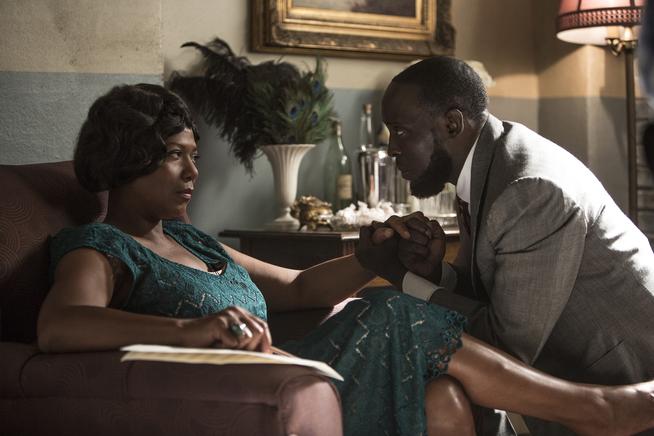
As she becomes more ambitious with her growing ego, Bessie eventually leaves Rainey, and she begins to do her own show with the assistance of her brother Clarence (Tory Kittles). She later meets Jack Gee (Michael Kenneth Williams), and she quickly begins a passionate relationship with this tough security guard although she has already been involved with her lesbian lover Lucille (Tika Sumpter). Jack becomes her manager as well her husband, and Bessie’s career goes up further along with her own troupe train and a big record deal with Columbia Records (the recording room scene has an amusing period detail to remind us of how elementary the recording technique was during that period).

While keeping hopping between many other episodes in the life and career of its subject, the screenplay by the director Dees Rees and her co-writers Christopher Cleveland and Bettina Gilois, which was based on the story written by Rees and late Horton Foote, frequently feels unfocused and incoherent. Several interesting story elements including Bessie’s bisexuality and her unhappy family history do not gel well together in its loose narrative, and it particularly feels superficial in the depiction of her apparent alcoholism. I could not help but notice how often she has a jar of bootleg besides her, and it is sort of remarkable that she mostly looks all right except in a few scenes (she died in 1937 in the age of 43).

Fortunately, the movie is held up together well by Queen Latifah, who recently received a Emmy nomination for one of the best performances in her career (she already won an Emmy on last Sunday as one of its producers). Since her delightful Oscar-nominated supporting turn in “Chicago” (2002), Latifah has shown more of her undeniable star quality which is a life force to reckon with on the screen, and she certainly dominates the screen whenever that is required. Through her lively embodiment of her character, Bessie comes to us as a complex human character to watch; strong but vulnerable at times, she is frequently driven by her own ego as well as her own integrity, and she often does not treat well others around her while stubbornly going her way as before.
AE15TVOSTROW.JPG

As a colored female artist, she naturally confronts racism as going around the country, and that is where some of Latifah’s best moments in the film come from. When a bunch of Ku Klux Klan members try to interrupt her evening performance on the field, she surely shows them that she is someone they cannot possibly mess with, and that increases more her popularity among her black folks while becoming the target of angry white racists. At an affluent social party held in Manhattan, she willingly gives a blues performance as requested for other white guests at the party, but she does not tolerate one hypocrite snob when he impertinently expresses his condescending view on black people behind his sophisticated appearance.

The supporting performers surrounding Latifah are not utilized well in most cases due to their underdeveloped characters, but some of them do leave some impression as revolving around her. Mo’Nique, whom I still remember for her ferocious Oscar-winning turn in “Precious” (2009), has lots of fun with her juicy role, and Michael Kenneth Williams is solid as a husband who loves his wife although he has a fair share of extramarital affairs just like her. Khandi Alexander is Bessie’s elder sister who is as stern as Mrs. Danvers in “Rebecca” (1940), Mike Epps is a bootlegger who becomes more serious about his ‘business relationship’ with Bessie, and Charles S. Dutton briefly appears as Ma Rainey’s no-nonsense husband/manager.

Compared to Rees’ previous film “Pariah” (2011), a touching coming-of-age drama about a young urban black teenager girl struggling with her closeted homosexuality, “Bessie” looks less distinctive, but this average TV movie tells a story which deserves to be told, and Latifah’s performance is worthwhile to watch. It could have been better indeed, but it is still good enough to compensate for its many flaws.

bessie06

Posted in Movies | Tagged , , , , | 1 Comment

Nightingale (2014) ☆☆☆(3/4) : Isolated in loneliness and madness

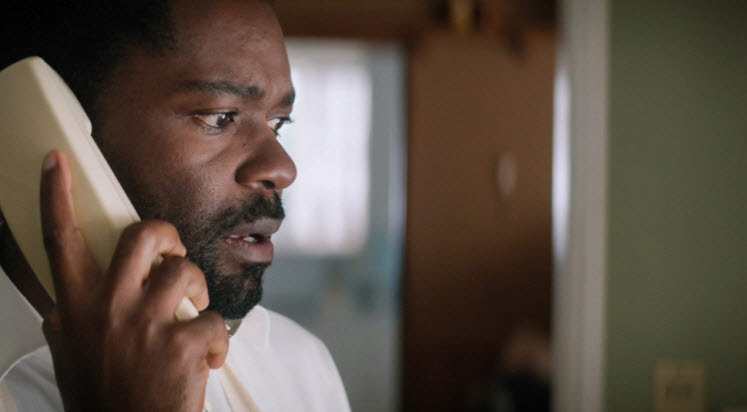
nightingale06HBO TV film “Nightingale” begins with its troubled hero rambling alone at his home. It looks like a bad thing has just happened, and we feel uneasy as sensing the disturbing tone of his words. Still shaken by what happened, he is angry, morose, and desperate, and he wants to believe that things will be all right for him in the end, though he probably knows that is not true at all.


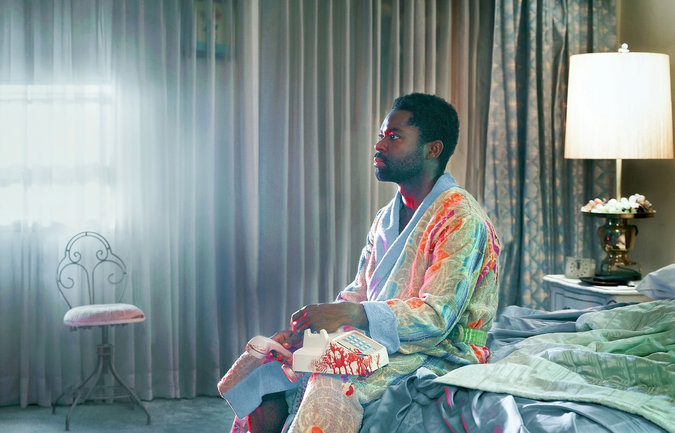
David Oyelowo plays Peter Snowden, an ex-soldier who has lived with his old mother in her suburban house for years. When he is about to begin his another day as a supermarket employee in the morning, he tries to look fine and normal in his employee clothes, but that does not help him much as he is reminded again of what happened when he and his mother fought over his private matter during last night.

He leaves the house for work as usual. He comes back hours later, and he complains about his work in a video journal for his Internet blog. When others want his mother on the phone, he simply tells them that she is absent or not available. He also does some redecoration job to change the glum, oppressive mood of the house, and he begins to feel a bit better than before.

Above all, he wants to see his old military friend again. For some vague reason, his friend, who is currently married, is out of reach whenever Peter tries to contact with him, but he keeps trying despite being angry and frustrated again and again. He is looking forward to cooking a nice dinner for his buddy, but it becomes more apparent that his friend is not willing to contact with him, let alone accept the dinner invitation.

nightingale02When he occasionally records his video journal, we gradually gather that Peter wanted something more than friendship from his friend, and that was probably the reason behind Peter’s strained relationship with his mother, who must have been a devout Christian woman considering several noticeable religious items in the house. At one point, he checks a bunch of mails recently sent to his mother, and one of the letters, which was from one of her close friends, suggests that she should be stricter on her problematic son with tough love.

Meanwhile, the situation becomes more difficult for Peter, who begins to show more of disturbing behaviors as being cornered from the outside. He loses his job, and he spends too much money until his credit card reaches to the maximum limit. His lies about his mother’s absence work for a while, but then he gets more phone calls from others. One of her friends actually attempts to get into the house to find out what is really going on, and Peter’s sister also begins to show concern about her mother and her dear brother – especially when an alarming incident is reported on TV.

In its austere minimalistic approach, the movie always sticks to Peter’s disturbed viewpoint throughout its short running time. Its space is limited to the house and a few outside places around it, and there is not any other character in the movie besides Peter and a few extras who are barely glimpsed outside. Even during the phone conversation scenes, we can only see Peter talking with whoever is on the other end of the line, and we can only guess what is being said to him as watching his responses.

While often accentuating his hero’s deluded state of mind through a few visual touches, the director Elliott Lester maintains well the tension silently seething beneath the screen. The movie feels dragged a little as it approaches to its inevitable ending, but its economic narrative is lean and efficient on the whole, and the screenplay by Frederick Mensch wisely lets its character details revealed along the narrative without being overstated.

nightingale03Of course, the success of the movie depends a lot on its sole actor’s skill and talent, and David Oyelowo delivers a captivating one-man show performance which deservedly received an Emmy nomination. Since his substantial supporting turn in “The Last King of Scotland” (2006), this stage-trained British actor has been an interesting actor to watch as appearing in a number of notable films including “The Help” (2011), “Lincoln” (2012), and “The Butler” (2013), and he recently got his breakthrough moment as Martin Luther King Jr. in “Selma” (2014), for which he should have been Oscar-nominated.

In “Nightingale”, Oyelowo deftly handles his increasingly unstable character as he swings up and down around different moods and nuances, and we come to care about this deeply unhappy man even though his fate has been already sealed from the very beginning. No matter how much Peter tries to get a chance to be happy as before, there is always the hard reality outside the house, and he only finds himself driven to more despair and madness – until he can no longer maintain the delusion he has desperately hung on.

Basically being a storytelling stunt, “Nightingale” bares its rather thin premise at times (the video journal recording scenes feel more like a gimmick for the audiences, for example), but it mostly works as a dark, tense chamber drama, and it is certainly worthwhile to watch how Oyelowo commands the screen in his another impressive performance. Judging from “Selma” and “Nightingale”, I think we will get more good things to watch from him.

nightingale01

Posted in Movies | Tagged | Leave a comment

The Look of Silence (2014) ☆☆☆☆(4/4): Silenced by fear and repression

thelookofsilence02Behind the frighteningly absurd world where murderers continue to reign without remorse or regret, there have been pain and sorrow silenced by fear and repression for nearly 50 years. Somber and meditative in its unadorned approach, “The Look of Silence” is relatively less sensational than its monumental predecessor “The Act of Killing” (2012), but it also has very powerful moments as looking into the Indonesian killings of 1965-66 from its intimate viewpoint opposite to that warped one of “The Act of Killing”. In the previous film, we hanged around the perpetrators who have wielded the power over their society along with the twisted denials and justifications of their genocide, and now we observe here how one family has quietly suffered from this monstrous injustice like many other people.

Like “The Act of Killing” had Anwar Congo, “The Look of Silence” has its own unforgettable hero to watch. He is an optometrist named Adi Rukun, and he was born several years after his older brother Ramli was killed during the Indonesian Killings of 1965-66 (it is estimated that more than 500,000 people were killed during this nationwide anti-communistic purge). Everyone in the village including his parents knows too well who were behind the death of Ramli and many others, but, as chillingly shown through those loony moments in “The Act of Killing”, the perpetrators of this ruthless purge were backed by the Indonesian government and military and most of them have exerted considerable social and political influences over their communities. They were once barbaric killers to be feared, and now they are powerful elders to be respected.

When he embarked on his documentary project during the early 2000s, the director Joshua Oppenheimer approached to Adi’s family and other survivors at first, but then he soon found that many of them were not very willing to talk about it for good reasons, so he went to a number of perpetrators instead. To his astonishment, the perpetrators were unbelievably candid about their atrocities with no apparent sense of guilt, and his growing fascination with these awful people eventually led him to Anwar Congo and one hell of nutty filmmaking to behold in “The Act of Killing”.

thelookofsilence03Along with Adi, we watch the video clips showing some of these perpetrators, and it is often frightening and exasperating to see them crudely boasting of their mass killings in the past. One middle-aged man enthusiastically recounts how he used to kill people mercilessly, and he feels no qualm about telling it all even when his wife is around him. In case of two former death squad members who murdered Adi’s brother and many others, they willingly guide Oppenheimer to their old execution site next to the river near their village, and they even give him a detailed description of their gruesome killing methods – and they later have themselves photographed for this, uh, special occasion.

We also get the glimpses of how this bloody history of violence has been whitewashed in the Indonesian society. At the school where Adi’s two children attend, a teacher gives a short lecture of the fabricated history to justify the purge, and most of his students have no problem with accepting an episode of how evil communists savagely tortured some brave, patriotic generals. In one incredulous archival footage scene, a local official flatly tells an American TV news reporter that all communists in his town willingly allowed themselves to be executed after learning the error of their misguided way. That is pretty ridiculous, but who would dare to disprove it there?

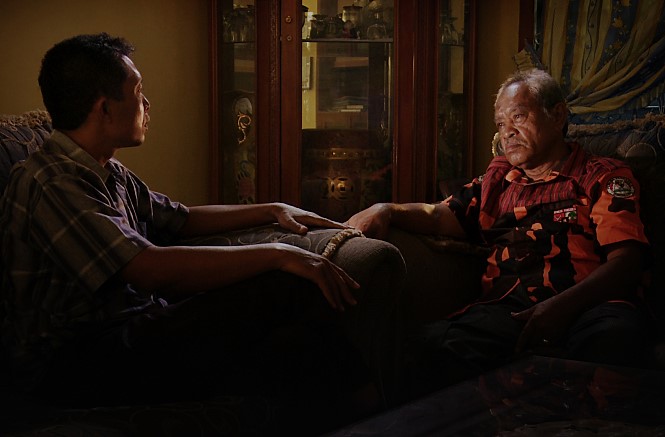
Through Oppenheimer, who had closely interacted with Adi during the production of “The Act of Killing”, Adi gets chances to meet and talk with several perpetrators in front of the camera. He simply wishes to bring the closure to his family and other survivors through apologies and reconciliations, but, not so surprisingly, he only comes to experience many infuriating moments of denial and frustration. At one point, Adi visits an aging former death squad member, and the old man phlegmatically recollects his violent past as Adi is examining his eyesight step by step. While we are horrified by his atrocious deeds including drinking man’s blood just for keeping his sanity intact, the mood becomes more tense and uncomfortable when Adi goes further to point out his client’s moral blindness, and their conversation ends with a bitter tone once Adi’s job is done. The old man will get his glasses, but, as ironically reflected by an apparent but striking metaphor in this memorable scene, he will probably keep himself blind to his guilt for the rest of his life.

thelookofsilence04The other interviewees in the film also show similar responses of panic and discomfort. When Adi confronts the surviving family members of a former death squad member who already passed away, the family members are visibly upset by what he presents to them. They respond to Adi with anger and disregard, and they keep emphasizing that they have nothing to do with the shameful past of their deceased family member because they did not know anything about that. In case of one woman accompanying her senile father, she is genuinely shocked by her father’s unintentional revelations and then promptly makes an apology to Adi, but this moment is no less strained than the other confrontation scenes. She is sincere indeed, but her apology looks more like a hurried reflex action for getting out of her very awkward circumstance as soon as possible.

Many people on the other side are not that willing to face their grim past again either. Walking along the very street on which he and others were heading to certain death, a middle-aged man describes to Adi and us how he was fortunate enough to survive during the darkest moment of his life, but he also expresses his doubts on whether it is really worthwhile to delve into the old wounds of the past he would rather keep untouched. As digging more into the past, Adi happens to learn an inconvenient fact about one of his own family members, and that comes to his mother as another personal pain to deal with.

As the documentary quietly observes their domestic life from time to time, Adi’s parents are presented as vivid, memorable human beings as much as their son. Mr. Rukun, who is 103 years old according to his identification card, is a thin, fragile old man gradually becoming deaf and blind, and his wife Rohani is a feisty old lady although she is probably near 90. Despite the tragedy which struck them very hard, they managed to endure anyway, and they must have been consoled to see their second son growing up well to be a decent, thoughtful man who is also a good father and husband to his own family.

But they still feel hurt and haunted by the past which is not through with them yet. Bitterly reminiscing about their past in front of her son, Adi’s mother shows tired resignation mixed with anger. She is still angry about what happened to Ramli, but there is nothing she can do about that, and she only hopes that justice will be done somehow. The most harrowing moment in the documentary comes from the video footage Adi shot for himself during one night at his parents’ house; his father comes to lose more of himself than before, and it is heartbreaking to see his body helplessly overwhelmed by fear and confusion which his fading mind cannot understand at all.

thelookofsilence05As a companion piece, “The Look of Silence” powerfully complements “The Act of Killing” with synergistic resonance, and they are great documentaries to admire for their astonishing achievements. During the Q&A session at the Busan International Film Festival in last year, Oppenheimer expressed his wish that Indonesian people will be able to make a documentary film on the Indonesian killings of 1965-66 for themselves someday, but I do not think that will happen soon, considering that so many local crew members of both documentaries are merely listed as “Anonymous” in the end credits. Although “The Act of Killing” and “The Look of Silence” were allowed to be screened in Indonesia while gaining considerable public attention, but those people who benefited from the genocide still remain as powerful figures firmly standing over their victims, and you will not be surprised to learn that Adi and his family had to move to somewhere outside North Sumatra for safety reasons.

As an individual living in a country which went through a fair share of dark, violent moments during the 20th century and still struggles to process their aftermath even at present, I found “The Act of Killing” and “The Look of Silence” quite universal in their stories and subjects, and I’d like to tell you one very interesting experience I and my father and other audiences had during one Sunday afternoon. Right after when the movie was over and the lights were turned on in the screening room, a middle-aged lady stood up and introduced herself, and then she talked about how her family was shattered by a massive anti-communistic purge during the Korean War. Although her mother was forced to remain silent for many years like other survivors, she lived long enough to see the South Korean government recognizing this terrible incident several years ago – but she still did not get a proper apology or indemnification.

When I was about to leave the screening room along with others, I happened to spot a very old woman sitting right next to that middle-aged lady. Probably because of exhaustion, she was asleep during the screening, and her daughter had some difficulty in waking her up. I really hope it will not be too late for them when something is done to relieve their personal pain a bit more.

thelookofsilence07

Posted in Movies | Tagged , | 2 Comments

Straight Outta Compton (2015) ☆☆☆(3/4) : Rappers with Attitudes

straightouttacompton01Galvanizing the audiences with a bunch of propulsive songs from a famous hip hop group during the 1980-90s, “Straight Outta Compton” is a vivid, pulsating music biographical film to watch. Like their music and attitude in public, the movie is uncomfortable at times for good reasons, but its riveting music performance scenes will definitely grip you with their straightforward fury and gusto.

The first act of the movie revolves around the formation of N.W.A. (it is the abbreviation of “N*ggaz wit Attitudes”) in Compton, California during the late 1980s. Right from its opening scene, the movie puts us into the tough neighbourhood in Compton, and some of the following scenes reminded me of what I saw from John Singleton’s unforgettable film “Boyz n the Hood” (1991) and Allen and Albert Hughes’ equally powerful movie “Menace II Society” (1993). Even if they are not related to any local gang organization, many young African American people in this poor neighbourhood can be suddenly cornered by thugs or brutally treated by police officers at any moment, and several harsh moments in the film particularly resonate with the recent media reports on race issue and police brutality in US.

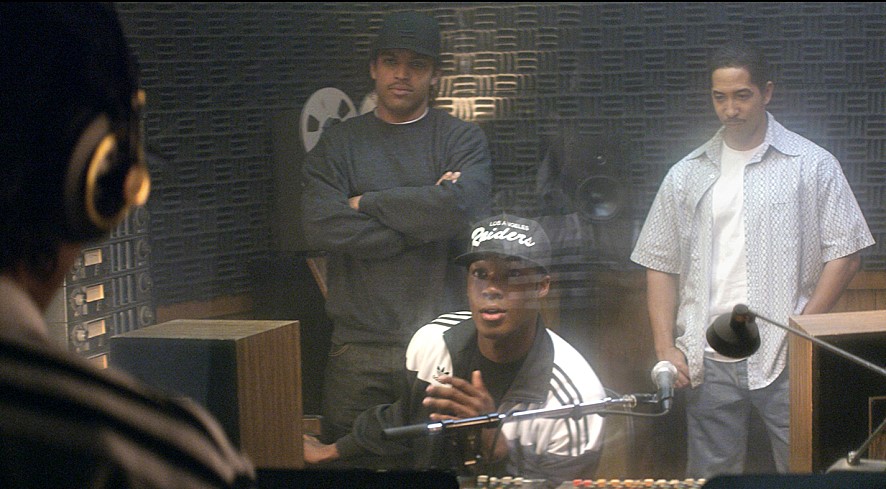
While working as the DJ at a local club owned by Alonzo Williams (Corey Reynolds), Andre “Dr. Dre” Young (Corey Hawkins) considers organizing his own hip hop group, and he persuades his drug dealer friend Eric “Eazy-E” Wright (Jason Mitchell) to finance his personal project while recruiting O’Shea “Ice Cube” Jackson (O’Shea Jackson Jr., who is, yes, Ice Cube’s son), Antoine “DJ Yella” Carraby (Neil Brown, Jr.) and Lorenzo “MC Ren” Patterson (Aldis Hodge). During the production of their first single “Boyz-n-the-Hood”, Eazy-E finds himself wearing more than one hat as coincidentally getting himself placed in the front position, and he and the other group members soon get the first taste of success when their song turns out to be a breakout hit.

straightouttacompton05Their growing popularity happens to draw the attention of veteran music manager Jerry Heller, played by Paul Giamatti with a white hairpiece which is a little less awkward than that distracting one he recently wore as the music manager in another music biographical film “Love & Mercy” (2014). Although he is not entirely reliable, Heller does deliver what he promised to the boys, and N.W.A. quickly attains the fame on the nationwide level after the release of their first album “Straight Outta Compton”. Drenched in expletives and blatant expressions of crime and violence, their songs naturally get a fair share of critics and haters, and the police and other law authorities are surely not very pleased about that infamous song “F*ck the Police”.

Heller is nervous about this trouble as their manager, but the N.W.A. members see that the controversy surrounding them can actually help public promotion (an old lesson: if you try to ban or censor something, you will only draw more attention to it). During their concert held at Joe Louis Arena in Detroit, they give a big middle finger to the Detroit Police even though they were warned in advance, and that rebellious act results in a night to be remembered by everyone in the arena.

Meanwhile, cracks begin to appear in the relationships among the group members. Dissatisfied with his less rewarding position, Ice Cube eventually decides to leave N.W.A. and go solo, and that leads to a serious conflict between him and the other N.W.A. members. While Eazy-E sees no problem in staying with Heller, Dr. Dre also wants to develop his own independent career like Ice Cube, so he asks for some help from Suge Knight (R. Marcos Taylor), an imposing ex-bodyguard who recently begins his music business career. Knight has already signed Tracy “The D.O.C.” Curry (Marlon Yates Jr.) as one of his first clients, and Dr. Dre sees from him an opportunity for easy exit.

But it turns out to be pretty much like enlisting a big tiger for chasing away a little fox, and Dr. Dre belatedly realizes that he gets stuck with someone more problematic than Heller. Exuding the unnerving aura of a tempestuous thug, R. Marcos Taylor is frighteningly convincing as an intimating juggernaut you cannot mess with. Compared to Knight, the N.W.A. members and other notable rappers appearing in the film relatively look like boy scouts, and you will not be surprised about Knight’s recent legal trouble early in this year, which will probably be the last chapter of his long history of notoriety.

straightouttacompton03Although the running time of the movie is more than 2 hours, the director F. Gary Gray keeps things floated along with its electrifying soundtrack, and the result is entertaining enough to compensate for the weaknesses of the screenplay by Jonathan Herman and Andrea Berloff, which is based on the story written by Berloff and his co-writers S. Leigh Savidge and Alan Wenkus. I must point out that most of the female characters in the film are poorly developed, and they are merely defined as 1) mothers or lovers to stand around their boys or 2) objects to be utilized for sex or any other hedonistic fun to pursue. Before watching the film, I happened to read Dee Barnes’s sobering article “Here’s What’s Missing From Straight Outta Compton: Me and the Other Women Dr. Dre Beat Up”, and I felt very uneasy during a few moments in the film depicting the male characters’ crass treatments of women (Shortly after Barnes’ article was published, Dr. Dre made a public apology about his misdemeanors in the past).

In spite of its problematic aspects, the movie still works mainly because of the charismatic performances by its young cast members. O’Shea Jackson Jr., Corey Hawkins, and Jason Mitchell are energetic and commanding as believably embodying their respective roles, and Aldis Hodge and Neil Brown, Jr. also provide good supporting performances although their characters are mostly held at the fringe of the story. These young actors get along well with each other on the screen, and their performances function as the emotional anchor to hold us during the sketchy third act, which involves with the eventual reconciliation among the N.W.A. members and the sad early departure of one of them.

Considering that it was co-produced by Ice Cube and Dr. Dre, it is not surprising that “Straight Outta Compton” is a rather sanitized version of the life and career of them and their colleagues, but this is a well-made film with enough amount of excitement and entertainment, and I enjoyed it despite my reservation. The boys were often unwise and reckless, but they grew up anyway.

straightouttacompton02

Posted in Movies | Tagged , , , , | Leave a comment

A Brilliant Young Mind (2014) ☆☆☆(3/4): Math + Emotion

abrilliantyoungmind01“A Brilliant Young Mind”, which was released as “X + Y” in UK early in this year, initially looks like one of those sappy feel-good movies. First, we have a smart but socially awkward teenager who is going to face the first major intellectual challenge of his life, and then we also watch his another challenge as he encounters what may be his first chance of romance. The movie finds a sincere way of deriving genuine emotions from its seemingly predictable plot equations, and it comes to us as a warm, touching drama about an autistic boy who begins to learn about matters of heart.

Even when he was very young, Nathan Ellis (Asa Butterfield, who has grown up a lot since “Hugo” (2011)) was not an ordinary kid, and he already showed several clear signs of autism when his parents took him to a child psychiatrist. When the psychiatrist showed young Nathan a big dinosaur doll and asked him whether he was scared by it, Nathan phlegmatically replied that he was not scared because Stegosaurus is not a carnivore animal, and that was more than enough for the psychiatrist to give his final diagnosis to Nathan’s parents later.

Since his father Michael (Martin McCann) passed away due to an unfortunate accident, his mother Julie (Sally Hawkins) has paid more care and attention to Nathan for years, but it is often difficult for her to live with her son who is usually occupied with mathematics while stubbornly sticking to the rigid patterns of his daily life. For instance, he always wants to get the same breakfast in the same shape at the same time, and then we have a painfully humorous moment at a Chinese restaurant when Julie is frustrated to find that she cannot get the exact quantity of shrimp fries as wanted by her son. 7 is good, but it should not be 6 or 8 just because they are not prime number.

abrilliantyoungmind04As he begins his first year at a local lower secondary school, Nathan is introduced to Martin Humphreys (Rafe Spall), a math teacher who was once a promising prodigy just like Nathan but has been going down in his life since that due to the early onset of multiple sclerosis. With Martin’s encouragement, Nathan comes to take the test for selecting the candidates for the upcoming International Mathematical Olympiad (IMO), and then he is notified that he is chosen as one of the candidates. That means he will go to Taiwan along with other candidates for the joint training session, which will be followed by the final selection of the team members to participate in the IMO held in Cambridge.

During their stay in Taipei, Nathan and other British team members are led by Richard (Eddie Marsan), a jolly but competitive math teacher who incidentally knew Martin during their old days. On the first day, Richard introduces his students to the Chinese team, who will be their biggest competitor considering that the Chinese team has won gold medals during last six years. Richard’s students study together with the Chinese students in one classroom, and they are respectively paired with each member of the Chinese team. In case of Nathan, he happens to be paired with Zhang Mei (Jo Yang), a sweet girl who is also a niece of the Chinese team teacher.

While Taipei looks quite alien to him and he is still shy and awkward as usual, Nathan gets accustomed to this new environment, and he also finds himself attracted to Mei. As they spend more time with each other, it is apparent that there is a mutual feeling growing between these two smart teenagers, and Asa Butterfield and his co-star Jo Yang have a number of tender scenes as their characters tentatively get closer to each other during their private time.

abrilliantyoungmind03The movie also focuses closely on the competitive mood surrounding them and others. The director Morgan Matthews and the screenplay writer James Graham did a good job of not making our heads dizzy with all those mathematical figures on the blackboard. Ably conveying his character’s innocence and intelligence behind his introverted attitude, Butterfield has a good scene when Nathan is asked to solve one difficult problem in front of others. He does not look confident at first, but he soon gains his confidence, and Butterfield looks spontaneous while his character moves from one point to another in his logic process.

As Nathan’s fellow prodigies, the other young actors including Alex Lawther (he previously played young Alan Turing in “The Imitation Game” (2014), by the way) and Jake Davies are believable in their performances, and they took me back to my personal memories of the 2000 IMO held in the KAIST campus. While I merely walked around the fringe of that international event, I often came across foreign teenagers not so different from Nathan and other adolescent characters in the film, and I remember well how I spent one curious evening while simply observing and hanging around a bunch of European kids. They might be nerds or geeks, but they surely knew how to have a fun for themselves, and I was glad that they did not deny my nutty curiosity during that short but memorable time. Where are they now, I wonder?

abrilliantyoungmind06While moving onto its third act revolving around the IMO held in Cambridge, the movie takes a couple of clichéd dramatic turns, but it keeps its heart intact as eventually arriving at its heartfelt finale. Rafe Spall, Eddie Marsan, Martin McCann, and Sally Hawkins are dependable in their supporting performances, and Hawkins is especially poignant when Julie gets a chance to talk more openly with her dear son. She is not smart enough for him, but she can tell him one or two things about human feelings he struggles to process, and Hawkins and Butterfield deftly handle the sentiments flowing between their characters while never making the scene too sentimental.

“A Brilliant Young Mind” was partially inspired by the real-life story of Daniel Lightwing, who appeared along with his British IMO team members in Matthews’ 2007 documentary “Beautiful Young Minds”. Although he did meet the love of his life as preparing for the 2006 IMO, many things in the movie are entirely fictional (I heard that both of his parents are very much alive, for example), and the movie thankfully does not emphasize its real-life inspiration to us. It works as a good story above all, and I am fine with that.

abrilliantyoungmind05

Posted in Movies | Tagged , , , , | 3 Comments

Ant-Man (2015) ☆☆☆(3/4) : Let’s get small!

antman04Here is a good news for you. Although it did have some problems during its pre-production stage, “Ant-Man”, another new superhero film from Marvel Comics, is equipped with enough wit and personality to distinguish itself amidst a myriad of superhero films produced during recent years. While following a quintessential origin story guaranteeing next installments to come, the movie is packed with enjoyable moments to amuse or excite us, and the result is a fun superhero film both charming and exhilarating as cheerfully zooming back and forth between its small and big dimensions.

The story is about how a young thief named Scott Lang (Paul Rudd) comes across a chance to change his life forever. While the crime for which he was jailed was rather well-meaning, that does not change the fact that he is an ex-con not very welcomed by many employers, and he soon finds himself tempted to go back to his criminal career even though he sincerely wants to be a good father for his young daughter Cassie (Abby Ryder Fortson), who is currently living with his ex-wife Maggie (Judy Greer) and her detective boyfriend Paxton (Bobby Cannavale).

By coincidence, Scott’s close friend/accomplice Luis (Michael Peña), who usually hangs around with his fellow goofy criminals Kurt (David Dastmalchian) and Dave (Tip ‘T.I.’ Harris), recently acquires the information about a possible big score. There is a safe in the basement of a house belonging to some retired old man, and it seems this safe is storing something quite valuable. During the first major sequence of the film, Scott penetrates into the house and then the safe step by step while assisted by his bumbling but mostly reliable accomplices, and the movie smoothly glides between humor and intrigue like a good heist film especially when Scott deals with a couple of unexpected obstacles through his clever improvised tactics.

antman06But there comes a more unexpected thing when Scott finally discovers what is stored inside the safe. As we already know, the house in question belongs to Dr. Hank Pim (Michael Douglas), and he has been watching on Scott from the very beginning because he believes that Scott is the right man for a certain job to be done as soon as possible.

More than 25 years ago, Dr. Pim found a special particle which can freely shrink or bloat anything through manipulating the distance between atoms, and he has been hiding and protecting his revolutionary technology for years since his bitter departure from SHIELD, a secret agency which is certainly familiar to you if you have seen any of recent Marvel Comics movies. But his former protégé Darren Cross (Corey Stoll), who took over Dr. Pim’s technology company years ago, has been determined to replicate his mentor’s technology for himself. Although there are still a number of problems to be solved by him and his technicians, Cross’ secret project on a new weapon called Yellowjacket is now very close to the success he has craved for, and he is already ready to sell his weapon to anyone willing to pay a lot for it.

After being pushed into the situation where he does not have many options, Scott agrees to participate in the plan to stop Cross, and he begins to work closely with Dr. Pim and his daughter Hope van Dyne (Evangeline Lily), who has been a sort of double agent for her father while working under Cross on the surface. With a special suit which can instantly shrink him into the size of an ant, Scott goes through a number of training sessions, and one of them is about how to handle and control several types of ants, who are more trustworthy (and likable) than those Velociraptors in “Jurassic World” (2015). Although I have some reasonable doubts on the scientific settings in the film (there are lots of implausible moments especially if you consider the laws of physics), the director Peyton Reed provides entertaining visual moments whenever Scott hurls himself into the microworld, and the movie even dabbles in the netherworld of quantum mechanics, though I must point out that, unlike what is shown in the film, there is no such thing like color in that theoretical world.

antman02It also helps that the movie has engaging actors to watch. Paul Rudd, who also wrote the screenplay with Adam McKay, Joe Cornish, and Edgar Wright, is convincing as an ordinary guy who comes to find more of his better sides through his bumpy adventure. Besides suitably looking brave and heroic during the action scenes in the film, Rudd can easily switch his performance between drama and comedy, and his few warm scenes with young actor Abby Ryder Fortson are the main reason why the later part of the climax sequence works within its relatively modest scale. Even when it goes into full action mode, the movie does not lose its sense of humor amid busy CGI actions while making us involved in what is being at stake for its characters, and I must tell you that it has the most exciting (and hilarious) toy train action scene since Aardman short animation film “Wrong Trousers” (1993).

The supporting characters are broad and simple, but they are imbued with distinctive colorfulness to engage us. Michael Douglas, who briefly looks younger during the prologue scene thanks to special effects, clearly relishes his moments while bringing some tough grit to his wise mentor character, and Evangeline Lilly is feisty as demanded as a substantial character who will probably be more active in the following sequels. As the megalomaniac villain of the film, Corey Stoll exudes manic intensity in his slick, obnoxious appearance, and Michael Peña, David Dastmalchian, and Tip ‘T.I.’ Harris are the constant source of laughs and chuckles as Scott’s comic sidekicks. While they may bumble and fumble a lot, they are still professionals with a particular set of skills anyway, and they do rise to the occasion when they see something must be done right now.

As reflected by one sequence featuring a certain character who recently appeared in “Avengers: Age of Ultron” (2015), “Ant-Man” and its sequels will be connected more with other Marvel Comics franchises. I am not that sure about whether this is a good thing or not, but I can assure you that “Ant-Man” shows the potentials for going further on its own way, and now I have some expectation for whatever will come next.

antman01

Posted in Movies | Tagged , , , | 2 Comments

Ricki and the Flash (2015) ☆☆1/2(2.5/4) : An aging rocker meets her family again

rickiandtheflash“Ricki and the Flash” is a conventional mix of two familiar movie genres. One is a musical drama about one aging rocker encountering what is probably the second chance for her messy life, and the other one is a family drama about old resentment and possible reconciliation. While the result is not as good as we can expect from a group of impressive talents assembled for the movie, it is mildly entertaining in spite of its weak story and characterization, and you can easily pass some time with it as long as you do not expect much from it.

Meryl Streep, who again delivers another commendable performance to be added to her great career, plays Linda “Ricki” Rendazzo, a middle-aged lady who still does not give up her dream despite her struggling status in life and career. While she released her first album a long time ago, her music career in California has been virtually going nowhere since that, and she barely supports herself by working at a local supermarket when she and her band do not perform at a local bar during many evenings. She and Greg (Rick Springfield) and other band members mostly play others’ songs as demanded, but they have a good time together during their routine gigs, and this spunky lady surely knows how to excite and entertain her audiences.

On one day, she receives a call from her ex-husband Pete (Kevin Kline), who has remained in Indianapolis since Linda left him and their children for pursuing her career. He married again not long after their divorce, and he and his new wife provided a stable home environment for Pete and Linda’s three children, who grew up without much contact with their mother. Their daughter Julie (Mamie Gummer) attempted suicide shortly after the sudden early end of her marriage, and Pete calls for the help from his ex-wife mainly because his wife is currently in Seattle for attending her sick father.

rickiandtheflash04While understandably reluctant, Linda agrees to go to Indianapolis, and Pete lets his ex-wife stay at his big, luxurious suburban house which certainly looks like another world to her. Still feeling lousy about her husband’s betrayal, Julie is angry and sullen in her depressed state, and Linda’s first encounter with her daughter after many years of separation is not so pleasant to say the least. In case of her other children, Joshua (Sebastian Stan) and Adam (Nick Westrate) do not welcome their mother either, and that leads to a very awkward moment when Joshua and his girlfriend happen to have a restaurant dinner with his family including Linda and Julie.

Despite the frictions between them, Linda eventually finds a way to reach to her daughter, and, not so surprisingly, Julie slowly starts to pull up herself through her mother’s little help. While there are still bad feelings between them, Julie begins to look less moody as spending more time with her mother, and we get a warm, funny scene later when they and Pete relax themselves a bit through a bag of marijuana he has stashed in a refrigerator.

Instead of further developing their recovering relationship after this point, the screenplay by Diablo Cody, which was partially inspired by Cody’s real-life mother-in-law, goes into an autopilot mode unfortunately, and it never recovers from it. Around the end of its second act, the movie introduces an artificial conflict necessary for the third act, and Audra McDonald, a six-time Tony winner who has been known well for her notable stage works in Broadway, is wasted as a character who is more or less than a plot device. The third act, which involves with Joshua’s wedding ceremony, is predictable to the core as trudging toward the expected feel-good ending, and I came to miss more the director Jonathan Demme’s previous film “Rachel Getting Married” (2008), which was full of characters far more real than the characters of “Ricki and the Flash”.

rickiandtheflash02Although the movie continues to falter, Meryl Streep holds it with considerable energy and spirit (Seriously, can we possibly expect anything less than that from her?). When I recently watched “Postcards from the Edge” (1990), I was particularly impressed by its highlight scene where Streep gave a spirited performance of its Oscar-nominated song “I’m Checking Out” as spreading fun and excitement around others (she was also Oscar-nominated for that film, by the way), and the band performance scenes in “Ricki and the Flash” are as vibrant as that moment thanks to Streep and Demme. Always masterfully committed in her performance, Streep makes the rocky development of Linda’s relationship with her daughter believable and engaging, and Mamie Gummer, who is incidentally Streep’s real-life daughter, holds her own place well in spite of her rather underdeveloped character.

In case of the other actors in the film, most of them fill their respective roles without much impression. Kevin Kline, who made his film debut when he played along with Streep in “Sophie’s Choice” (1982), gives a neutral performance as a decent man who still has some feelings toward a woman he once loved, and Rick Springfield, who has been known more for his music career, has his own moments as Linda’s fellow band member who has been in love with her but frustrated to see her being not very serious about their, uh, bedroom relationship. He and Streep and the other actors playing the band members in the film feel authentic on their stage, and maybe the movie should have focused more on the shabby daily life their characters keep moving on with like troupers.

While he has mostly been remembered for his Oscar-winning films “The Silence of the Lambs” (1991) and “Philadelphia” (1993), Demme made other good films including “Melvin and Howard” (1980), “Something Wild” (1986), “Married to the Mob” (1988), and “Rachel Getting Married”, and they all bounce with each own flavor and personality to charm and engage us. Although it has several nice moments to enjoy along with its pleasant lightweight mood, “Ricki and the Flash” feels a little too plain on the whole compared to the previous works by Demme or Cody, who made a terrific debut with her immensely colorful Oscar-winning work “Juno” (2007). Anyway, we can at least appreciate how a magnificent actress like Streep lifts her movie one or two levels above from the level of mediocrity where it is stuck. She does rock, you know.

rickiandtheflash03

Posted in Movies | Tagged , , | Leave a comment

Office (2015) ☆☆☆(3/4) : Someone else is there in this late hour….

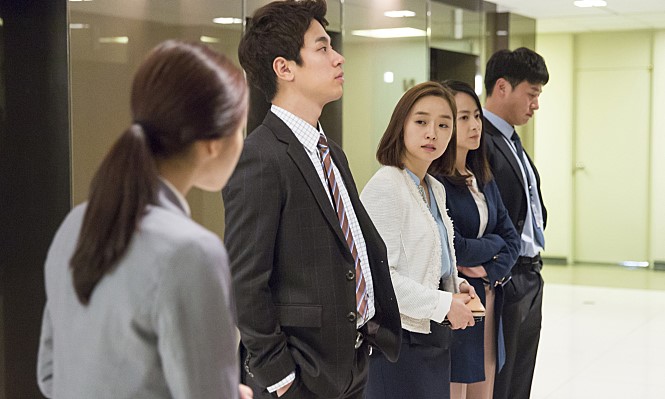
office01South Korean horror thriller film “Office” is scary when it deals with a ruthless corporate culture many South Korean people are familiar with. We frequently cringe at how the characters in the film often get themselves humiliated, and we are often chilled by how they allow themselves to be pushed and pressured in the name of raise and promotion. It is a jungle out there, and they must be willing to do anything as demanded from above just for getting ahead of others.

During the opening scene, we meet Kim Byeong-gook (Bae Seong-woo), a middle-aged family man who works as the manager of the sales department in a prominent corporation company. There is something ominous about his quiet, passive appearance as he is returning to his comfortable home, but his family does not suspect anything – even when he is standing behind them with a hammer in his hand.

In the next morning, everyone in his department is shocked by what Byeong-gook committed at last night, and two cops already come there for investigation. While their prime suspect is still missing, Jong-hoon (Park Seong-woong) and his partner interview each employee in the office about whether they noticed anything strange about Byeong-gook recently, but they do not get any useful clue about Byeong-gook’s motive behind killing his whole family. Everyone says he was a nice, quiet, and diligent man who had no particular trouble with others, and that is why this incident is all the more shocking to them.

In case of Lee Mi-rye (Ko Ah-seong, who previously appeared in Bong Joon-ho’s “Snowpiercer” (2013)), a young intern who usually looks a little too eager and nervous in front of others, she seems to know something else. Shortly after she hurriedly arrives in the office while being a little late for work due to traffic problem, she is surprised to find something inside her desk drawer, and it turns out that is not the only thing she would rather hide from the detectives. One of her seniors warns her in advance that she should keep her mouth shut about their boss, so she only says what others already said to Jong-hoon before, though he instinctively senses that she and others in the sales department did not tell everything to him.

office03Despite Byeong-gook’s murder, things go on as usual for Mi-rye and others in the office because, well, they have jobs to do. A routine meeting on their recent sales performance is turned into a grueling moment of insult and humiliation when the chief of their department bullies and scorches almost everyone in the meeting, and this seemingly mundane scene looks more grotesque as it is a dark and stormy afternoon outside. The chief makes it very clear to them that they must work harder for better sales performance, and everyone feels like being on the edge while trying to save each own position by any means necessary.

Meanwhile, it looks possible that Byeong-gook is hiding somewhere inside the office building. Not long after his murder, he was shot by a closed-circuit TV camera in the parking lot right below the building, and then he has never been witnessed since that point. It seems he has more work to do in his office, and that is certainly not a good thing to anyone who happens to work alone in the office during late hours.

Now this is a typical case of mad killer on the loose, so we are served with several scenes where characters feel like there is someone else besides them. While we can easily see that there will be surprises or shocks to jolt us during these scenes, the director Hong Won-chan, who previously handled the screenplays for “The Chaser” (2008) and “The Yellow Sea” (2010), knows how to generate the sense of dread and tension to hold our attention. In case of one terrifying moment unfolded within a toilet booth, we can only guess what may be behind the door as the level of suspense is increased, and then the movie strikes us with an expected moment of shock, which is clearly influenced by that infamous scene from “Psycho” (1960).

office02In the meantime, the movie gradually focuses on the realistic horror inside the harsh office environment which has been surrounding and suffocating Mi-rye. Feeling more nervous and alienated than before due to the absence of a man who was kind and generous to her before his bloody transgression, she later learns that her position in the office is not as stable as she once thought, and her senior employees do not help her much except a few casual advices. We later see her small residence outside Seoul, and its shabby appearance further emphasizes how desperately she has held onto her job. When she came to work in Seoul, she simply hoped for a good job and a nice life, but that simple wish looks like something beyond her reach now no matter how much she tries harder.

While Park Seong-woong holds the ground as a no-nonsense cop determined to track down his suspect, Ko Ah-seong is well-cast as an introverted heroine stuck at the bottom of office hierarchy, and Bae Seong-woo is disturbing enough to hover around the film even when he does not appear on the screen. Kim Ee-seong, who recently played a corrupt prosecutor in “Minority Opinion” (2013), is suitably despicable again here in this film, and Ryoo Hyeon-kyeong, Lee Chae-eun, Son Soo-hyeon, Park Jeong-min, and Oh Dae-hwa are a bunch of office lackeys who will not be safe from a murderous aura lurking around their office.

Although its climax part is a little too shaky mainly because of a number of contrivances which will test your tolerance of implausibility, “The Office” mostly works thanks to competent direction and good performances, and it also makes some biting points on the unpleasant aspects of South Korean corporate culture. As said in “Psycho”, people go a little mad sometimes, and you may say they have plenty of reasons for that in this case.

office05

Posted in Movies | Tagged , , , , , | 1 Comment

Cobain: Montage of Heck (2015) ☆☆☆1/2(3.5/4) : Inside Curt Cobain

kurtcobain04Since his tragic death in 1994, Curt Cobain has solidified his position as one of the legendary musicians during the 1990s. To be frank with you, I did not give much attention to his band Nirvana mainly because I was very young and more occupied with other things during that time, but I heard about him and his band like many others, and I was certainly familiar with that memorable album cover image of Nirvana’s second album “Nevermind”, though I have never considered listening to it yet.

So, I must admit to you that I do not know much about Cobain except a few bits of information about his problematic personal life and his iconic status, but I can tell you that HBO documentary “Cobain: Montage of Heck” is informative and compelling as closely looking into an artist who was clearly talented – and deeply troubled. The documentary draws an honest human portrayal which is alternatively revealing and harrowing with its absorbing mix of various archival materials, and it also gives us some valuable insights on the agony and the ecstasy during Cobain’s short career.

Cobain’s early childhood years in Aberdeen, Washington during the late 1960s were pretty simple and ordinary, and his parents reminisce about how bright and happy their son was during that period. While often hyperactive, he was a smart, sensitive kid with considerable potentials, and young Cobain’s perky appearance shown through their family photos and home movies makes a poignant contrast to his gloomy later years.

After his parents divorced when he was nine, Cobain, who was deeply hurt and shamed by this painful change as he often said to others, became a troublemaker bouncing around his parents and other family members. He soon experienced drug and alcohol during his wandering adolescent years, and one of his personal recordings candidly reveals one shameful sexual incident which is depicted through a moody but vivid animation sequence.

kurtcobain01That incident drove him to a suicidal attempt during one night, but he failed to kill himself by a lucky coincidence, and then he tried to move on with his own life as taking the first steps of his music career. Tracey Marander, who was his first girlfriend, tells us her story of their short relationship during the late 1980s. She was usually the one who took care of their financial hardships, and he mostly procrastinated while occasionally being focused on his music, but their relationship worked for a while. Around the time when things started to get better for Cobain and Nirvana, he and Marander eventually ended their relationship, but she has no hard feeling about that. She understood him well enough to live with him, and they just became estranged from each other somehow as he focused more on his music.

While Nirvana became a newcomer band to watch through the modest success of its first album “Bleach”, its second album “Nevermind” catapulted Cobain and Nirvana to instant stardom. Nirvana was soon regarded as “the flagship band of Generation X” by enthusiastic fans and critics, and Cobain suddenly became the representative of his generation, a burdensome position which he never wanted or dreamed of. When she listened to the recording tape of “Nevermind” before its release, Cobain’s mother instantly sensed what would happen next, and she warned her son: “You’re not ready for this.”

And he was indeed not ready for the fame he would have to deal with for the rest of his life. While very ambitious about his music and career, he was also quite sensitive about criticism. To make matters worse, he was still struggling with depression and heroin addiction. Quite frank about their addiction problem in the past, his wife Courtney Love tells us how they tried hard for their young daughter Frances, who was unfortunately born with drug-addicted condition but brought up fairly well by her flawed but sincere parents. As reflected by one embarrassing home movie footage scene, Cobain and Love were not exactly a model couple to say the least, but, as shown from their happy moments with their daughter, it did look possible that Cobain might attain the balance in his life through his family he deeply loved and cared about.

kurtcobain02Through the full cooperation of Love and other Cobain family members, the director Brett Morgen, who was Oscar-nominated for his documentary “On the Ropes” (1999), and his crew got a full access to the Cobain family archives as well as Cobain’s own personal records. Fluidly flowing around archival materials, interview clips, and animation sequences along with many of his famous songs on the soundtrack, the documentary is often revealing as showing how Cobain’s music was intertwined with his personal problems in many ways. Some of the animation sequences in the documentary, which are based on Cobain’s own words and sketches, are visually striking for their disturbing power, and they effectively convey to us his darkest moments full of despair and depression. Watching these moments, I could not help but think of a similar cri de cœur I experienced from Alan Parker’s “Pink Floyd: The Wall” (1982), a memorable musical film which brutally thrusts us into the disturbed mental state of a fictional popular rock musician as depressed as Cobain.

As his band member and close friend Krist Novoselic, who is now 50 along with his own career, points out at one point during his interview, Cobain had already been crying for help to others through his songs – and Novoselic and others close to Cobain see that more clearly now than before. Perhaps he could have gotten more help, but he kept going down toward the bottom of depression and addiction, and he eventually killed himself on April 5th, 1994, not long after his previous suicide attempt in Rome.

We can only imagine how much more Cobain could have achieved if he had avoided that tragedy, but he left a big indelible mark in the modern rock music history through his works, which will probably live far longer than him. “Cobain: Montage of Heck” did a heck of job in presenting his life and music with respect, honesty, and understanding while avoiding turning itself into a shallow hagiography, and it is a fabulous work to watch regardless of whether you are interested in Cobain’s music or not.

kurtcobain03

Posted in Movies | Tagged , , , | Leave a comment

10,000 km (2014) ☆☆☆1/2(3.5/4) : Separated by long distance

10000km04Spanish film “10,000 km” is about one relationship put under a difficult situation. They believe they can love each other enough for sacrifice and compromise demanded to them, but they only come to realize that their relationship is not as strong as they thought. They can talk with each other if they want, but they are always reminded of the long distance between them as looking at each other’s face in laptop monitor. Wholly limiting itself within the boundaries of their relationship, the movie works as a dense drama with interesting points on human relationship and online communication. We surely become more accessible to each other thanks to our advancing digital era, but does it really make us close to each other? And can love and affection be really sustained by online communication despite physical separation?

In the opening scene entirely consisting of an impressive long take fluidly handled for more than 20 minutes, we gather bits of background information about Alex (Natalia Tena) and Sergi (David Verdaguer) as they slowly begin another day after enjoying an early morning sex in the bedroom of their cozy flat in Barcelona. Living with each other for 7 years, they are pretty accustomed to each other’s presence, and they may move onto the next step of their relationship through having their child – and marriage, perhaps.

While Sergi works as a school teacher, Alex, a British woman who moved to Barcelona probably because of her relationship with Sergi, has been waiting for any good opportunity to advance her photographer career, and she finally gets a good news when she checks her e-mails as usual during this morning. A university offers her a job for some art project, and she will move to LA and live there for a year if she accepts the offer.

10000km03But there is one problem. Sergi cannot go with her because he is preparing for his appointment examination (he is not a full-time teacher yet), and that means she will have to go alone to LA while he will stay in Barcelona. Sergi is naturally not so pleased about that, and we see how they push and pull each other during their breakfast. He becomes sullen and disgruntled because she did not tell him anything about this before. She tries to placate him as he is about to walk out from the table. He relents a little, and then he eventually tells her that she should go to LA. As the camera keeps focusing on them in its seamless movement, the quiet but dynamic interaction between them feels palpable during this superlative long take scene, which would have no problem with being presented alone as a short film.

After Alex leaves for LA, the rest of the movie mostly focuses on how they try to stay in touch with each other through online communication. Living in a small but comfortable apartment alone, Alex shows him her new environment through the photos from Google Map, and Sergi coaches her cooking via Skype when she prepares a dinner for several colleagues she invites. At one point, they go into a naughty mode just for reminding that they are still a couple despite their changed circumstance.

We also see the strains in their relationship, which become more apparent day by day. Mainly because of time zone difference, their online correspondence becomes more burdensome to both of them. They are occupied more with each own business, and they accordingly feel more distant from each other. Sergi becomes moody and grouchy when he does not do well in his appointment examination, but all Alex can do for him is telling how sorry she feels about that. They gradually begin to have doubts on whether they can continue their relationship, and that is usually the point when couples begin to see more of the imperfections in their relationship.

While virtually having his film confined within two small separate indoor spaces, the director Carlos Marques-Marcet, who wrote the screenplay with his co-writer Clara Roquet, makes an interesting choice in his storytelling. We never see other characters besides Alex and Sergi, and the movie usually shows them communicating with each other using their laptops.

10000km02This austere approach could be tedious and lackadaisical in wrong hands, but Marques-Marcet and Roquet establish well their two characters right from the opening scene. Sergi and Alex are plain but distinctive characters to watch for their different personalities as well as the gradual changes in their relationship, and their online conversation scenes feel authentic and spontaneous along with small details and nuances to observe. There also are a number of clever scenes unfolded within their laptop monitors as they click or type, and I like one particularly moment when the movie switches from high-quality digital camera to low-quality webcam to signal the change in the mood during one of the crucial scenes in the film.

As the emotional center of the movie, Natalia Tena and David Verdaguer, who also provided additional dialogues for the film, are superb in their sensitive nuanced performances (Tena is probably more recognizable to you considering her recent appearances in late Harry Potter films and TV series “Game of Thrones”). Complementing well each other even when they are not together on the screen, Tena and Verdaguer did a commendable job of conveying the emotional bond between their characters, and they are especially good during one poignant scene accompanied with Alex and Sergi’s favorite song. Despite all the anger and frustration accumulated between them, Alex and Sergi see each other’s need to feel good and romantic again as before, and their faces are brightened for a while as they are swept along with their music.

Like many other couples, they eventually find that they must handle what has been changed in their relationship in one way or another, and the final scene of “10,000 km” leaves an ambiguous note as nothing is certain to both of them. They may make more compromise and sacrifice later, but are they willing to do for their love? They will soon see, regardless of whatever will happen next.

10000km01

Posted in Movies | Tagged , | 2 Comments