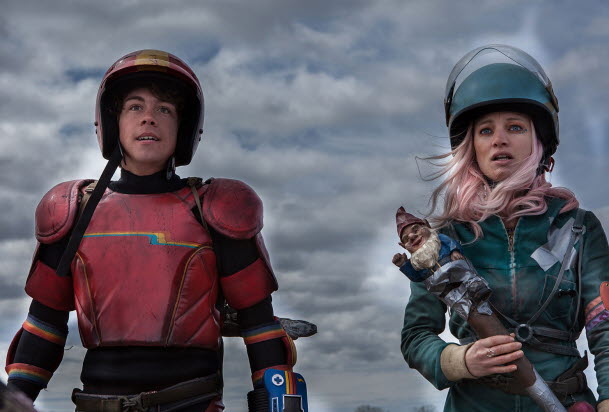
Turbo Kid (2015) ☆☆1/2(2.5/4) : Not for your kids, certainly

turbokid01“Turbo Kid” is a junk food packed with cheesy and hammy elements while cheerfully drenched in a nasty hot sauce of violence. It is goofy and amusing at times, but the movie eventually feels more like an expired one-note joke as spinning its wheels with more cheesiness and goriness to throw at us. You may appreciate the filmmaker’s enthusiasm behind the screen, but, unless you have some soft spots for those cheap SF adventure action flicks made during the 1980-90s or have some tolerance for various bloody ways of body mutilation, you will more likely cringe at it rather than laughing about it.

Right from its beginning, the movie feels authentically tacky with its notable old-fashioned details. Among so many logos of production companies shown before its first scene (please don’t ask me which one is real or not), there is the one clearly resembling that familiar logo of the Cannon Group, and we also get a typical prologue narration which briefly explains its post-apocalyptic background under a very, very serious tone just like those lesser imitators coming after the success of “Mad Max” (1979) and “The Terminator” (1984).

It is 1997 (no kidding), and the human civilization was collapsed by a nuclear war several years ago in this gray ‘futuristic’ dystopian world which actually looks like remote locations somewhere in Canada. The life is harsh and difficult for everyone in this world as they rummage for any useful or valuable scraps in their wasteland area, and clean water has been the most valuable commodity in their world.

As a cheesy synthesizer-dominated song which will definitely take you to the 1980s is loudly played over the main title scene, we meet our young hero who is simply named “The Kid” (Munro Chambers). While living alone in his private underground bunker where he has collected various remnants of human civilization like Wall-E, he goes around the surrounding area using his BMX bicycle, and he is ready to find anything valuable to be exchanged with a bottle of clean water or an old copy of his favorite comic book series “Turbo Rider”.

turbokid04His main dealer is Babu (Romano Orzari), and a shabby abandoned factory where Babu is doing his usual business are full of extras who mostly looks like costume party attendees despite their seemingly ragged and rusty attires. Among them is a tough cowboy guy named Frederick (Aaron Jeffery), and we see him doing his latest arm wrestling match with some other guy, which is accompanied with a considerable risk for each own right hand on the table.

Frederick has a brother who is also one of the members of his group, and that brother is killed by the brutal henchmen of Zeus (Michael Ironside), a sadistic gang leader who has dominated over the area and its people as firmly holding his source of clean water. One of his henchmen particularly stands out with his menacing mask and rather awkward body movement, and I must warn you in advance that this mute guy has a very unpleasant of killing people using a lethal weapon attached to his left arm.

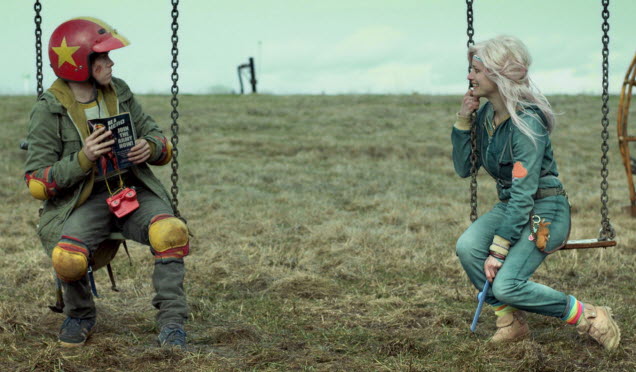
Meanwhile, our young hero come across two things to change his life forever. One is an odd girl named Apple (Laurence Leboeuf), and her loony perkiness certainly unnerves the Kid during their bizarre Meet Cute scene at an abandoned playground. She simply follows after him just because she wants to be at his service as his companion, and you will probably not be surprised when the Kidd comes to know a lot more about her later in the story.

The other one is a special power suit the Kid happens to discover within a mysterious aircraft which has been hidden under the ground for many years since its crash. Thanks to his favourite comic book series, the Kid instantly recognizes what it is. The left glove of the suit is attached with something you have probably seen from many old SF movies, and the Kid soon beholds what he can do with it during his first trial, though it frequently needs to be recharged.

turbokid02It will not be a spoiler to tell you that the Kid, Apple, and Frederic eventually stick together to fight against Zeus and his gangs, and the co-directors/co-writers François Simard, Anouk Whissell, and Yoann-Karl Whissell, who developed their debut feature film from their 2011 short film “T Is for Turbo” (they also appeared as minor supporting characters in the film, by the way), wildly wield the absurd moments of action and violence as maintaining the deliberately cheesy mood in their film. I was especially tickled by its goofy touch involved with BMX bicycles which happen to be the most common vehicles for both good and bad guys in the film, and how the movie uses them for action scenes is its another funny aspect to notice. The actors keep their performances straight to the materials they are supposed to deal with, and I liked the intentionally campy villain performance by Michael Ironside, a Canadian veteran actor who once played a vicious villain to be remembered for one hell of memorable exit in “Total Recall” (1990).

However, I got tired then as the movie kept going back and forth between its only two modes: very cheesy and very violent. You may go along well with those cheesy moments, but then there come lots of bloody moments where many characters including the Kid’s currently diseased parents are sliced or impaled or blasted or disemboweled in many imaginable ways to be admired by splatter horror fans. At one point, some unfortunate supporting character captured by Zeus is put under a gruesome situation in which his intestine is tightly connected to the rear wheel of a bicycle ready to be pedaled under Zeus’ order. During what is supposed to be a big climactic showdown, many guys are exploded like blood balloons, and we also get a man staggering with a number of sliced torsos stacked on him like a totem pole. In the other words, this movie is not for your kids, certainly.

“Turbo Kid” won the Audience Award in the midnight section at the SXSW film festival early in this year, and it also won the Best Director Award when it was shown at the Puchon International Fantastic Film Festival in South Korea during this summer. I could see how it appeals to some audiences as a cult favorite, but, seriously, it could have had more than those bloody guts for transcending its genre trappings.
turbokid03

Posted in Movies | Tagged , , | Leave a comment

Danny Collins (2015) ☆☆☆(3/4): A turning point belatedly coming to him

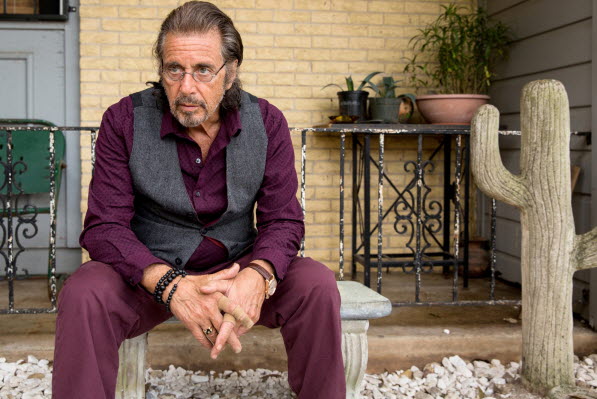
dannycollins02“Danny Collins” is the third Al Pacino movie I watched in this year, and it is easily the best of the bunch. While other two films “The Humbling” (2014) and “Manglehorn” (2014) were disappointing misfires despite his efforts, Pacino gives one of his better performances here in “Danny Collins”, a formulaic but ultimately sweet comedy drama about an aging musician at a belated turning point.

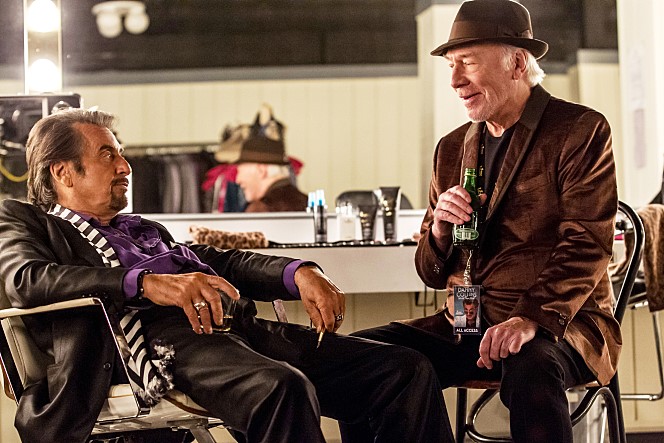
When he began his music career during the 1970s, Danny Collins, played by Eric Schneider during the opening scene and then Pacino after that, was a rising new talent to notice, and he soon attained more fame and success as everyone predicted at that time. 40 years have passed since that, but he is still popular enough to be recognized by others, and he has been comfortably coasting along on his fame and success. With the assistance of his manager Frank Grubman (Christopher Plummer), he dutifully goes through his routine concert tours, and all he has to do is performing his old popular songs as wanted by his many fans, most of whom are as old as he is now.

However, like many other old guys who become more aware of long years behind them, he begins to feel unsatisfied with his luxurious (and hedonistic) lifestyle he has been leading for many years – especially when he comes to learn on his birthday that John Lennon sent a personal letter to him after reading an interview article on Collins. Reading the letter belatedly delivered to him, Collins begins to wonder about how things could have turned out to be different if he had received that encouraging letter at that time, and, yes, that iconic song by Lennon is played over the scene as Collins pensively looks around his big residence in the aftermath of his wild birthday party (As jockingly recognized at the beginning of the film and then shown further during its end credits, this premise is partially inspired by a real-life incident; Lennon wrote a letter of support and encouragement to young British musician Steve Tilston in 1971, but Tilston himself learned about the letter only after being approached by a collector in 2005).

dannycollins04Eventually, Collins decides to pull up himself for a change. He temporarily stops doing concert tours to Frank’s dismay, he walks out of his big mansion where he has lived with his young new wife (she is No.4, by the way), and he travels to New Jersey for concentrating on resuming his songwriting while visiting his son he has not met for years. Tom (Bobby Cannavale), who has led an ordinary family life with his pregnant wife and their hyperactive daughter, understandably does not welcome his prodigal father at all, but he cannot stop him from approaching to his family. After all, how can he refuse an offer which will surely benefit his precious daughter?

Meanwhile, there comes the possibility of new romance to Collins. During his stay at a nearby Hilton hotel, he comes across Mary Sinclair (Annette Bening), the no-nonsense hotel manager who is not as thrilled to meet Collins as others in the hotel. Something clicks between them as they spend more time with each other, and it looks like she can be the one with whom he begins the new chapter of his life – if he is really committed to his initial decision.

Although the story takes a couple of conventional plot turns during the second half of the film, the first-time director Dan Fogelman, who previously wrote the screenplays for “Tangled” (2010) and “Crazy, Stupid, Love” (2011), pays attention to small, intimate moments between his well-defined characters, and his screenplay balances itself well between humor and drama even when the characters’ situation becomes more serious after a certain plot point. While Lennon’s songs are prominently played on the soundtrack, “Hey Baby Doll” and “Don’t Look Down”, which were specially written for the film as Collins’s two different songs, are effective used in the film with their contrasting impressions.

dannycollins03As far as I remember, this is the first time we see Pacino playing a singer on the screen. While he does not sing as much as you might expect, I can tell you that he looks as good as his character is supposed to be on the stage. He is perfectly cast as a vain but vulnerable man who wants to regain what he lost years ago, and his likable performance engages us as equally revealing Collins’s better and worse sides. Collins is indeed sincere in his quest for restart and redemption, but he is still a selfish star driven by his ego and insecurity, and that is why we are not so surprised by his sudden change of mind right before one crucial moment which may determine the rest of his career.

Pacino is surrounded by good supporting actors who bring considerable humor and warmth to their respective characters we come to care about as much as Collins. As the potential love interest in the film, Annette Bening has a nice understated chemistry with Pacino during their scenes, and Jennifer Garner gives a warm, gentle performance as Tom’s pregnant wife. Christopher Plummer, a great actor as legendary as Pacino, effortlessly steals the show as Collins’s loyal manager, and Bobby Cannavale has a very poignant moment when his character has to hide something from his loving family he deeply cares about. Young actress Giselle Eisenberg also holds her own small place well among her adult co-starts, and she looks natural even when her character is in her usual hyperactive mode which would overwhelm any good parents.

“Danny Collins” is an entertaining movie both funny and touching, and I enjoyed watching Pacino trying something different with gusto. Like Robert De Niro, he made several regrettable career choices during recent years (remember “Gigli” (2003) and “Jack and Jill” (2011)?) but he has kept working like a trouper, and there were indeed notable career highlights such as the Emmy-winning performances in “Angels in America” (2003) and “You Don’t Know Jack” (2010). “Danny Collins” may be a lightweight stuff compared to them, but Pacino is a lot of fun while bringing a touch of class to the film, and that is more than enough for us.

dannycollins05

Posted in Movies | Tagged , , , , | Leave a comment

Manglehorn (2014) ☆☆(2/4) : Pacino stuck in an uneventful dud

manglehorn01“Manglehorn” is an uneventful dud which is all the more disappointing when you consider the talents behind it. The movie is intended as a low-key character drama driven by small moments, but it is hopelessly uneven and tedious in its aimless narrative, and its good actors mostly struggle hard to make their cardboard characters look believable on the screen. While it has a few good scenes to notice, they only remind us of how it could been better with more flesh and blood to give any recognizable sense of life to its story and characters.

Al Pacino, who looks as shaggy and tired as he did in “The Humbling” (2014), plays A.J. Manglehorn, an old locksmith who lives alone with his precious cat in some small town of Texas. He was once married, but we do not learn much about his married life or his wife who is no longer with him, and he has been estranged from his son Jacob (Chris Messina) for years, though he is on good terms with Jacob’s young daughter Kylie (Skylar Gasper).

Manglehorn frequently writes letters to a woman who was probably the only true love of his life, but he always finds his letters sent back to his home. This looks sad at first as his letters being read by Pacino on the soundtrack, but the movie does not tell us anything about who she was or how their relationship was in the past, except that he is still yearning for any reply from her even after many years. As we see more of him checking his mailbox, his stubborn act of writing letters looks more like something as abstract and symbolic as waiting for Godot, rather than a recognizable human behavior we can identify with.

manglehorn02When he is not at his home, Manglehorn usually goes through his mundane work routine, and he does not have many people around him besides his son and granddaughter. Gary (Harmony Korine), who was a schoolmate of his son, looks like a sort of friend to him, and he gladly takes Manglehorn to a local nightclub for some fun, but this self-absorbed doofus is more occupied with his seedy tanning/massage business. Manglehorn’s face is brightened up a bit more than usual whenever he goes to a local bank and talks with one of the employees, but he and Dawn (Holly Hunter) have been so far no more than good friends although she is very willing to come closer to him if he wants.

While Manglehorn hesitates about what may lead to his first serious relationship after so many lonely years of anger and depression, the movie often sways with a handful of offbeat touches including a growing bee hive below Manglehorn’s mailbox or a surreal scene involved with multiple vehicle crashes on the road. There is also a brief unexpected moment of romance in the middle of one scene at the bank, and we cannot help but be curious about two minor characters who openly confirm their genuine affection to each other in front of others.

Unfortunately, Paul Logan’s screenplay is too clumsy and lackadaisical to provide any solid emotional center to support these episodic moments and many others including a rather pointless sequence involved with the illness of Manglehorn’s cat. While he is not a particularly interesting person to watch as he usually looks glum and passive, we only come to get the sketchy depiction of what kind of a person Manglehorn is, and we do not get much understanding on what others see from him, either. There are a couple of scenes where other characters talk about his past, but they do not work at all because 1) we can clearly see that the movie is directly talking down to us through them and 2) these scenes do not add up much to the barebone characterization of its hero.

manglehorn04

In case of Al Pacino, he shows us how much he can be restrained in contrast to his operatic performances in “Scarface” (1983) and “Heat” (1995), but his efforts here in this film are not served well by its lifeless screenplay. Although I did not like “The Humbling” a lot, I could see that Pacino was having a little fun with his performance in that flawed film, and that was why the movie was mildly amusing to watch, if not good enough for recommendation. In case of “Manglehorn”, he merely plods along with its dull story while occasionally flexing his acting muscle whenever it is demanded, and that is not an interesting thing to watch at all.

Like Pacino, the other actors in the film are wasted in most cases. While Harmony Korine’s distracting performance may make some of you forgive Quentin Tarantino’s bumpy acting attempts, Chris Messina is stuck with bad dialogues in his scenes with Pacino, and it is really a shame to see Holly Hunter not utilized well in the film. During one scene in which her character realizes how much Manglehorn has been held by his memories of past, Hunter conveys well her character’s pain inadvertently caused by his bumbling insensitivity, and that moment is a good example of what talented actors can do even if they are trapped inside bad films.

The movie is directed by David Gordon Green, whose previous film “Joe” (2013) was one of the best films I saw in last year. After his impressive debut with “George Washington” (2000), Green quickly rose as one of the leading American independent filmmakers, but then he baffled us with disposable films like “The Sitter” (2011) and “Your Highness” (2011), which is still one of the most awful comedy films I have ever watched during recent years. I was certainly glad to see him back in his element with “Joe” and “Prince Avalanche” (2013), and that is why I felt quite depressed by his big failure in “Manglehorn”. I hope he will soon get back on the track as he did before.

manglehorn03

Posted in Movies | Tagged , , | Leave a comment

Everest (2015) ☆☆☆(3/4) : Into Thin Air

everest01Based on an infamous real-life disaster which happened on Mount Everest in May 1996, “Everest” attempts to tell a chilling story about how everything went horribly wrong during that grim, horrifying moment of fear and chaos. Yes, they did know the risk of going into thin air from the very beginning, but then everyone became helpless and desperate as overwhelmed by the most unforgiving side of the mountain, regardless of how much they were prepared or experienced.

Since Edmund Hillary and Tenzing Norgay successfully climbed up to its summit during their historical expedition in 1953, Mount Everest has constantly drawn many other mountaineers as the highest mountain on the Earth, and, as told at the beginning of the film, commercial expeditions began around the early 1990s. After New Zealand mountaineer Rob Hall (Jason Clarke) took the first step into this new business area with his company Adventure Consultants, other mountaineering experts including Scott Fischer (Jake Gyllenhaal) soon followed after him, and the base camp of Mount Everest became crowded like a tourist spot despite hefty expedition fee.

At first, it just looks like another expedition to manage for Hall and his colleagues. While famous journalist Jon Krakauer (Michael Kelly) joins this expedition for his assignment from Outside Magazine, we also meet the other notable members of Hall’s group including Buck Weathers (Josh Brolin), Doug Hansen (John Hawkes), and Yasuko Namba (Naoko Mori), and we get to learn a bit about each own personal reason for this expedition during their journey to Everest Base Camp, which is located at the altitude of 5,364 meters (17,598 ft).

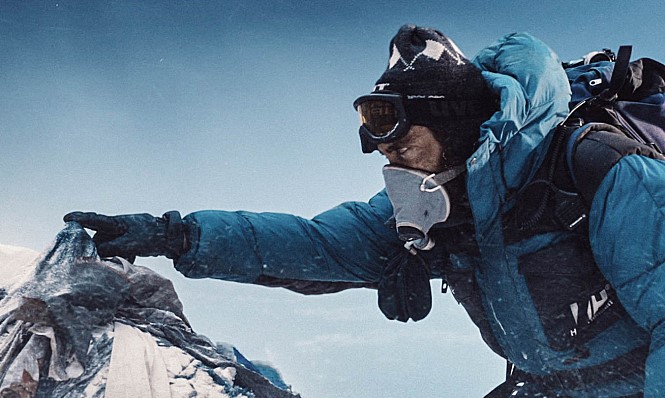
everest02As Hall’s group and other groups go through the preparation process, we see how demanding the climbing will be for most of them. While you can adapt your body condition to the low oxygen level in the air within several days, you will definitely need an oxygen tank once you climb above 6,000 meters (19,685 ft). Under this harsh condition coupled with a very high risk of hypothermia and hypoxia, even merely walking along the ridge requires a lot of will and strength from you, and you may become too dizzy and exhausted to go further even if you can see the summit not so far from you.

The situation turns out to be not very ideal for Hall’s group as well as other groups. Besides their considerably crowded base camp, there is also the unpredictable weather on Mount Everest, and it means there may not be enough chance for everyone at the base camp. When the weather finally becomes fine on May 10th, things look promising as Hall and his clients ready themselves for their big day, but then there come several complications including the unexpected long delay in the middle of their climbing. When Hall manages to take some of his clients to the summit and then finally begins his descent, he is already two hours behind the schedule.

Hall thinks he can handle this schedule problem as a well-experienced expert, but then the situation becomes quite worse as the base camp manager Helen Wilton (Emily Watson) has worried. The blizzard suddenly begins during the late afternoon, and all icy hell breaks loose upon everyone around the summit as a result. The weather becomes less hostile on the next day, but it is pretty clear to Wilton and others at the base camp that not all of their colleagues and clients will return.

Compared to the 1997 TV movie “Into Thin Air: Death on Everest”, which was based on the nonfiction novel of the same name written by Krakauer, “Everest” is surely superior on the technical levels as a major commercial film. While it certainly depends on CGI as much as location shooting, the director Baltasar Kormákur did a smooth job of mixing special effects and real landscapes on the screen, and the movie has some good tense moments which evoke my personal aversion to high places.

everest04However, the film feels thin in case of story and characterization like many other disaster movies. The screenplay by William Nicholson and Simon Beaufoy often loses its focus as going around various characters, and it is also not easy to distinguish one character from another especially during the climax part. Covered with snow and frostbite, most of the expedition members all look uniformly terrible and exhausted without much distinction, and we can only appreciate the efforts the actors and the crew members of the movie put into their difficult scenes.

Some of the cast members are more recognizable to us, but they are limited by the weak story as much as the other actors in the film. Jason Clarke, Josh Brolin, John Hawkes, Emily Watson, Michael Kelly, Sam Worthington, and Jake Gyllenhaal do whatever they can do with their colorless roles, and Robin Wright and Keira Knightley are unfortunately stuck with a quintessential case of thankless acting job we have seen many times before. As anxious wife characters, they usually hold their phones while fearing for the worst, and that is all they are required to do.

I recommend “Everest” mainly because I enjoyed its technical aspects, but I must also point out that it is not as good as that terrific book written by Krakauer or Kevin MacDonald’s great documentary “Touching the Void” (2003), which is about one legendary expedition on Siula Grande in the Peruvian Andes in 1985. That documentary terrified me a lot as the most vivid and harrowing mountaineering film I have ever seen. In case of “Everest”, it simply entertained me, and that was all.

Sidenote: I saw the film in 2D. As far as I could see, there was no need to watch it in 3D or IMAX.
everest03

Posted in Movies | Tagged , , , | 1 Comment

The Intern (2015) ☆☆1/2(2.5/4) : An old intern and his young boss

theintern01

“The Intern” is often warm and humorous, but I was constantly moving my judgement back and forth during my viewing. It goes without saying that its two talented lead performers are too good for the film, but I kept noticing how engaging they are as the human characters who deserve a better story with more edges and wits. The movie is not that good, but you may nearly forgive its flaws just because of how its lead performers diligently support it with each own star presence.

The movie begins with one of its two lead characters talking about his life during recent years. Ben Whitaker (Robert De Niro) is a retired phone book company executive entering the 70s, and we hear about how he has been spending his affluent retirement life which may make you wonder how much he actually earned during his work years. While his son happily settles in Seattle with his own family, Ben has lived alone in his posh upper middle-class house since his wife’s death, so he has tried several new things to enliven his rather uneventful daily life, but he still does not feel satisfied enough while looking for something more challenging to stimulate him.

On one day, Ben comes across the notice on the senior internship program of a rising e-commerce fashion company named About the Fit. While he has to learn several more things about the digital age he is not wholly familiar with, he soon makes a nice digital video file for his application, and he does not have much problem as going through a couple of interviews. He eventually begins to work at the company, and he is assigned to Jules Ostin (Anne Hathaway), the young founder/CEO of the company who is not that interested in her company’s special internship program intended as a community outreach for its Brooklyn neighbourhood.

theintern03Still amazed by how the Brooklyn neighbourhood he knew for many years has been rapidly gentrified, Ben gradually adapts himself to his new work environment. He may be an old-fashioned guy who still wears a tidy business suit at his work and also has to learn lots of things for working at an e-commerce company, but he knows a lot about how to handle small and big matters in the company as a resourceful man with experiences. Not so surprisingly, he quickly becomes everyone’s favorite employee in the company.

In case of Jules, it takes some time for her to see her new intern’s value because, well, she is constantly busy with her demanding business while facing a difficult moment of choice. Her investors recently suggest that she should bring in a more experienced CEO for the future of her expanding company, but she does not like the idea of someone else taking over the control of the company she is very proud of. She wants to keep running it as before, but she also knows well how frequently she has been absent to her young daughter Paige (Jojo Kushner), who has been taken care of by her generous husband Matt (Anders Holm) since he gave up his own career for his wife’s.

As Ben assists Jules in indirect or direct ways, he naturally becomes a valuable friend and adviser for her, and there is a nice moment when they happen to work alone in the office during one evening. As they have a private conversation accompanied with pizza, Jules comes to respect Ben more than before for his life experiences, and Ben equally admires Jules for how much she has accomplished even though she has just entered her 30s.

And it certainly helps that they are played by two very watchable actors. Although he is already past his prime period when he used to astound us with his great performances, Robert De Niro still can hold our attention as one of the best actors from his generation, and he wisely dials down his usual intensity for the role which could have gone to Dustin Hoffman. I think Hoffman could have been more effortless because he can play an ordinary guy more believably than De Niro, but De Niro is not bad in his dependable performance, and he has a number of good moments when his character subtly handles others around him while maintaining his humble position as usual.

theintern02In the opposite, Anne Hathaway gives a sunny, charming performance to balance De Niro’s low-key acting, though her character is ridden with those usual clichés we can expect from a working mother conflicted between work and family. While Jules’s strained relationship with her husband is the least convincing thing in the film, the movie curiously stays away from Jules’s meetings with possible CEO candidates, and how it eventually resolves these problems of hers in the end is too easy and safe to say the least.

The supporting performers surrounding De Niro and Hathaway do not have many things to do except providing occasional laughs from time to time. While Andrew Rannells is Jules’ sassy right-hand guy, Adam DeVine, Zack Pearlman, and Jason Orley are a trio of goofy office workers who come to assist Ben during one silly sequence involved with their attempt to break into a certain suburban house, and Rene Russo, who was excellent in her supporting turn in “Nightcrawler” (2014), is under-utilized as an office masseuse who gives Ben something he will not easily forget.

Since her Best Screenplay Oscar nomination for “Private Benjamin” (1980), the director/writer Nancy Myers has steadily written or directed notable lightweight comedy films for many years. I enjoyed those hilarious moments of “Something’s Gotta Give” (2003), but I was merely amused at times by “It’s Complicated” (2009), and “The Intern” is somewhere between them. It is not entirely bad thanks to De Niro and Hathaway, but, overall, this is a mild comedy film without much impression left behind it.

theintern04

Posted in Movies | Tagged , , , | Leave a comment

Right Now, Wrong Then (2015) ☆☆☆1/2 (3.5/4): Or Vice Versa

rightnowwrongthen01South Korean film “Right Now, Wrong Then” is another small piece of delight and amusement from Hong Sang-soo, one of the most prolific filmmakers in South Korea. Like Woody Allen, he makes one or two films per year, and watching his latest work has been sort of an annual event for me and other South Korean audiences. We always anticipate what we will get from him every year, and his small human comedy usually tickles us while reminding us again of how men can look silly sometimes – especially when they are accompanied with drinks and, yes, women.

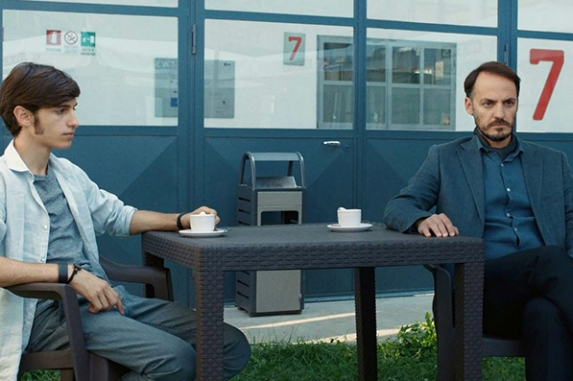
The movie is about two days mainly viewed through Cheon-soo (Jeong Jae-yeong), a filmmaker with several films in his established career. He comes to Suwon for the screening of one of his movies, but he happens to arrive in Suwon a day earlier than scheduled, so he has some free time for himself before going back to a motel later.

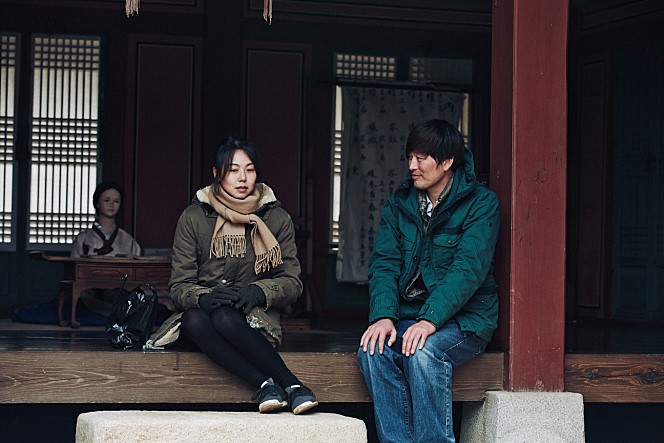
The opening scene shows him noticing a pretty young woman entering a restored palace before him, and he encounters her later when he is having a quiet rest inside the palace. Their initial interaction is a bit awkward, but they get to know about each other bit by bit after their formal introduction. Her name is Hee-jeong (Kim Min-hee), and Cheon-soo is clearly smitten with Hee-jeong. He says she is pretty, and she looks flattered to hear that from a well-known movie director like him.

After they leave the palace together, they go to her studio, and she gladly shows him her latest painting as she is working on it. He only throws some shallow praises to her painting just for getting more esteem from her, but she is oblivious to that as feeling more attracted to him, so they come to spend more time with each other while having a dinner at a nearby sushi restaurant.

rightnowwrongthen02Like many characters of Hong’s films, they drink soju as further softening the mood between them, and this long conversation scene feels fluid and spontaneous as Hong’s two lead performers do a lot more than looking drunk enough on the screen. As some of you know well, the performers in Hong’s films actually drink for their drinking scenes, and it should be pointed out that Jeong Jae-yong and Kim Min-hee hit the right notes together with their drunken chemistry to generate small chuckles for us (I have no idea on what will happen if Hong’s lead performer belatedly turns out to be a recovering alcoholic right before the shooting of his drinking scene).

Cheon-soo and Hee-jeong’s drinking hour is continued when she gets a call from her friends waiting for her at a small local cafe named Poet and Farmer. Yeong-sil (Seo Yeong-hwa) and Soo-yeong (Choi Hwa-jeong) are eager to have a conversation with Cheon-soo while drinking along with him and Hee-jeong, and that is when Hee-jeong begins to realize how superficial and insincere Cheon-soo has been to her. As her friends keep talking with him, the camera slowly focuses on Hee-jeong’s face, and Kim ably conveys the quiet but palpable shift in her character’s mind.

The night eventually ends as Hee-jeong walks back to her home alone while her mother is waiting for her. On the next day, we see Cheon-soo at the end of the Q&A session with a local movie critic. When the critics asks him a rather banal question, Cheon-soo is so annoyed that he gives a little too petty and aggressive response right in front of the audiences, but it is pretty clear to us that he does not know better than anyone in the room, and that becomes another amusing moment in the movie.

As previously he did in “The Day He Arrives” (2011), “In Another Country” (2012), “Nobody’s Daughter Haewon” (2013), “Our Sunhi” (2013), and “Hill of Freedom” (2014), Hong cheerfully plays with repetitive narrative elements again here in this film, and its second half gives us what is essentially the alternative version of what we saw during its first half. Again, the story begins with the accidental meeting between Cheon-soo and Hee-jeong at the palace, and then they go to her studio as shown before, but then we begin to notice different things here and there.

rightnowwrongthen03The plot still moves around the same other places under the same mood, but what happens between the characters looks and feels different in comparison to the first half. Cheon-soo is relatively more honest and sincere to Hee-jeong in this time, but, besides his current status as a married man, he feels frustrated about his inability to express his growing feeling toward her, and there is a hilarious moment when he does a very embarrassing thing in front of ladies while being, of course, pretty drunk.

Regardless of how these two different versions are related to each other, “Right Now, Wrong Then” is a witty comedy film wryly musing on how our life can go differently through small choices and moments even during a short period of time, and there are many things to savor in this film. While he has made his works on small budget, Hong can draw notable South Korean actors to his project as one of the most acclaimed South Korean filmmakers, and it is certainly a pleasure to watch Ki Joo-bong, Yoon Yeo-jeong, Yoo Joon-sang, and Ko Ah-seong in small but effective supporting roles.

As I said before, it took some time for me to get accustomed to Hong Sang-soo’s films, but I eventually began to like his films around the time when “Hahaha” (2010) and “Oki’s Movie” (2010) were released to change my opinion on his films. If you are still baffled or bored by Hong’s movies like I was, maybe you don’t have to watch “Right Now, Wrong Then”, but then you will miss what is possibly the wittiest South Korean film from this year.

rightnowwrongthen04

Posted in Movies | Tagged , , | Leave a comment

The Salt of the Earth (2014) ☆☆☆1/2(3.5/4): A photojournalist’s life journey

thesaltofthearth02

There are unforgettable moments to mesmerize you in Oscar-nominated documentary “The Salt of the Earth”, a compelling look into the life journey of one photojournalist who have captured various sights and people on his camera for many years. As the highlights of his long, illustrious career are vividly presented through his photographs as well as his own words, we come to see a wise, intelligent man who were deeply affected by what he had witnessed through his camera lens, and it is all the more touching to see how he later moved onto another new chapter of his life and carrier along with the hope for the better world.

At the beginning, we see a number of photographs shot at Serra Pelada, a massive gold mine in Brazil. This place was one of the memorable sights in Godfrey Reggio’s documentary “Powaqqatsi” (1988), and the photographs in “The Salt of the Earth” are also vivid in their visual presentation of the mine and its countless workers. We notice thousands of laborers climbing up and down along those steep slides of the mine, and they often look like tiny ants within the vast scale of the mine. Coming from different places and classes, these people all hoped for finding gold someday, and they kept working hard no matter how grueling their work environment was – and no matter how slim the chance of fortune was for them.

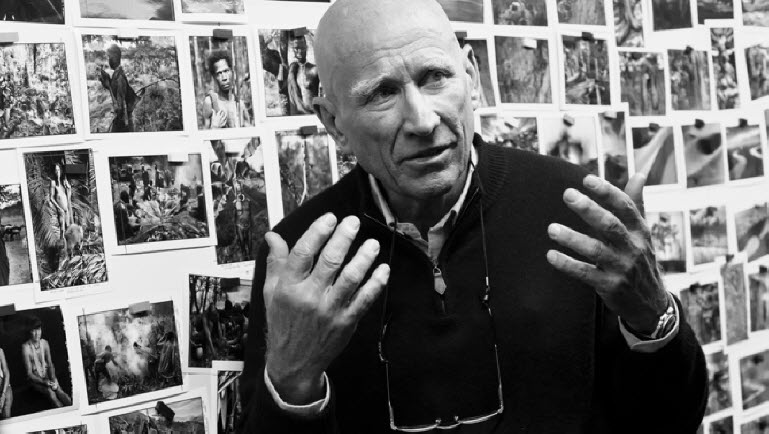
These photographs were shot by a renowned photojournalist Sebastião Salgado, and we are told about his early life in Aimorés, Brazil. Although he was not a very good student during his childhood years, he managed to get a chance to go to São Paulo for higher education, and he got a master’s degree in economics from the University of São Paulo several years later. He initially worked as an economist for the International Coffee Organization, and then he later worked for the World Bank after he and his wife Lélia moved to Paris mainly because of the military dictatorship in Brazil.

thesaltofthearth04As he went around Africa during his business trips, he began to have an interest in photography, and he eventually quitted his lucrative job to pursue the career of a professional photographer. With his wife’s support, he worked around here and there until he finally got a chance to launch his first photography project, “The Other Americas” (1977-1984). He went around many remote places in Latin America, and Salgado reminisces about a few episodes he experienced during that period as looking at those wonderful photographs shot through his considerable investment of time and efforts. Even after more than 30 years, they are still imbued with the palpable sense of life and place, and we cannot help but be curious about the people shown in the photographs as also observing their worlds.

As he continued his work in the following projects including “Sahel” (1984-1986), “Workers” (1986-1991), and “Migrations” (1993-1999), Salgado was frequently absent at his home, and his son Juliano Ribeiro Salgado, who did the narration along with his co-director Wim Wenders in their film, recollects his old personal memories of his father. Although he was usually not there for Juliano or his younger brother afflicted with Down Syndrome, Juliano looked up to his father with respect none the less, and it is clear from this documentary film that his respect toward his father remains same as before. When his father recently went to the Arctic area for his latest project, Juliano and Wenders followed him for getting to know more about his work process, and there is an amusing moment in which they are unexpectedly delayed by one meddling polar bear.

And we look at more of Salgado’s photographs as he talks about how it was sometimes very difficult for him to face the dark sides of humanity during his work. His photographs shot at the refugee camps in Ethiopia during 1984 show us many despairing moments of famine, disease, and death, and it is often overwhelming to watch those bleak sights of human sufferings. Most of the people shown in the photographs are drained of life and hope in their thin, skeleton appearances, and one of the most heartbreaking photographs shows three small babies looking directly into the camera – and we learn that one of them was actually dying without any help at that time.
thesaltofthearth03Salgado flied to Kuwait right after watching the burning oil rigs on TV in early 1991, and the images he brought from the aftermath of the Gulf War are hellish to say the least. With the raging pillars of fire on the desert field and the extreme conditions workers had to deal with for extinguishing fires and stopping oil leaks, it almost looks like those post-apocalyptic worlds we have seen from SF movies, and Salgado’s photographs are undeniably powerful as the grim, devastating record of destruction and desolation like Werner Herzog’s documentary “Lessons from Darkness” (1992), which was also shot in Kuwait around the same time.

He also went around a number of conflict areas including Yugoslavia and Rwanda for photographing refugees fleeing for their life, and Salgado tells us how he was saddened by many painful moments of human tragedies he encountered and documented using his camera. As he strongly points out at one point during his interview, we human beings are not very decent animals in most cases; we are capable of heartless brutality and ignorance as shown from countless incidents throughout our history, and, sadly, that virulent trend is still being continued even at this point.

Nevertheless, Salgado did not resort to despair and resignation, and he came across another turning point for his life and career not long after he came back to his hometown. While trying to reforest the barren environment of his family farm, he found a new interest which led to the foundation of an environment organization by him and his wife, and then he embarked upon his new photography project with regained passion. Around the end of the documentary, we see how the area around his family farm looks far different than before as a result, and that is another moving moment in the film.

“The Salt of the Earth”, which received the Special Jury Prize in the Un Certain Regard section at the Cannes Film Festival in last year, is a captivating documentary to watch on the whole, and Wim Wenders and Juliano Ribeiro Salgado did a superlative job of presenting their subject with respect and care while earnestly presenting the deep humanity behind his photojournalistic works. Although he is currently 71, Salgado is still active at present, and he reminds me of the aging photographer hero of documentary film “Bill Cunningham New York” (2010). Both of these old men are quite dedicated to their profession, and they certainly love what they do with their cameras. I guess they will probably keep working as long as they can push camera button.

thesaltofthearth06

Posted in Movies | Tagged , , , | 2 Comments

La Sapienza (2014) ☆☆☆1/2(3.5/4): Of Architecture and Sapience

lasapienza01“La Sapienza” is a tranquil visual meditation on the art and philosophy of architecture. Whenever it calmly gazes upon those gorgeous architectural works shown on the screen, we cannot help but marvel at the sublime beauty felt from their spaces and structures as appreciating the fine details in their grand, ambitious designs. While the characters in the film are basically constructs for talking and discussing about metaphysical ideas including art, knowledge, spirituality, and existence, their conversations are interesting to listen none the less as we come to ponder more on its beautiful sights, and the movie is also humorous at times even though it keeps its face straight just like its utterly serious characters.

As the opening scene looks around the urban landscapes of a modern city, we are introduced to Alexandre Schmidt (Fabrizio Rongione), a middle-aged architect at the peak of his career. He has just received an industry award to honor his lifelong achievement, and his acceptance speech emphasizes on how he has been sticking to his utilitarian philosophy with a touch of atheism throughout his esteemed career. He usually prefers to build more practical facilities like hospitals and factories, and he mentions during his speech that he once rejected a request for church design because it was against his longtime materialistic belief.

But he has recently felt hollow and dissatisfied with his career which seems to be going nowhere. When he has a meeting with his latest client, he becomes frustrated as the client demands more compromises on the initial design he would rather want to keep intact. He and his social psychologist wife Aliénor (Christelle Prot Landman) mostly look fine when they are together, but we feel the mood of distance between them as they dryly interact with each other in their comfortable but sterile apartment.

Along with his wife, Alexandre decides to take a trip to refresh his mind – and their relationship, perhaps. Travelling around Switzerland and Italy, they are going to look around a number of famous architectural works built during the Roman Baroque period of the 17th century, and their trip starts with the southern Switzerland town which was the birthplace of Francesco Borromini, one of the leading Italian architects active during that period.

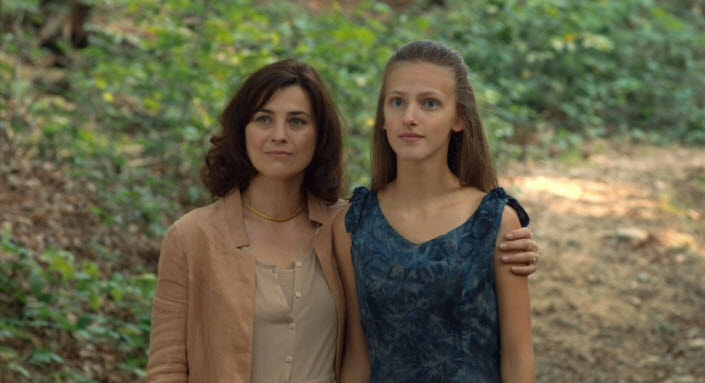
lasapienza02While they spend some time in Stresa, a small town on the shores of Lake Maggiore in northern Italy, Alexandre and Aliénor happen to encounter young siblings named Goffredo (Ludovico Succio) and Laviana (Arianna Nastro). Goffredo is aspiring to be an architect someday while preparing for his college education in Venice, and Lavinia is a fragile but lively girl who has spent most of her life at their home due to her ill health. They look happy together, but they will soon be separated from each other due to Goffredo’s upcoming departure to Venice, and we learn later that this change is particularly difficult for Goffredo, who cares a lot about his sister’s welfare as her dear brother.

After spending more time with Goffredo and Lavinia and then learning about Goffredo’s youthful passion on architecture, Aliénor persuades her husband to take Goffredo instead of her during the rest of the trip. While she hangs around Lavinia, Alexandre continues the trip along with Goffredo, who is certainly pleased to have such a fantastic opportunity like this thanks to his accidental friends.

Before going to Rome, Alexandre and Goffredo drop by Turin first, and they go to the Royal Church of San Lorenzo, whose architectural design by Guarino Guarini was considerably influenced from Borromini. As they walk around inside the church, Alexandre duly imparts the background knowledge of this lovely place to Goffredo as a knowledgeable and experienced professional, and they soon look upon that beautiful cupola right above them. After they leave the scene, the camera slowly pans up and down to convey us the sense of mood and space around the cupola, and we come to admire its intricate and delicate design to evoke something divine and heavenly.

As they go around several places in Rome including Borromini’s masterpiece Sant’Ivo alla Sapienza, we observe more of the apparent contrast between Goffredo and Alexandre. While Goffredo learns many things from Alexandre, Goffredo’s hopeful, idealistic attitude inspires Alexandre along with those old buildings still exuding their beauty and grandeur even after so many years, and he slowly begins to open his eyes to what he has overlooked as blindingly pushing his utilitarian philosophy. Spending more time with Laviana in Stresa, Aliénor also starts to be influenced by Laviana’s radiating pluckiness, and she feels more warmed and brightened than before as getting to know more about her young friend.

la-sapienza-2014-eugene-green-03

While this is essentially a typical tale about the journey of self-discovery, the director/writer Eugène Green, an American filmmaker who has lived in France for almost 40 years as a naturalized citizen, made odd, interesting choices in his movie. While his cinematographer Raphaël O’Byrne shot many scenes with static but precise compositions to be noticed, Green has his actors deliver their lines rather monotonously in their mannered performance, and this unorthodox approach sometimes generates unexpected moments of humor, which usually keep the film from being a dull, ponderous exercise on ideas and sceneries. There is a droll moment when Alexandre and Goffredo are invited to have a dinner with a group of superficial guests entangled in very complicated relationships among them, and then we are tickled by a funny scene involved with the stubborn concierge of Sant’Ivo alla Sapienza and one exasperated foreign tourist. Green briefly appears as a strange refugee Aliénor meets during one night, and this is still as amusing as I remember from the screening at the Jeonju International Film Festival in May 2015.

Because my condition was not particularly good when I watched “La Sapienza” for the first time at the 2015 JIFF, I was not quite sure about whether I understood it, though I did have a good time with it in spite of my sleepy condition. When I revisited it recently for this review, I was reconfirmed of my initial impression, and I found myself still enjoying its best scenes including the theatrically imagined sequence which brings a moment of artistic epiphany onto Alexandre.

Because of its slow, meditative tempo, “La Sapienza” probably requires some patience from you but it is a very rewarding experience coupled with interesting ideas and fabulous sights. Sometimes you can learn new things from old things, and you will agree to that when the movie finally arrives at its destination along with its characters. They did learn something new in each own way in the end, and now they can move on – with light and love to illuminate whatever is ahead of them.

lasapienza03

Posted in Movies | Tagged , , | Leave a comment

The Throne (2015) ☆☆1/2 (2.5/4) : A royal domestic problem beyond control

thethrone05What drove them to such an extreme circumstance like that? South Korean period drama “The Throne”, which was recently chosen as South Korea’s entry for the Best Foreign Language Film at the Academy Awards in the next year, attempts to understand both sides while humanizing its two opposing main characters, but it never gives us a plausible explanation on the insanity of the tragic outcome of their messy conflict. After all, how many fathers can force their sons to be incarcerated and starved for days in front of others, unless either of them are driven by power and madness?

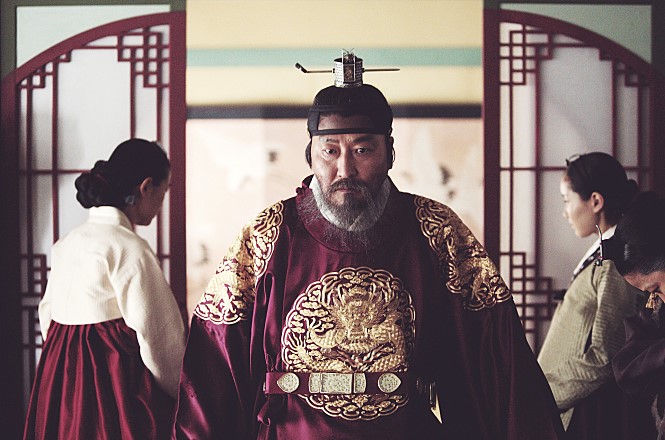
I and most of South Koreans are very familiar with its subject mainly through “The Memoirs of Lady Hyegyeong”, which was written by Lady Hyegyeong herself during 1795-1805. In July 1762, the long personal conflict between her husband Crown Prince Sado (Yoo Ah-In) and his father King Yeongjo of the Joseon dynasty (Song Kang-ho) became far more serious than ever, so the king eventually decided to take a very drastic measure for solving his meddling domestic problem once for all, and its devastating consequence affected not only themselves but also many others who unfortunately happened to be around them.

The movie begins around the point when the King Yeongjo made that fateful decision on the crown prince. After learning of how far his troubling son has gone, the king calls for his son on the next day, and then he sternly accuses his son of treason. As one of the king’s ministers cynically points out to his colleague, the king is not allowed to execute his son according to the law of his kingdom, so he instead gets his son imprisoned inside a rice chest in the middle of the palace courtyard, while forbidding everyone to help the crown prince.

The movie goes back and forth between the slow, grueling process of this cruel punishment and a number of flashback sequences showing the long past between the king and the crown prince. At the beginning, everything seemed to be all right for them; the crown prince already showed his brightness even when he was a little kid, and his father could not be prouder of his son – especially when the young crown prince answered well to his teachers in front of the king and his ministers.

thethrone01

Like many Asian parents, the king begins to expect more from his bright son as he grows up. Besides personally preparing the textbooks for his son, he also demands a higher standard during his son’s next test. He sincerely wants his son to be wholly prepared for sitting on the throne someday, and he frequently reminds his son that he should study and learn more everyday.

After the crown prince finally enters adulthood, King Yeongjo thinks it is the time for his son to start the succession process. He has his son take the role of regency at first, but the process turns out to be not as smooth as he thought. Although the crown prince is able to hold his place with his father sitting right behind him, some of his decisions cause troubles among the competing political factions in the court, and he also feels pressured a lot whenever his father points out his errors during the court meetings.
We see their relationship being deteriorated in one way or another as their failure to communicate with each other is worsened. As they conflict more with each other, King Yeongjo comes to change his mind about his son’s succession, and now he begins to dote on his young grandson, who begins to show lots of potentials just like the crown prince did. As cornered by his stressful situation, the crown prince begins to show unhinged behaviors, and his wife Lady Hyegyeong (Moon Geun-yong) and others near him are disturbed to watch him going more out of control day by day.

thethrone02Meanwhile, we also see how that horrifying ordeal of the crown prince is approaching to the point of no return as he continues to cry for help inside the rice chest for several days. No one dares to help him because of the king’s decree, and even the tearful plea from the crown prince’s son cannot change the king’s adamant position.

While this unbelievably ghastly incident really happened as recorded in historical documents, it is somehow not really connected well with what has been built up during the rest of the film. The lead actors Song Gang-ho and Yoo Ah-In give engaging performances as a father and a son struggling in their strained relationship, but the movie is not very convincing in the depiction of their characters’ shocking eventual descent into madness. There is a sentimental scene around the finale where the king and the crown prince finally seem to have an honest conversation between them, and this is rather distracting if you objectively consider the sheer horror and madness of their circumstance, which also reminds us of many other horrendous incidents associated with royal families throughout the human history.

“The Throne” is directed by Lee Jook-ik, who previously made several notable South Korean period drama films including “Once Upon a Time in a Battlefield” (2003), “King and the Clown” (2005), “Blades of Blood” (2010), and “Battlefield Heroes” (2011). While the movie is a well-made one with solid performances and commendable production quality, I observed the story and characters from the distance without enough emotional involvement, and its long epilogue is particularly unnecessary because it exists only for drawing more tears from the audiences. I cannot wholly recommend it, but it might interest you as an interesting attempt to dramatize one of the infamous incidents in the 18th century Korean history.

thethrone03

Posted in Movies | Tagged , , , | 1 Comment

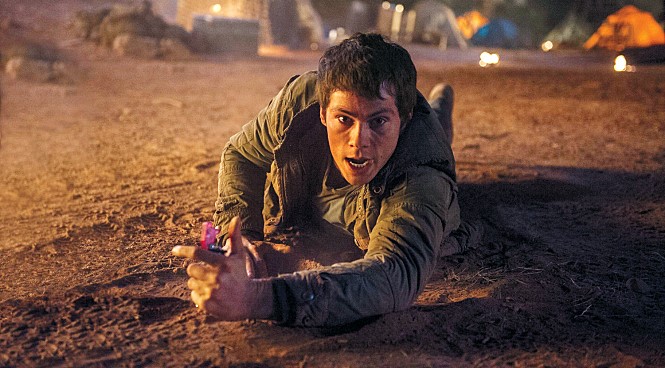
Maze Runner: the Scorch Trials (2015) ☆☆(2/4) : No maze in this time

mazerunnerscorchtrials02
“Maze Runner: the Scorch Trials” is the middling second chapter of the trilogy which merely promises the next sequel when it is finally over. While its predecessor showed some potentials with an interesting premise despite its flaws, the movie bores us with many familiar things we have already seen from other numerous movies based on young adult novels about dystopian futuristic world like “The Hunger Games” (2012), and I only looked at the screen with little interest as it trudged toward a mandatory cliffhanger finale a la “Empire Strikes Back” (1980).

In “The Maze Runner” (2014), we met a bunch of teenagers who happened to be trapped inside a huge complex maze for some unknown reason, and some of them managed to escape from the maze in the end while coming to learn about what had been actually going on beyond the maze. It turns out the human civilization was collapsed several years ago because of the global epidemic of a brain virus, and a powerful organization named W.C.K.D (World in Catastrophe: Killzone Experiment Department) has been trying find the cure for the disease by any means necessary. The people of W.C.K.D. are particularly interested in certain young people immune to the disease, and that was why Thomas (Dylan O’Brien) and other teenagers were locked inside the maze, though I still do not understand why the maze was necessary for their top-secret research from the very beginning.

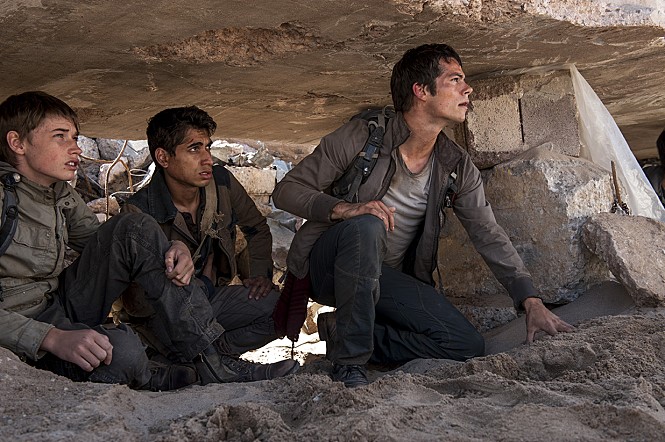
Anyway, Thomas and his colleagues are spirited off to some other place by a bunch of soldiers while not fully understanding the insidious master plan of W.C.K.D. for them. When they arrive at the military headquarters in the middle of your average post-apocalyptic desert landscape called the Scorch, they are greeted by a man named Janson (Aidan Gillen), and he assures them everything will be fine for them. In the headquarters, there are many other teenagers who were rescued from other mazes of W.C.K.D just like Thomas and his colleagues, and they have been waiting to be taken to a safer place somewhere outside the Scorch.

themazerunnerscorchtrial03Of course, Thomas begins to be suspicious about this especially after he meets Aris (Jacob Lofland), a nerdy boy who can sneak around the ventilator network inside the headquarters. When Janson and his soldiers eventually turn out to be not the people they are assumed to be (this is not a spoiler at all because it is already revealed in the trailer), Thomas instantly realizes that he and others must escape from the headquarters as soon as possible.

Once they manage to escape from Janson and begin their difficult journey across the Scorch, the movie gives us more of what was glimpsed briefly during the finale of the previous film. We see a city full of the decaying remnants of human civilization, we behold the wide, barren landscapes to dwarf our teenager characters on the screen, and we also meet several groups of survivors including a rebel group which may protect and Thomas and others from W.C.K.D.

And there are a bunch of virus-infected people called Cranks, who are, yes, pretty much like those hideous zombies we saw from “28 Days Later…” (2002). Cranks shriek a lot as dashing fast toward whoever happens to draw their attention, and it certainly helps that our young characters practiced a lot in advance as runners in the previous film. As they run here and there as fast as they can around dark places, we get choppy action sequences coupled with dizzy camera work, and we often do not understand well what is going on the screen as the movie keeps running and jumping to next action shots.

themazerunnerscorchtrial01The movie merely plods around its plot points without much impact, and it is also hampered by its weak characterization. While Dylan O’Brien gets a thankless job of playing the bland archetype hero who will be destined to change his dystopian world, the other young performers around him including Kaya Scodelarios and Thomas Brodie-Sangster do not have many things to do while managing to be distinguishable from each other thanks to the multi-racial casting.

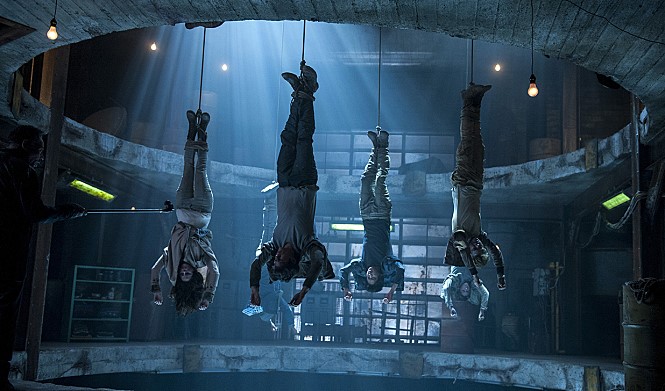
In case of the other actors in the film, they fill their flat characters as demanded while taking their paychecks. While it is nice to see Patricia Clarkson again, her talent is wasted again as before, and Aiden Gillen is suitably cast in his role as reminding some of you of his nefarious character in TV series “Game of Thrones”. Alan Tudyk briefly appears as the untrustworthy owner of a decadent nightclub located inside a shabby survivor community, Lily Taylor and Barry Pepper are two main members of the rebel group, and Giancarlo Esposito, who seems to be aging into the stage where he will take over the roles usually given to Morgan Freeman (can you believe that he was once a cocky loudmouth in “Do the Right Thing” (1989)?), is one of a few entertaining things in the film as a mercenary leader who turns out to be a better man than he seemed at first. As his daughter-like figure, Rosa Salazar also holds her own place, and she is believable during a tense moment when her character has to think and act fast on a cracking glass plate before she falls to the ground from high above.

Although I did not like “The Maze Runner” enough to recommend it, I was intrigued by its premise, and I hoped that they would make improvements in the next film. Unfortunately, “Maze Runner: the Scorch Trials” is a mediocre product which does not show anything I have not seen before, and it is not even good at handling its story and characters to engage us. They may get their groove back in the following sequel, but, at this moment, I do not expect much.
themazerunnerscorchtrial04

Posted in Movies | Tagged , | Leave a comment