The Advocate : A missing body (2015) ☆☆☆(3/4): A trouble with his case

theadvocate01South Korean film “The Advocate: A Missing Body”, which is released as “Angry Lawyer” in South Korea, feels like an expensive TV pilot episode right from its opening title scene. First, we are introduced to a hero with considerable reputation in his profession, and then we see how his life and career are turned upside down due to one tricky case – and how he comes to arrive at a turning point which will possibly lead to other interesting cases for him in the future.

Lee Seon-gyoon plays a hotshot lawyer named Byeon Ho-seong, whose name is probably a pun on “Byeonhosa” (it means lawyer in Korean). In the opening scene, he is handling a civil lawsuit against some powerful pharmaceutical corporation, and we see how this wily guy makes a successful defending argument for his wealthy client in the courtroom. He is interested only in protecting his client’s interest and winning the case, and he does not give a damn about whether a newly developed drug manufactured by his client has a serious side effect as claimed by the plaintiff lawyer. Even if that were true, he would then adjust it just for his win (and a big paycheck, of course)

Not long after his another success in the courtroom, there comes a case which initially looks pretty simple. Ho-seong is asked to defend a man who was recently arrested as the prime suspect of a brutal murder case, and he accepts this case as a favor to one of his clients although his new client seems guilty as charged by a young prosecutor who was once Ho-seong’s junior during his early years in the prosecution.

theadvocate02However, as looking more into the case, Ho-seong begins to see that he actually has a good chance for getting his new client acquitted. Along with his assistant, he searches for anything the police might have missed at the crime scene, and it turns out there are several things suspicious enough for reasonable doubts. Besides, there is one perplexing element in this case; the victim’s body was not found at the crime scene, and it has not been discovered yet, while the police only speculate that their prime suspect somehow took care of it before he hurriedly left the crime scene right in front of an eyewitness.

This is certainly an intriguing setting for courtroom mystery drama, but then the movie shifts its gear onto thriller mode once an unexpected thing happens during the trial. Angry and humiliated, Ho-seong is determined to dig deeper into the case, but then he comes to learn that his case is a lot more complicated than he thought. He soon finds himself pushed toward a dire circumstance with a very little chance of clean exit, and this may be the end of his career if he is not very careful about every move he is going to make.

As Ho-seong tries to find any possible way for getting out of his impossible situation, the screenplay by Choi Kwan-yeong and Lee Gong-joo maintains well its level of interest even when it becomes very predictable after Ho-seong makes a certain decision during its second half. The mystery in the film is solved a bit too early, but that moment, which clarifies many things in the story before it moves onto the next step, is accompanied with the satisfaction of a solved puzzle. While the movie lightens up its mood with some humor, we are constantly reminded of what is being at stake for Ho-seong and a few other characters in the film, and there are a couple of suspenseful moments when he must think and act fast within short time.
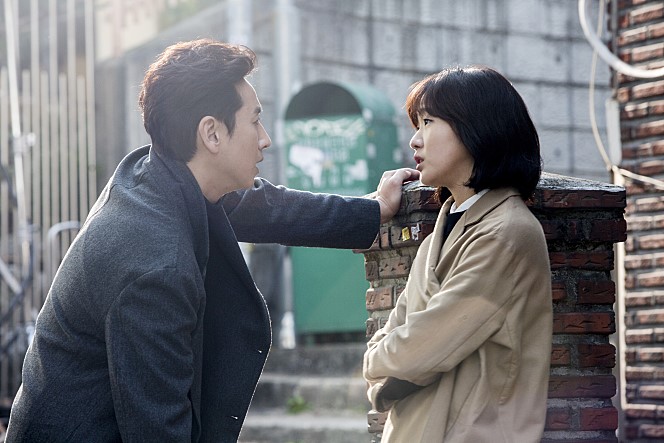
theadvocate03Since I came to notice his excellent performance in “Paju” (2009), Lee Seon-gyoon has steadily delivered solid performances in a number of recent South Korean films, and he is well-cast here as a slick, sardonic lawyer with some petty sides. Ho-seong frequently behaves like a selfish jerk, but he is a smart guy to watch as Lee imbues his character with personality and presence, and Lee is good especially when his character must depend solely on his wit. There is a tense sequence where Ho-seong must take care of an unconscious body before it is too late, and that reminds me of “A Hard Day” (2014), in which Lee plays a corrupt cop who attempts to hide a body as soon as possible for saving his position.

In case of the supporting performers revolving around Lee, they mostly fill their broad archetype characters who can easily be defined right from their first appearance, and some of them are relatively more notable in spite of their underdeveloped characters. While Kim Go-eun is a feisty female prosecutor determined to solve the case, Im Won-hee provides small moments for laughs as Ho-seong’s goofy but resourceful assistant with an unlikely background, and we may meet their characters again if a sequel happens to be made.

Compared to other similar films like “The Lincoln Lawyer” (2011), “The Advocate: A Missing Body” is less colorful and distinctive, but the director Heo Jong-ho did a fairly nice job of mixing different elements into a coherent package, and I enjoyed its clever moments along with Lee’s performance although I also found that it sometimes relies a little too much on contrived coincidences (Ho-seong’s plan during the climax part requires lots of luck and good timing beyond his control, for instance). It still looks like an average TV pilot episode on the whole, but it feels like a competent one none the less, with considerable potentials for next stories to follow. I do not know whether there will really be a sequel, but I’d love to see whether it will go further with the potentials glimpsed from this entertaining film.
theadvocate04

Posted in Movies | Tagged , , , | Leave a comment

The Visit (2015) ☆☆☆(3/4) : An odd, creepy week with grandparents

thevisit03“The Visit” is as good as its two main characters wish. They hope to shoot something special with their cameras, and then they sort of get their wish as they become more aware of a certain sinister undertone around their visiting place. While initially looking confined within the limits of its genre, “The Visit” has smart, effective ways for building up mood and suspense to engage us, and how it provides us some creepy fun with sly self-conscious winks is refreshing compared to those drab, solemn found footage horror movies woefully devoid of any sense of dread, let alone humor.

Its story is told entirely through the cameras belonging to two young siblings Rebecca (Olivia DeJonge) and Tyler (Ed Oxenbould), who are about to meet the family members they have never met before. Before they were born, their mother Paula (Kathryn Hahn) left her rural hometown in Pennsylvania, and it is implied that her parents were not very pleased about her relationship with a guy who is her ex-husband at present. During the interview with her mother, Rebecca asks Paula about what really happened between Paula and her parents, but her mother is not so willing to talk about it for some reason.

Anyway, Paula recently made a contact with her parents she never saw for 15 years, and her kids are going to spend a weak with their grandparents while she enjoys a cruise trip with her new boyfriend. Rebecca, a smart girl with aspiration for filmmaking, sees this as a great opportunity for her documentary project, and Tyler, a rambunctious but fastidious boy who wants to be a rapper someday, is eager to participate in his sister’s project mainly for getting a chance to be in front of the camera and show his rap talent (how he avoids using profanities as a character in the PG-13 rated film is one of the amusing things in the film, by the way).

thevisit01Shortly after their train arrives in the train station of their mother’s hometown, Rebecca and Tyler are welcomed by their grandparents John (Peter McRobbie) and Doris (Deanna Dunagan), who take their grandchildren to their cozy home located in a remote area. Although their cellular phones cannot get any signal in this area (this is not a good sign especially if you are in a horror film, you know), online communication is somehow available in the house, so Rebecca and Tyler can often talk with their mother using Skype.

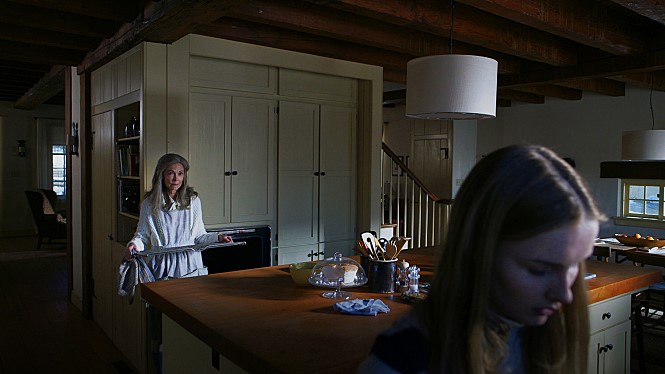
As they spend their first day at their grandparents’ home, it seems they will have a good time with their grandparents as their mother hopes, but then Rebecca and Tyler begin to sense something odd and weird about their grandparents. While she is gentle and cordial to her grandchildren, Doris frequently becomes erratic, and that disturbs her grandchildren more as they witness more of it. John calmly explains to his grandchildren that his wife is not very well, but then John does not look that well either while looking more suspicious in his behaviors. Why does he go to a shed outside the house so often? Why is she so adamant about not talking about her conflict with her daughter? And why don’t they go to a local hospital where they have worked as counselors for many years?

As Rebecca and Tyler feel more uncomfortable with their grandparents’ increasingly disturbing demeanors, we get a number of good scenes packed with a substantial amount of tension and dread on the screen. In case of one day scene unfolded within a shady mazy place, it is smoothly shifted from a harmless moment of prank to a frightening possibility of danger, and I also like how the movie effectively handles a certain repeated circumstance involved with strange noises heard inside the house during nighttime. There are also numerous false alarm moments as expected, but they mostly work without much distraction, and some of them are surprisingly humorous (I especially enjoyed a moment which is clearly influenced by one of Brothers Grimm’s fairy tales).

thevisit05The movie understandably looks shaky whenever its characters move roughly or frantically with their cameras, but it seldom feels too crappy or amateurish in visual aspects. After all, Rebecca really wants to make a good film which may be the starting point of her future filmmaking career, and her active filmmaking process, which does show her potential as a filmmaker at times, allows the director/writer M. Night Shyamalan and his cinematographer Maryse Alberti to make the film look more polished than expected. While it certainly helps that Rebecca and Tyler are equipped with two cameras during several key scenes in the film, its uneasy atmosphere is gradually established as the Rebecca’s camera occasionally captures small moments around the house, and it also tries some tongue-in-cheek humor as Rebecca and Tyler talk about how to present their grandparents and themselves in their film.
The main cast mainly consists of the performers not very familiar to most of us, and that helps accept them as the characters in the film without much difficulty. While Olivia DeJonge and Ed Oxenbould are likable in their engaging performances, veteran performers Deanna Dunagan and Peter McRobbie solidly support their young co-stars. Like Ruth Gordon and Sidney Blackmer in “Rosemary’s Baby” (1968), Dunagan and McRobbie have a juicy fun with the insidious possibilities behind their seemingly ordinary characters, and their performances are an enjoyable mix of homeliness and creepiness to savor.

Although it begins to lose tension after an expected plot turn during its third act, “The Visit” is a little competent horror movie with good mood and scary moments, and Shyamalan shows that he stills knows how to draw our attention despite a series of failures and disasters he has gone through during recent years. In my review on his previous film “After Earth” (2013), I wrote, “I can only hope that he will rise again someday, though I felt like watching a sinking ship being risen momentarily and resuming its descent.” I am glad that my feeling at that time turns out to be wrong at least for now.

movie_image

Posted in Movies | Tagged , , , | Leave a comment

An (2015) ☆☆1/2(2.5/4) : Would you like her pancake?

an05Japanese film “An”, which is also known as “Sweat Red Bean Paste”, is a lightweight drama about life, nature, and, yes, those sweet pancakes called dorayaki. While it is nice to get some glimpses of how this simple Japanese confection is made, the movie merely meanders along with its flat, superficial characters, and its gentle, meditative mood does not entirely compensate for its weak plot mixed with rote life lessons.

For Sentaro (Masatoshi Nagase), making and selling dorayakis alone at a small shop located in some urban area is more like a draining predicament rather than a labor of love. This sullen reticent guy does his job only because he owes lots of money to the shop’s owner due to some incident in his past, and he is not particularly interested in serving good dorayakis to his customers as going through his lonely daily life. When one of the customers happens to find something which is not supposed to be inside a dorayaki, he simply gives her another one for free, and that is all.

On one spring day full of cherry blossoms, someone suddenly enters his life. Not long after he put a notice for hiring an employee, an old lady named Tokue (Kirin Kiki) comes to the shop, and this rather odd but sunny lady says she would like to work for him despite her old age. Although she says she has a considerable experience in making confections, Sentaro rejects her because he thinks she is too aged to work with him. She comes again on the next day, and she gives him a sample of her sweet red bean paste for dorayaki, which, of course, impresses Sentaro for its sublime sweetness when he tastes it later.

an04On their first day at the shop, she shows him how she makes sweet red bean paste in her own simple but caring way. After fresh red beans are soaked in clean water in advance, they go through repeated procedures of washing and boiling for several hours. They add lots of sugar and molasses to sweeten up the cooked red beans, and then their sweet red bean paste is finally prepared while Sentaro is ready for making those small, round pancakes. All they have to do now is sandwiching the paste between pancakes and then selling their final products to customers.

Thanks to her sweet red bean paste, more customers come to drop by the shop than before, but then, as you have already guessed, there comes a problem when the shop’s owner happens to learn about something Tokue did not tell to Sentaro, who does not go too deep into her past because he likes her and he begins to enjoy his work thanks to her enthusiasm. He does not care much about Tokue’s secret even when it is directly told to him by the shop’s owner at one point, but he knows well that he has no choice but to let Tokue go sooner or later. He becomes bitter and frustrated as before, and Tokue also comes to sense how she becomes a burden to her young employer.

Based on the novel written by Durian Sukegawa, the movie makes some points about the unfair discrimination of a certain type of social outcasts like Tokue. During its second half, it looks around a small isolated rural community where she has lived for many years, and she and other community members remind us of how people harshly distance themselves from others just because of fear and ignorance.

an02 As she did in her previous works such as “The Mourning Forest” (2007), the director/screenplay writer Naomi Kawase takes a somber, restrained approach to the story as occasionally focusing on soothing sights and sounds from nature backgrounds. A narrow forest road to Tokue’s community feels like a portal to other world with its relaxing green ambiance, and we come to listen closer to the sound of wind and rustling tree leaves as Tokue tells more about her humble life philosophy and herself.

While it thankfully sidesteps the inherent sappiness of its drama, the movie instead falters with deficient characterization and trudging narrative pace. While Tokue is more or less than your average old noble lady to dole out her wisdom of life to others from time to time, Sentaro is not a very interesting character to hold our attention either, though Masatoshi Nagase did a good job of conveying to the audiences the subdued melancholy inside his passive neutral character. In case of Wakada (Kyara Uchida, who is Kirin Kiki’s granddaughter), a teenager girl who has been close to Sentaro as one of his usual customers, we do not get to know enough about her except the vague depiction of her unhappy domestic life. When Wakada reveals something supposedly important to Sentaro, it does not help the story much because 1) the fact in question comes out of nowhere without any foreshadowing and 2) we do not have any clear idea of her relationship with Tokue – or Sentaro.

“An” is a sincere and likable film made with some goodwill, but I did not like it enough for recommendation. I felt distant to the story constantly while not caring a lot about the making of dorayakis or sweet red bean paste, but I want to tell you how graceful Kirin Kiki is as the best thing in the film. This 72-year-old Japanese veteran actress has drawn my attention for her notable supporting roles in Hirokazu Koreeda’s recent films including “Still Walking” (2008) (she was fabulous as the matriarch character in that haunting family drama film), and I admire how she brings a sense of life and experience to many clichéd moments in the film. She is indeed aged to play such a role like that, but I am still not sure about whether the movie is good enough for her earnest efforts.

an03

Posted in Movies | Tagged | Leave a comment

Southpaw (2015) ☆☆☆(3/4): A predictable sports melodrama galvanized by Gyllenhaal

southpaw01

To be frank with you, “Southpaw” brings nothing new to its genre as dutifully following many familiar conventions of its genre. First, we have a tough boxer riddled with personal demons, and we already know he must confront them sooner or later – especially when he finds himself at the bottom of his life and career. Second, there is someone whom he lets down a lot, and that means he must earn his chance of redemption – and he is surely determined for that. Third, there is an obnoxious opposing contender, and it will not take a second for you to guess that there will be a big match to function as a dramatic climax – and we all know our guy will overcome the odds (if you think this is a spoiler, you are really in a serious need of watching more movies, sir).

Our troubled boxer hero in this case is Billy Hope, played by Jake Gyllenhaal with an eye-popping level of commitment as strikingly shown from his lean, muscular appearance in the film. While he must have been one hell of angry kid when he grew up as a problematic orphan drifted around orphanage and foster care, at least Billy found a productive way of ventilating his anger, and the opening scene shows his latest boxing match, where he finally becomes the World Light Heavyweight Champion when it is over.

While he is still in the need of anger management, his life has been so far stable and happy thanks to his professional success and, above all, his wife Maureen (Rachel McAdams), who knows her husband better than anyone as a woman who once grew up along with him during their difficult childhood years. She has been his guiding angel to advise and protect him, and she is naturally worried when his manager Jordan Mains (Curtis “50 Cent” Jackson) suggests another match for Billy, who is barely recovering from several big injuries he sustained during his last match.

southpaw02

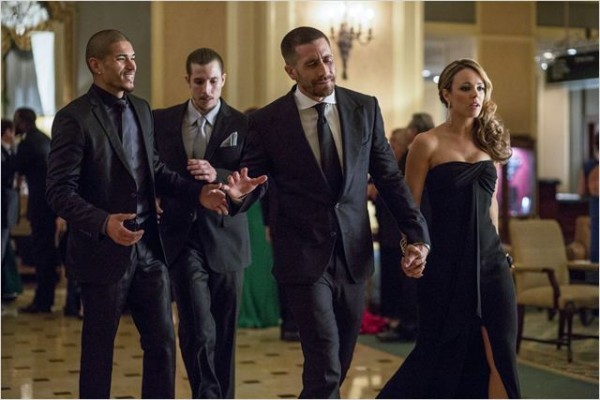
After talking with his concerned wife, Billy begins to consider retirement seriously, but then he is struck down by an unexpected tragedy. Shortly after he and his wife attend a charity party, he comes across a young rising boxer who has annoyed him. When that guy happens to push the right button to ignite Billy’s hair-trigger temper, it inevitably leads to a prompt clash between them – and their entourage members. A gunshot is soon heard during this clash, and, after he is cooled down a bit, Billy is devastated to find that Maureen has been somehow shot – and she eventually dies even before being taken to the hospital.
And, of course, everything in Billy’s life is turned upside down after that. Without his wife standing by him, Billy is pushed into another match by Mains, and that only accelerates his ongoing downward spiral of grief, anger, and addiction. What he has accomplished for years are rapidly crumbled down as a result while he becomes more morose and violent than before, and then his young daughter Leila (Oona Laurence) is taken from him after one destructive incident. He belatedly realizes how low he has hit the bottom, but he may never meet Leila again under this circumstance.

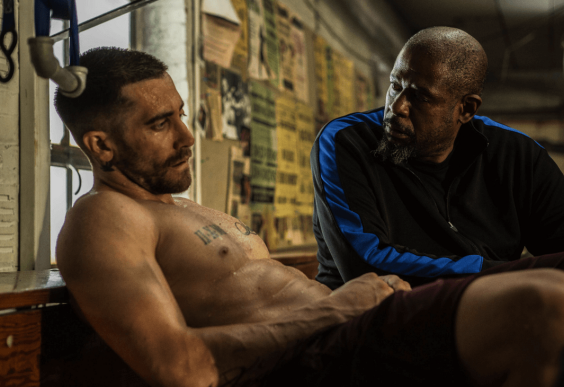
Trying to be with his daughter again, Billy starts to pull up himself as accepting his changed status. He moves to a small, shabby place after leaving behind his foreclosed mansion, and he goes to a local gym run by Titus “Tick” Wills (Forest Whitaker with glassy left eye), a veteran trainer who once trained one of Billy’s better opponents in the ring. Wills is not particularly interested in training any professional boxer, but he hires Billy as his employee mainly because Billy needs any decent job for showing to social workers that he is trying to be changed enough for regaining the custody of his daughter.

southpaw05

Now you already have a pretty good idea about the rest of the story, and the screenplay by Kurt Sutter indeed does not surprise us a lot, but the movie does not lose our interest mainly thanks to Jake Gyllenhaal’s strong performance. Gyllenhaal, who recently gave one of his best performances as the chilling sociopath hero of “Nightcrawler” (2014), immerses himself in a completely different mode right from the opening scene, and he brings considerable intensity and gravitas to those predictable scenes where his character tumbles down along with his self-destructive fury. His character’s quest for redemption is not always convincing, but Gyllenhaal does not step away from his edgy portrayal even when his character becomes a bit tamer than before, and he is the main reason why the clichéd finale works even though we can clearly see from the start where it will arrive in the end.

The other actors around Gyllenhaal do whatever they can do with their stereotype characters, and some of them often overcome clichés thrown to them. Although she exits early in the film, Rachel McAdams leaves a lasting impression hovering over the rest of the film, and Forest Whitaker, who has not gotten many good chances for his immense talent since his thunderous Oscar-winning turn in “The Last King of Scotland” (2006), gives an effective low-key performance as Billy’s reluctant trainer. While Curtis “50 Cent” Jackson is rather monotonous as Billy’s opportunistic manager, Naomie Harris is sadly under-utilized as a sympathetic social worker, and young actress Oona Laurence, who received a special Tony Award along with other three young actresses for their contribution to the 2013 Broadway production of “Matilda the Musical”, is commendable as a daughter less immature than her father.

The director Antoine Fuqua, who previously directed “The Equalizer” (2014), did a fairly competent job of making the boxing match scenes in the film look as intense and exciting as required, and there are several moments which made me cringe for good reasons. “Southpaw” is a predictable sports melodrama to the core, and I still think Gyllenhaal’s performance deserves a film better than this, but he and other few good things in the film are worthwhile to watch. It is not a very good contender, but it throws some nice punches anyway.

Sidenote: This is one of the last works by Oscar-winning composer James Horner, who died in an unfortunate plane crash shortly before the movie was released in US.

southpaw03

Posted in Movies | Tagged , , , | Leave a comment

The Age of Adaline (2015) ☆☆☆(3/4) : A young woman at old age

theageofadaline01“The Age of Adaline” sincerely believes in its preposterous premise, and it softly and somberly glides along its romance plot as its two good-looking characters adorably looking at each other. This is indeed a sappy stuff, but then there are warm, bright sparks between our lovely couple, and there are also some nice moments of genuine emotions in the film. Although it could have delved deeper into the human dilemmas inherent inside its premise, this is a solid standard comfort food for its target audiences, and you may forgive its flaws as enjoying its tender, sensitive scenes.

As our omniscient narrator tells us at the beginning, Adaline Bowan (Blake Lively) lived throughout the 20th century while never getting old at all. Born on New Year’s Day in 1908, she went through her early years as a normal girl living in San Francisco, and then she fell in love with a young engineer. They soon married, but, not long after the birth of their daughter, her husband got killed along with several others due to an unfortunate accident during the construction of the Golden Gate Bridge.

And then something happened when she was recovering from this devastating personal loss. While she was driving to her parents’ place alone during one exceptionally cold, snowy night, she had a car accident, and she was flung into a cold river along with her vehicle. As her body function was about to be shut down due to low body temperature and slowing heartbeat rate, a lightening suddenly stroke into the river, and that caused a significant biochemical change inside her body, which certainly would make my molecular biologist colleagues roll their eyes for its utter baloney.

theageofadaline03Anyway, after this incident of miraculous survival, Adaline slowly began to realize how things became different for her. She kept looking unbelievably young even after her daughter became old enough to go to college. When she realized how this could be a big trouble for her as well as her daughter, she began to live alone, and she has constantly changed her identity and residence throughout many years for hiding her secret from others (she was almost captured to be tested and studied at one point, by the way).

So far, her long life has been fairly good. Thanks to her wise investment in a certain famous company during its early years, she always has enough money to buy another place and identity for her, and she has maintained a sparse but loving relationship with her aging but spirited daughter. Ellen Burstyn, a great actress who has lost none of her energy and intelligence even during her later years, has a little fun with behaving like a mommy’s little girl during her scenes with Lively, and we cannot help but amused and touched by their characters’ affectionate interactions.

As 2015 is approaching, Adaline decides that it is time to leave behind her current life as a librarian named Jenny Larson in San Francisco, but then she happens to have a Meet Cute moment with a guy named Ellis Jones (Michiel Huisman) at the New Year’s Eve party. She does not expect to meet him again, but, what do you know, she encounters him again when it turns out that he is a new board member of her public library who also makes a considerable donation to the library (According to him, he got his fortune thanks to his software for stock market, which seemed to make him as wealthy as Steve Wozniak, if not Steve Jobs).

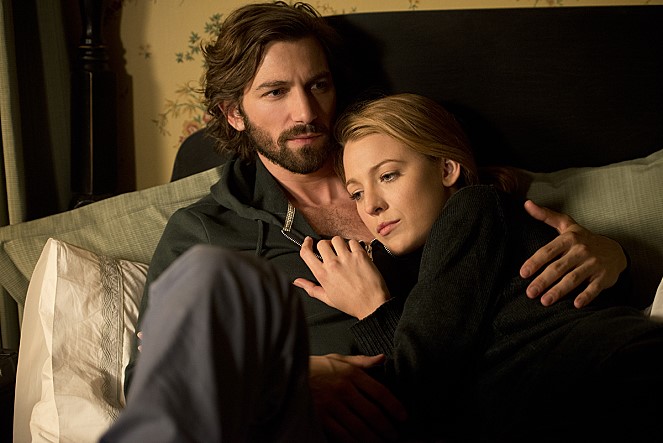
theageofadaline02While Ellis becomes more fascinated with her for many reasons, Adaline also becomes attracted to this handsome gentle lad, but she is naturally conflicted about whether she can share her lifelong secret with him – or whether it is possible to have a life with him. Because she still remembers well one old painful moment involved with a young man who really loved her, she initially wants to terminate her relationship with Ellis, but she eventually comes to have a second thought. While she is not wholly convincing as an old soul trapped inside her young boy, Blake Lively has a warm low-key chemistry with her co-actor Michiel Huisman, a Dutch actor who was quite believable as one of the New Orleans residents in HBO TV series “Treme” (but most of you are more familiar with his supporting character in another HBO TV series “Game of Thrones”). There is a tender scene where Adaline takes Ellis to an old abandoned place unknown to many people in San Francisco, and the director Lee Toland Krieger gives us a wonderful magical moment when she reveals its small surprise to him.

The screenplay by J. Mills Goodloe and Salvador Paskowitz stumbles especially during the third act which resolves its main conflict too conveniently, but Lively, Huisman, and the other good actors surrounding them support well its shaky narrative. Harrison Ford is particularly poignant in his supporting role, and Kathy Baker also holds her own place although her character is underdeveloped in comparison. Like Burstyn, Ford and Baker bring natural qualities to their characters as old, experienced veteran performers, and their characters come to us as engaging people to watch.

“The Age of Adaline” is not entirely successful, but I mildly recommend it because I enjoyed its mood and performances even while recognizing its preposterous sides. Some of us may desire for immortality, but immortality is a dreadful concept when you think more about it. I may be happy to be allowed to read books and watch movies as much as I want during endless years, but then I will be quite lonely as constantly watching others around me going away from myself forever. Considering that I am a guy with autistic personality, I may be able to handle that problem, but, still, death is a more preferable option to me.

theageofadaline04

Posted in Movies | Tagged , , , | 4 Comments

A Pigeon Sat on a Branch Reflecting on Existence (2014) ☆☆☆1/2(3.5/4): Being a human

Swedish film “A Pigeon Sat on a Branch Reflecting on Existence” is as weird, absurd, and hilarious as you can expect from the final chapter of Roy Andersson’s human trilogy. Again, we get a free-flowing series of vignettes featuring unhappy urban people who mostly look sad, lonely, sullen, morose, destitute, depressed, and cadaverous as being insulated in their self-absorbed melancholy and drab environment, and their deadpan moments are accompanied with a morbid sense of black humor which sheds some unforgiving lights on our human nature. We laugh with growing amusement, but then we are reminded of how we are sometimes no less uncaring and self-absorbed than these silly, pathetic people on display.

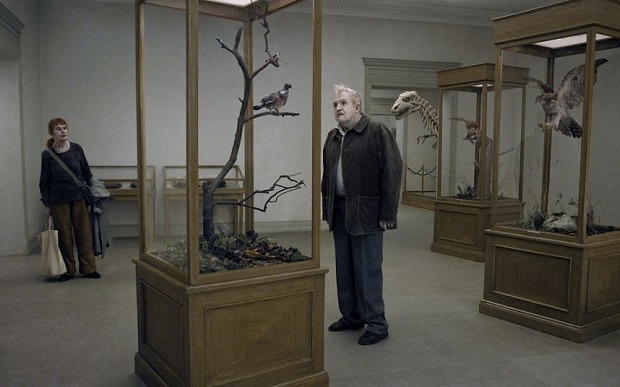
According to Andersson himself, the title of the film was inspired by those small birds sitting on branches in Pieter Bruegel’s 1565 painting “The Hunters in the Snow”, and the first scene seems to reflect that as a guy is blankly looking at a number of stuffed birds in exhibition. In another scene around the middle of the film, a girl mentions the title of the film in front of others during her school festival, but what she says does not draw much attention as other kids interrupt her time on the stage.

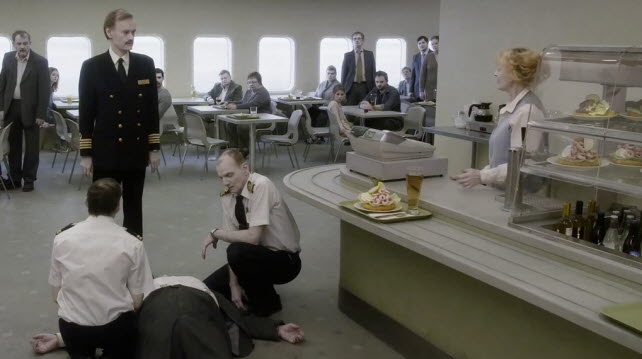
There are total 39 vignettes in the movie, and they are loosely strung together under the common mood and themes shared among them. Around the beginning, we get a trio of comic moments specifically about meeting with death. A husband suddenly dies in the dining room of his apartment, but his wife remains oblivious to that while working in her kitchen. Three children of an old lady come to see their mother at the hospital, and then they fight literally over her dying body due to what she does not want to let go even at her deathbed. A guy has just collapsed and died on a ferry ship, but others around him are more interested in what they should do with something he purchased right before his unfortunate departure.

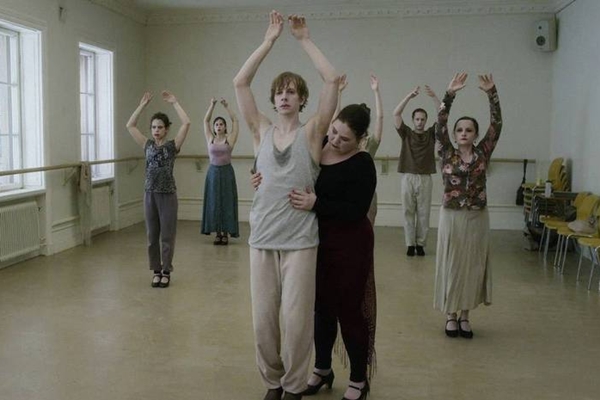
apigeonsatonabranchreflectingonexistence03The characters in the film often say “I’m happy to hear that you’re doing fine.” during their phone conversations. That gradually becomes an ironic running gag throughout the film as we observe that 1) they are not happy at all and 2) they do not care much about whether others on the other end of the line are really doing well or not, let alone what is going on around them. While bothered by the clapping sounds from a Flamenco dance lesson in the building, a cleaning lady keeps doing her work on the floor, as flatly engaging in her phone conversation. Whoever he is talking with on the phone, an old man remains isolated in his posh office – and he is not apparently all right considering what he is holding in his hand.

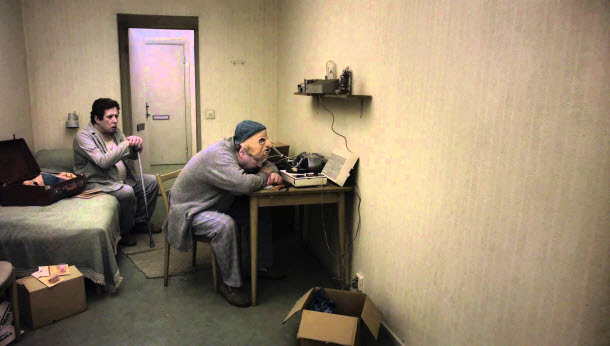
Two characters become more prominent as the recurring ones in the film. They are Jonathan (Holger Andersson) and Sam (Nisse Vestblom), and these middle-aged salesmen slouch around the nadir of their shabby business of selling trivial toys for practical joke. They are pretty lousy in dealing with their customers, and they do not get along with each other well either, though they live near each other in the same apartment building. Getting no fun or consolation from each other, they are tired of each other, but then they only find themselves being reminded of how they are destined to be stuck with each other while going nowhere in their miserable daily life. Compared to their seemingly endless predicaments, waiting for Godot looks more cheerful and productive in comparison.

Nevertheless, some of their scenes are very hilarious to say the least. In one scene, one of their complaining customers visits their apartment, and that leads to an absurd moment when this extremely shy and nervous guy talks only through his wife. In case of a long scene unfolded at a local bar, I can only tell you that you will be amazed and amused by how things get weirder step by step after a sudden change breaks into the scene.

apigeonsatonabranchreflectingonexistence04Like Andersson’s two previous films “Songs from the Second Floor” (2000) and “You, the Living” (2007), which are the other two chapters of his trilogy, “A Pigeon Sat on a Branch Reflecting on Existence” is both meticulous and effortless in its handling of moods and details. While the camera usually maintains its static positions, Andersson’s thoughtful scene compositions always attract our attention as we notice something odd and funny on the screen. As an aging captain is having a phone conversation outside a restaurant, we slowly come to spot two particular characters in the restaurant. While the camera focuses on a barber talking directly to the camera and us, we also observe that barber’s only customer sitting near him.

One of the most memorable scenes in the film, which features a huge copper chamber prepared for an unspeakable purpose, is simply spellbinding in its utterly surreal presentation of how far human beings can go in their ignorance and disregard of others’ pain and misery. The camera calmly stares at this disturbing sight for a while, and then the movie cuts to a shot showing what is going on at the opposite. Regardless of what exactly this scene symbolizes or reflects, it will leave a striking impression on you in the end.

While he made a successful debut with his first feature film “A Swedish Love Story” (1970), Roy Andersson focused more on making commercials after the critical/commercial failure of his second film “Giliap” (1975), and it took 25 years for him to come back with “Songs from the Second Floor”, which received the Jury Prize at the Cannes Film Festival in 2000. When I saw “You, the Living” for the first time in 2009, I loved its many quirky moments, and I had a great moment when I watched it again later at the 2010 Eberfest. The audiences around me constantly laughed with joy and amusement during the screening, and then we got an enthusiastic Q&A session accompanied with late Roger Ebert, who would be excited by “A Pigeon Sat on a Branch Reflecting on Existence” if he were alive now.

Besides being shown at the 2015 Ebertfest, the movie received the Golden Lion Award at the Venice Film Festival in last year, and it was recently chosen as Sweden’s submission to the Best Foreign Language Film category of the 2016 Academy Awards. Its dark laughs mercilessly penetrate into human nature, but those laughs come with human empathy and insights, and the last scene of the film somehow feels optimistic under its melancholic surface. We are basically alone in each own individual state of mind, but we are not alone at least in that aspect – and life goes on anyway as we are bumping with each other.

pigeonsatonabranchreflectingonexistencetangodancersarmsinair

Posted in Movies | Tagged , | Leave a comment

The Martian (2015) ☆☆☆1/2 (3.5/4): Stranded Alone on Mars

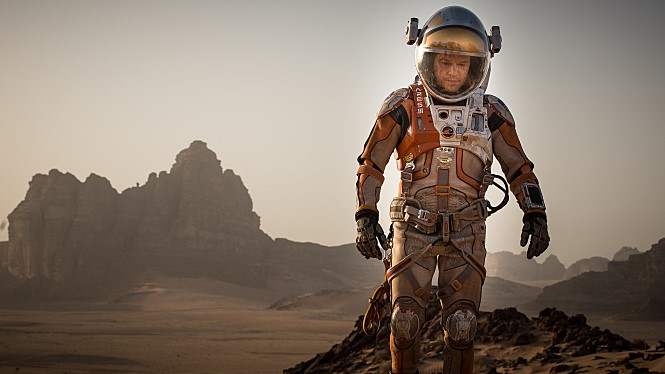
themartian01Even though we have learned a lot about Mars since the Viking 1 lander touched down on its surface in 1976, our red neighbor planet still remains as intriguing and mysterious as many other distant places in our solar system we have not visited yet. While several subsequent space probe missions including the Mars Space Laboratory mission during 2011-2 looked deeper into Mars for more information and knowledge, we often wonder about whether we will actually go there someday – and how it will really feel like being there.

Based on the SF novel of the same name by Andy Weir, “The Martian” goes forward with that enduring curiosity of ours. While its story is essentially a classic tale of survival with many familiar elements, it is a very compelling one with enough ideas and substances to intrigue and thrill us none the less. What will happen if one happens to be stranded alone on Mars during a manned mission? Will there be enough possibility for survival and rescue? And what can possibly be done for increasing the chance for that, in spite of many inherent obstacles in that difficult situation?

The story begins in the middle of a manned mission to Mars by NASA in the near future. When the astronauts of the Ares III mission are going through their 18th day (or 18th sol, to be precisely) on a wide plain area named Acidalia Planitia, a huge sandstorm suddenly comes upon their area, and Melissa Lewis (Jessica Chastain), the commander of the mission, decides that they should evacuate from their mission station for their safety before the sandstorm gets far worse.

themartian05Unfortunately, during their hurried evacuation process, Dr. Mark Watney (Matt Damon) gets himself knocked out by a flying object and then blown away from his colleagues by the sandstorm. Because they get no signal from Watney’s spacesuit, Lewis and others assume that he is already dead, so they immediately leave Mars and then head for the Earth. As they are returning, the incident is reported to the mission control center in Houston, Texas, and then we see Watney’s funeral being held as the whole nation (and planet, probably) mourns for his death.

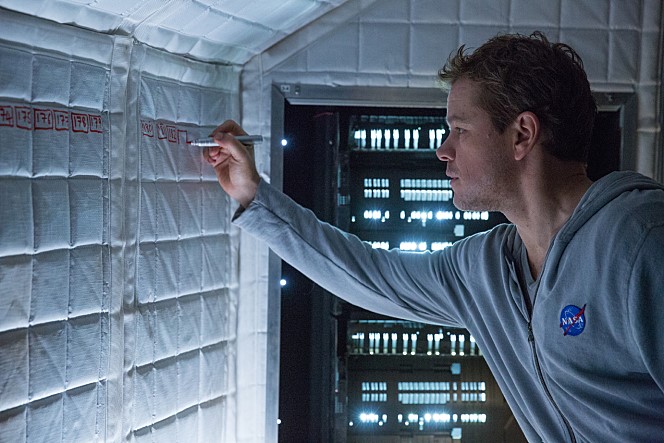
However, it turns out Watney manages to survive the sandstorm, and he soon sees how daunting his current circumstance is. The mission station is still working with the handy supply of oxygen and water for him, but then there are a number of big problems in front of him. For instance, there is a substantial amount of food supply left behind in the mission station, but he will run out of it even before 6 months no matter how much he tries to save it, and he knows it too well that he will have to survive for more than a year while waiting for any chance of rescue. Although the computers and other equipments in and around the mission station are mostly fine, the communication lines are cut off due to the sandstorm, and he also cannot go very far from his shelter mainly because of a technical limit of his Mars rover.

Like Robinson Crusoe or the resourceful hero of “Cast Away” (2000), Watney deals with these imminent problems and others step by step. The adapted screenplay by Drew Goddard keeps its plot rolling with Watney’s slow but promising progress while occasionally throwing unexpected troubles to maintain the constant level of tension. Watney happens to find a pack of potatoes, and, as a qualified botanist, he devises a clever way to establish a proper environment for growing them on the soils of Mars. With this reliable source of food, he becomes more confident and hopeful as focusing further on his survival, but that does not change the fact that his life on Mars is very fragile to say the least. Without his spacesuit, he will die within minutes in the thin atmosphere mostly consisting of carbon dioxide (it is more than 100 times thinner than the Earth’s atmosphere). At one point, he finds himself being barely protected from the outside only by a thin plastic membrane, ropes, and duct tapes, and that is more than enough for us to see how things can go quite wrong for him at any moment.

themartian04In the meantime, we cannot help but behold the barren beauty of those vast desert landscapes of Mars. While there are some unrealistic aspects to notice in their visual presentation (the sandstorms in Mars are actually not as harsh as depicted in the film, for instance), they certainly look more convincing than what we previously saw from other SF films about Mars including “Total Recall” (1990) and “Red Planet” (2000). I was amused to notice one of Mars’s two moons during one certain wise shot of Mars viewed from space, and, as far as I could see, it is Phobos considering its rather round shape.

The movie also looks around the situation on the other side, and we see how a group of NASA officials and technicians respond to their urgent situation not so far from “Apollo 13” (1995). After discovering that Watney is well and alive on Mars, the mission directors Vincent Kapoor (Chiwetel Ejiofor) and Mitch Henderson (Sean Bean) are determined to rescue their stranded astronaut as soon as possible, while their calm, unflappable boss Teddy Sanders (Jeff Daniels) often disagrees with them as a cool realist. They must hurry indeed, but, as many of you know, they cannot just shoot a rocket without any preparation. Even when they conflict with each other, they are well aware of that they may see the worst moment of NASA if they are not very careful about each step they are going to take.

As we get more involved in what is at stakes for Watney and other NASA people, the movie shows its sense of humor at times. Some of its humorous moments are very funny in fact while never disrupting the dramatic tension in the story. The occasional juxtaposition of the disco songs from the 1970s (they are Lewis’s favorite songs, by the way) and the landscapes of Mars surprisingly works better than expected with droll effects to tickle you, and I also enjoyed a small deadpan moment involved with a young NASA engineer nervously proposing a risky but feasible rescue plan to his bosses.

As the center of the film, Matt Damon earnestly carries the film in one of the best performances in his career. Like Sandra Bullock in “Gravity” (2013), he effectively functions as an emotional anchor we can hold on throughout the film, and we come to root for Watney as he struggles for his survival by any means available around him. Although we do not know much about him besides his professionalism, it is always fun to watch a professional using his knowledge and intelligence to handle matters to be taken care of, and Damon is excellent when he is required to convey the risks his character must take in his survival maneuvers.

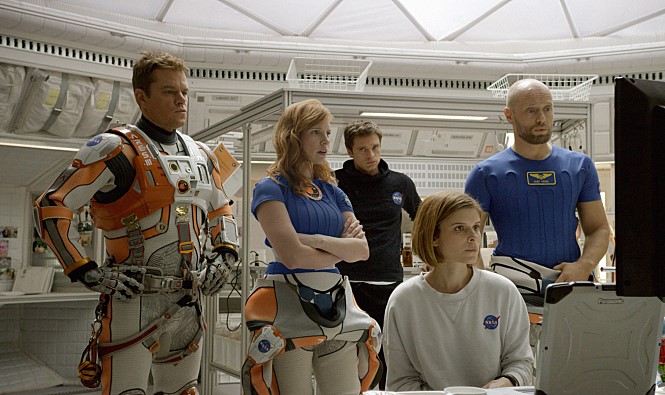
themartian02The other recognizable actors in the film dutifully fill their respective roles without stepping out of the line. Jessica Chastain is both gentle and commanding with a suitable aura of authority, and she and her co-performers Michael Peña, Kate Mara, Sebastian Stan, and Aksel Hennie have a good scene together when their characters all agree on doing the right thing which may end their careers in one way or another. Jeff Daniels, Kristen Wiig, Sean Bean, Benedict Wong, Donald Glover, and Chiwetel Ejiofor bring some personality to their archetype characters, and they do more than looking worried or frustrated in front of those many monitors and consoles in their mission control room.

Though he disappointed us with “Exodus: Gods and Kings” (2014) in last year, the director Ridley Scott, who will soon have his 78th Birthday in the next month, is back in his element here in this film. Since his debut work “The Duelists” (1977), he has gone around many different genres during last 38 years, but he has been usually remembered for “Alien” (1979) and “Blade Runner” (1982), two great SF films with each own visceral visual moments to strike and haunt you. “Prometheus” (2012), one of his recent films which was intended as a prequel to “Alien”, is not as great as them, but there are terrific space scenes which took me back to the memories of “2001: A Space Odyssey” (1968), and I came to forgive its several visible shortcomings.

While it is not as ambitious or groundbreaking as “Gravity” and “Interstellar” (2014), “The Martian” is a superb hard SF film to recommend. Like many SF fictions about space and its wonders, it reminds us of how tiny our existence is in the universe – and that how we can reach further into it if we want. It still creeps me out to think about going to where nobody can hear me scream, but who can deny its wonders?

Sidenote: I watched the film in 2D. Again, I did not see anything deficient, though I heard from others that 3D does not look that distracting.
themartian03

Posted in Movies | Tagged , , , , | 2 Comments

Slow West (2015) ☆☆1/2(2.5/4) : A slow, offbeat exercise in genre deconstruction

slowwest01

As literally reflected by its title, Western film “Slow West” is slow and languid in its offbeat exercise in genre deconstruction. It tries a number of whimsical things here and there as its archetype characters meander toward the inevitable arrival point waiting for them, but these things do not add up much to the whole although some of them are amusing or beautiful to watch. Sure, it looks like something different from conventional Western films, but it also feels more like a test drive of a mixed bag of ideas, and it may frustrate you at times even if you understand what it intends to do.

The movie is about one naive young man’s risky journey across the American West during 1870. Jay Cavendish (Kodi Smit-McPhee) is a Scottish lad looking for a young woman he loves, and the opening scene shows him riding alone across a remote area where a local Indian community has just been wiped out for some unspecified reason. As the camera follows him as if it were a fellow rider, we see several Indian people walking away from their burned place, and our young hero soon gets lost amidst smokes and ashes in the forest.

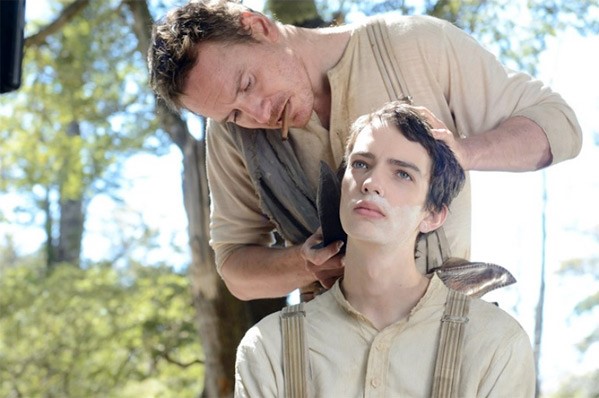
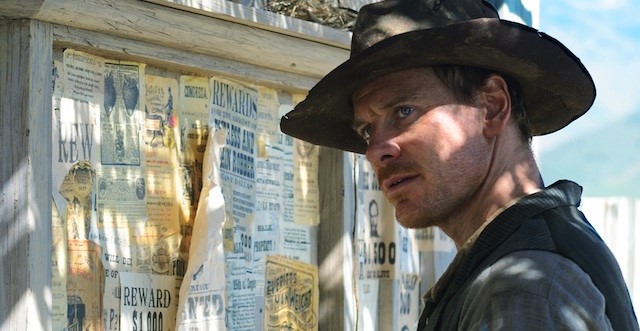
Shortly after his view is finally cleared, Jay comes across an Indian guy running away from a trio of uniformed guys. One of these uniformed guys tries to kill Jay while his cohorts are going after that Indian guy, but then a mysterious guy named Silas (Michael Fassbender) appears out of nowhere, and he promptly saves Jay from the peril.

After Jays hires Silas as his guide and protector, Jay’s journey is continued in the wilderness in which life is hard and violent for everyone. When they stop by a shop to buy supplies and clothes, they suddenly find themselves in the middle of an unexpected incident of violence, and Jay feels guilty as facing the consequence to which he partially contributed. It turns out that there are a bunch of outlaws moving around Jay and Silas, and Silas knows the reason because he also approached to Jay for the same thing these outlaws want. Jay somehow does not know at all that a bounty of considerable amount has been put on his girl and her father, and he does not realize either that he is virtually leading Silas to wherever she and her father are hiding at present.

slowwest03As Jay is often haunted by his past memories of Rose (Caren Pistorius) during nights, we come to learn what happened between them back there in Scotland. While they were friendly to each other, Rose wanted themselves to be remained as good friends, probably because she was well aware of the social boundaries between them as a peasant girl who knew better. Jay, who happened to be the nephew of a wealthy landowner, innocently believed he could marry her regardless of whether his uncle approved of that, and that inadvertently led to an unfortunate happening which prompted Rose and her father to flee to America.

While Jay still does not lose his quite innocent and idealistic view on life and people despite what he has gone through in the wilderness of American West (Silas dryly observes, “To him, we were in a land of hope and good will.”), Silas is cynical and skeptical as a jaded man who probably has a long history of violence and survival behind his taciturn appearance. “All I’m sayin’ is there’s more to life than just surviving”, says Jay. “Yeah. There’s dyin’”, says Silas in return.

Around the point when a character played by Ben Mendelsohn approaches to them, the mood becomes a bit tense, but the director/writer John Maclean keeps things loose and relaxed as throwing some moments of offbeat humor around his terse plot. There is an absurd episode about a hapless outlaw eager to be notorious enough to have a price on his head, and I like how an amusingly inventive way of drying clothes is later utilized for a nice punchline for good laugh. Like many other Western films, the movie eventually culminates to a shootout sequence, but this sequence is handled in a rather detached manner, and there is a certain irony in how things are resolved in the end.

The movie is admirable in its technical aspects. The cinematographer Robbie Ryan did a superb job of palpably presenting those wide landscapes on the screen with considerable lyrical beauty, and his crisp cinematography may be the best character in the film. The sparse score by Jed Kurzel is effective as one of the crucial elements in setting the dry, remote tone of the film, and it occasionally sounds wryly jaunty while never interrupting the mood.

slowwest02But I felt distant to its story and characters, which I found too thin and incohesive to engage me even during my second viewing. I understand that the movie does not intend to be ‘realistic’ (the movie was mostly shot in New Zealand, by the way), but I was frequently distracted by its artificial sides, and, rather than believing in their characters and the world they inhabit, I only observed how the actors managed to carry their sketchy characters with their own presences and talents. While Michael Fassbender always finds something interesting to play as usual with the clear influence from Clint Eastwood and other stoic Western film stars (he even has a cigar to chomp in his mouth, for instance), Kodi Smit-McPhee complements his co-star well with his boyish appearance, and Ben Mendelsohn, a veteran Australian actor who has been more notable since his chilling turn in “Animal Kingdom” (2010), has a little theatrical fun with his seedy character.

“Slow West”, which received the World Cinema Jury Prize at the Sundance Film Festival early in this year, is an interesting attempt of genre experiment, but the overall result is as half-baked as Jim Jarmusch’s equally unconventional Western film “Dead Man” (1995). Both of them are odd movies indeed, but there are not enough things to hold my interest besides their defiant oddness, even though I admired several visual goodies inside them. “Slow West” is mercifully short with the running time of 84 minutes and it is not completely a waste of time, but you can still see that there is not enough substance beyond its quirky style.

Anyway, it goes without saying that John Maclean is a promising filmmaker to watch considering the competent direction of his debut feature film, and I guess he simply explored what he could do with a genre like many other first-time directors. In the next time, he will probably give us something better than such a mildly frustrating genre doodling like this.

slowwest04

Posted in Movies | Tagged , | 1 Comment

Girlhood (2014) ☆☆☆1/2 (3.5/4): A girl’s life in Banlieue

girlhood01  French word ‘Banlieue’ originally meant a middle-class suburban area in the vicinity of big cities like Paris, but its meaning was modified around the 1970s along with the increased influx of foreign immigrants in France. These immigrants, most of whom were from Arab and African regions, and their next generations born in France have mostly been stuck in poor suburban areas of low-income housing projects, and their grim, vicious cycle of poverty trap in banlieues has been remained as the main cause of numerous social problems including high unemployment and crime rates.

Céline Sciamma’s “Girlhood”, which is intended as the third film of her trilogy after “Water Lilies” (2007) and “Tomboy” (2011), observes the life of an adolescent girl who has been coping with such a poor environment like that. During the striking opening scene which shows an American football match being held on a local sports ground during one evening, Marieme (Karidja Touré) enjoys its every dynamic minute along with her schoolmates, but then we notice how their joy and excitement are gradually dissipated as they return to their glum housing project neighborhood. They are quietly scattered one by one, and we soon see Marieme walking to her home alone at the end of this scene.

Watching her at home with her family, we get to know a bit about them. Their main income comes from her mother, and she is usually absent while working as a cleaning lady at some hotel. Marieme’s older brother is the de facto patriarch of the family even though he does not seem to have a real job, and this abusive guy is not very nice to his sister. In case of Marieme’s two younger sisters, they are on good terms with their older sister, and they always provide a little precious comfort in her unhappy life.

girlhood03

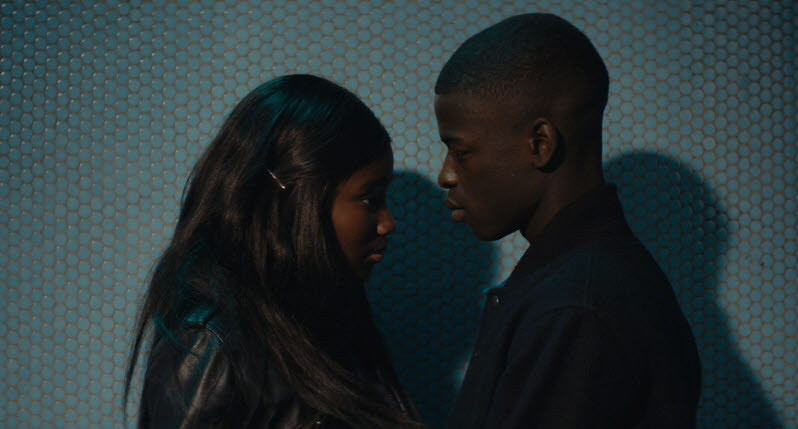
Marieme wants to go to high school rather than vocation school, but her school counselor reminds her that it is already too late for her to get any possible chance for that. As frustrated about this, she happens to encounter a gang of girls outside her school. They are Lady (Assa Sylla), Adiatou (Lindsay Karamoh), and Fily (Marietou Toure), and they are willing to accept Marieme as their new member. Marieme is reluctant about this offer at first, but she eventually joins them when she sees that this can be a better opportunity for approaching closer to Ismaël (Idrissa Diabaté), a nice boy who has been acquainted with her through her brother.

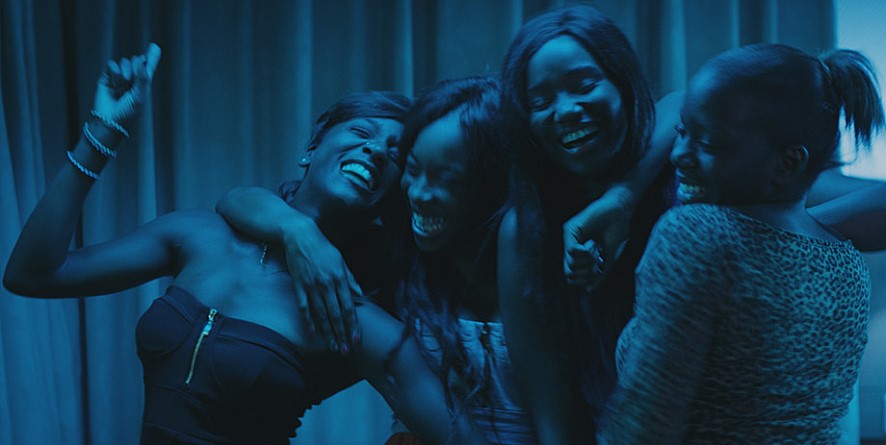
As hanging more around her new friends, Marieme gradually learns how to be more aggressive and intimidating as a gang member. She adapts herself to their hair style and attire, and we see her clumsily but successfully extorting pocket money from a female student. She and her gangs sometimes spend their own private time in a nice hotel room, and there is a wonderful moment when they lively dance together along with Rihanna’s “Diamonds” (Although there was a concern about the copyright issue during the production, Rihanna generously allowed her song to be used at a relatively cheap fee after Sciamma showed this scene to her).

girlhood06It goes without saying that her new friends are not a very good influence for her in objective view, but we also notice how Marieme becomes more confident and less shy about herself than before. When Lady goes through humiliation after being defeated by some other tough girl in their neighborhood, Marieme goes for a payback time although, as Lady points out to her in the aftermath, it is more for herself than her friend. She also approaches to Ismaël more actively; when she visits his home in the middle of one night, she surely knows where she is going, and she does not hesitate at all to take the control of what is going to happen between them.

While it is darker and grittier compared to the relaxed summer mood of “Tomboy”, “Girlhood” maintains a calm, objective attitude in its close, intimate observation of its young heroine’s emotional journey. It is curious about how she is shaped by her environment, and it empathizes with how she comes to make choices which will affect her life in one way or another. We sense her excitement and aspiration as she goes through her changes, and then we feel her desperation and frustration as she faces her harsh reality again and again. Later in the story, she decides to work for some shady guy just for getting out of her suffocating neighborhood, but then she finds herself being against the wall again as a woman with poor background and no good job opportunity.

girlhood05As the movie encloses itself in her rough world which is vividly presented with the authentic sense of place and people, Marieme comes to us as a smart independent girl grasping for a clearer idea of herself, and Karidja Touré, who had no previous acting experience before like many of the cast members in the film, gives an electrifying debut performance full of details to convey the small and big changes inside her character. When Marieme coldly threatens a minor character at one point, we are shocked but not very surprised by this sudden behavior of hers, for we have already sensed the change from Touré’s unadorned acting exuded from her open, expressive face.

As the other tough girls in the film, Assa Sylla, Lindsay Karamoh, and Marietou Toure also deserve to be mentioned for their good supporting performances, and they and Touré are impeccably spontaneous in their interactions on the screen. Look at a certain conversation scene where they effortlessly shift from one mood to another mood with no misstep, and you will see why girls are usually better than boys in case of handling their friendship matters.

When I watched “Tomboy” in early 2012, I was impressed by its sensitive and thoughtful direction, and Céline Sciamma did it again here in her another interesting coming-of-age drama to watch. Although nothing is certain for Marieme even in the end, there is a tiny glimpse of hope shown at the very end of the film, and her face right before the end credits is all the movie needs for making a brief but powerful ending to linger on us. I guess there will be more difficulties on her way, but this girl will survive – with her spirit as spry as before.

Karidja Touré in Girlhood

Posted in Movies | Tagged , , | 2 Comments

Cop Car (2015) ☆☆☆(3/4) : They stole a wrong one…

cop-car-movie-scope-pointofgeeks

“Cop Car” is about two kids who get more than they wish for after they come across a vehicle they should not have messed with. While there are a number of uneasy scenes of these naughty kids being put into possible dangers, the movie handles them with enough tension to engage and grip us while showing considerable tactfulness behind the screen, and that is one of several reasons why it works on both levels of narrative and technique.

Its premise is quite simple. The opening scene shows a quiet rural area somewhere around the southwestern region of US, and we meet two plain young kids walking across a wide field as they are blurting out profanities to each other just for passing their time. Although the movie is not very specific about their current situation, it is implied that they ran out of their homes for some reasons, and we later get a few little details about their background from their conversations. While Harrison (Hays Wellford) has lived with his grandmother, Travis (James Freedson-Jackson) has lived with his mother and her new husband, and it looks like they were not particularly happy at their respective homes.

When they happen to spot a police patrol car, they are immediately alarmed by it, but they soon become playful once they realize that there is no one around them and the vehicle. They throw a stone at the car. They sneak toward the car as if it were a scary dog lying in sleep. They walk around the car as looking for any fun they might have with it. When they find that the car is somehow left unlocked, they gladly go inside it for more fun they can have – and they cannot possibly be more excited when they discover the car key.

We soon see how they have a big joyous fun in several ways not so recommendable to any children around their age. Although they do not know enough about driving, they certainly know how to grab the steering wheel and push pedals besides igniting the car engine, and they freely drive their stolen vehicle across the wide field where there is virtually no one except cows peacefully grazing or moving on the field.

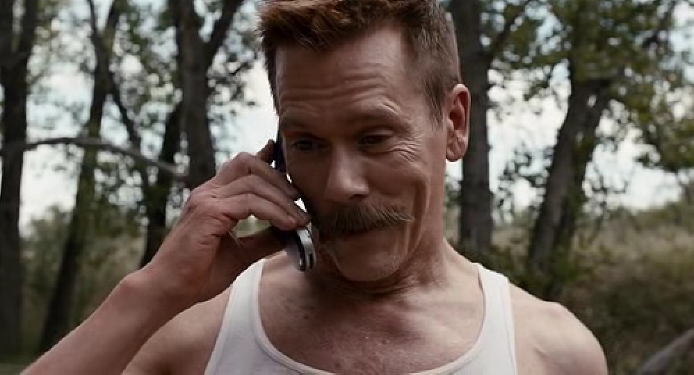
copcar02Of course, there is a man looking for that car. The flashback scene following right after the boys’ theft introduces Sheriff Kretzer (Kevin Bacon), a corrupt local policeman who was in the middle of his annoying business of burying two bodies when the boys stole his car. When he comes back from the burying spot, he is naturally befuddled by its unexpected disappearance, and then he becomes panic because that can lead to the full exposure of his latest crime for a good reason.

While our little boys continue to have more fun with his car, the movie also focuses on how Kretzer tries to take care of his urgent problem before it is too late. Although he cannot certainly report the theft, he can pull some strings to hide it for a while from the folks at his police station, and we get several suspenseful scenes as Kretzer manages to skirt around the constant danger of being noticed by others.

Around the end of its second act, it becomes pretty clear to us that the story is heading to a certain inevitable point, but the movie keeps building tension steadily under the confident direction by the director Jon Watts, who wrote the screenplay with Christopher D. Ford. The movie is morbidly humorous at times as shown from a darkly amusing moment when Travis and Harrison recklessly drive the car along the road at high speed, and some of you will probably be disturbed by one particular scene where they play with a rifle and a bulletproof vest while apparently having no idea on what kind of danger they are playing with.

copcar01It surely helps that its two young lead actors Hays Wellford and James Freedson-Jackson give natural performances to hold our interest, and it is often compelling to watch the dynamics of the relationship between their problematic characters. As Harrison and Travis push or pull each other in their interactions which are not entirely innocuous, we come to sense the poor environment which has shaped them respectively, and how they come to tumble toward a big trouble waiting for them is believable in its every step. They think they can have any fun without no one to stop them, but then they get themselves stuck in a situation far worse than they have ever imagined – and they may not have much chance to survive the day if they are not lucky.

On the opposite, Kevin Bacon, who also participated in the production of the film as one of its executive producers, provides a solid performance as the boys’ dangerous opponent. Rather than resorting to overacting, Bacon wisely stays on slow-burn mode while his character tries his best to have the situation under his control, and he is especially good when his character is slowly being cracked behind his cool façade. As two substantial supporting characters in the film, Camryn Manheim and Shea Whigham do their respective jobs as demanded, and Bacon’s wife Kyra Sedgwick provides a brief voice performance as the police station dispatcher.

During its relatively short running time (88 minutes), “Cop Car” is lean and efficient in its impressive handling of mood and story. The cinematography by Matthew J. Lloyd and Larkin Seiple is commendable for how it effectively establishes the static but uneasy atmosphere through its occasional shots of remote landscapes, and I was involved in the story thanks to good performances even when I observed the characters from the distance. After all, the boys had it coming from the start, didn’t they?

cop-car-full-movie-2015-download-free-42

Posted in Movies | Tagged , , | Leave a comment