The Program (2015) ☆☆1/2(2.5/4) : Cycling on a big lie

theprogram01The rise and fall of Lance Armstrong has a big irony we cannot help but notice at this point. He survived the illness which could have killed him, and he was determined to rise from his bottom by any means necessary, but what drove him to his triumph eventually led to one of the most disgraceful moments in the sports history.

As a broad look at his darkly dramatic trajectory, “The Program” starts its story around the point when Armstrong (Ben Foster) was a new promising cyclist to watch in 1994. As competing against other athletes, Armstrong and his American colleagues come to use performance-enhancing drugs, and we learn a bit about erythropoietin (EPO), a glycoprotein hormone which can enhance the strength and endurance of skeletal muscles through the increased synthesis of red blood cells. They can easily obtain EPO in Switzerland mainly because of the lack of local regulation, and they soon experience its impressive enhancement effect during their race.

Unfortunately, Armstrong is diagnosed to have a testicle cancer not long after that, and the circumstance is not very hopeful for him because his cancer is already developed into a malignant stage while spread around other organs including his brain. After the surgeries coupled with grueling chemotherapy sessions, Armstrong luckily avoids death, and then he sets a new goal which initially looks impossible considering his weakened health condition. He wants to make a comeback in the upcoming Tour de France, and he is already determined to win in this physically demanding race.

Armstrong knows the guy who will help him. Dr. Michele Ferrari (Guillaume Canet), an Italian physician who would gain his notoriety for helping the doping of many other athletes besides Armstrong, gives what Armstrong wants during their private sessions, and then Armstrong surprises everyone through his ‘miraculous’ victory in 1999 Tour de France – and he keeps astonishing everyone through his consecutive wins in the Tour de France during next 6 years.

theprogram02But some people begin to have reasonable doubts, and one of them is Irish sports journalist David Walsh (Chris O’Dowd), who once met Armstrong in 1994. Because he is familiar with Armstrong’s early race records, it looks pretty clear to Walsh that Armstrong used drugs during his races, but he becomes frustrated to see that his fellow journalists are very reluctant to go deeper into that suspicion. After all, Armstrong’s story is a fantastic life drama too good to be ruined for media and public, and nobody is willing to deliver a bad news to spoil fun and excitement just because he has been doing rather too well to be believed.

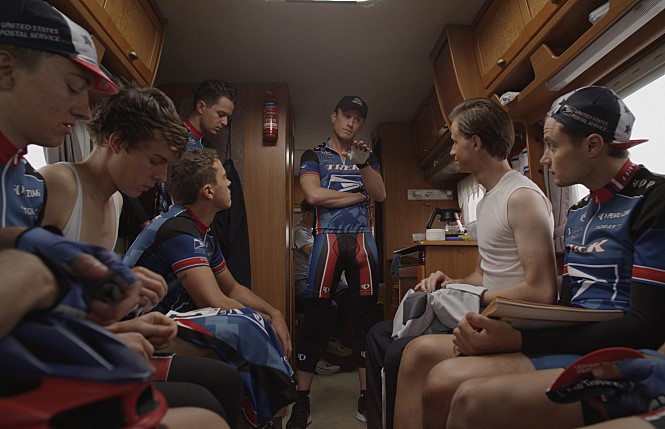
Assisted by his team coach Johan Bruyneel (Denis Menochet), Armstrong keeps going on with his doping, and he pushes his team members into doping as well. In case of Floyd Landis (Jesse Plemons), a young man from a devout Mennonite family in Pennsylvania, he comes to find how he can be easily corrupted – even when he arrives at the point where he cannot ignore any more how unethical and hypocritical Armstrong and his team have been.

The adapted screenplay by John Hodge, which is based on Walsh’s non-fiction book “Seven Deadly Sins”, tries to juggle lots of materials as jumping around Armstrong and the other key supporting characters in the film, but the result is more or less than the flat enumeration of a series of real-life events. Although the movie makes some points on how Armstrong managed to cover his doping for years through not only his fame but also others’ silent consent and willful disregard, it merely rides fast toward its finishing point just like its shady hero, and it fails to generate enough dramatic momentum for us. In the end, we are only served with facts, not an engaging drama to interest us.
theprogram05The actors in the film do whatever they can do with their roles. Ben Foster, who has been known well for his several intense performances, is packed with that brash, confident personality we saw from Armstrong in real-life. Besides looking physically believable on the screen, he always brings considerable intensity to his scenes, and that makes a nice contrast to Chris O’Dowd’s earnest low-key performance. Lee Pace, Guillaume Canet, Jesse Plemons, and Denis Menochet do not have many things to do in their thankless supporting roles, and Dustin Hoffman makes a very brief appearance as an insurance investigator who also smells something fishy from Armstrong.

The director Stephen Frears, who previously directed Oscar-nominated film “Philomena” (2013), also puts some efforts into the film while occasionally pumping up the narrative pace through the busy mix of archival footage clips and recreated scenes. The movie still feels thin and hollow, and I think the movie could be better if it focused more on the conflict between Armstrong and Walsh, who ended up being vindicated as well as getting his last laugh when everything based on Armstrong’s big lie was eventually crumbled down in 2012.

“The Program” is not that tedious thanks to its few good things including Foster’s committed performance, but I would rather recommend Alex Gibney’s documentary “The Armstrong Lie” (2013), which is more insightful and entertaining in comparison. I do not know what will happen next to Armstrong, but one memorable line from Michael Mann’s “The Insider” (1999) comes to my mind. “Fame has a fifteen minute half-life, infamy lasts a little longer.”

theprogram04

Posted in Movies | Tagged , , , , , | 1 Comment

The Lobster (2015) ☆☆☆(3/4) : To be or not to be a lobster

thelobster04“The Lobster”, which received the Jury Prize at the Cannes Film Festival early in this year, is another dark, weird, and ruthless comedy from Greek filmmaker Yorgos Lanthimos, who previously struck us with his offbeat black comedy film “Dogtooth” (2009). That film was about one nutty family who have been isolated from the outside environment for years by their stern, tyrannical patriarch, and it was both absurd and disturbing to see how he brainwashes his children to extreme degrees while often resorting to brutal tactics for giving them some lessons they will surely not forget.

In case of “The Lobster”, we are introduced to another bizarre world which is far wider but equally strange in many aspects. In a dystopian society in the near future, every adult citizen must have a spouse to live with, and single people must find their spouse within a short period of time allotted to them. They are all sent to a hotel located in some remote area outside their city, and there will be a serious consequence if they fail to find any suitable spouse before their time is over. Besides saying goodbye to their human life as they know, failures will be transformed into animals they chose in advance, and that will be how they are going to spend the rest of their life.

The movie shows us the details of this strange systemic process mainly through its plain hero played by Colin Farrell, who looks more mundane and paunchier than usual. Shortly after his wife left him for another guy, David is sent to the hotel along with a dog which was previously his brother, and he goes through a number of check-in procedures before getting his room. When he is asked about which animal he wishes to be transformed into, he casually replies that he wants to be a lobster. That may not be a very good choice if there is any seafood restaurant near the hotel, but at least it seems to be a better option than endangered species.

thelobster03Like other guests in the hotel, he receives 45 days for finding his right spouse, and that short period can be extended whenever he captures ‘loners’ during the routine hunt in a nearby forest. Loners are people who ran away from the hotel when they could no longer extend their stay at the hotel, and hotel guests are ready to use their tranquillizer gun whenever their time to hunt loners comes. One of the guests is particularly notorious for how she has ruthlessly maintained her stay in the hotel, and she does not even look very interested in getting her Mr. Right. After all, every guest in the hotel is her potential game, isn’t it?

As days go by, David becomes a bit friendly with some of his fellow guests while being accustomed to the strict rules adamantly applied to him and others. They are not allowed to masturbate (there is a severe punishment for that as shown during one unforgiving moment), but hotel maids are willing to provide a certain type of room service to their guests as a temporary alternative, though they always stop before going too far. Under the hotel manager’s supervision, the hotel guests attend absurd group meetings which constantly remind them of why a man needs a woman, or vice versa (considering that there also seem to be a separate place for homosexuals, I would love to see what kind of variations they will present to their gay/lesbian guests).

We also see how the hotel guests can move up to the next level once they find their match. In case of a young man with limp, he manages to get the affection of a woman with frequent nosebleed, and they are soon transferred to their new room as a couple. If they can maintain their relationship during next two weeks, they will be moved to another stage where they can further solidify their relationship during another two weeks – and then they will be allowed to return to the city as a legitimate couple.

thelobster02As his time is running out day by day, David naturally becomes desperate. He attempts to be a couple with a certain guest he does not like a lot, but it only turns out to be disastrous for both of them (and his dog, unfortunately). Through some unexpected help, he escapes from the hotel and then joins the loners in the forest, but he comes to face another set of strict rules as becoming one of them. In contrast to the hotel guests forced to coupledom, the loners forbid themselves to get too close to each other for keeping their single status, and they are also as merciless as hotel staff members if anyone happens to violate their rules.

And the movie finally introduces to us the constant narrator of the film, played by Rachel Weisz. As loners, she and David initially distance themselves from each other as required, but they begin to feel something between them, and that mutual feeling is developed further while they have to disguise themselves as a couple during their covert mission in the city. Of course, there comes a point when they go too far with their ‘disguise’, and they find themselves tested for the endurance of their relationship just like those synthetic couples in the hotel.

thelobster05“The Lobster” is the first English language film by Lanthimos, and he did a good job of transplanting his distinctive style to this film. You can instantly recognize his own stark mix of morbid laughs and striking violent moments from its decidedly ambiguous narrative, and Lanthimos also draws fine controlled performances from Farrell, Weisz, and other notable cast members including Olivia Colman, Ben Whishaw, Léa Seydoux, and John C. Reilly (the special mention goes to Angeliki Papoulia, who is utterly vicious in her heartless supporting role).

I guess the lesson of its story is that our human feelings cannot be easily defined or controlled no matter how much we try. I have been so far fine with my unmarried status, but who knows what will possibly happen to me during next several years? I may finally consider marriage as my parents have wanted, but then I may change my mind again after more thoughts and feelings.

The movie becomes less compelling as its premise becomes shakier around its third act, and I cannot help but wonder where loners get their backpacks and ponchos from – or why they do not move far away from both the city and the hotel despite their constant danger. Its open ending is rather anti-climactic even though it will make some of you cringe for a good reason, and I felt both detached and amused during my viewing, but “The Lobster” is still an odd, interesting work to admire for its style and atmosphere.

thelobster01

Posted in Movies | Tagged , , , | Leave a comment

Amour Fou (2014) ☆☆☆(3/4) : “Would you care to die with me?”

amourfou0When they meet each other for the first time, they have no idea of how they would influence each other’s fate. As pulling or pushing each other, they are slowly moved toward to a certain destination waiting for them from the very beginning, and we observed this progress with nervous fascination. They eventually get their wish, and we are reminded of that old saying: Be careful of what you wish for, you just might get it.

While it is mostly fictional, Austrian film “Amour Fou” is based on a real-life incident between one prominent German poet and a woman who unfortunately got involved with him. In the opening scene, we meet Henriette Vogel (Birte Schnöink), and she is preparing for a small social evening party to be held at her upper middle-class residence. Besides a famous singer who will give a performance for her guests, Heinrich von Kleist (Christian Friedel), who was one of the notable poets in Prussia during the early 19th century, is going to visit her house, and she cannot possibly be more thrilled about that as an admirer of his works.

When she meets her favorite artist during her evening meeting, Henriette sincerely tells him how much she has been impressed by his works including short story “The Marquise of O”. While not so flattered by her words, Heinrich, a neurotic guy who usually looks glum and aloof, flatly tells Henriette that she is not as happy in her life as she believes, and then he begins to regard her as someone unhappy enough to die along with him, though he merely fancies that morbid possibility in private at that point.

amourfou02Besides, he already has someone else in his mind. He has been in love with his cousin Marie (Sandra Hüller), so he directly asks her whether she is willing to join his suicide plan, but she tactfully rejects his irrational request, while also reminding him that they will still remain as good friends despite their rather embarrassing moment. When Heinrich subsequently approaches to Henriette as an alternative, she also shows a similar response, for she feels fine with her affluent life in spite of what he said to her before. Her husband Friedrich (Stephan Grossmann) may be a dull guy, but he is a decent man devoted his wife unless he is occupied with his business, and they also have a young adorable daughter between them.

And then there comes a big change which makes Henriette view her life differently. After her sudden faint, she becomes ill, and her doctor cannot find the exact cause of her illness. While her hypnosis session suggests that it is the problem of her mind rather than her body, she and her husband are advised to get a second opinion from other doctors, and then she is diagnosed to be terminal with a few years to live. From our modern perspective, we surely have reasonable doubts on that diagnosis and the rudimentary methods behind it, but Henriette believes it without any doubt, and, not so surprisingly, what Heinrich once offered to her begins to look like something quite acceptable to her.

However, when Henrietta shows him her willingness to be his suicide partner, Heinrich finds himself being reluctant about what he has been openly wishing for, and the movie shows a wry sense of understated humor as he tries to deal with this unexpected situation. He rejects her with a selfish excuse at first, but then he comes to have a sort of relationship with her, and there is a dryly funny scene when they happen to stay at an inn for one night along with literary critic Adam Müller (Peter Jordan). Heinrich is so sensitive about how he and Henriette look in front of Müller that their dinner soon becomes very awkward to say the least, and it ultimately ruins what they initially planned for the next day. Maybe he really wants to die as he says, but Heinrich wants that to happen in a way he prefers, so there comes another comic moment when he reaches for a more preferable option.

amourfou03As maintaining a certain degree of distance from its characters, the movie subtly draws our interest with mood and nuance. The camera usually observes the characters from static viewpoints, and we notice the precisely ordered composition of many of its indoor scenes. The characters in the film are always courteous and mannered in their words and behaviors, and we are tickled by the haughty attitude of several snobbish characters around Henriette and Heinrich. Their world is bound to experience some significant social changes sooner or later, but they still cannot accept that inevitable wave while often looking down at those common people below their class.

Under the director/writer Jessica Hausner’s restrained direction, Christian Friedel and Birte Schnöink are believable in the slow but fatal dynamics between their characters. Rather than passion or lust, their characters are attracted and then stuck to each other through a misguided idea of death, and there is a dark irony in that neither of them are capable of committing suicide alone. Even when she learns later that there is still some hope for her health, Henriette does not seem to be willing to hold on that possibility. She instead continues to let herself pushed by the pact between her and Heinrich, and so does Heinrich, who has probably never given any serious thought on his death wish. His incorrigibly romantic notion of suicide reminds me of a phrase written by Ernest Hemingway: Isn’t it pretty to think so?

“Amour Fou” is a cold black comedy of manners, and its irreversible finale is both pungent and devastating in its clinical execution. While observing its sad, tragic side, we are also reminded of its silly, absurd side involved with one undeniable fact of our life. We all do not want to die alone, so we understand Heinrich and Henriette to some degrees, but, as clearly pointed out by one supporting character in the film, we are all destined to be alone in our death no matter how we get there. When they come to see that, things do not look pretty to them at all.

amourfou04

Posted in Movies | Tagged , , , , | 2 Comments

The Exclusive: Beat the Devil’s Tattoo (2015) ☆☆☆(3/4): A scoop beyond his control

theexclusive01Around the ending of John Ford’s classic film “The Man Who Shot Liberty Valance” (1962), one supporting character says, “When the legend becomes fact, print the legend.” In case of South Korean film “The Exclusive: Beat the Devil’s Tattoo”, the lie becomes fact, and they broadcast the lie. In the midst of the relentless competition for any sensational exclusive to draw more readers and viewers, its reporter hero comes across what looks like a chance of lifetime, but then he is swept along with a storm of media frenzy he unwittingly initiated, and the movie has a vicious fun with how he tumbles into more risks and troubles as his lies are growing bigger and bigger.
Jo Jeong-seok, who was impressive in his scene-stealing supporting performance in “Architecture 101” (2012), plays Heo Moo-hyeok, a young news reporter facing the early end of his journalist career. Because of his recent inaccurate report on some influential corporation, he is bound to be fired from his position in a cable news channel, and he cannot find any new position outside due to his mistake. In addition, his estranged wife Soo-jin (Lee Ha-na) no longer lives with him while trying to start her own career as an art gallery staff member, and she also considers divorce although she has been pregnant for several months.
When Moo-hyeok gets a tip-off about some suspicious guy possibly responsible for a serial killing case which has been drawing lots of attention from the media with no sign of closure, he is initially skeptical about this, but then he is surprised when he breaks into a dark, shabby place belonging to that suspicious guy in question. The walls in one room are covered with numerous newspaper articles on the serial killing case, there are also several notes reflecting the inner thoughts of a very disturbed mind. As looking around this uneasy place more, Moo-hyeok finds weird things which look red and disgusting, and that discovery is far more than enough to erase any doubt he might have.

theexclusive04Like any normal people would in his situation, Moo-hyeok immediately calls the police while not revealing his name, but then a good idea is dawned upon him. It seems the police are closing on their suspect while being cautious about not drawing any unnecessary attention from reporters, and that means he may have a golden opportunity to resurrect his career in his hand right now.

When he shows his superiors a note he took from the suspect’s residence, they welcome him again after quickly realizing that they come across a possible mother lode. Once the note is shown on TV, Moo-hyeok rapidly rises from the bottom to the top, and everyone including his fellow reporters, his superiors, and the detectives investigating the case wants to know what else he can give them. But, alas, there is a serious problem; he belatedly finds that the suspect in question is an unknown actor who was simply preparing for a play based on some Chinese novel about a mad serial killer.

As Moo-hyeok desperately attempts to hide his fatal mistake from everyone, the movie pushes further its wry, irreverent satire on media sensationalism. No matter how much he tries hard to get out of his mess through more lies and evasions, things keep going wilder and crazier beyond his control. Around the middle of the story, he and his colleagues happen to behold a big grand moment which they have never imagined before, and even Moo-hyeok cannot help but be amazed and enraptured by what his latest ‘report’ has just caused. But it is still apparent that he may pay a price bigger than he expected, and he becomes far more cornered than before as the plot more thickens.

theexclusive02While Moo-hyeok is not a likable guy to identify with, the director/writer Roe Deok, who previously directed romantic comedy film “Very Ordinary Couple” (2012), makes his panic and struggle look alternatively gripping and hilarious. It goes without saying that he had it coming from the start, but we are curious about what will happen next, and Jo Jeong-seok deftly moves around black humor and suspense in a number of key scenes where his character must be very careful around others who may realize the truth at any point.

Some of the supporting performers around Jo enjoy themselves as their characters intentionally or unintentionally push Jo’s character into more troubles. Kim Ee-seong and Lee Mi-sook are Moo-hyeok’s cynical bosses ready for any chance for higher ratings, and Lee is especially wonderful when her character casually shows her cold cynicism during one brief but chilly scene. Bae Seong-woo is a frustrated detective in the charge of the investigation, Kim Dae-myeong is effective as a man who can ruin Moo-hyeock once for all, and Lee Mi-sook is stuck with a thankless job of playing a character whose function in the story is already written all over herself right from the beginning. The movie tries to make some additional points through a subplot involved with one lousy artist Soo-jin has been associated with, but that subplot only leads to the point where she comes to make a very unwise choice for her (and her baby, of course).

“The Exclusive: Beat the Devil’s Tattoo” is an entertaining mix of satire and thriller, and I was excited while frequently chuckling with the audiences around me during its satiric moments. It becomes shaky around its obligatory third act like many other thriller movies, but the movie eventually arrives in a big ironic moment of dark laugh, and we are reminded of how insatiable our hunger for sensational news stories is – and how willing media is to go along with that in these days.

theexclusive03

Posted in Movies | Tagged , , , , | 5 Comments

Mr. Holmes (2015) ☆☆☆(3/4): The Detective’s Last Case

mrholmes01Since Sir Arthur Conan Doyle’s “A Study in Scarlet” was published in 1887, Sherlock Holmes has been one of the immortal literary characters along with Tarzan and James Bond. He has been portrayed by many plays, movies and TV series during last 128 year, and we will certainly get more of Holmes as he keeps fascinating many readers around the world.

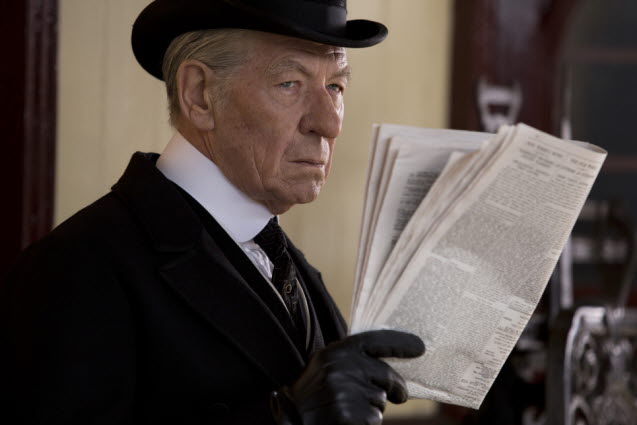
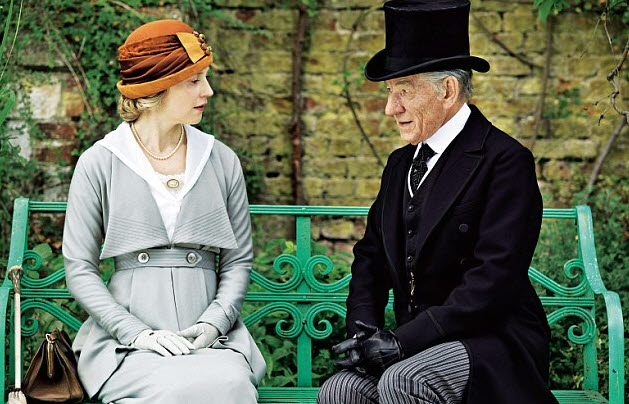
Based on Mitch Cullin’s 2005 book “A Slight Trick of the Mind”, “Mr. Holmes” revolves around the later years of Sherlock Holmes. It is 1947, and Holmes, played by Ian McKellen with graceful dignity, has been retired for nearly thirty years while living quietly at his small residence in Sussex. His dear friend Dr. John Watson and a few other people close to him were all gone now, and the only people around Holmes are his housekeeper Mrs. Munro (Laura Linney) and her young son Roger (Milo Parker). While willingly helping Holmes’ beekeeping work, Roger is eager to hear anything exciting or interesting from an old man who was once regarded as the most brilliant detective in the world, and Holmes does have something new to tell because he has wanted to write about his very last case, which was once told through Watson’s fictionalized version.

However, his brain has not been doing well recently as showing the early signs of senile dementia. He tried to slow down this irreversible progress through royal jelly and Japanese prickly ash, but he experiences more lapses while depending more on Mrs. Munro and Roger. He wants to finish his story before it is too late, but he is sometimes at a loss as his increasingly foggy mind tries to grasp the memories of the case which still haunts him even after many years.
mrholmes04As he slowly remembers it bit by bit, the movie goes back to that point in his past through a number of flashback scenes. A young man named Thomas Kelmot (Patrick Kennedy) visits Holmes’s real residence near to 221B Baker Street, and he says he really needs Holmes for his private problem. After being devastated by the loss of her two children due to miscarriage, his wife Ann (Hattie Morahan) has been obsessed with her glass harmonica lesson, and Kelmot suspects that his wife is somehow being exploited by her glass harmonica lesson teacher. While it looks like an easy case of fraud, Holmes accepts the case anyway, and we see him surreptitiously following after Ann, who does not notice Holmes partially thanks to Watson’s embellished description of Holmes’s appearance in his stories (so don’t expect that famous deerstalker hat and pipe).

Meanwhile, we also get another subplot involved with Holmes’s recent trip to Japan in the aftermath of the World War II. Right after his arrival, Holmes is greeted by Mr. Umezaki (Hiroyuki Sanada), and they spend some time together around Hiroshima while Holmes looks for Japanese prickly ash to grow at his home in Sussex. At one point, they drop by a bleak site reflecting the atomic bombing in 1945, and Holmes is particularly impressed by one spiritual ritual he happens to witness.

Shuffling around these three stories, the movie patiently builds up its wistful elegiac tone as the adapted screenplay by Jeffrey Hunter slowly moves toward the point where everything is eventually revealed to us. We learn of how Holmes came to decide his retirement after his last case was closed. We find how Holmes’s trip to Japan turned out to be less simple than it looked at first. And we see how Holmes comes to make a number of decisions at the present point, after managing to look back at all these things which will probably be faded away from him again sooner or later.

As observing the somber, melancholy character drama of “Mr. Holmes”, I was reminded of the director Bill Condon’s 1998 film “Gods and Monsters”, for which he received a Best Adapted Screenplay Oscar. That movie was a fictional drama about the final days of famous real-life Hollywood director James Whale, who made “Frankenstein” (1931) and “The Bride of Frankenstein” (1935). McKellen, who was Oscar-nominated for his performance in that film, was fabulous as an old naughty gay man who forms a strained but poignant relationship with a young, hulking gardener played by Brendan Fraser, and so was late Lynn Redgrave, who was also Oscar-nominated for her supporting turn as Whale’s faithful housekeeper.

mrholmes03However, “Mr. Holmes” feels less interesting compared to “Gods and Monsters”. If you expect anything as curious as the incident of that dog in “The Adventure of Silver Blaze”, you will be disappointed to find that there is not much mystery to grab your attention. The scenes in Japan feel a little too redundant, and the part involved with a small problem in Holmes’s beekeeping is too elementary even for Holmes’s fading mind.

Condon places talented performers around McKellen, but most of them are under-utilized. While young actor Milo Parker holds his own place well in his scenes with McKellen, Laura Linney, who was Oscar-nominated for her supporting turn in Condon’s 2004 film “Kinsey”, feels bland compared to Redgrave’s similar but more colorful character in “Gods and Monsters”. Roger Allam briefly appears as Holmes’s concerned doctor, and Hattie Morahan has a good scene with McKellen when their characters come to have a private talk between them.

In case of McKellen, he gives one of his better performances here in this film. While I have some reservation on “Mr. Holmes” due to its several notable weak points, this 76-year-old British actor elegantly carries the movie with wit and poignancy, and “Mr. Holmes” is worthwhile to watch just for his performance. He can do many others things besides Gandalf and Magneto, and I hope we will continue to see more of him for many years.
mrholmes05

Posted in Movies | Tagged , , , , | Leave a comment

Dope (2015) ☆☆1/2(2.5/4) : Three Geeks in the Bottoms

dope01

“Dope” wants to do many things. At first, it unfolds a coming-of-age comedy drama about three adolescent kids struggling in their rough neighbourhood, and then it tries to be a crime story accompanied with drug and shooting, and then it plays a bit of music, and then it attempts to give us social messages during one soapbox scene. The overall picture is not that coherent because of its heavy-handed plot and inconsistent tones, but at least it is mildly entertaining as rolling around here and there through its bouncy energy and good performances.

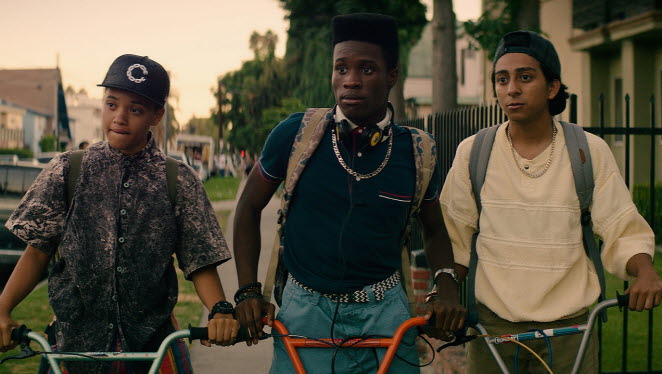
At the beginning, the narration by Forest Whitaker, who also participated in the production of the film, introduces to us its three high school student characters: Malcolm (Shameik Moore), Jib (Tony Revolori, fresh from his breakthrough turn in “The Grand Budapest Hotel” (2014)), and Diggy (Kiersey Clemons). They live in the Darby-Dixon neighborhood of Inglewood, California, and this crime-ridden suburban area nicknamed “the Bottoms” is not a very good place for them and other black teenagers in their neighborhood. While they are usually safe in their school, they may get themselves into any serious trouble on the streets outside even if they are careful.

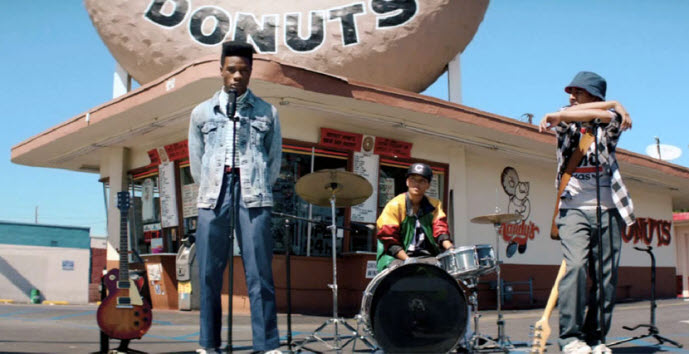
While being a fan of the hip-hop culture of the 1990s (yes, that was a long time ago now), Malcolm is an outsider in his school, and so are his two friends, who are two other members of his punk rock band. Jib looks less dark compared to others because of his mixed racial combination (while the movie does not tell much about his family, he says he is 14% African at one point), and Diggy is a tomboy girl who is openly lesbian, which certainly does not make her look good in front of her family as well as others in the school.

dope04  Malcolm aspires to go to Harvard after his high school graduation, but, not so surprisingly, his chance is pretty low. His teacher skeptically points out to him that he will need far more than good grades and high SAT score for going to Harvard, but Malcolm gets an appointment for the interview with some prominent local businessman anyway, and that man might help Malcolm get his wish if Malcolm gives enough good impression during the interview.

And then he and his friends find themselves in a very tricky situation. Malcolm is asked by a local drug dealer named Dom (A$AP Rocky) to deliver his private message to Dom’s ex-girlfriend Nakia (Zoë Kravitz), and Nakia, who comes to like Malcolm during their first encounter, says she will go to a local nightclub as Dom wishes, if Malcolm also goes there. Excited by this fantastic chance, Malcolm takes Jib and Diggy to the nightclub, and they all have a pretty good time together while Malcolm gets an opportunity to become more intimate with Nakia.

When a shootout suddenly happens in the nightclub, Malcolm and his friends manage to get out of the place without getting hurt or arrested, but they discover on the next day that Dom hid a gun and a substantial amount of packaged Ecstasy in Malcolm’s backpack during the pandemonium at last night. Not long after this alarming discovery, they are called by someone through an iPhone which was also put into the backpack, and they soon get themselves involved with a number of local criminals.

dope02

The movie enters darker areas after Malcolm meets a drug lord who indirectly pushes him into a deal he cannot refuse. If Malcolm does his job well as demanded, he may get a ticket to Harvard, so he decides to take a risk for that. With a little help from a hacker guy they met before, Malcolm and his friends turn their school into the main operation site for their drug business, and nobody in the school suspects them mainly because of their meek status as geeks, though they almost get caught by the police during one funny scene.

While their clever tactics for selling drug are cheerfully depicted, it is a bit uncomfortable to watch their serious criminal activities which can surely send them to jail, and the screenplay by the director Rick Famuyiwa often loses its way between different moods clashing with each other. I like a tense but humorous scene between Malcolm and the drug lord (Roger Guenveur Smith is effective in his deadpan mix of subtle menace and no-nonsense attitude), but a silly scene involved with body fluids does not wholly work while it will make some of you wince for a good reason. Busily keeping doing one thing after another, the movie does not tidy up its plot well, and then it is hampered by a big monologue scene around the ending, which tries too hard to drive its messages into our heads. We already got the messages before that, and we also notice that the movie does not throw hard questions on Malcolm and his friends’ criminal activities, which will probably affect the rest of their life in one way or another no matter how much the last shot of the film looks hopeful.

Compared to Famuyiwa’s first film “The Wood” (1999), which was another coming-of-age tale set in Inglewood, “Dope” is less satisfying, but it is not entirely without fun. Its three young main performers are lively and engaging whenever they are together on the screen, and it is disappointing that the movie does not pay more attentions to Jib and Diggy, who are as underdeveloped as other many supporting characters in the film (Kimberly Elise is virtually wasted as Malcolm’s single mother, for instant). The movie is undeniably spirited in its heart, but I think it should have been more concentrated in its mind.

dope03

Posted in Movies | Tagged , , , , | Leave a comment

Paper Towns (2015) ☆☆☆(3/4): Looking for his gone girl

papertowns05When she suddenly comes closer to him, he is happy for that. When she is gone then, he is determined to see her again. “Paper Towns” is often predictable, but it handles its story and characters with sincerity and care to engage us. The main characters may feel like stereotypes at first, but they slowly show some depth especially around the second half of the story, and they come to us as likable characters to empathize with.

Since Margo (Cara Delevingne) and her family moved into the house right in front of his family house, Quentin (Nat Wolff) has been carrying a torch for her for several years, but they have not been very close to each other recently. While there was a time when this charming girl, who is as eager and curious as Nancy Drew, actively hanged out with Quentin during their pre-adolescence years, but now she usually hangs out with popular kids as the coolest girl in their high school. In the other words, she seems to be out of his league for Quentin, who is your average shy teenager boy with nerdy sides.

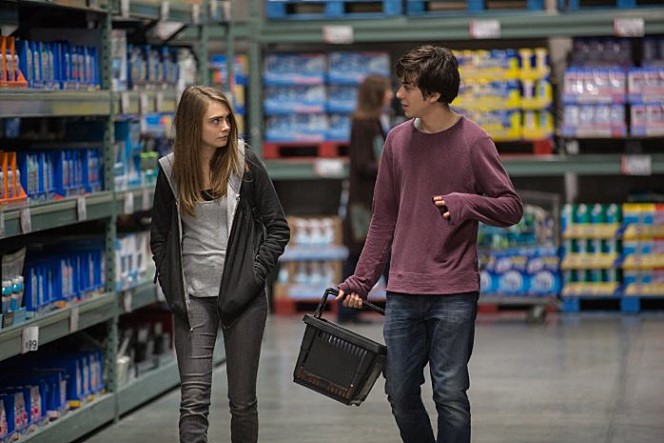
During one night, Margo makes a surprise visit to Quentin. She needs someone to drive her around their neighborhood, and he gladly helps her even though she does not tell him much about her purpose. Using his parents’ vehicle, he takes her to a supermarket because she has to buy several things in advance, and then it turns out that Margo has a small revenge plan on several friends of hers including her boyfriend who has lately cheated on her.

Margo and Quentin may get themselves into serious troubles because of Margo’s plan, but their mischievous night ends well in spite of a few little problems. Margo gets her payback moments as she wanted, and Quentin gets a nice private moment with her when she takes him to a tall office building for enjoying a quiet night view of their town together. She becomes opened to him more than before as letting out her inner thoughts and feelings in front of him, and it seems they may become more than mere old friends.

papertownsBut then Margo is gone on the next day, and Quentin is perplexed by her sudden disappearance. Margo’s family and many of her schoolmates are not very worried about this because she sometimes goes away without any announcement just for seeing and experiencing more of the world outside, but, as reflecting on their special night, Quentin begins to wonder whether he has to track her down to meet her. Did they really feel something between them during that night? And is it possible that Margo is waiting somewhere to be found by him before their upcoming graduation day?

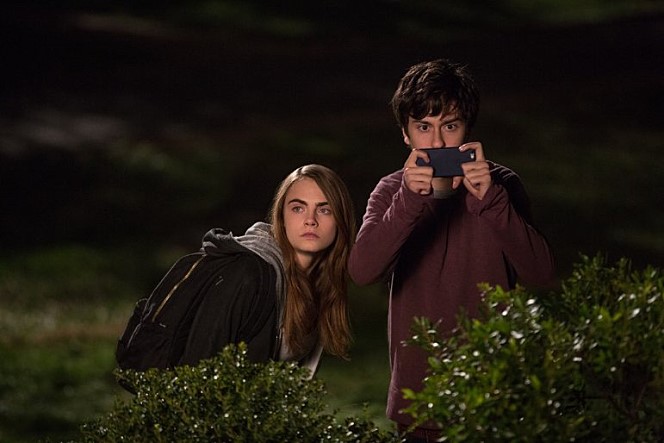
The story begins to look like a mild, lightweight version of “Gone Girl” (2014) as Quentin begins to notice small curious things which might be the clues left by Margo before her disappearance. He finds the first potential clue from Walt Whitman’s poetry book in her bedroom, and that leads to several other things which may give him more hints on where she is now.

Quentin is also assisted by others around him. His best friends Ben (Austin Abrams) and Radar (Justin Smith) are willing to help their friend’s search, and they are surely dependable allies when they and Quentin go inside a creepy abandoned place which was Margo’s private space. Mainly because of an unresolved misunderstanding between her and Margo, Margo’s best friend Lacey (Halston Sage) is also interested in the whereabouts of Margo, so she comes to join the boys as it becomes clear to everyone that they may put more efforts on their ongoing search.

papertowns02The movie is based on the novel of the same name by John Green, who also wrote “The Faults in Our Stars”. Although I did not like its 2014 film adaptation enough, I enjoyed several nice intimate scenes in that film, and “Paper Towns” also has a fair share of good moments as deftly going around comedy and drama with more satisfaction. The adapted screenplay by Scott Neustadte and Michael H. Weber, who wrote “The Spectacular Now” (2013) and adapted “The Faults in Our Stars”, takes its time in building plot and characters, and the director Jake Schreier, who previously made his directorial debut with bittersweet SF comedy drama film “Robot & Frank” (2012), gives us a number of sensitive scenes as its characters reveal more about themselves along the story.

One of the best moments in the film is when Quentin unexpectedly comes across Lacey during one evening party. The situation is pretty awkward for both of them, but then it leads to a small thoughtful talk between them, and she later shows her little surprising side to the boys. I also like a warm private scene between Radar and his girlfriend Angela (Jaz Sinclair), and how they deal with the strains in their relationship is both touching and amusing (he is reluctant about opening up himself further to her due to one odd private reason you have to see for yourself). In case of Ben, he initially looks like a merely buffoonish character, but then he turns out to be smart and decent enough to be embarrassed when he is recklessly drunk at one point.

I will not go into details about a bold step taken by Quentin and other characters during the second half of the film, but let’s say Nat Wolff, who previously played a supporting character in “The Faults in Our Stars”, and his fellow performers are enjoyable to watch together in their characters’ emotional journey. What they come to learn in the end will not surprise you, but “Paper Towns” is entertaining in its delightful progress to the predictable arrival point, and I came to like its characters more than expected when it finally arrived at that point. It is a mild familiar stuff, but it cares about its story and characters, and I like that.

papertowns03

Posted in Movies | Tagged , | Leave a comment

Me and Earl and Dying Girl (2015) ☆☆(2/4): Sweet and quirky and pretentious

meandearlanddyinggirl01“Me and Earl and Dying Girl” is one of those superficially whimsical American independent films often shown at the Sundance Film Festival, and I constantly groaned and grumbled throughout its running time. Brandishing its deliberately quirky style and mood, the movie does impress us on the technical levels, but this is nothing more than a rote teenager drama comedy spiced with broad stereotypes, blatant self-conscious humor, and a heap of shallow references to numerous films to be recognized.

This may look cool to some of you, but I did not find anything cool about this as only finding myself annoyed by countless artificial aspects popping up here and there in the film. Because I will certainly bore you if I talk about all of them one by one in this review, so I am going to enumerate some of its most annoying or distracting things which ruined my viewing at last night, and it is all up to you to decide whether you still have interest in watching this obnoxious piece of work.

1) Your average self-absorbed teenager prick who does not give a damn about himself or others around him. The adolescent hero in question is Greg (Thomas Mann), a high school kid who has been comfortable with his almost invisible position in his school. His only friend is a black kid named Earl (RJ Cyler), but he prefers to regard Earl as a ‘co-worker’ rather a friend. In the other words, he is one of those immature jerks who always distance themselves from others as if they were too cool to engage in any real life matters. In fact, he does not even care about which university he wants to go, and that certainly makes his parents quite worried, but then we already know he will go to some university, mainly because the opening scene shows him working on his essay for university enrollment application (and this is a very convenient storytelling device, you know).

2) Lots of movie references for further emphasizing its knowledgeable coolness. I mentioned above that Earl is Greg’s ‘co-worker’ instead of his friend, and they do work together for making their intentionally crappy short films which are cheap parodies of many famous movies they watched together. We see some of them including “A Sockwork Orange”, “The Turd Man”, “Blue Beer”, “My Dinner with Andre the Giant”, and “Apocalypse Wow”. They are a bit amusing at first along with several nice stop motion animation scenes, but their one-dimensional charm is quickly evaporated as we keep watching more of them. Especially in case of “Apocalypse Wow”, I want to point out that TV animation series “The Critic” made a better parody with the same title a long time ago.

me-and-earl-and-the-dying-girl023) Awkward use of film scores. If you were not so pleased about how Bernard Herrmann’s score for “Vertigo” (1958) was used during the climactic scene of “The Artist” (2011), you will be probably far more annoyed by how that great score is casually used during one scene which also features “Taxi Driver” (1976), which was incidentally Herrmann’s last film. Later in the story, David Shire’s acclaimed piano score for “The Conversation” (1974) is played on the soundtrack just because a) the movie has just made a reference to that great film and b) it can provide the deadpan background for a droning monologue by Greg’s sociologist father Mr. Gaines (Nick Offerman in his usual sullen comic mode), who was crucial in shaping his son’s movie taste. And can somebody please tell me why they used the orchestral version of Henry Purcell’s “Music for the Funeral of Queen Mary” in “A Sockwork Orange” instead of Wendy Carlos’s synthesizer version used in “A Clockwork Orange” (1971)?

4) Thin characterization with no visible human quality. The movie constantly reminds us through its hero’s narration that it is not a conventional teenager movie, and it is relentless in emphasizing its offbeat aspects. Beside its constant stream of stylish shots to show us how it can play a lot with its camera in many different ways (I do not remember any single plain shot in the film), the movie is packed with cardboard characters as unrealistic as its production design filled with odd, colorful elements. Most of the school characters in the film are caricatures without any recognizable human traits, and I am still wondering how Mr. McCarthy (Jon Bernthal), an eccentric tattooed history teacher, is allowed to have a big, antique office full of old books. Maybe I should have suspended my disbelief during the viewing, but I still cannot believe the characters and the world they are supposed to inhabit. To be frank with you, I was surprised to learn that the school building in the film actually exists in Pittsburgh, Pennsylvania – and it was used for the shooting of the film although the school was closed in 2008.

5) Ali MacGraw syndrome. The dying girl destined to change our self-absorbed hero’s life is Rachel (Olivia Cooke), who is recently diagnosed to have leukemia. While Greg has not been that close to her, Greg’s parents have him spend more time with Rachel just for giving her emotional support. Greg and Rachel make it clear to each other that they do not like to spend time together, but, what do you know, they soon become closer to each other (if Rachel’s alcoholic mother Mrs. Kushner (Molly Shannon) were lustier, we would probably have a citation of “The Graduate” (1967) along with Simon & Garfunkel songs). Enjoying his short films, Rachel encourages Greg to pursue college education, and he becomes determined to make a special film for her before it is too late. Though Thomas Mann and Olivia Cooke do have a nice chemistry between them and Cooke brings some gentle warmth into her character, Rachel is mostly defined by her illness, and she somehow maintains her fragile grace even during the expected tear-jerking scene at the hospital. Despite his vast knowledge of classic films, Greg never mentions why she is a classic case of Ali MacGraw syndrome or quotes that famous 1970 film which inspired it, and this is a shame considering so many other movies referenced in the film.

meandearlanddyinggirl036) Token black friend character. Like Rachel, Earl is another walking cliché in the film. While he is supposed to be Greg’s only friend, what he mostly does in the movie is a) sitting around Greg for watching movies and b) looking *very* thoughtful in his reticent appearance. Of course, there comes a conflict between them later in the story, but how it is initiated and then resolved feels quite contrived, and I could not help but notice Earl’s glaring clichéd aspects including his ‘rough’ neighbourhood and his buffoonish brother played by Bobb’e J. Thompson, who grows up a lot since his scene-stealing supporting turn in “Role Models” (2008).

“Me and Earl and Dying Girl” is based on the novel of the same name by Jesse Andrews, who adapted his novel for the film. When it was shown at the festival early in this year, the movie received lots of positive responses besides the Audience Award and the Grand Jury Prize, and I actually heard a lot of good words from many reviewers after it was released at US theaters in this June.

Considering its fairly solid technical aspects including the slick cinematography by Chung-hoon Chung, I understand why some critics are very enthusiastic about the film, though I still cannot agree with them much. It is undeniable that the director Alfonso Gomez-Rejon is a skillful filmmaker, and I was amused to some degrees by some of its movie references including Powell and Pressburger or Werner Herzog, but the movie fails to provide story and characters substantial enough to support its style and mood. With no particular care or interest in its story and character, I merely watched it with accumulating annoyance, while occasionally noticing its crew’s good efforts on the screen or being saddened to see its talented actors being wasted in their one-note roles. It is surely sweet and quirky, but it is also as pretentious as Sundance movies can be.

Oh, by the way, there is one more thing in the film I have not told you yet. At one point, Greg unwisely asks Mr. McCarthy about leukemia right in front of others, and I could see well that this contrived scene exists only for a) making Rachel’s illness known to everyone in the school and b) showing another example of what a jerk Greg is. My reason of disbelief is simple: why didn’t you just check Wikipedia, you idiot?

me-and-earl-and-the-dying-girl

Posted in Movies | Tagged , , , | Leave a comment

Beasts of No Nation (2015) ☆☆☆1/2(3.5/4): Into the heart of darkness

beastofnonation02“Beasts of No Nation” strikes us hard with intense moments both gut-wrenching and devastating. It is chilling to watch its little young hero being turned into a little savage creature of war, and it is also heartbreaking to see him being scarred by a war of which he does not have any clear understanding at all. This is difficult to watch indeed, but its unflinching look at the corruption of innocence by human savagery and depravity comes with undeniable emotional power to grip us even at its darkest moments.

During the first 10 minutes of the film, we look into the daily life of a young boy named Agu, played by young Ghanaian actor Abraham Attah. He and his loving family live in a buffer zone of an unnamed West African country probably somewhere around Nigeria, and it looks like nothing bad will happen to his small, comfortable world. The country is still struggling with its conflict problems, and their school is recently closed while refugees keep coming into the buffer zone, but Agu and other neighborhood kids are just happy to enjoy their free time. In the opening sequence, he and his friends try to sell an ‘imagination TV’ to adults, and we cannot help but be amused by these kids’ innocent but creative demonstration.

However, the buffer zone is no longer safe when another conflict in the country gets worse than before. Shortly after Agu’s mother manages to leave with her two young daughters, the area is ravaged by soldiers eager to shoot whoever happens to be in their sight. While the rest of his family are killed along with many local people during this horrible situation, Agu luckily survives, but then he comes across another serious danger. After he wanders alone into a nearby jungle forest, he is suddenly captured by a group of child soldiers, and then he confronts the Commandant (Idris Elba), their hulking charismatic leader who sees that Agu can be useful as another child solider under his command.

beastofnonation05 Intimidated by the Commandant and his soldiers, Agu joins the Commandant’s battalion, and that is merely the beginning of more horrors to come. We observe several rituals which Agu and other newcomers go through for being ‘reborn’ as soldiers, and there is a cruel moment when one of them fails to go through one ritual. We see how they are trained to shoot and kill while constantly motivated by the Commandant’s lieutenants, most of whom are just a little older than other child soldiers. In front of his whole battalion, the Commandant makes a grand speech about what they fight for, but his speech can be distilled into one simple (and evil) principle: do whatever he orders.

And Agu soon finds himself tested by the Commandant, who demands him to kill a helpless guy during the aftermath of their successful raid operation. Like other violent scenes in the film, this gut-wrenching moment does not show us too much of its bloody details, but it is effective enough for us to sense its sheer horror. Once he crosses the line, Agu finds that the rest is very easy to do, and there is no going back for him after that. He gets accustomed and then numbed to violence and death as he and other child soldiers move around their lawless region, and drug comes handy to him as a desperate way of detaching himself from his despairing reality.

As reflected by his phlegmatic narration, Agu is well aware of the atrocities he witnesses or perpetrates, but he keeps tumbling down further into the heart of darkness as being bound to the Commandant’s virulent influence. He comes to regard the Commandant as a fearful leader/father figure he must obey for survival and acceptance just like other child soldiers around him, and some of these boys become sort of new brothers for Agu to hang out with. When they are not on their missions, they show the remaining fragments of their innocence from time to time, and the most notable one among these damaged but dangerous boys is a mute kid nicknamed Strika (Emmanuel Nii Adom Quaye), whose hardened façade speaks volume through its uneasy silence.

“Beasts of No Nation” is the third feature film by the director/cinematographer Cary Joji Fukunaga, who also adapted Uzodinma Iweala’s acclaimed novel for his film. His remarkable debut feature film “Sin Nombre” (2009) was a harrowing drama about Latin immigrants on their long, perilous journey to the Mexico-US border, and some of its memorable moments come from a little Mexican boy who are eager to impress his ruthless gang leader. There is a clear parallel between that kid and Agu; so mesmerized by swagger and menace exuded from their evil macho leaders, these boys let themselves pushed toward senseless violence for becoming a ‘man’, and the outcome is irreversible for both of them to say the least.

beastofnonation03Like “Sin Nombre”, “Beasts of No Nation” feels vivid and realistic with the palpable sense of location and people. While there are occasional moments of lyrical beauty when the camera quietly looks at green sceneries from the distance, the combat sequences are taut and bleak with considerable verisimilitude to shake and unnerve us. In one gritty long-take sequence, the camera fluidly moves along with Agu as he and other child soldiers break into a building and then casually brutalize a woman and a girl who happen to be hiding inside the building. There is also a hallucinatory scene where green is turned into red on the screen as Agu goes through another combat for kill, and its deliberately unrealistic mood further emphasizes his mind distorted and damaged by the brutality of war.

Fukunaga pays attentions to his story and characters as well, and he handles them with subtle touches to reflect on later. After a disturbing scene involved with the Commandant’s certain unspeakable deed which is not directly shown on the screen, you may realize that there were already brief hints foreshadowing it. In spite of its relentless bleakness, the movie is not entirely devoid of humor, and there is a big ironic moment later in the story after the Commandant is summoned by his superior, who does not treat him as well as he hopefully expected.

Fukunaga draws good performances from the cast mainly consisting of non-professional performers. With his strong, unadorned performance, Abraham Attah earnestly carries the film as its tarnished heart and soul, and he handles well many difficult moments in the film under Fukunaga’s thoughtful direction. Attah and his fellow young actors look natural and spontaneous in their scenes, and Emmanuel Nii Adom Quaye has a small touching moment when his character gives a little consolation to Agu as a person who probably knows well what Agu has just gone through.

beastofnonation01On the opposite, Idris Elba, who is the only notable professional actor in the film, is compelling in his monstrous performance while never upstaging his young co-star. Electrifying with his own magnetic presence whenever that is required, Elba is also superb in revealing the hollow core covered behind the exaggerated machismo of his loathsome character, and one of his best scenes comes when the Commandant turns out to be nothing more than a disposable human pawn in the game of local politics played by his superior and others above. That undeniable fact is clearly shown to not only the Commandant but also Agu and other child soldiers around him, and it inevitably leads to another moment of madness and despair, which feels like a pathetic parody somewhere between “Apocalypse Now” (1979) and “Aguirre, the Wrath of God” (1972).

While I was impressed a lot by those commendable elements in the movie, I also noticed its weak points during my viewing. As it firmly sticks to its hero’s narrow viewpoint, the movie is rather murky about the background details of the ongoing conflict in the story, and that may frustrate some of you, though I guess that is an intentional storytelling choice to make the story feel, well, more universal. In addition, its finale part is less impactful compared to the rest of the film due to an understandable reason, and I think it could have been trimmed a bit without much problem.

“Beasts of No Nation” is a tough stuff, but it is worthwhile to watch this brutal but powerful war drama. As watching its ending, I was reminded of when I watched a short documentary about diamonds from war zones in Africa several years ago. I remember well one scene featuring former child soldiers, and it was really sad to see them recounting all those terrible things they were forced to do when they were young enough to be manipulated and exploited. They looked haunted by their violent past, and so will Agu, even if he gets his simple wish someday: “I just want to be happy in this life.”

  Sidenote: When the movie got a limited theatrical release in US during last week, its distributor Netflix also released it through online streaming service. It will be interesting to see whether this will set a new trend in movie distribution business.

beastofnonation04

Posted in Movies | Tagged , | Leave a comment

Ingrid Bergman: In Her Own Words (2015) ☆☆☆(3/4) : Bergman in her own view

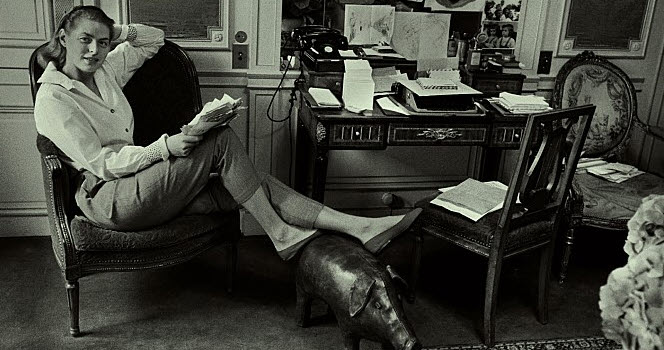
Ingridbergmaninherownwords01You cannot help but admire the life and career of Ingrid Bergman, one of the greatest actresses representing the Golden Age of Hollywood. Although she came to Hollywood as a young unknown newcomer from Sweden, she quickly rose to stardom, and then she graced the screen with some of the most memorable performances in the movie history. Even after her career took a serious downturn later due to her personal matter, she kept moving on with no regret, and she remained active and graceful even during her later years, which also had a fair share of highlights to distinguish her long, remarkable career.

Stig Björkman’s documentary film “Ingrid Bergman: In Her Own Words” presents a more personal view on Bergman’s life and career mainly through numerous archival records left by Bergman herself. Although there are not many revealing things to intrigue or surprise you especially if you are a Bergman fan, the documentary is worthwhile to watch in its engaging presentation of archival footage and interview clips, and it comes to us as a plain but respectful portrait of an exceptional woman who always tried her best as constantly balancing herself between life and career.

Even when she was very young, Bergman was accustomed to being in front of the camera. She had been taken care of by her father since her mother’s early death, and her father, who died when she was 13, frequently photographed her daughter as a way of showing his fatherly affection. As she grew up, Bergman became determined to be an actress, so she went to the Royal Dramatic Theater School, but then she left the school as starting her movie career. In her first film “Munkbrogreven” (1935), she merely played a small role, but then she became a new star in the town as appearing several Swedish films including “Intermezzo” (1936).

Ingridbergmaninherownwords08In 1939, she was invited to Hollywood because legendary producer David O. Selznick wanted her for his 1939 remake version of “Intermezzo”, and the rest was history. Although she was unable to speak English at first, Bergman soon learned how to speak English fluently, and she worked with famous Hollywood directors and actors while solidifying her status as another genuine actress from Sweden after Greta Garbo. She got her first Oscar nomination for “For Whom the Bell Tolls” (1943) while also appearing in “Casablanca” (1942), and then she received her first Oscar for “Gaslight” (1944), which was followed by Alfred Hitchcock’s “Spellbound” (1945) and “Notorious” (1946).

But then there came a major upheaval in her life and career. After the critical/commercial failure of “Joan of Arc” (1948), Bergman fell in love with Italian director Roberto Rossellini, and that caused a huge public uproar because Bergman was a married woman with husband and daughter at that time. After divorcing her first husband, Bergman married Rossellini, and she worked with her new husband in five films while having three children between them, but she became an unwelcomed figure in US in the meantime. She did not care a lot about that, but she could not meet her young daughter for a while until her daughter grew up enough.

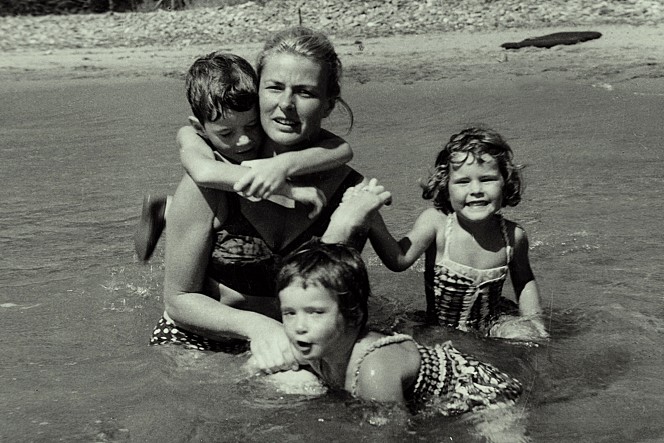
Pia Lindström, Bergman’s daughter from the first marriage, shows no hard feeling on her mother as remembering that difficult time, and she and her three step-siblings (Roberto Rossellini, Ingrid Rossellini, and, of course, Isabella Rossellini) fondly remember their fun times with their famous mother. While she was divorced from Rossellini in 1957 and married her third husband in the following year, she used to spend her free time with her children whenever she could, and we watch that through her home movie footage clips. She was always warm and caring to her children, and her children, who are wistful at times in their recollection of their loving mother, only wish that she could have spent more time with them.

Ingridbergmaninherownwords02Around the time when she received the second Oscar for “Anastasia” (1956), Bergman regained her star status as being welcomed by Hollywood again, and she was ready for more challenges while usually focusing on stage works. In “Cactus Flower” (1969), she willingly hurled herself into the contemporary mood of the 1960s, and the result was a surprisingly delightful comic performance to behold. After winning the third Oscar for her supporting turn in “Murder on the Orient Express” (1974), she collaborated with Ingmar Bergman as she had hoped since she met her fellow Swedish at the Cannes Film Festival in 1973, and that led to her superlative performance in “Autumn Sonata” (1978), which turned out to be her last theatrical film before her death in 1982.

Although she was not very well around the 1970s, Bergman maintained her professionalism as usual, and that certainly impressed young actresses around her. Liv Ullmann, who co-starred with Bergman in “Autumn Sonata”, has some amusing anecdotes about working with two Bergmans on the set, and Sigourney Weaver, who met Bergman when they worked in Sir John Gielgud’s Broadway production of “The Constant Wife”, tells us a small touching episode of how Bergman encouraged her to step forward with more confidence for her career.

Ingridbergmaninherownwords09Trying to present many things during its 2-hour running time, “Ingrid Bergman: In Her Own Words” often feels unfocused and superficial (Bergman’s brief romance with photographer Robert Capa seems important at first but then is quickly left behind for other things to show and tell, for instance). I got the feeling that it is probably more suitable as a DVD/blu-ray special feature for Ingrid Bergman film, but it has plenty of things to watch including old home movie footage clips from Bergman’s childhood years, and Alicia Vikander did a commendable job of reading Bergman’s personal journals and letters (Melinda Kinnaman, Joel Kinnaman’s sister, did the job in case of the English version).

By the way, I remember the YouTube clip of Bergman’s Oscar acceptance speech at the 1975 Academy Awards ceremony, and it is rather a shame that it is not included in this documentary. Surprised by her win, Bergman said her fellow nominee Valentina Cortese, who was nominated for “Day for Night” (1973), deserved the award more than her, and then she sincerely apologized to Cortese, who gladly accepted Bergman’s apology in response. That humble but classy moment shows us a lot about Bergman’s admirable humanity, and “Ingrid Bergman: In Her Own Words” assuredly confirms it to us.

Ingridbergmaninherownwords06

Posted in Movies | Tagged , , | 1 Comment