Misbehavior (2016) ☆☆☆(3/4): Dangerous misbehaviors

misbehavior02

South Korean film “Misbehavior” slowly boils with its dark, nervous tale of desire, jealousy, and manipulation. While it is quite uncomfortable mainly due to a number of serious misbehaviors committed by its main characters, the movie is compelling to watch none the less thanks to competent direction and engaging performance, and it feels like watching the irreversible progress of a destructive chemical reaction as they go further with each own desire.

The story is told mostly through the viewpoint of Hyo-joo (Kim Ha-neul), the chemistry teacher of a boys’ high school. The early scenes of the movie show how her life recently becomes more difficult than usual. Shortly after one of her colleagues has to leave her position temporarily because of her pregnancy, Hyo-joo is tasked with supervising that colleague’s class, and she cannot say no mainly because of her upcoming contract renewal. When she comes back to her place late, her slacker boyfriend does not seem to notice at all how much she feels pressured and exhausted, and this insensitive prick even demands her to make a late dinner for him.

While Hyo-joo manages to go through her hard days, there comes a new teacher. Apparently younger than Hyo-joo and other teachers in the school. Hye-yeong (Yoo Yin-yeong) is the daughter of the chairman of the school board, and that is certainly why she is employed so easily unlike others while never having to worry about getting fired.

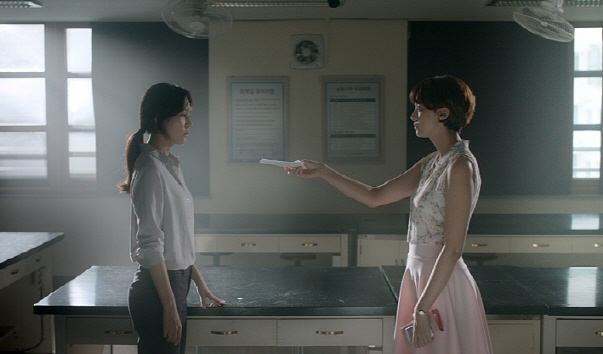
Naturally, Hye-yeong’s very existence exasperates Hyo-joo a lot, and she coldly responds to Hye-yeong even when she instantly recognizes Hyo-joo as a senior during her college year. Quite oblivious to how much Hyo-joo dislikes her, Hye-yeong keeps trying to be nice to Hyo-joo, and that only brings out more harsh responses from Hyo-joo. At one point, Hyo-joo points out how inappropriate Hye-yeong’s bright, colorful attire is in front of those hormone-charged boys in the school, and she does not even try to hide her displeasure in front of Hye-yeong and other teachers.

misbehavior03

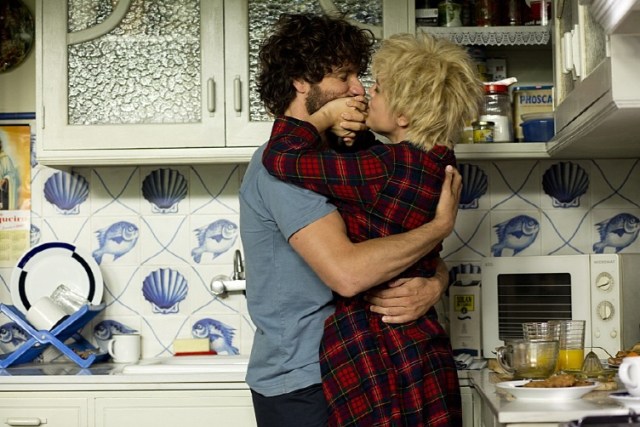
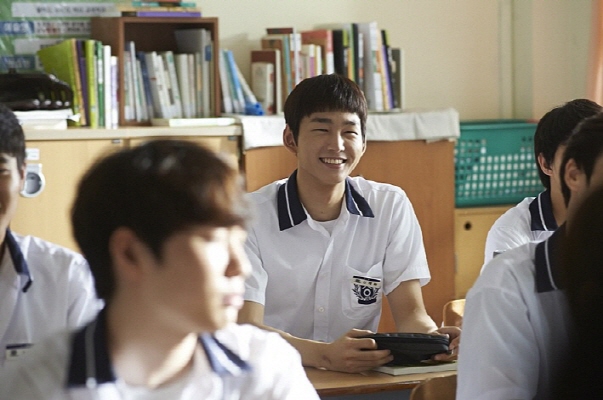
And then it turns out Hye-yeong has already done something far more inappropriate. During one evening, Hyo-joo drops by the school gym for checking Jae-ha (Lee Won-guen), one of her class students who routinely practices during after-school hours for his upcoming ballet contest. While looking for him in the gym, she hears something from a storage room in the building, and then she happens to witness Jae-ha having a sex with Hye-yeong.

On the next day, Hyo-joo tells Hye-yeong about what she saw during last evening, and she certainly feels empowered as Hye-yeong is thrown into panic in front of her. Now she becomes advantageous with her control over Hye-yeong’s scandalous secret, and that changed circumstance also prompts her to follow her secret desire toward Jae-ha. As she helps and supports him more than before, this good-looking boy shows her some gratitude in exchange, and she does not mind when he approaches to her closer for giving her more than a pupil is permitted to do.

Partially reminiscent of “Notes on a Scandal” (2006), another psychological thriller about two female school teachers and one male teenager student, the movie steadily dials up the level of suspense as calmly observing how its main characters’ situation becomes more unstable along the story, and we become more involved in the conflict between Hyo-joo and Hye-yeong even though both of them are not very sympathetic to say the least. It goes without saying that she suffered unfair disadvantages from the beginning because of Hye-yeong, but Hyo-joo has no problem with taking advantage of Hye-yeong as well as Jae-ha. In case of Hye-hyeong, she can be insufferable with her chirpy superficiality, which is exemplified well by a later scene where she casually confides to Hyo-joo what she actually thinks about Jae-ha.
misbehavior04

We accordingly watch these two very unlikable characters from the distance, but the two lead performers of the movie keep holding our attention. In what may be her best performance since “Blind” (2011), Kim Ha-neul is terrific as subtly conveying the emotions bottled up behind her character’s frigid façade, and Yoo In-yeong is equally convincing as balancing her character well between innocence and hypocrisy. While he looks a little too old as an adolescent character, Lee Won-guen, who previously appeared in “The Net” (2016), is mostly adequate as another crucial part of the story, and Lee Hee-joon, Lee Ki-woo, Ki Joo-bong, Lee Kyeong-yeong, and Jeong Seok-young are also solid in their small supporting roles.

“Misbehavior” is the second feature film from the director/writer Kim Tae-yong, who previously impressed me a lot with his first feature film “Set Me Free” (2014). That modest but powerful character drama was fueled by the considerable tension generated from its young, opportunistic hero’s desperate struggle to get out of his depressing reality, and I came to care a bit about him although I did not like him much even in the end.

I did not care a lot about the main characters of “Misbehavior”, but I enjoyed at least how their disturbing drama approaches to its critical point with accumulating tension. What happens after that point feels so sudden at first, but it is undeniably inevitable, and we are chilled by its devastating consequence. You may feel a little sorry for them, but they surely knew they were playing with fire, didn’t they?
misbehavior01

Posted in Movies | Tagged , , , | Leave a comment

The BFG (2016) ☆☆☆(3/4): A little girl and her big friendly giant

bfg05.jpg

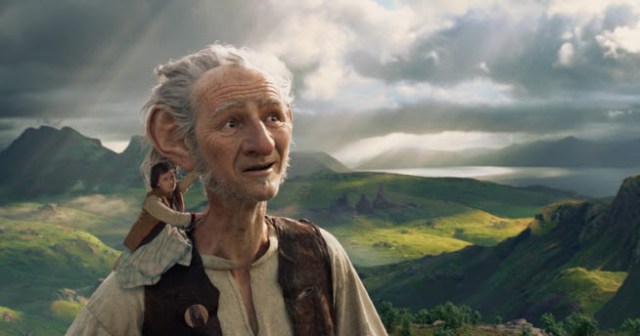
“The BFG” is a flawed but pleasant fairy tale with a number of good elements to admire. Although you may become impatient with its rather thin plot and loose narrative pace, the movie is not entirely without charm and wonder as supported by its endearing lead performance, and I enjoyed its nice visual moments even while clearly recognizing its weak aspects.

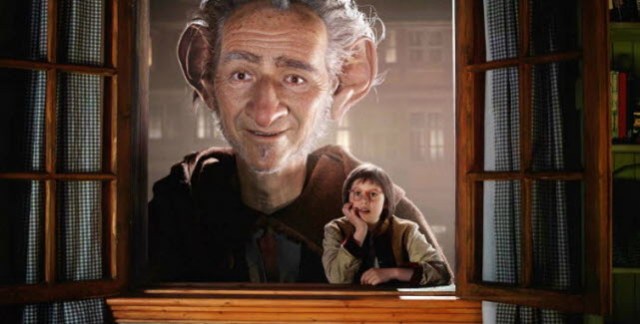
The opening scene of the movie introduces us to Sophie (Ruby Barhhill), a little girl living in a London orphanage whose interior and surroundings are amusingly Dickensian in contrast to the modern background of the story. While she stays awake during one late night due to her insomnia, she hears some noises from the outside, so she looks out the window and then happens to spot a giant on the corner of the street near the orphanage. The giant also notices her at that very moment, and she soon finds herself grabbed by his big hand and then swiftly taken far, far away from London.

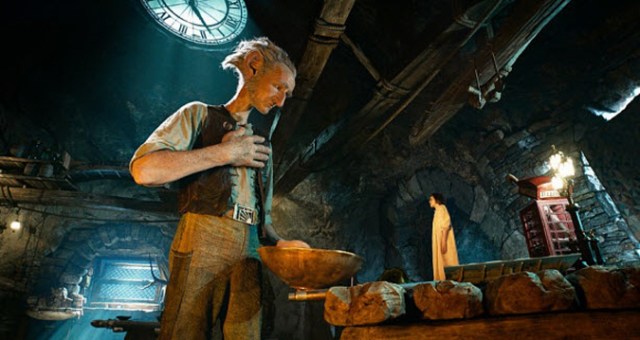
He takes Sophie to Giant Country, where he and other nine giants have lived for a long time. She naturally becomes scared when she confronts the giant in his place, but the giant, played by Mark Rylance in his first attempt of motion capture performance, turns out to be a gentle, eccentric old guy who does not eat ‘human beans’ unlike other giants. He took Sophie to his place just because he worried that Sophie might tell other people about him, and Sophie comes to see that he means no harm to her. He may keep her in his place for the rest of her life, but he certainly does not want her to be eaten by other giants, who will not mind having Sophie for a snack if they ever see or smell her.

As they spend more time together, Sophie and the giant, who is eventually called the ‘Big Friendly Giant’ or BFG, get close to each other as two different loners. While Sophie has no friend in her orphanage, BFG has been alienated from other giants just because he is far smaller than them. As they come to depend on each other more than expected, BFG becomes a sort of grandfather figure to Sophie, and Sophie brings some lively spirit into BFG’s lonely life.

bfg02

The best moments in the movie come from when BFG shows Sophie small and big wonders he has kept to himself for many years. His hidden private space is filled with many different kinds of collected dreams, which are presented as shiny, colorful floating matters contained in glass jars. While some of them feel as good as your average pleasant dream, others feel as bad as your typical terrible nightmare, and they also can be mixed together for concocting a more complex type of dream.

These dreams originated from Dream Country, a magical realm located not so far from Giant Country. When Sophie enters this region along with her friend, the movie gives us an enchanting sight of various dreams generated from a big mysterious tree, and then we get a lovely moment when BFG imbues a nice piece of dream into the sleeping mind of one boy and his parents. The content of the dream in question is presented in a simplistic way on the screen, but this moment is accompanied with the sense of wonder and curiosity as BFG and Sophie watch its effect together, and Rylance is effortlessly engaging as his character earnestly describes its progress to his little friend.

Around its third act, the movie becomes a little darker as BFG and Sophie are more threatened by other giants including Fleshlumpeater (Jemaine Clement), the biggest and meanest of the bunch. For her friend as well as herself, Sophie conceives a plan which may work, but it requires BFG to be more active and confident than before, and, not so surprisingly, he is reluctant about that.

bfg03

The adapted screenplay by late Melissa Mathison, which is based on Roald Dahl’s children’s book of the same name, maintains its leisurely narrative pace even at this point, and that is a wise choice considering its anti-climactic finale where everything is resolved a little too neatly. I am not wholly satisfied with this part, but I must admit that I was amused by the absurd encounter between BFG and several human characters who appear later in the story. I will not go into details here, but let’s say that I liked how the director Steven Spielberg goes for an outrageous moment of broad humor at one point – and how he and his performers keep everything straight for more comic effects during that moment.

Above all, it is really a pleasure to see how Rylance ably carries the movie to the end. When this renowned British stage actor drew more of our attention thanks to his Oscar-winning supporting turn in Spielberg’s previous film “Bridge of Spies” (2015), I commented that we would see a lot more from him in the next following years, and his wonderfully nuanced performance in “The BFG” surely confirms my prediction. While deftly capturing the comic sides of his character, he gently embodies his character’s more serious and thoughtful sides, and he is also convincing in his on-screen interactions with his co-star Ruby Barnhill, who holds her own place well with her plucky performance.

Although it is far less edgy compared to other notable adaptations of Dahl’s works such as “Willy Wonka & the Chocolate Factory” (1971) or “James and the Giant Peach” (1996), “The BFG” is still a likable family film which is as benign and sentimental as a Spielberg movie can be. Mainly because it does not reach to the level of “E.T. the Extra-Terrestial” (1982), it will probably be remembered as a minor work from Spielberg, but even a minor Spielberg film is more interesting than most of movies out there – and you will certainly not forget how Rylance brings a human touch of class to the movie.

bfg01

Posted in Movies | Tagged , , | Leave a comment

10 movies of 2016 – and more: Part 3

Now here is my list of 10 South Korean films of this year.

Continue reading →

Posted in Movies | Tagged | 2 Comments

10 movies of 2016 – and more: Part 2

And here are the other 5 movies in my list – with other films good enough to be mentioned. Continue reading →

Posted in Movies | Tagged | Leave a comment

10 movies of 2016 – and more: Part 1

Here are the first 5 movies in my list. Continue reading →

Posted in Movies | Tagged | Leave a comment

10 movies of 2016 – and more: Introduction

%ec%82%ac%eb%b3%b8-20161020_074803

It has been a pretty bad year for many of us. Many famous figures including David Bowie, Prince, Umberto Eco, Muhammad Ali, Leonard Cohen, George Michael, Carrie Fisher, and Debbie Reynolds passed away during this year, and there was also the dire, shocking result from the US presidential election in last month. Watching the alarming rise of Donald Trump and many other reckless demagogues around the world, I wonder whether our world is actually going down toward the darkness observed in Alfonso Cuarón’s “Children of Men”, whose dystopian world has unfortunately become more relevant than before.

Meanwhile, things have been a little better in my life during last several months. I have been paid more in a more stable position than before, and it seems I may accomplish something in 2017 if I keep studying and working more. In addition, I came out of the closet in this September, and now I have a few gay acquaintances I can talk with.

Anyway, 2016 is another interesting year for me and other moviegoers, and I am glad that I watched a fair share of good films during this year. Because I live in South Korea, I could not watch a number of notable movies released in this year, but I will probably watch “Moonlight”, “Manchester by the Sea”, “Fences”, “Silence”, “Paterson”, “Toni Erdmann”, “20th Century Women”, “Jackie”, “Arrival”, “The Red Turtle”, “Moana”, “Hacksaw Ridge”, “Hidden Figures”, and “Lion” during next two months. They will surely be mentioned at the end of the next year if they are excellent as other reviewers have said – and if you and I are still alive at that point, of course.

Posted in Movies | Tagged | Leave a comment

Rogue One: A Star Wars Story (2016) ☆☆☆(3/4): The Force is strong in this spin-off…

rogueone1

Whenever it works well, “Rogue One: A Star Wars Story” feels like the best Star Wars movie since the original Star Wars trilogy. Although it is riddled with several weak spots in terms of plot and characters especially during its first half, the movie eventually becomes more exciting as efficiently and spectacularly culminating to its expected finale. Overall, it does more than it is required to do as a spin-off product placed between “Star Wars: Revenge of the Sith” (2005) and “Star Wars: A New Hope” (1977).

Expanded from what was briefly mentioned in “Star Wars: A New Hope”, its story is mainly driven by what may completely change the course of the ongoing war between the Empire and the Rebel Alliance. As the Empire completes the construction of the Death Star, Galen Erso (Mads Mikkelsen), a scientist who was forced to help the design and construction of this infamous superweapon of mass destruction after being separated from his dear family, covertly sends his old friend Saw Gerrera (Forest Whitaker) an important message via a defecting Imperial cargo pilot, but the circumstance is not that good at all. The leaders of the Rebel Alliances are certainly interested in that message, but Saw is not so friendly to them as the rogue leader of an extremist faction fighting against the Imperial Military in a desert planet called Jedha, so they need someone who can approach to Saw without any suspicion or hostility from him.

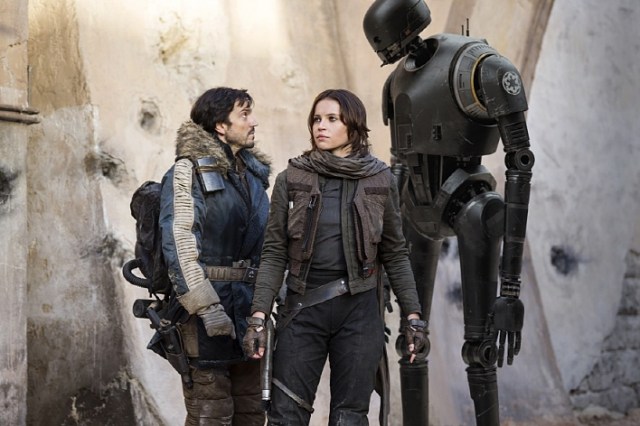
That is how Jyn Erso (Felicity Jones), Galen’s daughter who has lived a criminal life alone since she grew up under Saw’s protection, comes into the picture. When she is being transported to a labor camp, she is rescued by Rebel Alliance intelligence officer Cassian Andor (Diego Luna), and she agrees to help the Rebel Alliance mainly because they promise a reward she cannot refuse.

rogueone2

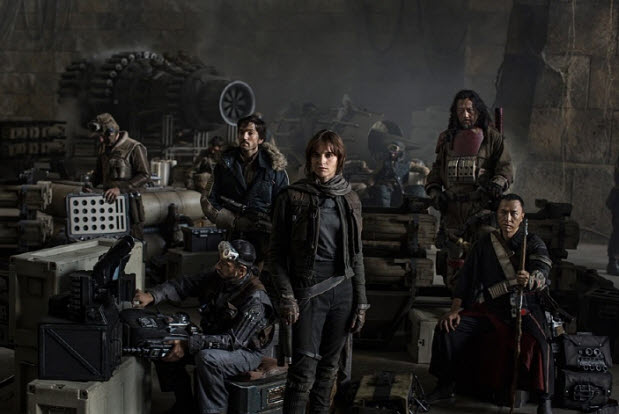
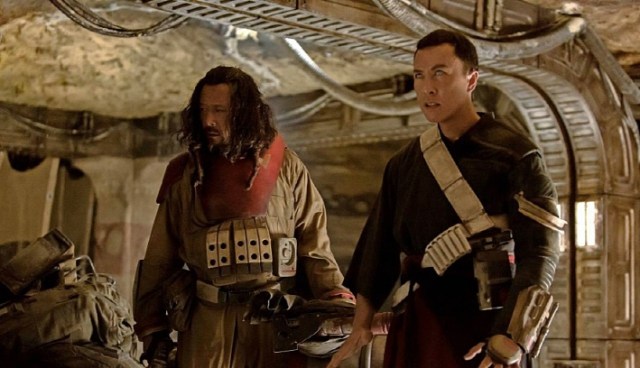
She and Cassian soon go to Jedha for finding and meeting Saw, and the movie gradually assembles several supporting characters around them. They are K-2SO (voiced by Alan Tudyk), a re-programmed Imperial enforcer droid who is pretty much like a calmer version of C-3PO; Chirrut Îmwe (Donnie Yen), a blind but skillful warrior who believes in the Force as he frequently emphasizes to himself and others; Baze Malbus (Jiang Wen), Chirrut’s friend who can do a lot more than being around Chirrut; and Bodhi Rook (Riz Ahmed), the aforementioned Imperial cargo pilot who finds himself facing far more risk than expected as getting involved with Jyn and Cassian.

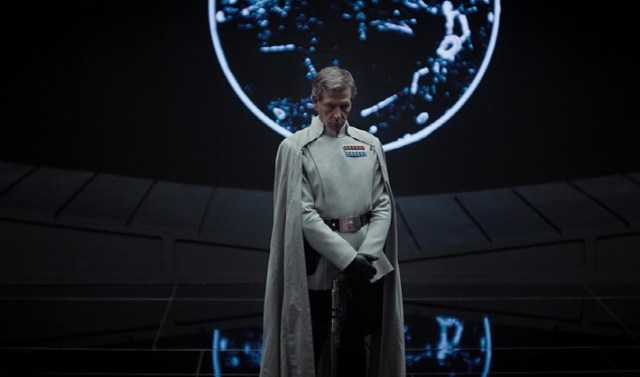
On the opposite side, we meet one new villain character besides two familiar old ones. As a high-ranking Imperial Military officer who has supervised the construction of the Death Star and is also directly responsible for Galen and Jyn’s miseries, Ben Mendelsohn is suitably despicable, and his best moment comes from when his character feels frustrated about not being rewarded enough to satisfy his lifelong ambition. Voiced by James Earl Jones as usual, Darth Vader shows more of his fearsome side, and Grand Moff Tarkin, who was played by late Peter Cushing in “Star Wars: A New Hope”, is chilly and heartless, which is no surprise considering that he is presented here via the CGI based on Cushing’s performance.

While introducing all these characters, its first half often stumbles because of its bumpy plot progress and rather weak characterization, but then the movie comes to gain narrative momentum as everything is set for action. The action sequences in the film are notably grittier and tougher than the ones in other Star Wars movies, and the sense of real danger is palpable as Jyn and other characters around her struggle through a series of perilous moments which may get them killed at any point. Looking more competent and threatening than ever here in this film, Stormtroopers shoot better than usual, and the Death Star has a grand, terrifying scene to behold when its destructive power is tested for the first time.

rogueone4

The movie is directed by Gareth Edwards, who previously directed “Monsters” (2010) and “Godzilla” (2014). While quite different from each other, both “Monsters” and “Godzilla” showed that Edwards is a filmmaker who really knows how to use special effects well for dramatic purposes, and “Rogue One: A Star Wars Story” further confirms his mastery of special effects especially during its climax sequence, which is the best CGI action sequence I have ever seen during this year. Yes, I have recently complained about how much I feel exhausted and bored with those big, massive CGI spectacles in numerous blockbuster films, but this actually engaged me right from the beginning and then thrilled me to the end with considerable satisfaction. While it busily shuffles between different places and characters, we never get confused amidst lots of bangs and crashes, and we come to care more about how the story inevitably comes to its ending.

It is a little shame that Jyn and her comrades are not as distinctive as Rey or Finn in “Star Wars: The Force Awakens” (2015), but they function well together as a group we can root for at least. While Felicity Jones and Diego Luna have more things to play as their characters come to trust and depend on each other along the plot, Riz Ahmed, Donnie Yen, and Jiang Wen fill their respective archetype supporting roles as demanded, and Alan Tudyk has a juicy fun with the deadpan attitude of his robot character.

While it is not without flaws, “Rogue One: A Star Wars Story” did a good job in many aspects. While feeling darker than other Star Wars movies in comparison, the movie also stays true to the mood and spirit of the original Star Wars trilogy, and that is further accentuated by Michael Giacchino’s score, which is appropriately based on John Williams’ music from the original Star Wars trilogy. The Force is strong in this movie, and that is more than enough for me to have some expectation on whatever will come next.

Sidenote: I watched the movie not long after hearing the news of Carrie Fisher’s death, and her brief appearance during the last scene felt quite poignant to me. Rest in peace, Miss Fisher.

rogueone3

Posted in Movies | Tagged , , | Leave a comment

Julieta (2016) ☆☆☆(3/4): Another tantalizing exercise in style by Almodóvar

julietta01

My eyes were thrilled and intrigued as watching Spanish film “Julieta”, another tantalizing exercise in style from Pedro Almodóvar. While it is relatively more straightforward and less flamboyant compared to his previous works, this is another stylish, confident work from a master filmmaker who really knows how to draw and hold our attention via thoughtful visual details and techniques. Although I observed its plot and characters from the distance, I savored its several fabulous visual moments as well as its two terrific main performances, so I came to conclude that they are good enough to compensate for its notable weak aspects, which still could not be completely overlooked even during my second viewing.

At first, the opening scene is filled with the bold red color of a gown worn by our heroine Julieta (Emma Suárez), and then we see her packing a number of things including a small sculpture at her slick modern apartment. She will soon move to Portugal along with her boyfriend Lorenzo (Darío Grandinetti) because of his work, and she has no problem with that at all, as reflected by her casual conversation with him.

However, there comes an unexpected change through one accidental encounter. Julieta happens to come across her daughter’s old friend, and she tells Julieta that she recently encountered Julieta’s daughter outside Spain. 12 years ago, Julieta’s daughter suddenly and totally disconnected herself from her mother without any explanation, and Julieta has distanced herself from that painful fact of her life during recent several years, but it seems the past is not through with her yet.

And she is not through with the past either. She promptly cancels her plan with Lorenzo, who is understandably dismayed but respects her decision none the less while not asking too much. She moves back to an apartment where she and her daughter once lived before her daughter disappeared, just because her daughter may attempt to contact her via their old home address. As she thinks more about her daughter, she feels the urge to tell everything she did not tell her daughter when they were together, so she begins to write them down on a notebook for her daughter – and us, of course.

julietta02

Along with her narration, the movie goes back to when young Julieta (Adriana Ugarte) had a couple of encounters to remember. On a night train to Madrid, Julieta happened to sit across a middle-aged guy, and she walked out from him when it looked like the guy was interested in her. While that seemingly inconsequential action of hers made her feel guilty when a tragedy occurred later, it also brought her to Xoan (Daniel Grao), a hunky fisherman who was on the same train.

Not long after their encounter which culminated to a very passionate moment between them, Julieta receives a letter from Xoan, and she soon goes to a seaside town where he lives. While Xoan recently lost his wife who were in coma for several years, Julieta has been pregnant since their encounter, so they eventually start to live together in his nice, cozy house near the sea, and then there comes their dear daughter Antía.

In the meantime, we are introduced to several other characters around them. Xoan’s middle-aged housekeeper Marian (Rossy de Palma) gives a frigid impression to Julieta right from their first encounter, but she becomes softened a bit after Antía is born. Along with her husband and their young daughter, Julieta visits her parents living in a country village, and it does not take much time for her to notice that her father Samuel (Joaquín Notario) is quite close to a young woman who has taken care of many things in his house besides his ailing wife.

And there is Ava (Iman Cuesta), Xoan’s artist friend who made that sculpture shown in the opening scene. Julieta already knew from the beginning that Ava and Xoan were very close to each other before she came into his life, but what has remained unresolved among these three people for years ultimately leads to an incident which will affect not only Julieta and Ava but also Antía.

julietta04

Through some help from Antía’s aforementioned friend and that friend’s generous mother, Antía and Julieta subsequently move to Madrid, and Antía takes care of her mother as Julieta struggles with what is probably the lowest point in her life. As time goes by, Julieta gradually recovers, and things seem to be all right for her and her daughter as before, but then Antía makes that drastic choice after spending some time at a spiritual retreat located somewhere in the Pyrenees.

As the movie constantly sticks to Julieta’s viewpoint, Antía eventually becomes a distant, elusive character along the plot, and Almodóvar’s adapted screenplay, which is based on three short stories from Alice Munro’s “Runaway”, remains rather vague about her even in the end. I felt a little frustrated about this during my first viewing, but then I came to have some understanding during my second viewing. After all, the movie is not about what exactly happened to Antía but about how Julieta tries to deal with her past and the accompanying guilt inside her, and that is why the ending of the movie works to some degrees, though it also makes the whole movie look like a long warm-up process before more things to be revealed beyond the movie.

I still have reservation on whether the movie works as well as intended, but I recommend it anyway for what I enjoyed and appreciated during my repeated viewings. Almodóvar and his cinematographer Jean-Claude Larrieu frequently delight us with the striking utilization of primary colors in precise, elegant mise-en-scène, and Almodóvar’s longtime collaborator Alberto Iglesias’ score subtly generates tension and curiosity during many of key scenes in the film. In case of lead performers Emma Suárez and Adriana Ugarte, they are so effortlessly connected with each other in their performance that you will marvel at how the movie makes a smooth transfer from Ugarte to Suárez at one point without any jarring impression.

While “Julieta”, which was chosen as Spain’s official entry for Best Foreign Language Film Oscar in this year, is not one of better works from Almodóvar in my inconsequential opinion, it still shows Almodóvar’s undeniable mastery of filmmaking, and some of its vibrant images will probably linger on my mind for a long time like those fresh, moistened red tomatoes in “Broken Embraces” (2009). He is simply having a fun with being Almodóvar here, and I guess we should not complain about that, considering how much he has impressed and dazzled us for many years as one of the best filmmakers of our time.

julietta907

Posted in Movies | Tagged | Leave a comment

Krampus (2015) ☆☆☆(3/4): Here’s a scary, naughty Christmas treat for you

krampus01

“Krampus” is a scary, naughty Christmas treat for you if you are ever tired of those platitudinous Christmas family movies. While its early part looks like a naughtier version of “National Lampoon’s Christmas Vacation” (1989), it is soon turned into something far darker and naughtier as invaded by a chilly horror premise, and it is sufficiently scary with some morbid sense of humor for our twisted amusement.

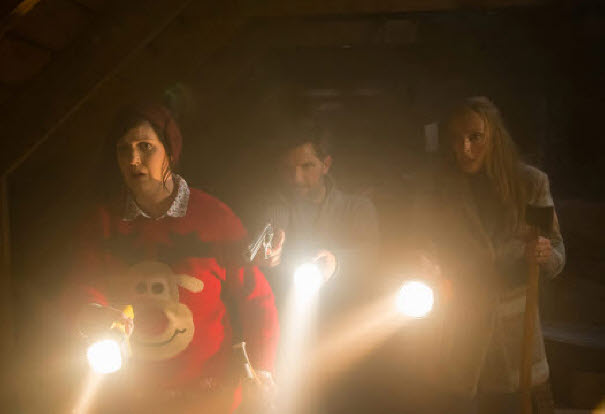
After its hilarious opening sequence which satirizes that dreadful frenzy of Christmas shopping season, the movie introduces a suburban family who is about to spend the holiday season with a group of unwelcomed family guests. Sarah (Toni Collette) and her husband Tom (Adam Scott) already shudder at the thought of spending three days with her sister’s family, and we soon see the reason as her sister’s family finally arrives at Sarah and Tom’s home. Although her sister Linda (Allison Tolman) is a fairly nice woman, her husband Howard (David Koechner) is an insufferable loudmouth, and it would be an understatement to say that Linda and Howard’s four children do not get along well with Sarah and Tom’s two kids. In addition, they come with Aunt Dorothy (Conchata Ferrell), another family member Sarah does not want to spend the holiday season with at any chance.

Sarah and Tom tries to hold themselves with their hospitality to their family guests, but, of course, things do not go well right from their first family dinner as Max (Emjay Anthony), Sarah and Tom’s son, happens to clash with his two cousins over his letter to Santa Claus. While their conflict causes a very awkward moment for everyone at the table, Max feels angry and humiliated for being taunted for believing in Santa Claus, so he comes to commit a serious act of apostasy against Santa Claus.

krampus03

He probably thought no one was watching him when he did that, but, alas, a mysterious entity somewhere in the sky senses his naughty deed instantly, and the consequence soon follows. A very heavy snow storm is commenced, and everyone in the house is confounded to discover on the very next morning that they are virtually isolated from outside due to the continuing snow storm. While electricity and phone line are somehow cut off, the surroundings of the house are shrouded in white calmness with no sign of neighborhood people, and then strange things begin to happen.

As it becomes apparent to everyone in the house that something terrible is lurking somewhere outside the house, it looks like Max’s European grandmother (Krista Stadler), who usually speaks in German, knows what is about to happen, and, not so surprisingly, she eventually tells others an old story about Krampus, which can be regarded as Santa Claus’ evil alter ego. Krampus’ main job is punishing anyone who happens to lose their belief in Santa Claus, and, as Max’s grandmother warns, the punishment will not merely be a slap on your naughty ass.

While Krampus’ ominous presence feels more palpable along the plot, the director/co-writer Michael Dougherty steadily dials ups the level of dread via his competent handling of mood and suspense. I liked the way how the mere appearance of a mysterious snowman outside the house leads to a very sinister payoff later in the movie, and I also enjoyed how a suspenseful sequence accompanied with Krampus’ first appearance has an effective moment of shock and awe sprung out of its inevitability. Like that shark in “Jaws” (1975), Krampus is usually kept around the corners of the screen for inducing more fear and suspense, and this ancient spirit certainly looks terrifying and menacing when it fully reveals itself as required by the climactic part of the movie.

krampus02

Dougherty also throws a number of naughty horror elements into the plot, and they are alternatively scary and amusing. Besides the mangy creatures which are its little helpers, Krampus has a bunch of nasty surprises to be unwrapped for its targets, and, though I will not go into details for not spoiling your entertainment, I can assure you that they are as fun as those vicious moments in “Gremlins” (1984).

Like any good horror films, the movie makes us care about its characters and then fear for them. As watching them cornered and threatened more and more in their perilous situation, we are constantly aware of what is at stake for them, and we come to care about everyone in the house regardless of whether they are likable or not. Skillfully going back and forth between different genre modes as demanded, Toni Collette, Adam Scott, Allison Tolman, and David Koechner often bring some degrees of human depth to their respective characters, and Conchata Ferrell has a small fun with her brash supporting role. In case of Austrian performer Krista Stadler, she has her own moment when her character’s old story is presented through an animation sequence, and that is another nice touch in the movie to mention.

Like “Rare Exports: A Christmas Tale” (2010), “Krampus” successfully balances itself between comedy and horror, and I found myself more involved in its mood and story than expected during my late afternoon viewing on this Christmas Day. While it was getting chillier and darker outside, my darkened room was lighted only by a candle, and the result was a spooky but fun holiday experience to remember. Maybe you should try that when Christmas comes again.

krampus04

Posted in Movies | Tagged , , , | Leave a comment

Hunt for the Wilderpeople (2016) ☆☆☆1/2(3.5/4): A quirky Kiwi adventure comedy

huntforthewilderpeople01

“Hunt for the Wilderpeople” is cheerfully odd and charming enough to draw lots of laughs from me. Freely rolling with its two distinctive main characters who cannot possibly be different from each other, the movie generates numerous small and big funny moments you have to see for yourselves, and it also gradually reveals its sweet heart to us while never losing its quirky sense of humor.

The early part of the movie shows us how Ricky (Julian Dennison) comes to live with Hec (Sam Neill) and Bella (Rima Te Wiata). As a parentless juvenile delinquent kid with a rather impressive record of various misdemeanors, Ricky is indeed a difficult case for Paula (Rachel House), but this unflappable child welfare worker whose motto is ‘No Child Left Behind’ is determined to make sure that this ‘real bad egg’ gets a suitable foster home under her supervision, and now he is sent to a remote rural place belonging to Bella and Hec.

At first, Ricky is not that enthusiastic about his new foster parents, but he soon gets accustomed to them mainly thanks to Bella’s hearty kindness and no-nonsense attitude. One of the sweetest moments in the movie comes from when his attempt to run away from her house is failed. While not so surprised at all, Bella simply says to Ricky, “Have some breakfast, and then you can run away.” Looking both chirpy and eccentric as required, Rima Te Wiata imbues her character with lots of genuine warmth, and her performance becomes all the more poignant when we later come to learn about Bella’s personal motive behind accepting Ricky into her house.

huntforthewilderpeople04

As days go by, Ricky comes to like Bella more than expected, though it takes some more time for him to get used to her husband’s gruff presence. On Ricky’s 13th birthday, Bella does everything she can do for celebrating this special day, but her husband remains sullen as usual although he gives Ricky a surprise gift after that.

Anyway, it seems Ricky finally finds a home where he can grow up under care and love, but then, due to a couple of plot turns I will not describe here, the situation is changed. Ricky eventually decides to run away, but then he inadvertently draws Hec into his escapade, and they soon find themselves becoming quite famous around the country mainly thanks to Paula, who is eager to bring Ricky back in her custody by any means available to her.

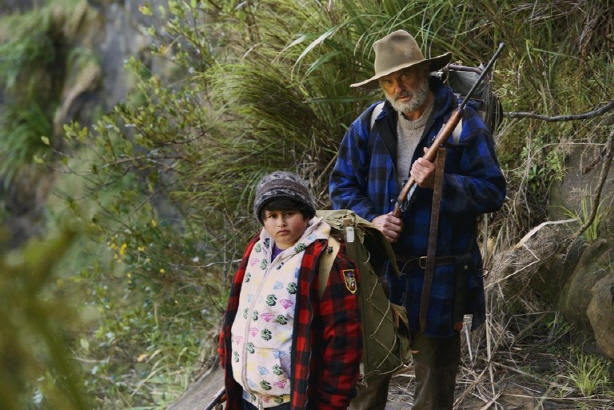
Spending a lot of time together in a vast area of mountainous wilderness, Ricky and Hec certainly become your typical mismatched duo, but the director Taika Waititi’s adapted screenplay, which is based on Barry Crump’s novel “Wild Pork and Watercress”, never feels conventional as always focusing on the rocky interactions between its two main characters. As jaunting from one moment to another along their bumpy adventure, Ricky and Hec come to us as fun, vivid characters to watch, and we care about them even when the movie tries a big climactic action sequence later in the story.

It definitely helps that these two characters are played by two engaging performers. Perfectly cast in his role, young actor Julian Dennison is hilarious as aptly balancing himself between innocence and brashness. In case of a certain wryly humorous scene where his character unintentionally brings another trouble to Hec, the way Dennison delivers his line is so innocuous that we cannot help but laugh as watching the following responses from the other characters in that scene, and it is all the funnier when Ricky belatedly realizes his mistake.

huntforthewilderpeople03

On the opposite, Sam Neill, a veteran actor whom I noticed for the first time through “The Final Conflict” (1981) and “Jurassic Park” (1993), gives a rare comic performance to appreciate. Wisely keeping his performance straight in front of Dennison, Neill goes for more subtle touches, and he is priceless whenever he reacts to his young co-performer’s comic moments such as when Ricky dances to his imaginary music in front of Hec.

Besides Te Wiata, the other main supporting performers in the film have each own fun with their broad but colorful characters. Rachel House delightfully chews her scenes, and Oscar Kightley is an effective counterpoint as a police officer accompanying her character. Rhys Darby is goofy as a loony hermit whom Ricky and Hec happen to encounter at one point, and Tioreore Ngatai-Melbourne is lovely and plucky as another crucial character in the story.

Waititi previously directed “What We Do in the Shadows” (2014), which was one of the funniest film I saw during 2015. That movie is about a trio of vampires living together in Wellington, and I really laughed and chuckled a lot during many of its deadpan moments which are the comic extension of those familiar genre rules about vampires.

While “Hunt for the Wilderpeople” is not as uproarious as “What We Do in the Shadows”, it has plenty of good things to savor besides the spirited performances from its cast. I appreciate the deliberate retro style of the score by Lukasz Buda, Samuel Scott, and Conrad Wedde, and the cinematographer Lachlan Milne provides a number of sweeping nature landscape shots, whose mythic quality reminds me of why Peter Jackson shot the Lord of the Rings trilogy in his homeland. The movie may be predictable to you at first, but then it keeps surprising and entertaining you through solid characters and deft storytelling, and the result is one of the most enjoyable comedy films in this year.

huntforthewilderpeople02

Posted in Movies | Tagged , | Leave a comment