Lost in Paris (2016) ☆☆1/2(2.5/4): A whimsical slapstick comedy set in Paris

lostinparis01

French film “Lost in Paris” is a whimsical comedy mainly driven by various amusing moments of slapstick comedy. It surely has its own offbeat charm and the audiences around me frequently giggled during the screening I attended, but the movie was not that funny for me as I constantly noticed its many artificial aspects, which were, to be frank with you, a little too much for me to ignore.

Right from the opening scene set in a remote town located somewhere in the arctic area of Canada, I knew I should not expect anything realistic from the movie. When the town is shown from the distance during this scene, you can clearly see that it is a model set, and it goes without saying that the two performers playing a young girl and her aunt are in front of a snowy CGI background.

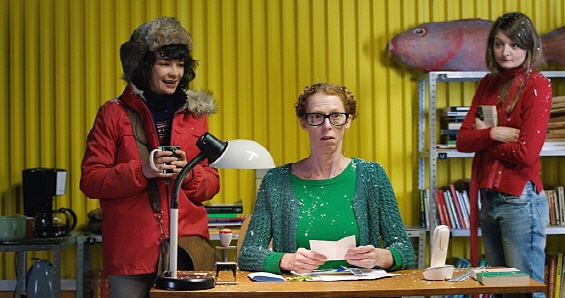
Many years have passed, and that girl, named Fiona (Fiona Gordon), now becomes your typical spindly spinster. She works at a local library, and the place looks so modest with a small quantity of books that I did not know at all that it was a library before reading a review by Todd McCarthy later. The weather is cold, snowy, and windy in the town as before, and we accordingly get a silly moment when Fiona and others in the library barely hold themselves against the mighty wind coming into the library along with a mailwoman.

The mailwoman delivers a letter to Fiona, and it is from her aunt Marta (Emmanuelle Riva, who died two months before the movie was released in France), who left the town and then went to Paris many years ago. As being over 80, Aunt Marta may be sent to a facility for old people, but that is the last thing wanted by this plucky old lady still enjoying her joie de vivre, so she sent a letter to her niece for help, though its delivery was considerably delayed due to a hilarious reason I will not reveal here.
lostinparis03

After reading her aunt’s letter, Fiona immediately flies to Paris, but she only finds herself stranded in Paris due to a series of bad lucks as well as her woefully unprepared status. While not changing her plain attire much, she just carries a red backpack with a Canadian flag on the top of it, and she gets herself into several slapstick situations thanks to her clumsiness. There is a sort of pratfall moment when she steps back a bit too far while trying to get a photograph of herself on one of those bridges on the Seine river, and, though this is not one of those outrageous selfie accidents, I think she should never be allowed to try a selfie for the rest of her life.

Because of that unfortunate accident, she loses her backpack containing her money and passport, and she is further frustrated when she finally comes to an apartment building where her aunt lives. She cannot enter her aunt’s apartment because her aunt is absent for some reason, so she has no place where she can stay and sleep, and we subsequently get a deadpan moment unfolded at a nearby laundromat.

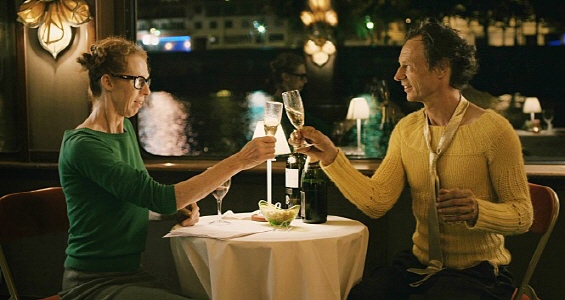
Meanwhile, a vagrant guy name Dom (Dominique Abel) comes into the picture via sheer coincidence. As he spends another his ‘usual’ day around the Seine river, he happens to find Fiona’s lost backpack, and he does not hesitate to use the money and other things in the backpack. Thanks to Fiona’s money, he is allowed to have a dinner at a fancy restaurant on the river, and then we are served with a comic sequence reminiscent of the works of Jacques Tati.
lostinparis04

And that is when Dom comes across Fiona. Right from when he sees her, Dom becomes attracted to Fiona, and he tries to charm her while dancing with her at the restaurant, but then she belatedly realizes that he is using her money and other things. Not long after they become separated via another slapstick moment, Dom approaches to Fiona again, and she reluctantly lets him accompany her when she goes to a certain place for seeing her aunt.

Of course, these two different characters are destined to get closer to each other as they bounce together from one comic situation to another, and the co-directors/co-writers Dominique Abel and Fiona Gordon skillfully handle many of their physical comedy scenes with distinctive comic sensibility. Although I only saw a few scenes from their previous film “Rumba” (2008) via its trailer, I could instinctively sense their own whimsical touches during my viewing of “Lost in Paris”, and Abel and Gordon, who worked together for a long time even before their debut feature film “L’iceberg” (2005), click together well on the screen like Fred Astaire and Ginger Rogers with a touch of silent comedy movie stars such as Buster Keaton.

And there is Emmanuelle Riva, who feels quite different from her heartbreaking Oscar-nominated performance in “Amour” (2012). Like Gordon and Abel, she is willing to go for fun and laugh, and she and Pierre Richard have a charming scene when their characters try to relive their good old time while sitting on a bench together. I wondered whether Gordon and Abel used stand-ins while shooting this scene, but it is presented with the quirky sense of fun to amuse and delight us, so I enjoyed it as feeling a little sad about Riva’s passing, which happened early in this year.

I liked “Lost in Paris” to some degrees, but it did not particularly hold my attention well due to its contrived plot and thin characterization, and I think it could be more hysterical or eccentric for more genuine laughs. The movie was not a waste of time, but I would rather recommend you the works of Jacques Tati and Buster Keaton first.

lostinparis02

Posted in Movies | Tagged , | Leave a comment

I Am Not Your Negro (2016) ☆☆☆1/2(3.5/4): Baldwin Remembers

Iamnotyournegro01.jpg

First, let me confess that I am not that familiar with James Baldwin, a renowned African American writer who was one of the notable figures in the Civil Rights Movement in US during the 1960s. Although I came to know a bit about him through a brief scene in “Capote” (2005) (“Jimmy. Your book is about a Negro homosexual who’s in love with a Jew. Wouldn’t you call that a problem?”) and then learned a little more about him during recent years, I have never tried to explore his books, which have been one of numerous blind spots in my knowledge in fact.

Considering that it mainly focuses on Baldwin’s ideas and philosophy instead of providing a wider view of his life and career, I may not be an ideal audience for Raoul Peck’s Oscar-nominated documentary film “I Am Not Your Negro”, but the documentary still engaged me thanks to its compelling collage of words and images, and I came to reflect more on his sharp, eloquent observation on the inconvenient sides of the American society. While there have been some progresses in the American society indeed, race is still a troubling issue there as shown from many recent incidents, and his words accordingly feel relevant as before.

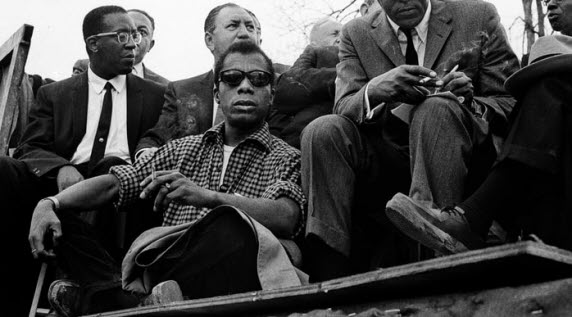
In 1979 June, Baldwin planned a personal book project focusing the Civil Rights Movement era via the life and death of three legendary activists who were also his close friends: Medgar Evers, Malcolm X, and Martin Luther King Jr. As reflected by his letter to his agent Jay Acton, he was eager to proceed with what could have been his magnum opus, but his project was ultimately left unfinished only with a 30-page manuscript, and he passed away several years later.

Iamnotyournegro03

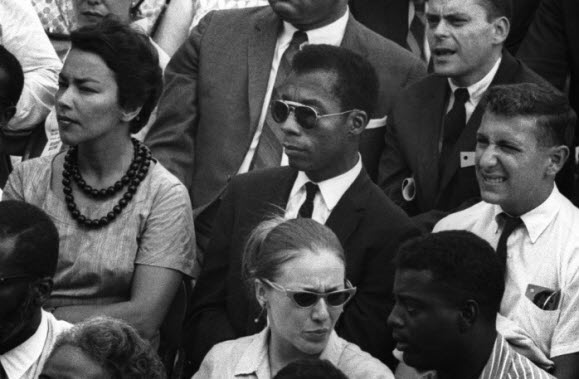
The excerpts from that unfinished manuscript, read by Samuel L. Jackson on a rare understated mode, are accompanied with a deft mix of various archival footage, photographs, news clippings, and documents, and the result is a vivid glimpse into that violent, tumultuous time in US during the 1960s. As the Civil Rights Movement was continued against segregation, racism showed its ugly face throughout the country in response, and there are a number of sobering moments as the documentary shows several archival footage clips and photographs of white people being openly racist in public.

Even when he was a young boy growing up on Harlem Streets, Baldwin was keenly aware of the racism prevalent in the American society. Watching John Wayne movies, he recognized their racist aspects, and he found himself more identifying with Indian characters rather than John Wayne. He also noticed that many black characters in those old Hollywood films are caricatures far from real black people he knew, and he certainly felt anger and contempt about that.

Baldwin eventually moved to Paris in 1948, and he could have just stayed there as wanted, but then there came a turning point when he saw the harrowing photographs of Dorothy Counts, a young black girl in North Carolina who had to endure several humiliating days for attending a high school attended by white students. Although he did not miss his country much (“I have never been lovesick for anything American.”), he saw that he had to observe and participate in the Civil Rights Movement, and that was how he came to meet Medgar Evers, who guided Baldwin in the South for Baldwin’s subsequent article “Letter from a Region in My Mind”.

He also met Malcolm X and Martin Luther King Jr., and we get an amusing episode on how nervous Baldwin was when he found Malcolm X sitting right in the very first front row before beginning his public speech in front of many audiences. As observing how much Malcolm X and Martin Luther King Jr. were different from each other in many aspects, Baldwin also points out that they eventually converged on common areas, and we can only wonder how much these two towering figures would have achieved more together if they had not died so early.

Iamnotyournegro02

Baldwin’s words vividly describe to us those sad, despairing moments caused by the deaths of his three friends. Not long after he said goodbye to Evers, he heard the news about Evers’ death while he was in Puerto Rico, and that bright tropical day felt far less sunny to his eyes. When he was in London a few years later, he heard from his sister about the assassination of Malcolm X, and that was another devastating blow to him. While he was working on the screenplay for a Malcolm X biopic film in LA during 1968, there came the news of King’s death, and the situation continued to look less optimistic than before while that biopic film in question never got made (he wanted Billy Dee Williams to play Malcolm X, by the way).

As trying to be optimistic with reserved hope, Baldwin also showed his deep worry and despair as alarmed by how the American society kept letting itself deluded as before. During one archival footage clip from the Dick Cavett show, he clearly and passionately made his points in front of Cavett and a smug white intellectual guest, and his argument uncomfortably resonates with the present of the American society. As he shrewdly discerned, the American society is mired in virulent denial and moral apathy without never fully facing its race problems and their origin for many years, and, as many of you know, it surely excels itself during the recent Presidential election.

Although it is sometime a little too heavy-handed in its juxtaposition of the past and present of the American society, “I Am Not Your Negro” is impressive as a meditative observation on James Baldwin as a writer and observer, and I particularly enjoyed his pointed observation on Sidney Poitier’s several classic films such as “The Defiant Ones” (1958), “In the Heat of the Night” (1967), and “Guess Who’s Coming to Dinner” (1967). Overall, this is one of the better documentaries coming out during last year, and it can be a good introductory guide to you if you are unfamiliar with Baldwin and his works like me.

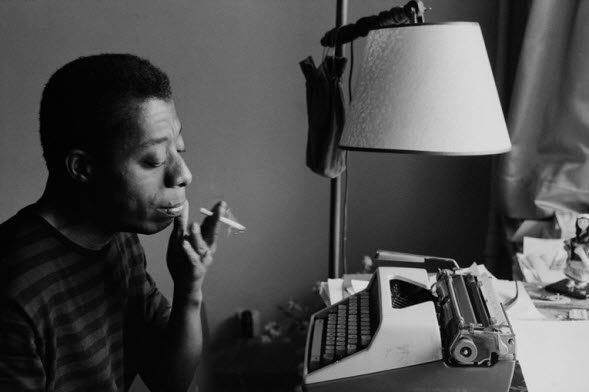
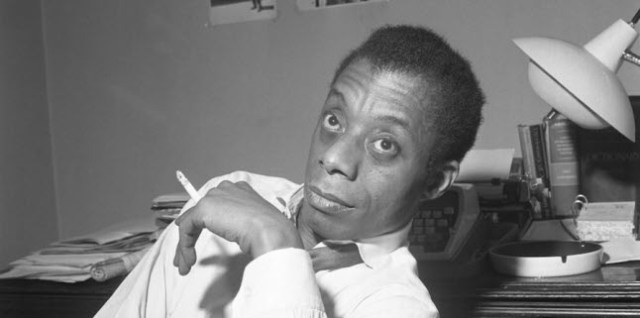
A photographer of author James Baldwin smoking a cigarette.

Posted in Movies | Tagged , , , , | 1 Comment

Get Out (2017) ☆☆☆(3/4): Guess who’s coming for weekend…

getout01

Reminiscent of those sinister paranoid thriller films made during the 1970s, “Get Out” is willing to unnerve us as providing a fair share of suspense as well as the biting sense of black humor. During my viewing, I could not help but amused and thrilled as enjoying how it pushes its premise to generate several nice twisted moments coupled with thought-provoking aspects, so now I advise you not to read the following paragraphs although I will try as much as I can for avoiding any potential spoiler.

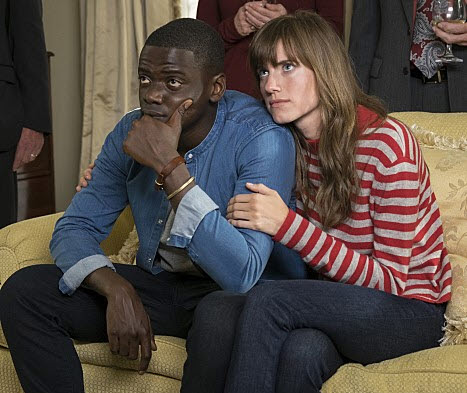
After the prologue scene which effectively sets the overall tone of the film, we meet Chris (Daniel Kaluuya, who will appear as one of the supporting characters in upcoming film “Black Panther” (2018)), a young promising photographer who has been in the relationship with a girl named Rose (Allison Williams) for a while. He and Rose are soon going to pay a weekend visit to Rose’s parents, and Chris is a bit nervous because of an apparent reason; He is black and she is white.

Although Rose assures him that her white parents are your average open-minded liberals who would vote for Barack Obama more than twice, Chris cannot entirely suppress his anxiety. Yes, it has been 50 years since “Guess Who’s Coming to Dinner” (1967) came out, but interracial relationship is still a matter which instantly draws our attention even though it is more widely accepted at present, and Chris’ close friend Rod (Lil Rel Howery) makes a jolly fun of Chris’ uneasy circumstance during their phone conversation.

As a matter of fact, there is an acerbic moment when Chris and Rose talk with a local white cop due to an unfortunate incident on the road. Although Rose is the one driving their car, the cop demands Chris to show his driver’s license card, and Chris knows the reason too well. While watching this uncomfortable moment of unfairness, you may be reminded of how thousands of young American black males are frequently targeted by police officers just because of their race – and the tragic ramifications of this troubling tendency.

getout03

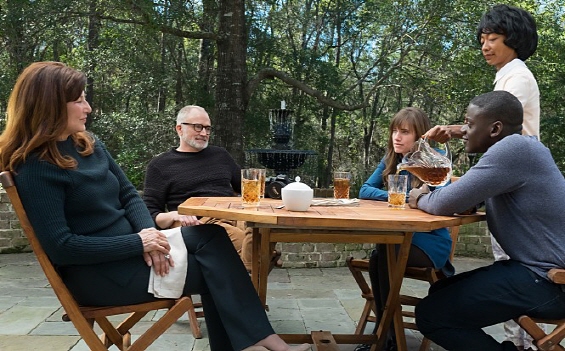
Anyway, Rose and Chris eventually arrive in the house of Rose’s parents, which is located in the middle of some remote rural area. Dean (Bradley Whitford) and Missy (Catherine Keener) seem to have no problem with their dear daughter being with a black guy, but Chris cannot help but notice how Dean and Missy try a little too hard in front of him, and that awkward feeling is further increased when Rose’s brother Jeremy (Caleb Landry Jones) arrives at the house. During the dinner, Jeremy throws some blatant questions about Chris’ physicality, and that certainly makes everyone else at the table a bit uncomfortable.

In addition, there is something very strange about two black people employees, who, according to Dean, were hired when Dean’s diseased parents were alive. They all say they are fine with working for their white employers, but they look quite strained to Chris at times. Georgina (Betty Gabriel), who works as a housekeeper, looks mild and courteous at first, but she often looks cold and distant, and then there comes a weird moment when she seems to be on the verge of a sort of mental breakdown right in front of Chris. In case of Walter (Marcus Henderson), who works a groundkeeper, he seems to disapprove of Chris’ relationship with Rose while never saying that loud and clear, and he also has a rather bizarre habit as shown during one moment.

The situation becomes all the more unsettling as a special weekend party is held for a bunch of Dean and Missy’s friends, who are mostly, yes, affluent white people. They are all invariably nice to Chris, but Chris keeps noticing more strange things. When he happens to see a black guy who is apparently one of the party guests, he approaches to that guy out of curiosity, but he soon finds that guy is as odd as Walter and Georgiana, and we get a creepy moment as it turns out that, for some unknown reason, the guests are far more interested in Chris than they seem on the surface.

getout02

The movie steadily dials up the level of tension with a number of tense moments shrouded in subtle menace. One crucial scene involved with a certain character’s professional skill is an exemplary case of how to spring a good surprise for the audiences, and I also like a mute but increasingly insidious scene where the camera slowly pulls back to reveal a major detail for suggesting what is really going on among a group of characters.

It surely helps that the performers in the film are convincing as required. While Daniel Kaluuya holds the center as we come to worry more about his character, Bradley Whitford and Catherine Keener have lots of fun with their roles as keeping their appearance straight all the time, and Allison Williams is also believable as a girl who stands by her man as much as she can. Marcus Henderson, Betty Gabriel, and Lakeith Stanfield are effectively disturbing in their respective supporting roles, and Lil Rel Howery provides a few relieving moments of laughs as functioning as a minor comic relief in the movie.

I must point out that “Get Out” starts to lose its narrative momentum around its third act like many thriller films, but the director/writer Jordan Peele, who has mainly been known for his partnership with Keegan-Michael Key in their sketch comedy TV series “Key & Peele”, did a competent job of mixing genre elements and social issues which are all the more relevant these days, and I think the movie will be frequently mentioned along with a number of recent notable American black films in the future. This is a darkly entertaining genre piece made with considerable skill and intelligence, and I hope that my review does not spoil your fun yet.

getout04

Posted in Movies | Tagged , | 2 Comments

20th Century Women (2016) ☆☆☆(3/4): Three interesting women in his adolescent life

20thecenturywomen01

“20th Century Women” is a warm, sensitive, and humorous film about one adolescent boy who grows up with several colorful people around him during a notable social/cultural transition point in the 20th century American society. Now it sounds like your average quirky Sundance film, but its story and characters are imbued with the genuine sense of life and personality, and we are instantly drawn to their human matters as getting to know more about them.

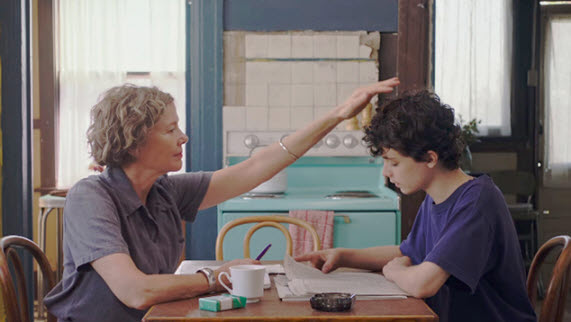
The story is set in Santa Barbara, California in 1979, and the movie opens with one sudden absurd accident which happens to a car belonging to Dorothea Fields (Annette Benning). Brimming with her own gentle but strong personality, Dorothea is quite an open-minded woman who has surely had an interesting life as reflected by a montage sequence on her life. We learn that she went through the Depression era during her early years, and that hard time was probably the basis of her exceptional personality. While she went through a good number of men after her divorce, she does not feel the need of marrying again, and she also has no problem with raising her teenager son Jamie (Lucas Jade Zumann) alone for years.

She lives with her son in a boarding house, where they live with their two tenants. Abbie (Greta Gerwig) is a young, independent photographer who is recently diagnosed that she has cervical cancer, and William (Billy Crudup) is a nice dude who once had a carefree time during the 1960s and now works as a carpenter/potter/mechanic without much thought on what will be the next step for his life. Added to this odd mix is Julie (Elle Fanning), a teenager girl who has been a close friend to Jamie since they were very young. As shown and told to us via her montage sequence, she is not so happy at her home, and that is the reason why she frequently comes into Jamie’s bedroom at night. Like any other boy around his age, Jamie becomes interested in going further than merely sleeping with her on his bed, but Julie does not allow that although she has already experienced several sexual encounters. She simply wants to remain as a friend to him, and this certainly confuses and frustrates Jamie.

20thecenturywomen02

As Jamie grows up day by day, it seems to Dorothea that her son needs more than her love and care for becoming a man, especially after one serious incident caused by a seemingly harmless prank among him and his friends. Maybe he needs a male role model, but William is not exactly qualified for that, so Dorothea suggests that Abbie and Julie should lead and teach him, though neither they nor Dorothea knows what exactly Jamie needs in this transition period of his.

Anyway, Abbie and Julie try as much as they can. Besides showing more of her current illness to Jamie, Abbie teaches him feminism via several books, and that leads to one of the most humorous moments in the film when Jamie explains to his mother how he got himself into a fight with some other boy. While still keeping the distance between Jamie and her, Julie comes to have more frank moments with him than before, and we get an amusing moment involved with her pregnancy test kit, which requires far more time than the ones in our era.

Meanwhile, Dorothea comes to feel more of the ongoing social/cultural change happening around her. The change is indeed coming as the 1970s is about to be ended, and that is reflected particularly well by the scene featuring the resigned speech of Jimmy Carter on TV, which feels like a sort of prelude to the approaching era of Ronald Reagan. At one point, she goes to a local nightclub along with William and Abbie, and she becomes more aware of the widening gap between her and her son during one reflective moment.

20thecenturywomen05

Rather than being driven by plot, the screenplay by the director Mike Mills, who received a Best Screenplay Oscar nomination for his film early in this year, takes its time as carefully establishing its period background and characters via small individual moments. With modest but authentic period details which never draw our attention too much, its characters come to us as real human beings interesting enough to observe, and Mills also adds a nice recurring visual touch to accentuate the drifting sense of time around his characters.

Mills draws terrific performances from his main cast members. Annette Bening is warm and radiant in one of her best acting turns during recent years, and Greta Gerwig and Elle Fanning are equally wonderful in their respective nuanced performances. While Billy Crudup also gives a solid supporting performance on the fringe, young performer Lucas Jade Zumann holds his own place well among his co-performers. These talented performers are constantly engaging as flawlessly interacting with each other on the screen, and that is exemplified well by one particular scene unfolded on a dinner table. The mood suddenly becomes awkward as one of the characters in the scene blurts out something rather inappropriate, and the scene becomes increasingly nervous with more awkwardness, but we cannot help but amused thanks to the good comic timing of the main cast members.

Overall, “20th Century Women” is an intimate, observant character drama to admire, and it is as enjoyable as Mills’ previous work “Beginners” (2011), which can be regarded as the companion piece of “20th Century Women” considering that both of them are partially inspired by Mills’ relationship with his parents in real life. The loose narrative structure of the movie may require some patience, but it is worthwhile to watch thanks to its smart, thoughtful storytelling as well as a bunch of well-rounded performances to appreciate, and the result is delightful and heartfelt to say the least.

20thecenturywomen04

Posted in Movies | Tagged , , | Leave a comment

Embrace of the Serpent (2015) ☆☆☆(3/4): Two parallel journeys into Amazonian jungle

embraceoftheserpent03

Sometimes I come across movies which both baffle and fascinate me, and Columbian film “Embrace of the Serpent”, which was nominated for Best Foreign Language Film Oscar early in last year, is one of such cases. Although I watched it twice, I am not sure about whether I understand everything in the movie, and now I wonder whether I should learn more of its background knowledge, but I do not think I will forget easily what I observed from the film with a certain degree of fascination and enchantment.

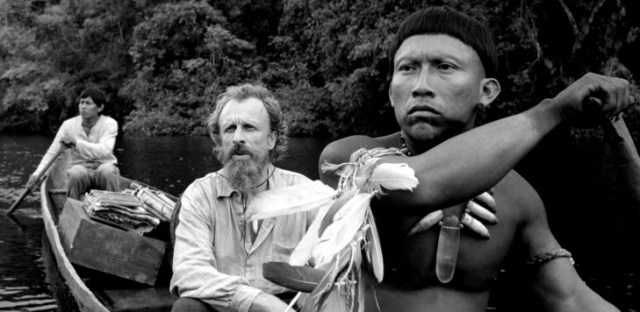
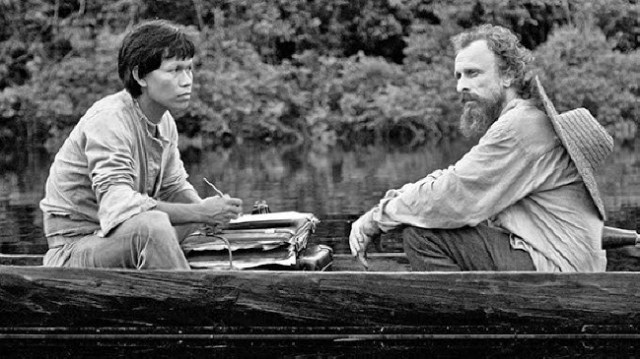
Loosely based on the diaries of Theodor Koch-Grunberg and Richard Evans Shultes, the movie alternates between two fictional main storylines. In 1909, a German ethnologist named Theo von Martius (Jan Bijvoet) happens to contract some serious tropical disease during his expedition in Columbian Amazon area, and Manduca (Yauenkü Migue), Theo’s local expedition partner who was freed from a rubber plantation by Theo, takes Theo to a shaman named Karamakate (Nilbio Torres). As a man who has been angry and bitter about how his people and their way of life was eradicated by the colonization process initiated by Europeans, Karamakate shows hostility toward Theo as well as Manduca at first, but he eventually joins them, and that is the beginning of their search for a rare plant which can cure Theo’s illness and save his life.

The other part of the movie is set in around 30 years later, and the first scene of this part shows Old Karamakate (Antonio Bolívar) drawing a vast chalky mural on the rock. While he is occupied with his mural, an American botanist named Evan (Brionne Davis) approaches to him, and Evan tells Old Karamakate that he is looking for that rare plant Theo and Karamakate searched for. Although it seems he does not remember many things in the past now, Old Karamakate comes to accompany Evans in the end, and they start to follow a route which was once trodden by Theo and his two accompanying figures.

embraceoftheserpent02

As going back and forth between these two parallel storylines, the movie flows from one interesting scene from another. At one point, Theo and his two accompanists drop by a small tribal community, and the mood becomes jolly and cordial as they get along well with its chief and community members, but then there comes an uncomfortable moment in the next morning when Theo tries to retrieve a compass taken from him. He simply does not want to disrupt these people’s way of life with a modern object, but, as Karamakate sharply points out, he does not look much different from other white men as being harsh and unkind to the people who openly welcomed him.

As the journey continues along the river, the movie often shows us several gloomy sights reflecting the ongoing exploitation involved with rubber business, and the most harrowing scene in the film comes from when Theo and his accompanists come upon a small rubber plantation. Apparently upset due to his painful past reflected by the scars on his back, Manduca kicks off several buckets of rubber, but then there comes a wretched worker devastated by Manduca’s action, and he even pleads Manduca to kill him for saving him from more misery to come.

In case of a shabby mission which was originally a rubber plantation, a bunch of indigene orphans are protected by an old priest, but, not so surprisingly, this place turns out to have its own darkness, and it turns into something far worse when Evan and Old Karamakate happens to pass by the place later. Now it is occupied by a bunch of cultists led by an apparently unhinged guy who rules the place as their messiah, and we soon get a loony ceremony scene which looks more nightmarish as the ceremony is driven into more madness.

embraceoftheserpent01

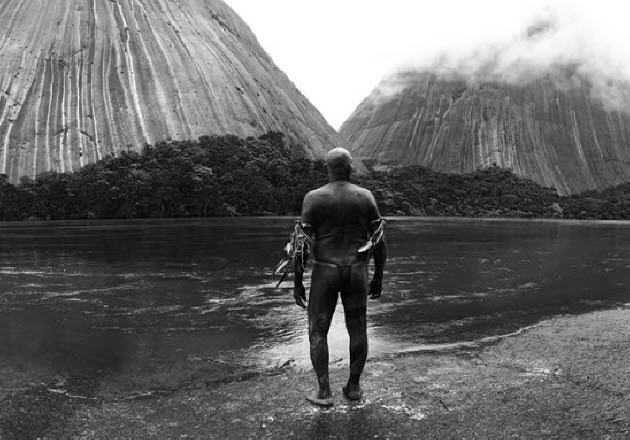
Now some of you may be reminded of similar films such as “Aguirre, the Wrath of God” (1972) or “Apocalypse Now” (1979), but “Embrace of the Serpent” has its own distinctive aspects. The director Ciro Guerra, who wrote the screenplay with Jacques Toulemonde Vidal, and his cinematographer David Gallego shot their film in 35mm black and white film, and the movie is imbued with the qualities of lucid dreams as constantly impressing us with visually striking shots to be appreciated. While the plot is a little too opaque and languid at times, the movie keeps engaging us via its visual prowess, and we become more immersed in its alien but undeniably mesmerizing world and then somehow come to accept the mythic aspect of its story. Not long after the meaning of the title of the movie is explained through Old Karamakate later in the story, there comes a hallucinogenic moment which somehow took me back to that climax sequence of “2001: A Space Odyssey” (1968), and I am still musing on the subsequent scene which ends with an ambivalent tone.

Most of performers in the film are non-professional performers, and they certainly bring considerable authenticity to their roles with their various indigene languages, which may be faded into the past within decades because of the continuing wave of modernization. While they never appear together on the screen, Nilbio Torres and Antonio Bolívar are effortlessly linked to each other in their natural performance, and Jan Bijvoet and Brionne Davis are competent as the counterpoint figures in the movie, and Yauenkü Migue is also fine as another substantial character in the story.

Since it won the Art Cinema Award in the Directors’ Fortnight section at the Cannes Film Festival in 2015, “Embrace of the Serpent” has received heaps of acclaim. I must say that I am not as enthusiastic about it as many other critics, but I admire its style and mood even though I felt impatient from time to time, and I am willing to recommend it to you if you are looking for something unique and different.

embraceoftheserpent04

Posted in Movies | Tagged , | Leave a comment

Come, Together (2017) ☆☆☆(3/4): A South Korean family in social/personal crisis

cometogether01

I experienced growing uncomfortable feelings as watching South Korean film “Come, Together”. This is another gloomy drama about the harsh reality of the South Korean society, and it is often difficult to watch its main characters struggling with each own social/personal crisis. This is indeed a tough stuff, but it is worthwhile to watch thanks to mostly competent storytelling as well as good performances, and it surely earns a tentative sense of hope shown in the end.

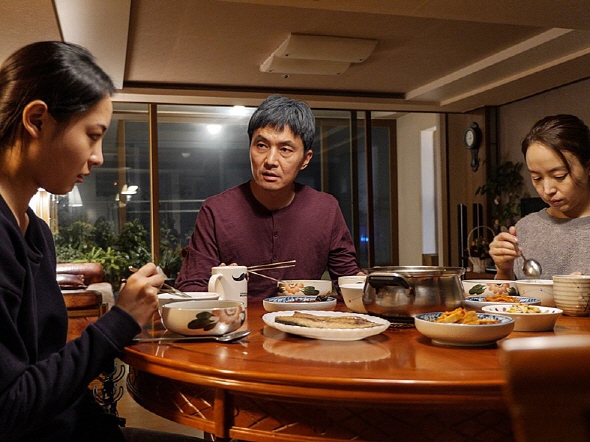
The story is about one particularly hard week of an ordinary middle-class family. Han-na is a young girl who has prepared for college entrance examination again since her first failure, and she is quite disappointed to learn that she is placed on the waiting list instead of being fully accepted. That news also disappoints her parents Beom-goo (Im Hyeong-gook) and Mi-yeong (Lee Hye-eun) a lot. When they later have a dinner together in their apartment, Beom-goo inadvertently hurts his daughter’s feeling as openly talking about her disappointing examination result, and the awkward mood among them is palpable even though the camera steps back from their dinner table.

And then there comes another serious problem. On the next day, Beom-goo is fired from the company he has worked for 18 years, and he does not know what to do with this sudden unfortunate change, while facing mounting financial matters including the mortgage on his family’s apartment. After telling this bad news to his wife, he begins to spend most of his time in the apartment as being mired in sulky self-pity. When a delivery guy comes during one afternoon, he does not open the door just because he does not want to show his pathetic status to a stranger, and he also commits an act of cruelty on some of her wife’s precious plants just because, well, he is pissed off.

On one day, Beom-goo happens to get to know a man living right above him. While their first encounter is not very pleasant to say the least, Beom-goo comes to learn during their second encounter that the guy is actually not so different from Beom-goo, and that is the beginning of their odd relationship based on their mutual pity on each other. As they drink a lot together, they feel consoled a bit by each other, but that does not change their current status which does not have much prospect.

cometogether04

While her husband keeps behaving like a bum, Mi-yeong tries to work harder than before as a saleswoman of a credit card company, but she only becomes frustrated when one of her latest clients is taken away by one of other saleswomen in her workplace. Watching Mi-yeong trying hard to persuade her potential clients, I could not help but think of a cousin working in the same field, and I came to think more about how hard she must work like Mi-yeong for more results. Sure, I was easily persuaded by her to get a new credit card for old time’s sake, but it was probably not so easy for her in case of her other clients.

Angry at that saleswoman who takes away her client, Mi-yeong attempts to get a moment of ventilation, but that only makes her circumstance worse than before, and she becomes more hostile to that saleswoman, who may look primmer than others but turns out to be as desperate as Mi-yeong. When some secret about that woman is revealed later in the movie, Mi-yeong decides to do something, but then her action eventually leads to an agonizing situation of sin and guilt.

As her parents are struggling with their respective matters, Han-na becomes more nervous about her uncertain position while desperately waiting for the call from a university in which she wants to enroll. At least, she feels consoled as being with her good friend who runs a small accessory shop, and she cannot help but envy her friend’s casual lifestyle. Rather than trying to enroll in a college, Yoo-gyeong (Han Kyeong-hyeon) decided to go her own way, and she looks happy and confident as reflected by her carefree attitude and her small but cozy residence, though she indirectly points out to her friend that her life is not all that good.

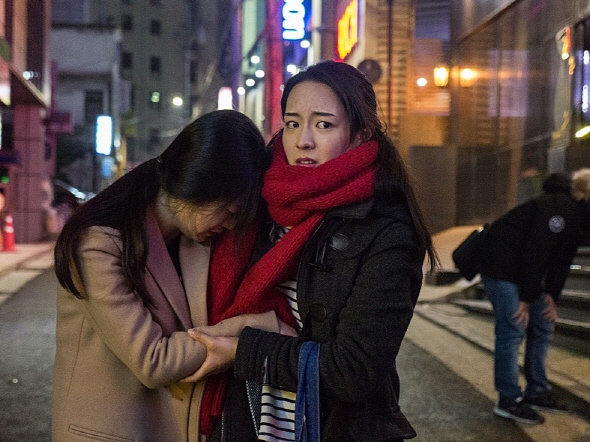
Through Yoo-gyeong, Han-na meets a girl who also happens to be on the same waiting list, and she becomes jealous because that girl is ahead of her on the list. As they drink together along with two lads during one late night, they become closer to each other, but Han-na finds herself tempted by some dark thought, and then there comes a difficult situation where she must make a moral choice on her new friend, who may be thrown into a serious danger if Han-na neglects her.

cometogether02

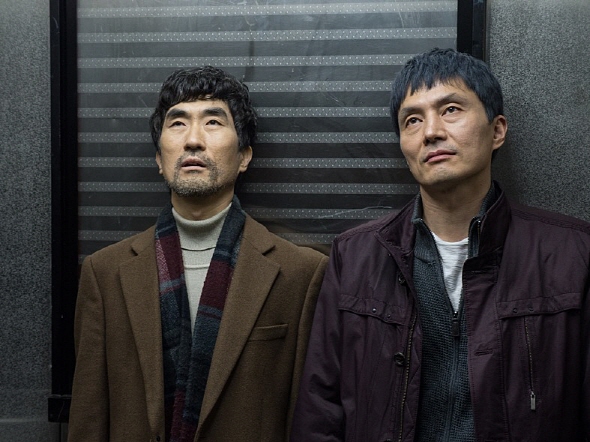
There are a good number of intense dramatic moments as its main characters go down further into the dark pit of desperation and guilt, but the movie is not entirely devoid of warmth and humor. The scenes between Beom-goo and his neighbor are silly but melancholic, and there is also an unexpectedly humorous scene involved with a group of guys stuck inside a stalled elevator. The scenes between Hanna and Yoo-gyeong feel warm and gentle, and I like how their last scene suggests that their relationship may be more than friendship.

The lead performers are engaging to watch as they carry the film together. Although Beom-goo is not a very sympathetic figure as frequently behaving like a jerk, Im Hyeong-gook conveys well his character’s anger and frustration, and we come to understand his character to some degrees. While Lee Hye-eun is terrific especially when her character comes to face the unexpected consequence of her hate, Chae Bin holds her own place well between her two co-performers, and Kim Jae-rok, Han Kyeong-hyeon, and Bae Jeong-hwa are also wonderful in their respective supporting roles.

“Come, Together” is written and directed by Sin Dong-il, who previously made “House & Guest” (2005), “My Friend & His Wife” (2006), and “Bandhoubi” (2009). Each of his previous films left a distinctive impression on me thanks to his good handling of story and characters, and “Come, Together” is no exception. Although it has several weak points including its rather contrived ending, I was involved in its main characters’ circumstances nonetheless, and their story made me think again of the ongoing social problems of the South Korean society. Will things get better for not only them but also many other South Koreans out there? I can only hope for that, to be frank with you.

cometogether03

Posted in Movies | Tagged , | Leave a comment

The Unknown Girl (2016) ☆☆☆(3/4): Who was that girl?

theunknowngirl01

In their new film “The Unknown Girl”, the Dardenne brothers tries a more conventional plot than usual while maintaining their typical dry realistic approach, but this mix is not entirely successful on the whole. While we get the vivid, authentic glimpses of hard social reality via its guilt-ridden heroine’s dogged pursuit of truth, the movie does not rise above our expectation in terms of plot and character, and the result is less compelling than the notable works of the Dardenne brothers.

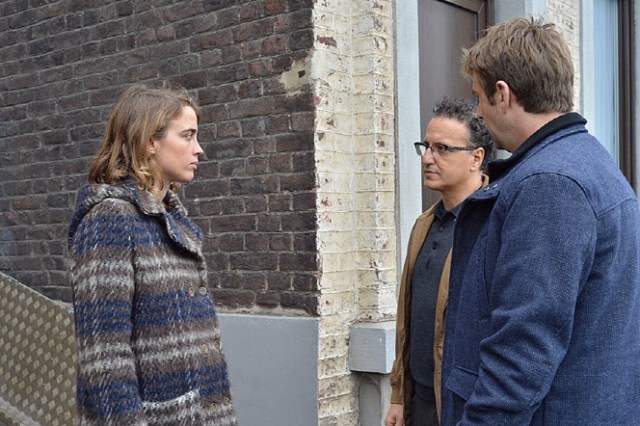
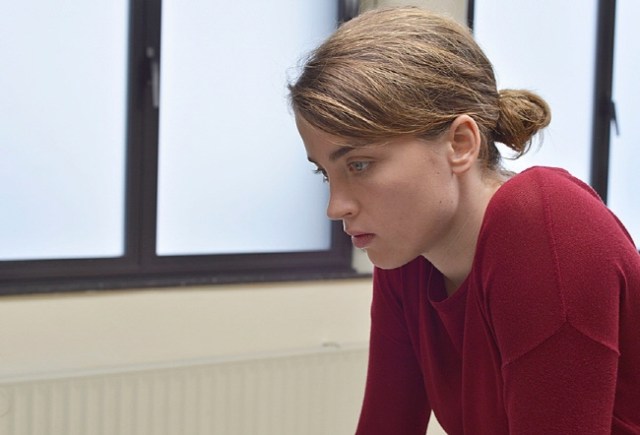
In the beginning, the movie shows its heroine going through the last hour of her working time. Jenny Davin (Adèle Haenel) is a young doctor who works in a modest clinic near Liège, Belgium, and we observe her cool, exemplary professionalism when she deftly handles a sudden emergency in the waiting room. While she temporarily works there instead of an old doctor currently in a hospital due to his illness, she will soon move onto a prestigious private clinic a few days later, and it goes without saying that this job transition will considerably benefit her career.

Not long after her working time is over, somebody pushes a buzzer button outside the clinic, but Jenny flatly ignores it because 1) the clinic is officially closed and 2) she is more occupied with dealing with a young medical school student working for her as an intern. In her view, he does not have enough professional detachment unlike her, and, as a matter of fact, that emergency incident in the waiting room makes him have some doubt about his future career.

theunknowngirl04

In the next morning, she is approached by two cops who want to see the surveillance video from a CCTV camera at the front gate of the clinic, and then she comes to learn about a tragic incident which happened during the previous night. Under an unspecified circumstance, a young African immigrant woman died at a spot near the clinic, and, not so surprisingly, it is revealed that she was the one who pushed a buzzer button at that time. It is apparent from the surveillance video that she was desperately looking for help due to some unknown reason, and Jenny naturally feels guilty as thinking about how she could have prevented this tragedy.

After learning that there is not anything which can help identify the dead woman, Jenny becomes determined to find out who she was. First, she chooses to stay at the clinic instead of going to that private clinic, and she often asks her patients whether they know that girl or not. Her attempt seems futile at first, but then it looks like she may find her answer, though the people who may know something are not so willing to open their mouth in front of her.

This sounds like your average hard-boiled mystery plot, and there are indeed a couple of tense moments as Jenny continues to dig deeper into the case, but the Dardenne brothers keep everything calm and dry as the plot of their film leisurely moves from one narrative point to another. While she becomes more obsessed with finding out the dead girl’s identity, Jenny never neglects her work, and the movie gives us several good individual scenes as she handles various people living in her area. In case of an immigrant worker who cannot speak French, he does not want to go to a big hospital despite his serious injury mainly because he is afraid of being deported, and he does not seem to change his mind even though Jenny tries to persuade him as much as she can with a guy accompanying him. At one point, a female patient shows Jenny little gratitude for her house call, and that is one of a few amusing moments in the film.

theunknowngirl02

In spite of these human moments to appreciate, the Dardenne brothers’ screenplay sometimes demands our suspension of disbelief a little too much. For example, a certain sequence during the second half has one sudden situation so unbelievably followed by the other one that I momentarily became befuddled with what was going on the screen. As the movie approaches to the finale, we are served with more implausible coincidences, and then it throws another coincidence during the final scene, which may be poignant but does not add up much to the whole film.

Nevertheless, the Dardennes brothers draw good performances from their performers, who look natural and earnest in their unadorned acting. Adèle Haenel, who was one of the main characters in “House of Pleasures” (2011), quietly exudes her character’s growing determination in her engaging performance, and I think we can expect more interesting things to come from this talented, beautiful French actress. The supporting performers are believable as real human characters inhabiting their mundane world, and some of you may recognize the Dardenne brothers’ regular performers including Jérémie Renier, Olivier Gourmet, Fabrizio Rongione, and Thomas Doret, who apparently grows up a lot since his breakthrough turn in “The Kid with a Bike” (2011).

“The Unknown Girl” did not engage me much during my viewing, and that accordingly took me back to how much I have admired the Dardenne brothers’ exceptional filmmaking career. Since I watched “La Promesse” (1996), “The Son” (2002), and “The Child” (2005), they have kept impressing me with “Lorna’s Silence” (2008), “The Kid with a Bike” and “Two Days, One Night” (2014), but “The Unknown Girl” feels like a lesser work in comparison as somehow lacking the deep emotional power of their previous works. I am not so sure about whether the movie succeeds as much as intended, but this is still an interesting work to watch despite its noticeable flaws, so I recommend it with some reservation.

theunknowngirl05

Posted in Movies | Tagged , | Leave a comment

Alien: Covenant (2017) ☆☆1/2(2.5/4): Same old monster horror

aliencovenant01

“Alien: Covenant” gives us exactly what we can expect from another entry from the franchise which has lasted for more than 35 years since “Alien” (1979) burst upon us. Again, a group of characters in a big spaceship go to an unknown place and then come across something quite dangerous, and the movie works to some degrees while not having much awe or surprise for anyone familiar with its enduring franchise.

As shown from its prologue/main title scene, the movie is a sequel to “Prometheus” (2012), but it starts its story with a different set of characters. Several years after what happened in “Prometheus”, a big spaceship, named Covenant, is sent into the universe for the colonization of some inhabitable planet far away from the Earth, but a big radiation storm happens in the middle of its long journey, and its crew members have to wake up from their hibernation sleep for repairing the considerable damage caused by this unexpected incident. While this emergency is quickly ended and then everything is under control, they unfortunately lose their captain as well as some of the hibernating passengers in the spaceship, and Daniels (Katherine Waterson), a terraforming expert who is also the captain’s wife, is particularly devastated by that.

Meanwhile, there comes another unexpected happening. Not long after the repair of the spaceship is completed, a mysterious signal is detected, and they come to learn that the signal is being transmitted from a nearby planet, which is virtually unknown but seems to be as inhabitable as their destination planet. Despite Daniels’ reasonable objection, Oram (Billy Crudup), who becomes the new captain of the spaceship after the previous captain’s death, insists on checking up that planet just in case, so the spaceship soon heads for that planet.

aliencovenant02

Of course, the planet gives them an ominous sign right from its very first appearance. The landing turns out to be quite difficult due to a big ion storm, and the area where they land is filled with disturbing gray silence. As Daniels points out at one point, there is no sign of animals although many plants not so different from the ones in the Earth grow well here and there, and Daniels and other crew members become more nervous when they come across the remnants of an alien civilization. As the camera looks around the open ground covered with many calcified bodies, you may be reminded of those exhibited bodies of Pompeii, and this unnerving sight further accentuates the increasing sense of menace around the screen.

Because it is already revealed in the trailer, it is not much of a spoiler to tell you that they are soon going to encounter that infamous creature of the franchise and some of them will be killed in one way or another. Once everything is set up for its horror mode during its second half, the movie throws a number of striking bloody moments at the audiences, and some of them will definitely make you cringe for good reasons.

However, these moments also feel like same old things we have seen before, and the movie does not give us anything particularly new. While there is indeed an intriguing story part involved with two different android characters played by Michael Fassbender, that is eventually hampered by the predictable third act, and the finale does not work as well as intended because we already see it coming from the distance.

Furthermore, many characters in the film are not that distinctive, and it is a shame to see most of its notable cast members being stuck with their flat characters. Katherine Waterson, who has been more notable since her supporting role in “Inherent Vice” (2014), brings enough pluck and intelligence to her character, but her character still feels rather bland compared to Sigourney Weaver’s iconic character in “Alien” or Noomi Rapace’s character in “Prometheus”. While Billy Crudup does not have many things to do except usually looking glum, Danny McBride is surprisingly effective in his non-comedy role, and Demián Bichir and Carmen Ejogo are seriously wasted in their almost nondescript roles.

aliencovenant03

In case of Fassbender, he surely has lots of fun with his dual role, and most of compelling scenes in the film come from his convincing duo performance. Whenever his two characters are on the same screen, we always tell the difference between them thanks to the subtle touches in his acting, and that is why his performance is alternatively chilling and poignant.

Anyway, “Alien: Covenant” is not a wholly bad movie at all thanks to the competent direction by Ridley Scott, a master filmmaker who has never made any truly awful movie during last 40 years. Even those missteps like “Legend” (1985), “Black Rain” (1989), “Hannibal” (2001), and “The Counselor” (2013) were not entirely without something good or interesting to mention, and the same thing can be said about “Alien: Covenant”. The movie is slick and smooth in terms of technical aspects, and I did enjoy how much it looks good on the screen. Jed Kurzel’s score effectively uses Jerry Goldsmith’s theme for “Alien” during a few key points in the film, and I could not help but feel a bit nostalgic as Goldsmith’s theme was played on the soundtrack.

On the whole, “Alien: Covenant” is one or two steps below “Prometheus”, which was not without flaws but admirable in its ambition and scope. That film was willing to reach for greatness, and I was entertained by that even though I experienced some disappointment in the end. In case of “Alien: Covenant”, it is just mildly disappointing, and that is all.

aliencovenant04

Posted in Movies | Tagged , , , , | Leave a comment

My Life as a Zucchini (2016) ☆☆☆(3/4): Meet Courgette and his friends

mylifeasazucchini04

It is always delightful to watch simple, sweet animation films like “My Life as a Zucchini”, which was selected as the Official submission of Switzerland for the Best Foreign Language Film category of the 2017 Academy awards in last year and then was nominated for Best Animation Feature Film Oscar instead early in this year. Rather than merely driven by plot, the film leisurely doles out small, delicate moments to enjoy and appreciate, and I enjoyed how it deftly balances itself between humor and melancholy as effortlessly revealing its big heart.

The opening scene introduces us to our young hero and his unhappy domestic life. Courgette (voiced by Gaspard Schlatter), which means Zucchini in French, is a young boy living with his divorced alcoholic mother, and we see him spending time alone in the attic of his house. As shown from the numerous drawings in the attic, he is a smart, imaginative child, but he is mostly neglected by his mother, and she is going through her another alcoholic day in front of the TV in the living room.

And then one unfortunate incident happens. When a stack of empty beer cans he is trying to build is accidently crumbled, his mother becomes mad because of the resulting noise and then she promptly climbs up to the attic. Scared of his angry mother, he shuts down the attic door upon his mother’s head, and that inadvertently causes his mother’s death. Although it is not entirely his fault, he feels guilty about this, and he also misses his mother although the life with her has not always been happy.

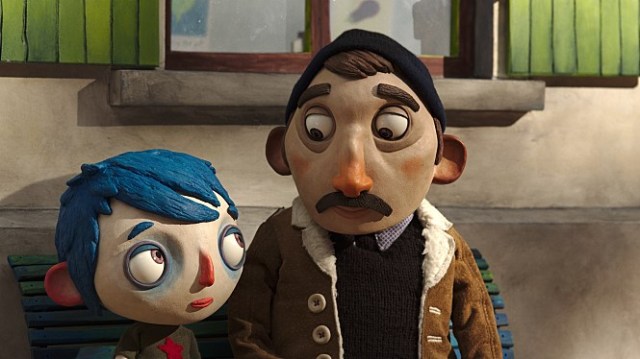
At least, the adults who happen to be around him after his mother’s death genuinely care about him. Raymond (voiced by Michel Vuillermoz), a police officer in charge of this tragic case, is sympathetic to Courgette, and he takes Courgette to an orphanage located outside the city. The orphanage may look modest on the surface, but its staff members are kind and generous, and the other few kids in the orphanage are mostly nice except one boy named Simon (voiced by Paulin Jaccoud).

mylifeasazucchini01

Although Courgette initially does not get along well with other kids in the orphanage, he comes to learn that they are also unhappy in each own way. While Simon has been separated from his addict parents, the father of Ahmed (voiced by Raul Ribera) is currently in prison, and Béatrice (voiced by Lou Wick) may never meet her mother who was deported out of the country. In case of Jujube (voiced by Elliot Sanchez), his mother was sent to a mental hospital, and Alice (voiced by Estelle Hennard) looks all the more heartbreaking after Courgette comes to know a bit about her terrible past.

While they all hope that they will have a family someday, it is apparent that they are already a family together, and the film serves us with a number of warm, innocent moments generated among Courgette and his new friends. When a girl named Camille (voiced by Sixtine Murat) comes to the orphanage, Courgette finds himself attracted to her, and there is a poignant moment as these two young kids come to realize that they are not so different from each other as two kids struggling with their respective misfortunes.

Meanwhile, the relationship between Courgette and Raymond grows day by day as Courgette sends letters and pictures to Raymond. When Raymond later visits the orphanage again for checking up Courgette, it is apparent that he has become a father figure Courgette has never had since his father was gone, and they eventually come to spend one weekend together. Although the situation becomes a little problematic as Camille accompanies them for avoiding her greedy, despicable aunt, they all enjoy themselves together, and Courgette and Camille feel like being at home when they come to Raymond’s cozy house, where he has lived alone while growing various plants.

mylifeasazucchini03

The mood of the film becomes a little tense later because of Camille’s aunt, but the director Claude Barras, who adapted Gilles Paris’s “Autobiographie d’une Courgette” with his co-writers Céline Sciamma, Germano Zullo, and Morgan Navarro, steadily maintains the overall gentle attitude of his film. Casually rolling along its episodic plot during the short running time (66 minutes), the film takes its time in building up individual scenes, and they are filled with details to notice even though they look plain and simple at first.

Like “Kubo and the Two Strings” (2016), “My Life as a Zucchini” is a stop-motion animation film, and I admire the enormous efforts put into every individual shot in the film. The characters may look broad and exaggerated on the whole, but they often feel more emotional than expected as the film gradually immerses us in its world, and that accordingly makes us involved more in the its characters’ emotional matters. At one point, Courgette and his friends happen to spot a mother and her child from the distance, and the following silent moment speaks volume about their thoughts and feelings even though their faces do not seem to signify anything.

Along with recent notable animation films such as “Kubo and the Two Strings”, “The Red Turtle” (2016), “April and the Extraordinary World” (2015), and “Your Name” (2016), “My Life as a Zucchini” provides us something different from usual digital animation films. I think its strong points will be appreciated more by adult audiences, but kids may also enjoy its gentle simplicity, and I’d love to hear opinions from them.
mylifeasazucchini02

Posted in Movies | Tagged , , , | 1 Comment

Denial (2016) ☆☆☆(3/4): History on Trial

denial01

As far as I can see from “Denial”, David Irving is a vile piece of work. He is a bullying propagandist who has no qualms about humiliating and discrediting others through lies and falsification, and any decent person cannot help but shake their heads with disbelief as watching him. He seems to care only about all the attentions he receives for his loathsome arguments against the Holocaust, and his egoistic behaviors and wily manipulations of the media will probably remind you of that orange-face scumbag currently residing in the White House.

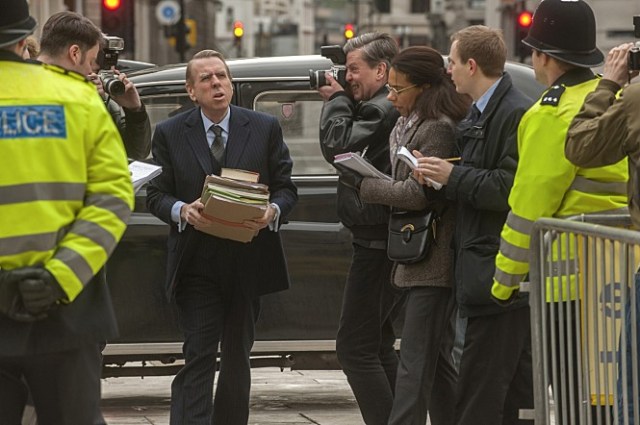
While Irving in the film is wonderfully played by Timothy Spall with fascinating hatefulness, the center of the movie is actually Deborah Lipstadt (Rachel Weisz), an American Holocaust scholar who was sued along with Penguin Books by Irving for libel in 1996. Rather than settling with him outside the court, Lipstadt decided to fight against Irving at the court, and their legal battle certainly drew lots of attention at that time.

The opening part of the movie shows us the first direct encounter between Irving and Lipstadt in 1994. When she is in the middle of her speech in an auditorium of Emory University, Georgia, she is suddenly interrupted by Irving, and he keeps pushing his points against her in front of many audiences. She adamantly refuses to engage in an argument with him because she knows too well that it is futile to argue with a Holocaust denier like him, but he exploits her response as much as he can, and there is nothing she can do about that.

denial03

Two years later, Lipstadt gets a call from Penguin Books. She is notified that Irving filed a libel suit against her and Penguin Books, and she soon comes to learn that the situation is not as simple as she thought at first. Because the trial will be held in Britain, the burden of proof lies with the defendant instead of the suitor, and that means Lipstadt and her lawyers must prove that Irving lied about the Holocaust as she described in her book published by Penguin Books.

Fortunately, her lawyers are pretty good ones. Anthony Julius (Andrew Scott), who is going to be her solicitor, explains his legal strategy to her, and he also advises her not to testify at the court because that is not only unnecessary but also risky. Putting her at the center of the court is exactly what Irving wants, and they will not let that happen at any chance. In fact, all she needs to do is attending the trial and watching her barrister Richard Rampton (Tom Wilkinson) do the job on her behalf.

Having its heroine in a rather passive mode like that, the screenplay by David Hare, which is based on Lipstadt’s book “History on Trial: My Day in Court with a Holocaust Denier”, often becomes deficient in narrative momentum, but this problem is compensated by several good moments in the film. The Auschwitz sequence feels obligatory at first, but it is presented with somber, haunting quality as Lipstadt and other characters look around the remains of the concentration camp, and we also hear a bit about that outrageous pseudo-scientific report by Fred A. Leuchter, which has been the basis of Holocaust denial since its publication. While the courtroom scenes have predictable dramatic points, they are effectively delivered with aplomb, and we come to feel more of the importance of the trial shown to us.

It also helps that the movie has talented performers who can instantly draw our attention right from their first appearance. Although she is mostly required to look exasperated or frustrated during many scenes in the film, Rachel Weisz fills her role with considerable amount of righteous spirit, and Adam Scott ably functions as a cool counterpart to her character during their scenes. While Timothy Spall is suitably slimy as demanded, Tom Wilkinson is terrific when his character calmly and mercilessly corners Spall’s character during one courtroom scene.

denial02

The movie is directed by Mick Jackson, who has been known for several notable TV films and theatrical films including “Threads” (1984), “The Bodyguard” (1992), and “Temple Grandin” (2010). While it was made more than 30 years ago, “Threads” is one of the most terrifying films about nuclear war, and I still tremble whenever I recall many of its frighteningly realistic moments including the very last shot. “Temple Grandin”, for which he won an Emmy, is a very moving drama based on the life of Dr. Temple Grandin, and I have treasured that film for giving me several powerful moments of elevation.

Compared to “Threads” and “Temple Grandin”, “Denial” is less special due to Jackson’s workman-like storytelling approach, and there are some weak parts which could have been improved or discarded. Most of minor supporting characters in the film are bland and superficial, and the part involved with a Holocaust survivor feels rather redundant although it is sincere and respectful at least. There are also several blatant visual moments throughout the film, and one brief shot suddenly showing the bad weather outside a window is too obvious to say the least.

Nevertheless, I think the movie is still worthwhile to watch considering its subject which has become more relevant during recent years. We have seen the alarming social/political rise of people as deceitful and despicable as Irving, and the movie reminds me again of why we must not step back from their virulent lies. The movie is imperfect in parts, but it does make its points anyway, so I recommend it with some reservation.

denial04

Posted in Movies | Tagged , , , | Leave a comment