Menashe (2017) ☆☆☆(3/4): A slice of Hasidic life from Brooklyn

menashe01

Sometimes movies can transport you to worlds unfamiliar to us, and “Menashe”, which was shown at the Sundance Film Festival early in this year and was recently screened at the Jeonju International Film Festival, is one of such cases. While its specific world and people are quite alien to most of us, it comes close to us via the universal elements of its gentle, intimate human drama, and we come to know and understand its struggling hero as rooting for him more than expected.

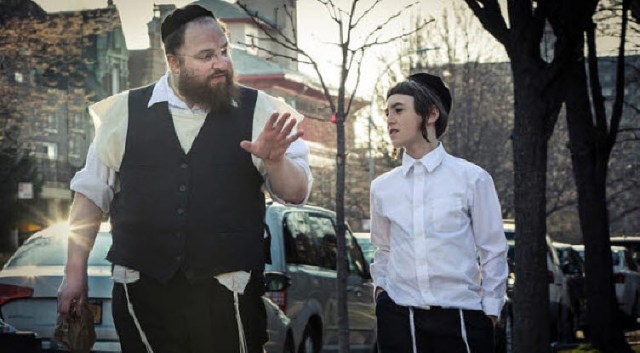
The movie is set in the Hasidic community of the Borough Park neighborhood in Brooklyn, and the opening scene shows another mundane working day for Menashe (Menashe Lustig), a portly Hasidic guy who works as a clerk in a grocery shop of his neighborhood. After his working hour is over, he goes to a meeting presided over by one of the rabbis in his neighborhood, and we observe him clumsily trying to recite passages from a Judaistic scripture along with others in the meeting.

After its ethnic background is succinctly established during these two early scenes, the movie lets us get to know more about Menashe. He has been widowed for several months, and he lives alone in his small apartment because he is not allowed to live with his young son Rieven (Ruben Niborski) due to the religious rule of their community. The second marriage can solve this problem, but he is not so eager to have his second wife. During his arranged meeting with a potential match, he brusquely tells her that he does not want to marry for now, and that is the end of their awkward conversation.
menashe02

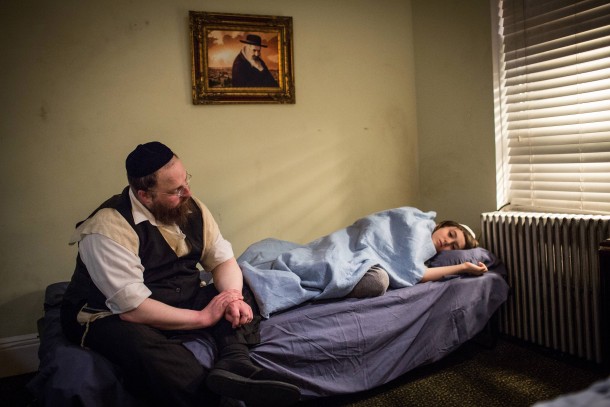
Rieven is currently in the custody of Menashe’s affluent brother-in-law Eizik (Yoel Weisshaus), who frequently clashes with Menashe as Menashe attempts to spend more time with his son. As a successful real estate businessman, Eizik can provide a far more stable environment for Rieven, and that may be the best for Rieven’s future, but Menashe really wants to live with his son. As he admits later, his married life was not so happy because he never wanted marriage from the beginning, but his son has always been a small light in his meager life, and that is evident whenever he is with his son. Although his attempts to get closer to his son are strained to say the least, Rieven is happy to be with his father, and Menashe is determined to show to Eizik and others that he can be a father good enough to take care of his son alone.

However, things do not go well for him due to not only bad luck but also his human flaws. When the aforementioned rabbi allows Menashe to live with Rieven for a week before the memorial day of his dead wife, Menashe is happy to get a good chance for proving himself to others around him including his son, but he only finds himself fumbling and bumbling many times. When he happens to wake up late in the morning, he has nothing to give his son for breakfast except coke and leftover cake. During one evening, he takes Rieven to a drinking party, and he soon comes to neglect his son as drinking a little too much.

It can be said that Menashe is a classic case of flawed loser, but the movie emphasizes with its desperate hero through small human moments to observe. He may be pathetic as living without much prospect, but he does try hard for what he wants, and that is why it is often sad and melancholic to watch him inadvertently letting down not only others but also himself. When he insists on holding the memorial ceremony for his dead wife at his apartment, we can clearly see a disaster from the start, and we are not so surprised when his another failure happens later, but we also sense how much he feels hurt by his latest failure.
menashe03

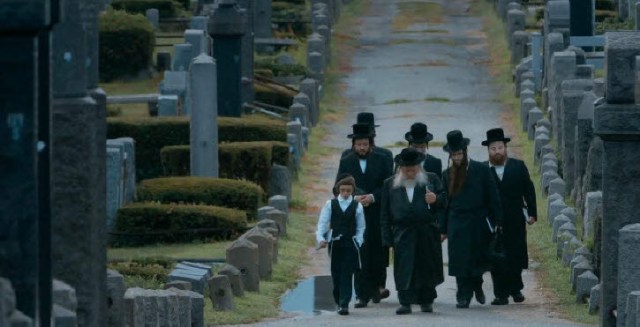
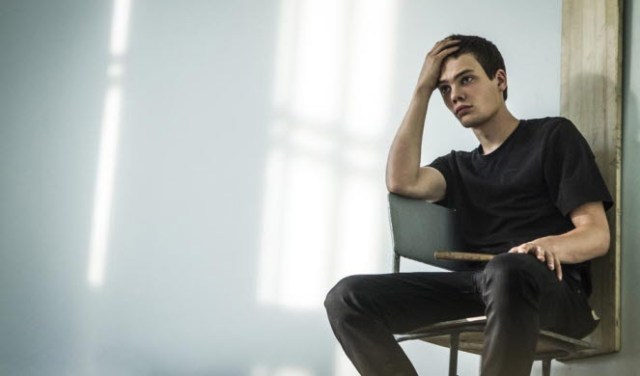
The director Joshua Z. Weistein, who wrote the screenplay along with Alex Lipshultz and Musa Syeed, did a competent job of generating the vivid sense of close-knit community around his characters. Thanks to the unobtrusive visual approach by Weistein and his co-cinematographer Yoni Brook, the movie is imbued with documentary-like quality, and we often feel like being an unseen observer during many scenes in the film as noticing small and big details from time to time. In case of one small scene, we happen to hear a conversation between two minor female characters, and that tiny moment says a lot about how tradition can stifle people sometimes.

The non-professional cast members of the movie, who mostly speak Yiddish throughout the film, bring a considerable degree of authenticity to the movie. Menashe Lustig is amiable and sympathetic in his unadorned performance, and he and young performer Ruben Niborski click together well as father and son on the screen. Yoel Weisshaus is effectively unflappable as Menashe’s disapproving brother-in-law, and Meyer Schwartz is also memorable as a rabbi who turns out to be more compassionate than he seems.

“Menashe” is a modest low-key character drama which takes its time in unfolding its rather simple plot, and you may feel impatient during its 82-minute running time, but this is an interesting film which not only fascinates us with its very specific ethnic background but also engages us via its universal story. In my inconsequential opinion, it is more engaging than your average blockbuster films, and I recommend you to give it a chance for experiencing something different.

menashe05

Posted in Movies | Tagged , | 1 Comment

The Student (2016) ☆☆☆1/2(3.5/4): A fanatic boy in the classroom

thestudent03

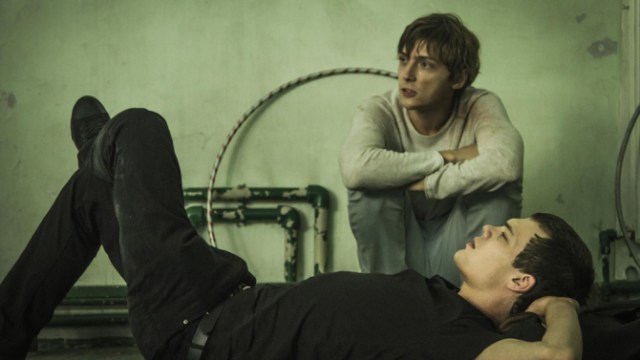
Darkly absurd and compelling, Russian film “The Student” disturbs us during its many fierce rhetorical scenes, which will grip your attention regardless of your opinion on religion. Here is an adolescent boy who suddenly starts to drive himself into religious extremism, and it is quite disturbing to watch his descent into fanatic behaviors, but the movie keeps holding our attention as coolly observing this unnerving progress accompanied with serious consequences.

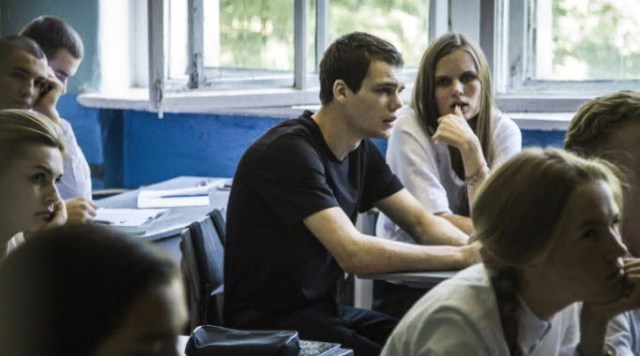
In the beginning, it seems to be a simple problem involved with the swimming class in a high school attended by its young problematic hero. Veniamin (Pyotr Skvortsov) refuses to participate in the swimming class just because of his Christian belief, and his divorced mother is flabbergasted and exasperated by her son’s weird behavior. It seems they were not particularly religious before, but now he is inseparable from the Bible, and he frequently quotes the Bible whenever he makes his points.

While ridiculed by his schoolmates, he adamantly pushes his belief without any compromise, and that certainly causes headaches for the teachers of his school. When Elena (Viktoriya Isakova), a biology teacher who is evidently the most progressive teacher in the school, is about to give her students sex education, Veniamin promptly goes into an aggressive mode as spurting out the passages from the scripture as usual, and he even takes off all of his clothes in front of Elena and other students. When she later tries to teach evolution in her classroom, he causes another commotion while wearing a furry gorilla suit, and this scene is alternatively tense and absurd especially after the principal comes into the classroom.

thestudent04

Virtually standing for everything Veniamin opposes, Elena sees that something must be done for stopping his potentially dangerous crusade, but, to her frustration, the principal and other teachers in the school are not so serious about that, and they are even willing to bend to his demands. Even though he still does not participate in the swimming class, the principal has female students wear ‘more appropriate’ swimsuits instead of bikinis. At one point, the principal suggests that Elena should teach both evolution and creationism in her classroom, and you may be reminded of those recent debates on whether religious belief should be treated equally along with science in American school classrooms.

As he continues to go on his way, Veniamin naturally clashes with the priest in the school. Although it is clear that he is not very pleased about how Veniamin does not tolerate anything which does not look right in his single-minded viewpoint, the priest rather admires Veniamin’s fervent faith and does not entirely disapprove of his extremism. From that moment, you can probably see how religions can often sanction fanatics in one way or another in the name of more expansion and influence.

And he comes to find his first disciple from Grigoriy (Aleksandr Gorchilin), a cripple boy who is frequently bullied at the school. Like any lonely, alienated kid, Grigoriy does not hesitate at all when Veniamin approaches to him, and we get an amusing moment when they attempt a faith-healing on Grigoriy’s disability. As they spend more time together, it turns out that Grigoriy wants something more than faith from Veniamin, and that leads to a very unpleasant outcome later in the movie.

thestudent01

Meanwhile, Elena becomes more preoccupied with her conflict with Veniamin. For arguing against him, she spends a lot of time in reading and analyzing the Bible, and that accordingly affects her relationship with her boyfriend, who is incidentally one of the teachers in the school. The more she sticks to her position, the more she becomes frustrated with the absurd circumstance surrounding her, and it increasingly looks like there is nothing much she can do about that.

While the movie evidently sides with Elena, the director Kirill Serebrennikov, who adapted a German play by Marius von Mayenburg for his film, steadily maintains its detached attitude, and some of you may feel impatient because it never fully explains the origin of Veniamin’s fanaticism. Was it caused by his unhappy household environment? Or was it resulted from his fear of sexuality, as suggested by one brief scene involved with one female student?

Despite that elusiveness, the movie is intense and engaging enough to maintain the level of interest for us, and Serebrennikov and his cinematographer Vladislav Opelyants give us a good number of long-take scenes to admire. Thanks to Opelyants’ deft use of handheld camera, we usually feel like being around the characters in the film, and it surely helps that the movie is supported well by its performers. While Pyotr Skvortsov is sullenly electrifying, Viktoriya Isakova is excellent as his opponent, and Aleksandr Gorchilin and other supporting performers are also solid in their respective roles.

“The Student”, which won François Chalais Prize at the Cannes Film Festival in last year, is not a comfortable film to say the least, but this is an intelligent piece of work with some thought-provoking sides, and its subject is more relevant to us now considering how much our world has been affected by extremism during recent years. This is indeed a tough stuff, but you will not forget its dark dramatic power easily after it is over.

thestudent02

Posted in Movies | Tagged , , , , | 1 Comment

Guardians of the Galaxy Vol. 2 (2017) ☆☆☆(3/4): A little less awesome this time

guardiansofgalaxyvol201

“Guardians of the Galaxy Vol. 2” is alternatively exhilarating and exhausting in its overstuffed mix of SF fantasy, action, and comedy. Like the previous film, the movie works best when it focuses on its colorful rogue characters, and there are a number of hilarious moments which elicit big laughs from me and other audiences around me in the screening room. However, it is also a bit tiresome due to its rather overlong plot and predictable narrative turns, and that aspect sometimes distracted me during my viewing, though I enjoyed the movie enough for recommendation.

Since their first adventure in “Guardians of the Galaxy” (2014), Peter Quill (Chris Pratt), Gamora (Zoe Saldana), Drax (Dave Bautista), Rocket (voiced by Bradley Cooper), and Groot (voiced by Vin Diesel) have been widely known as a team to hire for any big planetary/galactic problem, and the main title sequence shows them in the middle of their latest job. They must protect a bunch of precious energy batteries in a planet called the Sovereign, and their frantic battle with a gigantic monster effectively sets the offbeat tone of the movie with “Mister Blue Sky” by Electric Light Orchestra played on the soundtrack. Rather than focusing on the battle, the movie puts Groot’s cheerful dancing in the front to our amusement, and we can clearly see that the movie is willing to go for something different compared to many other run-of-the-mill superhero movies.

While their job is done well in the end, our main characters soon get themselves into a big trouble thanks to Rocket, who steals a few energy batteries before leaving the Sovereign. Ayesha (Elizabeth Debicki), the haughty leader of the Sovereign, is certainly not so pleased about this thievery, and we accordingly get another busy action sequences featuring heaps of drones attacking the spaceship of our main characters. (The operation system of those drones is another amusing touch to be appreciated in the film, by the way).

guardiansofgalaxyvol202

Not long after they manage to survive this attack and the subsequent crash on a nearby planet, they come across a mysterious guy who turns out to be none other than Quill’s father, who left Quill and his mother many years ago. Ego (Kurt Russell) wants to take his son to his planet where he lives alone with his sole companion Mantis (Pom Klementieff), and Quill surely wants to go there for getting to know more about his father.

Accompanied with Drax and Gamora, Quill goes to Ego’s planet, which looks like a galactic version of Shangri-La with its grand, wondrous sights including a huge palace where Ego and Mantis reside. Ego reveals to his son that he is a powerful ancient alien who is virtually immortal, and, as implied by the prologue scene between him and Quill’s mother, it looks like he wants more than a heart-to-heart conversation between father and son.

Meanwhile, Ayesha hires Yondu (Michael Rooker) for catching Quill and his comrades although there is a long history between Quill and Yondu. As depicted in the previous film, Yondu kidnapped young Quill for taking him to Ego, but he chose to have Quill under his protection instead of sending him to Ego, and, though Quill willfully left him and his bunch of alien outlaws later, Yondu still cares about Quill more than he admits on the surface.

From time to time, the screenplay by the director James Gun suffers from its uneven storytelling. The part involved with Ego’s planet does not have much surprise as being pushed to its obligatory climax sequence as expected, and I must point out that the father and son relationship presented in the movie is less complex and engaging than a similar relationship observed from Ang Lee’s underrated “Hulk” (2003). Fortunately, the other parts of the movie are more compelling in comparison for good reasons I will not reveal here, and they serve us with not only more humor and excitement but also the surprising depth shown from some characters in the film.

guardiansofgalaxyvol203

It is constantly fun to see the comic interaction among the main characters of the movie, and the main cast members keep the movie bouncing via their undeniable chemistry on the screen. Since his breakthrough turn in TV sitcom series “Parks and Recreation”, I have appreciated Chris Pratt’s amiable screen presence, and he wields it with gusto as letting his co-stars having each own fun around him. While Zoe Saldana is effective as a no-nonsense counterpart to Pratt, David Bautista shows more of his comic talent as looking droller than before, and Bradley Cooper goes all the way for getting good laughs for us. In case of Vin Diesel, his voice performance is less substantial this time, but he will probably be more amusing in the next movie, considering one of the teaser scenes shown during the end credits.

In addition, the movie provides enough space for several notable supporting performers. Michael Rooker, whom I always remember for his chilling performance in “Henry: Portrait of a Serial Killer” (1986), enjoys every juicy moment of his in the film, and his scene with a character played by Sylvester Stallone may remind you that they once played together a long time ago in “Cliffhanger” (1993). As he recently did in “The Fate of the Furious” (2017), Kurt Russell exudes his own B-movie sensibility which surely fits well to the film, and Pom Klementieff has several humorous scenes as a character who does not have much social skill despite her exceptional empathic talent. As Gamora’s resentful sister, Karen Gillan has more interesting things to do this time, Elizabeth Debicki is also solid during her few scenes while raising some expectation from us.

In my inconsequential opinion, “Guardians of the Galaxy Vol. 2” could be better. Its action sequences could be less choppy and frantic, and I still think it could be shortened further for more efficient storytelling. The overall result is a little less awesome than the previous film, but its cheerful spirit remains mostly intact at least along with the effective use of various pop songs from the 1970-80s, and I will not deny that I walked out of the screening with good feelings. To be frank with you, I am looking forward to enjoying the third volume now.

guardiansofgalaxyvol204

Posted in Movies | Tagged , , | 1 Comment

Colossal (2016) ☆☆☆(3/4): Her huge personal matter

colossal01

While people with drinking problem are bound to hit each own bottom, the heroine of “Colossal” hits an odd bottom under her extraordinary circumstance. Her life is already a mess, but then she finds herself suddenly being capable of a far bigger mess, and then there comes another trouble she must deal with. Having a small quirky fun with its preposterous mix of two different genres, the movie also surprises us as taking an unexpected plot turn later in the story, and I must confess as a South Korean audience that I was particularly amused by its chosen sight of mass destruction in South Korea.

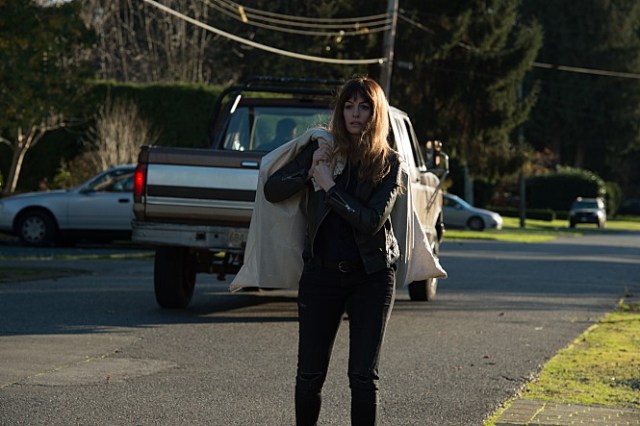
After the prologue scene which sets the overall tone of the film, we see another lousy day for Gloria (Anne Hathaway), a young unemployed writer whose life and career has gone nowhere as she has gone through many frequent drinking nights. When she comes back late again to a Manhattan apartment belonging to her boyfriend Tim (Dan Stevens), it is clear that he has decided enough is enough. In fact, he is already prepared to end their relationship.

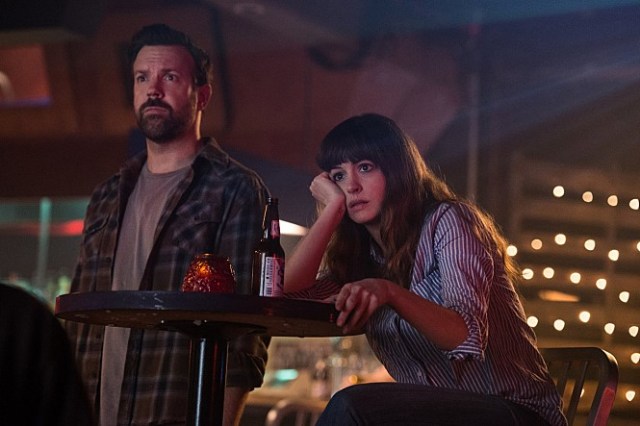
Naturally feeling devastated by this, Gloria decides to go back to her hometown located somewhere outside New York City. Although currently penniless, she can at least sleep in an empty house belonging to her parents (the movie never tells us whether they died or are merely absent, by the way), and she also happens to meet Oscar (Jason Sudeikis), an old schoolmate willing to help her more than expected. Besides hiring her at a local bar he has run since inheriting from his father, he also brings several pieces of furniture to her, and she is certainly glad to have a much more comforting alternative to her faulty inflatable mattress.

Considering her drinking problem, working at a bar is not exactly an ideal job for her, but Gloria becomes a little more spirited than before as hanging around with Oscar and his two friends after her working hour. While Garth (Tim Blake Nelson) is your average dopey loser, Joel (Austin Stowell) is a nice, good-looking guy, and that aspect of his does not escapes Gloria as they talk a bit with each other.

colossal03

Now the movie sounds like your typical Sundance comedy drama, but then there comes a plot turn we expect from the very beginning. After coming back from the bar during one early morning, Gloria falls asleep due to her heavy drinking, and she belatedly hears about a big international news when she wakes up several hours later. A gigantic monster suddenly appeared out of nowhere and then disappeared in the downtown area of Seoul, and the whole global community is thrown into panic and horror because of this unprecedented happening.

At first, Gloria is simply horrified and amazed just like many other people around her as the monster keeps appearing and then disappearing in Seoul, but she comes to notice something familiar from the monster’s behavioral pattern, and she soon discovers the unbelievable connection between her and the monster. For some reason, the monster appears in Seoul whenever she enters a certain spot during a certain time period, and every small action of hers in the spot is simultaneously amplified into every big action of the monster in Seoul.

As Gloria tries to deal with her literally huge personal matter, the screenplay by the director Nacho Vigalondo deftly balances itself between humor and gravitas. While being more aware of possible mass destruction she can inadvertently cause, Gloria cannot help but have a little fun with her weird circumstance, and we get a small humorous scene when she fully demonstrates it to Oscar and their drinking friends not long after their another drinking time. As delving into a dark subject glimpsed around its story, the movie generates interesting dramatic tension during its second half, and I will not go further into details on that for not spoiling your entertainment.

colossal02

Two lead performers in the film keep their acting straight as maintaining the emotional weight in the story. Dialing down her likable persona via an unkempt appearance, Anne Hathaway is believable as a walking mess of problems, and it is enjoyable to watch how she ably goes back and forth between comedy and drama while never making an excuse for her deeply flawed character. Jason Sudeikis, whom I noticed for the first time through his comic performance in “Horrible Bosses” (2011), deserves some praise for effortlessly showing his more serious side, and I appreciate how he subtly conveys his character’s disagreeable side during his early scenes. The other characters in the film are less developed in comparison, but Dan Stevens has a good scene when his character finds himself in a tense, awkward situation later in the story, and Tim Blake Nelson reminds me again that he has always been an interesting character actor who can fill thankless roles more than required.

Vigalondo previously impressed me with two modest but engaging genre pieces which distinguish themselves through smart storytelling and wily handling of genre elements. “Timecrimes” (2007) is a fun thriller which cheerfully plays with its inevitable logic of time travel within its small space and time, and I was amused a lot by its clever moments of irony and paradox. “Open Windows” (2014) has its entire story unfolded within one single laptop computer, and I liked how it pushes its setting as much as it can while not losing its sense of fun and thrill.

“Colossal” is another entertaining work from Vigalondo, and I enjoyed its offbeat spirit as wryly observing Seoul getting destroyed on the screen. Shot in Seoul and Bucheon, the Seoul scenes in the movie look mostly authentic, and I chuckled during the scene involved with a short Korean message. It was too bad that the movie did not reach to many audiences in South Korea, and I hope it will be regarded as an overlooked gem here someday. After all, Seoul under a monster attack is something we do not see everyday.

colossal04

Posted in Movies | Tagged , , | Leave a comment

A Woman’s Life (2016) ☆☆☆(3/4): Ups and downs in her life

awomanslife02

Life can be pretty disappointing at times, and the heroine of French film “A Woman’s Life” faces that painful truth again and again throughout the movie. It is quite depressing at times to watch her youthful ideals and dreams being withered by many ups and downs in her life, but the movie is engrossing none the less as steadily building up emotional resonance via its small details and contrasting moods, and it surely earns a small but significant glimpse of hope shown around the finale.

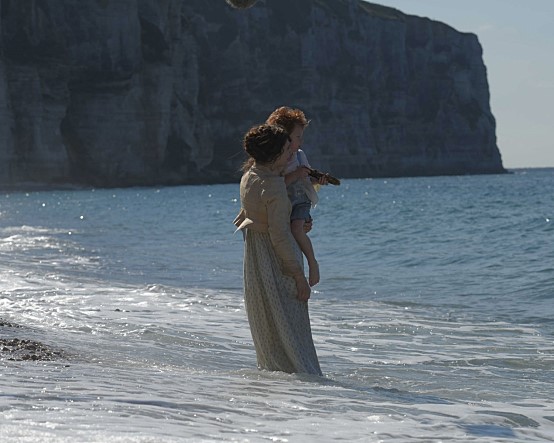
In the beginning, life looks just fine and hopeful for Jeanne du Perthuis des Vauds (Judith Chemla), the young daughter of a minor aristocrat family living in a rural area of Normandy, France during the early 19th century. Recently returning from her convent school, she is excited about the new chapter of her life she is going to begin, and her parents, Simon-Jacques (Jean-Pierre Darroussin) and Adélaïde (Yolande Moreau), are fully supportive of their daughter when she decides to marry Julien de Lamare (Swann Arlaud), a poor but handsome viscount with whom she falls in love not long after his visit to her family chateau.

However, she soon finds out how callous her husband can be. Their honeymoon night is uncomfortable for her to say the least as he does not show much consideration on their bed, and then she has to endure his callousness in their gloomy, distant domestic environment. At one point, he casually disregards her simple request to use more firewood for warming her up – and he goes outside frequently while leaving his unhappy wife alone in the house.

Meanwhile, Jeanne’s friendly maid Rosalie (Nina Meurisse) becomes distant to her with no apparent reason, and then Jeanne happens to discover the cause during one night when she looks for Rosalie. Rather than directly showing Jeanne’s discovery of Julien’s adultery, the movie presents what happens next instead, but it feels devastating none the less as the handheld camera follows two figures running in a murky night background.

awomanslife05

While deeply hurt by her husband’s unfaithfulness, Jeanne decides to give him another chance as she is pregnant with his son, and it seems happiness is within her reach as she befriends Gilberte de Fourville (Clotilde Hesme) and her husband, but then, not so surprisingly, she finds herself again in another difficult circumstance thanks to her crummy husband. She seeks for any advice from a local priest, but the priest only makes her feel all the miserable, and that scene is followed by a calm but striking moment showing another devastating blow to her and her life.

The movie moves forward to several years later, and we see Jeanne struggling with another problem because of her son Paul (Finnegan Oldfield), who turns out to be the apple which does not fall far from the tree. Just like his father, he keeps disappointing his mother, and she cannot possibly say no to his frequent requests for money to pay off his debts – even though he has never come to meet her since he left her.

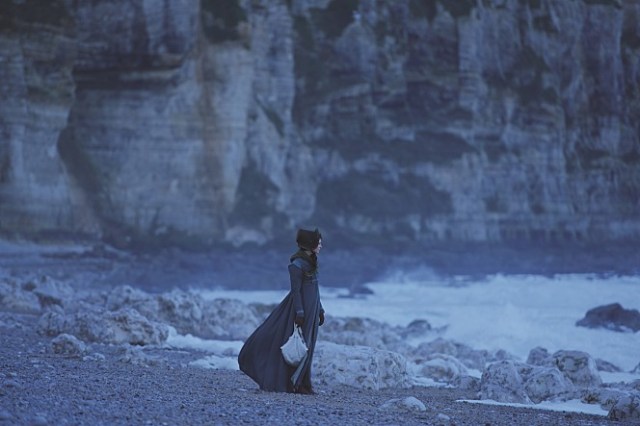
We see her world gradually sinking down as a consequence. Her family chateau feels no longer bright or comfortable as the family fortune is dwindled, and the drab atmosphere surrounding Jeanne and other characters around her feels more palpable as the cinematographer Antoine Héberlé emphasizes chilly seasonal changes on the screen. Around the point when Jeanne has no choice but to sell and leave her dear home, we cannot help but notice how much she looks different from her younger self, and we pity her more as she lets herself go down further.

awomanslife01

The movie is based on Guy de Maupassant’s classic novel “A Life: The Humble Truth”, which is also known as “A Woman’s Life”. I have not read the novel, but I can say instead that the director Stéphane Brizé, who adapted the novel with his co-writer Florence Vignon, did a good job of not only establishing authentic period background but also presenting an intimate character drama to engage us. Shot in 1.33:1 ratio, the movie usually sticks close to Jeanne, and that accentuates the stuffy feeling around her while drawing us more to her story. Mainly through frequent flashbacks, her happy moments represented by the warm, sunny ambience of spring and summer are contrasted with her unhappy moments reflected by the cold, cloudy mood of fall and winter, and that gives us more understanding of her unwise choices based on her naïve faith in people.

The performers in the film are uniformly commendable. Judith Chelma, who was one of the supporting characters in “Camille redouble” (2012), is believable as her character goes through different emotional stages, and she is especially heartbreaking when her character is driven near to madness later in the movie. While Jean-Pierre Darroussin, who was an unflappable cop in “Le Havre” (2011), is quietly poignant, Yolande Moreau, who drew my attention for the first time in “Séraphine” (2008), is enjoyable to watch as usual, and Nina Meurisse is also solid in her supporting role.

“A Woman’s Life”, which won the FIPRESCI Prize at the Venice International Film Festival in last year, is another interesting work from Brizé, who previously made “The Measure of a Man” (2015). I admired that film for many reasons including the unforgettable lead performance by Vincent Lindon, but I rather underestimated it despite that. I give “A Woman’s Life” only three stars with my discreet admiration for now, but I think I will admire and like it more later.
awomanslife03

Posted in Movies | Tagged , | Leave a comment

Dancer (2016) ☆☆☆(3/4): Reaching for his second chapter

thedancer01

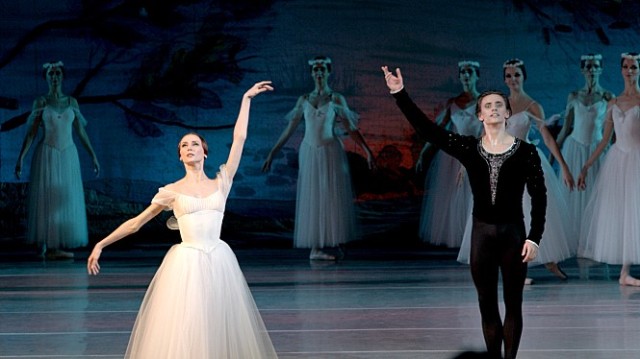
While watching the ballet performance scenes in documentary film “Dancer”, I thought about how much effort ballet dancers have to put into their performance. For achieving those brief but precious moments of grace and perfection, they must push themselves as much as possible even before being on the stage, and this is demanding and exhausting even for the ones with natural talent.

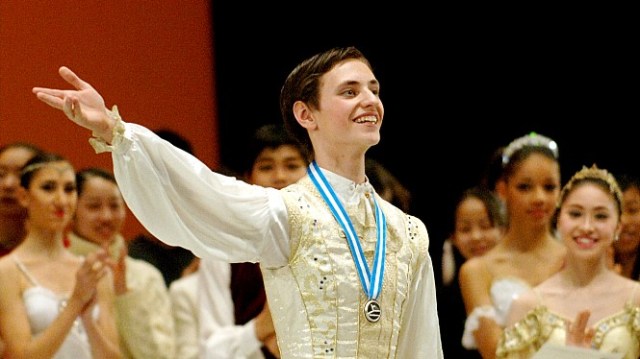
The documentary follows the dramatic career of Sergei Polunin, a young, talented Ukrainian ballet dancer who drew the attention of the media when he was chosen as the principle of the Royal Ballet Company in London in 2010. Besides being the youngest principle dancer in the history of the company, he impressed people a lot with his almost perfect mix of control and spontaneity on the stage, but he also gained lots of bad reputation as a troublemaker, and then he suddenly walked away from his prestigious position in 2012.

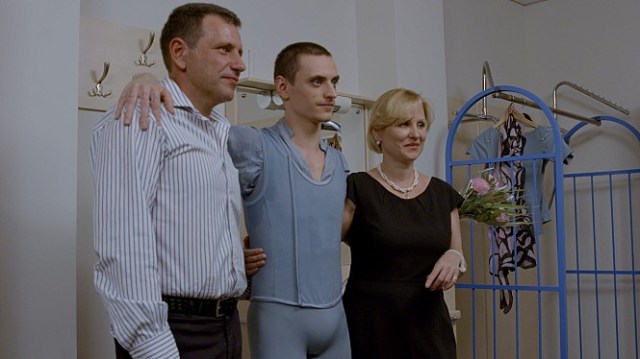
After the opening scene which shows Polunin preparing for the performance which is about to begin, the documentary looks at his early life in Kherson, Ukraine. Even when he was very young, he showed considerable potential through gymnastics as shown from the old video footage clips shot by his mother, and his parents were willing to do anything for further developing their son’s inherent talent. Although they were poor, they decided to send him to an expensive ballet school in Kiev, and that surely demanded a lot of sacrifice from his family. While his mother stayed with her son in Kiev, his father and grandmother went abroad for earning enough money for Polunin’s tuition, and Polunin tells us how much he felt hurt as his family became separated for giving him a better chance to succeed.

thedancer04

In 2003, Polunin and his mother went to London for the application to the Royal Ballet School. While he was accepted, he found himself being alone in London when his mother had to go back to Ukraine due to her visa problem, and it was certainly difficult for an adolescent boy who barely spoke English. Although he came to befriend some of other students in the school, he still felt lonely and isolated, and then his parents came to get a divorce a few years later. Both of them admit to us how much their divorce affected their young son around that time. They stuck together for their son’s future, but their efforts ironically caused their separation, which in turn made their son very unhappy.

Anyway, Polunin kept going on in the Royal Ballet school, and he soon came to be one of the most prominent students as demonstrating his undeniable talent. Not long after he joined the Royal Ballet Company in 2007, he became a soloist, and it was apparent to everyone that he was too good for that position – and it was a matter of time before he was promoted to the principle dancer of the company.

He finally attained what he and his family had wished for many years, but he began to go out of control after that point, and he and his two close friends/colleagues frankly tell us about how wild and reckless he was during that period. As feeling pressured and isolated by his fame and success, he hurled himself into alcohol and drug, and he frequently made the headlines for his self-destructive behaviors while reveling in his notorious status as the bad boy of ballet.

Eventually, Polunin came to lose interest and motivation, and that led to his decision to leave the company in 2012. He subsequently moved to the Stanislavsky Company in Moscow, and it looked like he found a place where he could be more comfortable, but then he became pressured as much as before, and we get a revealing moment which shows his exhausted state not long after the end of one performance.

thedancer03

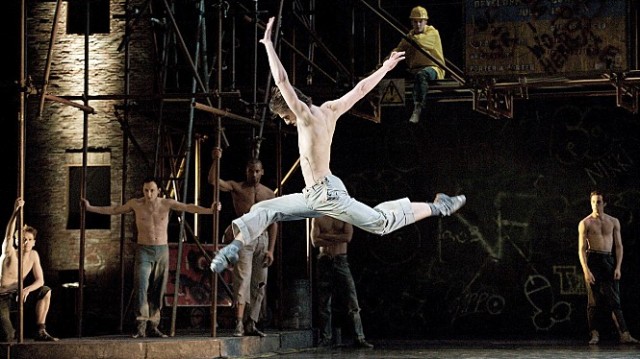
Feeling like going nowhere, he decided to retire in the end, but he wanted to do one last performance before retirement, and that was how he came to collaborate with renowned photographer David LaChapelle. We see them and others preparing for shooting his performance in Hawaii, and the following result, which is accompanied with Hozier’s hit song “Take Me to Church”, is fantastic to say the least. It often feels like his own act of ventilation as his lean muscular body goes through a number of dynamic movements in a stripped-down but well-lit space, and it is not so surprising that this raw music video went viral when it was posted on YouTube in 2015.

The director Steven Cantor, who was Oscar-nominated for his short documentary film “Blood Ties: The Life and Work of Sally Mann” (1994), did a good job of generating an engaging narrative to hold our attention. While those ballet performance scenes are indeed the main highlights of the documentary, the interview clips of Polunin and his family members establish the emotional base of the documentary as they earnestly talk about their past in front of the camera. There is a quiet, poignant moment between Polunin and his mother as they have a frank conversation at her small apartment in Kherson, and it is touching to watch when he later gets closer to his parents than before.

After the unexpected success of what was supposed to be his swan song, Polunin came to change his mind as reflected by the final scene of “Dancer”, and we see an artist actively reaching for the second chapter of his life and career. As watching him, I could not help but be reminded of what Tony Bennett once said: “Life teaches you how to live it if you live long enough.” I think Polunin will probably agree to that someday.

thedancer02

Posted in Movies | Tagged , , | Leave a comment

The Founder (2016) ☆☆☆(3/4): The aggressive takeover of an American dream

thefounder03.jpg

As a story about the early business years of McDonald’s, “The Founder” is fascinating as observing how this famous fast food restaurant chain company was pushed up to a bigger success to come, but it is also cautionary at times as recognizing the bitter, ruthless side of what can be described as the aggressive takeover of an American dream. It is enjoyable to watch its ambitious hero going all the way to his enormous achievement, but we cannot help but feel uncomfortable about his cutthroat business tactics, and the ambivalent attitude of the movie to its hero and story further accentuates that impression.

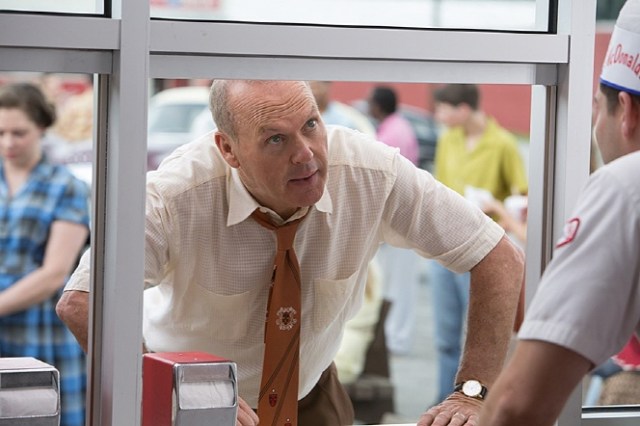
The early part of the movie shows us how Ray Kroc (Michael Keaton) came to across a chance which would change his life forever. It is 1954, and Kroc is a salesman traveling around rural areas of Missouri to sell multi-mixer milkshake makers. While he does not persuade many potential buyers despite his efforts, he is notified that some drive-in restaurant located in San Bernardino, California ordered no less than six milkshake makers, and he decides to go to that restaurant out of curiosity.

The restaurant in question is run by two brothers named Dick and Mac McDonald (Nick Offerman and John Carroll Lynch), and Kroc is instantly impressed by how tasty hamburgers are quickly served to customers there. The McDonald brothers willingly show Kroc more of how their restaurant is operated, and we subsequently get an amusing flashback sequence showing how the McDonald brothers developed and polished their idea on quicker customer service. In those days, you had to wait for more than 20 minutes to get your ordered food at a drive-in, but the McDonald brothers vastly minimized the waiting time as maximizing the efficiency of the cooking and serving process as much as possible, and it is certainly interesting to observe the early stage of a process familiar to many of us at present.

thefounder02

Seeing the considerable potential from the McDonald brothers’ business, Kroc eventually becomes their business partner, and he is determined to push up the business to the franchise of national level although the McDonald brothers already attempted that and failed before. Thanks to his persistence, he manages to get a bank loan for business expansion, and he soon has several franchises opened around the country. Although the first steps are not that easy as he experiences a number of setbacks, he comes to find a clever business strategy for not only expansion but also profit, and that is accordingly followed by far more growth than he and his partners have ever imagined.

However, the McDonald brothers are not so happy about this change while Kroc is willing to do anything in the name of business. As the McDonald brothers regret having Kroc as their business partner, Kroc is gradually annoyed as the McDonalds keep standing on his way to more success, and the circumstance culminates to a big clash between them when Kroc decides to use powdered milkshake for saving cost.

Around that point, the movie begins to take a darker tone with ample amount of bitterness, and the screenplay by Robert D. Siegel takes a neutral position on the conflict between Kroc and the McDonald brothers. While it is undeniable that Kroc unfairly treated the McDonald brothers, the movie also recognizes that Kroc was a smart, resourceful guy who happened to be at the right place and the right time, and it is alternatively compelling and disturbing to watch Kroc’s relentless advance. Sure, his grand business vision was indeed crucial in the success of McDonald’s, but we are reminded that his American dream was taken from his partners, and there is some sense of hollowness when we watch him during the final scene of the movie.

thefounder04

As the electrifying center of the movie, Michael Keaton, who has been recently going through career resurgence thanks to his superlative performances in “Birdman” (2014) and “Spotlight” (2015), ably carries the film, and he is counterbalanced well by his two equally good co-performers. Right from his first scene, John Carroll Lynch, who played Marge Gunderson’s husband in “Fargo” (1996) and the prime suspect character in “Zodiac” (2007), exudes gentle decency, and Nick Offerman, who has been one of the most dependable character actors since his breakout role in TV sitcom series “Parks and Recreation”, is also effective in his usual terseness which functions as a good contrast to Lynch’s amiable appearance.

Compared to the three main characters of the movie, the other characters in the movie are underdeveloped in comparison, and that is the main weakness of the movie. As Kroc’s increasingly estranged wife, Laura Dern is usually required to look disappointed or exasperated during her scenes; the movie often feels superficial in the depiction of the growing distance between Kroc and his wife, and the same thing can be said about the relationship between Kroc and Joan Smith (Linda Cardellini), a married woman who happens to come across Kroc via her husband and instantly clicks well with him.

Although it does not reach to the level of “The Social Network” (2010), “The Founder” is an entertaining drama thanks to the spot-on performances by Keaton, Lynch, and Offerman, and the director John Lee Hancock did a competent job on the whole. It could be tastier, but it serves the story mostly well, and you will probably want to go to McDonald’s and get a Big Mac because of those sizzling hamburger patties on the screen.

thefounder01

Posted in Movies | Leave a comment

The Fate of The Furious (2017) ☆☆1/2(2.5/4): There will be more….

small_thefateoffurious03

“The Fate of the Furious”, the eighth entry of the Fast and the Furious series, tries quite hard to impress its target audiences, but it ultimately is stuck in its enduring but predictable formula. Yes, it surely serves you with many well-made action sequences as demanded, and the result looks as spectacular as you can expect, but it does not have enough things to distinguish itself like the better entries of the franchise, while suffering from several glaring problems too big to be overlooked.

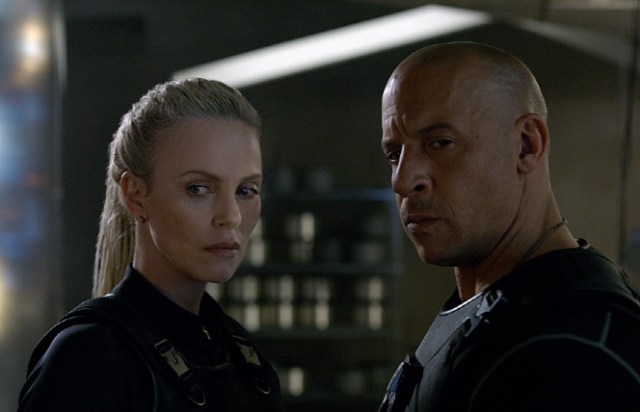
Considering that it is mostly all about actions, explaining the plot of the movie is pretty meaningless, but let me try a bit. When Dominic Toretto (Vin Diesel) is enjoying his honeymoon time with his girlfriend Letty Ortiz (Michelle Rodriguez) in Havana, Cuba, he is approached by a criminal mastermind named Cipher (Charlize Theron), who needs Dominic for the success of her evil plan. Because Cipher thrusts him into a situation he cannot ignore at all, Dominic has no choice but to betray Letty and his other colleagues during their latest operation involved with a certain type of weapon of mass destruction.

Surely feeling surprised and betrayed, Letty and other team members become determined to go after Dominic and Cipher, and Frank Petty (Kurt Russell), a high-ranking secret government agent who previously helped the team in “Furious Seven” (2015), is willing to provide anything they need for stopping Cipher’s plan. In addition, Deckard Shaw (Jason Statham), who was the main villain in “Fast Seven”, comes to join the team just because of his previous connection with Cipher, and he understandably does not get along well with the people who were once his enemies not so long ago.

small_thefateoffurious01

Driving fast along its thin plot, the movie unfolds a number of big action sequences, and some of them are quite ridiculous and preposterous to our amusement. While the opening action sequence set around the streets of Havana goes all the way to outrageousness as Dominic pushes a shabby vehicle to sheer extreme, the action sequence unfolded in the middle of Manhattan is impressive with heaps of hacked vehicles, and the climactic action sequence set in some arctic area of Russia will not disappoint the fans of the franchise as throwing many things including a big nuclear submarine into its busy, bombastic mix.

These action sequences are entertaining to watch at times, but they merely feel as big and loud as the high points of “Fast Five” (2011), “Furious 6” (2013), and “Furious Seven” (2015). Although I did not like “Furious 6” enough for recommendation, I still remember well how uproariously the audiences around me responded to one particularly unbelievable moment of action between Letty and Dominic in that film, and it is disappointing that “The Fate of the Furious” does not have any similar moment like that.

Above all, I am quite disappointed to see the movie wasting two talented performers in thankless supporting roles. Charlize Theron steadily maintains the cold façade of her villain character, but that is all she is demanded to do, and it is all the more disappointing when you remember how terrific she was as Imperator Furiosa in “Mad Max: Fury Road” (2015), which is a far better vehicle action film than any entry in the Fast and Furious series. In case of Helen Mirren, she only appears in two brief scenes, and I think she would enjoy herself a lot more if she were allowed to drive any of those fancy vehicles in the movie.

small_thefateoffurious02

The main cast members of the film mostly acquit themselves well. Trudging along a bland character arc you can easily predict, Vin Diesel is less engaging than before, and I wonder whether it is due to the absence of late Paul Walker, who supported the series along with Diesel for many years before his untimely death in 2013. While Michelle Rodriguez generates some degrees of seriousness as her character struggles with her conflicted feeling toward Dominic, Chris ‘Ludacris’ Bridges and Tyrese Gibson provide little amusing moments as expected, and Scott Eastwood and Nathalie Emmanuel fill their respective supporting roles as required.

The main fun of the movie comes from Dwayne Johnson, Kurt Russell, and Jason Statham. I have come to appreciate more of Johnson’s undeniable screen presence during recent years, and I certainly enjoyed watching him effortlessly moving back and forth between action and comedy. While Russell plays his unflappable role with gusto as before, Statham has a big fun during the hilariously tense interactions between him and Johnson, and that took me back to the equally amusing confrontation between Johnson and Diesel in “Fast Five”.

As I said before, I am not that enthusiastic about the Fast and the Furious series, but I have admired how the franchise has kept going during last 16 years. While it seemed to hit the bottom in “Fast & Furious” (2009), it bounced back with “Fast Five”, which I regrettably underrated. It went a bit down with “Furious 6”, but then it recharged itself in “Furious Seven” (2015) while also proving a poignant exit for Walker.

“The Fate of the Furious” is two or three steps down from “Furious Seven”, but it is not as bad as “Fast & Furious” at least, so I give it 2.5 stars. Considering its huge worldwide box office success at present, there will surely be more sequels in the future, and I hope they will be better than this mildly deficient entry. It is not so refreshing, but the series has not run out of its fuel yet.

small_thefateoffurious04

Posted in Movies | Tagged , | Leave a comment

Eve’s Bayou (1997) ☆☆☆1/2(3.5/4): A black family drama in the bayou town

evesbayou9.jpg

The opening scene of “Eve’s Bayou” is one of the most captivating opening lines I have ever encountered: “Memory is a selection of images, some elusive, others printed indelibly on the brain. The summer I killed my father, I was 10 years old.” As we wonder about what happened during that summer in question, the movie immerses us into the small, vivid world of its young heroine who tries to process what has been swirling and smoldering inside her good but inherently problematic family, and its haunting drama of love, hate, passion, guilt, and sorrow is surprisingly more complex and powerful than expected, as freely drifting around emotional realism and magic realism via its distinctive Southern atmosphere.

The story of the movie is set in one small bayou town of Louisiana during the early 1960s. In the opening scene, the narrator tells us about the origin of this swampy but beautiful little town. A long time ago, a slave woman named Eve saved her French master’s life through her powerful medicine, and she was rewarded with not only freedom but also a piece of land for her. She subsequently bore her master’s sixteen children, and we are told that our young heroine and her family are this slave woman’s direct descendants.

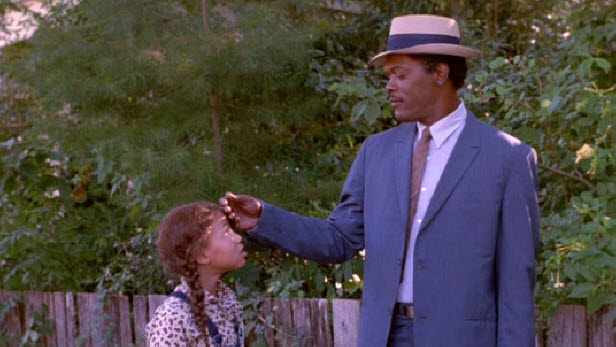
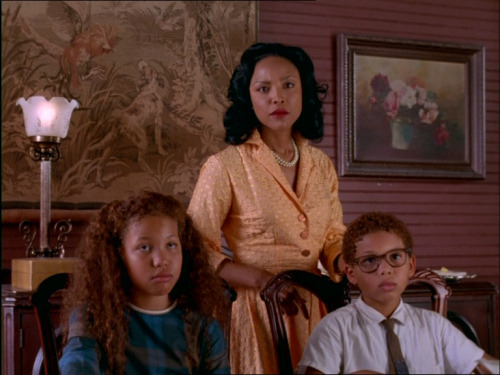
Named after her ancestor, Eve Batiste (Jurnee Smollett-Bell) is the second child of the Batistes, and we observe their prominent social status in the town as a party is being held in their big, lovely mansion surrounded by stream and trees. While her father Louis (Samuel L. Jackson) is a successful doctor who is also pretty popular around the town, his wife Roz (Lynn Whitfield) is a fair lady with grace and class, and their three dear children have grown up in an affluent and sophisticated environment, as reflected by when one of them quotes a line from a classic play by William Shakespeare.

evesbayou10Looking around these characters and others at the party, the movie lets us sense how much Eve feels like being overlooked compared to her two siblings. While her younger brother Poe (Jake Smollett) is mommy’s little prince, her older sister Cisely (Meagan Good), who has just has turned 14, is daddy’s little princess, and Eve cannot help but feel envy and jealousy as watching Cisely dancing with their father in front of party guests. At least, Eve has Louis’ sister Mozelle (Debbi Morgan) and her sweet husband Harry (Branford Marsalis), but she is disappointed about her father not dancing with her, and she promptly goes outside the house then sneaks into the warehouse.
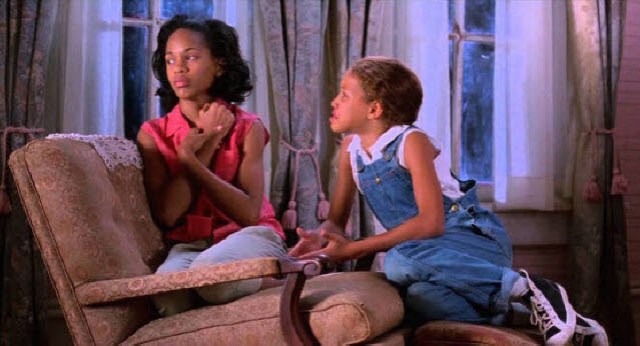

Not long after she is asleep in the corner of the warehouse, Eve is awakened by some sound, and that is when she happens to witness something very inappropriate between her father and a married woman she knows. Right after noticing her presence, Louis calms down his shocked daughter, and their relationship seems to remain intact on the surface as he promises to her that he will dance with her in next party, but Eve cannot possibly forget what she saw through her own eyes. When she later confides that to Cisely, Cisely says that she simply got a wrong impression at that time, and she even gives Eve a plausible alternative version of what happened in the warehouse.

While not so sure about what she really saw, Eve could just believe what Cisely told her, but then she becomes more aware of a trouble growing inside her family. During one evening, Roz is quite angry about an unspecified problem involved with Louis, and that surely draws their children’s attention. When Eve spends some time with her father during his worktime, she notices that her father stays longer than necessary in the bedroom of one of his patients, a young, beautiful girl who clearly wants more than a routine examination from her handsome doctor.

evesbayou8

Meanwhile, Roz receives an ambiguous but ominous warning from a local voodoo witch named Elzora (Diahann Caroll). Although Louis is skeptical, Roz decides to keep her children inside the house, and that adds more strain to the nervous mood hanging around the family. Louis continues to be frequently absent, and everybody in the house, probably except Poe, knows that he does not always go outside for work. While Roz keeps being frustrated and agitated, Eve resents more being stuck in the house all day long, and, going through lots of changes as an adolescent girl with blossoming femininity, Cisely begins to clash with her mother as siding with her father, whom she has adored and worshiped.

The movie was the first feature film by Kasi Lemmons, whom you probably remember for her notable supporting roles in “The Silence of the Lambs” (1991) and “Candyman” (1992). Although she made only one short film before moving onto the next step, she made quite an impressive debut work to admire and cherish for superlative handling of mood and storytelling. Clearly evoking the atmosphere of Southern Gothic fictions including the works of Tennessee Williams, the landscapes of its bayou town look simultaneously gorgeous and mysterious on the screen, and the cinematographer Amy Vincent gives us numerous beautiful shots which feel bright and colorful on the whole while also suggesting secret and darkness lurking somewhere around the screen. Terence Blanchard’s jazzy orchestral score, which is one of the best works in his career, is bouncy and lively at times as reflecting Eve’s innocence, but it is also darkly melodramatic as Eve enters a tricky emotional territory among her family members.

As the movie draws us more into its mesmerizing world, we come to accept its supernatural aspects mainly represented by Mozelle, who works as a psychic and is actually a real gifted one. When Harry unfortunately dies early just like her two previous husbands did, Mozelle is naturally devastated, and there is a brief moment when she saw the ghosts of her three dead husbands in a mirror. During her session with one customer in the dire need of help, she sees a series of striking black-and-white images as simply holding the customer’s hands, and then she gives the customer very specific details on how to find the customer’s missing family member.

evesbayou2

In such a rich background like this, the main characters in the movie are brimming with personality and intensity reminiscent of the family drama films by Ingmar Bergman. While he is both a good father and a lousy husband, Louis frankly recognizes his deep personal flaw (“To a certain type of woman, I am a hero; I need to be a hero.”), and he is sincere when he says his wife is the most beautiful woman he has ever seen. Although she feels hurt a lot by her husband’s infidelity, Roz still remembers how she came to marry him, and she genuinely tries to keep her marriage and family intact while supported and consoled by her sister-in-law. In case of Eve, she is not your average cute child at all, and the shifting dynamic of her relationship with Cisely is one of the most compelling elements in the movie – especially after one night when Cisely goes downstairs to comfort her father not long after his quarrel with Roz.

Rather than providing a mere simple explanation of what exactly happened between Cisely and Louis during that night, the movie shows us instead how that very brief but indubitably devastating moment can be regarded and interpreted differently through two viewpoints. Regardless of which one is closer to the truth which remains elusive to the end, it is clear to us that 1) that moment was bound to happen in one way or another considering what had been accumulated up to that point and 2) its irreversible consequence is hurtful to both sides, while also leading to another irreversible consequence later in the story.

The movie has remained as a career highpoint for Lemmons as well as her talented cast members. As the plucky heart of the film, Jurnee Smollett-Bell gives an unadorned performance packed with feisty innocence, and she and Meagan Good, who was actually considered for Smollett-Bell’s role during the long pre-production period of the movie, are convincing as their characters sway among strong emotions they cannot handle well. While Samuel L. Jackson is suave and charismatic in his understated performance, Lynn Whitfield is cool and elegant as his long-suffering wife, and Diahann Caroll is suitably spooky as a voodoo witch whose talent may be as real as Mozelle’s.

evesbayou3

The best performance in the film comes from Debbi Morgan, who is unforgettable as a sad but passionate woman who can foretell many things about others but not herself and the men coming into her life. When Mozelle reminisces a tragic night when her lover confronted her first husband, we behold that incident fully unfolded in a big mirror along with Eve, and the result is a hauntingly magical moment which powerfully echoes with when Eve painfully faces the ramification of her impulsive action.

Although it received heaps of praises from critics and audiences when it was released in 1997, “Eve’s Bayou” has been rather obscure during last 20 years, and I must confess that the movie drew my attention only after I came to learn that my late friend/mentor Roger Ebert picked it as the best film of 1997. Since I watched it for the first time in 2007, I revisited it more than once, and I always found myself drawn to its story and characters every time I watched it. This is a small gem too good to be overlooked, and I assure you that you will not forget this haunting family drama once you watch it.

Sidenote: For some unknown reason, the 2004 DVD edition contains the director’s cut instead of the theatrical version. The director’s cut, which was shown at the 2016 Ebertfest in last year, is around 5 minutes longer and also has one crucial supporting character cut from the theatrical version.

evesbayou6

Posted in Movies | Tagged , | Leave a comment

The Innocents (2016) ☆☆☆(3/4): A terrible secret in their convent

theinnocents01

Loosely inspired by a sad real-life story during the aftermath of the World War II, French film “The Innocents” is an understated period drama with thoughtful moments to appreciate. While never overlooking the dark, tragic aspect of its story, the movie engages us as calmly observing its characters’ difficult circumstance, and we are touched by the hope and redemption glimpsed around the end of the story.

The movie opens with a seemingly peaceful scene unfolded in the chapel of a small convent located somewhere in Poland. It is 1945 December, and the World War II is officially over, but it is gradually revealed that the convent has been hiding a secret for several months. When the war was being over, many nuns in the convent were raped by a bunch of Russian soldiers, and some of them got pregnant as a consequence. Now one of these pregnant nuns is in very painful labor, but they cannot ask anyone outside for help because that may expose their terrible secret in public.

However, a young nun decides that something should be done for that pregnant nun in pain, so she bravely goes outside the convent alone for finding any possible help. After passing through a remote wintry forest covered with snow, she arrives in a nearby town, and she soon encounters Mathilde Beaulieu (Lou de Laâge), a female doctor working for the French Red Cross. At first, Mathilde does not pay much attention to her plea, but she is eventually persuaded by the young nun’s persistence, so she comes to the convent along with her for helping that pregnant nun.

theinnocents03

On the next day, Mathilde comes again to the convent for checking that nun, and then she comes to learn about other pregnant nuns to the dismay of Mother Superior (Agata Kulesza), who does not welcome the presence of a stranger in her convent but does not reject Mathilde’s help. When the convent is suddenly shaken by a group of unwelcomed visitors on one day, Mathilde and Mother Superior stick together for protecting the convent, and that becomes a breakthrough moment between Mathilde and many nuns in the convent, who come to trust her a lot more than before.

As Mathilde spends more time in the convent, the movie immerses us in the plain, quiet environment of the convent while often observing its nun characters going through their daily routine. Although many of them initially look indistinguishable from each other, some of them are depicted with each own personality enveloped in their clothes, and we come to care about their silent inner struggle. They naturally have doubts about their faith after the war cruelly stomped on their belief, and their feelings toward their god and religion are summarized well during one private scene between Mathilde and Sister Maria (Agata Buzek), a young nun who turns out to be more secular than expected while having the very shrewd understanding of faith and life.

Meanwhile, the movie also focuses on the budding romance between Mathilde and Samuel (Vincent Macaigne), a fellow Red Cross doctor who may be gruff on the surface but is actually a nice, caring guy who really likes Mathilde. Macaigne and de Laâge have good low-key chemistry together in their scenes, and we are not so surprised when one evening at a shabby local bar leads to the scene where Mathilde and Samuel become franker about their mutual feeling to each other.

theinnocents04

The screenplay by the director Anne Fontaine and her co-writers Sabrina B. Karine, Pascal Bonitzer, and Alice Vial, which was developed from the original concept by Philippe Maynia, wisely lets its plot elements roll by themselves. While there are a couple of tense moments including the one involved with Mathilde’s unpleasant encounter with several Russian soldiers, the mood of the movie is mostly calm and serene, and Fontaine and her cinematographer Caroline Champetier did a good job of establishing the sense of desolation around the characters in the film.

Fontaine also draws engaging performances from her main cast members. Gradually holding the center of the film through her restrained performance, Lou de Laâge is excellent as a no-nonsense heroine who simply follows human decency like any good person would in her situation, and Agata Kulesza and Agata Buzek are equally fine in their respective roles. While Kulesza, who was superlative as a crucial supporting character in Oscar-winning Polish film “Ida” (2013), brings human nuances to what could be a thankless role, Buzek holds her own place well between her two co-performers, and I enjoyed how her character and Mathilde come to bond together despite their apparent difference. The performers playing the pregnant nuns in the film are also believable in their supporting performances, and it is sometimes poignant to watch how some of these characters respond to their physical/spiritual crisis.

Overall, “The Innocents”, which is released as “Agnus Dei” here in South Korea, is a good film supported well by the power of storytelling and performance. Although I duly noted that 1) the ending comes a little too easily compared to what has been built up to that point and 2) using Max Richter’s “On the Nature of Daylight” on the soundtrack has been quite clichéd these days, I admired how the movie respectfully handles its story subjects as steadily maintaining its non-judgmental attitude, and I was moved enough to forgive its shortcomings during my viewing. It has a story worthwhile to be told, and it did its job mostly well.

theinnocents02

Posted in Movies | Tagged , , | Leave a comment