I Am a Cat (2017) ☆☆☆(3/4): Aren’t they cute?

Iamacat04

South Korean documentary film “I Am a Cat” is full of cats, and I enjoyed that as a longtime cat lover. Since I began to photograph those stray cats living in the campus of Korean Advanced Institute of Science and Technology, my affection toward cats has grown for years, so I could not help but smile during my viewing, and I also came to reflect on how harsh South Korean society has been to many stray cats out there.

The documentary begins its story with one particularly cold winter in Seoul. A guy drives his motorcycle around narrow alleys during freezing nighttime for checking stray cats in his neighborhood, and then he comes across a dead cat on the one side of an alley. Life is always hard for stray cats, but winter is especially difficult for them due to not only low temperature but also the lack of food to eat, and they have to depend on the kindness of strangers like this guy whenever winter comes.

As the narrator of the documentary, who assumes the role of the representative of stray cats in South Korea, tells us how they struggle to survive and live everyday, a number of unpleasant news reports are quoted. One news reports tells about someone trying to poison stray cats, and we hear that the residents of one apartment building attempted to get rid of a bunch of stray cats in a very cruel way. I must tell you that I and other South Koreans frequently hear about such incidents like them; I remember the case of one poor stray cat who was burned alive by some vicious prick, and it broke my heart to see the harrowing photo of that cat, who was luckily rescued and then survived.

Iamacat03

After making its points on how much cats are disregarded and mistreated in South Korea, the documentary moves its focus to Japan, where cats are adored more by people in comparison to South Korea. We see large cat dolls, and we hear about how cats have been regarded as a sign of good luck in Japan for a long time. As the movie looks around Tokyo and several other cities and places in Japan, we meet several people who take care of stray cats with lots of affection and attention, and we see how they do many other things besides merely feeing cats. For example, neutering stray cats is essential for decreasing their number, and there is a little intriguing moment showing how stray cats are carefully captured through cage traps prepared with little yummy baits.

The highlight of the Japanese part in the documentary is two islands which are virtually a heaven for cats. The cats in these island live freely and casually along with the residents of the islands, and these cats certainly attract many visitors who would like to stroke them or photograph them. As some of you know, cats can be terrific photo models, and I must confess that I envied a South Korean photographer in the documentary as I watched him photographing those adorable island cats.

Cats are treated well also in Taiwan, and we meet an middle-aged lady who has diligently taken care of stray cats of her neighborhood in Taipei for many years. Her dedication to them is palpable especially when she shows us a big map showing where they respectively live around the area, and she tells us that she has seldom taken a break as taking care of them everyday.

In case of a rural mining town named Houtong, it is virtually saved by cats. After its coal mining business declined and its many residents accordingly left, the Taiwanese government tried to promote the town as a historic site at first, but it was many stray cats in the town who actually attracted visitors. Houtong soon became one of the best places for cats in the world as the focus of its local business was shifted to cats, and one middle-aged guy tells us a little interesting story on how he left the town but then came back later.

Iamacat02

These comfortable living places for stray cats in Japan and Taiwan are naturally contrasted with the continuing harsh reality for stray cats in South Korea. Fortunately, there are some people who care about cats as much as their counterparts in Japan and Taiwan. In case of a young amateur photographer, he feeds or photographs stray cats in his neighborhood while delivering newspapers at early dawn, and we later see him holding a small private exhibition of cat photographs in front of his fellow cat lovers.

We also meet an association dedicated to protecting or rescuing stray cats. Association people often get calls about stray cats in the need of help, and there is one urgent case involved with a cat which happens to be trapped in the narrow space inside a concrete wall. It is apparent that the cat went into the hole in the wall before the hole was sealed, and it was really lucky for the cat that somebody heard its faint meowing from inside the wall before it was too late. Eventually, the cat is rescued thanks to association people and others, and it recovers well as reflected by a photograph shown at the end of the documentary.

Through its earnest approach accompanied with occasional animation scenes, “I Am a Cat” works as a sweet, sincere documentary which will appeal to any cat lover. I wish it showed more cats, but that is just a mild grumble from your average incorrigible ailurophile, and I am satisfied with the overall result. After all, how can I possibly say any bad word to all those precious cats on the screen?

Sidenote: The title of the documentary comes from Natsume Sōseki’s novel of the same name.

Iamacat01

Posted in Movies | Tagged , , | 1 Comment

The Villainess (2017) ☆☆(2/4): She’s lethal….and sappy

thevillainess01

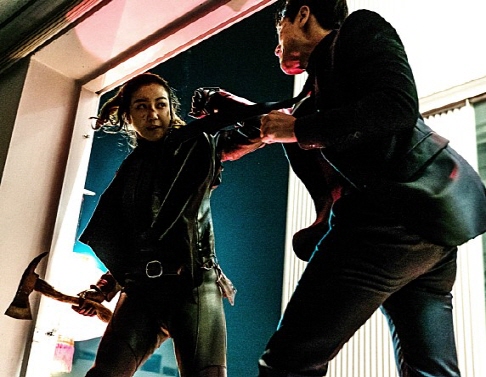
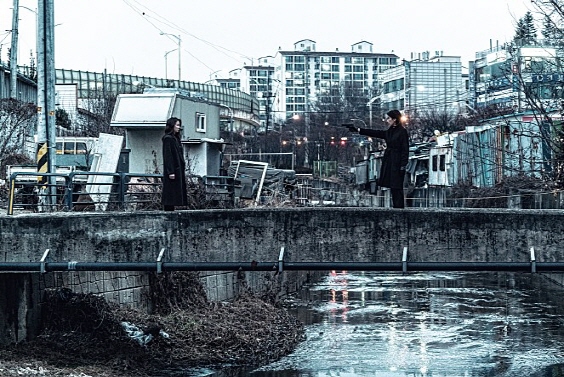
“The Villainess” is probably one of the most exciting bad South Korean films of this year. While there are several first-class action sequences to be admired for heaps of efforts and techniques put into them, it is unfortunately stuck with third-rate plot and characterization, and this gap distracted me a lot during my viewing. To my disappointment, the movie is not bold or crazy enough to go all the way with its badass heroine, and it only gets worse as mired in a sappy, hackneyed melodrama which does not mix well with its gritty, ruthless action.

Evoking the merciless energy of “The Raid: Redemption” (2011), the opening action sequence of “The Villainess” is visually arresting and pulsating right from its first minute. Someone suddenly comes into a shabby building which turns out to be the headquarters of a big criminal organization, and then lots of goons are swiftly maimed or killed right in front of our eyes as the camera mostly sticks to the viewpoint of the intruder. Although this impressive long-take sequence sometimes feels like watching someone playing a violent video game, I must say that it also feels quite visceral and electrifying as the intruder relentlessly advances from one spot to another in the building, and there are a good number of amazing moments which will surely make you wonder how the hell they shot these moments. For example, when the intruder smashes into a window and then hangs on a rope in the air, the camera also hurls itself into the action along with the intruder, and it goes without saying that this is one of the most awesome moments in the film.

The intruder in question is Sook-hee (Kim Ok-bin), a young Korean Chinese woman from Yenbian, China. After her father was killed when she was a little girl, she grew up to be a tough, ruthless killer under the guidance of a local gangster named Joong-sang (Shin Ha-kyun), and this quality of hers draws the attention of a secret government agency not long after she is arrested by the police in the aftermath of her carnage. The agency is interested in her particular set of skills, so she is sent to a clandestine training place, and her handler Kwon-sook (Kim Seo-hyeong) promises to her that she will be free after working for the agency as a spy/assassin for 10 years. Sook-hee initially resists, but she comes to accept her circumstance because of an unexpected reason, and she soon finds herself going through her training period there along with other female trainees not so different from her.

thevillainess02

Now many of you are probably reminded of “La Femme Nikita” (1990) and other similar films, and the movie gives us obligatory training scenes as required, though they are perfunctory at best and shallow at worst despite a few nice touches to amuse you. As a part of her training, Sook-hee learns acting at one point, and that leads to a brief moment which utilizes well the undeniable star presence of lead actress Kim Ok-bin, but other scenes do not add much to what was already established in the early scenes. While Sook-hee surely looks different in her more refined and sophisticated appearance around the end of the training, we do not get much sense of character development, and the supporting characters around her including Kwon-sook mostly remain one-dimensional without any discernable depth.

Anyway, the second act of the movie starts as Sook-hee begins her new life outside several years later. On her moving day, she comes across a guy living next to her apartment, and he seems to be interested in getting closer to her, but the guy is so awkward and clumsy that it would not be not much of spoiler to tell you that he is an agent assigned to monitoring her closely, even if the movie did not show you his identity in advance.

Sook-hee’s present relationship with that guy is juxtaposed with flashback scenes showing her past relationship with Joong-Sang, who is revealed to be more than a father figure to her. The screenplay by director Jeong Byeong-gil and his co-writer Jeong Byeong-sik tries to develop a melodramatic situation from that after a certain narrative turn, but it fails to engage us on the emotional level mainly due to its superficial characterization and heavy-handed plot. Kim is solid and believable in her physical performance, but her character is a rather bland cypher defined by a few characteristics, and Shin Ha-kyun and Seong Joon are woefully wasted in their mediocre roles.

thevillainess04

As I felt more depressed by the jumbled narrative of the third act of the movie which does not make much sense, I came to appreciate more its technical prowess. I was thrilled by a long-take action sequence where our heroine busily fights with a trio of goons chasing after her while all of them are running rapidly on motorcycles. And I was also impressed by another long-take action sequence which culminates to a pulse-pounding climax unfolded inside a speeding vehicle.

However, I am reminded of better films out there. “La Femme Nikita” is still one of more memorable works in its genre territory, and I may revisit it someday for appreciating not only its striking action sequences but also its poignant emotional power. In case of “Coin Locker Girl” (2015), this small South Korean noir film did a better job of presenting tough, strong female characters, and that is why it is more engaging to watch than “The Villainess”. Although I did not like “The Raid: Redemption” and its sequel enough for recommendation, I sort of admired how they were willing to push envelop relentlessly, and they certainly made “The Villainess” rather tame in comparison.

While I gave “The Villainess” two stars mainly because of its poor storytelling, I guarantee you that you will not waste your ticket money if you just want to enjoy well-made action sequences. Sure, we all can agree that its stunt performers and technical crew members deserve praises for what they achieve here, but the movie did not succeed in engaging me in terms of story and character, and I only observed during its final scene that its heroine looks too sappy for its title.

thevillainess05

Posted in Movies | Leave a comment

The Mummy (2017) ☆☆(2/4): A mummy comes to London

themummy02

“The Mummy”, a reboot of the Mummy series which is also the first installment in the Dark Universe film series of Universal Studios, is dour, bland, and joyless while not proving anything particularly fun or scary. This unexciting blockbuster product merely exists for whatever will come next as planned by Universal Studios, and it only gets worse in its lumbering steps even when you hope for any possible improvement.

Like the 1999 film of the same name, the movie gives us a long obligatory expository sequence unfolded in the era of, yes, ancient Egypt, and then the movie promptly moves forward to the present era as introducing Nick Morton (Tom Cruise), an American soldier who has looked for a big opportunity along with his sidekick Chris Vail (Jake Johnson) in a desert region around Mosul, Iraq. Officially, they come into this dangerous area riddled with ISIS fighters for a reconnaissance mission, but their private purpose is finding some ancient site which may contain valuable artifacts they can take and then sell later, and Morton does not hesitate at all although the site in question seems to be located in a small village which happens to be occupied by a bunch of ISIS fighters.

Not long after they manage to survive their clash with ISIS fighters and the subsequent drone strike, an underground tomb is revealed, and an archaeologist named Jenny Halsey (Annabelle Wallis) comes to the site along with Colonel Greenway (Courtney B. Vance, who is criminally under-utilized here). Because Morton stole the information about the location of the tomb from her, Halsey is certainly not so pleased to meet him again, and neither is he.

themummy03

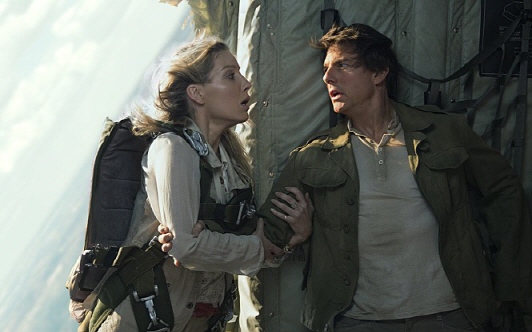
Anyway, she and Morton soon go down inside the tomb along with Vail for investigation, and then they come upon a mysterious sarcophagus hidden inside the tomb. Halsey decides to take it to London, but, not so surprisingly, the sarcophagus in question is not just an invaluable artifact but something quite dangerous, and Morton and Halsey belatedly come to realize that when they are on a cargo plane along with it.

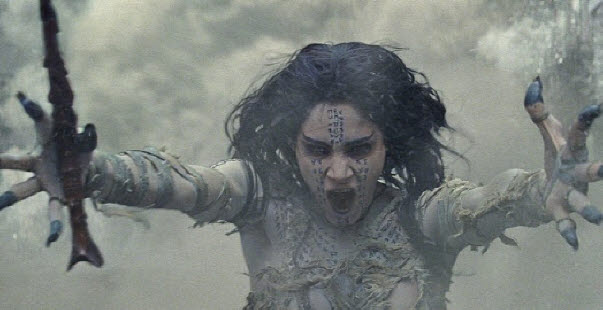
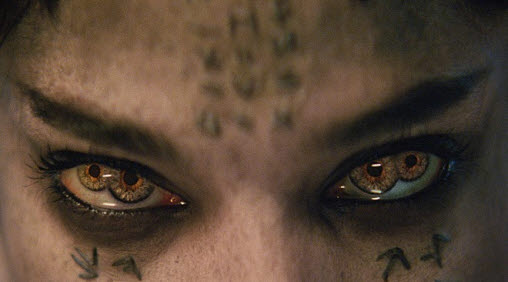
As already shown from the aforementioned expositive sequence, the sarcophagus contains Princess Ahmanet (Sofia Boutella), who was mummified alive around 5,000 years ago but is still quite alive. When her father came to have a male heir to succeed him instead of her, she made a deal with God of death and became an immortal entity with four pupils (don’t ask me whether that physical change can improve eyesight or anything else), but her attempt to usurp the throne and then have her god come into the human world was eventually thwarted by priests, and that was how she came to be locked inside that tomb.

After making the cargo plane crash down to a rural region outside London, Ahmanet quickly embarks on her old unfinished business. For restoring her physical shape, she sucks life force out of many unfortunate victims who are subsequently turned into withered zombies under her control, and this may make some of you a little nostalgic about Tobe Hopper’s “Lifeforce” (1985), which incidentally features a female supernatural entity who also sucks life force out of her victims and then turns them into similarly withered zombies.

After miraculously surviving the crash unlike others on the plane, Morton and Halsey become more aware of their urgent circumstance as confronting Ahmanet, who sets her eyes on Morton and is going to sacrifice him as the vessel for her God. Marked right from his first encounter with her, Morton often finds himself under Ahmanet’s influence, and he also sees his dead sidekick at times, who is cursed just like Morton while being as wisecracking as that dead friend of the hero of “An American Werewolf in London” (1981).

themummy01

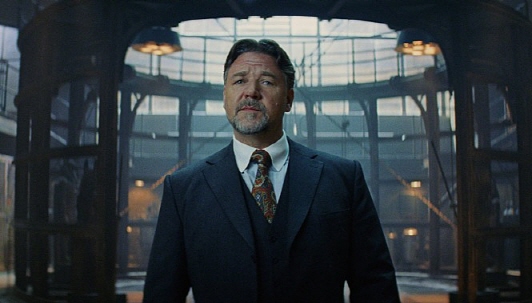
Fortunately, Halsey knows someone who may help them. I am not sure about whether I can reveal who that is here in this review, but I think I can tell you instead that 1) he is played by Russell Crowe as shown from the trailer of the movie, 2) you will instantly see something hidden behind his character mainly because he has been one of the most famous horror literature characters, and 3) I enjoyed to some degrees how Crowe handles his scenes with some gusto as the only performer in the movie who seems to be having any real fun.

When the movie eventually arrives at its climax, it continues to be disappointing as before. As it hurriedly moves from one place to another with lots of actions and special effects, the movie frequently loses its footing in terms of narrative and character, and it does not have enough urgency to hold our attention. The screenplay by director Alex Kurtzman and his co-writers Christopher McQuarrie and Dylan Kussman, which is based on the story written by Kurtzman, Jon Spaihts, and Jenny Lumet, frequently feels heavy-handed and half-baked, and that is particularly evident from how the movie constantly and blatantly emphasizes that Morton is basically a good guy in his heart.

Tom Cruise and Annabelle Wallis try as much as they can do, but their flat, mediocre characters have no chemistry between them on the screen. As the title character of the movie, Sofia Boutella is adequate, but there are not many things she is allowed to do, and I do not think the movie will boost her career as much as “Wonder Woman” (2017) is currently catapulting Gal Gadot’s. In case of Jake Johnson, he is evidently cast as a comic relief, but the movie does not seem to know what to do with his character, and he is accordingly wasted as much as many of his co-performers.

As feeling depressed more and more during the early morning screening of “The Mummy”, I found myself wistfully reminiscing the goofiness of the 1999 film and its two subsequent sequels. Sure, I laughed at their many corny, ridiculous aspects, but they were not entirely without amusement and entertainment at least. Maybe I should watch any of them right now for getting less depressed.

themummy04

Posted in Movies | Tagged , , | 1 Comment

Jane (2016) ☆☆☆1/2(3.5/4): Elusive happiness in her harsh, despairing world

Jane06.jpg

South Korean film “Jane” begins with one story and then proceeds with another story to tell. While these two stories feel different from each other, they are gradually connected with each other as the movie observes the harsh, despairing world surrounding its wretched heroine, and the emotional resonance between these two stories induces our empathy toward her even though she turns out to be very unreliable as the narrator of her stories.

The first part of the movie revolves around the accidental relationship between So-hyeon (Lee Min-ji) and Jane (Koo Gyo-hwan). So-hyeon, a young runaway girl who was recently left alone by a lad with whom she had lived in a motel room, tries to kill herself, but then there comes Jane, a transgender nightclub hostess who was close to that lad. After stopping So-hyeon’s suicide attempt, Jane takes So-hyeon to her small but cozy residence where she lives with three other young runaways not so different from So-hyeon, and we see how Jane functions as a sort of mother to So-hyeon and other young runaways in her residence. Never demanding anything to them, Jane is always nice and kind to them, and So-hyeon and her fellow runaways are happy to be under her care while also being grateful to her in return.

However, it turns out there is the deep unhappiness inside Jane. As reflected by one brief scene, her body is not that healthy, and we gather that her mind has struggled with depression. As a sexual minority on the fringe of South Korean society, she must have lots of pain and sadness inside her, but she keeps going on with her life while not losing the capability of kindness and compassion, and there is a poignant moment when she casually admits to So-hyeon and others that life is usually pretty lousy but also emphasizes why one should live for little happiness despite that.

Jane03.jpg

For So-hyeon, Jane surely represents the little happiness coming into her gloomy life, and she often spends time along with Jane, but this happiness does not last long due to a sad, tragic incident which is followed by the second part of the movie. In this part, So-hyeon is in a much harsher condition; she happens to live in a small place along with other young runaways, and we soon meet the leader of the group, who is usually called ‘Daddy’ (Lee Seok-hyoung). ‘Daddy’ is not very nice to So-hyeon just because she does not get along very well with others, and there is an emotionally brutal scene where he and others corner helpless So-hyeon as accusing of something she did not commit. When Su-hyeon and other girls have to earn money for supporting the group, the movie only implies what they are demanded to do, but that is more than enough for us to sense and understand their grim reality.

The situation becomes grimmer as the group is shaken by an incident involved with one of the girls in the group who has been quietly trying to get away from the group. I will not go into details, but I can tell you instead that the movie is often gut-wrenching as showing how unforgiving the world inhabited by So-hyeon and other runaways can be. Whenever anyone happens to cross the line in their world, punishment inevitably and mercilessly follows, and we get a very tense moment later in the movie when So-hyeon faces the dire consequence of her unwise choice.

As the second part of the movie makes a striking contrast with the first part, a number of common story elements between them begin to draw our attention, and we also notice that several characters in the first part appear differently in the second part. The more we look back on the first part, the more it becomes possible that the first part is So-hyeon’s imagined story reflecting her reality in the second part, but then we are caught off guard by a rather unreal moment around the end of the second part, and we come to wonder what exactly happens at that point.

Jane01

While it is baffling at times, the movie keeps holding our attention as anchored by its emotional narrative, which is steadily held by its lead actress’ stellar performance. Lee Min-ji, who previously drew my attention via her breakthrough turn in small independent film “End of Animal” (2010), ably conveys her passive character’s vulnerability in her low-key appearance, and she is quite effective especially during the last few minutes of the film. While she does not say anything at that point, her expressive face fully expresses her character’s emotional state to us, and that is why that moment is quite touching

The supporting performers of the movie are equally good in their respective roles. Koo Gyo-hwan is simply flawless in his colorful performance reminiscent of Cillian Murphy in “Breakfast on Pluto” (2005), and that is why we can feel his character’s presence hovering around the movie even when she does not appear on the screen. Lee Joo-young, who previously appeared in Zhang Lu’s “A Quiet Dream” (2016), is also fabulous as another crucial supporting character in the movie, and Lee Seok-hyoung and several other main cast members of the movie are convincing as the young runaway characters in the film.

“Jane” is the first feature film by director/writer Cho Hyun-hoon, and his movie is a haunting piece of work which distinguishes itself with its unforgettable mix of dry realism and poetic beauty while also being thoughtful on its social subjects. This is indeed a tough stuff to watch, but I can assure you that the movie is one of the best South Korean films in this year.

Jane05

Posted in Movies | Tagged , , , | 1 Comment

Wonder Woman (2017) ☆☆☆1/2(3.5/4): Here comes Wonder Woman!

wonderwoman05

Besides being more exciting and exhilarating than expected, “Wonder Woman” finally gives what its genre has desperately needed during recent years: strong, independent female superhero character. While this is another quintessential origin story, the movie is refreshing mainly thanks to its recognizable feministic touches, and it is also boosted by a number of galvanizing action sequences to enjoy. In short, this is an enthralling piece of entertainment a lot better than the tepid glumness of “Batman v Superman: Dawn of Justice” (2016).

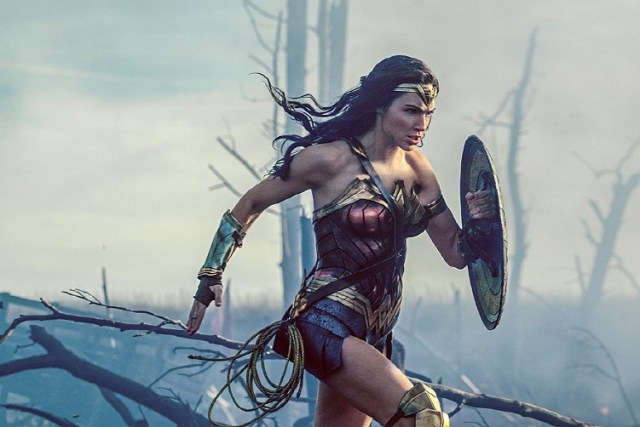
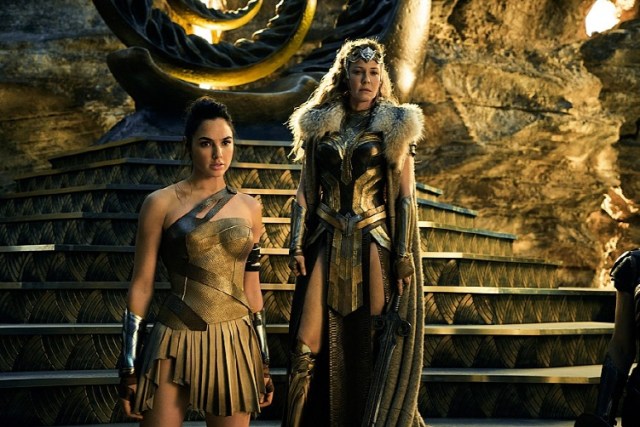
The early part of the movie tells us how Diana Prince/Wonder Woman (Gal Gadot) grew up as the princess of a remote hidden island called Themyscira, and we get to know a bit about her immortal female tribe living in that island. Since the ancient battle between Zeus and Ares ended with the former’s costly victory a long time ago, Amazons have trained themselves as mighty warriors for several thousand years because they must be always ready for the return of Ares, and we see how much young Diana wants to grow up to be a warrior just like her mother Queen Hippolyta (Connie Nielsen) and other Amazons. While her aunt Antiope (Robin Wright) is willing to teach young Diana, Hippolyta, who got her dear daughter via a non-reproductive way as explained during one scene, is reluctant in contrast like any caring mother would, but then she eventually accepts that nothing can stop Diana and her destiny.

Around the time Diana begins to be aware of something which distinguishes herself from other Amazons, there comes an unexpected moment of invasion. A World War I fighter plane crashes into the sea around the island, and Themyscira is soon invaded by a bunch of German soldiers, who are pursuing the pilot of the fighter plane in question. He is an American pilot named Steven Trevor (Chris Pine), and it is revealed that he is with a piece of top secret information which can seriously affect the course of the ongoing war. It is 1918 and Germany is losing the war, but an ambitious German general is secretly planning to unleash a new chemical weapon on the front line, and Trevor must notify this imminent danger to his superiors in London as soon as possible.

wonderwoman02

After hearing about the war from Trevor, Diana comes to believe that her time to go outside the island for confronting Ares has come. Despite her mother’s objection, she prepares herself with a number of weapons including the Lasso of Truth and the bracelets of infinite resilience, and she soon sails away from Themyscira along with Trevor.
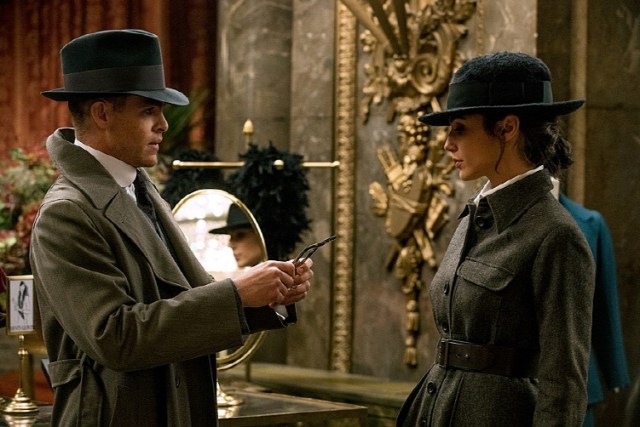
When she and Trevor finally arrive in London, she is amazed and intrigued by many things in the human world, and the movie has lots of fun with how Diana’s irrepressible naïveté and forthright attitude often clash with the British society in the 1910s. There is a humorous scene where she tries many different outfits as assisted by Trevor’s good-humored secretary Etta Candy (Lucy Davis), and then we get a sly moment when she comes into a conference room full of men and accordingly draws the attention of everyone in the room including Sir Patrick Morgan (David Thewlis).

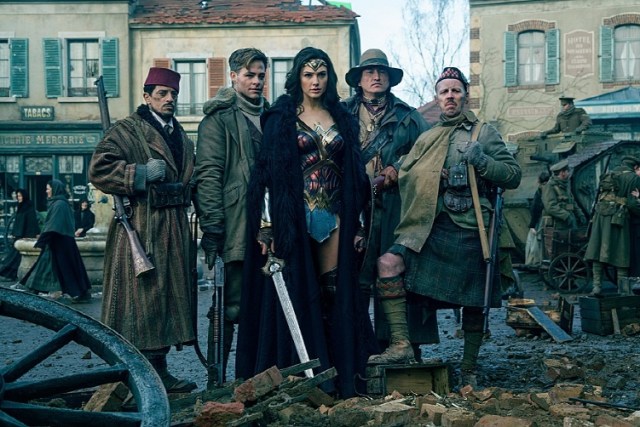
Through Sir Morgan’s unofficial support, Trevor and Diana go to the front line as she has wanted, and they are accompanied with three other guys: Sameer (Saïd Taghmaoui), Charlie (Ewen Bremner), and Chief (Eugene Brave Rock). While each of these guys is your average stock war movie character, they are depicted with each own colorful personality, and they also may remind you of those old war movies such as “The Dirty Dozen” (1967).

As Diana and her male comrades arrive at the front line in Belgium, the movie shifts itself into a grittier mode, and the director Patti Jenkins, who previously directed “Monster” (2003), surprises us with her deft handling of action sequences. I like how one certain action sequence unexpectedly starts and then goes all the way along with our unstoppable heroine, and I particularly appreciate how the movie never loses its sense of direction and physicality while swiftly moving from one action moment to another during this superlative sequence. Although the climax sequence during its third act is a little too bombastic for me as decorated with lots of CGIs, it thankfully remains driven by story and characters, and we accordingly come to care about the outcome even though we know well how it will end.

wonderwoman03

While she already showed her considerable potential in “Batman v Superman: Dawn of Justice”, this is the first time we see Gal Gadot on a full-fledged mode, and she does not disappoint us at all as giving a sincere performance packed with grace, bravery, innocence, confidence, compassion and a little sense of fun and humor. While I did not get much fun from Superman and Batman in their recent films by Zach Snyder (the screenplay of “Wonder Woman”, written by Allan Heinberg, is based on the story he wrote with Heinberg and Jason Fuchs, by the way), I was constantly amused thanks to the joy of performance palpably felt from Gadot’s acting, and the movie surely leaps high along with her whenever that is required.

The supporting performers in the film dutifully help Galdot leap higher. Balancing his performance well between jaded no-nonsense attitude and earnest idealism, Chris Pine clicks well with Gadot during their several key scenes, and Saïd Taghmaoui, Ewen Bremner, Eugene Brave Rock, David Thewlis, and Danny Huston fill their respective spots as much as demanded. While Lucy Davis and Elena Anaya have their own small juicy moments, Robin Wright and Connie Nielsen look commanding right from their first appearance, and Nielsen is especially poignant during her bittersweet scene with Gadot.

Like “Captain America: The First Avenger” (2011), “Wonder Woman” is sincere and compassionate while also being fun and entertaining, and I enjoyed some of its striking visual moments as touched by the occasional poignancy observed from Wonder Woman and some other characters around her. The movie does sometimes feel like another summer blockbuster product of this year due to several weak points including its obligatory connection with “Batman v Superman: Dawn of Justice” and “Justice League” (2017), but nobody will say that it does not have a big heart, and I am willing to wait for Wonder Woman’s next adventure.

wonderwoman04

Posted in Movies | Tagged , , , | 1 Comment

Our President (2017) ☆☆☆(3/4): We miss you, President Roh

ourpresident01

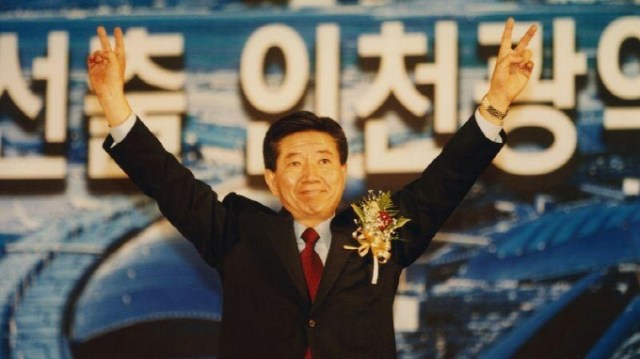
South Korean documentary film “Our President” comes to its main audiences at a point which cannot possibly be more appropriate. As the country went through two lousy presidents during last 9 years and then managed to get some possibility of hope and change early in this year, I and many South Korean people came to miss President Roh Moo-hyun more than ever, and the documentary reminds us again that he was a good president who did not deserve his tragic ending at all. He strenuously and diligently fought for us as well as democracy for many years, but many of us did not treat him well especially after his presidency, and I still feel guilty whenever I think about a mean, crude remark on him I made in 2004.

The documentary mainly focuses on President Roh’s remarkable political rise during 2002. In the beginning, he was merely a lawyer who had been known mostly for his human rights activities during the 1980s, and the record of his political career during the 1990s was not so stellar to say the least. He went through several failed election campaign before finally becoming a congressman representing a district of Seoul, and then he experienced another defeat when he boldly ran for a congressional seat in a district of Busan, which was not exactly his party’s home ground but looked like a worthwhile challenge to him at that time. He simply wanted to bring changes into the local political system as an outsider, but the system turned out to be too solid to be cracked, and we get a painful moment showing his campaign people quite depressed by the election result despite his sincere words of consolation.

Nevertheless, this failed campaign drew considerable public attention, and then there came a turning point for Roh when his party tried a popular election system for the first time in deciding its candidate for the 2002 presidential election. This allowed a considerable number of common party supporters to participate in the process which had been exclusive to a group of core party members, and Roh and his people saw the slim but undeniable possibility of getting enough votes to make him the presidential candidate of his party.

ourpresident03

Although his approval rate was initially no more than 2%, Roh soon became a dark horse candidate as he won in several key regions of South Korea to the surprise of many people, and this certainly alarmed his main competitor Lee In-je, who was deemed to be the leading candidate before the election. Several archival footage clips in the documentary show how Lee gradually looked uncomfortable as Roh continued to advance while other major candidates left the race one by one, and I heard some chuckles from the audiences around me during these rather amusing moments.

Not so surprisingly, Lee attempted vicious accusations against Roh as the race became more volatile than before. He openly accused Roh of being a communist, and he even tried to smear the reputation of Roh’s wife just because she was the daughter of a left-wing partisan member. In addition, the opposing conservative party joined this despicable political attack mainly because Lee was deemed to be a less threatening presidential candidate than Roh, and several notable conservative newspapers also went along with that as throwing lots of sensational headlines aimed at Roh.

Nonetheless, Roh endured and prevailed, and he eventually won not only his party election but also the following presidential election. While he did stumble many times during his presidency, he was honest and reliable as the leader of our country, and that aspect was something I came to value more as infuriated and horrified by the greedy hypocrisy of President Lee Myung-bak and the sheer incompetence of President Park Geun-hye.

ourpresident02

Besides vividly presenting the high and low points of that dramatic year, the director Lee Chang-jae shows us various people who knew or worked with President Roh, and their interview clips tell us a bit about President Roh’s human sides. While they often point out Roh’s personal flaws including short temper and stubbornness, they all fondly remember him with respect and admiration, and one of the most poignant moments in the documentary comes from a former government agent who monitored Rho during the 1980s but then somehow came to befriend him. As they helped each other from time to time, they got closer to each other, and this odd friendship of theirs was continued until Roh’s death on May 23rd, 2009.

Every interviewee in the documentary cannot help but be emotional as talking about how they felt about his death, and that takes me back to when I heard the news on that sad day. After I got on a taxi for going to a movie theater, the taxi driver told me that President Roh killed himself, and I was shocked and angry while thinking about how much he had been humiliated by President Lee and his cronies. They unjustly grilled him during his last months just because of bribery allegations, and they virtually drove him to death in the end.

Although it does not show me anything new about its subject, “Our President” works as an earnest tribute to President Roh. During the screening I attended on last Sunday afternoon, many audiences around me showed audible emotional reactions at times, and they were probably touched a lot by the archival footage clip shown at the end of the documentary. No matter how hard and difficult it was for him, he always tried for changing our society, and I hope many people in South Korean keep remembering his hope and ideal.

ourpresident04

Posted in Movies | Tagged , , , | Leave a comment

Paterson (2016) ☆☆☆1/2(3.5/4): A bus driver poet in Paterson

paterson01

Several days ago, I went to the Iksan campus of Chonbuk National University for meeting several colleagues of my previous workplace. After meeting them and then having a little chat with them, I waited outside for a bus to the main campus in Jeonju for a few minutes, and that was during that brief time when I happened to notice something interesting. It was merely a plain campus field in broad daylight, but I could not help but spot the centrical composition glimpsed from that sight, so I instantly photographed it. While the photograph looks less magical now, I still remember what I felt during that time, and I will probably cherish that experience for years from now.

When I watched Jim Jarmusch’s latest film “Paterson”, I was quite delighted to find that the movie contains such small but memorable moments like that. Looking around the seemingly plain daily life of its sensitive, introverted hero, the movie effortlessly presents a good number of poetic scenes accompanied with dry humor and heartfelt beauty, and it is engrossing to watch how these beautiful moments lead to sublime artistic creation in one way or another.

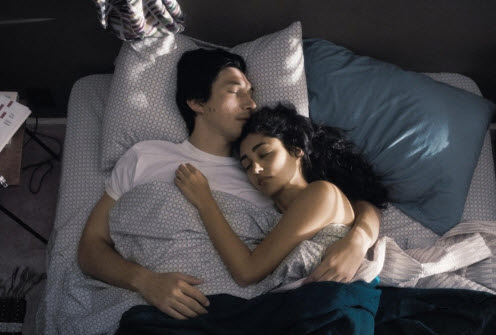
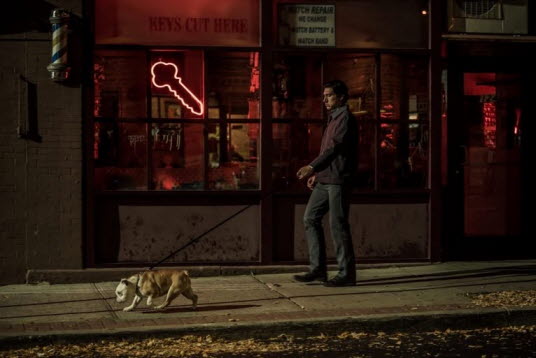
The movie begins with its hero and his wife beginning another week of their simple daily life. Paterson (Adam Driver) is a young man working as a bus driver in Paterson, New Jersey, and he lives with his wife Laura (Golshifteh Farahani) and their bulldog in their cozy house. After waking up early and having a bowl of cereal for breakfast, he walks to a bus garage, and we see him driving a bus around the downtown areas of the city. After his working hour is over, he walks back to his house, and then, after having a dinner with Laura, he goes outside with their bulldog for walk. During the walk, he drops by a local bar run by a middle-aged black guy named Doc (Barry Shabaka Henley), and he always drinks no more than one glass of beer. Observing this routine of his repeated over the following weekdays, we gather that he has stuck to it for years and has no problem with that.

paterson02

Whenever he is not working, Paterson usually focuses on his poems, which are often inspired by small and big things he comes across during his daily routine. While driving his bus, he sometimes listens to the conversations of passengers sitting near him. At his workplace, his co-worker frequently tells him how he feels miserable as before due to his numerous family problems. During his solitary lunch time, he eats his lunch at the Great Falls of the Passaic River and appreciates its beauty alone for a while. At Doc’s bar, he and Doc spend time together as talking about many things including Lou Costello, who is incidentally one of famous figures from the City of Paterson.

Paterson has kept all of his poems in his private notebook, and he has not shown them to anyone except Laura. Laura thinks he should publish his poems someday, but he is reluctant about that. He is simply content with writing poems for himself and, sometimes, Laura as usual, and it is interesting to see how he and Laura complement each other in terms of personality and attitude. More extroverted than him in comparison, Laura openly shows her artistic sensibility through her lovely black and white interior design of their house, and this unpretentiously sweet woman is also willing to try something new and different unlike her husband. For instance, she gladly makes heaps of her special chocolate cupcakes for a local bazaar, and she also tries to be a guitar player at one point just because, well, she feels compelled to do that.

Steadily maintaining its leisurely narrative pace, the movie slips some notable changes into Paterson’s daily routine. At one point, he encounters a young girl who is as passionate about poetry as him, and we get a small touching moment when she shows him a poem she is currently working on. When his bus is suddenly stalled on the road for an unspecified problem, he calmly handles the situation, but, to our amusement, he experiences little inconvenience because of his detachment toward modern technology. Later in the movie, he decides to go outside along with his wife for a change, but that results in an unexpected incident which can be regarded as the sole dramatic happening in the film.

paterson03

The movie is basically in the realm of fantasy considering Paterson and Laura’s comfortably insular environment, but Jarmusch and his cinematographer Frederick Elmes fill the background of the film with the vivid, realistic sense of place and people. While the locations in the movie look mundane on the screen at first, we come to appreciate their humble beauty, and we can really sense what inspires Paterson in addition to the works of his favorite poet William Carlos Williams and other poets. Although I am usually pretty oblivious to the beauty of poetry, I can say that Peterson’s poems in the film, which are written by still-loving poet Ron Padgett, are pretty good in their plain, direct words, and I was actually impressed by their aesthetic quality (my favorite poem is the one inspired by some fancy match brand, by the way).

As the heart and soul of the movie, Adam Driver, who has been a performer to watch since he drew my attention for the first time through his breakout turn in HBO TV series “Girls”, gives a wonderfully nuanced performance, which masterfully conveys his character’s glimmering artistic spirit to us without any excessive touch. While he and his co-star Golshifteh Farahani have nice understated chemistry between them, several notable supporting performers including Barry Shabaka Henley, Kara Hayward, Jared Gilman, Method Man have their own moments around Driver, and the special mention must go to that adorable bulldog in the movie, which deservedly won the Palm Dog Award at the Cannes Film Festival in last year.

Although I was initially not so enthusiastic about Jarmusch’s films, I have admired his notable works including “Ghost Dog: The Way of the Samurai” (1999), “Coffee and Cigarettes” (2003), “Broken Flowers” (2005) and “Only Lovers Left Alive” (2013). Maybe because I have come to accept and enjoy his own style and wit, I was entertained by “Paterson” far more than expected, and I belatedly agree with others that this is indeed one of the best films in 2016.

paterson04

Posted in Movies | Tagged , , , , | 1 Comment

Neruda (2016) ☆☆☆(3/4): An unconventional biopic inspired by Pablo Neruda

neruda01.jpg

“Neruda” is not a conventional biopic at all. While mainly focusing on one crucial point in Chilean poet Pablo Neruda’s life, the movie freely mixes fact and fiction for giving us a wider view on not only the poet himself but also how art, politics, and life can be overlapped and influence each other. I must admit that I am not so sure about whether I absorbed and understood everything presented in the movie, and I also have some doubt on whether its last act works as well as intended, but this is still an admirable biopic with interesting aspects to notice and talk about.

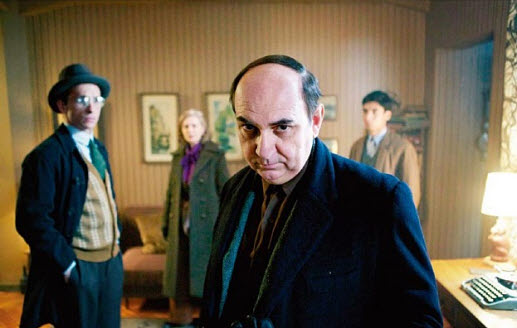
The first act of the movie shows and tells us how Neruda, played by Luis Gnecco, became a wanted man in his country in 1948. Not long after being elected in 1946, President Gabriel González Videla changed his political position to anti-communism, and that certainly infuriated many left-wing politicians including Neruda, who in fact supported President Videla during his presidential election campaign. As shown during the opening scene, he is very outspoken about his opposition to President Videla and other right-wing politicians, and he soon gets himself impeached after he openly criticizes President Videla in the National Congress. This is promptly followed by a warrant of arrest for Neruda, and he has no choice but to go underground along with his Argentine wife Delia (Mercedes Morán).

The progress of Neruda’s plight is accompanied with the words from a cynical narrator who apparently dislikes everything Neruda stands for, and that creates an interesting narrative tension especially when the narrator sarcastically points out many contradictions in Neruda’s life. As an elite leftist quite comfortable with his bourgeois sides, Neruda certainly prefers having little bits of freedom in his hiding places to letting himself incarcerated for his political belief, and he surely lives better than many poor people in his country even though the situation has become far less luxurious for him than before.

neruda03

We soon meet the narrator in question, and we come to learn a bit about this fictional character as he begins his pursuit of Neruda. He is a detective named Oscar Peluchonneau (Gael García Bernal), and he believes that he is an illegitimate son of a legendary police chief although his prostitute mother never told him who his father really was. For him, Neruda is a big opportunity to boost his social status, and he is ready to follow any trace which may lead him to Neruda.

However, he only finds himself always one or two steps behind his target. At one point, he almost catches Neruda at a bordello, but Neruda manages to evade Oscar and other policemen in a rather clever way coupled with some luck, and he continues to move from one place to another no matter how close Oscar is to arresting him.

And it looks like Neruda is well aware of his pursuer, because he frequently leaves behind pulpy detective novels for him. The movie has a wry self-conscious fun with establishing old-fashioned noir atmosphere around Oscar; his sulky narration is in fact as amusingly dry as your average hardboiled fiction, and we notice the tacky rear projection in the background whenever the characters in the movie are driving vehicles. The cinematographer Sergio Armstrong did a good job of evoking the texture of film noir through the striking use of shadows and lights during several scenes, and the score by Federico Jusid is effectively mixed with the classical works by Edvard Grieg, Charles Ives, and Krzysztof Penderecki to generate the moody ambience around the characters in the film.

neruda02

When Oscar meets Delia not long after she is separated from Neruda, the screenplay by the director Pablo Larraín and his co-writer Guillermo Calderón goes further with its interplay between fact and fiction, and the line between fact and fiction is blurred more than before as everything eventually culminates to the climatic sequence involved with Neruda’s escape attempt via a snowy path in the Andes Mountains. I still feel confused to some degrees about what Larraín tries to achieve here, but I can say at least that this sequence feels somehow profound when his two opposing characters’ paths finally converge on a certain point together.

The main performers are engaging to watch in each own way. Luis Gnecco initially looks plain but steadily holds the center even when he is not on the screen, and I appreciate how willingly he and the movie present Neruda’s flawed human aspects without any excuse. While he is indeed one of the greatest poets during the 20th century, Neruda in the movie is shown as a vain, egoistic womanizer who is far different from a gentler and kinder fictional version of Neruda in “Il Postino” (1994), and there is a small amusing scene which makes a little fun of his bald, overweight appearance, which is somehow compensated by his charm and poetry enough to draw many different women. On the opposite, Gael García Bernal, who previously collaborated with Larraín in “No” (2012), is suitably glum and brooding, and Mercedes Morán holds her place well between her two co-stars as a woman who has to put up with many things as standing by a man she loves.

Like Larraín’s recent other film “Jackie” (2016), “Neruda”, which was the official submission of Chile for Best Foreign Language Film Oscar in last year, is a fascinating biopic told via unconventional approach, and I admire that even though it is a little too sprawling at times. I felt impatient during my viewing, but I enjoyed its mood and performance while reflecting on its cerebral themes later, so I recommend it to you with some reservation.

neruda04

Posted in Movies | Tagged , , , , | Leave a comment

The Edge of Seventeen (2016) ☆☆☆1/2(3.5/4): Edgy, witty, and heartfelt

theedgeofseventeen04

Edgy, witty, and heartfelt, “The Edge of Seventeen” is a genuine coming-of-age story about that tumultuous life period called adolescence. While it often throws some funny moments of incisive humor via its spunky heroine who tries to deal with her bumpy adolescent life, it never takes a condescending attitude to its heroine while showing a lot of care to not only her but also the other characters surrounding her, and the result is one of the better teenager films coming out during recent years.

The movie begins with its heroine hurriedly coming to her high school teacher for spewing out whatever is churning inside her heart, and then we are told about how she has been awkward and insecure ever since she was very young. While her older brother Darian (Blake Jenner) has always been a popular kid in the neighbourhood, Nadine (Hailee Steinfeld) has mostly been a loner in contrast, and she knows too well that her mother Mona (Kyra Sedgwick) is more partial to her brother than her.

At least, Nadine has Krista (Haley Lu Richardson), who has been her only and best friend. Since Nadine’s father, who was quite dear to his daughter, passed away suddenly several years ago, Krista has accordingly become more important in Nadine’s life, but then there comes an unexpected happening which shakes their supposedly solid friendship. When Nadine and Krista have their small private drinking party in Nadine’s home while Nadine’s mother is absent, Darian also has his own party with his friends at the swimming pool outside the house, and he and Krista somehow come to have a very intimate physical encounter in the next morning.

theedgeofseventeen01

When Nadine happens to discover what is going on between her brother and her best friend, she is understandably upset about this, and then she becomes mad when Krista and Darian decide to be more serious about their accidental relationship. Maybe she should be happy about this as wishing the best for them, but she instead finds herself being further agitated with anger and jealousy, and she does not know what to do about this complicated circumstance while continuing to be angry and bitter toward Krista and Darian.

Meanwhile, she is eager to approach to some hunky boy in her school, but she keeps hesitating to show her feelings directly to him. When she finally gets a chance to approach to him in private, she only finds herself being clumsy and inarticulate in front of him, and we later get a hilarious moment involved with her indiscreet text message inadvertently sent to him.

When Erwin (Hayden Szeto, who is, believe or not, 31 at present), an Asian American boy who is in the same class with Nadine, approaches to her, Nadine does not have much interest in him at first, but then she lets him try to get closer to her, and he invites her to his house. Both of them naturally feel awkward as being alone together, but they gradually become a little more relaxed and comfortable with each other, and we get a sweet, tender moment between them as they simply hang around with each other in a big, posh swimming pool.

While Nadine continues to bounce around here and there as driven by her hormone-charged feelings, the screenplay by the first-time director Kelly Fremon Craig alternatively amuses and touches us via its deft balance between comedy and drama. Although she is not exactly likable, Nadine is a smart, witty girl with growing independent spirit, and her dynamic emotional struggle is depicted with a lot of sensitivity and empathy. We observe how unwise and foolish she can be while being occasionally self-absorbed just like any other adolescents around her age, but we can also understand her pain and confusion, and we come to cheer for her as she eventually learns some valuable life lessons through her difficult circumstance.

theedgeofseventeen03

It surely helps that the movie is supported well by the wonderful performance from its lead performer. Hailee Steinfeld, who drew our attention for the first time through her Oscar-nominated turn in the Coen Brothers’ “True Grit” (2010), shows here that she is indeed a very talented actress to watch; besides effortlessly conveying to us her character’s conflicted feelings, she delightfully wields her character’s witty side at times, and what she achieves here is as enjoyable as Ellen Page in “Juno” (2007) or Emma Stone in “Easy A” (2010).

The supporting performers around Steinfeld are equally engaging in their colorful performances imbued with personality and humanity. As Nadine’s best friend, Haley Lu Richardson is believable in her casual rapport with Steinfeld, and that is why their several key scenes in the film work on emotional levels. While her character may feel broad at first, Kyra Sedgwick brings considerable human depth to her character, and Blake Jenner, who was the amiable center of Richard Linklater’s “Everybody Wants Some!!” (2016), has a wonderful moment when his character reveals deep feelings he has kept behind his seemingly confident appearance. Constantly looking unflappable throughout the film, Woody Harrelson gives a droll supporting performance as Nadine’s high school teacher, and he is both funny and caring as his character tactfully handles his problematic student with understanding and patience.

Overall, “The Edge of Seventeen” distinguishes itself well via its smart, humorous, and thoughtful handling of story and characters, and its many good moments will probably remind you again of how difficult it is to grow up during adolescent years. It is indeed hard and painful for her, but she grows up in the end – like many of us did.

theedgeofseventeen02

Posted in Movies | Tagged , , | Leave a comment

Miss Sloane (2016) ☆☆☆(3/4): By Any Means Necessary

misssloan02

It is always entertaining to watch smart people doing their job well, and the heroine of “Miss Sloane” is one of such good cases. While we are amazed or horrified by how far she is willing to go for getting her job done, she is a fascinating human character to observe nonetheless, and the movie is firmly anchored by the top-notch lead performance at its center. We do not exactly like her, but we cannot help but wonder how she will deal with her increasingly difficult circumstance, and the movie provides enough thrill and suspense to compensate for its rather conventional plot.

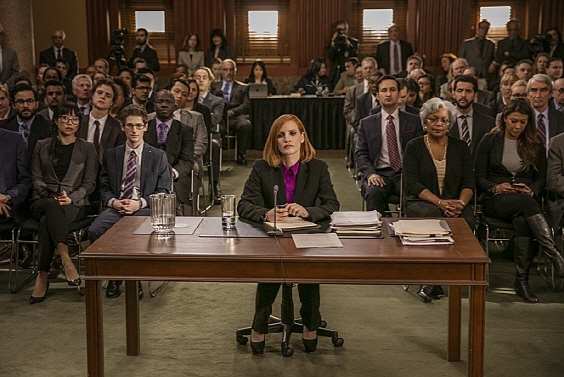
Jessica Chastain plays Elizabeth Sloane, one of the most prominent lobbyists working in Washington D.C. After the opening sequence which gives us a glimpse of what will possibly happen to her in the end, the movie moves back to when she was supervising her latest lobbying job several months ago. As she relentlessly pushes herself and others around her, it is clear to us that she is the smartest person in the room, and Chastain exudes intense intelligence and authority as her character holds the attention of everyone else in the room.

While that lobbying job is about to be successfully finished, Sloane’s boss George Dupont (Sam Waterston) arranges a meeting between her and Bob Sanford (Chuck Shamata), a representative from some powerful gun manufacturing association (the movie never mentions its name although we can clearly see that it is a fictional version of National Rifle Association). Sanford wants to block a recently proposed gun-control bill that would expand background checks on gun purchases, and he wants Sloane to handle the opposing campaign against that gun-control bill because of Sloane’s impeccable success record.

misssloan03

However, Sloane flatly rejects Sanford’s request because she is not against gun-control, and then she goes farther than that when she is later approached by Rodolfo Schmidt (Mark Strong), the CEO of a modest lobbying firm who is preparing for the campaign for that gun-control bill. After having a brief conversation with Schmidt, she leaves her firm on the very next day for moving to Schmidt’s firm, and some of the people working under her are persuaded to go along with her although her chance of win is slim to say the least. Besides their enormous financial source, Dupont and Sanford can pull many strings around numerous politicians in Washington D.C., and there are also Jane Molloy (Alison Pill) and Pat Connors (Michael Stuhlbarg), Sloane’s former co-workers who know Sloane enough to be her match.

Because of these formidable opponents of hers, Sloane is ready to use any tactic deemed to be necessary in her view, and this makes Schmidt and others in his firm quite uncomfortable. At one point, Sloane successfully finds a spy in Schmidt’s firm, but Schmidt is deeply upset by her clandestine method, and then there comes a crucial moment when Sloane deliberately pushes one of her new co-workers into media spotlight just for gaining more strategic advantage.

As Sloane keeps going further by any means necessary, the screenplay by Jonathan Perera never makes any excuse for its heroine, and neither does Chastain, who has been one of the most interesting actresses of our time since her sudden breakthrough in 2011 via several movies including “The Tree of Life” (2011), “The Help” (2011), and “Take Shelter” (2011). Filled with fierce, steely determination which reminds me of her Oscar-nominated performance in “Zero Dark Thirty” (2012), Chastain goes all the way as embodying her character’s strong and weak points, and she never loses the edgy, abrasive sides of her character while subtly conveying her character’s humanity to us. There is an eventual moment as Sloane faces the consequence from deceiving and manipulating her opponents as well as people working with her, but she knows she must go on while never looking back, and Chastain is simply captivating as her character steadily maintains her firm façade in spite of accumulating pressure on her.

misssloan04

Under the director John Madden’s competent direction, the movie smoothly goes from one narrative point to another, and I enjoyed it on the whole even though I could clearly see through the plot from the very beginning. I think the finale is a little too neat, but Chastain makes it work despite that minor flaw, and I will not deny that I found myself more involved in her character’s situation than expected.

The movie is basically Chastain’s show, and the notable supporting performers around Chastain fill their roles as required. Mark Strong and Gugu Mbatha-Raw are Sloane’s less jaded colleagues, and Mbatha-Raw is particularly good when her character comes to feel far wearier of Sloane than before. Michael Stuhlbarg, Alison Pill, Chuck Shamata, Christine Baranski, Jake Lacy, Dylan Baker, and Sam Waterston are also effective in their respective roles, and the special mention goes to John Lithgow, who is solid as a senator prepared to ruin Sloane’s career once for all as demanded.

Compared to many other recent political thriller films and TV series “House of Cards”, “Miss Sloane” does not bring anything new to its genre except its strong female protagonist, but it is still an entertaining film mainly thanks to Chastain’s terrific performance. Again, she does not disappoint us at all, and she surely gives us a piece of work to watch.

misssloan

Posted in Movies | Tagged , , | Leave a comment