Lost to Shame (2016) ☆☆☆(3/4): His ‘truthful’ performance

Losttoshame01

There is an ironic edgy fun in South Korean film “Lost to Shame”, a dark, biting story about one contradictory juxtaposition of art and hypocrisy. As its actor hero struggles with his pretension as well as his artistic job, the movie tries to penetrate that false nature of performance, and it gives us a number of intense dramatic moments as coldly observing its hero’s gradual downward spiral inside and outside his performance.

When we meet Song-joon (Nam Yeon-woo) for the first time, he is in a trouble due to his nearly penniless status. As soon as he arrives at his shabby apartment building by a cab, he goes right up to his apartment for finding any money for paying the cab driver, but there is not enough money for that, and he has no choice but to seek financial help from his younger brother Song-hyeok (Ann Sung-min), who instantly comes to take care of his brother’s problem and then has a little drinking time with him later.

We hear that there is a very good opportunity which young unemployed actors like Song-Joon cannot possibly miss. A famous play named “Dark Life” is about to be put on the stage under the direction of a renowned director, and Song-joon is willing to play its transgender hero although he does not know anything about transgender people or other sexual minority people. After he watches a TV documentary on one young transgender lady working in Itaewon-dong of Seoul, he decides to come there for getting to know more about transgender people, and that is how he coincidentally come across the very lady he watched from the TV documentary.

Although their first encounter is awkward to say the least, I-na (Hong Jeong-ho) willingly takes Song-joon to her world for giving him more knowledge and experience. After Song-joon has one jolly drunken night at a transgender bar, I-na takes him to a community meeting of various sexual minority people, and this surely opens his eyes to the people to whom he has never paid attention before. When one of his close friends later comes out of his closet during their drinking meeting, Song-joon is understandably perplexed at first, but he is mostly all right with that, though he is a little angry because his friend did not tell him that for years despite their long friendship.

Losttoshame03

Thanks to what he observes and learns from I-na and other sexual minority people, Song-joon is fully prepared for the upcoming audition, and he also gets considerable help from Song-hyeok. While diligently preparing himself for a contest which may lead to a bright future, Song-hyeok often teaches his brother some choreographic movements, and Song-joon is going to use them for more authenticity to impress the director and others in the audition.

While not showing much of the audition, the movie promptly moves onto its next plot point. Not long after he goes through the audition, Song-joon gets a call, and he is excited as notified that he gets the part. After that, everything goes well for him; the director and his cast and crew members have full confidence on him right from the very first day, and he does not disappoint them at all as fully hurling himself into his role. The opening night turns out to be a total success, and everyone around him is happy for that.

However, there comes an unexpected moment when he realizes that he is not actually free from his prejudice at all. I will not go into details here for not spoiling your entertainment, but I can tell you instead that the story becomes more interesting than before as depicting the resulting contradiction in Song-joon’s performance. The more he becomes conflicted, the better his performance looks on the stage, and there are several darkly humorous moments as he is accordingly praised more and more by the director and others in the production.

Losttoshame04

The movie is the first feature film by director/writer Nam Yeon-woo, who has steadily worked as a performer since his breakthrough turn in “Fatal” (2012). While never making any excuse on his increasingly unlikable character, Nam did a good job of conveying his character’s growing conflict to us, and he also shows here that he is a filmmaker with considerable potential. Although the story is heavy-handed at times, the movie seldom steps back from its forthright attitude, and it certainly strikes us hard as pushing its hero into more hypocrisy and shame during its finale.

The supporting performers in the film are effective in their respective parts. Ahn Sung-min is believable in his dance scenes in the film, and I was not so surprised to learn later that he actually studied dance before he later became interested in acting. While Han Myung-soo is fine as Song-joon’s gay friend, Hong Jeong-ho is well-cast as a transgender character as memorable as Koo Gyo-hwan’s character in “Jane” (2016), and he is simply terrific during one crucial scene where his character pours her angry emotions into her song performance. As the director and his chirpy assistant, Choi Yong-jin and Yang Jo-a mainly function as the source of wry deadpan humor in the film, and we get nice moments of small laughs thanks to them.

Although it is sometime hindered by its small budget as well as its occasionally clumsy storytelling, “Lost to Shame” modestly succeeds in what it intends to do, and I enjoyed its sharp satire which does not pull punches at all. This is surely a solid debut work to admire, and I really hope there will be other interesting things coming from Nam.

Losttoshame05

Posted in Movies | Tagged , , , , | Leave a comment

Our Souls at Night (2017) ☆☆☆(3/4): Redford and Fonda in a twilight romance tale

oursoulsatnight

“Our Souls at Night” is your typical twilight romance tale with a touch of class. While its drama is predictable to the core, the movie is filled with enough warmth and sensitivity to engage us, and it surely helps that the two main characters of the movie are played by two great American performers in our time, who effortlessly fill their respective roles with not only their own presence but also the genuine sense of life and experience.

Robert Redford and Jane Fonda play Louis Waters and Addie Moore, two old people who have known each other for a long time as living in the same neighborhood of a small town in Colorado. Since their respective spouse died, they have been accustomed to living alone for some years, but Addie recently feels lonely at night, so she comes to Louis’ house during one evening for her modest proposal. If he wants, he can come to her house and be her bedfellow, and that is all she needs.

Louis is reluctant at first, but, after reflecting on how lonely he has been without his wife and daughter, he comes to accept Addie’s proposal. On the next day, he packs some clothes in a brown paperback and then walks to Addie’s house, and, to our small amusement, Addie surely sticks to her words after they awkwardly lie together on her bed.

After their modestly satisfying first night, Louis finds himself going to Addie’s house again and again, and he and Addie come to share the very personal parts of their life as they spend many nights together. Louis still feels regretful about how he deeply hurt his wife and daughter with his brief affair with one of his colleagues, and he also becomes wistful as musing on his dashed aspiration in the past. Addie still feels the pain from the unfortunate early death of one of her two children, and the scene where she bitterly recollects that tragic moment is one of the most poignant moments in the film.

oursoulsatnight04

Not so surprisingly, many people in the town begin to notice more of Louis and Addie’s night activity, especially after Addie makes Louis come to the front door of her house instead of the backdoor. When one of Louis’ old fellows slyly taunts Louis for that, Louis emphasizes that nothing serious is going on between him and Addie, but then he and Addie come to confirm their relationship officially to others because, well, they have nothing to hide or be shamed about.

And then there comes another change into their life. Due to his recent failure in business and marriage, Addie’s son Gene (Matthias Schoenaerts) asks his mother to take care of his young son Jamie (Iain Armitage) for a while, and Addie has no problem with that at all. As he spends his days under Addie and Louis’ care, Jamie becomes close to Addie and Louis, and there is a warm, gentle moment when they later go camping together outside the town.

While there are some expected moments of conflict later in the story, the movie keeps leisurely moving along its episodic moments, and the adapted screenplay by Scott Neustadter and Michael H. Weber, which is based on the novel of the same name by Kent Haruf (it was his last work before his death in 2014, by the way), never lets the story fall into cheap sappiness. Neustadter and Weber, who previously entertained us a lot with their witty and heartfelt screenplays for “(500) Days of Summer” (2009) and “The Spectacular Now” (2013), balances the story well between humor and sentimentality, and the dialogues in the film seldom feel false as they are delivered with considerable frankness and sincerity by the performers in the film.

oursoulsatnight02

Effortless in their laid-back chemistry on the screen, Fonda and Redford, who previously worked together in “The Chase” (1966), “Barefoot in the Park” (1967), and “The Electric Horseman” (1979), clearly enjoy their time together as their characters tentatively dance around each other, and their engaging performances took me back to their long, impressive acting careers. While he will always be remembered for “Butch Cassidy and the Sundance Kid” (1969) and “The Sting” (1973), Redford gave many other stellar performances for many years, and “All is Lost” (2013) and “Captain America: The Winter Soldier” (2014) recently confirmed to us that he has lost none of his star presence yet. Although she retired from acting for 15 years after “Stanley & Iris” (1990), Fonda slowly returned to the screen after that period, and her recent success with TV series “Grace and Frankie” demonstrated that her career, which is filled with many good performances including her Oscar-winning turns in “Klute” (1971) and “Coming Home” (1978), is far from being over.

While the movie is basically Fonda and Redford’s show, several notable supporting performers surrounding them are also fine in their small roles. While Bruce Dern, who once played along with Redford in “The Great Gatsby” (1974) and with Fonda in “Coming Home” (1978), plays one of Louis’ friends, Judy Greer is touching in her single scene, and Matthias Schoenaerts has his own moment when Gene reveals his longtime grudge toward his mother. In case of young performer Iain Armitage, who was memorable as one of the supporting characters in HBO TV miniseries “Big Little Lies” (2017), he simply wins our heart right from his first appearance, and Phyllis Somerville provides a small salty fun as Addie’s close friend.

“Our Souls at Night”, which is currently available on Netflix, is directed by Ritesh Batra, who previously made “The Lunchbox” (2013) and “The Sense of an Ending” (2017). Like these two movies, “Our Souls at Night” is also a well-made adult drama equipped with fine performances, and I enjoyed its sensitive mood and storytelling while savoring what is accomplished by Redford and Fonda. They are indeed old, but they are still stars to watch, and I admire that.

oursoulsatnight03

Posted in Movies | Tagged | Leave a comment

The End of April (2016) ☆☆☆(3/4): As she prepares for her examination…

theendofapril02.png

South Korean film “The End of April” is a stark, gloomy psychological horror thriller which often unnerves and confounds us with a number of darkly nervous moments. While some of you may be confused about what exactly happens in the story, the movie constantly engages us thanks to its good mood and solid performances, and we are eventually left with a chilling impression as it arrives in its ambiguous ending.

In the beginning, we meet a young woman named Hyeon-jin (Park Ji-soo), who is preparing for the upcoming public servant examination. She needs a small quiet place where she can sleep or study alone, and her real estate broker shows her an old shabby apartment building which seems to have been built at least 20 years ago. Although The place does not look that ideal for her, the rent is cheap enough for her, so she decides to move into one of the apartments in the building, and we soon see her entering that apartment, which is full of barren emptiness without any furniture to notice.

While she gets accustomed to her new place, Hyeon-jin meets a few people living around her apartment, and none of them is pleasant at all. On her moving day, she comes across a couple of kids at the staircase, but neither of them responds to her much when she asks them where they live. On the next day, she meets a middle-aged woman and her daughter who live right next to her apartment, but there is something strange about them. While the woman says they will soon move out of their apartment because her husband will soon get promoted, her husband is seldom seen in the building, and their teenage daughter, named Joo-hee (Lee Bit-na), seems to suggest otherwise with her sullen attitude.

theendofapril04.png

Anyway, Hyeon-jin tries to concentrate on her study, but weird things begin to happen around her. At a small local factory where she works, she experiences a rather strange happening during one late evening, and then she gets fired for some minor mistake. Not long after she hears the sound of some squealing animal from her neighbor’s apartment, she comes across a pig walking on the corridor outside her apartment, but then it quickly vanishes from her sight, and nobody seems to see it besides her.

While it becomes apparent to us that Hyeon-jin’s agitated viewpoint is as unreliable as the heroine of Roman Polanski’s “Repulsion” (1965), the movie steadily increases the level of suspense beneath the screen. When Hyeon-jin happens to encounter Joo-hee’s father in the building, she cannot help but notice a hammer in his hand, and that is one of the creepiest scenes in the film. We also meet the mother of those two kids later in the story, and her harsh silent attitude further accentuates the ominous atmosphere surrounding the building, whose interior space is always dim and shadowy without much light even during daytime.

Meanwhile, the movie pays some attention to the developing relationship between Hyeon-jin and Joo-hee. Quite unhappy about being stuck with her problematic parents, Joo-hee seems to be glad when her mother asks Hyeon-jin to spend some time with Joo-hee for her school study, but she does not fully open herself to Hyeon-jin even though Hyeon-jin shows genuine care to her, and we already know there are good reasons for that. When Joo-hee’s mother takes Joo-hee to a local dentist, we instantly sense that something is going on between the dentist and Joo-hee. There is also a very disturbing moment involved with the owner of a small local shop and her mentally handicapped son, and then there comes a shocking incident which deeply unsettles Hyeon-jin. She happened to witness something important around the time when that incident in question occurred, but can we trust what she saw?

theendofapril03

The most reliable character in the movie is a public servant played by Jang So-yeon, who often goes around in the neighborhood for her work. While she looks happier than Hyeon-jin and Joo-hee as living the life they would envy, she is usually stuck with lots of works to do mainly because of her recent transfer, and then there comes a trouble which exasperates her a lot. When she drops by Hyeon-jin and Joo-hee’s apartment building, which is coincidentally where she lived around 10 years ago as preparing for her public servant examination, she happens to spot that local shop owner’s mentally handicapped son doing something very suspicious, so she confronts that local shop owner for that, but then she only finds herself being chided by her direct superior for making a big fuss out of a seemingly minor misdemeanor.

I will not go into details on what will eventually happen next among these three main characters, but I can tell you instead that director/writer Kim Kang-bok steadily maintains narrative momentum till the finale and his cast members did a terrific job on the whole. Drawing our attention right from the beginning, Park Ji-soo and Lee Bit-na ably carry the film together and I think we can expect to see more from these two promising actresses in the future. As another main part of the movie, Jang So-yeon holds her own place well, and the supporting performers including Cho Gyeong-sook, Seong Min-soo, Hong Wan-pyo, Lee Hyeok, and Lee Yong-nyeo are also effective in their respective supporting roles.

By the way, I must point out that “The End of April” is not entirely without problems. It could have been considerably tightened by excising a subplot involved with a guy who becomes interested in Hyeon-jin, and some of you may be frustrated as many things in the movie are left unanswered even in the end. Nevertheless, this is still an interesting work to watch, and I can assure you that this is one of better South Korean films of this year.

theendofapril01

Posted in Movies | Tagged , , , | 2 Comments

The Poet and the Boy (2017) ☆☆1/2(2.5/4): Poetry and sexual confusion

thepoetandtheboy01

South Korean film “The Poet and the Boy” is a familiar story to the bone. Here is an artist struggling with his lack of inspiration, but then there comes an unexpected possibility of romance, and he is both confused and inspired by that. While the movie is initially interesting to some degrees, it is considerably hampered by the contrived melodrama during the last act, and it is disappointing on the whole despite a number of good elements to enjoy.

Its hero is a poet named Hyeon Taek-gi (Yang Ik-joon), and the early scenes of the movie show us his mundane daily life in a seaside town in Jeju Island. While he drew some attention during his early career years, he is not exactly successful these days, and there is an amusing moment when he presents his latest poem to a group of his colleagues during their routine meeting. Almost everyone praises the poem first, but then one of them points out its flaws, and, to his embarrassment, the overall opinion is soon changed as others agree to that acerbic criticism.

Although he earns some money through teaching poetry at a local elementary school, he mostly depends on his wife, who virtually takes care of everything in their house while he concentrates on his work. Because they have lived alone together for years, his wife wants to have a baby, so she actively pursues her goal whenever she is with him at night, but Taek-gi is not particularly willing to give her what she wants. When she later takes him to a local clinic for checking his fertility, they come to learn that his sperms are not exactly ideal for impregnating her, but that rather embarrassing fact of his does not stop her at all.

thepoetandtheboy02

Meanwhile, a doughnut shop happens to be opened near their house, and Taek-gi comes to notice a handsome adolescent employee working in that shop during one evening. After tasting the doughnuts from that shop through his wife, he frequently visits the shop, and he cannot help but be more conscious of that boy in question. At one point, Taek-gi happens to peep on the boy having a sex with some girl in the bathroom in the shop, and he finds himself quite excited by that.

Not so surprisingly, this newfound passion of his makes him feel better in more than one way. He finds himself fueled by more inspiration than before, and the resulting poem is admired by his colleagues a lot more than his previous one. When his wife wants to try artificial insemination, he can provide more sperms as thinking about the boy, and his wife is happy for this physical improvement of his.

Is it just temporal infatuation? Has he been a homosexual or a bisexual from the beginning? The movie is rather vague on that matter, but we get a few small humorous moments as Taek-gi struggles with the sexual feeling he has never experienced before. When he confides to his close friend about that, his friend only shows casual discomfort, and his small gesture at the end of their scene drew a chuckle from me. When Taek-gi’s wife soon comes to learn of her husband’s sexual confusion, she is merely amused while not particularly angry about that, and she even throws at him a cheerful question on his sexuality.

But then things become more serious than before when Taek-gi approaches closer to the boy at one night. As getting to know about how unhappy the boy is at his poor family home, Taek-gi comes to care more about him, so he comes to spend more time with the boy, who does not seem to mind Taek-gi’s approach at all. When they happen to have a private conversation near an empty swimming pool, something seems to be developed between them, and the boy does not reject Taek-gi’s affectionate gesture toward him.

thepoetandtheboy03

While Taak-gi wonders whether he can move forward to the next step, his relationship with his wife naturally becomes strained, and that is where the movie begins to stumble. Through several plot contrivances, it pushes its main characters into a melodramatic situation which feels jarring compared to the rest of the movie, and its narrative becomes choppy as jumping from one moment to another while not filling the gaps between them enough. Furthermore, the ending is a total cop-out, and I was disappointed with how the movie handles its main characters’ emotional matters so conveniently and superficially like that.

Anyway, the movie, which is the first feature film made by director/writer Kim Yang-hee, is not entirely without admirable things. I am impressed by how she conveys well the vivid sense of locations to us, and she also drew good performances from her main cast members. While Yang Ik-Joon, who looks quite different from his gritty, electrifying performance in his unforgettable film “Breathless” (2008), is believable as a nebbish ordinary hero, Jeon Hye-jin, who recently appeared in “A Taxi Driver” (2017), effectively complements Yang with her lively performance, and Jung Ga-ram acquits himself well although he is stuck with a relatively bland character.

During my viewing, I was reminded of Jim Jarmusch’s “Paterson” (2016), which is one of the best films about poetry in my opinion. Compared to that sublime film, “The Poet and the Boy” feels shallow in its similar attempt to juxtapose life with poetry, and I don’t think I will remember well several poems appearing in the film. Sure, they are at least better than those lousy poems I sometimes came across in public spaces, but the movie fails to generate enough emotional resonance from them, and I am only left with dissatisfaction.

thepoetandtheboy04

Posted in Movies | Tagged , , , , | 1 Comment

The Fortress (2017) ☆☆☆(3/4): The impossible situation in a fortress under siege

thefortless01

There is the accumulating sense of despair hovering over the main characters in South Korean film “The Fortress”. As their stronghold is besieged by their powerful opponent, it is pretty clear to them that there are only two options left for them, and neither of these two options is easy at all. Is it right to fight to the death for their supposedly noble cause? Or is it better to follow pragmatism despite utter humiliation?

The movie is mainly about those long, desperate winter days in the South Mountain Fortress, Korea during 1636-7. As the Ming dynasty of China was entering its last years during the early 17th century, the Qing Dynasty came to rise and then expand its territory from Manchu, and it subsequently demanded the Joseon dynasty of Korea to be its ally. Mainly because it was helped a lot by the Ming dynasty in its war with Japan during 1592-8, the Joseon dynasty did not fully collaborate with the Qing dynasty while not totally severing its relationship with the Ming dynasty, and that led to the invasion of the Qing dynasty in 1627. Even after that, the Joseon dynasty still did not change its position, so the Qing dynasty invaded again in 1636, and its massive army swiftly came down to Hanseong, the capital of the Joseon dynasty which is Seoul at present.

The early scenes of the movie establish the gloomy situation of King Injo (Park Hae-il) and his ministers, who hurriedly flee from Hanseong and then find shelter in the South Mountain Fortress. They are safe in the fortress for now, but the circumstance has become more despairing day by day. While a small group of soldiers in the fortress are mostly unprepared, there are not even enough rations for these soldiers, and, to make matters worse, the weather gets colder everyday. The king and his ministers hope that they will be rescued by the remaining battalions in the country, but they cannot send any message outside the fortress as surrounded by the Qing dynasty army, which keeps tightening its grip around the fortress as days go by.

thefortless03

While many other ministers advise to King Injo that they must fight till the end, Choi Myung-kil (Lee Byung-hun) has a different thought. When he goes to the huge military camp site of the Qing dynasty army as a delegate for negotiation, he realizes that there is not any chance of win at all, so he bravely suggests to his king later that he should accept the conditions of surrender proposed by the Qing dynasty for saving his kingdom and people.

Not so surprisingly, Choi’s suggestion is vehemently opposed by most of ministers, and the strongest objection comes from Kim Sang-heon (Kim Yun-seok), who is quite determined to preserve the honor of his king and country as much as he can. Firmly believing that it is still possible to win the war, Kim naturally clashes with Choi during every meeting, and King Injo accordingly continues to agonize over his increasingly impossible situation. Maybe survival matters most in the end, but that means he will live in shame for the rest of his life, and that looks worse than death in the view of Kim and other ministers.

As King Injo and his ministers keep discussing over this complex matter, the movie also looks at the exhausting struggles of other people in the fortress. We meet a dedicated general who simply tries to do his job but often becomes frustrated for many reasons, and we see his soldiers frequently suffering from not only decreasing ration but also the freezing weather outside. Director Hwang Dong-hyeok, who adapted the novel of the same name by Kim Hoon for the movie, and his crew did a good job of establishing the cold wintry atmosphere vividly on the screen, and you will probably want to get a hot cup of coffee after watching the film.

thefortless02

While there are several battle scenes as expected, the power of the movie ultimately lies in the dynamic interactions among its three main characters, and three leading actors in the film are all solid on the whole. While Lee Byung-hun, who has recently expanded his career outside South Korean as shown from “Red 2” (2013) and “Terminator Genysis” (2015), is engaging as a decent man who humbly sticks to his belief, Kim Yun-seok, who has been always interesting since his breakout turn in “Tazza: The High Rollers” (2006), exudes his character’s steely determination, and some of the most entertaining moments in the film come from when their characters show respect toward each other’s integrity despite their conflicting opinions. Between his two co-stars, Park Hae-il, who previously played the hero of “War of the Arrows” (2011), holds his own place well in his earnest performance, and his best moment comes from when King Injo must endure the price of his eventual choice later in the story.

In case of the supporting characters in the film, most of them are more or less than storytelling tools. While Ko Soo is a valiant blacksmith who happens to be enlisted in the army along with his younger brother played by Lee David, Park Hee-soon and Song Young-chang are adequate in their respective supporting roles, and the special mention goes to Kim Beom-rae, who is commanding in his brief but crucial supporting performance.

Overall, “The Fortress” is as good as you can expect from a well-made period drama, and I enjoyed its nice moments although it could have been shortened around 15-20 minutes for tighter storytelling. It does not bring anything new to its history subject which is quite familiar to me and many other South Korean audiences, but it did its job better than I expected, so I will not complain for now.

thefortless04

Posted in Movies | Tagged , , , | Leave a comment

James White (2015) ☆☆☆1/2(3.5/4): He is a mess – and his mother is sick

jameswhite01

Patiently following and observing its flawed young hero, “James White” shows us a painful but inevitable process of late maturation. He has looked away from what he does not want to deal with for years, but then something happens to someone he cares about most in his problematic life, and he finds himself in a demanding circumstance where he cannot avoid his responsibilities anymore. As he gradually comes to be more matured than before, the movie doles out several moments of quiet emotional power, and they feel all the more touching when we reflect on its hero’s difficult emotional journey.

Christopher Abbott, who previously played a supporting character in TV series “Girls” before this movie, plays a young man named James White, and the opening scene of the movie shows James drifting here and there around in a night club somewhere in Manhattan. While drunk and tired to some degrees, James does not seem to be enjoying himself, and it is already early morning when he gets out of the nightclub and takes a cab for going to his mother’s apartment, where she is holding a Shiva meeting for mourning for her Jewish ex-husband. Although he was not that close to his dead father, James respects his mother’s wish anyway, and he tries to look polite in front of others at least.

As shown from the personal moments between them, James and his mother Gail (Cynthia Nixon) have been close to each other, and their bond has been more deepened as they have lived together for two years since she became ill due to cancer. Now she seems better than before, so she reminds him that he has to move on for his life, and he promises that he will pull himself together after having a rest for a while in Mexico.

We soon see him enjoying his vacation in Mexico, and it looks like everything will be fine for him in the end. As being more relaxed than before, he befriends a girl named Jayne (Makenzie Leigh) after their accidental encounter on the beach, and they enjoy themselves together while accompanied with his best friend Nick (Scott Mescudi, who also composed the score for the movie).

jameswhite04

However, there comes a sudden change. He receives an urgent call from his mother, who gets very sick again as her cancer returns. He quickly comes back to New York City along with Nick and Jayne, and he pays more attention to his mother, but her health keeps getting deteriorated with no sign of remission. At one point, she shows a sudden mood swing, and then she goes outside alone for no particular reason. When he eventually finds her, she is apparently not all right in her mind, and we get one of the most harrowing moments in the film as he tries to calm down her agitated mind as much as he can.

After later coming to learn that there is really nothing he can do for her mother except easing her pain, James is devastated a lot, and that puts him into more confusion and frustration. His relationships with Nick and Jayne become strained as he hurls himself into late night drinking as he did before, and that is eventually followed by a sobering scene between him and one supporting character, who genuinely cares about James and accordingly gives him an honest opinion on how messy James is.

The movie is not very comfortable to watch to say the least, but director/writer Josh Mond keeps holding our attention while steadily maintaining the level of emotional intensity. As his cinematographer Mátyás Erdély, who previously did an astonishing job in Oscar-winning Hungarian film “Son of Saul” (2015), has his camera constantly stay around James, we come to focus more and more on the thoughts and feelings churning inside him, and we come to understand and emphasize with him – even when he is more or less than a selfish jerk.

jameswhite03

Two leading performers of the movie are terrific in their earnest nuanced performance. I must confess that I did not notice Christopher Abbott much even though he appeared in several acclaimed films including “Martha Marcy May Marlene” (2011) and “A Most Violent Year” (2014), but he shows me here in “James White” that he is a talented actor to watch. Throughout the film, his performance never hits any false note while subtly conveying his character’s inner turmoil, and I think we can expect more from him considering how he has continued to advance in his career with more notable films including “It Comes at Night” (2017).

On the opposite, Cynthia Nixon, who has been mostly known for TV series “Sex and the City” but should be recognized more for her more serious performances, is fabulous as the other emotional half of the movie. While quite believable in her character’s physical/emotional struggle with cancer, she is also convincing in her interactions with her co-star on the screen, and there is a very touching moment when Gail is soothed by her son during one particularly difficult night. For making his mother feel a bit better, James tells how his life will be once she gets better, and we are moved as observing that he now has something to motivate him more than ever.

Although it won the NEXT Audience Award at the 2015 Sundance Film Festival and then received a substantial amount of acclaim when it was released in US several months later, “James White” has been unfortunately overlooked since that. and that is a really shame considering how good it really is. This is indeed one of the small forgotten gems of 2015, and I think you should give it a chance someday.

jameswhite02

Posted in Movies | Tagged , , | Leave a comment

Columbus (2017) ☆☆☆1/2 (3.5/4): Of Architecture and Romance

columbus01

During the two weeks of April 2010, I went around here and there in Chicago for getting to know more of the city, and one particular thing I still vividly remember is the various architectural styles observed from numerous buildings in the city. While I was fascinated with several lovely historical buildings designed by Daniel Burnham and Louis Sullivan, I was also enthralled by a number of slick modern buildings designed by Ludwig Mies van der Rohe and other prominent modern architects, and I tried to capture all of these gorgeous buildings on my small digital camera. They showed me that Chicago is one of the most post-modern cities in the world where the old and the new get along with each other well, and that is why I sometimes look into their photographs.

While watching “Columbus”, I felt a similar type of enthusiasm. As leisurely rolling its simple romance tale in the foreground, the movie also focuses a number of distinctive works of architecture in the background, and how it subtly generates the emotional resonance between these two main elements of the film is more absorbing than expected. While there are many sublime visual moments to engage us, there are also little tender human moments to touch us, and the movie ultimately comes to us a heartfelt character drama to remember.

The main background of the film is Columbus, Indiana, which is nicknamed ‘Athens on the Prairie’ because of many notable public buildings and public art pieces designed by prominent artists and architects such as Henry Moor, I.M. Pei, Robert Venturi, Cesar Pelli, and Richard Meier, and Eero Saarinen. During the opening scene, we see a neat white house which is one of famous spots in the city, and that is just the prelude to many other fabulous sites to be observed during the rest of the film. In case of the Cleo Rogers Memorial Library, I was especially impressed by its ceiling design, and that reminds me again that the library building in my college campus is rather depressingly plain in its blunt appearance.

columbus03

The early part of the movie is about how its two main characters happen to come across each other as total strangers. After a Korean architecture professor working in US suddenly becomes comatose in the middle of his visit to Columbus and then is sent to a local hospital, his Korean American son Jin (John Cho) soon comes from Seoul, but he does not feel particularly concerned about his father’s current health state compared to his father’s assistant Eleanor (Parker Posey). As shown from his conversation with Eleanor, he and his father have been distant to each other for many years, and he worries more about his ongoing work in Seoul, which he may give up if his father continues to be in coma without any progress.

Meanwhile, the movie also looks into the daily life of a young girl living in Columbus. While working as a page in the Cleo Rogers Memorial Library, Casey (Haley Lu Richardson) wants to be an architecture someday, and she is willing to go for higher learning after her high school graduation, but she knows too well that her situation is not very good. There is not much chance for her from the beginning, and she also cannot leave her mother Maria (Michelle Forbes), who really needs Casey’s support and care as a recovering drug addict.

On one day, Casey and Jin encounter each other by coincidence, and they find themselves spending more time with each other as going around various architecture sites which are Casey’s favorite places. At one point, Casey takes Jin to the Irwin Conference Center, and she tells him a bit about why this modern building designed by Saarinen is so significant. When Jin, who is not very interested in architecture but has some knowledge because of his father, asks her how she feels about the building, the movie makes an interesting choice in presenting her subsequent reply. As the camera looks at her behind a glass window, we cannot hear any word from her, but we can sense her enthusiasm as looking into her face, and that is more than enough for us.

columbus02

“Columbus” is the first feature film from director/writer Kogonada, who has been known well for a number of impressive video essays on the works of the great filmmakers including Robert Bresson, Wes Anderson, Terrence Malick, Yasujirō Ozu, and Stanley Kubrick. I must confess that I have not watched any of his video essays yet (Shame on me!), but I can tell you instead that “Columbus” clearly show that he is a talented filmmaker to watch. Every shot in the film looks interesting thanks to precise and elegant scene composition, and Kogonada and his cinematographer Elisha Christian did a splendid job of vividly presenting those lovely architectural sites on the screen. As watching those superlative moments through Jin and Casey’s viewpoint, we come to emphasize with them more, and we accordingly come to care about their respective situations more.

It surely helps that the movie is supported by a group of talented performers. While John Cho, who drew my attention for the first time via “American Pie” (1999) and “Harold & Kumar Go to White Castle” (2004), shows another side of his talent through his nuanced performance, Haley Lu Richardson, who was one of the colorful supporting characters in “The Edge of Seventeen” (2016), is equally fine in her warm, sensitive performance, and Parker Posey, Michelle Forbes, and Rory Culkin are also solid in their respective supporting roles.

When “Columbus” was shown at the Jeonju International Film Festival early in this year, I somehow missed it, but I fortunately got an opportunity to watch it thanks to a special screening held at a local arthouse theater, and I had a rewarding experience on the whole despite my rather drowsy condition today. I do not know when it will be officially released here in South Korea, but I really hope that I will be able to experience this stunning piece of work again as soon as possible.

columbus04

Posted in Movies | Tagged , | 1 Comment

First They Killed My Father (2017) ☆☆☆1/2(3.5/4): A girl in the Cambodian Genocide

firsttheykilledmyfather02

“First They Killed My Father”, which is currently available on Netflix, is a dark, harrowing tale of survival filled with quiet but powerful moments of horror and sadness. Based on the memoir of the same name by Loung Ung, the movie presents a closer glimpse into the Cambodian Genocide via its little heroine’s innocent perspective, and I admire how it tactfully and respectfully handles its sensitive subject while never overlooking the human darkness inside its story.

In the opening scene, the movie succinctly establishes its historical background through a series of archival footage clips from the 1970s. During the late period of the Vietnam War, the American government went further with a series of attacks on the border regions of Cambodia where North Vietnamese soldiers were ensconced, and this harsh military campaign led to more anti-US sentiment among Cambodian people, many of whom accordingly came to support the Communist Party of Kampuchea, a.k.a. Khmer Rouge. As the American government later decided to exit from Cambodia as well as Vietnam around 1975, Khmer Rouge eventually came to win the civil war and overthrow the Khmer Republic, and that was the beginning of an enormous atrocity which would devastate the whole country.

When we meet Loung (Sareum Srey Moch) for the first time, everything seems fine and normal in the view of this little 5-year-old girl living in Phnom Penh with her dear family, but then we gradually sense the tension beneath the comfortable middle-class environment surrounding her and her family. As a military officer, Loung’s father is well aware of how dangerous the situation will be, but he does not want his children to get scared because of that, and we see him enjoying a nice dinner with his family while not saying anything worrisome to them.

firsttheykilledmyfather01

Not long after, Khmer Rouge comes into the city, and Loung and her family’s world is quickly turned upside down. Along with thousands of citizens in the city, they are forced to leave the city, and the occasional overhead shots during this moment emphasize how helpless they are in this sudden circumstance. When Loung and her family later come across a brother of Loung’s mother, he is willing to provide them a place to stay, but then they have to leave his place because, as implied by one brief scene, he is not allowed to do that, and they eventually arrive in a labor camp along with many others.

What follows after that point is as stark and gut-wrenching as what is shown during the second half of “The Killing Fields” (1984), another memorable film which is also based on a real-life story from the Cambodian Genocide. Stripped of everything they have, Loung’s family and many others in the camp are relentlessly forced to do farm works everyday by Khmer Rouge soldiers, and the movie calmly observes how desperately Loung’s parents try to keep their family together. While keeping hiding his identity, Loung’s father does everything he can do for his family, but then there comes an inevitable moment he cannot possibly avoid, and it goes without saying that it is one of the saddest scenes in the film.

Meanwhile, we observe how Loung is influenced more and more by her harsh environment. After some of her siblings are separated from her, she is put into military training along with many other kids around her age, and they go through a series of training sessions including the one where a Khmer Rouge soldier aggressively pushes the party’s propaganda onto them. The country is tumbled into another war (This time, it is Vietnam), and Loung soon comes to face the horror of war as the war becomes more intensified.

firsttheykilledmyfather04

The movie is not a pleasant experience at all, but director Angelina Jolie, who adapted Ung’s memoir along with Ung, constantly holds our attention through her understated but undeniably absorbing storytelling. She trusts us enough to let us gather what is going on around Loung, and I appreciate how a number of small subtle moments in the film effectively convey a lot to us. Regardless of how much Loung understands her new reality, we always discern her situation clearly as paying more attention to what is said or unsaid on the screen, and we accordingly come to emphasize with her more.

As shown from her previous film “Unbroken” (2014), Jolie is a good filmmaker, and she and her crew did a commendable job on the whole while never drawing unnecessary attention to their technical achievement. Shot in several locations in Cambodia, the movie is imbued with a vivid, distinctive period atmosphere, and cinematographer Anthony Dod Mantle, who won an Oscar for “Slumdog Millionaire”, often provides subdued lyrical moments which generate a striking contrast with many gloomy moments in the film. The sparse score by Marco Beltrami is judiciously used throughout the film, and I like how it slowly comes out of its restrained mode with considerable dramatic effect later in the film.

Mainly consisting of local performers, the cast is uniformly excellent in their unadorned natural performance. As the center of the movie, Sareum Srey Moch is captivating even when her character does not speak much, and she ably carries the film under Jolie’s competent direction. In case of the other performers surrounding her, Phoeung Kompheak is poignant as a decent man trying his best for his family, and Sveng Socheata is also effective in her supporting role.

Overall, “First They Killed My Father”, which was recently selected as the Official submission of Cambodia for the Best Foreign Language Film category of 2018 Academy Awards, is unforgettable for its undeniable emotional power, and I think it will be remembered well along with “The Killing Fields”. This is surely a touch stuff, but this is a superb piece of work nonetheless, and you will not be disappointed.

firsttheykilledmyfather04

Posted in Movies | Tagged , , , | 1 Comment

Kedi (2016) ☆☆☆1/2(3.5/4): Cats in Istanbul

kedi01.jpg

If you adore cats like me, you will find that documentary film “Kedi” is a sheer delight right from its first scene. Looking here and there around the streets and alleys of Istanbul, the documentary presents a vivid glimpse into the daily life of numerous cats inhabiting in the city, and I must confess that it was rather difficult for me to maintain my objective critical viewpoint during my viewing. I could not help but amused by many small precious moments observed from those cute creatures, I could not help but touched by the genuine care and affection they receive from some decent citizens of the city, and, above all, I could not help but impressed by the considerable efforts put into the making of this amazing documentary.

In the documentary, seven different cats are introduced to us one by one, and each of them is equally memorable for each own personality and appearance. At first, we meet a female tabby cat, and we see how she goes through her daily routine for getting food for not only herself but also her little kittens. She and her kittens live in the stairwell of a building, and she also can have some rest in a shop inside the building thanks to its generous owner, who is always ready to provide a place for her.

In case of a female cat usually hanging around a textile shop owned by a middle-aged man, it turns out that she also gave birth to her kittens recently. The documentary watches her sneaking into some hidden place, and then it shows us what is going on inside that place in question. When a black cat happens to intrude into this private place of hers, she naturally becomes irritated by the intruder, and we are amused as watching how the black cat manages to stay there while not annoying her or her kittens.

kedi05

In one restaurant, there is a cat which has been a valuable figure for the restaurant. After this cat began to live near the restaurant, the restaurant finally became free of its annoying rat problem, and there is an amusing moment involved with its another search for rats during one evening. It surely senses a rat hiding somewhere, but the rat in question turns out to be a pretty sneaky one, and we get a good chuckle from this literal cat-and-mouse game.

One particular cat in the documentary is nicknamed ‘psychopath’, and there is a good reason for that. Always dominating over her territory, this lady cat is certainly feisty to say the least, and her male mate has no choice but to be pushed out of her way whenever she comes to eat first. When some other female cat dares to approach to her mate, she naturally becomes quite hostile, and she makes it pretty clear to her potential rival that nobody can take away her mate from her.

At a local market place, we meet a male cat which has been active around there for years. He is frequently mischievous as going around here and there in the market place, but the people working there are always friendly to him, and they also show some concern over whether he and other cats in the area will survive the ongoing redevelopment process in the city, whose landscape has constantly been changed with more modern buildings during recent years.

The next one is a male cat usually residing in a small bakery, and we hear about how this charming cat often gets himself into troubles and then gets injured as a result. He likes to spend some time in an apartment belonging to a middle-aged woman, and we watch how he enters that apartment with confident easiness. When some other cat comes into his territory, a tense but amusing turf war happens between them, and that is another entertaining moment in the documentary.

kedi06

Although it is mostly benign and mannered, a cat nicknamed ‘Smokey’ cannot help itself at times as following its nature. It usually stays quietly around a delicatessen, but it tries quite hard to draw attention whenever it gets hungry, and we see how much it is treated well. An employee working in the delicatessen gives not only meat but also cheese to this cat, and that takes me back to when I used to give pieces of cheese to a bunch of cats residing in the campus of Korean Advanced Institute of Technology and Science. Those cats surely enjoyed cheese, and I always attracted their attention whenever I unwrapped a pack of cheese in front of them.

The documentary also pays attention to several different citizens who have taken care of cats, and they have some interesting things to show and tell us. In case of one young female artist, she talks about how cats have influenced her femininity, and a fisherman tells us how he came to pay more attention to cats after one small happening. We meet a gregarious guy willing to talk a lot about cats, and he gives us a little explanation on how Istanbul has been strewn with cats for many years. We observe two old ladies who routinely provide freshly prepared food to numerous cats in their neighborhood, and then we hear a poignant personal story from one middle-aged man who has gotten a lot of comfort from taking care of his neighborhood cats.

While being quite amiable as expected, the documentary is also technically impressive, and director Ceyda Torun and her cinematographers Alp Korfali and Charlie Wuppermann surely deserve praises for vividly and intimately presenting their feline subjects on the screen. As closely observing cats, the cameras effortlessly capture a number of superlative moments to be admired and appreciated, and I sometimes wondered how they shot these moments without drawing unnecessary attention from cats.

Overall, “Kedi” is a charming documentary which is also quite terrific in many aspects, and it touchingly reminds me again of why I like cats a lot. Yes, cats may be really cold and selfish as some people say, but it is not easy for me to resist their charm, and I am always amused and delighted by them. After all, they are cute, aren’t they?

kedi03


Posted in Movies | Tagged , | 1 Comment

David Lynch: The Art Life (2016) ☆☆☆1/2(3.5/4): Lynch on his early art life

davidlynchtheartlife01

As one of the most fascinating filmmakers in our time, David Lynch has dazzled and confounded us with his odd surreal style during last 40 years. Since he made a striking impression on the audiences with his first feature film “Eraserhead” (1977), he directed a number of distinctive films including “Blue Velvet” (1986), “The Straight Story” (1999), and “Mulholland Dr.” (2001), and he also mesmerized many TV viewers with his ground-breaking TV series “Twin Peaks”, which recently made a glorious comeback 26 years after its unfortunate cancellation in 1991.

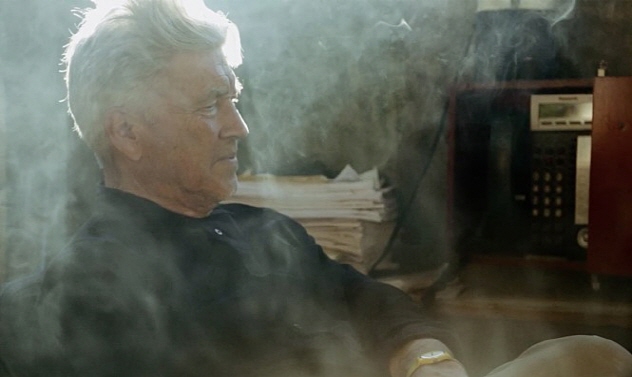
Because it mainly focuses on Lynch’s early years before “Eraserhead”, documentary film “David Lynch: The Art Life” may disappoint some of you, but it is still a compelling documentary nonetheless. As watching him recollecting how he grew up and how he was inspired to pursue his artistic career, the documentary presents an enlightening portrayal of Lynch as a young artist, and we come to get more understanding of what has fueled his art life for more than 50 years.

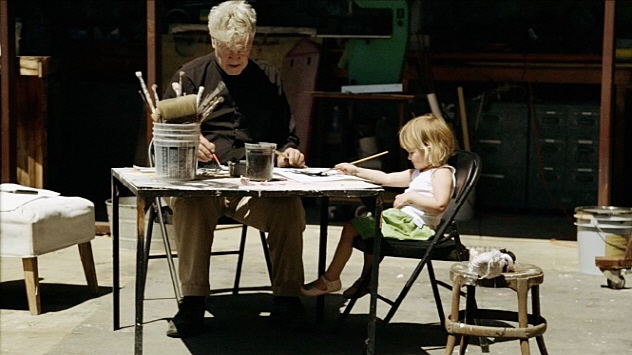
While often showing him working on his latest artworks in his studio located in California Hills, the documentary listens to Lynch as he casually reminisces his early years. As his father, who was a research scientist working for the U.S. Department of Agriculture, was transferred from one place to another, his family frequently had to move along with him, but Lynch’s childhood was normally happy and comfortable, and his parents willingly nurtured his potential. For example, Lynch’s mother never allowed her children to play with coloring books because she believed they would limit her children’s imagination, and Lynch is still grateful for her mother’s wise decision, which probably contributed a lot to the germination of his artistic talent.

davidlynchtheartlife02

Life was pretty good in young Lynch’s small suburban world, but there was one disturbing incident which is vividly remembered in his mind even at present. When he and his younger brother were outside their home on one day, they happened to spot a naked woman approaching toward them, and her apparently traumatized state deeply unsettled young Lynch and his younger brother. As some of you have already noticed, that happening later inspired one of notorious scenes in “Blue Velvet”, which was incidentally one of the main reasons why my late friend Roger Ebert hated that memorable cult film a lot.

In case of his adolescence, it was rather wild as he did some misdemeanors along with his high school friends, but, fortunately, Lynch soon found something he could be passionate about. One of his friends was the son of an artist named Bushnell Keeler, and Lynch instantly felt the desire to be an artist when he came to Keeler’s studio. As Lynch spent more time on developing his own art, Keeler became his big supporter, and he even defended Lynch when Lynch had an argument with his father.

For further polishing his talent, Lynch went to the School of the Museum of Fine Arts, Boston in 1964, but he did not like what its teachers taught to him and others in the school, and he also did not get along well with his roommate Peter Wolf as reflected by one amusing episode involved with a Bob Dylan concert. Eventually, Lynch and his best friend Jack Fisk, who would later be a notable production designer in Hollywood and Oscar-nominated for his works in “There Will Be Blood” (2007) and “The Revenant” (2015), went to Europe for studying under Oskar Kokoschka at his school in Salzburg, but their plan miserably failed when they arrived in Salzburg, so they returned to US 15 days later.

davidlynchtheartlife03

Anyway, things became better for Lynch when he began to study in the Pennsylvania Academy of Fine Arts, Philadelphia in 1966. Besides being with Fisk again, he was happy to find a place where he could study art more comfortably, and he also came to live with a young woman named Peggy Reavey, who later became his first wife shortly before giving birth to his first child Jennifer.

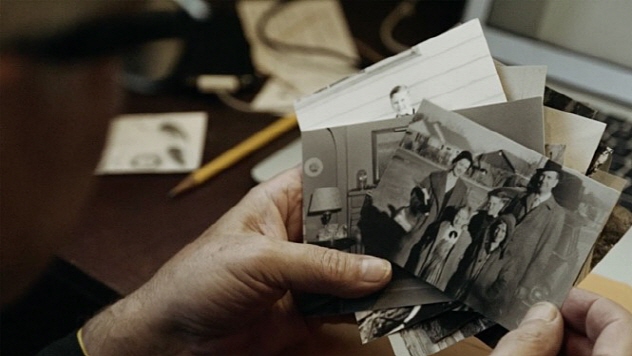
However, Philadelphia gave a rather unpleasant impression to Lynch. As he talks about many ugly sites and people he came across during his time in Philadelphia, the documentary presents us a series of striking black and white photographs showing  shabby abandoned areas of the city, and you will have a pretty good idea on his source of inspiration behind those bleakly nightmarish scenes in “Eraserhead”.

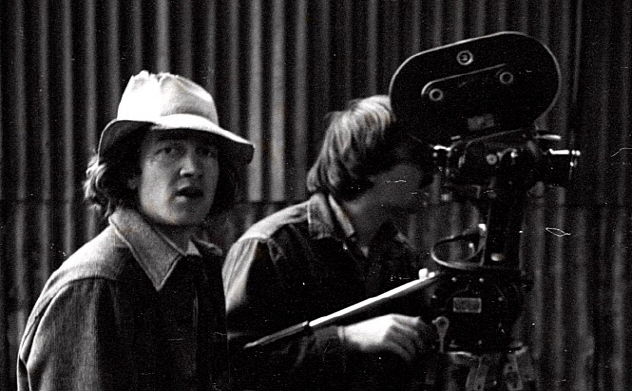
Around that time, Lynch became more interested in filmmaking. After making several short films including “The Alphabet” (1968), he applied for a grant from American Film Institute (AFI), and he was fortunately selected as one of its grant recipients. Thanks to his subsequent short film “The Grandmother” (1970), he could go to the AFI Conservatory, and that was where he learned more about filmmaking before making “Eraserhead”.

Although it does not look beyond that crucial period in Lynch’s life and career, “David Lynch: The Art Life” is a must-see for anyone interested in Lynch and his works. Directors Jon Nguyen, Rick Barnes, and Olivia Neergaard-Holm did a commendable job of mixing Lynch’s words with various archival materials, and I was entertained a lot while appreciating more of Lynch’s own artistry. As shown from this documentary and the recent season of “Twin Peaks”, he is still a passionate artist full of imagination and inspiration, and I truly hope that he will share more with us in the future.

davidlynchtheartlife04

Posted in Movies | Tagged , , , | Leave a comment