Versus: The Life and Films of Ken Loach (2016) ☆☆☆(3/4): How Loach has abided

versusthelifeandfilmsofkenroach03

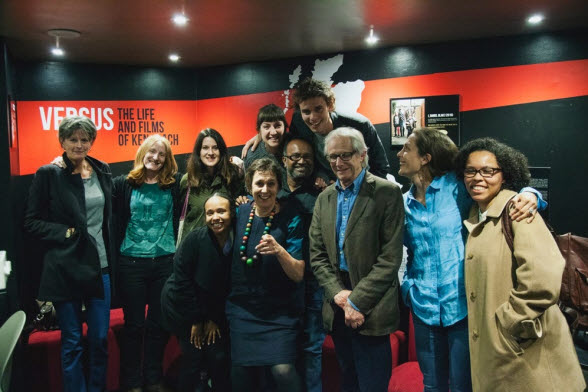
What a remarkable filmmaker Ken Loach is. Since he modestly started his career during the 1960s, he has ardently stuck to his integrity as well as his artistry during more than 50 years, and that admirable aspect of his is touchingly portrayed in Louise Osmond’s documentary film “Versus: the Life and Films of Ken Loach”. While being informative and interesting for illuminating Loach’s early career years, the documentary also gives us a little glimpse into his life and personality, and the result is a sincere and honest tribute to one of the most compassionate filmmakers in our time.

During its first half, the documentary focuses on Loach’s career during the 1960-70s. While he initially tried acting, Loach eventually found himself becoming a movie director as working in BBC, and his several TV movies for BBC’s Wednesday Play were quite sensational at that time for not only their earthly working-class characters but also the raw realism and social issues inside them. In case of “Cathy Come Home” (1966), its harrowing realistic drama impressed viewers so much that it subsequently ignited a number of public debates on the line between fact and fiction, and Tony Garnett, who appeared in “Up the Junction” (1965) and then became the producer of Loach’s early works including “Kes” (1969), gives us an amusing anecdote about his meeting between him and a government minister who wanted to hear Garnett’s opinion on the social issues raised by “Cathy Come Home”.

While continuing to make TV movies for the BBC, Loach also made a few feature films for theatrical release, and one of them was “Kes”, which is still one of the best films in his career. David Bradley, who was 14 when he was cast for the lead role of the film, recollects when he was notified by Loach that he won the part, and he tells us a bit about how Loach drew a terrific natural performance from him. When he shot one particular scene, Loach did not tell much to Bradley on what to say in front the camera, but that brought out what exactly he wanted from Bradley during that scene, which is surely one of key moments in the film.

versusthelifeandfilmsofkenroach02

Despite the considerable success of “Kes”, Loach’s career did not advance much during the 1970s, and the situation became quite more difficult for him during the 1980s. While his theatrical films suffered from poor distribution, several TV documentaries directed by him were prevented from being shown on TV. In case of TV documentary film “A Question of Leadership” (1981), it was blocked from being broadcast because of its relentless criticism of union leaders, and “Which Side Are You On?” (1985) was rejected for being ‘too political’.

And then there came another trouble in 1987. Jim Allen, a left-wing writer who was one of Loach’s close friends and also considerably influenced Loach’s political view, wrote a play named “Perdition”, and its sensitive subject drew lots of controversies even before its scheduled run at the Royal Court Theater. When its run was eventually canceled, Loach was understandably furious about that, and Gabriel Byrne, who participated in the rehearsal as one of the cast members, still remembers well how wrathful and unbending Loach was at that time. As shown from his interview clips, Loach is a mild, gentle guy on the whole, but he is not someone who would easily step back for compromise, and that aspect is evident as he talks about that incident with some bitterness.

However, as struggling to support his family, Loach eventually came to accept that he had to compromise a bit, so he decided to shoot several commercials, and we get the most amusing moment in the film. While I think his commercials for Nestlé and McDonald’s do not look that bad, Loach is still embarrassed by them although his children appreciate the artistic compromise their father made for them.

versusthelifeandfilmsofkenroach01

Fortunately, Loach’s career gradually rose with considerable successes during the 1990s. After “Hidden Agenda” (1990) received the Jury Prize at the Cannes Film Festival, he came to have more opportunities to make films than before, and that led to a series of notable works including “Raining Stones” (1993), “My Name is Joe” (1998), “Bread and Roses” (2000), “Sixteen Candles” (2002), and “The Wind That Shakes the Barley” (2006), which won the Palme d’Or at the Cannes film festival. After “The Angel’s Share” (2012) and “Jimmy’s Hall” (2014), Loach announced that he would retire from filmmaking, but then he came to change his mind when the Conservative party won the election in 2015. He felt that old need to tell stories of under-represented working-class people, and that led to “I, Daniel Blake” (2016), which garnered him his second Palme d’Or early in last year.

Although it is a little shame that the documentary does not delve a lot into the later years of Loach’s career, the documentary compensates for that through the behind-the-scene footage clips of “I, Daniel Blake”. We see Loach preparing for the production of the film, and then we observe how Loach closely works with his main performers Dave Johns and Hayley Squires. Loach sees that Johns and Squires have right qualities for playing their respective characters, and that is evident as watching Johns and Squires preparing for their roles.

Overall, “Versus: The Life and Films of Ken Loach” is a solid documentary film which does its job as well as intended, and I came to admire Loach and his works more after watching it. While he already passed 80, he seems to be willing to go further while following his artistic passion and political belief as usual, and it will be interesting to see whatever will come next from him.
versusthelifeandfilmsofkenroach04

Posted in Movies | Tagged , , | 1 Comment

Criminal Conspiracy (2017) ☆☆☆(3/4): How South Korean media has been ruined

criminalconspiracy01

South Korean documentary film “Criminal Conspiracy” made me sad and angry for good reasons. During last 10 years, several major broadcasting companies in South Korean have been seriously damaged and corrupted by South Korean politicians and their cronies, and the documentary gives us a close, sobering look into how that injustice has happened with alarming consequences. Considering the recent political events in South Korean, there will probably be some good changes, but I think it will probably take lots of time for cleaning up the mess.

The documentary begins its story with Jung Yeon-joo, the former president of the Korean Broadcasting System (KBS). When Rho Moo-hyun became the new president of South Korea in 2003, he guaranteed to Jung that his government would not interfere with whatever would be reported by KBS, which is the No.1 broadcasting company in South Korea. He did keep his promise during the 5 years of his presidency, and Jung becomes a little emotional as recollecting when he later showed his gratitude to President Rho not long after the end of Rho’s presidency.

However, things quickly changed as President Rho was succeeded by Lee Myung-bak in 2008. When KBS reported on the corruption of some of Lee’s cabinet member candidates, it was one of the best moments in the South Korean journalism history, but this apparently displeased President Lee and his high-ranking government officials a lot. Jung and many others in KBS soon found themselves becoming the target of an unfair government investigation, and then the board members of KBS, who were virtually under the control of the South Korean government, decided to fire Jung at their impromptu meeting.

After he was officially fired, Jung was further humiliated with more investigation, and his vacant position was instantly filled by a man closely connected with President Lee. KBS consequently went through lots of drastic changes; its several notable political commentary programs were discarded while many reporters and producers were fired or demoted, and it also began to focus more on the public relations of the South Korean government.

criminalconspiracy05

Not so surprisingly, that was just the beginning of the entire takeover of South Korean TV media. Munhwa Broadcasting Corporation (MBC), which is the No.2 broadcasting company in South Korea, also suffered the same fate not long after it reported on a controversial trade treaty made between the South Korean government and the US government, and director Choi Seung-ho, who worked in MBC during that time, and many other employees of MBC came to experience the same ordeal which happened to those unfortunate KBS employees.

The middle portion of the documentary focuses on how numerous employees of KBS and MBC tried to resist against this injustice. They often held demonstrations in front of the buildings of their broadcasting companies, and some of fired reporters and producers including Choi founded an alternative media company for continuing their public service. As their protest became louder, they drew more public attention, and we see their efforts being appreciated and supported by many citizens.

However, their circumstance only became worse as President Lee was succeeded by President Park Geun-hye, who will surely be remembered as one of the worst presidents in the South Korean history. Her government simply continued what had been done during Lee’s presidency, and KBS and MBC came to be ruined further as becoming mere propaganda tools for the South Korean government.

This problem ultimately culminated to when KBS and MBC incorrectly reported on the sinking of MV Sewol on April 16th, 2014. They initially reported that everyone on the ship was rescued, but they just repeated what was said by government officials, and I and many other South Korean citizens were soon shocked and infuriated as watching the sheer incompetence of the South Korean government and the eventual tragedy of that terrible incident.

criminalconspiracy03

And then there came a huge political scandal which rocked the whole country during late 2016. When it turned out that President Park had been virtually controlled by her personal associate Choi Soon-sil, this unprecedented scandal surely drew lots of anger and attention in public, but KBS and MBC did not report much on that, and their reporters accordingly received lots of contempt when they came to report on the demonstrations against Park’s government.

Eventually, President Park was ousted shortly after her subsequent impeachment early in this year, and I and other South Korean citizens saw some hope as Moon Jae-in was elected as the new president of South Korea, but, as sharply pointed out in the documentary, the people responsible for the corruption of KBS and MBC seem to get away with what they committed. As a matter of fact, some of them even tried to suppress the theatrical release of this documentary in South Korea, though their impertinent attempt fortunately did not succeed.

Overall, “Criminal Conspiracy” works as a modest but vivid chronicle of the corruption of South Korean media. As he did in his previous documentary film “Spy Nation” (2016), Choi shows admirable persistence in his stubborn pursuit of truth and justice, and he also did a good job of presenting facts via an effective mix of archival footage and interview clips. The film surely deserves more audiences in South Korea, and I sincerely hope that will bring more public attention to its troubling subject.

criminalconspiracy02

Posted in Movies | Tagged , , | 4 Comments

The Table (2016) ☆☆☆(3/4): One same table, four different conversations

thetable01

South Korean film “The Table” consists of four different conversation scenes unfolded on one table. During each scene, we meet two characters, and then we listen to their conversation as observing the mood and nuances surrounding them. While this is a pretty simple premise, the movie constantly engages us thanks to its sensitive writing as well as solid performances, and each scene serves us with some nice moments as they fleetingly pass by one by one during its rather short running time (70 minutes).

The sole background of the movie is a small cafe shop located on a small urban alley. In the beginning, we meet a lady who runs the cafe, and we see her beginning another day at her cafe. Although there are not many customers, the cafe looks neat and comfortable in its quiet atmosphere, and I could easily imagine myself reading a book or writing a movie review there.

In the first scene, we meet Yoo-jin (Jung Yu-mi) and Chang-seok (Jung Jun-won). They were once lovers several years ago, but they somehow became separated from each other, and their private meeting at the cafe reminds them of how much they are changed now. While Chang-seok is just a plain company employee, Yoo-jin recently becomes a famous actress, and we get a glimpse of her popularity when she happens to be noticed by a couple of girls passing by the cafe.

Their conversation becomes a little awkward as Chang-seok bumbles with whatever he feels about Yoo-jin. There is a funny moment when he inadvertently mentions several trashy gossips about her, and Jung Yu-mi, who has been one of the most notable South Korean actresses since her charming performances in Hong Sang-soo’s several works including “Oki’s Movie” (2010) and “Our Sunhi” (2013), is wonderful as maintaining her character’s cool, no-nonsense attitude in front of her co-performer Jung Jun-won, who is also effective as her counterpart.

thetable03

The second scene happens between Eun-hee (Han Ye-ri) and Min-ho (Jeon Seong-woo). They do not know each other much, but they became involved with each other when they happened to sleep with each other as total strangers some time ago. Not long after that, Min-ho went abroad for several months of world travel, and he is unemployed at present while not deciding on what to do next for his life. In case of Eun-hee, she is currently working in some food magazine, and it is clear to us that she is not that willing to meet Min-ho from the beginning.

Nevertheless, Min-ho wants to get closer to Eun-hee, and the mood becomes a little humorous as he tries to show her that he is sincerely interested in beginning a serious relationship with her. As Eun-hee goes through a number of different emotions during their conversation, Han Ye-ri, who previously collaborated with director/writer Kim Jong-kwan in “Worst Woman” (2016), subtly conveys her character’s thoughts and feelings through her beautiful face, and Jeon Seong-woo complements his co-performer well with his more extroverted acting.

Unlike the previous two scenes, the third scene in the film is unfolded between two female characters, and the purpose of their meeting is not so romantic at all. Kyeong-jin (Jeong Eun-chae) is a woman who is about to marry some guy, and she needs some help from a middle-aged woman named Sook-ja (Kim Hye-ok), who will be hired as Kyeong-jin’s fake mother at the upcoming wedding.

As their conversation is continued, we get to know a bit about these two women. Kyeong-jin is actually a con artist, but it looks like she really falls in love with the guy she is going to marry, and she wants her marriage to look good as much as possible. It is implied that Sook-ja has a fair share of criminal record, and she is ready to do as much as paid by Kyeong-jin, but then she cannot help but be emotional about her new work for a personal reason.

thetable02

Thanks to the gradual sense of poignancy surrounding it, the third scene is the best one in the bunch, and its two performers are simply fabulous in their fluid interactions on the screen. Jeong Eun-chae, who previously appeared in Hong Sang-soo’s “Nobody’s Daughter Haewon” (2012), is quietly touching as her character goes back and forth between sincere feelings and pragmatic deceits, and so is Kim Hye-ok, whose last line is a precise final touch for their scene.

In case of the fourth scene, it happens during nighttime unlike three previous conversation scenes, and we see Hye-kyeong (Im Soo-jung) and Woon-cheol (Yeon Woo-jin). They meet each other as ex-lovers, and it seems they still have some feelings between them, but there is one problem; Hye-kyeong is soon going to marry.

While wondering how her life has come to be rather disappointing for her, Hye-kyeong suggests at one point that she and Woon-cheol sleep together, but Won-cheol is too sensible for that even if he wants to do that, and we come to feel some bitterness between them at the end of their conversation scene. Im Soo-jung, who has been mainly known for her good performances in “A Tale of Two Sisters” (2003) and “I’m a Cyborg but That’s OK” (2005), exudes her own charm on the screen, and her co-performer Yeon Woo-jin steadily supports her performance.

“The Table” is basically the showcase of its four beautiful lead actresses’ undeniable presence and talent, and Kim Jong-kwan did his job well on the whole. While the third scene remains my favorite, the other scenes are also engaging to watch, and the overall result is a small but enjoyable film decorated with good performances. With this film and “Worst Woman”, Kim demonstrates his considerable talent, and I am certainly looking forward to watching his next work.

thetable04

Posted in Movies | Tagged , | 1 Comment

Richard Linklater: Dream Is Destiny (2016) ☆☆☆(3/4): A modest tribute to Linklater

RichardLinklaterdreamisdestiny01

To be frank with you, it took some years for me to become familiar with the works of Richard Linklater. When I happened to watch “School of Rock” (2003) around 2004, I did not pay much attention to its director, but then there came “Before Sunset” (2004), and I belatedly watched “Before Sunrise” (1995) before watching “Before Sunset”. Since that point, I watched most of his subsequent films, and I was certainly delighted by “Bernie” (2011), “Before Midnight” (2013), and, yes, “Boyhood” (2014).

That is why I enjoyed documentary film “Richard Linklater: Dream is Destiny”, a modest tribute to Linklater’s illustrious filmmaking career. As broadly looking around many of his works, the film shows and tells us how Linklater has steadily advanced in his career as shrewdly balancing himself between artistry and pragmatism, and it surely confirms to us that he is one of the most distinctive filmmakers working in US.

With the interview clips between Linklater and co-director Louis Black (he is the founder of the Austin Chronicle and one of the founders of the SXSW Film Festival, by the way) functioning as its narrative scaffold, the documentary looks at Linklater’s early years first. As spending his childhood years in Huntsville, Texas, young Linklater read a lot of books, and that tendency of his was continued during his college years. While he went to his college via an athlete scholarship, he could not play baseball due to an injury, so he came to spend most of his resulting free time at the college library, and that further boosted his longtime aspiration to be a writer.

RichardLinklaterdreamisdestiny04

After working at an oil rig for a while, Linklater moved to Austen, and then he became interested in making movies. After making a couple of short films, he came to make his first feature film “Slacker” (1991), and he was fortunately at the right time and the right place for that. As suffering the end of an economic boom during the 1980s, Austen provided many free empty places where he and his friends could shoot their low-budget movie, and, as you probably remember, the 1990s was the golden age of American independent movies. As praised by many critics including late Roger Ebert, “Slacker” drew considerable attention when it was released in theaters, and Linklater became a new young talent to watch while also inspiring other young filmmakers including Kevin Smith. As he frankly tells us in his interview clip, Smith came to realize that he could his own things just like Linklater after watching “Slacker”, and that led to “Clerks” (1994), another notable debut feature film during the 1990s.

After the critical success of “Slacker”, Linklater attempted to go up with “Dazed and Confused” (1993), which was his first major studio film. Although this sophomore work received a fair share of praises and then has gained more reputation since its theatrical release, it did not succeed as much as he hoped, and he was not particularly happy with how the Universal Studio advertised the film. Nevertheless, he soon moved onto his next project, and that was none other than “Before Sunset” (1995), which eventually became the first chapter of the Before Trilogy. During their respective interview clips, Ethan Hawke and Julie Delpy, the two stars of the Before Trilogy, tell us how much they enjoyed working together with Linklater, and that reminds us again of how special this trilogy is as a vivid, intimate portrayal of romance.

Linklater’s career took another downturn due to the critical and commercial failure of “The Newton Boys” (1998), but it came to bounce again through “Waking Life” (2001) and “Tape” (2001). I have not watched the latter yet, but I can tell you that the former is a dreamy stream of thoughts and feelings vividly and strikingly presented via rotoscoping animation, and I have been considering revisiting it someday for appreciating its many engaging moments more.

RichardLinklaterdreamisdestiny02

After the success of “School of Rock” and “Before Sunset”, Linklater seemed to go down again with “A Scanner Darkly” (2006) and “Fast Food Nation” (2006). While I was intrigued by its science fiction story premise and enjoyed its rotoscoping animation, “A Scanner Darkly” was less impressive compared to “Waking Life”, and “Fast Food Nation” is still a disappointing misstep to me as far as I remember.

Linklater soon returned with better works to notice. Although it was not a commercial success, “Me and Orson Welles” (2008) is an overlooked gem you should watch, and the same thing can be said about “Bernie”, a quirky black comedy film which has one of the best performances in Jack Black’s career. In case of “Before Midnight”, it was certainly another pinnacle for Linklater, Hawke, and Delpy, and watching it at a local movie theater was one of my best movie experiences in 2013.

And there was “Boyhood”, a sublime coming-of-age drama which will be remembered as one of great films coming out from this decade. Linklater and the producers of the movie tell us how difficult it was to finance their small but ambitious project. While lead actor Ellar Coltrane grew over 12 years, Linklater shot the movie bit by bit along with his crew and cast, and there was considerable risk and uncertainty during this long production process. As the movie was completed, the producers clearly saw that Linklater succeeded in making something quite extraordinary, and it was not only a masterpiece but also the culmination of Linklater’s career.

Although it could have delved deeper into its subject, “Richard Linklater: Dream Is Destiny” is engaging on the whole as doing a solid job of summarizing Linklater’s career. After the enormous success of “Boyhood”, Linklater promptly moved onto “Everybody Wants Some!!” (2016), and now his latest film “Last Flag Flying” (2017) is going to be released in US this year. He still keeps going as usual, and it will be really interesting to see where he will go next.

RichardLinklaterdreamisdestiny03

Posted in Movies | Tagged , , | Leave a comment

Last Men in Aleppo (2017) ☆☆☆1/2(3.5/4): Ordinary brave men in Aleppo

lastmeninaleppo01

Closely looking at a group of ordinary brave men struggling in the middle of the civil war in Syria, “Last Men in Aleppo” gives us a bleak but undeniably gripping experience accompanied with growing anger and sadness. As we watch them trying to do their risky job for many others in their city, the documentary gradually immerses us in their harsh, unstable reality filled with danger and despair, and we come to admire their bravery and resilience as reflecting more on what is going on in Syria.

After its gloomy main title scene featuring a few goldfishes, the documentary briefly gives us a bit of background information. When an uprising began in Syria in 2011 as a part of the Arab Spring movement, President Bashar al-Assad’s regime tried to crush this uprising via violent tactics, and that eventually led to a civil war which is still continued even at this point. As the conflict between the Syrian government and the rebels was more intensified, several cities in the rebel-controlled region became constant targets to be bombarded by the Syrian Arab Air Force and the Russian Air Force (as many of you know, Vladimir Putin has been one of al-Assad’s main backers), and Aleppo has been one of these unfortunate cities.

Mostly shot in Aleppo over a period spanning from 2015 to 2016, the documentary presents its story via two different men who are the members of the Syrian Civil Defense. Also known as the White Helmets, the Syrian Civil Defense mainly consists of civilian volunteers working in Aleppo and several other war-torn cities in Syria, and, as shown from this documentary as well as Oscar-winning documentary short film “The White Helmets” (2016), their main job is urban search and rescue in response to bombings. Whenever bombing happens, they are usually the ones who come first for saving people, and their extraordinary examples of human courage have drawn lots of attention from the world outside.

lastmeninaleppo02

When one of two heroes in the documentary is introduced to us, he is nervously looking up to the sky along with his colleagues. His name is Khaled, and we soon see this plain stocky guy riding a vehicle along with others right after a loud sound of explosion is heard from somewhere. Another air strike has just happened in their city, and they must go to the site of bombing as soon as possible.

After this urgent moment, we observe Khaled spending some time with his two daughters (his wife is never shown in the film although she is mentioned from time to time, by the way). While not fully grasping what their father does outside, Khaled’s daughters are very proud of their father, and they watch a video clip showing Khaled rescuing a child amid the rubbles of a bombing site.

For Khaled, that moment was just one of many dangerous and difficult incidents he and his colleagues had to deal with. While they sometimes have small moments of fun, there is always the possibility of another air raid, and the situation around them and others in the city remains despairing as before. As reflected by one brief scene showing Khaled’s visit to a local pharmacy, the city has suffered from the shortage of many things including medicines, and Khaled certainly worries a lot about his daughters. He considers going to Turkey just like many people of his country did, but he cannot imagine himself living his hometown, even though the circumstance becomes more frustrating for him and his colleagues. At one point, they make a small garden for several goldfishes he bought, and we cannot help but notice a sad parallel between them and goldfishes.

lastmeninaleppo03

The other hero of the documentary is Mahmoud, a quiet, decent young man who is also determined to stay in the city as much as he can. When we see him for the first time, he is driving his vehicle to a bombing site, and then we observe him and others working together for rescuing several children buried below heaps of rubbles. While they cannot save everyone, they manage to save two of them at least, and there is a poignant scene where Mahmoud and one of his colleagues visit two surviving kids and their father. As the kids’ father shows his gratitude to Mahmoud and his colleague, one of two surviving kids asks Mahmoud to tell how Mahmoud rescued him, and Mahmoud comes to feel rather awkward. As he later says to his colleague, he simply wanted to know more about those dead children they could not save, and we can clearly see that their death still feels painful to him.

Mahmoud often works with his younger brother, and they have been hiding their work from their dear parents (They lied to their parents that they work in Turkey). Mahmoud has been concerned about his brother’s safety, and there is a tense moment when they find themselves in a sudden peril. They luckily come back alive, but, as shown from a brief subsequent scene, Mahmoud is apparently shaken by what he and his brother have just gone through, and that adds more burden to whatever he has kept to himself.

While it is quite difficult to watch at times as Khaled, Mahmoud, and other White Helmets keep struggling under their increasingly daunting situation, “Last Men in Aleppo”, which won the Grand Jury Prize at the Sundance Film Festival early in this year, firmly holds our attention via its strong sense of immediacy and intimacy generated through its cinéma vérité approach. It is pretty clear that director Firas Fayaad and his crew took considerable risk while shooting their documentary in Aleppo, and I appreciate how the documentary maintains its sober attitude while never falling into sensationalism even during its most ghastly moments. This is a very tough stuff indeed, but its vivid presentation of the best and worst sides of humanity is powerful to say the least, and I think you should not miss this remarkable documentary.

lastmeninaleppo04

Posted in Movies | Tagged , | 2 Comments

Chasing Coral (2017) ☆☆☆1/2(3.5/4): An imminent SOS from coral reefs

chasingcoral03.jpg

Netflix documentary film “Chasing Coral” has an urgent environmental message for all of us. While dazzling our eyes with many wondrous sights from coral reefs, the documentary gives us the vivid, striking presentation of an imminent ecological catastrophe which has been unfortunately overlooked for many years, and it is often devastating to watch the ongoing collapse of one of the most important ecosystems on our planet.

The film begins its story with Richard Vevers, who was once an advertisement company executive but then eventually decided to devote himself to what he was really passionate about. After quitting his company, he went to tropical marine areas for enjoying underwater coral landscapes, and he subsequently founded XL Catlin Seaview Survey, which is pretty much like as an underwater equivalent of Google Maps.

Vevers tells us how he became interested in a problem which had not been noticed by many people including himself. After one of his favorite marine species was disappeared from its usual habitat area with no apparent reason, he wanted to know how that could happen, and he came to learn that many coral reefs around the world have been under a serious environmental threat. As pointed out in the documentary, 50% of coral reefs in the world was gone during last 30 years, and this disastrous happening has only become more rapid and frequent without any sign of decline.

As Vevers meets several scientific experts, we learn bits about how elaborate coral reefs are as a big, complex ecosystem. Consisting of numerous polyps, corals have formed a symbiotic relationship with algae which constantly provide nutrition via photosynthesis while living inside polyps, and they can virtually grow like trees as long as they are in an ideal environment. Evolved into a myriad number of species, corals have brought many different shapes and colors to their underwater environment, and their resulting reefs have provided habitats to thousands of marine species out there.

chasingcoral05

As a matter of fact, our human world depends on coral reefs a lot more than you think. For instance, many animal species living around coral reef areas have been the main protein source for a considerable part of the human population on the Earth. In addition, coral reefs themselves are quite valuable as the source of numerous important biochemical substances such as prostaglandin, which is widely used for cancer therapy.

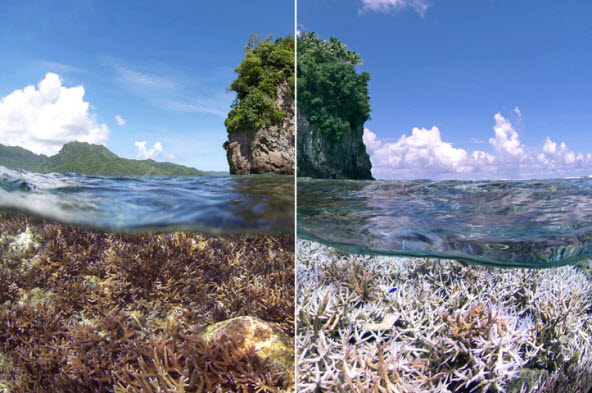
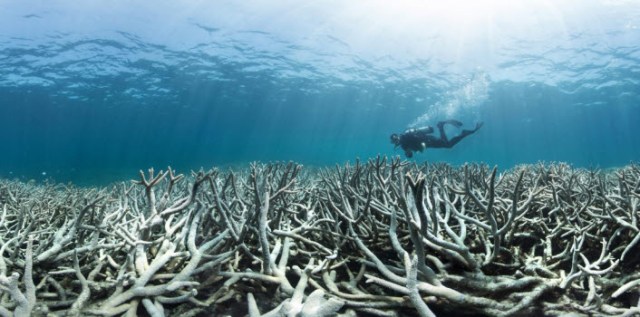
However, this precious beautiful world of corals is quite fragile in fact. Corals are very sensitive to the increase of water temperature, and they are ‘bleached’ even when water temperature is increased merely around 1-2 ℃ from their ideal temperature for living. Under that condition, algae inside corals stop photosynthesis while being toxic to coral, so corals let out algae for protecting themselves as being turned to white. Unless water temperature is decreased to the normal level, they will eventually die while being starved, and the whole ecosystem based on them will be accordingly collapsed.

Especially since 1998, coral bleaching has been more frequent around the world, and scientists already know the reason behind this alarming happening: global climate change. As many of you know, the increasing level of carbon dioxide in the atmosphere, which is resulted from the increasing combustion of fossil fuel, leads to more heat on the Earth, and the 93% of it is absorbed by the sea. While that is a good thing for us, it is a disaster for corals as the temperature of seawater is frequently increased beyond their tolerance as a result.

After learning about this serious environmental problem, Vevers decided to raise the public awareness of it, and he happened to find a right person who could help him. When he watched Jeff Orlowski’s acclaimed documentary film “Chasing Ice” (2012), Vevers noticed a clear parallel between decreasing coral reefs and the retreating glaciers shown in that documentary, so he instantly contacted Orlowsky, and that was how Orlowski became the director of “Chasing Coral”.

chasingcoral06

For capturing the progress of coral bleaching via time-lapse cameras over several months, Orlowski and Vevers worked together along with a number of technicians. We see a special device which can protect their cameras while also being able to maintain a clear 360-degree view constantly, and we observe their considerable efforts as they try to handle several difficulties in their work. During their first trial, they only got a few clean photographs, but they were not daunted by that, and then they went for the next big chance when they were notified that the water temperature of the Great Barrier Reef would be increased considerably.

What they eventually captured on their cameras was a harrowing glimpse into another massive coral bleaching around the world, and they could not help but emotionally affected by this. For Zach Rago, one of underwater camera technicians who is also an amateur coral expert, this was painful to watch to say the least. Later in the film, we see him visiting the home of his childhood hero who introduced him to the wonder of marine life, and their conversation feels bittersweet as they talk about the ongoing crisis of corals.

At least, there are still some time and hope, and “Chasing Coral” powerfully conveys that to us in the end. Yes, the situation will be inevitably more difficult for corals and us during this century, but we may solve this big problem as becoming more aware of it, and I am glad to see this documentary getting considerable public exposure via Netflix. This is one of the most significant documentaries in this year, and I strongly recommend you to watch it right now if you can.

Chasing Coral

Posted in Movies | Tagged , , | 1 Comment

Chasing Ice (2012) ☆☆☆(3/4): Capturing disappearing glaciers

chasingice01

As many of you know, there are still lots of people refusing to believe the alarming progress of global climate change and its undeniable cause. The temperature of our planet has been abnormally increased during several decades because of the increasing level of carbon dioxide in the atmosphere of our planet, but, despite heaps of scientific data, those people keep turning a blind eye to this while also denying that this is due to the dependence of our modern civilization on fossil fuel.

They may say there are not enough evidences for global climate change yet, but what is presented in documentary film “Chasing Ice” is another undeniable evidence showing the ongoing effects of the global climate change. While it has been several years since it was released in 2012, the film remains effective as a vivid, beautiful visual chronicle of disappearing glaciers, and it will definitely make you more aware of a big imminent change we will have to deal with in one way or another.

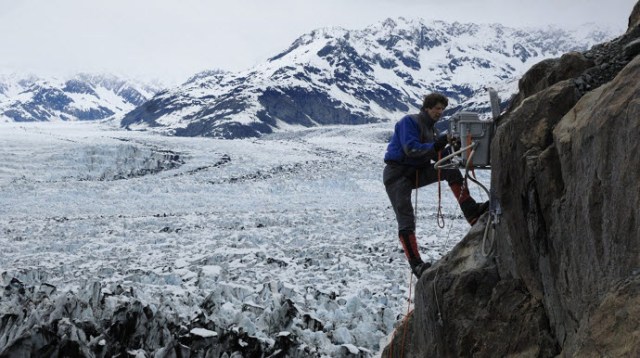
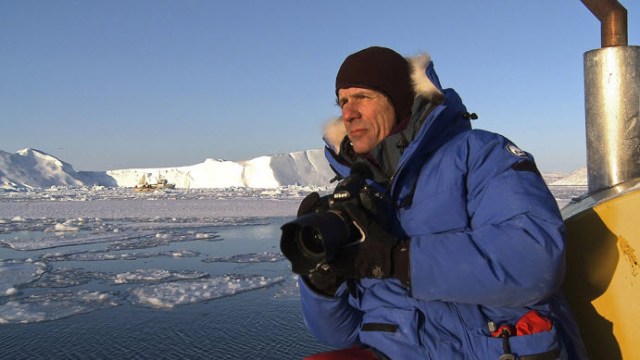
The documentary centers on the Extreme Ice Survey (EIS), an ambitious photographic glacier study initiated by nature photographer James Balog. While looking for another nature photography project to interest him, Balog became interested in glacier, and his trip to Solheim glacier in Iceland changed his view on global climate change. He had been rather skeptical about global climate change, but what he saw from Solheim glacier changed his opinion, and he accordingly felt the need to raise more public awareness of the impacts of global climate change.

Utilizing time-lapse cameras, Balog and a group of professionals working with him tried to get a multi-year record of several arctic glaciers in Greenland, Iceland, and Alaska, and the documentary observes several trials and errors during their initial stage. While it was pretty difficult to set the cameras in right spots, there were also a number of technical problems to handle after that, and the result of their first attempt was quite disappointing to say the least. Nevertheless, they did not give up as making additional technical improvements on their cameras, and they eventually began to get satisfying results once everything clicked well together.

chasingice04

Closely watching Balog and other EIS members at work, director/writer Jeff Orlowski did a competent job of presenting many vivid moments on the screen. At one point, the documentary shows us small black holes on the surface of a glacier, and Balog explains to us a bit about how they are generated. In case of an awe-inspiring scene which features an icy current of glacier water flowing into a seemingly bottomless hole, we see Balog carefully approaching closer to that big hole, and his considerable risk feels palpable to us even though the camera observes him from the distance.

The documentary also focuses on Balog’s admirable dedication to his work. Despite his knee problem, he kept trying to do more for his project, and he was not deterred at all even after his eventual knee surgery. We also meet his wife and children, and we can see that he is lucky to have a family who understands and supports what he has been passionate about for years.

We later watch a number of video clips assembled from thousands of photographs shot during several years. These video clips all show the rapid decrease of glaciers over that long time period, and Balog tells his audiences that this happening was observed even during winter. In case of one glacier, it receded so rapidly that the position of the camera had to be moved several times, and it is disturbing to see the full view of how much of this glacier was gone in the end.

chasingice02

Another highlight in the documentary comes from Jakobshavn Glacier in Greenland, which is one of the largest glaciers in the world. We see a gigantic chunk of ice being separated from the glacier and then floated away to the sea, and that moment chills us with its terrifying beauty. As watching it, I could not help but think of a similar moment in Oscar-winning documentary “An Inconvenient Truth” (2006), which also effectively demonstrated the ongoing progress of global climate change.

If you are constantly aware of global climate change like me, you surely know how devastating it will be if we don’t do anything about it. As pointed out well in the documentary, the increasing temperature of the Earth will lead to more incidents of storms, droughts, and forest fires, and the human civilization will be further threatened by the rising sea level resulted from more meltdown of Arctic and Antarctic glaciers. It is really depressing to see that global climate change still remains to be ‘controversial’ thanks to the political influences of big oil companies, and I must confess that this often makes me have lots of doubt on our future.

Anyway, “Chasing Ice” is a modest but impactful documentary film, and I came to admire Balog and his colleagues’ enormous efforts a lot after watching the film. In fact, I checked their website out of curiosity, and I was glad to see that their project has been steadily continued during last 5 years since the film came out. We do not have much time, and we certainly need more people like them.

chasingice03

Posted in Movies | Tagged , , | Leave a comment

Get Me Roger Stone (2017) ☆☆☆1/2(3.5/4): A political operator very proud of his infamy

getmerogerstone02

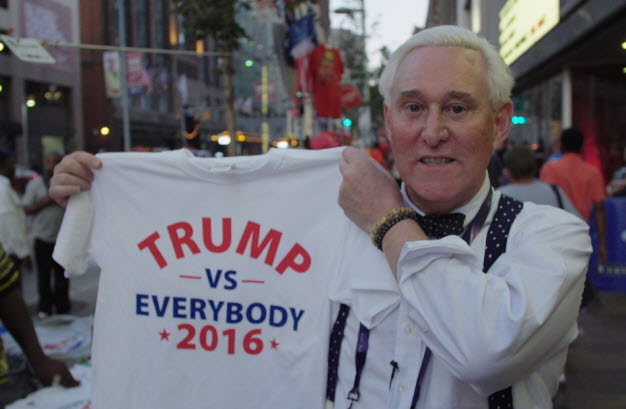
If you despise what Donald Trump and his party represent, I bet you will dislike and detest Roger Stone as much as me after watching Netflix documentary “Get Me Roger Stone”. Here is a smart, diabolical political operator who has always been willing to try any dirty tactic for his party’s political victory, and it is chilling and disturbing to observe how much he has contributed to the recent rise of Donald Trump as well as the bastardization of American politics during last several decades.

While closely watching Stone working for Trump’s presidential election campaign during 2016, the documentary gives us Stone’s political background via a number of interviewees including Stone himself, who is quite frank about himself in front of the camera. For instance, he gleefully recollects how he manipulated a mock presidential election at his school via spreading a fake rumor, and it is quite clear to us that he was born to be a political operator.

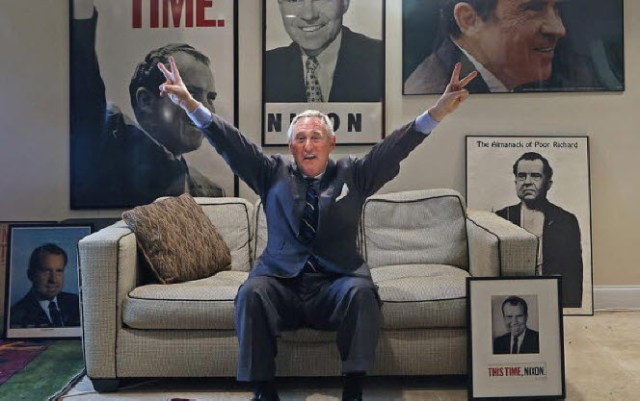
He initially aspired to be an actor, but there came a turning point during the 1964 US Presidential election. After quite impressed by Republican nominee Barry Goldwater and his hardcore conservative philosophy, young Stone came to set his eyes on politics, and he eventually came to work for Richard Nixon’s presidential election campaign in 1972. When Watergate Scandal finally broke out, he drew considerable attention as being the youngest person called before the following congress hearing, and he tells us how much he enjoyed that moment although his parents were ashamed of their son’s involvement in the scandal.

getmerogerstone05

That could have been the end of his political career, but Stone managed to keep moving on instead as continuing to work for Nixon, and he soon came upon his first big break through Ronald Reagan. He saw the considerable potentials from millions of blue collar democratic voters who could be persuaded enough to vote for Reagan, and his strategy on several key Democratic states worked marvelously as he predicted. After Reagan’s victory in 1980, Stone rose higher within his party, and that was how he came to meet Roy Cohn, a notorious right-wing lawyer who was one of the most influential figures in Republican party.

Through Cohn, Stone met one of Cohn’s close associates, and that guy was none other than Donald Trump, who was taking his first steps into the realm of celebrity during that period. As Trump became interested in entering politics, Stone was there to help and advise him, and you may notice how much Trump resembles Stone in terms of attitude and speech pattern. Both of them are so blunt and flamboyant that you cannot help but watch them, and Stone’s garrulous speech pattern certainly evokes Trump’s many verbal razzle-dazzles in front of the media and his supporters.

As the Reagan Presidency continued, Stone further accumulated his infamy through a lobbying firm he founded along with his several friends/associates including Paul Manafort, who, as many of you remember, was once the manager of Trump’s presidential election campaign during 2016. Besides having numerous politicians in Washington D.C. under its control, Stone’s lobbying firm was notorious for having many notable dictators and despots around the world as their clients, and it is darkly amusing to see Stone and Manafort talking casually about what they did during that time. They seem to feel no qualms about that at all, and Manafort’s phlegmatic attitude in front of the camera feels rather ironic considering his current legal problem.

The 1990s was quite disappointing for Stone as Republican Party lost twice to Democratic Party in the US presidential election. When he became a national joke due to his sex scandal in 1996, it looked like the end of his political career was near, but then he came back with a vengeance in 2000. Through his usual dirty tactics applied to several key districts of Florida, he made it sure that George W. Bush won the 2000 US Presidential election, and he also played a crucial part in Bush’s re-election in 2004.

getmerogerstone03

While he still remained on the fringe of his party, Stone became more prominent nonetheless, and he surely enjoyed his eventual rising status as Trump announced that he would run for the presidential nominee of Republican Party in 2015. During the primary election of Republican Party, Trump went for every dirty tactic available to him as he learned from Cohn and Stone, and Republican Party was helplessly overtaken by Trump mainly because, as already shown from the 2012 US Presidential election, there was not any substantial political force left inside the party.

Once Trump began to clash with Hillary Clinton during late 2016, things became quite uglier, and directors Dylan Bank, Daniel DiMauro, and Morgan Pehme provide lots of cringe-inducing moments which are also infuriating to watch at times. Even after he officially left the Trump’s presidential election campaign, Stone did everything he could for supporting Trump and tarnishing Clinton’s public reputation, and we are horrified and disgusted as watching how those ‘alternative facts’ spewed out from Trump and Stone were willingly accepted by Trump’s zealous supporters. When Trump got elected in November 2016, Stone delightfully celebrated that along with Alex Jones, and the documentary painfully reminds us of how despairing that day was for many Americans.

As sharply pointed out by many critical interviewees in the film including journalist Wayne Barrett, who died shortly before the film was released on Netflix, Roger Stone has done lots of serious damages to American politics, and he does not hesitate at all to take the credit for that. He is indubitably proud of the ultimate culmination of his dirty political tactics, and he will definitely have no problem with how he is presented in “Get Me Roger Stone” because, in his opinion, it is better to be infamous than to be never famous at all. He is a monstrous guy indeed, but, boy, he does enjoy being bad and notorious, and we come to look at him with horrible fascination, while worrying about the possible social/political ramification of what he has deliberately created.

getmerogerstone01

Posted in Movies | Tagged , | Leave a comment

Nobody Speaks: Trials of the Free Press (2017) ☆☆☆(3/4): The free press in peril

nobodyspeak04.jpg

Netflix documentary film “Nobody Speaks: Trials of the Free Press” is often alarming to watch for good reasons. It amusingly begins with many absurdities of one infamous court trial which drew lots of attention during last year, but then it eventually shows the possible beginning of a big, serious threat to the First Amendment of the US Constitution. As a matter of fact, this is all the more frightening considering the recent rise of Donald Trump, who has relentlessly attacked the media and its constitutional rights from the very beginning of his US Presidential election campaign.

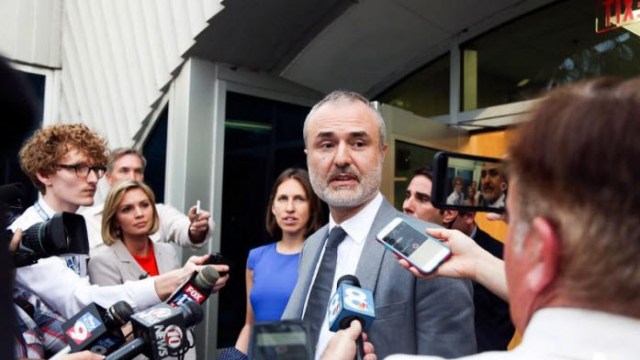
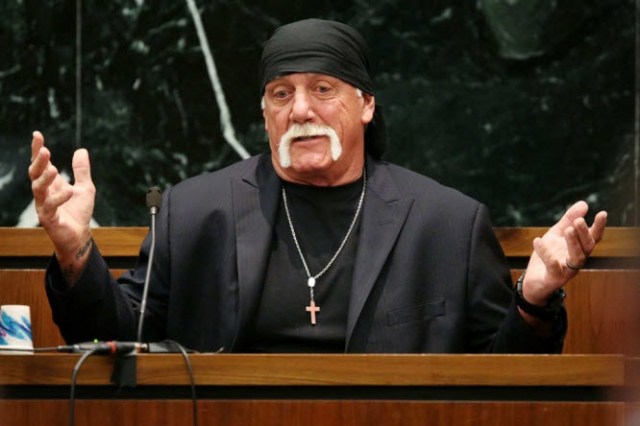
The first part of the documentary is about how Gawker, an American tabloid blog founded by Nick Denton and Elizabeth Spiers, got itself into a serious legal trouble. In 2012, A.J. Daulerio, who was the editor-in-chief of Gawker at that time, posted a short video clip which was edited from a sex tape of Hulk Hogan and Heather Clam, who was the wife of Hogan’s friend Todd Alan Clem, a.k.a. Bubba the Love Sponge. Hogan requested Gawker to remove that video clip from its site, but Gawker refused in the name of the First Amendment, and Hogan eventually filed a lawsuit against Gawker in July 2015.

As observing the progress of their trial, the documentary spends considerable time on how Gawker had made many enemies during its prime period. During their interviews, Denton and Daulerio emphasize that their blog site simply went for anything to be exposed for public, but, as far as I can see, their online articles are mostly sensational gossips on celebrities, and some of these articles are indeed mean and unpleasant. In fact, they can be regarded as cases of invasion of privacy, and it is easy to see why Gawker did not get much support when it faced its legal trouble.

nobodyspeak01

In case of Hulk Hogan, he is no better than Gawker as a guy who has always lived through his gaudy celebrity. Regardless of however he actually felt about the public exposure of his sex tape as Terry Bollea (That is his real name, by the way), Hogan actually boasted about his, uh, manliness shown from that tape, and there is a moment of sheer absurdity when Hogan tries to explain the difference between his private self and public self during his testimony in the middle of the trial.

Anyway, the trial turned out to be disastrous for both sides. Although Hogan won at the end of the trial while also being awarded $140 million in damages, his another sex tape was exposed in public, and his career was totally finished because of his racist words recorded in that tape. Due to its enormous legal cost, Gawker went down into bankruptcy, and its blog site was accordingly shut down in August 2016.

During the trial, Denton and his several colleagues suspected that someone big and powerful was surreptitiously backing Hogan’s lawsuit for crushing Gawker, and, to everyone’s surprise, their suspicion turned out to be right shortly after their legal defeat. Peter Thiel, who is one of the most influential business figures in Silicon Valley, willingly admitted that he was the one backing Hogan’s lawsuit from the behind, and everyone knew well his motive. Several years ago, Thiel was not so pleased when Gawker exposed his homosexuality in public, and it goes without saying that he had waited for a golden opportunity to get his personal revenge.

The final result must have been pretty sweet for Thiel, but, as several interviewees in the film point out with genuine concern, what he did to Gawker may open the door to darker possibilities. He demonstrated to other business moguls in US that the press can be suppressed or controlled through money and power, and this can lead to more erosion of what is guaranteed by the First Amendment.

nobodyspeak02

As a matter of fact, this disturbing trend is already beginning as shown from one example presented in the film. When Las Vegas Journal-Review, one of the most prominent newspapers in Nevada, happened to be sold to a group of anonymous investors, its editor-in-chief and reporters were naturally interested in who really owned their newspaper, and they eventually discovered that the actual owner is none other than the son of Sheldon Adelson, one of the richest businessmen in US. When they printed this hidden fact on the front page of their newspaper, Adelson and his associates were not so happy about that, and we were not that surprised to learn that many of reporters investigating the connection between their newspaper and Adelson were laid off in the end.

While covering many different things during its 95-minute running time, the film feels unfocused from time to time, and I think Director/writer Brain Knappenberger could have trimmed his documentary a bit for more succinct and focused storytelling. Maybe because I read several articles on its subject, I was not particularly surprised and enlightened during my viewing, and I was a little disappointed to see that the documentary did not go much beyond what I already knew.

Nevertheless, “Nobody Speaks: Trials of the Free Press” is worthwhile to watch because it will show and tell you how much the free press has been endangered in the American society – and how much its democracy is threatened because of that. There is still some hope as shown from the end of the documentary, but, folks, I cannot help but be skeptical as reflecting on how the situation keeps getting worse for the American press these days thanks to Trump and his deplorable cronies. Seriously, I hope I am wrong about that.

nobodyspeak03

Posted in Movies | Tagged , , | 1 Comment

War for the Planet of the Apes (2017) ☆☆☆1/2(3.5/4): Hail, Caesar!

WarforthePlanetoftheApes01.jpg

The recent reboot of the Planet of the Apes series has been one of the most interesting cases of reboot during last 10 years. In “Rise of the Planet of the Apes” (2011), the franchise successfully recharged itself with considerable potentials, and I was surprised as finding myself caring a lot about its ape hero who eventually became the leader of a big evolutionary revolution as the fall of humanity began. In “Dawn of the Planet of the Apes” (2014), the potentials glimpsed from the previous movie were further developed as he and his fellow apes inevitably clashed with human survivors, and the result was certainly one of more memorable films I saw during 2014.

Now here comes “War for the Planet of the Apes”, and I can attest that this supposedly final chapter of the series exceeds my expectation just like its predecessors. While being as grim and intense as required, the movie is also quite smart, compelling, and thoughtful in terms of story and characters, and that is something we do not encounter very often during summer blockbuster season. I was gripped by its brooding but captivating apocalyptic tale which will probably make you reflect on the dark sides of humanity, I was involved in its ape hero’s another plight he must go through, and I was impressed by how the movie powerfully delivers a satisfying epic finale he richly deserves.

As you probably remember, a genetically engineered virus strain lethal to human beings was spread all around the world at the end of “Rise of the Planet of the Apes”, but this virus provided an evolutionary breakthrough for Caesar (Andy Serkis) and many other apes, who all became quite smarter and then came to form their own community as shown in “Dawn of the Planet of the Apes”. After the eventual clash between humans and apes occurred despite Caesar’s good-willed effort during the finale of “Dawn of the Planet of the Apes”, Caesar came to realize that he had no choice but to fight for his species’ survival, and the eventual war between his species and humanity began as explained during the opening sequence of “War for the Planet of the Apes”.

WarforthePlanetoftheApes03

It has been around two years since the war began, and the situation is not exactly good for Caesar and his tribe. While they have managed to hide from the human soldiers commanded by the Colonel (Woody Harrelson) for a while, their hiding place is eventually exposed, and the resulting battle results in massive loss in both sides. Caesar tries to be reasonable despite that, but, alas, he subsequently comes to pay a hefty price for his choice; his wife and his first son are killed later, and he naturally becomes determined to get revenged on the very person responsible for his heartbreaking loss – the Colonel.

Although Caesar’s longtime confidant Maurice (Karin Konoval), an Orangutan who has always been an endearing character to me, advises to him that he should lead his tribe to a possible safe place first, Caesar is adamant about having his revenge on the Colonel. While having his tribe depart for that safe place as planned, he embarks on his journey to the Colonel’s place, and he is accompanied by Maurice and two other apes who have been loyal to him.
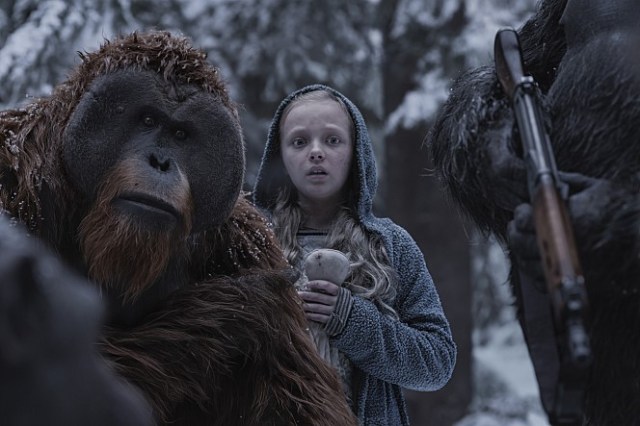
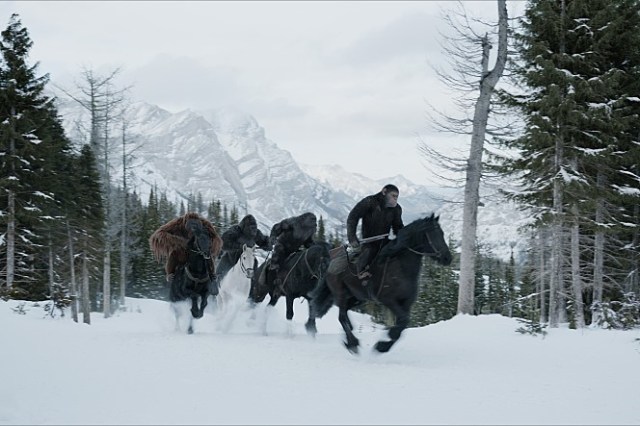
As they ride their horses together across wide, snowy landscapes, the movie evokes the qualities of classic western films while also being reminiscent of Joseph Conrad’s “Heart of Darkness” and, yes, “Apocalypse Now” (1979). Cinematographer Michael Seresin, who previously did a wonderful job in “Dawn of the Planet of the Apes”, provides a number of superlative visual moments full of bleak apocalyptic beauty, and Michael Giacchino’s score, which feels more expressive and harmonic compared to his restrained dissonant work in “Dawn of the Planet of the Apes”, effectively enhances the mood and drama unfolded on the screen.

During their journey, Caesar and his fellow apes come across two different characters. One is a young human girl who is mute for a reason which will be revealed later in the story, and the other one is an ape who can speak just like Caesar. Although she does not speak any line in the film, young performer Amiah Miller holds her own place well among Caesar and other ape characters, and she is poignant as her character gradually becomes closer to Maurice. As “Bad Ape”, Steve Zahn brings some sense of humor to the movie, and I like how he subtly conveys the pathos behind his character’s comic neurotic attitude.

WarforthePlanetoftheApes04

After steadily building up narrative momentum during its first half, the screenplay by director Matt Reeves and Mark Bomback goes into darker areas as Caesar comes to face the stark horror and madness in the Colonel’s place. Certainly reminiscent of Colonel Kurtz in “Apocalypse Now”, Woody Harrelson brings considerable menace and intensity to his scenes, and we are horrified by what the Colonel is going to do while also understanding how desperate and despairing the situation is for him and his men. Humanity is bound to fall irreversibly, but he and his men are not going away easily, and he is surely determined to do whatever is necessary in his twisted view.

While pulling out all the stops during its expected climax action sequence, the movie still remains driven by story and characters. We are surely served with lots of CGI actions, but they are skillfully handled while serving the story and characters in the movie, and then there comes a literally sweeping dramatic moment at the end of the sequence, which feels like a grand finishing touch to what is achieved by Reeves and his crew.

And there is another superb performance by Andy Serkis, who imbues his CGI character with heart and soul as he did in two previous films. Thanks to Serkis, Caesar is a compelling character to watch as usual, and we are treated with several powerful scenes as observing his dramatic character arch in the film. In my review on “Dawn of the Planet of the Apes”, I said that Serkis might deserve a special Oscar someday as a performer behind many memorable CGI characters, and I still stand by that opinion of mine.

While there may be another sequel to follow, “War for the Planet of the Apes” completes well what was started and then developed in its two predecessors, and I am fully satisfied with that for now. What is accomplished in these three films is undeniably impressive, and I think they will have their own iconic place in the movie history like “Planet of the Apes” (1968). Humanity falls indeed – but the apes rise at least.

WarforthePlanetoftheApes02

Posted in Movies | Tagged , , , | 2 Comments