A Monster Calls (2016) ☆☆☆(3/4): A typical but solid fairy tale of grief and anger

amonstercalls01

“A Monster Calls” is a fairy tale which knows how to engage and enchant its audiences. While its story may be typical and predictable in terms of narrative and characterization, it impresses us with a number of nice fantasy elements and then touches us with a solid human base below them, and we come to care about its young hero’s difficult emotional struggle in the story.

For Conor O’Malley (Lewis MacDougall), life has been quite difficult inside and outside his home. His dear mother Elizabeth (Felicity Jones) has been suffering from her cancer, and she keeps saying to her son that things will be all right in the end, but it is apparent that she does not have much time left for her and Conor. That means he will soon have to live with his grandmother, but he does not her like at all due to her rather strict attitude, which is not mellowed much even when her daughter is later sent to a hospital for a more intensive treatment.

In his school, Conor has been tormented by several bullies just because he looks like someone to be bullied, and one of these bullies is particularly cruel to him. Whenever that boy looks back at him in their classroom, Conor knows that he will be cornered and beaten as usual, and it seems there is nothing he can do about that.

As his mind is boiling with anger and grief, he comes to experience a strange happening at one night. There is an old yew tree in a decrepit church cemetery not so far from his home, and it is suddenly transformed into a gigantic monster which looks like a cross between a robot in the Transformer movies and that wooden alien in “Guardians of the Galaxy” (2014). As Conor looking at it with horror and fascination, the monster, which is voiced by Liam Neeson, soon comes to Conor, and it offers a sort of deal to him; it will tell three stories one by one during its visits to Conor, and Conor must tell his own truthful story in exchange for that later.

amonstercalls03

The first story, which is presented via a broad but striking animation sequence, seems to be a simple tale of good and evil at first but turns out to be a little more complex than expected. As it goes through several narrative turns, the story indirectly teaches Conor that no one is wholly good or bad, and Conor accordingly comes to realize that his life is not as simple as he once thought. His grandmother may be too frigid in his view, but one brief scene implies that she has struggled with her own grief and torment just like him. His father, who divorced her mother some years ago and moved to LA since that, cannot always be near Conor, and his current job and family come first for him now, but that does not mean that he does not love his son.

While Conor has to stay in his grandmother’s house for a few days, the monster visits him again for giving him the second story, which is also presented via an animation sequence. While it is about retaining hope and faith in front of despair and sadness on the surface, it also reflects the deep anger and frustration growing inside Conor, and that eventually leads to a harrowing moment of devastation after Conor loses himself in anger along with the monster.

In case of the third story, it is far simpler than the other two stories, and I am not so sure about whether it delivers any particular good lesson. As Conor is tormented again by his school bullies, the monster comes to him, and it tells him about an invisible man who finally came to decide to do something about his miserable status which has been ignored by many others around him. Prompted by this last story, Conor surely demonstrates to not only his bullies and but also many other students that he will not be ignored at all, and that leads to a brief scene with the school principle played by Geraldine Chaplin (Yes, she is the daughter of that legendary silent movie star).

amonstercalls02

While it looks like the monster and his three tales are more or less than the imaginative reflections of Conor’s inner struggle, the movie constantly keeps its story grounded in reality, and the screenplay by Patrick Ness, which is adapted from his book of the same name, establishes well the strong relationship between Conor and Elizabeth during its early part. During a sweet, intimate scene where they watch “King Kong” (1933) together, we can clearly feel the affection between them, and that is the main reason why later scenes between them are genuinely sad and poignant.

The main characters in the movie initially look simple, but they gradually come to us as real characters thanks to its good main cast members. Young actor Lewis MacDougall is heartbreaking at times in his unadorned performance, and he is also supported well by several reliable veteran performers. While Felicity Jones, who has been more notable since her Oscar-nominated performance in “The Theory of Everything” (2014), brings warmth and gentleness to her character, Sigourney Weaver is commendable especially when her character expresses her feelings to her grandson later in the story, and Liam Neeson, who indirectly appears in the film via one small detail, is perfectly cast as the authoritative voice of wisdom to our young hero.

“A Monster Calls” is directed by J.A. Bayona, who previously directed “The Orphanage” (2007) and “The Impossible” (2012). While these three movies are quite different from each other in many aspects, they are all competent pieces of work thanks to deft storytelling and skillful filmmaking. According to IMDB, Bayona is going to direct the fifth installment of the Jurassic Park franchise, and I think we can have a little expectation considering the solid achievements in his three films.

amonstercalls04

Posted in Movies | Tagged , , | Leave a comment

The Lost City of Z (2016) ☆☆☆1/2(3.5/4): Searching for a lost civilization in jungle

thelostcityofz01

“The Lost City of Z” is something we rarely see these days: a contemporary epic film brimming with classic filmmaking style. As patiently following its hero’s life as well as his several risky explorations in the Amazonian jungle, the movie slowly immerses us into its world via its vivid, palpable sense of time and space, and it rewards us with numerous haunting images which will linger on you as you look back on what and how the movie is about.

The movie is based on the nonfiction book of the same name by David Grann, and its opening sequence, which is unfolded in one rural area of Ireland, 1905, introduces us to its hero Percy Fawcett (Charile Hunnam), a young, ambitious British officer who does not hesitate in front of any chance for recognition. While he surely impresses others with his sharpshooting during a stag hunt, that does not help him much when he attends the following party to which several important figures come. Although the movie does not explain a lot, everyone knows some disgraceful thing committed by his father a long time ago, and that has certainly affected his reputation even though he has tried hard to regain his family’s honor.

However, there comes an unexpected chance in the next year. The Royal Geographical Society requests him to survey an uncharted jungle area on the border between Brazil and Bolivia, and he agrees to do the job for that although that means he will be separated from his dear wife Nina (Sienna Miller) at least for a year. While he is on a ship to South America, he is joined by Henry Costin (Robert Pattinson, who is nearly unrecognizable with his bushy beard), and we soon see them doing their surveying job alone in the jungle.

Although the job is naturally hard and difficult due to the hot, humid jungle environment surrounding them, Fawcett and Costin keep doing their duty, and we get a mesmerizing moment when they come upon a rubber plantation town in the middle of the jungle. As they approach to the town, they suddenly hear the music, and they soon find that it is from an ongoing opera performance being held inside the town. While watching this moment, I could not help but think of Werner Herzog’s “Fitzcarraldo” (1982), a great film which is about one rubber business man’s grand, ambitious plan for bringing opera to his Amazonian jungle town.

thelostcityofz02

After getting an indigenous guide from a rich rubber business man played by Franco Nero, Fawcett and his men continue their expedition along a big river although the British government instructs him to abort the mission, and we see them going through several moments of danger and despair. At one point, they are suddenly ambushed by an indigenous tribe, so they hide themselves in the water, but, not so surprisingly, it turns out that there is also a considerable peril in the water.

As days go by, they become more desperate and starved, but then they finally arrive at their final destination, and that is where Fawcett comes across a few things which might be the evidence of an old civilization. After safely returning to England with fame and glory, he openly argues about the possible presence of a lost civilization in the jungle, and he is determined to prove that despite many ridicules from his peers.

That determination of his naturally results in the strains in his relationship with Nina, who had to raise his children alone while he was struggling in the jungle. Actively supportive of her husband, she even unearths a small but crucial record for her husband’s supposedly fantastic argument, but he does not allow her to join his new expedition although he has respected her as his equal, and the movie makes a small good point on the sexism during the early 20th century through her disadvantaged position.

Fawcett’s second expedition into the jungle turns out to be more difficult and hazardous, and there eventually comes a point where he must stop the expedition even though it looks like his lost city, named ‘Zed’ by him, seems to be within his reach. The World War I begins not long after he comes back to England, and he becomes focused on other things as he goes to the war along with many other soldiers, but then he finds himself lured by another possible chance after the war is over.

thelostcityofz04

As spending considerable time to the wartime scenes, the second half of the movie feels unnecessarily overlong at first, but it works as a part of the big picture envisioned by director James Gray, who also adapted Grann’s book for his film. Taking his time, Gray lets individual moments flow along the plotline as steadily building up narrative momentum, and many of these scenes are visually stunning as imbued with a lot of beauty and verisimilitude. Cinematographer Darius Khondji, who did a marvelous job in Gray’s previous film “The Immigrant” (2013), deftly fills the screen with different distinctive moods as the movie moves back and forth between Europe and South American along with its hero, and the production design by Jean-Vincent Puzos and the costume by Sonia Grande are as impeccable as you can expect from a first-rate period drama.

As the human center of the movie, Charlie Hunnam, who has been mainly known for TV series “Sons of Anarchy”, gives a compelling performance which surely shows that he is a talented actor to watch, and he is supported well by other good performers surrounding him. While Robert Pattinson demonstrates again that he is willing to go for any role more interesting than his vampire character in the Twilight movies, Sienna Miller holds her own small place well as a strong woman who understands her husband more than anyone else, and Tom Holland is also solid as Fawcett’s first son Jack, who resents his father at first for many years of his absence but ironically becomes his enabler later in the story.

Because of its slow narrative pace, “The Lost City of Z” will probably demand a certain amount of patience from you, but you will find it rewarding once you accept from the start what it intends to do. I admired its evocative atmosphere while enjoying its main cast members’ performances, and I certainly appreciated how the movie eventually arrives at the finale which may be a little too ambiguous for some of you but was quite satisfying for me. This is a fascinating journey to be experienced, and I may revisit it someday for getting more from it.

thelostcityofz05

Posted in Movies | Tagged , , , | 1 Comment

The Beguiled (2017) ☆☆☆(3/4): A disturbance in their insular world

thebeguiled02

“The Beguiled”, the latest work from Sofia Coppola, is an atmospheric period piece about one small insular world and the quiet disturbance among its few inhabitants. When an outsider happens to be brought into their world, his presence gradually casts a certain influence over them, and the movie calmly and subtly observes the growing nervousness around its main characters as leisurely rolling the plot to a dark, disturbing moment of inevitability.

The movie is based on Thomas P. Cullinan’s novel “A Painted Devil”, which was already made into a feature film by Don Siegel in 1971. I did not read the novel, but I can tell you that the plotline of Coppola’s adapted screenplay does not deviate much from that of the 1971 film while making a number of notable changes. For example, the black maid character in the 1971 film is eliminated in the 2017 version, and Coppola chooses a more subtle and restrained storytelling approach in contrast to the blatantly morbid impression of the 1971 film. While this low-key approach can occasionally be frustrating for some of you, the movie is still engaging thanks to its absorbing period atmosphere, and it is also intriguing to watch considering its female perspective on the rather misogynous aspects of the story.

Like the 1971 film, the 2017 version opens with a young girl walking around in a nearby forest. It is around the end of the Civil War in US during the late 19th century, and Amy (Oona Laurence) is one of a few girls remaining in a seminary located somewhere in the South. While looking for mushrooms to eat as usual, she suddenly comes across an Union soldier who is injured badly as being on the verge of losing his consciousness. He is Corporal John McBurney (Colin Farrell), and Amy brings him into the seminary although he is an enemy to her and many others in the South.

thebeguiled05.jpg

Because McBurney is apparently in the serious need of help, Miss Martha Farnsworth (Nicole Kidman), a spinster who has run the seminary while assisted by a young teacher named Edwina Morrow (Kirsten Dunst), decides to treat him first before handing him to the Confederate army. He is taken to a music room which will temporarily function as a space for his recovery, and Farnworth promptly takes care of his injury. As the camera closely watches her hands washing his body parts during a subsequent scene, the movie quietly implies a certain feeling being stirred inside Farnsworth’s mind, and we are not so surprised when she comes to change her initial decision not long after that.

As McBurney stays longer in the seminary, we see how his presence brings a considerable change into the isolated world of Farnsworth, Morrow, and their students. Like any other adolescent girls, Amy and other students cannot help but curious about a man brought into their world, and we get an amusing moment between Morrow and one of the students who uses Morrow’s earrings for making her look good in front of McBurney.

Knowing well that his situation depends on Farnsworth and Morrow as well as the students, McBurney tries to win a favor from them. As he gets better day by day, he shows Farnsworth that he may help her a lot as an able-bodied man, and he becomes nicer and friendlier to Amy and other girls including Alicia (Elle Fanning), who is the eldest of the bunch and is certainly interested in him a lot.

In addition, McBurney approaches very close to Morrow, who slowly comes to lose her introverted attitude as he shows his affection toward her in private. While the war is still being continued as reflected by the occasional sounds of cannons heard from outside, it is bound to be over sooner or later, and there may be a future for them in the West after the war.

thebeguiled04

However, there is always the faint sense of tension hovering around the characters in the film, and it is steadily accumulated below the surface thanks to the competent direction of Coppola, who received the Best Director award at the Cannes Film Festival early in this year. After a sudden narrative turn which happens around the end of the second act, the situation among the characters in the movie becomes more complicated than before, and that is how Farnsworth and her girls come to decide that something should be done for taking care of their problem. If you have seen the 1971 film like me, you know what will happen in the end, and the movie does deliver an effective dramatic punch during that part.

Although most of characters in the film are rather underdeveloped, the cast members fill their respective roles with each own presence. While Nicole Kidman and Kirsten Dunst are relatively subdued compared to Geraldine Page and Elizabeth Hartman in the 1971 film, Colin Farrell is a little more sympathetic in contrast to Clint Eastwood’s caddish turn in the 1971 film. Elle Fanning ably exudes her character’s burgeoning sexuality, and Angourie Rice, Oona Laurence, Emma Howard, and Addison Riecke are also fine as the other characters in the seminary.

As shown from “The Virgin Suicides” (1999), “Lost in Translation” (2002), “Marie Antoinette” (2006), and “Somewhere” (2010), Coppola has usually been interested in characters stuck in their insular environments, and “The Beguiled” is another curious work exemplifying that interesting aspect of her filmmaking career. While I don’t think it is better than the 1971 version, Coppola mostly succeeds in mixing old and new things along with her distinctive female perspective, and the result is surely another interesting case of remake.

thebeguiled01.jpg

Posted in Movies | Tagged , | 1 Comment

It (2017) ☆☆☆(3/4): It finally comes….

it03.jpg

Stephen King has been known well for creating compelling horror stories from seemingly ordinary backgrounds, and “It” is surely one of his prime examples. As the story and characters are vividly and realistically established in this big, ambitious modern horror work, we are gradually drawn to its captivating tale about a group of kids confronting an unspeakable evil entity which has haunted their small town in Maine for numerous years, and we come to brace ourselves as King rolls his story and characters toward the climactic confrontation between good and evil.

As a guy who voraciously read “It” and King’s many other works during his loony adolescent years, I was certainly intrigued when it was announced several years ago that “It” would be made into a feature film, but then I and others heard about the troubles surrounding the pre-production process of the movie. While the production eventually began in last year, I could not help but skeptical about whether the movie would be successful or not.

Anyway, I am glad to report that the movie does its job as well as intended, but I am also a bit disappointed to see that it is not as special as I hoped. No, there is nothing particularly wrong with the movie, and it has enough good elements to engage me, but I somehow observed the movie from the distance as thinking more about what I imagined while reading King’s novel a long time ago. This is surely a competent horror film with some nice scary moments, but I was not that terrified even while appreciating its goodies.

Although moving the main background of a half of King’s novel from 1958 to 1989, the movie is mostly faithful to the novel, and that is evident from its terrific opening sequence, which is unfolded on one gloomy rainy day in Derry, Maine. We see a young boy named George (Jackson Robert Scott) happily going outside with a paper boat made by his older brother Bill (Jaeden Lieberher, who was wonderful in “St. Vincent” (2014) and “Midnight Special” (2016)), but then he comes to encounter something in the storm drain when his paper boat happens to go down into the drain. Shrouded in ominous gloominess right from its first shot, the opening sequence effectively sets the tone, and it eventually culminates to a horrendous moment as the entity in question reveals its fiendish nature to George.

it01

Six months later, summer begins for kids as the last day of their school is over, and Bill and his friends Richie (Finn Wolfhard, who was memorable in TV series “Stranger Things”), Stanley (Wyatt Oleff), and Eddie (Jack Dylan Grazer) are ready to enjoy their summer days like any other students, but, as reflected by one brief shot showing the notice of curfew time, their town has been disturbed by a series of incidents of missing kids since George was gone missing. While his parents believe George is dead, Bill is determined to try as much as he can for finding his brother, and his friends are willing to help him because, well, it looks like a fun adventure for their summer days.

The first half of the movie focuses on how they are joined by three other kids: Ben (Jeremy Ray Taylor), Mike (Chosen Jacobs), and Beverly (Sophia Lillis), the only girl in the group. Like Bill and his friends, they have struggled with each own problems inside or outside their school, and these seven kids stick together as the members of the ‘Losers Club’ when they confront a gang of mean bullies including Henry (Nicholas Hamilton), the most vicious one among the bunch.

But there is a far bigger threat out there, and each of them has a frightening experience because of that entity responsible for George’s missing, which is mainly manifested into the shape of a creepy clown named Pennywise the Dancing Clown (Bill Skarsgård). As they come to delve more into their supernatural matter, the entity, which is simply called ‘It’ in King’s novel, threatens them more, and the movie accordingly doles out another series of tense, spooky moments.

Director Andy Muschietti, who previously directed “Mama” (2013), did a skillful job of accumulating enough mood and suspense on the screen. The cinematography by Chung-hoon Chung, who has been mainly known for his contribution to Park Chan-wook’s works, frequently suggests something dark and insidious in corners, and so does the score by Benjamin Wallfisch. The period background details in the film are authentic on the whole, and you may be a little amused to spot the movie posters of “Gremlins” (1984) and “A Nightmare on Elm Street 5: The Dream Child” (1989).

it02

However, the movie does not entirely satisfy me especially during its second half, which becomes a bit too repetitive in its shock and awe and then arrives at a rather ponderous action climax unfolded within the underground sewer system of the town. In the end, the movie merely feels like a warm-up process for whatever will come next in the following sequel, and I came out of the screening room with a certain degree of dissatisfaction.

While Jaeden Lieberher and Finn Wolfhard draw our attention first due to their more notable acting careers, they and other young main performers in the film are effortless in their ensemble acting, and that is the main reason why the movie works. On the opposite, Bill Skarsgård lacks the twisted sense of humor in Tim Curry’s deliciously over-the-top performance in the 1990 TV miniseries which is based on King’s novel, but he is as nasty and spooky as required at least, and he is certainly having his own dark fun during his scenes.

Overall, “It” is better than the 1990 TV miniseries version in terms of storytelling and technical aspects, and I recommend the movie mainly because I appreciated its good mood and performance, but I don’t think it will be remembered as one of the best movies based on King’s works. They tried, and they succeeded to some degrees anyway, so I will not grumble despite my reservation.

it05

Posted in Movies | Tagged , , | Leave a comment

Tramps (2016) ☆☆☆(3/4): Looking for a briefcase

tramps01

As a little film about two young strangers who happen to get involved with each other, “Tramps” seems pretty conventional at first, but then it turns out to be a little more distinctive than expected. Although I must confess that I was distracted by a number of flaws and contrivances during my viewing, but I later come to like the movie more as reflecting more on its good elements including its commendable lead performances, and it surely has its own spirit and charm to distinguish itself from other similar films.
Its two lead characters are Danny (Callum Turner) and Ellie (Grace Van Patten), and the early scenes of the movie show their respective situations which lead them to their eventual encounter. Danny is a Polish American lad living with his mom and older brother Darren (Michal Vondel) in Queens, and the first scene of the movie shows him handling an illegal horse racing betting operation in his family apartment. As reflected by a brief subsequent scene, he has aspired to be a chef, but he currently works at a local fast food shop as a part-time employee, and he only gets small satisfaction from cooking a nice meal for him and his family.

When the meal is ready and he and his mother are waiting for Darren to come back, there comes a call from Darren, who is going to be incarcerated in a prison for one day due to some trouble. When he asks Danny to do a simple thing on the next day and then receive the money for that job instead of him, Danny is reluctant because his brother does not explain much except giving him a brief instruction, but he eventually agrees to do it because of his mother.

Meanwhile, we see Ellie arriving in New York City, and we get to know a bit about her desperate situation when she meets a guy named Scott (Mike Birbiglia). She needs the money for paying the debt to a guy with whom she lived in Pittsburgh, and Scott has a job to be offered to her. All she will have to do on the next day is taking a guy to a subway station by a car, and she will get paid handsomely for that once the delivery of a certain briefcase is completed.

tramps04

Of course, that guy in question is Danny, and we soon get the Meet Cute scene as he and Ellie come across each other in front of a car to be driven by her. After they wait in the car for a while, somebody puts the briefcase in question inside the car, and everything seems all right as she takes him to the station and then he looks for someone who is going to receive the briefcase from him at the station.

However, as you have already expected, an unexpected trouble happens. By coincidence, Danny puts the briefcase next to a wrong recipient and then takes the handbag of that wrong recipient as instructed. When he belatedly realizes his mistake, he is already on a train leaving the station. As soon as he gets off the train on the next station, he hurriedly goes back to the station, but that wrong recipient is already gone with the briefcase.

While understandably being panicked, Danny comes across Ellie near the station, and Ellie knows she must do anything for getting her money. Fortunately for them, that handbag in question contains the home address of that wrong recipient, so Ellie asks Scott to give them some time for taking care of their trouble as soon as possible, and she and Danny soon leave for a suburban area outside NYC, where that wrong recipient supposedly resides.

tramps02

Not so surprisingly, Ellie and Danny find themselves spending a lot more time than expected as trying to look for the briefcase, and the movie leisurely goes along with them while occasionally generating some tension as required. They do not get along well with each other as being frustrated about their problematic situation, but they gradually become more opened to each other as they stroll around a suburban area which is alien to them in many aspects, and the movie allows them a little relaxed moment at an amusement park. While there is still a certain degree of distance between them, they come to like each other nonetheless, and that is followed by a nice moment unfolded inside a small shack near the swimming pool of a big suburban house.

The second half of the movie is predictable to the core, but director/co-writer Adam Leon, who previously drew considerable attention through his first feature film “Gimme the Loot” (2012), keeps the movie floating in its vivid realistic atmosphere. While the lively urban mood of Queens and Brooklyn makes a good contrast with the quiet rural mood of a suburban area outside NYC, the soundtrack is decorated with various types of songs, and composer Nicholas Britell, who was recently Oscar-nominated for his haunting work in “Moonlight” (2016), provides a low-key counterpoint to that diverse musical combination.

And it certainly helps that Callum Turner and Grace Van Patten ably carry the film together via their good chemistry. While Turner is engaging in his amiable performance, Van Patten is equally solid in her charming performance, and the movie works best whenever it focuses on what is being exchanged between them on the screen.

“Tramps” is not without flaws. Most of supporting characters in the film are more or less than storytelling tools, and the movie loses some of its energy whenever it moves its focus from Danny and Ellie to other characters. Although its running time is rather short (82 minutes), the movie often feels a little too loose, and the finale could be tighter in my inconsequential opinion. It is not entirely satisfying on the whole, but it is likable enough to compensate for that, so I recommend it with some reservation.

tramps03

Posted in Movies | Tagged | Leave a comment

Other People (2016) ☆☆☆(3/4): As his mother is dying

otherpeople01

If you are a seasoned moviegoer like me, you will instantly see that “Other People” is filled with many typical elements you can expect from a bittersweet family comedy drama involved with terminal illness, but, fortunately, the movie is better than you may expect. As it calmly and closely observes the interactions between its depressed hero and several other substantial characters in the film, we get to know more about them while also coming to understand them more, and this is engaging enough to hold our attention even though we can clearly see how the story will eventually end.

The story is mainly told through the viewpoint of David (Jesee Plemons), a young comedy writer who is going through a very difficult period in his life. His professional career has been going nowhere especially since the pilot of his comedy TV series was rejected, and his personal life is shaken up by two different incidents. Not long after he broke up with his boyfriend Paul (Zach Woods), his mother Joanne (Molly Shannon) is diagnosed to have a cancer, so he comes back to his family home in Sacramento, California for being with his mother.

Sincerely supported by her family, Joanne tries to maintain her spirit as much as she can. On New Year’s Eve, her parents and sisters visit her house, and the mood becomes cheerful when she gladly presents herself while wearing her flashy old-fashioned dress. As the new year is about to begin, everything feels merry and hopeful, and it looks like she will be all right in the next year.

However, as already shown to us in the very beginning of the film, she is going to die in the end, and her family members soon find themselves helplessly watching her difficult and painful struggle with cancer. Due to chemotherapy, she frequently vomits while often becoming moody and cranky, and she eventually gives up her chemotherapy several months later as there has not been any sign of recovery. Accepting her unavoidable death, she wants to die with less pain and difficulty, and her family respects that.

otherpeople02

Feeling more brightened than before, she goes to New York City for watching her son performing along with other comedy performers on the stage, and she surely has a fun time when she is invited to the stage, but her body keeps becoming weakened day by day. When she visits an elementary school where she worked before her illness, we cannot help but notice how much she looks feeble compared to her chatty colleagues, and there is a poignant moment when she struggles to tell an amusing anecdote about one of her students.

Meanwhile, the movie also focuses on the accumulating depression and frustration inside David. He keeps looking for any other chance for his professional career, but he seems to be going nowhere as before while continuing to stay in his family home. Sill not fully recovering from his breakup with Paul, he tries to move on from that while hiding that from his family, but he is rather clumsy in his attempt. At one point, he tries a dating website suggested to him by his gay childhood friend, and he later manages to have a date with some guy, but then he cannot help but nervous in front of that guy.

And there is a relationship problem with his father Norman (Bradley Whitford), who, unlike his other family members, still cannot accept his son’s homosexuality well due to his religious background. After his family watch his stage performance in New York City, David wants to show his family his apartment and then introduce them to Paul, but Norman even refuses to go inside the apartment, and David is apparently hurt by that.

otherpeople03

What I have so far described surely sounds like your average Sundance family drama, and the movie was indeed shown at the Sundance Film Festival early in last year, but director/writer Chris Kelly brings a considerable amount of honesty and sincerity to his story and characters. While the characters in the film often feel like archetypes, they are depicted with care and humor nonetheless, and I was not so surprised to learn later that the movie is loosely based on Kelly’s own life. Before making this first feature film of his, he actually worked as a comedy writer of “Saturday Night Live”, and he also lost his mother to cancer in 2009.

As mainly driven by its characters and their personalities, the movie depends a lot on its main cast members’ talent, and they do not disappoint us at all. While Jesse Plemons, a promising actor whom I began to notice via his notable supporting turns in TV series “Breaking Bad” and Paul Thomas Anderson’s “The Master” (2012), is engaging in his unaffected performance, Molly Shannon, who has been mainly known for her comedy work in “Saturday Night Live”, is unpretentious in her character’s gradual deterioration, and their commendable acting gives us some of the most moving scenes in the film. While Zach Woods has a small nice scene with Plemons, Bradley Whitford has a heartfelt moment when his character happens to have a private conversation with David, and Maude Apatow and Madisen Beaty are also solid as Norman and Joanne’s two other children.

Overall, “Other People” is a gentle comedy drama equipped with good performances. While there is a fair share of melancholy and sadness, there is also an ample amount of humor and warmth in the story, and the movie did a fine job on the whole as earning its laughs and tears via its sincere, thoughtful storytelling. Yes, I could discern what exactly it was going to do, but I enjoyed how well it did that, and that was enough for me.

otherpeople04

Posted in Movies | Tagged , , , | Leave a comment

Blue Jay (2016) ☆☆☆(3/4): When they meet again

bluejay01

The premise of “Blue Jay” is quite simple. Two people happen to meet each other, and their old feelings are gradually revived as they talk more with each other. While the movie mainly consists of their private conversation scenes, its minimalistic storytelling approach works as it is supported well by its engaging lead performers, and the result is a small but lovely character drama tinged with intimacy and melancholy.

After the brief prologue scene showing Jim (Mark Duplass) in his recently diseased mother’s house, the movie promptly proceeds to his accidental encounter with Amanda (Sarah Paulson), who was his high school girlfriend 22 years ago. This could be ended as a mere brief encounter between two old friends who have not seen each other for many years, but then they subsequently find themselves coming across each other again, so they come to decide to spend more time with each other.

As their interaction is continued, we get to know a bit about Jim and Amanda. Jim has been in Arizona for several years, but he has recently lost his job due to a big dispute at his workplace. Because of his mother’s death, he comes back to his small hometown in California, and he is currently staying alone in his mother’s house while understandably depressed about his current state filled with regret and uncertainty.

In case of Amanda, life has been relatively satisfying in comparison. She married an older guy with two kids several years ago, and she has been happy with her husband and stepchildren. She comes back to the town because she has to be with her pregnant sister for a while, and there is a nice running gag involved with the ice cream for her pregnant sister, which will definitely be melted if Amanda spends too much time with Jim.

bluejay03

As they walk together around several places in their hometown, they notice how much their hometown is changed. They are delighted when they happen to spot an old man running his store as before, and they are more pleased when that old man recognizes who they are. As pretending to that old man that they are still lovers, they certainly feel like going back to their good old time.

After spending some time at the beach of a nearby lake, they go to Jim’s house, and several old things belonging to Jim surely remind them again of how much they were in love with each other in the past. They cannot help but be amused while listening to a funny tape recording which was made by them when they were young and hopeful, and they try roleplaying later as feeling more of what is being brought back between them.

While the movie takes an unexpected narrative turn later as they come to face an undeniable fact of their past relationship, director Alex Lehmann, who also worked as the cinematographer of his film, keeps the movie rolling with considerable realism and spontaneity. Shot in black-and-white film, the movie is filled with wistful nostalgic feelings as the camera quietly observes a number of lonesome sights in the town from time to time, and that subtly enhances the intimate but melancholic mood surrounding its two characters. According to the IMDB trivia, the movie was shot for only 7 days, but it mostly looks smooth and fluid, and I was surprised to learn later that many scenes in the film were actually improvised a lot by its two lead performers, who only received the basic summary of the movie and their respective characters before the shooting.

bluejay02

While he has been known well for several movies he wrote and directed with his older brother Jay Duplass, Mark Duplass has also been notable for a number of solid acting turns. I was tickled by his comic performance in “Humpday” (2009), and his earnest performance in “Safety Not Guaranteed” (2012) was one of the main reasons why that quirky film worked in terms of story and characters. In “Blue Jay”, Duplass gives another good performance to notice, and I like how he effortlessly conveys his character’s feelings and thoughts while never overplaying them. Sure, Jim is your typical depressed guy coming back to his hometown and such characters are dime a dozen thanks to many American independent movies out there, but Duplass brings considerable life and personality to his character at least, and his character does not feel like a bunch of clichés at all.

On the opposite, Sarah Paulson is sweet and charming in her equally fabulous performance. While she has been mainly known for her acclaimed performances in TV series “American Horror Story” and “American Crime Story”, she held her own small place well between Cate Blanchett and Rooney Mara in “Carol” (2015), and “Blue Jay” surely demonstrates to us that she is indeed a talented performer who should appear more in movies. Even when Amanda does not say anything, we can always sense what is going on inside her thanks to Paulson’s expressive face, and that aspect is crucial especially when Amanda suddenly changes her mind at one dramatic point later in the film.

Thanks to the good chemistry between Duplass and Paulson and the competent direction by Lehmann, “Blue Jay” is a little enjoyable piece of work. While the movie was released via Netflix in last year, I somehow missed it even though it received lots of praises from critics, and now I think I should have watched it earlier. I recommend it to you without any hesitation, and I can assure you that you will not be disappointed thanks to its two wonderful lead performances to remember.

bluejay04

Posted in Movies | Tagged | Leave a comment

Atomic Blonde (2017) ☆☆☆(3/4): Brutal, Bruised, and Beautiful

atomicblonde04.jpg

“Atomic Blonde” is a gritty but stylish action film impressing us a lot with its colorful personality and bruised beauty. As the movie confidently moves from one narrative point to another along with its feisty, resourceful spy heroine, we are served with a number of intense physical action sequences to admire, and the movie also dazzles us with several striking visual elements presented on the screen. Although it becomes a little too murky and plodding during its second half, the movie is firmly held together by the strong presence of its talented lead actress, and I came out of the screening room with enough satisfaction even while a bit confused about the story and characters in the movie.

The main background of the movie is Berlin in late 1989. The Cold War era is approaching to its closing chapter as East Germany is about to be collapsed, but the era is not over yet for many figures in that gray world of espionage including Lorraine Broughton (Charlize Theron), a top-level MI6 field agent who is sent to Berlin for a very urgent mission. An MI6 field agent who once closely worked with her was killed in Berlin a few days ago, and Broughton must retrieve a certain microfilm which was in his possession before he died. That microfilm in question contains the list of every double agent around the world, and her superiors in MI6 want to get that film for not only for their field agents’ safety but also for exposing a mysterious double agent who has given many crucial pieces of information to the other side.

Broughton tries to be undetected as much as she can, but she inevitably goes into Jason Bourne mode as soon as she arrives in West Berlin, and we accordingly get the first major action sequence in the movie. Once it starts with a sudden physical movement, the sequence becomes more fierce and brutal as unfolded inside a vehicle being driven along the road, and it eventually culminates to an expected big moment.

atomicblonde02

As Broughton goes deeper into her mission, we meet several distinctive characters coming into her increasingly dangerous situation. David Percival (James McAvoy), the Berlin station chief of MI6, looks more like a street hoodlum on the surface, but this eccentric guy has so far done his jobs well for his agency, and he surely knows how to go back and forth between East and West Berlin. While he can be helpful, Percival is not exactly trustworthy, and Broughton becomes suspicious of him especially after she happens to face an unexpected trouble at one point. Channeling that manic intensity shown from his previous performance in “Split” (2016), McAvoy is clearly having lots of fun with his character, and his rambunctious performance effectively complements his co-star’s steely appearance during their scenes.

In case of a KGB guy named Aleksander Bremovych (Roland Møller), this dude is determined to get that microfilm by any means necessary. During one particular scene, Bremovych demonstrates how ruthless he can be to a group of unfortunate East German lads, and Møller, who was excellent in Oscar-nominated Danish film “Land of Mine” (2015), brings considerable intensity and menace to his role.

And there is Delphine Lasalle (Sofia Boutella from “The Mummy” (2017)), a young French field agent who also seems to be waiting for any chance to obtain that microfilm but then looks like being attracted to Broughton. Both of them are certainly well aware of each other’s possible intentions, but that does not prevent them from having a sexual relationship with each other, and Theron and Boutella have a nice chemistry between them as their characters let themselves carried away by their mutual attraction for a while.

atomicblonde03

Based on the graphic novel “The Coldest City” by Antony Johnston and Sam Hart, the adapted screenplay by Kurt Johnstad sometimes loses its narrative pacing as its plot becomes more convoluted, but the movie keeps maintaining its momentum as constantly pouring style and substance into the screen. Director David Leitch and his cinematographer Jonathan Sela soak many scenes in colorful noirish lighting, and composer Tyler Bate’s aggressive electronic score further accentuates this striking visual impression. While there are a number of nice period details including a certain famous video game, the movie utilizes well several popular pop songs, and I was delighted by when David Bowie’s song from “Cat People” (1982) fabulously sets the tone in the beginning of the film.

Besides the aforementioned action sequence, the movie has other first-rate action sequences to strike and then excite us. Leitch, who was the producer and unofficial co-director of “John Wick” (2014), surely knows how to convey to us the vivid impact of physical actions, and he and his crew did a terrific job especially in case of a dynamic long-take action sequence unfolded inside a building. As becoming more involved in this sequence, we can really sense that the characters fight or struggle hard on the screen, and Charlize Theron and other performers surely earn their bruises as making their physical actions look as real and visceral as possible.

For Theron, this is another wonderful opportunity to play a strong action movie heroine after “Mad Max: Fury Road” (2015), and she delivers a sexy, compelling performance which will instantly erase her forgettable villain performance in “The Fate of the Furious” (2017). Besides McAvoy, Møller, and Boutella, the other notable performers in the film including John Goodman, Toby Jones, Eddie Marsan, Barbara Sukowa, and Til Schweiger dutifully fill their respective small supporting roles, and Goodman and Jones remind me again of how these two reliable character performers have always brought interesting things to their roles.

“Atomic Blonde” is a genre exercise which does not transcend its genre conventions, but it knows exactly what it wants to do, and it does its job as well as intended. Although I still think the movie could be improved by tighter storytelling, I enjoyed its mood and performance while excited by its action sequences, and I can assure you that this is another wonderful action film of this year.

atomicblonde01

Posted in Movies | Tagged , , | Leave a comment

Versus: The Life and Films of Ken Loach (2016) ☆☆☆(3/4): How Loach has abided

versusthelifeandfilmsofkenroach03

What a remarkable filmmaker Ken Loach is. Since he modestly started his career during the 1960s, he has ardently stuck to his integrity as well as his artistry during more than 50 years, and that admirable aspect of his is touchingly portrayed in Louise Osmond’s documentary film “Versus: the Life and Films of Ken Loach”. While being informative and interesting for illuminating Loach’s early career years, the documentary also gives us a little glimpse into his life and personality, and the result is a sincere and honest tribute to one of the most compassionate filmmakers in our time.

During its first half, the documentary focuses on Loach’s career during the 1960-70s. While he initially tried acting, Loach eventually found himself becoming a movie director as working in BBC, and his several TV movies for BBC’s Wednesday Play were quite sensational at that time for not only their earthly working-class characters but also the raw realism and social issues inside them. In case of “Cathy Come Home” (1966), its harrowing realistic drama impressed viewers so much that it subsequently ignited a number of public debates on the line between fact and fiction, and Tony Garnett, who appeared in “Up the Junction” (1965) and then became the producer of Loach’s early works including “Kes” (1969), gives us an amusing anecdote about his meeting between him and a government minister who wanted to hear Garnett’s opinion on the social issues raised by “Cathy Come Home”.

While continuing to make TV movies for the BBC, Loach also made a few feature films for theatrical release, and one of them was “Kes”, which is still one of the best films in his career. David Bradley, who was 14 when he was cast for the lead role of the film, recollects when he was notified by Loach that he won the part, and he tells us a bit about how Loach drew a terrific natural performance from him. When he shot one particular scene, Loach did not tell much to Bradley on what to say in front the camera, but that brought out what exactly he wanted from Bradley during that scene, which is surely one of key moments in the film.

versusthelifeandfilmsofkenroach02

Despite the considerable success of “Kes”, Loach’s career did not advance much during the 1970s, and the situation became quite more difficult for him during the 1980s. While his theatrical films suffered from poor distribution, several TV documentaries directed by him were prevented from being shown on TV. In case of TV documentary film “A Question of Leadership” (1981), it was blocked from being broadcast because of its relentless criticism of union leaders, and “Which Side Are You On?” (1985) was rejected for being ‘too political’.

And then there came another trouble in 1987. Jim Allen, a left-wing writer who was one of Loach’s close friends and also considerably influenced Loach’s political view, wrote a play named “Perdition”, and its sensitive subject drew lots of controversies even before its scheduled run at the Royal Court Theater. When its run was eventually canceled, Loach was understandably furious about that, and Gabriel Byrne, who participated in the rehearsal as one of the cast members, still remembers well how wrathful and unbending Loach was at that time. As shown from his interview clips, Loach is a mild, gentle guy on the whole, but he is not someone who would easily step back for compromise, and that aspect is evident as he talks about that incident with some bitterness.

However, as struggling to support his family, Loach eventually came to accept that he had to compromise a bit, so he decided to shoot several commercials, and we get the most amusing moment in the film. While I think his commercials for Nestlé and McDonald’s do not look that bad, Loach is still embarrassed by them although his children appreciate the artistic compromise their father made for them.

versusthelifeandfilmsofkenroach01

Fortunately, Loach’s career gradually rose with considerable successes during the 1990s. After “Hidden Agenda” (1990) received the Jury Prize at the Cannes Film Festival, he came to have more opportunities to make films than before, and that led to a series of notable works including “Raining Stones” (1993), “My Name is Joe” (1998), “Bread and Roses” (2000), “Sixteen Candles” (2002), and “The Wind That Shakes the Barley” (2006), which won the Palme d’Or at the Cannes film festival. After “The Angel’s Share” (2012) and “Jimmy’s Hall” (2014), Loach announced that he would retire from filmmaking, but then he came to change his mind when the Conservative party won the election in 2015. He felt that old need to tell stories of under-represented working-class people, and that led to “I, Daniel Blake” (2016), which garnered him his second Palme d’Or early in last year.

Although it is a little shame that the documentary does not delve a lot into the later years of Loach’s career, the documentary compensates for that through the behind-the-scene footage clips of “I, Daniel Blake”. We see Loach preparing for the production of the film, and then we observe how Loach closely works with his main performers Dave Johns and Hayley Squires. Loach sees that Johns and Squires have right qualities for playing their respective characters, and that is evident as watching Johns and Squires preparing for their roles.

Overall, “Versus: The Life and Films of Ken Loach” is a solid documentary film which does its job as well as intended, and I came to admire Loach and his works more after watching it. While he already passed 80, he seems to be willing to go further while following his artistic passion and political belief as usual, and it will be interesting to see whatever will come next from him.

versusthelifeandfilmsofkenroach04

Posted in Movies | Tagged , , | 1 Comment

Criminal Conspiracy (2017) ☆☆☆(3/4): How South Korean media has been ruined

criminalconspiracy01

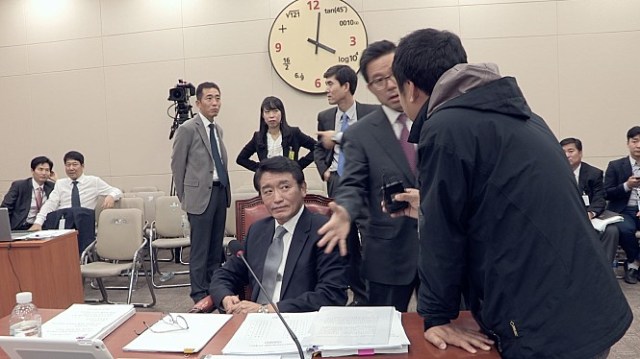
South Korean documentary film “Criminal Conspiracy” made me sad and angry for good reasons. During last 10 years, several major broadcasting companies in South Korean have been seriously damaged and corrupted by South Korean politicians and their cronies, and the documentary gives us a close, sobering look into how that injustice has happened with alarming consequences. Considering the recent political events in South Korean, there will probably be some good changes, but I think it will probably take lots of time for cleaning up the mess.

The documentary begins its story with Jung Yeon-joo, the former president of the Korean Broadcasting System (KBS). When Rho Moo-hyun became the new president of South Korea in 2003, he guaranteed to Jung that his government would not interfere with whatever would be reported by KBS, which is the No.1 broadcasting company in South Korea. He did keep his promise during the 5 years of his presidency, and Jung becomes a little emotional as recollecting when he later showed his gratitude to President Rho not long after the end of Rho’s presidency.

However, things quickly changed as President Rho was succeeded by Lee Myung-bak in 2008. When KBS reported on the corruption of some of Lee’s cabinet member candidates, it was one of the best moments in the South Korean journalism history, but this apparently displeased President Lee and his high-ranking government officials a lot. Jung and many others in KBS soon found themselves becoming the target of an unfair government investigation, and then the board members of KBS, who were virtually under the control of the South Korean government, decided to fire Jung at their impromptu meeting.

After he was officially fired, Jung was further humiliated with more investigation, and his vacant position was instantly filled by a man closely connected with President Lee. KBS consequently went through lots of drastic changes; its several notable political commentary programs were discarded while many reporters and producers were fired or demoted, and it also began to focus more on the public relations of the South Korean government.

criminalconspiracy05

Not so surprisingly, that was just the beginning of the entire takeover of South Korean TV media. Munhwa Broadcasting Corporation (MBC), which is the No.2 broadcasting company in South Korea, also suffered the same fate not long after it reported on a controversial trade treaty made between the South Korean government and the US government, and director Choi Seung-ho, who worked in MBC during that time, and many other employees of MBC came to experience the same ordeal which happened to those unfortunate KBS employees.

The middle portion of the documentary focuses on how numerous employees of KBS and MBC tried to resist against this injustice. They often held demonstrations in front of the buildings of their broadcasting companies, and some of fired reporters and producers including Choi founded an alternative media company for continuing their public service. As their protest became louder, they drew more public attention, and we see their efforts being appreciated and supported by many citizens.

However, their circumstance only became worse as President Lee was succeeded by President Park Geun-hye, who will surely be remembered as one of the worst presidents in the South Korean history. Her government simply continued what had been done during Lee’s presidency, and KBS and MBC came to be ruined further as becoming mere propaganda tools for the South Korean government.

This problem ultimately culminated to when KBS and MBC incorrectly reported on the sinking of MV Sewol on April 16th, 2014. They initially reported that everyone on the ship was rescued, but they just repeated what was said by government officials, and I and many other South Korean citizens were soon shocked and infuriated as watching the sheer incompetence of the South Korean government and the eventual tragedy of that terrible incident.

criminalconspiracy03

And then there came a huge political scandal which rocked the whole country during late 2016. When it turned out that President Park had been virtually controlled by her personal associate Choi Soon-sil, this unprecedented scandal surely drew lots of anger and attention in public, but KBS and MBC did not report much on that, and their reporters accordingly received lots of contempt when they came to report on the demonstrations against Park’s government.

Eventually, President Park was ousted shortly after her subsequent impeachment early in this year, and I and other South Korean citizens saw some hope as Moon Jae-in was elected as the new president of South Korea, but, as sharply pointed out in the documentary, the people responsible for the corruption of KBS and MBC seem to get away with what they committed. As a matter of fact, some of them even tried to suppress the theatrical release of this documentary in South Korea, though their impertinent attempt fortunately did not succeed.

Overall, “Criminal Conspiracy” works as a modest but vivid chronicle of the corruption of South Korean media. As he did in his previous documentary film “Spy Nation” (2016), Choi shows admirable persistence in his stubborn pursuit of truth and justice, and he also did a good job of presenting facts via an effective mix of archival footage and interview clips. The film surely deserves more audiences in South Korea, and I sincerely hope that will bring more public attention to its troubling subject.

criminalconspiracy02

Posted in Movies | Tagged , , | 4 Comments