Kedi (2016) ☆☆☆1/2(3.5/4): Cats in Istanbul

kedi01.jpg

If you adore cats like me, you will find that documentary film “Kedi” is a sheer delight right from its first scene. Looking here and there around the streets and alleys of Istanbul, the documentary presents a vivid glimpse into the daily life of numerous cats inhabiting in the city, and I must confess that it was rather difficult for me to maintain my objective critical viewpoint during my viewing. I could not help but amused by many small precious moments observed from those cute creatures, I could not help but touched by the genuine care and affection they receive from some decent citizens of the city, and, above all, I could not help but impressed by the considerable efforts put into the making of this amazing documentary.

In the documentary, seven different cats are introduced to us one by one, and each of them is equally memorable for each own personality and appearance. At first, we meet a female tabby cat, and we see how she goes through her daily routine for getting food for not only herself but also her little kittens. She and her kittens live in the stairwell of a building, and she also can have some rest in a shop inside the building thanks to its generous owner, who is always ready to provide a place for her.

In case of a female cat usually hanging around a textile shop owned by a middle-aged man, it turns out that she also gave birth to her kittens recently. The documentary watches her sneaking into some hidden place, and then it shows us what is going on inside that place in question. When a black cat happens to intrude into this private place of hers, she naturally becomes irritated by the intruder, and we are amused as watching how the black cat manages to stay there while not annoying her or her kittens.

kedi05

In one restaurant, there is a cat which has been a valuable figure for the restaurant. After this cat began to live near the restaurant, the restaurant finally became free of its annoying rat problem, and there is an amusing moment involved with its another search for rats during one evening. It surely senses a rat hiding somewhere, but the rat in question turns out to be a pretty sneaky one, and we get a good chuckle from this literal cat-and-mouse game.

One particular cat in the documentary is nicknamed ‘psychopath’, and there is a good reason for that. Always dominating over her territory, this lady cat is certainly feisty to say the least, and her male mate has no choice but to be pushed out of her way whenever she comes to eat first. When some other female cat dares to approach to her mate, she naturally becomes quite hostile, and she makes it pretty clear to her potential rival that nobody can take away her mate from her.

At a local market place, we meet a male cat which has been active around there for years. He is frequently mischievous as going around here and there in the market place, but the people working there are always friendly to him, and they also show some concern over whether he and other cats in the area will survive the ongoing redevelopment process in the city, whose landscape has constantly been changed with more modern buildings during recent years.

The next one is a male cat usually residing in a small bakery, and we hear about how this charming cat often gets himself into troubles and then gets injured as a result. He likes to spend some time in an apartment belonging to a middle-aged woman, and we watch how he enters that apartment with confident easiness. When some other cat comes into his territory, a tense but amusing turf war happens between them, and that is another entertaining moment in the documentary.

kedi06

Although it is mostly benign and mannered, a cat nicknamed ‘Smokey’ cannot help itself at times as following its nature. It usually stays quietly around a delicatessen, but it tries quite hard to draw attention whenever it gets hungry, and we see how much it is treated well. An employee working in the delicatessen gives not only meat but also cheese to this cat, and that takes me back to when I used to give pieces of cheese to a bunch of cats residing in the campus of Korean Advanced Institute of Technology and Science. Those cats surely enjoyed cheese, and I always attracted their attention whenever I unwrapped a pack of cheese in front of them.

The documentary also pays attention to several different citizens who have taken care of cats, and they have some interesting things to show and tell us. In case of one young female artist, she talks about how cats have influenced her femininity, and a fisherman tells us how he came to pay more attention to cats after one small happening. We meet a gregarious guy willing to talk a lot about cats, and he gives us a little explanation on how Istanbul has been strewn with cats for many years. We observe two old ladies who routinely provide freshly prepared food to numerous cats in their neighborhood, and then we hear a poignant personal story from one middle-aged man who has gotten a lot of comfort from taking care of his neighborhood cats.

While being quite amiable as expected, the documentary is also technically impressive, and director Ceyda Torun and her cinematographers Alp Korfali and Charlie Wuppermann surely deserve praises for vividly and intimately presenting their feline subjects on the screen. As closely observing cats, the cameras effortlessly capture a number of superlative moments to be admired and appreciated, and I sometimes wondered how they shot these moments without drawing unnecessary attention from cats.

Overall, “Kedi” is a charming documentary which is also quite terrific in many aspects, and it touchingly reminds me again of why I like cats a lot. Yes, cats may be really cold and selfish as some people say, but it is not easy for me to resist their charm, and I am always amused and delighted by them. After all, they are cute, aren’t they?

kedi03


Posted in Movies | Tagged , | 1 Comment

David Lynch: The Art Life (2016) ☆☆☆1/2(3.5/4): Lynch on his early art life

davidlynchtheartlife01

As one of the most fascinating filmmakers in our time, David Lynch has dazzled and confounded us with his odd surreal style during last 40 years. Since he made a striking impression on the audiences with his first feature film “Eraserhead” (1977), he directed a number of distinctive films including “Blue Velvet” (1986), “The Straight Story” (1999), and “Mulholland Dr.” (2001), and he also mesmerized many TV viewers with his ground-breaking TV series “Twin Peaks”, which recently made a glorious comeback 26 years after its unfortunate cancellation in 1991.

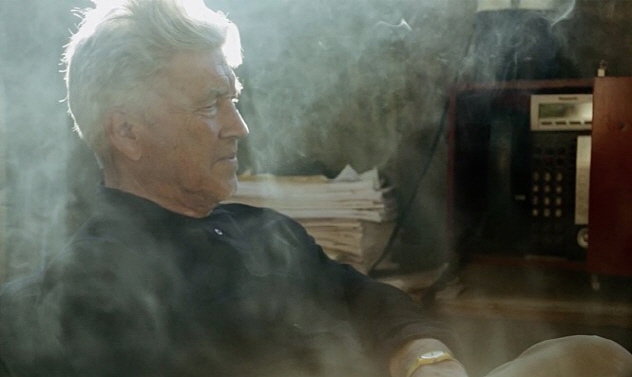
Because it mainly focuses on Lynch’s early years before “Eraserhead”, documentary film “David Lynch: The Art Life” may disappoint some of you, but it is still a compelling documentary nonetheless. As watching him recollecting how he grew up and how he was inspired to pursue his artistic career, the documentary presents an enlightening portrayal of Lynch as a young artist, and we come to get more understanding of what has fueled his art life for more than 50 years.

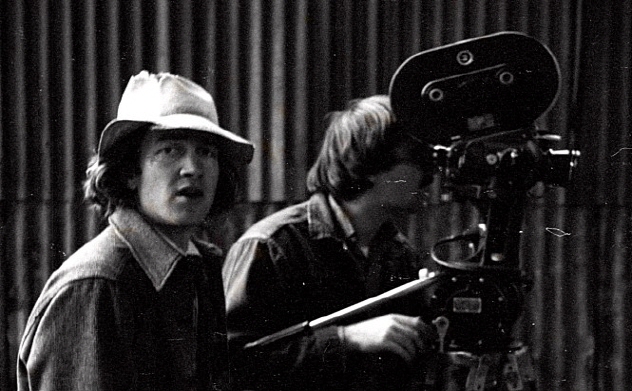
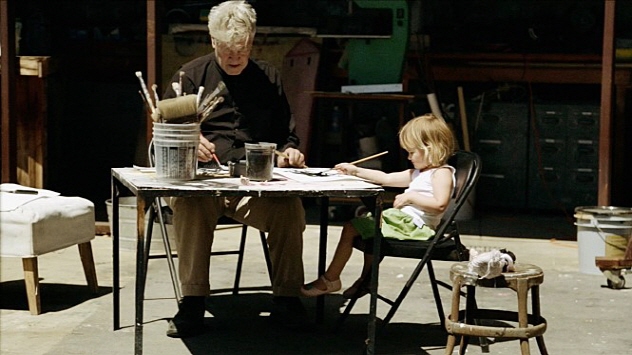
While often showing him working on his latest artworks in his studio located in California Hills, the documentary listens to Lynch as he casually reminisces his early years. As his father, who was a research scientist working for the U.S. Department of Agriculture, was transferred from one place to another, his family frequently had to move along with him, but Lynch’s childhood was normally happy and comfortable, and his parents willingly nurtured his potential. For example, Lynch’s mother never allowed her children to play with coloring books because she believed they would limit her children’s imagination, and Lynch is still grateful for her mother’s wise decision, which probably contributed a lot to the germination of his artistic talent.

davidlynchtheartlife02

Life was pretty good in young Lynch’s small suburban world, but there was one disturbing incident which is vividly remembered in his mind even at present. When he and his younger brother were outside their home on one day, they happened to spot a naked woman approaching toward them, and her apparently traumatized state deeply unsettled young Lynch and his younger brother. As some of you have already noticed, that happening later inspired one of notorious scenes in “Blue Velvet”, which was incidentally one of the main reasons why my late friend Roger Ebert hated that memorable cult film a lot.

In case of his adolescence, it was rather wild as he did some misdemeanors along with his high school friends, but, fortunately, Lynch soon found something he could be passionate about. One of his friends was the son of an artist named Bushnell Keeler, and Lynch instantly felt the desire to be an artist when he came to Keeler’s studio. As Lynch spent more time on developing his own art, Keeler became his big supporter, and he even defended Lynch when Lynch had an argument with his father.

For further polishing his talent, Lynch went to the School of the Museum of Fine Arts, Boston in 1964, but he did not like what its teachers taught to him and others in the school, and he also did not get along well with his roommate Peter Wolf as reflected by one amusing episode involved with a Bob Dylan concert. Eventually, Lynch and his best friend Jack Fisk, who would later be a notable production designer in Hollywood and Oscar-nominated for his works in “There Will Be Blood” (2007) and “The Revenant” (2015), went to Europe for studying under Oskar Kokoschka at his school in Salzburg, but their plan miserably failed when they arrived in Salzburg, so they returned to US 15 days later.

davidlynchtheartlife03

Anyway, things became better for Lynch when he began to study in the Pennsylvania Academy of Fine Arts, Philadelphia in 1966. Besides being with Fisk again, he was happy to find a place where he could study art more comfortably, and he also came to live with a young woman named Peggy Reavey, who later became his first wife shortly before giving birth to his first child Jennifer.

However, Philadelphia gave a rather unpleasant impression to Lynch. As he talks about many ugly sites and people he came across during his time in Philadelphia, the documentary presents us a series of striking black and white photographs showing  shabby abandoned areas of the city, and you will have a pretty good idea on his source of inspiration behind those bleakly nightmarish scenes in “Eraserhead”.

Around that time, Lynch became more interested in filmmaking. After making several short films including “The Alphabet” (1968), he applied for a grant from American Film Institute (AFI), and he was fortunately selected as one of its grant recipients. Thanks to his subsequent short film “The Grandmother” (1970), he could go to the AFI Conservatory, and that was where he learned more about filmmaking before making “Eraserhead”.

Although it does not look beyond that crucial period in Lynch’s life and career, “David Lynch: The Art Life” is a must-see for anyone interested in Lynch and his works. Directors Jon Nguyen, Rick Barnes, and Olivia Neergaard-Holm did a commendable job of mixing Lynch’s words with various archival materials, and I was entertained a lot while appreciating more of Lynch’s own artistry. As shown from this documentary and the recent season of “Twin Peaks”, he is still a passionate artist full of imagination and inspiration, and I truly hope that he will share more with us in the future.

davidlynchtheartlife04

Posted in Movies | Tagged , , , | Leave a comment

Strong Island (2017) ☆☆☆1/2(3.5/4): Remembering his brother – and how he was killed

strongisland04.jpg

Calmly examining one case of senseless killing and the resulting anger and grief, documentary film “Strong Island”, which is currently available on Netflix, makes its intention very clear to us right from the beginning. It wants us to see how tragic the case was, it wants us to feel how devastating the case was to the victim’s family and friends, and it wants us to realize how unfairly the case was handled by the justice system. Austerely sticking to its personal perspective, the documentary is not exactly ‘balanced’ in its narrow viewpoint, but we are slowly gripped by its quiet emotional power nonetheless, and it gives us many haunting moments to linger on our mind.

The narrative of the documentary revolves around a tragic death which happened at a small auto body shop located in a suburban area of Long Island on April 7th, 1992. During the night of that day, a 24-year-old black man named William Ford Jr. was shot to death by a 19-year-old white mechanic named Mark Reilly, and this was quite a shock to Ford’s family. At one point during her interview, Ford’s mother recollects how much she was devastated when she heard the news, and you can sense that she is still struggling with the grief over the untimely death of her dear son.

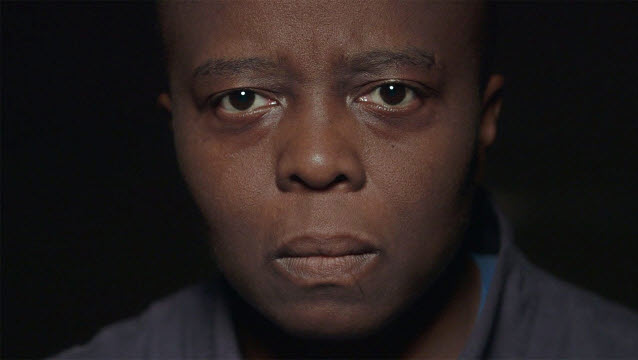
Director Yance Ford, who is one of William Jr.’s younger siblings, gives us an intimate presentation of his family history. Not long after they married, his parents William Sr. and Barbara moved to New York City from South Carolina during the 1960s, and it looked like they could happily live there without the racism they usually experienced in the South. After abandoning his dream of being a draughtsman for practical reasons, William Sr. began to work as a train conductor on a NYC subway line, and Barbara became a teacher as she hoped. Besides teaching students, she also taught female inmates of Rikers Island prison, and that was just one of many things she is still proud of.

strongisland03

Above all, Barbara and William Sr. wanted to provide a good environment for their three children William Jr., Yance, and Lauren. When they moved to a suburban area outside New York City, they were delighted at first, but they soon found themselves confronting a subtle form of racial segregation. While it was nice to be surrounded by other black families moving from New York City just like them, their neighborhood was virtually segregated from the surrounding white neighborhoods, and they were always conscious of that whenever they went outside their neighborhood.

Nevertheless, William Sr. and Barbara were happy to see their children growing up well under their care. As the eldest child, William Jr. was always someone to lean on for Lauren and Yance, and William Jr.’s two close friends remember how amiable he was to them and others. At one point later in the film, Ford reminisces when he happened to be aware more of his burgeoning sexuality (He was a girl during that time, by the way), and he regrets that he did not confide that to his brother early before he was killed.

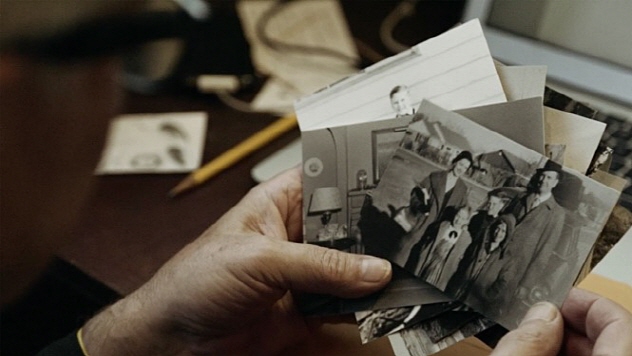
While its interviewees talk directly to us, the documentary shows us a bunch of family photographs one by one. As each photograph is put on the white background by Ford’s hand, the documentary feels more personal and intimate, and that impression is further accentuated while Ford places himself quite close to the camera during his interview. He wants us to pay attention to not only his words but also his feelings, and he succeeds as willing to bare himself in front of our eyes without any pretension.

Although the documentary does not delve deep into what exactly happened at that tragic night, it is apparent that William Jr. and his family were unjustly treated by the justice system. Detectives and prosecutors assigned to the case did not try much in their investigation, and, not so surprisingly, the case did not go to the trial as the grand jury decided not to indict Reilly for his killing. Besides being devastated again by this unfair outcome, Williams Jr.’s family was frequently harassed by vicious phone calls during many nights, and Ford still remembers well those tormenting nights he had to endure during that time.

strongisland02

Trying to process his grief and make a sense of his brother’s death, Ford contacts two people who handled the case at that time. While one of them rejects to talk anything about the case, the other one is willing to talk with him, so he asks a few questions to him, but that leads to more confusion and grief as the case turns out to be not as simple as it initially seemed. During that moment, Ford is emotionally overwhelmed, but he lets the camera firmly stick to him, and the result is indubitably harrowing to say the least.

When Ford later reads the excepts from his brother’s diary, the sense of grief becomes more palpable to us. Life surely went on for William Jr.’s family after his death, but it is evident that they are still not recovered from his death, and their sadness is deepened further by an unexpected moment I will not describe here. While we can clearly see that Ford tries to draw emotional responses from us at that point, it definitely works thanks to what his documentary has carefully and steadily built up, and we accordingly come to share more sadness with him and his family.

Although it will probably demand some patience from you due to its slow pacing, “Strong Island”, which received the Special Jury Prize at the Sundance Film Festival early in this year, will engage you and then move you while making you muse on the social injustice indirectly reflected by its deeply personal story. 25 years have passed since William Ford Jr.’s death, but nothing much is changed in the American society as shown from the death of many black young men including Trayvon Martin, and this social problem has only gotten worse during recent years. Will there be any change in the end? I am rather skeptical, but I really hope that there will eventually be the justice for not only William Jr.’s but also other similarly unfortunate black families in US.

strongisland01

Posted in Movies | Tagged , , | 1 Comment

Icarus (2017) ☆☆☆(3/4): The biggest doping scandal in sports history

icarus01

Bryan Fogel’s documentary film “Icarus” begins with one story and then goes into the other story. While the former is mildly fascinating, the latter is more compelling in comparison, and the documentary wisely lets the latter take the center, as presenting us the sobering presentation of a huge doping scandal which will probably be remembered as the biggest one in sports history.

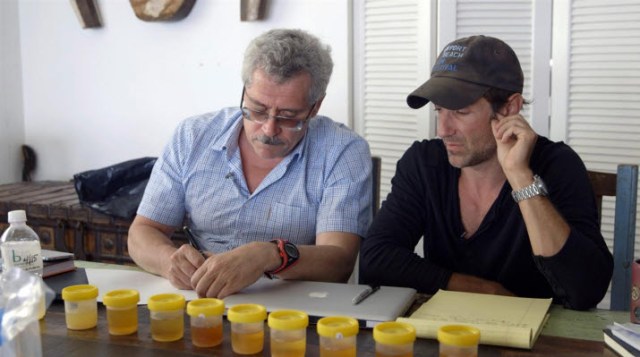
The first story begins with when Fogel decided to subject himself to a doping program for his documentary in 2014. As an avid amateur cyclist, he was certainly disillusioned when Lance Armstrong admitted that he used performance-enhancing substances, and then he became interested in whether he can get away with doping program just like Armstrong did many times. As he prepared for the Haute Route in Switzerland during next several months, he consulted several experts including Don Catlin, and Catlin, a renowned anti-doping scientist who is one of the founders of modern drug-testing in sports, later recommended Fogel a Russian scientist he has known for a long time.

The person in question was Grigory Rodchenkov, who was the director of the Anti-Doping Center in Moscow at that time. Compared to Catlin, who became reluctant as worrying about whether Fogel’s experiment could hurt his reputation, Rodchenkov was more willing to help Fogel, and we see Fogel routinely popping pills or injecting drugs into his body under Rodchenkov’s guidance. While his physical ability was notably enhanced during several months, Fogel also prepared his urine samples as instructed by Rodchenkov, and they were ready to pass the drug tests when Fogel was about to participate in the Haute Route in May 2015.

icarus02

However, things did not go as well as they planned. Before and during the race, Fogel and other participants never went through any drug test, and that nullified Fogel and Rodchenkov’s meticulous preparation. In addition, Fogel came across a small mechanical problem during the race, so his performance in the race turned out to be less satisfying than he hoped.

At least, he became Rodchenkov’s close friend as frequently corresponding with him, and that was how he was led to the second story of his documentary. While he and Rodchenkov were preparing for the Haute Route, a Germany documentary film exposed a state-sponsored doping in sports by the Russian government via a number of whistle blowers, and the Anti-Doping Center in Moscow accordingly drew lots of attention as the World Anti-Doping Agency (WADA) started an independent investigation. Although he continued his correspondence with Fogel, Rodchenkov became more discreet as his laboratory was further investigated by WADA, and then he became all the more anxious after he resigned from his position. When he eventually decided to leave Russia for his safety, the mood of the documentary becomes more tense and nervous than before, and Fogel accordingly pumps up some suspense into the screen as indirectly depicting how Rodchenkov got out of his country.

Not long after Rodchenkov safely arrived in LA, the situation took a dark turn in Russia. One of Rodchenkov’s close colleagues suddenly died under a very suspicious circumstance, and that confirmed to Rodchenkov and Fogel that they had to be really careful about their next move. When Rodchenkov received a subpoena from the US Department of Justice, they instantly consulted lawyers, and they also contacted New York Times reporters for fully revealing what the Russian government was trying to cover up.

icarus03

Rodchenkov gives us a detailed description of how the Russian government cheated during the 2014 Sochi Winter Olympics, and its elaborate scheme sounds like something coming out of espionage novels. While it looked like every corner of the Anti-Doping Center building was constantly monitored on the surface, there was a hidden room in the building, and that room was where those ‘dirty’ urine samples from Russian athletes were swapped with ‘clean’ ones by the agents of Federal Security Service (FSB). As a result, all of the Russian athletes participating in the 2014 Sochi Winter Olympics could pass their drug tests without any problem, and Vladimir Putin and his Russian Government surely got what they wanted. When the 2014 Sochi Winter Olympics was over, Russia garnered no less than 13 gold medals besides being on the top of the competition, and Putin’s subsequent approval rate literally skyrocketed thanks to that.

When its state-sponsored doping in sports was further exposed by Rodchenkov in May 2016, the Russian government vehemently denied everything even as the WADA investigation committee eventually concluded that there is not any doubt on the fraud committed by the Russian government during the 2014 Sochi Winter Olympics. While Russia was initially suspended from participating in the 2016 Rio Summer Olympics, the suspension was loosened a lot in the end, and Russia was also allowed to participate in the upcoming Winter Olympics to be held in Pyeongchang, South Korea.

Although it is a bit overlong while occasionally trying to make its points a little too hard, “Icarus”, which is currently available on Netflix, is still an engaging documentary film. I was amused by Fogel’s experiment, I was gripped by Rodchenkov’s plight, and I was alarmed by what has been going on in that competitive world of sports. We can all agree to that this must be stopped, but, considering how the Russian government virtually got away with its fraud, I cannot help but doubt whether that is really possible.

icarus04

Posted in Movies | Tagged , , | 1 Comment

I Can Speak (2017) ☆☆☆(3/4): She wants to speak…

Icanspeak04.jpg

South Korean film “I Can Speak” is more serious than its trailer suggests. When I watched the trailer, I thought it was merely another silly comedy film, but then I heard that it is about a certain serious historical subject which is still reverent at present, and I am happy to report that the movie is better than I initially expected. Although it is sometimes clumsy especially during its melodramatic second half, the movie mostly works thanks to the engaging interactions between its two lead performers, and it surely earns its laughs and tears even though we can clearly see through its manipulative aspects.

During the opening scene, we meet Park Min-jae (Lee Je-hoon), a young public servant who is recently transferred to one district office in Seoul. When he begins the first day at his workplace, everything looks fine as he and others ready themselves for work, but then there comes someone who has been feared by his co-workers for many years. The person in question is an old lady named Na Ok-boon (Nah Moon-hee), and she has been quite notorious in her neighborhood for routinely filing civil appeals for various things. Her latest civil appeal is involved with a suspicious guy who often purposefully damages an old building in her neighborhood, and she suspects that this is connected with a local construction company which wants to redevelop the area surrounding that building as soon as possible.

As nobody else in the district office wants to get involved with Ok-boon, Min-jae decides to handle her latest civil appeal by himself, and he soon comes to see why his co-workers call her ‘troll granny’. After they happen to come across each other at a private English academy, Ok-boon persistently requests Min-jae to teach her English in private, and he eventually surrenders with one condition; she must pass his test first, and then he will teach her.

Icanspeak02

Of course, Min-jae intends to block her request once for all, and the movie gives a small amusing moment when Min-jae demands Ok-boon to memorize 100 words which, in my inconsequential opinion, are rather difficult for beginners. For example, he deliberately chooses sophisticated words like ‘encyclopedia’ or ‘conspiracy’, and that took me back to those good old days when I eagerly absorbed many difficult English words for enriching my vocabulary.

It is not much of a spoiler to tell you that Min-jae eventually changes his mind as he comes to see Ok-boon’s more gentle and likable side. While she is indeed an annoying busybody to many people around her, Ok-boon really cares about her neighborhood and neighbors, and that aspect is apparent when she confronts a group of thugs cornering one of her neighbors – or when she shows considerable kindness to Min-jae’s teenager brother who has lived with Min-jae since their parents died some years ago.

Around its midpoint, the movie takes an expected turn after Min-jae and Ok-boon become closer to each other than before, but then it takes another narrative turn as Ok-boon’s hidden past is fully revealed to Min-jae and others. I will not go into details here, but I can tell you instead that Ok-boon’s desire to learn English turns out to be based on a personal reason involved with her old friend Jeong-sim (Son Sook). As shown from one flashback scene later in the movie, she and Jeong-sim have shared a terrible past which still hurts them a lot, and that reminded me of how many Korean women like them had to hide their pain and shame for many years before they recently came to open their mouth.

Icanspeak01

After going through a series of melodramatic moments, the movie culminates to an obligatory dramatic moment for Ok-boon, and I must point out that this moment is clichéd and heavy-handed at times. In case of two certain minor supporting characters appearing during that moment, I understand that they simply exist for emphasizing what is at stake for Ok-boon and many other women she represents, but they look so broadly despicable that you will be surprised to see that they do not have any mustache to twirl.

Nevertheless, the movie is not entirely without emotional appeal, and that is mainly because of Nah Moon-hee’s likable performance. As grabbing our attention right from her first scene, Nah fills her character with a considerable amount of life force, and we come to like and understand Ok-boon while accepting her brash, colorful personality. Deftly handling many humorous scenes during the first half of the film, Nah also brings genuine sadness to more serious scenes during the second half, and she surely holds her ground well during the aforementioned dramatic moment.

On the opposite, Lee Je-hoon functions as a humble but effective counterpart to Nah’s showier acting. While stepping aside for his co-star from time to time, Lee ably captures the dry humor in his character’s no-nonsense attitude, and he is also believable as his character comes to care about Ok-boon more than expected. In case of the supporting performers in the movie, Park Chul-min, Yum Hye-ran, and Lee Sang-hee are fine in their respective roles, and Son Sook is poignant in her few scenes with Nah. As they talk with each other, we can instantly sense a long history between their characters, and we are not so surprised when Ok-boon later makes a certain decision without any hesitation.

“I Can Speak” is directed by Kim Hyun-seok, who previously made “Y.M.C.A. Baseball Team” (2003), “Scout” (2007), and “Cyrano Agency” (2010). Compared to these well-made comedy drama films, the movie is less satisfying in terms of story and characters, but its good elements are still strong enough to compensate for its notable flaws, and I sincerely hope that the movie will draw more public attention to its subject.

Icanspeak05


Posted in Movies | Tagged | Leave a comment

Brad’s Status (2017) ☆☆☆(3/4): On his insecure status

bradsstatus01

Going through the 34th year of my life at present, I sometimes wonder whether I am fine with my current status. While I recently managed to settle on a modest but stable job after several years of personal confusion and difficulty, I often cannot help but think of the time which irreversibly passed by me during last 17 years, and I feel regretful and anxious as reflecting on the fact that I already spent more than a third of my possible life span. Could have I done better than this? And am I really all right with where my life is going?

That is why I was amused and touched by a similar type of anxiety and discontent observed from the hero of “Brad’s Status”. Although he is different from me in many aspects besides being more than 10 years older than me, his thoughts and feelings are not alien to me at all, and I constantly got small laughs thanks to several sharp, honest moments in the film. While he often looks silly and pathetic, we come to emphasize with him as understanding his insecurity and frustration, and the movie is also supported well by an engaging performance from its talented lead performer.

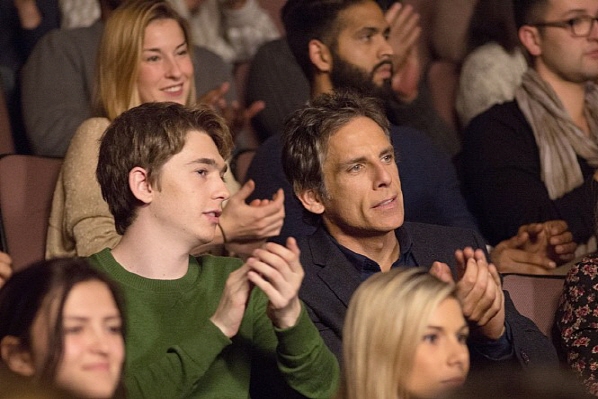
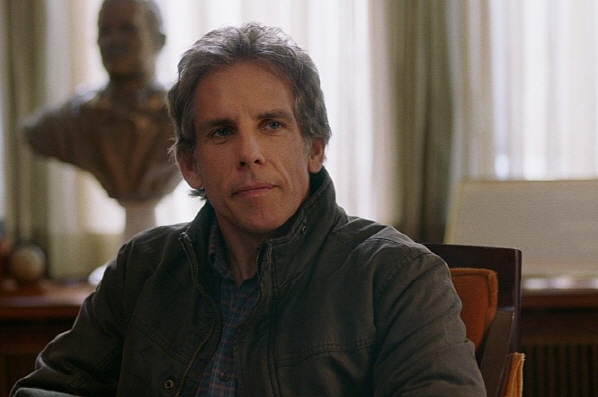
Ben Stiller, who has always been good at playing insecure characters with human flaws, plays Brad Sloan, a fortyish guy who has led your average middle-class American life with his wife Melanie (Jenna Fischer) and their teenager son Troy (Austin Abrams). While Brad runs a non-profit organization, Melanie has been prominent in her academic field, and Troy is preparing himself for college enrollment as going through his last high school year.

bradsstatus05

Troy wants to go to Harvard University, so he and Brad fly to Boston for visiting not only Harvard but also Brad’s alma mater, which can be the second option if Troy is not accepted by Harvard. For having a good time with his son, Brad tries as much as he can do, but then things do not go as well as he wishes. He experiences a rather embarrassing moment when he tries to change their original plane tickets with the ones for business class, and then there comes a little complication when they go to Harvard on the next day.

However, it looks like that problem can be solved via Craig Fisher (Michael Sheen), who was one of Brad’s close schoolmates during their college years and is also a visiting professor in Harvard besides being a famous author with a considerable career. Although it has been several years since they met each other for the last time, Fischer instantly agrees to give a little help to his old friend, and Brad is certainly happy for that.

However, he feels unhappy as thinking more about how Fisher and other three college friends look more successful than him. While Billy Wearsiter (Jemaine Clement) is enjoying his early retirement after selling his lucrative IT company, Jason Hatfield (Luke Wilson) is a hotshot hedge fund manager of Wall Street, and he is also married to a rich woman who probably gives her husband more clients. In case of Nick Pascale (Mike White), he has been a successful filmmaker working in Hollywood, and Brad feels hurt when he comes to learn that he was not invited to Nick’s recent wedding.

Brad gets some consolation from how Troy grows up well as a good son, but then he cannot help but be envious of what may lie ahead in his son’s future, and we get an amusing scene as Brad imagines how he will be regarded by his son in the future. Will he be proudly remembered by his son? Or will he be simply ignored?

bradsstatus04

Of course, the movie later goes through a predictable turn as Brad comes to realize that his old friends are not as successful as they look on the surface, but the screenplay by director/writer Mike White, who previously wrote the screenplays for “Orange County” (2000) and “School of Rock” (2003), keeps providing amusing scenes coupled with keen insights. As directly pointed out by one of supporting characters in the movie at one point, Brad is actually not as miserable as he believes, and the movie also recognizes how privileged he really is compared to many other people around the world. After all, he is a first-world citizen who is also a middle-class white male, isn’t he?

Nevertheless, we come to care about Brad’s bumpy situation as the movie depicts it with honesty and perceptiveness, and Ben Stiller deftly goes back and forth between drama and comedy in his nuanced performance. While I still remember well his many hysterically funny scenes in “There’s Something About Mary” (1997), Stiller has recently shown his more serious sides via a number of notable films including “Greenberg” (2010) and “While We’re Young” (2014), and the movie shows us again that he is always effective whenever he plays an everyman who tries a little too hard at times.

The supporting performers surrounding Stiller are also fine on the whole. While Austin Abrams is convincing in his scenes with Stiller, Jenna Fischer brings some warmth to what could have been a thankless role, and Shazi Raja has her own moment when her character happens to spend some hours with Brad. Luke Wilson, Jemaine Clement, and Michael Sheen are all suitably cast in their small supporting roles, and Sheen ably exudes his character’s loftiness during his scene with Stiller.

Overall, “Brad’s Status” is a small but funny character comedy drama film, and I enjoyed its humor and insights as reflecting again on my life. Sure, I am not as successful as I once hoped, but I have been lucky in many aspects, and I am doing what I like at this very moment thanks to that. At least for now, that’s all right for me.

bradsstatus03

Posted in Movies | Tagged , | Leave a comment

Keep Quiet (2016) ☆☆☆1/2(3.5/4): The repentance of an anti-semite Jewish Hungarian

keepquiet01

Joseph Martin and Sam Blair’s documentary film “Keep Quiet” presents one extraordinary human story. Here is a man who has tried to reach for repentance and redemption since he confronted a hidden truth which shattered what he had fervently espoused for years, and the documentary gives us a number of quiet but powerful moments as calmly observing not only who he was but also whom he tries to be at present. While we cannot help but have some doubt on him for good reasons, the documentary is still a thought-provoking experience, and its main subject is surely relevant considering the recent political situation around the global community.

His name is Csanád Szegedi, and the early part of the documentary is mainly about his early years and his following rapid political rise during the 2000s. Considerably influenced by his father’s right-wing nationalistic view, Szegedi was ready to embrace nationalism during his college years, and he talks to us about how much he was drawn to far-right propagandas filled with crackpot ideas such as a global Jewish conspiracy. He eventually joined a radical nationalist party named Jobbik, and he quickly became quite prominent in public thanks to his wild, charismatic rhetoric.

As pointed out in the documentary, Szegedi and his party were at the right moment for aggressively expanding their political influence. As Hungary struggled with economic depression in 2006, many people in the country felt angry about the failure of their government, and Jobbik further propelled that volatile mood in a way not so far from how Hitler and his Nazi party did in Germany during the 1930s. Szegedi and other leading figures of Jobbik constantly propagated their messages full of xenophobia and anti-semitism in public, and he and his close associates even founded a paramilitary group called Magyar Gárda (Hungarian Guard), which was fortunately banned in 2009.

keepquiet02

As he began to serve in the European Parliament thanks to his party’s considerable political success in 2009, Szegedi was prepared to go higher, but then there came an unexpected disclosure. When one of party members disclosed to Szegedi and others that Szegedi’s maternal grandmother is actually Jewish, Szegedi could not believe it at first, but there was an undeniable evidence, and then it was confirmed to him by his maternal grandmother, who also revealed to her grandson that she was a survivor of Auschwitz concentration camp. Once this unbelievable fact was eventually exposed in public, everything in Szegedi’s public life instantly crumbled; he had no choice but to leave his party, and he confides to us that he even considered a suicide as feeling more morose and confused during that time.

While trying to deal with his confusion, Szegedi tried to find a way to restart his life and amend himself, and he found the way from an unlikely place. He went to a local synagogue in Budapest, and that was where he met Baruch Oberlander, who was understandably skeptical about Szegedi’s intention but decided to help Szegedi because that is what he should do as a compassionate religious man. Under Oberlander’s guidance, Szegedi slowly entered the world of Orthodox Judaism, and we watch him going through a number of rituals while accompanied with Oberlander and other rabbis.

Through Oberlander, Szegedi came to learn more about the Holocaust, which he and his former right-wing colleagues virtually derided and denied for years. At one point, we see him and Oberlander visiting a famous spot in Budapest where many Jewish people were killed during 1944-45, and Oberlander makes a sobering point on how many Hungarians were quite willing to assist Nazi Germany in murdering Jewish people. Szegedi also visited Auschwitz concentration camp along with an old lady who was sent there just like his grandmother, and he came to see that his grandmother did not exaggerate at all.

keepquiet04

As looking around the remains of the concentration camp along with Szegedi, the old lady tells him and us about what she experienced during that horrific time, and that is the most harrowing and haunting moment in the documentary. She still remembers well when she was sent to the concentration camp along with thousands of people including her families and friends, and we can feel her pain and sorrow as listening to her tragic story.

While getting himself closer to his Jewish root, Szegedi tried to present himself in public as a repentant man quite different from his former self, and Oberlander supported that as much as he could, but, of course, that turned out to be quite difficult. After Szegedi gave a speech at a meeting held in Germany, several people openly showed their skepticism on his changed status. During his visit to Canada, he was held by authorities for a while due to his political past, and he had to leave sooner than planned.

Is Szegedi really sincere in this rather dramatic personal transformation? And can he possibly attain what he supposedly hopes for? “Keep Quiet” wisely sticks to its calm, objective position, we come to wonder constantly about Szegedi and what will happen next in his uncertain life, and all I can tell you for now is that there is some tentative hope around the end of the documentary. Regardless of what you will think of him, this is one of the most fascinating documentaries of this year, and I am glad that it is widely available at present thanks to Netflix.

keepquiet03


Posted in Movies | Tagged , , , , | Leave a comment

The Running Actress (2017) ☆☆☆(3/4): It’s hard out here for an actress…

therunningactress01

First, let me talk a bit about Moon So-ri, who has been one of the most prominent movie actresses in South Korea during last two decades. After drawing the attention of South Korean audiences in Lee Chang-dong’s “Peppermint Candy” (2000), she gave an unforgettable performance in Lee’s following work “Oasis” (2002), and then she entertained us with her stellar performances in a series of good films including “A Good Lawyer’s Wife” (2003), “The President’s Barber” (2004), “Family Ties” (2006), “Forever the Moment” (2008), and Hong Sang-soo’s several films such as “Hahaha” (2010) and “Hill of Freedom” (2014). Even when she only made a brief appearance in Park Chan-wook’s “The Handmaiden” (2016), she gave us something to remember, and I certainly enjoyed her spirited voice performance in animation feature film “Leafie, A Hen into the Wild” (2011).

During recent years, Moon also tried writing and directing. She previously wrote and directed three short films “The Actress” (2014), “The Running Actress” (2015), and “The Best Director” (2015), and these three short films are assembled here together in her first feature film “The Running Actress”. While the overall result may look modest on the surface, the movie is filled with small funny moments which constantly induced laughs and chuckles during the screening I attended during last Saturday evening, and I was certainly delighted by her interesting attempt in filmmaking.

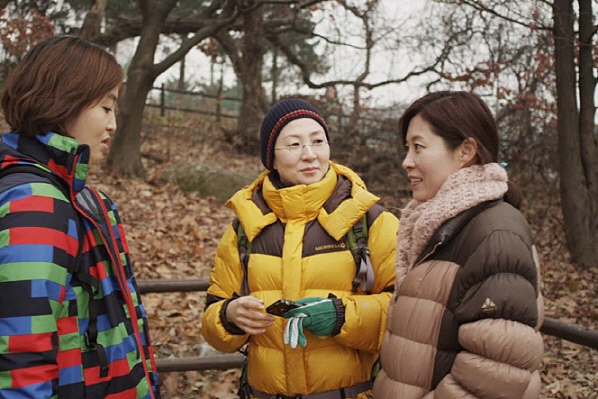
In all of these three short films, Moon So-ri plays a fictional version of herself, and the first short film, “The Actress”, opens with Moon being about to go hiking along with her two female friends. As they talk with each other while climbing up a mountain outside Seoul, their conversation is naturally turned to Moon’s recent acting career which does not seem to be going nowhere due to the lack of good screenplay, and we get little good laughs as Moon and her friends talk more about that.

therunningactress02

The situation becomes funnier when Moon and her friends come across a movie production company guy and two other guys accompanying him. When they enjoy their drinking after climbing down the mountain, they meet these guys again, and that leads to a moment not so far from those drunken comic moments of Hong Sang-soo’s films. Quite more inebriated than Moon and her friends, these guys generate silly moments of embarrassment and rudeness, and you may simultaneously laugh and cringe as watching how much Moon feels insulted and exasperated by these drunken guys’ insolent remarks on her life and career.

Moon did a good job of accumulating comic momentum during this painfully funny scene, which is then followed by a couple of equally amusing scenes. Moon tries to get some consolation from one of her friends when they have a little talk outside later, but her friend does not help her much while keeping emphasizing what Moon should do as one of the best actresses in South Korea. When she is going back to home, Moon is understandably a bit harsh to her manager, and that leads to another funny moment in the film.

The second short film “The Running Actress”, which was shot in 2.35:1 ratio in contrast to the other two short films which were shot in 1.85:1 ratio, focuses on Moon’s one long, difficult day. We see her beginning the day at her home where she lives with her husband, her daughter, and her mother, who asks Moon to do some favor for her when Moon is about to leave their home. We see her trying to deal with a problem involved with a bank account belonging to her mother-in-law, who does not even seem to remember whether she has a bank account or not. And we see her having a rather awkward meeting with a middle-aged independent filmmaker, who wants her to make an appearance in his film without getting paid much.

therunningactress03

While this part feels merely episodic, it gradually conveys the sense of suffocation felt by Moon in the film. She wants to keep working as usual, but there are so many other things to be handled besides her little daughter, and her husband’s little sympathetic words do not make her situation look better. In the end, we come to emphasize with her a lot as watching her trying to ventilate her frustration, but we also cannot help but laugh thanks to Moon’s good comic timing.

The third short film “The Best Director” also provides plenty of laughs despite its supposedly solemn background. A director with whom Moon worked a long time ago recently died, so Moon comes to attend his wake, but there is no other visitor besides a washed-up actor who worked with Moon in the past. Quite drunken alone, this guy rudely suggests that Moon have a drink with him, and Moon reluctantly agrees to spend some time with him. The mood becomes more awkward as they talk more about the diseased director, and then there comes another visitor, who only makes the situation a lot more awkward.

I will not go further into details for not spoiling your fun, but I can tell you that I was impressed by how confidently Moon handles this scene. As the camera calmly watches the conversation between Moon and the other characters for a long time, the level of hilarity is increased to our amusement before the movie eventually punctuates the situation with a sudden moment you have to see for yourself, and I like how Moon finishes the story with an unexpected tender moment between Moon and one certain character.

While being an enjoyable summation of another side of Moon’s talent, “The Running Actress” also makes sharp points on how many talented South Korean actresses like Moon have been under-utilized during recent years, and that reminds me of how most of recent major South Korean films have been male-dominant despite the notable critical success of “The Handmaiden” and other South Korean films representing female perspectives. That biased trend is surely needed to be changed, and I sincerely hope there will be more chances for Moon as well as other talented women in South Korean movie business.

therunningactress04

Posted in Movies | Tagged , , | 1 Comment

Wind River (2017) ☆☆☆1/2(3.5/4): A bleak, chilly procedural on the wilds of Wyoming

windriver01

While often quite stark in its gloomy tone, “Wind River” is a compelling procedural which gradually grabs our attention via its vivid atmosphere and deft storytelling. As it slowly builds up its story and characters, we become absorbed into its harsh, violent world where everyday is a struggle for survival, and there are several haunting moments which will linger on you for a long time after it is over.

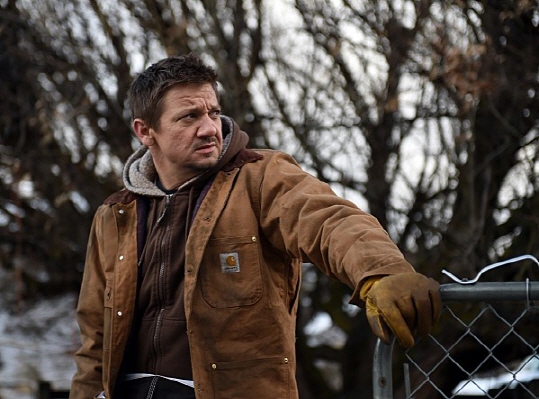
After the chilly opening scene unfolded across a wide snowy field in the middle of one cold winter night, the movie introduces us to Cory Lambert (Jeremy Renner), a tracker working for the US Fish and Wildlife Service around the Wind River Indian Reservation in Wyoming. When we see him for the first time, he is protecting a herd of goats in one local farm from a few wolves, and we observe how efficient he is as a professional while he shoots some of those wolves one by one.

On one day, Lambert happens to discover a frozen corpse while doing another tracking job near the farm belonging to his native ex-wife’s father. It is the body of the girl who was shown to us during the opening scene, and he knows who that girl is. Her name is Natalie (Kelsey Chow), and she was a close friend of his dead daughter, who died several years ago under a circumstance still remaining to be unclarified.

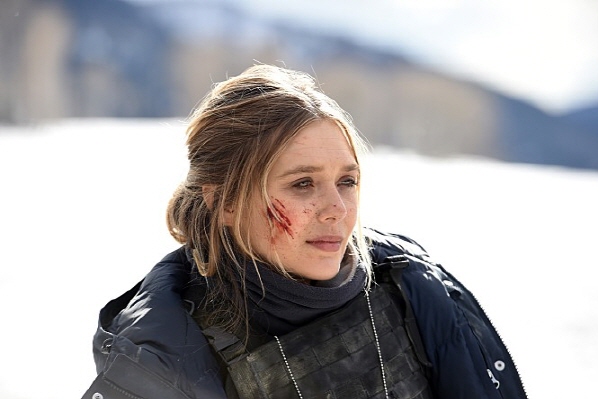
Because Natalie’s body is found within the reservation area, the case is going to be investigated by the local police of the reservation area, but FBI sends an agent to the area for confirming whether the case is serious enough for investigation. The agent in question is Jane Banner (Elizabeth Olsen), and the movie gives us some amusement as she hurriedly comes from Las Vegas without enough preparation. Due to a sudden blizzard, she nearly loses her way even though her car is quite close to where Lambert and others are waiting for her, and then she has to borrow several winter gears for going to the crime scene along with others.

windriver04

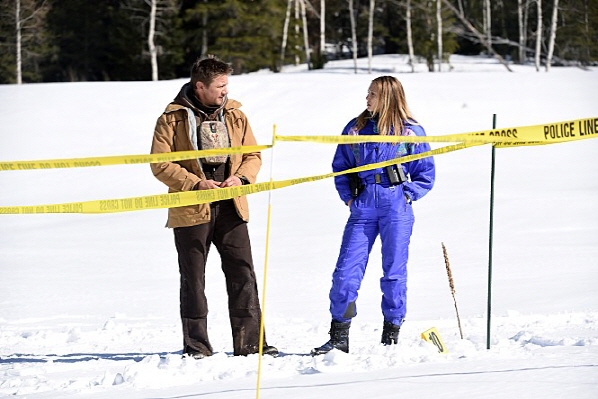
Nevertheless, she knows not only what she should do but also what she needs for doing that. After seeing how Lambert clearly deduces what possibly happened from the trail around the crime scene, she instantly enlists him for her investigation, and he is willing to help her as a guy who knows well the area as well as its people. Still haunted by his daughter’s death, he wants a chance of redemption from this case, and that aspect is clearly shown from when he talks with Natalie’s grieving father in private.

The movie takes its time as immersing us into its moody wintry background, and we come to get accustomed to its bleak sense of life around Lambert and other characters living in and around the reservation area. Their life is full of despair and ennui without much hope, and that is particularly exemplified well by a bitter conversation scene between Lambert and a young native guy, who was once promising in the past but went down into the pit of addiction probably because of his frustration with racism.

And we get to know more about Lambert as he works more with Banner. As discerning that they must depend on each other for solving the case, Lambert and Banner come to respect each other as equal partners, and the movie wisely does not go for any possibility of romance between them – even when Lambert confides to Banner about that tragic night which changed his life forever.

windriver03

The mystery surrounding Natalie’s death turns out to be rather simple, but director/writer Taylor Sheridan, who wrote the screenplay for “Sicario” (2015) and was recently Oscar-nominated for his screenplay for “Hell or High Water” (2016), steadily increases narrative momentum as his main characters delve deeper into their case. As the movie approaches to its expected finale, we are already quite involved in what is in stake for them, and that is why a sudden narrative turn around that point works.

The movie is supported well by a bunch of good performers. Since his electrifying Oscar-nominated performance in “The Hurt Locker” (2008), Jeremy Renner has impressed us with a number of notable performances which are more interesting than his obligatory acting in the Marvel Cinematic Universe movies, and he gives another excellent performance here in this film. Elizabeth Olsen, who drew my attention via her breakthrough performance in “Martha Marcy May Marlene” (2011), is equally fine as demonstrating well her considerable acting talent, and I enjoyed a good professional chemistry between her and her co-star. In case of supporting performers, Graham Greene, whom you may remember for his Oscar-nominated supporting turn in “Dance with the Wolves” (1990), is wonderful as the no-nonsense sheriff of the reservation area, and Gil Birmingham, who was one of crucial supporting characters in “Hell or High Water”, is poignant when his character reveals the deep grief behind his stoic façade.

“Wind River”, which received the Director award in the Un Certain Regard section at the Cannes Film Festival early in this year, is the second feature film directed by Sheridan, and what is achieved here shows that he is a competent filmmaker to watch. While I was entertained by a number of well-written scenes in the film, I was impressed a lot by its mood and performance, and I came to observe its world with considerable interest. That is what a good movie can do, you know.

windriver02

Posted in Movies | Tagged , | 1 Comment

Baby Driver (2017) ☆☆☆1/2(3.5/4): A slick, efficient jukebox action movie

babydriver01

“Baby Driver” delighted and excited me. Here is a slick, efficient jukebox action movie which mixes familiar genre elements in a way a lot more refreshing and thrilling than expected, and it is electrifying to watch how it deftly and smoothly drives along its course as doling out a number of superlative action sequences which will linger on you along with its terrific soundtrack.

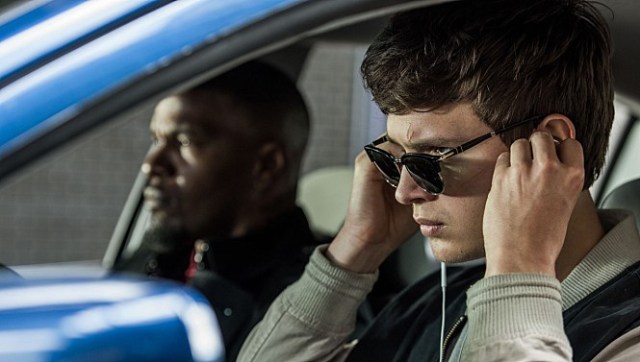
From the beginning, the movie clearly recognizes its source of inspiration. Its hero is a young taciturn man nicknamed ‘Baby’ (Ansel Elgort), and he is a getaway driver as skillful as Ryan Gosling’s character in “Drive” (2011) or Ryan O’Neal’s in “The Driver” (1978). During the opening sequence, we see him working with a trio of bank robbers, and he certainly demonstrates his exceptional driving technique when they need to get away from the crime scene as quickly as possible.

Because of his tinnitus caused by a tragic accident which happened when he was very young, Baby usually listens to the music played on his iPods, and that even applies to when he works. Yes, we have already seen countless cases of vehicle action sequence mixed with music, but director/writer Edgar Wright and his editors Paul Machliss and Jonathan Amos push that cliché further, and it is a sheer pleasure to watch how dexterously music and action is mixed together for our entertainment.

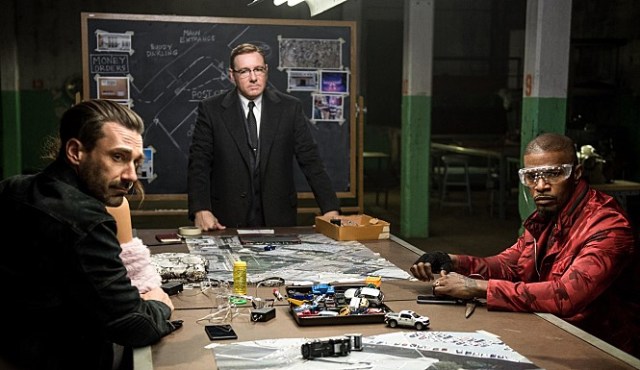
After this impressive opening sequence, the movie establishes Baby’s relationships with various characters surrounding him. His boss is a criminal mastermind called Doc (Kevin Spacey), and we come to learn that Baby has worked for Doc since he happened to steal Doc’s car full of stolen goods several years ago. So far, Baby has been impeccable as gradually paying off his debt to Doc, and Doc personally promises to him that he will soon be clean and free after one last job.

babydriver05

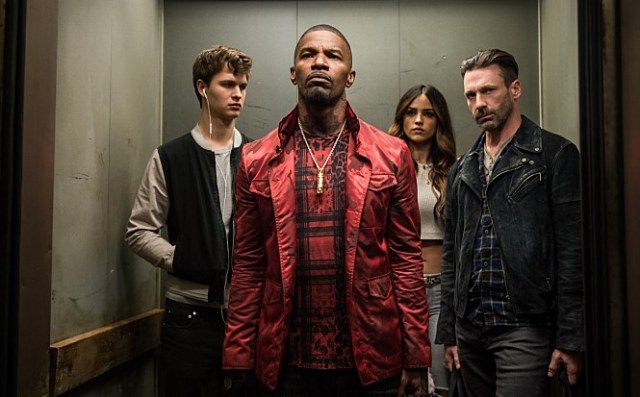
Of course, we all know that is not possible, and we already see the trouble when Doc assembles another trio of criminals for his latest heist plan. One of them is a guy nicknamed Bats (Jamie Foxx), and this pugnacious guy instantly becomes hostile toward Baby right from when he and others gather together for preparing for their heist. At first, Bats seems to be merely threatening, but there comes a darkly amusing moment where he casually justifies what he and his accomplices are going to do, and this is later followed by a brief but chilling moment which implies how ruthless he can be.

Meanwhile, the movie pays some attention to Baby’s private life. He has lived with his deaf foster father Joseph (CJ Jones), and it is evident from their affectionate interactions that they genuinely care about each other. In his room, Baby often has his solitary fun with making mix tapes based on the snippets of the conversations he privately records, and that gives us another nice musical moment to be appreciated.

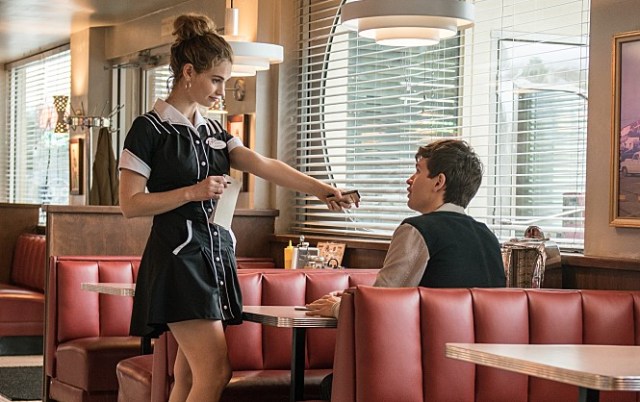
And there is a young girl named Debora (Lily James), who works as a waitress at a local cafeteria. When she and Baby happen to meet each other on one day, they instantly become attracted to each other, and they come to share their mutual dream of getting out of their world someday, though Baby does not tell her much about his current occupation.

As these story elements are assembled in each own place, the movie readies itself for a full-throttle mode. While it is surely expected that our young hero is pulled into his criminal world again, we get some unexpected moments of thrill and surprise, and there is a very tense mode when Baby and his criminal associates confront a group of guys who may not be what they seem on the surface. The climactic action sequence does not disappoint us at all with its nice payback moment, and you will certainly appreciate how Queen’s “Brighton Rock” is used during the finale.

babydriver03

The cast members are all excellent in their respective roles. Ansel Elgort, who previously drew our attention via his earnest performance in “The Fault in Our Stars” (2014), gives a likable performance, and he and Lily James play well with each other in their warm, intimate scenes. Kevin Spacey shows that he is always compelling whenever he plays the smartest person in the room, and there is a little poignant moment when his character shows some generosity to Baby later in the story. While John Hamm, Jon Bernthal, and Eiza González imbues their criminal characters with life and personality, Jamie Foxx is effectively menacing, and CJ Jones and Paul Williams are also solid in their small supporting roles.

Since “The Shaun of the Dead” (2004), Wright has shown his considerable talent through a number of various comedy films. While “The Shaun of the Dead” was a funny zombie comedy film which amused me a lot for its gory but witty moments, “Hot Fuzz” (2007) was a violent but exhilarating parody of action flicks, and I still remember well how I laughed hard during one scene which hilariously parodied one certain scene from “Point Break” (1991). In case of “Scott Pilgrim vs. the World” (2010), I was entertained by its playful handling of a video game world inhabited by Michael Cera’s nerdy hero, and “The World’s End” (2013) was another fun movie with lots of goodies to savor.

In “Baby Driver”, Wright tops himself while being a little more serious than before, and the result is one of the best action movies of this year. It may be all about style, but it is presented with admirable skill and exuberant energy, and I found myself energized by its many exciting moments during a night screening I attended on this Thursday. This is one hell of joy ride, folks.

babydriver02

Posted in Movies | Tagged , , | 2 Comments