The Disaster Artist (2017) ☆☆☆(3/4): Meet Tommy Wiseau

thedisasterartist01

“The Disaster Artist” is a wacky comedy film based on one bizarre real-life figure and his nutty filmmaking which led to one of the most awful films in the movie history. Although the movie is often frustratingly vague about who he is and what makes him tick, I must admit to you that I could not help but laugh at lot while watching a number of hilariously loony moments in the film, and that undeniable hilarity compensates for its several notable shortcomings to some degrees.

The real-life figure in question is Tommy Wiseau, and some of you have probably heard about him and his infamous film “The Room” (2003), which has steadily gained its cult status since its modest premiere at a small LA theater in 2003. I must confess that I have not seen that movie yet, but I have heard about its sheer awfulness from others, and, as far as I can see from what is painstakingly recreated in “The Disaster Artist”, it is one of those memorably bad films you cannot possibly forget for good reasons including incongruous plot, lousy acting, and incompetent direction.

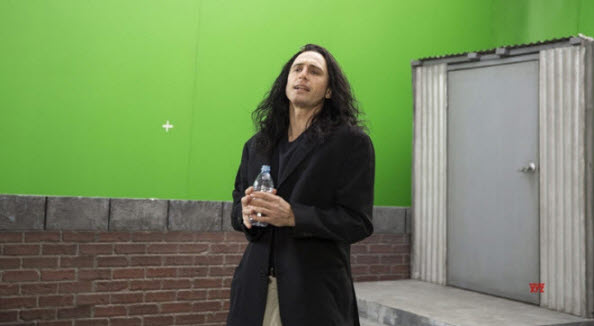
The story is mainly told via the viewpoint of Greg Sestero (Jimmy Franco), a young struggling actor who comes across Wiseau in San Francisco, 1998. They happen to attend the same acting class, and Wiseau, played by director James Franco with commendable bizarreness, gives Sestero and other students an unforgettable moment when he volunteers to demonstrate his, uh, acting ability in front of everyone. Quite impressed by Wiseau’s ‘performance’, Sestero approaches to Wiseau after the class is over, and that is the beginning of their odd friendship. Although Wiseau is usually odd and elusive in his words and behaviors, Sestero is eager to be his friend, and he eventually moves into Wiseau’s expensive apartment, which is full of many various things but does not show much about Wiseau except one photograph shot in Paris.

thedisasterartist04

It looks like Wiseau is a very rich guy, but he does not tell a lot about where his money comes from, and he is also quite vague about when and where he was born. He says that he is from New Orleans, but it is hard to believe him as we constantly notice his weird accent. Always looking like being stuck in his apparently delusional mindset which is probably as nutty as Don Quixote’s, he really seems to believe that he can be a great actor, and Sestero is willing to be his friend’s Sancho Panza.

Several months later, they move to LA for boosting their acting careers, and they quickly settle in Wiseau’s another apartment, but, not so surprisingly, things do not go well for both of them. Sestero tries as much as he can, but he keeps finding himself stuck in anonymity like many young performers out there in Hollywood. In case of Wiseau, he surely draws attention wherever he goes, but he always gets rejected or ridiculed due to his idiosyncratic behavior and insensitive attitude, and there is an amusing moment when he tries a different accent at one audition. He seems to try hard, but he becomes far more awkward than before, and we cannot help but cringe and laugh while watching this weird sight.

Eventually, Wiseau comes to decide that he should write and make a movie for himself, and Sestero is fully supportive of it. A few years later, Wiseau finally finishes writing the screenplay for his first movie which is titled, yes, “The Room”, and then he proudly presents it to Sestero. Filled with many crappy lines (My favorite: “Do you know that chocolate is the symbol of love?”), the screenplay is not exactly good to say the least, but Sestero is happy to know that he is going to play one of the main characters in the movie, and he and Wiseau soon take the first step for the production of their movie.

The rest of the movie focuses on the insanity of Wiseau’s filmmaking process, and the adapted screenplay by Scott Neustadter and Michael H. Weber, which is based on “The Disaster Artist: My Life Inside The Room, the Greatest Bad Movie Ever Made” by Greg Sestero Tom Bissell, continues to give us cheerfully wacky moments to remember. When Wiseau and Sestero come to a camera rental shop, the owners of the shop are flabbergasted by how utterly clueless Wiseau is about filmmaking, but they decide to go along with that because Wiseau is willing to pay them a lot, and they even provide a studio for Wiseau’s production. During the eventual production of “The Room”, the cast and crew members are all confounded by Wiseau’s endless quirks, so they naturally come to have serious doubts on the movie, but they keep going on because, well, they get paid for that at least.

thedisasterartist03

Franco gathers a bunch of notable performers for this part, but they are mostly under-utilized in their underdeveloped roles. Ari Graynor, Josh Hutcherson, Jacki Weaver, and Zac Efron have some little fun as their performer characters are pushed into many silly moments thanks to Wiseau, but their characters remain superficial on the whole, and so does Sestero’s girlfriend played by Alison Brie, who does as much as she can do with her functional role. In case of Seth Rogen, who also participated in the production of the movie, he did a good job of keeping his face straight in front of Franco’s offbeat acting, but then he has nothing much to do besides that.

And I think the movie could go deeper into its subject instead of merely laughing at his absurdity. Later in the story, Sestero finally comes to decide that enough is enough, so he pushes Wiseau with several questions, but Wiseau does not answer to any of these questions, and neither does the movie, which just takes a shortcut to its expected final act after that point. Although Dave Franco is effectively earnest in his role and he and his brother have a good comic chemistry on the screen, the movie does not seem to have sufficient understanding of their characters’ relationship, and we are only baffled as wondering why Sestero lets himself associated with Wiseau from the beginning.

While watching “The Disaster Artist”, I was reminded of Tim Burton’s “Ed Wood” (1994), which was about another notoriously bad filmmaker in real-life. That movie also generates lots of laughs from how pathetic and incompetent its goofy hero is, but it is also filled with considerable respect and affection, and we come to understand and emphasize with him more than expected. Compared to “Ed Wood”, “The Disaster Artist” lacks depth and insight, but it does provide some good laughs along with enough curiosity and amusement, so I recommend it anyway despite my reservation.

thedisasterartist02


Posted in Movies | Tagged , , , | 1 Comment

Darkest Hour (2017) ☆☆☆(3/4): Oldman’s Finest Hour

darkesthour05.jpg

For Winston Churchill, 1940 was one of the most dramatic years in his illustrious life and career. While everything seemed to be over for Britain as Nazi Germany swiftly advanced over the Europe continent during that turbulent and perilous time, he showed extraordinary leadership as the Prime Minister of Britain, and his defiant position against Nazi Germany eventually led to the victory of the Allies at the end of World War II.

Although it may not show anything particularly new about Churchill’s life and career, “Darkest Hour” works as a vivid, compelling look into his risky political struggle during that period. The movie did a skillful job of taking us right into its period background, and it is a solid historical drama which can be watched along with Christopher Nolan’s “Dunkirk” (2017), which is another notable World War II movie of this year and overlaps with “Darkest Hour” to some degrees.

The movie opens with the urgent situation in Europe during early May of 1940. Not long after invading Poland and Norway, Nazi Germany goes forward to the Netherlands, Belgium, and France, and the British government is certainly shocked and shaken by this rapid progress of the war. As pressured by the opposition party, Prime Minister Neville Chamberlain (Ronald Pickup) has no choice but to resign, so his governing party must choose somebody else as new Prime Minister, but then they soon come to see that they have only one guy for that.

That guy in question is none other than Winston Churchill (Gary Oldman), and he is ready for doing his duty, but many people including King George VI (Ben Mendelsohn) are not so pleased about this. While he was quite correct about Hitler and Nazi Germany from the start, Churchill has been stuck with a very bad reputation due to not only many political missteps in the past but also his volatile personality, and his irascible side is exemplified well by when he becomes too harsh to his new secretary Elizabeth Layton (Lily James) on her first day.

darkesthour02

After officially replacing Chamberlain, Churchill quickly assembles the War Cabinet, but he soon finds himself in the conflict with his two cabinet members: Chamberlain and Lord Halifax (Stephen Dillane). They believe that the British government must negotiate with Nazi Germany as soon as possible, but Churchill does not approve of that because their enemy is not negotiable at all in his view. As reflected by one of his famous speeches at the parliament (“I have nothing to offer but blood, toil, tears, and sweat”), he is determined to stand against Hitler and Nazi Germany as much as he can.

However, things get worse day by day. As the Nazi Germany Army keeps advancing into France, the British Expeditionary Force in France is eventually cornered in the beach area of a small French city named Dunkirk. Churchill orders a massive evacuation operation for thousands of British soldiers trapped in Dunkirk, but there is a big risk for that, and the situation becomes more desperate when US President Franklin D. Roosevelt tells him that the US government cannot help due to the Neutrality Acts of 1930s, which prevented US from being directly involved in the war until the attack on Pearl Harbor in 1941.

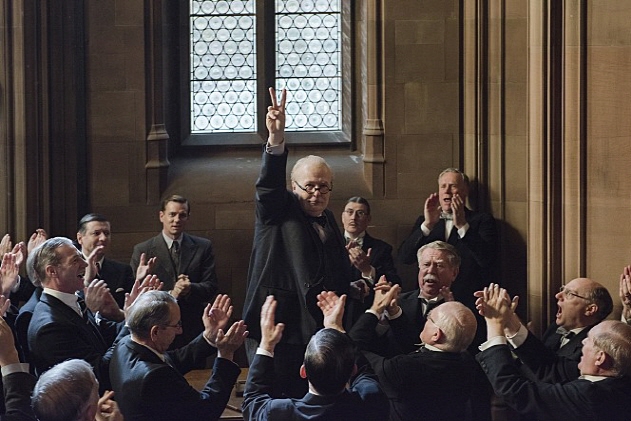
As the movie closely observes how Churchill struggles inside and outside during this very desperate time, Gary Oldman’s stellar performance, which will definitely get an Oscar nomination in next week, ably conveys the thoughts and feelings churning behind his character’s feisty façade. Almost unrecognizable due to his heavy makeup, Oldman brings considerable humanity and personality to his larger-than-life character, and the resulting performance is another interesting dramatic portrayal of Churchill, who is recently played by John Lithgow in the acclaimed TV series “The Crown”. While he is as intense and ferocious as demanded in many big moments in the film, Oldman also deftly handles a number of small intimate scenes, and he is particularly wonderful when his character happens to have an unexpected guest at one point later in the film.

darkesthour01

The supporting performers revolving around Oldman do their respective jobs as much as required. As Churchill’s no-nonsense wife, Kristin Scott Thomas has a couple of juicy scenes, and she and Oldman click together well on the screen as two people who have known and understood well each other. Lily James is relatively bland in her functional role, but she holds her own place well in front of Oldman at least. While Stephen Dillane and Ronald Pickup are effective as Churchill’s main opponents, Ben Mendelsohn, who has been more notable since his breakout turn in “Animal Kingdom” (2010), is commendable as King George VI, and his good performance deserves to be compared to Colin Firth’s performance in “The King’s Speech” (2010).

On the technical levels, “Darkest Hour” is impressive on the whole thanks to the competent direction of director Joe Wright, who is no stranger to period drama as previously shown from “Pride and Prejudice” (2005) and “Atonement” (2007). While providing several good visual moments through fluid camerawork, his cinematographer Bruno Delbonnel establishes well authentic period atmosphere on the screen, and we come to sense the gloom constantly hovering over Churchill and his country and people. While mostly sticking to its restrained mode, Dario Marianelli’s score dials up the level of dramatic tension whenever it is necessary, and this is certainly his another fruitful collaboration with Wright.

The movie is not without flaws. The screenplay by Anthony McCarten is often trite and blatant, and I do not think a scene where Churchill encounters a group of civilians by himself alone works as well as intended, but the movie is still an engaging experience thanks to its many strong elements including Oldman’s captivating acting. Yes, it is indeed your typical Oscar-season performance, but he did a heck of job, and that is surely something worthwhile to watch.

darkesthour03

Posted in Movies | Tagged , , , , | 1 Comment

Maze Runner: The Death Cure (2018) ☆☆(2/4): The tedious last chapter of the trilogy

mazerunnerthedeathcure01

“Maze Runner: The Death Cure”, the last chapter of the trilogy which began with “The Maze Runner” (2014), is a tedious mix of familiar things you can expect from a SF action film set in dystopian world. While “The Maze Runner” (2014) distinguished itself a bit through its curious setting based on its mysterious maze, the subsequent sequel “Maze Runner: The Scorch Trials” (2015) was a letdown in comparison as getting out of that maze and then throwing itself into its rote dystopian world, and “Maze Runner: The Death Cure” only continues that mediocrity without anything good enough to intrigue or engage us during its 142-minute running time.

Without much background explanation, the movie begins at the point not long after the finale of “Maze Runner: The Scorch Trials”, so I give you a brief summary of the previous two films just in case. After managing to escape from their maze in “The Maze Runner”, our young hero Thomas (Dylan O’Brien) and his colleagues came to discover that they were selected by a shady organization called World Catastrophe Killzone Department (WCKD, a.k.a WICKED), which has been trying to develop the cure for a deadly virus plague through a bunch of specifically selected boys and girls. While continuing to run away from WCKD in “Maze Runner: The Scorch Trial”, Thomas and his colleagues fortunately encountered several characters willing to help them, but then they were all ambushed by WCKD due to the betrayal of Teresa (Kaya Scodelario), who came to believe that WCKD is doing the right thing for the world.

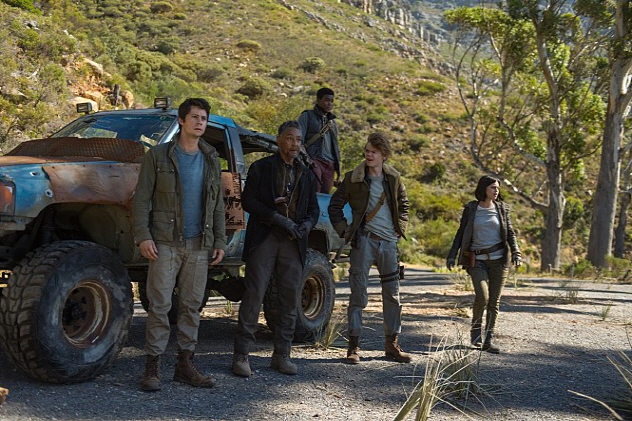
Thomas and some of his colleagues managed to avoid being captured by WCKD, and the opening scene of the movie shows them attacking a train which are taking Minho (Ki Hong Lee) and other captured boys and girls to the headquarters of WCKD. While they succeed in rescuing many of these boys and girls despite considerable risk, some of them including Min-ho are still held as captives under WCKD, so Thomas decides to go to the WCKD headquarters for saving Min-ho. Although that may not be a very wise decision considering that, as pointed out by one supporting character in the film, those rescued boys and girls need to be transported to a safer place as soon as possible, he remains adamant nonetheless, and his two friends, Newt (Thomas Brodie-Sangster) and Frypan (Dexter Darden), join him without hesitation.
mazerunnerthedeathcure04

Of course, they soon see how perilous their journey is. When they enter a dark tunnel leading to the WCKD headquarters, they instantly come across virus-infected people who are virtually a bunch of, yes, zombie extras. Those virus-infected people in the movie, called ‘Cranks’, surely run fast and scream loudly, but they only remind me that I have been rather tired of zombies during recent years. As a matter of fact, I was not particularly scared while watching the action sequence unfolded in the tunnel, and I merely noted that our heroes are good runners as shown from the previous movies.

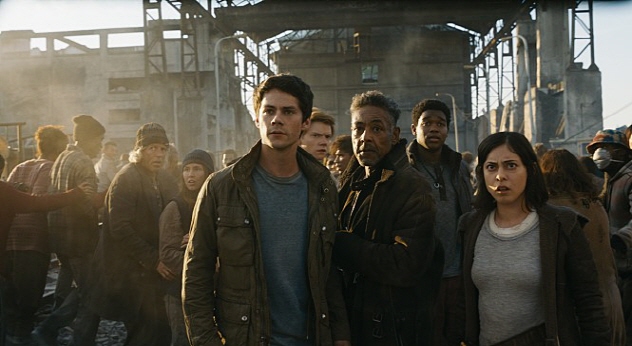
After luckily rescued by Jorge (Giancarlo Esposito) and Brenda (Rosa Salazar) in time, Thomas and his friends eventually arrive in the area surrounding the city where the WCKD headquarters is located. The city is surrounded by its huge wall blocking thousands of desperate people living outside the city, and we see how well it is being guarded when an angry mob approaches to the wall from the outside at one point.

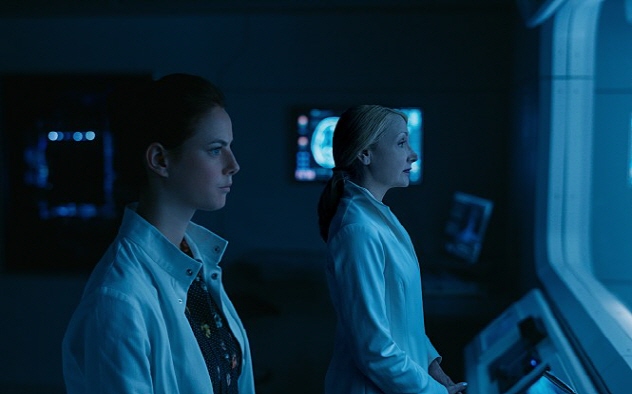
There is a possible way for Thomas and his colleagues to sneak into the WCKD headquarters without getting caught, but it depends on how much they can persuade Teresa, who has worked with Dr. Ava Paige (Patricia Clarkson) since she chose to side with WCKD. She still believes that she and Dr. Paige are doing the right thing, but she has also felt guilty about what they have done in the name of greater good, and then there comes a moment when she must make another important choice.

mazerunnerthedeathcure03

During the second half, the movie shifts its gear into action mode as expected, and director Wes Ball, who directed two previous films of the series, provides a few solid action scenes including the one involved with a bus and a tower crane, but that does not hide its weak storytelling and its glaring lack of style and personality at all. The main characters in the film are mostly flat on the whole, and their drama is not particularly engaging as often being predictable and contrived. In case of their dystopian world, it feels quite bland and superficial in terms of mood and details, and I became depressed as observing that there is nothing much worthwhile to talk about in the film.

The performers in the movie diligently try to carry the film together, and some of them manage to acquit themselves rather well. While Dylan O’Brien and Kaya Scodelario often struggle with their colorless characters, Thomas Brodie-Sangster and Rosa Salazar manage to leave some impression, and Giancarlo Esposito has some fun with his character as he did in the previous film. As the main bad guy of the film, Aidan Gillen looks as sneaky as required, and Patricia Clarkson is again under-utilized in her thankless role.

While I did not like “The Maze Runner” enough for recommendation, I enjoyed it to some degrees, and I hoped for better things to come next. Unfortunately, “Maze Runner: The Scorch Trial” was several steps down from that, and “Maze Runner: The Death Cure” further squanders whatever is left in this diminishing series. It is not awful at least, but I had to suffer its boredom for more than 2 hours, and I was only consoled by the fact that I watched it for free. Every cloud has a silver lining, isn’t it?

mazerunnerthedeathcure02

Posted in Movies | Tagged , | Leave a comment

Lady Bird (2017) ☆☆☆1/2(3.5/4): Precisely funny and effortlessly poignant

ladybird

At first, “Lady Bird” looks like another conventional adolescent coming-of-age drama. Again, we have a young heroine eager to go further with her burgeoning life and she surely comes to grow up a lot in the end as being ready for the next chapter of her life, but her bumpy emotional journey is vividly depicted with considerable intimacy and intelligence, and we can only admire how precisely funny the movie is – and how effortlessly poignant it also is.

The movie is mainly about Christine McPherson (Saoirse Ronan), a 17-year-old girl who is a Catholic high school student living in a suburban area of Sacramento, California. As her senior year is being over in 2002, Christine, who has preferred to be called ‘Lady Bird’, hopes to go to any prestigious college far away from her hometown, but the circumstance is not exactly good for her. Her parents do not have enough money for that, and, above all, her headstrong mother Marion (Laurie Metcalf) does not approve of that. She simply wants her daughter to be more practical, but Christine is adamant with her growing hope, and their conflicting relationship is exemplified well by the opening scene of the movie. The mood initially seems jolly as they listen to an audiobook copy of John Steinbeck’s “The Grapes of Wrath”, but then they start to quarrel about Christine’s college matter, and the scene eventually ends with a sudden moment of jolt.

At her school, Christine joins a drama club along with her close friend Julie (Beanie Feldstein). While she is not so pleased to see that she does not get a big part in the upcoming musical performance, she quickly becomes close to Danny (Lucas Hedges, who had a good year thanks to his solid supporting turns in this film and “Three Billboards Outside Ebbing, Missouri” (2017)), and he is soon introduced to her parents when he is going to take her to his grandmother’s house on Thanksgiving Day. As spending more time with him, Christine comes to have some expectation for what may be her first serious romance, but, alas, this nice, earnest boy turns out to be not as suitable as she thought.

ladybird02

While quite disappointed by this, Christine keeps trying to look cool as before, and that leads her to Jenna (Odeya Rush) and Kyle (Timothée Chalamet, who recently drew lots of attention for his acclaimed breakthrough performance in “Call Me by Your Name” (2017)). As your average sassy rich girl, Jenna is everything Christine is not, and Christine tries to get closer to Jenna as much as she can, but she later experiences a painful moment of humiliation because of her small lie. With his seemingly sophisticated appearance, Kyle looks like a good alternative to Danny, but, not so surprisingly, he turns out to be your typical selfish jerk, and that leads to one of the most humorous moments in the film.

As smoothly moving from one episodic moment to another, the movie lets us emphasize more with Christine’s emotional wandering, but it also recognizes how self-absorbed she can be just like many other teenagers. She is sometimes rather unkind and unpleasant to people around her, and her tumultuous emotions frequently clash with the growing impatience of her mother, who surely loves her daughter but cannot help but be angry and resentful at times.

But things are not always bad between Christine and Marion, and the screenplay by director/writer Greta Gerwig thoughtfully handles their complex mother and daughter relationship. When they are buying clothes for Christine in one scene, they have a brief but undeniably touching conversation, and that is one of the best moments in the film. Like any good mothers, Marion simply wants the best for her daughter, and Christine understands that, though they often do not agree well with each other.

ladybird03

While their relationship is the center of the story, the movie also pays some attention to its other substantial characters. The scenes between Christine and her father Larry (Tracy Letts) feel warm and tender, and the same thing can be said about a private conversation scene between him and his wife. Their adopted son Miguel (Jordan Rodrigues) and his girlfriend Shelly (Marielle Scott) may look goofy at first, but they are depicted with loving care, and so are several school characters revolving around Christine, who are presented with each own distinctive personality.

The main cast members of the film are impeccable. Saoirse Ronan, who astonished us with her unforgettable performance in “Atonement” (2007) and then impressed us a lot more with a series of stellar acting turns including her recent Oscar-nominated performance in “Brooklyn” (2015), gives another superb performance to remember. While deftly modulating her nuanced performance between comedy and drama, Ronan subtly conveys to us her character’s gradual emotional growth, and that is why the last scene of the movie works with poignant emotional resonance. In case of the supporting performers surrounding her, Laurie Metcalf, who will definitely be Oscar-nominated along with Ronan for this movie late in this month, is commendable as Ronan’s equal acting match, and I also enjoyed how notable veteran performers like Tracy Letts, Lois Smith, and Stephen McKinley Henderson are allowed to have each own moment to shine.

While adolescent coming-of-drama has been a rather common genre, “Lady Bird” brings lots of fresh air to its genre elements, and it is almost perfect in terms of mood, storytelling, and performance. While this is only her first solo work, Gerwig, who has steadily risen since her likable performance in “Greenberg” (2010), shows here another side of her immense talent through her confident handling of story and characters, and I think she will be another interesting American filmmaker to watch. In fact, I am willing to wait for whatever will come next from her.

ladybird04

Posted in Movies | Tagged , , , | 3 Comments

I, Tonya (2017) ☆☆☆(3/4): The rise and fall of Tonya Harding

Itonya03

I could not help but shake my head while watching “I, Tonya”, a darkly funny cautionary tale based on the rise and fall of Tonya Harding. While she might have some right stuffs for being one of the best figure skaters in the world, she had some serious disadvantages from the very beginning, and she also happened to be stuck with wrong kinds of people. While generating lots of black humor from her absurd real-life story, the movie also lets us understand what makes her tick, and we come to emphasize with her to some degrees even while we get good laughs from how she tumbled into her eventual disgrace which will remain with her for the rest of her life.

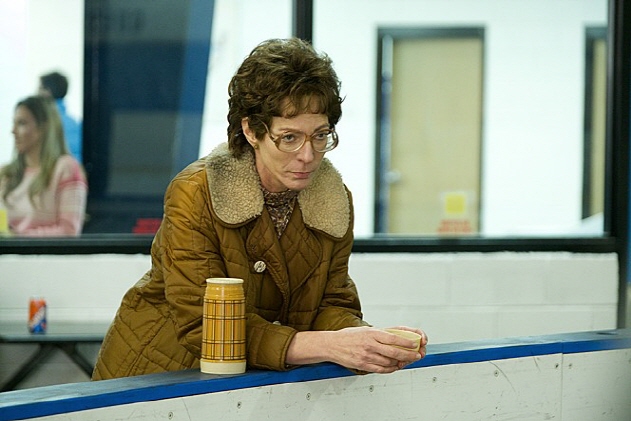
After introducing Harding and its other main characters one by one through its mockumentary opening scene, the movie goes back to Harding’s early years with her mother LaVona (Allison Janney) in Portland, Oregon. Even when she was four, young Harding, played by McKenna Grace during this part, showed considerable talent in figure skating, LaVona was determined to do anything for her daughter’s success although they were your average poor white trash family. At one point, she forcefully demands a coach to teach her daughter, and then we see how she relentlessly pushes her daughter by any means necessary. For this bitter, abrasive woman, nothing seems to be enough no matter how much her daughter tries, and she is even quite abusive to her daughter in the name of tough love.

This toxic relationship between Harding and her mother is continued even after Harding, who is now played by Maggot Robbie, grows up to be a very good adult professional figure skater. Even when Harding successfully achieves a rare athletic feat in front of many cheering audiences, LaVona does not look that proud or happy, and there is a small acerbic moment showing how much she can go further for ‘motivating’ her daughter.

Itonya04

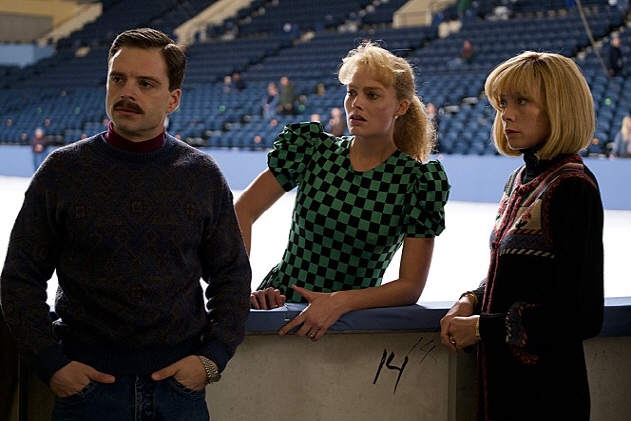
Things seem to get better for Harding when she comes across Jeff Gillooly (Sebastian Stan) and then falls in love with this guy, but, alas, it soon turns out that he is no better than LaVona. He is also frequently abusive to her, and she finds herself drawn back to him again and again even though they often violently clash with each other. She eventually leaves him and puts a restraining order on him, but then she gets herself into a very messy situation when he suddenly comes to her residence at one night.

At least, she feels good whenever she throws herself into major figure skating competitions, but she soon gets frustrated as being reminded again and again that she is not exactly someone ‘wholesome’ enough to be the representative of American figure skating. To many competition juries, her rival/colleague Nancy Kerrigan looks a lot more appropriate in comparison, and that undeniable fact certainly exasperates Harding as she keeps receiving lower scores than expected.

After eventually accepting that she needs to be changed for getting to the top, Harding tries hard again, and she also allows Gillooly to come back into her life, but, as some of you already know, that turns out to be her another big mistake. While Harding is preparing for her upcoming competition with Kerrigan at the 1994 US Figure Skating Championships in Detroit, Gillooly and his hapless friend Shawn Eckhardt (Paul Walter Hauser) come to plan something nasty for Harding’s advantage, and, thanks to their stupidity and their equally sloppy associates, that somehow results in that infamous incident on January 6th, 1994.

Itonya02

Cheerfully gliding along its increasingly absurd and sensational plot, the screenplay by Steven Rogers constantly provides wryly hilarious moments even when the circumstance becomes quite serious for Harding and everyone associated with her, and director Craig Gillespie, who previous made charmingly quirky comedy “Lars and the Real Girl” (2007), did a competent job of maintaining the pungent comic tone of the movie. Although the soundtrack mainly consisting of a number of recognizable pop songs is often a little too blatant, these songs are mostly effective in accentuating the morbid hilarity presented on the screen, and I must confess that I was amused a bit when “How Can You Mend a Broken Heart” was ironically played on the soundtrack during one certain scene.

Gillespie also draws strong performances from his talented main cast members. As the center of the movie, Margot Robbie, who has steadily advanced since her breakout supporting turn in “The Wolf of Wall Street” (2013), gives a compelling comic performance, and this is certainly the best moment to date in her growing career. Besides looking believable in her figure skating scenes, she is also quite engaging to watch as her character goes up and down in her bumpy narrative arc, and she is especially good when her character desperately tries to overcome the scandalous mess virtually swallowing up her life and career. While Allison Janney, who will be Oscar-nominated along with Robbie, is terribly impressive in her barbed supporting performance, Sebastian Shaw, Paul Walter Hauser, Julianne Nicholson, and Bobby Cannavale are also fine in their respective supporting roles, and special mention goes to young performer McKenna Grace, who holds her own small space as young Harding.

While it may make you cringe for good reasons, “I, Tonya” is an entertaining black comedy equipped with a deliciously biting sense of humor and enjoyable performances. Yes, there have already been lots of talks about how truthful the movie is, but, folks, it does not intend to be very truthful right from the start, and I will not deny that I was amused by its irreverent spirit.

Itonya05

Posted in Movies | Tagged , , , | 1 Comment

The Florida Project (2017) ☆☆☆1/2(3.5/4): Their young innocence in hard reality

thefloridaproject01

Full of a vivid, palpable sense of life, “The Florida Project” is simply unforgettable. While constantly recognizing a hard reality surrounding its young heroine and other characters around her, the movie also finds precious moments of joy and happiness as leisurely prancing along with its young heroine, and I admire how it deftly balances itself between innocence and reality, though I have some reservation on its finale which does not work as well as intended in my inconsequential opinion.

The main background of the movie is an area near the Walt Disney World Resort in Florida. In this area, there are a bunch of cheap motels which were originally built for tourists but mainly function instead as the residence of many poor working-class people, and a 6-year-old girl named Moonee (Brooklynn Prince) and her mother Halley (Bria Vinaite) live in one of these motels. Although being virtually unemployable, Halley tries anything for earning the money for paying her rent, so she frequently leaves her young daughter alone, but Moonee does not mind this much because she always has free time to spend with other kids living in her neighborhood.

In Moonee’s unadulterated viewpoint, the world is a constant source of fun and excitement, and that is exemplified well by one amusing scene where she and her friends attempt a small mischief on the car belonging to a middle-aged lady living in a nearby motel. Even when they get noticed by that lady, that does not stop them from having a fun, and they subsequently befriend one of that lady’s granddaughters who have been taken care of by her due to their mother’s absence.

As closely following Moonee and her friends, the movie serves us with a series of funny and joyous moments generated between them. When they are not doing mischiefs around in the motel, they freely go around here and there in the surrounding area, and they often hang around a local ice cream shop for getting free ice cream. At one point later in the story, Moonee takes her new friend to a ‘safari’, and that amusing scene reminds us of how much kids can be imaginative in their innocent state of mind.

thefloridaproject03

However, the movie also reminds us of how vulnerable and reckless Moonee and her friends are in their small world. There is a subtly creepy scene where they and other kids are approached by a very suspicious old man, and then there is an alarming moment when Moonee and her friends’ seemingly innocent prank in an abandoned condo building leads to a far more serious incident. That incident subsequently affects not only the relationship between Moonee and a boy who is one of her close friends but also the one between Halley and that boy’s mother, who has helped Halley a bit but now comes to distance herself away from Halley because of that incident.

Meanwhile, the situation becomes more difficult for Halley. As getting desperate more than ever, she eventually tries something not allowed in the motel, and that certainly tests the patience of Bobby (Willem Dafoe), the generous manager of the motel who has been kind and compassionate to many residences of his motel as much as he can. He does not want to be mean at all, but then there comes a point where he decides that enough is enough, and he adamantly sticks to his decision.

Although it shifts its gear into melodramatic mode around the finale, the movie never sensationalizes or romanticizes its story and characters, and director/editor/co-writer Sean Baker, who previously impressed us with his notable achievement in “Tangerine” (2015), did a commendable job of mixing raw realism with lyrical elements. Mostly shot on 35mm film via handheld camera, the movie is imbued with a considerable amount of verisimilitude, and that makes us more immersed into the mundane world of its marginalized characters. While steadily maintaining the low-key mood of the movie, Baker and his cinematographer Alexis Zabe occasionally give us some poetic moments shining with natural beauty, and I particularly like a brief but lovely moment when Moonie and her friend looks at something in the sky with their innocent wonderment.

thefloridaproject02

Under Baker’s skillful direction, Brooklyn Prince and other young performers in the movie give engaging natural performances. As the lively heart of the film, Prince is terrific while effortlessly exuding her character’s brash innocence, and I enjoyed the easy rapport between her and her fellow young performers. Whenever they interact with each other on the screen, there is always spontaneous energy among them, and we gladly go along with that while constantly amused by them.

In case of the adult performers in the film, they also give solid performances on the fringe of the story. As Moonee’s problematic but defiant mother, newcomer Bria Vinaite holds her place well next to her young co-star, and Willem Dafoe, who will garner an Oscar nomination for this film, is surprisingly effective in his against-the-type role. While he certainly draws our attention with his recognizable face right from the beginning, Dafoe ably dials down his usual intense persona, and the result is one of the best performances in his illustrious career full of many interesting acting turns.

By the way, I must tell you that I felt bothered by the finale of the movie. Although I understand well that it is intended as a sort of make-believe moment to resonate with the preceding melodramatic moment, it felt jarring to me in terms of mood and storytelling, and I guess Baker came to care a little too much about his characters.

Nevertheless, there are many good moments to be cherished in “The Florida Project”, and that is more than enough to compensate for its questionable storytelling choice in the end. It is not entirely flawless, but it is still a vibrant slice of life packed with lots of spirit and care, and I think you should not miss this small gem.

thefloridaproject05

Posted in Movies | Tagged , , | 2 Comments

Coco (2017) ☆☆☆1/2(3.5/4): A lovely Mexican fantasy tale from Pixar

coco03

Alternatively enchanting and moving, “Coco” is another lovely work from Pixar Animation Studios. Right from its very first scene, I was instantly charmed by its colorful style and vibrant spirit, and that was just the beginning of more things to enjoy and admire. While observing how it supremely works as a superlative visual experience full of rich cultural details to notice, I also found myself touched a lot by its deceptively simple but undeniably heartfelt drama about life, death, love, and family, and its overall achievement is more than enough to confirm to me that Pixar has lost none of its magic yet.

Its story revolves around a 12-year-old Mexican boy named Miguel Rivera (voiced by Anthony Gonzalez), who has aspired to be a musician like his legendary idol Ernesto de la Cruz (voiced by Benjamin Bratt) but has been hiding his aspiration from his family mainly due to the strong opposition from his grandmother Elena (voiced by Renée Victor). Since Elena’s grandfather left his wife and daughter a long time ago for developing his musician career, music has been strictly forbidden in the Rivera family for many years, and, as shown from a series of comic moments, Elena has diligently stuck to that tradition as the matriarch of her family. She and everyone else in the family expect Miguel to devote himself to their old shoemaking business which was founded by her grandmother, and he has been in fact working as a shoeshine boy in their small town.

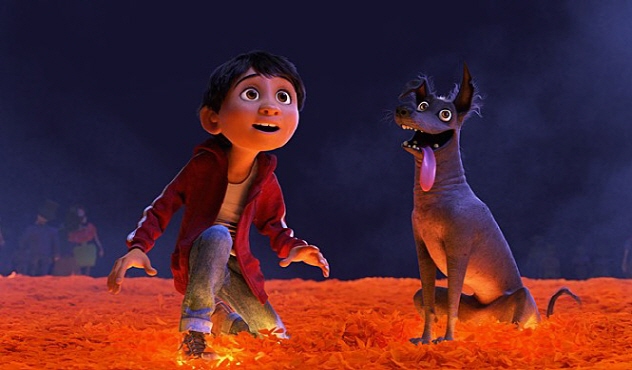
Nevertheless, Miguel does not give up his hope of being recognized for his musical talent which has been appreciated only by a stray dog named Dante, and there soon comes a chance he cannot possibly resist. During the town festival held on the Day of the Dead, a Mexican holiday which has always been associated with Malcolm Lowry’s unforgettable alcoholic masterpiece “Under the Volcano” and its 1984 movie adaptation by John Huston in my mind, there will be a music contest which will draw many local musicians, and Miguel is quite eager to compete with them at that contest – especially after accidentally discovering one hidden thing about Elena’s musician grandfather.

coco04

Of course, his determination inevitably clashes with his family, and that only makes him more determined than ever. As he later looks for a guitar to use at the upcoming contest, it soon comes to his mind that there is a precious guitar preserved in de la Cruz’s mausoleum which happens to be right in the middle of the town cemetery, and he decides to borrow it for a while. After breaking into the mausoleum, he tries to play that guitar a bit, but that turns out to be a big mistake. He inadvertently puts himself in the boundary between his world and the realm of the dead, and he is certainly scared as his sight is filled with all those dead people coming to see their living families on the Day of the Dead.

Among those dead people, there are Miguel’s diseased family members, and they take him to their realm for taking care of his trouble. All they will have to do is giving a blessing to Miguel, but then Miguel refuses to follow a condition from Elena’s grandmother Imelda (voiced by Alanna Ubach), and that is how he comes to get involved with some dead guy who may help Miguel if Miguel helps him in exchange. In his spirited voice performance, Gael García Bernal clicks well with his plucky young co-star, and I was especially tickled by his certain humorous scene associated with a famous Mexican artist.

Never overlooking what is seriously being at stake for its young hero, the screenplay by director Lee Unkrich and his co-writers Jason Katz, Matthew Aldrich, and Adrian Molina, who is also the co-director of the film, joyfully bounces from one narrative point to another, and the film impresses us with lots of visual pleasures. While that huge bridge placed between the world of the living and the realm of the dead is definitely the most visually striking element in the film, there are also numerous colorful and humorous details shown from the realm of the dead, and I particularly like how the dead characters in the film are lovingly depicted with considerable individual personalities although they are basically a bunch of walking skeletons.

coco06.jpg

Within such a bountiful visual background like this, the family drama inside the story turns out to be more complex and touching than expected. There are some predictable narrative turns, but the film always finds unexpected ways to surprise and entertain us, and everything in the story eventually culminates to a rather modest but powerful moment, which has grown on me since the screening I attended during last evening and, in my inconsequential opinion, wonderfully exemplifies the power of good storytelling.

Like any good films associated with music, “Coco” is supported well by its fabulous soundtrack. While Michael Giacchino’s commendable score ably holds the ground, a number of various songs are effectively performed on the whole, and “Remember Me”, the main song of the film which is composed by Kristen Anderson-Lopez and Robert Lopez, certainly deserves to be remembered for how it is flexibly utilized throughout the film.

As many of notable works from Pixar Animation Studios did before, “Coco” shines with wit and imagination while also distinguishing itself with deft storytelling and sincere drama. While it may not be as great as “Wall-E” (2008) or “Inside Out” (2015), this is indeed another glorious triumph from Pixar, and I am certainly willing to revisit it someday.

coco01

Posted in Movies | Tagged , , , , | 2 Comments

Downsizing (2017) ☆☆(2/4): Let’s get small!

downsizing01

At first, “Downsizing” starts with an absurd but intriguing science fiction premise. As it keeps its attitude straight during its first act, it gives us a series of nice deadpan moments, and I and other audiences around me had some good laughs while watching these humorous moments. Unfortunately, the movie comes to lose most of its satiric edge while lackadaisically meandering with its rather colorless hero during the rest of the story, and what we ultimately get is another tiresome case of your average American white male coming-of-age drama.

The movie opens with a Norwegian scientist succeeding in developing an innovative technology which surprises everyone around the world when he presents it at an international academic conference five years later. Using some special chemical substance and device, he successfully shrank not only himself but also a group of people including his wife to the degree of 0.0364% without any particular damage to themselves, and everyone quickly becomes interested in the considerable potentials of his technology. Once people get ‘downsized’, they will consume food and resource far less than before, and this may ensure the survival of humanity in the future, which has been more threatened day by day due to increasing global environmental problems and decreasing resources.

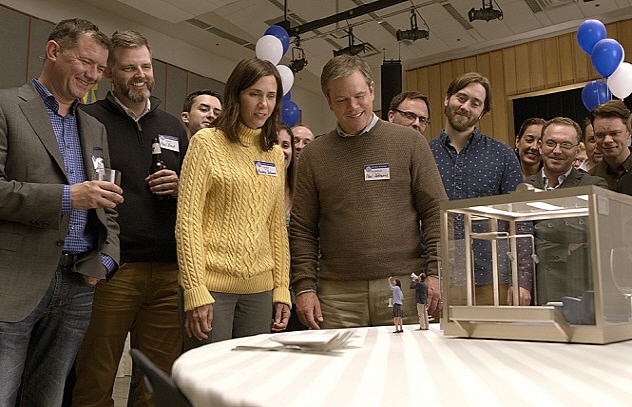
When this technology is reported on the media, Paul Safranek (Matt Damon), the occupational therapist of a meat processing factory located in Omaha, Nebraska, is mildly amazed like others around him, but things are changed a lot 10 years later. Downsizing becomes a lot more common than before, and there are several places around the country where those downsized people reside together. When Paul and his wife Audrey (Kristen Wiig) come to his high school reunion party, he is surprised to find that one of his high school friends recently got downsized along with his wife, and that friend enthusiastically tells Paul about how comfortably he and his wife have lived in one of those special places.

downsizing02

Mainly because they have been struggling with their tight economic circumstance, Paul and Audrey come to consider getting themselves downsized, so they visit the place where that friend and his wife live, and they are surely impressed by its sunny, luxurious environment insulated from the world outside. At one point during their visit, they and other visitors watch an amusing presentation from two downsized characters played by Neil Patrick Harris and Laura Dern, and it is clear from their wryly broad performance that Harris and Dern enjoy every second of their brief scene.

When a financial counselor notifies them that they can actually live far more comfortably than before, Paul and Audrey eventually decide to get themselves downsized, and we soon get another funny scene as watching Paul going through the downsizing process step by step. Once he is anesthetized, his naked body is swiftly handled along with the naked bodies of many other people, and they soon cross the line once their bodies are put together into a big downsizing machine.

Not long after regaining his consciousness in his brave new world, Paul is devastated to learn that his wife changed her mind right before being anesthetized, and he is frustrated to see that there is nothing he can do about that unexpected change. One year later, he reluctantly signs his name on a divorce document, and he continues to feel unhappy although his current economic situation is less desperate than before.

Around that narrative point, the movie begins to spin its wheel while increasingly feeling aimless, and even Matt Damon’s earnest acting is not much of help. While Damon surely fits well to his character, Paul is not a particularly interesting character from the beginning, and the screenplay by director Alexander Payne and his co-writer Jim Taylor does not give us enough reasons for why we should care about Paul’s unhappy status. We may feel sorry for him a bit, but his emotional journey in the film is flat and dull on the whole, and even the rowdy sequence associated with Paul’s hedonistic neighbor played by Christoph Waltz does not help much.

downsizing03

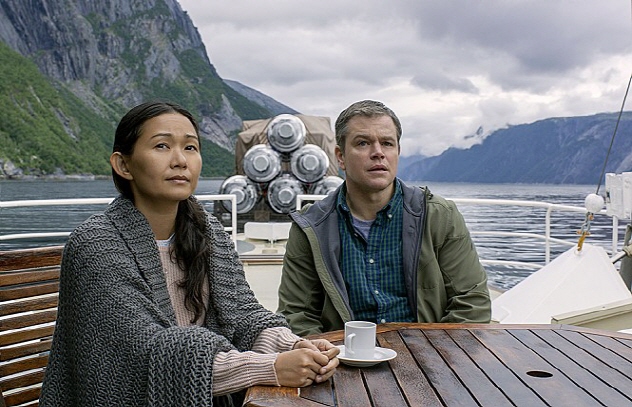
This narrative problem becomes more glaring when the most interesting character in the film appears later in the story. After having a rough night in his neighbor’s residence, Paul comes across a young Vietnamese cleaner named Ngoc Lan Tran (Hong Chau) in the next morning, and she shows him the other side of his seemingly comfortable world when she takes him to where she and other poor people reside. Although her character initially feels like a broad stereotype, Hong Chau, who previously played one of supporting characters in “Inherent Vice” (2014), imbues her character with a considerable amount of pluck and personality, and you may wonder whether the movie could be more compelling if it were about her character instead of Damon’s character.

The movie subsequently tries a little left turn during the third act, but it does not push its premise any further, and, to make matters worse, it virtually fizzles without any substantial dramatic or comic effect. While Paul surely comes to be enlightened a bit in the end, that is predictable and contrived to say the least, and I only came to observe the ending without much care. I was also quite disappointed to see a group of good performers being under-utilized in their thankless roles in the film, and Kristen Wiig, who can quite funny or touching as shown from her previous films including “Bridesmaids” (2011) and “The Skeleton Twins” (2014), is particularly wasted in her bland functional role.

“Downsizing” is not a total bore at least, but it is a major letdown compared to Payne’s acclaimed works including “Election” (1998), “About Schmidt” (2002), “Sideways” (2004), “The Descendants” (2011), and “Nebraska” (2013). They all can be labeled as American white male coming-of-age drama, but they are equipped with more humor and personality compared to “Downsizing” at least, and I enjoyed and admired them all. I understand that Payne tries something different here, but the overall result is mediocre at best while lazy at worst, and I can only hope that he will soon rebound from this misfire.

downsizing04

Posted in Movies | Tagged , | Leave a comment

Three Billboards Outside Ebbing, Missouri (2017) ☆☆☆1/2(3.5/4): When she goes further

threebillboardsoutsideebbingmissouri01

“Three Billboards Outside Ebbing, Missouri”, the third feature film from director/writer Martin McDonagh, surprised me in many aspects. Although many of elements in the film often feel disparate or disjointed, the movie somehow works better than expected thanks to its top-notch storytelling and first-rate performance, and I found myself quite involved in how it dexterously shifts its gear among many different modes. I will try to avoid spoilers here as much as I can, but I might ruin your entertainment as describing its plot and characters in the following paragraphs, so I recommend you not to read the rest of my review if you want to enjoy the movie as fully as you can.

The movie opens with its heroine making one decisive action after being frustrated and exasperated for several months. Around seven months ago, a teenager girl was brutally raped and then murdered in a small rural Missourian town named Ebbing, and her mother Mildred Hayes (Frances McDormand) has been bitter and angry due to the lack of any progress in the investigation of her daughter’s murder. She comes to believe that this is due to the incompetence of the local police department headed by Chief Willoughby (Woody Harrelson), so she decides to rent three billboards on a remote road outside the town, and these billboards surely draw lots of attention because of their short but impactful messages directed toward Willoughby.

While certainly not so pleased by this blatant action of hers, Willoughby is not that angry about it because, like many of town people, he understands well how Mildred has been angered and devastated by her daughter’s death. He tries to find a reasonable way to handle this unpleasant circumstance, but it seems there is nothing he can do for persuading her to take away her angry messages. He looks into the case again, but it is very clear that the case is stuck in dead end with no helpful evidence, and Mildred continues to stick to her position adamantly with no intention of stepping back.

threebillboardsoutsideebbingmissouri04

Meanwhile, her billboard causes several other conflicts around her besides the one between her and Willoughby. Her teenage son Robbie (Lucas Hedges, who recently drew our attention via his Oscar-nominated supporting turn in “Manchester by the Sea” (2016)) does not want to be painfully reminded of his sister’s death again, and the relationship between him and Mildred becomes more strained than before. Her abusive ex-husband Charlie (John Hawkes), who left his family for a young woman some years ago, is annoyed by the trouble caused by his ex-wife, and we get an amusingly tumultuous scene when he comes into her house and then argues with her while his girlfriend and their son are around them. As the scene wildly swings from one mood to another, we cannot help but amused due to its sheer absurdity, and the performers in the scene flawlessly handle their sharp dialogue while never missing a beat.

In addition, there are some town people who are pissed about what Mildred has done, and one of them is Jason Dixon (Sam Rockwell), a dim, hotheaded police officer who is also your typical sleazy Southern racist. In contrast to his thoughtful boss, he instantly becomes furious about Mildred’s billboards, and he does not hide hostility at all when he happens to confront her at one point, but she is not someone who can easily be scared. That surely makes him angrier, and there eventually comes a striking moment of violence when he gets himself driven by hate and fury later in the story.

Once his characters are established along with their complex human conflicts during the first half, McDonagh throws a number of dramatic narrative turns into the story, and he effectively jolts us whenever we think we know where his story is going. Like his previous films “In Bruges” (2008) and “Seven Psychopaths” (2012), the movie is packed with a dark, morbid sense of humor, but it is also surprisingly sad and poignant at times, and I can only admire how McDonagh pulls off the ending which is simultaneously ironic and sort of touching.

threebillboardsoutsideebbingmissouri03

The main cast members of the movie are impeccable in their superlative acting. Frances McDormand, who has been always reliable since her debut movie performance in “Blood Simple” (1984), is terrific as a flawed but determined woman who is virtually a force of nature for everyone around her. Mildred is not a very likable heroine, but we come to understand her pain and guilt at least thanks to McDormand’s deft human touches, and she richly deserves to receive an Oscar nomination.
McDonagh surrounds McDormand with a bunch of notable performers, and they are also very good in their respective supporting roles. While Sam Rockwell, who recently won the Golden Globe Award along with McDonagh and McDormand, is the showiest one of the bunch, Woody Harrelson is equally effective in his understated performance, which eventually becomes the sensible moral compass of the film. I was also delighted to see John Hawkes, Lucas Hedges, Abbie Cornish, Clarke Peters, Caleb Landry Jones, Željko Ivanek, and Peter Dinklage having each own juicy moment in the film, and Dinklage shows us again that he is indeed a valuable scene-stealer.

I always enjoy movies which not only can make me keep guessing and but also can make me care, and “Three Billboards Outside Ebbing, Missouri”, which will definitely be one of major contenders at the upcoming Oscar ceremony, is one of such movies. This is quite a compelling mix of drama and black comedy, and I was entertained a lot by its strong performances while also impressed by its precise, confident handling of plot and characters. In short, this is one of best films during this Oscar season, and I am willing to assure you that you will not regret to watch this masterful piece of work.

threebillboardsoutsideebbingmissouri02

Posted in Movies | Tagged , , | 2 Comments

After Life (1998) ☆☆☆1/2(3.5/4): Before they go away

afterlife04.jpg

I remember well when I happened to watch Hirokazu Kore-eda’s “After Life” for the first time. I did not expect much when it was shown on TV during one hot Sunday afternoon of 2006, but I became intrigued by its rather plain fantasy premise, and then I found myself touched a lot by its gentle and elegant human drama, which lingered on me for a while along with small precious moments of humanity.

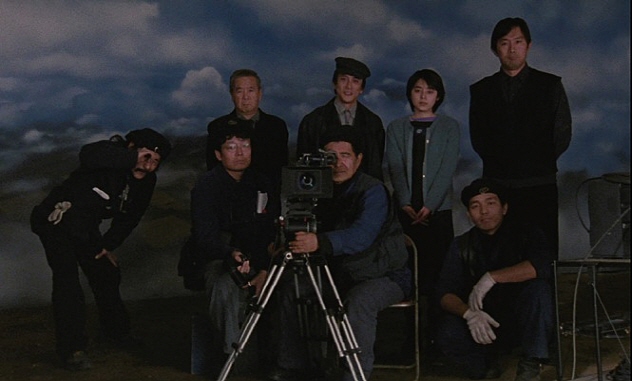
Although the movie is technically a fantasy tale, its mood and background are quite mundane right from its opening scene, where we meet a group of people working in a shabby place located somewhere between our world and hereafter. Their another week has just begun, and now they have to prepare themselves for handling another group of people who are going to spend a week there after their recent death. We soon see these dead people arriving at the foggy front gate of the place one by one, and that visually modest moment is more than enough to remind us of their current status.

Once they all arrive, the dead of this week individually meet their handlers, who officially notify them of their death and then explain to them (and us) what they have to do before going over to the afterlife waiting for them. During three days, each of them has to choose the happiest memory of their life, and then their handlers will make movies based on those chosen memories in question during the following two days. Once everything is ready on Saturday, they will watch that movie together in a screening room, and that will transfer themselves to the eternity of afterlife along with their chosen memory, which will be the only thing they remember about their life before afterlife.

As being interviewed by their handlers, these dead people come to reflect on their respective life. The movie simply looks at them as they talk about their life, but we cannot help but listen to what they say in front of the camera because their scenes brim with a real sense of life on the screen. In fact, many of these dead people are played by non-professional performers, and Kore-eda shot their scenes impromptu as they reminisced about their own lives.

afterlife02

While we watch the dead in the film, some of them become a little more prominent as being difficult cases for their handlers. In case of a middle-aged guy, he seems to have been so unhappy in his life that he welcomes the oblivion of the eternity to come, and there is the sad irony in what he comes to choose as his happiest memory. In case of a young man, he prefers not to choose because, well, he does not think he lived long enough to experience something to remember forever.

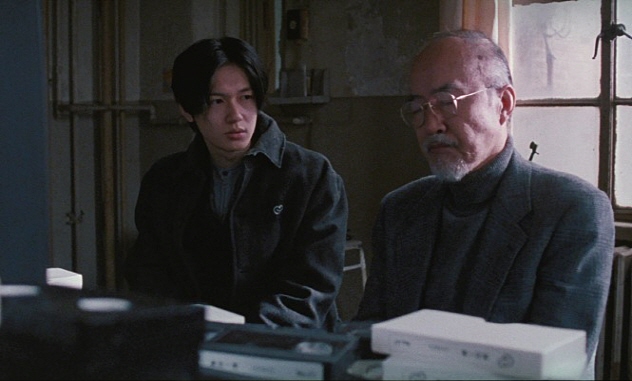
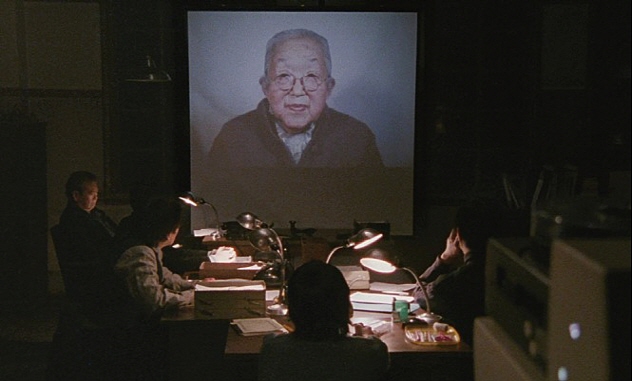
The most poignant case is an old man who comes to feel lots of regret over his life. As going through a stack of video tapes containing his whole life (Don’t ask me how that is possible), he is painfully reminded of how ordinary his life was from the beginning to the end. Nothing was particularly bad for him and his wife who passed away several years ago, but it seems there is nothing worthwhile to be remembered in their mundane life, and there is a bittersweet moment when he gets some consolation from his handler, who turns out to be quite older than he looks on the surface.

In the meantime, the movie lets us get to know a bit more about the handlers. At one point, they wonder whether their work will mean anything in the end, but they continue to work as usual, and they and other people working with them begin to prepare for the shooting in a studio filled with a number of different sets based on those chosen memories. Their rudimentary filmmaking process may look a little silly to you, but they are quite serious about that, and we get several amusing moments as they try to recreate those chosen memories through simple practical means. For example, in case of a piece of memory involved with aviation, they just use pieces of cotton for more vividness, and everyone including the owner of that memory is satisfied with that.

afterlife01

Later in the story, there comes a surprising moment of revelation associated with one of the handlers, but the movie keeps maintaining its calm, restrained attitude even at that point, and it eventually gives us another hauntingly powerful moment to remember. I admire how effortlessly this moment is presented with considerable emotional effect, and I also appreciate how thoughtfully the movie lets us muse more on our life as its narrative makes a full circle in the end. It is clichéd to say that life goes on, but that is indubitably true for all of us, and the movie movingly reminds us of that.

I must confess that I was quite sleepy when I watched “After Life” again thanks to its recent re-release in South Korea, but, at least, I was glad to see that it is still a wonderful movie as I remembered, and that reminds me of how steady Kore-eda has been in his career with a series of excellent works including “Still Walking” (2008), “I Wish” (2011), “Like Father, Like Son” (2013), and “After the Storm” (2016), which was incidentally one of my best films of 2016. Although I felt less enthusiastic about “Air Doll” (2009) and his latest film “The Third Murder” (2017), they are noteworthy attempts nonetheless, and they also show that he is indeed one of the most interesting filmmakers in our time.

By the way, I remember saying about what I will choose if I happen to be in the situation depicted in “After Life”. It was the afternoon of April 25th, 2010 at a certain Steak ‘n Shake restaurant in Urbana-Champaign, Illinois, and I vividly remember how much I felt happy while spending my last time with my late mentor/friend Roger Ebert and those wonderful cinephile/critic friends I met through him and his famous movie festival. I still think I will choose that moment with no regret or hesitation.
afterlife03

Posted in Movies | Tagged , , | 1 Comment