Psychokinesis (2018) ☆☆1/2(2.5/4): When he becomes a superdad

psychokinesis02

What if an ordinary guy suddenly gets superpower? South Korean film “Psychokinesis” seems to be ready to do something different with that familiar premise at first, but it only comes to spin its wheels due to its uneven mix of fantasy, comedy, and melodrama. While there are a few inspired moments to amuse me, the movie is rather unimaginative and predictable as hampered by its thin plot and rote characterization, and I found myself losing patience from time to time despite its short running time (101 minutes).

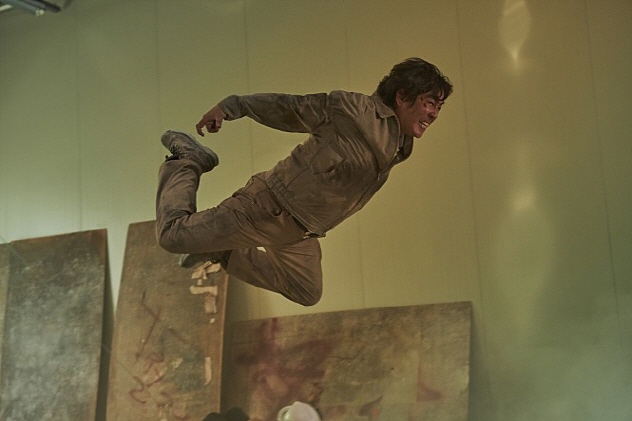
How its plain hero gets his superpower is pretty simple. When Seok-heon (Ryu Seung-ryong) goes to the fountain in a nearby mountain during one morning, something falls from the sky to a spot near the fountain, and its mysterious substance quickly seeps into the fountain and then happens to be ingested by Seok-heon when he drinks a dipper of water from the fountain. Several hours after drinking that water, his body goes through some change, and then he comes to realize that now he can move things at his will.

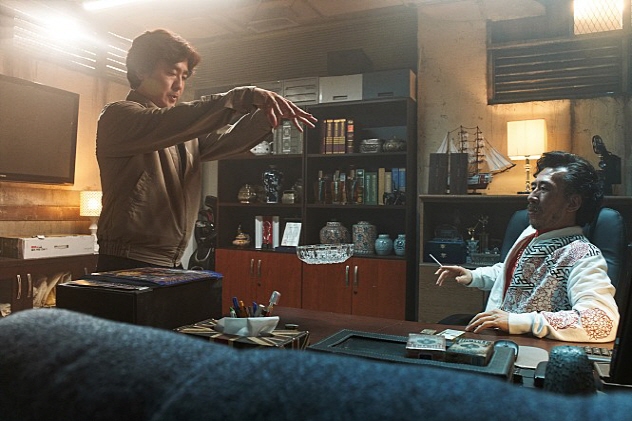
While never having any serious thought on how he happens to acquire such an awesome power like that, Seok-heon simply regards it as a tool for earning easy money. After mastering his power a bit more, he goes to a nightclub for being hired as a magician, and he is instantly hired after he presents his ‘magic’ to the manager of the nightclub.

Meanwhile, the movie also focuses on his estranged daughter Roo-mi (Shim Eun-kyung), who is not so happy to see her father again because she still remembers well when he left his family due to his debt problem. She and her mother worked hard together since he left them, and things went well for a while as their fried chicken shop became successful as shown from the opening scene of the movie, but then they and other small business people in their neighborhood get threatened by a big company which is about to redevelop the area. As she and other small business people protest against the company for not being paid enough for their relocation, the company hires a bunch of goons in response, and Roo-mi’s mother happens to be killed when those thugs attack the fried chicken house at one night.
psychokinesis04

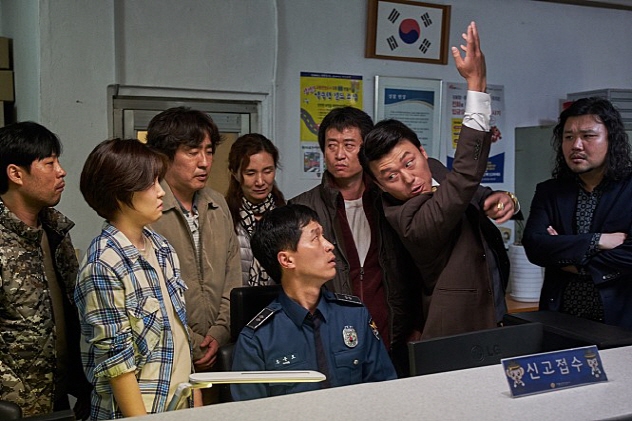
While feeling guilty about this tragedy and willing to help his daughter, Seok-heon is not so eager to get involved in what is going on around his daughter and her neighbors, but, of course, he comes to demonstrate his power in front of them when those thugs come again, and that is just the beginning of what he is going to do for protecting them. At one point, he gathers many small and big objects together for making a barricade for them, and that certainly impresses everyone including Jeong-hyeon (Park Jung-min), a young lawyer who has been trying to help Roo-mi and her neighbors and, yes, has also had some feelings toward Roo-mi.

Now this looks like a promising setup for whatever may follow next, but the screenplay by director Yeon Sang-ho fails to fully develop the potentials inside its story. While Seok-heon is not a very interesting character to watch, there is not enough fun or interest in how he becomes more and more powerful along the plot, and his relationship with his daughter is conventional and clichéd to say the least. Yes, this is another typical story of a lousy father proving himself and his love to his daughter, and it is not much of a spoiler to tell you that he eventually wins her trust and affection back.

The movie later tries to be more serious as pushing its characters into an obligatory climax part, but it does not have enough dramatic weight to hold our attention, and it is also superficial in handling notable social issues in the story. The climax part is apparently inspired by Yongsan Tragedy, a real-life incident which happened in Seoul in 2009, and there is certainly some emotional impact to be felt by me and other South Korean audiences, but everything in that part is so conveniently resolved in the end that we are only left with a hollow impression during its overlong closing scene.

psychokinesis03

As stuck with their underdeveloped characters, the main performers of the movie are mostly wasted. As shown from his breakthrough supporting turns in “War of the Arrows” (2011) and “The Front Line” (2011), Ryu Seung-ryong can be as charismatic as required, but even his adequate performance here in this film cannot compensate for his bland hero. In case of Shim Eun-kyung, she tries to bring some pluck to her character, but she is frequently limited by her thankless role, and so is Park Jung-min, a good actor who drew my attention for the first time via his solid supporting turn in “Bleak Night” (2010).

The best performance in the movie comes from Jung Yu-mi, a wonderful actress who has been mainly known for her charming performance in Hong Sang-soo’s “Oki’s Movie” (2010) and “Our Sunhi” (2013). As the main villain of the story, Jung delightfully chews her several scenes in the film, and she is especially fun when her character cheerfully shows a certain supporting character how ruthless she can be.

Before making a successful transition to feature film via zombie thriller movie “Train to Busan” (2016), Yeon impressed me and other South Korean audiences with “King of Pigs” (2011) and “The Fake” (2013), two very disturbing animation feature films which cynically and chillingly show the dark, despairing sides of the South Korean society. Besides lacking edges compared to these two gloomy but striking works, “Psychokinesis” is less entertaining compared to “Train to Busan” in terms of story and characters, and its good things including Jung’s juicy villain performance only remind me of how it could be better. I am mildly disappointed, but, folks, I don’t think I will remember it well a few weeks later.
psychokinesis01

Posted in Movies | Tagged , , | 1 Comment

Roman J. Israel, Esq. (2017) ☆☆(2/4): An insipid turkey by Gilroy and Washington

romanjisraelesq02

From time to time during Oscar season, we come across films quite disappointing despite talented people behind them, and “Roman J. Israel, Esq.” is one of such dismal examples. Although looking promising to some degrees at first, the movie eventually becomes an aimless and lifeless dud which will bore and confuse you for many glaring reasons including trite dialogues and uninteresting characters, and it is all the more disappointing to see one of the greatest performers of our time struggling in this insipid turkey.

Denzel Washington plays Roman J. Israel, a middle-aged lawyer who has worked in a tiny law firm in LA for many years but never had much court experience. While it is apparent from his social ineptness and obsessive-compulsive behavior that he is on autistic spectrum, Roman is also a brilliant legal expert who can instantly talk about any legal precedent he encountered before, and he has surely been a big help to his boss, who is the only other lawyer of their law firm besides Roman and has always taken care of those legal procedures at the court instead of him.

However, there comes a sudden big change. Not long after Roman begins another day at his law firm, his boss’ secretary tells Roman that his boss had a serious heart attack and then was taken to a hospital. He is instructed to go to the court instead of his boss and then request continuances, but, not so surprisingly, he does not do his job very well. At one point, he clashes with a judge just because he cannot keep his mouth shut, and he is subsequently sentenced to $5,000 fine.

romanjisraelesq04

As Roman’s boss is in permanent coma with no chance of regaining his consciousness and the law firm has been in a pretty bad financial status, someone needs to take care of this trouble, and that person is George Pierce (Colin Farrell), a hotshot lawyer who once studied under Roman’s boss a long time ago. As Roman’s boss requested in advance, Pierce is going to liquidate the law firm and then give Roman a position in his prominent law firm, but Roman does not accept Pierce’s offer as sticking to his belief and integrity, and we soon see him clumsily attempting to be employed elsewhere.

And that is how he happens to encounter Maya Alston (Carmen Ejogo), a community activist who is initially baffled by Roman’s anti-social attitude and odd appearance but somehow impressed by his ideal and passion. Later in the story, she invites him to a meeting for giving him a chance to talk in front of a group of young people, but, of course, that turns out to be not a wise choice. While his idealistic opinion may be worthwhile to listen to, his viewpoint is hopelessly out of touch with his young audience, and he soon finds himself tumbling into an unnecessary argument when one of the young audiences in the meeting is offended by his rather sexist remark.

Eventually, Roman accepts Pierce’s offer and then starts to work in Pierce’s law firm, but he soon causes unintentional conflicts with others in the law firm, and then he comes to make a very big mistake. While handling the case of a young black man involved with a robbery murder incident, he botches up the negotiation with a prosecutor due to his lack of social skills, and that results in a devastating consequence which affects not only him but also the law firm.

Around that point, director Dan Gilroy’s screenplay takes an inexplicable left turn along with its hero. Roman decided to do something which is quite contrary to everything he has believed in, and he also changes himself a lot in the process. After obtaining a considerable amount of money via his misdeed, he buys new slick suits to replace his usual frumpy attire, and he also rents an expensive apartment which certainly looks a lot better than his current residence located in some shabby building. Looking much more well-adjusted than before, Roman comes to gain more trust and goodwill from Pierce and others in the law firm, and it seems everything will be fine for Roman.

romanjisraelesq03

As you have already guessed, there comes an inevitable moment when Roman confronts the consequence of his choice, and the movie tries to generate some dramatic tension in the story, but it frequently fails to engage us due to its serious deficiency in story and characters. Except a number of autistic traits, Roman does not have many personal details to interest us, and the supporting characters around him are more or less than plot devices. In case of a certain big case Roman has been obsessed with for years, we hear about how important it will be for the justice system, but the movie never delves much into this case, and we are only baffled when the movie suddenly thrusts this case into its lackluster ending.

The main performers of the movie do try, but they are constantly limited by their superficial characters. Washington, who somehow received an Oscar nomination for this film, looks awkward and ridiculous with stereotype attitude and behavior which may look offensive to autistic people, and this will probably be one of the least interesting acting turns in his stellar acting career filled with many better performances. Carmen Ejogo, a wonderful actress who has been more notable since her strong supporting turns in “Selma” (2014) and “Born to Be Blue” (2015), acquits herself well despite her artificial scenes, and Colin Farrell manages to keep his dignity intact although his character’s eventual change of heart is not particularly convincing.

By the way, according to the IMDB trivia, “Roman J. Israel, Esq.” went through considerable re-editing after its premiere at the 2017 Toronto International Film Festival, and around 12 minutes of footage was removed from the original version as a result. The movie is still a mess nonetheless, and now I am thinking about how much I was impressed by Gilroy’s previous film “Nightcrawler” (2014), which is a far better character study than “Roman J. Israel, Esq.” While watching that film, I was totally absorbed into its drama even though I did not like its sociopathic hero at all. In case of “Roman J. Israel, Esq.”, I only observed it from the distance while not giving a damn about its story or characters, and, in the end, I was left with nothing particularly good enough to talk about. To be frank with you, I really wish the people involved in this serious misfire will soon move onto something better in the future.

romanjisraelesq01

Posted in Movies | Tagged , | 1 Comment

Loveless (2017) ☆☆☆1/2(3.5/4): Gone from a loveless world

loveless05.jpg

Quite moody and chilly right from its opening scene, Russian film “Loveless” calmly observes the end of one bitter marital relationship. Here are two people who probably should not have been together from the very beginning, and the anger and resentment between them become more intensified when they are stuck by a sudden terrible incident. Mainly due to its austere and clinical storytelling approach which will remind you of the works of Ingmar Bergman, Michelangelo Antonioni, and Michael Haneke, the movie is a rather tough stuff to watch on the whole, but it gradually grabs our attention through its palpably bleak atmosphere and stark realism, and it is interesting to watch how the movie subtly works as an indirect critique of the Russian society.

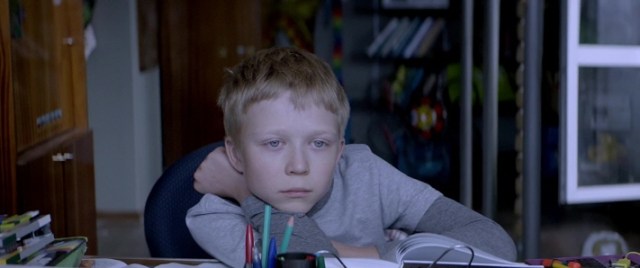
After the opening scene which shows several wintry sights, the movie introduces us to a young boy named Alyosha (Matvey Novikov), and we soon observe his loveless domestic environment. His parents, Zhenya (Maryana Spivak) and Boris (Aleksey Rozin), are recently divorced, and they have no regret about that because, well, they have been sick of each other for years. Once their apartment where only Zhenya and their son reside at present is sold, they will be completely separated from each other, and both of them surely want that to happen as soon as possible.

However, their apartment is still not sold yet, and that surely makes Zhenya and Boris more resentful to each other. As they viciously argue with each other at one point, the movie strikes us with a modest but memorable shot which reminds us again of how much Alyosha feels sad and lonely while not particularly wanted or loved by his parents. As mentioned later in the movie, he was never wanted even when he was conceived, and neither Zhenya nor Boris wants to live with him just because they are mostly occupied with starting their respective life again.

loveless02

The first half of the movie pays some attention to how much Zhenya and Boris have been separated from each other. Boris has a girlfriend who is already pregnant with their child, and they virtually look like a married couple when they are shopping together. Because the head of a technology company where Boris works is an ultra-conservative guy who does not like divorce much, Boris must hide his divorce from everyone in the company, and one of his colleagues tells a rather amusing story about how one employee managed to hide his divorce when he had to bring his family to an annual company party.

In case of Zhenya, she has been in the relationship with some affluent guy, and he surely looks like a far better alternative compared to her ex-husband. Besides being usually nice to her, this guy has a slick, expensive modern house where they often sleep together comfortably, and he also takes her to a posh restaurant. For Zhenya, this relationship means a chance for not only real love but also social upgrade, and she is certainly determined not to lose this guy.

After carefully establishing its main characters’ positions during its first half, the screenplay by director Andrey Zvyagintsev and his co-writer Oleg Negin starts its second half with a sudden happening. On one day, Alyosha is suddenly disappeared without any trace, and Zhenya and Boris find themselves in a very frustrating situation. A detective says that there is nothing much he and his colleagues do about this incident because there is not any clue to help them and they are also busy with many other cases to be handled, and he recommends that they should instead get some help from a group of volunteers dedicated to finding missing persons. While those volunteers are willing to help Zhenya and Boris as much as they can, their wide search around the neighborhood does not lead to anything substantial, and Zhenya and Boris become more nervous as time goes by.

However, their shared nervousness does not make them nicer or closer to each other at all, and it actually makes them more spiteful to each other than before. When Zhenya and Boris come to the residence of Zhenya’s mother just in case, Zhenya’s mother, a cranky old lady who deserves to be called ‘Stalin in a skirt’, cruelly reminds them of how loveless their relationship has been for many years, and that causes another angry argument between them.

loveless03

In the meantime, the search for Alyosha goes on and on without any particular process, and Zvyagintsev and his cinematographer Mikhail Krichman, who previously worked with Zvyagintsev in “The Return” (2003) and “Leviathan” (2014), provide a number of striking visual moments which are filled with an unnerving sense of barren emptiness. In case of the scene which shows Boris and other people looking around here and there in an abandoned decrepit building, the gloomy hollow mood surrounding them is accentuated further by harsh lighting and desaturated color palette, and that will probably remind you of those unforgettable moments of ambiguous emptiness in Antonioni’s notable works such as “L’Avventura” (1960).

As he did in “Leviathan”, Zvyagintsev often makes sharp points on the social matters of the Russian society through his moody drama, and the depiction of the Russian society in his film is not very pretty to say the least. His main characters’ misery and unhappiness come to feel more like a symptom reflecting their glum, uncaring society, and that is backhandedly emphasized more by the last scene of the movie, where its characters phlegmatically watch the news about the conflict in Ukraine without much concern.

Like Zvyagintsev’s previous films, “Loveless”, which received the Jury Prize at the Cannes Film Festival in last year and recently garnered a nomination for Best Foreign Language Film Oscar, is not a pleasant experience at all, but I admire it a lot for its distinctive visual impression as well as its restrained but ultimately impactful drama. Although this is indeed your typical arthouse film, it is a very good one nonetheless, so I recommend you to give it a chance with some patience.

loveless04


Posted in Movies | Tagged , , , | 2 Comments

The Post (2017) ☆☆☆1/2(3.5/4): Standing up for free press

thepost01

Steven Spielberg’s new film “The Post” looks at one important moment in the American journalism history, which is all the more relevant at present for good reasons. While it is often a little too blatant in delivering its timely social message, the movie still works well as a vivid, compelling drama powerfully reminding us of the democratic value of free press, and it surely helps that it is firmly anchored by its top-notch direction and stellar performances to admire.

The movie is mainly about how the Pentagon Papers, famous classified documents regarding the 32-year involvement of the US government in the Vietnam War, was fully reported by the Washington Post in 1971, and the story begins with how these documents came to be leaked by Daniel Ellsberg (Matthew Rhys) at that time. In 1966, Ellsberg came to Vietnam as a US State Department military analyst, and it did not take much time for him to see how bad the situation was for US. He told this frankly to Secretary of Defense Robert McNamara (Bruce Greenwood), but McNamara did not tell anything about this when he was in front of reporters later.

Ellsberg was certainly disillusioned by this, and that is why he decides to do something five years later. While working for a civilian military contractor named the RAND Corporation, he surreptitiously photocopies the Pentagon Papers, and then he gives a small part of these documents to the reporters of the New York Times, who surely know that they must be really careful about this important but very sensitive news material.

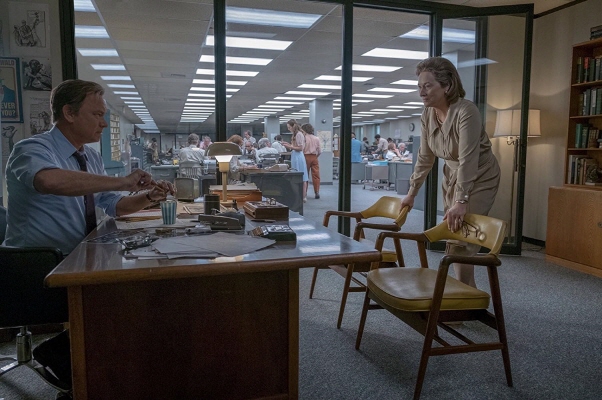
Around that time, Ben Bradlee (Tom Hanks), the executive editor of the Washington Post, senses that something big is about to come from the New York Times, but then the New York Times publishes an article on Ellsberg’s documents, which shocks the whole nation as exposing how the US government has lied to its people about the Vietnam War for many years. Bradley is quite pissed about not getting that scoop first, but he also becomes more determined to beat the New York Times, so he demands his reporters to find the secret source of the New York Times as soon as possible.

thepost03

Eventually, one of his reporters, Ben Bagdikian (Bob Odenkirk), discovers that Ellsberg is the one who leaked the documents, and he soon approaches to Ellsberg, who is ready with the rest of his photocopied classified documents. As Bradlee, Bagdikian, and other journalists of the Washington Post look into these documents, it becomes very clear to everyone that they get something quite bigger than what was already reported by the New York Times, and they also see that they and their newspaper are going to be in a serious legal trouble. Right after the New York Times published its article on the Pentagon Papers, President Richard Nixon and his administration swiftly retaliate with legal measures against the New York Times, and the same thing will definitely happen to the Washington Post once they publish their article.

In the end, everything depends on the decision to be made by Katharine Graham (Meryl Streep), who recently became the publisher of the Washington Post after her husband’s unfortunate death. While being the first female publisher of a major American newspaper, she finds herself getting constantly underestimated by men surrounding her, and that often makes her feel uncertain about whether she can do her job well while her newspaper goes through a crucial financial circumstance.

As gradually realizing how important her newspaper’s article on the Pentagon Papers is, Graham seeks advices from others around her. Almost everyone thinks they should not publish the article considering the enormous legal risk from it, but Graham eventually decides to stick to their journalistic principles and their constitutional right of free press, and she fully trusts her judgement even when she is given a chance to step back from that.
As steadily accumulating its narrative momentum, the movie constantly engages us through its efficient storytelling and considerable verisimilitude. The screenplay by Liz Hannah and Josh Singer falters at times whenever it has its characters push its message directly to us, but it did a mostly competent job of juggling numerous details and characters in the story, and Spielberg and his crew smoothly present them on the screen while also effectively establishing the authentic atmosphere of the American newspaper business in the 1970s, which will instantly remind you of “All the President’s Men” (1976) with those frequent typewriter sounds.

thepost02

The performers in the movie are impeccable to say the least. Meryl Streep, who recently garnered her 21th Oscar nomination for this film, is marvelous as filling her character with subtle human nuances to appreciate, and I particularly like how she effortlessly conveys to us her character’s thoughts and feelings during several key scenes in the film. While his performance is automatically compared to Jason Robards’ Oscar-winning turn in “All the President’s Men”. Tom Hanks successfully embodies his character’s integrity and dignity as finding his own things to play, and he and Streep are always interesting to watch whenever they are together on the screen.

Streep and Hanks are surrounded by an impressive array of talented performers. Sarah Paulson, Bob Odenkirk, Tracy Letts, Bradley Whitford, Bruce Greenwood, Matthew Rhys, Alison Brie, Carrie Coon, Jesse Plemons, David Cross, Zach Woods, Pat Healy, and Michael Stuhlbarg are all solid in their respective supporting roles, and the result is one of the best movie ensemble performances in 2017.

I must point out that “The Post”, which was recently nominated for Best Picture Oscar, is rather modest compared to what we may expect from the combination of Streep, Hanks, and Spielberg, but it is still a very good work on the whole, and it will be interesting to observe how it will be remembered after several years. Will we be still stuck in the ongoing era of ‘fake news’ even at that point? Or, will our world get better with more courageous and principled journalism as the movie and its makers sincerely hope? Time will tell.

thepost04

Posted in Movies | Tagged , , , | 2 Comments

Wonder Wheel (2017) ☆☆(2/4): A colorful misfire from Woody Allen

wonderwheel02

Woody Allen’s new film “Wonder Wheel” is one of his most visually gorgeous works during recent years. Filled with colorful period atmosphere right from its very first shot, the movie provides a number of beautiful visual moments, and its first-rate cinematography and production design surely deserve to get some praise, but, alas, these nice technical elements do not compensate much for several glaring deficiencies in the movie including lackadaisical storytelling and bland characterization.

The main background of the movie is Coney Island, New York City in the 1950s, and the story opens with the introduction of one of its main characters. Mickey Rubin (Justin Timberlake) is a young New York University graduate student majoring in drama, and, like many Woody Allen movie heroes, he has aspired to write something great in the future, but he is currently spending his summertime on the Coney Island beach while working as a lifeguard. Apparently bored by his uneventful worktime hour, he is eager to tell us what is going on around him lately, and the movie soon moves its focus from him to Ginny Rannell (Kate Winslet), a restaurant waitress who has lived in the Coney Island along with her second husband Humpty (Jim Belushi) and her young son Richie (Jack Gore).

As shown from her weary appearance, life has been quite tiring and frustrating for Ginny. No matter how much she works hard, things do not get better for her and her family at all, and she is constantly frustrated with many daily problems in her life. Their shabby residence, which is located in the amusement park on Coney Island and is right next to a big Ferris wheel named, yes, Wonder Wheel, does not provide much comfort as noises and lights frequently invade its interior, and there is not much affection left between her and her husband, who usually goes fishing when he is not working in the amusement park. In addition, her son, who was born from her previous marital relationship, has recently developed pyromaniac tendency, and she does not know what to do with him as he keeps making his fiery troubles.

wonderwheel01

And then there comes another matter to deal with. On one day, Carolina (Juno Temple), Humpty’s estranged daughter who left him for marrying her mobster boyfriend, suddenly appears in front of Humpty and Ginny, and she desperately wants her father’s help because she has been running away from her husband and his henchmen. While he is initially not so happy to see his prodigal daughter again, Humpty eventually decides to protect her for a while, and Ginny goes along with that despite her reluctance.

As Carolina continues to stay in her father’s residence, Ginny becomes more annoyed and frustrated than before, but she gets some consolation from her ongoing secret affair with Mickey. As a woman who was once an aspiring actress, she surely enjoys spending time with this smart young man who knows a lot about plays and playwrights, and it often seems possible to her that he will be more committed to her someday in the future.

However, their relationship takes a downturn when Carolina accidentally comes across Ginny and Mickey. While she does not have any idea on what is going on between Ginny and Mickey, Carolina finds herself attracted to Mickey, and Mickey also feels something toward her even though he is still emotionally involved with Ginny. At one point, he asks for a sound advice from his friend, but he does not follow that advice because, well, he cannot help himself when he sees Carolina again, and Ginny is not so pleased about what is going on between him and Carolina.

wonderwheel04

What we get here is a typical melodramatic circumstance, and the movie often evokes the qualities of those old-fashioned melodrama movies based on the works of Tennessee Williams and William Inge but, unfortunately, Allen’s screenplay fails to keep us engaged in its story as frequently hampered by its trite narrative and mediocre characters. While the main characters of the movie are one-note caricatures we do not care much about, the story is mostly predictable and insipid on the whole, and the finale is seriously devoid of any dramatic punch despite the diligent efforts from Kate Winslet, who is surely trying hard here but only remains to be stuck with her colorless character in the end.

The other main performers in the movie also try to do as much as they can, but their results are mostly disappointing too. Maybe because of his contemporary aura, Justin Timberlake feels rather awkward in the period background surrounding him, and Jim Belushi is only demanded to look dour and miserable. In case of Juno Temple, she brings some sense of life to her performance, but then her performance is limited by her underdeveloped character, and that is another disappointment in the film.

At least, “Wonder Wheel” is not a total failure considering its competent technical aspects. The production design by Santo Loquasto is colorfully gorgeous, and cinematographer Vittorio Storaro, who previously worked in Allen’s previous film “Café Society” (2016), reminds us again that he is indeed one of the best cinematographers in our time. The movie, which was blasted by many critics when it was released in US in last December, is not as awful as I feared, but this is still a major disappointment, and I can only hope that his upcoming next movie is less dissatisfying than this.

wonderwheel03

Posted in Movies | Tagged , | Leave a comment

The Square (2017) ☆☆1/2(2.5/4): Challenging, baffling, and annoying

thesqaure01

Swedish comedy film “The Square” challenged me, baffled me, and annoyed me. I sort of understood its points as occasionally amused by some of its satiric moments, and I actually admire its several challenging moments, but I also felt impatient as observing how superficial and self-indulgent it often is. It surely wants to laugh at its subjects, but there is not enough dramatic or comic impact due to its rather thin characterization, and it frequently hangs on its jokes too long and too much. You may laugh at times during its 150-minute running time, but it merely goes on and on until it eventually fizzles out, and there is not much satisfaction in that.

The main background of the movie is some prominent art museum in Stockholm, and the opening scene shows us several workers preparing the site for a new exhibition. After a silly moment involved with an old statue to be displaced for the exhibition, we see these workers carefully working on the ground step by step, and then we soon behold a big empty square area established on the ground. This square is actually the main part of the exhibition, and we are frequently told about what it means and represents: “The Square is a sanctuary of trust and caring. Within it, we all share equal rights and obligations.”

Well, that sounds pretty nice, but it looks like there is not much trust and caring in the world surrounding our hero Christian (Claes Bang), the curator of the museum. When we see him for the first time, he and his colleague simply pass by a poor beggar just like many other passersby, and then he gets his wallet and smartphone stolen while he and his colleague are distracted by some frantic woman.

thesqaure02

Through his assistant’s technical help, Christian is able to track down his smartphone. It seems to be in some apartment building, but he cannot get its exact location, so he decides to do something rather drastic for getting his smartphone back. With his assistant, he goes to that apartment building in question, and he delivers his message to every apartment in that building. It is initially amusing to watch this silly behavior of his, but this scene quickly becomes monotonous as he just moves from one floor to another, and what happens in the end is too mild to be a punch line in my trivial opinion.

Anyway, Christian eventually gets his smartphone back, but there soon comes another problem. Somebody becomes quite mad because of what he did in that building, and that character in question demands an apology from him. What happens between him and that character is a textbook case of failure to communicate, but this situation does not engage us much because we are reminded again and again of how unlikable both of them are. As your average self-absorbed prick, Christian does not see any reason why he should apologize, and he simply disregards that character, who keeps loudly threatening to give him chaos as much as possible.

Meanwhile, the movie also gives us a series of absurd moments unfolded in the museum. While Christian is distracted by his smartphone problem, the people working under him try to find a way to draw more publicity for the upcoming exhibition, and that later leads to something which quickly goes viral when it is posted on YouTube. During the meeting attended by a renowned artist played by Dominic West, somebody constantly makes noises due to his neuropsychiatric disorder, and everyone has no choice but to tolerate that person because they are all, well, civilized people. In case of a modern artwork merely consisting of piles of gravels, it reminds me of when I wondered whether those abstract modern artworks in the Art Institute of Chicago are profoundly simple or simply profound, and I will not deny that I could not help but be amused whenever it was shown on the screen.

thesqaure04

The most striking moment in the film comes from when a bunch of dinner guests experience a performance art which goes horribly wrong. When a guy suddenly appears and then behaves like a big ape in front of the guests, the guests are amused for a while, but then the guy continues his aggressive behavior even after Christian formally introduces him to everyone, and that certainly tests the patience of the guests, who finally decide that enough is enough when the guy really goes too far.

To some degrees, I appreciate how the movie is constantly challenging and baffling with these moments and other absurd moments, but it does not succeed in generating something coherent from them. As it keeps spinning its wheels, we become more distant to its story and characters while not caring much about them, and then it becomes more self-indulgent to our annoyance. In case of a part involved with the character played by Elisabeth Moss, this part feels redundant to say the least, and I must confess that I did not see any particular point from an ape living in her character’s apartment.

“The Square”, which received the Palme d’Or at the Cannes Film Festival early in last year and is recently nominated for Best Foreign Film Oscar, is written and directed by Ruben Östlund, who previously made “Force Majeure” (2014). That film was really funny, and I still remember well its many hilarious moments. “The Square” will not be easily forgotten in my mind either, but I do not think I will remember it fondly.

thesqaure06

Posted in Movies | Tagged , , | 1 Comment

The Commuter (2018) ☆☆☆(3/4): Liam Neeson on train (you guess it)

thecommuter03.jpg

“The Commuter” will be a definite guilty pleasure for you if you have enjoyed a bunch of recent action thriller flicks starring Liam Neeson. Again, he plays a tough guy suddenly thrown into a very urgent circumstance, and you will surely appreciate how he steadily carries everything well as a good actor who has established himself as an unlikely but undeniably effective action movie hero during last 10 years since the unexpected success of “Taken” (2008).

Here in this film, he plays an ex-cop named Michael MacCauley, who has worked as an insurance company employee for 10 years since he retired from the New York City Police Department. He has lived with his wife and son in a suburban area outside New York City, and the opening sequence of the movie shows us his constant morning routine over several months. After waking up early in the morning, he talks a bit with his wife and son as preparing himself for another day to begin, and his wife later takes him to a nearby train station where he gets on a commuter train to the city along with others.

When Michael gets on the train on one day, everything seems to be mostly fine as usual except his family’s chronic financial problem, and that impression is continued as he works on his potential clients, but then there comes a bad news. He is suddenly notified that he is fired, and he does not know what to do as struggling with the emotional turmoil inside him. He understandably hesitates to tell this bad news to his wife, and his grueling hesitation continues even when he eventually gets on a commuter train to his suburban neighborhood in the evening.

thecommuter02

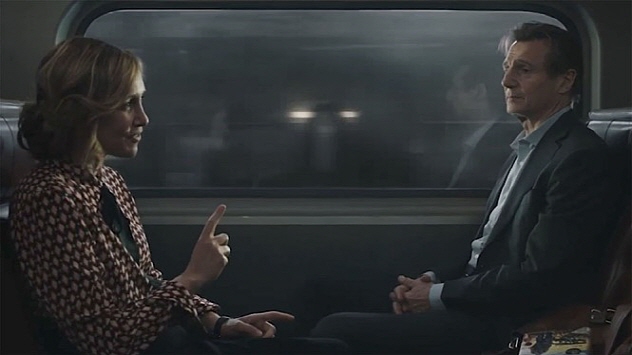
And then something unusual happens while he is on that train. It looks like someone has been paying attention to Michael right from when he gets on the train, and that person in question soon approaches to him. At first, the mood between that person and Michael feels rather playful, but, as already shown from the trailer of the movie, that person wants Michael to do something in exchange of $100,000. Although her character is essentially a plot device, Vera Farmiga did a good job of exuding the subtle aura of mystery and intrigue during her brief scene, and she also shows some sense of humor as her mysterious character reveals her shady intention step by step in front of Michael.

Of course, Michael is befuddled at first by the offer from Farmiga’s character, but he soon comes to see that her offer is quite a serious one. As she told him, there is already $25,000 ready to be taken by him, and the rest of the money will be given to him if he just finds a certain person on the train and then secretly pinpoints that unknown person via a GPS tracker.

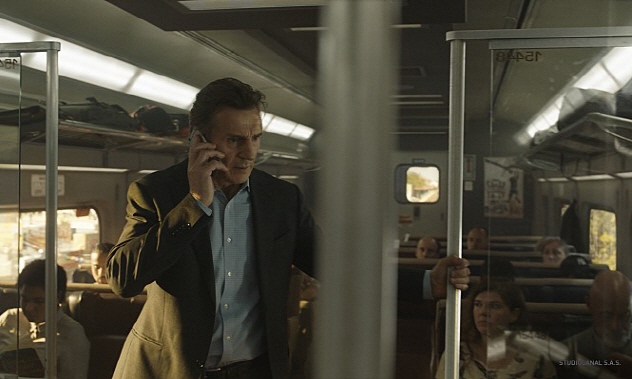
Because of his current financial difficulty, Michael surely feels tempted by this offer for a while, but he also feels qualms about what can possibly happen once he finds that unknown person. He decides to refuse the offer, but, of course, he only comes to realize that he is already trapped in this increasingly risky circumstance. It looks like his every move on the train is being watched, and then he is pushed further as he faces what will happen to his dear family if he does not do the job as demanded before the train arrives at a certain station.

As a man with a particular set of skills, Michael may be able to find that unknown person before his deadline. While he carefully and desperately searches for any possible clue, director Jaum Collet-Serra, who previously collaborated with Neeson in “Unknown” (2011), “Non-Stop” (2014), and “Run All Night” (2015), provides several good suspenseful scenes. I particularly like one certain scene where Michael finds himself stuck below the train and must get out from there as soon as possible, and I certainly appreciate how Neeson looks believable in that scene and other gritty moments in the film.

thecommuter01

Around the third act, the movie starts to get literally derailed while becoming more ridiculous and preposterous, and it accordingly becomes less engaging as we become more aware of its weak plot. When a hidden motive is finally revealed around that point, we are not so surprised at all because it was virtually telegraphed to us during an earlier scene which exemplifies two time-honored genre clichés. I will not go into details here, but you will recognize them instantly if you are a seasoned moviegoer like me, and you may be wryly amused like I was during my viewing.

Anyway, the movie still works mostly thanks to Collet-Serra’s competent direction and Neeson’s strong presence on the screen, and the result is a bit better than “Unknown” and “Non-Stop”. Yes, it has a fair share of plot holes just like these two films (my nagging question: how the hell is our hero monitored on the train so thoroughly like that?), but it keeps its elements rolling along the course at least during its first two acts, and I enjoyed that process enough to forgive its contrived third act.

I must point out that “The Commuter” is less impressive than Collet-Serra’s previous thriller film “The Shallows” (2016) and also less distinctive that Neeson’s more effective thriller films such as “The Grey” (2011), “A Walk Among the Tombstones” (2014), but it achieves most of what it intends to do at least, and Neeson shows here that he can be tough and steely as before despite being 65 at present. As he said in his recent interviews, he will soon stop playing action movie heroes because of his age, but, boy, he still has it, and I will not deny that I had some fun with that.

thecommuter04

Posted in Movies | Tagged , | Leave a comment

Molly’s Game (2017) ☆☆☆(3/4): A crackling drama from Sorkin and Chastain

mollysgame04.jpg

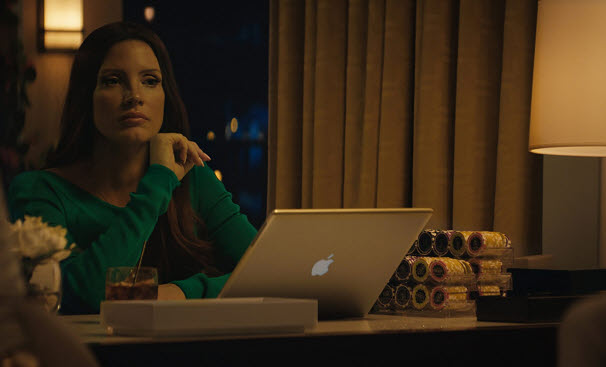
“Molly’s Game” is as talky and snappy as you can expect from a work written by Aaron Sorkin, who makes a directorial debut here in this film. While it surely has numerous lengthy dialogue scenes where its characters talk quite a lot, these dialogue scenes always draw our attention because of the considerable wit and eloquence in Sorkin’s writing, and, above all, they are fueled by the lead performer’s fierce, intelligent performance.

Based on Molly Bloom’s nonfiction book “Molly’s Game: From Hollywood’s Elite to Wall Street’s Billionaire Boys Club, My High-Stakes Adventure in the World of Underground Poker”. the Sorkin’s adapted screenplay begins its story with one defining moment in Bloom’s life. Bloom (Jessica Chastain) was once a promising skier looking forward to playing in Winter Olympics someday, but the unfortunate accident at an important competition virtually ended her skiing career, so she came to change her life plan a bit. She was supposed to go to a law school, but she decided to postpone her enrollment for spending one free year in LA.

In LA, she initially works as a nightclub waitress, but then she comes to work for a real estate guy named Dean Keith (Jeremy Strong). She works as a mere secretary for him at first, but, after noticing her cleverness and resourcefulness, Keith later offers her another job. He has a hike-stakes underground poker business behind his back, and he needs someone to assist him in handling those big-time Hollywood clients of his.

mollysgame02

Once she sees how much more she can earn through this ‘extra’ job, Bloom soon goes all the way for getting more money and empowerment. When she comes to clash with her boss, she swiftly sweeps up his every important client to her own high-stakes underground poker business, and it does not take much time for her to be on the top of her business field. One of the most fun parts in the film is how she achieves her success step by step, and that enjoyable process is further boosted by a number of high-stakes poker scenes in the film. While these scenes are mostly packed with myriad terms and details, we seldom get confused as the movie briskly and excitingly bounces from one poker scene to another, and we gladly go along with that as often amused and excited by whatever is happening on the poker table.

The movie pays some attention to two particular clients of hers. One is Harlan Eustice (Bill Camp), and this expert poker player comes to lose his bearing when he unfortunately makes an absurd wrong judgment at one point. Camp, who recently drew my attention with his Emmy-nominated supporting turn in HBO miniseries “The Night Of”, is simply devastating as his character is gradually mired in more misery and obsession, and we come to feel sorry for his character as much as Bloom in the end.

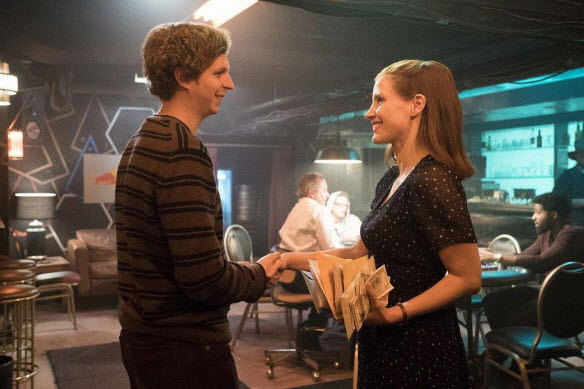
The other one is a young A-list Hollywood guy who is referred to as “Player X” (Michael Cera) in the film. He is a nasty competitive prick who enjoys not only defeating his opponents but also destroying their confidence and spirit, and, not so surprisingly, he later turns out to be far nastier than expected. Cera is very effective in his against-the-type role, and he surely surprises us as showing that he can look quite unpleasant and malicious.

Meanwhile, the movie also focuses on Bloom’s serious legal problem which happens several years after she eventually leaves LA and then goes to New York City. She begins her high-stakes underground poker business again there, and she soon attracts many big-time clients as before, but, unfortunately, some of her clients turn out to be Russian mobsters. When these guys are arrested, the prosecutor handling the case demands Bloom to reveal her clients, but she refuses to do that even though she already reveals some of them through her tell-all book.

mollysgame01

As she sees that she may go to jail for this, she goes to a lawyer named Charlie Jaffey (Idris Elba), who is reluctant at first but eventually agrees to take the case. Elba, a charismatic actor who can instantly grab our attention, dials down his intensity level a bit for supporting Chastain, but he has his own moment later in the movie, and he ably delivers it with power and conviction.

The movie falters when it attempts to tell us what makes Bloom tick. While it is quite clear to us already that Bloom’s edgy, competitive personality is originated from her strained relationship with her father Larry (Kevin Costner), Sorkin tries to explain his heroine directly to us via a rather blatant and contrived scene between her and her father, and the movie loses some of its narrative momentum as a result.

Nevertheless, Jessica Chastain’s strong performance remains as the compelling center of the movie, and that reminds me again of what a fantastic actress she has been since her breakout turns in “The Tree of Life” (2011), “The Help” (2011), and “Take Shelter” (2011). As she previously did in “Miss Sloane” (2016), Chastain imbues her character with intensity and intelligence, and she also dexterously handles her many lengthy dialogue scenes without missing any beat. Right from the opening scene, she holds our attention with her fast-talking narration, and that is just the beginning of how she keeps impressing us throughout the film.

Despite its few glaring flaws, “Molly’s Game” is a solid work on the whole thanks to Sorkin’s competent job as its director/writer and Chastain’s commanding lead performance. Although it is a little overlong, its narrative pacing is mostly maintained well during its 140-minute running time, and I was entertained enough even though I noticed its weak points during my viewing. It could be better, but it is still good enough for recommendation at least.

mollysgame03

Posted in Movies | Tagged , , , | 1 Comment

City of Ghosts (2017) ☆☆☆(3/4): Brave Syrian civilian journalists against ISIS

cityofghosts02

Documentary film “City of Ghosts” often chills us with its unflinching presentation of what was going on in Raqqa, a Syrian city which was relatively unknown before it became the self-declared capital city of ISIS in 2014. We see video clips showing people getting crucified or executed, and we also get a number of unforgettable moments vividly showing how things were quite bad for many people living in Raqqa.

Those moments were secretly shot by the undercover members of a civilian journalist organization named “Raqqa Is Being Slaughtered Silently” (RBSS). which was founded around the time when the Syrian Civil War was begun in 2012. The initial purpose of this organization was reporting on the brutality of Bashar al-Assad’s dictatorship, but it later came to focus on ISIS when ISIS occupied Raqqa in 2014 July, and that was how it drew considerable attention from the world outside.

As mentioned in the documentary, RBSS members had to take lots of risk for shooting many atrocities committed by ISIS. Once what they shot on the streets of Raqqa was spread around the world via Internet, they were soon targeted by ISIS, and many of them had to leave the city after one of them happened to be captured and then was brutally tortured and murdered.

cityofghosts03

Nevertheless, those RBSS members who left the city continued their work. The documentary shows them working in their safe houses located somewhere in Germany and Turkey, and we get to know a bit more about some of them. In case of a young man named Aziz, he tells us that he was not particularly political before the war, but he has been one of the key figures of RBSS, and he is determined to keep going on with his political activity even after he is notified that his life may be in serious danger. Like many of his colleagues, he has been accustomed to danger as constantly threatened by ISIS, but he cannot help but be nervous as the camera looks at him for a while during one scene later in the film.

In case of a former high school teacher named Mohamad, he usually maintains his jovial attitude while working with his colleagues in Turkey, but then they find themselves quite disturbed by a sudden tragic incident involved with an acclaimed journalist who has been their mentor figure. Eventually, Mohamed decides to leave Turkey along with his wife, and they feel safer as arriving in Germany later, but they still should be careful as before.

In case of Hamoud and Hassan, these two brothers had to endure a painful personal tragedy while working as RBSS members. Not long after they got out of Raqqa, ISIS soldiers arrested their father and older brother, and both of them were promptly executed. Along with Hamoud, we see an atrocious video clip which presents his father’s execution in a slick hyper-reality style not so far from Hollywood films, and he phlegmatically tells us that he was more motivated rather than scared by that.

We see how these people and other RBSS members working outside Syria work closely with a number of remaining undercover RBSS members in Raqqa. The circumstance becomes a lot harder for them as ISIS cuts off Raqqa from the world outside step by step, but they keep trying hard anyway, and the evil of ISIS is exposed more around the world thanks to their diligent efforts,

cityofghosts04

However, they sometimes feel helpless and frustrated as watching how ISIS spreads its virulent ideas around the world via the same tools they use for exposing ISIS, and the documentary pays considerable attention to those vile ISIS propaganda video clips spread around Internet. While it was initially pretty clumsy in making propagandas, ISIS soon came to produce slicker and showier versions for attracting more possible recruits, and we hear about how much its upgraded propagandas can be effective to its numerous potential targets around the world. In fact, their harmful effects were already shown from a number of terrible terror incidents around the world – including that horrible shooting incident in Tampa, Florida.

Although there were several limits in the production of his documentary, director Matthew Heineman, who was previously Oscar-nominated for “Cartel Land” (2015), brings considerable verisimilitude to his documentary, and he also did a competent job of capturing small intimate moments of humanity from RBSS members. While the mood among RBSS members is not exactly bright due to their constant danger, they sometimes let themselves loosened a little, and there is a warm human moment when several RBSS members have a casual conversation in their safe house. At one point, Hamoud reveals his personal matter in front of the camera, and the last shot of the documentary is poignant as he sees a tentative sign of hope.

Although it is occasionally tough to watch, “City of Ghosts” is worthwhile to watch nonetheless because it palpably presents another human story inside the Syrian Civil War. After ISIS was eventually driven out of Raqqa in 2017 October, the documentary loses some of its urgency at this point, but it still works as an engaging record of one admirable case of journalism, and it surely deserves to be mentioned along with “Last Men in Aleppo” (2017) and other notable documentaries about the Syrian Civil War.

cityofghosts05

Posted in Movies | Tagged , , | Leave a comment

The Shape of Water (2017) ☆☆☆1/2(3.5/4): Mute beauty and the water beast

theshapeofwater01

“The Shape of Water”, the latest film from Guillermo del Toro, is a haunting mix of fairy tale and love story with a bit of social commentary. While it does not entirely succeed in mixing its many different story elements together, the movie still works as a superlative visual experience packed with enchanting mood and numerous details to notice, and, above all, it somehow makes us care about an unlikely relationship between its two main characters.

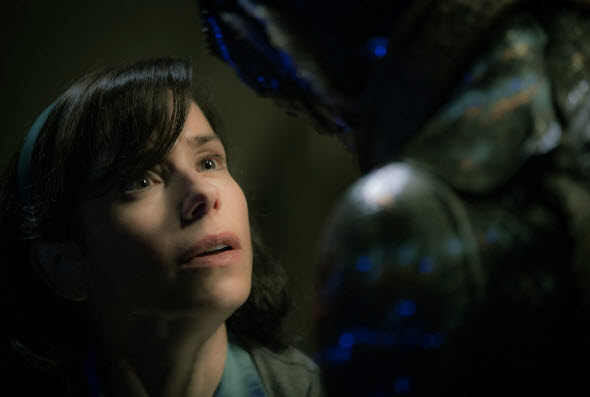
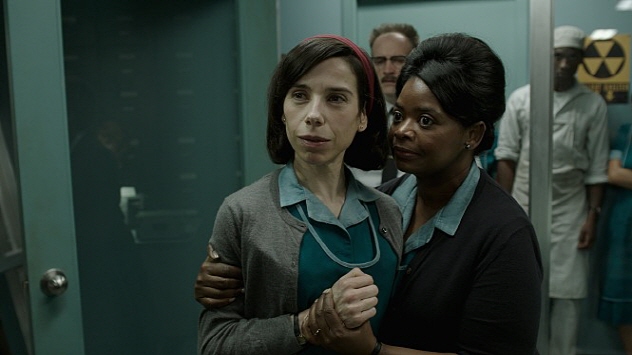
In the beginning, we are introduced to a mute woman named Elisa (Sally Hawkins). She lives alone in a shabby apartment located above a big old movie theater in Baltimore, Delaware in the early 1960s, but life is not that bad for her on the whole. She has a fairly good job, and she is also close to her neighbor Giles (Richard Jenkins), an aging gay painter who has been accustomed to loneliness as much as Elisa.

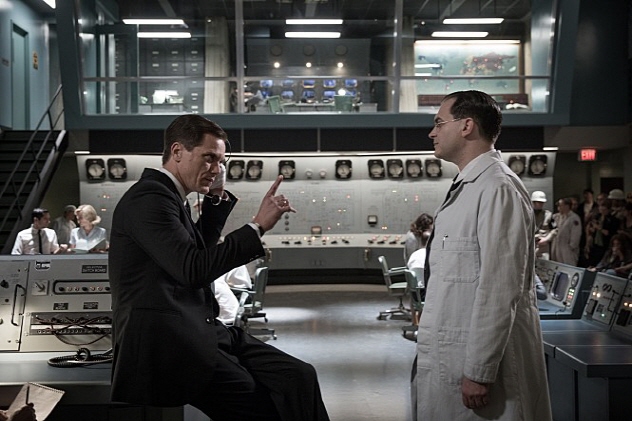
At her workplace, which turns out to be some high security government facility, she usually works with her colleague Zelda (Octavia Spencer), a sassy African American woman who frequently talks about her domestic life while doing their cleaning work with Elisa. When they are going through their another usual workday, they are instructed to clean the floor of a big laboratory room in the facility, and then they happen to see the metal water tank containing a mysterious entity, which has just been transported to the facility under the supervision of Colonel Richard Strickland (Michael Shannon).

The entity in question, which was captured by Strickland somewhere in the Amazon, turns out to be a humanoid amphibian who may remind you of “Creature from the Black Lagoon” (1954). For some unspecified reason, this creature can provide possible advantages in the ongoing Space Race between US and Russia, so Strickland and his direct boss have no qualms about vivisecting this exceptional creature, but Dr. Hoffstetler (Michael Stuhlbarg) thinks otherwise as a scientist who genuinely appreciates the value of this creature. He protests against the heartless decision of Strickland’s direct boss, but there is nothing he can do about that, and then the circumstance becomes trickier for him for a reason I will not reveal here.

theshapeofwater04

Meanwhile, Elisa becomes curious about the creature, and so she comes to approach tentatively to the creature. Their first direct encounter is not exactly cordial, but Elisa eventually gains the creature’s trust through her small gesture of kindness, and they quickly come to interact more with each other. Besides teaching the creature a bit of sign languages, she also introduces several pieces of music to the creature, and there is a lovely moment when she becomes a little playful in front of the creature while music is played in the background.

Of course, their sweet time does not last long as Elisa comes to learn about what will soon happen to the creature, and she decides to do the right thing for the creature. With some help from Giles, she devises a plan for getting the creature out of the facility, and that leads to a suspenseful sequence unfolded within the facility.

While steadily maintaining the level of tension, the movie slows down its plot a bit during its second half, and the screenplay by del Toro and his co-writer Vanessa Taylor takes some time for developing further the relationship between Elisa and the creature. As spending more time with the creature, Elisa finds herself somehow attracted to the creature, and she does not hesitate at all for getting what her heart comes to desire for. At one point, she willingly shows more of herself to the creature, and the creature, who is apparently male, does not resist her more intimate approach at all. Thankfully not delving too much into their, uh, carnal business, the movie later gives us an impressive romantic moment reminiscent of the climax scene of “Delicatessen” (1991), and Sally Hawkins, who had a wonderful year thanks to her superb performances in this film and “Maudie” (2016), is convincing in her onscreen interaction with Doug Jones, who has been known well for playing several memorable creatures in del Toro’s films.

theshapeofwater03

Like many of del Toro’s previous films, the movie also has several dark, unpleasant moments, and most of them come from Strickland, a vile, hateful man who virtually embodies the hypocrisy and monstrosity of the American society during the 1960s. While I think Shannon plays villains a little too often these days, he brings considerable intensity to his character as usual, and his disturbing performance makes an effective contrast to the decent supporting turns by Richard Jenkins, Michael Stuhlbarg, and Octavia Spencer.

As I pointed it out before, these story elements and other ones are not exactly held well together at times, the movie is an absolute pleasure to watch nonetheless. While the production design by Paul D. Austerberry, Shane Vieau, and Jeff Melvin is impeccable with bountiful details to be appreciated, the cinematography by Dan Laustsen is fabulous with a number of wonderful visual moments shining with haunting beauty, and Alexandre Desplat’s lyrical score is effectively used along with several period songs including “You Will Never Know”.

“The Shape of Water”, which received the Golden Lion Award at the Venice International Film Festival in last year, has been regarded by many critics as his best work since “Pan’s Labyrinth” (2006), and it is expected to garner a bunch of Oscar nominations including the one for Best Picture. I have some reservation mainly because the movie did not strike me as hard as “Pan’s Labyrinth” on emotional levels, but it is still a very admirable work on the whole, and I am certainly glad to have another helping of del Toro’s undeniable artistry.

theshapeofwater02

Posted in Movies | Tagged , , | 2 Comments