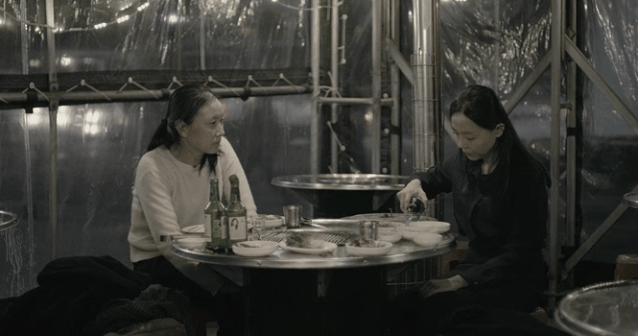
Faces Places (2017) ☆☆☆1/2(3.5/4): Agnès Varda and JR on the road

facesplaces01

To be frank with you, Agnès Varda was not a familiar name to me even when I watched tons of movies during the 2000s. Although I managed to watch her second feature film “Cléo from 5 to 7” (1962), her notable works such as “Vagabond” (1985) were somehow out of my reach during that time, and I remained oblivious to her significant contribution to the French New Wave era until I came to learn about her two recent documentary films “The Gleaners and I” (2000) and “The Beaches of Agnès” (2008).

Due to my late learning on Varda’s long, illustrious filmmaking career, I was a bit worried as preparing myself for watching her latest documentary film “Faces Places”, but I instantly found myself charmed by its free-wheeling spirit. As entertaining and mesmerizing as “The Gleaners and I” and “The Beaches of Agnès”, the documentary is another lovely work from a great filmmaker who deserves to be nicknamed the ‘Grandmother of the French New Wave’, and you will admire how effortlessly it draws into its lively journey which is full of sublime episodic moments to remember.

In the beginning, the documentary presents a series of playful scenes between Varda and JR, a 34-year-old French flyposting artist who is the co-director of the documentary. As we see them coming across and then passing by each other several times, they respectively emphasize how they do not notice each other much, and this sly humorous moment continues for a while until we eventually see them talking with each other in private.

For their collaborative project, Varda and JR are going to go around here and there in rural regions of France, and that surely reminds me of what she previously did in “The Gleaners and I” and “The Beaches of Agnès”. In “The Gleaners and I”, she virtually gleaned many small precious moments from various types of gleaners she encountered during her little journey, and there is an unmistakable thematic resonance between her subject and storytelling approach. In “The Beaches of Agnès”, she moved from one beach to another as vivaciously and poignantly presenting her life and career, and she certainly showed us that she is too spirited to be merely labeled as a living legend.

facesplaces04

Although she is soon going to have her 90th birthday this year, Varda demonstrates to us again here in this documentary that she has not lost any of her spirit yet. While her distinctive appearance mainly defined by her rather unusual hairdo instantly draws our attention, she casually exudes joie de vivre from her gentle, diminutive face, and that makes an interesting contrast with JR, who is your average hip artist inseparable from his slick, fashionable attire and a pair of sunglasses.

While JR drives his truck which often functions as a big photograph booth, he and Varda looks for people and places curious enough for their collaborative project, and they do come across a number of interesting people and locations. In a nearly abandoned rural town which were once resided by many miners, they meet an old woman virtually living alone in her neighborhood, and she has her own story to tell. In a remote farm, they meet a farmer who gladly tells them about how he has managed a large chunk of land alone thanks to automatization, and we observe how he works on a field to be cultivated. In a chemical factory, they meet a group of workers, and one of them happens to be going through his last day before retirement. In two goat farms, they observe two different ways of handling goats, and we come to reflect on which way is really better. In Le Havre, they meet a trio of port workers, and then they also meet these workers’ wives, who have their own things to tell.

In the meantime, Varda and JR work together for bringing art to the places visited by them. In case of that abandoned town, they plaster the big photographs of miners to the walls of several old abandoned buildings, and the front side of that old lady’s house is covered with her photograph. In case of the aforementioned chemical factory, they shoot two groups of employees separately and then plasters the two resulting photographs together on one wall, and the overall result is quite memorable as succinctly conveying the messages of unity and solidarity. In case of Le Havre, they have heaps of containers assembled together, and we soon see the completion of a triptych showing those three port workers’ wives.

facesplaces03

The most challenging case for JR and Varda comes from an old German military bunker left on a beach. After some talks and discussions, they eventually agree to choose an old photograph from Varda’s collection, and her instinct turns out to be correct. The photograph somehow fits well to the surrounding environment, and that surely gives us another memorable moment in the documentary.

As working and traveling together, Varda and JR come to solidify their friendship. At one point, JR introduces Varda to his 100-year-old grandmother, and Varda later attempts to introduce JR personally to another living legend of her generation. I will not go into details on that part, but I can tell you instead that I admire a lot how fluidly and sincerely JR and Varda pull out an unexpectedly special moment in the end.

Overall, “Face Places”, which received the Golden Eye award at the Cannes Film Festival in last year and recently garnered an Oscar nomination for Best Documentary Feature, is one of the most interesting films from last years, and Varda, who deservedly received an Honorary Oscar in last year, seems to be far from retirement. Yes, as occasionally shown from the documentary, she is indeed getting older and weakened day by day, but her spirit is still there, and I hope this extraordinary artist will keep going on as usual.

facesplaces02

Posted in Movies | Tagged , | 3 Comments

Black Panther (2018) ☆☆☆1/2(3.5/4): Here comes Black Panther…

blackpanther03

“Black Panther”, the latest superhero movie from the Marvel Cinematic Universe (MCU) franchise, is quite different from those usual blockbuster products from the MCU franchise. Not only just entertaining but also very distinctive in many aspects, the movie distinguishes itself a lot from many other recent superhero movies, and it definitely brings lots of fresh air to its genre as “Logan” (2017) and “Wonder Woman” (2017) did in last year.

In the beginning, we get two prologue scenes, and the first one is about the foundation of Wakanda, a country located somewhere in the middle of Africa. Many million years ago, a big meteor containing an alien metal called vibranium fell right into the land of Wakanda, and five tribes fought with each other over the control of that special metal, but then there came a warrior who gained superpowers after ingesting a special herb containing vibranium. Under his leadership, the five tribes united together to form their kingdom, and he became their first ‘Black Panther’.

After the second prologue scene set in Oakland, California in 1992, the movie moves forward to the point not long after what happened in “Captain America: Civil War” (2016). Because of the sudden unfortunate death of King T’Chaka (John Kani) in that movie, his son T’Challa (Chadwick Boseman) goes back to his country for his official succession, and we come to see more of Wakanda. While disguising itself as one of the poorest Third World nations in the world, Wakanda is in fact a powerful country which has been equipped with highly advanced technologies thanks to vibranium, and that aspect is exemplified well by a slick technology laboratory operated by T’Challa’s plucky sister Shuri (Letitia Wright), who is eager to provide more technological improvement for her brother’s Black Panther suit.

blackpanther05

After his official succession is completed, things look stable again in Wakanda, but, of course, there soon comes a trouble to draw the attention of T’Challa and others around him. A mercenary named Ulysses Klaue (Andy Serkis), who has a bad history with Wakanda, attempts to sell a certain precious object in Busan, South Korea, so T’Challa promptly go to Busan along with Okoye (Danai Gurira) and Nakia (Lupita Nyong’o). I must tell you that I and other South Korean audiences were amused to see these characters walking around in the busy marketplace area of Busan, and I was also excited to see the subsequent vehicle action sequence which is spectacularly unfolded on the streets and alleys of Busan.

Anyway, the main villain of the movie turns out to be a guy named Erik Killmonger (Michael B. Jordan), and this ambitious and ruthless character wants to take away Wakanda from T’Challa for not only an old personal reason but also his radical political belief. His clash with T’Challa is presented as a battle of wills and ideas instead of a run-of-the-mill showdown between good and evil, and Jordan, who previously collaborated with director/co-writer Ryan Coogler in “Fruitvale Station” (2013) and “Creed” (2015), is intense and charismatic as a proud, formidable opponent for our hero.

What follows next may be a bit predictable, the screenplay written by Coogler and his co-writer Joe Robert Cole, keeps its plot rolling as providing enough personality and entertainment to engage us, and we actually come to care about what is being at stake for its characters. Yes, the movie indeed culminates to a big action climax during its last act just like other countless superhero films, but it is still driven by story and characters nonetheless, and we get an unexpectedly reflective emotional moment as our hero eventually arrives at the end of his struggle.

blackpanther02

In terms of mood and style, the movie looks bright and wonderful thanks to cinematographer Rachel Morrison, who recently garnered an Oscar nomination for her supreme work in “Mudbound” (2017). Production designer Hannah Beachler and costume designer Ruth E. Carter fill the screen with myriad details to be appreciated, and I observed these details with curiosity even though I was well aware of many unrealistic aspects of Wakanda (Don’t they need many other things besides vibranium for developing such highly advanced technologies as shown in the film?).

The main cast of the movie is fantastic on the whole. As the title character of the movie, Chadwick Boseman, who has steadily advanced since his breakthrough turn in “42” (2013), is solid and commanding in his strong performance, and he is ably supported by Jordan and other talented performers. While Angela Basset and Forest Whitaker are dependable as usual, Lupita Nyong’o, Letitia Wright, and Danai Gurira are striking in their respective roles, and I also enjoyed the good supporting performances from Daniel Kaluuya, John Kani, Andy Serkis, Winston Duke, Sterling K. Brown, and Martin Freeman, who plays a CIA agent who comes to function as an accidental sidekick for T’Challa and his comrades.

After the considerable critical success of his first feature film “Fruitvale Station”, Coogler advanced further with his next feature film “Creed”, and “Black Panther” confirms to us again that he is a distinguished filmmaker to watch. Like “Creed”, “Black Panther” successfully galvanizes its franchise with fresh new elements, and I hope the MCU franchise will learn a lesson from this rousing success.

blackpanther04

Posted in Movies | Tagged , , | 4 Comments

A Fantastic Woman (2017) ☆☆☆1/2(3.5/4): A fantastic transgender melodrama

afantasticwoman01

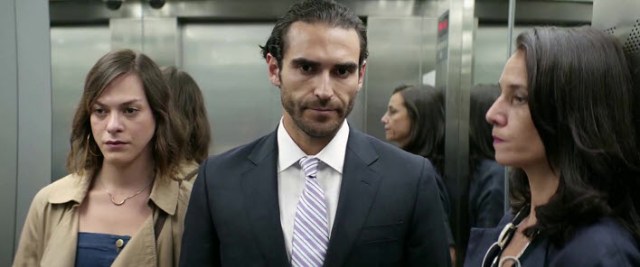
Chilean film “A Fantastic Woman” is as fantastic as it can be as a melodrama which goes all the way along with its transgender heroine. While there are lots of painful moments as she struggles with many difficulties besides her deep grief and sexual identity, she does not step back at all, and it is often touching to see how she keeps trying to be herself as usual despite all the inhospitality and humiliation thrown upon her.

The movie opens with her boyfriend Orlando (Francisco Reyes) having a rest in a spa, and we get to know a bit about him as he tries to find something after he gets out of the spa. He is a middle-aged man who has run a textile company, and he is looking for a gift he bought in advance for his transgender girlfriend Marina (Daniela Vega), a young restaurant waitress who also works as a nightclub singer during nighttime.

Although Orlando cannot find the gift before he comes to the nightclub where Marina works, Marina does not mind that at all, and they soon go to a Chinese restaurant for their own happy private time. While Orlando is old enough to be her father, neither their age difference nor Marina’s sexual identity matters in their relationship, and Marina has actually lived with him and his dog in his cozy apartment.

However, their happiness is shattered by an unexpected incident. While they try to have a sex shortly after they come back to their apartment, Orlando suddenly suffers a severe case of aneurysm, and he also falls down along the stair when Marina tries to take him to a nearby hospital. When they finally arrive in the hospital, Orlando is nearly unconscious, and Marina is devastated when a doctor later comes to her and then notifies her of Orlando’s death.

afantasticwoman03

As Marina tries to deal with this sudden loss, a policeman approaches to her because Orlando’s death looks rather suspicious due to the injuries caused by his fall, and he does not show any respect or courtesy to her at all. For instance, he does not accept her present name, and he also demands her to give him her old identification card showing her former male identity.

When a female detective from the Special Victims Unit comes to Marina on the next day, the situation becomes more exasperating for Marina. The detective casually and condescendingly assumes that Marina is a victim or a suspect, and she throws several insensitive questions at her. While naturally becoming more exasperated, Marina keeps her temper down as much as she can, but the circumstance only becomes more difficult for her. At one point later in the story, the detective virtually forces her to be naked in front of a camera just because she needs to confirm officially that Marina is not a sexual abuse victim, and that is one of the most hurtful and infuriating moments in the film.

And there are Orlando’s family members, most of whom have been not so pleased with Orlando’s relationship with Marina. While Orlando’s brother Gabo (Luis Gnecco) is a little sympathetic to Marina, Orlando’s ex-wife Sonia (Aline Küppenheim) is harsh and cruel to Marina just because she still does not get over the fact that her ex-husband left her for Marina, and she even forbids Marina to attend Orlando’s funeral while calling Marina ‘chimera’. Like Sonia, Orlando’s son Bruno (Nicolás Saavedra) also wants Marina to go away from their life as soon as possible, and they demand that Marina should leave Orlando’s apartment within a few days.

afantasticwoman02

Now this is indeed a quintessential melodrama setup, and the movie is willing hurls its heroine into a series of stylish moments to accentuate strong emotions churning inside her. While there is a striking moment of violence when Marina happens to be confronted by Bruno and two other family members, there is also a noirish sequence unfolded within Orlando’s frequent spa, and we get a couple of lovely fantasy moments which reflect Marina’s resilient personality. The soundtrack of the movie is as bold as its visual style, and you may smile when Aretha Franklin’s “(You Make Me Feel Like) A Natural Woman” is played on the soundtrack in one brief scene.

Above all, the movie is supported well by the superb performance from its lead actress. As a transgender actress, Daniela Vega surely brings considerable natural qualities to her character, and she also did a tremendous job of presenting a vivid, complex character on the screen. As her character is frequently placed at the center of the screen, the movie lets us face and then accept who she is, and Vega is simply magnificent as effortlessly conveying her character’s dynamic emotional status to us.

“A Fantastic Woman”, which won three awards including the Silver Bear award for Best Screenplay at the Berlin International Film Festival and was recently Oscar-nominated for Best Foreign Language Film, is directed by Sebastián Lelio, who previously impressed me and other audiences with “Gloria” (2013), a wonderful drama film about one plain middle-aged divorced woman who tries to find her own way to live and feel happy. In both “Gloria” and “A Fantastic Woman”, Lelio shows that he is a skillful filmmaker who is very good at making sensitive and thoughtful drama film with refreshing aspects, and I think we can have some expectation on his two upcoming films which would be released during this year.

afantasticwoman04

Posted in Movies | Tagged , | 2 Comments

Phantom Thread (2017) ☆☆☆1/2(3.5/4): Elegant disruption

phantomethread02

Precisely elegant and subtly intense, Paul Thomas Anderson’s new film “Phantom Thread” is a mesmerizing period chamber drama which draws our attention with its delicate and sumptuous moments at first and then unnerves us with dark psychological undercurrents beneath them. The movie is as tense as the works of Alfred Hitchcock while also being as sobering as the works of Ingmar Bergman, and it is a sheer pleasure to observe how it effortlessly glides along with its style and mood as firmed anchored by three fabulous performers at the center of the film.

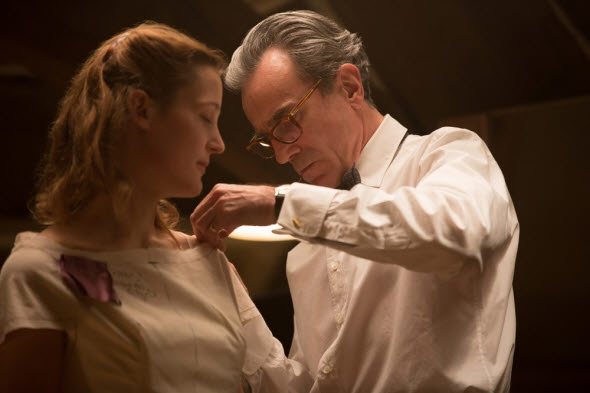
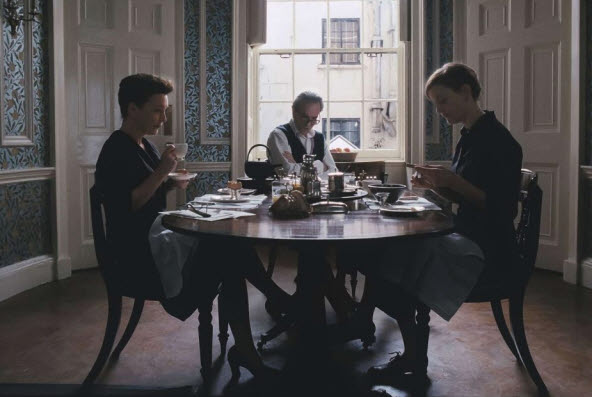
Daniel Day-Lewis, who recently announced his retirement not long before the movie was released in US around the end of last year, plays Reynolds Woodcock, a renowned dressmaker working in London in the 1950s. Reynolds is a dedicated professional who has lots of pride in his work and artistry, and the early scenes of the movie show how his daily life and work are always under control for him as steadily managed by his sister Cyril (Lesley Manville), who is your average unflappable British lady and understands her brother better than anyone as his only close family member.

However, things are not exactly under control in case of his latest romantic relationship. While he has lost interest in his current lover Johanna (Camilla Rutherford, who holds her own small place well during her brief appearance), she has been frustrated with his detachment and self-absorption, and Cyril is ready to handle their eventual separation. To her and her brother, Johanna is just another pretty young woman passing through their house, and Reynolds happily continues to focus on his work while not disrupted as usual.

phantomethread04

But then there comes another woman into his life. While he spends some free time outside London, he drops by a hotel restaurant, and that is where he comes across a young waitress named Alma Elson (Vicky Krieps). As he orders a meal in front of her, something instantly clicks between them, and then they come to spend more time with each other. While Reynolds is attracted to her plain beauty to be dressed by him, Alma enjoys the gentle attention from him, and there is a tender, sensitive moment when he shows her a bit of his professional skill in the workroom of his countryside cottage.

Not long after that, Alma begins to live in Reynolds’ London residence as his latest lover, and, not so surprisingly, she soon comes to face the difficulties of living with him. She is willing to move their relationship to the next level, but that is certainly the last thing he wants, and he firmly sticks to his egoistic attitude and stiff lifestyle as further frustrating her. While their romantic feeling still seems to remain when they defiantly retrieve a dress from one superficial customer together, he and she come to clash harshly with each other when she tries to bring a big change into their relationship at one point, and that is the point where their situation begins to get darker.

Even after that narrative point, the movie maintains its elegance and subtlety as before, and Anderson, who not only wrote the screenplay but also worked as the cinematographer of the movie, continues to treat us with lovely visual moments shining with precision and clarity. Thanks to its first-rate production design and costume, the period atmosphere on the screen is flawless while filled with authentic details to admire, and Jonny Greenwood’s classical score effectively accentuates the characters’ emotions churning beneath the surface.

phantomethread01

The three main performers of the movie are all terrific in their respective fine performances. As meticulous and focused as ever, Day-Lewis perfectly embodies his character’s prim appearance and aloof egoism, and that is why the eventual disintegration of his character’s composed veneer is dramatically impactful. In one crucial scene later in the movie, Reynolds does not say anything at all, but his silence speaks volumes thanks to Day-Lewis’ deftly modulated acting, and the resulting emotional intensity is overwhelming to say the least.

As Reynolds’ no-nonsense sister, Lesley Menville, who previously drew my attention through her devastating supporting turn in Mike Leigh’ “Another Years” (2010) and deservedly received an Oscar nomination along with Day-Lewis (the movie received total six Oscar nominations including the ones for Best Picture and Best Director, by the way), gives an equally nuanced performance to behold. While usually looking as frigid as Judith Anderson in “Rebecca” (1940), Menville slowly reveals her character’s human qualities through her subtle acting, and you may wonder whether Cyril knows a lot more about what is going on between Reynolds and Alma than she seems.

In case of Vicky Krieps, a rather unknown Luxembourgian actress who previously played small supporting roles in “Hanna” (2011) and “A Most Wanted Man” (2014), she is simply astonishing for being an equal acting match for her co-star, and it is really compelling to watch how she gradually takes the center besides Day-Lewis. I think this movie will be her career breakthrough, and I will not be surprised to see her becoming as prominent as Alicia Vikander or Léa Seydoux within a few years.

While it may require some patience from you, “Phantom Threads” is another fascinating work from Anderson, who has always intrigued and excited us with his distinctive works. While I was baffled by “The Master” (2012) and “Inherent Vice” (2014), I appreciated their admirable qualities despite that, and I was certainly impressed by the sheer ambition of “Boogie Nights” (1997), “Magnolia” (1999), and “There Will Be Blood” (2007), which is incidentally fueled by another memorable performance from Day-Lewis. As I said before, again, I have no idea on what will come from Anderson next, but I will savor and cherish numerous good things in “Phantom Threads” for now.

phantomethread03

Posted in Movies | Tagged , | 3 Comments

A Prophet (2009) ☆☆☆☆(4/4): A criminal education in prison

aprophet01

It is always fascinating to see a smart character rising up from the bottom step by step, and French film “A Prophet” is one of such cases. Here is a plain young man thrown into a grim, violent closed world filled with dangerous criminals, and it is both unnerving and compelling to watch him learn, survive, grow, and prevail through his ‘education’. While we are often alarmed to see the gradual formation of his criminal identity, we cannot help but watch his progress with curiosity and fascination, and the movie supremely works as a gritty but electrifying mix of character study and crime drama.

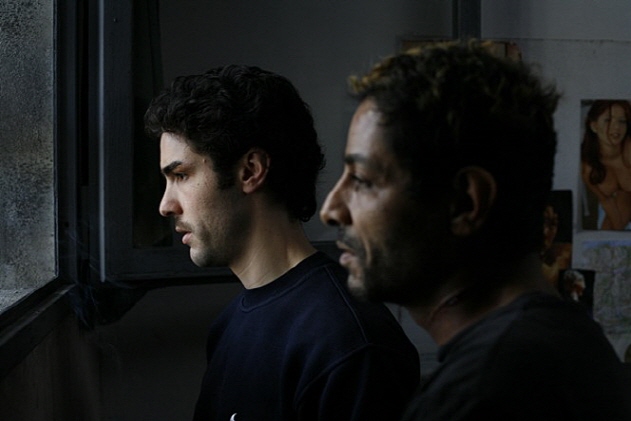
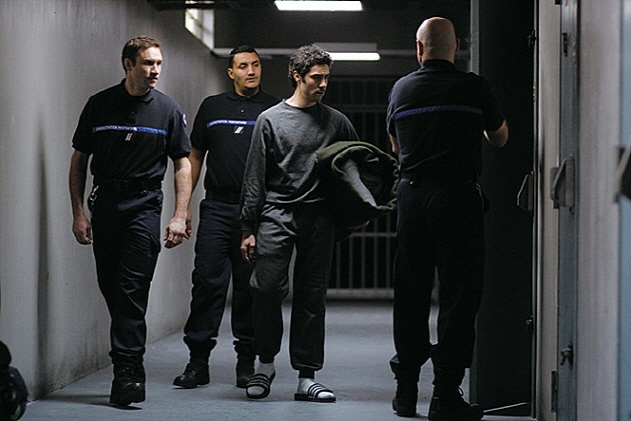
Its hero is Malik (Tahar Rahim), a 19-year-old illiterate French lad of Arab descent. The movie opens with him being kept in custody, and we do not learn much about him except that he is sentenced to 6-year incarceration for beating a police officer. He claims he is innocent, but that does not matter much, because he is already about to be transferred to a prison where he is going to be incarcerated for at least 3 years. Once he arrives in the prison, he is quickly stripped of his possession and privacy, and he soon begins his first day while being nervous and uncertain as before.

As a lone prisoner who does not belong to any group in the prison, Malik quickly becomes an easy prey. When he walks around alone in the prison yard, a prisoner suddenly approaches to him, and then he and other prisoner take away Malik’s sneakers. Malik tries to fight back, but he has no chance from the beginning, and that is the first hard lesson for him.

While continuing his solitary status, Malik comes to draw the attention of César (Niels Arestrup), a Corsican gang member who sees that Malik can be useful for him. An Arab prisoner named Rayeb (Hichem Yacoubi) is recently transferred to the prison, and César is ordered to eliminate him before he testifies against a high-ranking member of César’s gang organization. As an Arab prisoner not associated with any particular group in the prison, Malik looks like someone who can easily approach to Rayeb without provoking any suspicion, so César and his fellow Corsican prisoners approach to Malik one day, and César demands Malik that he should kill Rayeb soon.

aprophet05

Because he has never killed anyone before, Malik understandably becomes quite agitated and conflicted, but there is not any other option for him. César and his gangs virtually have the prison under their control, and Malik learns another hard lesson when he tries to contact the warden. Eventually, he comes to follow César’s demand, and we get a cringe-inducing moment as he does some practice with a sharp razor blade, which he will have to hide in his mouth when the time comes.

However, that moment is nothing compared to the subsequent killing scene, which is utterly gut-wrenching to say the least. Malik tries to stay calm and cool, but then he clumsily tries to kill his target, and the result is quite messy and bloody. I remember well when I watched the movie at Music Box Theater in Chicago during one afternoon of 2010 April; a woman sitting in front of me gasped and then turned her head away from the screen during that scene, and that memory instantly came back to my mind while I watched that scene again a few days ago.

After managing to kill Rayeb, Malik finds himself becoming more associated with César and his gangs, and he makes some advancement for himself. He begins to attend a class for learning how to read and write, and he also becomes more attentive to how the system works among prisoners and guards. He turns out to be a pretty smart student who can quickly learn and grow, and he becomes more confident and experienced as days go by. Observe how shy and introverted he looks in the beginning. And look at how much he talks and behaves differently around the time when his ‘first birthday’ comes.

While he gradually becomes watchful of Malik’s progress, César comes to need Malik more than before as his power in the prison is considerably deflated after many of his gang members leave the prison. After learning that Malik can speak Corsican, he decides to utilize Malik more, so Malik is allowed to have a brief furlough outside the prison for taking care of his boss’ business matter. At one point, he even flies to South France for meeting an Arab gang boss, and he does not hesitate when he sees an opportunity to benefit himself.

aprophet02

Besides César, some other prisoners also become crucial parts of Malik’s formative years. From a gypsy drug dealer named Jordi (Reda Kateb), he learns Criminal Economics 101, and they come to work together when a substantial amount of drug comes into their hand. From a fellow Arab inmate Ryad (Adel Bencherif), he gets not only an extra help for his writing class but also real friendship, and he also comes to learn responsibility when Ryad gets ill again after his early release and Ryad’s family needs help and support.

As watching him learn and advance more and more, we cannot help but wonder what Malik would become if he had grown up in a more positive environment, but the movie does not make any judgment on his criminal maturation, and it often throws us into the thrill and excitement felt from his rapid rise in the system. The movie gives us a number of energetic sequences palpably depicting this dramatic process, and it also effectively utilizes several songs including Nas’ “Bridging the Gap” and Turner Cody’s “Corner of My Room”, which make a good aural contrast to Alexandre Desplat’s somber but tense score.

While firmly maintaining its raw, gritty ambience via its considerable realism and verisimilitude, the movie is willing to shift itself onto different moods, and that is particularly exemplified well by an odd relationship between Malik and Rayeb, who often appears around Malik as a ghost when Malik is alone in his cell. He may represent Malik’s guilt and conscience at first as reflected by their first hallucinogenic scene, but then he comes to function as another friend/adviser to Malik, and he even becomes a sort of spiritual guide to Malik when Malik is about to commit another criminal act which will impact on his life in one way or another.

aprophet03

As the center of the story, Tahar Rahim, who was a fresh newcomer when he was cast for the movie, is superlative with subtle gestures and nuances which give us a glimpse into the silent but dynamic development inside his character. While it is uncomfortable to watch his transformation from a naïve young man to a hardcore criminal, Malik remains as an interesting human being to observe, and Rahim did a commendable job of slyly suggesting his character’s thoughts and feelings while not revealing too much at all. We are often so sure about what exactly Malik thinks as he frequently keeps his counsels like Michael Corleone, but it is compelling to watch how he cleverly maneuvers others around him for his survival and benefit, and we come to feel sort of satisfaction when he is about to begin the next chapter of his criminal life in the end.

As various criminal figures who have each own things to teach to Malik, the supporting performers surrounding Rahim are also very effective. The best performance comes from Niels Arestrup, whose intense performance complements well Rahim’s low-key acting. Along with Rahim, Arestrup conveys well to us the inevitable shift in their characters’ strained relationship, and their best moment comes from a certain wordless moment between their characters later in the movie. They do not say anything to each other while looking at each other from the distance, but the situation is quite clear to us as well as them.

“A Prophet” is directed by Jacques Audiard, who has been constantly interested in characters coping with challenging circumstances they are thrown into. While “A Self Made Hero” (1995) is an amusing black comedy about a smart, innocent liar who disguises himself as a war hero right after World War II and almost gets away with that, “The Beat That My Heart Skipped” (2005) follows a young criminal’s rocky struggle toward his artistic aspiration, and “Rust and Bone” (2012) focuses on the developing relationship between two different people who must rise from each own gloomy bottom. In case of his recent work “Dheepan” (2015), this flawed immigrant drama is not as successful as intended, but its subjects are not so far from his other works, and it is still an interesting work to note.

In addition to being Audiard’s best work to date, “A Prophet” is a top-notch genre piece which distinguishes itself with its deft storytelling and impeccable performance. When I watched it for the first time in 2009 November, I was not entirely sure about whether it is a masterpiece as many others said, but my recent viewing confirmed to me that it is indeed a great prison drama film, and I was reminded again of how much I vividly remember its many memorable moments. Like its hero, the movie deserves full marks.

aprophet04

Posted in Movies | Tagged , , | Leave a comment

Paddington 2 (2017) ☆☆☆1/2(3.5/4): A cuddlier sequel with more charm and warmth

paddington2

“Paddington 2” is so genuinely cute, sincere, and charming that it is virtually impossible for me to say anything negative about it. This may sound like a complaint to you, but, folks, I am not complaining at all, and I am ready to tell you a lot about how much the movie amused and charmed me from the beginning to the end.

First, let me tell you a bit about what happened in the previous film. In “Paddington” (2014), our young bear hero Paddington, voiced by Ben Whishaw, came to London after leaving his jungle home in Darkest Peru, and he soon found himself staying in a nice cozy house belonging to Henry Brown (Hugh Bonneville) and his family. Although Henry was initially reluctant about letting Paddington into his house, he came to like and care about Paddington as much as his wife Mary (Sally Hawkins) and their children Judy (Madeleine Harris) and Jonathan (Samuel Joslin), and Paddington eventually became another member of their family.

“Paddington 2” begins its story not long after the ending of the previous film. While he is more accustomed to his new home and its neighbourhood than before, every day is always filled with new and interesting things for Paddington, and he is eager to write about them in his frequent letters to Aunt Lucy (voiced by Imelda Staunton), who took care of Paddington along with Uncle Pastuzo (voiced by Michael Gambon) for ‘many bear years’ before sending him to London and is now residing in a retirement home located somewhere in Darkest Peru.

Because Aunt Lucy is about to have her 100th birthday, Paddington wants to send her something very special, and then he comes across an old but lovely pop-up book when he visits a local antique shop run by Mr. Gruber (Jim Broadbent). As its each section is beautifully and spectacularly unfolded in front of his eyes and ours, Paddington becomes determined to buy this pop-up book for Aunt Lucy, but it turns out to be quite an expensive one, so he decides to work for earning enough money for buying it.

paddington203

At first, he tries to work at a local barbershop, but that leads to a hilariously disastrous circumstance you have to see for yourself, so he comes to try a simpler job which, to our amusement, suits him better than expected. As he is diligently and happily working day by day, he is accompanied with the cheerful music performance by a street band, and we cannot help but smile while watching this jolly moment.

However, there comes a big trouble when a washed-up actor named Phoenix Buchanan (Hugh Grant) comes into the picture. Because he knows that the pop-up book is actually far more valuable than it seems, Buchanan is willing to get it by any means necessary, so he breaks into Gruber’s shop at one night and then steals the pop-up book, and it looks like he can get away with his crime as he frames it on Paddington, who happens to witness Buchanan in disguise on the spot but then comes to be arrested by the police instead.

Despite the protest from the Browns and many of his good neighbours, Paddington is swiftly sent to the court and then sentenced to 10-year incarceration. Drenched in dreary Victorian style, the prison where he is incarcerated is not exactly a nice place, and he is not so popular among fellow prisoners due to his funny mishap in the prison laundry, but he maintains his gentle, courteous attitude as usual – even when he comes to confront Knuckles McGinty (Brendan Gleeson), the prison cook who is also the most fearsome dude in the prison. While it is not much of a spoiler to tell you that Paddington eventually comes to melt the tough heart of not only McGinty but also other prisoners, the movie bounces from one humorous from another as exuberantly wielding its colorful style and mood reminiscent of Wes Anderson’s “The Grand Budapest Hotel” (2014), and we accordingly get plenty of laughs from that.

paddington202

In the meantime, the Browns try to prove Paddington’s innocence, and that inevitably leads them to Buchanan, who is not deterred at all as gradually approaching to what he has wanted for years. In the end, everything in the story culminates to the climactic sequence unfolded on a train, and director/co-writer Paul King did a good job of balancing the sequence well between humor and excitement.

As the center of the movie, Ben Whishaw gives an endearing voice performance, and he is supported well by the other cast members including Hugh Bonneville, Sally Hawkins, Madeleine Harris, Samuel Joslin, Julie Walters, Jim Broadbent, Imelda Staunton, Michael Gambon, Brendan Gleeson, Joanna Lumley, Noah Taylor, Eileen Atkins, Tom Conti, Peter Capaldi, and Hugh Grant, who has a lot of fun here with his flamboyant villain character. Like Nicole Kidman in “Paddington”, Grant is willing to throw himself into silliness and wickedness, and he is absolutely hilarious whenever his character goes into his theatrical mode – and that happens quite often in the movie, by the way.

In conclusion, “Paddington 2” is a successful sequel which is more entertaining than its previous film in many aspects. You can clearly see right from the beginning that it is a fantasy, but it is a sweet and entertaining one nonetheless, and it is also really touching as we see how Paddington’s genuine decency brings the goodness from many of characters around him. Although I was frequently amused by his naiveté, I came to cherish his good-heartedness a lot, and his story gently reminded me again of why we should be more generous and compassionate to each other these troublesome days. To be frank with you, my brain says that I should give the movie 3 stars because it is essentially a lightweight family film, but I also feel that it earns an extra half star for its bona fide sincerity, so I give it 3.5 stars as following its good lessons.

paddington204

Posted in Movies | Tagged , , , | 1 Comment

78/52 (2017) ☆☆☆(3/4): Anatomy of that infamous shower scene

785202

Among many notable works by Alfred Hitchcock, “Psycho” (1960) is one of his greatest works for many good reasons. While he was already regarded as the master of suspense at that time, he wanted to do something different for shocking and scaring his audiences, so he went all the way for it when he came across Robert Bloch’s novel of the same name, and the final result turned out to be far more successful than expected. While it was the biggest hit in his long, illustrious career, it has also influenced countless works since it came out in 1960, and, above all, it has not lost any of its disturbing power even at present.

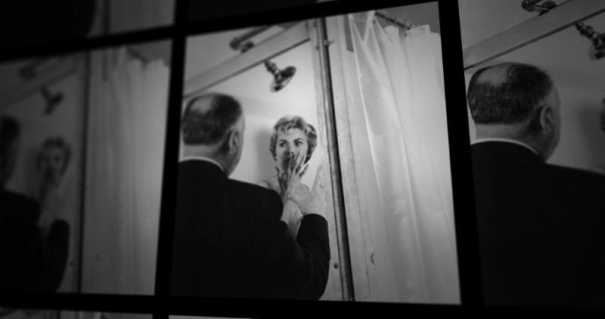
As many of you know, the most memorable moment of “Psycho” is that shower scene, and documentary film “78/52” delves deep into that infamous three-minute scene, which was created from 78 camera set-ups and 52 cuts as reflected by the title of the documentary. While many things presented in the documentary are quite familiar to me, it is still an enjoyable analysis piece on one of the most famous moments in the movie history, and I surely appreciated its considerable effort and enthusiasm during my viewing.

While dissecting the shower scene bit by bit, the documentary makes an interesting point on how “Psycho” was the culmination of what Hitchcock tried to convey to his American audiences for years. Many of his thriller films made during the 1940-50s often reflected darkness and danger in the world outside, and that aspect was particularly exemplified well in “Shadow of a Doubt” (1943), a chilling masterpiece which is memorable for its striking contrast between evil and innocence. As finding himself competing with other skillful thriller directors such as Henri-Georges Clouzot, Hitchcock wanted to push boundaries further, and, fortunately, he was at the right time for that in 1959. Hollywood began to unshackle itself from the Motion Picture Production Code of 1930, a.k.a. Hays Code, thanks to the critical/commercial success of “Some Like It Hot” (1959) and “Anatomy of a Murder” (1959), and he could afford to take risks thanks to the success of “North by Northwest” (1959).

785203

While preparing for the production of “Psycho”, Hitchcock paid a lot of attention to setting the stage for the shower scene in the movie, and the documentary demonstrates how the first act of the movie deftly misleads its unsuspecting audiences as focusing on the character played by Janet Leigh. The movie initially seems to be about her character’s struggle to free herself from her personal problems, and it dexterously plays with its audiences’ expectation as generating a number of suspenseful moments including the sequence involved with a highway patrol officer.

And then the movie takes an unexpected turn along with Leigh’s character when her character comes to spend a night at a remote motel, which is run by a young man who turns out to have a very dark secret behind his seemingly benign façade. Although the documentary does not dig enough into how perfectly Anthony Perkins was cast in his role, it presents to us several subtle touches in his iconic performance, and I came to appreciate more of how important his performance is in the effective setup for the inevitable narrative point waiting for Leigh’s character.

While the shower scene of “Psycho” may not look that shocking these days, it was quite a shock to many audiences when it was released in 1960, and Peter Bogdanovich, who worked as a movie critic at that time, still remembers well how much the audiences around him were shocked as watching the shower scene. The movie broke through a sort of safe barrier between itself and its audiences, and, as many interviewees in the documentary say, the movie industry was forever changed after that milestone moment.

785204

As we listen to various interviewees including Walter Murch, Guillermo del Toro, Danny Elfman, and Marli Renfro, who was the nude double of Janet Leigh, the documentary gives us a detailed shot-by-shot analysis on the shower scene. Its every shot and camera angle were carefully and precisely planned and then executed for the maximum level of terror, and the documentary later tells us an amusing anecdote about how Hitchcock and his sound effect crew members tried to get the right sounds for the shower scene.

It is a well-known fact that Hitchcock was not so sure about the movie and even considered trimming it down to a one-hour TV movie. Fortunately, his composer Bernard Herrmann came to the rescue of the movie, and the documentary naturally pays some attention to how crucial Herrmann’s music is in the shower scene. The shrieking sound from string instruments is so effective that it has been steadily quoted or imitated during last 58 years, and I certainly remember well how it was jockingly used in one episode of “The Simpsons”.

Overall, “78/52”, which is currently available on Netflix at present, is a modest achievement, but director Alexandre O. Phillippe did a commendable job of presenting his endlessly fascinating subject, and the documentary reminds me again of the greatness of Hitchcock’s unnerving masterpiece, which virtually opened the door for many subsequent shockers including “The Texas Chainshaw Massacre” (1974) and “Halloween” (1978). Come to think of it, it has been a while since I watched “Psycho” for the last time, and I guess I really have to appreciate its greatness again as soon as possible.

785201

Posted in Movies | Tagged , | Leave a comment

A United Kingdom (2016) ☆☆1/2(2.5/4): Respectful but conventional

aunitedkingdom02.jpg

“A United Kingdom” is a respectful but conventional film about one extraordinary real-life interracial couple. While it surely shows us how courageous and resilient they were as standing together against lots of social/political pressure inflicted upon them, the movie unfortunately does not have enough life and personality to distinguish itself in terms of story and character, and that is a shame considering its several good things including its two versatile main performers.

The early part of the movie is about how Seretse Khama (David Oyelowo) and Ruth Williams (Rosamund Pike) met and then fell in love with each other in London, 1947. As the future king of Bechuanaland, a British protectorate located near South Africa, Seretse has studied in Britain for years, and now he is almost ready to take his regal position, but then he accidentally encounters Ruth, a British middle-class office worker who happens to come along with her sister to a dance party attended by Seretse and his friends. When Seretse and Ruth notice each other for the first time, it is apparent that something clicks between them, and they soon find themselves happily dancing with each other after their formal mutual introduction.

As they spend more time with each other, Seretse and Ruth come to feel more affection toward each other. Even after Seretse reveals to her that he is going to go back to his country as its new king, Ruth continues to love him as before, and Seretse eventually comes to propose to her. Although they surely know how things will be quite different for them once they officially become husband and wife, they are willing to take risks for their love nonetheless, so they quickly marry after she says yes to his proposal.

aunitedkingdom05

Of course, the situation soon becomes quite difficult for both of them. Ruth is disowned from her conservative parents who simply cannot accept her relationship with Seretse, and Seretse is not welcomed much by his uncle Tshekedi (Vusi Kunene) when he and Ruth arrive together in Bechuanaland. Tshekedi wants his nephew to divorce Ruth and then marry someone else who looks more appropriate to be the queen of their country, and so does the British government, which does not want to get into any political trouble because of Seretse and Ruth’s marriage.

Despite their increasing difficulty, Seretse and Ruth become more determined to stick together as they always have. Even without the support from his uncle and the British government, Seretse succeeds in drawing considerable support from many people after making a passionate speech at a public meeting. Although there are so many new things she has to learn and get accustomed to, Ruth keeps trying everyday, and she eventually gets some help and support from Seretse’s younger sister Naledi (Terry Pheto).

However, they cannot help but frustrated as constantly pressured by the British government. At one point, Seretse is sent to London and then pushed into exile, and Ruth has to take care of not only herself but also their newborn baby. At least, they can sometimes talk with each other by long distance, but they only come to miss each other more, and the circumstance remains hopeless for them.

Around this part, the screenplay Guy Hibbert, which is based on Susan Williams’ nonfiction book “Colour Bar”, tries to bring some dramatic tension to the story, but it is often hampered by weak storytelling and thin characterization. As following predictable narrative arc, Hibbert’s adapted screenplay does not interest or entertain us much, and it also fails to bring enough human passion and complexity to its two main characters. Sure, they look brave and noble as expected, but they also look blandly clean-cut at times, and it looks like Hibbert’s screenplay respects them a little too much.

aunitedkingdom03.jpg

Nevertheless, the lead performers of the movie acquit themselves well. While David Oyelowo, who previously drew lots of attention for his electrifying performance in “Selma” (2014), ably handles several big speech scenes including the aforementioned one, Rosamund Pike, who was memorable in “Gone Girl” (2014), balances her character well between resilience and vulnerability, and their good chemistry on the screen is the main reason why the movie works to some degrees. Whenever Oyelowo and Pike are together, we can sense their character’s strong personality, and it is regrettable that the movie does not utilize more of their undeniable talent and presence.

In case of the supporting performers surrounding Oyelowo and Pike, they are mostly wasted in their stereotype roles. While Vusi Kunene and Terry Pheto bring some dignity to their characters, Jack Davenport and Tom Felton look stiff, arrogant, and odious as the main bad guys of the movie, and you may be amused to know that Jessica Oyelowo, who is Oyelowo’s wife, plays one of the haughty British characters in the film.

Compared to director Amma Asante’s previous film “Belle” (2013), “A United Kingdom” is less compelling in many aspects, but I was not that bored mainly thanks to Oyelowo and Pike, and I also enjoyed the vivid mood contrast between London and Bechuanaland in the movie. The movie is fairly watchable, but I cannot help but feel that Mr. and Mrs. Khama deserve something more special than this.

aunitedkingdom04

Posted in Movies | Tagged , , , | Leave a comment

All the Money in the World (2017) ☆☆☆(3/4): All he cares about is money

allthemoneyintheworld01

What a piece of work J. Paul Getty is. While being the richest man in the world, he was also probably the cheapest guy in the world, and Ridley Scott’s new film “All the Money in the World” is compelling to watch whenever it focuses on how selfish and heartless this monstrous real-life billionaire was. Although it does not wholly work well, the movie is entertaining on the whole mainly thanks to Scott’s competent direction, and that is all the more amazing considering that famous post-production trouble associated with the film.

After the movie opens with the kidnapping of John Paul Getty III (Charlie Plummer) which happened in Rome on July 10th, 1973, we get to know more about how he grew up in his rich and famous family through a series of flashback scenes. His grandfather is J. Paul Getty (Christopher Plummer, who is not related to the aforementioned performer), and we hear about how J. Paul Getty became the most powerful oil business man in the world. Once he made a deal with several Bedouin chiefs in Saudi Arabia, Getty went all the way as finding a way to supply the oil from Saudi Arabia to the global market, and his company has been the No.1 oil company in the world for more than 20 years.

John Paul Getty II (Andrew Buchan), who is one of Getty’s several children, did not like his father much, so he had distanced himself from his father for several years, but, after listening to a sound advice from his wife Gail (Michelle Williams), he eventually came to change his mind and then asked for help from his father. While everything initially seemed to be all right as he and Gail and their children including John Paul Getty III arrived in Rome and then were greeted by his father, John Paul Getty II unfortunately succumbed to his longtime addiction problem not long after that, and that certainly disappointed Gail, who finally divorced her husband when she decided that enough is enough. Being well aware of how unwilling her father-in-law was to pay any money to her, Gail did not demand anything besides full child custody and child support money, and her father-in-law agreed to that although he was a bit baffled by this offer at first.

allthemoneyintheworld05

At that time, Gail thought there would not be any further trouble with her ex-father-in-law, but now she really needs his help as her dear son is gone. As she becomes more nervous and desperate, someone calls her and demands her to pay no less than $ 17 million in exchange of her son. The caller in question and his accomplices did kidnap her son, and they are holding him captive somewhere in Southern Italy.

Gail immediately flies to England and then goes to a huge mansion where Getty has resided, but she only finds herself coldly prevented from meeting her ex-father-in-law, who already announced in public that he is not going to pay any money to whoever kidnapped his grandson. His logic is coldly simple. Although paying $ 17 million is a piece of cake for him, he has many other grandchildren besides John Paul Getty III, and he does not want to make a precedent to be followed by more possible kidnappings.

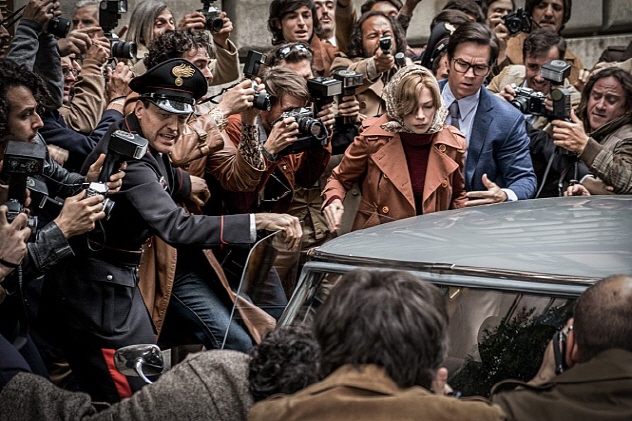
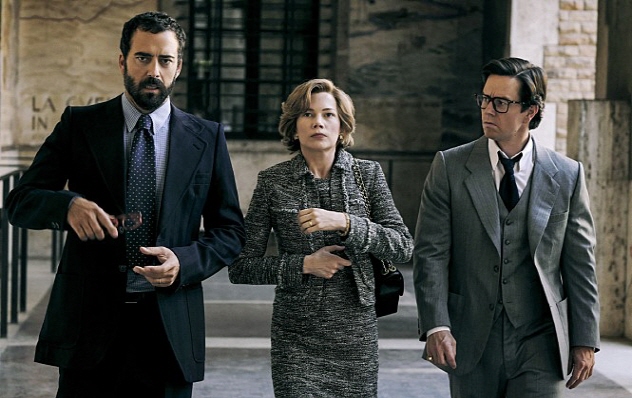
At least, Getty sends one of his employees to Rome. As a former CIA operative who has worked as a professional negotiator for Getty, Fletcher Chase (Mark Wahlberg) surely knows how to handle the situation, and, mainly thanks to him, the ransom money is eventually decreased from $17 million to $4 million, but he also becomes as frustrated as Gail because his boss keeps sticking to his adamant position. As days and months go by, the circumstance becomes worse and worse for Gail’s son, and we later get a gut-wrenching scene when his kidnappers decide to do something quite drastic for pressuring their opponents.

allthemoneyintheworld02

While you may easily guess how the story will end, the movie steadily holds our attention as gradually accumulating tension on the screen, and it is also firmly anchored by two strong performances. Although it looks like she does not have many things to do except looking agitated or exasperated, Michelle Williams, who has diligently advanced since her Oscar-nominated turn in “Brokeback Mountain” (2005), aptly fills her role with human nuances, and her performance functions well as the human center of the movie. While we sometimes get some bitter laughs from several absurd aspects of Gail’s situation, we also come to emphasize a lot with her nonetheless, and Williams is believable in her sensitive depiction of her character’s growing pain and frustration.

On the opposite, Christopher Plummer, who was recently Oscar-nominated for his performance here in this movie, has a number of juicy moments as a despicable curmudgeon. Although he hurriedly replaced Kevin Spacey due to Spacey’s sexual harassment scandal shortly before the movie was released in US at the end of last December, Plummer did an effortless job of embodying the sheer pettiness and heartlessness of his character, and we accordingly get some morbid entertainment from how loathsome Getty can be as obsessively clinging onto his enormous wealth. All he cares about is money, and, as he frankly admits at one point, he simply wants more of that.

While not entirely without weak points including its artificial third act, “All the Money in the World”, which is adapted by David Scarpa from John Pearson’s nonfiction book “Painfully Rich: The Outrageous Fortunes and Misfortunes of the Heirs of J. Paul Getty” is still an enjoyable work, and I especially admire what is achieved by Scott and Plummer. Although they are over 80 at present, they show here that they are still at the top of their respective crafts, and that definitely makes the movie worthwhile to watch.

allthemoneyintheworld04

Posted in Movies | Tagged , , , | 1 Comment

Jamsil (2016) ☆☆☆(3/4): An elusive relationship between two women

jamsil05

To be frank with you, South Korean film “Jamsil” was elusive and confusing for me at first. During its first half, I felt impatient as often baffled about what is exactly going on between its two heroines, and it was also rather hard for me to hold onto its slow, free-flowing narrative which frequently slips into dream and flashback scenes. However, once I accepted how it is about what it is about, the movie became sort of interesting; I came to enjoy its ambiguous mood and solid performance, and I could sense the sadness and melancholy surrounding two women who somehow get closer under their unlikely circumstance.

In the beginning, we get to know a bit about one of these two women. After she fails to pass the state law examination again, Mi-hee (Lee Sang-hee) feels unhappy and depressed, and even her nice boyfriend Doo-min (Lee Sun-ho) cannot console her much when she comes back to their small residence. While feeling uncertain and nervous about her future, she decides to end her relationship with Doo-min, and she soon moves into a smaller place where she is going to live alone for a while.

Giving up trying to pass the state examination again, Mi-hee feels a bit relieved, but she does not know what to do next. There was a time when she dreamt of studying literature, but she had to give up her dream because of her parents, and there is a painful moment later in the story when she visits her parents’ apartment. She cannot help but feel angry about how her parents pushed her into her current unhappiness, and that is why she cannot possibly stay in their home.

While she is on a subway train on one day, Mi-hee notices a high school girl who previously drew the attention of her and other passengers during the opening scene. She immediately follows the girl when that girl gets off from the train at a station in Jamsil-dong, and the girl leads her to an apartment complex. After seeing that girl at the entrance of one apartment, Mi-hee goes to that apartment in question, and that is how she meets a woman named Seong-sook (Hong Seung-yi).

jamsil01

For some unknown reason, Mi-hee introduces herself to Seong-sook as an old friend in their high school years, and, though she is apparently a bit older than Mi-hee, Seong-sook does not question Mi-hee’s claim at all. After allowing Mi-hee to enter her apartment where she has lived with her roommate/friend Ik-joo (Im Hyeong-gook), she begins to spend lots of time with Mi-hee, and they soon come to look like real close friends.

What exactly do these two women want from each other? As shown from a number of warm flashback scenes, Seong-sook did have a close friend during her high school years, and we observe how close they were to each other until they became distant to each other after some point. Although Mi-hee is not that friend in question, Seong-sook comes to think more about her old friend, and she seems to get some consolation from Mi-hee while being with her.

In case of Mi-hee, she is glad to have someone to listen to her, and her daily life looks a little more stable than before after meeting Seong-sook, but she is still struggling with her unstable emotional state. It later turns out that she has been obsessed with her old high school friend, and her fixation on that old friend eventually leads to a rather disturbing scene where she has herself locked in a storage room.

Meanwhile, the movie also focuses on how two other main characters in the story revolve around Mi-hee and Seong-sook. As a guy who was also Seong-sook’s schoolmate and has been a bit more than a mere roommate for her, Ik-joo does not welcome Mi-hee’s appearance much, but then he finds himself getting involved with her more than expected when he confronts her at her residence. When Seong-sook happens to meet Doo-min, something is mutually felt between them, and they come to have a personal meeting when they encounter each other again.

jamsil02

So far, I have only described the plot and characters of the movie while not delving deep into what is sensitively and thoughtfully presented by director/writer Lee Wan-min. Her screenplay’s implicit storytelling approach is frustrating at times, but it gradually builds up its emotional momentum along with its two heroines at least, and we are served with several intimate scenes between them even as we keep wondering about their odd friendship. While these scenes and many other scenes in the movie are shrouded in gray melancholy, the flashback scenes in movie are imbued with a bright sense of nostalgia, and this visual contrast makes us understand more of why Seong-sook remains haunted by the memories of her old friend – and why she chose to stick to Mi-hee from the very beginning.

Under Lee’s competent direction, the main performers of the movie are engaging to watch in their understated performance. While Lee Sang-hee, who previously drew our attention via her wonderful performance in “Our Love Story” (2016), and Hong Seung-yi effectively complement each other, Lee Sun-ho and Im Hyeong-gook are also fine in their earnest supporting performance, and Kim Sae-byuk, who has been more notable since her charming performance in “A Midsummer’s Fantasia” (2014), deserves to be praised for effortlessly going back and forth between her two roles.

On the whole, “Jamsil”, which is belatedly released in South Korea this week although it had its premiere at the Busan International Film Festival in 2016 October, requires considerable patience from you, but it is still an interesting work to be appreciated for its good elements, so I recommend you with some reservation. Although I am not entirely sure about the movie, it has grown on me after I watched it yesterday, and I am willing to revisit it for getting more from it.

jamsil04

Posted in Movies | Tagged | Leave a comment