Overlord (2018) ☆☆1/2(2.5/4): A gory and brutal war horror flick

overlord01

“Overlord” is a gory and brutal war horror flick which may not be for everyone. There are numerous grisly moments of violence and mayhem throughout the film, and I was not entertained enough for recommendation probably because I have been rather tired of its certain horror element, but its overall result is a fairly watchable hybrid genre piece at least.

Mainly set in some rural area of France, 1944, the movie initially comes to us as your typical modern World War II movie. One day before the invasion of Normandy, a bunch of American paratroopers are sent to that area for destroying the German radio tower installed in a local church, but, not so surprisingly, their airplanes are soon heavily attacked the German Army, and we accordingly get a frightening sequence showing how Private Ed Boyce (Jovan Adepo) manages to survive as going through the perilous chaos in the sky.

Not long after his eventual landing, Boyce comes across his several comrades who were also lucky enough to survive. Led by Corporal Ford (Wyatt Russell), Boyce and a few other soldiers look for a village where that church in question is located, and then they encounter a young local woman named Chole (Mathilde Ollivier), who does not trust them much at first but eventually leads them to her village.

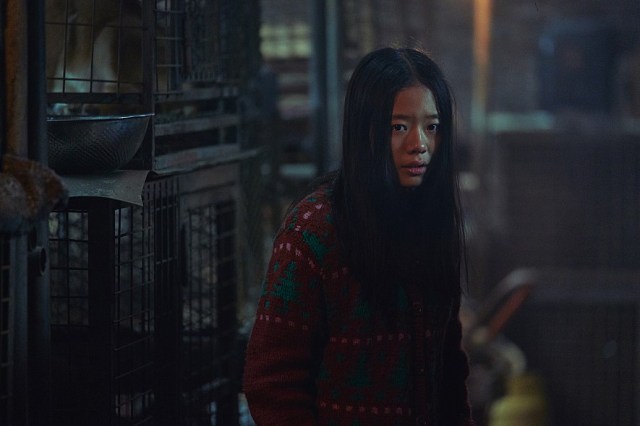
While hiding in her house, Ford and his soldiers must decide what to do next for accomplishing their mission, but things get more complicated when a German officer named Wafner (Pilou Asbæk) comes into Chloe’s house. As your typical Nazi guy, Wafner is cruel and despicable to say the least, and there is a tense moment when Chloe must be very careful with Wafner for not exposing what she is hiding in the attic of her house now.

overlord03

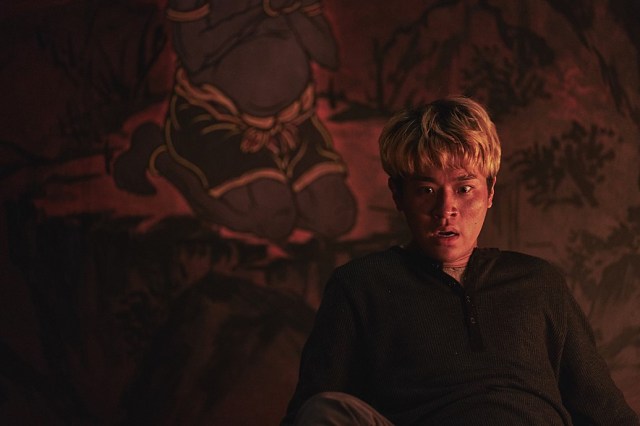
After that narrative point, the movie gradually switches itself onto horror mode. When Boyce later happens to come across a German bunker right below that church, he witnesses a very atrocious act committed by German soldiers, and he encounters more terrible things after sneaking into that bunker. While it surely has radio equipments, the bunker turns out to have a secret laboratory, and the laboratory has a number of unspeakable things which may not surprise you much if you are a seasoned horror movie fan. While there is your average mad scientist, there are also several other things including 1) a dismembered body part which still looks alive, 2) many body bags held in the air, 3) a number of chambers which seem to be holding something inhuman, and 4) syringes containing a mysterious serum.

As evoking a certain type of horror films, the movie naturally serves us lots of blood and violence as required. There is a savage scene which shows how far Ford is willing to go for accomplishing his mission, and then there later comes a terrifying moment involved with that mysterious serum, and the movie goes further with its brutal violence during its last act, which is full of gory moments which will surely make you cringe at times.

It is a shame that the screenplay by Billy Ray and Mark L. Smith does not provide much substance to engage us enough in terms of story and characters. While the characters in the movie are broad archetypes as expected, they are more or less than genre elements to function in predictable ways, and that is particularly exemplified by the sudden death of a certain supporting character at one point, which happens so predictably that you may chuckle instead of being shocked as much as other characters in that scene.

overlord02

The main performers in the film do as much as they can for filling their respective roles. While he is stuck with a rather bland character, Jovan Adepo, who previously played the son of Denzel Washington’s character in “Fences” (2016), shows here again that he is indeed a new talent to watch, and Wyatt Russell reveals a more serious side which is a lot different from his comic performances in “Everybody Wants Some!!” (2016) and “Ingrid Goes West” (2017). As the main villain of the movie, Pilou Asbæk, a Danish actor who previously drew our attention via his memorable performances in “A Hijacking” (2012) and “A War” (2015), is as loathsome as demanded, and Mathilde Ollivier manages to hold her own small place as the sole substantial female character in the film.

The movie is directed by Julius Avery, an Australian filmmaker who previously directed “Son of a Gun” (2014). I have not seen that film yet, but “Overload” shows that he is a skillful filmmaker who knows how to build mood and tension, and I admire its technical aspects to some degree. While the movie looks as slick and gritty as required, cinematographers Laurie Rose and Fabian Wagner did a good job of establishing grim atmosphere on the screen, and that is further enhanced by Jed Kurzel’s moody score.

On the whole, “Overlord”, which is co-produced by J. J. Abrams, is a well-made genre product accompanied with some nice aspects to be appreciated, but it is not that refreshing in its attempt to mix two bloody and violent genres together. After all, war movies can be as gory and gruesome as horror flicks these days, so there is nothing particularly new for us here, but you may want to watch it anyway – especially if you are a devoted horror genre fan.

overlord04

Posted in Movies | Tagged , , | Leave a comment

Becoming Astrid (2018) ☆☆☆(3/4): Before she becomes a writer

becomingastrid

Swedish film “Becoming Astrid” focuses on the early years of Astrid Lindgren (1907-2002), a Swedish writer who has been known well for her many famous children’s book series such the one featuring Pipi Longstocking. I must confess that I am not that familiar with her works (I only know a bit about Pipi Longstocking, who is known in South Korea as ‘Romping Pipi’), but I can say at least that the movie is an engaging drama coupled with some insights on how Lindren’s life experiences inspired her works, and I can also assure you that you will enjoy it even if you are not that knowledgeable about Lindgren’s life and career.

After the opening scene where old Astrid in her last stage of her life is reading a bunch of letters from many young fans congratulating on her birthday, the movie instantly flashes back to her early years. She grew up under her stern parents along with several siblings in her rural hometown, and it is clear from the first scene showing her younger self, played by Alba August at this point, that she is not someone who will easily conform to custom and authority like many others around her. For example, after hearing a local vicar’s sermon on Sodom and Gomorrah, she instantly makes an amusing catch phrase (“Good Morning, Soda!”), and her parents are definitely not so pleased about that, though they are mostly caring and loving to their children despite their puritanical sternness.

Because of her considerable talent in writing, Astrid’s father has her work for Reinhold Blomberg (Henrik Rafaelsen), the editor of a local newspaper. Right from her first day in Blomberg’s office, something clicks between them as they do some playful wordplay, and Blomberg willingly helps Astrid advance further with her writing talent. At first, she mainly handles proofreading and miscellaneous short articles, but then she comes to work as a reporter, and we soon see her at a local train station for covering a newly installed railroad line.

becomingastrid03

In the meantime, she finds herself quite more attracted to Blomberg than before. When she actively attempts to get closer to him, Blomberg initially hesitates mainly because he is a married man currently going through a very difficult divorce process, but then he eventually begins a secret affair with her, and, not so surprisingly, Astrid discovers on one day that she is pregnant. Blomberg wants to do what is the best for Astrid and their child, but he is also afraid of going to jail for adultery (Yes, adultery was considered as a crime in Sweden during the 1920s), so he wants to handle this matter as quietly as possible – and so do her parents, who are quite worried about whether their daughter’s pregnancy will tarnish their reputation.

It is decided that Astrid should be sent to Stockholm for not only taking a training course for secretaries but also covering up her pregnancy from others in hometown, and she follows that decision without protest as discerning that is the best option for her and her child. Not long after settling in Stockholm, she hears about unmarried pregnant women going to Copenhagen, Denmark for giving birth to their children in anonymity, so she subsequently goes to Copenhagen and then gives birth to her son, whom she has to leave under foster care in Copenhagen as he can be a definite living proof of Blomberg’s adultery.

While missing her young son more as time goes by, Astrid also becomes more frustrated with her lover, who is rather passive as mostly concerned about whether he will get caught for his adultery. Despite their caution, his adultery comes to be exposed in the end, but then it turns out that there was not much problem for him from the beginning, and his casual attitude to this makes Astrid think more serious about whether she loves him – and whether she can really live with him and his children for the rest of her life.

becomingastrid04

Although she is well aware of how difficult life can be for a single mother, Astrid decides to leave Blomberg and raise her son alone, but she soon faces her hard reality. Quite getting used to his foster mother, her son becomes awkward and sullen after he comes to live with her in their new place, and Astrid often feels helpless as not knowing what to do with her son – until there later comes an unexpected act of kindness from her boss.

Occasionally making indirect observations on Lindgren’s life and works via a series of comments from her young fans, the screenplay by director Pernille Fischer Christensen and her co-writer Kim Fupz Aakeson, gives us sensitive and intimate moments to be admired for mood and storytelling, and it surely helps that the movie is held up well together by August, who is terrific as a strong, intelligent woman who comes to find her will and strength as struggling with many difficulties in her life. August is also supported well by several fine supporting performers including Henrik Rafaelsen, Maria Bonnevie, Magnus Krepper, and Trine Dyrholm, and Dyrholm is particularly wonderful during a scene where her character thoughtfully consoles Astrid after Astrid becomes depressed by the gap between her and her son.

Overall, “Becoming Astrid” has enough mood, personality, and substance to hold our attention, and it did a solid job of presenting to us a plain but crucial part of Lindgren’s life. After watching this entertaining film, you may be more interested in Lindgren’s works, and you may come to agree to the comment from one of her young fans: “So many people die in your books, but, when I read them, I just want to live.”

becomingastrid02

Posted in Movies | Tagged , , | Leave a comment

1985 (2018) ☆☆☆(3/4): Coming back to his home in Texas, 1985

198501

“1985” is a somber but sensitive drama about a young man coming back to his home with a secret he cannot tell to his family. As calmly observing his several days in his hometown, the movie gradually reveals the repressed emotions between him and his family, and it gives us a number of wonderful moments quietly pulsating with considerable emotional power.

Set in 1985 as reflected by its very title, the movie opens with its young hero arriving in his hometown in Texas. Having lived in New York City since he left his hometown some years ago, Adrian Lester (Cory Michael Smith) has not been particularly close to his family, but now he wants to spend the Christmas week with his family, and we see his rather awkward meeting with his father Dale (Michael Chiklis) at a local airport.

As Adrian begins to stay in his suburban family house, we get to know about his family members bit by bit. While Dale is a Vietnam War veteran who has worked as a mechanic since he returned from Vietnam, his wife Eileen (Virginia Madsen) is your average American suburban housewife, and their younger son Andrew (Aidan Langford) is a shy adolescent boy who is visibly going through the early stage of puberty. As reflected by several brief moments, Dale and Eileen are your typical conservative Christians, and that is the main reason why Adrian still cannot tell them about his homosexuality.

However, it is implied to us that his parents know about their son’s homosexuality to some degree, though they also cannot talk or discuss about that mainly due to their Christian mindset. Whenever Dale talks with his son, there are always some uncomfortable feelings between them, and the same thing can be said about how Eileen interacts with her son. When his former girlfriend Carly (Jamie Chung) is mentioned at one point, it is clear that Eileen wants her son to rekindle whatever is still left between him and Carly, and Adrian eventually comes to call Carly, who is currently pursuing the career of a stand-up comedian in Dallas.

198502

When Adrian talks a bit with Carly after watching her latest stage performance, the mood becomes a bit tender as it turns out that Carly still has some feeling toward Adrian. They eventually go to her residence, and then she attempts to get a little closer to him, but, of course, that only leads to a bitter and painful moment for both of them.

Meanwhile, Adrian becomes a little friendlier with Andrew, who feels rather resentful about his older brother’s long absence but then comes to bond with him as they share their common interest in the certain types of music forbidden by their father for religious reasons. Adrian gladly introduces his young brother to the works of several contemporary pop bands such as The Cure and R.E.M., and they also go to a movie theater together for watching “A Chorus Line” (1985), though, to my small personal amusement, they end up watching “A Nightmare on Elm Street 2: Freddy’s Revenge” (1985) instead.

It is quite possible that Andrew is also a gay, but the movie never directly points that out to us while doling out some notable details one by one (He is more interested in stage acting than football to his father’s chagrin, for instance). As spending more time with Andrew, Adrian comes to see his younger self in the past from Andrew, and he sincerely wants to be someone Andrew can lean on.

However, there is something Adrian has not confided to his family yet. He often looks quietly depressed and despaired because it seems there is not anyone with whom he can talk about what has been eating him for last several months, but then there comes an unexpected moment of kindness and compassion, and he feels a little better after that, though nothing much is changed for him and his family even in the end.

198503

As leisurely rolling along its loose narrative, the screenplay by director/co-editor/co-writer Yen Tan, which is based on the story written by Tan and his co-editor/co-writer/cinematographer Hutch, handles its characters with considerable care and thoughtfulness. Shot in 16mm film, the movie is filled with deliberate rough textures reminiscent of those micro-budget independent films made during the 1980s, but it still feels raw and vivid with a number of authentic period details to notice, and I particularly admire how Tan and Hutch subtly convey to us the emotional undercurrents inside several key scenes in the film including a long conversation scene between Adrian and his father.

The main performers are all excellent in their unadorned nuanced performance. While Cory Michael Smith, who previously played minor supporting roles in “Carol” (2015) and “First Man” (2018), is terrific as deftly handling the emotions and thoughts churning behind his character’s pensive façade, Michael Chiklis and Virginia Madsen are also very good in their respective roles, and so are Jamie Chung and Aidan Langford.

Like Tan’s previous film “Pit Stop” (2013), “1985” is a modest but admirable queer drama film, and I surely appreciated its small precious human moments during my viewing. Although the movie occasionally feels a bit too languid despite its short running time (85 minutes), the overall result is still engaging nonetheless, and I think you should give it a chance someday.

198504

Posted in Movies | Tagged , | Leave a comment

Braid (2018) ☆☆☆(3/4): They must play….

braid01

I enjoyed how things get weirder in “Braid”, a small horror thriller film which alternatively jolts and baffles us with the growing madness surrounding its three main characters. Although I am still not so sure about what I exactly watched from the film, I was impressed a lot by its style and atmosphere nonetheless, and I found myself getting more fascinated with whatever is going on the screen, even while observing its story and characters from the distance.

The story begins with one desperate situation of Tilda (Sarah Hay) and Petula (Imogen Waterhouse), two college students who get involved with some drug gang organization and then find themselves in a serious big trouble. When they are handling a substantial amount of drug in their private place, the police suddenly come, and they have no choice but to run away without that drug, which is worth around 80,000 dollars.

When Petula later calls a drug dealer they work for, the drug dealer is not so pleased while also demanding her and Tilda to pay back 80,000 dollars within 48 hours. Although Tilda and Petula do not have 80,000 dollars right now, they have an idea for how to get it. They have a rich childhood friend named Daphne (Madeline Brewer), and they may steal more than 80,000 dollars from her while playing a game with her alone at her big house located in some remote area.

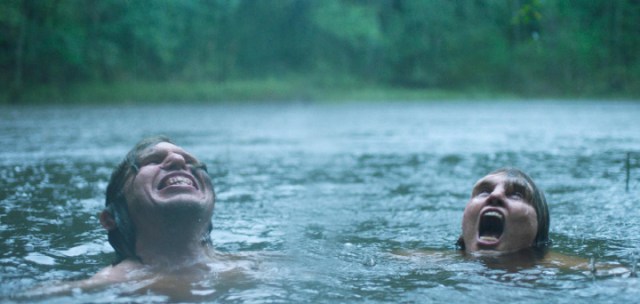
Once Tilda and Petula arrive in Daphne’s house, the game is instantly started as demanded by Daphne. While Tilda plays ‘Daughter’, Daphane plays ‘Mother’, and Petula later appears as ‘Doctor’. Their game initially seems to be a harmless child’s play, but Daphne turns out to be quite a disturbed girl to say the least, and we soon get one of the most shocking moments in the film as Tilda and Petula obediently follow a certain sadistic demand from Daphne.

braid02

As they find themselves stuck in Daphne’s house longer than expected, Tilda naturally become more nervous and scared about what may happen during their game, but Petula insists that they should stay for finding the money necessary for their survival. There is nobody in the house except them and Daphne, so it looks like they will easily get the money once they find the location of a safe which probably contains lots of cash.

Of course, things do not go as well as they hoped, and Petula and Tilda only come to play more with Daphne, who surely has some very twisted ideas for more fun and thrill. She keeps demanding Tilda and Petula to stick to their roles, and Petula and Tilda are subsequently thrown into more absurdity and madness, while desperately trying to get out of their increasingly loony situation as soon as possible.

As slowly accumulating tension on the screen step by step, the movie frequently emphasizes the warped reality surrounding its three main characters, and we are accordingly served with a series of hallucinogenic moments filled with panic and paranoia. The more Daphne shows her dark side, the more Tilda and Petula becomes confused and disoriented somehow, and we begin to wonder about what is exactly going on among them.

And the circumstance becomes more complicated when a local detective who knows a bit about their past enters the picture. When he visits Daphne’s house at one point, he senses that something is not so right, so he gets himself more involved in the situation later after getting some information about Petula and Tilda, but, as already announced in the opening scene, that leads to another disturbing moment in the film.

braid03

While its three main characters are not particularly likable enough to make us care about them, the movie still draws our attention via a series of visually striking moments. As fluidly moving here and there around the spaces inhabited by the main characters in the film, cinematographer Todd Banhazl effectively establishes the nightmarish mood on the screen, and the ambient score by Michael Gatt is utilized well along with several notable pieces of music including a couple of operas by Wolfgang Amadeus Mozart.

And it surely helps that the movie is anchored well by the excellent trio performance from its three lead performers. While Sarah Hay and Imogen Waterhouse steadily hold the ground as required, Madeline Brewer, who was unforgettable in Netflix film “Cam” (2018), is fantastic as freely wielding her character’s psychotic aspects, and she and her two co-performers are engaging to watch with the constant power shifts among their characters throughout the film. Although the movie occasionally becomes shaky due to its rather thin plot and characterization, its three lead performers ably support the movie together under the competent direction of director/writer Mitzi Peirone, and we sort of come to accept its several illogical moments as also embracing its unreliable emotional narrative.

“Braid” is the first debut feature film by Peirone, and she shows considerable talent and confidence here in this film. In my inconsequential opinion, the movie deserves to be mentioned along with other similar films such as “Heavenly Creatures” (1994) and “Thoroughbreds” (2017), and you will not be disappointed if you are looking for something edgy and different.

braid04

Posted in Movies | Tagged , | Leave a comment

Velvet Buzzsaw (2019) ☆☆1/2(2.5/4): An uneven mix of art, satire, and horror

velvetbuzzsaw01

Netflix film “Velvet Buzzsaw” consists of two different parts which do not fit well with each other. While it begins as a broad satire on the world of contemporary art business, the movie eventually becomes a creepy supernatural horror tale as taking several darker narrative turns, and the resulting discord between these two contrasting parts is often too jarring in my trivial opinion.

In the beginning, we meet a prominent LA art critic named Morf Vandewalt (Jake Gyllenhaal), who is doing his job as usual while visiting a gallery in Miami, Florida. Like many others around him, he is looking for anything interesting enough to be the next big thing in their field, and Rhodora Haze (Rene Russo), an influential art gallery owner in LA, is certainly interested in whatever happens to draw his attention.

Not long after Vandewalt and Haze return to LA, Josephina (Zawe Ashton), who is one of Haze’s employees and is also Vandewalt’s close friend, comes across something quite interesting by coincidence. When she is about to leave her apartment building in the morning, she finds the dead body of one of her neighbors, and then she discovers heaps of paintings after going inside that dead man’s apartment. While she learns later that he wanted to remove and destroy all of his artworks, she cannot help but fascinated with his artworks which look very striking and mesmerizing to say the least, so she decides to bring all of his artworks to her apartment instead of throwing them away.

After incidentally learning of what Josephina has, Haze instantly sees a rare big business opportunity from those artworks, and then she shows some of them to Vandewalt. Quite impressed by the strong sense of artistry felt from them, Vandewalt becomes curious about who that dead guy is, but there is not much information about him, and that certainly makes Vandewalt more curious.

UNTITLED DAN GILROY FILM

Anyway, those artworks in question become an instant sensation once they are exhibited at Haze’s gallery, and many art collectors are eager to buy them from Haze, who is happy to sell some of them while keeping others in storage for more profit in the future. In case of Vandewalt, he is planning to write a book about the art and life of that dead guy, and it goes without saying that the book will surely make him more prominent than before.

However, the situation subsequently becomes very ominous as bad things begin to happen. After one of Haze’s employees suddenly disappears, a couple of terrible incidents happen, and Vandewalt subsequently comes to learn very disturbing things about that dead guy, whose life was not exactly ordinary from the beginning. In addition, he often experiences visual and auditory hallucinations, and that makes him all the more nervous about whatever is going on around him.

Around that point, we are supposed to care about what will happen to Vandewalt and some others around him, but we remain rather distant to these characters instead as the screenplay by director/writer Dan Gilroy struggles to balance itself between satire and horror. It often feels uneven and incoherent as wildly swinging back and forth between its broad satire and stark horror, so we do not get involved much in the story, and the movie becomes more uninteresting as going down further along with bland horror genre clichés during its second half.

Anyway, the movie is not wholly without good elements to be appreciated. For example, I especially enjoyed several satiric moments on contemporary art, and they somehow took me back to my baffling experience with the contemporary art section of the Art Institute of Chicago in April 2010. To be frank with you, as appreciating all those modern artworks in that section, I often wondered whether they looked profoundly simple or simply profound, and I have not still figured out which one is true.

velvetbuzzsaw02

The movie is mostly solid in technical aspects. Cinematographer Robert Elswit, who previously collaborated with Gilroy in Gilroy’s debut film “Nightcrawler” (2014), provides a number of stylish moments to notice, and he did a good job of establishing the slick urban atmosphere around the characters in the film. Although it has some tonal problem just like the film itself, the score by Marco Beltrami and Buck Sanders is effective on the whole, and I like how it brings some cheerful spirit to several comic scenes in the film.

In case of the main cast members of the film, most of them are under-utilized while stuck in their caricature roles. While Jake Gyllenhaal, who was chillingly fantastic as the sociopathic hero of “Nightcrawler”, has a few nice moments to show his funny side, his performance becomes less interesting as the movie cheerlessly pushes his character toward its predictable finale, and the other notable performers including Rene Russo, Toni Collette, Zawe Ashton, Daveed Diggs, Billy Magnussen, and John Malkovich simply fill their underdeveloped roles as much as demanded.

Overall, “Velvet Buzzsaw” did not bore me much, but I was not satisfied enough to recommend it to you. Sure, comedy and horror are often not far from each other, but the movie does not succeed well in its attempt to mix these two genres together, and we are only left with a misfire which could be better if it were more balanced and focused.

velvetbuzzsaw04

Posted in Movies | Tagged , , , | 1 Comment

Every Day A Good Day (2018) ☆☆(2/4): Life with tea ceremony lesson

everydayagooday01

I am too jaded and blunt for Japanese film “Every Day A Good Day”, which bored me a lot as droning on life and tea ceremony for its 100-minute running time. While there is nothing particularly awful about the film itself and I observed its cultural subject with some curiosity from time to time, I also felt quite impatient with its tedious narrative pacing and shallow storytelling, and I was very dissatisfied as the movie fizzles in the end despite a few dramatic moments during its second half.

The heroine of the movie is a young female college student named Noriko (Haru Kuroki). When her mother suggests that she should attend the traditional tea ceremony class of an old lady named Takeda (Kirin Kiki), Noriko is rather reluctant at first, but she eventually goes to Takeda’s house along with her cousin Michiko (Mikako Tabe), who has been her best friend since she came to live with Noriko’s family after leaving her rural hometown for her college education. Although she understandably feels awkward at first, Noriko gradually gets accustomed to those numerous etiquettes and tools required for making and serving a cup of traditional tea, and the class time at Takeda’s house soon becomes one of main routines in her daily life.

Slowly moving from one episodic moment to another, the movie gives us several nice scenes showing how to make and serve a cup of traditional tea properly. Under Takeda’s fastidious but gentle guidance, Noriko, Michiko, and other students attending Takeda’s class should be very careful and courteous in their every move in addition to concentrating a lot on brewing up traditional tea, and we get a few small laughs as some of them happen to make a mistake in the middle of their demonstration. When they and others go to a temple at one point for holding a special tea ceremony there, many of them are not so eager to be the host of the ceremony because of the possibility of embarrassment, and it accordingly takes some time for them to decide who will be the host.

everydayagooday02

As seasons come and go, many small and big things happen in Noriko’s life. After graduating from the college along with Michiko, she hopes that she will have a career in publishing industry, but it looks like her dream is beyond her reach as her career goes nowhere during next several years, and she still lives with her parents. In case of Michiko, she is quite content with her job in some trade company, but then she decides to get married several years later, and she subsequently comes to live the life of your average housewife.

In the meantime, Noriko continues to attend Takeda’s class. As more students come to Takeda’s class, she finds herself becoming an experienced senior to other students, and that surely reminds her of how much she has learned and changed since her first day at Takeda’s lesson. She often wonders why she has kept sticking to learning tradition tea ceremony for many years, but, of course, there eventually comes a moment of epiphany when she is making a cup of traditional tea in front of others as usual.

That significant moment could be touching if the screenplay by director Tatsushi Omori, which was developed from the essay of the same name by Noriko Morishita, brought more life and personality to its story and characters. While thoroughly decent and courteous, Noriko and many other characters in the film are not particularly engaging enough to hold our attention, and we never fully get the sense of change inside Noriko even though the movie blatantly spells out her thoughts and feelings via her frequent narration. In addition, many episodic moments in the film are more or less than mere narrative points to signify the passage of time, and they do not get meshed well together to generate any synergistic effect in terms of storytelling.

everydayagooday03

While I got bored more and more during the screening I attended this afternoon, I observed how its two lead actresses try to elevate the movie as much as they can. Haru Kuroki, who recently provided a voice performance to Mamoru Hosoda’s animation film “Mirai” (2018), is calm and graceful as required in her low-key performance, and she fluidly moves from one emotional situation to another even while the movie suffers from its rickety narrative. I must confess that I did not notice this talented Japanese actress before (I later learned that she won the Silver Bear award for Best Actress at the Berlin International Film Festival for her performance in Yoji Yamada’s “The Little House” (2014)), and I can only hope that she will soon move onto better things to come.

On the opposite, Kirin Kiki is as solid as we can expect from her. The movie is one of the last films made before her death in last year, and she did a good job of imbuing her character with warmth and wisdom. Although she was much better in Hirokazu Kore-eda’s “Shoplifters” (2018), Kiki’s performance in the movie is still fun to watch nonetheless, and I will not deny that I came to miss her more after watching the movie.

“Every Day A Good Day” is not entirely without appeal, but it is too mild and tepid for me. I certainly appreciated the considerable efforts from Kuroki and Kiki, and I also enjoyed its various seasonal moods to some degree, but I kept noticing its many weak aspects while occasionally checking the time. That is not a good sign, you know.

everydayagooday04

Posted in Movies | Tagged , | Leave a comment

Can You Ever Forgive Me? (2018) ☆☆☆1/2(3.5/4): Her brilliant criminal writing career

canyoueverforgiveme01

“Can You Ever Forgive Me?” tells us an amusing real-life crime story of Lee Israel, a washed-out biographer who resorted to forging letters of a number of famous figures when she happened to hit the bottom of her life and career during the early 1990s. Never overlooking how pathetic and unlikable its antisocial heroine is, the movie constantly tickles us as drolly depicting how far she went for her criminal writing career, and we come to observe her quick rise and fall with some sympathy and understanding.

The early part of the movie shows us how life has been difficult and desperate for Israel (Melissa McCarthy). Although there was once a time when she was a fairly successful biographer, she is almost penniless now with no bright prospect for her writing career, and she has just lost her current job due to her serious drinking problem. While she has tried to write a new biography on Fanny Brice, she has been struggling with writer’s block, and her agent does not show any interest on that biography at all mainly because she has been pretty sick of Israel not having made any attempt to make herself look more social and presentable in contrast to a certain popular writer, who has just received a considerable amount of advance for his next novel.

As Israel nurses her anger and resentment in local bars, things get worse for her than before. Her apartment somehow begins to smell pretty bad with lots of flies, but the maintenance man of the apartment building only reminds her that she has already been behind three months in paying her rent. In addition, her dear old pet cat gets very sick, so she must find any possible way to get money as soon as possible.

After her unsuccessful attempt to sell some of her old books, she decides to sell a few old letters from famous figures which have been stored by her for years, and then she comes to have a nice criminal idea. After forging one of these letters a bit and then selling it at a higher price, she goes further as forging letters of various famous figures ranging from Noël Coward to Dorothy Parker, and she soon gets enough money for not only her delayed rent but also her cat.

canyoueverforgiveme02

As she keeps going on in her criminal activity, the adapted screenplay by Nicole Holofcener and Jeff Whitty, which is based on Israel’s memoir of the same name, cheerfully hops from one narrative point to another, and director Marielle Heller immerses us further into the authentic urban atmosphere of New York City during the 1990s. Below its tall, slick skyscrapers, we see a number of antique bookshops located here and there in the city, and you may feel a bit nostalgic if you are familiar with the city during that period.

In the end, Israel is eventually welcomed less by collectors after they become more cautious about her forged letters, so she enlists an acquaintance named Jack Hock (Richard E. Grant), who is your average flamboyant aging gay dude. While Hock sells her forged letters outside, she focuses on forging more letters inside her apartment, and we later see her apartment filled with various old typewriters which will give her forged letters more authentic impression.

As they continue to work closely with each other, Israel and Hock become a bit friendlier with each other, and we observe how their contrasting personalities complement each other to some degree. While they still do not get along that well with each other mainly due to Israel’s antisocial tendency, they rely on each other mainly because both of them do not have anyone particularly close to them, and that is why they feel hurt a lot when their criminal activity comes to an inevitable end.

canyoueverforgiveme03

Around that narrative point, the movie loses a bit of its comic momentum, but it is still held well together by Melissa McCarthy, who was recently Oscar-nominated for her entertaining performance here in this movie. Dialing down her indomitable comic spirit in her dowdy appearance, McCarthy vividly presents an unpleasant but compelling human figure without making any cheap excuse, and the result is her finest work since her breakthrough turn in “Bridesmaid” (2011).

As McCarthy’s counterpoint, Richard E. Grant, a wonderful British character actor who has steadily entertained us since his memorable debut performance in cult classic film “Withnail & I” (1987), gives a rich, delicious performance which garnered him a well-deserved Best Supporting Actor Oscar nomination. He and McCarthy are always entertaining whenever their characters exchange barbed banters, and their last scene in the film is alternatively funny and touching thanks to their effortless interaction on the screen.

On the whole, “Can You Ever Forgive Me?” is another impressive work from Heller, who previously debuted with “The Diary of a Teenage Girl” (2015). Because I admired how that interesting coming-of-age drama film handles well its rather sensitive subjects, I am naturally glad to see that she advances further with her next film, and I certainly appreciate how she deftly handles Holofcener and Whitty’s adapted screenplay while also drawing superb performances from McCarthy and Grant. Besides confirming her status as one of the most notable American filmmakers to watch, this is indeed one of the most enjoyable films of 2018, and you may watch antique letters with amusement and suspicion after watching it.

canyoueverforgiveme04

Posted in Movies | Tagged , , , | 3 Comments

If Beale Street Could Talk (2018) ☆☆☆1/2(3.5/4): As their love abides

ifbealestreetcouldtalk05

Barry Jenkins’ latest film “If Beale Street Could Talk” warmly starts with its two main characters spending time together outside. Even before one of them talks to us about how much they are in love with each other, their mutual affection and attraction are already palpable to us as they silently but tenderly regard each other, and this precious moment between them poignantly haunts us as we observe their intimate relationship – and how it happens to be tested by an unjust predicament inflicted upon them.

Set in New Yok City in the 1970s, the movie tells the story of Clementine “Tish” Rivers (KiKi Layne) and Alonzo “Fonny” Hunt (Stephan James), two young African American people who were just close childhood friends in the past but now become two young adults deeply fallen in love with each other. While their future is not exactly bright, they have been happy and optimistic as becoming more serious about their relationship, and they luckily get a nice place where they are going to live together after getting married, but then, unfortunately, Fonny is arrested and then incarcerated in prison for a rape incident of which he is wrongfully accused considering the rather unreliable testimonies from the victim and a police officer who caught him at that time.

Whenever Tish visits Fonny at the prison, they frequently confirm their deep love to each other, but things become more desperate and frustrating day by day. As Fonny keeps getting stuck in prison with no progress for his upcoming trial, he cannot help but exasperated and depressed at times, and Tish becomes saddened as there is nothing she can do for him except providing him constant support via her routine prison visit.

And there is a serious matter they must deal with sooner or later. Tish recently finds that she has been pregnant for around 3 months, and Fonny is certainly happy when he receives this unexpected news from her, but both of them soon come to worry more as being aware of more uncertainty in their situation. Will he be released before his child is born? Or, will she be able to raise their child well while he remains stuck in his prison as before?

ifbealestreetcouldtalk08

Anyway, Tish eventually decides to tell her family about her pregnancy, and they all stand by her in contrast to Fonny’s mother and two sisters, who have looked down on Tish and her family and does not hide their condescending attitude at all when Tish and her family requests a private meeting for discussing Tish’s pregnancy. When Fonny’s mother and two sisters go a bit too far in their harsh judgment on Tish’s pregnancy, we get one of a few tense dramatic moments in the film, and we are sort of relieved as these self-righteous ladies leave with indignation and humiliation in the end.

When Tish and her mother Sharon (Regina King) later consult with Fonny’s attorney, they are told that proving Fonny’s innocence requires a considerable amount of time, money, and effort, but they decide to do whatever is necessary for Fonny. While Tish’s father Joseph (Colman Domingo) and Fonny’s father Frank (Michael Beach) collect money as much as they can, Sharon subsequently prepares for going to Puerto Rico for meeting the victim of the rape incident, who ran away to somewhere in Puerto Rico not long after giving her testimony against Fonny.

As frequently anxious and worried, Tish’s mind often goes back to her happier time with Fonny, and the movie gives us a number of memorable flashback scenes full of care and sensitivity. We watch them having a nice romantic dinner at a local restaurant thanks to Fonny’s friend who works there, we observe the first carnal experience between them in Fonny’s shabby basement residence, and we also see their fortunate encounter with a young Jewish landlord who shows them more kindness and compassion than expected.

However, Tish and Fonny are also frequently reminded of the harsh and difficult reality surrounding them and others around them. When Fonny’s old friend Daniel (Brian Tyree Henry) comes to spend some time with them, the mood becomes quite sad and gloomy as Daniel talks about his prison experience, and that moment resonates with an earlier scene where Fonny expresses his desperation and frustration with his continuing incarceration. When Tish happens to be harassed by some Caucasian guy while shopping at a local store, Fonny almost gets himself arrested for violently reacting to that guy, and we are reminded of how the American society has not been changed much for its colored citizens for many decades.

ifbealestreetcouldtalk07

While steadily maintaining the sensitive and thoughtful storytelling approach of his film, Jenkins, who also adapted James Baldwin’s novel of the same name, did a commendable job of capturing the essence and spirit of Baldwin’s novel along with his dependable crew members. While cinematographer James Laxton, who previously collaborated with Jenkins in “Medicine for Melancholy” (2008) and “Moonlight” (2016), brings lots of warmth and sensibility to many intimate scenes between Tish and Fonny, the somber but gentle score by composer Nicholas Britell, which was deservedly Oscar-nominated in last week, adds extra poetic beauty to the film, and the overall result on the screen is quite lovely to say the least.

KiKi Layne and Stephan James hold the center via their unadorned chemistry on the screen, and they are also surrounded by a bunch of good performers to watch. While Regina King, who expectedly received the nomination for Best Supporting Actress Oscar, is simply terrific, the other supporting performers including Teyonah Parris, Colman Domingo, Ed Skrein, Aunjanue Ellis, Michael Beach, Finn Wittrock, Diego Luna, Pedro Pascal, Emily Rios, Dave Franco, and Brian Tyree Henry have each own moment to shine, and the special mention must go to Henry, who became more prominent to us in last year thanks to his notable supporting performances in “Widows” (2018), “Spider-Man: Into the Spider-Verse” (2018), and this film.

After drawing our attention through his debut feature film “Medicine for Melancholy”, Jenkins went further with his next film “Moonlight”, which won three Oscars including the one for Best Picture, and “If Beale Street Could Talk” surely confirms us again that he is indeed one of the most important filmmakers in our time. Thanks to his masterful handling of mood, story, and characters, we come to care and emphasize a lot with two main characters in the film, and the quite emotional power generated from their bittersweet romance drama lingers on us for a while along with the tentative optimism glimpsed from the last shot of the film. In short, this is one of the most powerful movies of 2018, and I sincerely urge you to check it out as soon as possible.

ifbealestreetcouldtalk04

Posted in Movies | Tagged , , | 3 Comments

How to Train Your Dragon: The Hidden World (2019) ☆☆☆(3/4): Their final adventure

howtotrainyourdragonthehiddenworld01

Animation feature film “How to Train Your Dragon: The Hidden World”, the last chapter of the trilogy which started with “How to Train Your Dragon” (2010) and then continued with the following 2014 sequel film, is a fairly entertaining work with some emotional moments to touch us. Although it is not exactly better than its two predecessors, the film still amuses and excites us enough while following the last adventure of its two endearing main characters, and it is also quite poignant as they come to accept the inevitable change on their friendship in the end.

The story of the film begins with the latest rescue operation led by a Viking lad named Hiccup (voiced by Jay Baruchel) and his dragon friend Toothless. Since their big adventure in “How to Train Your Dragon 2” (2014), they have rescued lots of dragons along with their colleagues including Hiccup’s girlfriend Astrid (voiced by America Ferrera), and a remote sea island where Hiccup and other members of his tribe including his mother Valka (voiced by Cate Blanchett) reside has been quite saturated with many different dragons as a result. As the chief of his tribe, Hiccup tries his best for the harmonious co-existence of his tribe and dragons on the island, but it is clear that the island is too small to accommodate both his tribe and dragons, and he certainly knows well that he should do something about this imminent matter.

However, there soon comes another matter as a wily and ruthless dragon hunter named Grimmel (voiced by F. Murray Abraham) enters the picture. Hired by a trio of warlords who want to capture dragons without any interference from Hiccup and his fellow dragon riders, Grimmel is quite determined to capture and kill Toothless mainly because Toothless is a dragon of a very rare breed, and he happens to have a perfect bait for Toothless: a female white dragon of the same breed. When that female dragon appears right in front of Toothless and Hiccup during their flight time in the sky, Toothless certainly becomes curious about that female dragon, and we later get some laughs as they come to have a little humorous moment of courtship.

howtotrainyourdragonthehiddenworld04

In the meantime, after his first encounter with Grimmel, Hiccup decides that his tribe and all the dragons in the island must leave the island, though he is not so sure about whether he can find a certain mythic place which is probably located somewhere beyond the sea. When he was very young, his father Stoick the Vast (voiced by Gerard Butler) used to tell him about that mysterious place, and he has been trying to figure out its exact location from pieces of records left by his father, but there has not been any breakthrough for him yet.

Not long after Hiccup’s tribe and the dragons come to settle temporarily at some spot far away from their island, Toothless encounters that female dragon again, and he comes to have a joyful free time along with his new friend thanks to a new device made by Hiccup. As Toothless and his new friend freely fly high in the sky together, the film serves us a series of lovely visual moments worthwhile to watch at a big movie theater, and the score by John Powell, who did a superlative job in the previous two films, further enhances the lyrical romantic mood between these two fine creatures.

Of course, things eventually get more serious than before as Grimmel succeeds in tracking down Hiccup’s tribe and the dragons, and director/writer Dean DeBlois, who previously directed “How to Train Your Dragon” and the 2014 sequel film, gives us plenty of fun and excitement. Although the overall result occasionally looks rather plain compared to what we saw from the two previous films, the action sequences in the film are competently handled with skill and style at least, and I also appreciated the considerable awe and wonder shown from a visually gorgeous sequence later in the story.

howtotrainyourdragonthehiddenworld03

Above all, the film keeps focusing on what is being changed between Hiccup and Toothless, whose relationship has always been the engaging emotional center of the trilogy. As they go through their last adventure together, Hiccup is reminded again of how much he cares about Toothless, but he also comes to realize what is really the best for not only Toothless but also many other dragons, and we accordingly get a bittersweet moment when he and his people do what should be done for Toothless and other dragons.

The main cast members of the film are solid in their voice performance. Jay Baruchel is likable as usual in his nerdy voice performance, and he is also supported well by various performers including America Ferrara, Cate Blanchett, Craig Ferguson, Jonah Hill, Gerard Butler, Kit Harington, Christopher Mintz-Plasse, Justin Rupple, Kristen Wiig, and F. Murray Abraham. While most of them are rather under-utilized, they fill their respective supporting roles as much as required, and Abraham surely has some fun with his villain character.

Although it understandably feels less fresh at times, “How to Train Your Dragon: The Hidden World” is still a well-made animation film which did its job as much as expected. Sure, it is not something as great as the best works of Pixar Animation Studios, but it and its two predecessors are admirably consistent in terms of quality, and that is certainly an achievement to be cherished in my inconsequential opinion. Bye-bye, Hiccup and Toothless – it was pretty fun to watch your adventures.

howtotrainyourdragonthehiddenworld05

Posted in Movies | Tagged , , , , | 1 Comment

Extreme Job (2018) ☆☆(2/4): A half-fried cop comedy

extremejob01

I am not an ideal audience for South Korean comedy film “Extreme Job”, which is currently having a considerable box office success in South Korea after released in last week. While I understand its comic appeal to local audiences to some degree, I did not react well to its numerous heavy-handed moments of cheap comedy as frequently noticing its sketchy plot and broad characterization, and I only found myself more bored, annoyed, and depressed in the end as reflecting on its failure to utilize well its supposedly funny comic premise as well as its good main cast members.

In the beginning, we are introduced to a police squad led by Chief Go (Ryu Seung-ryong), who attempts to arrest several small-time criminal junkies along with his team members but inadvertently causes a disastrous outcome in the end. While he feels quite miserable after being chided a lot by his direct boss, one of his colleagues hands him a small case involved with a certain member of some big local drug organization who was recently released from prison, and he and his squad team members soon begins a stakeout around their target’s main operation site.

Of course, things do not go well for them from the beginning. While their target does not do anything particularly suspicious, they almost get themselves exposed to their target due to a small absurd incident at one point, and then they have no choice but to do their job at a fried chicken restaurant which happens to be right across from their target’s main operation site.

extremejob02

While eating lots of fried chicken for maintaining their cover, Chief Go and his squad members come upon a seemingly brilliant idea for approaching closer to their target. Considering that their target has often ordered fried chicken, they will probably be able to infiltrate further into their target’s operation site through delivering fried chicken, and they instantly go for their idea when they happen to learn that the owner of the fried chicken restaurant has been considering selling his restaurant due to bad business. Thanks to the bank savings of their youngest squad member, they immediately buy the restaurant from the owner, and they soon get a closer look on their target as running the restaurant on the surface.

However, running the restaurant turns out to be more complicated than expected. As their stakeout is frequently disrupted by customers, Chief Go decides that they should serve their customers fried chickens for maintaining their cover, and, after he and other squad members respectively try to cook chicken, it is eventually decided that Detective Ma (Jin Seon-kyu) is going to be their chef mainly because his fried chicken tastes far better than others’ results. As a matter of fact, he does his new job so well that more customers come for tasting his delicious fried chicken, and Chief Go and his squad members find themselves concentrating more on serving these customers instead of keeping watching on their target.

This is surely an ironic comic situation, but, unfortunately, the screenplay by director Lee Byeong-hun and his co-writer Bae Se-young only throws predictable cheap laughs while never fully developing the comic potentials inside this comic situation. While the main characters in the film remain to be more or less than cardboard figures only demanded to look silly or exaggerated. the story itself often feels uneven and contrived, and that weak aspect of the movie is further exacerbated during its second half, where Chief Go and his squad members come to get far more involved with their target than expected.

extremejob03

Above all, their investigation process is not particularly interesting to watch. It is initially a bit fun to watch them bumbling a lot in their investigation, but I found this rather tiresome in the end, and I frequently shook my head as they merely keep going on without any smart tactics while also doing unbelievably stupid things at times. For instance, during one certain scene later in the film, one of them happens to get a crucial piece of information while being with several criminal figures, but he only comes to draw more attention instead of not getting noticed, and that is just one of many idiotically contrived moments in the film.

The main cast members of the movie try as much as they can do with their cartoonish characters, and there are a few watchable comic moments thanks to their diligent efforts. While Ryu Seung-ryong, who has deftly moved around many different genres since his memorably intense supporting performance in “War of the Arrows” (2011), provides some gravitas to the story as required, Lee Honey, Jin Seon-kyu, Lee Dong-hwi, and Gong Myung are well-cast in their respective roles, and it is really dissatisfying to watch their considerable comic talent being wasted on the screen. They all are willing to do anything for laughs, but the movie does not provide any solid ground for them, and I was also disappointed to see several other notable South Korean performers including Shin Ha-kyun and Kim Eui-sung stuck in their thankless supporting roles.

Although it is not that awful on the whole, “Extreme Job” is too crude and half-fried for me to enjoy it, and I recommend you to watch Lee Byong-hun’s debut work “Cheer Up Mr. Lee” (2013) instead, which is a better comedy film in my trivial opinion despite some weak points. While that movie has some real laughs to be savored, “Extreme Job” does not have much in contrast, and I was only left with growing disappointment, but, considering what I observed from the audiences around me during the screening I attended at last night, you may enjoy it if you simply want to laugh along with others.

extremejob05

Posted in Movies | Tagged , , , , , | Leave a comment