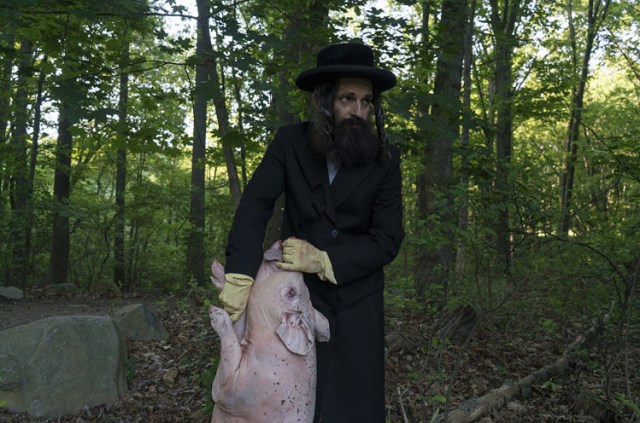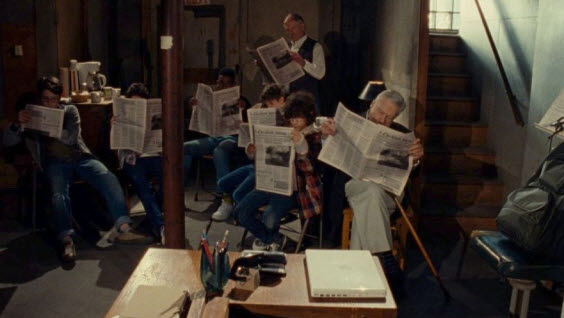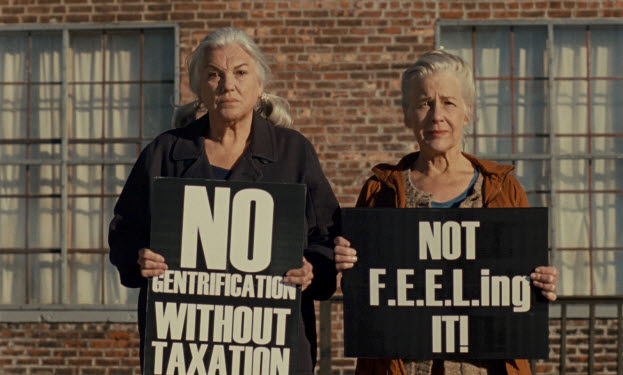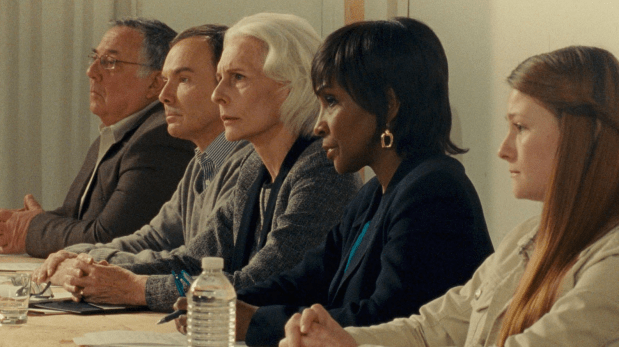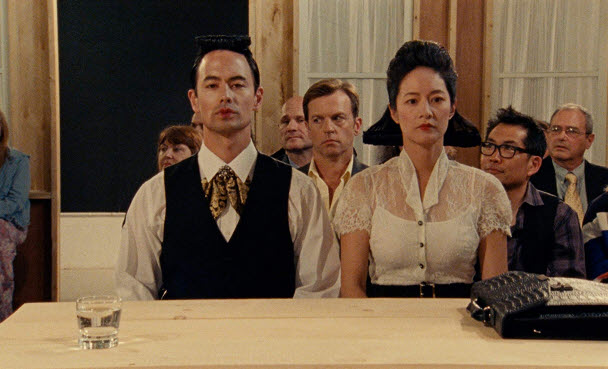
Glass (2019) ☆☆1/2 (2.5/4): A decidedly lukewarm superhero movie

glass01

“Glass”, which is supposed to be the concluding chapter for director/writer M. Night Shyamalan’s “Unbreakable” (2000) and “Split” (2016), is a decidedly lukewarm superhero movie which is fascinating enough to talk about but is not good enough to recommend. Although it has some interesting self-conscious touches to amuse us to some degree, it is still disappointing due to a number of weak aspects including its rather deficient storytelling, and I often found myself distracted and frustrated during my viewing even while entertained by its good parts.

The movie starts at the point not long after what happened at the end of “Split”. Kevin Wendell Crumb (James McAvoy), a seriously disturbed young man with dissociative identity disorder who also occasionally shows superhuman strength as his super-id identity ‘The Beast’, has been still on the loose in Philadelphia, and it looks like nobody can prevent him from continuing his deranged criminal act of kidnapping and mutilating young women, but there already comes an opponent who may stop him: David Dunn (Bruce Willis), the hero of “Unbreakable” who has secretly operated as ‘The Overseer’ for last 19 years since he became aware of his extraordinary abilities.

With the help and assistance from his son Joseph (Spencer Treat Clark), Dunn has patiently searched for where Crumb has been hiding, and he eventually discovers Crumb’s hideout and then confronts him, but they are suddenly ambushed by the Philadelphia Police and Dr. Ellie Staple (Sarah Paulson), who promptly sends Crumb and Dunn to a local institution for mental illness once she and the police suppress Crumb and Dunn. In her opinion, Crumb and Dunn are simply no more than patients having the delusion of being comic book characters, and she looks confident about taking care of their delusion problem within a few days.

Incidentally, there is another patient in the institution who interests Dr. Staple as much as Crumb and Dunn, and he is Elijah Price (Samuel L. Jackson), who is also known as ‘Mr. Glass’. If you have watched “Unbreakable”, you will certainly remember that Price is a dangerous criminal mastermind who caused a series of massive accidents just for finding people like Dunn and Crumb, but Dr. Staple does not worry much about Price as he has been heavily sedated for years while also locked in his cell with maximum surveillance system.

glass03

There subsequently comes a long scene where Dunn meets not only Crumb but also Price under Dr. Staple’s supervision, and that is surely one of a few high points of the film. James McAvoy is certainly having a big fun here as he previously did in “Split”, and, not so surprisingly, he cannot help but dominate the scene over his co-performers while gleefully switching amid his character’s multiple personalities.

In the meantime, the movie also pays some attention to several other characters in the story. While Mrs. Price (Charlayne Woodard), who is Price’s mother, still regards her son with same care despite his horrible crimes, Casey Cooke (Anya Taylor-Joy), the girl who survived at the end of “Split”, decides to meet Crumb again, and, after their re-encounter at the institution, she subsequently becomes more interested in whatever has been implied in comic books and superhero characters. In case of Joseph, he tries to find any possible way to help his father, and then he happens to discover something which is going to be revealed later in the story.

I will not go into details here not for spoiling anything, but I can tell you instead that it gradually turns out that Price has been carefully planning for a big moment he has been waiting for many years. Things get more interesting once he embarks on executing his plan, and it is not much of a spoiler to tell you that there will be an eventual confrontation among Price, Crumb, and Dunn.

glass04

Interestingly, the movie defies our expectation in terms of story and characters, and I sort of enjoyed how it deliberately maintains its phlegmatic storytelling approach even during its climactic part which is notably far less explosive than what we have observed from other blockbuster superhero movies during recent years, but Shyamalan’s screenplay somehow fails to meld its different story elements into something coherent. As often hampered by its thin characterization and disjointed narrative, it does not succeed much in making us care about its story and characters, and some of its plot twists are too contrived to say the least.

Furthermore, the main cast members of the movie besides McAvoy seem to be merely filling their respective roles on the whole. While Samuel L. Jackson has some chance to chew his several scenes later in the movie, Bruce Willis does less acting here than he briefly did in “The Lego Movie 2: The Second Part” (2019), and Sarah Paulson is as under-utilized as other substantial supporting performers in the film including Spencer Treat Clark, Charlayne Woodard, and Anya Taylor-Joy.

Although it is not the worst film in Shyamalan’s uneven career which gave us not only “Unbreakable” and “Signs” (2002) but also “The Last Airbender” (2010) and “After Earth” (2013), “Glass” is still a letdown compared with his recent solid comeback shown from “The Visit” (2015) and “Split”. I am left with disappointment now, but, considering its modest success in the US box office early in this year, Shyamalan will surely move on as before, and I can only hope for something more satisfying than this middling piece of work.

glass02

Posted in Movies | Tagged , | Leave a comment

A Vigilante (2018) ☆☆☆(3/4): A female avenger against domestic violence

avigilante04

“A Vigilante” is a small but fascinating drama about one troubled woman who chooses a rather drastic way of fighting against domestic violence. While firmly sticking to its austere attitude, the movie works as a restrained but intense character study with subtle human touches to be appreciated, and we come to understand and emphasize with its heroine even while we mostly observe her from the distance.

When we are introduced to Sadie (Olivia Wilde) at the beginning of the film, she is preparing for her latest job, and the movie calmly and clinically depicts how she does her unpleasant but necessary job step by step. Once she is fully prepared, she goes to a house where her latest client, a married woman who has been abused by her husband for years, lives, and she meets her client’s abusive husband when he returns to the house. Shortly after he makes a very big mistake of underestimating her, we see him forced to follow every demand of hers, and her client, who looks a lot more relieved than before as being totally free from her husband, thanks Sadie a lot while also paying her some cash.

Although it seems to be often emotionally exhausting for her to commit her cold, merciless violence on her targets, Sadie keeps going whenever she gets a call for help. While most of her targets are men, she does not make any exception at all when she happens to handle the situation involved with a mother who has been not so good to her two children, and we accordingly get another uncomfortable moment of violence.

avigilante03

Via a series of flashback scenes, the movie gradually reveals what has been fueling Sadie’s violent tendency. When we see her attending a meeting held at a shelter for female abuse survivors, she mostly remains quiet and distant while other women at the meeting recount their painful experience of abuse one by one, but, eventually, she comes to confide to others on what happened to her and her dear son some time ago, and that is the most harrowing moment in the film.

When one of her fellow abuse survivors tells her that she should be more active in coping with her pain and trauma instead of just nursing them passively, Sadie comes to decide that she really should do something for healing herself. After leaving the shelter, she promptly begins to operate as a vigilante for those abused people out there, and she also attempts to get a personal closure for herself through tracking down her husband, who disappeared right after that terrible incident and is probably hiding somewhere.

Now some of you will have a pretty good idea on where the story is going, but the movie surprises us as adamantly avoiding any chance of cheap thrill or catharsis. While there are several tense moments during its last act as expected, the movie dryly maintains its low-key tone without any gratuitous moment, and the overall result is as impressively stoic as Lynne Ramsay’s “You Were Never Really Here” (2017), which is incidentally another brutal and intense movie about a violent and traumatized figure.

As a result, we come to focus more on its heroine’s damaged state of mind, and Olivia Wilde, who drew my attention for the first time with her good supporting performance in TV drama series “House”, delivers a solid performance which conveys well whatever is churning behind her character’s detached façade. While ably imbuing her character with considerable determination and physicality as demanded, Wilde also did a commendable job of subtly revealing her character’s vulnerability, and she is particularly convincing during a brief but striking scene where her character cannot help but become helpless in front of the origin of her pain and trauma. No matter how much Sadie has tried to overcome her pain and trauma, it ultimately turns out that her old mindset does not die easily, and we come to cringe a lot as watching what happens next because of that.

avigilante02

The movie is the first feature film directed by director/writer Sarah Dagger-Nickson. She only made two short films before making this film, but she shows here that she is a competent filmmaker who knows how to hold our attention via mood and storytelling. Never looking deficient in technical aspects, the movie is also slick and efficient in its economical storytelling, and I especially appreciate how a certain recurring aural detail is deftly utilized throughout the film for a modest but haunting dramatic effect.

In addition, Dagger-Nickson assembles a number of good performers around Wilde. While Betsy Aidem and C.J. Wilson are effective in their brief appearance during the early part of the movie, Tonye Patano gives a gentle and thoughtful performance as a caring counselor for Sadie and other female abuse survivors, and Morgan Spector brings chilly creepiness to his supporting character.

Although it received lots of praises from critics after it was shown at the South by Southwest Film Festival early in last year, “A Vigilante” did not get much attention when it was released in last month in US, and that is a shame considering the substantial achievement by Dagger-Nixon and her cast and crew members. Yes, it is probably a bit too dry and tough for some of you, but it is still worthwhile to watch on the whole for several good reasons including Wilde’s electrifying performance, and you will not be disappointed if you are looking for something different.

avigilante01

Posted in Movies | Tagged , , | 1 Comment

Never Look Away (2018) ☆☆☆(3/4): A sprawling epic period drama

neverlookaway01

German film “Never Look Away”, which was nominated for Best Foreign Language Film Oscar early in this year, is a sprawling epic period drama about one young man struggling to find his own artistic voice during the most tumultuous part of the 20th century German history. While this is surely your average old-fashioned melodrama full of predictable clichés and plot turns, the movie mostly works because of its solid mood and storytelling as well as several good performances, and you may come to forgive its notable shortcomings as enjoying its strong parts.

The movie mainly revolves around an artist named Kurt Barnert (Tom Schilling), and the early part of the movie shows his childhood years in Dresden during the 1930-40s. When young Barnert and his aunt Elizabeth (Saskia Rosendahl) go to a special art exhibition showing various modern artworks, they and others are told about how these artworks do not fit well with the ideals of Hitler and his Nazi Party, but young Barnert cannot help but impressed by these artworks, and his aunt, who is as your typical free eccentric soul, later tells her nephew on why he should never look away for beholding the beauty inside everything that is true.

Life is never boring for young Barnert as he is with his aunt, but their good time does not last that long. As often being emotionally unstable, his aunt is sent away to an institution for mental illness, and she is promptly sterilized along with many other mentally ill people as ordered by the government. When she meets Professor Car Seeband (Sebastian Koch), a gynecologist who happens to handle her case, she tearfully pleads him not to sterilize her, but he coldly ignores her plea, and his following action eventually leads to her tragic death a few years later.

neverlookaway02

Several years after the end of World War II, Barnert now becomes a lad aspiring to be an artist, but the situation is not exactly ideal for him. As an East German citizen, he has to conform to the ideology of the communist party just like many others around him, and he initially believes he will be all right with that as long as he can pursue his artistic career in a local art school, but he only finds himself not getting along that well with social realism style, which is not that far from the totalitarian style of the Nazi era.

Meanwhile, Barnert happens to encounter a young female student named Ellie (Paula Beer), and it does not take much time for them to fall in love with each other, but they have to hide their relationship from her parents for a while, until they cannot hide it from her parents any longer. Her stern father is understandably not so pleased about this, so he decides to do something quite heartless to his own daughter, but Barnert and Ellie’s relationship only becomes more strengthened than before, and her father has no choice but to give a blessing to his daughter’s eventual marriage.

Although he makes some advance in his nascent artistic career, Barnert feels more suffocated and frustrated than before, so he eventually decides to go over to West Berlin along with his wife shortly before the Berlin Wall is built, but he still finds himself searching for his own artistic voice. Now he gets a lot more freedom and choices than before, so he tries many different things, but he is only told by his new professor that he has not found his own individual style yet.

neverlookaway03

Around that narrative point, the movie plods more than before, but it gives some nice visual moments to remember, and the period atmospheres and details in the film are impeccable thanks to cinematographer Caleb Deschanel, who received a surprise Oscar nomination for the film. While I enjoyed a sequence where Barnert tries several styles including the one belonging to Jackson Pollock, I was amused by when Barnert’s new professor makes a big fiery point in front of his students, and I also appreciated how the movie delivers a big dramatic punch not long after Barnert eventually finds his simple but distinctive artistic method (Is that a spoiler?).

I must point out that the main characters in the film are mostly archetypes who are a little too broad in my trivial opinion, but that weak aspect is compensated to some degree by its good cast members. Although Barnert, who is loosely based on real-life German artist Gerhard Richter, is rather bland as the center of the story, Tom Schilling carries the film well with his earnest performance, and he is supported well by the other cast members including Paula Beer, Saskia Rosendah, Oliver Masucci, and Sebastian Koch, who delivers the most effective performance in the film as being quite different from his sensitive performance in director/writer Florian Henckel von Donnersmarck’s debut feature film “The Lives of Others” (2006)

Compared to “The Lives of Others”, which deservedly won a Best Foreign Language Film Oscar in 2007, “Never Look Away”, whose original German title “Werk ohne Autor” means “Work Without Author”, is relatively less powerful in many aspects, but it is at least two or three steps above von Donnersmarck’s previous film “The Tourist” (2010), a lackluster misfire starring Johnny Depp and Angelina Jolie. Although it feels overlong and self-indulgent at times, it constantly keeps us interested during its 188-minute running time, so I will not complain for now.

neverlookaway05

Posted in Movies | Tagged , , , | Leave a comment

Divide and Conquer: The Story of Roger Ailes (2018) ☆☆☆(3/4): A Man Behind Fox News

DivideandConquerTheStoryofRogerAiles01

Roger Ailes was a pretty deplorable guy in my humble opinion. As running Fox News for more than 20 years, he actively and aggressively spread fear and hate over the American society along with his loony right-wing figures such as Bill O’Reilly and Sean Hannity, and this toxic political culture generated from them has still continued even after his humiliating downfall which was soon followed by his death in 2017. Although it may be a bit too early to examine how much Ailes and his monstrous creation have damaged and contaminated the American society, documentary film “Divide and Conquer: The Story of Roger Ailes” gives us an engaging presentation of his life and career, and it is alternatively disconcerting and compelling to watch how he irreversibly changed the landscapes of the American media during last several decades.

After the prologue juxtaposing Ailes’ downfall in 2016 with that unbelievable political rise of Donald J. Turmp in the same year, the documentary shows and tells us about Ailes’ early years in Warren, Ohio. He was the son of a stern conservative father who worked in a local factory, and, as some of his childhood friends tell us, he was a smart, ambitious boy ready to go forward for bigger things in the future despite his hemophilia, which was the main reason he could not join the Army during the Vietnam War.

In 1968, Ailes worked as the producer of “The Mike Douglas Show” in Philadelphia, which was one of a few daytime talk shows in US during that period. Not long after Richard Nixon, who was running for the US President in that year, appeared in the show, Ailes approached to Nixon, and he succeeded in convincing Nixon to hire him as a ‘media advisor’ who could help Nixon a bit on looking good on TV, which was not one of Nixon’s strong points as previously shown from his disastrous TV appearance with John F. Kennedy in 1960. Thanks to Ailes, Nixon could present himself on TV a lot better than before, and that certainly contributed a lot to his eventual victory in the 1968 US Presidential Election.

DivideandConquerTheStoryofRogerAiles04

After this considerable success of his, Ailes found himself sought by many other Republican politicians ranging from Ronald Reagan to Mitch McConnell, who initially did not have much chance when he tried to be a US senator from Kentucky in 1984 but got a major boost thanks to a simple but effective political advertisement supervised by Ailes. Around the time of the George H.W. Bush administration, he further solidified his reputation as a kingmaker, and he also established his own national cable TV network named America’s Talking in 1992, which was intended as something he had envisioned for a long time since the Richard Nixon administration: a political media platform for the Republican Party and its conservative followers.

When he later got competed by CNN and MSNBC, Ailes became determined to beat his competitors, and that was how he came to work with Rupert Murdoch, who helped him found, yes, Fox News in 1996. Under Ailes’ cutthroat leadership, Fox News aggressively went for attracting more viewers around the country, and it surely had a big field day when the Bill Clinton administration, which was hated a lot by Ailes and many other right-wing guys in US, happened to be shaken by a sex scandal involved with Monica Lewinsky. In the end, Fox News became the No.1 News channel above CNN and MSNBC around 1999, and its continuing dose of sensationalism and propaganda was further increased after the 9/11 incident in 2001.

Meanwhile, Ailes showed his nastiness also in a smaller scale. He bought a tiny newspaper company in a small village of New York state where his big house was located, and a number of interviewees including a local Democratic politician tell us how Ailes attempted to manipulate the political environment of their small community. Once he bought that newspaper company, he tried to undermine that politician’s reputation by any means necessary, and some employees of his were not so pleased about that.

DivideandConquerTheStoryofRogerAiles03

Around the time when Barack Obama got elected as the new US president in 2008, Fox News went higher for more sensationalism and propaganda while also filled with numerous figures which will indubitably make you cringe if you are as liberal as I am. Besides O’Reilly and Hannity, there was Glenn Beck, and, now looking quite repentant about what he did during that time, he looks willing to talk about anything in front of the camera, but, considering all the damages he caused via his virulent TV show, I personally think director Alexis Bloom should have been harsher on him instead of drawing easy comments from him.

Anyway, Beck tells us a bit on Ailes’ darker sides along with several other former Fox Channel employees. While he could instinctively see how to exploit fear and paranoia in others, Ailes was also ironically driven by his own fear and paranoia, and we later hear about how his office was heavily guarded by several security measures in addition to a handgun in his desk drawer.

Above all, Ailes was a sexual predator as loathsome as Harvey Weinstein. Even before his years at Fox News, he often harassed women who happened to be around him, and this despicable behavioral pattern of his continued for many years until 2016, when he was eventually accused of sexual harassment by a number of former female Fox Channel employees including Gretchen Carlson and Megyn Kelly and then consequently got fired from his position in Fox News.

Although I still cannot help but think that it could benefit from a wider perspective for its subjects, “Divide and Conquer: The Story of Roger Ailes” did its job as much as intended, and you may come to be more concerned about what is going on in the American media at present. Ailes is gone now, but his virulent legacy is still alive, and, unfortunately, his story is not fully over yet.

DivideandConquerTheStoryofRogerAiles02

Posted in Movies | Tagged , , , , | Leave a comment

To My River (2018) ☆☆☆(3/4): The daily life of a poet

tomyliver02

South Korean independent film “To My River” grows on me more as I reflect on it more. As a dry but sensitive character drama about life and poetry, it requires some patience from time to time, but it gradually comes to hold our attention with its small but haunting episodic moments, and the result is another notable South Korean film of this year.

Kang Jin-ah, who previously drew our attention via her small but crucial supporting turn in “Microhabitat” (2017), plays Jin-ah, a young female poet who is about to publish her first poetry collection but has quietly struggled with the sudden absence of her lover Gil-woo (Kang Gil-woo). He has been unconscious for a while due to a serious accident, and it looks like there is not much hope for him as shown from a brief scene showing her visiting him and his concerned mother at a local hospital.

Anyway, Jin-ah tries to keep on with her ongoing life. We see her teaching poetry at colleges, we watch her meeting some of her friends including Gi-yoon (Han Gi-yoon), and we observe her having a discussion with her publishing editor, who shows her some generosity but also reminds her of the approaching deadline for her poetry collection.

However, Jin-ah’s work process seems to be going nowhere although there are already a number of new poems written by her. As she confides to her publishing editor, she does not feel like writing sincerely from her heart these days, and her mind often drifts to her memories of Gil-woo as reflected by a series of flashback scenes between them. Usually happy together, they frequently spent time around the Han River along with Gi-yoon and some other friends of theirs, and everything looked all right for them during that time.

tomyliver03

As she is haunted more by her happy memories of Gil-woo, people around Jin-ah often ask whether she is all right, and she does not like that much while feeling more of her lover’s absence. At one point, she is so drunken during her evening meeting with Gi-yoon that Gi-yoon has to take her to her residence, and then there comes a moment when they happen to be swept by a momentary emotional mood between them.

Leisurely moving from one episodic moment to another, the movie slowly establishes the rhythm of the daily life surrounding its heroine, and it occasionally gives us wonderfully realistic moments to be savored. I like those brief poetry class scenes where Jin-ah diligently explains the concepts of poetry to her students, and it is a bit shame that the movie does not delve much into them. In case of a scene showing a small meeting attended by Jin-ah and other poets, the rapport among them is palpable to say the least, and there is also a short but nice music performance around the end of this scene.

And we later get a nice long-take scene which is mainly driven by the private conversation between Jin-ah and her two close friends who have been a married couple for some time. As these three characters drink and talk together more or more, the mood becomes more uninhibited, and the couple come to talk quite a lot about how they came to live together, but we cannot help but smile as observing how much they are in love with each other.

This sequence is later contrasted with a couple of bitter flashback scenes showing a small personal conflict between Jin-ah and Gil-woo in the past. They happened to quarrel with each other over a rather inconsequential matter, and the resulting sour feeling between them remained same even when they later spent another evening time along with their friends near the Han River. As watching their conflict, I was reminded again that being a couple sometimes requires a lot more than love.

tomyliver04

The movie is the first feature film directed by Park Kun-young, who also did editing and cinematography for his movie besides writing the screenplay. I later came to learn that he frequently shot his performers alone without any other crew member for generating considerable private intimacy on the screen, and, as far as I could sense during my viewing, she mostly succeeds as much as he intended. While the movie feels rather rough from time to time, many of its key scenes are presented well with admirable restraint and sensitivity, and the overall result demonstrates here that Park is a talented filmmaker who really knows how to handle mood, story, and characters.

In addition, Park draws an engaging performance from Kang. While steadily maintaining the low-key tone of her acting, Kang ably conveys her character’s quiet emotional turmoil, and it surely helps that she is surrounded by a number of good performers to watch. While Kang Gil-woo clicks well with Kang during their several scenes, Han Gi-yoon is also solid as a caring friend of Jin-ah and Gi-yoon, and Jeon Go-woon, who is the director/writer of “Microhabitat”, and Yee Yo-sup, who is the director/writer of “The Queen of Crime” (2016) and is also incidentally Jeon’s husband, are enjoyable as the couple appearing in the aforementioned long-take scene.

On the whole, “To My River” may be a little too dry and slow for some of you, but it is still worthwhile to watch for its mood, storytelling, and performance, so I recommend you to give it a chance if you happen to come across it. To be frank with you, I am mostly illiterate in case of poetry, but the movie makes me more interested in poetry at least, and I hope I will appreciate it more someday.

tomyliver01

Posted in Movies | Tagged , , | Leave a comment

Another Child (2019) ☆☆☆1/2(3.5/4): Two mothers, Two daughters

anotherchild01

South Korean film “Another Child” surprised me. Although it begins with a rather soapy promise, the movie engaged and interested me more than expected as showing considerable humor, sensitivity, and thoughtfulness in its deft handling of story and characters, and it also distinguishes itself a lot as something quite rare in South Korean movies these days: a complex character drama mainly driven by female characters.

At the beginning, we are introduced to Joo-ri (Kim Hye-joon), an adolescent girl who has recently found that her father Dae-won (Kim Yun-seok) has been cheating on her mother. He has had an affair with a woman named Mi-hee (Kim So-in) during last several months, and we see Joo-ri secretly watching on her father as he and his colleagues go inside a restaurant run by Mi-hee, but then she happens to be spotted by Mi-hee by coincidence.

And that is how Joo-ri comes to encounter Mi-hee’s teenage daughter Yoon-ah (Park Se-jin), who has incidentally attended Joo-ri’s school. On the next day, they meet each other again, and they come to see that both of them do not like what has been going on between Mi-hee and Dae-won, but, unfortunately, they only find themselves conflicting over what to do about that. Joo-ri wants her father’s affair with Yoon-ah’s mother to be ended as soon as possible without being exposed to her dear mother Yeong-joo (Yun Jung-ah), but, after some quarrel with Joo-ri, Yoon-ah promptly discloses her mother’s affair to Joo-ri’s mother.

anotherchild02

What follows next is a tense but amusing situation for Joo-ri and her parents. Quite oblivious to what is going on behind his back, Dae-won does not sense anything wrong from his wife and daughter, and Joo-ri cannot help but feel nervous about what may happen sooner or later while Yeong-joo is understandably a little more distant to her husband than usual.

Meanwhile, the situation turns out to be more complicated that it seemed at first. Mi-hee has been pregnant with Dae-won’s child as a matter of fact, and, to Yoon-ah’s displeasure, she seems to be willing to raise the child regardless of how that will affect her relationship with Dae-won, who still does not know anything about her pregnancy.

Of course, there subsequently comes a breaking point for the four main female characters in the film, but the movie rolls its story and characters further in an unexpected way. While there are a couple of catfight scenes as expected, the movie generates more humor and drama as calmly showing what happens next among its four female main characters, and we cannot help but amused and touched as observing the dynamic and complex interactions among them. All of them are presented with considerable human depth, and we come to emphasize more with them while also caring a lot about how they are going to handle their complicated circumstance.

Constantly balanced well between humor and drama, the screenplay by director Kim Yun-seok and his co-writer Lee Bo-ram, which is based on a play written by Lee, smoothly moves from one narrative point to another. While the situation becomes a bit more melodramatic during its last act, the movie does not lose any of its sense of humor at all, and I must say I was quite amused by a rather morbidly humorous aspect of its final scene.

anotherchild03

By the way, the movie is the first feature film directed by Kim, who has been mainly known for his excellent performances in a number of notable South Korean films including “The Chaser” (2008). While its overall result looks rather modest on the whole, the movie shows that Kim is a good director who really knows how to present story and characters well enough to hold our attention, and I particularly appreciate one major scene between his character and Yeong-joo, which effectively and succinctly utilizes lighting and scene composition for intended emotional effects.

Besides willingly throwing himself into the pathetic aspects of his character, who is inarguably unlikable as the origin of all the troubles in the movie, Kim humbly steps aside for the other four main performers in the film, who surely have each own juicy moments throughout the movie. While Yum Jung-ah, who recently appeared in “Intimate Strangers” (2018), and Kim So-jin, who previously played supporting roles in “The Spy Gone North” (2018) and “The Drug King” (2018), complement well each other with their contrasting personalities, newcomers Kim Hye-joon and Park Se-jin hold their own place well as another crucial part of the story, and I sincerely hope that we will see more from these two young talented actresses. In case of other cast members of the film, Lee Hee-joon, Lee Jeong-eun, Lee Sang-hee, Yum Hye-ran, and Kim Hee-won are also fun to watch in their small supporting roles, and the special mention goes to Jeong Jong-joon, who provides some gravitas to a certain scene later in the movie.

In conclusion, “Another Child” is not only the brilliant showcase of its four female main cast members but also a wonderful debut work which surely demonstrates another side of Kim’s talent. Considering all those gritty male characters he played during last 10 years, the movie is a total surprise, and it will be really interesting to see what may come next from him after this small but significant achievement.

anotherchild04

Posted in Movies | Tagged , , , | 1 Comment

The Inventor: Out for Blood in Silicon Valley (2019) ☆☆☆(3/4): Blood fraud

TheInventorOutforBloodinSiliconValley02.jpg

Not long before watching HBO documentary “The Inventor: Out for Blood in Silicon Valley”, I happened to have a small conversation with some of colleagues in a biotechnology company where I have worked during last two years. The subject of the conversation was a newly developed machine from a certain other company which can automatically handle, analyze, and visualize a bunch of DNA samples within a considerably short time, and, even though I am a guy with a doctoral degree in biological science, I could not help but amazed by how much technology have advanced, while also wondering how far it may advance in the future.

However, there are always limits for what technologically can be done for now, and that is what Elizabeth Holmes, the founder of Theranos, willfully overlooked from the very beginning. She may really have believed that she could lead her biotechnology company to a revolutionary technology breakthrough via her supposedly innovative idea, but she only came to sell her shiny vision to numerous investors without achieving anything at all, and her rapid rise and fall is certainly another cautionary tale from Silicon Valley.

In the beginning, Holmes looked like another young, promising figure to be as famous as, say, Steve Jobs. Although she was only 19 when she was attending Stanford University in 2003, she was already driven by her vision and ambition while impressing others around her a lot, and she eventually quit her education course and then came to found Theranos although she clearly did not have much knowledge on her business field. She thought she could develop a machine which can execute various medical tests at once even with a few drops of blood, but her advisor professor was naturally skeptical for good reasons, and I must say I even found myself rolling my eyes during my viewing. Sure, her idea sounds pretty awesome on the surface, but, though I am one of those defective products from the biological science department of Korea Advanced Institute of Advanced Technology (KAIST), I could think of at least ten reasons why her idea is practically unfeasible. For example, how can you maintain stable and constant test conditions while hundreds of activities are being done inside the machine? And, above all, how can you deal with inherent blood contamination problems?

TheInventorOutforBloodinSiliconValley03

Anyway, Holmes was very good at attracting the attention of people who could help and support her company. She recruited one prominent Stanford professor as the science advisor of her company, and she also managed to persuade a number of wealthy investors including George Shultz, who were quite impressed by her ambition and vision just like many others encountering her. In addition, she packed her company board with several prominent public figures including Henry Kissinger, and it did not take much time for her and Theranos to become the new toast of Silicon Valley.

With the considerable money and support from Shultz and other influential figures around her, everything seemed to be aligned well for Holmes, but there inevitably came the reality which was not as rosy as her vision. Her machine, which was called Edison, remained stuck in its development stage without much progress, and there were numerous technological problems which frustrated the technicians of her company at lot. For instance, it could not execute well even a few medical tests, and that was certainly far from whatever was envisioned by Holmes.

Nevertheless, Holmes kept pushing her vision in public. While continuing to promote her machine aggressively, she adamantly hid what was actually going on inside Theranos, and, as several former employees of her company tell us, the mood inside her company was on the verge of paranoid as she virtually prevented them from telling anything about her company outside. Taylor Shultz, who was incidentally Shultz’s grandson and came to work as an intern at Theranos, finally decided that enough is enough, but then he soon found himself cornered by lawyers hired by Holmes not long after quitting his job, and the same thing can be said about Erika Cheung, who eventually decided to act as a whistle blower for exposing Holmes’ fraudulent activities.

TheInventorOutforBloodinSiliconValley01

Meanwhile, John Carreyrou, a journalist working in the Wall Street Journal, sensed something fishy about Theranos, and that subsequently led to a series of investigative articles in late 2015, which ultimately resulted in the quick downfall of Holmes and her company. At its peak during 2013-4, the estimated value of Theranos was no less than 10 billion, but, once it was more thoroughly inspected after Carreyrou’s articles came out, the company fell down to the bottom, and it became defunct in last year.

As deftly mixing interview and archival footage clips, director/writer Alex Gibney, who has been known for several acclaimed documentaries films such as “Enron: The Smartest Guys in the Room” (2005), “Taxi to the Dark Side” (2007), and “Going Clear: Scientology and the Prison of Belief” (2015), gives us a clear and sobering presentation on how Holmes managed to get away with her fraudulent activities until she got caught. Although she is presented on the screen only via archival footage clips, Holmes comes to us a darkly compelling figure with her unblinking zealous eyes, and we can see how she could deceive not only others but also herself.

I wish it could delve deeper into some parts including the one involved with a certain renowned documentary filmmaker who made a commercial for Theranos, but “The Inventor: Out for Blood in Silicon Valley” is still a documentary both informative and fascinating, and its cautionary tale may make you reflect a bit on that faulty side of our human nature. Sometime we tend to stick to what we want to believe too much, don’t we?

TheInventorOutforBloodinSiliconValley04

Posted in Movies | Tagged , , , , | Leave a comment

Dragged Across Concrete (2018) ☆☆☆(3/4): A gritty and vicious crime thriller

draggedacrossconcrete

S. Criag Zahler’s latest work “Dragged Across Concrete” is a gritty and vicious crime thriller film testing our patience and tolerance in many different ways. Mainly revolving around two undeniably racist cop characters, the movie often unnerves us with their viewpoint and behaviors far from political correctness, and it also strikes us hard with several brutal and nasty moments of violence you will not easily forget. This is certainly not something you can casually watch on Sunday afternoon, but I sort of admire how steadily and confidently the movie rolls its story and characters during its rather long running time (159 minutes), and I found myself more entertained than expected during viewing even though I observed its story and characters from distance.

When the movie introduces to us Detective Brett Ridgeman (Mel Gibson) and his younger partner Detective Anthony Lurasetti (Vince Vaughn), they are in the middle of their latest mission, and we see how they eventually arrest their target with no mercy after their patient waiting – and how they cruelly handle their target’s girlfriend just for finding the evidence they are looking for. Shortly after they send away these two arrested figures, Ridgeman and Lurasetti are notified by their supervisor that their harsh arrest process happened to be caught on video, and their supervisor tells them that he has no choice but to have both of them suspended without pay for several weeks for avoiding the criticism from the public and media.

While Lurasetti is not particularly concerned about this problem as hoping to find a right moment for his marriage proposal to his girlfriend, Ridgeman becomes more bitter about the system he has served for many years, and he also comes to worry more about his family’s desperate situation. His adolescent daughter happens to have another unpleasant experience in their neighborhood which is not exactly a good place to live, and his wife, who was also a cop before retiring due to her serious illness, has considered moving to a safer neighborhood, but, unfortunately, they do not have enough money for that.

draggedacrossconcrete03

And then Ridgeman comes to have a certain idea for solving his family problem once for all. Through a criminal figure for whom he once did some small favor, he obtains a piece of information which may lead him to a considerable amount of cash, and then he attempts to enlist his partner in this criminal plan of his. Although he is understandably reluctant at first, Lurasetti eventually comes to agree to help Ridgeman because, well, he does not want his partner to be left alone in any potential danger.

Of course, as some of you have already guessed, their situation turns out to be far more complicated and perilous than expected, and several other characters come into the picture. There is an ex-con who has just been released from prison but then is drawn into his old criminal world because he really needs to get money for his poor family right now, and then there come a couple of masked figures who are quite ruthless and efficient in their criminal activities, and we also have an emotionally fragile woman who finds it very hard to be away from her newborn baby when she is about to go to her workplace.

As gradually moving his characters toward a certain narrative point later in the story, Zahler, who also wrote the screenplay, deftly maintains the dry but increasingly tense ambience surrounding the characters in his film, and he gives us a series of calm but suspenseful sequences including the one where Ridgeman and Lurasetti patiently follow their target step by step. As shown from his previous films “Bone Tomahawk” (2015) and “Brawl in Cell Block 99” (2017), Zahler can go all the way for extreme violence, and we surely get several grisly moments such as when a certain supporting character gets eviscerated for what he has just swallowed (He dies before that happens, by the way).

draggedacrossconcrete04

I must point out that it is frequently uncomfortable to watch those blatantly racist moments from Ridgeman and Lurasetti, and you may be also bothered by how callously many of substantial female characters in the film are handled. At least, the movie sticks to its cold, non-judgmental attitude without making any excuse on its two main characters, and it is also supported well by its two terrific lead performers who carry the film well together. Although his acting career has been less prominent than before during recent years, Mel Gibson shows here that, despite all those troubles in his life and career, he has lost none of his acting talent, and he is matched well by the no-nonsense low-key performance from his co-star Vince Vaughn, who previously demonstrated a more serious side of his talent via his electrifying performance in “Brawl in Cell Block 99”.

In addition, Zahler assembles an array of good performers around Gibson and Vaughn. As another crucial part of the movie, Tory Kittles holds his own place well on the whole, and I also enjoyed the fine supporting performances from other cast members including Don Johnson, Michael Jai White, Jennifer Carpenter, Fred Melamed, and Udo Kier, a wonderful German actor who has always been fun to watch for his uncanny presence.

Overall, “Dragged Across Concrete” is a pretty tough stuff, but I appreciate the efforts and skills put into it, and that is a bit more than enough to compensate for its rather self-indulgent exercise in brutality and nastiness. I do not think I will soon watch it again, but I will not deny that it is a solid genre piece nonetheless, so I recommend it with some reservation.

draggedacrossconcrete02

Posted in Movies | Tagged , , | Leave a comment

On the Basis of Sex (2018) ☆☆☆(3/4): A lawyer who changed the world

onthebasisofsex01

“On the Basis of Sex” focuses on the early career period of US Justice Ruth Bader Ginsburg, a legendary American figure who is still actively keeping on in the US Supreme Court for civil equality and liberties even at this very point. Although it occasionally feels a bit too conventional considering its extraordinary human subject, the movie did a fairly respectable job on the whole, and it surely helps that the movie is supported well by a solid lead performance to be appreciated.

In the beginning, we see young Ginsburg (Felicity Jones) attending the enrollment ceremony of Harvard Law School along with hundreds of male students and a few other female students besides her in 1956. While she and other female students are ready to do their best, they are not so welcomed much by the dean of Harvard Law School at the following evening party, and that is just one of many obstacles they are going to face during their first year at this prestigious law school.

Nevertheless, Ginsburg does not give up at all while also excelling most of her colleagues – even after her husband Martin (Armie Hammer), who has also studied at Harvard Law School, gets suddenly sick due to cancer. Besides concentrating on her study as usual, she also steadily helps him continue his study at their home, and, fortunately, he is eventually recovered from his illness and then graduates some time later.

When Martin is subsequently hired at a New York law firm, Ginsburg requests a permission to finish her Harvard law degree at the Columbia University in New York City, but, not so surprisingly, the dean refuses to make an exception, and she has no choice but to transfer to the Columbia University without any advantage. She eventually graduates from the Columbia University, but no law firm in New York City wants to hire her just because of her gender, so she comes to accept a teaching position at Rutgers Law School instead, and we soon see her teaching her students on the sex discrimination in laws.

onthebasisofsex03

As feeling how much the American society is changed for women around 1970, Ginsburg feels more compelled to do more for women’s rights than before, and that is when her husband gives her a certain tax case in Denver, which is involved with a male bachelor denied of tax deduction for the nursing care for his old mother. Although she is not particularly interested in this case at first, she soon comes to discern an unlikely opportunity from this case. If she makes a successful legal argument on the sex discrimination in the tax law preventing the plaintiff from getting his tax deduction, this legal victory will definitely open the door for more court rulings against the sex discrimination in many other laws, and that will legally guarantee gender equality more than before.

Of course, the situation does not look that bright to Ginsburg from the very beginning, because, though Martin is ready to support her personally as well as professionally, others around her including Mel Wulf (Justin Theroux), who works for American Civil Liberties Union (ACLU), are not particularly sure about whether she will succeed. The US Department of Justice is already quite ready for winning the case, and their young representative attorney James H. Bozarth (Jack Reynor) gets the full support from his boss, who does not want any ‘radical social change’ which may be resulted from this case.

What follows next is a series of predictable dramatic ups and downs, and the screenplay by Daniel Stiepleman, who is incidentally the nephew of Ginsburg, is rather clichéd particularly during this part. It tries to generate some dramatic tension as Ginsburg often gets frustrated with numerous obstacles on her road to the Court of Appeals, but the result is a bit mild and contrived while also slowing down the narrative to some degree, and I must say that I felt impatient from to time while watching this part.

onthebasisofsex04

Nonetheless, under the competent direction of director Mimi Leder, the movie remains to be driven by its earnest storytelling, and it eventually arrives well in the expected finale sequence unfolded in the Court of Appeals, which is evidently spiced ups with some fictional elements. We already can see from the very beginning that we will get a big moment when Ginsburg courageously stands up and then impresses the judges in front of her with her shrewd and succinct legal argument, but that moment is delivered with considerable sincerity and restraint at least, and we are touched as being reminded of how the subsequent court ruling did open the door for more changes for gender equality during next several years.

Above all, Felicity Jones ably carries the film with intelligence, sensitivity, and dignity, and it is certainly another notable performance in her growing career which has been more prominent since her Oscar-nominated performance in “The Theory of Everything” (2014). She is also supported well by other notable prominent cast members including Armie Hammer, Justin Theroux, Kathy Bates, Sam Waterson, Jack Reynor, and Stephen Root, and the special mention goes to Cailee Spaeny, who is effective as Ginsburg’s feisty adolescent daughter.

In conclusion, “On the Basis of Sex” is your typical plain biographical drama film, but it is engaging nonetheless mainly thanks to Jones’ commendable performance, and it will certainly make a nice double feature show along with “RBG” (2018), an acclaimed Oscar-nominated documentary film about Ginsburg’s life and career. Sure, it is flawed to some degree, but it did its job as much as intended, so I recommend it without grumbling much.

onthebasisofsex02

Posted in Movies | Tagged , , | Leave a comment

Asako I & II (2018) ☆☆(2/4): Between two same but different men

asako1and201

Japanese film “Asako I & II” rubbed me in a wrong way. While I observed its first two acts with mild interest, I was quite baffled and annoyed by its contrived third act which takes a sudden plot turn without much conviction, and I only found myself grunting a lot in discontent during the rest of the movie as being more aware of its artificial aspects in terms of story and character.

In the beginning, the movie opens with the Meet Cute moment between Asako (Erika Karata) and Baku (Masahiro Higashide). Right from when they come across each other during one fine summer day in Osaka, something clicks between them even though they are total strangers to each other, and we subsequently see them going through a number of happy moments including the one when they happen to have a minor traffic accident on the road but feel blissful nonetheless as lovingly looking at each other (They miraculously do not get injured much, by the way).

However, as her friend Haruyo (Sairi Ito) warns in advance, Baku turns out to be not a very good lover for Asako. During one evening party at his friend’s house, he simply walks from her just because he want to go outside for buying some bread, but he does not come back for a while, and this certainly makes Asako anxious. He eventually returns in the next morning with an excuse which may make your eyes roll, but then he disappears again a few weeks later, and that seems to be the end of their relationship.

asako1and202

Two years later, Asako is now living in Tokyo while working at a local coffee shop located near some prominent sake company. When she comes to that company for delivering coffee, she happens to encounter a guy named Ryohei (Masahiro Higashide), and she is quite shocked to see how much he resembles Baku. Once she discerns that he is not Baku, she tries to stay away from him as much as she can, but, of course, she finds herself often being around him via a series of coincidences, and he becomes attracted to her as feeling more curious about her.

Thanks to Asako’s actress roommate Maya (Rio Yamashita), Ryohei is invited to Asako and Maya’s residence along with one of his colleagues, but Asako remains as reserved as before, and the mood later becomes more awkward when Ryohei’s colleague comes to make a rather rude comment on Maya’s acting talent. He sharply points out how artificial and narcistic her acting feels, but then you may also sense how strained the four performers on the screen look as flatly delivering their lines, and I guess that is a sort of intentional meta-irony.

Anyway, once Ryohei’s colleagues apologizes to Asako’s friend, the mood becomes less tense than before, and these four people come to spend more time together. Although Asako is still distant to Ryohei, Ryohei keeps trying to win her heart, and Asako eventually comes to open her heart to him after another unbelievably coincidental moment involved with that earthquake which happened in 2011 March.

Five years later, Asako and Ryohei are now living together in their small but cozy apartment. Although they are not married yet unlike Maya and Ryohei’s colleague, they are very happy to be with each other, and they also have a cute cat which, in my humble opinion, steals the show every time it appears on the screen.

asako1and203

And then, not so surprisingly, there come an unexpected change. On one day, Asako and Ryohei happen to come across Haruyo, who is surely surprised by Ryohei’s uncanny resemblance to Baku. When Asako and Haruyo later come to have a private conversation during Ryohei’s momentary absence, Haruyo informs Asako that Baku returned a few years ago and then became a famous actor and model, but Asako does not seem to mind that much, and she subsequently says yes to Ryohei when he suggests that they should marry after moving to Osaka together for his work.

I will not describe in detail what happens next after that narrative point, but I guess I can tell you instead that the movie seriously lacks logic and credibility in depicting Asako’s confusion and conflict between two same but different men in her life. Sure, they say heart has its reasons of which reason knows nothing, but we cannot discern at all what Asako sees from Baku, who is merely a self-absorbed prick living by his childish impulse and does not feel like someone who can stir Asako’s heart. In the end, we come to observe Asako’s certain decision and its consequence without much care or attention, and the adapted screenplay by Ryūsuke Hamaguchi and his co-writer Sachiko Tanaka, which is based on “Netemo Sametemo” by Tomoka Shibasaki, simply trudges toward to its unresolved finale which is empty and superficial to say the least.

Overall, “Asako I & II” could be an interesting romantic drama about that elusive nature of love, but it is frequently hampered by its ham-fisted storytelling and half-baked characterization instead, and I still remember well how I sarcastically reacted to its problematic third act. To be frank with you, I actually felt a strong urge to shake its heroine hard for making her more sensible and then kick that prick really hard in the groin – and that is not a good sign, you know.

asako1and204

Posted in Movies | Tagged , | Leave a comment