Camille Claudel 1915 (2013) ☆☆☆1/2(3.5/4) : Three days of an artist being suffocated

camilleclaudel1915-01It does not look that bad to us at first, but, as following her imprisoned daily life, we slowly realize how terrible it is for her to live there for the rest of her life. Yes, she is still struggling with her mental problems, but she looks less crazy compared to others, and she is aware of her confined condition unlike them. That certainly drives her crazy, and she desperately wants to get out of this confinement.

Bruno Dumont’s “Camille Claudel 1915”, which can be regarded as a sequel to Bruno Nuytten’s 1988 film “Camille Claudel”, presents us three days of its ill-fated artist heroine, and it is an experience both vivid and bleak. Here is a talented woman who could have lived nicely outside the asylum but was unfairly denied of that chance, and the movie calmly but powerfully captures how it must have been felt like for her to live in such a drab environment which would make any normal person bored to death – or craziness, perhaps.

It is 1915, and Camille Claudel(Juliette Binoche) has been in the Montedevergues Asylum at Montfavet, which is located six kilometers from Avignon. It has been around two years since she was ‘voluntarily’ committed to a mental hospital in 1913, and she is eagerly waiting for her younger brother Paul to visit her because he may release her from this place which has been suffocating her spirit day by day.

As depicted in the 1988 film, Claudel had a long, tempestuous affair with Auguste Rodin during the 1880-90s and then was plunged into mental illness after the breakup with Rodin, but now it seems her darkest years are put behind her. Though still showing the signs of paranoia along with occasional emotional outbursts, she behaves normally compared to other patients, and most of the staff members treat her generously; they even allow her into the kitchen to relieve her paranoia on poisoning although it is strictly against the hospital rule.

camilleclaudel1915-02Nevertheless, this place feels like a hellish prison to Claudel. She is usually surrounded by various mental patients mostly incapable of communication, and, as human beings already confined in each own craziness, they are not someone you want to spend some time with. They shout or wail or make other noises, and you may come to understand how much effort is required to take care of mental patients as observing their loony behaviors throughout the film. They are not some stock characters from “One Flew Over the Cuckoo’s Nest”(1975); they are people with real mental problems in the serious need of medical care.

The director/writer Bruno Dumont paid lots of attention to the realistic details of his film, and his approach is interesting to say the least. The movie was shot at several locations in the psychiatric hospital which the Montdevergues Asylum later became, and the real staff members of the hospital were also hired to play their counterparts in 1915. In addition, the mental patients in the movie were actually played by the patients of the hospital, and that odd casting choice gives a considerable amount of realism with the sparse, natural approach of the film. I have no idea on how they were directed to give their performances in front of the camera, but it goes without saying that their hopeless state shown in the film has something impossible to be imitated by professional acting, and that certainly adds more bleakness to the movie.

Dumont also put painstaking efforts into presenting a slice of Claudel’s life. The screenplay was based on his diligent pre-production research on not only the writings left by Claudel and her brother but also the medical records on Claudel, and I came to know later that many of the lines in the film directly came from their own writings. The result is an engaging film which draws us into its realistic mundane background, and we are accordingly immersed into that while identifying with Claudel’s stifled condition.

camilleclaudel1915-03Around the second half of the film, Paul Claudel(Jean-Luc Vincent) finally comes to see his sister, and Claudel is excited to see him, but we sense from his very first scene that (this is not a spoiler at all) he is not going to save her from this unbearable mental predicament. Maybe he is a good brother who really cares about his unhappy sister, but we feel a gap between them during their meeting because of his stiff Catholic faith as well as her mental illness. Like his sister is passionate about her art, he is so focused on God and his glory that he seems to forget that human compassion preached by Jesus, and he does not understand at all how much his sister needs his mercy – even when psychiatrist gives him a professional advice that she can lead a normal life outside the asylum despite her mental problems.

The movie keeps maintaining its calm attitude even as it is arriving at its quiet but devastating finale, and so does Juliette Binoche, a wonderful French actress who has always drawn our attention effortlessly in many of her memorable performances during more than 25 years. Whenever the camera beholds her during its frequent close-up shots, she ably carries the scenes alone with her expressive face, and it is compelling to watch even when she does not say anything; because we can see all that from her face, she does not have to tell us how frustrated and desperate her character is.

“Camille Claudel 1915” is a slow but rewarding film which also works as a good companion piece to the 1988 film, and you may enjoy this film more if you watch it after the 1988 film, which is also a very good film on its own. Whatever Claudel feels or thinks at the very last scene, it is apparent to us that her fate is sealed with her talent, and there is an undeniably tragic feeling in that moment. To any artist, there is no punishment worse than career terminated forever, and, sadly for her and us, she will suffer it for very, very long years.


camilleclaudel1915-04

Posted in Movies | Tagged , , , , , , | 1 Comment

The Counselor (2013) ☆☆1/2(2.5/4) : A descent into the hell a la Cormac McCarthy

small_thecounselor03 Around four years ago, I was temporarily banished from my lab after another disastrous academic failure of mine. So disappointed with myself, I retreated into the campus library, and I read several books I previously bought but had never touched, and I was especially impressed by Cormac McCarthy’s “Suttree” and the Border trilogy. I was touched by a long but heart-wrenching life story told by an aging woman to the hero of “All the Pretty Horses”, and a philosophical conversation on good and evil between an old man and the hero in the middle of “Crossing” remained in my mind for a long time – I even dared to quote it in my first Far-flung correspondent review for the website of my late friend Roger Ebert, who was a long-time admirer of McCarthy’s works.

There are a number of good scenes evoking that experience of mine in Ridley Scott’s latest movie “The Counselor”, and they are accompanied with the well-written dialogues from McCarthy’s screenplay, but, unfortunately, the movie itself is not a compelling experience on the whole. Although I was less bored than others at the screening during last night and my ears paid attention to what its characters said, I found myself impatient and baffled about the pedestrian narrative occasionally punctuated by the morbid moments of brutal violence and black humor. I appreciated the efforts and skills put behind the movie for presenting an inexorably ruthless chaos we can expect from McCarthy, but I was left with a hollow feeling in the end, and that was not enough for me.

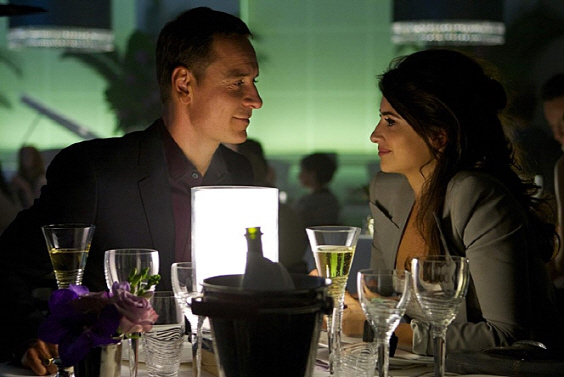
During its opening scene which feels peaceful and normal compared to the subsequent dark scenes to come, we are introduced to its unnamed hero  who is always called ‘Counselor’ by others in the movie. Counselor(Michael Fassbender) is in his clean white bedroom with his girlfriend Laura(Penélope Cruz), and, after their sweet talk under the white sheet, he gives her a nice sexual pleasure as a man who sincerely loves her. He is going to marry her sooner or later, and he even flies to Amsterdam to buy a diamond for her wedding ring. The one he chooses looks very expensive, but he does not care about the price as long as his chosen jewel suits her well.

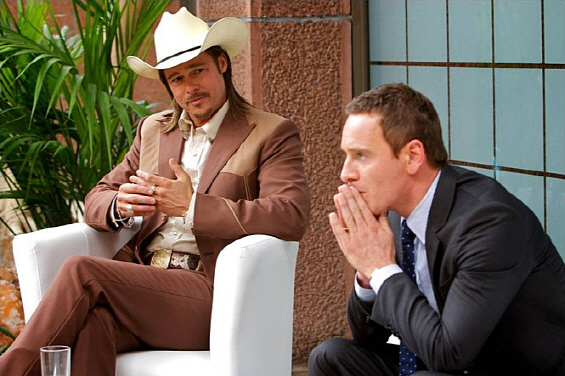
small_thecounsellor02 And that is the beginning of how he falls from bliss to desolation. He needs more money to buy that ring and other things, so he decides to participate in a drug business over the Mexico-US border, which is handled by his corrupt and hedonistic friend/partner Reiner(Javier Bardem). Reiner warns Counselor of the possible risk in this dangerous business, and so does Westray(Brad Pitt), the other guy who works as a ‘middle man’. I must confess that I do not have any clear idea on how he works or what position he is in, but that does not matter to the screenplay, for this character solely exists for 1) giving customary warnings to our hero and 2) foretelling what kind of horrible things may happen later.

The movie is also vague and abstract about what Counselor agrees to do for this business or how he suddenly gets himself in a big trouble. All we know clearly is that Reiner’s scheming (and kinky) girlfriend Malkina(Cameron Diaz) is mainly responsible for this trouble, and she has some plan revolving on a septic truck which crosses over the border and then is moved around here and there in US. Its tank is filled with not only the barrels containing drug but also the sewage for hiding them, and that takes me back to when I once joked that Cormac McCarthy’s elegant prose would make even a cesspool look beautiful – I guess this is how I pay a small price for my cheap joke.

Without knowing about Malkina’s scheme at all, some powerful dangerous guys in Mexico seem to think Counselor, Reiner, and Westray are behind the botched business operation. Mexican guys are going to do whatever they should do to keep their business looking intact and invulnerable, and Counselor finds himself being helplessly stuck to a grim course heading to the inevitable point as violence and death keep happening around the story. The movie has several moments of shocking violence, and one of them is a gruesome scene involved with a special wire noose; once it is hung around the victim’s neck, it keeps tightening around his neck second by second, and the consequence is not a pretty sight to say the least.

small_thecounselor04While it certainly does not feel tedious as we observe all these things and try to guess what is exactly going on in the story, the movie weirdly lacks the momentum to drive its plot despite its good moments. The director Ridley Scott tries as much as he can do with McCarthy’s screenplay as a visual storyteller, and his slick end product has the clear and distinctive sense of various locations including that bleak landscapes of the Mexico-US border region, but the story merely plods along its predetermined path while keeping confounding us. I respect its refusal to reach to the climax near the ending, but I do not think that is satisfying or rewarding in spite of a restrained but merciless gut punch it delivers as promised.

Most of the cast members acquit themselves well despite thin characterization. Michael Fassbender is smooth and tense as before, and Javier Bardem finds some humor in his broad character, and Brad Pitt savors juicy dialogues in his brief appearance. While Penélope Cruz is stuck in a thankless role, Cameron Diaz has the most fun as the cunning villain of the story; she willingly puts herself into a truly bizarre scene casually reminisced by Bardem’s character, and you will learn that it is sort of possible to have a sex with a sports car. It goes without saying that this is pretty weird, but you won’t be so surprised if you are familiar with McCarthy’s novels; in “Suttree”, one offbeat supporting character ‘raped’ watermelons, and, to be frank with you, I mused for a while on whether there is any appropriate English word for this odd behavior besides bestiality.

Considering the talents gathered behind it, “The Counselor” is a disappointing result, but its failure is an understandable one. McCarthy’s screenplay probably looked good and erudite on paper, but it does not make an engaging story on the screen, and that is why many of his novels except “No Country for Old Men” have been deemed as unadaptable ones. I heard that the screenplay is also published at this point, and now I wonder whether reading it may give me a better experience than watching the movie. As a matter of fact, I am now wishing for its novelization.

small_thecounsellor01

Posted in Movies | Tagged , , | 1 Comment

Farewell, My Queen (2012) ☆☆☆(3/4): Her last few days in the palace

farewellmyqueen02The storm is coming, but they have no idea on what will happen to them and their world. It is July 14th, 1789, and everything looks fine just like any other day to the people in the royal palace of Versailles, but we all know that their insulated decadent world will be turned upside down within a few days – and most of them will not be lucky enough to survive in this massive historical storm which will not only sweep them all and but also topple the class system they have depended on and been accustomed to for years.

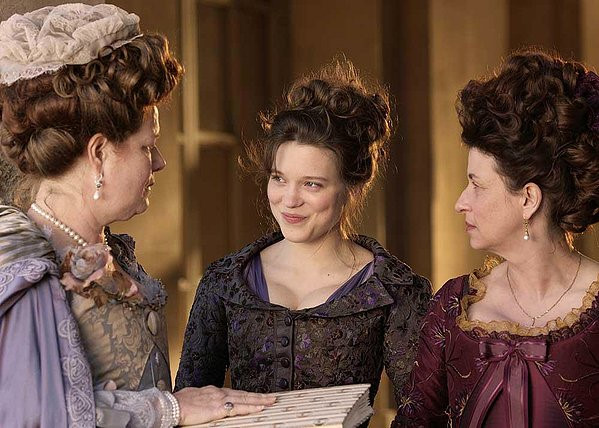
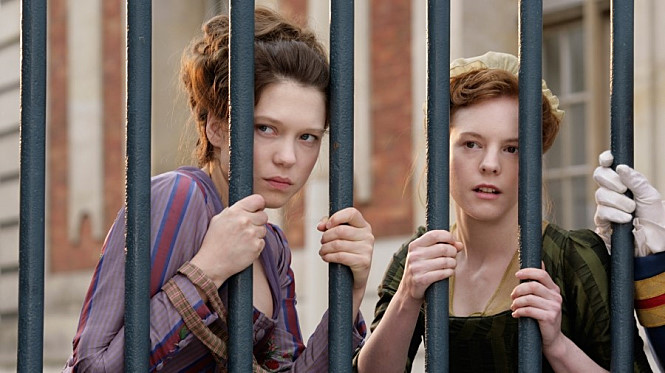
While confining its viewpoint nearly within the Versailles, “Farewell, My Queen” tells its story through a young woman named Sidonie Laborde(Léa Seydoux), one of the servants living and working in the Versailles. Her job, reading books for Marie Antoinette(Diane Kruger), looks simple, but Madame Campan(Noémie Lvovsky from “Camille Rewinds”(2012)) is very serious about this menial job. Before Sidonie enters the room, they discuss on which book to read for the queen, and, though this talk turns out to be not very useful, we can sense that this pointless discussion has been a part of the daily routine between them.

Like any good servants serving for the system they belong to, Sidonie has a strong belief in the system while never doubting about it. Whether it is out of love or loyalty, she is so devoted to her queen that she is almost blind to her mistress’ superficiality. When the queen shows a little care to her, Sidonie is pleased to get her royal kindness, but, unlike us, she does not realize that the queen merely regards her as one of the objects surrounding and serving for her in the Versailles. While everything is being taken care of for her, the queen starts going through another luxurious day as usual in her small comfortable world, and she is utterly ignorant of what is going on outside the palace.

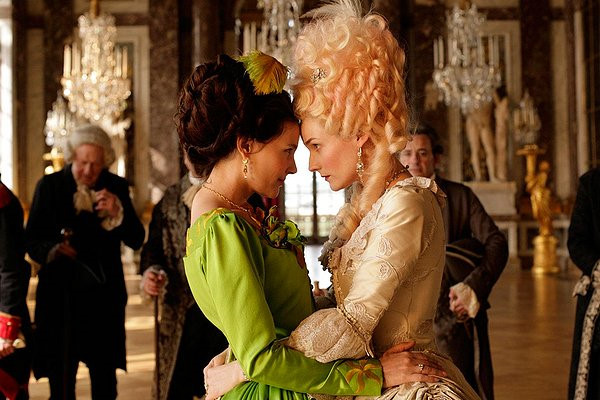
farewellmyqueen06When she is not paying attention to what to wear or what to get, the queen’s attention is mostly focused on the Duchess Gabrielle de Polignac(Virginie Ledoyen), who has maintained her high position in the palace through the queen’s deep affection to her. Everyone in the palace knows how manipulative the Duchess is, but the queen is oblivious to that because of her infatuation with the Duchess, and the movie implies that they may be a lot more than close friends.

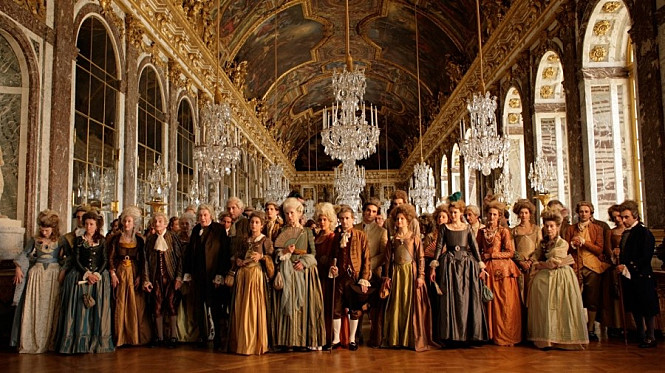
The movie was actually shot in the Versailles, and it gives us an interesting perspective on its place and time as Sidonie moves around the place. The palace looks grand and splendid with its wide gardens and sumptuous interior designs, and the nobles looks good in their lavishing clothes, but there are also the ungainly sights hidden around the palace. The living places of Sidonie and other servants look plain and sparse, and only notable thing in Sidonie’s room is an expensive clock to help her keeping with her daily routine exactly as demanded.

We also observe the hygienic condition of the palace, it is not particularly good. Mosquito bite is a common thing during summer days, and Sidonie sees dead rat twice during one day, but she does not look that surprised, if disgusted. Compared to the gorgeous halls and corridors of the palace, the kitchen looks more like a dungeon, and we see Sidonie and other servants enjoying their meals together in this place with some good leftover from their masters’ dinners.

July 14th normally goes on for everyone like that, and then their world starts to be shaken by a disturbing news from the outside on the next day. A massive riot was started in Paris during the previous night, and then more alarming news and rumors are spread around the palace and its people. It seems the whole nation is quickly being hurled into chaos after the fall of the Bastille, and, while some people instantly leave the palace for saving themselves, others just remain in the palace with the king and the queen. They are not awakened to the fact yet that their world is crumbling now, and neither is Sidonie, who sticks to her position like many of her fellow servants.

farewellmyqueen04The sense of doom looms over them as well as the nobles while things are becoming rapidly worse and worse. The night is full of worried faces in the candlelight, and, while doing her job as ordered, Sidonie also tries to get any information about what is going on in the outside. She is not stupid, but, unlike a wise, aging archivist(Michel Robin) friendly to her, she does not have a clear view on the whole circumstance, and we know that there would not be much she can do even if she really understood what is happening to her and others in the palace.

Based on the novel by Chantal Thomas, the director/co-screenplay writer Benoît Jacquot made an engaging movie which can be a good companion piece to Sophia Coppola’s underrated film “Marie Antoinette”(2006). Like “Farewell, My Queen”, “Marie Antoinette” spends most of its time inside the Versailles while observing the decadent ennui inside the lavishing and reckless lifestyle of young Marie Antoinette and others, and “Farewell, My Queen” looks like the next story coming after that. As a woman who has been hopelessly stuck in her lofty mindset for many years, Diane Kruger gives a good performance which makes her character pathetic but somewhat sympathetic; the queen has her own feelings, and we have some pity on her because of her tragic end to come, but she is still a self-absorbed woman more concerned about her private matters than the urgent public matter which will soon swallow up her and her family and others.

As the center of the story, Léa Seydoux, who has steadily been gaining our attention since she appeared in “Mission: Impossible – Ghost Protocol”(2011), holds our interest with another good performance as a smart girl who is open to the demands given to her but remains elusive to us until the very end. The final scene, which is presented with amusing irony, reveals to us the main reason why she adamantly clings to her sinking world despite what she has seen and observed from her queen and others, but that means nothing as before – and we know that it will be completely obliterated along with her world in the end.

farewellmyqueen01

Posted in Movies | Tagged , , , , | Leave a comment

Cats, Geese, and Autumn leaves (11/04/13)

null null null null null null null null null null null null null null null null null null null null null null null null null null null null null null null null null null null null null null null null null null null null null null null null null null null null null null null null


It’s getting cold, colored leaves are everywhere…

Posted in Photos | Tagged , , , | 1 Comment

All Is Lost (2013) ☆☆☆1/2(3.5/4) : Our Man and the Sea

allislost04Nearly stripped of every expected convention, “All Is Lost” is so pure and simple that it does not look like an interesting movie at first. There is no back story or flashback for its lone hero, and its reticent aging hero is simply named “Our Man” in the end credit. We can only guess vaguely his personal motive for solitary sail during the tranquil opening scene while listening to his words from what may be his last letter, and he remains all alone by himself with no particular desire to talk with anyone including himself.

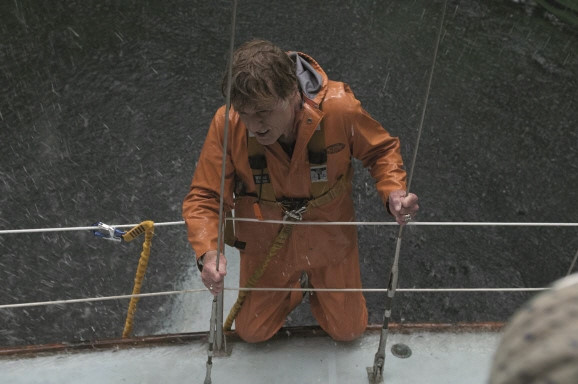
The movie shows us his 8 days of desperate but stubborn struggle to survive and to be rescued. When his yacht is around 1500 nautical miles from the Strait of Malacca, Our Man(Robert Redford) is awakened to find that the yacht has crashed with a floating metal cargo container which was probably fallen from one of those big cargo ships sailing around the Indian Ocean. One edge of the container has penetrated into the cabin, and, unfortunately for him, it hit the very spot where the communication equipments including his personal laptop computer were placed. Many things in the cabin are soaked in the sea water flowing through the hole, and, to his frustration, the yacht also has lost its electric power source due to the accident.

We see how he calmly tries to handle this trouble, and he turns out to be a very resourceful guy. He makes a makeshift waterproof membrane for covering the hole, and he pumps out the water from the yacht, and he also dries the broken communication equipments to get any possible chance for requesting rescue(I learned that it is wise to clean electronic devices with fresh water first if they happen to be soaked in sea water). Although it is not completely safe, the yacht looks fine on the whole despite the damage, and it seems he will be able to manage this disastrous situation at least for several days while searching for any help.

Nevertheless, that does not change the fact that he is completely alone and isolated on the big ocean which can be pretty ruthless to any vulnerable creatures, and his grim solitude makes other notable movies about the isolated struggles for survival in the vast landscapes look relatively, well, less lonely. The hero of “Cast Away”(2000) had a volleyball to talk with, and the hero of “127 Hours”(2010) had a digital video camera to play with, and the hero of “Life of Pi”(2012) had a tiger to deal with, and the heroine of “Gravity”(2013) had a fellow astronaut to stick with, but Our Man has no one to interact with from the beginning.

allislost03

This setting may not look very compelling to you, but the director/writer J.C. Chandor willingly places many limits on his story while pushing it straight to his intended goal, and the movie seldom loses its steady pace while never feeling dragged. Stoically sticking to its hero all the time, it always gives us clear ideas of what is going on or what the hero is thinking during its wordless scenes, and the interactions between the hero and the perilous challenges he faces on the ocean are placed and handled well along the narrative: whether it is the sound and fury of tropical storm or the suspense from the alarming squeaking noises in quietness, it is always engaging, gripping, and terrifying to watch under Chandor’ deft direction.

Such a film like this certainly demands a lot from its lead actor, and Robert Redford, who is 77 years old at present and definitely deserves an Oscar nomination for his excellent one-man show performance here in this film, proves that he has lost none of his star presence as well as his underrated acting talent. Unlike Spencer Tracy in “The Old Men and the Sea”(1958), Redford does not directly communicate to us while carrying the whole movie alone(As far as I can remember, he utters only six or seven lines in the whole film), but he fully embodies an understated but powerful portrayal of a man under the extreme situation, and we willingly follow his character’s increasingly burdensome predicament thanks to his likable persona. Whenever we see Redford, his furrowed face fills the blank inside his character more than enough, and, whoever Our Man is, we come to sense that he is probably a prudent man who has seen and experienced a lot during many years of his life; this guy may survive if he keeps trying and, of course, is lucky.

He does try his best, but he is constantly reminded of his vulnerability and limits by the continuing challenges from the nature. He has a reasonable plan for getting more chances for rescue, and he has the resources for making that plan possible, but he cannot stop the desperation and frustration growing inside him as the worsening situation keeps cornering him. The movie gives a few moments of relief through the beautiful shots of the ocean which may remind you of those BBC or National Geographic nature documentaries, but its tranquility is only for us, not for him.

allislost02

J.C. Chandor’ previous work was “Margin Call”(2011), which got him his first Oscar nomination, and that talky but intelligent film makes an interesting contrast with “All Is Lost”. While the former focuses on a group of various characters discussing and pondering on the impending global catastrophe to come upon them and their business world sooner or later, the latter focuses on only one character silently coping with his immediate personal disaster. Two films are quite different from each other, but both of them evidently show Chandor’s talent as an efficient storyteller who can hold our attention even if we do not see the whole picture; like we can clearly feel the sense of urgency hovering over the characters of “Margin Call” even though we do not understand everything they say in the movie, we come to sense the conflict between desperation and defiance inside the hero of “All is Lost” even though he rarely reveals his feelings or thoughts to us.

As New York Times movie critic A.O. Scott recently pointed out in his article, it is notable that we have frequently encountered the movies about individual survival during recent years just like when disaster films were dime a dozen around the 1970s, and “All Is Lost” is surely one of the latest examples. I wonder whether this trend reflects our anxiety toward the uncertainty of the 21th Century, the time when that familiar phrase “anything is possible” feels more fearful and palpable than before. Our human resilience has surprised and amused ourselves many times in fiction and reality, and that is sort of comforting to observe, but I sometimes wonder whether we can really survive this century because, well, anything can happen.

Whatever you think about that, “All Is Lost” is a first-class minimalistic survival drama, and it is a small but impressive triumph of story and acting under challenging settings. When I watched “Gravity” three weeks ago, I was reminded of how timid our existence is compared to that seemingly endless scope of the space, and now this movie reminds me that we are still timid entities even on the Earth. At least, as its rather ambiguous ending suggests, we are capable of trying hard even when all seem to be lost and we have no choice but to make an exit.

allislost01

Posted in Movies | Tagged , | 1 Comment

Steel Cold Winter (2013) ☆☆☆(3/4) : A dark, bloody winter romance in the countryside

steelcoldwinter02South Korean film “Steel Cold Winter”, which is released as “A Girl” at South Korean theaters in this weekend, is dripping with the moody atmosphere which will draw you to its dark secret hidden behind one mysterious girl and the plain wintry countryside. Although the ending is a little too anti-climactic mainly due to its predictability, I liked its chilly feeling in the progress, and I found myself more conscious of the cold weather outside than before when I walked out of the screening room.

The girl in question is viewed through a high school student named Yoon-soo(Kim Si-hoo), who has recently been transferred to a high school located in some remote country village. Although his affluent parents do not explain much about his transfer from Seoul, we come to have some pretty good idea about how they came to make such a decision. He looks quiet and normal at first, and he gets along well with his new classmates, but he sometimes suffers from the piercing noises inside his head – especially when he is under stressful condition.

Hae-won(Kim Yoon-hye), one of the students in his class, seems to know the reason, although she never explains to him how she knows. When she says about something he has never told to anyone in the school, he is naturally alarmed and disturbed by her remark, and his classmates tell him later that Hae-won has been regarded as a creepy girl in their village. She sometimes blurts out many things she cannot possibly know, but it looks like she is a sort of truth teller; at one point, she whispers something to a certain character, and we later learn that she did not lie to that character at all.

Some of the village peoples, including the avuncular head of the village, pity Hae-won rather than ostracize her. She lives in a poor household, and her only family is her mentally unstable father. According to a bad rumor which has been spread around the village, he has probably committed something unspeakable to his daughter, and many neighbors think they must do something about that, but Hae-won remains weirdly quiet regardless of whatever they talk about her and her father, about whom she seems to care a lot.

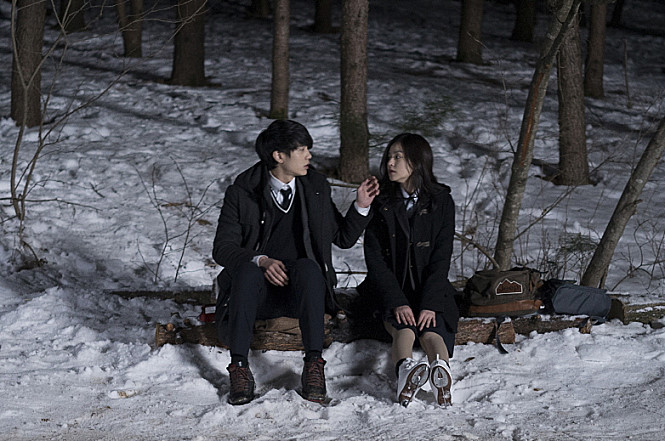
steelcoldwinter04Even after he comes to learn about that rumor, Yoon-soo finds himself still attracted to this detached but pretty girl who approaches to him closer than anyone. When he saw her during his first day in the village, she was freely skating figures on the frozen lake alone, and he could not help but just watch her beauty in cold solitude. As they become a little friendlier to each other, they spend some time together at the lake during late evenings, and he gives her a new pair of figure skates as a sincere gift for her.

As I watched this tentative romantic relationship growing in the cold landscape, a cold but sad Swedish vampire film “Let the Right One In”(2008) and its American remake version “Let Me In”(2010) instantly came to my mind. Although “Steel Cold Winter” is not a vampire film, much of its strength resides in its desolate and disturbing wintry ambience not so far from that of those two darkly romantic movies, and it also has its own desperate lovers holding onto each other amid the bleakness surrounding and oppressing them.

Based on the screenplay by Choi Yoon-jin, the director Choi Jin-seong did a splendid job of creating a vivid wintry atmosphere; it really feels cold and freezing to everyone on the screen even when we do not see snow or ice. There is also a considerable amount of gloominess on the screen even during midday, and we are constantly reminded of something unwholesome hidden behind the surface while Kim Yoon-hye gives an effectively restrained performance which imbues her character with the sufficient aura of dark mystery. It is quite possible that there is a lot more behind her pretty icy face than she tells, and we keep wondering about her along with Yoon-soo: is she just an odd girl? Is she merely a lonely pariah in the village? Or…

steelcoldwinter05The movie becomes more noirish when a terrible incident shocks the whole village, and, as a flawed and troubled hero tormented by his fatal error in the past, Yoon-soo becomes confused and conflicted because of what he happened to witness around the time when the incident happened; though he cannot be entirely sure about what he saw at that time, it can surely implicate Hae-won in the serious crime, and he may lose her forever because of that.

As implied in its bloody opening scene, things will not be resolved nicely in the end, and the sudden epidemic of foot-and-mouth disease among pigs casts another shadow on the village, which will certainly receive an economic blow due to this disaster. There is a horrible scene showing how those poor pigs carrying the disease are buried alive in the pit, and, though this is undeniably a striking moment, it is one of several missteps in the movie. The movie attempts to make a symbolic connection between this scene and how an individual can be inadvertently ‘buried’ by others, but it does not fit into the story as well as intended, and the same thing can be said about the oncoming moon eclipse, which is emphasized several times throughout the movie. This might have looked like a wonderful dramatic background on paper, and it really could have been, but it distracts our attention to the story rather than heightening the dramatic effect of the scene it accompanies.

What will eventually be revealed in the end will not surprise you much, but “Steel Cold Winter” is a good film which works at its best when it sets and then develops its mood and characters. Kim Si-hoo and Kim Yoon-hye has a nicely understated chemistry between them as engaging(and pretty) couple, and other actors also look convincing as their respective rural characters. The movie could have been better through more polishing, but it is still good as a dark, bloody piece of winter romance which finds a small consolation even at its bleakest moment: “It is so warm over here.”

steelcoldwinter01

Posted in Movies | Tagged , , , , | 10 Comments

Mr. Nobody (2009) ☆☆(2/4) : I’m sorry, but which timeline is he talking about?

mrnobody02 “Mr. Nobody” juggles its balls with all the ambition it has, but I could not hold on to that. As going back and forth between its five or six parallel timelines, it eventually loses its ground and then gets lost in its confusing plot, and I only looked at its parallel life stories from the distance. As a result, the ‘surprise’ revealed around the ending is not as powerful as intended, and it even feels like a cheap ending while many things in the movie still do not make much sense. I constantly felt confused and detached during the screening, and I must say watching this film was a rare theater experience in which I had to suppress my personal urge to boo or shout “bullsh*t!” for more than 2 hours.

I am not sure about how to describe its complicated plot structure precisely to you, but let’s say it seemed at first that everything in the story comes from the memories of a very old guy named Mr. Nemo Nobody. Played by Jared Leto with the make-up which makes him look like the hybrid of a 200-year-old Galapagos tortoise and Dustin Hoffman in “Little Big Man”(1970), Nemo is officially the last mortal man in the late 21th century society where other human beings on the Earth are enjoying immortality thanks to advanced medical technology, and the people around the world are eagerly watching on Nemo spending his few remaining days.

It is 2092, and Nemo is 118 years old at present. While he is still a stubborn old soul despite his frail body, his mind is frequently confused about his early life despite his officious tattooed doctor’s help, and a young reporter who visits him for the interview finds Nemo’s life story too incredible to believe; he did live for long years, but how could he possibly go through three different lives at the same time?

We see how that can be possible as his story is told along with the hokey narrations/speeches about life and universe which increasingly annoyed and distracted me for their ponderous attitude. In addition to Nemo’s wistful and melancholic narration, the movie is also saddled with young Nemo’s innocent and plucky narration, so we get an unintentionally hilarious sight in which every child to be born into the world are innocuously walking around in the Heaven before kissed by the angel to get their heavenly memories erased and then be sent to their biological parents. I would not have been surprised if the movie had showed them delivered by storks.

mrnobody04According to young Nemo, he remembers his time before his official birth because the angel somehow did not kiss him. Probably for that reason, he is equipped with the ability to see the future; he can clearly see his small moments of choice are the crucial turning points of his life, and he can also see how his choices will resonate throughout his life. For instance, when he sees three young girls sitting together on the bench, three individual images of wedding days come upon his mind literally side by side; I guess that means each of them has an equal chance of being his spouse.

His most important turing point was the day when he had to choose between his dad and mom(Rhys Ifans and Natasha Little) after their divorce, so the movie rolls two separate timelines: the one where Nemo chooses his mom and the other one where Nemo comes to live with his dad. The movie goes even further in case of the latter, so we get not only another timeline for Nemo but also a SF story being written by him around the time he falls into coma due to a car accident after one of his fateful choices.

The movie frequently jumps between these parallel timelines as if everything were really happening simultaneously in the universe. Nemo wakes up with lots of confusion about his life many times, and he is mostly unhappy regardless of which timeline he is in or which woman he is with. In one case, he falls in love with Anna, the daughter of his mother’s new boyfriend, and then they are separated from each other in a tearful situation, and then they meet again after many years have passed – and then they are separated again through an unbelievable event which is explained by the movie as a textbook example of the Butterfly Effect, one of the well-known terms in that famous chaos theory.

mrnobody05

The screenplay written by the director Jaco Van Dormael tries hard with its ambitious ideas, but it only scratches the surface while feeling more superficial, and most of its parallel plots feel flat and tepid despite the nice efforts from its actors. The movie probably looked like a good challenge to Jared Leto, and this talented actor admirably carries the movie while flexibly going through many different modes throughout the film; in fact, the movie could have been more confusing if it had not been for him. Toby Regbo and Juno Temple are good as Nemo and Anna in their teenager years, and, as older Anna, Diane Kruger interacts nicely with Jared Leto, though their part eventually loses its way just like the other parts.

As the story approaches to its ending, more strange things happen around Nemo, and the movie has some nice moments such as when Nemo is bewildered by a surreal construction work process in front of his house. By that point, you will probably be not that surprised when the movie finally reveals what is really happening from the beginning.

I was well aware of that its story is told through an unreliable character with fuzzy memory, but I was frequently baffled while trying to get the overview, and I could not care much about how the story would be unfolded and then finished. Though it was made in 2009, “Mr. Nobody” arrived pretty late in US(and South Korea) despite its continuous screenings at several film festivals. I found that a bit weird when I heard about the movie, but now I have a pretty good idea about how that could happen.

mrnobody03

Posted in Movies | Tagged , | 2 Comments

Like Someone in Love (2012) ☆☆☆1/2(3.5/4) : Like Someone in Lies

likesomeoneinlove01After delighting us with “Certified Copy”(2010), Abbas Kiarostami enjoys himself again in his latest film “Like Someone in Love”. While it looks like a plain, exemplary Japanese film made with the local actors and crew on the surface, his own natural approach and his constant themes can be easily recognized as it observes a rather indecent and unstable human relationship at the center of the story(while it was produced by the French production company, several Iranian collaborators of his also participated in the production), and the movie is playful even when the mood surrounding its characters becomes more serious and suspenseful because of their small lies for handling their problematic circumstance.

Its opening scene feels a bit confusing at first because of its odd, subtle camera angle. We listen to a phone conversation at some bar in Tokyo, but, while the camera are clearly watching the people at the bar at its fixed position at the same time, we do not see anyone having conversation on the phone. As we keep looking around the scene, one girl at the right corner approaches to the camera, and then we realize that we are seeing the bar through the viewpoint of Akiko(Rin Takanashi), who is having a personal talk with her current boyfriend Noriaki(Ryo Kase).

As this scene continues, it is revealed that Akiko and her friend Nagisa(Reiko Mori) are college girls who also do a part-time job as the call girls for older guys. The movie does not say much about what exactly they do for their clients, but it goes without saying that Akiko’s part-time job is something she wants to hide from Noriaki, a possessive guy who is very suspicious about what his girlfriend does during late nights despite his love toward to her.

After barely fending off his suspicion with lies, she receives another work to do from her manager Hiroshi(Denden). She is tired due to her study for the exam in the next morning, and her grandmother wants to see Akiko right now before she goes back to Akiko’s rural hometown, but Hiroshi is quite persuasive; he gives her some thoughtful professional advices like a caring uncle, and then he gradually induces her to accept his demand although she remains pretty reluctant even at the end of their conversation.

likesomeoneinlove03As the camera looking at Akiko in the taxi taking her to the client, the movie surrounds her with that alien atmosphere of the downtown of Tokyo, and the feeling of isolation and alienation is palpable on Takanashi’s tired face although we do not know a lot about her current life. Her grandmother frequently called today because she really wanted to see her granddaughter, but it is implied that the grandmother may have guessed about how Akiko manages to earn her living while studying alone in Tokyo, and that is probably why Akiko chooses not to meet her grandmother during a quietly bitter moment.

After sleeping for a while in the taxi, Akiko meets her client. Takashi(Tadashi Okuno) is an aging retired sociology professor, and he courteously takes her to his comfortable and sophisticated residence filled with many books. Whatever they are supposed to do as a call girl and her client, Akiko is too exhausted for doing anything with a man who is old enough to be her grandfather, and Takashi comes to spend a rather uneventful night although he enjoys her company. From his gentle and tentative behaviors, we see a man who has probably experienced a fair share of disappointment with women; he is not so annoyed when the night does not go well as planned, and he just accepts what happened, though I am not sure about what exactly happened during that night.

On the next day, he takes her to her college early in the morning, and that is where their trouble begins. Noriaki happens to be in the campus to see his girlfriend, and he sees Takashi bringing her to the campus by his car. He assumes Takashi is her grandfather, and Takashi lets Noriaki assume like that for avoiding trouble, and Akiko has no choice but to go along with his lie while lying more to her boyfriend.

While there is a certain degree of suspense as these characters keep interacting with each other, the movie has a wry fun with the deceptions and ironies around them. While covering his identity, Takashi finds himself unexpectedly assuming the role of an advising mentor to Noriaki as Akiko’s ‘grandfather’, and his every word to Noriaki feels sincere while they have a private talk on Noriaki’s personal difficulty with Akiko – but we and he know well that their conversation will turn into nothing once the cover is blown.

likesomeoneinlove04We also see something is developing between Akiko and Takashi. Takashi’s busybody neighbor, who carried a torch for him in the past, mistakes Akiko for his granddaughter, and neither Takashi nor Akiko corrects that misunderstanding. While watching this, I was reminded of that ambiguously interesting development between the two main characters in “Certified Copy”(2010). They look like playing a couple at first, but they increasingly look like a real couple as their ‘play’ goes on, and we even come to wonder whether they are a real couple from the beginning as their real/copied emotions are presented on the screen.

In case of “Like Someone in Love”, its main matter is relatively less ambiguous, but it is also an equally interesting role-playing drama. Akiko’s relationship with Tadashi feels more intimate compared to her real but problematic personal relationships, but that does not change the fact that their relationship is basically impersonal from the beginning. Sure, they can be like a genial grandpa and his pretty granddaughter, but they are still an employee and a client none the less – and he may eventually do what is certainly not licensed to grandfather and his granddaughter.

The movie maintains its light approach even when it goes through the inevitable point we saw right from their first lie, and the director/writer Abbas Kiarostami pulled out good natural performances from the two lead performers under his improvised direction(the actors were not prepared with the screenplay even when they were about to act in their scenes). They are so good that sometimes they do not need the dialogues for implying what their characters probably feel and think, and Ryo Kase also deserves to be mentioned for his supporting performance which is the major source of tension in the story; his character is not an innocent jerk but he is instead a volatile, narrow-minded asshole, and you may wonder sometimes why Akiko has not left this unpleasant guy yet(is it some sort of masochistic punishment on her guilt, I wonder?).

After making several critically acclaimed films in Iran, Kiarostami took an unexpected direction with “Certified Copy”, and he continues his unusual trend with “Like Someone in Love”. According to him, he got the idea for it during his visit to Japan during the late 1990s, but it had been put aside until he finally got a chance to develop it into the movie after his success with “Certified Copy”. The result is another fascinating work from an old master enjoying the new freedom which comes late in his career, and I am particularly amused by a simple but literally shattering stroke in the end; after all, they had it coming from the beginning, didn’t they?

likesomeoneinlove02

Posted in Movies | Tagged , | 2 Comments

The Purge (2013) ☆☆(2/4) : A suburban night of legalized killings

thepurge04“The Purge” starts with an outrageous but intriguing premise: what if the society temporarily allows killings as a way of ventilating the social anger/resentment pressed inside its individuals? I can think of at least five or six implausible aspects of this premise, but it certainly has the potentials for exploring the dark sides of human nature and human society, and I could see several nice possibilities to be explored during its first 10 minutes. Outrageous, but it could be as interesting as, say, Shirley Jackson’s infamous short story “The Lottery”.

However, despite its promising beginning, “The Purge” sadly devolves into a run-of-the-mill thriller involved with home invasion and predictable moral questions, and it is not even a good one. The screenplay is saddled with flat characterization and bland dialogues packed with clichés, and it goes even worse as every character is mired in lots of unbelievable contrivances and startling stupidity. This is one of those movies where characters move around alone in the dark when they really should move or stick together to find any solution to get out of their perilous situation, and then there comes more idiocy to make your head shake in disbelief while it approaches to its ludicrous third act without any suspense or plausibility.

And the movie does not even try much to make its background at least temporarily plausible. Yes, we are told during the prologue that the US government finally succeeds in restoring its economy and society through the annual social event called “The Purge”, but the movie does not tell us enough about how American people came to accept such a terrible event within a short period(it is only 2022 in the movie) or how the resulting social improvement can be achieved so easily and quickly like that. For example, it is said in the movie that the murder rate becomes almost zero thanks to this murderous annual romp of human savageness, but it somehow overlooks that there are many other kinds of murder besides the one fueled by our animalistic side. Sure, many people indeed get killed everyday due to our biological aggressiveness, but haven’t we heard about those cold, heartless murders by gang organizations? Can such crimes and other ‘rational’ crimes be possibly suppressed by the Purge?

The movie focuses on one affluent suburban family who happen to have one tough night they will never forget. It is March 22th, the day of the Purge, and everyone in the neighborhood is ready for the extremely dangerous night to come as James Sandin(Ethan Hawke) is returning to his house. He is confident that he and his family will go through the Purge safely as usual; he is a rich and successful salesman who has sold many security equipments to his dear neighbours, and his house is certainly equipped well with a dependable security system which will instantly protect the house from any serious threats as soon as the Purge begins.

thepurge03We come to learn a bit about how the Purge will be initiated, progressed, and then terminated. It will be started precisely on PM 7:00 in the evening, and all the police stations, fire departments, and hospitals will be out of reach for the next 12 hours. While putting some restriction on weapons(the movie does not explain well the reason behind it, by the way), the government guarantees that no one will get arrested or charged no matter how many people he kills, and some of James’ neighbors are already preparing to kill even before the Purge officially begins.

While the Sandins and other affluent families can afford to protect themselves with their money, most of the lower class people have nothing to protect themselves, and they naturally become the targets to be killed by others. You may see some social allegory on how the weak is brutalized by the strong, but the movie does not pay attention much to a certain stranger crying for help in front of the Sandins’ house. He is merely a plot device to bring the peril into the story(played by Edwin Hodge, this character is just named ‘Bloody Stranger’ in the end credit), and the movie sometimes seems to forget about him unless he is necessary for the plot progress.

His plea could have been ignored, but James’ son Charlie(Max Burkholder) cannot ignore this desperate guy for some humanitarian reason or whatsoever. He opens the front door to let him in the house, and, what do you know, he and his family soon find that a group of mobs wearing freaky mask surround the house(don’t ask me why they have to wear mask), and their psychopathic leader(played by Rhys Wakefield, this character is just named ‘Polite Leader’ in the end credit) demands that James should surrender that poor stranger to them because he is a ‘pig’ to be killed in their Purge ritual. This character is so over-the-top on psychotic mode that you cannot possibly miss the racist aspect of this despicably evil character; he looks like a rich white fraternity boy while Bloody Stranger is a black guy from some poor neighborhood, so you can easily guess the point even before it is blatantly made by the hateful lines viciously and politely uttered by Polite Leader.

small_thepurge02This still looks a bit like a good thriller setting at least, but then the movie becomes more hopeless to my disappointment. The house becomes dark when electricity is cut off(has it ever occurred to them that leaving the lights on is more strategically advantageous to them?), and the camera busily goes around the characters without generating any tension, and the movie drones on as the time is running out for them. Ethan Hawke and Lena Headey, who plays James’ wife, are good performers, but there are not many things they can do for their bland characters, and the same thing can be said about Max Burkholder and Adelaide Kane, who are also stuck with bad dialogues and sketchy characterization.

The director/writer James DeMonaco previously wrote the screenplay for “Assault on Precinct 13”(2005), which was a good remake of John Carpenter’s 1976 film. That movie also started its story with a simple premise and broad characterization within its surrounded space, but the story was handled well, and its characters were distinctive, if not complex, enough to hold our attention.

“The Purge” is an utter failure in comparison because of its lackluster story and thin characterization, and I only saw its glaring flaws rather than enjoying it – and I thought of several movies better than this dismal result. As soon as the movie was over, my interest was quickly moved to the 1976 version and 2005 version of “Assault on Precinct 13”, and I quickly forgot my disappointed reaction with “The Purge”. Believe me, you will have a better time with either of them.

small_thepurge01

Posted in Movies | Tagged , , | Leave a comment

Thor: the Dark World (2013) ☆☆(2/4) : To be continued…

thordarkworld02 I usually think reviewing movie trailers is pretty ludicrous, but I seriously doubt that my review on “Thor: the Dark World”, the sequel to “Thor”(2011) and also one of the latest entries in the Marvel Comics mega-franchise, would be inappropriate if it were only based on the trailer rather than the movie itself. The movie is essentially a 112-min teaser announcing another sequel to come later along with a few new additional characters, and it is depressing to report to you that what you saw in its trailer is all the movie can offer. You know you’re in problem when you come to discover that the trailer showed virtually everything in the climax to you, and this is one of such disappointing cases.

Like another recent Marvel Comics blockbuster “Iron Man 3”(2013), the movie starts its story not long after that epic catastrophe depicted in “The Avengers”(2012). After encountering and then falling in love with Thor(Chris Hemsworth), Dr. Jane Foster(Natalie Portman) has been trying to find any possible way to meet her beefy boyfriend from the outer space again since they happened to be separated from each other at the end of the previous film, but there has not been any particular breakthrough yet, and it is no surprise that she was rather pissed to know that he did not visit her during his recent business trip in “The Avengers”.

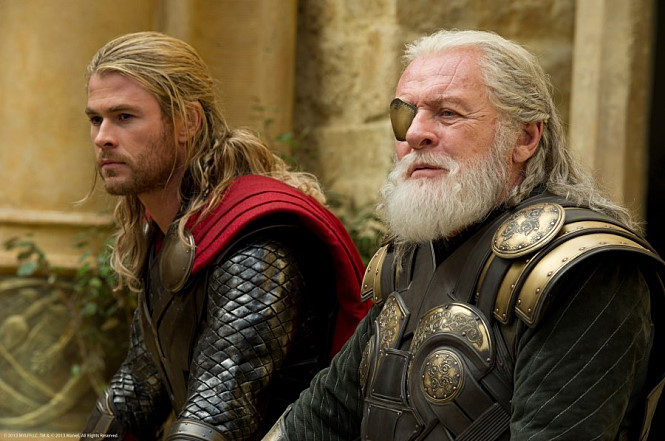
She soon gets her wish, but a big danger also comes along with that. The opening scene narrated by Anthony Hopkins, who plays Thor’s big daddy Odin, introduces the villains called Dark Elves, and we get a long explanation part coupled with the CGI battle scene which weirdly feels like the second-hand version of “The Lord of the Rings” movies. Dark Elves were defeated by Odin’s father and mostly killed in a big battle, but some of them managed to survive, and, once they see that their powerful weapon hidden by Odin’s father many eons ago is finally unsealed, they are determined to retrieve it because their big chance is coming again. They are going to use it when nine universes converge and align together, and that will bring the whole universes into the darkness which is, in my imaginal multi-dimensional view, probably located around the point before the Big Bang.

thordarkworld04 That dangerous weapon in question is called Aether, which pronunciation may amuse you a bit if you have ever heard about the Michelson–Morley experiment. As the Convergence is approaching, the portals between universes somehow begin to appear here and there around the Greenwich area in London, and Dr. Foster inadvertently goes into one of them while privately investigating this mysterious happening. Arriving at some place in the universe, she comes across Aether, and Aether, which looks like some smokey wine-colored fluid, goes inside her body instantly.

Now I realize that I forgot to describe what is going on in Asgard meanwhile, and the reason is simple; like Greek gods, the characters of Asgard are pretty simple and uninteresting although the movie emphasizes that they are biological creatures not entirely immortal(but they can live at least for 5,000 years). Thor and his merry band of comrades do the battles as usual for maintaining their control over the universes, and Odin and his wife Frigga(Rene Russo) are proud of their brave son while having some headaches due to their ever-naughty stepson Loki(Tom Hiddleston), who was captured by Thor after his big evil plan in “The Avengers” was thwarted.

As he did before, Hiddleston enjoys every moment of being mean and sarcastic, but I must point out that Loki is not a very compelling bad guy compared to the truly memorable comic book villains we have seen from other superhero movies. Loki is cunning and opportunistic in bland and predictable ways, so, whatever he does or feels, we always know that nature solely defines him, and we are not surprised by whatever he commits. Considering how well Hiddleston maintains the sense of humor in spite of the mediocrity surrounding him, I’d rather watch him in the remake of “The Mask”(1994).

thordarkworld03Anyway, as soon as he sees that something bad is happening to his sweetheart, Thor quickly comes to the Earth with his mighty hammer, and then Jane is swiftly taken to Asgard by him, and then the movie goes on autopilot along with little surprise and obligatory action sequences. The Dark Elves led by Malekith(Christopher Eccleston) invade Asgard for getting Aether back, and Jane naturally becomes one of their main targets, and I do not spoil any of your entertainment if I tell you that Thor eventually requests some help from his bad step brother.

The action scenes in the movie are good, and they will satisfy you if you just look for action, but they do not carry much weight in the story which just keeps rolling from the background A to the background B with no particular sense of build-up. There is the big invasion scene in London as expected, but this climax looks quite timid compared to the mega-budget spectacle of “The Avengers”, and it seriously wasted one interesting potential involved with the maze of cosmic portal network formed around London. This could have been more fun, but what we get here is just one of those usual fight scenes in which CGI characters busily tumble or crash around the screen, and I found its action logics rather shaky and murky. The movie explains in advance that the law of gravity will be broken due to the rare cosmic event, but how can the characters move or run normally while bigger objects like cars are floated above the ground?

thordarkworld01 I cannot recommend “Thor: the Dark World” to you mainly because of my boredom and disappointment, but, considering its several minor improvements compared to the previous film, the movie may appeal to you more than me especially if you liked “Thor”. If you accepted Chris Hemsworth as Thor, he won’t disappoint you, and other actors do their best with the roles given to them. Natalie Portman is wasted again in her bland love interest role which mostly functions as a living container, and Stellan Skarsgård and Kat Dennings reprise their respective roles as the main comic relief of the story, and, as ever-reliable Heimdall, Idris Elba does a little more than before; he takes off his golden helmet at one point, and that is sort of refreshing.

Unlike some of you, I d0 not think Thor is an interesting superhero to be presented on the screen for his inherent two-dimensional personality, and “Thor: the Dark World” does not change my personal opinion at all. I understand that it tries to advance as an independent superhero franchise like its fellow Marvel franchises, but it only spins its wheel for more than 90 minutes, and we are only told in the end that we have to wait for the next movie to come(yes, please stay in the screening room during the end credit if you’re interested). You may be able to wait, but, folks, life already feels short to me.

thordarkworld05

Posted in Movies | Tagged , , , , , | 1 Comment