August: Osage County (2013) ☆☆1/2(2.5/4) : An average chocolate box movie

augustosagecounty01 I have several personal terms/nicknames defining certain types of movies, and one of them is ‘chocolate box movie’. In my definition, chocolate box film is usually packed with a bunch of good actors who respectively have each own scene to showcase acting in front of us, and we can’t possibly go wrong with them unless it is totally ruined by their director or writer. Even if we are not entirely satisfied with the whole package, we come to savor their individual scenes for their acting, and we come to enjoy different performances, or flavors, in its box.

“August: Osage County”, directed by John Wells and adapted by Tracy Letts from his acclaimed stage play which won the Pulitzer prize along with several Tony awards including Best Play, is one of those chocolate box movies, and it begins promisingly with three good actors in one lonely house in a rural area outside Pawhuska, Oklahoma. Beverly Weston(Sam Shepard), the patriarch of the troublesome Weston family, is conducting a job interview with a native American woman named Johnna(Misty Upham from “Frozen River”(2008)), but we see him talking about himself and his miserable life rather than asking her about whether she can be a good live-in cook and nurse for Beverly’s ailing wife Violet(Meryl Streep).

We soon meet Violet, and she is not a woman you can feel sorry for. While going through a difficult treatment for her mouth cancer, this bitter, vicious woman keeps smoking or popping pills or hurling vitriolic comments to others near her, and Meryl Streep makes her character into a monstrous caricature of misery and resentment. Besides being confused in her drug-addicted mind, she is not very happy, so she is always ready to drag down others into her misery, and we can only guess from Shepard’s resigned appearance that how much Beverly, who was once a good poet but now is being mired in books and bottles, has been tolerating this difficult woman.

And then he is suddenly disappeared not long after that, and, not so surprisingly, his family gathering for this emergency soon gets the news that he was drowned in a nearby lake. While no one is particularly shocked by this news, Barbara(Julia Roberts), one of Beverly and Violet’s three daughters, has lots of issues with her mother besides her own problems, and we can see there will be lots of barbs and shouts exchanged between them – especially they and other family members gather around their dinner table.

augustosanacounty02The movie is basically a typical resentful family drama evoking several classic dramas by Tennessee Williams and Eugene O’Neill, and we are naturally served with the dark dynamic between angry, bitter characters along with a couple of revelations for dramatic/humorous effects. The movie has a wry sense of dark humor even during its most hurtful moments, and the actors bite their lines hard to accentuate it, and we get several good intense scenes as their characters bitterly clash with each other throughout the film.

The actors assembled for the movie are interesting to watch even though not all of them give satisfying performances. Meryl Streep has recently received her another record-breaking Oscar nomination for this film(it’s her 18th nomination, by the way), but, like her recent Oscar-winning performance in “The Iron Lady”(2011), the movie is not exactly one of the best moments in her career. Of course, she is good as usual, but her character remains as a thin caricature in spite of her good scenes which provide us the glimpse of humanity inside this utterly unlikable character. When Violet in her relatively docile mood openly reminisces about how lousy her mother was to Violet and her sister Mattie Fae(Margo Martindale) in the past, we get a pretty good idea about how she became such a bad mom to her own daughters, and we feel a little sorry about her – for a while.

On the opposite, Julia Roberts holds herself well against Streep as a hardened woman we can more easily identify with. Although Barbara does not like her mother much, a family tie is not something easy to cut off, so she tries to tolerate her mother’s mean words and behaviors, but she always finds herself thrown into the emotional tug-of-war with Violet whenever she is with her. Roberts, who finally got a nice opportunity to fully flex her acting muscle after long years and is rewarded with an Oscar nomination for her performance here in this film, has a good scene when Barbara finally decides enough is enough; she only gives a relatively restrained gesture to her mother, but we can clearly see her crucial ultimate decision through that.

AUGUST: OSAGE COUNTY Streep and Roberts are surrounded by the competent supporting ensemble, and some of them are wasted while others are good enough to match Streep and Roberts. Julianne Nicholson and Juliette Lewis are Barbara’s sisters Ivy and Karen, and they and Roberts have an easy rapport between them during the scene when the girls have their own private time together. Abigail Breslin, who has grown up a lot since her Oscar-nominated turn in “Little Miss Sunshine”(2006), is more or less than wasted as Barbara’s willful teenager daughter, and the same thing can be said about Ewan McGregor, Dermot Mulroney, and Benedict Cumberbatch, who feels pretty strained as a shy, dim-witted cousin of the Weston girls. As Violet’s sister and brother-in-law, dependable veteran actors Chris Cooper and Margo Martindale give the most convincing performances in the movie, and Martindale is especially good when her character reveals the family’s skeleton in the closet to Barbara during their private conversation. She will do anything to hide it for her son, and we accordingly see how cruel and monstrous one can be in the name of family love.

I enjoyed “August: Osage County” to some degrees, so I was not bored during my viewing, but I got a nagging feeling that the stage version is better none the less. I previously watched the film adaptations of Tracy Letts’ other stage works, and “Bug”(2006) and “Killer Joe”(2011) stroke me hard with their intensity and dark humor as memorable but uncomfortable experiences. Compared to these edgy films, “August: Osage County” feels merely like a mild work barely supported by its ensemble performance, but you will not be disappointed a lot anyway if you watch it just for beholding performances.

augustosanacounty04

Posted in Movies | Tagged , , , | Leave a comment

Frozen (2013) ☆☆☆(3/4) : A familiar recipe with sparkling icing

frozen01 Disney animation film “Frozen” is made with usual ingredients which can be expected from Disney animations based on fairy tales, and they have done it well while doing some different things within its conventions. Like other spunky princesses in recent animation films such as “Tangled”(2010) and “Brave”(2012), its princess heroine is determined to take care of her matter for herself despite her shortcomings and possible dangers, and the movie sprinkles her bumpy adventure with several beautifully icy sights as sparkling icing added to its familiar recipe, and I found myself enjoying them despite some reservation.

With Hans Christian Andersen’s famous fairy tale “The Snow Queen” as its inspiration, “Frozen” tells the story of two princesses who were once very close to each other but then have been estranged from each other since an unfortunate incident. Since she was young, Elsa was gifted with a magical power to generate ice and snow, and her parents naturally worried about their daughter’s ability, but her little sister Anna loved to have a fun with Elsa’s wintry power – and Elsa could not say no to her dear sister whenever she asked.

However, when Anna unintentionally got hurt by Elsa on one day, their concerned parents decided that Elsa should be separated from Anna, even though she meant no harm to her little sister. Because her parents had her memories associated with Elsa’s power erased, Anna was left in confusion and frustration while wondering why she could not talk with her dear sister any more, and Elsa was left in isolation while trying to find a way to control her power.

The time has passed, and Elsa(voiced by Idina Menzel), who now grows up enough to succeed her deceased parents, is still nervous about herself as the coronation day is coming. In contrast, while knowing nothing about her sister’s problem as before, Anna(voiced by Kristen Bell) is happy and excited to see the palace finally opened to the outside after long years, and she soon meets her potential Prince Charming as many foreign guests are coming to attend the ceremony.

frozen03 Everything seems to go smoothly at first, but Anna inadvertently gets her sister’s power exposed in public, and, frightened by others’ reactions as well as her uncontrollable power, Elsa hurriedly flees away from the scene. She decides that it is better for her to leave alone while freely being true to herself, and the movie gives a fantastic moment looking around the gradual emergence of her ice crystal castle on the top of a snowy mountain. This scene is also immensely aided by Idina Menzel’s fabulous singing voice, and the songwriters Robert Lopez and Kristen Anderson-Lopez, who wrote eight songs for the film, certainly deserves the recent Oscar nomination for their highlight song “Let it Go”.

Meanwhile, finding her sister becomes an urgent matter to Anna. Their Nordic kingdom which has been enjoying its summer days is suddenly hurled into a massive cold wave due to Elsa’s power growing beyond control, and Anna must find Elsa as soon as possible because it is getting colder day by day. On her increasingly difficult journey to the mountain area, she encounters Kristoff(voiced by Jonathan Groff), a young man whose ice-selling business is currently being threatened by this sudden change of weather. Yes, it won’t take a minute for you to guess that he will be the one she may eventually come to love, but our perky heroine is too active to be a typical damsel in distress, though she does depend on him a lot while going through her risky adventure featuring a pack of wolves, a stiff cliff, and a huge snow giant.

Although far less icy than Andersen’s original fairy tale, “Frozen” serves us with a fair amount of snow and ice on the screen, and the result is visually enchanting. While Elsa’s ice crystal castle and other wintry landscapes unfolded on the screen shine with their cold beauty, the movie is imbued with that chilly ambiance of Nordic fairy tales, and that is well exemplified by its opening musical scene showing a bunch of men harvesting ice on a frozen lake under the cold moonlight; despite its jolly work song “Frozen Heart”, this scene feels a little spooky at times due to the artificial quality shown from the faces of digital animation characters, but that somehow functions well as one of main fantasy elements in the story.

frozen05 The film also has many humorous moments to tickle us, and its humor mainly comes from Olaf, a talking snowman who cheerfully sings about his personal (death) wish to enjoy summer days in his hilarious song “In Summer”. Josh Gad, who was one of a few good things in disappointing biopic film “Jobs”(2013), is scene-stealing in his goofy voice performance, and some of the gags involved with Olaf’s separable body parts are fun to watch. The movie also has a bunch of lovable trolls who kindly took care of Kristoff during his childhood years, and I must say they sometimes look like stony Smurfs when they sing and dance.

Although its third act including grave danger, desperate running, and expected emotional climax feels shaky, “Frozen” works as a drama about the strong bond between two different sisters, and Kristen Bell and Idina Menzel are convincing in their voice performances as the sisters who still care about each other in spite of long years of estrangement. The co-directors/co-writers Chris Buck and Jennifer Lee also give us a nice, clever variation of that famous fairy tale cliché during their predictable ending, and you may be a little surprised by that.

2013 was notably a weak year for animation feature films despite several huge box office successes, and “Frozen”, which will probably get the Best Animation Film award along with the Best Song award in the upcoming Oscar ceremony, is one of a little better ones which can cheer us up and then make us hope for better things to come. This frosty animation film feels familiar on the whole, but it is well done with entertaining things to be appreciated, and my warm heart has nothing to complain about that.

frozen02

Posted in Movies | Tagged , , , | Leave a comment

12 Years a Slave (2013) ☆☆☆1/2(3.5/4) : A harrowing look at the brutalities of slavery

12yearsaslave01 Based on a harrowing real-life story reflecting countless inhumane atrocities committed under the American slavery during the 19th century, “12 Years a Slave” honestly and bravely faces its dark historical subject, and it will give you an unforgettable experience which will linger on your mind long after watching it. You may cringe at its brutal and ruthless moments of human evil reigning under an unethical system, but we know such things did happen in the history, and the variety of strong emotions generated from these ugly sights of trampled and corrupted humanity is powerful enough to hold our attention to its uncompromising portrayal of human sufferings to be seen and remembered.

The movie is adapted from the 1853 memoir written by Solomon Northup, an African American who had to endure 12 years of horrible experience under the slavery in Louisiana before being luckily rescued in the end. While the book has been relatively forgotten since its publication, it has been regarded as one of the important historical records from that tragic era, and the book was once adapted to a TV film directed by Gordon Parks in 1984(I have not seen it, but I heard that it was a good movie though its depiction of slavery was milder in comparison).

Before he was kidnapped, Solomon Northup(Chiwetel Ejiofor) was a free-born African American living in Saratoga, New York in 1841. While he was an educated man who worked as a musician, he also had a wife and two children, and we see the brief scene of their happy time before his plight begins. They walk freely around the city like any other citizens, and most people treat the Northups nicely, but the slavery is still a part of their reality, as shown during a small moment when an African American guy looks at them with a mixed feeling of curiosity and envy.

Not long after his wife and children leave their home for a while due to her work in Sandy Hill, Northup is approached by two gentlemen offering a job to him, and he accepts the offer. On the next day after he arrives at Washington D.C., he realizes that he was deceived, but it is already too late for him; when he wakes up in the next morning after the night of dinner and following heavy drinking with them, he finds himself shackled and locked up in a cell, and now he is going to be sold into slavery after being sent to the south region.

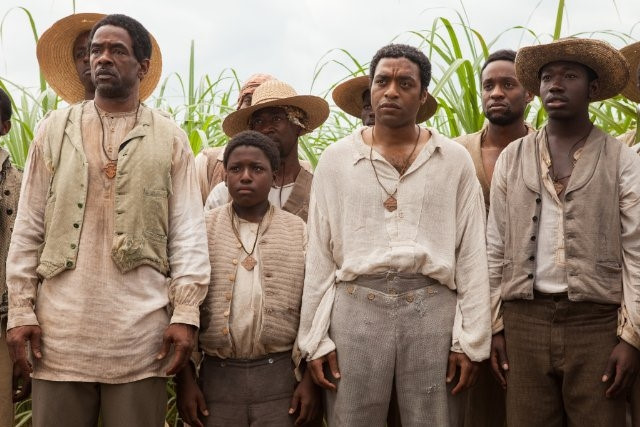
12yearsaslave03 The movie is unflinching in depicting how Northup is tumbled down into the dark, hopeless pit of slavery along with others, and it deeply unsettles us through how much human beings can be cruel to others while following an unjust system called slavery. Handled by a slave trader named Freeman(Paul Giamatti), Northup is stripped of his identity and then named ‘Platt’, and he quickly learns from others that he must say and do as little as possible – even when he happens to witness a heartless moment when his fellow kidnapped woman Eliza(Adepero Oduye) is forced to be separated from her young children by Freeman as a part of his usual business day.

Northup encounters various people during his long, grueling plight. Some of them are capable of compassion and kindness, but they are also bound by the slavery just like others. Northup is luckily bought by a kind plantation owner named Ford(Benedict Cumberbatch), and he is benevolent to his slaves compared to his wife or his despicable racist employee Tibeats(Paul Dano), but Ford lets himself ignore the evil of slavery because he cannot deny that his struggling business depends on it. He does a right thing when he prevents Northup from being killed at one point, but, instead of helping him regain his freedom, he chooses to sell Northup to Edwin Epps(Michael Fassbender), a vicious man who whips his slaves whenever they do not work enough in his standard.

While never stepping away from the barbaric behaviors fueled by racism, the director Steven McQueeen firmly maintains the focus on his subject clear and sharp throughout the film. As shown in his two uncomfortable but memorable works “Hunger“(2008) and “Shame“(2011), McQueen has shown his talent in vividly presenting the extreme human conditions on the screen with considerable power and honesty, and his austere approach to John Ridley’s adapted screenplay generates many striking moments such as when Northup is left alone while hanged on the tree for a long time in the quiet mood of a Southern plantation in the afternoon. While it is painful to watch him barely supporting himself on the ground with a noose on his neck, it is also horrible to see that no one is particularly willing to help him until he is finally released from this long ordeal after several hours.

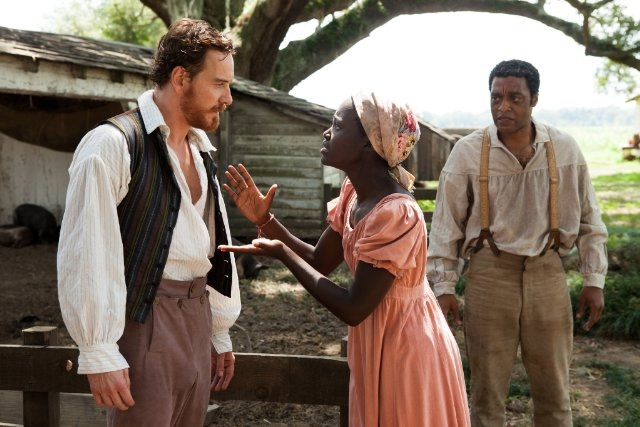
12yearsaslave05 After being sent to Epps’ cotton plantation where he will be held for nearly 10 years, it only gets far worse for Northup, and he is pushed into more atrocities along with the other slaves including Patsey(Lupita Nyong’o), who has been unbearably stuck between Epps and his wife(Sarah Paulson) because of Epps’ obsessive desire toward her. Besides exploiting her labor at the cotton field almost everyday, Epps frequently rapes Patsey, and Mrs. Epps lashes out her cold fury at Patsey while making no secret about how much she despises her sadistic husband. During a gut-wrenching scene in which Patsey is ordered to be whipped mercilessly, the cinematographer Sean Bobbit’s handheld camera captures all the physical/psychological cruelties and sufferings in a smooth, steady movement around the characters, and this is devastating to watch even when the camera does not look at the gruesome details to be shown.

Under McQueen’s deft direction, the movie is imbued with the vivid atmosphere of the 19th century for depicting the time when human beings were treated like objects to be owned. The widescreen of 2.35:1 ratio is effectively used with frequent close-ups for generating the constant feeling of confinement surrounding Northup and other slave characters, and Hans Zimmer’s restrained ambient score mostly holds itself except during a few scenes where it is required to increase its volume to emphasize the dramatic tension on the screen.

As the lead actor holding the center of the movie, Chiwetel Ejiofor gives a strong performance bound to be Oscar-nominated along with his excellent co-performers. Like other slaves surrounding him, Northup does not say a lot about his feelings while working as ordered, but Ejiofor’s face directly shows us a despairing human soul who has been suffering so many humiliations and torments, and he is particularly good during the scene in which Northup sings with others at the funeral of their co-worker; he is reluctant at first, and then he slowly joins others in the singing, while barely holding the swelling emotions inside him.

12yearsaslave04 On the opposite, Michael Fassbender, who previously collaborated with McQueen in “Hunger” and “Shame”, gives the most twisted case of racism since Ralph Fiennes in “Schindler’s List”(1993). Epps is a monstrous man who knows no bottom in his cruelties, and Fassbender always electrifies his scenes with scary unpredictability and sheer manic intensity as suggesting deep self-hate rooted inside Epps. While he is the one who wields a whip above the others, this hateful guy is miserable in his own way, and he only makes him as well as the others more miserable while rampaging with his hate and anger.

While Lupita Nyong’o deserves an Oscar nomination for her heartbreaking performance as a helpless woman at the bottom of despair, Sarah Paulson also deserves praise as Epps’ unforgiving wife who has her own twisted side nurtured by racism, and the movie is sprinkled with reliable actors from the beginning to the end. Alfre Woodard briefly appears as a former slave woman who climbed up the social latter through marrying her former master, and she and Benedict Cumberbatch effectively represent the people willing to go along with the system while just waiting for the change to come someday. Paul Dano and Paul Giamatti are detestable in their respective small villain roles, and Brad Pitt, who also participated in the production of the film, appears as a Canadian guy who chooses to help Northup even though there will be a big risk for that.

Since it was shown at the Toronto International Film Festival in last year, “12 Years a Slave” has been regarded as a strong Oscar contender, and it will probably win several awards at the upcoming Oscar ceremony. While it is a tough film to watch for its frank depiction of slavery, it is also a powerful work churning with strong emotions toward its subject, and its restrained finale in the end is very moving to say the least. This is indeed one of the best films about a painful chapter of the American history.

12yearsaslave02

Posted in Movies | Tagged , , , | 2 Comments

Dallas Buyers Club (2013) ☆☆☆(3/4) : A small fight against AIDS

dallasbuyersclub01 Sometimes people are changed through sudden incidents in their lives, and the life of Ron Woodroof, the real-life hero of “Dallas Buyers Club”, was particularly dramatic. After finding that he became an AIDS patient, his life was turned upside down as a result while losing all his friends, and he was told that he had only one month to live even at the best condition. But he never gave up, and he lived far longer than expected, while becoming a small hero for the people he had ignorantly despised because of his prejudice.

It was 1985, and that was the time when the American society became more aware of the AIDS epidemic being spread around the nation. As narrow-minded as his close friends, Woodroof(Matthew McConaughey) believes only ‘faggots’ like Rock Hudson get the disease, and he never imagines that his rough cowboy lifestyle filled with sex and drug can make him infected with HIV virus. The familiar symptoms are shown here and there in his physical appearance, but he keeps going, and, when he is finally diagnosed at the hospital after an accident at his workplace, the doctors are rather amazed that he has somehow managed to live despite a very low level of immune cells.

He cannot believe the diagnosis at first, but it becomes more apparent to him as his sickness gets worse and he learns more about AIDS. Like any people dying from AIDS at that time, he wants to live longer, but the chance is too low. While there is an antiviral drug named AZT, the drug is still going through the clinical trial stage before approved by FDA, and, though it was one of the first effective drugs against HIV virus, it turns out to be too toxic in some cases.

Searching for any possible alternatives for treating his disease, Woodroof goes down to Mexico, and, while spending some time under the care of an expatriate American doctor working at a shabby hospital, he gets a good business idea after he comes to learn that there are several drugs outside US reported to be effective treatment against AIDS. These drugs can help many desperate people who may not even get the chance of participating in the ongoing AZT clinical trials, but they are not allowed yet to be imported into US for selling just because they are not approved by FDA.

dallasbuyersclub02Therefore, Woodroff smuggles drugs and other helpful supplement pills over the Mexico-US border while claiming to authorities that they are only for his personal use. His business on the streets does not go well at first, but, after forming the practical partnership with a transgender AIDS patient Rayon(Jared Leto), he sets Dallas Buyers Club, and the number of the club members, who monthly pay him $400 as membership fee while periodically getting smuggled drugs from him, is quickly increased thank to the words spread around the local AIDS patients.

Of course, his contraband activity is illegal in the view of local authorities, and, while Woodroof are trying to fend off the oppressions from FDA, hospital doctors, and the pharmaceutical company which developed AZT, we get the glimpses of the era which was quite a gloomy time for many people in US. As shown in the recent Oscar-nominated documentary “How to Survive a Plague”(2012), the US government was ineffectual in dealing with the AIDS epidemic even while the number of AIDS patients was increased day by day at that time, and many people like Woodroof had to fight for their chance to live even though they knew well that their days were numbered.

While not giving many insights on that hard time compared to that moving documentary, “Dallas Buyers Club” works as a character drama in its relatively smaller focus. With his plain, naturalistic approach to the story, the director Jean-Marc Vallée prevents the movie from becoming one of those sappy ‘disease-of-the-week’ movie, and the screenplay by Melisa Wallack and Craig Borten provides nice moments of character interaction along the story although it feels occasionally choppy at times.

dallasbuyersclub045 And the movie is anchored by Matthew McConaughey’s compelling performance. After playing the title role he was literally born to play in “The Lincoln Lawyer”(2011), McConaughey has continued to entertain or amuse us in a number of films including “Bernie”(2011), “Killer Joe”(2011), “Magic Mike”(2012), “The Paperboy”(2012), “Mud”(2012), and “The Wolf of Wall Street”(2013), and now he gave another terrific performance here in this film. While his striking physical transformation for the role is the first thing to draw our attention(he lost 23 kg(50 pounds) for playing Woodroof), McConaughey is also convincing in depicting his character’s gradual inner transformation in the story. It may be just a small way of survival to him at first, but, while overcoming his prejudice against Rayon and other LGBT people, Woodroof eventually goes all around the world for helping his fellow AIDS patients, and there is something touching about the efforts of this indomitable guy determined to do anything for him and others before his death.

The supporting characters are less-defined in comparison, but the movie has good actors to bring life into them. Jared Leto, who lost 14 kg(30 pounds) for his role, injects grace and humanity to his functional stereotype character, and his scenes with McConaughey are powerful enough for their possible Oscar nominations in the next week. As a young doctor sympathetic to the plights of Woodroof and other AIDS patients, Jennifer Garner has not many things to do, but her scenes with McConaughey feel warm and intimate even though their cordial relationship is remained mostly underdeveloped in the movie.

While it is not one of the best films reflecting the struggles with AIDS during the 1980s, “Dallas Buyers Club” is a solid drama supported by two very good performances to be remembered. I think the movie could have delved more deeply into its story and details considering its interesting subject deserved to be told more, but it is still a good story of a man who rose to the occasion under his extraordinary situation, and it is certainly great to see Matthew McConaughey proving again that he is one of the most interesting actors working in Hollywood.

dallasbuyersclub04

Posted in Movies | Tagged , , , , , , | Leave a comment

Saving Mr. Banks (2013) ☆☆☆(3/4) : A spoonful of medicine behind Mary Poppins

savingmrbanks01 As a dramatized version of the real-life story behind a beloved classic film, “Saving Mr. Banks” is as pleasant and gentle as it wants to be. It becomes sentimental at times, but its warm sincerity feels genuine, and it is entertainingly mixed with acerbic wits mainly coming from its unflappable heroine who ironically refuses any sugarcoating on her dear novel in spite of being the author of famous children’s books.

The writer in question is P.L. Travers(Emma Thompson), who wrote “Mary Poppins” and the following sequels during 1934-88. Although Walt Disney(Tom Hanks) had been trying to buy the film right for “Mary Poppins” since he promised to his young daughters that he would make their favorite book into a movie someday, Travers refused to sell the right to Disney because she did not want her book turned into an animation feature film, and she had stood by her position for more than 20 years.

However, in 1961, she begins to reconsider his offer seriously despite her remaining reluctance. Her economic situation has recently been difficult due to the decreased sale of her books, so Travers accepts Disney’s offer in the end, but she does not bend to him easily; before selling the right, she is going to make it sure that her book will be adapted into a feature film as she wants, and then she will sign the paper only if she is satisfied.

When she arrives in LA to meet Disney and visit his studio, Disney is ready to please her in every way possible to him, but this prim middle-aged Australian lady is not so pleased about lots of things. She does not like the hot, sunny atmosphere of LA, and she is not very kind to her genial driver, and she stands aghast at her hotel room filled with not only a fruit basket but also a bunch of Disney dolls including, of course, Mickey Mouse.

savingmrbanks02 And Disney and his studio people suffer her constant flow of demands and criticisms right from their first meeting day at the studio. While she is not very amused to know that the movie is going to be a musical, she rejects many small and big details in the script, costumes, and production design just because they are not what she envisioned while writing her book. Besides, she complains about the negative depiction of Mr. Banks in the script, the bank employee father of the Banks family in her book.

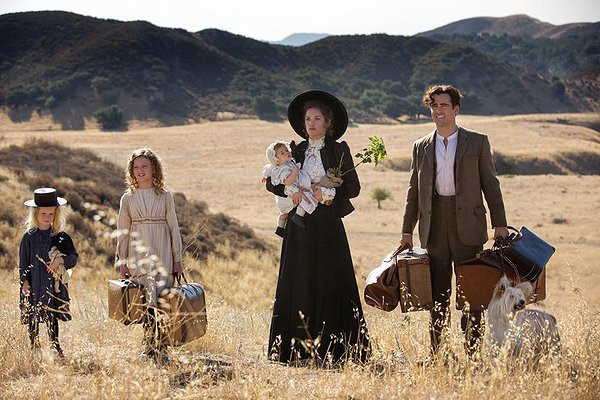
The movie gradually reveals the reason behind her reluctance and stubbornness as going back and forth between the scenes depicting this difficult process in 1961 and the scenes showing Travers’ unhappy childhood in Australia in 1906. Even when she was a child, young Travers(Annie Rose Buckley), nicknamed ‘Ginty’ by her dear dad(Colin Farrell), already learned that life has many disappointments through the problems in her household; her father, who worked at a local bank, was a good father encouraging her imagination, but he had several serious problems including his alcoholism, and that drove his struggling wife Margaret(Annie Rose Bukcley) to manic depression at one point.

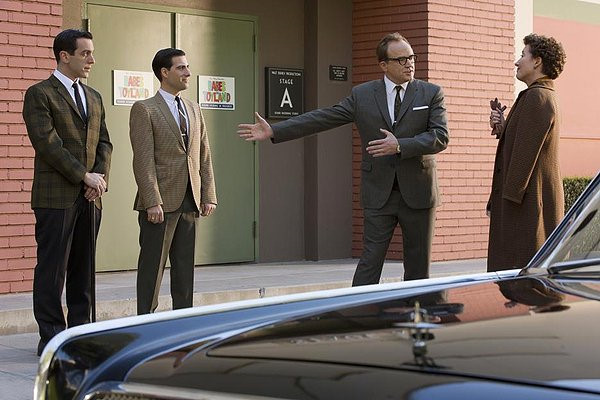
While we come to see how the memories of her hard childhood life including her aunt Ellie(Rachel Griffiths) inspired her book, the movie maintains its light tone through several delightful scenes where Don DaGradi(Bradley Whitford), the co-screenplay writer of “Mary Poppins”, and Richard and Robert Sherman(Jason Schwartzman and B.J. Novak), who would win two Oscars for their music, try to get Travers’ approval. Several familiar songs including “A Spoonful of Sugar” and “Feed the Birds” are played and sung by them during these moments, and that will certainly take you back to the sweet memories of the 1964 film.

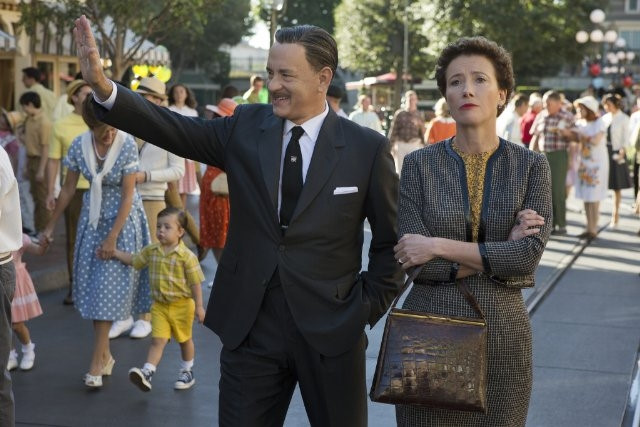
savingmrbanks03 Travers is still unenthusiastic and displeased about many things, but she cannot help herself from being a little opened to the gentle, smiling gesture of Disney and his world. On one day, Disney manages to take her to Disneyland to show his goodwill, and, though she is not willing to admit it, she becomes a little nicer in her attitude, and there is a lovely moment when the Sherman brothers succeeds at last in getting Travers’ full approval on one of their highlight songs.

Based on the screenplay by Kelly Marcel and Sue Smith, the director John Lee Hancock made a film good enough to be watched along with “Mary Poppins”. The real-life story between Disney and Travers was actually more bitter than what is depicted in the film(Travers was very unhappy about the end result, so she never sold the film rights of her other Mary Poppins books until her death), but the movie works as a drama about two people clashing with each other for their respective artistic visions and then finding something common between them through their conflict.

The movie is equipped with handsome production details thanks to the full support from Disney Studio(well, can you possibly imagine any other way?), and I liked the performances from its talented cast members. While Emma Thompson is probably going to get Oscar-nominated in the next week for her enjoyable performance, Tom Hanks is flawless as Walt Disney with his spot-on mannerisms. B.J. Novak and Jason Schwartzman are fun to watch as the Sherman Brothers, and Paul Giamatti looks sunnier and jollier than usual as Travers’ understanding chauffeur, and young actor Annie Rose Buckley did a good job of generating the gravitas in the story along with her adult co-actors.

“Saving Mr. Banks” is your average cotton candy film you can expect from Disney, and I must say that is not always a bad thing. The result is more or less than being mildly sweet, but it is served with a spoonful of medicine to remind us of that undeniable difference between fantasy and reality, and that is why the finale involving with the LA premiere of “Mary Poppins” feels both sweet and touching. Life is indeed disappointing as Travers says in the movie and we should not forget about that, but isn’t it nice to have a little taste of fantasy sometimes? I am sure even Travers or her famous nanny won’t disagree to that.

savingmrbanks06

Posted in Movies | Tagged , , , , , | Leave a comment

The Wolf of Wall Street (2013) ☆☆☆1/2(3.5/4) : Goodfellas on Wall Street

wolf07

“You sharpen the human appetite to the point where it can split atoms with its desire; you build egos the size of cathedrals; fiber-optically connect the world to every eager impulse; grease even the dullest dreams with these dollar-green, gold-plated fantasies, until every human becomes an aspiring emperor, becomes his own God… and where can you go from there?”

                                                                                           -From “The Devil’s Advocate”(1997)

How much more they want to have? And how much more they want to enjoy? “The Wolf of Wall Street”, a horribly fascinating and disturbingly funny masterwork from Martin Scorsese, gives the answer through its relentless array of sickening debaucheries committed by its despicable hero and his equally loathsome guys whose hunger for more money and more pleasure is utterly insatiable. Driven by that virulent opportunistic mentality still dominating over Wall Street, they are so addicted to being on the top of their world that it is never, never enough for them as they keep reaching for more money, more drug, more booze, and more sex.

The movie is a cautionary tale based on the real-life story of Jordan Belfort(Leonard DiCaprio), a former stockbroker who was indicted in 1998 for securities fraud and money laundering after his rapid rise through his brokerage firm Stratton Oakland. The following investigation revealed that he and his firm caused investor losses of approximately $200 million through stock fraud, and this case later inspired 2000 film “Boiler Room”, another cautionary tale about uninhibited greed and ambition. After serving 22 months in prison, Belfort wrote the memoir which the movie is based on, and he actually participated in the production as a technical advisor.

wolf08 The movie briefly shows us at the beginning how Belfort’s broker career was started during the late 1980s. He might have been a naïve young man at first on his first day at a brokerage firm on Wall Street, but he is quickly changed as soon as he is swept by the competitive heat generated from other brokers fully driven to sell more stocks everyday, and he also finds himself under the guidance of a sleazy senior broker Mark Hanna(Matthew McConaughey), who gladly gives his junior some teachings on how to be an efficient and lucrative stockbroker. During one of the most memorable moments in the movie, Hanna begins to thump his chest while humming a repetitive tune, and Belfort willingly joins with Hanna in the chest-thumping, and the instant chemistry between DiCaprio and McConaughey is so contagious that I found myself keeping nodding my head along with them. The pupil quickly learns from the mentor, and now he is ready for kill, or money in this case, just like his mentor.

His career on Wall Street does not go long due to the stock market crash in 1987, and Belfort becomes unemployed, but then he encounters another opportunity for getting rich quickly. After employed at a shabby Long Island boiler room dealing with trashy penny stocks, he rapidly rises through his aggressive brokerage skill, and he soon gets enough money for starting his own brokerage firm. At the foundation stage, Stratton Oakland only has a handful of employees including his neighbour Donnie Azoff(Jonah Hill) and his old neighbourhood friends with shady records, but, through Belfort’s wily and illegal manipulation strategies including ‘pump and dump scheme’(this is a classic method of microcap stock fraud, by the way), the firm is rapidly expanded in a short time. Not long after getting its first big score, Belfort’s firm is boosted from a small, shabby garage to a vast, clean-cut office space, and we also see the firm getting bigger and bigger along with more employees motivated to sell those worthless stocks under Belfort’s charismatic leadership. He promises them money through his rousing routine speeches, and they believe they can be rich just like him, and then they exploit the same wish of their clients just like Belfort exploits theirs.

small_wolf05 This is not a pleasant sight at all, but Scorsese pulls all the stops for depicting the thrill and excitement in Belfort and others’ dirty business, and we cannot help but watch them with a mixed feeling of fascination and repulsion. The movie runs between scenes in brisk pace from the beginning to the end thanks to Scorsese’s confident direction supported by his long-time editor Thelma Schoonmaker and the cinematographer Rodrigo Prieto, and the various songs are effectively used on the soundtrack for the heightening the dizzy and insane moods among the characters mired in the excesses which will make many raunchy R-rated comedies look like child’s play. Whenever they get more, they want far more, while hurling themselves into the orgy of embarrassment and humiliation.

The movie is basically a twisted black comedy about excessive behaviors, and it rightfully goes all the way for presenting the sheer absurdity inside them on the screen. The more we look around Stratton Oakmont, the more it looks like a dirty rotten fraternity house out of control, and we get many, many outrageous sights here and there. Prostitutes are usual service workers in the firm along with strippers, and Belfort and his naughty boys even classify them according to, uh, their service quality. Whether it is not office hour or not, many of ‘vice presidents’ frequently get high with their drugs of choice, and the most popular ones are cocaine and Quaaldue, a sleeping drug illegally used as a recreational drug. There is even a Fellinisque office party sequence featuring march band members only wearing underwears, countless confetti falling from the ceiling, and dwarves hurled onto the score board, and I particularly cringed at the moment when a female employee let her head shaved in exchange of the money for her breast enlargement. She could say no, but, like other employees, she is so swept by the group mentality swelling with excitement that she gives herself up to degradation in front of others.

Believe or not, many of these incredulous things depicted in the movie really happened, and the same thing can be said about the equally excessive lifestyle of Belfort. He was an ordinary guy who grew up in a middle-class family in the past, but now he becomes a prominent millionaire, and he buys whatever he thinks he must get. We see a humongous manor located in the suburban area occupied by many rich people, and he also has several fancy sports cars along with his personal helicopter and boat. His first wife Teresa(Cristin Milioti) is a good wife who stood by him during their difficult time, but he has already betrayed her many times through his endless hedonistic fun. When he encountered a younger(and sexier) woman named Naomi(Margot Robbie) at a party, his eyes are set on her, and it does not take long for him to get a divorce and then marry Naomi.

wolf01 But, still, it is not enough yet for him – even when a federal agent Patrick Denham(Kyel Chandler) starts to focus on him and his firm. Some of the biggest laughs in the movie come from how stupidly Belfort and his accomplices behave even when a good chance of avoiding jail is rolled into their hands. Addicted to their bigger-than-life lifestyle and boosted by their enlarged male ego, they dash with arrogance and idiocy while disregarding the serious circumstance closing onto them, and, as a result, they suddenly find that all hells break loose in front of them.

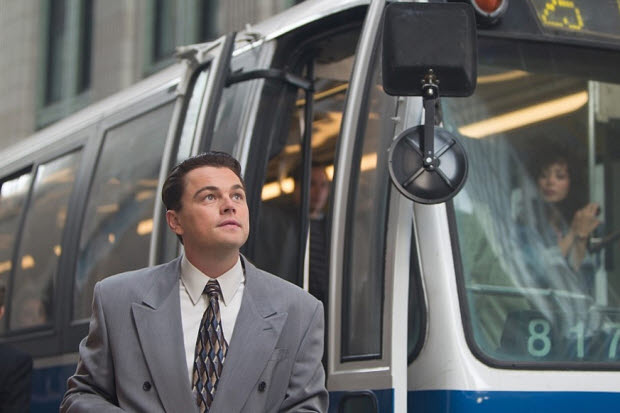
As the reprehensible center of the movie, Leonard DiCaprio, who has been steadily working with Scorsese since “Gangs of New York”(2002), bravely throws himself into the most challenging role in his career. Belfort is pretty unsympathetic from the moment he begins to talk to us via his self-serving narration, but he is a charming and compelling crook to watch thanks to DiCaprio’s uncompromising performance, and DiCaprio pushes himself into full-throttle mode to generate many darkly electrifying or amusing moments throughout the film.

Terence Winter’s screenplay seldom loses its way amid overflowing debaucheries on the screen, and DiCaprio and the other good actors circling around him imbues their dialogue scenes with considerable spontaneity(not so surprisingly, many dialogues in the movie were improvised by the actors during shooting). As Belfort’s main sidekick Donnie Azoff, Jonah Hill is both funny and creepy as a man who is possibly more twisted and amoral than Belfort in many aspects, and he and DiCaprio are absolutely hysterical during the morbidly hilarious scene in which their characters are struggling with their heavily intoxicated state under an urgent situation. While Jon Bernthal, Ethan Suplee, Kenneth Choi, P.J. Byrne, Brian Sacca, and Henry Zebrowski are effective as Belfort’s merry band of crooks, Matthew McConaughey, who had another fabulous year with his stellar performances in 2013, literally steals the show in his brief appearance, and Margot Robbie holds her little place among the boys as one of very few substantial female characters in the movie. Jean Dujardin, Joanna Lumley, Spike Jonze, Rob Reiner, and Jon Favreau also appear in small roles, and, Reiner, who plays Belfort’s irascible accountant father who comes to work in his son’s firm, is notable as a few saner spots in the movie along with Kyle Chandler.

small_wolf04 “The Wolf of Wall Street” is not a comfortable experience at all, but it is as exciting as the best works by the director who still can excite us with his mastery even after giving us so many remarkable films for more than 40 years. Like his great films “Taxi Driver”(1976) or “Goodfellas”(1990), the movie strikes us hard with many impressive moments to talk about, and we feel rarely bored during its long running time(180 minutes), as fascinated and horrified by how the characters keeps breaking another new bottom in their endless fall into misdemeanors and debaucheries.

The movie has been generating the controversy over its depiction of many excessive behaviors in the film, and it was even accused of celebrating Belfort and his colleagues. While the movie surely pulsates with the fun and excitement felt by its unlikable characters, they are seen through an observant viewpoint drenched with dark humor, and any sensible audience will see how despicable Belfort and other characters are, while observing their endless greed and towering stupidity which will even make those brutish characters in “Goodfellas” shake their heads in disbelief.

In the end, “The Wolf of Wall Street” bitingly points out that Belfort’s crime is only a tip of a far bigger problem in Wall Street and, to some extent, the American society. When Forbes Magazine nicknamed him ‘the Wolf of Wall Street’, that notorious nickname only drew more brokers and clients to his firm because everyone wanted to be rich like him, and he gladly enjoyed that reputation even though he was furious about that nickname at first. That trend went on even after the stock market crash in 1987, and that has been continued even after another big crash in 2008. Like many big figures of Wall Street who were responsible for 2008 crash, Belfort virtually got away with what he had done while not being punished enough, and the final scene somehow reminds me of what filmmusic composer Bernard Herrmann said to his wife around the end of the screening of “Taxi Driver”. “You know, he’ll do it again.”

wolf03

Posted in Movies | Tagged , , , , , | Leave a comment

American Hustle (2013) ☆☆☆1/2(3.5/4) : That ‘70s Hustle

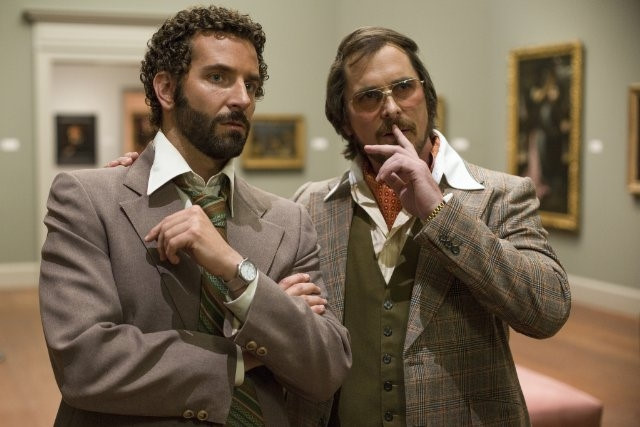
americanhustle01 “American Hustle” dances along with a bunch of colorful characters roaming around their groovy era, and it does its dance as long as it can under its cheerful tone. Even when we are not entirely sure about who is conning whom or who is being conned by whom, the movie rolls its story and characters with so much energy and style that we gladly go along with it, and we have a joyful fun as the characters roll or clash with each other.

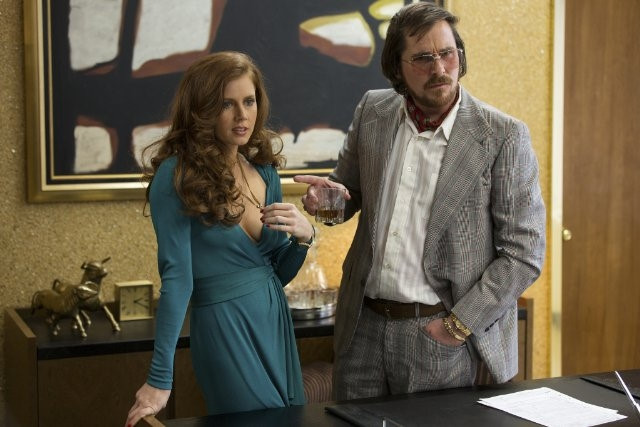
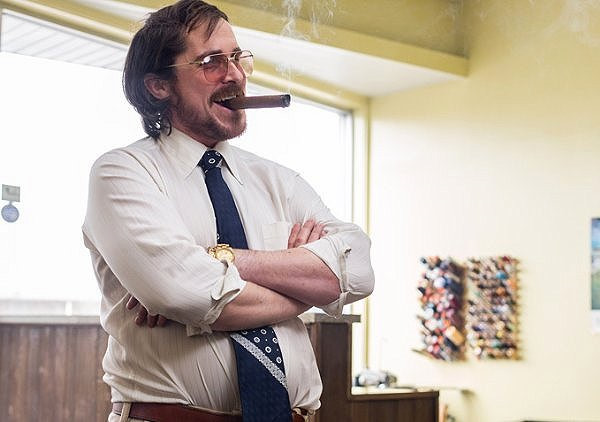
The story is about how a mid-level scammer Irving Rosenfeld(Christian Bale) and several people associated with him get into a very tricky situation. On the surface, Rosenfeld looks like a legitimate business man owning several successful dry cleaner shops in Long Island, but his actual income comes from his small-time criminal operations including art forgery and personal loan fraudulence, and he has been so far successful enough to have his own American dream while covering his head with an awful piece of comb-over. The opening scene shows Rosenfeld carefully decking himself up in his hotel room, and Christian Bale strikes us with his character’s ungainly physical characteristics including paunchy belly and balding head during this wryly comic moment. Once he finishes redesigning, or reinventing, himself, he is ready for work, and he goes forward with confidence while that ugly hair-piece is always on his head.

Considering that phony aspect of his life, it is no wonder that he comes to fall in love with a young woman named Sydney Prosser(Amy Adams), who also reinvents herself while hiding her seedy past behind her. When these two masquerading souls happen to meet at a party, something instantly clicks between them, and, what do you know, Rosenfeld soon reveals everything about himself to this woman just because he really loves her.

That could have been an unwise thing in his criminal field where disguise is necessary for living, but, fortunately, Prosser becomes his partner-in-crime within few minutes. With her fake British accent and sexy dresses for her cleavage, she newly disguises herself as Lady Edith, a woman connected with some good financial friends in England, and Prosser and Rosenfeld have lots of fun and thrill together both professionally and personally as money keeps rolling from many hapless targets of theirs.

americanhustle02 However, there is a big problem in their relationship, and they don’t know what to do with it. As a matter of fact, Irving is a married man, and he does not hide it form Sydney, but his wife Rosalyn(Jennifer Lawrence) will not let her husband leave her easily because this tempestuous but vulnerable woman needs someone to support her. Furthermore, Irving is not going to leave her either mainly because he cares about his stepson, who looks fairly normal despite the problematic relationship between his parents in the household.

And then they get another complication, and that comes from Richie DiMaso(Bradley Cooper with a curly hairdo as bad as Bale’s), a FBI agent who initially approaches to Irving and Sydney as another potential target and then promptly arrests them on the spot. DiMaso is going to use them as a bait to arrest other bigger scammers, and Irving and Sydney, after realizing that there is no alternative choice for them, decide to cooperate with DiMaso for not going to jail.

Their deal looks simple at first, but things become more complicated as the operation is getting bigger and bigger in scale. The screenplay by the director David O. Russell and his co-writer Eric Warren Singer is loosely inspired by the Abscam scandal during the late 1970s and early 1980s(The title card at the beginning reminds us humorously, “some of this actually happened.”), and its main pleasure is how it keeps being busy, crazy, and vibrant as the situation becomes more serious and unpredictable for everyone. DiMaso’s initial plan was merely catching four major con men, but he and his temporary criminal partners find themselves juggling more balls than expected; the first was the other con man acquainted with Rosenfeld, and then, mainly through a powerful and well-connected New Jersey politician Carmine Polito(Jeremy Renner), far more(and far bigger) fishes to catch come in series, including a senator, several congressmen and the members of a powerful Mafia organization.

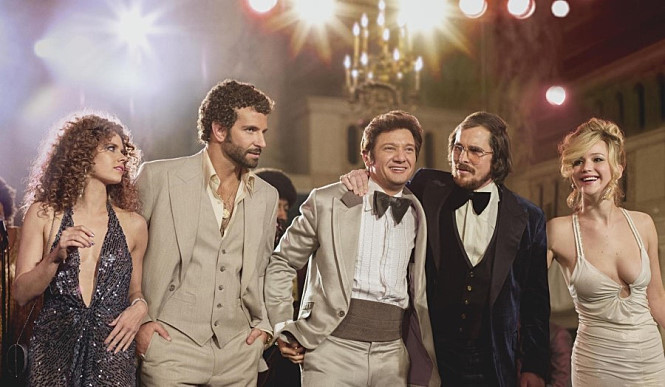
americanhustle03 Russell accelerates the plot with a stylish gusto reminiscent of Martin Scorsese’s “Goodfellas”(1990) and Paul Thomas Anderson’s “Boogie Nights”(1997), and the movie visually engaging to watch. The camera frequently moves around or along with the characters in smooth and fluid movement, and we always remain held to its bouncing narrative even when we are not sure about where it is exactly heading to. A bunch of familiar period songs including “Live and Let Die” and “White Rabbit” are effectively and precisely used for dramatic effects, and these songs also work as amusing periodic details along with those tacky period clothes worn by the characters in the movie.

The movie also reminds me a lot of Russell’s recent works pulsating with offbeat sensibility in their respective genres. “The Fighter”(2010) seemed to be about its boxer hero at first, but its main fuel came from its colorful and noisy supporting characters fighting over the hero who was more or less than their boxing ring, and that was more interesting than the boxing scenes in the film. While most of the main characters in “Silver Linings Playbook”(2012) were crazy or quirky in each own way, their dynamic interactions brought a fresh air to its romantic comedy conventions, and the movie ultimately brought out genuine optimism in the middle of their craziness.

In a strict sense, the main characters of “American Hustle” are mostly seedy people not very honest to themselves while hiding themselves behind disguise or delusion, but they are flawed but interesting people to watch none the less, and some of them are actually more likable than expected. In case of Polito, he is not a greedy idiot but a capable mayor hoping to do something good for the people of his city, and the movie shows him as a loving and exemplary family man at one point – but it goes without saying that he chooses a wrong way for his good intentions and, sadly, he is bound to pay for that sooner or later.

americanhustle05 Russell assembled the cast mainly consisting of the actors who previously worked with him before, and these dependable actors give excellent performances as expected. Christian Bale, who gained more than 40 pounds(around 18-kg) for playing his role in contrast to his diet for the Oscar-winning performance in “The Fighter”, is terrific as usual while holding the ground for the other actors, and Amy Adams, who previously worked with Bale in “The Fighter”, gives an alluring performance as a woman seemingly true to her feelings but rather elusive about her thoughts. It seems Prosser is getting drawn toward DiMaso while getting distant from Rosenfeld, and Rosenfeld naturally begins to wonder about what is going on between them: is it an act as she said or does she really like him?

Bale and Adams are well supported by the two lead performers from “Silver Linings Playbook”. As a federal agent eager for the big chance for his promotion, Bradley Cooper has his own funny moments including the hilarious scenes involved with DiMaso’s long-suffering boss(Louis C.K.), and Jennifer Lawrence, who looks strikingly different from her recent turn in “The Hunger Games: Catching Fire”(2013), surprises us again here as an unstable and unpredictable woman who cannot be possibly ignored even if she does not demand it loud. Rosalyn can be pretty oblivious to what’s going on around her, but she can be also pretty troublesome if she wants that out of pique, and Lawrence steals every minute of her scenes as the wild card of the movie.

americanhustle06 As an amiable politician unwittingly making himself and his colleagues fallen into entrapment, Jeremy Renner also deserves to be mentioned along with his co-stars, and his scenes with Bale feel warm and sincere. While they get along well together, Polito really regards Rosenfeld as a good friend, and that certainly gives another burden to Rosenfeld’s heart, which is already burdened with many other personal matters besides that. The movie has enough space for the other good actors including Jack Huston, Shea Whigham, Alessandro Nivola, Saïd Taghmaoui, Michael Peña, and a certain well-known actor who makes an uncredited cameo appearance during a crucial scene in the middle of the movie(I know many of you have already known who that actor is, but I won’t spoil your entertainment).

Like Paul Thomas Anderson did in “Boogie Nights”, David O. Russell successfully made a distinctive and entertaining work moving on its rhythm and mood while recognizing the influences from other films. While the movie is a bit overlong and subsequently loses some of its steam during its third act as following the predictable genre conventions, this is a well-made comedy equipped with juicy performances and satirical edges on the whole, and the outcome is one of the better films we get during this Oscar season.

americanhustle04

Posted in Movies | Tagged , , , , | Leave a comment

Scenery (2013) ☆☆☆1/2(3.5/4) : Their lives and dreams in Seoul

scenery01

Just by simply observing and listening, “Scenery” gives us an experience both familiar and alien. As introducing a group of various foreign workers in Seoul one by one, this calm, quiet documentary looks around the various hidden corners here and there in the city I have been familiar with for years, and a simple but haunting picture of different people and their different lives inside this big international city is gradually formed along the process. As the people respectively coming from Philippines, Cambodia, Thai, Bangladesh, Nepal, Sri Lanka, China, Vietnam, Uzbekistan, and East Timor, they look different and speak different, but they all came to South Korea for the same reason, and we come to look at them closer as they tell us about what they dreamed during many nights in the world still feeling alien to them.

The things they dreamed feel trivial at first, but their dreams indirectly tell us many things about them – including how much they miss their families left at their hometowns or how much they want to succeed or how they feel about their current lives. In case of Augustino, a worker from East Timor, he says he frequently saw his mother in his dreams after coming to South Korea. Though he does not tell a lot about his feelings besides that, the fact that his mother died while he was working in South Korea brings a sad, melancholic feeling to the scene of him waiting for his plane at the Inchon International Airport.

While the usual night dreams of Thasila, an amiable Sri Lankan worker, simply reveals his small wish to have a better life someday, the personal dream told by Bangladeshi worker Oaliullah Bhuiyan is poignant to hear. Separated from his dear wife, he had dreamed about taking her to Jeju Island, but he has never been to that island, and he even does not know where Jeju Island is although he must have heard about it at least once. Right after this scene, the movie makes a momentary stop at Jeju Island, and we naturally come to wonder about the possible difference between reality and his dream – and whether he will come to realize his dream someday.

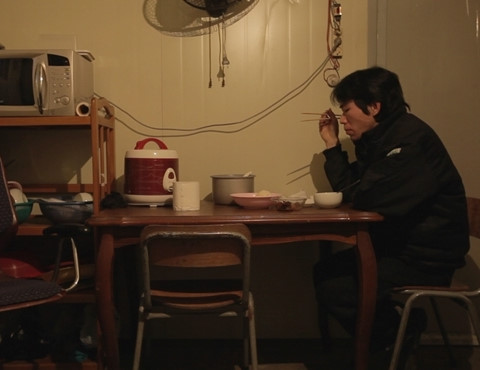
scenery04 The movie continues to listen to other  foreign workers working and living in Seoul. Some can speak Korean fairly well while others speak in English or their native languages instead, and we sometimes see them at work. Most of them are menial employees working at factories, and, though they do not talk much about their work condition, you can sense the hard facts of their lives as observing their jobs and their residences. Even before we listen to Xu Chun Ming, a Chinese worker who has been tired of working in a meat shop, we already see how grueling his daily work is, and, while watching him and others relentlessly processing not only meat but also the other parts from pigs, I thought again about an undeniable fact that  foreign workers usually do many difficult, thankless jobs which not many of us are willing to do.

And some of us are not very nice to them despite their diligence. In case of Shekhal Mamun from Bangladesh, who now works as a carpentry teacher, seems to be well-adjusted to the South Korean society after long years, but what he dreamed repeatedly was the day he decided to quit his job at some factory during his early years in South Korea. From how he phlegmatically tells about his dream, we can only guess how much he endured the unfair treatments from his boss and South Korean co-workers during that time – and how that painful memory still remains somewhere in his mind in spite of his current improved status.

Through its fluid stream-of-consciousness approach, the documentary freely shuffles these interviews and other ones with the interesting images captured from Seoul, and it reminds us of how Seoul has many different kinds of people inside its corners – and how much they have been becoming the parts of the city. We see these people going for work just like any other Seoul citizens in the morning, and we also see their living areas, which feel like different worlds at times compared to the other parts of Seoul. When a mosque for Muslim workers was shown at one point, I noticed that the main doctrine of Islam was written in Korean above its main entrance, and that somehow took me back to my small childhood memory with the mosque in my hometown(maybe because of its exotic design, I thought it was a mere fancy spa, by the way).

scenery03 One of the most engaging moments in the documentary comes from a photo shop located on a busy street where we see Chinese letters written everywhere on placards and signboards and notices. As the camera observing on its gentle owner and a young girl in its static position, he casually and warmly asks several personal questions to her while packaging the photographs for her, and we get to know a little more about her as she innocently answers to his questions. The interaction may be short, and he probably has gone through the same routine many times before, but it is always nice to see two strangers responding to each other with warmth and sincerity.


The director Zhang Lu keeps the distance between his camera and his subjects to certain degrees while never saying more than what his interviewees say, but the documentary is an absorbing experience thanks to the series of the mesmerizing moments generated throughout its running time. Besides those memorable foggy/cloudy scenes in the film, the documentary captures the moments of surprising beauty from many shabby or mundane sights in Seoul while patiently looking on them, and there is a good scene showing Uzbekistan worker Sherzod Akbarov and his fellow co-worker at their busy workplace. Although we do not understand what exactly they are doing at first, this is a vivid sight of labor and dedication with industrial noises as its vital music, and the final result of their work is ordinary but beautiful when it is fully shown on the screen at the end of this scene.

scenery07 As a Korean Chinese director born in Jilin, Zhang Lu has been an outsider at the fringe of South Korean society just like his interviewees, and some of his films were interesting as the stories set between China and Korea. My first experience with his work was “Dooman River”(2010), and I was particularly impressed by his keen sense of mood, space, and people for showing the world I am not very familiar with, and I also admired how he ably pulled a short but harrowing moment of emotional eruption at the ending after steadily maintaining the low-key tone for that resonant finale.

Although it demands some patience to us in its slow, serene pace, “Scenery” is a poetic work of humble humanity emphatically looking at the people usually overlooked by others in the South Korean society, and Zhang Lu made a very good documentary film while effortlessly applying his own artistic sensibility to the documentary genre. Though it never directly addresses their social difficulties, the documentary lets us see their fragile social positions for ourselves, and it eventually strikes an effective emotional chord during its last scene even though it still sticks to its understated way of revealing the feelings below the surface. When the movie is over, Seoul will probably look a little different to you than before – and you may come to think about them more.

scenery02

Posted in Movies | Tagged , | Leave a comment

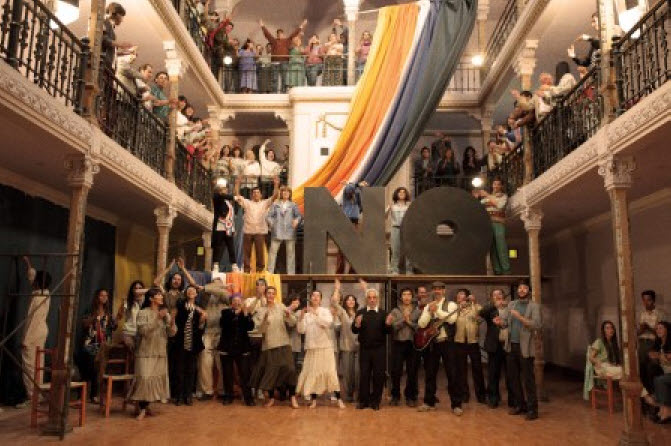
No (2012) ☆☆☆1/2(3.5/4) : How they made people say ‘No’

no01 While sharply reminding us that political campaigns are essentially advertisements promising their political products to voters, “No”, an engaging movie about the national plebiscite of 1988 in Chile, tells us a fictional story of how one clever campaign strategy effectively turned the tide during that crucial historical moment for Chile and its people. It was started from a very disadvantageous position at first, but there was a possible chance of victory through the creative use of advertisement images on the media, and how this came to be an effective visual weapon against the dictatorship is a compelling underdog drama to watch.

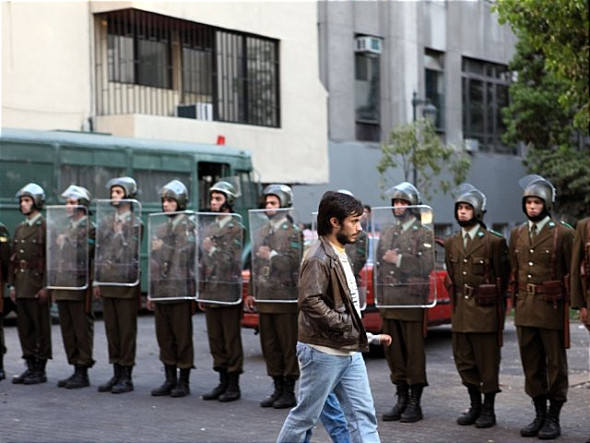
The story is mainly told through René Saavedra(Gael García Bernal), a young, promising advertisement creator on the way of success in his company. On one day, he is approached by a key member of the left-wing group, and he is asked to work as a consultant for their campaign against Augusto Pinochet for the upcoming plebiscite. Pinochet had ruled Chile for 15 years while backed by the US government since his bloody coup against the left-wing government in 1973, but, due to the increasing international pressure from the outside, his government decided to hold the plebiscite in 1988 which would let Chilean people decide whether they wanted another 8 years of his regime, and all they had to was simply voting for ‘yes’ or ‘no’ after several weeks of campaign.

On the surface, it looks like a fair election, but many of left-wing people are pessimistic or cynical about their campaign. 4 weeks are given to both sides, and both get equal 15 minutes on TV to persuade the voters at every night, but there is not much of hope of winning for them because it is apparent that the government will do anything behind its back for its win – and most of the voters are not very willing to participate in the plebiscite because of the very same reason.

no03 In such a situation like that, being a consultant for the “No” campaign does not look like a wise career choice, but René agrees to help the campaign even though, as reminded by his boss Lucho Guzmán (Alfredo Castro) later, he can just choose less risky jobs which come along with more payment and promotion. Rather than directly underlining the motive behind his decision, Pedro Peirano’s screenplay based on Antonio Skármeta’s unpublished play wisely lets us sense it through the small scenes of his interactions with the people around him including his activist ex-wife Verónica(Antonia Zegers) and his young son Simón (Pascal Montero), and Gael García Bernal’s good performance suggests a man who is not only a professional attracted to a challenging assignment but also a father hoping for a better world for his son.

Unlike many people in the campaign who think they should concentrating on increasing the public awareness of the atrocities committed under Pinochet’s dictatorship rather than trying to win, René has the other idea about their campaign strategy; instead of emphasizing that dark past, he thinks they should go in the completely different direction and focus on the bright possibility of change which can be realized through this election.

As an advertisement guy as good, if not slick or dashing, as Don Draper, René quickly develops the ideas for the campaign in a short time given to him and others, and then, after going through the presentation and some discussion, they move onto the production level. While René is the fictional hero, the results shown in the movie are the actual footage of the campaign advertisements broadcast during the campaign weeks, and you can see they did a really good job with those sunny, hopeful images and catchy music, which effectively branded them as a new alternative for the people of Chile.

The second half of the movie is a tense media match between “No” and “Yes” campaigns, and the movie has a fair share of amusement while vividly capturing the society on the verge of a possible change at that time. Due to their excessive confidence on the plebiscite and the narrow mindset of Pinochet and his cabinet members, the government spectacularly embarrasses itself right after the successful start by the “No” campaign on TV, and one particular shot in its crass advertisement is almost hilarious due to its sheer tastelessness(and, yes, this is also actual footage from that time).

no05 Nevertheless, Pinochet and his government still have the upper hand in this match, and we see how the government tries to inhibit René and others in many unfair ways. While mildly pressured by his boss at work who later comes to supervise the “Yes” campaign as a insurance tactic for his company, René later finds himself threatened at home, and the government tries all the dirty tactics including stealing tapes or blocking broadcast through censorship. The competition between two groups also becomes fiercer on TV; as the “No” campaign goes further with its sunny brand while cheerfully mocking the opponent, the “Yes” campaign fully counterattacks with more negative advertisements, and it even copies the advertisement from its opponent in a reverse way at one point.

For getting us closer to the time and space and people depicted in his film, the director Pablo Larraín takes an interesting visual approach to the story. He shot the scenes in 1:40 ratio on Sony U-Matic magnetic tape, an early analog recording videocassette format before VHS which was used by most Chilean news media during the late ’80s, and the resulting mix between actual footage and the scenes of the movie is nearly seamless on the whole. When I watched it on Blu-ray at last night, I was a bit caught off guard at first by its rather low image quality represented by grains and faint color rings, but the verisimilitude generated from this raw approach is palpable with its authentic period details, and the movie works well as a vivid and realistic window to an important political event in the past.

“No” received the Art Cinema Award at the Cannes Film Festival in 2012 and then got Oscar-nominated for Best Foreign Language Film early in 2013, but the movie has not been introduced yet to the South Korean audiences, who will definitely find something common with the Chilean people in the movie considering that South Korea also went through the brutal era of dictatorship during the 1960-80s and then started the first major step toward the democratization in 1987 through the increasing public demand for it. To be frank with you, I have been quite dismayed by how the current president was illegally elected and how much she has been trying to turn the clock back with the ghosts of dictatorship from her dictator father’s time, but, as many recent demonstrations in South Korea did, the movie indirectly reminded me that we still have a right to say no to her and must protect that precious right no matter what will happen in this year or next years. This is surely a terrific film, and I am glad that I ended my movie journey of 2013 with this movie.

no02

Posted in Movies | Tagged , , , , | Leave a comment

10 movies of 2013 – and more: Part 3

And now here is the list of 11 South Korean films you should not miss.

Continue reading →

Posted in Movies | Leave a comment