Besides a kitten belonging to one of my colleagues, I want to show you several new cat family members of KAIST.
Besides a kitten belonging to one of my colleagues, I want to show you several new cat family members of KAIST.
 Kim Ki-duk’s twentieth film “One to One” feels like listening to the same angry words over and over again in a barren empty class room with no particular interest. I can accept that it is angry about the injustice and inequality which have been accumulated inside South Korean society, and I know well that some of its uneasy parts reflect the dark, seedy aspects of South Korean society, but all it can give us is just a barebone story which repeats its few notes again and again with little variations. Although I can sense from it an urge to remind the South Korean audiences of their unfair reality, the movie becomes more tedious as solemnly trudging along the plot, and I did not care much about it during my viewing.
Its story is about seven people who attempt to execute the justice for the victim of one terrible crime. In the opening scene, a young high school girl is being followed by a bunch of guys during one night, and this poor girl is soon captured and murdered by them in the end. We see one of them reporting to his direct boss, who then reports to the guys above him that the job is done as ordered. The motive behind this heinous crime is not very clear, but, considering that the girl’s name is Min-ju, which phonetically means ‘democracy’ in Korean, I guess this is a symbolic scene of how South Korean democracy is destroyed by the rich and powerful who can get whatever they want through their money and power.
The movie does not tell us a lot about how other six members are assembled and persuaded by their mysterious leader(played by Ma Dong-seok), but they follow his scheme anyway while believing they are doing the right thing. We learn that there are seven guys responsible for that young girl’s death, and the leader and his group are going to confront these bad guys one by one for reminding them of what they did.
 Their plan is so simple that it sometimes looks pretty ridiculous. First, they approach to their target when the target is alone, and then they take the target to their secret place by force, and then they begin interrogation under various disguises. They disguise themselves as military guys in the case of one target, and then they pretend as police guys in the other case. I do not understand well the purpose behind this constant change of disguises, but it is certainly one of a few amusing things in the movie; during one scene, they even wear street cleaner uniform.
The leader, who can be quite ruthless at times, is determined to get what he wants by any means necessary, and that makes his accomplices become more doubtful and uncomfortable about their actions as their plan is progressed. Their targets did a very wrong thing indeed, and they do deserve punishment for that, but is it worthwhile to torture them and then force them to write confession? The movie expresses that moral question mainly through one of the group members, but that does not work due to its flat characterization and awkward dialogues strewn over the story. Besides the leader, who turns out to have an understandable motive behind his brutal plan, the rest of the group members are simply defined by each own social hardship presented along the story, and they do not have many things to do except standing awkwardly around their leader or kidnapping their targets as instructed.
Meanwhile, after being tortured and humiliated by them, their first target, Oh-hyeon(Kim Yeong-min), becomes determined to find out who they are, and he soon discovers their secret place as well as their real identities. He initially wants the retaliation for what they did to him and his colleagues, but then he comes to have a doubt growing inside him as watching on them and their activities. His close colleague killed himself because he felt guilt about that murder after his forced confession, and his direct boss, who also had to endure that torturous experience just like them, confides to Oh-hyeon on how he starts to feel guilty about merely following the order from above at that time.
 As expected from the start, the movie arrives at the final stage where a guy who ordered the murder from the top is finally brought to face the leader and the other group members, but this ‘climax’ lacks dramatic tension like the other confrontation scenes in the film, and it even becomes very confused about where it should stand. At one point, one supporting character says he does not know what to believe, and I must confess that I had a similar feeling while having no idea about what was the exact point the movie was trying to make.
Such a bland, uninteresting result like this is rather surprising because the works of the director/writer Kim Ki-duk have rarely been boring. His screenplays are not exactly well-written ones(I must point out that his characters are more effective with behaviors rather than dialogues) and his scenes sometimes look contrived and artificial, but they have interesting situations to talk and discuss about, and he usually strikes us hard with striking moments to be remembered. I revisited “The Isle”(2000) recently, and I found myself still cringing at that unforgettable moment involved with fish hooks while observing the contrasting serene beauty encompassing the brutal aspect of its story. “Arirang”(2011) is a rather embarrassing self-portrayal to watch, but it painfully shows the director struggling to get back on his track, and he did return with “Pieta”(2012) and “Moebuis”(2013) while writing several screenplays for other directors as before.
Although his character is merely one-dimensional, Ma Dong-seok is suitably aggressive and brooding as the leader in the film, and Kim Yeong-min deserves some praise for his deft multiple performances as Oh-hyeon and the various minor characters around each group member character in the film. Kim Ki-duk urgently wants to say something to us, and his message is delivered to us as he intended, but this is a dull, repetitious experience which mostly bored me with its ponderous diatribe. Yes, I surely got its point, and I also understood its intention, but, seriously, what else is there besides that?

 Although hampered by its weak story and shaky characterization, “Neighbors” tries many gross or outrageous things to maintain its comic momentum, and I must duly report that the movie did a fairly nice job of inducing me and the other audiences around me to laugh or chuckle during the screening at last night. I kept recognizing its flaws along with a number of the scenes which are not as funny as intended, but it somehow did not leave a bad taste in my mouth despite all these raunchy gags thrown at me and others, and, as going back to my dormitory room right after the screening, I concluded that I had a good time with it.
Seth Rogen and Rose Byrne play Mac and Kelly Radner, a young married couple who has recently started their first step into suburban family life with their little baby daughter Stella(played by Elise and Zoey Vargas, who always look like a sweet, innocent island floated on the ocean of many R-rated jokes throughout the film). The daily life at their home constantly revolves around their adorable daughter, and they have been learning that their life is becoming quite different from their good old college days. At one point, they are invited by their friend to a music concert during one evening, but, after trying so hard to prepare themselves well for going out with their baby, they only find themselves waking up near the front door in the next morning.
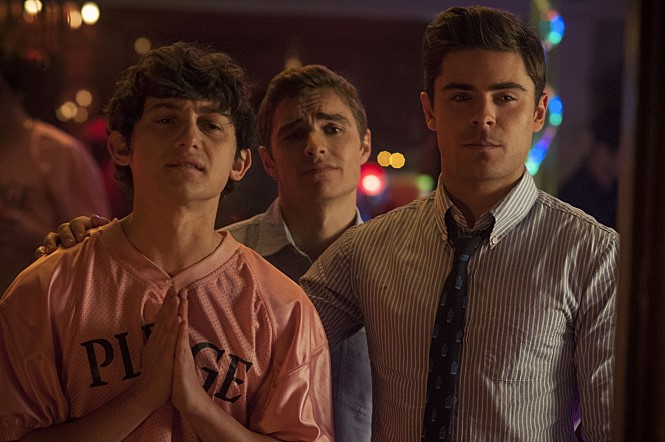
Anyway, they have accepted this transition period of theirs while being happy with their daughter, but then a college fraternity moves into the house right next to theirs. When they come across Teddy(Zac Efron) and his fraternity members who are ready to have a fun right from their moving day, they quickly see that this will be a major problem to their home life. They try to be both polite and cool as trying to tell these fraternity boys that they do not welcome too much noisy at night, and Teddy and other boys seem to understand their concern, but Mac and Kelly are soon annoyed by the relentless noises from their new neighbors every night.
However, they are also attracted to the heedless excitement generated from the fraternity house. When they are invited to the fraternity house during one evening party, they are quickly swept by its crazy mood filled with fluorescent lights, booze, and drug, and they temporarily feel like being young again as hanging out with boys and girls in the house.
 Considering how much loud noises they make every night, the fraternity boys in the movie would be kicked out of their house within a week in real life, but they manage to stay in their house, mainly because that is absolutely required by the plot for setting the comic conflict between them and our young couple. Mac and Kelly eventually decide that enough is enough, so they call the police, but Teddy and other fraternity members turn out to be not an easy opponent to handle. As the animosity is increased between two neighboring houses, the series of mean retaliations are exchanged between them as a consequence, and one of the funniest moments in the film is involved with car air bags. I do not think car air bag can be so forceful like that, and it apparently looks cartoonish, but it is hilarious to watch none the less.
The screenplay by Andrew J. Cohen and Brendan O’Brien is uneven and flawed to say the least, but it has a fair share of humor to compensate for that, and the director Nicholas Stoller, who previously directed “Forgetting Sarah Marshall”(2008) and “Get Him to the Greek”(2010), handles well its comic scenes in most cases. Not all of its attempts are successful(I can live without many of its gags involved with a certain male body part, for example), but we constantly get unexpected comic moments to surprise and tickle us, and the one involved with a trampoline is a good textbook example showing why precise setting and timing are crucial for drawing laughs from the audiences.
The certain scenes in the movie will make some of you cringe due to their blatant raunchiness, but the movie thankfully does not go too far in that aspect, and it handles Mac and Kelly’s parenting with considerable care while not cheapening their difficult daily life as parents. Like “Baby Blues”, a famous newspaper comic strip which has always tickled me since my high school years, their comic situations at home are funny mainly because they humorously reflect some truths about parenting experience, and you may be more amused than me if you are experienced.
 While it can be said that he is not so different from his previous goofy comic roles, Seth Rogen is appropriately cast as a likable guy who is a good father and husband but still needs to grow up a bit more, and he and his co-star Rose Byrne has good chemistry between them. Their frantic scene built around Kelly’s breasts in the need of being pumped is not so successful as intended, but, believe me, it could be far more embarrassing to watch if it were not for the quick, sharp exchanges between Rogen and Byrne during that scene.
As the character functioning as the villain of the story, Zac Effron ably fills his role while doing more than taking off his shirts to show his good physical state, and he is surrounded by several young notable actors including Christopher Mintz-Plasse and Dave Franco. While he is capable of some pretty nasty things to be frowned upon, Teddy is not entirely a mean bastard, and there is a pointed moment in which he comes to realize that he should have thought more about his life beyond college years rather than wasting his time with endless parties.
“Neighbors” has visible shortcomings including the superficial treatment of the other female characters besides Byrne’s character(Teddy’s girlfriend is no more than a plot device, for instance) or its weak ending which feels more like an obligatory footnote, but it remains as a funny film with good laughs thanks to the talents behind it. I still think it could have been better with more wits or barbs, but it is not easy to be grouchy about that when you see a baby who seems to enjoy her own moment on the screen.
 When I watched “Frances Ha” around the end of last year, I was amused by its lightweight charm. I briefly mentioned it along with other good films in my annual movie list of 2013, and I thought I will probably like it more when I revisit it. Several months have passed since that, and now I have watched it again for writing this review, and I still think the movie is a charming piece of work, although I also recognized its weak points including its thin plot and unfocused narrative flow.
The movie revolves around the wandering period of Frances(Greta Gerwig), a young New Yorker who is an apprentice in some dance company. She is ready for any chance to establish and develop her dancer career, but she has been stuck in the position where she started after her college graduation. She has not yet been promoted to a regular member of her company, and it looks like she may have to think seriously about changing the direction in her life and career.
But, like many young people at her age, she is optimistic about her current situation, and the opening sequence of the movie shows her having a fun time with her best friend Sophie(Mickey Sumner), who has been living with Frances in their cozy Brooklyn apartment. They still feel like being in their good old college days, and everything looks fine to them as they go around the city with Georges Delerue’s playful score for “A Gorgeous Girl Like Me”(1972) being played on the soundtrack.
And then an unexpected change comes. When her boyfriend Dan(Michael Esper) suggests to her that they should live together, Frances rejects his proposal just because she has been comfortable with living with Sophie, and that results in the breakup of her relationship with Dan. To make the matters worse, her friendship with Sophie turns out to be not as strong as she thought. Sophie tells Frances that she is soon going to move into a better apartment in Manhattan without her, and now Frances has to find the other place to live.
 She fortunately gets a new place to live before their lease is expired, and her new roommates, Lev(Adam Driver) and Benji(Michael Zegen), are nice guys, but then she receives another bad news. When she is expecting another payment for her performance, she is laid off from her dance company due to financial problem, so she has no choice but to leave New York and go to Sacramento, California for staying at her parents’ house for a while.
She comes back to New York later, but her life keeps drifting around places and people with no particular sign of advancement. At one point, she makes an impulsive decision of going to Paris for meeting some people she previously met, but that impromptu trip only results in nothing but the waste of her money thanks to her carelessness. She goes back to her college for working as an employee, and we get a small humorous moment of embarrassment when she is notified that she cannot attend a dance class due to regulation.
Watching her aimless drifting, I was reminded of Lena Dunham’s small debut work “Tiny Furniture”(2010), another movie about a young girl struggling to take the first step into adult life. While a little more matured compared to the confused heroine of “Tiny Furniture”, Frances is still a young girl hesitant to move forward for herself and her life, and it is sometimes frustrating to watch her wandering with no particular plan except her vague aspiration.
None the less, Frances comes to us as a likable heroine to watch, and Greta Gerwig, who wrote the screenplay with the director Noah Baumbach, supports her character with her lively presence. I did not like Baumbach’s previous movie “Greenberg”(2010) a lot, but I appreciated her warm performance along with Ben Stiller’s surprisingly edgy performance, and Gerwig exudes her own natural charm again here in this film. Frances can be silly, unwise, and self-absorbed at times, but you cannot help but like her, and you may smile as watching this sunny girl running hurriedly along the streets of New York or casually making some dance moves just for fun.
 The young supporting actors around Gerwig hold their respective places on the fringe while showing each own potential. Mickey Sumner has a nice scene with Gerwig later in the movie when her character happens to spend one drunken night with Frances, and Michael Zegen is one of Frances’s new roommates who aspires to be hired as a writer for Saturday Night Live(he is the one who labels her as “undatable”), and some of you may be amused by the performance of Adam Driver, who plays a New Yorker character different from the one he has been playing in Lena Dunham’s HBO TV series “Girls”.
With the fabulous black and white cinematography by Sam Levy, Baumback soaks his movie into the style and mood reminiscent of the French New Wave films from the 1950-60s. I have been a fan of Georges Delerue’s works since I listened to his wonderful score for “Joe Versus the Volcano”(1990), so I was naturally delighted by the prominent use of Delerue’s scores in the film, and I also enjoyed the crisp black and white images of the New York locations which will certainly take you back to Woody Allen’s classic film “Manhattan”(1979).
Although it begins to lose its pace during its second half and then ends its story rather abruptly, “Frances Ha” floats along with its heroine as much as it can through its breezy style and Gerwig’s lovable performance. Its charm may be merely superficial and temporary, and my second viewing did not change much of my initial reaction toward it, but I won’t deny that I enjoyed it at least during my viewing.

 The premise of “Locke” is so simple that it does not sound like a good movie when you read its synopsis. Here is a man who has just made a big important decision to change his life forever and is determined to stick to his choice no matter what will happen in the end, and the movie accordingly sticks to his point of view while observing his night drive coupled with a big personal crisis from the beginning to the end
This does not sound very entertaining indeed, but, fueled by its sole physical performance and supported by its smooth, efficient screenplay, the movie works as a gripping character study. While watching its ordinary hero driving or talking with others through his car phone, we get to know more about him, and then we come to understand more what drives him into a decision which will topple his life one way or another.
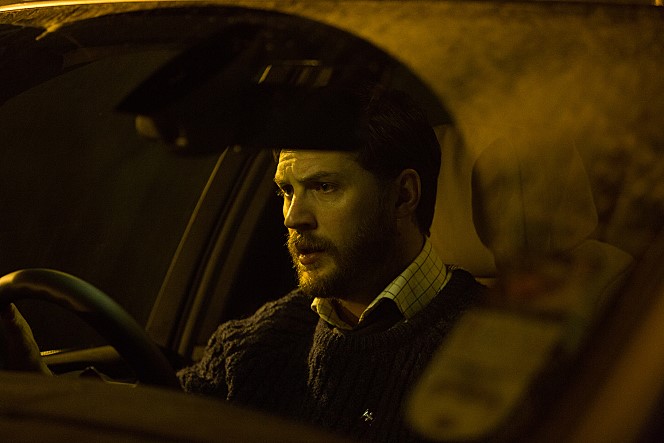
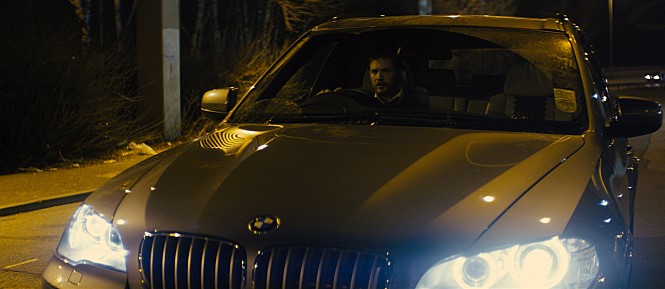
As Ivan Locke(Tom Hary) leaves his workplace in Birmingham and then drives his car to London during one late evening, we get several pieces of basic information about his life. He has worked as a foreman at some big construction site, and we hear that tomorrow is especially an important day for his company. The massive concrete pour for the base of a high-rise building is scheduled to be done tomorrow, and everyone is counting on Locke, who has diligently been preparing and supervising this crucial process as the foreman.
But now he cannot complete his work, for someone needs him right now and he believes he must do the right thing. He calls his family that he cannot go to their home and spend their evening with a big soccer match on TV. He notifies to his direct boss that he will not be at the construction site in the next morning, and then he instructs one of his guys to handle the preparation for the upcoming concrete pour instead of him.
 He also gets the calls from a hospital in London, and we come to learn bit by bit about the relationship between him and a woman he met several months ago. She got pregnant due to their accidental one-night-stand, and now she is about to give a birth to her baby while no one is around her to support or comfort her. Locke loves his wife and family, and he does not seem to be in love with this woman he barely knows, but he cares about the baby to be born because of his own personal reason. He could stay away from this trouble if he wanted, but he does not want that at all, and his resolution becomes stronger even when he is going through what will possibly be the most difficult moment of his life.
As getting closer to London minute by minute, he keeps getting pressured and cornered by others. He finally confesses to his wife about his infidelity and its consequence, and she naturally feels angry and confused about what her husband did as well as what he is doing right now. His sons begin to sense something wrong is going on, and one of them asks him about that at one point. Locke’s boss is understandably flabbergasted by his sudden message, and the same thing can be said about a young employee, who suddenly finds himself in charge of several important tasks after he receives a call from Locke around the end of his worktime.
The screenplay by the director Steven Knight, who wrote “Dirty Pretty Things”(2002) and “Eastern Promises”(2007), steadily rolls Locke’s situation on its straight course while effectively shifting its gear between different modes, and it always holds our attention through good dialogues which carefully flesh out not only its hero but also its supporting characters who only appear as the voices on the other end of the line. As listening to the conversations between Locke and other characters, we gradually sense that his life is virtually crumbling down around him because of his choice, and the feeling of isolation becomes more palpable as he continues his lonely drive through the bleak nocturnal landscape of motorways.

It goes without saying that the movie depends a lot on its lead actor’s performance, and Tom Hardy, who has always been an interesting actor to watch since his breakout performance in “Bronson”(2008), gives us a dynamic portrayal of a conflicted decent man who is willing to pay the price for doing what he believes is right. While he is sitting on the driver seat throughout most of the running time, Hardy is captivating to watch even when he does not say anything, and he is especially good when his character desperately juggles several things at once. Locke tries to reduce the consequences of his action as much as he can, but his situation becomes a lot more troublesome than expected, and there is a short but grueling moment when he must suppress his increasing frustration for getting things done as he promised.
While the movie is essentially Hardy’s one-man show, it should be mentioned that the other actors including Olivia Coleman, Ruth Wilson, Ben Daniels, Bill Milner, Tom Holland, and Andrew Scott did a believable job of interacting with Hardy on the screen as the voices on the other end of the line. Each of them brings different moods to their respective scenes, and Andrew Scott is particularly good as a young employee who happens to go through one hell of night just like Locke.
I watched “Locke” not long after enduring “Transformers: Age of Extinction”(2014), and “Locke” entertained me far more than that dreadful soulless product which is almost twice as long as the former. While I did not care much about those big, bloated CGI actions, I cared a lot about Locke’s situation, and I even found myself worrying along with him whenever his phone rang. It is quite apparent from the beginning that he will pay a big price for his choice, but at least he knows where he is driving to – and he is ready for that.
 It has been a good life for her and her family, but now she finds herself getting suffocated by her daily life. As she feels her discontent growing inside her day by day, she decides to try something different, and she feels a little better with her secret deviation, even though it can possibly destabilize her family life if she is not careful.
Deviation behind the ennui of middle-class daily life is not exactly a fresh subject(remember “Desperate Housewives”?), but “Concussion” handles its subject with dry humor and thoughtful sensitivity, and the result is an intimate character drama which sometimes surprises not only us but also its heroine while she is reaching for something she cannot explain well even to herself. Like many people dissatisfied with their lives, she wants more from her life, but what she really wants from her deviation?
When we meet Abby(Robin Weigert) in the beginning, she is going through her usual daily routine at a local gym with her friends/neighbors as an average suburban housewife, and then we see a noticeable aspect of her family. She and her spouse Kate(Julie Fain Lawrence) have been living together as a lesbian couple for many years, and they also have two loving children, Mayer(Maren Shapero) and Jake(Micah Shapero).
They are certainly not a conventional family on the surface, but their family life is not so different from any other ‘normal’ family life. Kate, a lawyer specializing in divorce case, is usually busy with her work, and it is always Abby’s job to take care of domestic matters including taking their kids back from the school. While she spends some time with other moms in her neighbourhood, Abby also works as an interior designer; she and her business partner Justin(Johnathan Tchaikovsky) buy cheap apartments in New York and then sell them at higher price after renovating them during her free time.
 Things are going well for everyone, but Abby is not very happy with her life, and that feeling of hers becomes louder especially after an unfortunate accident. During the afternoon playtime with her kids, she happens to be hit hard by her son’s baseball when he throws it at her. She looks all right after getting emergency treatment at the hospital, but she seems to feel the ennui of her domestic life more than ever. She tries to have a sex with Kate during one night, but Kate is too tired due to her work, and Abby naturally feels more dissatisfaction along with frustration. She tries to ventilate that feeling through exercise later, but she still feels discontented and suffocated, while not knowing what to do about that.
And then she somehow gets an idea. She meets a prostitute through advertisement, but that prostitute does not fulfill her need at all while giving her a pretty lousy experience. When she confides her experience to Justin, he introduces Abby to the other prostitute through his girlfriend who happens to be running a call girl service, and Abby is satisfied with, uh, a better service.
After that, she goes further. She meets Justin’s girlfriend, and now she begins to work as a call girl named “Eleanor”. While pretending to Kate and others that she goes outside for her work, she meets her female clients at a cafe near to one of her apartments currently going through renovation. After some talk, her clients will come to that apartment, where Abby is ready to give whatever they want in exchange for their money.
While this situation probably reminds you of Luis Buñuel’s darkly amusing film “Belle de Jour”(1967), “Concussion” takes a more somber and realistic route as Abby meeting various clients with each own need and desire, and it is interesting to watch how she interacts with them respectively. She deals with younger girls at first, and, as a woman with more experience, she becomes a sort of counselor to one shy, chubby college girl who has never experienced intimate sexual experience before. Serving this young girl as much as paid, Abby also gives her some advices on losing weight and improving her self-image, and they become a little friendlier to each other as they spend more time together.
 And then we get a dryly humorous scene between Abby and a client who is around her age. When that client, played by Laila Robins with sharp, no-nonsense attitude, comes into the apartment, she instantly senses that Abby is attempting to take the control of their situation, and she is not so pleased about that. She quickly decides to quit their meeting, but Abby wisely handles the situation, and her client changes her mind again.
The movie has several explicit sex scenes, but they are handled with care and some humor, and they function well as a part of the story while looking both objective and sensitive. It is strictly business between Abby and her clients, but they try together to get what they respectively want under mutual agreement, and the sense of intimacy is palpable even when the camera is mostly focusing on the faces of Abby and her client at one point.
While all these things and others are happening behind her back, Abby goes through her daily routines as usual, and the director/writer Stacy Passion imbues her movie with the realistic mood of mundane daily life. There are a number of small good moments here and there in the film, and one of them comes from Kate, who has probably been sensing the increasing gap between her and Abby. It is initially a trivial conversation on what their daughter will say during the upcoming school presentation, but then both of them see how much their relationship has been strained when Kate finally expresses her own frustration to Abby through a revealing line(“I just want you to like something”).
Although “Concussion” has a number of flaws including its weak third act, Stacie Passion shows here considerable talent as a competent director who can ably handle story and characters while pulling good performances from her performers. While the other performers including Julie Fain Lawrence, Johnathan Tchaikovsky, Laila Robins, and Maggie Siff(she plays one of Abby’s neighbours who later comes to her as Eleanor’s new client) deserve to be praised for their solid performances, it must be said that Robin Weigert is simply fabulous as the center of the film, and she is always engaging to watch even when she does not seem to reveal much about what is going on inside her character. I must confess that I am not that familiar with this talented actress who has been steadily working for more than 10 years, but I think we can expect to see a lot more from her later.

 “Transformer: Age of Extinction” should be re-titled as “Transformers: The Unbearable Loudness of Being”. The movie relentlessly pummels us with tons of big explosions and loud noises on the screen during its burdensome 165-minute, and you may be at a loss as struggling to comprehend what the hell is going on in its lazy, incoherent plot which is no more than a belt conveyor to dole out bloated, pointless CGI action scenes to its audiences one after another. I began to feel numb and bored even when there were more than 2 hours to go, and, as I feared even before watching the movie, that unbearable loudness of being on the screen was continued during the rest of my screening in the early morning.
Although the first movie released in 2007 was mildly enjoyable, the series has been going down since “Transformers: Revenge of the Fallen”(2009), which was one of the most depressing experiences at my local theater during 2009. “Transformers: Dark of the Moon”(2011) did not exactly hit another bottom, but it is an equally awful mix of messy CGI actions and lousy plot, and “Transformers: Age of Extinction” continues this tiresome trend while nothing much is changed except its extended running time. Those big robots are back again, and there will be lots of crashes and bangs around various places, and, sadly, that is all for us.
The movie begins not long after that disastrous attack on Chicago during the climax of “Transformers: Dark of the Moon”. Although it seems Chicago has been restored well when we see its downtown area later in the film, the American society becomes hostile to not only Decepticons but also Autobots, who have defended humans against Decepticons but now suddenly find themselves becoming the fugitives chased by the US government agency.
Autobots have been ruthlessly hunted and destroyed by Harold Attinger(Kelsey Grammer), a shady government official determined to exterminate all of them for his own purpose. It turns out that Attinger made a deal with the other alien robot named Lockdown(voiced by Mark Ryan) for accomplishing his mission, and Lockdown will give Attinger some valuable thing in exchange for the capture of Optimus Prime(voiced by Peter Cullen). Attinger is also connected with Joshua Joyce(Stanley Tucci, who looks like only actor having a little fun in the film), an influential company CEO with abrasive confidence reminiscent of Steve Jobs, and Joyce wants that object for moving onto the next step of his secret project.
 Meanwhile, we meet Cade Yeager(Mark Wahlberg), a struggling inventor living in Texas. While looking for anything fixable or useful, he comes across a shabby broken truck at a local movie theater which is about to be closed, and, what do you know, that truck turns out to be Optimus Prime, and the government agents and Lockdown soon chase after them and others including Yeager’s daughter Tessa(Nicola Peltz) and Tessa’s boyfriend Shane(Jack Reynor).
The rest of the movie is occupied by a number of big action sequences, and they are barely connected to each other by the disposable scenes involved with human cardboard characters, whose main job is running away while surrounded by many crashes and explosions on the screen. The movie does try inject some drama into its story through the strained relationships between Yeager and his daughter and her boyfriend, but their scenes feel bland and contrived while packaged with usual clichés expected from these stereotype characters, and its occasional moments of cheap humor do not help much either.
In case of those big robots in the film, well, they are not that interesting because they are usually big chunks of metal which look big and ugly – especially when they are fighting with each other. Some robots are a little more recognizable because they are colorfully painted or decorated with some amusing features. One of them, voiced by John Goodman, is a chubby robot usually chomping a sort of metallic cigar in its mouth, and I became a little curious about whether it has the same mechanism applied to electronic cigarette – or where he got it from.
There are also more robots including the freakish ones who look like dinosaurs, and they prominently appear during the overlong climax sequence unfolded in Hong Kong, but I already lost my interest around that part while feeling disoriented a lot about who was attacking whom or where the characters were going or what was exactly happening. I especially remember a brief shot featuring the Chinese government officials trying to handle their emergent situation during the climax part, but I do not remember well how they respond to their situation, except several patrol cars around the ending.
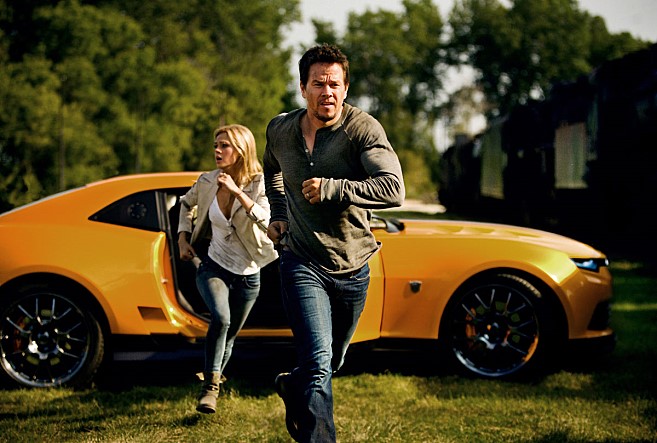 And the action scenes in the film are choppy and discontinuous while creating no clear sense of direction and movement. For instance, a car chase sequence during its first half feels disjointed as jumping from one shot to another one without building any momentum, and this gets only worse as it also begins to show the other action which happens around the main action. Many action shots strangely feel distant to their backgrounds with no particular feeling of urgency, and we are supposed to be excited just because of loud, booming sound effects on the soundtrack – and that goes on and on with no elementary understanding of plot or character at all.
Mark Wahlberg, who took a baton from Shia LaBeouf, did as much as he could do with his colorless character, but I cannot help but think of the better moments in his acting career after witnessing him stuck in such an epic dreck like this, and you may recall that he was much better in the director Michael Bay’s flawed but funny film “Pain & Gain”(2013). Nicola Peltz and Jack Reynor do not leave much impression except their good-looking appearances, but I must point out that Peltz is a little better than Rosie Huntington-Whiteley when she looks at somewhere in the distance during a couple of shots. While Kelsey Grammer and Stanley Tucci willingly chew their scenes, Sophia Myles, Bingbing Li, and T.J. Miller play other accessory supporting characters, and John Goodman and Ken Watanabe somehow manage to prevent their distinctive personalities from being suppressed by anonymously metallic voice effects(but I came to wish desperately that they will be cast for any parts in “The Lego Movie 2”).
“Transformers: Age of Extinction” is an awful waste of time and money, and I just looked at the screen with accumulating boredom while amused a bit by a few things including a trivial and ridiculous reference to “2001: A Space Odyssey”(1968). As depressed by this very unpleasant experience, my mind went back to “Edge of Tomorrow”(2014), and I appreciated again how it surprisingly demonstrated to us that action film can be both exciting and interesting even when it is mixed with bombastic actions. While that movie cared about story and characters, this film does not even have a shred of intelligence for that from the beginning, and it makes me sadder to see that, as reflected by its ending as well as its guaranteed box office success, we will have to endure another ordeal sooner or later.
Sidenote:
1. Maybe I can accept its unconvincing change of mind around the middle of the film, but I noted one illogic choice done by Optimus Prime at the end of the film. Why do you waste your energy when an easier way is available to you?
2. The movie is also shown in 3D, but you don’t have to waste your extra money on that.
3. My acquaintance Kevin B. Lee recently made an amazing video assay titled “Transformers: The Premake”, which insightfully and succinctly shows many interesting things surrounding the movie. Now I can assure you that this is far more interesting than the film itself.
Here is the link: http://youtu.be/dD3K1eWXI54

 Three weeks ago, I watched Denis Villeneuve’s “Enemy”(2013), an odd movie about a man shocked and then disturbed by the discovery of someone who looks exactly like him. And now I have watched “The Double”, whose story also deals with identity crisis through a similar surreal premise revolving around two main characters with the uncanny resemblance to each other. Although it has a fair share of unanswered questions in the end like the former did, I was more entertained by the latter, and I enjoyed its interesting visual style and black humor on the whole even while finding its plot a little too murky at times.
Based on Fyodor Dostoevsky’s novella with the same name, the movie tells the story of Simon James(Jesse Eisenberg), a meek clerk working in some government agency. Even though he is surrounded by a bunch of other employees who look far older than him, he is virtually nobody to everyone at his dim, shabby workplace, and he is always pushed or blocked by many things including a hostile gate guard who does not recognize him at all despite his diligent attendance record, a creaky elevator which sometimes seems to have a personal grudge against him, and his cantankerous boss(Shawn Wallace) who always has a reason to look down on him.
His private life is virtually empty, as reflected by the barren interior of his small apartment. Only character personally close to him is his ailing mother, but nothing much is exchanged between them while he is visiting her nursing home, and it recently becomes a little more difficult for him to support his mother due to the increased charge for her stay at the nursing home. He has been interested in a girl living in the other apartment which he can see from the window of his apartment, but he never musters up the courage to approach more actively to Hannah(Mia Wasikowska) even though she works in the same agency where he works.
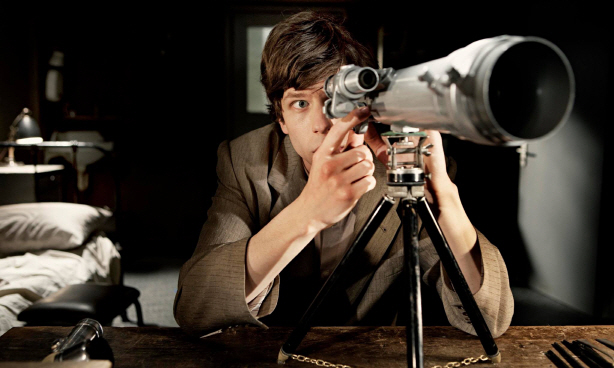 The urban environment surrounding Simon looks as gloomy as him, while usually being drenched in yellow/brownish lights and bleak shadows. The time and background of the story are not exactly specified, but its world seems to be stuck in a time period around the 20th century, and you see many old-fashioned electronic devices here and there on the screen. We frequently notice those good old cathode ray tube TVs around the characters in the film, and a copy machine in one scene looks more like a dry cleaning machine(and it takes more than 10 seconds to get a copy, by the way).
Along with its darkly amusing moments of bureaucratic nightmare which will remind you of the works of Franz Kafka and George Orwell, this world is not so far from those memorable dystopian worlds we have seen from “Nineteen Eighty-Four”(1984) or “Brazil”(1985). In such an oppressive environment which has been suppressing him for years, Simon keeps being frustrated with how things around him do not go well everyday, but, as shown in the opening scene, he only responses to his various small and big troubles with passive frustration, and Hannah seems to be out of his reach no matter how much he feebly tries to be a little closer to her.
And then, on one day, something unbelievable happens. A new guy comes in the agency, and he just looks like Simon except his personality which is exactly opposite to Simon’s. James Simon, also played by Jesse Eisenberg, is a brash and confident guy, and you can easily sense right from his first appearance that he is a sort of guy who always gets whatever he wants.
Simon is certainly shocked by this, and he is more confounded to see that nobody really seems to notice how much Simon and James resemble each other, and that aspect painfully reminds Simon of his nearly anonymous status at the workplace. Whenever he is with James, his introverted personality is always eclipsed by James’s more visible one, and the story becomes more interesting as an odd relationship is formed between Simon and James. They sometimes swap their identities whenever James wants, and James helps Simon getting closer to Hannah at one point, but it becomes clear that James is slowly intruding into Simon’s life – and it increasingly looks like he is going to push Simon out of existence someday.
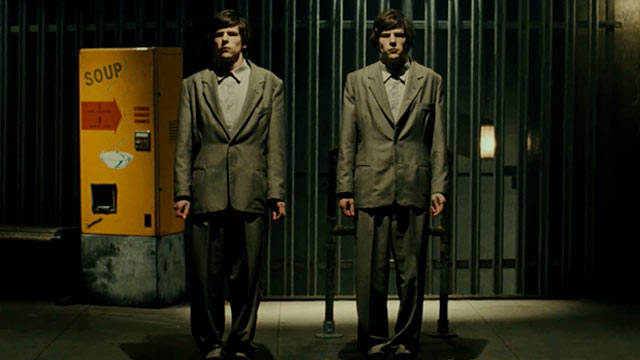 The lines between Simon and James start to get disrupted, and it works thanks to Jesse Eisenberg’s engaging duo performance. Eisenberg can be your typical nerdy guy as shown in comedy films like “Zombieland”(2009), but he also can be intense and assured as proved in his Oscar-nominated performance in “The Social Network”(2010), and that talent of his is well utilized here in this film. Besides doing a convincing job of presenting two different characters together on the screen, Eisenberg skillfully captures the disturbing progress glimpsed through the interactions between his characters, and even a simple scene of these two guys walking together side by side has a certain unstable intensity generated from his performance.
Although its finale feels like being no more than an easy exit, “The Double” is still a curious film which impresses us with its mood and performances, and the director/co-screenplay writer Richard Ayoade shows his competent skill in establishing the appropriate atmosphere for his story to show and tell. While the movie is mainly the showcase of Eisenberg’s acting talent, Wallace Shawn and Noah Taylor, who plays a clerk who is a little more friendly to Simon than others, are good actors whom you are always glad to watch, and Mia Wasikowska, who has diligently expanded her range since her breakout role in “Alice in Wonderland”(2010), functions well as a sole warm part in the story.
Compared to “Enemy”, which maintains its distant, glacial attitude all the time while doing almost nothing other than confounding me, “The Double” is more direct about its similar subject in comparison while giving more elements to enjoy and appreciate, and I was especially amused by its odd choices of music on its soundtrack. A Korean song being played over the end credit of a British film is certainly not something you encounter everyday, you know.

 I could not enjoy well the first part of Japanese black comedy film “Why Don’t You Play in Hell?” because nearly all of its characters are too hysterical or delusional or idiotic in each own way. They frequently look and behave like a bunch of caricatures coming right out of Japanese anime/manga, and it was sometimes difficult for me to watch their lunatic behaviors which were further amplified by the blunt, exaggerated style of the movie.
However, I watched the film with some sort of bizarre fascination as observing how far it was willing to push its sheer craziness, and it surely did not disappoint me. It is apparent from the opening scene that this nutty movie does not give a damn about looking realistic or believable at all, and it keeps going on and on with more craziness, and then we find ourselves in the middle of the deranged bloody mix of passion and delusion, in which every character is swept to the extreme point which must be seen to be believed.
After a bright, cheerful toothpaste commercial featuring a cute little girl and her catchy jingle, the movie introduces to us four members of a pathetic high school movie club named “F*ck Bombers”. Always dreaming of a great movie they will make someday, they shoot whatever is in front of their 8mm movie cameras, and they are sincerely encouraged by a kind projectionist working at a local movie theater, but it is pretty clear to us that they are not that talented while their passion is as admirable as, say, Ed Wood. When they are about to shoot a scene, they are not even prepared enough for their shooting, and, when a fight between young hoodlums happens to start nearby, they instantly throw away their initial plan because, well, action is always more interesting to shoot.
 Meanwhile, there is a big clash between two yakuza organizations in the neighborhood, and that results in a bloody incident involved with the wife of Muto(Jun Kunimura), the leader of one of these two gang organizations. Five rival gang members break into his house to kill him, but they only find his wife in the house, and everyone except one guy is brutally murdered by this feisty woman who happens to be working at the kitchen at that time. It turns out that a young girl in that toothpaste commercial is Muto’s daughter, so we get a viciously humorous moment when this cute little girl cheerfully arrives at her home and then gracefully glides on one hell of bloodbath left by her mom.
Not long after that, F*ck bombers come across an injured gang member who managed to get out of Muto’s house alive. They instantly shoot a scene with this guy while never realizing how serious the situation is, and Ikegami(Shin’ichi Tsutsumi) gladly allows that just because he wants to look good in front of the camera. He survives in the end, and then he becomes the new boss after his boss is killed by Muto as a part of his retaliation. Muto and Ikegami agree to that they are even now, and everything looks settled thanks to their reasonable agreement, which is incidentally one of a few sane behaviors in the film.
The movie goes forward to 10 years later, and Muto is eagerly waiting for the upcoming release date of his dear wife. He has an ambitious plan for welcoming her return. He is going to make a movie for her, and the star of the movie is none other than his daughter Mitsuko(Fumi Nikaidô), whose career in entertainment business has been tarnished by her mother’s carnage. He has money, and his gangs are willing to help the production, but his spoiled daughter does not care much about her father’s plan – and that makes a big headache for Muto, who really wants to complete the film before his wife is released from the prison.
 Meanwhile, we meet F*ck Bombers again, and they are in a far more pathetic state than before. The local theater, which used to be their hangout, is about to be closed, and they have so far only made a cheap trailer for an action movie they have not even shot yet. Hirata(Hiroki Hasegawa), still hopeful and ambitious about their future as the leader of the group, maintains that they should not give up their dream, and his camera guys, Miki(Yuki Ishii) and Tanigawa(Mika Haruki), are loyal to him as usual, but Sasaki(Tak Sakaguchi), who has dreamed of becoming a Japanese answer to Bruce Lee(he is even wearing that famous yellow tracksuit from “Game of Death”(1978)), becomes sick of this situation which has been going nowhere for him or others. He finally decides that enough is enough, and that leads to a hilarious confrontation between Sasaki’s angry frustration and Hirata’s incorrigible delusion.
It will be pointless to tell you that F*ck Bombers will get involved with not only Muto’s gangs but also Ikegamis’ gangs, and it will be also futile to describe how that happens, for the director/writer Shion Sono keeps building the momentum inside his story with more outrageous nonsense which may be too much for some of you to suspend disbelief. Uncompromisingly mean and violent, hysterically kitsch and melodramatic, his movie crazily dances between many jarring elements including absurd humor and extreme violence. Setting its intensity level high all the time, it never flinches from any possible bad taste during its macabre romp, and I think I must warn you that there is a cringe-inducing scene involved with the sharp fragments of a broken beer bottle(Seriously, I do not want to go into details about how one character uses them for an act of revenge).
I heard that Sono wrote the screenplay 17 years ago, and, as alternatively flabbergasted and amused by its many preposterous narrative turns, I could sense the heedless passion of a young filmmaker who was willing to try whatever he could do with his story. The movie frequently feels loose and unfocused during its first half, but then everything starts to gather around the flimmaking process in the story during its second half, and it eventually culminates into a demented climax sequence filled with madness, mayhem, and blood. It is surely a violent climax, but this is rather hilarious to watch mainly because of its weirdly exuberant mood which further elevates its incredible absurdity to another level of lunacy.
 It goes without saying that not all of the characters in the movie will survive in the end, but everyone seems to be on good mood while being ready for their *real* violent action in front of the cameras. For Muto, this is his sincere gesture of love and gratitude to a woman who defended his organization despite his frequent infidelity. For Ikegami, who has been nurturing a rather unhealthy obsession on Mitsuko since their accidental encounter in the past, this is a golden opportunity to appear with her in front of camera, and he even orders his men to cooperate with their enemies as much as possible.
In case of Hirata, this deluded guy cannot possibly be happier to get such a fantastic chance to make his first movie. As he is enthusiastically working with his crew to capture a massive chaos going beyond control in front of his cameras, you see a lad who fully commits himself into what he loves to do, and his irrepressible joy of filmmaking makes an ironic contrast to all the bloody violence showered upon him and others.
Shion Sono previously made “Cold Fish”(2010), a dark, disturbing film about an ordinary man falling down into his own darkness as getting involved with an ebullient guy who turns out to be a cruel and remorseless monster. I did not like that movie enough, but its cold, grotesque mix of black humor and ruthless violence was quite chilling to watch at times, and that uncomfortable experience was more than enough for me to understand why Sono’s works have been contrasted with the gentle works by his fellow countryman Hirokazu Koreeda.
While more cheerful and enjoyable than “Cold Fish” in comparison, “Why Don’t You Play in Hell?” requires you to have a certain sense of humor for enjoying its violent and insane comedy. I did not enjoy everything in this film, but I appreciated its goofy energy and no-holds-barred style even when cringing at its extreme violence, and it also generates some surprising moments of genuine emotions as going wild along with its loony characters. These characters are indeed stupid and crazy, but I guess it does not hurt to have some laughs with their bloody filmmaking to die for. After all, aren’t there many young hopeful filmmakers ready to kill for making their glorious debut?

 First, let me talk a bit about my personal movie term “coin toss movie”. While it does not specify any particular genre, I sometimes use this term whenever I come across a certain type of film whose plot mostly depends on whether it will turn out to be A or B(An example: is he insane or is he right from the beginning?). Such movies usually toy with that kind of question to hold our attention before surprising us at the finale in one way or the other, and we may not get the answer even in the end if that is what was intended from the start.
After I went through the first 30 minutes of “Safety Not Guaranteed”, a small film which received positive reactions along with the Waldo Salt Screenwriting Award at the Sundance Film Festival in 2012, I recognized that the movie is a typical specimen of “coin toss movie”, but it is also a smart, good-natured work which does not lazily dwell in the central question residing inside its story. While surely having some fun with its preposterous premise as balancing itself between two certain possibilities, it also pays considerable attention to its characters as unfolding its modest plot, and we come to have lots of reasons to care about them, regardless of whatever will happen at the ending waiting for us.
Its story revolves around a weird classified ad which happens to draw the attention of Jeff Schwensen(Jake Johnson), one of the writers working at Seattle Magazine. While not giving any particular information about who is behind this odd ad, it simply says, “Wanted: Somebody to go back in time with me. This is not a joke. P.O. Box 91 Ocean View, WA 99393. You’ll get paid after we get back. Must bring your own weapons. Safety not guaranteed. I have only done this once before.”
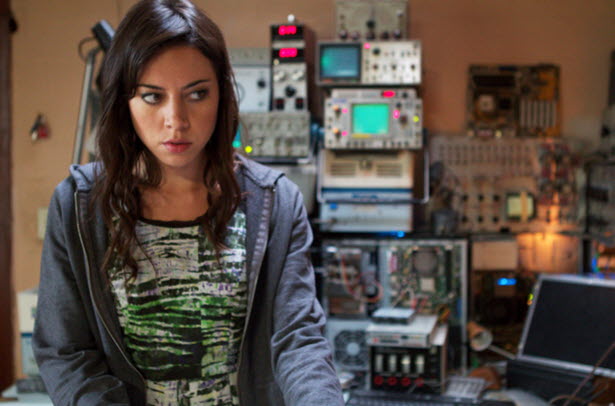
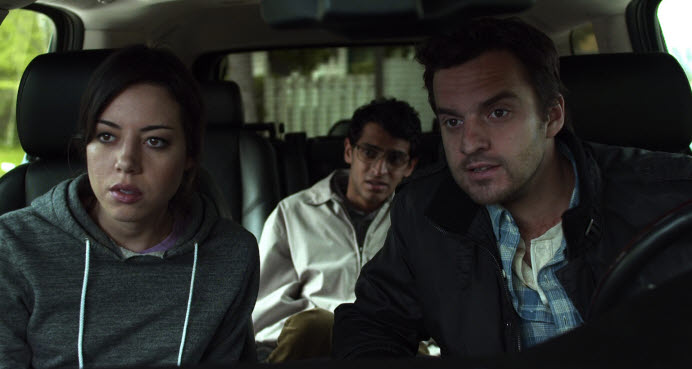 This sounds pretty outrageous to say the least, but Jeff suggests that there may be an interesting story for their readers, and, as soon as his editor approves of his idea, he immediately goes to Ocean View, Washington with two young interns casually chosen by him. Arnau(Karan Soni) is an Indian American intern who is also a biology major(he entered internship just for filling his résumé), and Darius(Aubrey Plaza) is a grumpy smart-ass girl who is not very social with others.
Not long after they arrive in Ocean view, they quickly find the guy in question while watching on the P.O. box mentioned in the ad. They manage to follow after him while not exposing themselves, and then they get some basic information about him. His name is Kenneth Calloway(Mark Duplass), and he lives alone in his parents’ house while working as a clerk at a local grocery store, and, as far as Jeff and his interns can see, this average Joe does not look that weird on the surface.
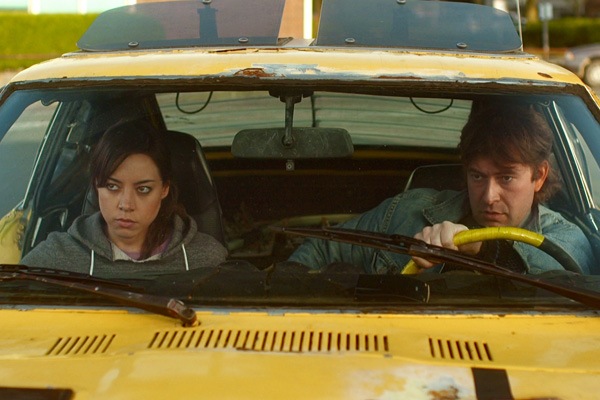
But he is very, very serious about his secret plan. When Jeff approaches to Kenneth, Jeff instantly fails because Kenneth immediately senses that Jeff is not very serious about time travel. As the plan B, Darius approaches to Kenneth in the next attempt, and she succeeds in getting his trust while going along with his paranoia about being watched by someone, and she is soon accepted by him as his time travel partner.
While preparing for their upcoming time travel, Kenneth and Darius begin to spend more time with each other. They do a shooting training together in the forest near his house, and Darius helps Kenneth stealing several special equipments from a big
medical center during one night. It seems he does have a plan which can be succeeded at least in his view, and Mark Duplass, who has been steadily building his directing career with his brother Jay Duplass as making several nice character drama films including “Cyrus”(2010) and “Jeff, Who Lives at Home”(2011), shows here that he is also a talented and engaging actor who can ably handle a tricky role like his character in this film. Although you cannot believe him much as listening to his unrealistic plan and dubious logics, Duplass is both earnest and offbeat in his well-balanced performance, and you may wonder about the real possibility of time travel, especially when it is revealed later in the story that there are the other guys secretly following Kenneth for some purpose.
 On the opposite, Aubrey Plaza, who is not far from her deadpan persona in the TV comedy series “Parks and Recreation”, is also fabulous as a quirky girl who finds herself more attracted to an equally odd guy while getting to know about him with us. There is a heartfelt moment when Kenneth and Darius become more open to each other during their private time on the beach, and we come to see that they are not very different from each other as two lonely souls wishing to rectify something in their respective pasts.
With the screenplay by Derek Connolly, which was inspired by a real-life 1997 Backwoods Home Magazine classified ad(that was a practical joke, by the way), the director Colin Trevorrow mainly focuses on the interactions between characters, and that gives enough space to the other characters in the film. We learn that Jeff’s actual purpose behind his coverage is seeing his high school girlfriend, and his eventual encounter with Liz (Jenica Bergere) shows us how much he wants to feel young again even though he can never go back to that good old time of his. Jeff may be crass and insensitive sometimes, but he sincerely helps Arnau having some fun at one point, and, thanks to Jeff and his sunglasses, Arnau comes to experience a night to remember during one small scene, which is played out with a right balance between humor and sensitivity.
The movie ends its story a little too abruptly, but it smoothly handles its characters and their matters without a glitch during its climax scene, and the eventual choices made during that part do not feel contrived to us at all. I don’t dare to tell you what will happen in the end, but I can tell you that “Safety Not Guaranteed” is enjoyable enough to be called “Predictability Not Guaranteed”, and that is a good reason for my humble recommendation.


![Light Show [Explored 2026-10-09]](https://live.staticflickr.com/65535/55578539818_958ce4fa9c_s.jpg "Light Show [Explored 2026-10-09]")