


We have new kittens in the campus…
 “How to Train Your Dragon 2” is a sequel with more story, more characters, and more dragons which will certainly satisfy its young target audiences. Although its exhilarating charm is occasionally weighted down by the more serious aspect of its standard plot while the story subsequently feels dragged sometimes, this animation feature film has enough visual goodies to entertain our eyes, and it also pulls out genuine moments of emotions from its main characters.
Four years have passed since the first big adventure of a young Viking named Hiccup(voiced by Jay Baruchel) and his dragon friend Toothless, a.k.a. Night Fury, in the previous film, and Berk, Hiccup’s island hometown decorated with crags, has been changed quite a lot thanks to the co-existence of Vikings and dragons. Dragons, who were once Vikings’ enemies to kill, are now happily living with Vikings, and the opening scene shows an exciting match in which young Vikings are riding dragons boldly across the sky while tossing or snatching those poor sheep for making a score(Don’t worry, folks. No sheep is harmed in this scene).
Because Hiccup is no longer that nerdy boy he once was, his father Stoick(voiced by Gerard Butler), who has been Berk’s mighty and respected chief for years, decides that it is the time for Hiccup to prepare himself for succeeding him as the next leader, but our reluctant young hero is more interested in exploring the world beyond Berk with Toothless. Like the previous film, “How to Train Your Dragon” soars with awe and excitement when it is on flying mode, and we get a fun, thrilling sequence when Hiccup tries his own flying for a while using his new device.
And then he happens to come upon a surprise discovery which becomes a serious matter for not only him but also others in Berk. Through a bunch of trappers led by Eret(voiced by Kit Harrington), Hiccup learns about Drago(voiced by Djimon Hounsou), a fearsome villain who has assembled captured dragons as his army. Stoick, who once met this dangerous guy a long time ago under a very unpleasant situation, immediately prepares for battle, but Hiccup has a different thought about resolving this situation, so he goes out to search for Drago in spite of his father’s order.
 But he comes across another surprise instead. He meets a mysterious figure who has been protecting dragons from Drago and his men, and this human protector turns out to be none other than Hiccup’s mother Valka(voiced by Cate Blanchett), who was thought to be lost when Hiccup was very young. Just like her son, she also recognized that dragons were not merely savage beasts, and, after many years of her life with dragons a la Jane Goodall, she is willing to show her son many unknown things about dragons, including a wondrous dragon shelter hidden inside a giant icy sculpture whose outer appearance somehow reminded me of the Fortress of Solitude in “Superman”(1978).
The middle act of the story feels meandering as it goes back and forth between its two main storylines, but it instead provides enough time and space for the most touching part in the film. When Stoick finds that his wife is alive well, it leads to a slow but warm interaction between them, and they eventually confirm to each other that their mutual feeling has remained same as before even after long years of their separation.
Of course, its third act arrives with big battle scenes as demanded when Drago is about to attack the dragon shelter as well as Berk, and this is a less interesting part compared to others. Its flying action scenes are as well-done as required with a style reminiscent of classic dogfights, but it is no more than a bigger version of what we saw from the previous film, and I duly report to you that there is not just one big dragon but two humongous dragons who have two big horns on their jaw along with many spikes on their body.
 None the less, the movie still works well thanks to its good animation, its overall spirited mood, and its endearing characters. Toothless, who sometimes looks like cat or dog in its amusing behaviors, is a lovable animation creature, and the movie stays true to the enduring relationship between Hiccup and Toothless even at its weakest point. The returning supporting characters also bring considerable humor and energy to the film; Astrid(voiced by America Ferrara), Hiccup’s plucky girlfriend, is feisty as usual while actively functioning as a substantial part of the story, and I found myself amused again by Gobber(voiced by Craig Ferguson), Stoick’s good-natured sidekick who is like a jolly uncle to Hiccup. The score by John Powell, who was Oscar-nominated for his superlative work in the previous film, is effective along with the flying sequences and other action scenes in the film; I wonder again why it utilizes Celtic music style for an animation movie about Vikings, but I guess that comes with the territory when all those beefy, hairy Vikings speak English with thick Scottish accent(are they living in the North Sea area, I wonder?).
When I watched “How to Train Your Dragon” in 2010, it was a pleasant experience to freshen me up although my mind stuck with 3-star rating. Though my initial opinion is not changed a lot, that animation film is a solid animation film with lots of energy and heart, and its sequel is equally enjoyable for its engaging mix of old and new elements in spite of its, uh, hiccups. It may be a little too heavy for young audiences in some parts, but it also goes a little deeper than expected on the emotional level as convincingly presenting the eventual growth inside its two main characters, and that certainly makes us expect another adventure of Hiccup and Toothless to come.
Sidenote: I watched it in 2D yesterday, and I did not sense anything lacking in my viewing experience, but, considering that this is an animation film packed with fabulous flying scenes, the extra charge for 3D IMAX is probably not a bad idea.

 He is a good man with faith and compassion, but now he is going to be killed just because of that. “Cavalry”, a somber drama with a little touch of absurd comedy, slowly moves to its inevitable point like a funeral march as its gentle, thoughtful hero goes through what may be the last week of his life. While littered with the little moments of black humor generated from the undeniable absurdity in his unfortunate plight, the movie also has several quiet but powerful moments to reflect on later, and we come to more realize how sad and absurd his situation is as that fateful day is approaching to him.
The movie begins with Father James Lavelle(Brendan Gleeson) being notified that he will be killed exactly a week later. We see him in the confession room of his church, and an unidentified man behind the wooden wall between them begins his ‘confession’ with a shocking secret in his past. When he was 7 years old, he was raped by a priest in his neighbourhood, and that heinous act of sexual abuse continued for 5 years as leaving a deep wound inside him. That horrible priest in question died, so this unidentified guy, still full of his unresolved anger and torment, decides to kill Father Lavelle instead, for killing a good priest will draw far more attention from others. His logic is surely twisted to say the least, but, after all, aren’t we usually more alarmed and shocked to hear the news about good people being killed?
Father Lavelle seems to have a pretty good idea about the identity of the man who promises to kill him on next Sunday, but he is in a tricky theological situation which is similar to Alfred Hitchcock’s “I Confess”(1953). The guy talks about his murder plan during his confession, so Father Lavelle cannot possibly reveal anything exchanged between them to others. He discusses his problem with his superior at one point, but the bishop does not help him much; while not being willing to take any responsibility for whatever will happen, he only suggests to Father Lavelle indirectly that he can bend the rule in this situation.
 With fear and concern growing inside him day by day, Father Lavelle goes through the remaining days while interacting with the people of his rural Irish town. We meet an easygoing local butcher who is having a problem with his promiscuous wife, who is currently in the relationship with a mechanic from the Ivory Coast. We meet a rich banker who seems to be going through his own personal crisis while behaving like an arrogant, self-pitying jerk. We see Father Lavelle having a personal conversation with a socially awkward young man, who considers joining the army just for getting out of the town. There are also a bitter pub owner who is not so cordial to Father Lavelle; a gruff local cop who does not try to hide his sexuality from Father Lavelle; a cocky male prostitute who does not give a damn about his future; an aging American writer who is finishing his novel at his solitary residence; a sarcastic hospital doctor who never misses any chance to wield his cynical atheistic view in front of Father Lavelle, and a freckled altar boy who sometimes draws his painting on the nearby beach. As observing all these colorful characters in the town who can possibly be more than what they seem to be, I could not help but think of Agatha Christie’s mystery novels, though the Gaelic background of the film reminds me more of “The Quiet Man”(1952) and “Ryan’s Daughter”(1970).
But, as I said above, the movie is more of a character study than a mystery thriller, and the mystery inside its story is simply a MacGuffin to lead us to more about Father Lavelle. He is a decent, open-minded man ready to provide solace and guidance for helping the people in his parish, but he does not have much success or satisfaction as the spiritual leader of his town. His fellow priest is ineffectual and spineless while his superior is venal and obsolete, and most of the people in the town do not feel much need to be saved or advised, and he is constantly reminded of the tarnished public image of the Catholic Church. During one small scene, he comes across a young girl on the road and walks with her for a while, but then the girl’s father appears and stares at Father Lavelle with suspicion as taking away his daughter. This may look odd to some of you at first, but you have probably heard about those awful cases of sexual abuses on minors by Catholic priests and how their crimes were covered up by the Church, and you can see how those despicable deeds make sincere priests like Lavelle more frustrated.
 It is implied that Father Lavelle had a fair share of life experience before entering priesthood, and we come to learn a few things about his former life mainly through his estranged daughter who visits him. While he found solace and peace in the religion when his wife died, his eventual decision to become a priest hurt his daughter when she also needed help as much as he did. Fiona(Kelly Reilly) is not in a very good condition as reflected by the bandages on her wrists, but she and her father slowly become open to each other, and Gleeson and Reilly have a poignant scene as Father Lavelle and Fiona have a more honest talk as a father and a daughter.
The movie is the second work from the director/writer John Michael McDonagh, who previously wrote and directed “The Guard”(2011). That movie was a hilarious comedy about a quirky Irish cop who may be smarter than he looks despite all those incorrigible behaviors of his, and McDonagh showed through his debut work that he is a gifted writer/director like his brother Martin McDonagh, who wrote and directed two fabulous dark comedies “In Bruges”(2008) and “Seven Psychopaths”(2012).
Although it takes a far more serious direction here in contrast to “The Guard”, the movie is not without humor. The dialogues in McDonagh’s screenplay are sharp and precise, and they sometimes make small self-conscious winks while rarely stepping out of the overall low-key tone of the film(My favorite line: “How is it that for a third-act revelation?”). The characters revolving around Father Lavelle bring each own flavor to the story, and the vivid sense of locations is established well on the screen thanks to the cinematography by Larry Smith, who wonderfully captures the moody atmosphere surrounding green fields and wind waves.
 As the center of the movie, Brendan Gleeson gives a terrific performance which is quite different from his no-hold-barred comic performance in “The Guard”(2011). He looks mostly restrained throughout the film, but he subtly modulates his performance in each scene as Father Lavelle listening and responding to different characters in his phlegmatic attitude. He is caring and concerned as gently but firmly pointing out what may be a real trouble inside that awkward young guy who wants a counsel from him. He suffers no fool, and he cuts directly through the self-absorbed bullsh*t from the rich banker who is probably one of the financial guys responsible for the recent economic disaster in Ireland. When he reaches his breaking point, we are not surprised about his outburst because we know well what has been frustrating him from the beginning. We cannot help but agree to what one character says to him at one point: “You’re a little too sharp for this parish.”
McDonagh also draws good performances from the rest of the cast, which consists of notable actors like Chirs O’Dowd, Kelly Rielly, Aidan Gillen, Isaach De Bankolé, M. Emmet Walsh, Marie-Josée Croze, and Domhnall Gleeson. Marie-Josée Croze has a brief but memorable scene as a French woman who has a quiet talk with Father Lavelle at the hospital chapel after losing her husband due to a sudden car accident, and Aidan Gillen has his own moment as his doctor character tells about quite a terrible incident he witnessed in the past, which is probably the origin of his cynical worldview. While Chris O’Dowd dials down his comic persona, M. Emmet Walsh provides a welcoming comic relief as an ailing writer waiting for death instead of Godot, and Domhnall Glesson, who is Gleeson’s son, appears as a young imprisoned serial killer who was once Father Lavelle’s pupil. During their private conversation in the prison, this young man reasons that God will forgive him as he feels really sorry about the atrocities he committed, and Father Lavelle can’t disagree with him. If God does exist, can’t God understand and forgive him as an entity who made him?
The title of the movie refers to the place where Jesus was crucified, and you may see an allegorical parallel between that biblical story and Father Lavelle’s difficult circumstance. When the movie finally arrives at the expected confrontation scene on the beach, it is proceeded with the inexorable inevitability which has been carefully built along the plot, and its final scene is emotionally resonating regardless of how it can be interpreted. The world may be just a godless random mess which does not care much about good and evil, but the movie somehow reminds us that we should not throw away our capability of compassion and understanding. It may turn out to be futile in the end as some cynics think, but we need it more to keep moving on in our life anyway.

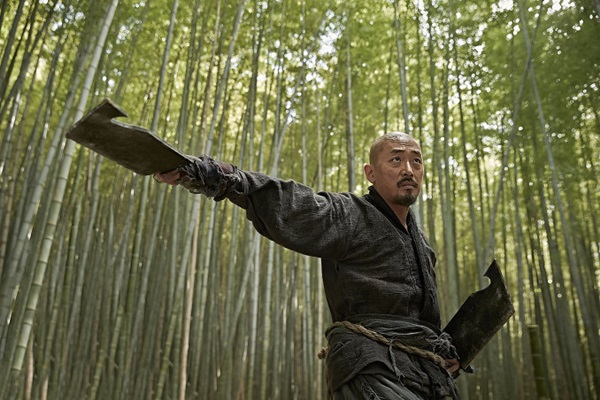 South Korean film “Kundo: Age of the Rampant” is a funny mix of period drama, action comedy, and Spaghetti western. Although it is frequently incoherent and feels dragged especially around its last chapter, there are many fun moments of humor and excitement, and it is supported well by a number of colorful and spirited performances which always bring the sense of fun to the screen.
Its main characters, who are a bunch of thieves residing in Jiri Mountain, are loosely inspired by a group of real-life thieves who were active during the late period of Joseon dynasty. It is 1859, and common people around the country have been suffering through several years of natural disasters followed by bad harvest, and the rich and powerful do not hesitate to exploit and plunder common people. In this desperate period, a group of outlaws form an organization called “Kundo”, and they become sort of Robin Hood figures to many people as robbing sacks of rice and other valuable assets from those greedy 1% guys and then spreading them around 99% people in hunger and poverty.
After showing their latest success in a surprise attack on a corrupt official’s party packed with other noblemen, the movie quickly moves its focus to Dolmoochi(Ha Jeong-woo), a young lowly butcher who has been leading a humble life with his mother and sister outside the city but unfortunately gets involved with Jo Yoon(Kang Dong-won), a fierce and ruthless son of some powerful nobleman. Because of his status as an illegitimate son, Jo Yoon has been pushed aside since his father finally got a legitimate son not long after he adopted Jo Yoon, but now he comes upon a very good chance to get what he wants, and he is determined to do anything for that.
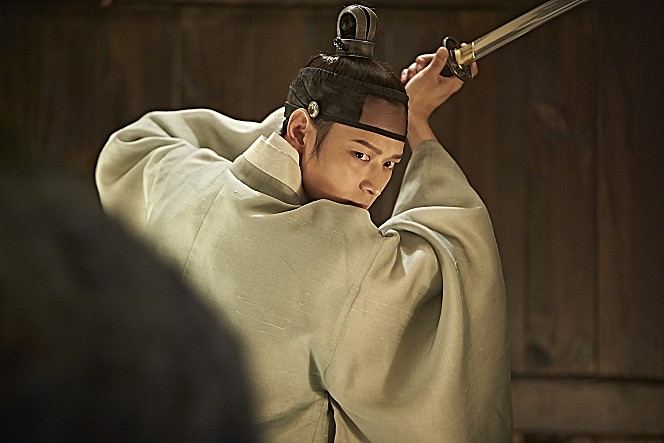 With a considerable amount of money as the reward, Jo Yoon instructs Dolmoochi to kill someone standing on his way to the sole heirship, but Dolmoochi, who is not very bright but does not feel right about killing from the beginning, botches the job, and he gets a severe punishment as a consequence. He loses his dear family, and then he is going to be executed promptly thanks to the backroom dealing between Jo Yoon and a law official who gladly accepts a boxful of bribery promised to him.
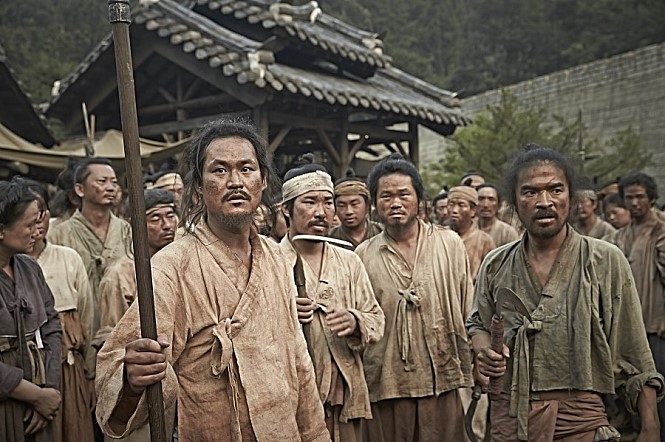
Fortunately, Dolmoochi is saved by the members of Kundo at the last minute, and he soon joins this clan as “Dochi”. While Dochi transforms himself into one of its notorious members who is well-known for not only his skill with knives but also his hilarious way of humiliating his targets, Jo Yoon stops at nothing for getting more land, more money, and more power as the de facto head of his house, and he becomes an infamous figure to many poor people who suddenly lose their land and then become his slave or tenant for life. Dochi and other members of Kundo decide they should do something about this infuriating injustice, and the clash between them and Jo Yoon becomes inevitable when they plan to invade into Jo Yoon’s manor.
While not overlooking lots of pain and torment caused by Jo Yoon and other corrupt officials, the movie does not lose its sense of humor at all, and one of the funniest things in the movie is its deadpan narration by Jeong Yoo-mi. She describes and explains many things in the movie while sounding as calm and plain as your average TV history documentary narrator, but her narration is done with a tongue-in-cheek modern viewpoint which certainly tickled me and other audiences around me(“So, at the age of 11, he comes to experience the bitterness of life.”). The movie does not care much about realism as brandishing its wild style, so its climax sequence comes with a certain weapon which looks pretty anachronistic considering the 19th century Korean background, and its score does not hide the influence from Spaghetti western movies as an electric guitar is gleefully played along with the characters riding on a dry, wide plain. As far as I know, there is not such a wide plain like that in Korea although we do have some plains among mountains, but I guess I should not complain about that because the movie does not attempt to be realistic from the start.
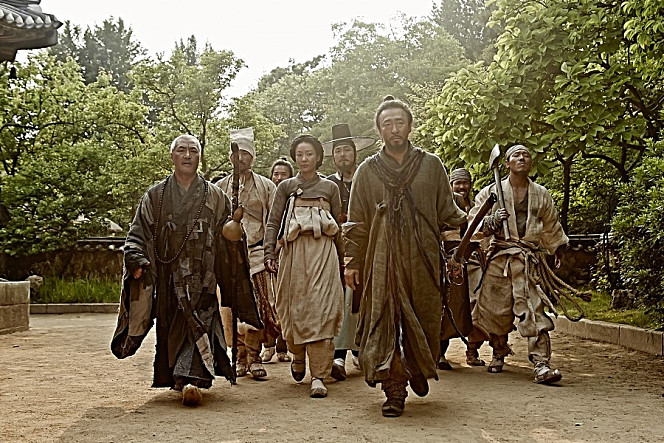 The actors assembled for the movie go along with its cheerful attitude while having a fun with their roles as much as they can. Ha Jeong-woo, who collaborated with the director/writer Yoon Jong-bin in Yoon’s previous three films, is dependable as the lead actor, and he is surrounded by various delightful supporting performances to be enjoyed. Lee Seong-min is the leader of Kundo, Lee Kyeong-yeong is a rogue Buddhist monk who may remind you of Friar Turk, and Ma Dong-seok and Jo Jin-woong are two very different Kundo members competing with each other for winning the affection from Ma-hyang(Yoon Ji-hye), a female member who can take care of herself well among the guys around her.
As the villain of the movie, Kang Dong-won does not stumble even when his character happens to look quite silly during one fight scene, but he seems to have the least fun in the movie compared to the other actors in the film. As showing him as a formidable but pitiful monster who was shaped by his cruel, unhappy childhood years, the movie eventually makes him into a brooding villain who may be far more suitable for a different kind of film, and the screenplay is also rather murky about Jo Yoon’s conflicted feelings toward to a little minor character who should be killed for his final goal. The movie also has many notable South Korean actors including Jeong Man-sik, Kim Seong-gyoon, Song Yeong-chang, Kim Hae-sook, Joo Jin-mo, Lee Da-wit, and Kim Kkobbi, and they function well as the small parts of the ensemble at the fringe of the story.
Although it does not fully develop the potentials inside its story and characters, “Kundo: Age of the Rampant” is enjoyable when it bounces with its sly humor and the jolly energy generated from its saucy performances during its first half, and that impression is not wholly ruined by its less interesting second half which is a little too long. I still think it could be better if its interesting mix of genres were more focused and balanced, but I had a fair amount of entertainment with this uneven but enjoyable movie, and I was amused by its whimsies. Not many South Korean period movies ride into the sunset on the horizon, you know.
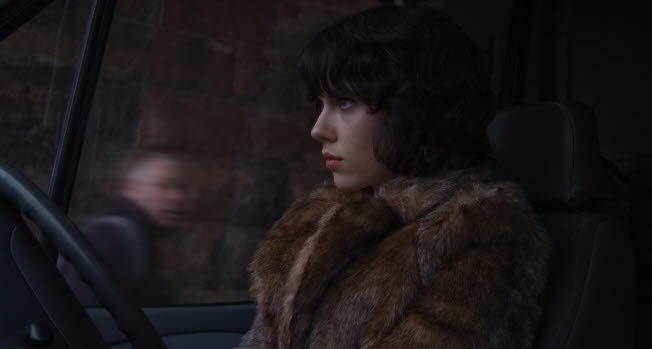 “Under the Skin” will baffle you and frustrate you with its cold, abstract style, but it is also a weirdly fascinating experience you cannot easily forget. The movie only gives us a few bits of vague information on what is going on and below its surface, and there are still many things left unexplained even after its final minute, but its glacial ambiguity has a way of drawing our attention to how it is about even when we are not so sure about what exactly it is all about.
During its opening sequence which is alternatively mysterious and ominous, we see lights and circles in the dark background as a voice of woman is heard on the soundtrack. Uttering the series of syllables during this uncanny moment, her voice sounds like an artificial machine practicing its communication skill before its full operation, and then we arrive at the shot showing a pupil, which seems to signify nothing but indirectly recalls our memories with “Vertigo”(1958) and “2001: A Space Odyssey”(1968).
And then we meet an anonymous motorcyclist(Jeremy McWilliams), who seems to be doing a covert mission in Scotland. After stopping at one spot on the road, he walks down from the road to somewhere, and then he comes back with a female body. He puts the body into a van, and then we see the body laid in a white blank space. Another woman, played by Scarlett Johansson with dark wig, comes into the scene, and, after a little moment of curious inspection, she takes clothes and other things from the body with no hesitation.
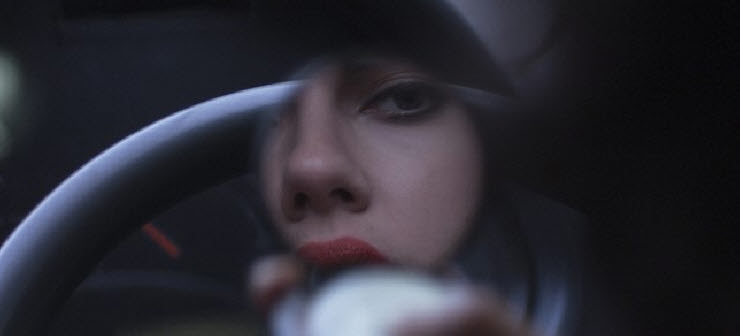
Driving the van around streets, the woman picks up guys whenever they look suitable for her hidden purpose. She approaches to them mainly through innocuous questions about direction, and then, after offering them a ride, she lures them to her house. As watching these guys entering that suspicious place with no question, I was reminded of those old folk stories about unlucky guys enticed into deadly trap by an attractive girl who is not what she seems to be on the surface. I thought they were pretty dumb, but it is not easy for guys to say no to a sexy, beautiful woman, right?
 Of course, they never get out of the house after their entrance. They do not seem to have any slightest piece of doubt even when they go into a very, very dark space in the house, and then something quite bad happens to them when they go after her for sex. The movie is based on Michel Faber’s novel with the same name, and I heard that Faber’s novel describes a lot about this sinister process and many other things, but you do not need to read the novel to see that 1) the woman and the motorcyclist are aliens from the outer space and 2) their secret mission is not so pleasant to our species regardless of whatever their actual purpose really is.
This is an unconventional SF film which is mainly driven by atmosphere rather than plot, and the director/co-screenplay writer Jonathan Glazer, who debuted with “Sexy Beast”(2000) and then made “Birth”(2004) before this film, gives us a curious mix of surreal ambience and realistic touches. As shown in the movie, Johansson drove the van around Glasgow while hiding her identity and her ‘mission’, and that makes an amusing parallel between the movie and the filmmaking process behind it. The men approached by Johansson in the movie are mostly non-actors who did not know that they were being filmed by the hidden cameras installed in the van; they were notified about that later, and some of them got more time to act with Johansson if they were willing to participate more in the production.
With the creepy ambient score by Mica Levi and the chilly cinematography by Daniel Landin, the movie sticks to its ambiguous tone from the start and never steps back from it while maintaining its enigmatic attitude. Although a little amount of tension is added during its second half, that does not affect its slow, contemplative pace much, and the desolate wintry landscapes of the Scottish Highlands add another layer of cold, distant beauty to the film.
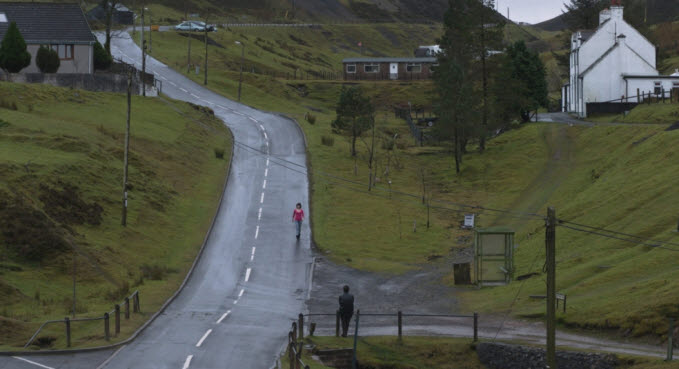 This can be a very frustrating experience to some of you, but the movie is not devoid of interest, and, if you are ready to go along with its pace and mood, it constantly engages your curiosity through its odd moments. There is a chilling scene in which an innocent baby is helplessly left alone on a remote beach while a terrible thing is happening nearby, and then we get a moment of small ironic poignancy during the chance encounter between the alien heroine and a man with disfigured face(he is played by a real guy suffering from neurofibromatosis type I, by the way).
Effectively dialing down her star presence, Scarlett Johansson gives a beguiling low-key performance which subtly suggests what is behind her character’s appearance through facial expressions and body languages. We sometimes sense what is probably happening to this nameless alien as observing her behaviors being gradually affected by her human disguise, but then we are also reminded of an undeniable fact that she is an outsider we may never understand well, as reflected by one brief scene featuring a piece of chocolate cake.
While reminiscent of several SF films such as “Lifeforce”(1985) and “Species”(1995) because of its fatal alien seductress, “Under the Skin” reminds me a lot of Nicholas Roeg’s “The Man Who Fell to Earth”(1976), an equally strange SF film about an alien who comes down to the Earth with a far less sinister purpose. Even though I frequently felt lost and confused during my viewing, I admired the offbeat spirit of that flawed but interesting cult film, and “Under the Skin” impressed me in similar ways through its pure abstract beauty open to any possible interpretation of its components. It surely requires a certain amount of patience, but you may find it absorbing if you are looking for something different.


 They have been close friends to each other since they were very young, but now their long friendship is threatened by a devastating incident which shakes them all. Calmy observing the guilt and torment resulted from that incident, South Korean film “Confession”, which is released in local theaters as “Good Friends”, tells a sad, gloomy story under its somber tragic mood pressing down on everyone in the movie. Even when they do not say a lot, what is beneath the surface feels palpable to us, and we even come to feel sorry about a certain character who can be labeled as the villain of the story.
At the beginning, the movie shows an unfortunate accident which happened in the past of its three main characters. When they are about to graduate from their middle school, Hyeon-tae, In-cheol, and Min-soo have their own special plan for the graduation day. Rather than attending the ceremony, they go to the top of a nearby mountain with a camera and their graduation certificates(they sneaked into their school and then stole them in advance), and they take photos together as best friends while enjoying their own private time on the mountain.
Everything looks fine to them, but then the weather is suddenly changed, and then they find themselves in a serious trouble. Min-soo gets injured due to an unexpected fall, and his friends manage to move him down from the peak, but heavy snow keeps falling on the mountain with lowering temperature. The time is running out, and it becomes harder for them to move further on the snow.
They luckily come across an empty cabin on their way, so they decide to stay there for a while. Because Min-soo is in a very serious condition and Hyeon-tae is also not in a very good condition, In-cheol decides that he should go outside alone for calling for help. After being left alone with Min-soo for hours, Hyeon-tae decides to take care of the situation for himself, so he takes Min-soo out of the cabin, but both of them soon become exhausted not long after that and then eventually collapse on the ground.
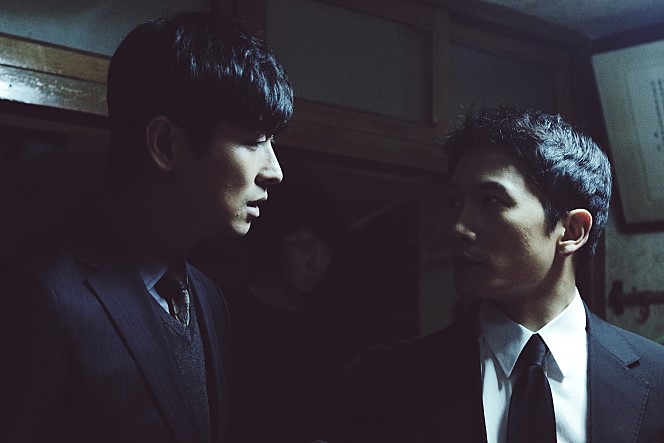 Fortunately, they are saved in time by In-cheol and others coming to the rescue, and the accident brings them closer than ever to each other. 17 years have passed since that, and they are still like brothers to each other while respectively living different lives. In-cheol(Joo Ji-hoon) works as an insurance agent, and Hyeon-tae(Ji Seong) works as a fireman, and Min-soo manages a small laundry while also running a retail beverage store.
We also meet Hyeon-tae’s mother(Lee Hwi-hyang), who has been estranged from her son due to his marriage she does not approve of. Hyeon-tae married Mi-ran(Jeong Ji-yoon), and they have been leading a happy family life with their adorable little daughter at their shabby apartment, but Hyeon-tae’s mother does not like that just because Mi-ran is a deaf mute orphan, and she and her son have only communicated with each other through In-cheol, who sometimes looks more like a son to her.
While insuring her small game arcade through In-cheol’s help, Hyeon-tae’s mother gets an idea for getting out of her current financial problem. She considers burning the game arcade for getting a nice big check from the insurance company, and In-cheol gladly joins in her scheme mainly because he is recently in a big trouble associated his own insurance scheme. Min-soo is naturally reluctant about this criminal plan when In-cheol asks Min-soo to help him, but he eventually becomes persuaded by his friend. After all, nobody will get hurt if everything goes well as planned, and, as In-cheol emphasizes, this scheme will benefit them as well as their best friend’s mom – and their best friend, perhaps.
 I will not go into details about what will happen next, but I can tell you that the consequence will put everyone into a big emotional turmoil for different reasons. Shocked by this sudden happening, Hyeon-tae is determined to find who is responsible for that, especially after learning that the police is not very willing to investigate it for some reason. As watching their best friend in grief and desperation, In-cheol and Min-soo tremble in each own remorse and guilt, and they only find their situation worsening than before. There is a greedy mob boss who had some share in the game arcade, and there is also a fastidious inspector from the insurance company who has been focusing on In-cheol and is determined to get any evidence to incriminate him.
Maintaining the restrained tone throughout his film, the director/writer Lee Do-yoon draws good performances from his leading actors, and they are always believable as the characters who have known each other for many years but now have to hide something from each other. With Ji Seong as the stable neutral base in the story, Joo Ji-hoon and Lee Gwang-soo ably convey us the sense of implosion from their characters, and there are a number of emotionally tense moments between them as the camera closely watches their conversations which gradually become terse and awkward along the story.
Although its third act feels overlong and I do not think a flashback scene around the ending is necessary, “Confession” is an engaging drama with a touch of noir on the whole. Rather than resorting to cheap thrills or easy melodramatic tears, it wisely does not overplay the emotions churning behind its characters as steadily moving them into an inevitable point, and its understated ending is filled with bitter sadness over what can never be restored. Yes, they still do care about each other as before, but, sadly, they cannot go back to where they were – and they come to admit that with a price.

 Breaking legs, twisting arms, slashing throats, smashing heads, stabbing bodies, shooting anyone, crashing one car into another, burning face on hot plate, and, above all, kicking and punching hard each other. All of these acts of violence and mayhem are relentlessly served to us in “The Raid 2”, and I must tell you that there are a lot more of no-hold-barred extreme violence to jolt you during its running time of 2.5 hours. The movie is more or less than a broad exhibition site for its gritty, punishing action scenes, and they deserve to be appreciated individually for their enormous skills and prowess inside them, but I only observed them with increasing detachment mainly due to its messy plot riddled with many problems including the lack of characterization and the absence of strong narrative pull. It has the ambition to excite us with a bigger scope, but it becomes loose and unfocused as bulking itself up, and the result is a half-baked crime action drama occasionally punctuated by its well-made action scenes which are its major selling points.
“The Raid 2” starts its story not long after a disastrous SWAT operation which was the center of “The Raid: Redemption”(2011). Rama(Iko Uwais), a rookie SWAT member who managed to survive that hellish carnage initiated by a ruthless gang lord, is ready to expose the big corruption in his system through a crucial evidence he obtained from his estranged brother who happened to be that gang lord’s right hand man, but he soon finds that it is far more difficult than expected. He immediately goes to a cop he can trust, but the cop tells Rama that there are a lot more things to do for getting the justice he wants – and he wants Rama to be his undercover agent for exposing the connections between the local gang organizations and several corrupt high-ranking police officials including Reza(Roy Marten), who was briefly mentioned around the ending of the previous film.
Rama is not willing to be an undercover agent at first, but then he accepts the job later because of his personal reason. His mission is approaching to the son of one of the powerful crime bosses in the city, so he is put into the prison where Uco(Arifin Putra) is being temporarily incarcerated. After a spectacularly barbarous prison fight on muddy field which will definitely make many of you cringe for its sheer savageness drenched with mud and blood, Rama, who disguises himself as a criminal named Yuma, starts to gain Uco’s trust. When he is released from the prison two years later, Uco introduces Rama to his father Bangun(Tio Pakusodewo) and Bangun’s trusted right-hand guy Eka(Oka Antara), and Rama slowly begins to infiltrate into Bangun’ organization as a henchman they can rely on.
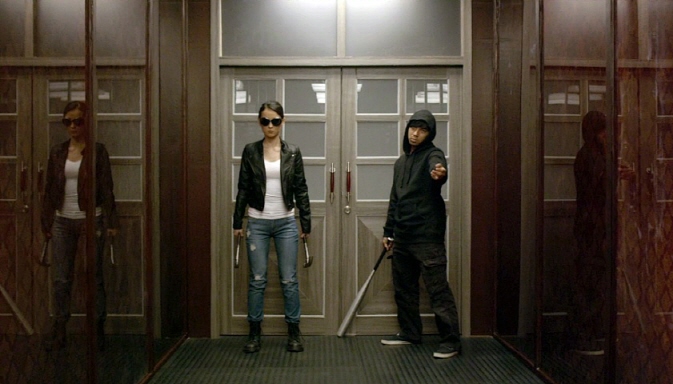
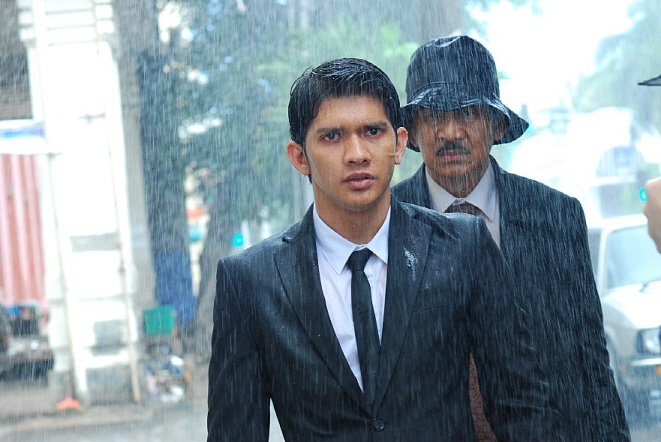 The movie keeps introducing the other underworld characters into its increasingly complicated plot. There is a Japanese gang organization led by Goto(Ken’ichi Endô), and then there is also another gang organization led by Bejo(Alex Abbad). Bejo has a number of killers who are a little more distinguished than other characters only because of their methods of killing; one young lady’s specialty is swiftly wielding two hammers at her opponents with no mercy, and her partner, who is as remorseless as she is, uses a bat and a baseball during his usual operations.
Eager to impress his father and ambitious to solidify his position, Uco wants to defeat the Japanese mobs, so he is naturally drawn to Bejo’s secret offer. They will break a long truce between Bangun and Koto for starting a war again, and Bejo promises that he will fully support Uco, though this untrustworthy guy clearly has some other ideas behind his back. As secretly watching on them, Rama sees what will happen sooner or later, but he also realizes that he may not survive the upcoming situation if he is not very careful.
While reprising some of the physical actions presented in his previous film, the director/writer Gareth Evans tries to top himself as making action scenes bigger, louder, faster, and bloodier on his broader canvass. Its fight choreography by Iko Uwais and Yayan Ruhian(he also plays one of minor characters in the film) is packed with ferocious intensity as expected, and the fight scenes in the movie do not feel choppy at all in spite of rapid camera movement and quick editing. The cinematography by Matt Flannery and Dimas Imam Subhono gives the movie a slick, polished look while never losing the gritty aspect of its actions scenes, and there are several action sequences which made me curious about how they made them.
 One of them is particularly mentionable because it simultaneously captures two different types of actions happening along the highway through a busy mix of well-planned camera movement and first-rated stunt performances. We have an intense struggle inside one vehicle, and then we also have a car chase action literally following after that vehicle, and this sequence rapidly shuffles between them without any confusion until it reaches to its finish line.
However, when action is not on the screen, the movie is bland and uninteresting as it struggle to roll its insipid crime story. The characterization is one-dimensional to say the least, and the plot frequently loses its pace while dully explaining the situations around its bunch of characters. We are not sure about what is exactly going on as losing our way amid the cardboard characters who simply exist for killing or being killed, and the movie just keeps throwing action and other things into its disorienting story without no particular focus or attention to story and characters. I am not so sure about what Rama’s boss is exactly planning, and I am also scratching my head on the motive behind one deadly action scene with a taxi.
I do not doubt that Iko Uwais is competent as a promising action movie star, and he and other stunt performers deserve praises for making their fight scenes look quite real without getting any serious injury in front of the camera, but his character still feels like a blank page as before. There are a few shots involved with his family members, but these obligatory shots do not add much to his character except informing us that he is a good family guy inside his dirty disguise. As the movie bloats its plot, Rama relatively becomes an insignificant part in the story, and its big climax containing his series of striking fight sequences does not compensate much for that.
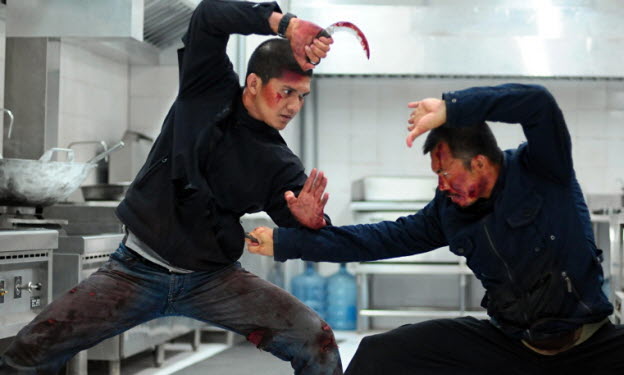 Mainly due to thin characterization, the other actors surrounding Uwais do not leave much impression unless they fight or kill. There are many conversation scenes between Rama and the other characters, but I think the most memorable line in the movie is “Ahhhhhhhhhhh!” or “Arrrrrrrrgh!” – and I can assure you that these visceral lines are used again and again throughout the film.
I previously said “The Raid: Redemption” will be “the most single-minded and simple-minded action flick of this year”. Although impressed and excited by its single-minded ferocity, I was not very enthusiastic about it mainly due to its lack of substance to support its action scenes, and I was also bothered by its inherent vicious attitude toward its extreme violence.
While technically more improved and polished, “The Raid 2” continues that disturbing trend with more problems to block my entertainment. Its narrative is unnecessarily sprawling and ponderous, and I could not care about its clumsy plot, and I got quickly tired of its long, long parade of violent actions with a very little sense of fun or excitement. I understand well why this film is being regarded as an electrifying action masterpiece by many people, and I will not deny that its physical action scenes are certainly a lot more engaging to watch than that dreary CGI spectacles of Transformers movies. I still don’t think I will watch this movie again, but I may enjoy a documentary showing how they made its actions scenes – now that’s an interesting film I am more eager to watch.
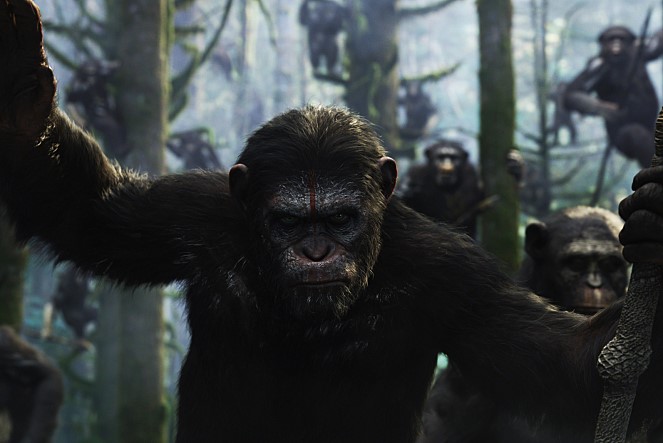 As the second chapter of the rebooted series, “Dawn of the Planet of the Apes” fully develops the potentials shown in the previous film which breathed fresh air into the franchise with a surprising result. As a blockbuster film, the movie certainly has a number of well-made action scenes worthy of your ticket price, but it does far more than that; it gives us another engaging story to hold our attention, and we eventually come to see a touch of classic tragedy behind the inevitable clash of species depicted in the movie.
As implied during the epilogue scene of “Rise of the Planet of the Apes”(2011), a virus lethal to human species was spread all over the world not long after a big revolt by our ape hero Caesar(Andy Serkis) and his fellow apes, who acquired considerable intelligence through ‘simian virus’. With no cure for this virus, lots of people died as the human society got collapsed as a result, and now there are only a small number of people who have managed to survive among the ruins of human civilization since the outbreak.
After settling in the forest near San Francisco, Caesar and other apes have been leading a nice tribal life during last 10 years. They made their own primitive community on the top of a mountain, and we see them hunting together with sticks and other tools like our ancestors did a long time ago. I wonder where they acquired those horses which all look like Black Beauty’s descendants from(was there a horse ranch near their area?), but I guess that is a small nod to that memorable moment in “Planet of the Apes”(1968).
Although they usually depend on sign language for communication, they can speak while teaching rudimentary English to the younger members of their tribe(another question: how could they reproduce that much during a short span of time?), and, as musing on their progress, Caesar and his close colleagues believe that they will continue to prosper as they have since their revolution. Caesar’s dear wife Cornelia(Judy Greer) is sick and probably has not many days to live(she is always attended by her, uh, apes-in-waiting while saying or expressing little to her husband), but they have two children they love, and his son Blue Eyes(Nick Thurston) may succeed him someday although this young ape still needs much to learn for standing up for himself as a future leader.
 And then their peaceful existence is disrupted by a bunch of humans who come into their territory on one day. Malcolm(Jason Clarke) and others accompanying him mean no threat to Caesar and other apes; their community residing in the downtown area of San Francisco has been facing a serious energy crisis which will put them back to that dark, chaotic time, and they need to find and reactivate a water power plant in the apes’ territory for supplying electricity to their place.
At first, Caesar throws a hostile response to Malcolm and other humans mainly for calming down his more aggressive tribal members including Koba(Toby Kebbell), but he eventually accepts Malcolm’s sensible request, so it seems things will be worked out well for both sides. Malcolm and others are allowed to go to the water power plant and repair it with some help from the apes, and Caesar begins to trust Malcolm, who is as decent as a few human beings he knew in the past.
However, as we have seen from many stories about two different groups in hostile conflict, both Caesar and Malcolm soon find the situation going beyond their control as being swept by that. The humans in San Francisco, led by their de facto leader Dreyfus(Gary Oldman), are ready to invade into the apes’ territory with the weapons from a nearby military storage, and some of Caesar’s tribal members are also determined to get rid of humans. Both sides come to follow that destructive tribal mentality represented by ‘it’s us or them’, and, through his misjudgment and mistakes, Caesar comes to learn a bitter lesson as a consequence.
The director Matt Reeves, who did an exemplary remake job in “Let Me In”(2010), establishes well the dark, uncertain mood along with the accumulating tension amplified by Michael Giacchino’s uneasy dissonant score on the soundtrack. In contrast to that dizzy shaky camera approach in his previous film “Cloverfield”(2008), Reeves shows steadier handling of the action sequences during the climactic part of the film(there are at least two fabulous tracking shots which you have to see for yourself), and they are supported well by a good story which makes us 1) understand the motives of its major characters and 2) worry about what will possibly happen due to their clashing motives and 3) care a lot about not only its ape hero but also some of the other characters in the movie.
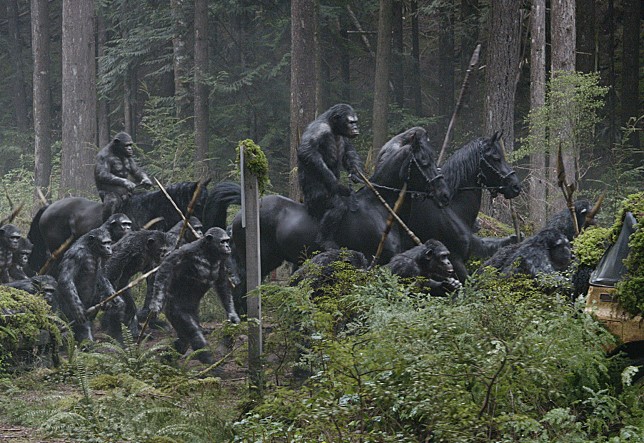 When I watched “Rise of the Planet of the Apes”, I was surprised by how much I came to care about Caesar’s plight even though I knew well that he was a CGI character, and Andy Serkis’ performance was one of crucial elements which made Caesar into a compelling hero. Serkis, who may deserve a special Oscar someday as an actor who has been the soul of many memorable CGI characters during recent years, is more prominent here as a well-meaning leader who believes a little too much in his fellow apes, and he and the other actors provided convincing performances to be transformed into their vivid ape characters on the screen. The drama between Caesar and his son is familiar to the bone, but they do feel like real characters in their interactions, and their quiet conversation scene later in the movie is particularly effective thanks to that. It is also welcoming to see the various ape characters we met in the previous film, and I was reminded again of my small personal affection toward Maurice(Karin Konoval), a wise, gentle orangutan who slowly becomes a friend to Malcolm’s son Alexander(Kodi Smit-McPhee).
Not so surprisingly, the human characters are less distinctive in comparison as the apes steal the show. Besides Jason Clarke, who earnestly holds his place in opposite to Serkis, most of the actors including Gary Oldman and Keri Russell(she plays Malcolm’s doctor girlfriend) are stuck with simple characterization, but the solid screenplay by Rick Jaffa, Amanda Silver, and Mark Bomback treats its human characters as an equal major part of the story, and that is one of the main reasons why its climax, which revolves around a high-rise building virtually ready for one of the oldest villain clichés, works on many levels.
Promising the next story to come before its end credits, “Dawn of the Planet of the Apes” successfully moves the franchise into more potentials as doing nearly everything a good sequel should do. I cared about the apes as well as the humans in the film, and, as observing that there is not much difference between these two species entangled with each other in their ugly conflict, I could not help but think of the last paragraphs from George Orwell’s novel “Animal Farm”. They are still lingering on my mind as I am reflecting on the movie now, and Caesar will probably understand why: “Twelve voices were shouting in anger, and they were all alike. No question, now, what had happened to the faces of the pigs. The creatures outside looked from pig to man, and from man to pig, and from pig to man again; but already it was impossible to say which was which.”

 In my humble opinion, style and substance are necessary for making a good SF film. For drawing our curiosity, SF film needs some style to create its own mood and reality, and that will make us believe that something fantastic can happen in its story. For stimulating our interest, it also needs some substance to support its own ideas, and that will intrigue and entertain us while inducing other interesting thoughts from us.
As a small SF film, “The Signal” has style and substance, but it does not have enough substance to be a recommendable one. I do not mind that its premise is not so fresh, but, after the nice set-up process in the beginning, the movie moves its story in a very familiar and predictable way, and what will be revealed in the end can be easily guessed within its first 20 minutes if you are a seasoned movie audience. I felt dissatisfied to see that there were not many things to talk about besides that, and I eventually could not help but think of other several other SF films which handle similar premises better than this one.
Anyway, the movie starts with promising potential while establishing its characters and their initial circumstance. Because his girlfriend Haley(Olivia Cooke) is going to move from MIT to Caltech, Nick(Brenton Thwaites, who previously appeared in “Oculus”(2013) and “Maleficent”(2014) early in this year and will be soon shown to us again through the upcoming film “The Giver”) is taking her to California by his car along with his close friend Johah(Beau Knapp), and they are mostly in good mood although there is a growing doubt between Nick and Haley. As shown through flashbacks, Nick was a marathon runner before he got a permanent injury on his legs, and, as they become distant to each other after his injury, Haley naturally begins to wonder whether this road trip is his act of saying goodbye to her.
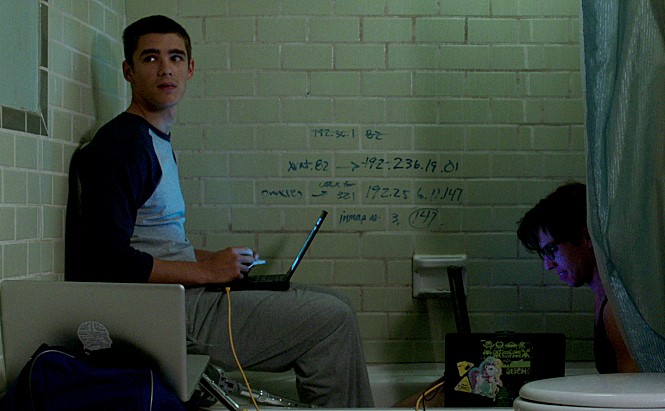 Meanwhile, an interesting thing draws Nick and Jonah’s attention during one evening. They once encountered a hacker named NOMAD, and this mysterious guy impressed them a lot through successfully breaking into the computer network system of MIT, while almost getting Nick and Johah expelled as a consequence at that time. When NOMAD contacts them again, Nick and Jonah succeeds in tracking down NOMAD’s real IP address, and their curiosity is increased further when they discover that NOMAD resides in some area of Nevada which happens to be near their road trip route.
Although Haley is not so pleased about their changed plan, Nick and Jonah want to know the identity of NOMAD, so they and Haley go to that remote area in question during the next evening. They only find nothing but a barren house on the spot, and the house clearly looks suspicious for good reasons, but Nick and Jonah make an unwise choice of going into the house instead of leaving the area as soon as possible(I guess they have not watched those horror movies about young guys getting into serious trouble).
It is not much of a spoiler to tell you that something happens while Nick and Jonah look around the house, and then Nick wakes up to find himself being confined in an unknown place which looks like some top secret government facility. Everyone wears white hazmat suit in this place just because Nick is assumed to be infected through whatever happened during that baffling moment he cannot remember well, and he is frequently tested and interviewed by Damon(Laurence Fishburne), who seems to be in charge of everything in the building.

The director William Eubank, who co-wrote the screenplay with Carlyle Eubank and David Frigerio, maintains well the claustrophobic feeling of paranoia on the screen as suggesting something insidious going on beyond Nick’s limited view. Damon does not tell a lot about what is exactly happening, so Nick naturally becomes more furious and frustrated as the time goes by, and he also realizes that there are many other things he should not trust besides Damon and other facility guys.
Along with the white sterile atmosphere surrounding him, Fishburne’s unflappably patient and authoritative attitude throws a certain chilling quality into the movie. Whatever cards his character is holding behind his back(or inside his hazmat suit, shall we say), Fishburne’s calm, detached performance always conveys us the sense of authority during his scenes and we begin to sense that he is the guy who always has the situation under control – no matter what happens.
Unfortunately, the movie becomes less interesting as going through its obligatory third act, and it was particularly disappointing for me to watch the movie taking a less intelligent route just for accelerating itself toward the expected ending. I do not mind about action as a part of story, but the action scenes in the movie just feel like being an artificial attempt to finish the story with bangs, and the movie leaves a little too many unexplained things around its ending.
Although “The Signal” was made only with a low budget of 2 million dollar, I can assure you that its budget was spent far more efficiently than the mega-budget for “Transformers: Age of Extinction”(2014), and the result clearly shows that William Eubank, who previously made a debut with “Love”(2011), is a good director with skills and potential. The movie is passable, but it is a commendable work to some degrees, and I guess we can accept it as a good signal for better things to come from its director in the future.


![Light Show [Explored 2026-10-09]](https://live.staticflickr.com/65535/55578539818_958ce4fa9c_s.jpg "Light Show [Explored 2026-10-09]")


