The Night Is Short, Walk On Girl (2017) ☆☆☆(3/4): One phantasmagoric night

thenightishortwalkongirl01

Japanese animation feature film “The Night Is Short, Walk On Girl” is a phantasmagoric fantasy which literally goes wild with its style and imagination. Although I must point out that it could not wholly engage me as I became more aware of its deliberately warped reality and decidedly broad characterization, I enjoyed its numerous stylish scenes brimming with exuberance and humor, and I admire how willingly it goes further for more wild and crazy moments to impress its audiences.

The premise of its story is pretty simple. During one night in Kyoto, a young unnamed female college student is attending a drinking party for the wedding of one of her friends, and she decides to have more fun and drink after this drinking party. When the party is almost over, she goes outside and then comes into a nearby bar, and she promptly orders and then drinks a number of various cocktails. While watching this, I could not help but think of my similar drinking routine at bars; I also enjoy drinking those tasteful cocktails, and I always start with gin tonic and then end with Long Island Ice Tea.

After a rather unpleasant encounter with a creep who is obsessed with erotic pictures, our heroine comes across two eccentric characters who are quite ready for fun and drink just like her, and that is the beginning of a wild, spirited drinking time for them and several others who gladly join them. In the end, our heroine comes across a wealthy old man residing in his huge moving boat, and she and the wealthy old man come to have a high-stake drinking duel with some special liquor.

thenightishortwalkongirl02

Meanwhile, the film also focuses on the misadventure of a male senior who has carried a torch for our heroine. During the aforementioned drinking party, he cannot help but look at our heroine from the distance, but he still cannot find enough courage for approaching to her even though he is pretty much drunk just like many others at the party. After the party, he decides to go after her for another ‘accidental’ encounter between them, but, alas, he finds himself getting into a series of troubles instead, and he later finds himself in a very embarrassing situation when he finally come to be in front of her.

As the night goes on, the spring mood of the film is changed to hot summer atmosphere (don’t ask me why), and our two main characters come into another loony circumstance. While our hero spends some time with a dandy friend who happens to be in charge of monitoring college students, his friend suggests a way to win our heroine’s heart, and our hero is tempted by his friend’s suggestion. It turns out our heroine is looking for a certain old book which may be found somewhere at a local bazaar for old used books, and our hero’s friend knows how to get that book in question.

Of course, getting the book turns out to be pretty difficult for two reasons. There is an impish child who sneaks around here and there around the bazaar for his own small prank, and one of the funniest moments in the film comes from how our hero gets into another trouble thanks to this naughty kid. Furthermore, our hero later has no choice but to participate in a literally hot and hellish competition for obtaining the book, and that leads to a cheerfully exaggerated moment you should see for yourself.

thenightishortwalkongirl03

Not long after that, the film hops into its third act with another seasonal change in the background. Surrounded by autumn atmosphere, our two main characters suddenly find themselves in the middle of the fall college festival, and they soon come to be involved with a guerrilla stage performance which is intended as a public message from some lovesick male student yearning to reunite with a girl with whom he fell in love at first sight. That guy also swore that he will not change his underpants for clean ones until he finally meets her, and I was rather glad that the film did not go into details on that.

Anyway, this part eventually culminates to a loony musical climax equipped with several songs, and you may roll your eyes while also being tickled by a number of unabashedly absurd plot turns during this sequence. It looks quite silly indeed, but the main voice performers including Gen Hoshino and Kana Hanazawa bring lots of spirit into this sequence while maintaining some degrees of seriousness as required, and the result is another highlight in the film.

During the last act, the film shifts itself onto winter background as expected, and it initially seems to falter under stark wintry atmosphere, but, what do you know, it surprises us with another crazy moment to remember. Although I think director Masaaki Yuasa and his crew go a bit too far during this part, I will not deny that I was impressed by how they manage to pull out a sweet ending after all those wild and crazy moments shown on the screen.

Considering its wildly whimsical style and personality, “The Night Is Short, Walk On Girl”, which is based on the fantasy novel of the same name by Tomihiko Morimi, may not be for everyone, but you will not be disappointed if you are looking for something unique and different. Although I am less enthusiastic than some other critics, I appreciate its rambunctious spirit, and I will probably revisit it someday after drinking several glasses of cocktails.


thenightishortwalkongirl04

Posted in Movies | Tagged , , , | 1 Comment

Thelma (2017) ☆☆☆(3/4): Her power awakens

thelma01

“Thelma”, which was chosen as Norway’s official entry for Best Foreign Language Film Oscar in last year, is a calm but unsettling experience. Firmly sticking to its young heroine’s increasingly agitated state of mind, the movie constantly unnerves us throughout its running time, and there are a number of striking scenes generated from its compelling mix of coming-of-age drama and supernatural thriller.

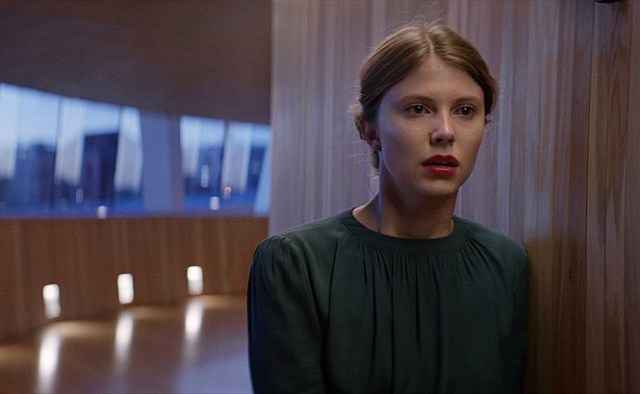
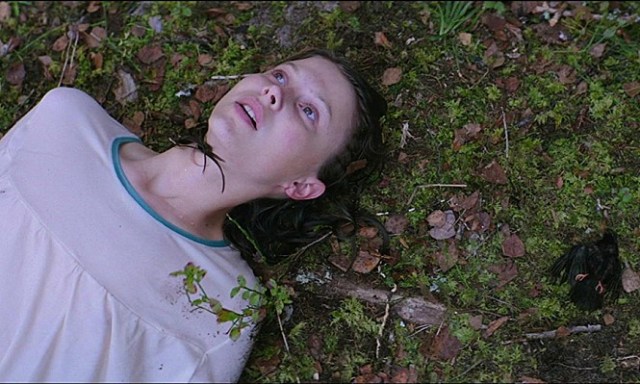
After the disturbing opening scene which shows a father attempting to kill his little daughter in the middle of a snowy winter forest but then changing his mind, we meet Thelma (Elie Harboe), who was, as you can easily guess, that small girl in the opening scene. Several years passed, and now she becomes a young woman who begins her first year at a college located in Oslo after leaving her rural hometown, but she often feels lonely and awkward as trying to get accustomed to her new environment. She wants to have more freedom like any girls around her age, but, as a shy, repressed lass who has grown up in a conservative Christian household, she is afraid of committing anything against her religious faith, and her routine phone conversation with her parents always reminds her of what she must avoid for being a good Christian.

Her parents, Trond (Henrik Rafaelsen) and Unni (Ellen Dorrit Petersen), seem kind and caring like any good parents, but we cannot help but notice the tension between them and their daughter when they visit their daughter at one point. During their dinner at a Chinese restaurant, Thelma happens to express her critical opinion on several conservative families in her hometown, and, not so surprisingly, her parents are not so pleased about that. Trond sternly represses his daughter’s opinion as emphasizing the importance of faith, and Unni, who has been wheelchair-bound for some reason, silently agrees with her husband.

thelma02

Trond and Unni sincerely want their daughter to remain to be a good Christian girl, but the inevitable change in Thelma’s life has already been beginning since she came across Anja (Kaya Wilkins). Freely exuding her beauty and sexuality, Anja is far more confident and uninhibited than Thelma, and she is willing to befriend Thelma although their brief first encounter was not exactly pleasant due to Thelma’s sudden inexplicable seizure.

As spending more time with Anja, Thelma experiences more fun and freedom than before, and she also finds herself attracted to Anja – especially after she happens to learn that Anja recently breaks up with her boyfriend. It soon turns out that Anja also feels attracted to her, but Thelma feels guilty as being more aware of her good old Christian values, and this accordingly brings more turmoil into her mind. She experiences more incidents of inexplicable seizure, and very strange things happen around her in addition to that.

It is not much of a spoiler to tell you that Thelma has a sort of supernatural power and her parents knew about it from the very beginning. As she tries to understand what is happening to her, the movie occasionally goes back to her childhood past, and we get a quiet but chilling moment when young Thelma unwittingly causes a devastating incident for her family on one day.

thelma03

While her situation will surely remind you of several similar horror films such as, yes, “Carrie” (1976), the movie distinguishes itself with its distinctive mood and style. Steadily increasing its palpable sense of dread and spookiness, it gives us a series of intense and disturbing moments which effectively present not only Thelma’s psychological tumults and but also their external ramifications, and I particularly like a hallucinogenic scene where Thelma happens to have an odd experience at a party she attends along with Anja. She cannot help but swept by what has been repressed inside her for years, but then she also feels quite inhibited by her faith, and this growing inner conflict of hers leads to a serious incident which puts more guilt upon her.

As approaching to its eventual narrative point along with its heroine, the movie further dials up its level of tension, and director Joachim Trier, who wrote the screenplay with his usual collaborator Eskil Vogt, deftly draws the engaging performances from his main cast members. Eili Harboe is convincing in her character’s gradual development along the plot, and she is simply captivating as her character is inexorably hurled into uncharted emotional territories later in the story. While Kaya Wilkins imbues her rather functional character with life and personality, Henrik Rafaelsen and Ellen Dorrit Petersen are solid in their respective supporting roles, and I especially appreciate how their characters are depicted with considerable sympathy and understanding.

In my inconsequential opinion, “Thelma” could be more impactful, but I was impressed enough by its mood, acting, and storytelling at least, and this is certainly another successful work from Trier. I do not like his debut feature film “Reprise” (2006) a lot, but I was quite touched by the quiet but harrowing drama of “Oslo, August 31st” (2011), and I also liked “Louder than Bombs” (2015), a small but thoughtful family drama film which was incidentally his first English language film. “Thelma” may disappoint you if you expect something as explosive as “Carrie”, but this is still an engaging piece of work nonetheless, and you may admire its achievement as much as me.

thelma04

Posted in Movies | Tagged , , , , , , | Leave a comment

Our Kind of Traitor (2016) ☆☆1/2(2.5/4): A middling adaptation of John le Carré novel

ourkindoftraitor01

“Our Kind of Traitor”, which is based on the novel of the same name by John le Carré, engaged me to some degrees but then eventually disappointed me. Although this is a fairly watchable espionage thriller film with some good elements to draw our attention, it does not have enough narrative momentum to maintain our interest, and it only leaves a rather hollow impression in the end despite the admirable efforts from its cast and crew members.

After the chilling opening sequence which ends with a brutal and ruthless act of killing at a remote spot somewhere in Russia, we meet Perry MacKendrick (Ewan McGregor) and his wife Gail (Naomie Harris), an ordinary middle-class British couple who is in the middle of a vacation in Marrakech, Morocco. It is pretty apparent right from their first scene that their relationship has not been exactly good, and Perry, who is an English literature professor, tries his best for making his wife feel better, but Gail, who is a successful lawyer working in London, still does not feel that fine for a reason which you can easily guess even before it is revealed later in the story.

When they are going to have a dinner at some posh local restaurant, they notice a bunch of Russian guys having a rowdy time there, and one of these Russian guys approaches to Perry during Gail’s temporary absence. His name is Dima (Stellan Skarsgård), and he suggests that Perry should go to a party being held in his big mansion. Although he understandably hesitates at first, Perry comes to accept Dima’s suggestion, and we soon see Perry surrounded by the wild, hedonistic mood of the ongoing party as he enters Dima’s mansion along with Dima and other Russian guys.

ourkindoftraitor02

Rather than swept by this mood, Perry holds himself quite well. When he happens to spot some burly tattooed guy attempting to rape a woman, he instantly intervenes in this very unpleasant circumstance, and this brave act of decency impresses Dima, who turns out to be a mobster just like that burly tattooed guy. In the next morning, he virtually pushes Perry into a tennis match with him, and then he invites Perry and Gail to the upcoming birthday party for his teenage daughter.

While enjoying Dima’s hospitality, Perry and Gail starts to sense something odd about Dima and the people around him. Although constantly surrounded by his associates, he does not look very comfortable, no matter how much he tries to hide that behind his swagger. In case of his wife and other family members, they do not look like having a good time with him, and Gail becomes particularly concerned about two quiet girls in the group.

It is during that birthday part that Perry comes to learn a lot more about Dima, who knows a lot about the extensive financial network of his criminal organization as its No.1 money launderer. While Dima has been a crucial part of the organization for many years, the new boss of the organization is going to not only take everything from him but also eliminate him and his family, and Dima must find any possible way to save himself and his family. While no one is watching them, he gives Perry a memory stick containing a valuable piece of information, and he asks Perry to approach to any British government official who may help Dima and his family.

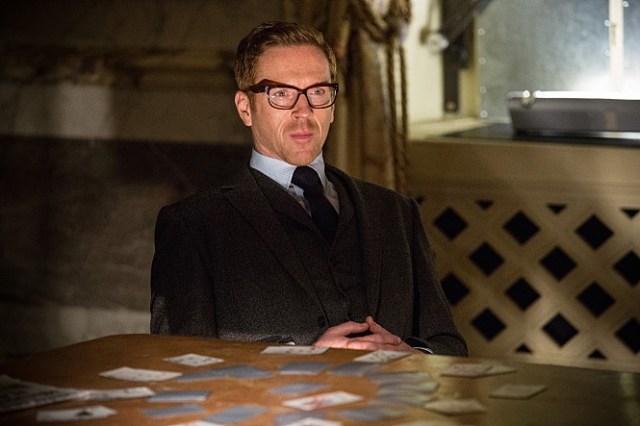
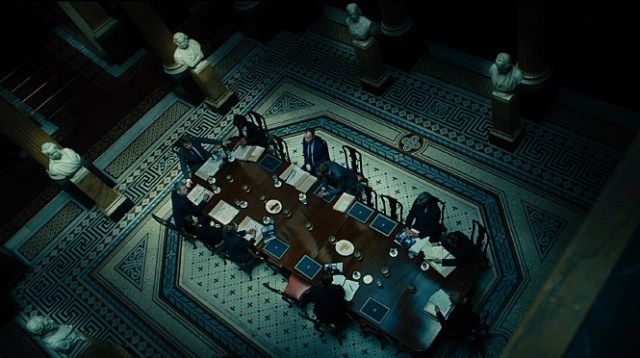
Because he comes to care about Dima and Dima’s family, Perry agrees to do that job, which is done faster than he expected. Once he returns to London along with Gail, he tries to contact with anyone to help him, and an MI6 official named Hector (Damian Lewis) soon enters the picture along with his two assistant agents. Thanks to that piece of information from Dima, Hector comes to learn of the hidden connection among Dima’s organization, British financial industry, and a bunch of corrupt British politicians, and he becomes quite determined to pursue this vast criminal connection.

ourkindoftraitor03

And that is how Perry and Gail find themselves getting far more involved in this situation. After persuaded by Hector, they ‘come across’ Dima in Paris as planned in advance, and Perry soon becomes a sort of middleman between Hector and Dima. While Hector doggedly asks for more information, Dima adamantly demands the guarantee of his and his family’s safety, and the situation becomes all the more precarious as the members of Dima’s organization begin to suspect Dima more than ever.

The movie tries to keep things rolling as providing several nice moments including a suspenseful sequence alternating between two different places in Berne, Swiss, but it never generates sufficient tension on the whole, and we come to observe its story and characters from the distance. While mostly faithful to le Carré’s novel, the adapted screenplay by Hossein Amini often falters as trying to sort out its rather murky plot, and it ultimately fizzles with its disappointing ending which feels contrived to say the least.

Overall, “Our Kind of Traitor” is not as satisfying as other recent movie adaptations of le Carré novels such as “Tinker Solider Tailor Spy” (2011) and “A Most Wanted Man” (2014), but this is not a total failure at all thanks to director Susanna White’s competent direction and her four main performers’ solid acting. As a guy who recently read le Carré’s novel, I recommend you to read the book instead, but you may be entertained by the movie if you do not expect much from it.

ourkindoftraitor04

Posted in Movies | Tagged , , | Leave a comment

Maborosi (1995) ☆☆☆1/2(3.5/4): The remarkable debut work from Hirokazu Kore-eda

maborosi05.jpg

“Maborosi”, the first feature film of Hirokazu Kore-eda, is a haunting work of serene beauty and aching sadness. Phlegmatically observing how its heroine keeps going on with her life which is irreversibly changed by one devastating incident, the movie intimately and thoughtfully depicts her somber emotional journey along the slow but perpetual passage of time, and it is often quite mesmerizing as presenting a number of sublime moments which powerfully remind us of those everlasting matters of life and death.

In the beginning, the movie opens with a seemingly simple sequence which eventually turns out to be what its heroine, Yumiko (Makiko Esumi), occasionally dreams of. When Yumiko was a young adolescent girl, her senile grandmother frequently tried to leave their family residence just because she wished to go to her hometown and then die there. On one day, she tried again, but she never came back this time, and Yumiko has been haunted by her very last moment with her grandmother. No matter how much Yumiko tried to stop her grandmother, grandmother adamantly insisted on going back to her hometown, and there was nothing Yumiko could do except watching her grandmother walking away from her.

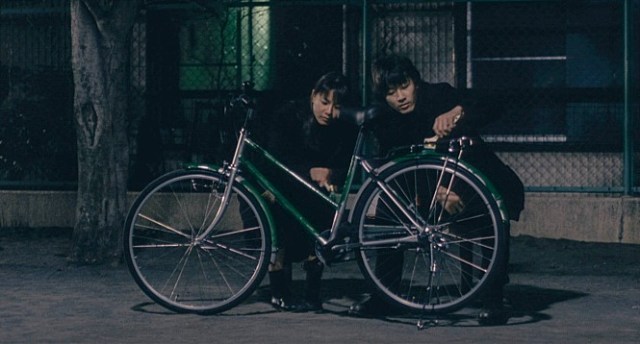
Around the end of this sequence, the movie shows us a bit about the growing relationship between Yumiko and a boy who lived near her family residence, and then we see them living together as a young married couple several years later. Although they live in one of tiny apartments above a tailor’s shop, Yumiko and Ikuo (Tadanobu Asano) are fine and happy with their little baby son, and we observe more of the mutual affection between them through several intimate scenes including the one involved with a stolen bicycle. Yes, it is wrong to steal that bicycle, but Ikuo and Yumiko feel amused and romantic as newly painting that bicycle together, and we come to smile a little as they joyously ride that bicycle together during one free evening.

maborosi06

However, Ikuo dies on one day, and this tragic happening devastates and disorients Yumiko. When she saw Ikuo for the last time during that afternoon, he looked all right as usual, but she is told that it is quite possible that her husband killed himself. For some unknown reason, he was walking on a railroad during that evening, and, according to a witness, he did not even try to save himself right before being hit by a train.

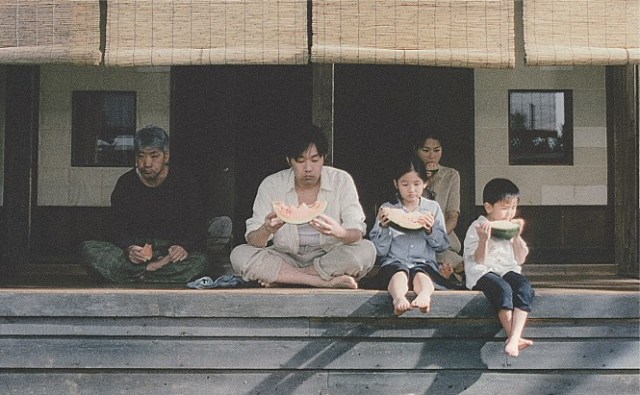
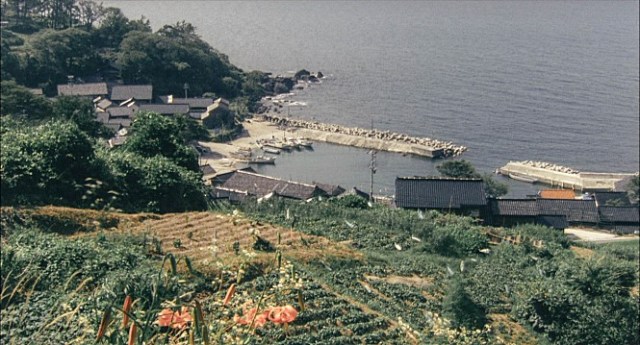
While her husband’s motive for suicide remains elusive, Yumiko carries on her life as receiving some help from others around her. Her mother stays with her for a while, and she takes care of Yumiko’s young son as Yumiko is still mired in her grief. A few years later, Yumiko is about to marry a widower around her age thanks to her neighbor’s considerate matchmaking, and she and her young son soon leave for a small fishing village where her new husband lives along with his father and the daughter from his previous marriage. Although the village does not look exactly cheery at first, it gradually becomes the second home for Yumiko and her young son as they get more accustomed to it, and her new husband and his family do not have any particular problem in accepting them as their new family members.

Leisurely moving from one small episodic moment to another, the movie slowly establishes its tranquil atmosphere surrounding its heroine and other characters around her. While usually sticking to its static position, cinematographer Masao Nakabori’s camera mostly observes characters and objects from the distance, but the subtle visual touches generated from precise scene composition constantly engage us, and we come to reflect more on small details in the film such as a certain little object left by Ikuo, which later functions as a painful reminder of what still lingers on Yumiko’s mind.

maborosi04

The overall meditative mood surrounding the film is reminiscent of the works of Yasujirō Ozu, who consistently focused on life and family throughout his exceptional filmmaking career filled with great works such as “Tokyo Story” (1953) and “Floating Weeds” (1959). Like Ozu, Kore-eda has steadily focused on the same themes as reflected by many of his notable works including “Still Walking” (2008) and “Like Father, Like Son” (2013), and their thoughtful sensitivity is not so far from Ozu’s works.

When I happened to watch “After Life” (1999) during one hot summer day of 2006, I did not know much about Kore-eda, but I was touched a lot by its quiet but powerful drama about afterlife, and that was the starting point for me. While I admired his stellar family drama films ranging from “Nobody knows” (2004) to “After the Storm” (2016), I also appreciated his minor works such as “Hana” (2006), “Air Doll” (2009), and “The Third Murder” (2017) to some degrees, and I was certainly delighted to see when he recently had another artistic/critical success thanks to his latest film “Shoplifters” (2018), which deservedly won the Palme d’Or award at the Cannes Film Festival several months ago.

Although more than 20 years have passed since it came out, “Maborosi”, which was adapted by Yoshihisa Ogita from Teru Miyamoto’ acclaimed short story of the same name, remains as an exceptional debut work. It is still captivating for me to watch how the movie eventually culminates to its emotional climax and then makes an effortless finishing touch in the end, and, considering its recent Blu-ray release in US, I think you should really watch this small gem as soon as possible.

Sidenote: The title of the movie means ‘illusionary light’ in Japanese.

maborosi03

Posted in Movies | Tagged , | 1 Comment

Disobedience (2017) ☆☆☆(3/4): A somber drama of love and faith

disobedience01

Good adult drama is something we do not encounter everyday, and I am glad to report to you that “Disobedience”, the latest film of Chilean filmmaker Sebastián Lelio, is an engaging adult drama to be appreciated for its mood, storytelling, and performance. While it may require you some patience due to its rather slow narrative pacing, it will gradually draw you into the complicated emotional circumstance of its three main characters who come to face the old feelings among them again, and you will come to care about them as understanding and emphasizing with their respective positions.

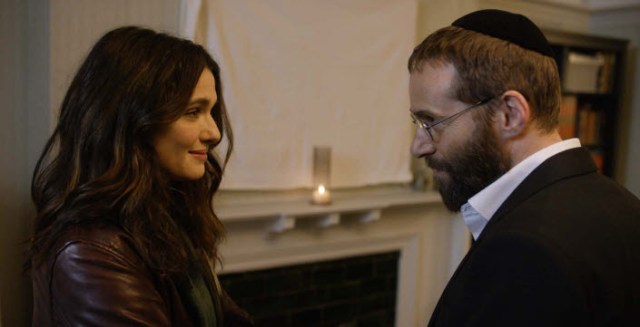
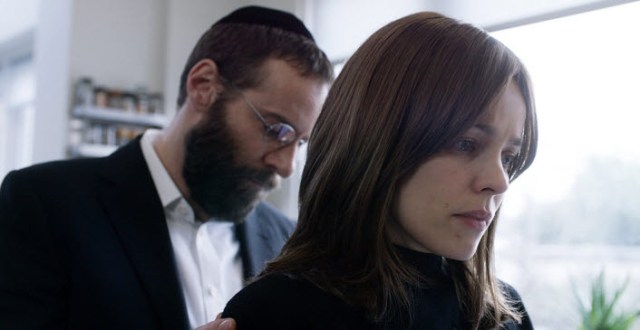
After the opening scene which effectively sets the overall tone of the film, we meet Ronit Krushka (Rachel Weisz), a woman who left her Orthodox Jewish community in Britain a long time ago and now works as a professional photographer in New York City. While she is working on her latest project associated with tattooed people, there comes a phone call for her, and she is notified of the death of her rabbi father. Although she and her father have been estranged from each other for years, she cannot help but feel morose and devastated, and she eventually decides to come back to her hometown.

When Ronit arrives in her hometown, she comes across Dovid (Alessandro Nivola), a childhood friend who has been like a son to Ronit’s father and is also expected to fill the empty position left by him. While surprised by her unexpected visit, Dovid welcomes Ronit nonetheless, and he even suggests that she should stay in his house during the mourning week for her father. It turns out that he married their friend Esti (Racheal McAdams), and Esti is certainly glad to have her old friend in their house.

disobedience02

As going through the mourning week along with Esti and Dovid, Ronit becomes more aware of the gap between her and her conservative hometown. With her modern attire and forthright attitude, she always draws attention from others, and there is a little amusing moment when she frankly tells others that she is not interested in marriage at all. When she later goes to see her uncle for checking whether her father left anything to her, her uncle does not welcome her much, and he flatly informs that there is nothing to inherit for her.

Meanwhile, the movie slowly reveals Ronit’s emotional matters in the past. While it turns out that Dovid has some old feeling toward Ronit, it is also revealed that Esti and Ronit once fell in love with each other, and the circumstance becomes quite awkward as Ronit and Esti come to see that they are still attracted to each other. Although she tries to stick to her faith, Esti cannot deny what has been repressed inside her for many years, and Ronit begins to consider living with her in New York City.

This is surely a familiar melodramatic situation, but the adapted screenplay by Lelio and his co-writer Rebecca Lenkiewicz, which is based on the novel of the same name by Naomi Alderman, handles its three main characters with care and respect, and all of them are presented as complex human characters to observe. While they cannot resist their mutual attraction, both Ronit and Esti care about Dovid, and Dovid, who knew about their relationship from the beginning, becomes more conflicted as he also cares a lot about them. He tries to deal with this difficult circumstance as much as he can, but then there comes an eventual moment when he cannot turn a blind eye to what is going on between Ronit and his wife.

disobedience04

Although being somber and restrained, the movie is filled with vivid mood and details to observe and appreciate. Cinematographer Danny Cohen did a good job of establishing grey somber atmosphere on the screen, and the restrained score by Matthew Herbert is effective as conveying what is being churned inside the main characters in the film. The cultural details in the movie are presented with considerable authenticity, and these realistic details further accentuate how its main characters are limited by the conservative environment surrounding them.

The movie is also supported well by a trio of strong performances. Rachel Weisz, who has steadily advanced since her Oscar-winning turn in “The Constant Gardener” (2005), naturally embodies her character right from her first scene in the film, and she and Rachel McAdams, who fully immerses herself in her character’s dowdy appearance, are effortless with their understated onscreen chemistry. As the third main part of the story, Alessandro Nivola, who drew my attention for the first time via his supporting turn in “Junebug” (2005), holds his own place between his co-stars, and he is excellent especially when his character silently struggles with his growing inner turmoil later in the story.

Overall, “Obedience” is another commendable work from Lelio, who has recently been more prominent thanks to the recent critical success of “A Fantastic Woman” (2017), which won the Best Foreign Language Film Oscar early in this year. Compared to that lively melodramatic film, “Obedience” is less spirited, but I was seldom bored at least thank to Lelio’s skillful direction and his main performers’ solid acting, and the movie, which is incidentally his first English language film, confirms again that he is a talented filmmaker who knows how to make a good adult drama. At this point, he is working on the American remake version of his previous film “Gloria” (2013), and I sincerely hope that will be another interesting work in his advancing career.

disobedience05

Posted in Movies | Tagged , , , | Leave a comment

Shoplifters (2018) ☆☆☆1/2 (3.5/4): As they live as a family

shoplifters01

Gentle and sensitive in its thoughtful storytelling, Japanese film “Shoplifters” is another masterful work from Hirokazu Kore-eda, one of the most humane filmmakers in our time. Calmly observing its main characters’ shabby but happy daily life, the movie generates numerous small but moving moments of understanding and empathy, and we are touched more as we come to know more about them later in the story.

The movie opens with a petty act of crime committed by Osamu (Lily Franky) and a young boy named Shota (Kairi Jō). They are in a supermarket, and we see Shota stealing several goods while Osamu watches out for any possibility of getting caught. Once their job is done, they happily go back to the shabby, modest residence of Hatsue (Kirin Kiki), an old lady who has lived with them and Osamu’s spouse Nobuyo (Sakura Ando) and an adolescent girl named Aki (Mayu Matsuoka).

On the way to their home, Osamu and Shota spot a little young girl left outside her nearby residence due to her mother’s domestic problem. Seeing that the girl needs some help and comfort, Osamu and Shota come to bring the girl to their residence, and Hatsue and the others in the residence do not mind at all sharing their warm dinner with her.

At first, the girl, named Yuri (Miyu Sasaki), is supposed to stay just for one night and then sent back to her home on the next day, but she come to stay in Hatsue’s residence, and Hatsue and the others in her residence do not object to that because Yuri does not seem to be willing to go back to her home. At one point, they notice scars on Yuri’s body, and that is more than enough for us to discern that she was not so happy at her home.

shoplifters03.jpg

While Yuri comes to stay in Hatsue’s residence longer than expected, we watch how Hatsue and the others in her residence respectively go through their daily life. Osamu has worked as a part-time worker at a construction site, but then he happens to get injured during his working time, so he cannot work outside for a while as depending on Nobuyo to some degree. She has worked in a laundry factory, and there is a brief amusing scene which shows that she does not mind stealing just like her spouse.

In case of Aki, she has earned her money at a place where she and other girls around her age casually sell their erotic images. Never sensationalizing what Aki and her colleagues do for their customers, the movie later gives us a nice moment of intimacy between Aki and a quiet young man who happens to be her latest customer. Although they do not talk much and Aki sticks to her rules, we sense something mutual being shared between them as they quietly spend their short private time together.

We also get to know a bit about the private life of Hatsue. While receiving the monthly annuity from her diseased ex-husband, she routinely visits the son from her ex-husband’s second marriage and his wife mainly for getting some extra money, and I and other audiences around me had some laughs as watching her courteously accepting the money from him.

Meanwhile, Shota gets closer to Juri as functioning as an older brother to her. He and Osamu show her how to steal things, and Juri soon comes to participate in their criminal activities. There is a little funny scene where they steal a couple of fishing rods, and there is also a small touching scene where Shota and Juri encounter an unexpected act of kindness.

shoplifters05

As Juri and the other main characters in the story continue to stay together, they look like a real family, and they even go to a beach together during one sunny summer day, but the movie never lets us overlook a big problem remaining in their circumstance. Not long after Juri began to stay in Hatsue’s residence, Hatsue and the others in her residence comes across a TV news report on Juri’s ‘disappearance’, and they all come to see that they are now in a very serious circumstance. Maybe they should send Juri back right now, but then they will surely be arrested for ‘kidnapping’ her.

Of course, the situation eventually becomes more serious for them after a couple of certain incidents happen later in the story, but the movie sticks to its low-key mood as before, and that leads to several quiet but powerful moments to remember. In the end, we come to realize how much the main characters have stuck together with love and care, and that is why the last scene of the movie feels particularly poignant.

Under Kore-eda’s deft direction, the main performers in the film give natural nuanced performances. While Lily Franky, who was wonderful in Kore-eda’s previous film “Like Father, Like Son” (2013), and Kiki Kirin, who appeared in Kore-eda’s several notable works including “After the Storm” (2016), are the most notable ones in the bunch, Sakura Ando and Mayu Matsuoka are also solid in their respective roles, and the same thing can be said about Kairi Jō and Mayu Matsuoka, who are effortless in their unadulterated acting.

Since he made his first feature film “Maborosi” (1995), Kore-eda has never disappointed us during last 23 years except a few minor missteps like “The Third Murder” (2017), and “Shoplifters”, which received the Palme d’Or award at the Cannes Film Festival in this May, shows him at the top of his mastery. After making “After the Storm”, he said he considered having some rest, but then he kept going on instead, and I certainly hope that he will continue to impress and touch us a lot as before.

shoplifters04

Posted in Movies | Tagged , , | 3 Comments

Mission: Impossible – Fallout (2018) ☆☆☆(3/4): Cruise in another impossible mission

MissionImpossibleFallout04.jpg

“Mission: Impossible – Fallout” did its job as spectacularly and exhilaratingly as we can expect from it. Again, the movie puts its hero into a series of breathtaking action sequences as he and his few trusted colleagues try to accomplish another impossible mission, and it is really fun to watch how deftly it operates within its established plot formula. Although a number of plot turns in the movie will probably not surprise you much if you have seen the previous films, the movie keeps finding ways to amuse and excite us, and the result is another solid entry in a franchise which has been maintained pretty well during last 22 years.

The movie begins with the latest mission of Ethan Hunt (Tom Cruise) and his IMF (Impossible Missions Force) team members Luther Stickell (Ving Rhames) and Benjamin “Benji” Dunn (Simon Pegg). They must prevent a very dangerous terrorist organization from getting plutonium and then making nuclear bombs, but then their operation goes wrong at the last minute, and the plutonium is snatched away from them in the end.

Fortunately, there later comes another chance to stop their opponent, but Hunt and his team face a little problem due to Erica Sloane (Angela Bassett), the new Director of the Central Intelligence Agency (CIA). She is not so pleased about Hunt and his team’s failure, so she has one of her agents included in Hunt’s team despite the protest from Alan Hunley (Alec Baldwin), Sloane’s predecessor who has been the new IMF Secretary since what happened in “Mission: Impossible – the Rogue Nation” (2015).

MissionImpossibleFallout03

The agent in question is August Walker (Henry Cavill), and Hunt does not like much him for an understandable reason, but he agrees to work along with Walker anyway because he must get the mission accomplished as soon as possible. They soon get on a military cargo airplane together, and then they jump from the airplane while it is quite high above a certain spot in Paris, where they are going to approach to a powerful black market arms dealer who may lead them to that stolen plutonium.

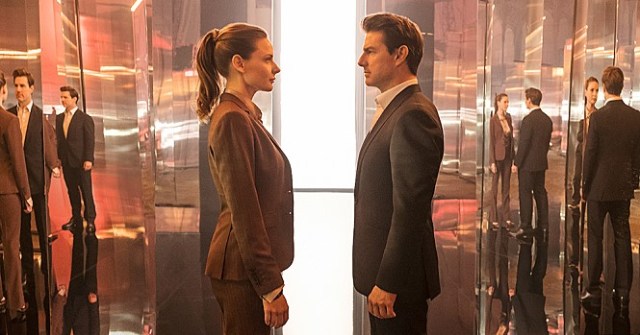
However, not so surprisingly, the situation becomes very complicated for Hunt and his team members. When Hunt finally succeeds in approaching to the arms dealer despite a few setbacks, the arms dealer demands him to accomplish a mission he is not so eager to accept. Furthermore, he comes across Ilsa Faust (Rebecca Ferguson), a former MI6 agent who previously worked with Hunt in “Mission: Impossible – the Rogue Nation” and turns out to have her own small mission to be accomplished.

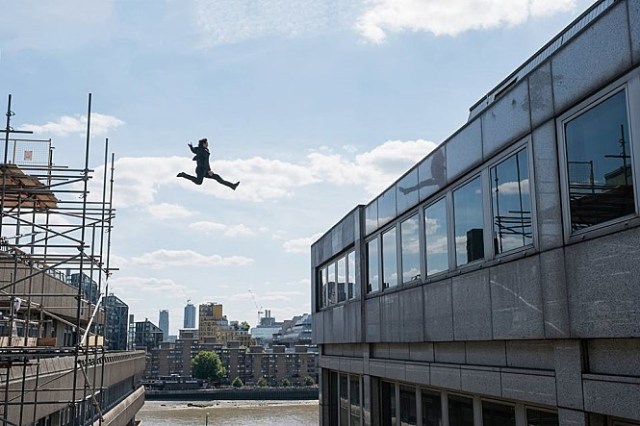
What follows after that narrative point is several big action sequences, and they are effectively handled under director/writer Christopher McQuarrie’s competent direction. As shown from “Mission: Impossible – the Rogue Nation”, McQuarrie is a skillful filmmaker who knows how to make good action scenes, and that is particularly exemplified well by a heart-pounding action sequence unfolded on streets and alleys of Paris. Lots of things rapidly happen on the screen during this sequence, but it is never confusing for us at all thanks to the brisk, efficient editing by Eddie Hamilton, and the movie ably dials up and down its level of tension while never overlooking what is being at stake for Hunt and his team members.

MissionImpossibleFallout01

And Tom Cruise shows us again that he is one of the most dependable action movie stars in our time. Although he recently had his 56th birthday, he willingly hurls himself into realistic physical actions as usual, and his diligent effort in the film is more than enough for us to forgive his recent disastrous turn in “The Mummy” (2017). He is surely back in his element here in this film, and, as far as I can see from the movie, it looks like he will be able to make one or two more sequels in the future.

Cruise is also supported well by the other performers surrounding him. While Simon Pegg and Ving Rhames are reliable as before, Rebecca Ferguson, who was simply fantastic in “Mission: Impossible – the Rogue Nation”, adds a touch of class to the movie, and Henry Cavill, Alec Baldwin, Angela Bassett, Vanessa Kirby, Sean Harris, and Michelle Monaghan function well in their respective supporting roles.

As entertained a lot by “Mission: Impossible – Fallout”, I was reminded again of how the franchise has steadily improved itself during last 22 years. When the first film came out, it just looked like another successful film in Cruise’s career, but then the franchise gradually solidifies itself with two following sequels, and then it surprised us with the bigger success of “Mission: Impossible – Ghost Protocol” (2011) and “Mission: Impossible – the Rogue Nation”, which is the best of the bunch in my insignificant opinion.

Mainly because I gave “Mission: Impossible – the Rogue Nation” only three stars and its accomplishment is not surpassed by “Mission: Impossible – Fallout”, so I have no choice but to give the latter three stars, but I must emphasize to you all that, so far, “Mission: Impossible – Fallout” is the best action film of this summer season, and I tell you one little thing about how I watched the movie today. When I walked into a screening room right before the movie began, I was warned that the air conditioner is broken, but I soon came to forget that while being enthralled along with many other audiences around me. Folks, that is what a good blockbuster film can do.

MissionImpossibleFallout02

Posted in Movies | Tagged , | 1 Comment

Illang: The Wolf Brigade (2018) ☆☆(2/4): Heavy is the body that wears the armour

illangthewolfbrigade01

Watching South Korean film “Illang: the Wolf Brigade” was a grim and ponderous experience. Although there are a number of well-made action sequences, the movie does not provide enough fun and interest to hold my attention despite its supposedly intriguing story premise, and I only came to observe how it solemnly trudges along its convoluted plot, about which I did not care much as feeling more confused and distant to what was shown on the screen.

During its prologue part, the movie gives us a brief explanation of its near-future background. In 2024, South and North Korea decided to be unified for their mutual political benefit and safety, so they have gone through the preparation stage for their unification for next 5 years, but this process has been riddled with problems from both inside and outside. While it is not so welcomed by several powerful countries including US and China, it is also strongly opposed by many South Koreans, and this local anti-unification movement leads to the formation of a terrorist group called “Sect”.

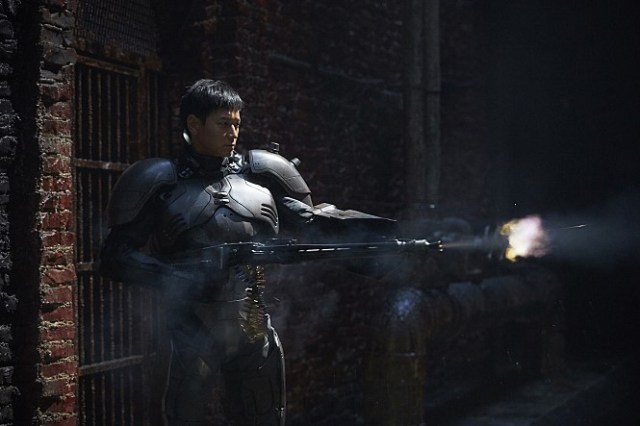
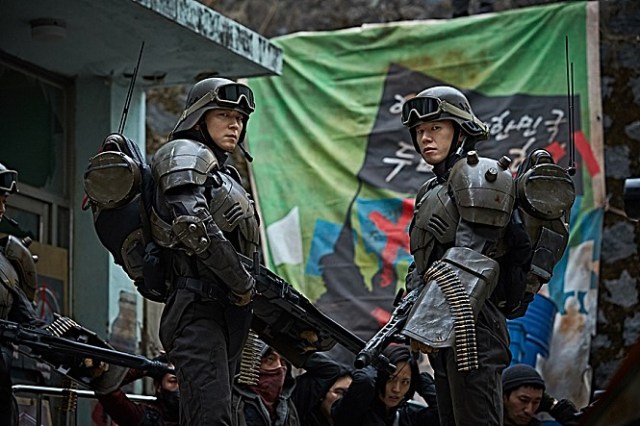
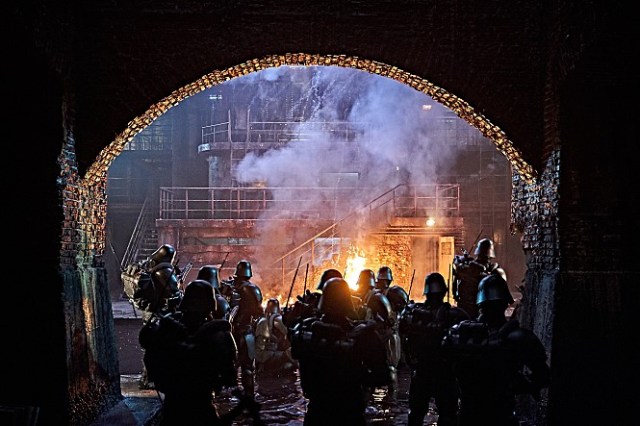
To fight against this terrorist group which seems quite willing to do anything for its political purpose, the South Korean police comes to launch a special unit known as Wolf Brigade. While they look heavy and ponderous in their metallic armour which may remind you of those stormtroopers in Star Wars movies, these special unit soldiers can efficiently and ruthlessly eliminate targets as ordered, and they do not even hesitate at all even when the targets to be eliminated happen to be a group of young school girls.
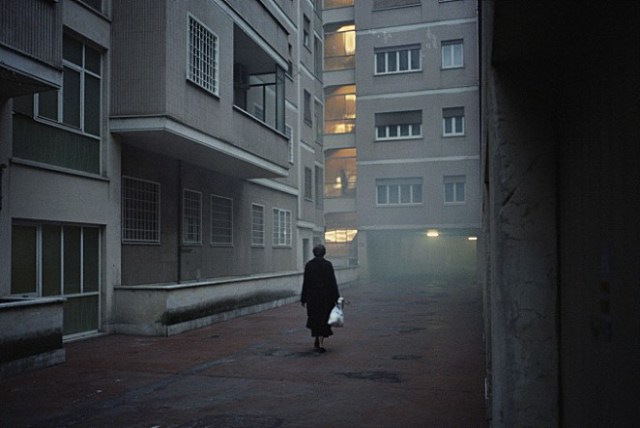
After that shocking moment, the movie moves forward to 5 years later. While the unification process is being near the end, the South Korean society remains unstable as before, and we see the South Korean police trying to handle another big demonstration held in the middle of Seoul. Once the situation becomes far more violent due to several Sect members, Wolf Brigade is brought into the scene, and the situation soon comes to the end as the unit members systemically wipe out a bunch of Sect members.

illangthewolfbrigade04

During that operation, Im Joong-kyung (Gang Dong-won), one of the unit members, happens to kill a girl who tries to detonate a bomb she is carrying. Although this is certainly not his first killing, it looks like something inside him is shaken by this incident, and he does not hesitate when his former colleague Han Sang-woo (Kim Mu-yeol), who has been the deputy head of the public security department since he left the unit, suggests that he should meet the older sister of that dead girl.

Her name is Lee Yoon-hee (Han Hyo-joo), and she does not show much anger or sorrow over her sister’s death because, well, life has already been hard for her since her sister joined Sect. As spending more time with Yoon-hee, Joong-kyung comes to know more about her and her dead sister, and we get a rather blatantly symbolic scene where she shows more of her feelings to him via the variation of a certain well-known fairy tale which is involved with a big bad wolf.

Meanwhile, the circumstance surrounding Joong-kyung and Yoon-hee turns out to be more complicated than it seems on the surface. While the head of the public security department wants to undermine Wolf Brigade by any means necessary, the chief of Wolf Brigade tries to protect his unit as much as he can, and it is not much of a spoiler to tell you that Joong-kyung and Yoon-hee later find themselves in a very serious danger because of this growing conflict between Wolf Brigade and the public security department.

As Joong-kyung and Yoon-hee struggle to survive this perilous circumstance of theirs, the movie gives us several technically impressive moments, and its technical crew members deserve some praises for their good efforts. I like a relentless action sequence unfolded in and around the Namsan Tower in Seoul, and I also appreciated the palpably gloomy atmosphere surrounding the characters in the film, which is effectively established from the start thanks to cinematographer Lee Mo-gae.

illangthewolfbrigade06

However, the movie failed to engage me mainly due to its deficient narrative and weak characterization. It is often too murky and disorienting in its uneven narrative, and most of its characters are more or less than colorless plot elements to be moved along its plot. In addition, it fails to generate any tangible sense of emotional connection between Joong-kyung and Yoon-hee, and that is why its melodramatic ending does not work at all.

Kang Dong-won surely tries very hard in his decidedly stoic performance, but, alas, his character is flat and uninteresting from the beginning, and there is not much to do for him except looking intense and ambiguous. As a result, we cannot feel much of his presence when he later goes into a full action mode while fully wearing that metallic armour, and it is really monotonous to watch him mechanically eliminating his numerous opponents one by one during that sequence.

As another main part of the movie, Han Hyo-joo, who was fantastic as the strong heroine of “Cold Eyes” (2013), is woefully under-utilized here, and the same thing can be said about other notable supporting performers in the film. While Kim Mu-yeol looks as treacherous as required, Jung Woo-sung looks as brooding as demanded, and Han Ye-ri manages to bring some spirit and personality to her small supporting role.

In conclusion, “Illang: the Wolf Brigade” is a major letdown compared to director Kim Ji-woon’s notable works such as “A Tale of Two Sisters” (2003), “The Good, the Bad, the Weird” (2008), and “The Age of Shadows” (2016). I was quite disappointed as not getting much fun during my viewing, and I must confess that the movie was quickly faded away from my mind as I subsequently watched “Mission: Impossible – Fallout” (2018), which is a far better action film in my trivial opinion.

Oh, by the way, the movie is in fact a live-action adaptation of Mamoru Oshii’s acclaimed animated film “Jin-Roh: The Wolf Brigade” (1999). I have not watched Oshii’s animated film yet, but now I am very willing to check it out for comparison, and I will probably get more fun from it considering how animated films are usually more stylish and atmospheric than live action films. Maybe you should watch it instead of its mediocre live-action movie version.

illangthewolfbrigade07

Posted in Movies | Tagged , , | Leave a comment

The Tale (2018) ☆☆☆(3/4): How differently she remembers

thetale01

Memory can be deceptive at times, and HBO film “The Tale” explorers that tricky aspect through its heroine’s painful emotional journey into her past. As she comes to realize how unreliable her memories are, she comes to see more of what she has unconsciously overlooked for many years, and the movie is alternatively sensitive and disturbing in its gradual revelation of her hidden psychological scar which turns out to be a lot more devastating than expected.

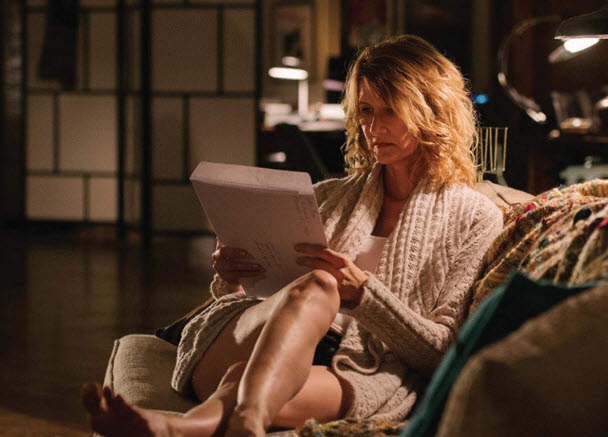
As stated at its beginning, the movie is based on the real-life story of director/writer Jennifer Fox, who is played by Laura Dern in the film. As shown from the opening scene of the movie, Fox is a documentarian who is also a college professor teaching documentary filmmaking, and she is working on her latest project when her mother Nadine (Ellen Burnstyn) suddenly calls her for a very important personal matter. Nadine recently discovered a short story which was written by her daughter many years ago, and she was quite upset because of what is implied in that short story.

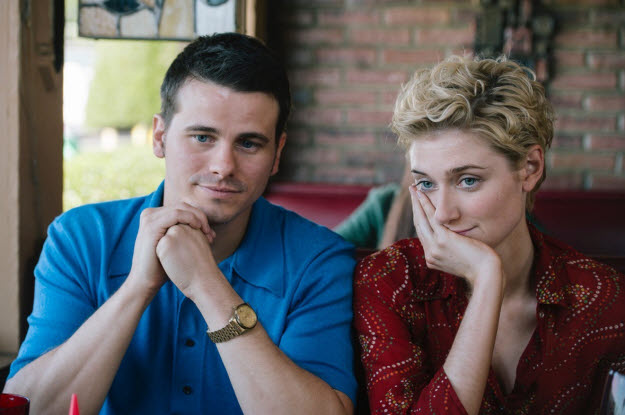
Fox is rather baffled by her mother’s reaction, because, to her, the short story in question is just the innocent fictional version of her past relationship with two adults who were quite nice and generous to her. When she was 13, Fox was sent to a summer ranch camp run by “Mrs. G” (Elizabeth Debicki), and this charismatic married woman introduced Fox and other girls in her summer ranch camp to Bill Allens (Jason Ritter), a handsome divorced guy who turned out to be Mrs. G’s secret lover. As far as Fox can remember, she was free and happy under the guidance of these two adults, and she remained very close to them even after that summer was over.

Through one flashback scene, the movie shows us how much young Fox, played by Jessica Sarah Flaum at this point, enjoyed that summertime in Mrs. G’s ranch. Looking more confident than the other girls in the ranch, Fox was Mrs. G’s favorite student, and Mrs. G was willing to show many things including how to make a perfect apple pie.

thetale04

However, this supposedly pleasant memory begins to crack as Fox looks closer into her past. When she meets a woman who was one of the girls in the ranch during that time, the woman remembers many things differently, and she points out to Fox that Fox was far less confident than other girls in the ranch. When she later checks old photographs along with her mother, Fox is surprised to discover that her 13-year-old self looks quite younger than she remembers, and she naturally comes to have lots of doubts on her memory.

While trying to locate Mrs. G and Allens, Fox delves further into the remains of her past, and her search for the truth is intercut with the following series of flashback scenes. Played by Isabelle Nélisse from this point, young Fox surely looks younger in her immature status, and her relationship with Mrs. G and Allens looks quite different to us as a result. It is very clear that these two adults manipulated and then exploited young Fox, and there later comes a very uncomfortable scene where Allens approaches too close to young Fox while they happen to be together alone in his house. The movie thankfully handles this unpleasant moment with considerable restraint, and I was certainly relieved to learn later that they used a body double when this scene was shot.

As reflected by the opening sentence of her short story, this inappropriate relationship has been regarded as something romantic and beautiful in Fox’s viewpoint, but then she comes to realize how she is not so different from child sexual abuse victims. Like many of them, she has been in the denial of how she was abused and exploited, and that short story of hers was her own way of surviving those traumatizing moments from her relationship with Allens and Mrs. G.

thetale03

Although it sometimes feels disorienting in its unconventional storytelling approach, the movie is firmly held well together by two strong performances at its center. Dern, whose acting career is going through another peak after her Oscar-nominated supporting turn in “Wild” (2014), is terrific as a woman who gradually awakens to the disturbing aspect of her unforgettable adolescent experience, and she ably conveys to us her character’s emotional state even when she does not say much. Nélisse is believable as the other half of the movie, and she is particularly good when her character finally decides that enough is enough and then does what she should have done earlier.

The supporting performers in the movie are solid on the whole. While Elizabeth Debicki, who has been more prominent since her supporting turn in “The Great Gatsby” (2013), is effective in her increasingly unlikable role, Frances Conroy is equally good as older Mrs. G., and Jason Ritter is suitably despicable with his jolly façade. As Fox’s regretting mother, Ellen Burstyn has a small poignant moment with Dern when their characters happen to have an honest private conversation between them, and Common and late John Heard fill their respective functional roles as required.

“The Tale” is not entirely without weak aspects, and it stumbles a little during the finale, but it is still an interesting personal drama to be admired and appreciated. Yes, it is surely not easy to watch at times due to its subject, but there are several emotionally powerful moments including its very last shot, and I assure you that they will linger on your mind for a long time after the movie is over.

thetale02

Posted in Movies | Tagged , | Leave a comment

Hannah (2017) ☆☆(2/4): Drab, dreary, and hollow

hannah01

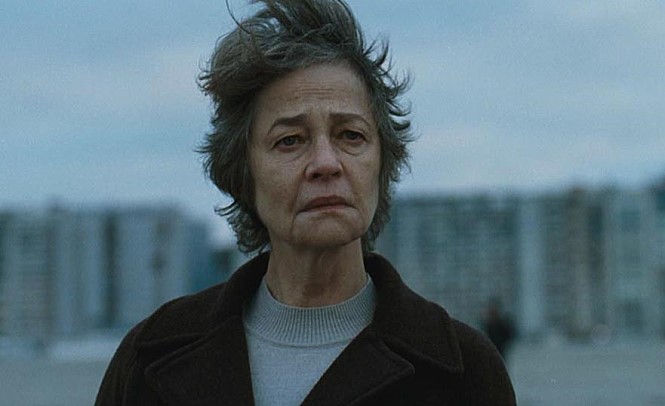
It took some time for me to appreciate the distinctive presence of Charlotte Rampling. As far as I remember, I noticed her for the first time through her supporting turn in “Angel Heart” (1987), and then I came to see more of her considerable talent through several notable films including “The Night Porter” (1974), “Farewell, My Lovely” (1975), and “The Verdict” (1982). As getting gracefully older with her edgy beauty and charisma, she became all the more interesting than before, and I certainly enjoyed watching her in a number of recent notable works such as “Never Let Me Go” (2010), “Melancholia” (2011), and “45 Years” (2015), for which she was belatedly nominated for Best Actress Oscar.

In case of “Hannah”, for which she won the Best Actress award at the Venice Film Festival in last year, Rampling did everything she was demanded to do, and she deserves praises for her committed performance which reminds us again of what a compelling actress she is, but, unfortunately, the movie is no more than a mere showcase of her talent. Decidedly drab and dreary in its austere storytelling approach, the movie does not provide much substance in terms of story and characters, and even Rampling’s admirable effort cannot compensate much for its frustratingly hollow impression.

In the movie, Rampling plays an old married woman named Hannah, and the first half of the movie shows us how her melancholic daily life becomes more desolate after her husband is incarcerated in a prison for a crime which is seldom discussed in the film. During their meeting in the prison, her husband says he is not guilty, but there later comes a moment when Hannah happens to discover a certain envelope hidden in their apartment. The movie does not show or tell us at all what is in the envelope, but it seems the envelope contains an incriminating evidence against her husband, so Hannah gets rid of the envelope once she checks its content.

hannah03

Living only with a pet dog in her apartment, Hannah feels increasingly lonely and isolated, and she is sometimes disturbed by some of her neighbors in the apartment building. At one point, some woman knocks on the front door of the apartment, and that woman seems to want a serious conversation with Hannah, but the movie never clarifies that woman’s motive while merely implying that it is involved with the crime of Hannah’s husband. When Hannah notices that water is leaking from the ceiling, she naturally goes up to the apartment right above hers, but she only comes to discover a rather confusing and unpleasant situation, and you will be probably as baffled as I was during my viewing.

Meanwhile, she continues to work as usual in a slick modern house belonging to an affluent middle-class family. We see her cleaning the house, and we also come to gather that she is close to a young blind kid living in the house, though the movie never lets us have any clear understanding of her relationship with that kid. There is actually a small intimate scene where she comforts him through telling a story, but, to our frustration, that is all for us to observe.

In addition, Hannah attends an acting class along with several other people, and you may get little amusement from their teacher’s rather unconventional teaching method. It looks like they are practicing with some play, but the movie does not delve much into what they are handling. We often see Hannah and other students practicing together, but we never get any clear idea of what they are doing, and this is often quite frustrating to watch although we are later served with a brief but nice scene where Hannah demonstrates her good physical acting in front of others.

hannah04

Around the midpoint of the movie, we get to know a bit about Hannah’s estranged relationship with her son and her son’s family. When her grandson’s birthday comes, Hannah goes to her son’s house with a cake and a present, but her son does not welcome her much for a reason revealed later in the movie, and he also prevents from her entering his house. After this painful moment, the movie cuts to a scene which shows Hannah quite saddened and devastated by her son’s rejection, and Rampling deftly handles her character’s irrepressible emotions in front of the camera.

All these and other elements in the movie could add up to something powerful enough to engage us, but the screenplay by director Andrea Pallaoro and his co-writer Orlando Tirado adamantly sticks to its barebone narrative without giving us anything to hold on. Hannah and other substantial characters in the film are never fully developed as human characters to interest us, and the movie does not even try to generate enough narrative momentum. As a result, we come to observe Hannah’s ongoing predicament from the distance without much care, and we accordingly become more aware of Rampling’s acting instead.

Overall, “Hannah” is one of the most disappointing movie experiences I had during this year, but it is not a total dud at least for a few reasons including Rampling’s performance, which is its saving grace in my inconsequential opinion. As shown from its smooth camera work and considerate scene composition, the technical aspects of the movie are commendable on the whole, and they certainly show that Pallaoro is a talented filmmaker. I can only hope that he will soon move onto something better than this bland misfire.

hannah02

Posted in Movies | Tagged , | Leave a comment