Adulthood (2017) ☆☆☆1/2(3.5/4): A girl and her con man uncle

adulthood01

South Korean film “Adulthood” is a simple but charming comedy drama to be cherished. Alternatively humorous and sensitive in its low-key comic approach, the movie generates a number of nice intimate scenes to enjoy, and it is also anchored well by the solid acting from its main cast members. The overall result may be modest on the surface, but it will linger on your mind through its dexterous storytelling and engaging performance, and I am willing to revisit the film someday for appreciating it more.

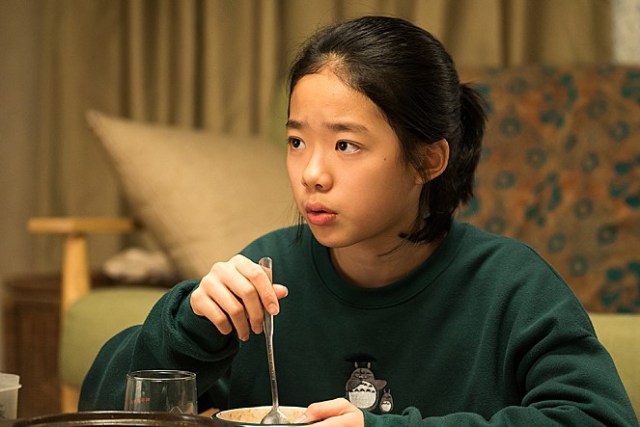
The movie opens with the encounter between its two main characters. When Kyeong-eon (Lee Jae-in), a 14-year-old girl whose father recently passed away, is attending her father’s funeral along with a few other people, a man named Jae-min (Um Tae-goo) comes to her, and he tells her that he is her father’s younger brother. Because Jae-min is a total stranger to her, Kyeong-eon is naturally suspicious of him, but he is indeed her real uncle as shown from an old family photograph later, and he soon becomes her legal guardian as her mother gave up her custody when she divorced her father a long time ago.

Unfortunately, Kyeong-eon’s initial suspicion turns out to be true not long after that point. When she finds that Jae-min bilks her father’s insurance money, he is already gone with the insurance money, but she manages to track him down and then confronts him in the end. While certainly caught off guard by this, Jae-min cannot give the money back to her because it was already used for paying off his debt, and Kyeong-eon has no choice but to join his next scam as she really needs money right now due to the increased deposit money for the lease of her home.

The target of Jae-min’s next scam is Jeom-hee (Seo Jung-yeon), an affluent single woman who has successfully run a local pharmacy. Although she is not exactly an amiable lady, Jae-min succeeds in approaching a bit closer to her via a small act of kindness, and then he introduces her to Kyeong-eon, who agrees to be his ‘daughter’ for his scam. While it is still difficult for Jae-min to get closer to Jeon-hee, it looks like Kyeong-eon touches somewhere inside Jeon-hee’s heart, and that is how these three main characters come to spend more time together than expected.

adulthood03

Now the movie will probably remind you of other similar movies such as “Paper Moon” (1973), but it leisurely goes its own way while never hurrying itself, and we come to focus more on what is being exchanged among its three main characters. The relationship between Kyeong-eon and Jae-min gradually grows as they get to know each other bit by bit, but Kyeong-eon also becomes conflicted about their scam as she comes to care a lot about Jeom-hee especially after one private moment between them. Behind her rather frigid façade, Jeom-hee has been hiding her old emotional wound, and we come to understand why she willingly opened her heart to Kyeong-eon from the beginning.

Steadily maintaining its understated sense of humor, the screenplay by director Kim In-seon and her co-writer Park Geun-beum deftly balances itself between comedy and drama. When the situation becomes more serious for its main characters later in the story, the movie wisely avoids unnecessary melodrama, and I particularly like how it succinctly and effortlessly presents its final scene, which feels quite sweet and touching as I think more about it now.

Under Kim’s confident direction, the main performers in the movie are entertaining to watch in their respective roles. Um Tae-goo, who recently drew my attention via his intense supporting role in “The Age of Shadows” (2016), is effective as your average small-time crook, and he is fun to watch whenever he shows his character’s human flaws. Right from his first appearance, we can clearly see that Jae-min is not a very good person at all, but we cannot help but amused as watching him clumsily working on Jeom-hee, and we eventually come to like him to some degrees.

adulthood04

On the opposite, Lee Jae-in, a young performer who previously appeared in “I Can Speak” (2017), is simply fabulous in her unadorned mix of precociousness and naiveté. Although being surely smart, feisty, and resourceful, Kyeong-eon is also innocent and vulnerable just like many girls around her age, and Lee did a commendable job of embodying these contradicting aspects together while never making any misstep throughout the film.

As the third main part of the movie, Seo Jung-yeon holds her own place well between her two co-performers. Thanks to her nuanced performance, Jeom-hee comes to us as another interesting character to observe in the movie, and Seo is terrific during a certain crucial scene between her character and Jae-min. In case of other supporting performers in the film, Kim Hee-chang is amusing as Jae-min’s fellow con man, and I was delighted to see notable performers including Kim Sae-byuk and Hwang Jung-min, who was unforgettable in “Jesus Hospital” (2011).

“Adulthood” is a small nice surprise for me. When I heard about it for the first time a few weeks ago, I did not expect much from it, but then I heard some good words about it, and then I found myself impressed a lot during my viewing. In my trivial opinion, this is one of the best South Korean films of this year, and I sincerely hope it will be appreciated by more audiences out there.
adulthood02

Posted in Movies | Tagged , , , , | 1 Comment

Whitney (2018) ☆☆☆(3/4): The life and career of Whitney Houston

whitney01

Documentary film “Whitney” gives us a close look at the life and career of Whitney Houston, a famous singer who has been remembered for not only her meteoric rise but also the following downward spiral of which she could never get out in the end. To be frank with you, I do not know much about her except that famous song in “The Bodyguard” (1992) and the public humiliation involved with her drug addiction, so watching the documentary was an enlightening experience for me, and I came to feel sorry for her more than before as wondering whether she could have risen again if it had been not for her tragic death in February 2012.

Like many African American female singers of her generation, Houston began to distinguish herself as singing at the local church of her neighborhood in Newark, New Jersey, and she also grew up in an ideal background for nurturing her talent. Her father John Russell Houston Jr., who was a prominent civil servant in the city, and her mother Cissy Houston, who was a singer who mainly worked as a background singer for many famous singers such as Aretha Franklin, provided their daughter and other children a nice middle-class environment, and Cissy was quite determined to make her daughter become a famous singer she never was. She and Houston frequently clashed with each other as she pushed her daughter harder, but it is undeniable that Houston’s natural talent was enhanced further by her mother’s teaching. Several years later, there came a moment for her big break when Cissy deliberately had her daughter perform at a club instead of her during one evening, and Houston surely impressed everyone in the club during that performance.

This considerable public success of hers led to getting a contract with Arista Records, and Houston kept going further after making her first TV appearance in 1983. With a series of big hit songs during next several years, she soon reached to the top of her field, and then she had two defining moments for her career. In 1991, she performed the national anthem during the Super Bowl, and her distinctive rendition of the national anthem mesmerized millions of people watching her on TV. In the next year, she tried acting in “The Bodyguard”, and its box office success and her stunning performance of Dolly Parton’s song “I’ll Always Love You” in the movie further boosted her career.

whitney02

However, her career slowly began to go down due to a number of personal problems. It was no secret among people close to Houston that she was quite close to her friend Robyn Crawford, and Houston’s family members did not like Crawford much for her considerable influence on Houston. As frankly shown in the documentary, most of them depended a lot on Houston in one way or another, and Crawford was certainly a disagreeable factor to them.

Meanwhile, Houston met Bobby Brown, a popular singer who had led his own successful career. After romantically involved with each other for a while, they eventually married in 1992, but their relationship got deteriorated as Houston’s career became far more successful than Brown’s, and that led to numerous troubles in their married life. Brown frequently caused public scandals as becoming more bitter about being regarded as “Mister Houston”, but Houston tried to maintain their marriage, and she even let Crawford walk away from her even though Crawford had been the most dependable figure in her life besides her mother.

And her drug addiction problem continued to get worse and worse. Around the early 2000s, Houston could not hide her problem anymore as everyone was shocked by how much she looked different than before, and then she had an embarrassing moment when she admitted her problem during her TV interview with Diane Sawyer. While quickly becoming a target for cruel gossips and jokes, she went down further into her pit of addiction, and things became gloomier for her after she and Brown came to divorce in 2007. She tried to make a comeback a few years later, but that attempt only resulted in the most disastrous moment in her career, and she also became virtually penniless.

whitney05

The documentary provides some explanation on Houston’s personal demons. According to one interviewee in the documentary, Houston was sexually abused by one of her relatives when she was very young, and that might be the origin of her self-destructive behaviors. Although nothing is confirmed, you will probably be surprised to learn who is allegedly responsible for that sexual abuse.

Anyway, Houston tried to restore her career around the early 2010s while also trying to deal with her drug addiction. It seemed she would get the second chance via her solid supporting turn in “Sparkle” (2011), but, alas, she died at the age of 48 not long after the shooting of that movie is over, and her daughter Bobbi Kristina Brown, who also struggled with drug addiction as much as her mother, died under a similar circumstance three years later.

“Whitney” is directed by Kevin Macdonald, who won an Oscar for “One Day in September” (1999) and made several admirable documentary films such as “Touching the Void” (2003) and “Marley” (2012). Although it does not reach the harrowing emotional level of Asif Kapadia’s Oscar-winning documentary “Amy” (2015), the documentary is mostly engaging on the whole in its deft mix of interview and archival footage clips, and it does a commendable job of presenting Houston as a talented artist and spirited human being. She was indeed a wonderful singer, and it is a shame that she left us too early.

whitney04

Posted in Movies | Tagged , , , , | Leave a comment

Tully (2018) ☆☆☆(3/4): A mother and her odd nanny

tully01.jpg

Raising kids is often quite a demanding task, and “Tully” honestly and incisively illuminates that undeniable fact via its sharp wit and thoughtful sensitivity. As we are frequently amused by its many humorous moments which are both funny and truthful, we become gradually immersed into its struggling heroine’s daily life, and we come to observe her reality with more understanding and empathy when her story takes an unexpected left turn during the last act.

In the beginning, the movie shows us one of the daily routines of Marlo (Charlize Theron), a married woman who has been daunted a lot by her many domestic tasks. While her 8-year-old daughter Sarah (Lia Frankland) is your average sweet girl, her 6-year-old son Jonah (Asher Miles Fallica) frequently causes troubles and headaches due to a behavioral problem which may be involved with autism spectrum, and now she has to prepare for the upcoming birth of her third kid. Her husband Drew (Ron Livingston) is aware of how much she struggles everyday, but he is frequently absent due to his busy work, and all he can do at present is providing a little support and consolation to her from time to time.

After Marlo finally gives birth to her third child, the situation becomes more burdensome and stressful than before, and there is a hurtfully hilarious sequence consisting of her repeated routines revolving around her baby. As busily taking care of her baby, she constantly suffers from stress and sleep deprivation, and, not so surprisingly, there eventually comes the breaking point when she happens to argue with Jonah’s kindergarten teacher on one day.

tully02

And that is when Marlo is reminded of what her brother Craig (Mark Duplass) previously offered to her as a gift. According to him, there is an excellent nanny who can take care of her baby instead of her at night, and he was willing to hire that nanny for his sister, but she flatly rejected it because she thought she could handle the situation for herself. Fortunately, he gave her a calling card at that time, so Marlo soon comes to contact with that nanny, who instantly comes to Marlo’s suburban house.

She is a young woman named Tully (Mackenzie Davis), and Marlo comes to like her a lot as seeing how deftly she does her job in spite of being rather odd and quirky. While quite knowledgeable about many different things, Tully sincerely handles Marlo’s baby with lots of care and attention, and Marlo soon begins to enjoy the result from hiring Tully. For instance, she comes to have a good rest which she has always yearned for, and things surely look better than before after she has several hours of uninterrupted sleep.

In addition to taking care of Marlo’s baby, Tully also handles a number of other domestic matters. Besides cleaning Marlo’s house, she makes a bunch of cupcakes for Jonah and other kids in his kindergarten, and there is an amusing scene where she and Marlo come to do something special (and kinky) for Drew, who is understandably surprised at first but is quite satisfied as shown from the following morning scene.

As Tully becomes more indispensable for her, Marlo talks more with her, and their private conversations usually revolve around themselves. As watching how confident Tully is, Marlo cannot help but be reminded of how she was before her married life, and Tully later suggests that they should go together to a Brooklyn neighborhood area where Marlo once lived along with her former best friend.

tully03

It is around that narrative point that Diablo Cody’s screenplay suddenly throws a moment of revelation at us. Some of you may not like this abrupt change, but I think it works on the whole because of what has been carefully and thoughtfully established under the skillful direction of director Jason Reitman, who previously collaborated with Cody in “Juno” (2007) and “Young Adult” (2011). While it is less idiosyncratic than “Juno” in comparison, Cody’s screenplay is balanced well between comedy and drama as occasionally wielding a snarky sense of humor, and she and Reitman did a commendable job of making genuine emotional moments to touch us in the end.

And the movie is anchored well by two excellent performances. Charlize Theron, who was utterly fearless as the incorrigibly unlikable heroine of “Young Adult”, thoroughly embodies her character right from her first scene, and the result is another good work from this very talented actress who has steadily advanced since her unforgettable Oscar-winning turn “Monster” (2003). Mackenzie Davis, who played a minor supporting character in “Blade Runner 2049” (2018), is equally fine as effortlessly exuding her natural charm, and she and Theron always generate engaging moments to watch whenever they are together on the screen. In case of other performers in the film, Asher Miles Fallica and Lia Frankland are as unadorned as we can expect from good young performers, and Ron Livingston and Mark Duplass are also solid in their respective supporting roles.

Overall, “Tully” is a funny, touching movie about motherhood, and Reitman, Cody, and their two lead performers deserve to be praised for their considerable achievement here in this film. Sure, the movie feels a bit too offbeat at times, but it handles its story and characters with sincerity and intelligence, and it certainly earns its ending in my inconsequential opinion.

tully04

Posted in Movies | Tagged , | 1 Comment

To All the Boys I’ve Loved Before (2018) ☆☆☆(3/4): The trouble with her letters

Toalltheboysivelovedbefore01

Netflix film “To All the Boys I’ve Loved Before” is a conventional coming-of-age comedy drama, but it distinguishes itself with several good things to notice. First, it is rather refreshing to see a major American teenager film featuring an Asian American heroine, and that is certainly a nice change for more diversity in American movies. Second, the movie is mostly entertaining even though it is quite predictable at times, and you will appreciate its witty storytelling and colorful characters. Third, the movie is packed with a bunch of likable performances to enjoy, and I must tell you that I frequently smiled or chuckled as entertained by numerous comic moments generated among them.

During the early scenes, we get to know about Lara Jean (Lana Candor) and her daily adolescent life in general. Since her Korean mother died several years ago, she and her two sisters Margo (Janel Parrish) and Katherine (Anna Cathcart) have grown up under the loving care of their gynecologist father Dan (John Corbett), and they all have been comfortable together in their cozy suburban house, but now there comes a big change to be accepted. Margo, the oldest girl in the house, is soon going to a college in Scotland, and Lara Jean and her younger sister Katherine are surely as happy for that as their father, but it goes without saying that they are going to miss their dear oldest sister a lot once she leaves.

While the family is having a Korean dinner clumsily but sincerely prepared by Dan, Margo’s boyfriend Josh (Israel Broussard) comes to show more affection toward her, but Margo surprises everyone as announcing that she wants to break off with Josh for focusing more on her study, and this certainly breaks Josh’s heart while also bringing some turmoil into Lara Jean’s heart. Since Josh and his family started to live right next to her house, Lara Jean has had a crush on him, but she has kept her feeling to herself after he and Margo began their relationship, and now she becomes agitated again by that feeling of hers as watching the end of the relationship between her sister and Josh.

Toalltheboysivelovedbefore02

It turns out that Lara Jean actually expressed her feeling once through a letter to Josh a few years ago, but she chose to keep it within her secret box along with several other letters she wrote as driven by her romantic feeling toward other boys besides Josh. One of them is Peter (Noah Centineo), but he is one of the most popular boys in her high school, and he surely seems to be out of her league. In addition, he is currently in the relationship with Genevieve (Emilija Baranac), a popular girl who was once very close to Lara Jean during their middle school years but then has distanced herself from Lara Jean in contrast to Christine (Madeleine Arthur), Lara Jean’s current best friend who is incidentally Genevieve’s cousin.

As many of you already guessed, these letters are eventually sent to their respective recipients by someone (you can easily discern who that is within a few seconds, by the way), and Lara Jean soon finds herself in a very complicated circumstance. When Peter approaches to her with the letter sent to him, she is surely shocked and embarrassed, but then she sees Josh approaching to her for the same matter, and she has no choice but to pretend that she loves Peter right in front of Josh.

This certainly results in quite an awkward moment between her and Peter, but then Peter suggests that they should pretend to be a couple for a while. Although he recently broke up with Genevieve, he wants her to come back to him, and he requests Lara Jean to be his fake girlfriend who may make Genevieve consider restarting her relationship with him. While understandably reluctant at first, Lara Jean agrees to be Peter’s fake girlfriend in the end, and they even make a contract for their fake relationship.

As their fake relationship becomes official to everyone in their high school, Lara Jean is amazed to see how much her status is changed as a result. While their fake relationship surely induces the jealousy from Genevieve as planned, Lara Jean sees her popularity rising far higher than she has ever imagined. As she is associated more with Peter, more boys and girls begin to hang around her, and her social life is accordingly expanded a lot.

Toalltheboysivelovedbefore03

In the meantime, she finds herself more attracted to Peter than expected, and it seems Peter also comes to like her more than before, but she still has to sort out her complex emotional matter. She remains conflicted between Josh and Peter, and the situation becomes more complicated when Margot comes back from Scotland later in the story.

What follows after that narrative point will not surprise you much, but the movie keeps bouncing along the plot, and the screenplay by Sofia Alvarez, which is adapted from Jenny Han’s popular young adult romance novel of the same name, did a good job of handling its archetype characters with wit, humor, and affection. While Lara Jean comes to us a smart, sensitive girl who comes to mature as coping with her feelings, the other characters in the film are also depicted with a considerable amount of personality and humanity, and even Genevieve is allowed to show her own insecurity behind her haughty appearance during one brief scene.

As the center of the movie, Lana Condor is plucky and lovable in her charming performance, and she is supported well by good performers surrounding her. While Noah Centineo clicks well with Candor during their scenes, Janel Parrish and Anna Cathcart are believable as Lara Jean’s two sisters, and I enjoyed how effortlessly they and Conor convey the strong emotional bond among their characters. Israel Broussard, Madeleine Arthur, Emilija Baranac, and John Corbett are also fine in their respective supporting roles as holding each own small place around Candor, and Corbett has a small touching scene where his character has a sincere and honest conversation with Lara Jean.

In the strict sense, “To All the Boys I’ve Loved Before” does not break any new ground in its genre territory, but it brings some fresh air to its genre conventions. Sure, we can clearly see what it is going to do right from the very beginning, but it did its job as well as intended, and we come to cheer for its heroine a lot in the end.

Toalltheboysivelovedbefore04

Posted in Movies | Tagged , , , | Leave a comment

Where Is Kyra? (2017) ☆☆☆(3/4): Her slow descent to another bottom

whereiskyra01Watching “Where Is Kyra?” is akin to observing a slow, irreversible descent. No matter how much its heroine tries, it is quite clear that she is destined to hit another bottom in one way or another, and the movie is often unsparing as steadily focusing on her despairing human condition. This is not a very pleasant sight to say the least, the movie works as an engaging character study at least, and it is also quite compelling at times thank to the strong acting from its dependable lead performer.

Michelle Pfeiffer plays Kyra Johnson, a middle-aged divorced woman who has lived with her ailing mother for a while in a Brooklyn neighbourhood since she lost her job. During the opening scene, the camera calmly watches Krya washing her mother during one night, and we come to see how much they have been depending on each other. Kyra’s mother is glad to have someone taking care of her, and Kyra feels fine and comfortable in her mother’s small but cozy apartment although she is well aware of that she cannot depend on her mother’s meager pension forever.

She certainly tries to get a job as soon as possible, but things have been quite difficult for her. During one early scene in the film, it initially looks like she will get a small office job, but she unintentionally gives a bad impression to her potential employer, who says he will think over whether he will hire her but does not call her later. She keeps trying, but she fails again and again, and we sense more despair and frustration accumulated behind her hardened façade.

And then her mother dies on one day. The funeral is soon held, and we observe how much Kyra is lonely and helpless as being without her mother. Except her ex-husband and the maintenance man of the apartment building, nobody comes to her for showing condolence, and then she soon comes to face a serious financial matter. While she has to pay for the funeral, she also has to pay the rent, but she still remains unemployed as before, and she may be evicted from her apartment because of that.

whereiskyra05

She eventually comes to lower her standard a bit, but the circumstance does not change much for her. She manages to get a meager part-time job, but she does not get hired and then paid everyday. At one point later in the story, she attempts to get hired as a waitress in a shabby restaurant, and it seems she actually has a chance this time, but, alas, some other girl is hired instead of her in the end.

As Kyra sells furnitures and some other things for the money she needs, her apartment becomes more barren than before. She cuts off the heating of her apartment because she cannot simply afford it, and the resulting bleak mood further accentuates her desperate situation. What was once an insulating place for Krya and her mother now feels like a stark pit of despair and hopelessness, and the cinematographer Bradford Young, who was recently Oscar-nominated for “Arrival” (2016), did a fabulous job of establishing the gloomy sense of isolation and desperation on the screen via dim lights and dark shadows.

At least, she gets some consolation from Doug (Kiefer Sutherland), a nice guy whom she encounters at a local bar during one night. As they spend more time together, they come to sense something mutual developed between them, and Kyra feels a little better as later finding herself on his bed. However, while less desperate than her in comparison, Doug also struggles to maintain his life everyday, and there is nothing much he can do for her when she happens to get the eviction notice from her landlord.

whereiskyra02

In the meantime, the movie slowly reveals what Kyra has been doing behind her back in the name of survival. I will not go into details on that here, but I can tell you instead that Pfeiffer is fabulous in her nuanced low-key acting which is surely one of the best works in her career. Although she has been less notable during recent years, Pfeiffer, who made a big impression on me when I happened to watch “Batman Returns” (1992) along with my younger brother during one summer day of 1992, demonstrates here that she is still an actress of considerable talent and presence as before, and the movie is often devastating as she wordlessly expresses her character’s thoughts and feelings in front of the camera.

Around Pfeiffer, the supporting performers in the movie acquit themselves well in their respective roles. While Kiefer Sutherland, who is far less intense compared to his acclaimed performance in TV drama series “24”, gives a solid performance as a guy who sincerely wants to try to help a woman he loves, Suzanne Shepherd is convincing in her scenes with Pfeiffer, and Babs Olusanmokun holds his own small place as the maintenance man of the apartment building.

“Where Is Kyra?” is the third feature film of director/co-writer Andrew Donsumu, who previously directed “Restless City” (2011) and “Mother of George” (2013). Although I have not seen these two previous works of his yet, “Where is Kyra?” shows me that Donsumu is a talented filmmaker, and I admire what he and Pfeiffer achieve in this small but interesting character drama. As I told you before, it is not exactly entertaining, but it is worthwhile to watch thanks to the considerable skills and efforts put into the film, and you will not forget it easily once you watch it.

whereiskyra04

Posted in Movies | Tagged , | 1 Comment

Love After Love (2017) ☆☆☆(3/4): Love after death

loveafterlove01.png

“Love After Love” calmly observes how life goes on for its ordinary characters after their sad, painful loss. While it may be a little too dry or somber for you, the movie is engaging on the whole thanks to its intimate moments and the commendable performances from its main cast members, and you will simply go along with its leisurely narrative flow once you get accustomed to it.

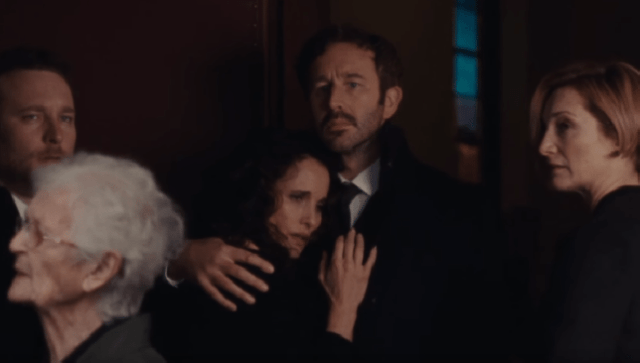
The movie opens with a private conversation between a middle-aged woman named Suzanne (Andie MacDowell) and her son Nicholas (Chris O’Dowd). They are casually talking about being happy, and they do look happy and comfortable as we watch them spending time along with other family members including Suzanne’s husband Glenn (Gareth Williams). As Glenn later makes a heartfelt speech, everyone looks at him with love and endearment, but we sense something is not so right, because of his hoarse voice and weak appearance.

The following part shows how his family has gone through a very difficult time due to his worsening health condition. It seems there is nothing they can do except being near him, and there is a poignant moment when Suzanne, Nicholas, and his brother Chris (James Adomian) try to help Glenn in the bathroom. They surely do as much as they can for Glenn, but it is often frustrating and depressing for them to watch his health condition deteriorated day by day, and they are often reminded of his impending death as hearing him struggling to breath everytime.

While Suzanne tries to pull herself together as focusing on her theater work, Nicholas copes with his messy emotional circumstance. Feeling angry and helpless, he wants someone to lean on, but he only lashes out at his ex-wife Rebecca (Juliet Rylance) even though she kindly comes to support him and Suzanne, and we see him subsequently having a quick sex outside with his girlfriend Emilie (Dree Hemingway).

loveafterlove02

In the end, there comes an inevitable moment Suzanne and her family have prepared themselves for, and the movie handles this sad moment with somber sensitivity without resorting to cheap melodrama. Once the funeral is over, daily life gradually resumes for everyone, and the movie slowly lets us gather some changes in their life. While remaining to be a colleague to his ex-wife in the same publishing company, Nicholas eventually becomes engaged to Emilie, and we get a small hilarious moment when Chris, who is evidently envious while also quite drunk, embarrasses himself in front of others during Nicholas and Emilie’s engagement party.

Meanwhile, Suzanne tries to move onto the next stage of her life, but, of course, that is not so easy for her. She dates with one of her co-workers and then sleeps with him later, but she does not feel like going further with him, and she continues to feel sad and lonely as often being reminded of the void left by her dead husband. At one point, she cannot help but a bit too emotional in front of her co-workers, and that surely perplexes her co-workers, but she soon regains her composure anyway.

Eventually, she comes to find comfort and stability from a middle-aged guy named Michael (Matt Salinger). As they spend time together, something mutual is clearly felt between them, and Suzanne later holds the birthday party for him at her house, but Nicholas is rather sour and sullen in contrast to everyone else in the party. As his relationship with Emilie is going nowhere recently, he finds himself attracted again to Rebecca, but she does not want to get emotionally involved with him again, and he only comes to show more of his pettiness and selfishness. While watching his mother being happy with Michael, Nicholas becomes pettier than before, and that eventually leads to a tense, awkward moment between him and others in the party.

LoveAfterLove02

Steadily maintaining its calm attitude, the movie observes its story and characters with empathy and understanding, and director/writer Russell Harbaugh did a good job of drawing believable performances from his main cast members. While Chris O’Dowd, who drew my attention for the first time via his comic performance in “Bridesmaids” (2011) but then showed his more serious side through his excellent supporting turn in “Calvary” (2014), is effective as a self-centered guy with emotional issues, James Adomian has his own moment as his character tries to ventilate his feelings on the stage later in the story, and the other performers in the film including Juliet Rylance (yes, she is the stepdaughter of Mark Rylance), Dree Hemingway, Gareth Williams, Francesca Faridany, and Matt Salinger are also fine in their respective supporting roles.

And there is Andie MacDowell, whose effortless performance in the film shows us that she has lost none of her talent and presence although she has recently been less prominent compared to when she impressed us with her wonderful performances in various films such as “Sex, Lies, and Videotape” (1989) and “Groundhog Day” (1993). Even her character does not say much, MacDowell ably conveys to us the thoughts and feelings behind her character’s phlegmatic appearance, and the result is definitely one of the best performances in her career.

Although I felt impatient from time to time during viewing, I was touched by what was modestly presented in “Love After Love”, and I recommend it mainly for its thoughtful storytelling and entertaining performances. It may not be something you must watch, but I assure you that you will appreciate its considerable intimacy and sensitivity, and you will probably have a good time with it in the end.

LoveAfterLove04

Posted in Movies | Tagged , | Leave a comment

No Country for Old Men (2007) ☆☆☆☆(4/4): A great thriller from the Coen Brothers

nocountryforoldmen01

It is always exhilarating to recognize a great film right from when it comes out, and the Coen Brothers’ “No Country for Old Men” was my first experience of encountering a new great film to cherish and admire. When I watched it for the first time in January 2008, I expected something as good as others said, but then I found myself wholly captivated by its chilling but compelling chase drama, and I was simply knocked down by how masterfully the movie manipulates and subverts its genre elements. After the movie was over, I was fully convinced of its greatness, and I was excited when it won four Academy awards for best picture, director, adapted screenplay, and supporting actor.

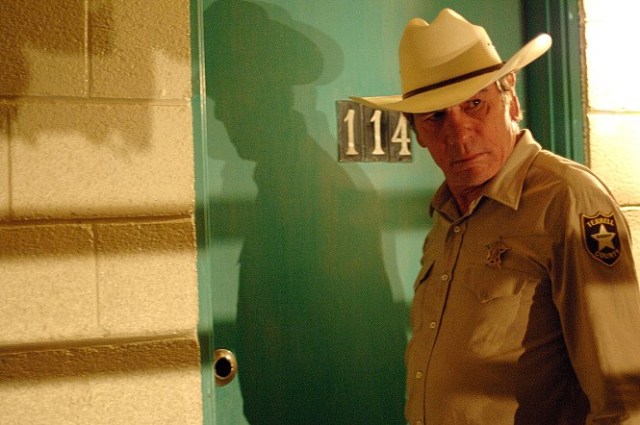
Like many great films, the movie establishes its overall tone right from the opening scene. As a series of barren landscape shots are shown, we hear the phlegmatic narration of Ed Tom Bell (Tommy Lee Jones), an old Texan sheriff who cannot help but nostalgic about good old days in the past as baffled and daunted by the senseless reign of chaos and violence in his world at present. He recollects his disturbing encounter with a boy who showed no remorse or regret even when he was about to be executed for his brutal murder of a 14-year-old girl who was incidentally his girlfriend, but that horrible boy is nothing compared to what we are soon going to observe along with the movie. There is a mysterious murderous man who casually wields his cold-blooded violence at every step of his, and we sense weary resignation from Bell’s voice as he flatly expresses his fear and bafflement about this evil man beyond his understanding, whose messy and bloody trail bitterly confirms Bell that things are falling apart in his world.

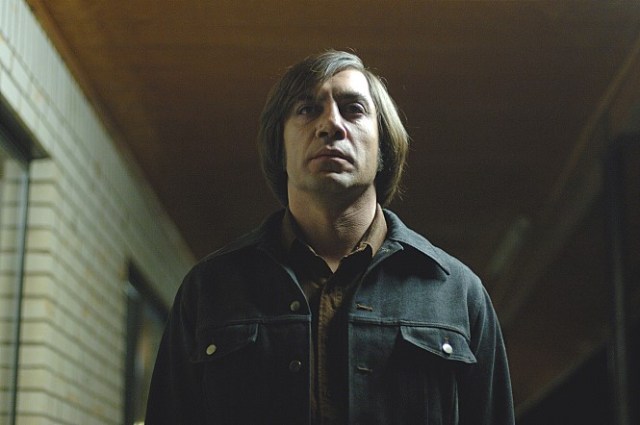
The man in question is Anton Chigurh (Javier Bardem), whose main tool is as bizarre as his odd hairdo which, to my small amusement, reminds me of a common hairstyle of South Korean males in the 1980s (The period background of the film is 1980, by the way). He usually carries a captive bolt pistol connected to an air tank, and there is a gut-chilling moment when he approaches to his latest victim with his captive bolt pistol ready to be used. “Step out of your car, please”, he says with a courteous but terrifying smile, and then he swiftly finishes his job once he has his captive bolt pistol right on the forehead of that unfortunate guy.

nocountryforoldmen02

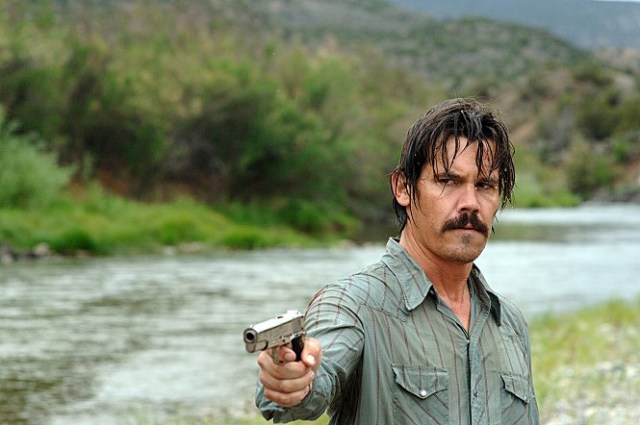
The first part of the movie is mainly about how Llewelyn Moss (Josh Brolin), an ex-welder who is also a Vietnam War veteran, gets himself in a trouble with Chigurh and some other dangerous criminals. When he is hunting in the wilderness outside his small town on one day, he happens to come across a spot where a drug deal was terribly gone awry for some unknown reason. Everyone at the stop except one badly injured Mexican guy is dead, and, after his careful search around this crime scene, Moss eventually finds another dead man and a satchel full of money. Instead of calling the police, Moss decides to take away the money for him and his wife Carla Jean (Kelly Macdonald), but then he finds himself in a grave danger due to his unwise act of mercy, and we soon see him being pursued by Chigurh, who is hired by a criminal organization involved with that disastrously failed drug deal.

While it becomes quite apparent to us that Moss is in a situation way over his head, we get a number of superlative moments pulsating with sheer terror and suspense. During my recent viewing at a local arthouse theater, I marveled again at how dexterously the Coen Brothers handles an alternatively tense and humorous sequence involved with one chasing dog, and I found myself clenching my teeth tight again as watching a heart-stopping sequence which quietly and steadily dials up the level of tension with small but crucial sound details including the faint sound of a telephone ringing from downstairs.

Right before watching the movie, I and other audiences around me were told that we must be very quiet for appreciating more of its meticulous sound effects, and it was a really interesting experience for me to notice more of those subtle sound details in the film. The sound of wind blowing in the air is constantly heard in the soundtrack throughout the movie, and that adds more bleakness and loneliness to the stark atmosphere which is vividly established on the screen by cinematographer Roger Deakins. The more I paid attention to that beeping sound of Chigurh’s tracking device, the more I appreciated how deftly it is used in the movie, and I particularly admire how it is subtly utilized for conveying to us what is going on behind a closed door at one point in the film. Carter Burwell’s sparse ambient score effectively functions along with sound effects as never drawing any unnecessary attention to itself, and we are seldom aware of this unconventional score until it makes a prominent exit during the end credits.

The movie is based on the novel of the same name by Cormac McCarthy, a great American novelist who is no stranger to bleak, pitiless human conditions. His gruesome western novel “Blood Meridian” is mainly driven by a barbaric character who is as evil and fearful as Chigurh, and many of its savage moments are not so far from what is depicted in the movie. While his Border Trilogy is often striking with dark moments of human cruelty, “Suttree” is depressing but haunting as delving into the despair of its alcoholic hero, and “The Road”, which won him the Pulitzer prize, is virtually an apocalyptic extension of his pessimistic view on humanity.

nocountryforoldmen03

Although many of McCarthy’s works are not exactly ideal materials for movie adaptation due to their dense, elegant prose, “No Country for Old Men” is relatively easier to adapt thanks to its pulpier quality, and the Coen Brothers were ideal as its adapters from the beginning. After all, they are masterful storytellers with a dark, morbid sense of humor just like McCarthy, and their adaptation result is quite faithful to the novel while also successfully presenting what is felt between words and lines in the novel. For instance, look closer at the terse but intense conversation scene between Chigurh and a gas station owner who is gradually forced to bet his whole life on coin toss; each line during this memorable scene is delivered with considerable precision and nuance, and the sense of doom becomes more palpable to us shot by shot.

Chigurh, who is regarded as a “true and living prophet of destruction” in the novel, is one of the most unforgettable villains in the movie history, and Javier Bardem deservedly won an Oscar for his uncanny performance in the film. As Chigurh adamantly and mercilessly pushes his own twisted principles amid chaos and violence, he ironically becomes the most reliable entity in the story, and that makes him strangely funny at times. In the end, it turns out that he is not above everything at all, and we accordingly get a rich irony at the end of his final scene in the movie.

On the opposite, Josh Brolin is solid as a desperate man hopelessly mired in his increasingly precarious situation. Moss is clever and resourceful enough to stay a few steps away from the men chasing after him, but it is clear that there is no way out for him as he is relentlessly pursued by his unstoppable opponent. He is outmatched by not only Chigurh but also the chaotic world they inhabit, and we are shocked but not surprised when another twist of fate comes upon him later in the story.

In between his two co-performers, Tommy Lee Jones effortlessly holds the center with his nuanced performance which eventually becomes the beating heart of the movie. Like Marge Gunderson in the Coen Brothers’ another great film “Fargo” (1996), Bell is a shrewd, no-nonsense character with human warmth and decency, and he instantly intuits what is going on as he looks around the aforementioned crime scene, but he knows too well that there are not many things he can do. He tries to do his job as much as he can, but he is confirmed again of how the world has become too messy and chaotic for him, and we subsequently get a thought-provoking moment between him and his older relative. When he expresses his growing weariness, his old relative sharply points out that things were not that peaceful either in the past, and we come to wonder whether our civilization is inherently destined for chaos and destruction due to our dark human nature.

nocountryforoldmen05

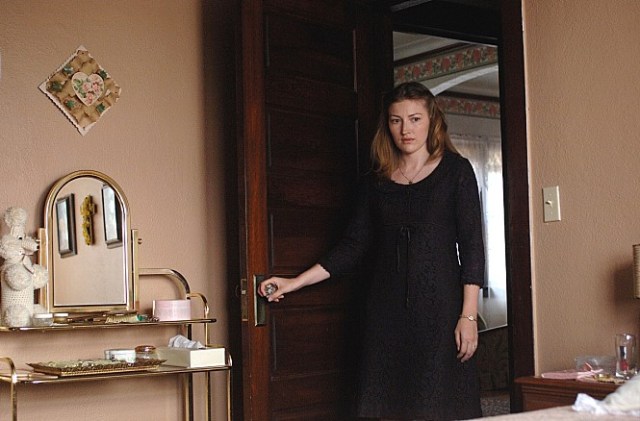
The movie also cares about some of other substantial characters in the story. While Woody Harrelson is engaging in his colorful supporting role, Garret Dillahunt provides lightweight humor as one of Bell’s deputies, and Tess Harper briefly appears as Bell’s caring wife. As Moss’ loyal wife, Kelly Macdonald is especially poignant when her character faces an inevitable moment waiting for her, and the movie shows a little mercy to her character, though that does not make much difference on the whole.

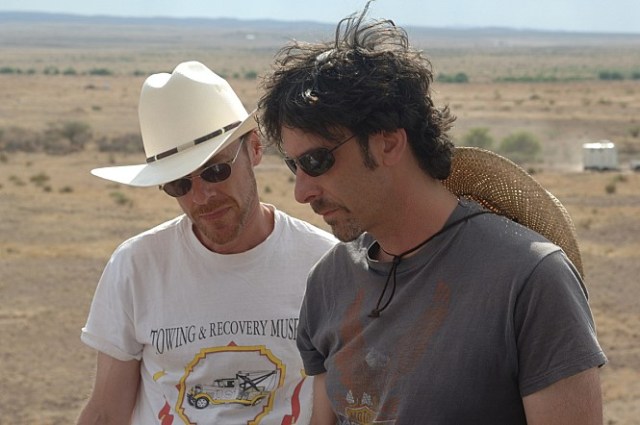
Along with “Blood Simple” (1984) and “Fargo”, “No Country for Old Men” has been the pinnacle of the wild, illustrious career of the Coen Brothers. While they can go all the way for laughs as shown from “Raising Arizona” (1987), “The Hudsucker Proxy” (1994), and “Hail, Caesar!” (2016), they can be quite serious as shown from “Barton Fink” (1991), “The Man Who Wasn’t There” (2001), and “Inside Llewyn Davis” (2013), and they also can be somewhere between these two opposing territories as shown from “The Big Lebowski” (1998) and “A Serious Man” (2009). They have never made a boring film, and even their lesser works such as “Intolerable Cruelty” (2003) and “The Ladykillers” (2004) show their own distinctive style, which is mainly represented by their smart, twisted handling of genre conventions.

Besides being a top-notch thriller, the movie is a grim but haunting observation of human chaos and violence, and it leaves an indelible impression on us via the closing scene which can be interpreted in more than one way. Bell tells his wife he dreamt two dreams about his dead father at last night, but he does not say much about what these two dreams mean to him. Do they merely reflect his wistful state of mind? Or, do they remind him that there is still something worthwhile to preserve and fight for? Regardless of how he feels about them, he is going to spend more time with his wife, and that is all we can be sure about for now.

nocountryforoldmen04

Posted in Movies | Tagged , , | Leave a comment

The Spy Gone North (2018) ☆☆1/2(2.5/4): The Spy Who Came into North Korea

thespygonenorth01

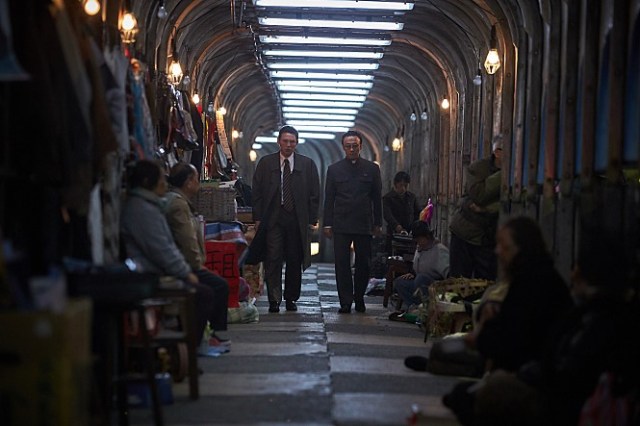
South Korean film “The Spy Gone North” did not show me anything particularly new. Inspired by the remarkable real-life story of a South Korean secret agent who successfully approached to high-ranking North Korean officials and then even went inside North Korea, the movie wants to be your typical gray espionage movie as evoking the works of John le Carré, and it succeeds to some degrees within its genre conventions, but it is unfortunately marred by several problems including its deficient final act. Although I was not wholly bored during my viewing at least, the movie left me a rather hollow impression in the end, and I came out of the screening room without much enthusiasm.

The story of the movie is set in the early 1990s, when the longtime geopolitical conflict between South and North Korea took another serious turn as North Korean embarked on nuclear weapon development. Thanks to the success of his latest operation, Park Seok-young (Hwang Jung-min), an undercover agent of South Korean intelligence, and his direct boss come to learn more about the ongoing nuclear weapon development program of North Korea, and Seok-young’s boss soon orders Seok-young to approach to a certain high-ranking North Korean official who may lead them to more information.

The North Korean official in question is Ri Myung-woon (Lee Sung-min), and we see how Seok-young carefully approaches to his target while maintaining his thoroughly prepared disguise. In Beijing, he presents himself as a seedy, opportunistic South Korean businessman who will not hesitate to deal with North Korean officials, and this certainly draws the attention of Myung-won and other North Korean officials, who soon approach to Seok-young as expected. Although the mood is pretty tense when they meet each other for the first time, Seok-young manages to gain some trust from Myung-won, and he further solidifies his business relationship with Myung-won as showing more of his goodwill during next several years.

thespygonenorth02

Seok-young and his boss have an outrageous but plausible plan for how to get into North Korea and then obtain the information on its nuclear weapon development program. Once Seok-young sells Myung-won an idea of shooting a joint commercial in North Korea, he will probably be permitted to go around here and there in North Korea while looking for any suitable shooting location, and then he may come closer to a spot where nuclear weapon is being developed. Of course, everything must be approved by Myung-won’s party and its notorious leader Kim Jong-il (Gi Ju-bong), so Seok-young has no choice but to come into North Korea, and we accordingly get a tense, unnerving sequence as Seok-young is taken to somewhere right after arriving at the airport in Pyongyang.

After getting the personal approval from Kim, Seok-young is ready to move onto the next level of his operation, but then his circumstance is unexpectedly changed. As the presidential election in South Korea approaches, his boss and a couple of prominent South Korean politicians have a clandestine meeting with Myung-woon, and Seok-young comes to realize how much his agency and government are willing to do anything for maintaining their status quo. After that realization, he becomes conflicted about what he has been doing, and he also begins to feel guilty about his growing relationship with Myung-woon, who is certainly in a serious danger for being associated with Seok-young.

Around that narrative point, the movie tries to dial up the level of tension on the screen, but the screenplay by director Yoon Jong-bin and his co-writer Kwon Sung-hwi does not provide enough ground for that as often suffering from its rote storytelling and thin characterization. Although it is fairly interesting to observe the strained relationship between Seok-young and Myung-hoon, how their relationship is developed along the story is rather predictable to say the least, and we are not so surprised by what they decide to do later in the story.

thespygonenorth03

The movie is commendable in technical aspects. Cinematographer Choi Chan-min did a competent job of establishing different local atmospheres on the screen with some stylish touches, and I enjoyed a number of nice period details in the movie. The score by Cho Young-wuk is effective during several key scenes in the film, and I was particularly amused when “Dies Irae” was briefly quoted at one point.

The main performers in the movie fill their respective archetype roles as much as they can. Hwang Jung-min is good whenever his character must balance himself well between his duty and disguise, and Lee Sung-min is also solid in his stoic performance which effectively complements Hwang’s showier performance. While Cho Jin-woong, who previously collaborated with Yoon in “Nameless Gangster: Rules of the Time” (2012) and “Kundo: Age of the Rampant” (2014), is suitably cast as Seok-young’s untrustworthy boss, Ju Ji-hoon is unfortunately stuck in his one-note supporting character, and Gi Ju-bong has a little fun during his brief appearance.

During last 10 years, Yoon has impressed me with several good works to remember. While I admired “The Unforgiven” (2005) and “The Moonlight of Seoul” (2008), I was enthralled by “Nameless Gangster: Rules of the Time”, and I was also entertained by “Kundo: Age of the Rampant” although it was not entirely successful. Compared to them, “The Spy Gone North” is less distinctive in my trivial opinion, so I cannot recommend it, but you may enjoy it more than me if you are not familiar with its genre territory.

thespygonenorth04

Posted in Movies | Tagged , , , | Leave a comment

Jupiter’s Moon (2017) ☆☆1/2(2.5/4): A boy who can levitate

jupitersmoon01

Sometimes I come across films which are commendable in technical aspects but unsatisfying in terms of story and characters, and Hungarian film “Jupiter’s Moon” is one of such disappointing examples. I was impressed by a number of technically superlative moments in the film, but I also felt impatient and frustrated due to its weak plot and uneven storytelling, and I just found myself baffled and dissatisfied around the end of the movie. While it attempts to make some points on its social issues, it fails to generate something coherent enough to hold our attention, and those good moments in the film only remind us of how it could be better through more focused narrative and more solid characterization.

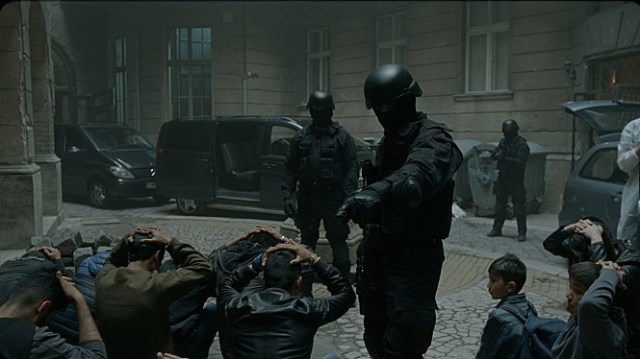
The opening sequence, which is incidentally one of the best parts in the film, shows a bunch of refugees trying to cross the border region between Serbia and Hungary during one late night. Once they all gather at a riverside spot, they try to go across the river by several small boats prepared for them, but then they are soon ambushed by the Hungarian border patrol, and the movie instantly thrusts us into the ensuing chaos via the viewpoint of a young Syrian refugee named Aryan Dashin (Zsombor Jéger), who becomes separated from his father during this chaotic moment. As he tries to get away from the Hungarian border patrol, the camera fluidly and urgently moves along with him and many other fleeing refugees, and the sequence eventually culminates to a striking moment as his flight is stopped by a police officer named László (György Cserhalmi), who shoots Aryan several times without much hesitation.

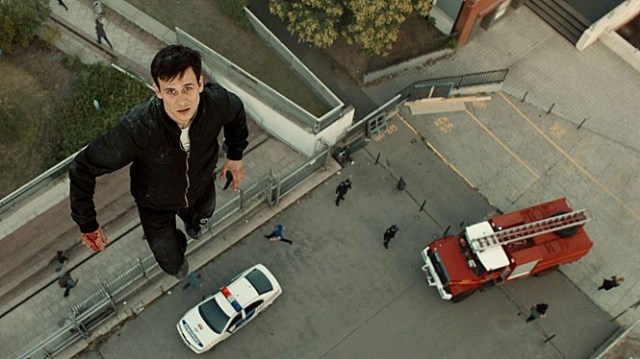
At first, it looks like Aryan is fatally wounded, but then an inexplicable thing happens. He somehow comes to obtain the supernatural power to levitate, and the movie gives us a nice moment of awe and mystery as the camera smoothly floats along with Aryan’s body in the sky. Cinematographer Marcell Rév, who previously collaborated with director Kornél Mundruczó in “White God” (2014), did a tremendous job here in this film, and his masterfully effortless camera work from the numerous long-take shots in the film will probably remind you of what Emmanuel Lubezki achieved in Alfonso Cuarón’s “Children of Men” (2006) and “Gravity” (2013)

jupitersmoon02

Not long after he falls to the ground, Aryan is sent to the hospital inside a camp for refugees being held by the Hungarian government, and that is how he comes to encounter Gábor Stern (Merab Ninidze), a seedy doctor who has been stuck in that hospital due to a serious case of malpractice and the following legal trouble. For getting out of his legal trouble, Stern needs lots of money, so he has often sold refugees medical referrals which can get them out of the camp, and his colleague and girlfriend Vera (Mónika Balsai) goes along with that scheme.

When Stern meets Aryan for the first time, Aryan just looks like another refugee to be taken care of, but then Aryan shows his power to Stern, and Stern immediately changes his mind as seeing an opportunity for more money. After managing to get Aryan out of the camp, he offers Aryan a partnership for their mutual benefits, and Aryan agrees to work with Stern as he really needs to reunite with his father and then get out of the country.

We soon see how they work together. They visit several different people one by one, and these people are quite surprised by what Aryan demonstrates in front of them. In case of some tough guy, Aryan not only levitates but also warps the reality around him and that guy a bit, and the resulting moment is another visual highlight in the film.

jupitersmoon03

Meanwhile, László is tracking down Aryan for covering up his deed. It does not take much time for László to learn of Aryan’s power as well as Stern’s association with Aryan, and that makes him more determined to catch Aryan. After making a sudden plot turn, the movie tries to generate more suspense as László comes quite closer to Aryan and Stern, and we later get an intense vehicle sequence which is steadily and palpably presented via an unbroken shot.

However, despite all these technically impressive aspects, the movie did not engage me a lot mainly because I felt distant toward its story and characters. Although I enjoyed its realistic approach, the story itself does not have enough narrative momentum, and its characters are more or less than cardboard figures to be moved along the plot. I guess we are supposed to care about Stern and Aryan, but neither of these two main characters are particularly well-developed, and the same thing can be said about several substantial supporting characters around them.

Although I appreciate some of its strong points, “Jupiter’s Moon” is a major letdown compared to what was achieved in Mundruczó’s previous work “White God”, which was one of the most interesting films I saw during 2015. Besides several visually striking moments to remember, that movie was also propelled a lot by its powerful drama revolving around one abandoned dog who came to lead a sort of revolution against human beings, and its overall result was something as emotionally resonating as “Rise of the Planet of the Apes” (2011) and its two excellent sequels. While surely as ambitious as “White God”, “Jupiter’s Moon” lacks the emotional power of “White God” in my trivial opinion, and I think you will have a better time if you watch “White God” instead.

Sidenote: At the beginning, the movie states that Jupiter has 67 moons, but, at this point, the total number of Jupiter’s moons is 79.

jupitersmoon04

Posted in Movies | Tagged , | Leave a comment

The Night Is Short, Walk On Girl (2017) ☆☆☆(3/4): One phantasmagoric night

thenightishortwalkongirl01

Japanese animation feature film “The Night Is Short, Walk On Girl” is a phantasmagoric fantasy which literally goes wild with its style and imagination. Although I must point out that it could not wholly engage me as I became more aware of its deliberately warped reality and decidedly broad characterization, I enjoyed its numerous stylish scenes brimming with exuberance and humor, and I admire how willingly it goes further for more wild and crazy moments to impress its audiences.

The premise of its story is pretty simple. During one night in Kyoto, a young unnamed female college student is attending a drinking party for the wedding of one of her friends, and she decides to have more fun and drink after this drinking party. When the party is almost over, she goes outside and then comes into a nearby bar, and she promptly orders and then drinks a number of various cocktails. While watching this, I could not help but think of my similar drinking routine at bars; I also enjoy drinking those tasteful cocktails, and I always start with gin tonic and then end with Long Island Ice Tea.

After a rather unpleasant encounter with a creep who is obsessed with erotic pictures, our heroine comes across two eccentric characters who are quite ready for fun and drink just like her, and that is the beginning of a wild, spirited drinking time for them and several others who gladly join them. In the end, our heroine comes across a wealthy old man residing in his huge moving boat, and she and the wealthy old man come to have a high-stake drinking duel with some special liquor.

thenightishortwalkongirl02

Meanwhile, the film also focuses on the misadventure of a male senior who has carried a torch for our heroine. During the aforementioned drinking party, he cannot help but look at our heroine from the distance, but he still cannot find enough courage for approaching to her even though he is pretty much drunk just like many others at the party. After the party, he decides to go after her for another ‘accidental’ encounter between them, but, alas, he finds himself getting into a series of troubles instead, and he later finds himself in a very embarrassing situation when he finally come to be in front of her.

As the night goes on, the spring mood of the film is changed to hot summer atmosphere (don’t ask me why), and our two main characters come into another loony circumstance. While our hero spends some time with a dandy friend who happens to be in charge of monitoring college students, his friend suggests a way to win our heroine’s heart, and our hero is tempted by his friend’s suggestion. It turns out our heroine is looking for a certain old book which may be found somewhere at a local bazaar for old used books, and our hero’s friend knows how to get that book in question.

Of course, getting the book turns out to be pretty difficult for two reasons. There is an impish child who sneaks around here and there around the bazaar for his own small prank, and one of the funniest moments in the film comes from how our hero gets into another trouble thanks to this naughty kid. Furthermore, our hero later has no choice but to participate in a literally hot and hellish competition for obtaining the book, and that leads to a cheerfully exaggerated moment you should see for yourself.

thenightishortwalkongirl03

Not long after that, the film hops into its third act with another seasonal change in the background. Surrounded by autumn atmosphere, our two main characters suddenly find themselves in the middle of the fall college festival, and they soon come to be involved with a guerrilla stage performance which is intended as a public message from some lovesick male student yearning to reunite with a girl with whom he fell in love at first sight. That guy also swore that he will not change his underpants for clean ones until he finally meets her, and I was rather glad that the film did not go into details on that.

Anyway, this part eventually culminates to a loony musical climax equipped with several songs, and you may roll your eyes while also being tickled by a number of unabashedly absurd plot turns during this sequence. It looks quite silly indeed, but the main voice performers including Gen Hoshino and Kana Hanazawa bring lots of spirit into this sequence while maintaining some degrees of seriousness as required, and the result is another highlight in the film.

During the last act, the film shifts itself onto winter background as expected, and it initially seems to falter under stark wintry atmosphere, but, what do you know, it surprises us with another crazy moment to remember. Although I think director Masaaki Yuasa and his crew go a bit too far during this part, I will not deny that I was impressed by how they manage to pull out a sweet ending after all those wild and crazy moments shown on the screen.

Considering its wildly whimsical style and personality, “The Night Is Short, Walk On Girl”, which is based on the fantasy novel of the same name by Tomihiko Morimi, may not be for everyone, but you will not be disappointed if you are looking for something unique and different. Although I am less enthusiastic than some other critics, I appreciate its rambunctious spirit, and I will probably revisit it someday after drinking several glasses of cocktails.

thenightishortwalkongirl04

Posted in Movies | Tagged , , , | 1 Comment