Jane Fonda in Five Acts (2018) ☆☆☆1/2(3.5/4): Being Jane

janefondainfiveacts01

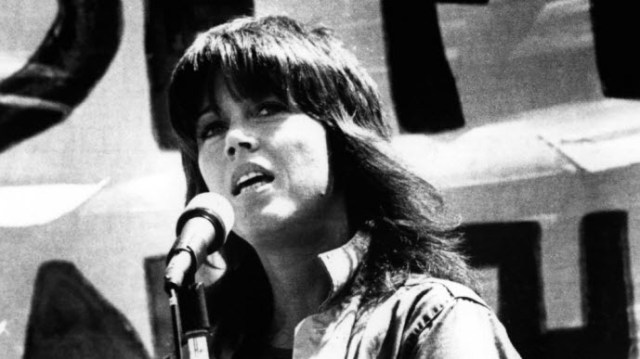
HBO documentary film “Jane Fonda in Five Acts” is a compelling examination of the life and carrier of Jane Fonda, a famous movie star who has also been an outspoken activist for many years. As she frankly recounts about her eventful past in front of the camera, the documentary gives us a vivid, honest, and respectful portrait of a woman who has constantly tried to be true to herself throughout her life and career, and it is engaging to observe how she has steadily kept on for being a strong, independent woman.

The documentary presents Fonda’s life and career via five acts, and the first act is titled “Henry”. As many of you know, Fonda was the daughter of legendary actor Henry Fonda, and she tells us about her rather distant relationship with her father. While he usually represented those wholesome American values on the screen, her father was not a very good father to Fonda and her brother Peter, and her mother’s worsening mental illness added more unhappiness to Fonda’s childhood years. When her mother committed suicide not long after her father married other woman, her father did not tell anything about that to his children, and Fonda belatedly came to learn of the truth about her mother’s death several years later.

Often overwhelmed by her father’s public image (“I grew up in the shadow of a national monument”, she says at one point), Fonda tried to earn her father’s affection and recognition, and that eventually led her to acting. Although she was not particularly interested in acting during her childhood years, she came to study under renowned acting teacher Lee Strasberg as entering her adulthood, and she remembers how much she was terrified when she was instructed to show her acting talent in front of other students on one day. She was afraid of getting humiliated, but she got some recognition from her teacher, and that made her more far confident than before.

As working as a model in New York City during the early 1960s, Fonda slowly got more recognition as a young promising actress who would follow her famous father’s footsteps. While appearing in several notable American films including “Barefoot in the Park” (1967), she decided to expand her range further, so she went to France, and that was where she met her first husband Roger Vadim, a famous French filmmaker who had been quite prominent thanks to a number of popular films such as “And God Created Women” (1956).

janefondainfiveacts03

The second act, titled “Vadim”, looks into Fonda’s relationship with Vadim, and Fonda reminisces how much she was enthralled during her first encounter with him at Maxim’s. While well aware of his notorious reputation due to many women in his life, she could not help but charmed by him, and Vadim was also attracted to her a lot. They married in 1965, and Fonda appeared in Vadim’s several films including “La ronde” (1964), “La curée” (1966), and, yes, “Barbarella” (1968), a camp classic film which has the amusing opening sequence where Fonda cheerfully presents her naked body.

Around the late 1960s, Fonda came to be more conscious of what was going on in the American society. While the Vietnam War became worse and worse outside, the American society went through many tumultuous political moments, and Fonda came to feel that she had to do something about that. As participating in many political activities, she became more vocal about her opinions on the Vietnam and other political issues, and that accordingly caused more conflict between her and her father, who even warned her that he would report her to authorities if he ever found out that she was a communist.

Meanwhile, she kept advancing in her acting career. After getting her first Oscar nomination via her devastating performance in Sidney Pollack’s “They Shoot Horses, Don’t They” (1969), Fonda triumphed again with Alan J. Pakula’s “Klute” (1971), for which she received her first Oscar. During the shooting of “Klute”, she felt that she was not suitable for her role, but she came to delve deeper into her role with the strong support from Pakula, and the result was one of the most fascinating performances in her career.

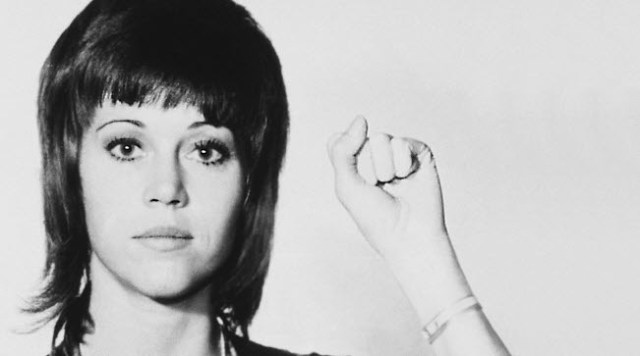
After being separated from Vadim, Fonda began a relationship with famous left-wing activist Tom Hayden, and the third act, titled “Tom”, examines how Fonda was swept further into her political activities. When she visited Hanoi in 1972, she surely caused a huge controversy as making lots of enemies, but she adamantly stuck to her position, though she later admitted that she was rather careless while visiting Hanoi and then defending her political opinion.
janefondainfiveacts02

Around the 1980s, Fonda and Hayden began the Campaign for Economic Democracy, but they did not have enough money, and then Fonda got a brilliant idea for financing their campaign. Because she knew well about workout, she decided to make a workout video, and, to her surprise and amusement, her workout video turned out to be a lot more successful than imagined.

However, Fonda and Hayden eventually divorced in 1990, and then Fonda married someone who was quite opposite to Hayden: Ted Turner. During the fourth act, titled “Ted”, Fonda tells us how fun and exciting it was for her to be with her third husband who is incidentally one of the wealthiest persons in the world, and we later see her visiting a farm owned by Turner, who still remains as a good friend of hers despite their eventual divorce in 2001.

After her third divorce, Fonda came to resume her acting career which was stopped during her third marriage, and the fifth act, titled “Jane”, shows us how she has been active during recent years. For example, she recently received considerable praises for her supporting turn in Paolo Sorrentino’s “Youth” (2015), and she is currently appearing with her longtime friend Lily Tomlin in TV series “Grace and Frankie”. In case of her private life, she has been quite comfortable with who she is and where she is now, and there is a warm, intimate scene where she shows a bit of her life to one of her grandchildren.

Although it feels a little overlong at times, “Jane Fonda in Five Acts” is an excellent documentary which is both engaging and insightful, and director Susan Lacy did a commendable job of presenting her subject with honesty and admiration. While she is about to have her 81st birthday, Fonda is willing to go further with the last chapter of her life, and I am sure it will be interesting as before to see what may come next from this great American actress who is also a passionate activist to remember.

janefondainfiveacts04

Posted in Movies | Tagged , , , , | 1 Comment

Zama (2017) ☆☆☆(3/4): Waiting for his transfer

zama03.jpg

“Zama”, which was Argentina’s official submission for Best Foreign Language Film Oscar in last year, is an odd, unconventional period drama which will probably frustrate you for good reasons. As leisurely observing its hero’s seemingly endless predicament and ennui, the movie demands us considerable patience and attention at first, but then it makes us slowly immersed into its vivid, realistic mood and background, and the overall result is sort of rewarding on the whole with some cerebral aspects to be savored.

Set in a remote South American colony in the late 18th century, the movie mainly revolves around the plight of Don Diego de Zama (Daniel Giménez Cacho), a plain magistrate who has yearned to be transferred to a city far from where he has supposedly been stuck for years. His reason is simple; he misses his wife and children, and he has been tired of merely filling his position without doing nothing much. While he does his job whenever it is required, that does not give him any satisfaction at all, and he becomes more bored and frustrated as days slowly go by as usual in the colony.

While Zama joylessly goes through his mostly uneventful daily life, we get to know a bit about a few people around him. There is a deputy who is supposed to work under him but does not care much about their duty, and there is also a lady who is wife of a local high-ranking official and has been quite close to Zama for a while. When a business man associated with Zama visits the colony for his business matter, Zama takes him to the lady’s house, and the movie gives us a dryly humorous moment generated from their flat conversation.

zama02

In the meantime, Zama takes care of several small matters which do not mean much to him at all. At one point, he handles a case involved with a family who requests a bunch of native slaves to work for them, and he also visits a monastery and then talks with a bishop for a matter involved with dead bodies to be buried. As we listen to their conversation presented in the foreground, we see dead bodies being casually handled in the background, and the result is one of the most memorable visual moments in the film.

Zama later goes to the local governor for getting a permission for his transfer, but the governor himself is going to be transferred to somewhere, and he is only notified that he should try again when the new governor comes. When he meets the new governor, the new governor apparently does not give a damn about Zama’s transfer, and the situation becomes more difficult for Zama as it turns out that his deputy has been doing something else besides doing his duty. The new governor demands Zama should write an official report on that, and Zama has no choice but to follow the demand because, well, his superior is going to decide whether a letter for requesting his transfer will be sent to the King of Spain.

Of course, things do not go well for Zama, and we see how his circumstance gradually deteriorates further. When the new governor suddenly orders the inventory on a government building where Zama has resided, Zama has to move away to a shabby inn which feels like a haunted house, and there are a number of eerie moments involved with a few characters working and living in this desolate place. When he finally submits his report to the new governor, the new governor does keep his promise, but, alas, it turns out that there is another obstacle for Zama.

During its last act, the movie moves forward to some time later, and we see Zama becoming more desperate and exhausted than before. He finally gets a chance to leave the colony, but now he has to join a search party which is assembled for catching some infamous criminal, and he and other soldiers soon leave the colony and start their perilous journey in the wilderness which is full of potential dangers.

zama01

As they go deeper and deeper into the wilderness, director Lucrecia Martel, who also wrote the adapted screenplay which is based on the 1956 novel of the same name by Antonio di Benedetto, provides a series of haunting scenes to remember. There is a spooky but poetic scene where Zama witnesses a bunch of blind natives during one night, and then there is also a tense scene where Zama and other soldiers get some harsh treatment after being captured by another group of natives. Thanks to cinematographer Rui Poças, the movie is full of evocative mood accompanied with realistic details to observe, and I particularly admire several vast, beautiful landscape shots shown later in the film, which further emphasize Zama’s increasingly trivial existence in his uncaring world.
In the end, Zama’s story arrives in a moment of madness and desperation, but the movie keeps its detached attitude as before, and its final scene will make you reflect a bit on what you have observed from the movie. To be frank with you, I am still scratching my head as trying to understand what exactly the movie is about, but I like its vivid, authentic period atmosphere, and I also appreciate its occasionally striking sound effects which often remind us of its hero’s disoriented state of mind.

As a typical arthouse film which mostly depends on mood and nuance, “Zama” is an admirable piece of work, and I understand to some degrees why some critics are enthusiastic about it, though I still feel some reservation on it. I recommend the movie for its considerable technique achievement, but please keep in mind that this is not something you can watch for casual entertainment.

zama04

Posted in Movies | Tagged , , | 1 Comment

Private Life (2018) ☆☆☆1/2(3.5/4): A funny, sensitive human comedy about infertility

privatelife04.jpg

“Private Life”, which was released on Netflix this Friday, is alternatively amusing and touching in its intimate and humorous depiction of an ordinary couple struggling with their infertility problem for a long time. While generating lots of small good laughs from their rocky emotional journey, the movie also looks closely into the ups and downs of their life and relationship, and we are often moved by a number of honest and sincere moments observed from them and other characters around them.

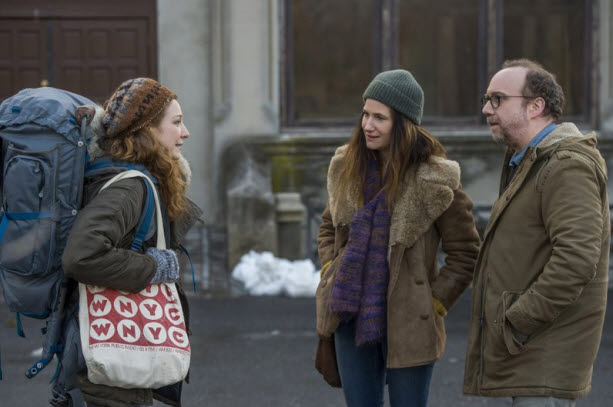
Kathryn Hahn and Paul Giamatti play Rachel and Richard Grimes, who are your average sophisticated couple living in the Manhattan neighborhood of New York City. Richard was once a prominent theater director, but he has earned his living through a small pickle company for years, and it looks like he will be stuck with that business of his for the rest of his life. In case of Rachel, she has been active as a writer, but she has not been that successful, and she is also constantly distracted by her ongoing infertility problem.

Both Richard and Rachel have tried to do as much as they can for having a child, and they have surely gone to their infertility clinic many times, but the circumstance has always disappointed them. They recently decided to try in vitro fertilization (IVF), so she her several ova collected from her ovary, but, alas, it turns out that there is a problem with Richard’s reproductive organ, and that means they will have to spend extra $10,000 for extracting sperms from Richard’s testicle (he has only one testicle, by the way).

In the meantime, Richard and Rachel also try adoption just in case although that process is more difficult for them. When a social worker visits them for a consultative interview, we get a funny moment as they try to look as nice and respectable as possible in front of their social worker, but then it is followed by a flashback sequence which shows us how much they have wanted to have a child, and we come to understand and emphasize with them more than before.

privatelife03.jpg

To their big disappointment, their latest attempt for Rachel’s pregnancy fails, and their doctor suggests another option. Considering that Rachel’s ova seem to be not that healthy enough for IVF, they may have to use healthier ova from a younger woman. While Rachel is understandably not so pleased about this option, Richard is more open to this option in comparison, and the apparent difference in their opinions leads to a big argument between them. While never overlooking their respective emotional issues, the movie also recognizes how silly they look during their argument, and Hahn and Giamatti handle this scene well with the excellent comic timing between them.

In the end, Rachel and Richard agree to have to find an ovum donor together, and there soon comes a supposedly ideal candidate. When Sadie (Kayli Carter), the stepdaughter of Richard’s brother Charlie (John Carroll Lynch), comes to stay in Rachel and Richard’s residence not long after dropping out from her college, Rachel and Richard begin to regard this smart young girl as a possible ovum donor candidate, and we accordingly get a couple of hilarious scenes as they try to see whether Sadie is okay with that.

To their surprise, Sadie is totally fine with being the ovum donor for them because she really likes them. As an aspiring writer, she enjoys being with Rachel and Richard, and she certainly loves how open they are to talk with her about anything. At one point, Sadie and they freely talk about cunninglingus on a dinner table, and there is also an amusing moment when she talks about how much she despises those ludicrous short stories written by her classmates. She sharply criticizes them for writing stories insincerely based on their privileged middle-class life, but we observe that she is not so different from them in many aspects, so we cannot help but amused while listening to her along with Richard and Rachel.

When Charlie and his wife Cynthia (Molly Shannon) happen to learn about what their daughter is going to do with Richard and Rachel, they are certainly surprised. While Charlie does not object much to his stepdaughter’s decision, Cynthia becomes quite exasperated, but the movie thankfully avoids presenting her as a merely angry mother. Although she can be domineering at times, Cynthia does care about her daughter nonetheless, and she later has a thoughtful conversation with her daughter. Like any good mothers, she simply wants her daughter to live well and be happy, and their dynamic relationship may remind you of the similar mother and daughter relationship in “Lady Bird” (2017).

privatelife01

As leisurely rolling its story and characters together, the screenplay by director/writer Tamara Jenkins, who rose to prominence via her Oscar-nominated film “The Savages” (2007), continues to give us more nice moments to be cherished, and Jenkins also did a good job of establishing the vivid, realistic atmosphere around her characters. I was impressed by the tangible sense of daily life even from such tiny details as numerous books and other noticeable objects in Richard and Rachel’s apartment, and I particularly appreciated the realistic details in infertility clinic scenes in the film. Not so surprisingly, Jenkin’s screenplay is inspired by her own experience with infertility clinic, and she certainly handles her story and characters with care and affection while often demonstrating her sharp sense of humor coupled with thoughtful human insights.

As the center of the movie, Giamatti and Hahn are fabulous in their nuanced performance filled with subtle touches to notice. While Giamatti is perfectly cast as a man who has nursed worries and insecurities behind his phlegmatic appearance, Hahn, who has shown more of her talent during recent years, is convincing as embodying her character’s emotional needs, and they ably convey to us their characters’ complex relationship without making any misstep.

On the opposite, Kayli Carter, whose perky performance reminds me a lot of Saroise Ronan in “Lady Bird”, is very good as another important part of the story, and other notable performers in the movie are also solid in their respective roles. Molly Shannon and John Carroll Lynch are reliable as usual, and Denis O’Hare, a veteran character actor who has been more prominent thanks to his enjoyable supporting turn in TV series “American Horror Story”, has some deadpan fun as Richard and Rachel’s infertility clinic doctor.

Almost impeccable in terms of storytelling and performance, “Private Life” is a small gem you should not miss, and I am certainly glad that it is widely available via Netflix. It may look modest on the surface, but it is full of life and personality, and you will feel satisfied with its nearly perfect last shot after getting to know its main characters a lot more than expected.

privatelife02

Posted in Movies | Tagged , , , | 1 Comment

Hold the Dark (2018) ☆☆1/2 (2.5/4): A cold, brutal genre exercise in Alaska

holdthedark04.jpg

I feel ambivalent about “Hold the Dark”, a cold, brutal genre exercise which is admirable in technical aspects but too distant to engage me on the emotional level. While I was entertained by its atmosphere and performance to some degrees, I also became frustrated with how the movie adamantly remains murky and ambiguous throughout its 2-hour running time, and I was only left with a rather hollow impression in the end as wondering about several elusive things in its story.

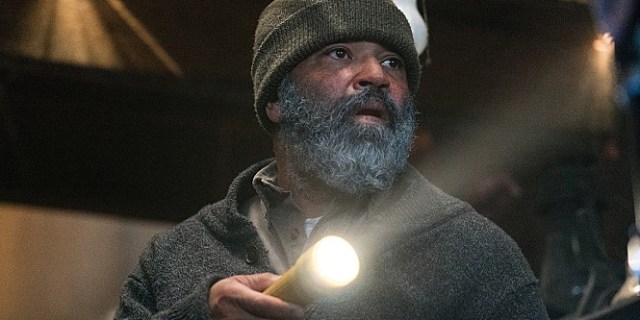
During its first act, the movie succinctly establishes a moody situation surrounding its hero and other main characters. Russell Core (Jeffrey Wright), who has been known well as a wolf expert mainly via a book on his experience with wolves in wilderness, receives a letter from a young woman living in a remote rural town of Alaska, and it seems this woman, named Medora Sloane (Riley Keough), really needs his help even though he cannot do that much for her. Several days ago, her young son was disappeared, and it was assumed that her son was taken and then killed by wolves because a similar incident happened to other kid before that. Although there is no chance for her son’s survival at present, she asks Core to track down and then kill wolves responsible for her misery, and he reluctantly agrees to come to her town.

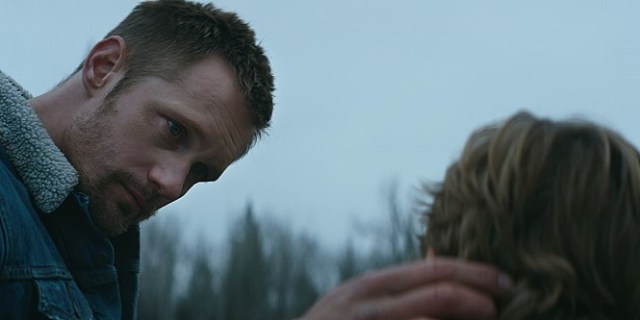
Right from when Core arrives in her town going through its cold, harsh wintry days, the movie immerses us into the icy, desolate mood hovering over the town and its few inhabitants. As nobody gives him any particular attention, Core goes to Medora’s house, and he gets to know a bit more about her as staying in her house. Her husband Vernon (Alexander Skarsgård) is currently absent because of his military service in Iraq, and she is clearly bitter about that while not notifying him of their son’s disappearance for herself yet. She also seems to hold herself barely behind her rather detached façade, and we later get an odd moment when she approaches closer to Core in a rather bizarre way when he is trying to sleep in her house.

holdthedark01

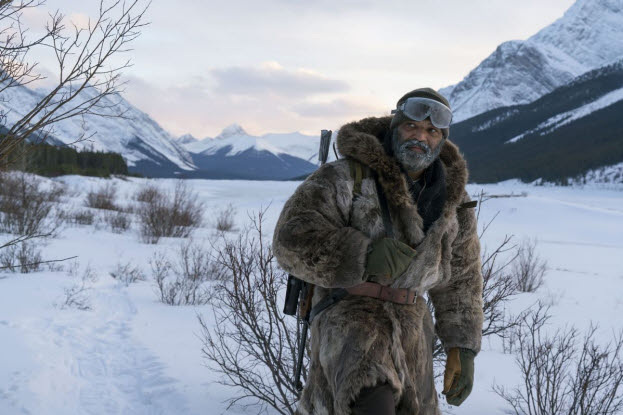
On the next day, Core goes outside the town for finding any possible trail which may lead him to the wolves he is looking for, and the movie gives us the vivid shots of vast landscapes covered with snow and coldness as he slowly moves around in the wilderness outside the town. Cinematographer Magnus Nordenhof Jønck, who previously worked in “A Hijacking” (2012), “A War” (2015), and “Lean on Pete” (2017), did a commendable job of establishing the glum and chilly atmosphere around the screen, and the resulting moodiness is further emphasized by the ambient score by Brooke and Will Blair.

Eventually, Core confronts a pack of wolves who may be responsible for the disappearance of Medora’s son, and there is a tense scene where he must act quickly for avoiding getting attacked by these wolves. I have no idea on how they handled these wolves during the shooting of the movie, but I can tell you that these wolves look as threatening as the wolves in “The Grey” (2011).

Now you may think you know where the story is heading, but the movie takes a sudden left turn as Core manages to return to the town, and the mood becomes more nervous and disturbing as Vernon comes back from Iraq. As shown from one certain scene, Vernon can be violent and ruthless without any hesitation, and it soon becomes apparent to us that he is quite ready to do what he wants by any means necessary.

As the circumstance accordingly becomes more tense and violent, director Jeremy Saulnier jolts us with a series of sudden striking moments which did catch me off guard during my viewing. I appreciated how the movie takes another left turn with a totally unexpected moment of brutal violence, and I also admired how Saulnier and his crew deftly handle an intense action sequence revolving around Vernon’s friend, who turns out to be quite angry, violent, and ruthless just like Vernon.


holdthedark02

However, the screenplay by Macon Blair, which is adapted from William Giraldi’s novel of the same name, does not provide enough emotional ground for all these and other well-made scenes in the film. As mostly observing its main characters from the distance, the movie does not delve much into their thoughts and feelings, and we come to care less about its story and characters as it solemnly trudges toward its expected finale.

Anyway, the main cast members of the movie did as much as they could do with their respective roles. Jeffrey Wright, who has been always dependable as one of the most interesting American performers since his breakthrough turn in “Basquiat” (1996), brings considerable gravitas to his rather passive character, and I also enjoyed watching a number of notable supporting performers surrounding Wright. While Alexander Skarsgård imbues his character with brooding intensity as required, Riley Keough is effectively ambiguous, and James Badge Dale, Julian Black Antelope, and Macon Blair are also fine in their supporting performance.

Overall, “Hold the Dark”, which is currently available on Netflix, is not entirely without good things to be appreciated, but it is relatively disappointing compared to Saulnier’s two previous works “Blue Ruin” (2013) and “Green Room” (2015). He is certainly a good filmmaker who knows how to establish a mood to engage us, but the movie lacks an emotional focus to maintain our interest, and that is a shame considering the palpable efforts from his cast and crew on the screen.

holdthedark03

Posted in Movies | Tagged , , | Leave a comment

Christopher Robin (2018) ☆☆1/2(2.5/4): Robin meets his old toy animal friends again

christopherrobin01

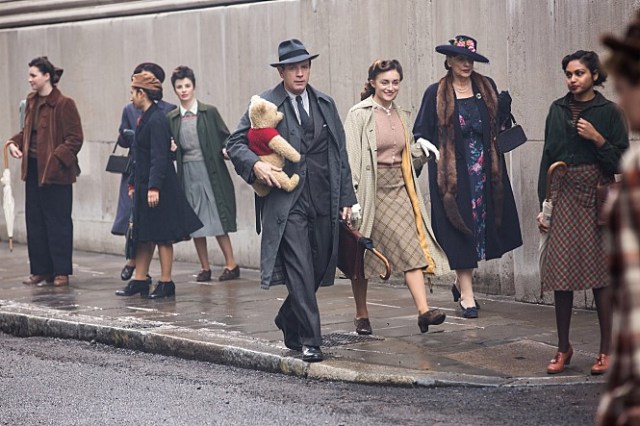
“Christopher Robin”, a live-action film inspired by Walt Disney’s beloved animation film franchise which is based on A. A. Milne and E. H. Shepard’s book “Winnie-the-Pooh”, frequently clashes with my fond memories of Winnie the Pooh, who has been known to me and many others in South Korea as “Winnie the Teddy Bear”, and his toy animal friends. Although it shows some humor and spirit at times, the movie mostly feels moody and melancholic, and it is also often hampered by its clichéd plot and thin characterization. When I walked into the screening room early in this morning, I hoped that my sleepy mind would be rejuvenated during the screening, but I only came to leave the screening room without much satisfaction, and now I am left with a rather hollow impression.

The movie opens with a wistful sequence showing how young Christopher Robin (Orton O’Brien) becomes separated from his toy animal friends and the Hundred Acre Wood. As he grows older, Robin cannot play with Winnie the Pooh (voiced by Jim Cummings) and his other toy animal friends anymore, so his toy animal friends give Robin a farewell party, and it is subsequently followed by a bittersweet private conversation between Robin and Pooh.

Not long after that, Robin is sent to a boarding school, and we soon come to observe several years of adult Robin (Ewan McGregor). He marries a young woman with whom he instantly falls in love right from their first encounter. He gets enlisted in the army when World War II begins, and he experiences some pretty tough moments on battlefield. When war is over, he comes back to his wife and his young daughter, and then he begins to work in a big suitcase company in London.

Now Robin is the manager of a department of the company, but things have been not that good for him and others his department. His direct boss has been demanding that he should give a solution for the ongoing sales problem of the company as soon as possible, and that means Robin may have to fire some of people working under him. As Robin becomes more occupied with his work, he finds himself more distant to his wife Evelyn (Hayley Atwell) and his daughter Madeline (Bronte Carmichael), and Evelyn and Madeline are quite disappointed when they learn that they will have to spend the upcoming weekend outside London without him.

christopherrobin02

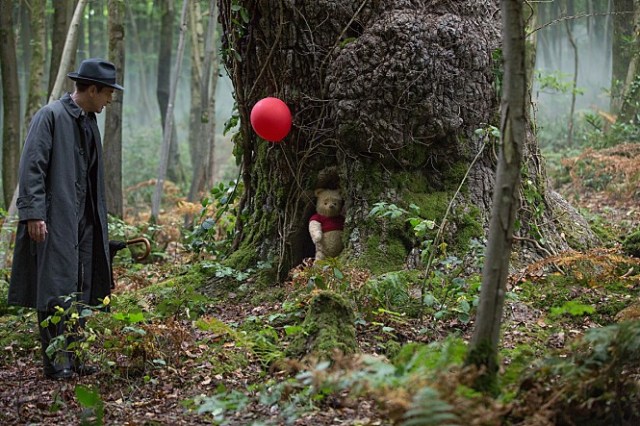
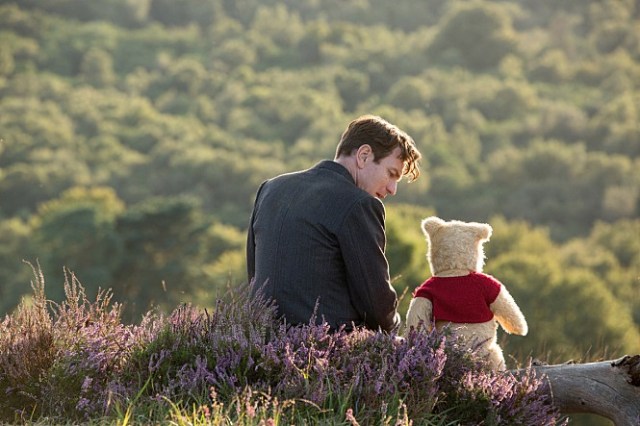
After Evelyn and Madeline leave, Robin focuses on his work as usual, but then something unexpected happens. Pooh suddenly comes to see him, and he wants Robin to help him find other toy animal friends in the Hundred Acre Wood. Although he is understandably shocked and flabbergasted at first, Robin lets Pooh stay in his house for a while, and he later goes back to the Hundred Acre Wood along with his old friend for taking care of their matter, though his mind is still occupied with his company work.

As Robin enters the Hundred Acre Wood again, the movie attempts to conjure some sense of magic and wonder, but the result does not have enough charm to engage us. While the Hundred Acre Wood in the movie often looks plain and drab, the toy animal characters in the film somehow look less cheery compared to their endearing animation versions, and that aspect further sinks the film into its glum atmosphere pervading the screen.

Anyway, the performers who provide the voices of toy animal characters in the film do as much as they can do for bringing life and personality to their respective roles. Jim Cummings gives an adequate voice performance as Pooh, and he also did a fairly good job as Tigger, but I must confess that Tigger’s rather shabby appearance in the film made me miss a lot his animation version, who is a lot more colorful and spirited in comparison. While Nick Mohammed is suitably neurotic as Piglet, Peter Capaldi is appropriately cranky as Rabbit, and Toby Jones, Sara Sheen, and Sophie Okonedo are well-cast on the whole although they are relatively under-utilized.

christopherrobin03

The standout voice performance in the movie comes from Brad Garrett, who is quite effective as Eeyore, an ever-depressed toy donkey who is as gloomy and pessimistic as I was during many bad days of my life. Steadily sticking to his character’s melancholic nature which is somehow funny and likable, Garrett did a good job of delivering a few amusing moments in the film, and you may want to have Eeyore more than any other toy animal character in the movie.

In case of Robin and the other human characters in the movie, they are less interesting as merely being flat archetype characters. Ewan McGregor fills his role as much as he can with his engaging screen presence, but the screenplay by Alex Ross Perry, Tom McCarthy, and Allison Schroeder, which is developed from the story by Greg Brooker and Mark Steven Johnson, does not provide enough human dimension for his character, and I was only reminded again that Christopher Robin is the least colorful character in the Hundred Acre Wood. In case of other performers including Hayley Atwell, Bronte Carmichael, Orton O’Brien, and Mark Gatiss, they are mostly limited by their superficial roles, and that is one of the main reasons why the finale does not work as well as intended.

“Christopher Robin” is directed by Marc Forster, who drew attention from me and others via several excellent films such as “Monster’s Ball” (2001), “Finding Neverland” (2004), “Stranger than Fiction” (2006), and “The Kite Runner” (2007). He is a good filmmaker and “Christopher Robin” is entirely devoid of charm and magic thanks to his competent direction, but I still remain disappointed and dissatisfied, so I recommend you to watch animation feature film “Winnie the Pooh” (2011), which is a lot more charming than this meandering misfire.

christopherrobin04

Posted in Movies | 3 Comments

A Prayer Before Dawn (2017) ☆☆☆(3/4): A brutal prison drama to strike you hard

aprayerbefoedawn03

“A Prayer Before Dawn”, which is currently available on Netflix, is a brutal prison drama packed with grim but striking moments you cannot easily forget. This is surely a tough stuff, but the movie is compelling and electrifying thanks to its considerable realism and verisimilitude, and it is also firmly anchored by its strong lead performance which is definitely one of the notable breakthrough performances of this year.

During its first act, the movie depicts how a British lad named Billy Moore (Joe Cole) comes to be tumbled to the bottom of his problematic life. In Thailand, Billy has tried to reach for success via Muay Thai boxing, but he is miserably defeated in a big match, and that further accelerates his methamphetamine addiction, which in turn pushes him into crime. As briskly moving from one moment to another after the opening match sequence, the movie succinctly presents its hero’s rapid descent into crime and addiction, and we are not so surprised at all when he is eventually arrested by the Thai police on one day.

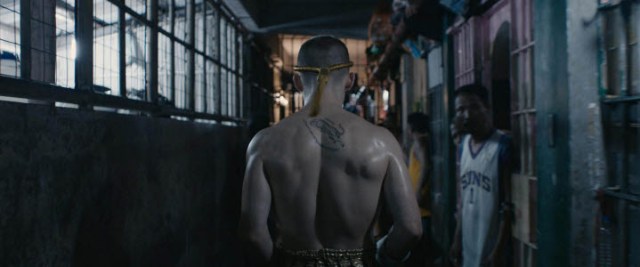
Not long after his arrest, Billy is sent a big prison whose seedy and harsh condition is not so far from “Midnight Express” (1978). He has to share a big cell along with a bunch of prisoners, and he finds himself sleeping right next to a dead man during his first night in the prison. As a foreign prisoner, he has many disadvantages besides language barrier, and there is not anyone to help him inside or outside the prison.

aprayerbefoedawn04

And this is just the beginning of his predicament. After committing a serious act of violence, Billy is promptly transferred to a section for hardcore criminals. Many of prisoners in this section look quite menacing with numerous tattoos covering their bodies, and they harass and intimidate Billy and other few new inmates for showing, well, who the boss is in the section. Not long after that, he happens to witness a group of inmates rape one of the new inmates, and that gut-chilling moment is surely more than enough to remind him that he is thrown into a far worse circumstance.

As becoming more frustrated and desperate, Billy lets himself fall further into his drug addiction. As he craves more and more for methamphetamine, he becomes quite willing to do anything for getting the drug, and there eventually comes the moment when he hits another bottom. As demanded by a prison guard who occasionally supplies him methamphetamine, he savagely beats two inmates, and that is the point when he comes to face what he has become due to drug addiction.

Fortunately for him, the prison has a Muay Thai boxing team, so he decides to join the team. Although he is initially rejected, he eventually joins the team thanks to his persistence and a little help from a generous transgender inmate, and he soon comes to be recognized by the team coach and other team members as diligently throwing himself into training.

Of course, there come several expected problems and obstacles later in the story, but the screenplay by Jonathan Hirschbein and Nick Saltrese, which is based on a real-life story as shown at the end of the movie, deftly handles these and other elements in the story with considerable efficiency. During one particular scene involved with a private letter sent to Billy, the movie does not show or tell us the content of the letter at all, but all we need to know is clearly conveyed to us as the camera calmly looks at Billy from the distance. While Billy’s close relationship with his transgender friend leads to a rather predictable moment of conflict, the movie finds a neat way to resolve their conflict without making a fuss, and that is one of a few milder moments in the film.

aprayerbefoedawn05

In case of a number of Muay Thai boxing scenes in the movie, they are quite gritty and thrilling as demanded, and director Jean-Stéphane Sauvaire did a commendable job of charging these scenes with lots of energy and excitement as required. Fluidly moving around in the ring, cinematographer David Ungaro’s handheld camera closely and vividly captures every physical movement, and the dexterous editing by Marc Boucrot makes it sure that we can feel every impactful shot while seldom getting confused.

As the center of the movie, Joe Cole, a young British actor who previously played a supporting character in “Green Room” (2015), gives a dynamic performance as memorable as Jack O’Connell in “Starred Up” (2013), which is incidentally another gritty and violent prison drama revolving around a troubled young hero. While looking believable in the Muay Thai boxing scenes, Cole ably conveys to us his character’s constant struggle with personal demons, and we come to care about his character to some degrees. In case of other performers in the film, many of them are real ex-inmates who have served time in Thai prisons, and they certainly contribute a lot to the realistic atmosphere of the movie.

Although it is often difficult to watch for good reasons, “A Prayer Before Dawn” is a competent genre piece to be admired by its mood, storytelling, and performance, so I recommend it with some caution. Prison drama is not exactly my favorite genre, but this is a fairly well-made one with some distinctive aspects, and you may appreciate it as much as me.

aprayerbefoedawn01

Posted in Movies | Tagged , , , | Leave a comment

Quincy (2018) ☆☆1/2(2.5/4): He’s still keeping on

quincy02

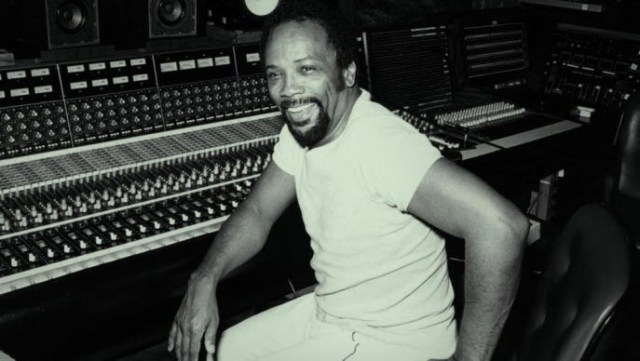
Netflix documentary film “Quincy” broadly looks around Quincy Jones’ numerous achievements, and it is hard not to be impressed by how much this legendary musician achieved during last six decades. As shown at the end of the documentary, he produced heaps of successful albums and singles throughout his long, illustrious career, and he received no less than 27 Grammy Awards while also receiving a Tony Award, an Emmy Award, and a special Oscar Award.

Jones was born in Chicago, 1933, and the early part of the documentary shows and tells us his difficult childhood years via Jones’ casual reminiscence. His South Side neighborhood in Chicago was not a good place for him and his brother due to its prevalent crime and poverty, and things got worse for them when their mother was taken away from them because of her mental disease, from which she was never fully recovered during the rest of her life.

At least, their father was someone young Jones and his brother could depend on. Several years later, he and his two sons moved to Seattle, and that was where young Jones came to discover his interest in music. Besides piano, he wanted to play many other musical instruments as much as he could, so he went all the way for that, and he subsequently came to draw considerable attention as a young but versatile musician. Although he was only 14 around that time, Jones played with many notable black musicians, and one of them was a 16-year-old blind lad named Ray Charles, who quickly became a close friend/mentor to Jones after their first encounter.

quincy03

During the 1950s, Jones’ career was boosted by a number of significant successes. Not long after he came to New York City for his career advancement, he was selected by Dinah Washington as the arranger of her eventual hit song “For Those in Love”, and this success was promptly followed by more fame and success. After studying music more in Paris for 2 years, Jones came to have his own band in 1959, and he tells us how exhausting it was for him to lead and manage the band before he had no choice but to disassemble it due to a financial problem.

However, there soon came another peak for Jones. In 1961, he began to work at Mercury Records as a new executive, and that was the beginning of his music production career. A few years later, Frank Sinatra took a chance with him, and Jones promptly demonstrated his immense skill and talent to Sinatra, who eventually became one of Jones’ lifelong friends and even helped Jones and other black musicians break the racial barrier in American entertainment business.

Around the late 1960s, Jones tried to expand his range further, so he moved to LA for working as a film music composer. Although he faced racial prejudice again (For example, his friend Henry Mancini was once asked whether Jones could compose film music despite being black), he soon showed his versatility again through a string of striking film scores including “In Cold Blood” (1967), which incidentally made him the first African American composer nominated for Best Score Oscar.

In 1974, Jones had a serious case of brain aneurysm, but that did not stop him much once he recovered from a couple of brain surgeries. Although his musical activity became a bit limited because of that health problem, he kept on nonetheless, and the 1980s was another peak period for him. Besides producing Michael Jackson’s several hit albums, he also produced Steven Spielberg’s “Color Purple” (1985), and he received three Oscar nominations as its producer/composer.

quincy04

In the meantime, his personal life went through a series of rocky moments as he was occupied more and more with his work. Not long after being separated from his first wife Jeri Caldwell in 1966, he married a Swedish woman named Ulla Andersson, but their marriage was ended in 1974. In case of his third wife Peggy Lipton, she and Jones maintained their marriage for more than 10 years, but, as told to us by her interview recording, she eventually became distant from him as he continued to be driven more by his work, and their marriage was ended in 1990.

The documentary comes to lose its focus to some degrees as busily presenting more career highlights in Jones’ later years. During the 1990s, Jones went further with several new business projects, and he also became a mentor figure for many young black musicians including Will Smith, but the documentary did not delve much into that, and a part involved with Tupac Shakur and Notorious B.I.G. is rather superficial and redundant in my trivial opinion.

Anyway, directors/writers Alan Hicks and Rashida Jones, who is, yes, Jones’ daughter from his third marriage, did an adequate job of presenting the respectful summary of Jones’ life and career. While I think Hicks and Jones could go deeper into their human subject with more honesty and insight, it is a fairly nice documentary at least, and you can clearly sense the respect and affection from Hicks and Jones, though I must confess that I got a bit tired in the end by the constant stream of praise and admiration throughout the documentary.

Overall, I am a little disappointed because “Quincy” does not go beyond what I generally know about Jones, but Jones, who had his 85th birthday early in this year, remains as its compelling human center nonetheless, and I certainly admire how much he is willing to keep on despite his recent health problems. He is indeed a trouper, isn’t he?

quincy01

Posted in Movies | Tagged , , | Leave a comment

Final Portrait (2017) ☆☆☆(3/4): An erratic artist and his frustrated model

finalportrait01

“Final Portrait” reminds me that some of great artists are difficult people to hang around with. Focusing on a long, problematic artistic process between an artist of undeniable genius and a man who admires him but becomes increasingly frustrated with his eccentricity, this modest movie gives us a sly, humorous comedy about that agony and ecstasy of artistic creation, and it is often fun to watch the strained interactions between its two different main characters.

Although he is not as well-known to many of us as Pablo Picasso, Alberto Giacometti (1901-1966) was one of the most prominent artists representing the 20th century modern art. Although many of his sculptures may look a little too simple in their monochromatic texture, they have been regarded as invaluable artworks, and, according to Wikipedia, one of his sculptures was sold for no less than 126 million dollars in 2015.

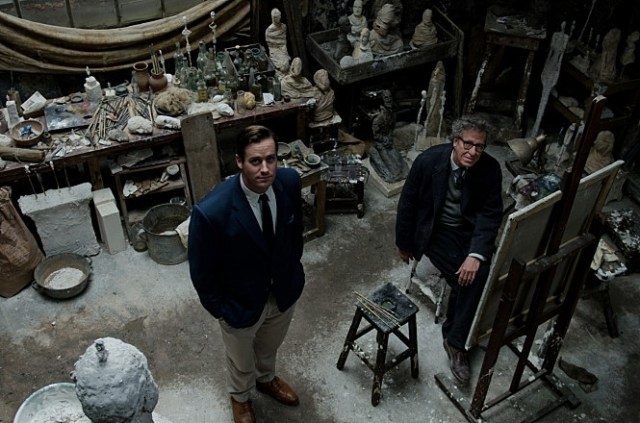
Based on American writer James Lord’s memoir “A Giacometti Portrait”, the movie mainly revolves around 18 days between Lord and Giacometti in Paris, 1964. When Lord, played by Armie Hammer, is staying in Paris, Giacometti, played by Geoffrey Rush, asks him to be a model for his new portrait, and Lord is certainly excited by this wonderful opportunity, but it gradually turns out that spending time with Giacometti is not as easy as he initially thought. When he comes to Giacometti’s studio, he expects that he will just sit in front of Giacometti for two or three hours, but he subsequently finds himself staying in Paris a lot longer than expected just because Giacometti needs more time for finishing the portrait, and he understandably becomes frustrated more and more as days go by without much progress shown from Giacometti.

finalportrait02

Meanwhile, Lord gets to know a bit more about two women around Giacometti. His long-suffering wife Annette (Sylvie Testud) clearly wants more care and attention from her husband, but she has been instead quite exasperated mainly due to her husband’s affair with a young prostitute named Caroline (Clémence Poésy), and Giacometti does not even try to hide his ongoing affair with Caroline from his wife. As he frequently lavishes more money on Caroline, Annette naturally becomes more furious and jealous, and she eventually clashes with her husband at one point. In case of Caroline, she has her own issues with Giacometti, but she is fine with him as long as he takes care of her financial matter, and we get a humorous moment when Giacometti surprises her pimps with a very generous offer they cannot possibly refuse.

In addition, Lord gets to know more about how Giacometti works. While it often looks like Giacometti does not do much except adding a few touches on the canvass, but it also seems that he is slowly making a progress, though he frequently goes back to where he began to Lord’s frustration. While coming to admire more of Giacometti’s artistic talent, Lord worries more about how long it actually takes for Giacometti to finish the portrait, and then there comes a point where he gets a nice idea while talking with Giacometti’s supportive brother Diego (Tony Shalhoub).

Leisurely observing what is going on between Giacometti and Lord, the movie is engaging as deftly presenting their relationship via small interesting moments, and director Stanley Tucci, who also adapted Lord’s memoir for his film, and his production designer James Merifield did a good job of establishing a vivid background surrounding Giacometti and Lord. I must confess that Giacometti’s studio looked quite cheerless to me with its drab, melancholic atmosphere, but I came to sense his artistry to some degrees, and I also came to regard Giacometti in the film with some amusement. Sure, he is not exactly a pleasant person, but he is a colorful guy to watch at least, and I could not help but amused as observing his erratic side.

finalportrait03

Tucci draws solid performances from his two lead performers. While Rush, who is no stranger to eccentric artist characters as shown from his Oscar-winning performance in “Shine” (1996), is simply delightful whenever he wields his character’s capricious personality, Hammer, who has shown more of his considerable talent through several recent films including “Call Me by Your Name” (2017), functions as an effective counterpart to his co-actor, and they always generate interesting things to notice whenever they are together on the screen.

In case of a few substantial performers surrounding Rush and Hammer, they hold well each own place. While Sylvie Testud, who was unforgettable in “Lourdes” (2009), fills her rather thankless role with nuances to be appreciated, Clémence Poésy brings some cheeriness into the movie whenever she appears, and we can see why Giacometti needs both of two women in his life. As a guy who probably understands his artist brother more than anyone, Tony Shalhoub, who previously collaborated with Tucci in Tucci’s debut feature film “Big Night” (1996), gives a suitably low-key performance, and he is particularly good when his character slyly helps Lord manipulate Giacometti later in the story.

While he is mainly known for his supporting turns in a number of notable movies including “The Devil Wears Prada” (2006), “The Hunger Games” (2012), and “Spotlight” (2015), Tucci is also a good filmmaker, and that is exemplified well in “Final Portrait.” Although I think its last act feels rather hurried and I cannot help but wonder whether it would work better if it were a short film, the movie is mostly amusing and entertaining thanks to its vivid mood and commendable performances, and I guess the 90 minutes of my life is spent well on the whole.

finalportrait04

Posted in Movies | Tagged , , , , | Leave a comment

Nappily Ever After (2018) ☆☆☆(3/4): Being herself with her natural hair

nappilyeverafter02

“Nappily Ever After”, which is currently available on Netflix, is a funny and delightful comedy movie about hairdo and self-image. As an Asian guy who has seldom cared about hairdo (I usually prefer crewcut, by the way), I initially observed its story and characters from the distance, but I soon found myself often amused and touched by its heroine’s bumpy struggle toward self-improvement via changing her hairdo, and I eventually came to root for her as watching how she becomes more comfortable with being herself – and her natural hair.

In the beginning, we are introduced to a young African American woman named Violet Jones (Sanaa Lathan), and she tells us a bit about her childhood years during the opening scene. During that time, she was a little shy girl who was mostly fine with her curly hair, but her domineering mother Paulette (Lynn Whitfield) always had her daughter’s hair look less curly just because she thought that made her daughter more presentable to others, and Violet accordingly became quite fastidious about her hairdo and appearance as following her mother’s demands.

At present, everything looks perfect for Violet, who is currently working at an advertisement company. While she is about to finish another successful advertisement project, it seems Clint (Ricky Whittle), a hunky doctor boyfriend who has lived with her for 2 years, is going to propose to her on her upcoming birthday, and her mother, who still visits Violet’s apartment at times for straightening her daughter’s hair as usual, is certainly delighted when she hears about that possibility from Violet.

nappilyeverafter03

However, alas, it turns out that Violet’s assumption was totally wrong. While Clint gives her something during her birthday dinner, it is not what she hopes to receive, and that certainly results in considerable awkwardness among them and other dinner guests. When they later return to her apartment, Violet and Clint come to argue with each other, and Violet comes to learn of how much Clint has been uncomfortable with not being that close to her much. Sure, she is impeccable in many aspects, but she has rarely opened herself to him even during their private time, and he has felt like being stuck in the first date during last 2 years.

After Clint eventually leaves her apartment, Violet becomes devastated and depressed, but, after allowed to have a brief respite from her job, she comes to have a chance to reflect on what is wrong with her life, so she tries to bring some changes into her life. She hangs around with her two close friends more, and she also dyes her hair blonde for a change.

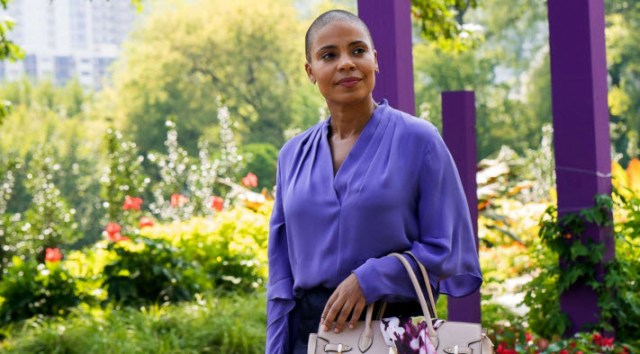
Nevertheless, Violet still does not feel right about herself, and then there comes a moment she decides to do something very drastic while also being quite drunk. Tired of her hairdo which has always required constant care and attention, she promptly shaves herself bald, and she feels much liberated as cutting her hair step by step. As the camera steadily focuses on her face, the sense of joy and relief is palpable on the screen, and we can really feel that she is boldly making her first forward step to being herself.

Of course, Violet’s radically changed appearance surprises others around her, and the movie generates some nice laughs for us during several small comic moments. In case of a humorous scene where Violet is inadvertently invited to a certain type of support meeting, the movie handles this scene with enough seriousness and sensitivity, and the result is not only funny but also touching as Violet comes to discover more confidence for her new appearance.

nappilyeverafter04

Meanwhile, she also finds a new possibility of romance through Will (Lyriq Bent), a hairdresser who has been living alone with his young daughter since his wife left several years ago. Although their initial encounter at his workplace was not exactly pleasant due to his daughter’s unfortunate mistake, Violet comes to care about Will’s daughter after a certain incident at a local mall, and she soon finds herself attracted to Will as spending more time with him. While Will is not exactly ideal in her mother’s view. Violet is willing to go to the next step, and it looks like he also wants that.

In the third act, the movie takes a few predictable narrative turns, but it keeps maintaining its breezy mood, and the adapted screenplay by Adams Brooks, which is based on the novel of the same name by Trisha R. Thomas, continue to provide good moments for Sanaa Lathan and other performers surrounding her. Lathan, who previously appeared in “The Wood” (1999) and “Brown Sugar” (2002), is believable in her character’s gradual personal growth along the story, and she is supported well by notable performers including Ricky Whittle, Lyriq Bent, Lynn Whitfield, and Ernie Hudson, who plays Violet’s sympathetic father who, like his daughter, tries something different which you have to see for yourself.

“Nappily Ever After” is directed by Haifaa al-Mansour, a female Saudi Arabian filmmaker who previously made “Wadjda” (2012). Compared to that small but extraordinary film which is about a young Saudi Arabian girl stubbornly trying to get her own bicycle, “Nappily Ever After” feels relatively conventional, but it is still an engaging female story full of heart and spirit thanks to al-Mansour’s thoughtful and competent direction, and I had a fairly good time on the whole. At this point, both “Nappily Ever After” and “Wadjda” are available on Netflix, and I wholeheartedly recommend you to watch them together someday.

nappilyeverafter01

Posted in Movies | Tagged , , | Leave a comment

The Land of Steady Habits (2018) ☆☆☆(3/4): It’s still a messy life for him

thelandofsteadyhabits01

“The Land of Steady Habits”, which was recently released on Netflix, is a typical suburban comedy drama about one middle-aged guy’s bumpy attempt toward a new beginning for his unhappy life. Although there have already been many similar films out there, the movie engages us thanks to its solid storytelling and characterization, and it also has another fine performance from an actor who has been one of the most compelling performers during recent years.

Ben Mendelsohn, a dependable Australian character actor who has been a lot more prominent since his nasty breakthrough turn in “Animal Kingdom” (2010), plays Anders Hill, and the early scenes of the movie show us how this guy’s life has been going nowhere since he suddenly decided to walk away from not only his family but also his lucrative job in some financial company. Now living alone in a smaller house in his neighborhood, Anders seems free and fine on the surface, but he still feels frustrated and discontented as before, and he frequently goes to a local mall for buying stuffs for filling his rather empty residence. When he comes across a woman around his age during his shopping, he does not hesitate to come a bit closer to her during their casual conversation on a vase, and we soon see them having a little private time later.

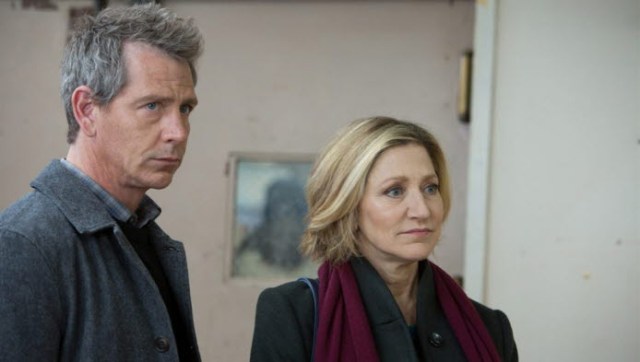
While there is not much anger or resentment between him and his ex-wife Helene (Edie Falco), Anders cannot help but become envious and petty when he comes to learn that Helene has already been moving onto the next chapter of her life along with her boyfriend Donny (Bill Camp), who has incidentally worked in the same financial company where Anders once worked. Although he had no qualms about handing the family house to Helene, Anders does not like much Helene living with Donny in the house, and his subsequent meeting with Donny and Helene is certainly awkward to say the least.

thelandofsteadyhabits03

The circumstance gets messier thanks to Anders and Helene’s son Preston (Thomas Mann), a lad who has led a rather aimless life since his college graduation. Although he looks like a good son happy to work at his mother’s workplace and his relationship with his father seems fairly good, we come to learn that he had an addiction problem in the past, and we are not so surprised when Helene happens to learn that he has been tumbled into another kind of vice.

Meanwhile, Anders inadvertently gets involved with an adolescent boy named Charlie (Charlie Tahan), who is the son of a couple who has been close to Helene for many years. During their accidental encounter during an evening party held at Charlie’s home, he comes to share a drug along with Charlie, and that leads to a small amusing moment involved with a turtle belonging to Charlie. After Charlie is hurriedly taken to a hospital due to a serious incident of overdose, Anders shows some care and concern through visiting him at the hospital, and Charlie certainly appreciates that.

Deftly going back and forth between comedy and drama, the adapted screenplay by Nicole Holofcener, which is adapted from the novel of the same name by Ted Thompson, steadily rolls its main characters along its leisurely narrative, and we get a number of nice little moments to enjoy for considerable humor and sensitivity. While we often get laughs from how lousy Anders is to people around him, we also come to understand his confusion and frustration, and he eventually comes to us as a flawed but engaging individual to observe.

thelandofsteadyhabits04

I must point out that Anders is still your average white guy in mid-life crisis, but Holofcener’s smart, sensitive writing imbues its hero with life and personality, and Mendelsohn gives a fabulous performance to cherish for nuanced touches and effortless coming timing. Ably balancing his performance among different modes, he shows another side of his immense talent here in this film, and I especially like a certain scene later in the story where his character unintentionally causes a very awkward circumstance among him and other characters. He surely feels sorry, so he tries to do his best for making the situation less uncomfortable, but, alas, things do not go well in the end.

The other main performers surrounding Mendelsohn are competent on the whole, though some of them are not utilized well because of their underdeveloped characters. While Eddie Falco, who has diligently advanced since her memorable performance in TV series “The Sopranos”, is direct and straightforward as Ander’s no-nonsense ex-wife, Bill Camp, a character actor who has recently been more notable since his acclaimed supporting performance in HBO miniseries “The Night Of”, is interesting to watch as usual, and Thomas Mann, Charlie Tahan, Elizabeth Marvel, Michael Gaston, Josh Pais, and Connie Britton are also effective in their small respective supporting roles, though Britton, who drew my attention for the first time via TV series “American Horror Story”, is seriously under-utilized in her thankless role.

As shown from two previous films “Please Give” (2010) and “Enough Said” (2013), Holofcener is a good director who knows how to establish and then develop story and characters, and “The Land of Steady Habits” confirms to me again that she is indeed one of interesting American filmmakers to watch. Although the movie is not without flaws and I still think its ending is a little too abrupt, I was entertained by storytelling and performance, and I can assure you that it is one of better movies from Netflix.

thelandofsteadyhabits02

Posted in Movies | Tagged , , | Leave a comment