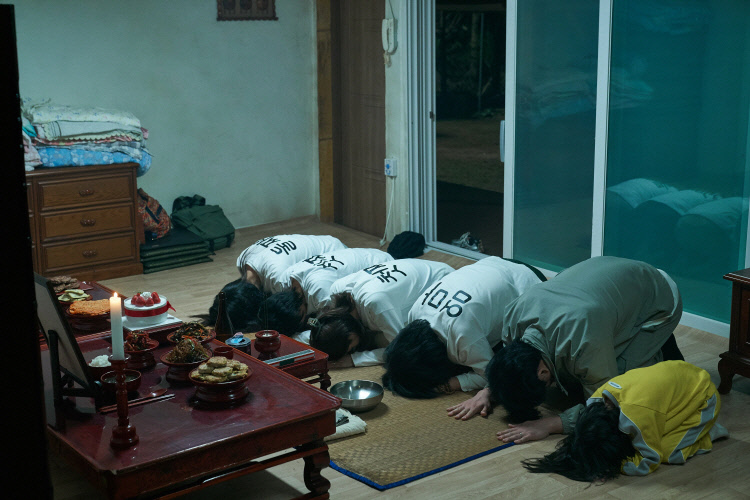
South Korean film “The Journey to Gyeong-ju” is a mixed bag which actually works better than expected. Although it often feels rather uneven as frequently bumping back and forth between comedy and drama along the story, the movie is somehow held together by the game efforts from its several main cast members, and we come to care more about their characters’ desperation while having some good laughs at times.
At the beginning, the movie looks like your average dysfunctional family comedy on the surface. Ok-sil (Lee Jung-eun) and her three daughters, Jang-joo (Kong Hyo-jin), Yeong-joo (Park So-dam), and Dong-joo (Lee Yeon), are going to an old tour city named Gyeong-ju, and they are supposed to have a time of healing for their minds there, though they cannot help but clash with each other as going to Gyeong-ju by their shabby old vehicle as colorful as that vehicle in “Little Miss Sunshine” (2006).
However, it soon turns out that they have other plan behind their back. Several years ago, Ok-sil’s youngest daughter Gyeong-joo (Hwang Hyeon-jeong) was brutally beaten and then murdered by some horrible dude, but he subsequently received a rather light sentence to the anger and frustration of Ok-sil and her other family members including her husband, who eventually died not long after his daughter’s killer was sent to prison. Now, this horrible guy, Sang-hyeon (Byun Yo-han), is on parole, and Ok-sil’s and her other daughters are not going to let him enjoy his freedom.
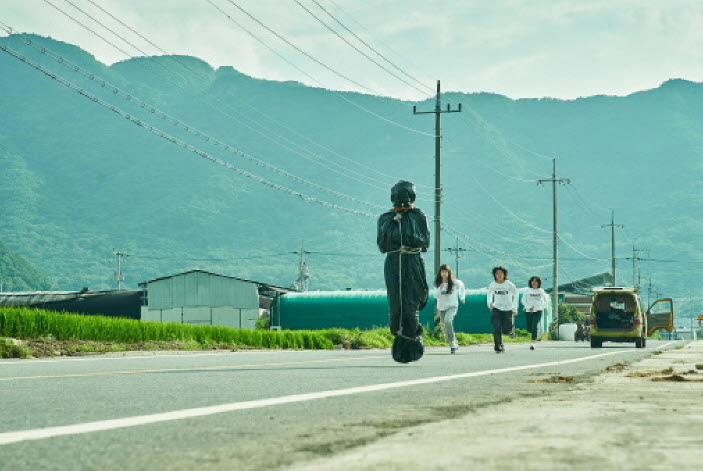
What they planned looks pretty simple at first. A female friend of Ok-sil and her two sons who have a certain particular set of skills already kidnapped Sang-hyeon while Ok-sil and her daughters were going to Gyeongju, and this is supposed to give Ok-sil and her daughters a fairly good alibi. Not long after they arrived in Gyeong-joo, Sang-hyeon’s unconscious body is handed to them, and now they are going to execute their big personal revenge upon him at a certain remote spot prepared for them.
Needless to say, things do not go that well for Ok-sil and her daughters in one way or another, and the movie accordingly serves us one absurd comic moment after another as they struggle to accomplish their goal. While those people hired by them turn out to be rather sloppy, Ok-sil and her daughters are no better than them at all, and they are certainly thrown into panic and frustration as their plan frequently goes wrong despite their desperate efforts.
And they also come to clash more with each other as facing each own pain and sadness from Gyeong-joo’s tragic death. While Ok-sil cannot help but become more haunted by the memories of her dead daughter, her surviving daughters turn out to have each own issues to handle besides trying to move on with their respective lives, and things get more complicated when it turns out that not all of them are really willing to go all the way with their mother.
Meanwhile, the plot thickens a bit more as the situation becomes more serious for not only Ok-sil and her daughters but also several others around them. Shortly after Sang-hyeon was gone without any trace, a couple of detectives assigned to this cast instantly sense something fishy about his sudden disappearance, and they soon come to look for Ok-sil and her daughters. In addition, Sang-hyeon turns out to be quite a vile and nasty guy to say the least, and he surely brings more troubles for everyone associated with this ongoing circumstance.
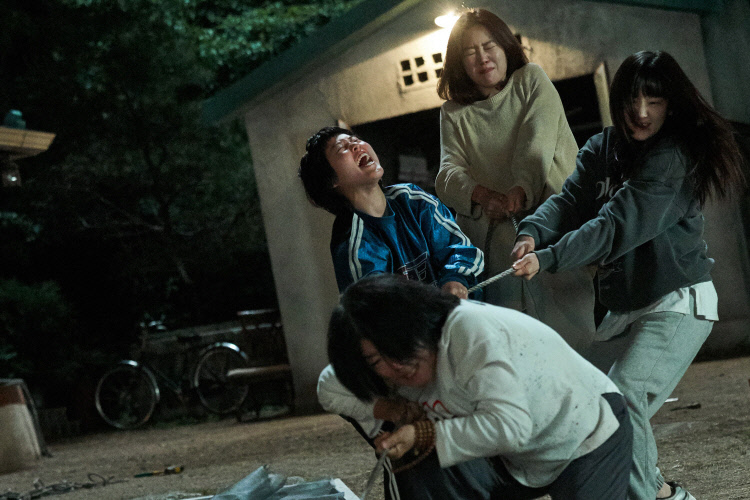
I am not so sure about whether the finale works as effectively as intended, but the screenplay by director/writer Kim Mi-jo, who previously made a feature film debut in little but unforgettable #MeToo drama movie “Gull” (2020), manages to juggle many different genre elements to the end. Although things surely become all the more serious for everyone later in the story, the movie steadily maintains its sense of black humor as well as its narrative momentum, and we become more engaged in what is being at stake for Ok-sil and her daughters.
Above all, the ensemble performance among the four principal cast members of the film keeps things rolling even when the movie stumbles a bit. As Lee Jung-eun deftly balances her character between comedy and melodrama without any misstep, Gong Hyo-jin, Park so-dam, who incidentally appeared along with Lee in Bong Joon-ho’s Oscar-winning film “Parasite” (2019), and Lee Yeon have each own moments to shine along the story, and these four wonderful actresses always click well with each other thanks to the effortless comic timing among them. Kim also assembles a number of good performers around them, and Byun Yo-han, Hwang Hyeon-Jeong, Kim Young-sung, Nam Gwon-a, Kim Jung-young, and Kim Hak-sun dutifully fill their respective spots around the story.
Overall, “The Journey to Gyeong-ju” is an occasionally incoherent but fairly enjoyable movie whose strong elements compensate enough for several notable weak aspects, and Kim made a mostly successful transition to mainstream here in her second feature film. Although it is less satisfying compared to “Gull”, the movie confirms that she is a competent filmmaker who can go on, and I will certainly keep following her promising filmmaker career.