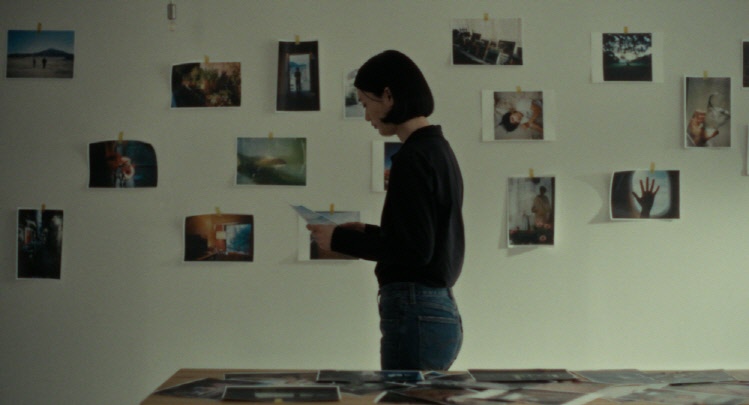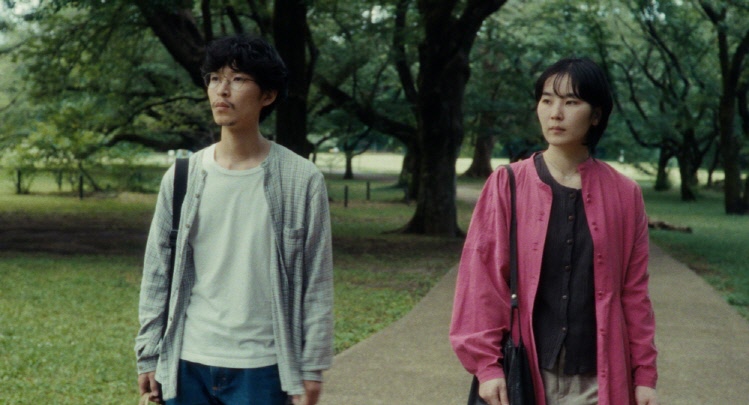
2025 Japanese film “Leave the Cat Alone”, which was premiered in the Busan International Film Festival in last year and then was released in South Korean theaters in last week, is frustrating at times as we try to grasp what is really about. While I admired its mood, storytelling, and performance, I often observed the story and characters from the distance during my viewing, and I am not so sure about whether it works as well as intended.
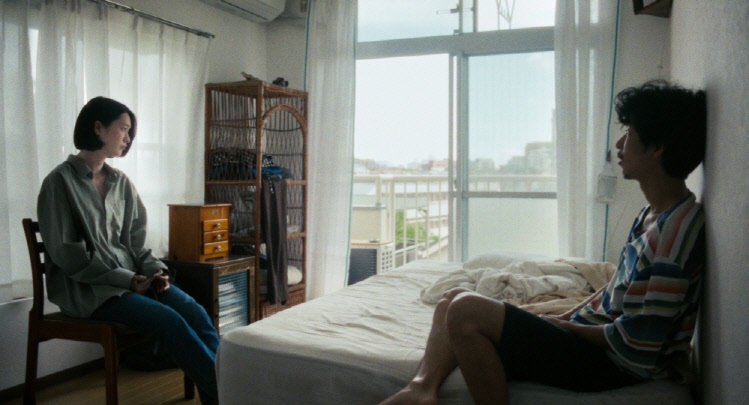
At first, the movie seems to be about the estrange martial relationship between Mori (Soma Fujii, who also composed the score for the movie) and Maiko (Ran Taniguchi). Maiko is a photographer artist who is about to have a modest exhibition of her latest works, and it looks like things are pretty going well for her and her career, but we soon come to sense a trouble in her domestic life with her husband. Mori, who is a small-time musician, has been rather depressed for no apparent reason, and we see how he lets himself stuck in their little apartment without much communication with his wife.
As observing more of the emotional gap between them, we naturally wonder what has been troubling Maiko and Mori, but the movie does not give us any answer at all. When Mori says he cannot forgive her, Maiko accepts his words in silence, and that leaves us with more questions about whatever caused the growing estrangement between them.
However, it gradually turns out that the story is more about Mori and someone in his past. That person in question is a woman named Asako (Yukino Murakami), and she and Mori happen to come across each other at a spot in his neighborhood by sheer coincidence. As they come to spend more time with each other, they begin to look back at their old past, and then the movie presents the two different versions of how they became more than merely close friends at that time.
While their respective memories of that shared past between them are not exactly identical, it is clear that they loved each other a lot at that time. At first, it was just an impulsive physical interaction between them, but Asako soon became more serious about their relationship, and so did Mori. When Asako told this to her best friend Chika (Meiry Mochizuki) later, Chika was rather skeptical while most occupied with her upcoming wedding, but Asako was still willing to go further with Mori.
The mood becomes a bit humorous when Asako and Mori sneak into Mori’s workplace in the middle of one night for doing a little favor for Chika. While they manage to get what they want, something rather spooky occurs to Mori at the last minute, and this can be compared with a little inexplicable happening crucial to Mori and Asako’s accidental encounter in the present part.
Anyway, Mori and Asako gladly rekindle a bit of their old feelings toward each other after this unexpected encounter between them, but they are also reminded of how things have changed since they somehow got separated from each other in the past. When the movie subsequently shifts from Mori’s viewpoint to Asako’s, she turns out to be as unhappy and frustrated as him, and then there is a bittersweet moment between Asako and Chika, who happens to need some help from her best friend due to her impending personal matter.
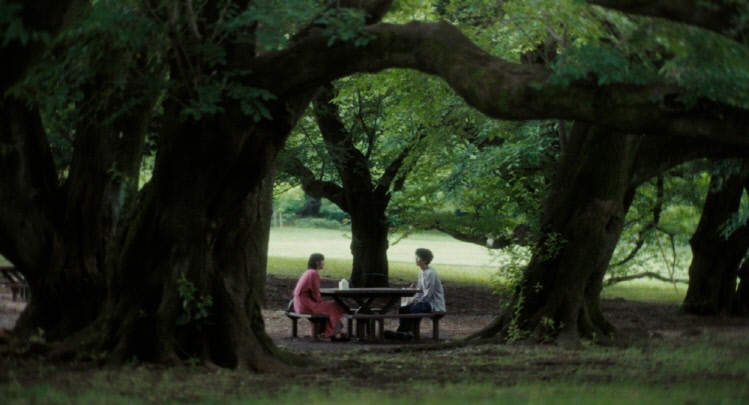
In addition, Mori and Asako also face some undeniable facts of life. No matter how much they miss their good old time, that is something they will never regain just like many other things in the past, and there is a little poignance in how they respectively accept what has been irreversibly changed and then pay more attention to what they have in their respective lives. After coming back to her home where her caring husband is waiting for her, Asako somehow rejuvenates her artistic spirit to her little delight. Besides sincerely appreciating a little input from his wife, Mori tries to step closer to his wife, and there is a little moving moment when he comes to see how much his wife cherishes many personal memories between them.
While often glimmering with low-key sensitivity, the screenplay by director/writer Daisuke Shigaya, who incidentally made a feature film debut here after making two short films, is often a little too opaque and distant to hold our attention, and it also may take some time for you to get the subtle meaning of its very title (There is no cat appearing in the film to my little disappointment, by the way). Although its four principal main cast members did a good job of embodying the human qualities of their respective roles, their understated acting does not go further than suggesting the emotional undercurrents surrounding their characters, and we never feel like really getting to know their characters even in the end. Consequently, the movie often feels like merely scratching the surface, though it wisely avoids any unnecessary melodrama as firmly sticking to its restrained attitude.
On the whole, “Leave the Cat Alone” is not satisfying enough for recommendation, but I must point out that it is not a total bore at least. Before watching it, I happened to endure the long tedium of South Korean film “The Love of Truman” (2025) for more than 2 hours, and, despite also being quite dry and slow, “Leave the Cat Alone” felt relatively more interesting to me. I do not wholly like it for now, but I also see considerable potential from its director, and I sincerely hope that he will demonstrate more of his talent in the near future.