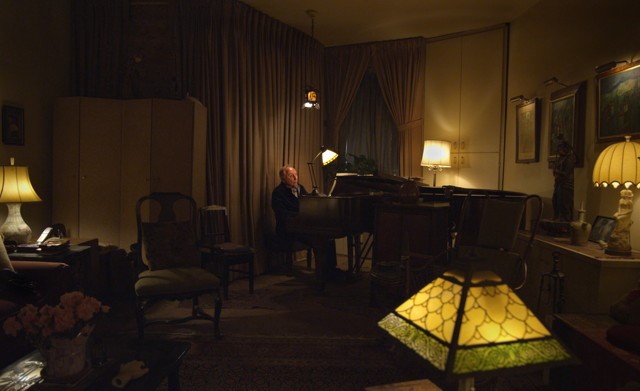
Spa Night (2016) ☆☆☆(3/4): A somber, tentative gay drama in Koreatown

spanight01

“Spa Night” puts itself in the middle of an ethnic community area in LA both familiar and foreign to me. As this small exceptional independent movie let me assess its specific, intimate details with curiosity and amusement, I was involved in its somber, tentative character drama, and I found myself touched by its young, closeted hero’s inner conflicts.

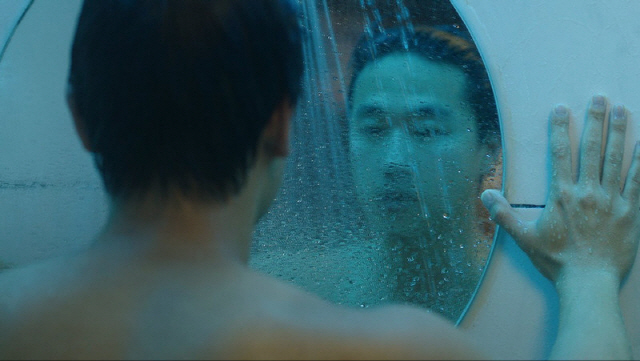
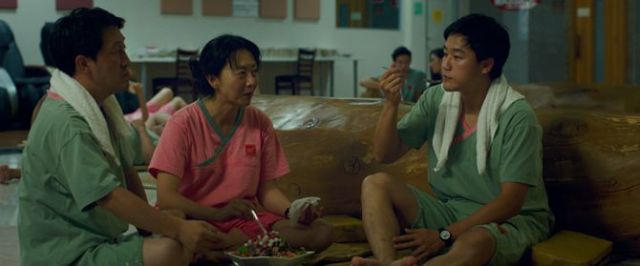
When we meet David (Joe Seo) for the first time, everything looks fine for this Korean American lad and his parents Jin (Youn Ho Cho) and Soyoung (Haerry Kim). They are at a spa located somewhere in the Koreatown neighborhood of LA, and the opening scene shows David and Jin going through what I and my father usually do at our neighborhood spa: sweating in steamy sauna, scrubbing each other’s body, and having some rest later.

In the common lounge, they join Soyoung, who says she would love to be accompanied with her future daughter-in-law. I nodded at her words with amused recognition during the screening at the 2016 Jeonju International Film Festival. Due to my bachelor status, my own mother incessantly says similar things to me whenever we happen to have a private conversation between us. Like David, I have no choice but to behave like a dutiful, obedient son on the surface even though I have no particular interest in date, let alone marriage.

It turns out David’s parents are having a serious problem. Their small Korean restaurant, which looks as old-fashioned as some of shabby restaurants I know in South Korea, has been declining in its business, so they eventually decide to close the restaurant. When she talks about this to her friend during their weekend church service, Soyoung emphasizes that her family are all right with this change, though it is just for keeping their appearance in front of her friend and other neighbors.
spanight02

In spite of their difficult financial situation, David’s parents still hope that their only son will go to college someday (and marry someone and then move out to have his own family, of course). They enroll David in a recommended private prep school which may improve his SAT score, which should be far higher if he really wants to go to a good college like the University of South California. Although he does not seem to be that eager for higher learning now, David begins his SAT study as his parents want and expect, and he also spends a few days in the USC campus.

As we watch more of David’s mundane daily life, the movie gradually reveals his other private matter. After he and his old childhood friend have a boozy night along with several other young Korean Americans, they go to a neighborhood spa for detox, and David becomes more conscious of his homosexuality than before. He soon gets a part-time job at that place. As doing his menial work around hot/cold pools, shower booths, saunas, and sleeping room, he sometimes sees some of its customers satisfying their private urge in corners.

There is a certain amount of tension as David does not talk anything about his job to his parents, but the movie is mostly driven by individual personal moments rather than conventional plot. The director/writer Andrew Ahn handles his story with admirable sensitivity and restraint. The locations in the film feel authentic with cultural details I would love to explain to you, and they certainly make distinctive impressions along with the urban landscapes of LA. As far as I can remember, the main cast members handle their frequent Korean dialogues without much awkwardness, and I must say that some of indoor scenes in the film almost feel as if they had been shot in South Korea instead of LA.

Considering his same double minority background, I guess Ahn experienced difficult things not so far from what is shown in his film. Besides David’s conservative Christian family background which can be compared to the similar background of Dee Rees’s lesbian coming-of-age drama “Pariah” (2011), other young Korean Americans’ insensitive attitude toward homosexuality is another inhibitory factor for David, as shown from when he has to join their crude ‘dare-to-kiss’ game in a karaoke room. While observing how unhappy he has been without anyone to understand his sexuality, we come to sense more of the invisible gap between him and others including his parents, though he and his parents do love and care about each other.

There is a small scene in which David and his parents attend their relative’s traditional party for a one-year-old baby, and that instantly took me back to Ahn’s short film “Dol” (2011), which I fortunately encountered thanks to a South Korean critic acquaintance around three years ago. It is about a young Korean American man attending that traditional baby party, called ‘Dol party’, along with his family, and this autobiographical short film subtly shows how much he feels isolated as a closeted gay who has been hiding his current relationship from his family. As he confirmed to me after the screening of “Spa Night”, Ahn had his own parents participate in the production of “Dol”, but, maybe because he did his job too well, they did not realize their son’s intention even after they watched the final product (they do know now that their son is gay, by the way)
spanight03

What was glimpsed from “Dol” is further expanded and developed under the low-key ambience of “Spa Night”. The cinematographer Ki Jin Kim, who previously collaborated with Ahn in “Dol”, conveys to us David’s emotionally constrained state via the effective use of widescreen composition, and the occasional close-up shots of bare male body parts constantly remind us of what is being stirred and churned inside David. With many scenes unfolded at the spa, nudity comes with the territory, but it is simply presented as a plain part of daily spa business. Ahn told me about how he luckily found this nice place for his shooting, and, after hearing that it looks as good as shown in the film, I actually considered taking my parents there if I have a chance to visit LA with them.

Joe Seo, who was almost the last one to be auditioned right before the shooting (it was pretty hard for Ahn to find a Korean American actor who can speak Korean as fluently as he wanted), gives a gentle, likable lead performance balanced well with subdued intensity. When David finally takes a bold, active step around the finale, we are not surprised at all because we already sensed buttons bound to be pushed sooner or later inside him. It is risky to say the least, but our brain tends to be oblivious to reason when everything clicks to trigger whatever is in our biologically programmed nature.

Youn Ho Cho and Haerry Kim are also good in their supporting roles, though Kim looks a little too young for her role (I hope she will take this negative comment as a compliment). Soyoung and Jin are not exactly perfect parents, but the movie depicts them with sympathy and understanding. As drinking more than before due to his unemployment, Jin begins to show his worse sides, but the movie understands his wounded pride while never excusing his pathetic behaviors in front of his family. Kim has a sad scene in which Soyoung and David come across a place where she once lived with her husband during their first year in LA; she and Jin came to US for a better life like any other immigrants, but now they may have to recognize that their life was not as good as they once wished a long time ago.

Roger Ebert used to talk about how good movies can let us feel what it is like being someone different from us, and “Spa Night” qualifies for that because of its universal empathetic quality generated from specific human elements. Like its hero, the movie stays calm and distant throughout its 90 minutes, and I began to lose some of my patience during its last half hour which merely throws a typical unresolved ending with lots of uncertainty, but it is a notable debut to watch none the less. During recent years, there have been lots of conversations revolving around the diversity in American movies, and, considering what is presented here in his film, I think Ahn is a new interesting filmmaker who may make significant contributions to the industry currently in the urgent need of reflecting more of social/racial changes outside.

 Sidenote: Here is the link to “Dol” (2011). https://vimeo.com/34502663

spanight04


Posted in Movies | Tagged , , | Leave a comment

Rabin, the Last Day (2015) ☆☆☆(3/4): When Israel failed itself

rabinthelastday01

As with other infamous political assassination incidents, the assassination of Israeli Prime Minister Yitzhak Rabin has devastating historical resonance over its aftermath. Despite the increasingly difficult domestic situation following the Oslo Accord I, which could have been the real first step toward the peace for Israel and Palestine, Rabin tried to handle this tricky problem with admirable bravery and determination till the very last hour of his life, and I wonder whether the current situation between Israel and Palestine might be less troublesome even if he had ended up with humiliating political failure instead of being killed on that shattering day of 1995 November.

After 20 years, Israeli docudrama film “Rabin, the Last Day” looks here and there around the assassination incident as firmly holding itself in its rather cold, clinical approach, and it is often gut-chilling while its big, gloomy picture is being assembled in front of us. We see the infuriating inevitability surrounding the whole circumstance during that time, and then we are indirectly reminded of how things have become quite worse since that regrettable point in the modern history of Israel.

After a long TV interview clip featuring Shimon Peres, who was one of Rabin’s cabinet members, the movie instantly takes us right into Tel-Aviv on November 4th, 1995. During the evening of that day, Rabin came to a rally supporting the Oslo Accord I, which was held at the Kings of Israel Square (this place was renamed Rabin Square after his death). After being surprised and excited by more supports than expected, Rabin went back to his car waiting for him outside the city hall building, and that was when a young Israeli zealot named Yigal Amir shot at Rabin three times. In the following frantic sequence, we see Rabin’s bleeding body being hurriedly taken to a nearby hospital, and then we watch the whole nation being shocked by the news of his death.

rabinthelastday02

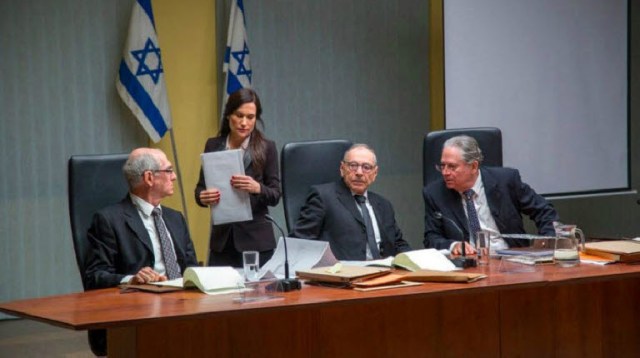
The movie mainly revolves around two contrasting parts. The commission of inquiry is assembled for a more thorough investigation, and various witnesses are summoned one by one and then respectively testify in front of the head of the commission and his two fellow members. Along with two commission lawyers, the commission members are going to look closely upon every detail for their final conclusion, while also making sure that their commission stays in line without any transgression.

In the meantime, a number of disturbing scenes show us the incredulous insanity among some of Rabin’s fanatic detractors. We see a group of fundamentalist rabbis holding an ancient religious ceremony for putting a curse on Rabin. We see young people being influenced by extreme Zionism. We get the glimpses of how Amir came to push himself willingly toward the assassination as one of such young men. The most memorable moment in this part comes from when a psychiatrist is brought into a private meeting held by radical Zionists. Using her twisted rationale which would repel any sane decent person, she argues that Rabin is suffering from schizophrenia and, therefore, he must be removed by any means necessary for the good of their country. Does she truly believe in this outrageous argument? I do not know, but all I can say is that she sells it pretty well to her loony band of audiences even if she does not.

Regardless of how much these scenes are fictional, they do reflect the dark side of the Israeli society which is still affecting the nation at present. Rabin was really hated by those zealous extremists who had been nurtured and overlooked by the Israeli government for its aggressive tactics on Palestine, and, as shown from the disturbing footage clips of real anti-Rabin rallies held during that time, many other right-wing people in Israel were no fan of Rabin either. Labeling him as a traitor who deserves to die, they even compared Rabin and his government to Nazi, and many of his political opponents did not hesitate to exploit this violent political turmoil. Not so surprisingly, the movie does not have anything nice to present in the case of current Israeli Prime Minister Benjamin Netanyahu, who did not even try to quench the smoldering hatred among many of his and his party’s supporters while indirectly endorsing seditions just for his political advantage over Rabin.

rabinthelastday03

As the commission continues its investigation, it gradually becomes clear to us that everything was bound to culminate into that tragic moment sooner or later – and that it could have been avoided if things went a little different at that point. Although he was not afraid of death threats, Rabin should have worn a bulletproof vest as advised. If the police and the internal security service had been more careful and watchful, they might have noticed Amir in advance. If Rabin’s bodyguard and driver had been a bit swifter in their response, Rabin might have survived the shooting. Later in the film, Amir tells his police interrogator that he was surprised by how he managed to approach to his target so easily and so close like that, and this incorrigible lad does not seem to grasp at all what he has done, while so blind in his smug, self-righteous attitude which makes his no-nonsense interrogator shake his head in disbelief and disgust. Amir was indeed a mere lone gunman, but, alas, that was more than enough to blow away a golden opportunity for both Israel and Palestine.

While many scenes in the movie feel theatrical as lines are flatly delivered, the cast members give convincing performances as the cinematographer Eric Gautier’s camera calmly observed them via long, steady shots, and the director Amos Gitai, who wrote the screenplay with Marie-Jose Sanselme, keeps engaging us as constantly maintaining the level of subtle tension throughout the film. It is the testament to Gitai’s talent that I was seldom bored during its long running time (153 min), though I also felt disoriented and distant at times as trying to process and gather its seemingly random pieces hurled at me and a few other audiences at the 2016 Jeonju International Film Festival. Although it will surely demand your brain to be more active than usual during your viewing, the movie is worthwhile to watch for its commendable direction and performances besides its relevant political subjects.

During the screening, Oscar-nominated documentary “The Gatekeepers” (2012) came to my mind. In that memorable Israeli documentary I recommend you to see in advance for more understanding of Gitai’s film, all of the interviewees who once served as the directors of the Israeli internal security service agree that there should be changes in their country’s policies for avoiding its possible bleak future. “Rabin, the Last Day” agrees to that as arriving in its quiet but stern conclusion, but it also has reasonable skepticism, and we naturally come to wonder whether things will ever get better, even though there is still the possibility of hope and peace remained out there.

rabinthelastday04

Posted in Movies | Tagged , , | Leave a comment

Hitchcock/Truffaut (2015) ☆☆☆1/2(3.5/4): Two great filmmakers, one monumental book

hitchock-truffaut01

When I was young and wild during the 1990s, I began to be more serious about movies, and it was fortunate for me to have two wonderful things to boost my growing interest on movies around that time. First, a bunch of Alfred Hitchcock films became more accessible to cinephile wannabes like me thanks to a special VHS release, and Hitchcock soon became quite a familiar figure to me like Steven Spielberg or George Lucas. Second, François Truffaut’s monumental interview book “Hitchcock/Truffaut” was translated and published in South Korea in 1994, and I did not hesitate at all when I came across the book during one afternoon in 1996. I devoured every page of that book, and I am still keeping it along with many other books from my adolescent years.

Looking into what was exchanged between Hitchcock and Truffaut during their long interview sessions at the Universal Studio in 1962, Kent Jones’s documentary film “Hitchcock/Truffaut” is more entertaining than I expected. While some of its contents may be not that new to anyone who has ever read Truffaut’s book, the documentary is an insightful and respectful tribute to Hitchcock’s invaluable achievements in the movie history, and this is surely something you cannot miss if you are an admirer of Hitchcock’s films.

When he was approached by Truffaut and then accepted his proposal for the interview, Hitchcock was entering the late period of his long, illustrious career while remained overlooked by American critics. He was certainly a star Hollywood director thanks to the financial success of many of his classic movies as well as TV series “Alfred Hitchcock Presents”, but, believe or not, he was mostly regarded as a commercial filmmaker who was just more successful than others in the Hollywood studio system.

hitchock-truffaut03

But Truffaut and his critic gangs in Cahiers du cinéma, who eventually tried filmmaking for themselves and then brought a groundbreaking change into the field as the front runners of the French New Wave during the 1950-60s, were the passionate champions of Hitchcock’s works. As learning new things from knowing old ones through Hitchcock, they recognized his indelible cinematic style to be appreciated and analyzed, and Hitchcock became a prime example of Truffaut’s auteur theory, which defined Hitchcock not as a mere hired hand but as an individual artist who imbued personal ideas and visions into his movies.

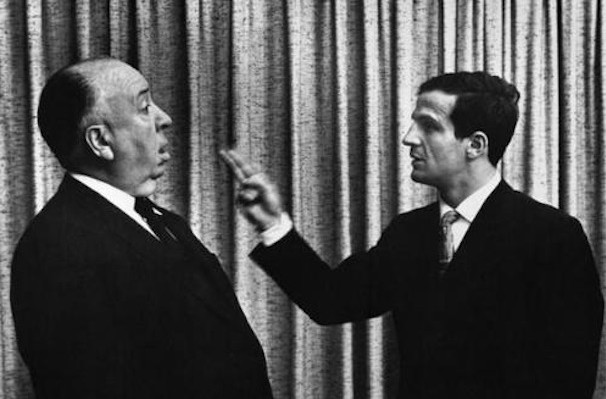
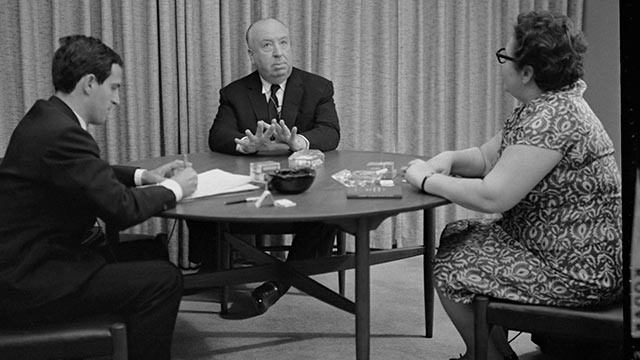
Right from their first meeting, Truffaut was ready to hear anything from a man whom he had admired for years, and Hitchcock was willing to talk anything about his techniques and experiences. With Truffaut’s friend Helen Scott as their translator, Truffaut and Hitchcock went through Hitchcock’s films one by one, and a number of audio and photo excerpts from their interview sessions clearly show that both of them had a fun, pleasant time together. As pointed out in the documentary, they were so different from each other in many ways, but they clicked well with each other despite their language barrier, and their interview became the beginning of their beautiful friendship.

As we listen to them talking about some of Hitchcock’s films, the documentary often juxtaposes their conversations with footage clips deftly presented for facilitating our understanding of Hitchcock’s sheer mastery of filmmaking techniques, and we are also served with informative bits of commentaries from various contemporary filmmakers including Wes Anderson, Olivier Assayas, Peter Bogdanovich, Arnaud Desplechin, David Fincher, James Gray, Kiyoshi Kurosawa, Richard Linklater, Paul Schrader, and Martin Scorsese. I must confess that it sometimes feels like being lectured about what I already know, but, what the heck, you cannot possibly complain in front of such an impressive array of filmmakers who do have a lot to talk about a great director they all admire with unadulterated enthusiasm (You may notice the curious absence of Brian De Palma, who understandably declined Jones’s request because he already had his own place for talking about Hitchcock in Noah Baumbach and Jake Paltrow’s upcoming documentary “De Palma” (2015)).

hitchock-truffaut02

Among Hitchcock’s 53 feature films, “The Wrong Man” (1956), “Vertigo” (1958), and “Psycho” (1960) come to take the spotlight of the documentary as his most personal works. As an exceptionally earnest drama in his career, “The Wrong Man” is literally about the innocent man wrongfully accused, Hitchcock’s recurring theme originated from his childhood fear of the police. “Vertigo” is the haunting manifestation of his longtime personal obsessions, and Hitchcock virtually revealed his dark sides through mesmerizing artistic sublimation in that masterpiece. Although it is less shocking at present, “Psycho” is still a powerfully disturbing work even after more than 55 years, and we hear about how shocking it was to the audiences during that time. They did expect something terrible because they came to see a Hitchcock film, but then they were at a loss after that infamous scene, while completely gripped by the master of suspense who could play them like an organ.

After Truffaut’s book was published in 1966, Hitchcock found himself admired and respected for his body of work far more than before, though his career began to decline with the failures of “Torn Curtain” (1966) and “Topaz” (1969). While his next film “Frenzy” (1972) was a welcoming return to form, his final film “Family Plot” (1976) was a mild footnote in comparison. He died in 1980, and, sadly, Truffaut died four years later, not long after he finished working on the revised version of his book.

I think you will enjoy “Truffaut/Hitchcock” more if you are familiar with Truffaut’s book, but the documentary also works as an enjoyable supplementary guide for newcomers. Rather than mired in myriad details to bore us, it vividly presents the entertaining interactions between two great filmmakers who are still influencing many film directors around the world, and it will definitely ignite your interest toward the book. As a matter of fact, I am considering reading it again, and I may revisit this documentary once I finish re-reading it.

hitchock-truffaut04

Posted in Movies | Tagged , , , | Leave a comment

Captain America: Civil War (2016) ☆☆1/2(2.5/4): The Avengers 2.5

captainamericacivilwar01

I remember when I grumbled to myself while watching one certain action scene in “The Avengers” (2012). Watching its two superhero characters clashing with each other over something trivial, I felt the urge to say something to them: “Hey, guys, why don’t you just have a talk instead of fighting with each other, especially when a bad guy is waiting for you to be captured outside the screen?”

4 years have passed since then. In the meantime, I finally received my PhD degree in biological science despite my 11 years of phenomenal procrastination in KAIST, I managed to go through my first research job in last year, and I recently moved onto another research job in this year. But it seems our numerous superheroes in the Marvel Cinematic Universe still have troubles with getting along well with each other as if they were schoolyard kids in the dire need of adult supervision, and “Captain America: Civil War” continues that persistent trend under a more serious tone.

When the latest mission of Steve Rogers/Captain America (Chris Evans) and his dependable team members unexpectedly results in a devastating collateral damage despite their overall success in stopping bad guys, the public concerns over superheroes become more increased around the world, and the US Secretary of State Thaddeus Ross (William Hurt, who reprises his role from forgettable “The Incredible Hulk” (2008)) decides to have the Avenger members under the international legal control for preventing any possible massive damage like that. Feeling more guilt about what was caused by his irresponsibility in “Avengers: Age of Ultron” (2015), Tony Stark/Iron Man (Robert Downey Jr.) accepts Ross’s decision, but Rogers has a different opinion about this mainly due to his bitter adventure depicted in “Captain America: The Winter Soldier” (2014).

captainamericacivilwar02

The situation becomes more troublesome when Bucky Barnes/Winter Soldier (Sebastian Shaw), Rogers’s old colleague who was transformed into Winter Soldier but then began to regain his former identity at the end of the previous film, is identified as the prime suspect of a terrible terror incident in Vienna. While Ross and Stark are determined to capture Barnes as soon as possible, Rogers wants to protect his old friend first as sensing something fishy about the incident, and that naturally causes more widened schism between Rogers and Stark.

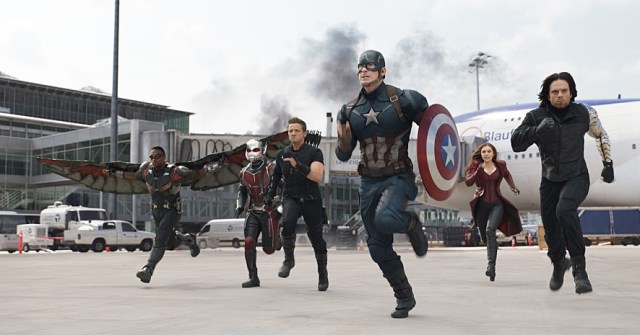
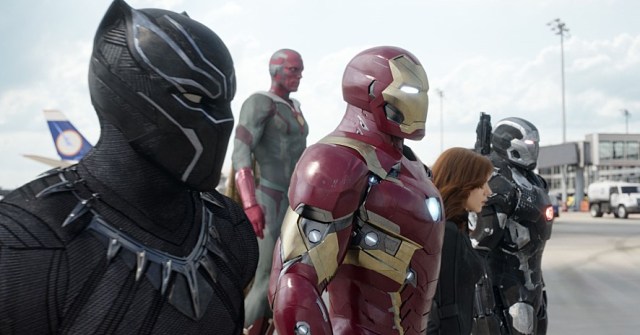
Eventually, they decide to fight against each other, and so do the other members of Avengers. While Sam Wilson/Falcon (Anthony Mackie), Clint Barton/Hawkeye (Jeremy Renner) and Wanda Maximoff/Scarlet Witch (Elizabeth Olsen) are on Rogers’s side, Romanoff, Lieutenant James Rhodes/War Machine (Don Cheadle), and Vision (Paul Bettany) are on Stark’s side, and there are also other superhero characters who join this fight.

While it goes without saying that their busy action sequence unfolded in a big airport is the major highlight in the film, the directors Anthony and Joe Russo, who previously directed “Captain America: the Winter Soldier”, also serve us with other competent action sequences as the movie hops around many different locations including Vienna, Berlin, New York, London, and, surprise, Cleveland. Relentlessly driven by shaky camerawork and frantic editing, these action sequences often look like emulating Jason Bourne movies too much, but they mostly work on the whole although I kept noticing lots of CGIs on the screen.

captainamericacivilwar05

Handling similar ideas relatively better than that grim, ponderous wreck called “Batman v Superman: Dawn of Justice” (2016), the movie tries to put more focus on story and characters, but it unfortunately overlooks that the story itself is not that engaging from the beginning. Again, our superheroes’ conflict is actually something which can be solved if they just have a real adult conversation for a while. Furthermore, I did not care a lot about the actions during the climax part, which predictably puts its main characters into another physical clash through an expected revelation.

The main cast members wear their respective roles comfortably as before, so we get as much as we can expect from them, and there are also a number of various performers popping up here and there throughout the movie. Emily VanCamp, who briefly appeared in “Captain America: the Winter Soldier”, has a little fun with her more expanded role, and I was entertained to watch recognizable veteran performers including Martin Freeman, Frank Grillo, Daniel Brühl, William Hurt, John Slattery, Hope Davis, John Kani, Alfre Woodard, and Marisa Tomei, who plays one of the last roles you can possibly imagine her playing. Paul Rudd, who had a nice start with “Ant-Man” (2015) in last year, makes an obligatory appearance as announced before, and Chadwick Boseman and Tom Holland ably present their potentials as new superhero characters to be added to MCU, though I am not so sure about whether their upcoming movies will be successful or not.

Overall, “Captain America: Civil War” is a little too serious and bombastic about its supposedly interesting subjects, and I could not enjoy it enough to recommend it. I liked “Captain America: The First Avenger” (2011) as an earnest retro fun, and I was surprised by how “Captain America: the Winter Soldier” threw at us some nice surprises along with distinctive mood and personality, but “Captain America: Civil War” does not have much to distinguish itself from its predecessors except its rather bland homogenized impression not so far from “The Avengers” and its 2015 sequel. After enduring “Batman v Superman: Dawn of Justice” and then coldly responding to “Captain America: Civil War” without much enthusiasm, I remain concerned about what we will get during next several years, as getting tired of getting same things again without anything refreshingly fun or wondrous enough to talk about.

captainamericacivilwar06


Posted in Movies | Tagged , | 1 Comment

Chinese Take-Away (2011) ☆☆☆(3/4): When things happen to him

ChineseTake-Away02

The opening scene of Argentine film “Chinese Take-Away” looks so absurd that you will not believe that, as shown during the end credits, this darkly comic moment is actually inspired by a truly bizarre real-life incident. Yes, such incidents like that can just happen by sheer coincidence, and we cannot help but amused and horrified as being reminded of how random and unpredictable our world can be.

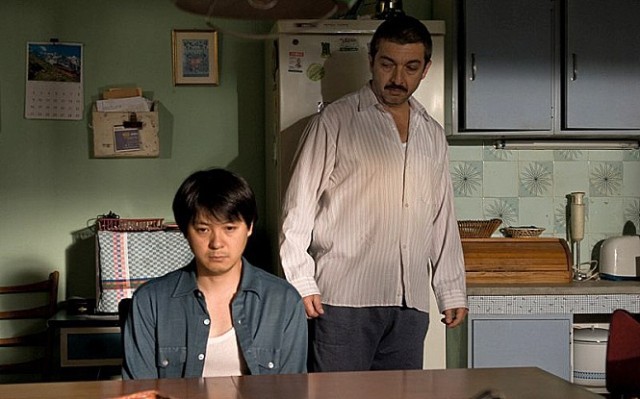
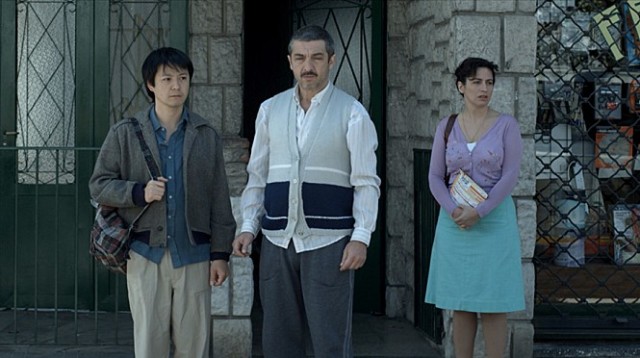
While his private hobby is collecting newspaper articles about those unbelievable incidents, the daily life of Roberto (Ricardo Darín) has always been stable and ordered in contrast. Running his small hardware shop, he is quite fastidious about many things including the exact number of screws in one ordered package, and he is not so pleased when the number turns out to be incorrect. Living alone in his small residence right next to his hardware shop, he follows the daily routine to which he has adhered for nearly 30 years, and his day always ends at PM 11:00 as he turns off the lamp besides his bed.

There are a very few people around Roberto. Leonel (Iván Romanelli), who is probably the only guy who can be regarded as Roberto’s friend, routinely visits him, but that is mainly for delivering newspaper articles to be pasted on Roberto’s old scrapbook. In the case of Mari (Muriel Santa Ana), this lovely lady has apparently carried a torch for Roberto for years, but he is reluctant although his heart still yearns for her as before.

While his life seems to be destined to keep going on like this, Roberto comes across an unexpected incident during one afternoon. When he is comfortably resting by the road, he witnesses a young Chinese guy being suddenly kicked out of a taxi. It is pretty clear that this flummoxed lad really needs help, so Roberto provides a temporary staying place to him, and Jun (Ignacio Huang) is grateful for his generosity although he cannot speak Spanish at all.

ChineseTake-Away04

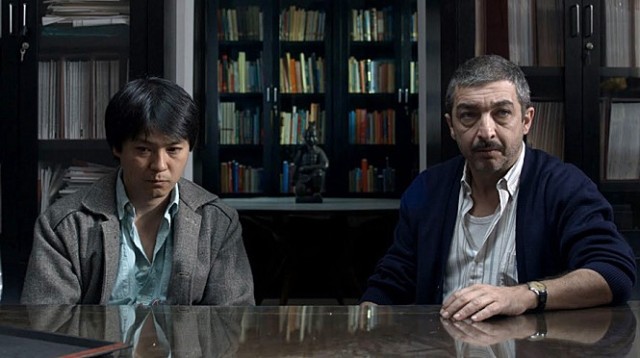
Thanks to the Chinese Embassy and other Chinese people in the city, Roberto comes to learn more about Jun’s current trouble. Because there is not any close family member in his homeland, Jun decided to go to Argentina where his only uncle lives, but his uncle turns out to be more difficult to find than expected. The Chinese Embassy can surely help locating his uncle, but it will take some time, and that means Jun will have to stay together with Roberto for a while.

Of course, Roberto does not welcome this change. Mainly due to their language barrier, Jun often disrupts Roberto’s orderly daily life, and that annoys and frustrates Roberto a lot, but he lets Jun stay at his home anyway as their initially strained relationship is slowly developed day by day. They manage to communicate with each other through gestures to some degrees, and Jun does some jobs for Roberto while also warmly welcomed by Mari, who gladly invites Jun to a dinner and shows him around the city.

It goes without saying that this is a story of familiar type, but the movie takes its time as building up its plot through small moments of humor and humanity. While Jun is indeed a typical stranger who brings changes into our grumpy hero’s mundane life, he comes to us as a human character less stereotypic than expected. Through his awkward interactions with Jun, Roberto gradually reveals a kind, decent man behind his gruff attitude, and there is an unexpected moment when he realizes something common between Jun and himself.

ChineseTake-Away03

The movie is also quirky and humorous as maintaining its low-key approach, and the director/writer Sebastián Borensztein has a fun with a number of outrageous scenes which depict some of the incidents described in Roberto’s collected newspaper articles. In the case of a certain scene with one mean police officer, it gives a nice example showing the importance of surprise as a crucial element of comedy, and I was also amused by how the movie cleverly utilizes this for more chuckles later.

The main cast members all give well-rounded performances to hold our interest. Ricardo Darín, whom I came to notice for the first time via his memorable lead performance in Oscar-winning film “The Secret in Their Eyes” (2009), is likable even when his character is on his grumpiest mode, and he and his co-star Ignacio Huang have nice understated comic chemistry during their scenes. While Jun usually speaks Chinese without subtitle, Huang’s unadorned performance makes you emphasize with his character’s confusion and desperation even if you do not know Chinese, and I must mention that the movie is one of a few recent cases which point out the difference between Mandarin and Cantonese. As two other substantial characters in the film, Muriel Santa Ana and Iván Romanelli provide amiable supporting performances, and Ana is sunny and sexy as a forthright woman who has patiently waited for her man to come closer to her.

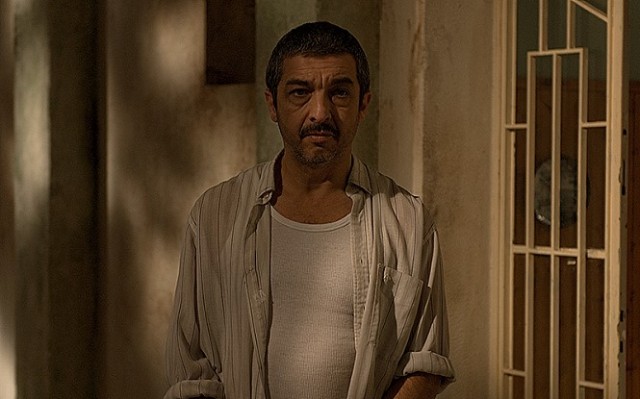
“Chinese Take-Away” is modest but charming as a funny, heartfelt story about how two total strangers can be nice and kind to each other in spite of their many differences. Wisely avoiding sappy sentimentalism and deftly going around humor and pathos, it richly earns its feel-good ending, and Darín’s wordless face during that moment is more than enough for telling us how much his character becomes different than before. I recently enjoyed his another terrific performance in Oscar-nominated film “Wild Tales” (2014), and now I am looking forward to chances of watching more of this engaging Argentine actor.

ChineseTake-Away01


Posted in Movies | Tagged , | Leave a comment

Chronic (2015) ☆☆1/2(2.5/4) : Living through his sick people

chronic04

It is always interesting to observe human behaviors from movies. “Chronic”, which received the Best Screenplay award at the Cannes Film Festival in last year, engaged me because of its calm observation of curious human behaviors, but I was also bothered by how it eventually meandered and then suddenly struck me with something quite jarring around its final minute. I admit that I was utterly jolted by that, but, as I thought more about it during last several days, I conclude that it does not work, and that is a shame considering the fine direction and commendable performances of the film.

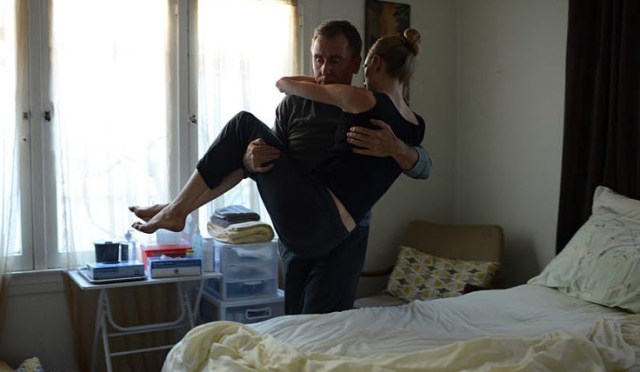
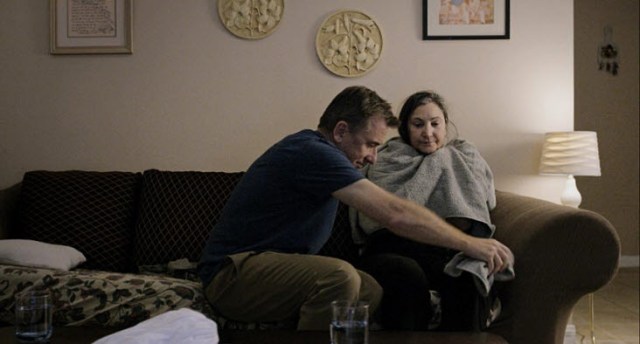
The movie revolves around the daily work of a caregiver named David (Tim Roth). His latest client is a dying woman getting sicker day by day, and we see how much he puts himself into his work as a well-experienced professional. He is the one who helps Sarah (Rachel Pickup) whenever she needs to get up from her bed or couch. He is the one who washes her in the bathroom. He is the one who remains besides her when her visitors leave as soon as possible. And he is the one who willingly takes care of her dead body when nobody wants to do that for an understandable reason.

After that point, we observe something odd from David. He attends Sarah’s funeral, and he is approached by Sarah’s niece who wants to hear more about Sarah from him, but he flatly rejects her approach as if his relationship with Sarah had been merely professional. However, he looks sad and depressed when he is at a bar during the following scene, and he tells a young couple sitting next to him that he lost his wife. Does he have some delusional problem? Or is he just a professional who devoted his heart and soul to his client too much?

chronic01

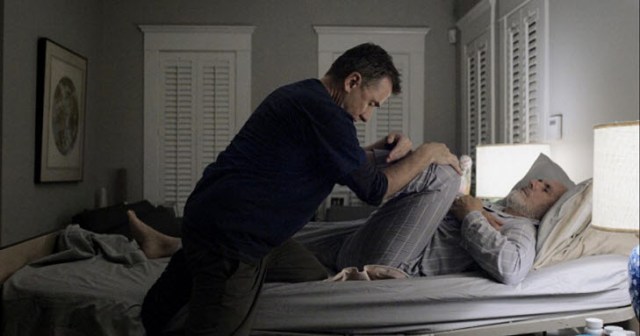
As he moves onto his next client, we begin to see the pattern. John (Michael Cristofer) is a middle-aged architect who has been bedridden since his stroke, and David quickly becomes his invaluable companion as immersing himself into John’s life. He becomes more knowledgeable about architecture for being someone with whom John can talk casually, and he also has no problem with providing something to satisfy John’s naughty need.

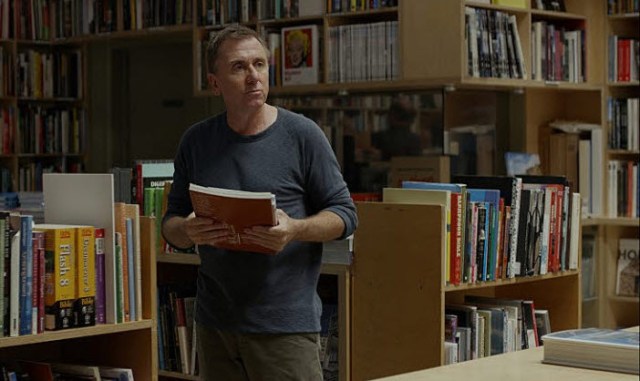
Again, he lies about himself to strangers who do not know him. When he goes to a bookstore for buying architecture books, he says he is an architect. When he visits a house designed by John a long time ago, he introduces himself as John’s brother to its owner, who kindly allows David to look around the house and take a photograph for John.

And then there is another odd thing about David as shown from the opening scene. When he is not busy, he often spends his free time on watching a young girl from the distance. Sometimes he follows after her without being noticed. He also checks her Facebook page and rummages photographs posted by her. As watching David focusing on her, we cannot help but wonder whether he has any questionable intention.

Anyway, he later finds himself getting into a trouble as keeping himself a little too close to John. He is consequently switched to the other client with less wage, and he does not complain much because there is nothing he can do about that. His new client Martha (Robin Bartlett) is a cancer patient struggling with her chemotherapy sessions, and David soon becomes close to her as he did with his former clients, but then Martha, who knows about his past, requests him to do something for her.

chronic03

How David comes to open himself a bit to the past he has distanced himself from for years is the weakest part of the movie. While it begins to lose the subtle tension generated by his intriguing ambiguity, the movie does not seem to know what to do next once his cover is gone, and that is why the aforementioned finale feels contrived rather than organic. Sure, life can ambush us in such ways like that, but all I could see from that moment was more or less than a cheap final touch.

The performances in the movie are solid enough to cover this serious narrative flaw to some degrees, if not entirely. Tim Roth, who may be on another rising phase of his career now with this film and “The Hateful Eight” (2015), gives a performance delicately measured in nuances and gestures, and three supporting performers playing David’s clients embody their respective characters without any artificiality of those disease of the week movies. Rachel Pickup looks believable in her frail appearance, and you may be surprised to know that Michael Cristofer actually has a long, distinguished acting career. Robin Bartlett deftly handles her certain scene with Roth, and I was amused to learn later that this veteran actress was that funny high school French teacher in goofy spy comedy action flick “If Looks Could Kill” (1991).

It is evident that the director/writer Michel Franco, who received the Un Certain Regard award at the 2012 Cannes Film Festival for his previous film “After Lucia” (2012), is a competent filmmaker who knows how to establish story and character to attract our attention, but “Chronic” is not wholly satisfying in its overall execution in spite of several strong points worthwhile to be mentioned. I cannot recommend the movie for now, but he surely gets my attention at least for what he did here with Roth.

chronic05


Posted in Movies | Tagged , | Leave a comment

Seymour: An Introduction (2014) ☆☆☆1/2(3.5/4): On his duet of life and art

seymouranintroduction01

The first minutes of documentary film “Seymour: An Introduction” was more than enough for me to become interested in its remarkable human subject. As a man who has happily maintained his own balance between life and art for many years, he is willing to impart some of his lifelong wisdom to us, and the documentary gives us a vivid, loving, and respectful portrayal of his exceptional life and career.

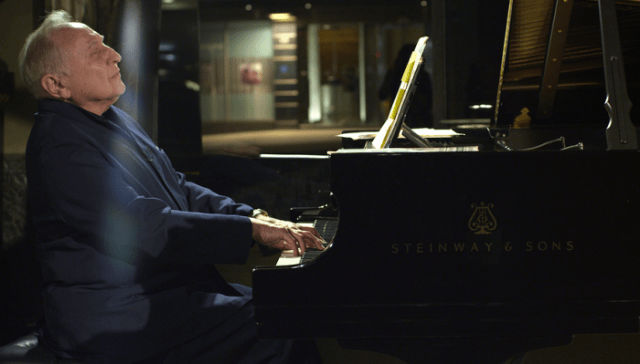
Born on April 24th, 1927 in New Jersey, Seymour Bernstein already showed his considerable potential as a pianist during his early years, and he quickly became a new talent to watch as he made a terrific debut with the Chicago Symphony Orchestra in 1969. While his career kept rising during next several years, he decided to quit on one day in 1977, and he has mostly concentrated on teaching since then.

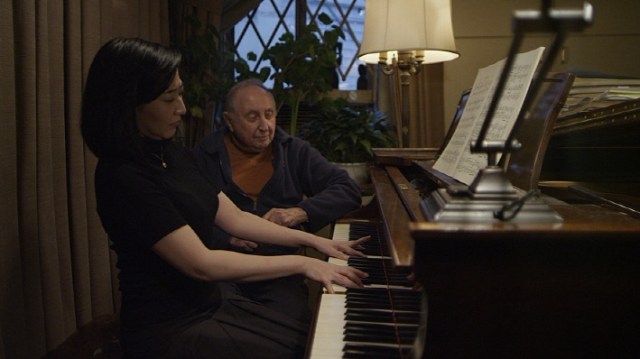
Early scenes in the documentary show a number of students individually receiving a private piano lesson at Bernstein’s small but posh apartment in the Upper West Side area of Manhattan. While sharply pointing out small and big things to be corrected and modulated by his pupils, he never raises his voice, and his instructions are always accompanied with warm, honest encouragement. We meet some of his former pupils, and we can sense their deep affection and respect toward him as they talk with their dear mentor who still inspires them as before.

seymouranintroduction02

As the documentary freely looks around several important points in his life, Bernstein candidly talks about how he came to step down from the peak of his career. Although he found a way to accept and deal with the emotionally challenges of public performances, he was still not so satisfied with where his life and career were going, so he simply made a choice as reaching for something more satisfying and rewarding to himself.

We also hear about his military experience during the Korean War. He and other few musician soldiers were ordered to give classic music concerts for soldiers in the front line, and there is a mildly amusing episode about how a piano to be played by him managed to be sent to its destination. He still vividly remembers one horrible sight he saw around a battlefield, and he later reminisces about an uncanny moment of poetic beauty he encountered by coincidence during one early morning.

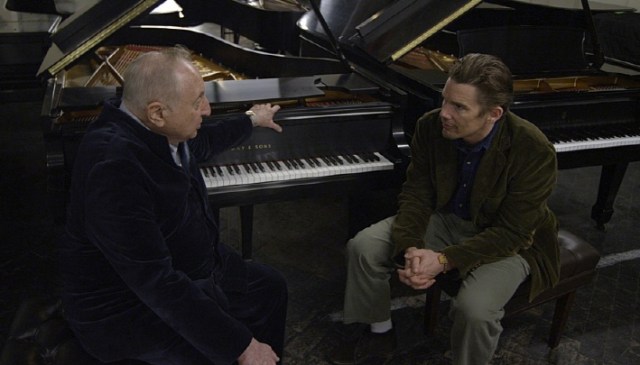
The documentary is directed by Ethan Hawke, who humbly steps aside for Bernstein even when he talks about how much he has learned from his friend and mentor since their chance meeting via a dinner party held by Hawke’s friend. Increasingly stressed and anxious despite his successful career, Hawke was not so sure about what to do with his life and career around the time when he met Bernstein, and he gave Hawke helpful advices on how he can moderate himself between life and career as focusing on his artistic talent. Life is unpredictable indeed, but life without trouble is as meaningless as harmony without dissonance in Bernstein’s view, and he believes that one’s artistic talent can be an important balancing element for life. Although it has been more than 30 years since he left the stage, he has never stopped practicing and composing music, and we see some of significant achievements during his later years.

seymouranintroduction03

Hawke later suggested that Bernstein should give a small concert for him and the members of his acting troupe, and Bernstein accepted this challenge. One of the most entertaining scenes in the documentary comes from when Bernstein visits the storage room filled with many Steinway pianos. All of these precious musical instruments do not look that different to us, but he can tell the differences as carefully examining some of them one by one. Like players, instruments are imbued with their own personalities, and he wants to find which one is more suitable for his upcoming performance.

In the meantime, we get lots of piano performances by Bernstein and others, and they are another enjoyable element in the documentary. As a contemporary of Glenn Gould, Bernstein tells us one humorous anecdote about that legendary pianist whose genius he admires with reservation, and the documentary makes a nice point along with Bernstein through the archival footage of Gould’s performance full of his usual eccentric mannerisms. We also get to know about Bernstein’s British mentor Clifford Curzon, and there is a touching episode about how Bernstein probably helped his mentor receiving a prestigious recognition, which he richly deserved as one of the best musicians representing his country.

While watching the documentary, I was reminded of “Searching for Bobby Fischer” (1993), an overlooked chess drama film which makes a thoughtful argument not so far from Bernstein’s wise gentle words in the documentary. Like the chess prodigy hero in that film, Bernstein exemplifies that being talented and being human are not exclusive to each other at all, and that is why he is all the more inspiring at the end of the documentary.

“Seymour: An Introduction” effortlessly gets us involved in what it wants to show and tell, and it did a commendable job of presenting Bernstein’s artistry and humanity with clear insight and warm respect. Stable and comfortable with his life and career, he is ready for whatever will come next in his remaining life, and we cannot help but applaud when another beautiful performance in his life is over.

seymouranintroduction04


Posted in Movies | Tagged , , , | Leave a comment

Steel Flower (2015) ☆☆☆(3/4): Working and living alone by herself

steelflower01

While it may often frustrate you because of its dry, clinical storytelling, South Korean independent film “Steel Flower” has several things good enough for recommendation. As it never goes that deep into its young desolate heroin, the movie occasionally feels like a merely depressing exercise in realism, but it is worthwhile to watch for its strong lead performance, which functions as the steely emotional base for a few powerful moments in the film.

When we meet Ha-dam (Jeong Ha-dam) during the opening scene, she is in a very agitated state as frantically wandering around with her backpack and suitcase for some unknown reason. All alone by herself on the streets and alleys of Busan, she searches for a job to earn her living, but she does not even get a simple part-time job mainly due to her nearly anonymous social status. She cannot give her cellular phone number because she does not have it, and she cannot even give her social ID number probably because she does not want to reveal anything about herself.

She also looks for any place where she can stay, but she does not have enough money for that, so she eventually settles in an abandoned house located somewhere in the city. Stripped of any conveniences, this decrepit house is not exactly a good sleeping place, but she is fine with this dreary condition as long as she has a place where she can sleep alone.

During one evening, she comes across a suspicious guy, and he gives her a job without asking too much. He owns a seafood restaurant, and all she has to do is washing and scrubbing in the kitchen. It is quite apparent to us that the guy is not a good man at all, but Ha-dam has no problem with that because she is promised to get paid as much as she works.

steelflower03

But then there comes a problem when a woman suddenly appears while Ha-dam is working in the kitchen. The woman, who has clearly been in a relationship with the restaurant owner, regards Ha-dam as someone to replace her, and it seems she is right despite her alcoholic jealousy. Not long after the clash between her and Ha-dam, the owner follows after Ha-dam without being noticed, but then the movie takes an unexpected turn during this quietly tense, ambiguous scene. The guy does not have any good will from the very beginning, but he comes to change his mind when he learns a little more about his latest employee, though that does not explain his subsequent decision much.

Going through several other plights besides this, Ha-dam remains distant and elusive to us, but she is not a blank cypher at all, and we sometimes gets glimpses of what makes her tick. Both vulnerable and stubborn, she tries to go on with her harsh life full of difficulties and dangers, and there is something simultaneously maddening and compelling about her persistence. She is ready to do any menial job as she flatly says, but she does not bend herself easily, and she certainly does not step back whenever she believes she deserves to be paid.

And we also get to know a bit about tender sides hidden behind her weathered appearance, when she happens to encounter one certain thing to brighten her up. Although it is going to demand a lot from her, she does not mind about that, and this eventually leads to one of a few soft moments in the movie. She finally gets what she has wanted so much, and we can see how much happy she is, even though we only watch her from the distance.

steelflower02

The director/writer Park Suk-young, who previously received considerable praises for his first feature film “Wild Flowers” (2014), wisely does not make any cheap attempt to explain his heroine. He simply observes her behaviors as stoically maintaining the calm, objective attitude of his movie. Looking more into Ha-dam, the movie effectively builds up more sense of isolation and desperation around her while never asking for pity or sympathy from us, and we come to care more about her situation even though we never fully understand her even in the end.

The lead actress Jeong Ha-dam, who collaborated with Park in “Wild Flowers” and recently played a minor supporting character in South Korean hit film “The Priests” (2015), is fabulous in what may be her career breakthrough performance. Like the movie, Jeong never lets any sentimentality into her understated performance, and her hardened face speaks volume as subtly revealing her character’s battered but determined spirit. The last part of the movie feels forced as predictably and blatantly pushing its heroine into another infuriating moment of anger and heartbreak, but Jeong remains convincing as before, and her performance works a living map of tumultuous emotions as the camera looks closely at her around the end of the final scene.

“Steel Flower” is a competent work on the whole thanks to good direction and performance, but I recommend it with some reservation mainly because it is not particularly new in my opinion. Other South Korean films including “Alive” (2014) and “Madonna” (2014) already gave us slices of harsh life at the fringe of South Korean society, and I do not think the movie is better than these equally gray social dramas. “Steel Flower” is still a good film, and Jeong Ha-dam is indeed a new talent to watch, but now I wonder whether we need more than merely being reminded of harsh reality out there.

steelflower04

Posted in Movies | Tagged | Leave a comment

10 Cloverfield Lane (2016) ☆☆☆(3/4): Three below the ground

cloverfieldlane101

As the opening sequence of “10 Cloverfield Lane” is unfolded, we know that something bad will happen sooner or later. Everything looks mundane on the surface as its young heroine leaves her place, but the ominous score on the soundtrack suggests otherwise, and we become curious and nervous as the camera looks upon her car being driven alone on the road.

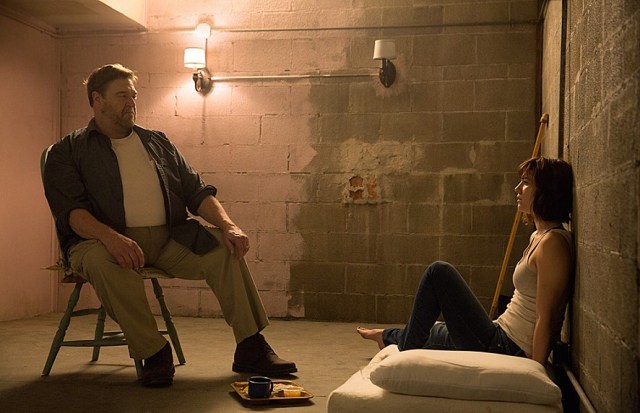
She is Michelle (Mary Elizabeth Winstead), and we come to gather that she is running away from a personal problem with her fiancé. When she is driving her car somewhere in a rural area of Louisiana during late evening, her car is suddenly hit by something, and she becomes unconscious as her car is tumbled out of the road. When she regains her consciousness later, she finds herself confined in a cell, and she is naturally alarmed by this unexpected circumstance.

She soon confronts a guy who is keeping her there. Howard (John Goodman) explains to her that he rescued her and then brought her to his underground shelter because an unknown massive attack happened not long after her car accident, but the guy does not look exactly trustworthy to Michelle as well as us. Sure, he took care of her injury, and maybe she should appreciate that, but why does this supposedly good Samaritan not only lock her in the cell but also chain her to the wall?

cloverfieldlane102

Anyway, Michelle is allowed to get out of the cell once she recovers more from her injury, and she meets Emmett (John Gallagher Jr.), another guy in the shelter. He tells Michelle about what he witnessed before he was fortunately allowed to go inside the shelter, so it seems they must stay in Howard’s shelter as long as possible for avoiding whatever is happening above them, but Michelle does not trust Howard or Emmett completely. There is something insidious about Howard’s behaviors even when he looks nice and gentle, and Emmett looks like one of those gullible guys who can be easily persuaded to believe whatever is told to them. Is Howard only a mere eccentric guy with cranky tempers? Is Emmett someone who can be trusted? And what is really going on outside the shelter?

Most of the entertaining moments in the movie come from how it smartly and deftly plays with this textbook thriller premise which could be used for a “The Twilight Zone” episode, so now I have to advise you to stop reading my review at this point for staying away from possible spoilers I may inadvertently reveal in the next paragraphs. I will try as much as I can for hiding its shocks and surprises, but this is a movie you will enjoy with maximum effect if you do not know much about what it is about or how it is about.

The movie has been advertised as a sort of sequel to “Cloverfield” (2008), but I do not think you have to watch the latter in advance, for they are different from each other in many aspects except a few little connections including their titles. While “Cloverfield” was a dizzy, interesting mix between found footage and monster movie, “10 Cloverfield Lane” is a steady chamber thriller packaged with several recognizable genre elements I don’t dare to reveal, and the director Dan Trachtenberg diligently builds up the level of suspension and dread among its three main characters as providing occasional moments of black humor to relieve the tension for a while.

cloverfieldlane103

It certainly helps that his movie has three talented performers who can keep us in its tightening grip through their convincing performances. Mary Winstead Elizabeth, an actress who deserves more attention considering her solid work in “Smashed” (2012), is engaging to watch as her character tentatively deals with her unstable situation, and we come to root for Michelle more especially when she shows considerable resourcefulness through her particular set of skills. Her situation may be another case of ‘woman in danger’, but Winstead imbues pluck and intelligence into her character as she did in “The Thing” (2011), and that is the main reason why the third act of the movie works to some degrees despite its weaknesses.

On the opposite, John Goodman, a dependable character actor who has always been a welcoming presence in many films since his breakthrough turn in the Coen brothers’ “Barton Fink” (1991), clearly has a lot of juicy fun with his increasingly sinister character. He is captivating especially when he fluidly switches between contrasting modes during one crucial scene, and we become more fearful of whatever his character may be holding behind his hefty back.

As another key part of the story, John Gallagher Jr., a Tony-winning actor who has been gaining more notice since his supporting turns in TV series “The Newsroom” and overlooked gem “Short Term 12” (2013), balances himself well between his two co-stars. As the plot thickens, he makes his character more sympathetic than expected, and there is a small poignant scene in which Emmett tells Michelle about how he regrettably let himself waste his potentials in the past.

While I do not like its third act much because it becomes more predictable with unoriginal genre elements compared to the first two acts, “10 Cloverfield Lane” still is a smart entertainment movie which values story, mood, and character. Unlike the Paranormal Activity series, the movie does not make a dull mistake of repeating same things we saw before, and, considering its enjoyable success, I think we can expect another good entry to follow after this.

cloverfieldlane104

Posted in Movies | Tagged , , | Leave a comment

Grandma (2015) ☆☆☆(3/4) : A day with her pregnant granddaughter

Grandma01

To be frank with you, it took some time for me to notice Lily Tomlin. I encountered her for the first time when I happened to watch “All of Me” (1984) on TV during the early 1990s, but they showed a dubbed version, so Tomlin, who played a haughty soul stuck in Steve Martin’s body in that hilarious comedy movie, felt less distinctive, though I must say they did a fairly decent dubbing job as far as I can remember.

Anyway, Tomlin gradually became more familiar and recognizable to me especially after I watched “Nine to Five” (1980) on TV during the 2000s (It was not a dubbed version in that case, by the way). As getting to know more about this colorful actress’s distinguished career around TV, stage, and movie, I saw her in other films including Robert Altman’s “Nashville” (1975) and “Short Cuts” (1993). I still remember when she gave us a priceless Altmanesque moment along with Meryl Streep at the 2006 Academy Awards ceremony right before Altman went up to the stage to receive his Honorary Oscar, and she and Streep touched me a lot with their lovely duet performance of “My Minnesota Home” when I watched Altman’s poignant swan song “A Prairie Home Companion” (2006) several months later.

Approaching to 80 at present, Tomlin is still active and robust as before, and small independent film “Grandma” (2015) gives her a character she has been aged to play. While starting with a seemingly predictable premise, the movie works as a unique character drama packed with details and nuances to observe, and Tomlin is fabulous in her vibrant performance as effortlessly playing between humor, honesty, and humanity.

Tomlin plays Elle Reid, an aging lesbian poet who has been recently unemployed. During the opening scene set in one early morning, we learn that she has been in the relationship with a much younger woman for 4 months, but now she decides to break up with Olivia (Judy Greer) because, as Olivia complains during their argument, their relationship seems to be going nowhere. Olivia clearly feels hurt by this, but Elle remains unmoved with her curt decision, which turns out to be pretty hard for herself.

Grandma05

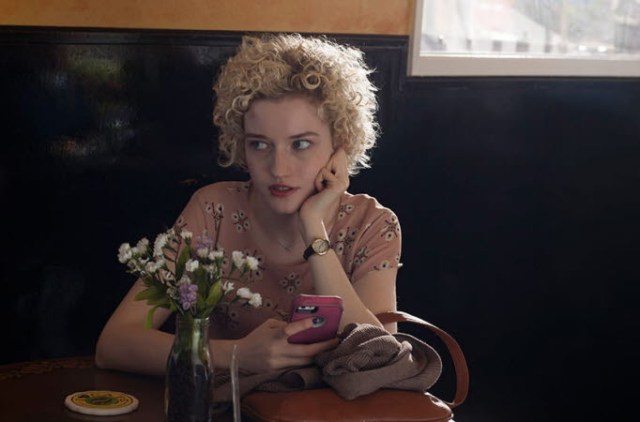
Not long after this hurtful separation, Elle has an unexpected visitor. She is her teenage granddaughter Sage (Julia Garner), and she comes to her grandmother for financial help. After getting pregnant by her boyfriend, Sage decided to have an abortion, but she needs $630 to pay right now for her reserved abortion operation at a clinic during late afternoon, and her mother Judy (Marcia Gay Harden) is the last person she wants to know about this.

Unfortunately, Elle is nearly broke after paying all the hospital bills for the medical treatments of her dead spouse Violet, who passed away about two years ago after more than 35 years of life with Elle. Furthermore, she does not have any available credit card because she impulsively got rid of her credit cards for being more financially free, and there are not many people around her who can immediately lend her $630.

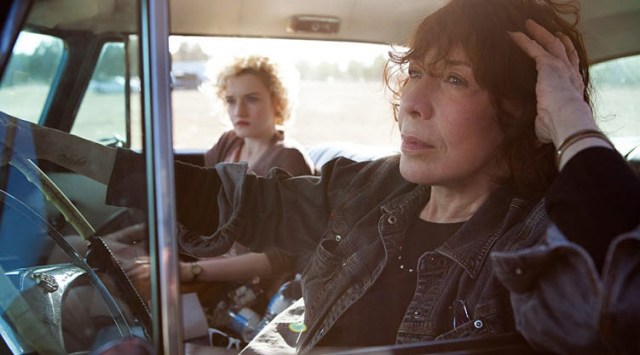
As Elle drives her old Dodge Royal car here and there around the town for any chance to solve her granddaughter’s problem, she and Sage encounter a number of different people on their way, and each individual moment mirrors Elle’s compelling life and personality. Acerbic, brash, and forthright, she is a force to be reckoned with to say the least, and she surely gives Sage’s boyfriend one hell of lesson when he is impertinently insolent to her and her granddaughter during their impromptu visit.

As we are amused by this and other humorous scenes, more serious moments in the film let us get to know more about Elle’s personal history. At a local tattoo shop run by her transgender friend, we learn a bit about Elle’s relationship with Violet, and we cannot help but wonder about how Elle and Violet maintained their relationship for many years in spite of Elle’s abrasive personality. I guess Violet must have been an exceptional woman with her own personality to match Elle’s, though she is only glimpsed through a couple of brief shots showing her old photos.

Grandma03

The scene involved with Elle’s ex-husband is another good moment in the movie. When he is visited by Elle and Sage, it is apparent that there is still some affection left between him and Elle, but there are also other feelings to be aroused during their seemingly casual conversation. Sam Elliot, who has been known well for a distinctive screen presence as indelible as Tomlin’s, deftly handles this tricky emotional scene along with Tomlin, and we come to sense old personal wounds being exposed as their characters inevitably face their problematic past again.

When he worked with Tomlin in his previous film “Admission” (2013), the director/writer Paul Weitz saw that she was the perfect actress for a movie idea he had worked on for several years without much progress, and his screenplay was quickly developed after that point. Thanks to his succinct storytelling, the movie is lean and dense during its rather short running time, and Weitz also did a smooth job of establishing the realistic background around his characters although he and others in the production were limited by their small budget and tight shooting schedule. While the movie was shot for 19 days with $600,000, they often had to depend on their own resources in creative ways, and Elle’s car in the film is actually a used car belonging to Tomlin, for instance.

While its main subjects including feminism and abortion inherently draw our attention, the movie presents them with considerable frankness without spelling them out loud. Elle’s feministic activism is economically presented through a bunch of her old books including the first edition of Betty Friedan’s “The Feminine Mystique”. When she talks about her relationship with Olivia, she does not hesitate to admit that she simply went for what excited and inspired her, and she is fine with that. In case of abortion, the movie maintains a thoughtful position to this sensitive subject as respecting Sage’s practical decision. Although she may be young and inexperienced, Sage knows what is best for a life as she wants, and Julia Garner has a nice scene when her character reveals more depth and intelligence than we expected.

Grandma04

Besides Elliot and Garner, the other substantial supporting performers in the film respectively fill their roles as holding each own small place around Tomlin. Judy Greer, an actress whom I fondly remember for her recurring supporting character in TV sitcom “Arrested Development”, shows more of her serious side previously shown in “The Descendants” (2011), and Laverne Cox is warm and delightful while it is poignant to see Elizabeth Peña in her last movie performance before her untimely death in 2014. As Sage’s workaholic mother, Marcia Gay Harden feels a little too exaggerated during her first scene, but then she has an introspective moment with Tomlin as her character and Elle come to reflect on how much they resemble each other as mother and daughter. Like her mother, Judy is a fighter who never steps back easily, and so will be her daughter, probably.

While they have mostly stayed in the mainstream since their big break through “American Pie” (1999) and their Oscar-nominated work “About a Boy” (2002), Paul Weitz and his brother Chris Weitz have occasionally tried different things at the fringe of Hollywood from time to time. Although he might have hit his lowest career point in “The Twilight Saga: New Moon” (2009), Chris Weitz subsequently surprised us with a modest but heartfelt immigrant drama “A Better Life” (2011), which garnered an Oscar nomination for its leading actor Demián Bichir’s moving performance. While he was stuck with an unenviable job of directing “Little Fockers” (2010) around that time, Paul Weitz bounced back with “Being Flynn” (2012), and that sincere little film reminded us that Robert De Niro is still a great actor despite numerous paycheck roles he took during recent years.

In “Grandma”, Weitz did another small precious thing to admire. Through its specific details, the movie makes us look into its unconventional heroine and her life with interest and curiosity, and then we come to discern human matters as more emphasizing with her. Elle is definitely not the nicest person in the world, but she is a fun, vivid character to remember thanks to Weitz and Tomlin, and this cool grandma deserves to be mentioned along with Imperator Furiosa and other strong female movie characters we encountered in 2015. This thorny lady does not smile much, but, as you will see, it is really something special when she does.

Grandma02

Posted in Movies | Tagged , , , , | Leave a comment