Midnight Special (2016) ☆☆☆1/2(3.5/4) : It deserves its odd title

midnightspecial03

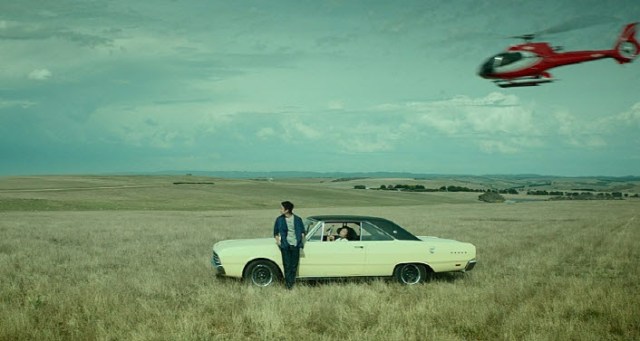
Reminiscent of “Close Encounters of the Third Kind” (1977), “Starman” (1984), and TV series “The X-files”, “Midnight Special” virtually puts us right in the middle of its ongoing situation we gradually come to grasp along its narrative. This small but mesmerizing SF thriller movie is constantly intriguing as juggling its thought-provoking matters of faith and parental love, and it surely helps that there are a number of strong visual moments to linger on your mind after it is over.

The movie begins with the quietly tense opening sequencing which slowly reveals the urgent circumstance of Roy (Michael Shannon) and his young son Alton (Jaeden Lieberher). Along with Alton, Roy recently ran away from a religious cult group in Texas, and now they have to be more careful because Roy is being wanted by the state police after ‘kidnapping’ his son. Thanks to Roy’s old childhood friend Lucas (Joel Edgerton), they have so far managed to avoid the police search, and we come to learn that Roy is going to take Alton to a certain location outside Texas because he believes that his son needs to be there for something big to happen on a specific day.

Roy is not crazy at all, for Alton is a special boy with remarkable gifts. While avoiding daylight, Alton usually wears swimming goggles during his nighttime mainly because of his eyes which can emit light beams with some telekinetic power, and that is just one of his many uncanny abilities which certainly impressed many other people besides Roy and Lucas. Calvin Meyer (Sam Shepard), the old leader of Roy’s religious cult group, wants to get back Alton by any means necessary, and he instructs two of his followers to track down Roy and Alton, shortly before government agents raid in the middle of another night service at Meyer’s community ranch.

midnightspecial05

While Meyer and his followers are thoroughly investigated by government agents, an NSA analyst named Sevier (Adam Driver) appears, and it turns out that the numerical sequences used at Meyer’s night service as a sort of divine messages from Alton are actually pieces of secret government information from one of those military satellites in the sky. As getting to know more about Alton from Meyer and his followers, Sevier and other government agents become more interested in Alton, and they surely want to get him as much as Meyer.

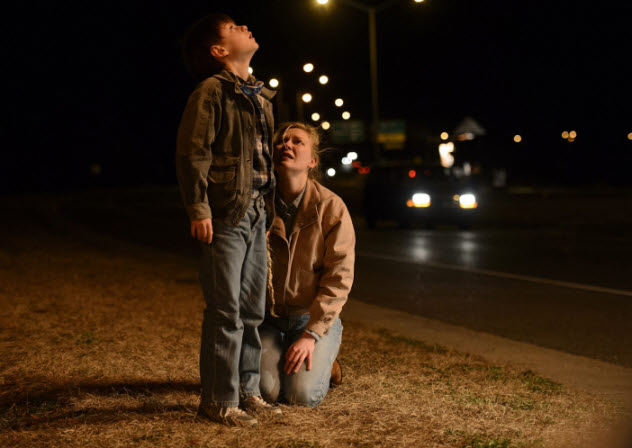
Meanwhile, Roy, Alton, and Lucas continue their risky journey on the road. When they need to change their vehicle due to an unexpected incident, they are fortunately helped by a former cult member, but that leads to another trouble to jeopardize their plan. They later visit where Alton’s mother Sarah (Kirsten Dunst) has lived since she left the cult, and she soon joins them while being well aware of that this may be her last time with her son.

As the movie steadily moves toward its destination, the director/writer Jeff Nichols keeps engaging us through his deft control of mood and storytelling. There are notable plot gaps and holes here and there throughout the film, but it confidently takes its big steps with considerable technical prowess. The cinematographer Adam Stone did a fabulous job of capturing wide, beautiful Southern landscapes on the screen, and these gorgeous location shots are tinged with nervous ambience by David Wango’s atmospheric score. The special effects during several key scenes in the film are succinctly used for generating exact dramatic effects as intended, and the movie also gives us a terse but effective vehicle action sequence which looks and feels a lot more realistic than those overblown ones in The Fast and the Furious movies.

midnightspecial04

Nichols also draws terrific performances from his cast members. Michael Shannon, who appeared in all of Nichols’ three previous films, effortlessly exudes his character’s firm determination driven by love and faith, and he and Jaeden Lieberher, a young actor who held his own place besides Bill Murray in “St. Vincent” (2014), are convincing in the depiction of their characters’ strong father and son relationship. While Joel Edgerton, whom we will see again in Nichols’ upcoming film “Loving” (2016), is equally good in his calm, focused performance, Kirsten Dunst and Adam Driver have each own moment to shine as two substantial supporting characters in the film, and Sam Shepard is suitably cast as a shady cult leader although he appears only in a few early scenes.

Since he made a notable debut with “Shotgun Stories” (2007), Nichols has been one of the most interesting American filmmakers during recent years. I was surprised by his intense, powerful family drama in “Shotgun Stories”, and then I was impressed more as being struck by his next film “Take Shelter” (2011), which still grabbed me hard and tight when I happened to revisit it two months ago. His third film “Mud” (2012) was a haunting story about love, friendship, and redemption, and it also had one of the best performances in Matthew McConaughey’s career.

“Midnight Special” is another superlative work from Nichols, and it has grown on me since I watched it several days ago. I felt curious and intrigued during my viewing, and I still vividly remember many of its awe-inspiring highlights I will let you behold for yourselves. If you are looking for a SF film depending on ideas and characters rather than mindless actions, I think you will enjoy this movie a lot – and you will see that it does deserve its odd title.
midnightspecial02


Posted in Movies | Tagged , , , , | Leave a comment

Born to Be Blue (2015) ☆☆☆(3/4): Improvised from Chet Baker’s bluesy bottom

borntobeblue01

As a music drama loosely inspired by Chet Baker’s life, “Born to be Blue” tries a little different thing. While mainly focusing on a melancholic late period of this legendary American jazz musician’s life, it freely mixes reality and fiction via its unconventional storytelling approach akin to jazz improvisation, and it is interesting to see how this unconventional approach works with its bluesy mood, sound, and texture. Although it eventually feels conventional as arriving at its predestined finale, it still looks and sounds good, and it is also supported by two solid performances worthwhile to watch.

The early scenes in the movie show Baker (Ethan Hawke) on the verge of a bottom to hit in 1966. Struggling with his heroin addiction as usual, he is recently hired to play himself for a movie based on his early years, and that is how he gets to know Jane (Carmen Ejogo), an actress who is cast to play Baker’s wife in the movie. While Baker did appear in a handful of movies during the 1950-60s, it should be mentioned that the movie production shown in “Born to Be Blue” is purely fictional, and so is Jane, who is a composite character of several women in Baker’s real life.

Outside the movie set, Baker and Jane find themselves enjoying each other’s company more, but then there comes a big blow to his life and career. Shortly after their first private time, a group of gangs who have an unfinished drug business with Baker suddenly appear in front of them, and he gets a serious injury as badly beaten by these gangs. Besides his lost upper front teeth, his embouchure is irrevocably damaged, and that means he will never play trumpet as well as before, even if he manages to play it again.

He hits his bottom pretty fast. The production of his movie is quickly shut down as soon as the news about his injury comes out. His long-suffering manager Dick (Callum Keith Rennie) finally decides that enough is enough and walks away from his problematic musician. In addition to his following financial problem, Baker also needs to remain employed due to his probation period, and one brief scene shows him working at a gas station (he really went through such a humiliating time like that in real life).

borntobeblue02

While Baker feels broken and devastated by this gloomy situation, Jane stands by him because, well, she loves and cares about a man who really needs help despite all those possibly incorrigible flaws of his. After he cannot pay the rent for his apartment anymore, they begin to live together modestly in her minivan, and Chet finds solace and comfort from her as trying to take his first step toward recovery and comeback.

Leisurely following Baker’s slow, tentative progress, the movie doles out small intimate moments to observe. When Baker and Jane visit his hometown in Oklahoma at one point, his mother welcomes them in contrast to his father, a former musician who does not dislike his son but remains sternly skeptical about his son’s recent recovery. When Baker and Jane are visited by Jane’s parents later in the story, her father also shows the same concern as any sensible father would, and that naturally leads to an awkward moment among everyone.

As Jane tries to advance her own acting career through one audition after another, Baker comes to rise again thank to her support. Although his first public performance after the injury is pretty tacky to say the least, it does get attention because he is still famous, and then he gets employed as a studio session player not long after that. As finding himself promoted by Dick again, he shows others that he has not lost all of his ability and talent, and we get a soulful music performance scene featuring one of his most famous songs.

The director/writer Robert Budreau and his cinematographer Steve Cosens make sure that every scene in the film is filled with dry, somber ambience to reflect its hero’s melancholy, and the score by David Braid, Todor Kobakov, and Steve London is mixed well with familiar jazz songs on the soundtrack. The movie also utilizes the fictional movie in its story as one of its storytelling tools, and this provides us a glimpse into Baker’s relationship with Dizzy Gillespie (Kevin Hanchard) and Miles Davis (Kedar Brown) during his early years of stardom.

borntobeblue04

Looking as dashing and boyish as Baker, Hawke smoothly slips into the role in his thoughtful performance. His character’s narrative arch may be predictable, but there is always a certain amount of nervousness around his low-key acting as Baker looks unsure about whether he can really make a comeback, and Hawke did a good job of injecting dramatic tension into his music performance scenes without emphasizing it too much (While his trumpet performance in the film was done by Kevin Turcotte, he provided the vocal for two music performance scenes).

On the opposite, Carmen Ejogo, a wonderful actress who should have been noticed more for holding her own place in front of David Oyelowo in “Selma” (2014), is terrific as a woman who may tolerate her lover’s many flaws but sticks to her integrity none the less. She and Hawke play so well with each other during their scenes that we can clearly sense what is happening between them during the finale – even before a certain revealing shot is inserted into the middle of the sequence.

“Born to Be Blue” is a minor work compared to other notable jazz movies such as Clint Eastwood’s “Bird” (1989) and Bertrand Tavernier’s “Round Midnight” (1986), but you will probably enjoy its mood and performance regardless of your background knowledge on Baker’s life, which was far longer than his idol Charlie Parker’s but did not end well like many other famous troubled musicians’ life. Its music is basically a familiar one from the start, but “Born to Be Blue” serves us a nice improvisation to appreciate.

borntobeblue05

Posted in Movies | Tagged , , , , , | Leave a comment

The Jungle Book (2016) ☆☆☆(3/4): A fun, wondrous fantasy adventure film from Disney

thejunglebook01

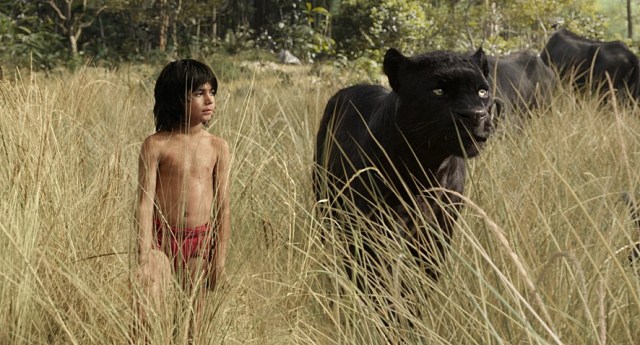
“The Jungle Book” is a refreshing experience for many reasons. While this is another Disney adaptation of Rudyard Kipling’s famous collective works, its bountiful fantasy world is brimming with the sense of unadulterated fun, wonder, and excitement, and I looked at its world with interest and curiosity. Its various animal characters are so vividly and colorfully presented through its top-notch special effects that these talking CGI creatures quickly become important parts of the story, and I often myself involved a lot in their respective interactions with our little feral human hero.

The adapted screenplay by Justin Marks faithfully follows a storyline which most of us are very familiar with thanks to the 1967 Disney animation feature film version. Since he was left alone in the jungle and then luckily found by a black panther named Bagheera (voiced by Ben Kingsley) when he was very young, Mowgli (Neel Sethi) has grown up under the care and protection of Bagheera and a clan of wolves led by Akela (voiced by Giancarlo Esposito). Akela’s wife Raksha (Lupita Nyong’o) loves Mowgli like her son, and Mowgli is virtually another brother to Raksha’s own cubs including Gray (voiced by Brighton Rose), though he becomes more aware of how he is different from his wolf family and many other animals in the jungle.

While Mowgli has been accepted as an exception anyway, there is one animal who strongly disapproves of Mowgli’s existence. He is Shere Khan (voiced by Idris Elba), and this fearsome Bengal tiger can alarm other animals even with his mere presence, as shown from the tense, disquieting scene of his first appearance. He wants to kill Mowgli because of his old grudge against human, and it is evident to everyone including Akela and Bagheera that nothing can stop Shere Khan’s vengeful determination.

thejunglebook04

Mowgli eventually decides to leave for not endangering his clan, and Bagheera accompanies him for taking Mowgli to a human village outside the jungle where he can be safe. Of course, their journey turns out to be more perilous than expected, and Mowgli gets himself tumbled into the circumstance where he must defend himself alone in the middle of the jungle as trying to find a way to the human village.

As Mowgli’s precarious journey is being continued, the movie immerses us more into its fantasy jungle world which is alternatively gorgeous and dangerous. Although we know well from the beginning that most of its world is based on CGI, the movie is decorated with vibrant details tinged with care and imagination, and it serves us many wondrous visual moments to enjoy and appreciate. While the scenes featuring a herd of huge elephants are imbued with awe and majesty, the introduction of Kaa (voiced by Scarlett Johansson) is creepy and mysterious as this long, humongous python gradually reveals her presence around Mowgli. I also like a big, dilapidated temple which is the lair of King Louie (voiced by Christopher Walken), a megalomaniac giant orangutan whose dramatic appearance stands somewhere between “King Kong” (1933) and “Apocalypse Now” (1979) (To be frank with you, I have never imagined that I would mention these two great films together in one sentence).

The most humorous part in the movie comes from Baloo (voiced by Bill Murray), a laid-back bear who comes to befriend Mowgli by chance. After Mowgli helps Baloo through his smart ideas for getting what his bear friend craves for, they sing “The Bare Necessities” while having a pretty good time together, and this is one of several nice musical references to the 1967 version, whose three songs are delightfully utilized here while also being incorporated along with George Bruns’ score into the composer John Debney’s commendable hybrid work.

thejunglebook02

In case of a number of action sequences in the movie, they are visceral and exciting while never overshadowing story and characters. The director Jon Favreau is a good action director as shown from “Iron Man” (2008) and its 2010 sequel, and he steadily maintains the narrative momentum of his movie as its story hops from one point to another until it arrives in the expected moment of confrontation between Mowgli and Shere Khan. Rather than just being vicious and brutal, Shere Khan is depicted as a formidable foe with dignity and intelligence, and the climax sequence in the film really feels like a battle of two clashing wills especially when Shere Khan gleefully corners Mowgli into an impossible situation.

As the sole main human character in the story, young actor Neel Sethi gives an unadorned likable performance to function as the emotional anchor of the film, and it is the testament to his considerable talent as well as Favreau’s skillful direction that his character looks believable amidst heaps of CGI on the screen. The voice cast assembled around Sethi is impressive to say the least. As Bagheera, Ben Kingsley exudes wisdom and patience in his calm, commanding voice, and Lupita Nyong’o and Giancarlo Esposito are also solid as two wolves willing to protect their human cub as much as they can. Although I can hardly imagine him roaring like a bear, Bill Murray effortlessly imbues his own comic personality into Baloo, and Christopher Walken, another great natural scene-stealer, ably switches back and forth between humor and terror as his character cajoles and threatens Mowgli – and he also sings “I Wan’na Be Like You” with gusto for our amusement. While Scarlett Johansson is both silky and insidious in her lithe voice performance, Idris Elba brings simmering intensity and savage charisma into Shere Khan even when he is not ready for attack, and it should be noted that the movie features the last work of Gary Sandling, a wonderful comedian actor who died early in this year.

I often wonder whether I am too harsh on some of recent blockbuster films which dissatisfied me in one way or another, but good blockbuster films like “The Jungle Book” remind me that I should not lower my standard of entertainment at any chance. Favreau, who previously had a productive respite with his small charming comedy film “Chef” (2014), really wants to show something to us here, and he did a job pretty well with style and personality to distinguish his film from many other homogenized blockbuster films out there. I felt like being recharged and refreshed as I walked out of the theater after the movie was over, and I hope I will get similar experiences like this during the rest of the summer blockbuster season in 2016.

thejunglebook03

Posted in Movies | Tagged , , | Leave a comment

The Conjuring 2 (2016) ☆☆1/2(2.5/4): Same scares and shocks in a different location

theconjuring01

“The Conjuring 2” serves us same scares and shocks we saw from its predecessor. During the screening I attended yesterday, I and other audiences around me did get as much as we expected from it, and there were indeed several effective moments to entertain us, but I merely observed this well-made horror product from the distance without enough emotional involvement. This is a familiar horror amusement park packed with usual scary things, and it will not surprise you that much if you have ever watched “The Exorcist” (1973), “The Amityville Horror” (1979), “Poltergeist” (1982), and, yes, “The Conjuring” (2013).

Anyway, the movie tries a few fresh things as moving to a different background. It is London in 1977, and we meet one struggling family living in the London borough of Enfield. Since her husband recently left her and their four children, Peggy Hodgson (Frances O’Connor) has been frustrated with her family’s difficult economic situation, which is reflected well by the dim, shabby interior of their council house. Margaret (Lauren Esposito), Janet (Madison Wolfe), Johnny (Patrick McAule) and Billy (Benjamin Haigh) know well about how much their mother struggles with her domestic matters everyday, but they look mostly fine as sticking together as siblings, and they have been comfort and solace in Peggy’s hard daily life.

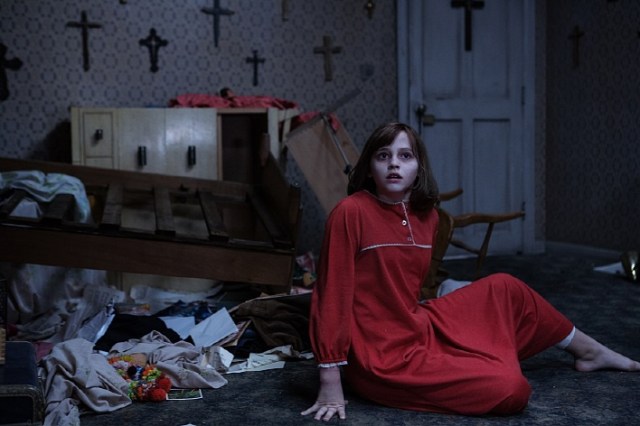
But then, on one day, something wicked begins to creep into their house not long after Janet and Margaret attempt to have a little fun with an Ouija board made by Janet and her schoolmate. Nothing particularly strange happens at that time, but a series of weird happenings soon follow after that, and the Hodgsons become more disturbed day by day. They hear strange noises during night, and then they have spooky nocturnal experiences too real to be nightmares. Furthermore, Janet starts to show unnerving behaviors including sleepwalking and talking to someone invisible, and then it finally becomes very clear to everyone that the house is being influenced by some unseen supernatural force.

theconjuring03

As what is happening in the Hodgsons’ house naturally draws the attention of local media (There is an amusing moment when local police officers quickly decide that this is beyond their, uh, jurisdiction), several paranormal investigators including Maurice Grosse (Simon McBurney) come to examine the house. While they do not get any strong evidence to prove the paranormal activities surrounding the house, Grosse and others happen to witness Janet being possessed by something in the middle of their investigation, and scary things keep happening even when the Hodgsons stay for a while at their kind neighbor’s house right across from theirs.

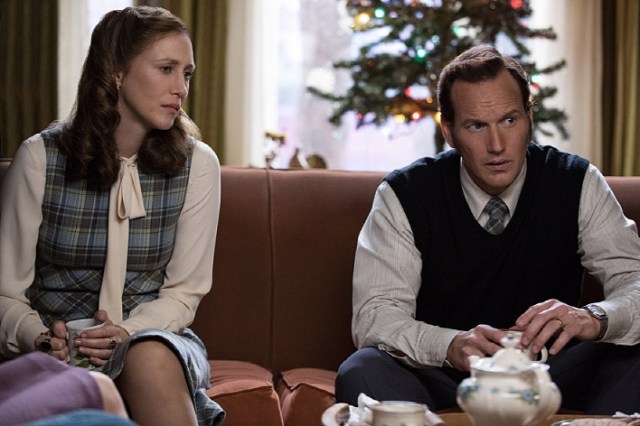
Meanwhile, the movie occasionally looks at how Ed and Lorraine Warren (Patrick Wilson and Vera Farmiga) are going through a recovery period at their home in US. Because Lorraine, who is a clairvoyant, had a very bad experience during their investigation of the Amityville Horror case, they decided to take some rest, but she finds herself still haunted by an evil spirit she beheld during their previous investigation, and she becomes more nervous especially after that evil spirit in question somehow influences her husband’s artistic sensibility. When they are asked to look into the Hodgsons’ case for determining whether the Catholic Church should deal with the case directly, they are reluctant at first, but they come to London anyway because they cannot disregard people in the urgent need of their help.

As they did in the previous film, Vera Farmiga and Patrick Wilson bring sincere humanity into their roles, and these two talented performers are believable as a couple who are strongly connected with each other through their mutual love and belief. Farmiga and Wilson really know how to make their scenes look engaging through their performance, and you can look at their characters with interest even though you remain skeptical about what the movie and most of its characters believe in. As mentioned during its end credits, the movie is indeed inspired by a real-life incident which is one of the most well-known haunted houses cases, but I must tell you that the incident is as questionable as the real-life counterpart of Mr. and Mrs. Warren, who once claimed that they encountered a werewolf.

theconjuring02

The other cast members besides Farmiga and Wilson are also convincing in their respective supporting roles. Simon McBurney, who looks a lot different from his shady supporting turn in “Mission: Impossible – the Rogue Nation” (2015), feels rather silly at first but then has an earnest scene where his character reveals his personal side. Frances O’Connor and four young performers around her look as plain and ordinary as required, and young actress Madison Wolfe deserves praises for handling a number of demanding scenes well with admirable conviction.

The director/co-writer James Wan, who wrote the screenplay with Carey Hayes, Chad Hayes, and David Johnson, did a competent job of establishing disturbing atmosphere and then pushing shock buttons to jolt us. There are numerous ‘Boo!’ moments here and there throughout the film, but they are effective ones based on its good mood and suspense. The movie is often visually impressive thanks to its smooth cinematography by Don Burgess, and I liked how the tension is slowly increased via deft camerawork and editing during a certain scene involved with a toy fire truck.

In my review on “The Conjuring”, I wondered whether I was not scared enough because I had watched many horror films as a seasoned moviegoer, and that impression was repeated during my viewing of “The Conjuring 2”. I was amused and entertained from time to time, but, again, I was not so scared enough to recommend it to you. As a matter of fact, I previously watched scarier and spookier horror films like “The Babadook” (2014) and “It Follows” (2014), and maybe you should check them out someday.

theconjuring04

Posted in Movies | Tagged , , , , , | Leave a comment

All the Way (2016) ☆☆☆1/2(3.5/4): All the way to the Civil Rights – and his re-election

alltheway04

It is always nice to see a good actor finally getting a career boost he deserves, and Bryan Cranston is one of such examples during last 10 years. While this veteran actor has steadily worked for more than 30 years, he came to be noticed by many of us only after his electrifying performance in recent TV drama series “Breaking Bad”, and then he has kept showing us more of his immense talent as giving a number of notable movie performances including his Oscar-nominated turn in “Trumbo” (2015).

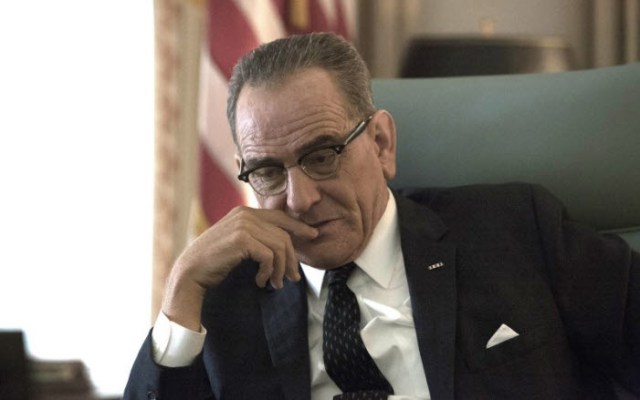
In HBO TV movie “All the Way”, which is adapted from the Tony-winning stage play of the same name, Cranston plays Lyndon B. Johnson, and he is utterly spellbinding in the role which previously garnered him a Tony and will definitely bring another Emmy to him. Besides looking real and authentic on the outside as required, his multifaceted performance vividly channels Johnson’s larger-than-life personality and shrewd political mind, and Cranston invigorates every minute of his scenes as leading us to the illuminating insights into the Johnson Presidency and its turbulent era, which indubitably feels timeless as mirroring another tumultuous transitional period which the American society is struggling through at present.

The movie begins its story shortly after President John F. Kennedy was assassinated on November 22nd, 1963. After Kennedy’s death is pronounced, Johnson, who was Kennedy’s vice president, becomes the next president of the United States as returning to Washington D.C., and he is already well aware of a tricky situation he has to tread very carefully. Besides stabilizing the whole country still in shock and grief, he must get the Civil Rights Act passed at the US Congress as his predecessor wanted, and he discerns a golden opportunity from Kennedy’s death, but many Southern Democratic congressmen, who do not welcome racial equality much just like many of their white voters, remain to be a hefty major obstacle as before. As the 1964 US presidential election is approaching, Johnson becomes more conscious of party unity, and angering Southerners on which his party has depended for many decades is something he wants to avoid as much as possible.

alltheway05

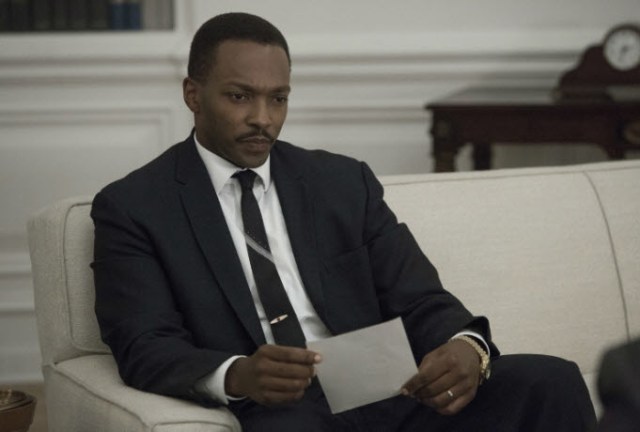
While Senator Richard Russell, Jr. (Frank Langella), Johnson’s friend and mentor, may help Johnson on this difficult matter, there are also other political factions to be maneuvered with equal caution. The liberal faction of the Democratic Party represented by Hubert Humphrey (Bradley Whitford) is not very pleased to hear that they may have to compromise more, and neither are many civil rights movement leaders including Martin Luther King, Jr. (Anthony Mackie), who has been as frustrated as his colleagues although he understands well how difficult it is to get things done in Washington D.C. even for the US president.

How Johnson handles his complicated political circumstance is not so far from what was shown in Steven Spielberg’s “Lincoln” (2012). Through his wily tactics equipped with slick charm and forceful attitude, he manages to secure enough votes for the Civil Rights Act to get passed at the US Congress, and he also makes sure that King and other civil rights activists are satisfied enough to guarantee their continuing support to the Democratic Party, though a certain crucial part of the Civil Rights Act has to be removed as the unavoidable price for attaining their common goal.

As Johnson shifts his focus onto re-election, the American society continues to go through its bumpy period. Three civil rights activists are gone missing in Mississippi, and then their bodies are found not long after Johnson has this infamous case investigated by FBI. When he receives a rather uncertain military report from the Gulf of Tonkin, Johnson has to make a quick decision to maintain his political status, and we all know that this will come to tarnish his public image several years later.

alltheway01

While the movie betrays its theatrical origin especially when Johnson expresses his thoughts and feelings directly to us, the adapted screenplay by Robert Schenkkan, who also wrote the original stage play, provides many juicy scenes to be enhanced further by Cranston. Johnson’s difficult political situations bring not only the best and but also the worst out of him, and Cranston’s colorful and complex human portrayal of his character is tour-de-force in every nuance and gesture. Johnson can be casual and charming, but he can also be harsh and irascible even to his own people, who often have to tolerate that a lot as working under him. Constantly balancing himself between pragmatism and idealism, Johnson can be very ruthless if that looks necessary to him, and that is exemplified well by when he blatantly steers the attention of media away from civil rights activists protesting against the exclusion of their voice from the 1964 Democratic National Convention. He surely understands their position, but the unity of his party comes first in his view, and he pushes his position aggressively without any hesitation.

Cranston is surrounded by the dependable supporting cast consisting of many recognizable performers. While Frank Langella brings quiet class and dignity to his character, Bradley Whitford has a humorous scene when Johnson suggests to Humphrey an offer any ambitious politician cannot refuse, and Stephen Root is deliciously slimy as J. Edgar Hoover, the legendary but equally notorious director of FBI who was far more interested in King’s extramarital affairs than civil rights. As Johnson’s longtime top aide Walter Jenkins, Todd Weeks holds his own small place besides Cranston, and Melissa Leo exudes a whiff of gentle warmness as Lady Bird Johnson. Although his performance is automatically compared to David Oyelowo’s in “Selma” (2014), Anthony Mackie is effective in his supporting role, and his last scene may make you want to revisit “Selma”, which focuses on another moment of struggle and progress after the Civil Rights Act and Johnson’s re-election.

While he is mainly known for his major comedy films including “Austin Powers: International Man of Mystery” (1997) and “Meet the Parents” (2000), the director Jay Roach, who previously collaborated with Cranston in “Trumbo”, has moved into a more serious area with his acclaimed HBO TV movies “Recount” (2008) and “Game Change” (2012). Like these two political drama movies, “All the Way” aired in US when the American society was bracing itself for its presidential election, and it wants to remind American people of the importance of their upcoming political event, as looking into one of the most dynamic points in the modern American history. Will their nation survive its another perilous and unpredictable social/political upheaval? We will soon see whether they shall overcome.

alltheway02

Posted in Movies | Tagged , , , , | Leave a comment

Last Cab to Darwin (2015) ☆☆1/2(2.5/4): An old cab driver’s last journey

lastcabtodarwin01

Believe or not, the story of Australian film “Last Cab to Darwin” was really inspired by a real-life story associated with the first legalization of euthanasia in the world. In 1995, euthanasia was legalized in the Northern Territory of Australia, and it was naturally followed by lots of controversies until the law was eventually nullified in 1997. During that time, an old sick cab driver named Max Bell actively pursued his chance for euthanasia in a dramatic way as reflected in the movie, and his story later inspired the stage play of the same name which the movie is based on.

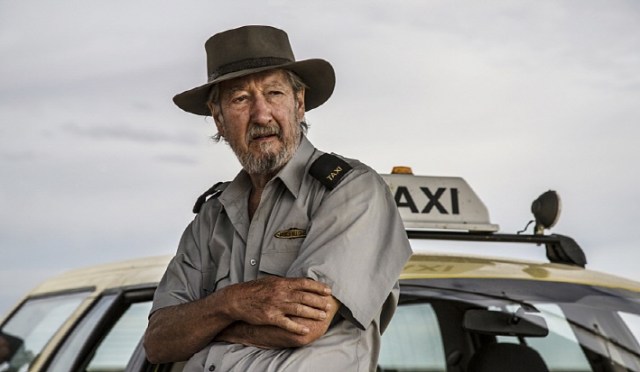
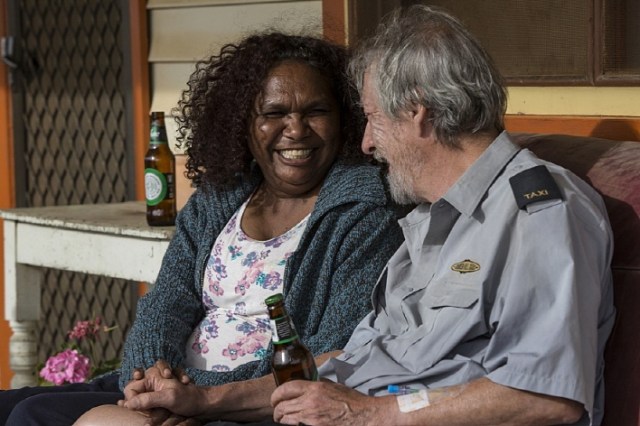
In the beginning, we look around the mundane daily life of Rex McRae (Michael Caton), a cab driver who has spent his whole life in Broken Hill, a rural town located in the Southern Territory of Australia. Without any close relative, this aging loner lives alone in his small house with a dog, but his life is not that terribly lonely at least. When he is not working, he usually spends time with his three drinking buddies at a local bar, and he has also been in a close relationship with Polly (Ningali Lawford), a brash middle-aged Aboriginal lady living in a house right across from Rex’s house.

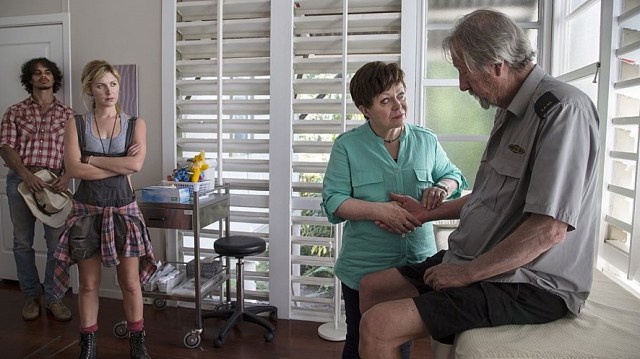
On one day, Rex receives a bad news. When he goes to a local hospital for his recent stomach problem, it turns out he has a terminal stomach cancer, and he is told that he has only three months to live even under the best circumstance. After hearing about the legalization of euthanasia in the Northern Territory, he decides to drive to its capital city Darwin for meeting Dr. Farmer (Jacki Weaver), the leading advocate of this euthanasia law. Although the distance between Broken Hill and Darwin is no less than 1,900 miles (around 3,000 km), he is not daunted by that at all, and he soon embarks on what may be the last journey in his life.

lastcabtodarwin02
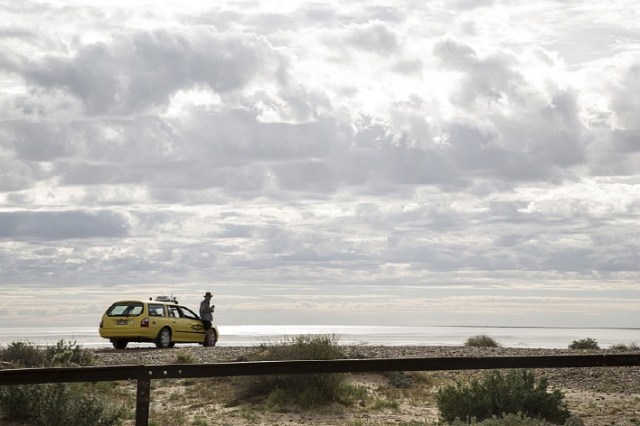
As following his journey, the movie takes a familiar route which has already been taken by many other road movies. As Rex drives his cab along the road, the movie often captures wide, awesome shots of barren landscapes, and the cinematographer Steve Arnold did a commendable job of evoking the dry, dusty, and distinctive ambience of Australian outback regions on the screen. At one point, Rex comes across a bizarre tourist attraction which seems to come right out of Cormac McCarthy novel, and we cannot help but look at this site with curiosity while horrified by its sheer morbidity.

And he encounters two different people by coincidence. When he stops by a shabby small town for replacing the broken windshield of his cab, he meets Tilly (Mark Coles Smith), an Aboriginal lad who once had a chance to join the Australian Football league but has been stuck in his aimlessly drifting life. This jolly guy is not exactly someone you can rely on, but he eventually joins Rex’s journey, and then they are joined by Julie (Emma Hamilton), a young British bar employee whose particular set of professional skills comes handy when Rex’s health becomes more deteriorated than before.

As they are getting closer to their destination, the movie ironically becomes less focused as its increasingly scattershot narrative frequently shifts itself between different tones and subjects. As Tilly reveals despair and frustration behind his carefree attitude, the movie seems to attempt a serious look into racial/social matters, but then it jumps onto less serious things including the growing relationship between Tilly and Julie, which does not have much future especially after Rex tells Julie one thing about Tilly’s personal status.

lastcabtodarwin05

I was also disappointed with how the movie deals with its thought-provoking main subject. During its third act, the movie hesitates to take any forward step as Rex is waiting for the legal permission of his euthanasia, and Dr. Farmer is broadly depicted as a doctor who seems to be occupied more with legality and public opinion than human need. The finale feels like a cop-out to avoid difficult questions which would be arisen from Rex’s situation, and I was not surprised to learn later that the real-life story behind the film was far less rosy compared to its fictional counterpart.

Anyway, “Last Cab to Darwin” is mostly fine as a road movie, and Sims and his crew did a nice job of transferring the original stage play to the screen without any stagy impression. Although I am not so sure about whether the movie works as well as intended, the adapted screenplay by the director Jeremy Sims and his co-writer Reg Cribb, who wrote the original stage play, surely gives a wonderful opportunity to the lead actor Michael Caton. Caton effortlessly embodies his character right from his first scene, and his engaging performance ably carries the film even while its plot stumbles or trudges. Although their respective supporting roles are not fully developed, Emma Hamilton, Mark Coles Smith, Jacki Weaver acquit themselves well through their own presence, and Ningali Lawford is excellent as a feisty woman who wants far more than small decent gestures of care and affection from a man she has loved for many years. Whenever she and Caton appear together on the screen, we can always sense a long history between Rex and Polly, and I think the movie would work better if the story focused more on their interesting human relationship.

As I felt reservation and dissatisfaction at the end of the film, my mind went back to a couple of better films associated with euthanasia. While Barry Levinson’s HBO TV movie “You Don’t Know Jack” (2010) is more thoughtful and powerful, Denys Arcand’s Oscar-winning film “The Barbarian Invasions” (2003) is more humorous and touching, and both of them are not afraid of stepping forward with their common subject. Of course, I do not mind life-affirming moments, but “Last Cab to Darwin” only scratches the surface as sidestepping that hard inevitability of life and death, and it ultimately feels like a mild diversion compared to these two aforementioned films.

lastcabtodarwin04

Posted in Movies | Tagged , , , | Leave a comment

Irrational Man (2015) ☆☆(2/4): He thinks – she thinks

irrationalman03

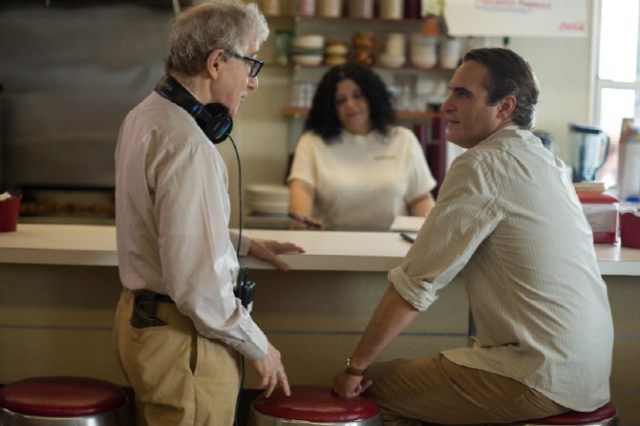
There are many far worse things out there, but watching “Irrational Man” is the blandest experience I have ever had from Woody Allen film since “Cassandra’s Dream” (2007). Although there are a few moments where we can get glimpses of wit and charm we can expect from Allen, the movie is tepid and uninteresting as hampered by half-baked storytelling and characterization, and I kept thinking about how memorably Allen handled similar themes and situations in “Crimes and Misdemeanors” (1989) and “Match Point” (2005), which are much better on both comic and dramatic levels compared to this utterly forgettable result.

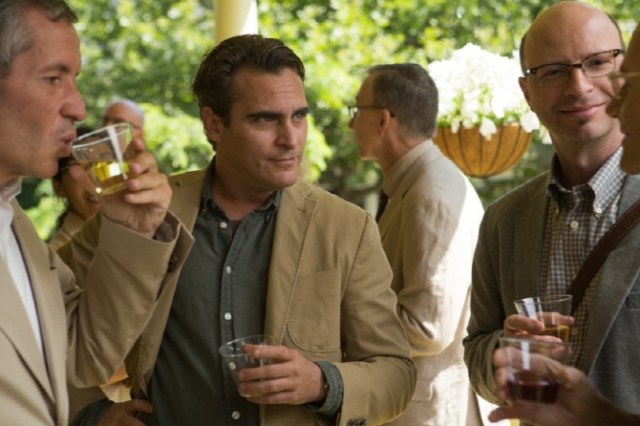
The movie begins with its introduction of the hero who is actually not so interesting as others around him incessantly say. He is a philosophy professor named Abe Lucas (Joaquin Phoenix), and he is about to join the faculty of some small-town college in New England area. Everyone in the campus heard about him at least once, and we hear about how his life has been riddled with many unhappy things such as his journalist friend who died in Iraq or his ex-wife who left him while he was occupied with helping people during the aftermath of Hurricane Katrina.

I wonder whether his stories are no more than rumors, but he never confirms their veracity while looking as sullen and depressed as ever in his continuing misery of, yes, existential crisis. Many philosophers including Immanuel Kant and Martin Heidegger are steadily mentioned or quoted as he is teaching his students or talking with other faculty members, and he also shows serious signs of alcoholism and depression. At one point, he tries Russian roulette twice in a row in front of others, and this reckless behavior of his surely freaks out everyone around him.

irrationalman02

We also meet two women who somehow find him attractive despite the fact that he is essentially a superficial intellectual bore I would stay away from as much as possible. Jill Pollard (Emma Stone), a smart, plucky young student, becomes fascinated and infatuated with Abe as talking about him more and more, and this certainly displeases her current boyfriend. In case of Professor Rita Richards (Parker Posey), Abe is the latest faculty member this libidinous married woman would love to sleep with, and it does not take much time for them to be together on his bed, though this is just a minor distraction for him.

And then one accidental incident begins to stimulate Abe to break away from his usual ennui. When he is meeting Jill at a local restaurant during one afternoon, they happen to hear the conversation among the people seating right behind them, and they come to learn about a judge who is going to pass his very unfair judgment on a custody case. Nothing can stop this judge’s decision legally, and it also seems that he has some bad career reputation due to a number of misconducts he managed to get away with.

Abe naturally comes to wonder about several moral questions as musing more on this matter later. Is it right to kill the judge to prevent the considerable unhappiness to be caused by his heartless decision? Can murder be morally or ethically justified as a solution? And, above all, can one possibly commit a murder and then remain unsuspected and free of guilt after that?

Mulling on these dark questions which remain to be on metaphysical levels at least for now, he ironically feels more alive and excited than before, and his plan for murder accordingly takes its shape in his mind step by step. As he surreptitiously watches on the judge for a while, he comes to find an ideal spot in the judge’s consistent daily routine – and he also does some research for finding a swift and efficient way to eliminate this guy.

irrationalman05

In the meantime, Allen’s screenplay frequently goes back and forth between Abe’s and Jill’s viewpoint for making the situation look a bit lighter, but its two main storylines, which are bound to converge on a certain point, do not interact with each other much while merely proceeding in parallel, and its main characters do have enough depth or personality to be explored during this process. The movie tries some serious thoughts on its themes, but it feels lazy and shallow compared to the darker half of “Crimes and Misdemeanors”, where one of its main characters comes to arrive at a chilling conclusion after his agonizing moral conflict on murder and guilt. While the hero of “Match Point” is a callous, superficial guy, how he eventually comes to choose a drastic way to solve his troubles is very shocking and compelling to watch, and the plodding plot of “Irrational Man” lacks the cold, sharp, and ruthless narrative logic of “Match Point” in comparison.

As usual, Allen assembled talented performers for his movie, but it looks like they are in front of the camera only because they cannot resist an opportunity to work with Allen. Joaquin Phoenix can be very funny or very disturbing as shown from his contrasting performances in “The Master” (2012) and “Inherent Vice” (2014), but the movie does not utilize his comic potentials much while only making him stuck in monotonous passive-aggressive modes. Emma Stone does what she can do with her underdeveloped character, but she was much better in Allen’s previous film “Magic in the Moonlight” (2014), and Parker Posey is sadly wasted in her thankless role.

“Irrational Man” is a tedious failure on the whole, but it is sort of comforting to see that even the worst Woody Allen movies like this do not look truly awful and idiotic in their intellectual fumbles. Come to think of it, Allen already completed his next film and then had it shown at the Cannes Film Festival in this year, and my mind is ready to move onto that as leaving behind this big disappointment.

irrationalman04

Posted in Movies | Tagged , , , | Leave a comment

Mountains May Depart (2015) ☆☆☆(3/4): Past, Present, and Future

mountainsmaymove01

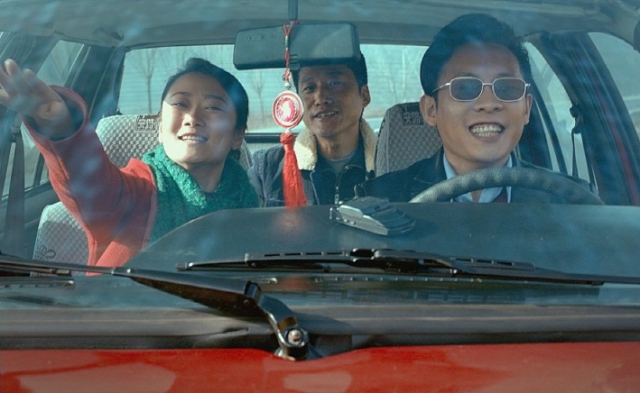
The first part of Jia Zhangke’s new movie “Mountains May Depart” may be the longest prologue I have ever seen during recent years. The title of the movie appears on the screen only after the end of this part, and that point is already more than 40 minutes after its opening scene. That feels odd at first, but this unorthodox storytelling choice makes sense as the movie looks around its main characters’ past, present and future as their world goes through rapid social changes which affect their lives in one way or another.

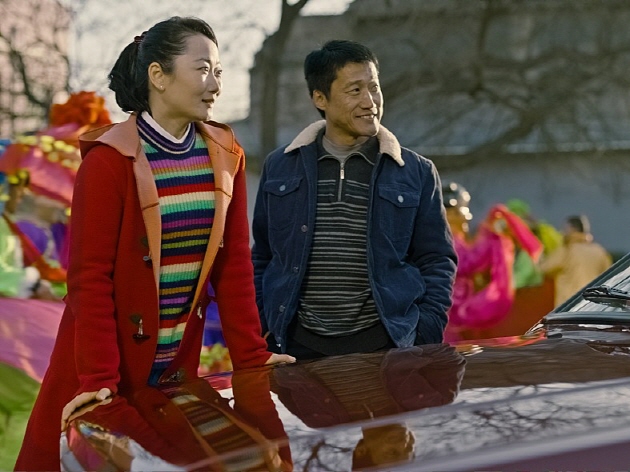
Set in a local Chinese city during 1999, the first part revolves around a triangle between Shen Tao (Zhao Tao), Zhang Jinsheng (Zhang Yi), and Liang Jangjung (Liang Jing Dong). They are young and hopeful just like many others in China as it is soon going to enter the 21th century with its rising global status, and the opening scene shows them exuberantly dancing together with others at a local nightclub as Pet Shop Boys’ “Go West” is played.

When Jinsheng decides to come closer to Tao rather than just being her friend, things become complicated mainly because Jangjung, usually called Liangzi, also likes Tao. Jinsheng is well aware of that from the beginning, so he makes what he wants clear to Liangzi, but Liangzi does not try much to stop Jinsheng, probably because he knows his disadvantages in their romantic competition. While Liangzi is merely a local coal mine employee, Jinsheng is a rich business guy with money to spend, and it looks like he will soon be richer than ever once he rides on a growing economic boom as planned.

In case of Tao, she feels conflicted as the relationships among her and her two friends become more strained. Although she does not refuse Jinsheng when he clumsily reveals his feelings toward her, she also cares about Liangzi, and that is why she feels hurt when Liangzi chooses to leave the city not long after she chooses to marry Jinsheng in the end.

mountainsmaymove05

After Tao gives a birth to her son several years later, the movie moves forward to 2014 for its middle part. When we see Liangzi again, he still works as a miner while living with his own family in a different city, and everything mostly looks fine as he is going through his meager daily life, but he soon gets a bad news for his family as well as himself. He needs an expensive medical treatment due to his sickened lungs, and he and his family return to his hometown for getting any possible financial help from people who were close to him.

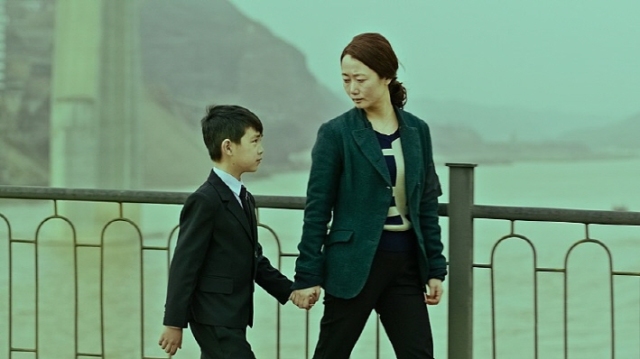
After hearing about her old friend’s illness from Liangzi’s wife, Tao visits Liangzi, and their quiet private moment is tinged with the bittersweet sense of loss and regret. After divorcing her husband several years ago, Tao has been leading her own life and business well in the city, but it still hurts her that she had to leave her young son at that time, who is currently living with his father and stepmother in Shanghai. At one point, she shows Liangzi how much she still remembers their good time, but they are not young anymore, and now their paths are being drifted apart further even during their reunion.

When a sad incident suddenly happens to Tao later, Zhao Tao, who is not only the director/writer Jia Zhangke’s wife but also his valuable artistic collaborator, is terrific as gracefully handling her character’s shifting emotional states. While quite devastated during the aftermath of the incident, Tao is glad to see her young son again when he is sent to her as requested, but then she has to accept that her son will be away from her sooner or later, and it is poignant to see how she tries as much as she can for spending more time with him.

The final part of the movie is set in 2025, and Tao’s son, nicknamed Dollar (Zijian Dong), now grows up to be a lad living in Australia, where he went along with his father not long after he saw his mother for the last time. We see a considerable gap between him and his father, who usually spends his time with fellow Chinese guys and can understand his son’s English e-mail message only through Google translator. When Dollar decides to quit his college education, his father is not so pleased about that, but Dollar sticks to his decision anyway although he still does not know what exactly what he wants to do with his life.

mountainsmaymove04

Compared to the other two parts preceding it, this part is far weaker as being without the most engaging character in the film. Its futuristic setting feels bland and heavy-handed while deficient in its own sense of time and space, and its mediocre characterization does not help much either. Dollar is a rather flat, colorless character, and his developing relationship with his middle-aged teacher played by Sylvia Chang is contrived while not contributing a lot to the whole narrative.

It is notable that each part in the movie is presented in different screen ratio. While the first part is presented in 1.33:1 ratio, the middle part is presented in 1.85 ratio, and the last part is presented in 2.35:1 ratio. I am not so sure about whether this visual approach is necessary; several sequences actually shot in 2001 are mixed well into the first part without much awkwardness, but the widescreen during the third part seems to exist only for capturing wide landscape shots.

Nevertheless, “Mountains May Depart” is not entirely ruined by its glaring missteps, and Jia Zhangke shows here again that he is one of the most interesting filmmakers in China. When the movie works best, it shines with his gentle, thoughtful humanistic approach to story and characters, and it shows his deep care and concern over what the Chinese society has been going through. Changes may be inevitable, and it may not be good for everyone, but, as reflected by the last shot of the film, there is still some hope anyway.

mountainsmaymove03

Posted in Movies | Tagged , , , | Leave a comment

The Handmaiden (2016) ☆☆☆(3/4): Pretty, Kinky, and Naughty

thehandmainden05

South Korean film “The Handmaiden” is a droll, morbid exercise in sensuality and perversity. Besides being a sumptuous erotic melodrama which tantalizes and enthralls our eyes with its ornate moods and details, this is also a delightfully twisted thriller which thrills and amuses us as revealing whatever lies behind or below its apparently unreliable settings. When its convoluted plot becomes more loose and straightforward during its last act, it becomes relatively less interesting, but the movie provides enough naughty fun to support its long running time (144 minutes), and we are willing to go along with the potentially dangerous dynamics of seduction, perversion, and manipulation among its main characters.

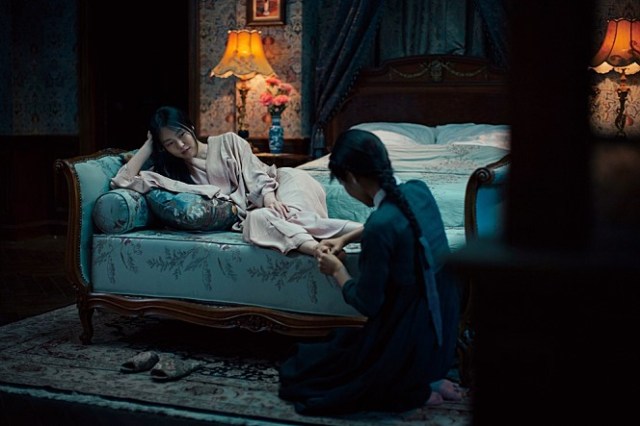
Its story is set in Korea during the 1930s, which was the middle of the Japanese Occupation era. The opening scene introduces to us a poor urban girl named Sook-hee (Kim Tae-ri), and she is soon sent to a big manor somewhere outside the city as a newly hired handmaiden for Lady Hideko (Kim Min-hee), the young lady of the manor. As a car carrying Sook-hee enters the manor, we cannot help but be impressed by not only its vast scale but also the weirdly eclectic style of the mansion located in the middle of its remote surrounding area. This big, imposing mansion is distinguished by its baroque juxtaposition of British and Japanese architectures, and so is a huge antique library for the owner of the manor, who has been known well for his enormous personal collection of kinky books and artworks.

His official name is Kouzuki (Cho Jin-woong), but this dirty wealthy middle-aged guy is in fact a Korean naturalized as a Japanese citizen via his marriage to some Japanese noble woman, who killed herself not long after her young orphaned niece was brought to Kouzuki’s manor. That young girl was Lady Hideko, and it seems her uncle actually considers marrying her just for further solidifying his social and financial status. After all, he still wants to collect more for his library, and that will definitely cost a lot.

As she goes through her first day as Tamako at the mansion under the stern supervision of its female butler who is as forbidding as Mrs. Danvers in “Rebecca” (1940), Sook-hee is told about how she should behave and serve Lady Hideko, but, this is not much of a spoiler, she already knows well what kind of job she is going to do there. In contrast to her seemingly naïve appearance on the outside, she is actually a street-smart crook who has worked for her small organization, and her real purpose is helping the nasty scheme of her accomplice, who presents himself as Count Fujiwara to Kouzuki and Lady Hideko in advance.

thehandmainden03

As the plot thickens, we come to know more about their plan. While Count Fujiwara (Ha Jung-woo) ingratiates himself with Kouzuki as assisting Kouzuki’s lucrative swindles involved with his collections, he is also going to try to win Lady Hideko’s heart, and Sook-hee will smoothen this process as someone whom this lonely lady can trust and lean on. Once he gets the money through his marriage with Lady Hideko, there will be a dire consequence for his wife, but Sook-hee is fine with that because she will get her own share of money in the end.

However, Sook-hee finds herself unexpectedly attracted toward Lady Hideko, who initially seems to be frigid and haughty enough to deserve her handmaiden’s hidden contempt but then reveals her more benign and alluring sides as days go by. The more Sook-hee and her accomplice advance with their plan on Lady Hideko, the more Sook-hee becomes drawn to her mistress, and that naturally creates considerable strains in this increasingly unstable triangle.

As a number of things during the first act are rearranged later along with other crucial things and then presented via a different viewpoint, the director/co-adapter Park Chan-wook, who has been known well to international audiences thanks to “Oldboy” (2003) and the following works including “Thirst” (2009) and “Stoker” (2013), did an impeccable job of building up his own edgy, stylish atmosphere to hold our attention even when we observe his mostly untrustworthy characters from the distance. The production design by Ryu Seong-hee, who received the Vulcan Prize for the Technical Artist after the movie was shown at the Cannes Film Festival in last month, is dazzlingly beautiful as creating a visually bountiful world to be inhabited by characters, and the cinematography by Chung Chung-hoon is superb in its deft, confident handling of lighting and scene composition, while constantly suggesting something dark and sinister behind their slick, luxurious environment.

thehandmainden04

As doing a fairly good job of delivering the frequent Japanese dialogue scenes in the movie, the main cast members have a fun with hurling themselves into their respective roles. While the movie is indubitably a big breakthrough for newcomer actress Kim Tae-ri, Kim Min-hee, who delighted me with her comic performances in “Very Ordinary Couple” (2012) and “Right Now, Wrong Then” (2015), is equally compelling and beautiful as effectively complementing her co-star on the screen. The movie is often surprisingly very funny and humorous as these two lovely actresses push and pull each other behind their back, and we also get a couple of heated moments of nudity which, to our amusement, turn out to have more things to be undressed later.

While Ha Jung-woo is alternatively dapper and caddish as required, Cho Jin-woong, who previously acted along with Ha in “Nameless Gangster” (2012), is loathsome as a man with unspeakable perversions to nurse in his secret dungeon. The movie does not miss the absurd irony between these two rotten men of different social classes who are trying to deceive each other through each own fake Japanese identity, but it is a little disappointing that the movie does not go further with their certain scene which may take you back to one of the infamous moments in “Oldboy”. Kim Hae-sook, who gave a scene-stealing supporting performance in “Thirst”, holds her own small place as a butler who may be as sadistic as a man she serves for, and Moon So-ri briefly appears as Kouzuki’s doomed wife.

“The Handmaiden” is based on Sarah Waters’ acclaimed novel “Fingersmith”, whose story is set in the 19th century England during the Victorian era. Although I have not read the novel yet, I heard that the novel is different from the movie in many aspects besides this notable period background difference. Due to visible narrative flaws during the third act of the movie, I came to wonder whether the novel or its 2005 BBC TV miniseries adaptation is better in comparison, but “The Handmaiden” remains to be a bold visual pleasure packaged with style and wit, and I enjoyed its performances and technical achievements as tickled by its wry naughtiness. I paid, and I got as much as I could expect from Park Chan-wook’s work.

thehandmainden01

Posted in Movies | Tagged , , , , , | 2 Comments

Sing Street (2016) ☆☆☆1/2(3.5/4) : First Music – and First Love

small_singstreet01

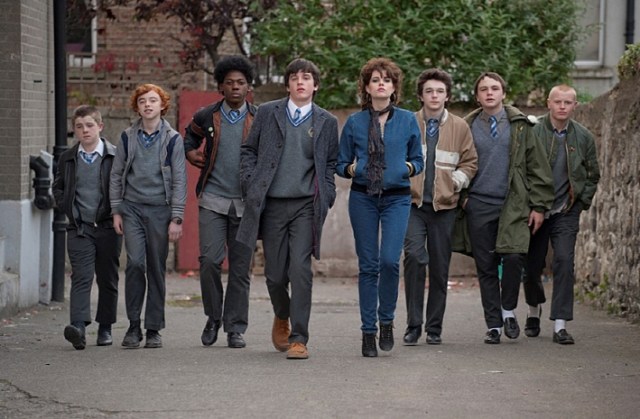
“Sing Street” is a small but sweet musical movie with lots of charm and energy. While its musical period background is not that familiar to me, I was amused and entertained by its superlative soundtrack consisting of old and new songs, and I also enjoyed its sincere coming-of-age tale full of colorful characters I came to like and care about more at the end of the movie.

The story is set in Dublin, 1985, when many people in Ireland struggled with a local economic depression as shown from the archival footage in the opening scene. After Robert (Aidan Gillen) becomes unemployed and his wife Penny (Maria Doyle Kennedy) gets paid less than before, they frankly tell their three children Brendan (Jack Reynor), Ann (Kelly Thornton), and Conor (Ferdia Walsh-Peelo) that they have to save money as much as possible now, and that means Conor is going to be transferred from his private school to a cheaper public school.

Conor’s reluctant first day at the Synge Street Christian Brothers School is not very pleasant to say the least. The school looks like a wildlife jungle with many unruly adolescent boys, and he soon finds himself targeted for bullying. In addition, just because of a minor attire regulation, he makes a bad impression to Brother Baxter (Don Wycherley), the stern, constipated school principle who reminds me of those oppressive, hypocritical pricks in Dickens novels.

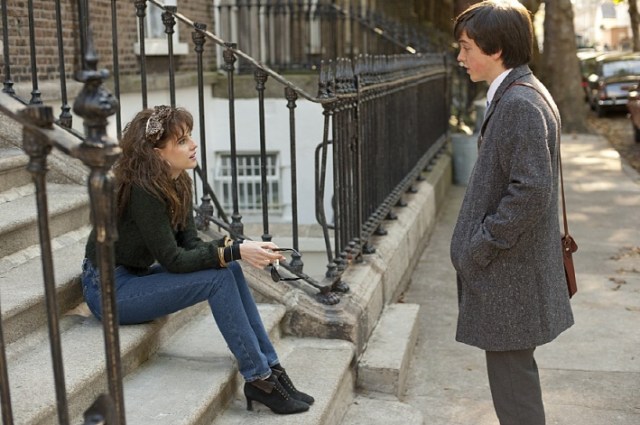
But then he comes upon what may be his first love. At the front gate of the school, he notices a girl around his age standing across the street. Her name is Raphina (Lucy Boynton), and she is hoping to go to London and start her model career there someday. Conor naturally wants to impress this attractive girl who looks more mature and sophisticated than him or other boys in the school, so he lies to her that he has a rock band – and he even suggests that she should appear in a music video his band is going to make.

small_singstreet03
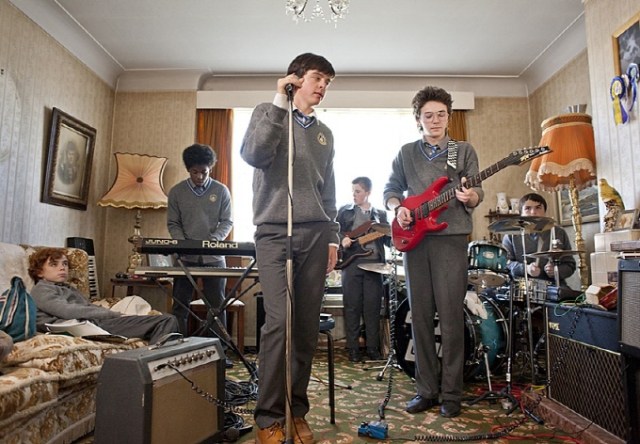
After Raphina accepts his offer, Conor needs to have his band as soon as possible, and, fortunately, he gets helps sooner than expected. Darren (Ben Carolan), who becomes Conor’s first friend in the school as someone to help dealing with bullying, quickly assumes his role as a talent scout and manager, and they soon gather four additional band members: Eamon (Mark McKenna), a nerdy wunderkind who can deftly handle many different instruments and usually has his pet bunnies around him; Ngig (Percy Chamburuka), the only African boy in the school; and Larry (Conor Hamilton) and Garry (Karl Rice), who volunteer as bassist and drummer shortly after they come across a recruitment notice on the school board.

While Conor’s assembled band, named Sing Street, is taking its first steps, Conor is encouraged and guided by his older brother Brendan, a laid-back college dropout willing to teach his little brother everything he knows about rock and roll. He recommends Conor to listen to his precious LP albums, and he also advises Conor to search for his own music rather than merely absorbing and imitating many popular rock bands out there.

Supported by his brother and motivated by his love toward Raphina, Conor makes a few songs with Eamon, and we get a funny and touching scene when they and other band members clumsily try to make a music video with Raphina, who turns out to be more cooperative and resourceful than she seemed at first. While their amateurish final result certainly looks rough and tacky to our amusement, their unadulterated enthusiasm is evident from their raw musical performance at the corner of a neighborhood alley, and their hilariously corny band attires begin to look a bit endearing as they become more confident about themselves as well as their music.

Besides decorating the soundtrack with various pop songs from the 1980s, the director/writer John Carney and his co-composer Gary Clark provide a number of original songs to be performed by Conor and his band members in the movie, which are suitably and effectively used as the crucial parts of its narrative. While most of musical performance scenes in the film are grounded in plain realism, they are presented with infectious spirits and genuine emotions to engage us, and we do not mind the sudden insertion of an exhilarating song and dance scene unfolded at the school auditorium.

small_singstreet04

Carney cast a bunch of young unknown performers for his film, and they look believable as amateur musician characters in their unadorned ensemble acting. As the modest center of the movie, Ferdia Walsh-Peelo is likable in his earnest performance, and he and his co-star Lucy Boynton click together well along the relationship development between their characters. As Conor’s band members, Ben Carolan, Mark McKenna, Percy Chamburuka, Conor Hamilton, and Karl Rice are engaging with each own personality, and Ian Kenny is fine as a school bully with understandable low self-esteem.

The movie also pays attentions to several adult characters at the fringe of the story. While Aidan Gillen and Maria Doyle Kennedy bring considerable humanity to Conor’s increasingly estranged parents, Lydia McGuinness plays a kind art teacher in contrast to the firm, heartless presence of Don Wycherley. In case of Jack Reynor, a promising actor who is as amiable as Chris Pratt, he steals the show as his character comes to show more complex sides behind his goofy slacker appearance. As a sort of father figure to his little brother, Brendan is happy to see Conor maturing with his own passion, but that also reminds him of how disappointing and wasteful his own life has been for years, and Reynor is very good when Brendan confides his conflicted feelings to his brother during one of their private moments.

After the unexpected critical/commercial success of “Once” (2007), Carney tried something more conventional in “Begin Again” (2013), which was enjoyable with nice songs but not so memorable compared to that enduring likability of “Once”. With its youthful heart and soul reminiscent of Alan Parker’s “The Commitments” (1991), “Sing Street” is a welcoming return to form for Carney, and this will be a refreshing experience for you especially if you yearn for any entertaining respite from the bombastic Hollywood blockbuster season.

small_singstreet02


Posted in Movies | Tagged , , , , | Leave a comment