Train to Busan (2016) ☆☆☆(3/4): South Korean Zombie Express

traintobusan02

South Korean film “Train to Busan” combines one of my least favorite movie subjects with one of my most favorite movie subjects: zombie and train. As you have already guessed, this is basically another typical zombie movie in which a group of ordinary characters struggle to stay or run away from a sudden zombie epidemic, but the movie is scary and thrilling enough to fix us on the edge of our sear during most of its running time, and it also plays well with its refreshing premise while relentlessly passing by its plot points one by one as demanded.

After the unsettling opening sequence which announces a disaster on the horizon in advance, the movie moves onto its hero’s one bad day. Seok-woo (Gong Yoo) is a fund manager working in Seoul, and he is trying to deal with an unexpected trouble associated with some biotechnology company he has recently invested. While occupied with this annoying problem, he manages to prepare the birthday present for his young daughter Soo-an (Kim Soo-an), but he only finds himself disappointing her while being reminded again of how lousy he has been as her father.

Because Soo-an really wants to see her mother who moved away to Busan after her divorce, Seok-woo decides to take a half day-off for accompanying her on their express train to Busan. Although they happen to witness a big accident on their way to the train station during the early next morning, everything mostly looks quiet and normal in the city, and we see them and other passengers going on board one by one before the departure time of their train.
traintobusan03

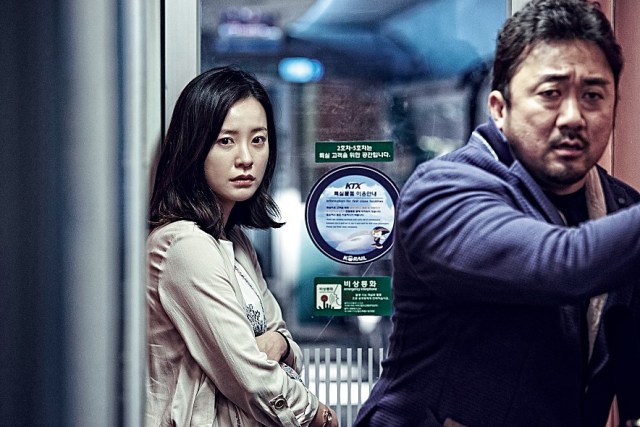
Not long after the train leaves the station, Seok-woo and other passengers slowly begin to sense that something weird is going on outside. They see TV news reports about numerous violent incidents which are happening in Seoul with no apparent reason, and the government continues to emphasize that there is nothing to be alarmed about, though this ongoing situation seems to be getting worse and worse with more rampages in the city.

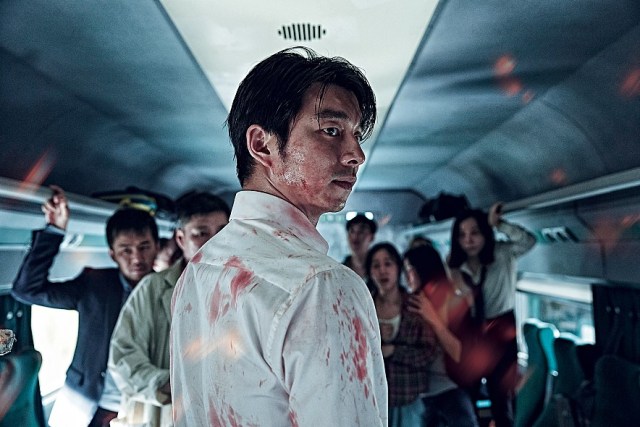
Of course, this is just the beginning of a zombie epidemic to sweep across most of the country, and the movie steadily increases its level of tension step by step until it reaches the expected breaking point in the end. Once one unfortunate passenger eventually goes into that fully violent and infectious mode, it does not take much time for most of other passengers to be transformed into a horde of raging zombies not so different from what we saw from “28 Days Later…” (2002), and Seok-woo must do anything to save himself and his daughter from this terrifying circumstance.

As the train keeps staying on its course to Busan, the movie presents several impressive sequences packed with dread, suspense, horror, and action. At one point, there is a frightening moment when surviving passengers belatedly realize an imminent danger waiting right in front of them, and then we get a suspenseful scene when Seok-woo and a few other characters must be very careful in their every small movement for evading zombies. While the zombies in the movie do not bring anything new to their genre, they do look scary and daunting in their murderous group behaviors, and they are effectively utilized to make us involved in what is at stake for our endangered living characters during their desperate action scenes.

traintobusan04

The characters in the movie are simple and broad to say the least, but I guess that comes with the territory, and you may recognize its various stereotype characters with amusement as its supporting cast members fill each own spot as required. We have a pregnant lady and her hulking husband; two old ladies who occasionally bicker with each other; a high school baseball team player and his pretty cheerleader girlfriend; a selfish businessman prick who spells out troubles right from his first appearance; a train conductor and a train engineer who are trying to deal with the situation way over their head; and a questionable stowaway who seems to be still frightened by whatever he saw before getting on the train. As Gong Yoo’s earnest performance holds the center even during the most frantic moments in the film, other notable South Korean performers including Ma Dong-seok, Jeong Yu-mi, and Kim Ee-seong are also effective in their supporting roles, and young actress Kim Soo-an handles well her rather sentimental scenes with Gong.

“Train to Busan” is the first live-action feature film by the director/wrtier Yeon Sang-ho, who previously directed two animation feature films “The King of Pigs” (2011) and “The Fake” (2013). Both of these moody and disturbing animation films were utterly uncomfortable but compelling works which trembled me a lot with its dark, brutal insights on the South Korean society, and I can tell you that a number of certain scenes in “Train to Busan” will probably resonate with South Korean audiences for good reasons. While watching those scenes, I could not help but think of the MERS virus outbreak which happened in South Korea during last summer – and how that outbreak was widely spread around the country mainly thanks to the stupendous incompetence and ignorance of our government as our society was thrown into the panic over that outbreak.

Although it unfortunately loses some of its narrative momentum during its last act coupled with arbitrary melodramatic moments, “Train to Busan” remains to be an entertaining genre piece with enough goodies to thrill and excite us, and Yeon makes a solid forward step into the mainstream as demonstrating his considerable filmmaking skills here. The movie made me frightened for what might happen for its characters, and I think I will be a little more watchful in the next time when I get on a train.

traintobusan01

Posted in Movies | Tagged , , , | 1 Comment

Good Kill (2014) ☆☆1/2(2.5/4): His unbearable lightness of following orders

goodkill01

“Good Kill” wants to be a thought-provoking drama about the disturbing sides of modern warfare technology of our time, but it only keeps spinning its wheels with no sense of direction. While there are a number of darkly absurd scenes which remind us of “Dr. Strangelove” (1964) and “Catch-22” (1970), the movie does not have any edge to push itself into ironic satire despite its interesting contrast of backgrounds. Although there are also several serious moments of uneasy moral questions, the movie does not have enough narrative pull to grab us, and we merely watch its burned-out hero going through his unbearable lightness of following orders.

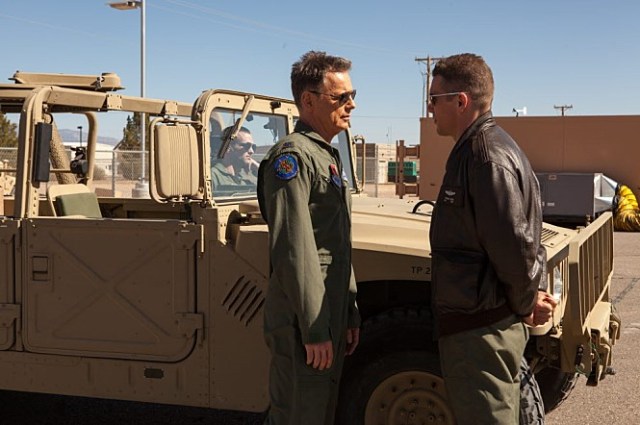
Ethan Hawke, who constantly looks numb or alienated in his most parched performance to date, plays Major Thomas Egan, who is doing his usual duty at an Air Force Base near Las Vegas during the opening sequence. Under the command of Lieutenant Colonel Jack Johns (Bruce Greenwood), Egan and his few colleagues are operating an armed MQ-9 Reaper drone flying above somewhere in Afghanistan, and we watch how their mission is done as they carefully monitor the situation for the precise elimination of their target. Once the target is in the right place, the missile launch is ordered by Johns, and the mission is accomplished just after a little more than 10 seconds.

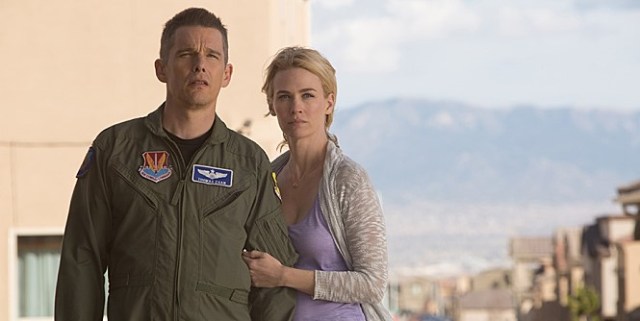
While his colleagues do not have much problem with working inside one of those high-tech trailers placed in the base, Egan has been frustrated because his military career seems to be reaching the dead end. He works in a more comfortable condition than before, and his wife Molly (January Jones) is content to have her husband near her and their kids in their suburban house, but this changed situation remains to feel alien to his detached state of mind. He misses when he could fly jet fighter, and he still hopes that he will be sent to the front line again someday.

goodkill02

But, as his boss bitterly tells him during their private conversation, nothing can stop the changes in their military world. Drones are replacing jet fighters day by day, and there are not many positions available to Egan nowadays. Most of new recruits in the base are selected because of their computer game skill rather than flying skill, and I can easily imagine their military job being outsourced if that can ever be possible. After all, all you need is knowing what buttons to push during your operation, isn’t it?

While the daily routine for Egan and his colleagues goes on and on, their drone operations become morally questionable especially after they are ordered to work with CIA. At one point, they bomb a building, and then they are ordered to bomb the site again even though it is possible that not everyone gathering around the site after the first bombing is a potential terrorist. Collateral damage becomes acceptable as their drone operations become more expanded and ruthless, and there is a disturbingly ironic moment when Egan and his colleagues spot a local woman being helplessly abused by some guy while their drone camera looks upon her village from the sky. They cannot ignore this terrible moment, but neither the woman nor the abuser is their target, so there is nothing they can do about that.

Despite such provocative moments like that, the director Andrew Niccol’s screenplay is seldom energized as droning on with its military characters’ repetitive operations. Hawke, who previously collaborated with Niccol in “Gattaca” (1997) and “Lord of War” (2005), is believable in his understated presentation of suffocation and frustration, but there is not much depth in his agonizing character who seems to have been drained of his spirit for years, and it is difficult for us to care about him as the movie keeps the clinical distance between its aloof hero and us.

goodkill03

In case of Egan’s relationship with his wife, its depiction is sketchy at best except keeping reminding us of how much they are estranged from each other, and January Jones, who is still trying to find her next solid career step after TV series “Mad Men”, is wasted in her thankless role. At least, she and Hawke have a good scene together when Egan tries to open himself more to his wife, and this calm but unnerving scene shows us how much their performances could be enhanced if they were served by a better screenplay.

Like Hawke and Jones, the other actors in the film try their best with their underdeveloped characters. Zoë Kravitz is a female soldier who gradually becomes conflicted about her missions just like her senior, and Bruce Greenwood has a couple of nice scenes where his character shows his practical balance between cynicism and common sense as the leader of his unit. He does not like what is going on around him, but he follows orders anyway as a dutiful soldier, while often reminding his soldiers of the human cost of what they do everyday.

As shown from his debut work “Gattaca” and many of his following works, Niccol has steadily shown his interest on the relationship between technology and humanity. While “Gattaca” has been more relevant as biotechnology keeps rapidly advancing, his screenplay for “The Truman Show” (1998) predicted the rise of reality TV shows in advance, and “Lord of War” pungently points out that virulent global cycle between human war and arms dealing. “Good Kill” is not as memorable as these smart works, but its few good moments may make you reflect on the brave new war emerging in our time.

goodkill04

Posted in Movies | Tagged , , , | Leave a comment

Finding Dory (2016) ☆☆☆(3/4): Another marine family adventure

findingdory01

As the screening of “Finding Dory” began during last evening, I could not help but become nostalgic about the time when I watched its predecessor “Finding Nemo” (2003), one of the best animation feature films from Pixar Animation Studios. Although I have never revisited it yet to my regret, I still remember many of its dazzling and beautiful visual moments, and I still feel affection toward its various marine characters including that little clownfish named Nemo and his caring and protective father Marlin.

While mostly sticking to familiar storytelling formulas and themes already established in the previous film, “Finding Dory” is still a well-made animation feature film which mixes old and new things well for our entertainment. We are delighted to meet our endearing fish characters again, and then we are also amused to encounter new colorful characters. Although the movie may be predictable to the core, the people behind it do know how to engage the audiences through good story and characters, and the overall result is better than most of other animation feature films out there at least.

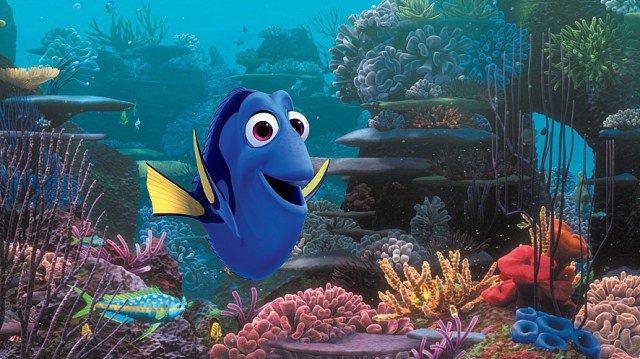
As depicted in “Finding Nemo”, Marlin (voiced by Albert Brooks) and a regal blue tang named Dory (voiced by Ellen DeGeneres) became close friends during their adventurous quest for finding Nemo (voiced by Hayden Rolence, who filled the role instead of Alexander Gould in the previous film), and they have so far lived together well along with Nemo for a while although Dory is still suffering from her short-term memory loss problem. She still does not remember who she is or where she came from, and Marlin is concerned about his friend because she can easily lose her way around their cozy Pacific coral neighborhood at any moment.

findingdory04

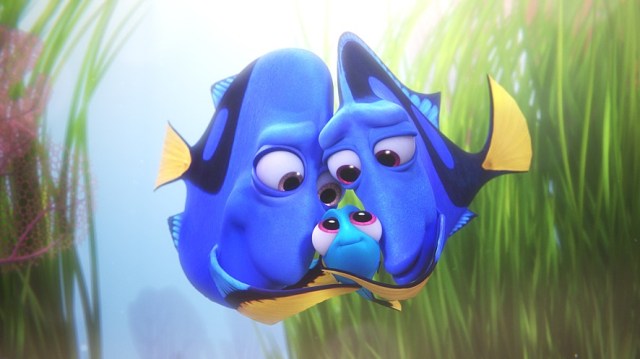
On one day, Dory happens to regain some of her old forgotten memories by coincidence. When she was very young and tiny, she lived somewhere around Morro Bay in California, and she also had her parents, Jenny (voiced by Diane Keaton) and Charlie (voiced by Eugene Levy). Young Dory (voiced by Sloane Murray) was suffering from that memory problem even during that time, and her parents did their best for helping their daughter cope with her disability, but she accidentally got herself drifted far away from her home and parents – and that was the beginning of her long, forgetful wandering before her eventual encounter with Marlin.

Accompanied with Marlin and Nemo, Dory rides that swift, dizzy ocean current previously shown in “Finding Nemo”, and they soon arrive at their destination, the Marine Life Institute in Morro Bay. Not long after their arrival, Dory gets herself separated from Marlin and Nemo as being caught and then taken to the institute, but she keeps looking for her parents, while Marlin and Nemo are trying to find any possible way of getting inside the institute and rescuing her.

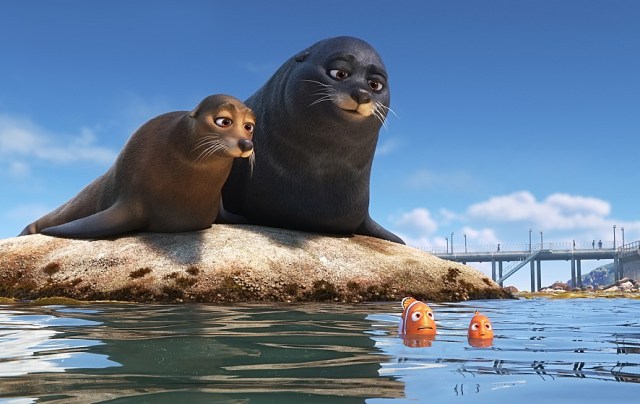
As the story alternates between these two separated narrative lines, a number of amusing supporting characters pop up here and there around them. Marlin and Nemo come across two lazy sea lions named Fluke and Rudder, and Idris Elba and Dominic West, who were once in antagonizing positions in the HBO TV series “The Wire”, have a couple of jolly moments as brandishing Cockney accents for their characters, who are amiable but quite fastidious about their small rocky spot. As Dory remembers more of her past, she meets her old childhood friend Destiny (voiced by Kaitlin Olson), a near-sighted whale shark who is living next to Bailey (voiced by Ty Burrell), a beluga whale suffering from his temporal loss of echolocation.

findingdory03

The most memorable new character in the film is Hank (voiced by Ed O’Neill), a grumpy East Pacific red octopus with seven tentacles. He desperately wants to be sent away to an aquarium in Cleveland, and he becomes Dory’s reluctant partner when she presents him a possible chance to fulfill his longtime wish. As shown from his first appearance, Hank is very adept at hiding and evading humans, and he gives us several inspired moments as fluidly and dexterously changing the shape and color of his body for camouflage. Channeling the gruffness of Walter Matthau, O’Neill is a fabulous comic foil for Ellen DeGeneres’ plucky voice performance, and they are particularly good when their characters must depend on each other during one exciting vehicle action sequence.

Under the skillful direction of the director/co-screenplay writer Andrew Stanton, who won Oscars for “Finding Nemo” and “Wall-E” (2008), the animation quality of “Finding Dory” is as excellent as we can expect from the latest Pixar animation movie, and I had a fairly good time while enjoying its bright colors and tangible textures, but I also noticed its repeated aspects. While it is not without poignancy, the drama involved with Dory’s parents is a mere variation of what touched us in “Finding Nemo”, and the movie looks and feels a little too familiar at times while being one or two steps down from the awe and wonder of the previous film.

As I am writing this review, my mind goes back to one of haunting memories from my New York City trip during early 2004. As I and my brother were on an early morning subway train as spending the last day of our trip, I noticed two Metropolitan Transportation Authority employees, and one of them, who was apparently a family guy, told his colleague about how much he enjoyed watching “Finding Nemo” with his kid, and they both agreed that it was a pretty good animation movie. I think they probably enjoyed “Finding Dory” too.

Sidenote: Short animation film “Piper” is shown before the feature presentation. It is about a hungry baby sandpiper who must overcome its fear of water.

findingdory02

Posted in Movies | Tagged , , | 1 Comment

The Nice Guys (2016) ☆☆☆(3/4): Two ‘nice’ buddies in LA

niceguys01

Surprise is always a key factor in comedy, and “The Nice Guys” has enough surprises to bring out good chuckles from me. While it has several weak points which bothered me even during my viewing, it is witty and cheerful on the whole as gleefully gliding along its tongue-in-cheek plot with two mismatched characters who come to find that, like their numerous seniors in countless buddy films, they can work with each other pretty well despite their many contrasting differences.

It is 1977 in LA, and private investigator Holland March (Ryan Gosling) has been searching for a girl named Amelia Kutner (Margaret Qualley) because of his latest case. The girl was close to a famous porn actress named Misty Mountains (Murielle Telio), and March was asked to find Misty Mountains by her old aunt Mrs. Glenn (Lois Smith), who claimed to have witnessed her niece a few days after her unfortunate death. Although he is understandably skeptical about Mrs. Glenn’s claim, March does not mind taking this seemingly nonsense case because he is accustomed to exploiting those forgetful elderly people who have been the main source of his income during recent years.

But, as we have seen from other private detective movies in LA, the case turns out to be not so simple at all. Not long after he sets himself on the search for Amelia, March is visited by an enforcer named Jackson Healy (Russell Crowe), who is hired by Amelia to take care of whoever is following after her. Their first encounter is not very pleasant to say the least, and Healy surely gives March a brutal warning he will not forget.

niceguys03

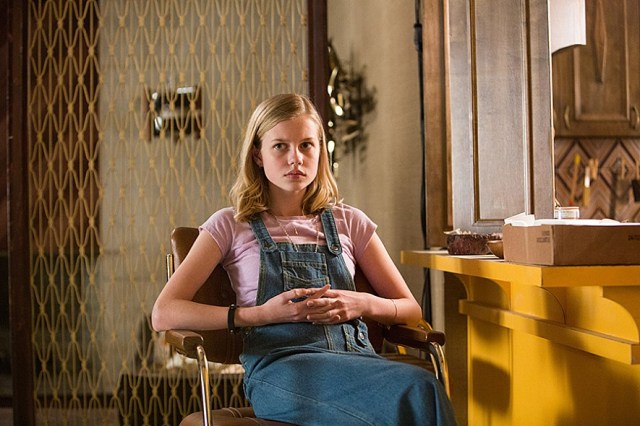
March subsequently steps away from the case, but then he finds himself hired by Healy to dig more into the case. As it turns out that there are some other people looking for Amelia, Healy senses something fishy from the situation revolving about his currently missing client, so he requests March’s service although March is not exactly the best private investigator in the town. March is reluctant, but, thanks to his perky, precocious adolescent daughter Holly (Angourie Rice), he eventually makes a deal with Healy, who soon becomes March’s de facto partner as March resumes his investigation.

Of course, our two heroes come to face riskier circumstances as they manage to get closer to whatever is hidden behind Amelia’s disappearance, and the plot naturally becomes busier than before. There is a mysterious ‘experimental’ movie which is possibly more scandalous than, say, “Deep Throat” (1972), and it looks like this can seriously affect a certain ongoing public court case. There is also a lethal contract killer who will not stop at nothing for getting his job done, and we get a darkly funny scene when Healy and March happen to come upon the latest work of their dangerous opponent.

While serving us a number of tough action sequences as expected, the movie has a lot of fun with its period background as March and Healy bounce here and there around the town. The cinematographer Philippe Rousselot did a commendable job of evoking authentic period atmosphere coupled with the slick chiaroscuro of neo-noir films, and this distinctive ambience is further accentuated by the spunky score by David Buckley and John Ottman.

niceguys02

The director Shane Black, who wrote the screenplay with Anthony Bagarozz, keeps maintaining the level of wit and humor through offbeat touches to savor. At one point, March and Healy meet Amelia’s environment activist friends who are doing their silent protest in front of the city hall, and we cannot help but be amused as watching March and Healy trying to extract any valuable information from these adamantly still and silent protesters. I also like the opening sequence which somehow works as balancing itself well between comedy and tragedy, and there is even a surreal moment involved with a giant talking killer bee (I am not kidding).

Like any buddy movies, the movie depends heavily on what is exchanged between its two lead actors, and Russell Crowe and Ryan Gosling bring an ample amount of comic chemistry onto the screen. While he can be very intense in “The Believer” (2001) “Drive” (2011), Gosling can be genuinely funny as shown from “Crazy, Stupid, Love” (2011) and “The Big Short” (2015), and he gives another engaging comic performance here as smoothly embodying the messy and ineffectual aspects of his seedy but ultimately likable character. Pulling out an expected funny side from his usual tough guy image, Crowe has a ball with what may be his best performance since “American Gangster” (2007), and you will be delighted by many of his droll moments with Gosling. Among the supporting cast members surrounding Crowe and Gosling, young actress Angourie Rice steals the show as a smart girl willing to help her careless father and his rough partner, and Kim Besinger, who once appeared along with Crowe in “LA Confidential” (1997), plays one of the crucial supporting characters during the second half of the film.

“The Nice Guys” is not entirely successful in what it intends to do, and I do not like its superficial treatment of female characters besides Holly as well as its rather incoherent attitude to violence. Like Black’s previous film “Kiss Kiss Bang Bang” (2005), the movie is too self-indulgent and self-conscious at times, and I think its second half could be improved considerably by tighter storytelling and more judicious editing. Fortunately, its good things including Gosling, Crowe, and Rice compensate for its visible flaws, so I guess I can be a bit more generous than usual to this entertaining yarn.

niceguys04

Posted in Movies | Tagged , , , | Leave a comment

Francofonia (2015) ☆☆☆(3/4): A floating visual meditation on the Louvre

francofonina04

“Francofonia” is a floating visual meditation on one of the famous museums in Europe. Alternatively baffling and fascinating, it freely looks around not only the museum and its historical background but also many other things to be mused on by its director, and I sort of enjoyed the movie while often being frustrated with its scattershot stream of consciousness.

The early part of the film consists of fragmented thoughts from its director/writer Alexander Sokurov, who previously made “Russian Ark” (2002) and “Faust” (2011). Because I disliked the latter when I watched it around late 2012, I was rather reluctant to watch the former even though I bought its Blu-ray copy several years ago, but I found myself being quickly enthralled by Sokurov’s daring and exciting filmmaking experiment at the Russian State Hermitage Museum in St. Petersburg when I finally saw “Russian Ark” during last Saturday night, and I must admit that I had some expectation when I came into the screening room for watching “Francofonia” during last Sunday afternoon.

At his office somewhere in Paris, Sokurov’s mind randomly ruminates on a number of things while he is barely communicating with the captain of a freight ship which is struggling through a mighty sea storm somewhere in the middle of ocean. While the purpose of their satellite communication is vague to say the least, it looks like there are some important museum artworks among many other cargos in the ship, and there is nothing Sokurov can do about this desperate situation except helplessly watching the precarious state of the ship.

He soon comes to reflect on his movie project on the Louvre Museum in Paris, and the movie floats along his flow of thoughts associated with this invaluable historical site. While it is one of the monumental architectures in the French history, the Louvre has also been well-known for its vast and various collections of artworks, and we occasionally behold its grand architectural designs while also looking closely at some of its prominent sculptures and paintings including, yes, that famous painting by Leonardo da Vinci.

francofonina02

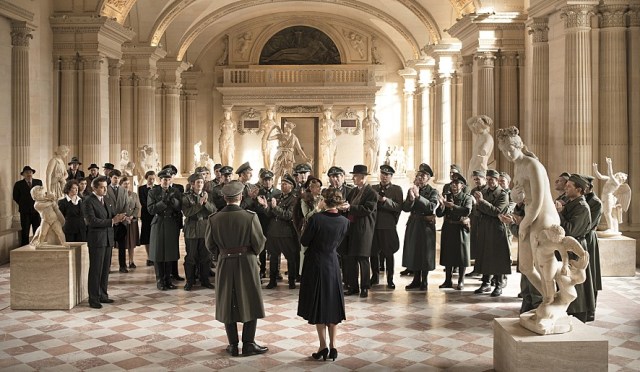
Like the Russian State Hermitage Museum, the Louvre can be regarded as a big ark of the human art history, and we hear about one particular dangerous time in its long history, which becomes a sort of main narrative in the movie. Before Nazi Germany invaded France during the World War II, heaps of artworks were sent away from the museum in advance for safety, but they were still in danger of being looted or destroyed as Nazi Germany occupied the half of France and the rest of the country was under the rule of the puppet government headed by Marshal Philippe Pétain.
Shortly after the German Army entered Paris, Jacques Jaujard, who was the curator of the Louvre during that time, met Franz Wolff-Metternich, a German officer who was tasked with ‘protecting’ the artworks in not only the Louvre but also other major museums of France. Besides their opposing positions, Sokurov tells us how different these two men were from each other. While they both fought as soldiers during the World War I, Jaujard was from a plain middle-class family while Wolff-Metternich grew up in a respectable aristocratic household, and they would probably have never met each other if it had not been for another war between their countries.

Probably because of their common love of art, Jaujard and Wolff-Metternich secretly worked together to protect the priceless artworks of the Louvre. While Jaujard cooperated with Wolff-Metternich on the surface, Wolff-Metternich deliberately inhibited his looting operation although he knew well about the whereabouts of those hidden artworks. In addition, he also gave some extra help to Jaujard from time to time, and he was later vindicated by Jaujard after the war was over.

francofonina01

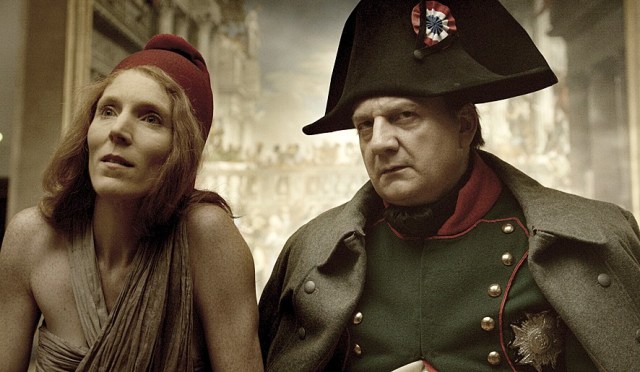
Shuffling between archival footage clips and fictional scenes as accompanied with Sokurov’s reflective words, the movie gives us a dense visual experience decorated with interesting elements. The scenes between Jaujard and Wolff-Metternich are presented in 1.33:1 ratio with the texture of old film stock, and we constantly notice the audio signals on the left side of the screen. We sometimes see a French woman wandering around the hallways of the Louvre and repeatedly murmuring “Liberty, Equality, and Fraternity”, and we also meet Napoléon Bonaparte, who pompously moves around in the museum as reminding us that some artworks in the Louvre were actually loots from the beginning. In a number of notable scenes, Sokurov puts his characters in our contemporary background, and this intentional discrepancy looks amusing especially when Jaujard and Wolff-Metternich have a serious conversation amid a bunch of the 21th century Parisian children.
However, I am not so sure about whether I understand enough what is shown in “Francofonia”, though this curious arthouse film stimulated and engaged me with ideas. While there are several wonderful individual moments to admire, the movie seems to keep searching for something to anchor everything unfolded on the screen, and I am afraid that its cacophonic finale may make you scratch your head in the end.

Compared to the magnificent technical achievement in “Russian Ark”, “Francofonia” is a minor work, but it is more engaging than “Faust” at least, so I recommend it although I only got the small glimpses of the Louvre on the whole. That was disappointing indeed, but, what the heck, I may go there for myself someday.

francofonina03


Posted in Movies | Tagged , , | Leave a comment

Mountain Cry (2015) ☆☆☆1/2(3.5/4): Amongst mountains

mountaincry06

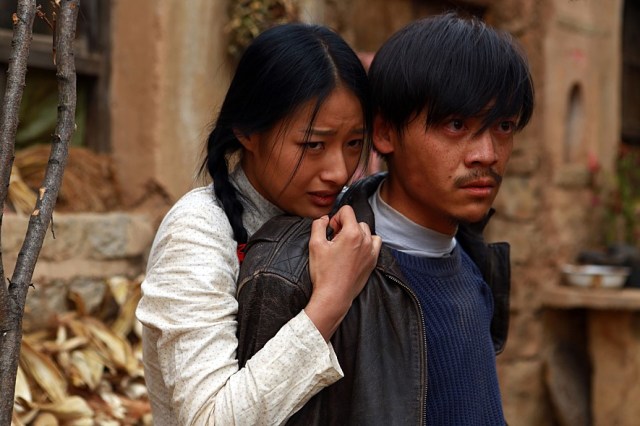
Immersing itself deep into its isolated rural background, Chinese film “Mountain Cry” looks at one human relationship between two different people. While its story is essentially a typical melodrama about love and redemption, the movie takes its time as patiently observing the development of their initially tentative relationship, and it is touching to see how they come to find their better sides in front of an impossible circumstance which must be resolved in one way or other.

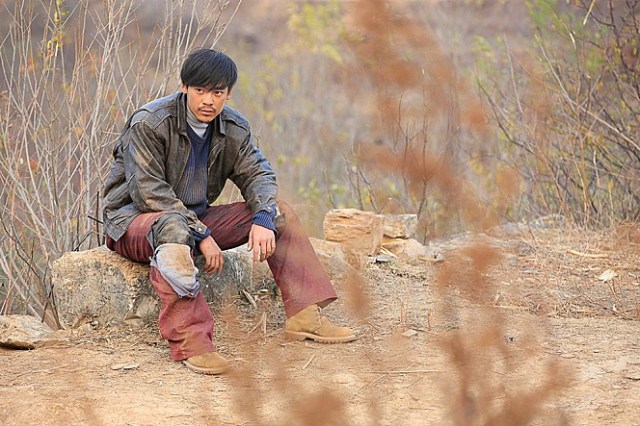
It is 1984, and things look quiet and uneventful in Anshanping village as the movie looks around the village and some of its residents. Surrounded by peaks, ravines, and terraced farmlands in the Taihang Mountains area, this tiny village is located high on rocky ravines as being insulated from the outside world, and villagers know each other pretty well as living together there for many years. For example, everyone in the village knows that Han Chong (Wang Ziyi), one of a few young men in the village, has been infatuated with a sassy widow named Qin Hua (Guo Jin), and Han Chong and Qin Hua make no secret about that. During the opening sequence, they have a brief ‘private’ talk across a ravine between them, and anyone in the village can hear their exchanged words being spread in the air.

Eager to please Qin Hua, Han Chong tries another attempt to catch a badger, but this leads to an unexpected accident. La Hong (Yu Ailei), a guy who came from outside to settle in the village with his family around six months ago, happens to be seriously wounded by Han Chong’s trap, and he eventually dies not long after he is hurriedly taken to his residence. Because the village chief is currently absent due to his health problem, the other town elder and villagers have to make the decision on how to take care of this serious incident, and they decide that they should cover up the incident rather than reporting it to authorities outside, mainly because they do not want any scandal to tarnish the reputation of their village.

mountaincry03

In case of La Hong’s family, it is decided that they should get a considerable amount of compensation to be paid by Han Chong’s father (Cheng Taishen), but La Hong’s young mute wife Hong Xia (Lang Yueting) seems to have a different idea. Although she cannot speak, she can write instead, and she demands that Han Chong should support her and her two young kids until he finds any possible way to compensate for her husband’s death.

Han Chong is understandably reluctant about this, but he follows this specific demand of hers anyway, and, what do you know, it does not take much time for him to like this elusive but pretty woman who slowly shows her silent affection toward him. As he spends more time with her and her kids, Han Chong and Hong Xia begin to see their possible future, and it looks like all they need is the clear confirmation of the mutual feeling growing between them day by day.

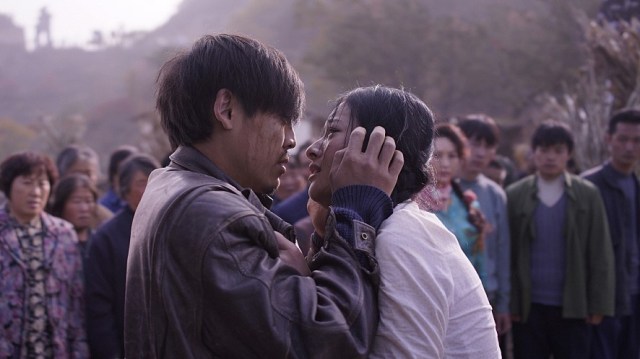
However, there is something Hong Xia does not reveal to Han Chong, and the movie gradually presents her secret bit by bit. As shown during the opening sequence, La Hong was not a good father and husband at all, and there is a dark, disturbing flashback scene which reveals the true nature of Hong Xia’s relationship with her husband. As it later turns out that her presence can lead to another problem for the village, Hong Xia becomes an unwelcomed figure under this changed circumstance, and we soon see how ordinary people can be selfish, unfair, and heartless to outsider in the name of common good.

The movie goes into bold melodramatic mode around this point as expected, but it remains grounded in vivid details and believable characters, and the director Larry Yang, who adapted Ge Shuiping’s novel of the same name for his movie, and his crew did a splendid job of bringing the palpable sense of period and location into the screen. While they mainly shot the film at three different rural locations in Shanxi, the locations are seamlessly put together to create one fictional village on the screen, and the cinematographer Patrick Murguia wonderfully captures those gorgeous mountainous landscapes on his camera. Thanks to the production design by Jeffrey Kong, the shabby environment of the characters in the film is filled with realistic details of their mundane daily life, and Han Chong’s daily mill work is particularly interesting to watch for its old-fashioned aspects.

mountaincry04

It also helps that the movie is supported by two excellent lead performances. While Wang Ziyi is likable as a young man who comes to find himself rising to the occasion through love and accompanying personal growth, Lang Yueting is simply superb in her wordless performance. Evocative of those mesmerizing silent movie actresses, her beautiful expressive face subtly conveys to us whatever is felt and thought behind her character’s mute façade, and there is a lovely scene when her character freely expresses her joy and happiness in her own way on the top of a nearby peak.

While the supporting characters in the film are more or less than your average stereotypes, they are depicted with life and personality thanks to the good supporting cast. While being stern and distant to his son, Han Chong’s father is not so proud about his seedy past, and Cheng Taishen has a poignant moment when his character decides to do what should be done for his son. Yu Ailei is effective in his increasingly loathsome role, Guo Jin is also convincing when her character causes a serious trouble as driven by jealousy, and the special mention goes to Han Chong’s cute little kitten, which always attracted my attention every time it appeared.

Although it is a bit slow in the beginning, “Mountain Cry”, which should not be confused with Jia Zhangke’s “Mountains May Depart” (2015), is quite rewarding to watch how it surprises and touches us with its earnest human drama. There will be tears in the end, and the movie properly earns them through the characters we come to care about more than before. They may be flawed, but they are good people, and we are moved by their choices – as being saddened by the inevitability they all have to accept.

mountaincry05

Posted in Movies | Tagged , | 1 Comment

Freeheld (2015) ☆☆(2/4): A mediocre drama based on one real-life love story

freeheld01

If “Freeheld” had been made around 20 years ago, it would have looked a bit better and bolder as a movie willing to tell a story about sexual minority people and their equal rights. While its story is based one of the most poignant real-life love stories I have ever heard about, the movie does not have much to tell besides what I know, and, to my disappointment, it falters and slouches as failing to bring human dimensions to its story and characters.

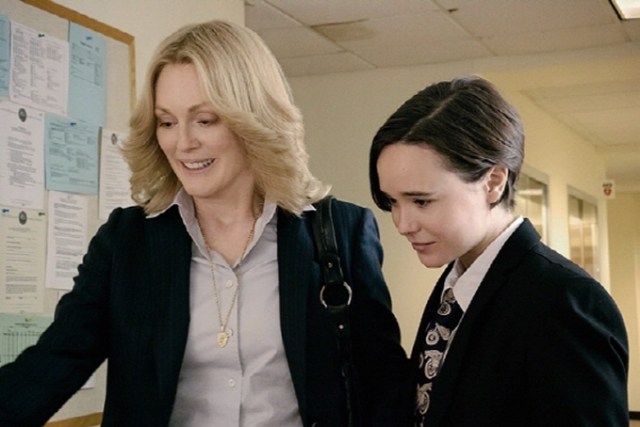
When Laurel Hester (Julianne Moore) and Stacie Andree (Ellen Page) happened to encounter each other for the first time in 2002, it was love at first sight for both of them. Shortly after a volleyball game in which they participate with other ladies, Laurel approaches to Stacie, and something clicks between them as they talk with each other for a while. They soon have their private evening date at a local bar for gays and lesbians, and, despite many differences between them including age and background, they eventually move together to their new home.

But Laurel keeps hiding this serious romantic relationship from her colleagues in the police department of Ocean County, New Jersey. As a female detective, she knows well that she has to stay in line without causing any trouble to jeopardize her career, and she even does not tell about her sexuality to her partner Dane Wells (Michael Shannon), a taciturn guy she can always depend on whenever they are doing their duty outside.

In case of Stacie, she has no problem in getting a new job around their home. While the movie does not delve into whether she is open about her homosexuality at her new workplace, all her tough guy boss cares about is how good she is as an experienced car mechanic, and she surely impresses him when she swiftly exchanges a wheel within a few minutes.

freeheld04

Anyway, Stacie understands Laurel’s situation, and they have been happy together for several years as life partners, but then there comes a bad news for them. When her body does not feel that right on one day, Laurel goes to the hospital, and the medical examination result turns out to be worse than she thought. She has a cancer, and it has already progressed to the terminal stage. Even under the best circumstance, she does not have much time to live, and that little remaining time will definitely be hard for her as well as Stacie.

While they are not technically a married couple and same-sex marriage has not been legalized yet in their state, Laurel wants Stacie to receive her pension after her death because she believes Stacie deserves that right. They are still paying off their mortgage as well as Laurel’s medical treatment bills, and Stacie will really need Laurel’s pension if she continues to live in their house as Laurel wishes.

Laurel writes a petition letter to the county legislators who are commonly called ‘freeholders’, but they immediately reject her requests, and that is the beginning of Laurel and Stacie’s public protest, which was the subject of Oscar-winning short documentary film “Freeheld” (2007). I watched that short documentary film in late 2008 when it was shown on TV as a part of the EBS International Documentary Festival, and I remember well how much I felt angry about those small-minded conservative legislators who disregarded a dying woman’s wish as hiding behind their petty excuses. To be frank with you, their impertinent hypocritical attitude reminds me of those despicable US senators who said how sorry and condolent they were about the Orlando shooting incident and then blocked a gun control bill in the very next week.

freeheld03

One of several touching things in that short documentary film was how others around Laurel and Stacie stood by them, and that is also depicted in the movie. While he is initially not so pleased to learn that Laurel has been hiding her personal relationship from him for years, Dane becomes her No.1 defender at the police department, and he also encourages her to make a direct petition right in front of the freeholders during the public meeting. Her public petition accordingly draws lots of media attention, and Laurel and Stacie are fortunately supported not only by activists including Steven Goldstein (Steve Carell) but also their neighbors.

This indeed has considerable potentials for genuine human drama, but Ron Nyswaner’s screenplay is stuffed with many unnecessary things including a drug crime case investigated by Laurel and Dane, and it is also disappointing to see its talented performers being stuck with bland characterization. Julianne Moore and Ellen Page try their best even when the movie trudges along its lackluster narrative, but I am only reminded of how they were a lot better in other films. As watching her character’s health being deteriorated in the movie, I could not help but think about how wonderful Moore was as the terminally ill heroine of “Still Alice” (2014), which garnered an Oscar for her in last year. Since her charming Oscar-nominated turn in “Juno” (2007), Page has always been an interesting actress to watch, but she does not have much to do here just like her co-star. While Michael Shannon draws our attention with his mere presence as usual, Steve Carell is awfully wasted in his thankless role, and I must say that I was surprised to learn that his seemingly caricature character has a real-life counterpart.

Under the director Peter Sollett’s flat direction devoid of any human personality or intimacy, “Freeheld” feels like a mediocre TV movie, and this deficiency looks all the more glaring compared to “Carol” (2015) and other recent better drama films about sexual minority characters. In fact, the 2007 short documentary film is packed with far more power and authenticity, and I am willing to watch it again now – and I think you should watch it instead of this disappointing dramatized version if you can.

freeheld02

Posted in Movies | Tagged , , , , | Leave a comment

The Truth Beneath (2016) ☆☆☆(3/4): Gone daughter

thetruthbeneath01

I expected one thing before watching South Korean film “The Truth Beneath”, but the movie served me the other thing I did not expect at all. When it takes its first steps with a familiar thriller premise, you may think you know where it is going, but then it keeps throwing totally unexpected elements into its mixed bag as baffling or surprising you. While the movie is a little too chaotic and confusing at times, I enjoyed a wry sense of humor hovering over its increasingly unhinged mystery plot, and I also liked how it goes all the way for delivering all those offbeat moments to be loved or hated by its audiences.

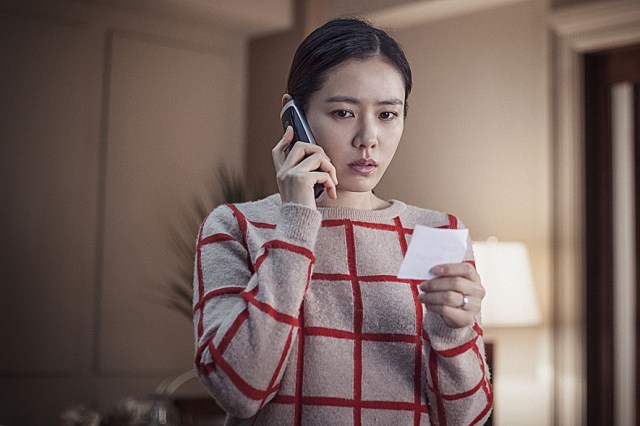
When we meet Yeon-hong (Son Ye-jin) and her family in the beginning, they look like a model family anyone would envy. Thanks to her successful husband Jong-chan (Kim Joo-hyeok), she and her adolescent daughter Min-jin (Shin Jee-hoon) live in a big luxurious house located in a suburban area outside Jong-chan’s hometown city, and now Jong-chan is about to run in the upcoming parliament election. There are several other candidates, and one of them is not an easy opponent at all as a seasoned local politician with considerable influence, but Jong-chan believes he will win the election – and his wife is ready to support and stand by her husband to the end as one of his main campaigners.

As busily preparing for the first day of her husband’s election campaign with others, Yeon-hong has a brief conversation with her daughter. When Min-jin tells her mother that she will probably come home late tomorrow because of an appointment with her best friend, Yeon-hong does not particularly mind about that, though she does not know that much about her daughter’s friend except the name.

thetruthbeneath02

On the next day, Min-jin is gone missing. While Yeon-hong becomes quite nervous as fearing the worst situation, her husband is more occupied with how much their daughter’s missing will affect his election campaign once it is reported on the media, and that certainly puts a rift between him and Yeon-hong, who begins to have serious doubts on their relationship as discerning more of her husband’s imperfect aspects than before.

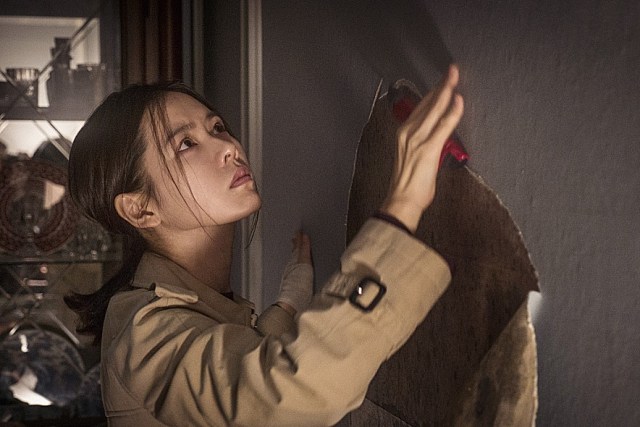
While the local police begin the investigation and her husband continues to focus on his election campaign, Yeon-hong decides to look for clues for herself, but she is soon flabbergasted by how little she knows her daughter in fact. For example, Min-jin’s aforementioned friend turns out to be a false one, and Yeon-hong also comes to hear about how lonely and unhappy Min-jin was in her school life as being ostracized by other girls.

And a number of questions start to emerge along with several suspicious characters who may be hiding something from Yeon-hong. Why does Mi-ok (Kim So-hee), a girl who is Min-jin’s actual best friend and is also the last person who saw Min-jin on that day, keep trying to unlock a certain smartphone currently in her possession? Does the art teacher in their school know more than what she initially confides to Yeon-hong? Is it possible that Jong-chan’s political opponent is involved with the missing incident, which is seriously damaging Jong-chan’s chance to win at present? And who sent Min-jin mysterious e-mails which can explain a lot about her recent test scores?

thetruthbeneath03

As we keep guessing on these questions, the movie constantly shifts its narrative course among different moods, and the director Lee Gyeong-mi, who previously made a remarkable debut with her hilariously wild, outrageous black comedy movie “Crush and Blush” (2008), does not hesitate to strike us with many weirdly disjointed moments as her tenacious heroine bumps around here and there with more truths to be revealed in front of her. Although it feels uttermost tense and serious on the surface, the movie slips into oddly humorous mode from time to time, and the soundtrack often brandishes its sly tongue-in-cheek attitude. This ironic offbeat approach eventually culminates to its highpoint during the second half of the movie, and there are even surprisingly tender, sensitive flashback scenes which caught me off guard during my viewing.

In contrast to this dizzy mix of clashing moods, the performers in the movie keep their performances as straight as possible, and that is exactly what is necessary for the movie to work. Son Ye-jin, who has been somehow wasted in several forgettable movies despite her undeniable screen presence, finally gets a real plum role to shine her acting ability, and her strong performance is captivating and believable as Yeon-hong goes through a series of dynamic changes resulted from her dogged pursuit of truth. In case of the supporting performers revolving around Son, Kim Joo-hyeok is effective as Yeon-hong’s selfish, ambitious husband, and Shin Jee-hoon gives a haunting performance to linger around the movie while Kim So-hee is also fine as a girl who turns out to be more connected with her friend than we thought.

I must admit that it took some time for me to hold onto its story and characters due to its occasionally uneven storytelling, but “The Truth Beneath” tries different things with its genre conventions, and the overall result has more style and personality than those run-of-the-mill thriller movies. As I pointed out at the beginning of this review, you may not be an ideal audience of the movie, but you will not be disappointed if you are ready for something different.

thetruthbeneath04

Posted in Movies | Tagged , , , , | 2 Comments

Suffragette (2015) ☆☆1/2(2.5/4): Well-intentioned but passable

suffragette01

Looking into one important feminist movement during the early 20th century, “Suffragette” tries to show and tell us a story of brave women who fought hard for social equality for them and many other women in their conservative society. Considering its historical subject which remains relevant even at present, the movie may deserve some attention, but it is unfortunately hampered by weak storytelling and thin characterization, and we merely observe the history facts reflected in the film rather than being involved in the story itself.

Through its ordinary fictional heroine who comes across an accidental chance of social enlightenment, the movie looks into the middle of the British suffragette movement during 1912. Maud Watts (Carey Mulligan) is a young married woman who has worked in a laundry factory for many years since she was a child, and we see the grueling working environment she and other female employees have to endure everyday. Besides frequently exposed to occupational hazards, they are paid far less than male employees including Maud’s husband Sonny (Ben Whishaw) even though they work as hard as men, but they cannot complain about this unfair discrimination mainly because of their poor social status as well as the prevalent social prejudice on women during their period. As reflected by an arrogant male statement during the opening sequence, women in Britain during that time were denied of many basic social rights just because they were believed to be inferior to men, and they did not even have the right to vote, which was the main aim of the British Suffragette movement.

When she is doing an extra delivery job on one day, Maud encounters the latest commotion by a group of suffragettes including her co-worker Violet Miller (Anne-Marie Duff). she does not want to get involved with them at first, but, as becoming more conscious of how much she and other female employees are mistreated by their mean, inconsiderate male boss, she comes to spend more time with Violet and other suffragettes including Edith Ellyn (Helena Bonham Carter) and Alice Haughton (Romola Garai), and she even finds herself in the middle of an important public moment when she must rise to the occasion as the last-minute representative of her factory female workers.

suffragette04

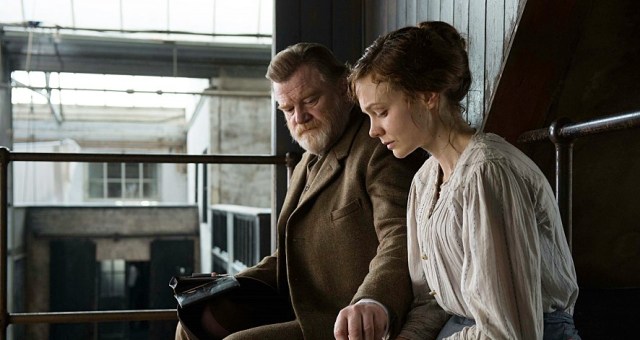
Of course, this gradual change of hers is not welcomed much by Sonny and her neighbors, and her relationship with Sonny naturally becomes strained as she gets more involved in the suffragette movement. Furthermore, she is soon included on the watchlist of Detective Steed (Brendan Gleeson), who has been constantly monitoring the suffragettes operating in London and patiently searching for Emmeline Pankhurst (Meryl Streep), a real-life activist and leader of the British Suffragette movement.

The movie works best when it focuses on the limits and prejudices its suffragette characters face during their hard fights. When it looks like new Prime Minster David Lloyd George (Adrian Schiller) is willing to listen to them, they get some hope and expectation from that, but they are rejected again in the end, and then they get brutally suppressed by the police when they begin to protest. As trying to deal with the personal cost resulted from her choices, Maud becomes more determined than before, and she does not hesitate at all when the suffragette movement enters a more radical mode.

Carey Mulligan is well-cast as a woman who comes to find her own inner strength as opening her eyes to the social injustice surrounding her and other many women, but the screenplay by Abi Morgan, who previously wrote the screenplay for “The Iron Lady” (2011), does not support well Mulligan’s good efforts. The movie is clumsy and artificial when it tries to depict its heroine’s eventual growth as an active suffragette, and her drama somehow seems to be at the fringe of a bigger and more interesting story out there although she is supposedly the center of the story. This flawed aspect is particularly evident during one sequence based on a tragic real-life incident which was a major turning point for the British suffragette movement, and the movie stumbles and fizzles even at that point with little dramatic effect.

suffragette03

The supporting performers in the film do not have many things to do, but they try their best as filling their mostly underdeveloped roles. While Anne-Marie Duff, who gave a fabulous supporting performance in “Nowhere Boy” (2009), brings weary determination to her character, Helena Bonham Carter is engaging as usual, and it is a shame that the movie does not delve that deep into Ellyn’s long relationship with her husband, a quiet decent man willing to support his wife’s cause. Romola Garai, who held her own place between Saoirse Ronan and Vanessa Redgrave in “Atonement” (2007), is sadly underutilized like Ben Whishaw, and the same thing can be said about Meryl Streep, who only appears for a few minutes during one scene.

The best supporting performance in the movie is from Brendan Gleeson, who presents his character as a compassionate and principled guy who simply does not approve of what suffragettes are doing in the name of their belief. Yes, those activists really destroyed mailboxes and cut off telephone lines for making their defiant voices heard more widely in public, and these deeds were indeed regarded as serious criminal acts by many people during that time. Gleeson has a good scene when his character sincerely tries to convince Maud to do a right thing in his view, and that scene is another nice example of what this dependable Irish actor can do with a colorless role given to him.

I cannot wholeheartedly recommend “Suffragette”, but maybe you should watch it just for enlightening yourself a bit on how much women fought for equal social rights many of us take for granted – and reminding yourself of how much women are still struggling with discrimination and oppression even at present. I do not deny good intentions behind the movie, but I just cannot help but wish that it were something more than a passable social history lesson.

suffragette02

Posted in Movies | Tagged , , | 1 Comment

The World of Us (2016) ☆☆☆1/2(3.5/4): A little bumpy relationship between two girls

theworldofus02

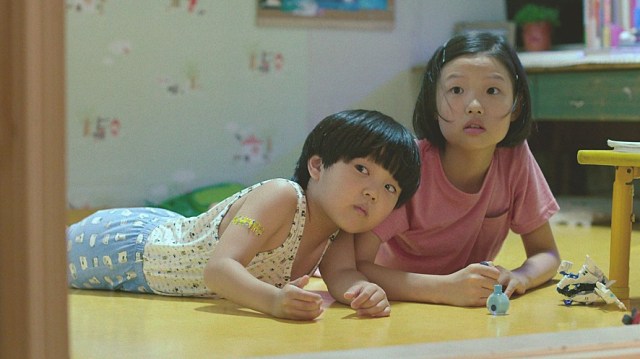
Human relationship is a fragile and tricky thing to handle for anyone, and South Korean film “The World of Us” shows that kids are no less clumsy than most of us in developing and maintaining relationship. Closely observing one little bumpy relationship dynamically being shifted here and there around the wide spectrum of various clashing emotions, this small but fabulous coming-of-age drama immerses us into its young heroine’s small world via its seemingly simple, unadorned approach, and we come to emphasize a lot with her emotional struggles with her accidental school friend. We are amused by how innocent they are, but then we also watch how vulnerable they are to human emotions they cannot control well, and the movie touches us with its many modest but intimate scenes which are thoughtfully presented with admirable sensitivity and subtlety.

Its young heroine is an 11-year-old girl named Seon (Choi Soo-in), who is not that popular at her elementary school as shown during the opening scene. Nobody particularly wants to play along with her when her classmates are about to play dodge ball together at the school playground, and we see her virtually getting pushed out of the game not long after they begin to play.

Nevertheless, Seon actively tries to get closer to Bo-ra (Lee Seon-yeon), a popular girl in the class who does not give a damn about Seon while being usually surrounded by her class entourage. When she makes a rather transparent attempt in front of Bo-ra and other classmates, Seon manages to get the invitation to Bo-ra’s upcoming birthday party, but then, not so surprisingly, there comes a painful moment of embarrassment and rejection.

theworldofus03

When Seon is about to leave the school on the last day before summer vacation, she comes across a student who has just been transferred to the school. Her name is Ji-ah (Seol Hye-in), and it turns out that she is assigned to Seon’s class, though it is already too late for her to introduce herself to her new teacher and classmates. After this brief encounter, Seon and Ji-ah quickly befriend each other mainly because both of them need someone to play and hang around with during their summer vacation, and Seon naturally feels happy and excited about this unexpected chance of friendship from a girl who looks much more active and confident than her.

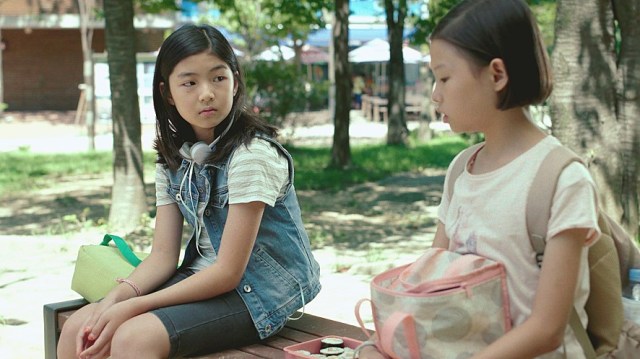
While they enjoy each other’s company during their long hot summer days, we cannot help but notice how much different they are from each other in many other ways. When Seon goes to a place where Ji-ah lives with her grandmother, Seon is impressed by how it looks far more affluent than Seon’s humble family home, but Ji-ah casually tells her friend that her grandmother’s place does not look that good compared to where she lived before her parents’ divorce. Although Seon’s family is not dreadfully poor, the movie implies a considerable economic gap between Seon and many of her classmates, and that aspect is subtly conveyed to us through her plain attire and appearance as well as her parents who are frequently busy with their respective jobs.

As the summer is being over, things become complicated for both Seon and Ji-ah. They become drifted apart from each other especially after Ji-ah comes to spend more time on her study as her grandmother demands, and then we sense more of the growing strain and distance between Seon and Ji-ah when the new semester begins at their school. As a new girl in the class, Ji-ah instantly draws everybody’s attention with her confidence and sophistication, and that accordingly makes her look like someone to socialize with for Bo-ra and her cronies. Ji-ah comes to hang around with them more and more, and this change surely hurts Seon, who finds herself reverting to her usual ostracized status in the class.

theworldofus05

And that is just the prelude for numerous emotional fluctuations to be felt and observed during the rest of the story, and the movie keeps itself close to Seon as aligning itself with her limited viewpoint. As the camera is usually placed around her eye level, we come to pay more attention to what she thinks and feels, and we also gather some minor details from adult characters at the fringe of the story while they are mostly glimpsed through Seon’s viewpoint. We can only guess why Seon’s drinker father still feels so angry about his ailing father who is currently spending his remaining days at a hospital, and the same thing can be said about how Ji-ah’s parents came to divorce, while it is apparent during a brief scene that Ji-ah is not very happy about her parents’ divorce as well as her father’s new relationship. Although I noticed that there are also boys in the class, they are not shown much on the screen, probably because, well, our girls still need to grow up more to be interested in boys.

Carefully building up the churning emotional momentum behind its leisurely narrative, the movie vividly and realistically depicts its young main characters’ undulating mutual interactions, and the director/writer Yoon Ga-eun, who previously received the Crystal Bear Award for her sublime short film “Sprout” (2013) at the Berlin Film Festival, did a superb job of drawing natural performances from her three talented young actresses. Choi Soo-in and Seol Hye-in are spontaneous and impeccable as their characters pull or push each other on the screen, and Lee Seo-yeon is also fine as a mean girl who later turns out to have her own issues to deal with. While the adult performers in the film take a backseat as required, Jang Hye-jin deserves some praises as Seon’s caring mother, and she has a good scene where her character patiently tries to know and understand what is troubling her dear daughter lately.

theworldofus04

The movie is also humorous at times, and its humor mostly comes from Seon’s little brother Yoon, played by adorable young actor Kang Min-joon with bouncy innocence to win your heart right from his first appearance. During a certain crucial scene, Yoon says something so simple and wise to his sister, and I cannot help but admire how this scene is effortlessly handled to resonate with the following scene. I am now reminded again of what my late friend Roger Ebert once said about that consistently excellent quality of child performances in movies: “Maybe we are all born as great actors, but after a certain age, most of us morph into bad ones.”

“The World of Us” is specific in its background and details, but its coming-of-age drama feels universal as honestly and sincerely presenting familiar emotional matters of young heart. Sure, kids may make many big mistakes as being angry and inconsiderate, but they usually learn from their mistakes as growing up day by day, and the last scene of the movie delicately makes a good point of that while functioning as an almost perfect ending for its story and characters. Kids can do better than us sometimes, you know.

theworldofus01

Posted in Movies | Tagged , , , | 2 Comments