April and the Extraordinary World (2015) ☆☆☆(3/4): Alternative steampunk world

aprilandtheextraordinaryworld03

French animation feature film “April and the Extraordinary World” gives us a literally extraordinary world to admire and appreciate. Although its story is not as bountiful as its visual pleasures on the screen, its imaginary world is interesting and delightful to observe for odd, distinctive style and imagination, and there are a number of fabulous moments I still vividly remember with lingering amusement and satisfaction.

At the beginning, we get the prologue sequence describing how its 20th century world came to diverge from our version because of one incident during the late 19th century. When the conflict between France and Germany was about to culminate to a war in 1870, French Emperor Napoleon III came to a secret laboratory whose recent project might give a considerable advantage to his army in the upcoming war, but then an unfortunate deadly accident happened during his clandestine visit, and this completely changed the course of history for not only Europe but also the whole world. The war known as the Franco-Prussian War in our world did not happen as Napoleon IV succeeded his deceased predecessor and then made a peace treaty with Germany, and that led to more stability of the monarchy in France as it kept expanding its influence around Europe.

While the human civilization entered the 20th century on this alternative timeline, the advance of science technology was somehow slowed down considerably as many of leading scientists around the world were vanished without any trace. As a result, the human civilization kept being stuck with steam engine instead of moving onto electricity and gasoline, and the world becomes quite dour in 1931 due to consequent environmental problems as well as continuing national conflicts.

aprilandtheextraordinaryworld04

In the meantime, Dr. Prosper Franklin (voiced by Jean Rochefort) has worked on a scientific experiment originated by his dead father, who was killed during that accident in 1870. With his son Paul (voiced by Olivier Gourmet) and Paul’s wife Annette (voiced by Macha Grenon), he is about to accomplish at last what he has hoped for many years, but then their secret laboratory is suddenly surrounded by Detective Pizoni (voiced by Bouli Lanners) and his men. While they manage to escape along with Paul’s young daughter April (voiced by Marion Cotillard), the Franklins soon become separated from each other, and April is left alone with her talking cat Darwin (voiced by Philippe Katerine) and a certain item which contains the final result of her grandfather’s experiment without her knowledge.

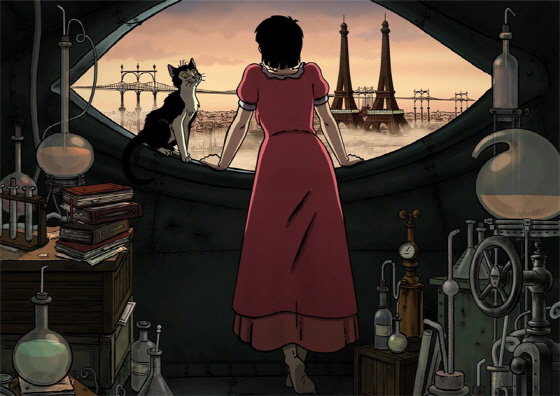
10 years later, April is now living with Darwin at her hidden place in Paris, and she has been trying to reproduce the experiment result by herself although there is still a lot she has to learn as an amateur researcher. We see her stealing a chemistry book and chemical materials to help her meager experiment, and we also come to understand more of her personal motive. I must say that there are lots of silly scientific terms to tickle me and my academic colleagues during her experiment scene, but you cannot deny her spirit and determination as watching her being focused on her latest attempt.

Not long after April comes to realize the importance of that item in her possession, she finds herself under another perilous circumstance. Besides Darwin, the only character she can depend on for now is a young likable small-time crook named Julius (voiced by Marc-André Grondin), but we already know that he is an informer under the supervision of Pizoni, who is still looking for any chance to lead him to April and her missing family. In addition, there is also a mysterious group searching for what April has, and it becomes more apparent to us that this group is behind the continuing disappearance of scientists around the world (the latest one is Enrico Fermi, by the way).

aprilandtheextraordinaryworld01

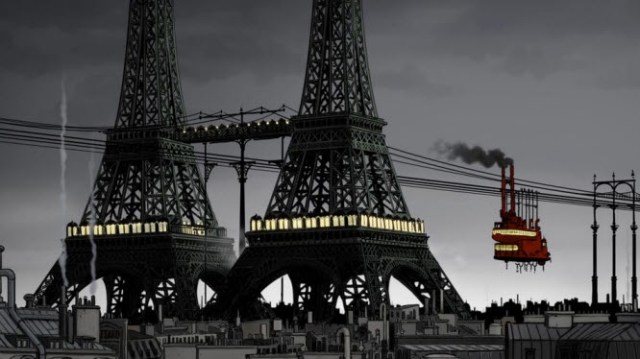
As April and her two companions bounce around here and there in their risky adventure somewhere between “Sky Captain and the World of Tomorrow” (2004) and “The Adventures of Tintin” (2011), the movie entertains us with many splendid visual moments as brandishing its gray brown steampunk style. While these moments are tinged with dystopian mood as required, they are presented with small and big details to engage us. In case of one particular scene involved with a big warehouse, its nice visual surprise took me back to Hayao Miyazaki’s “Howl’s Moving Castle” (2004), and I also enjoyed the ashy sights from the alternative version of Paris, which is mainly represented by the twin version of the Eiffel Tower.

But the story suffers from its notable flaws at times. While its first act is a bit overlong, its third act is contrived to say the least, and you may question the plausibility of its alternative world as you think more about it. For instance, can technological and scientific development be really arrested for more than 70 years just because of the academic holes left by those vanished scientists? And, above all, how can they be so easily persuaded to serve together for a plan to be revealed later in the story?

Anyway, I remain to be charmed by the steampunk style of “April and the Extraordinary World”, and the co-directors Christian Desmares and Franck Ekinci did a good job of presenting a vivid, compelling old-fashioned world based on their graphic designer Jacques Tardi’s graphic novel. While most of the characters in the film are caricatures, April comes to us as a heroine as plucky as Merida in “Brave” (2012) and Anna in “Frozen” (2013), and Marion Cotillard and other cast members of the movie provide solid voice performances on the whole. It may not be the best animation film I saw in 2016, but it comes with style and personality, and I like that.

Sidenote: In the US version, Angela Galuppo provides the voice performance for April while supported by prominent American performers including Tony Hale, Susan Sarandon, J.K. Simmons, and Paul Giamatti.

960


Posted in Movies | Tagged , , , , | 1 Comment

The Secret Life of Pets (2016) ☆☆☆(3/4): The Adventure of NYC pets

thesecretlifeofpets01
I have often complained about the recent homogenization of numerous Hollywood animation feature films during these years. They all look certainly well-made on the surface thanks to the rapid industrial development and expansion of digital animation since Pixar Animation Studio made “Toy Story” (1995), but most of them are usually less memorable compared to the high standards which have been set by Pixar Animation Studio during last 21 years. Unless they are successful enough to be followed by their sequels, they are quickly forgotten within a few years, and that is all.

In case of “The Secret Life of Pets”, almost everything in this new animation feature film is pretty conventional to say the least. Its story is apparently borrowed from “Toy Story”, and you can clearly see its narrative arc right from the beginning. For its young audiences, it is packed with a number of bouncy kinetic action sequences to excite and delight them. For its adult audiences, it is peppered with indirect jokes to amuse and tickle them. In the other words, this is your average family entertainment, but it actually has more fun and excitement than I expected thanks to the solid efforts by the people behind the film, and I must admit as your humble amateur critic that I chuckled several times along with the audiences around me during this Thursday evening screening.

The story is about a Jack Russell terrier named Max (voiced by Louis C.K.) and his fellow pets living in a neighborhood area of New York City. Since he was found by Katie (voiced by Ellie Kemper) when he was a little puppy, Max has enjoyed a comfortable domestic life under the care of his kind, generous human owner, and he also has neighbor pets to spend time with. Like those animal characters in “Over the Hedge” (2006), they are more intelligent than they look on the surface, and we get an amusing montage sequence showing how they enjoy themselves while their owners are absent.

thesecretlifeofpets02

On one day, Max’s paradise is disrupted by an unwelcome stranger. He is Duke (voiced by Eric Stonestreet), and this big, shaggy Newfoundland brought by Katie is determined to settle in his new home. Max and Duke naturally become hostile and mean to each other right from their very first day, and that eventually leads to a serious situation on the next day. When they are taken to a nearby park along with their neighbor dogs including Buddy (voiced by Hannibal Buress) and Mel (voiced by Bobby Moynihan), Duke attempts to get rid of his annoying problem once for all, but then he and Max find themselves getting separated from other dogs by a series of unlucky coincidences.

And that is how they encounter a white rabbit named Snowball (voiced by Kevin Hart) and his rogue colleagues living inside the sewer system of the city. Since being abandoned by his magician owner, this megalomaniac rabbit has been dreaming of having revenges on all human pet owners someday, and it does not take much time for Max and Duke to realize that they should get away from Snowball and his various animal minions as soon as possible.

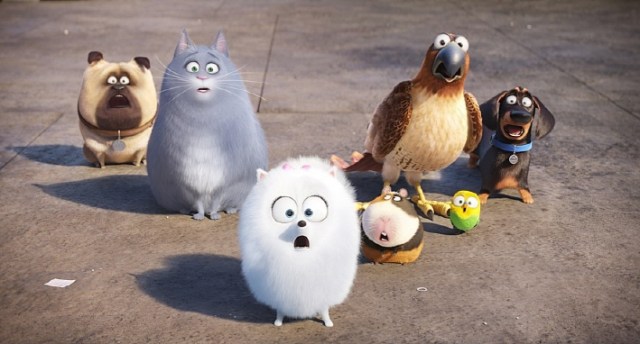
In the meantime, Gidget (voiced by Jenny Slate), a white fluffy Pomeranian living in an apartment building across from the one where Max lives, notices that Max and Duke are missing, and this plucky dog becomes determined to find them by any means necessary for her love toward Max. Besides Mel and Buddy, she has other pets to help her, and they are Chloe (voiced by Lake Bell), a grey tabby cat who is more obese than my cousin’s orange tabby cat; Norman (voiced by the co-director/co-writer Chris Renaud), a guinea pig who has been looking for his owner without much success; Sweat Pea (voiced by Tara Strong), a tiny budgerigar whose owner is one of nice small surprises in the movie; Pops (voiced by Dana Carvey), an old basset hound who has many animal connections around the city; and Tiberius (voiced by Albert Brooks), a red-tailed hawk who has to suppress his predatory nature for helping Gidget.

thesecretlifeofpets03

As going back and forth between these two main storylines, the movie throws lots of jokes and actions into its plot, and most of them work well enough to entertain us. The digital animation in the film are bright and colorful, and I like its urban landscapes which look like a modern fairy tale version of its real-life counterpart. The action sequences are often a little too frantic, but they are always accompanied with the sense of fun and excitement, which is buoyed further by Alexandre Desplat’s snazzy score. I also enjoyed a sequence probably inspired by Homer Simpson’s chocolate land fantasy, and I was particularly delighted when a certain immortal line from “Some Like It Hot” (1959) was used at one point.

The co-directors/co-writers Chris Renaud and Yarrow Cheney assembled the reliable cast for their animation film. While Louis C.K. and Eric Stonestreet effectively complement each other through their distinctive personalities, Jenny Slate, Lake Bell, Dana Carvey, Steve Coogan, and Albert Brooks have lots of fun with their respective roles, and the special mention goes to Kevin Hart, who finds here a tailor-made character to channel his irrepressible manic energy into.

Like Renaud’s previous animation films “Despicable Me” (2010) and “Despicable Me 2” (2013), “The Secret Life of Pets” is a safe, predictable conventional entertainment product, but there are enough enjoyable stuffs to fill its 90-minute running time. To be frank with you, I do not think I will remember it well until its possible sequel comes later, and I would rather recommend “Zootopia” (2016) or “April and the Extraordinary World” (2015), but why should I complain if I had a fairly good time?

Sidenote: A short animation film featuring Minions is shown before the screening.

thesecretlifeofpets04

Posted in Movies | Tagged , | Leave a comment

Green Room (2015) ☆☆☆(3/4): Trapped in the green room

greenroom02
“Green Room” is a bleak, cold-blooded thriller determined to shock and disturb us. Once its unfortunate young characters suddenly find themselves trapped a grim situation way over their head, the movie keeps pushing them into more fear and dread, and we are chilled and frightened by its merciless narrative logic as the situation becomes more narrowed and tightened for them. Although it begins to lose its tension during its last 20 minutes, the movie continues to hold our attention thanks to skillful direction and engaging performances, and I appreciate that even though I observed the movie from the distance rather than being wholly involved in it.

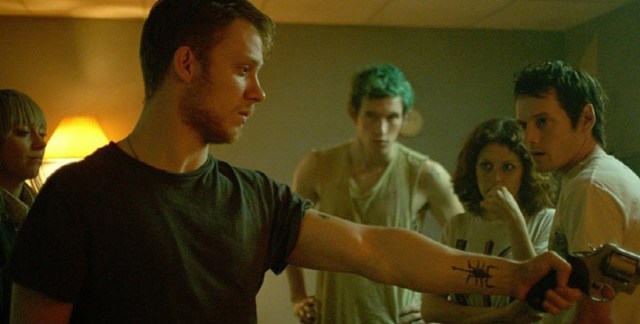
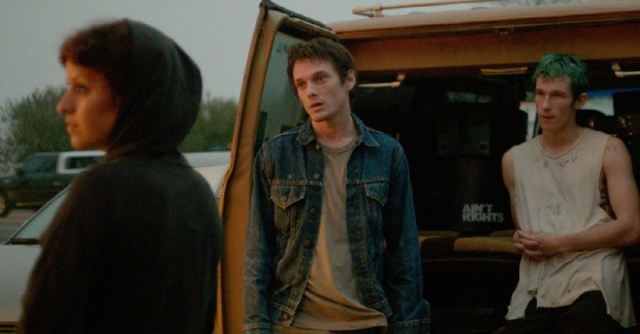
At first, it merely seems to be an inconvenient but necessary gig for them. Pat (Anton Yelchin), Sam (Alia Shawkat), Reece (Joe Cole), and Tiger (Callum Turner) are the members of a minor punk rock band called the Ain’t Rights, and their current status is almost near the bottom as shown from the quiet opening scene of the film. When they wake up in their shabby van during one early morning, they find that their van crashed into a cornfield, and it looks like they had a pretty wild time during last night. The van is all right at least, but they unfortunately run out of gas, and they have no choice but to steal gas from other vehicle because of their financial shortage.

They have been moving along the Pacific Northwest area for a while, and their latest destination is Seaside, Oregon, where they meet a local promoter named Tad (David W. Thompson). Although Tad kindly lets the band members stay at his house besides interviewing them for a radio show, the gig he promised to them turns out to be far less rewarding than they expected, so he gives another gig as a compensation. His cousin is looking for a band to play at some bar located within a remote forest area outside Portland, and he guarantees that they will get paid handsomely for this gig.

greenroom03

Now this naturally sounds inauspicious, but the band members are already reminded from the start that there will be a certain degree of risk or inconvenience. Tad does not hide that the bar in question is a gathering place of neo-Nazi skinhead gangs, and the band members have to accept this uncomfortable offer anyway because they really need money now.

Nevertheless, that does not suppress their rebellious attitude. As soon as they arrive at the bar not long after driving their van deep into its surrounding forest area, they clearly sense the aggressive mood around the bar and many of its skinhead customers, but they decide to start their performance with one of the very last songs you can imagine being performed at a neo-Nazi bar.

Fortunately, despite their understandable initial displeasure, the audiences come to enjoy the performance in the end, and the band members are happy to play their music and then get paid as promised, but one small act leads to a very serious trouble right before they leave the bar. They become the witnesses of something they should not see, and it is quite apparent that they are the problem to be taken care of sooner or later. As they are stuck in the waiting room behind the stage (the title of the movie means a space for performers before and after their performance, by the way), the band members desperately search for any possible way out, but they are reminded again and again that they may not survive this very unlucky day.

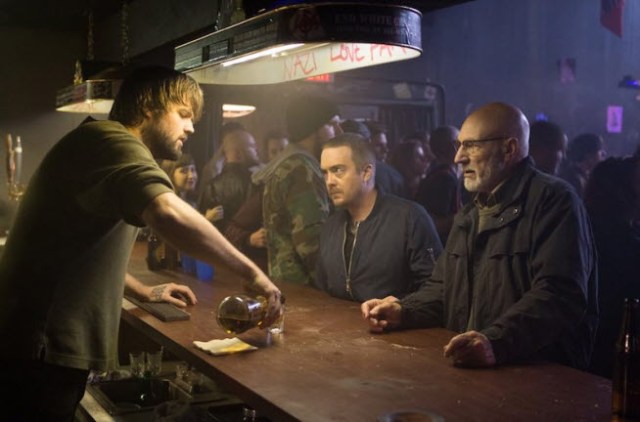
While Gabe (Macon Blair) and other skinhead gang members try to get the situation under control, their leader/bar owner Darcy (Patrick Stewart) arrives, and he knows how to handle the situation. Surprisingly effective in his against-type role, Stewart presents his villain character as a calm, rational man capable of doing whatever should be done for him and his vile organization, and his understated performance is all the more chilling to watch as Darcy and his men steadily and systematically corner their targets through his smart and brutal tactics. While he and his men certainly have advantages, Darcy is always watchful and careful in every step of his diabolical plan, and it goes without saying that there is not much chance for the band members trapped inside the bar.

greenroom04

The movie occasionally punctuates its tension with striking bursts of violence and blood while the situation becomes more hopeless for the band members, and the prominent use of green color on the screen further accentuates its nightmarish atmosphere especially during its second half. Anton Yelchin, Alia Shawkat, Joe Cole, and Callum Turner are convincing as their characters are put under more pressures along the plot, and Imogen Poots provides a good supporting performance as another crucial character in the story.

“Green Room” is written and directed by Jeremy Saulnier, who made a notable breakthrough with his previous film “Blue Ruin” (2013). Although that movie depended on the low budget partially funded by a Kickstarter campaign, it was an impressive work which showed his confident control of mood and storytelling, and the result was an intense, haunting revenge drama which was one of the cinematic highlights of 2014.

While I found its plot and characterization a little too thin to care about and I also have some reservations about its third act which uses a few easy contrivances for narrative resolution, “Green Room” confirms that Saulnier is indeed a talented filmmaker to watch, and he definitely deserves to be praised for drawing a rare villain performance from Stewart. It is always fun to watch something unexpected from a familiar actor, you know.

Sidenote: The movie is one of the last films of Anton Yelchin, who sadly died due to a car accident not long after the movie was released in US.

GREEN ROOM

Posted in Movies | Tagged , , , | Leave a comment

After the Storm (2016) ☆☆☆1/2(3.5/4): Gathered by the storm

afterthestorm01

I still marvel at how effortlessly intimate and humane the works of Hirokazu Kore-eda are. Many of his family dramas such as “Still Walking” (2008) and “Like Father, Like Son” (2013) are mostly somber and quiet on the surface, but they are undeniably powerful in their gentle, thoughtful observations of small but genuine human interactions, and they always make me reflect on life and people, two important things I often overlook in my busy inconsequential daily life.

In his new film “After the Storm”, Kore-eda presents another delicate family drama which is alternatively humorous and touching, and it is surely a pleasure to watch how his story subtly rolls along with its characters. Through the episodic glimpses of their daily life during summer days, the movie lets us get to know and understand its four main characters bit by bit, and we find ourselves involved in its bittersweet mix of humor and pathos as it arrives at the expected narrative point.

For Ryota (Hiroshi Abe), life has been not that good for many years. There was a time when it looked like he would be a successful writer after the publication of his first novel which won some literature award, but that was more than 10 years ago, and he has been stuck in writer’s block since that without any particular progress on what might be his second novel. When a minor character briefly talks about his first novel at one point, I could not help but be reminded that many first novels are already waiting for being written by their writers from the start. Sure, anyone has at least one story to tell, but what ultimately matters for your writing career is whether you have any other ones to tell.

afterthestorm04

Anyway, he has so far managed to earn his living through his, uh, research work for story materials, though he is frequently short of money due to his gambling problem besides the alimony for his ex-wife Kyoko (Yôko Maki). He works at a detective agency whose main business fields are missing pets and extramarital affairs, and his work ethics are pretty flexible to say the least. In one case, he and his young assistant Kento (Sôsuke Ikematsu) approach to a woman they are supposed to investigate for their client, and they soon get paid from both sides while not telling anything to their amiable boss played by Lily Frankie.

And he is not very good to his family either. When he comes to his family home in an old housing complex not long after his father died, the first thing he does is checking whether there is anything valuable left by his deceased father, whom he resembles more than he admits. While his aging mother Yoshiko (Kirin Kiki) is happy to see her dear son again, his no-nonsense sister Chinatsu (Satomi Kobayashi) knows better, and the apparent tension between her and Ryota later leads to one of the funniest moments in the film.

While it looks like Kyoko will marry again, Ryota tries to be a nice dad for their young son Shingo (Taiyô Yoshizawa), but, not so surprisingly, things do not go as well as he intended mainly thanks to his immature behaviors and thoughtless decisions. He continues to fail to pay the alimony to Kyoko’s frustration, and it seems Shingo is well aware of many of Ryota’s shortcomings, though he does not dislike his father at all.

Leisurely looking around Ryota and other characters, the movie gradually focuses on Ryota’s personal disappointment and disillusionment. Still not getting over from many failures of his life, he naturally wonders about how he has become as pathetic as his father, and he comes to feel more of the wide gap between his old aspiration and his shabby reality. Maybe he may complete his second novel and then get it published someday, but life always demands far more than hope and dream, and he may have to be a little more practical and responsible for not only himself but also others who care about him.

afterthestorm03

As announced around the beginning of the movie, a summer typhoon eventually arrives, and we get a domestic situation reminiscent of one of the dramatic moments in Kore-eda’s first feature film “Maborosi” (1995). Ryota, Kyoko, and Shingo happen to stay together at Yoshiko’s apartment while it is a dark and stormy night outside, and Kore-eda deftly balances this situation between comedy and drama as his characters go through their restless night, which feels rather predictable at first but then surprises us with precious low-key moments to savor and appreciate.

Most of the main cast members are probably familiar to you if you have seen Kore-eda’s previous works, and they all give well-rounded performances full of human nuances. Looking constantly jaded and disillusioned, Hiroshi Abe makes no excuse about his hangdog character who is often pretty unlikable and unreliable in many aspects; we do not like Ryota much, but we understand his human flaws at least, and it is touching to see when he slowly comes to realize how he can follow his better sides rather than being merely unhappy. Yôko Maki is fine as a woman who is more realistic than her ex-husband, and she has a good scene when her character has a little private conversation with Ryota. While Kirin Kiki is delightful to watch as usual, Lily Frankie, Sôsuke Ikematsu, Satomi Kobayashi are also enjoyable in their respective supporting roles, and young actor Taiyô Yoshizawa’s unaffected performance reminds me again that not many filmmakers in the world can surpass Kore-eda in handling child performer.

With simple gestures, the final scene of “After the Storm” makes a good point on how we can be nice and kind to each other in our life, and that takes me back to what late critic Roger Ebert once said: “I believe that if, at the end, according to our abilities, we have done something to make others a little happier, and something to make ourselves a little happier, that is about the best we can do. To make others less happy is a crime. To make ourselves unhappy is where all crime starts. We must try to contribute joy to the world. That is true no matter what our problems, our health, our circumstances. We must try.” Considering how much my dear friend loved and admired many of Kore-eda’s works, I think he would love “After the Storm” too.

afterthestorm02

Posted in Movies | Tagged , , , | Leave a comment

Jason Bourne (2016) ☆☆1/2(2.5/4): The Bourne Redundancy

jasonbourne02

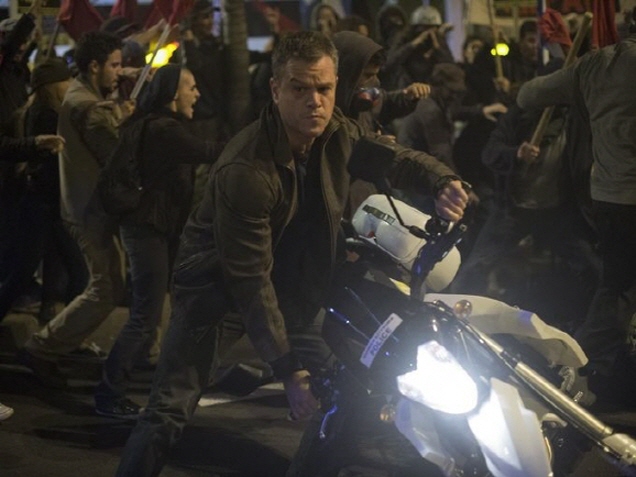
As I watched “Jason Bourne” during this Wednesday evening, my mind kept making comparisons while feeling the increasing detachment toward actions presented on the screen. Although it serves us with gritty, intense action sequences as busily hopping around different locations along with its lone hero, the movie suffers from the inherent lack of what makes its better predecessors so interesting and exciting, and it feels repetitive at every point even though the people behind it try as much as they can.

At the beginning of “The Bourne Identity” (2002), CIA agent Jason Bourne (Matt Damon) happened to become totally amnesiac due to the disastrous failure of his latest assassination operation, and he soon found himself in a very dangerous and confusing situation as trying to know who the hell he was. That movie and its two following sequels “The Bourne Supremacy” (2004) and “The Bourne Ultimatum” (2007) revolved around his perilous journey of self-discovery and redemption, and it seemed around the finale of “The Bourne Ultimatum” that he finally attained what he had struggled and fought for.

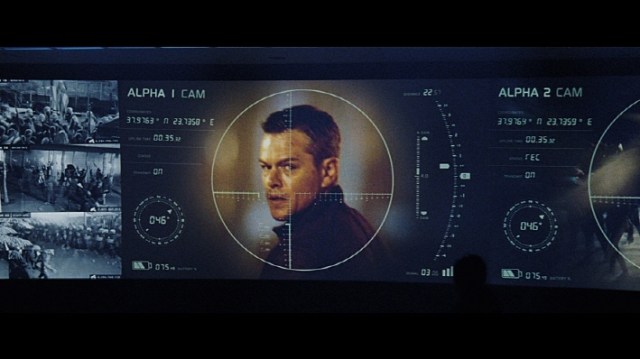
Around 10 years have passed since that point, but Bourne still looks troubled when we meet him at the beginning of “Jason Bourne”. Although he does know now who he really was both before and after he volunteered for a top secret CIA program, but he has been aimlessly drifted around the world while still hiding from the watchful global monitoring of CIA, and we see him throwing himself into an illegal fistfight match held somewhere in the Eastern Europe region.

jasonbourne03

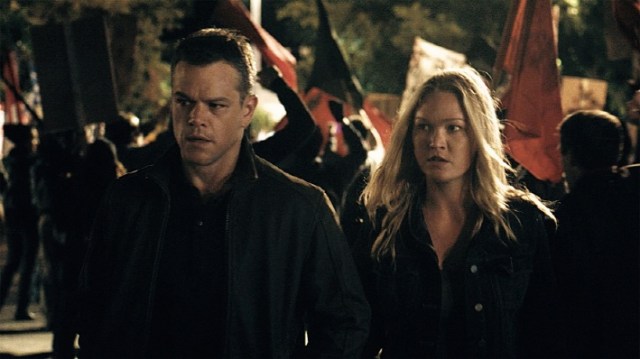
Not long after that, a figure from his past suddenly appears in front of him. Nicolette “Nicky” Parsons (Julia Stiles), an ex-CIA agent who came to cross over the line as helping Bourne in “The Bourne Ultimatum”, recently managed to extract a heap of top secret computer files from the CIA headquarters in Langley, Virginia, and some of them are involved with something Bourne must know for a certain personal reason.

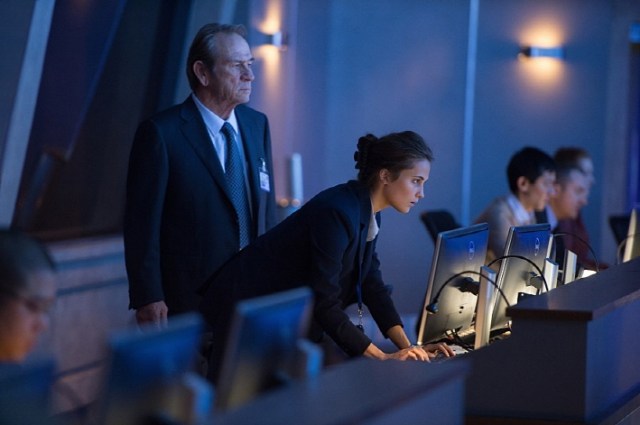
Not so surprisingly, the people in CIA have already come into the picture when Parsons contacts Bourne. Like many high-ranking CIA officials before him, the CIA Director Robert Dewey (Tommy Lee Jones) is determined to get rid of a rogue agent who gave so many troubles and headaches to the agency and will definitely cause more problems. Besides the files about those obsolete secret programs including the one Bourne volunteered for, Parsons also stole the ones associated with the latest secret program called Ironhand, and its public disclosure is certainly the last thing wanted by Dewey as well as Aaron Kalloor (Riz Ahmed), the young CEO of a major social network service company who has covertly collaborated with Dewey in exchange of his business success.

As Bourne eventually runs as before, the director/co-screenplay writer Paul Greengrass dutifully sticks to his action formula which was established in “The Bourne Supremacy” and then has influenced other action films including recent James Bond movies. As the cinematography Barry Ackroyd’s agitated handheld camera reaches for urgency and verisimilitude, the co-screenplay writer/editor Christopher Rouse, who won an Oscar for his superb work in “The Bourne Ultimatum”, busily juggles many different things as actions are frantically and chaotically unfolded on the screen. This visual approach can be quite disorienting or distracting to some audiences, but Greengrass is a filmmaker who knows how to convey the visceral sense of physical impacts to his audiences even when he goes all the way for chaotic actions, and the movie sometimes becomes quite tense and ferocious as intended while lots of things get crashed here and there during its well-made action sequences.

jasonbourne01

However, the movie ultimately failed to engage me, mainly because of the fact that its hero’s character arc was completed a long time ago. When “The Bourne Legacy” came to us with another CIA agent hero in 2012, I pointed out how he is far less interesting in comparison as a guy who knows who he is in contrast to Bourne, and now the same thing can be said about Bourne here. While there is a mystery involved with his dead father, you will not be surprised a lot by the truth behind it, and the movie strangely does not delve much into how Bourne has dealt with his true identity during his dormant period. Did he ever visit people who knew him before his CIA years? Or did he just choose to continue to live as Jason Bourne as ordained by his torturous fate?

With his engaging ordinary guy persona which was effectively used in his recent Oscar-nominated turn in “The Martian” (2015), Matt Damon shows again admirable commitment to his character as he did in his previous three Bourne movies, though he is stuck with less things to do in this case. Maybe because he knew that his role was a pretty bland thankless job, Tommy Lee Jones seems to be saving his energy for something far juicier to come in the future, and Alicia Vikander, who recently dazzled us with a series of wonderful performances including her Oscar-winning turn in “The Danish Girl” (2015), is woefully under-utilized as a CIA agent who has different thoughts on Bourne in contrast to her adamant boss. While Vincent Cassel is criminally wasted as a ruthless CIA assassin, Riz Ahmed, a promising British actor who has become more prominent since I noticed him in darkly absurd terrorist comedy film “Four Lions” (2010), leaves more impressions than the other supporting performers in the film. There is always a certain degree of unpredictability about how his character will function in the whole story, and that makes Ahmed constantly interesting to watch.

Like “The Bourne Legacy”, “Jason Bourne” is a redundant blockbuster action film which is not boring but unsatisfying, and it is disappointing especially when you consider the numerous dependable talents gathered for its production. I do not know whether it will be followed by another sequel as hinted during its final minutes, but I may be interested in how they will decide on the title of that possible new sequel, which will surely not be named “The Bourne Redundancy”.

jasonbourne04

Posted in Movies | Tagged , , | Leave a comment

Everybody Wants Some!! (2016) ☆☆☆1/2(3.5/4): Let good times roll…

everybodywantssome01

My first days as an undergraduate student of the Korean Advanced Institute of Science and Technology were rather uneventful to say the least. While getting acquainted a bit with my two dormitory roommates, I just simply attended lectures and prepared for exams as demanded, and I kept spending considerable time on books and movies whenever my campus schedule was free. I did not have much interest in having friends or meeting girls (or boys, if you ask), and even joining a music club did not help my social life much.

That is the main reason why Richard Linklater’s new movie “Everybody Wants Some!!” felt quite alien to me from the beginning besides considerable cultural gaps, but I observed its colorful campus characters with a sort of anthropological interest, and I eventually found myself charmed by its good-natured comedy vibrating with humor and intelligence. These characters inhabit in a world far different from my good old campus life in the past, but they are funny and engaging guys to observe and care about, and the movie has plenty of enjoyable moments as they roll here and there around their campus during their few remaining carefree days.

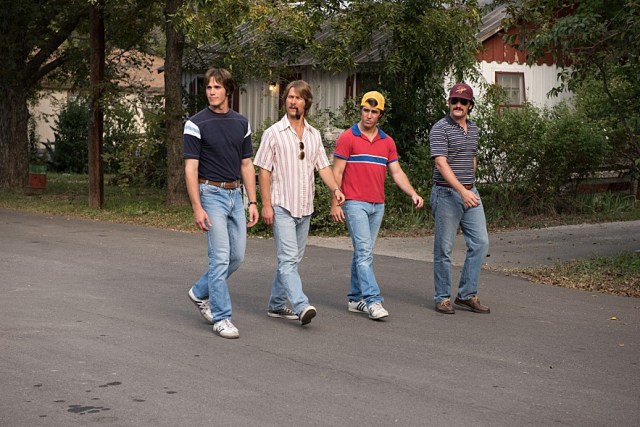
It is the early fall of 1980, and Jake (Blake Jenner) is about to have his first day at a college in the Southeast Texas region, where he is going to play as a new member of its baseball team. Not long after he arrives at one of the two houses for team members, he gets himself acquainted with many of senior members including McReynolds (Tyler Hoechlin), Dale (J. Quinton Johnson), and Finn (Glen Powell), and he also meets his fellow new players including his roommate Billy “Beuter” Autrey (Will Brittain), who is often ridiculed for being your average Texan country boy.

everybodywantssome03

Because there are only three days left before the beginning of their upcoming semester, everyone in the team is ready to have all the fun and excitement they can get during this brief period. At the team meeting, their coach emphasizes that 1) no alcohol is allowed and 2) they should be discreet with girls, but his words have already been disregarded even before he said, and the meeting is soon followed by a night party packed with bottles and, of course, girls.

Now this sounds like a generic R-rated college comedy, but, while it does not hesitate to hurl itself into debaucheries like mud-wrestling, Linklater’s screenplay is too smart and thoughtful to allow itself to fall into genre conventions. Jake and his teammates come to us as likable lads who simply want to enjoy themselves together, and we constantly get small and big laughs as observing numerous hilarious moments generated from the ceaseless dynamic interactions among these dudes. Sure, they often look silly and goofy as being a little too competitive in many other things besides baseball, but their brash and cocky behaviors are depicted with recognizable human traits, and some of these guys turn out to be more serious or intelligent than we thought.

As following their wild nights one by one, the movie gives us a vivid, amusing look into the cultural landscapes of the early 1980s. When they get kicked out of a local disco club because of a fight caused by one of them, they go to the other club instead just because they have still more time to spend, and the next scene reminded me of how persistent American country music has been for many years. When Jake comes across his high school friend, he and his several teammates are invited to a punk rock concert, and they understandably feel awkward in front of this emerging musical trend, though most of them manage to dress themselves fairly well for that occasion (I am more amused now by a certain accessory worn by Jake, by the way).

everybodywantssome02

In the meantime, Jake gets closer to a girl he encountered during his first day at the campus. He and Beverly (Zoey Deutch) do not have many common things between them, but they click well with each other as getting to know more about each other. She invites him to a chic party held by her and her friends in the performing-arts department, and then there comes a sensitive moment as Jake and Beverly have a quiet private time together during the early next morning. Both of them are serious about what will be the next step for their life, and their intimate conversation took me back to what was exchanged between the two characters of “Before Sunrise” (1995), the first chapter of Linklater’s Before Trilogy.

Under Linklater’s seemingly laid-back but ultimately confident direction, the movie always sparks with spontaneity, and he draws the fabulous ensemble performance from his cast, which mainly consists of unknown young performers. I must admit that it was a bit difficult for me to distinguish one performer from another at first, but their characters become more distinctive along the free-flowing narrative of Linklater’s screenplay, and it is really pleasant to see how their individual performances effortlessly work together during one particular sequence later in the story.

Brimming with joyous energy, “Everybody Wants Some!!” invites us to have some good times with its youthful characters, and it will surely have its place right next to Linklater’s “Dazed and Confused” (1993). While the movie may look like a minor work compared to his exceptional achievement in “Boyhood” (2014), this is another delightful comedy film from Linklater, and you will not be disappointed by its funny, delicious slice of college life.
everybodywantssome04


Posted in Movies | Tagged , , , | Leave a comment

The Witch (2015) ☆☆☆1/2(3.5/4): An isolated terror in the wood

thewitch05

Shrouded in the gnawing sense of dread and terror, “The Witch” will give you a creepy experience as calmly observing how its characters are slowly crumbled under an unknown influence out there. When it is over, you may wonder about what exactly happened to them, but you will not easily forget its spooky atmosphere enfolding several chilling scenes to disturb and frighten you.

It is around the 17th century, and the opening sequence shows William (Ralph Ineson) and his family being banished from their puritan community located somewhere in the New England region. Although the reason for their banishment is not specified well, it is implied that there was some theological conflict between William and town elders, and William stubbornly sticks to his belief, even though he could compromise with town elders for avoiding the hardships he and his family will have to face once they leave the community.

Along with his wife and their five children, William moves to a remote spot far away from the community. As looking at a new settling place for them, he and his family try to be optimistic while hoping for God’s blessing, but the forest surrounding this place suggests otherwise to us via its moody presence, and this is further amplified by Mark Korvan’s unnerving dissonant score, which often sounds like a malicious vibe generated from somewhere inside the forest.

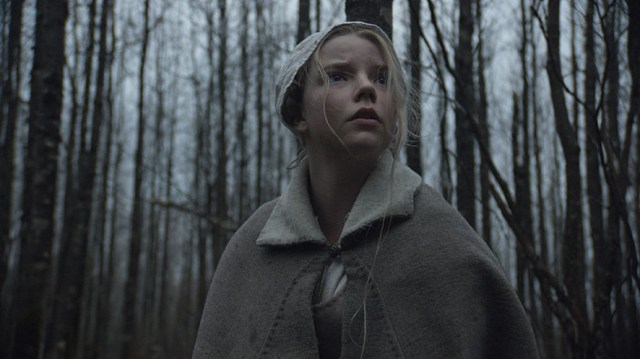
Not long after the family settles in their new place, a bad thing happens as expected. William’s youngest child is suddenly vanished on one day, and William’s neurotic wife Katherine (Kate Dickie) is devastated by this incident while William’s eldest daughter Thomasin (Anya Taylor-Joy) is baffled about it. She can swear by God that her little baby brother was right in front of her eyes during their very last moment, but then he was gone without any trace right after that point, and she knows too well that her grieving mother is blaming her for that.

thewitch02

As William says to his eldest son Caleb (Harvey Scrimshaw) during their private moment, the baby seemed to be snatched away by a wolf or some other predatory animal in the forest, but then the family becomes more conscious of the possibility of evil force hovering around their place. There is a ghastly scene involved with an unspeakable case of witchcraft, but we are not so sure about whether this is real or imagined. Twin siblings Mercy (Ellie Grainger) and Jonas (Lucas Dawson) look innocuous and mischievous as playing with their family black goat, but they may know more than they tell to other family members. Do they merely imagine things just for fun? Is there really an evil witch lurking somewhere in the forest?

Regardless of what is really happening to the family, the strained relationships among them become more palpable than before as days go by. As the approaching winter time looks gloomy for his family due to their disappointing harvest, William has to confront the price of his pride, and he also has to hide a few things from his wife, who has many things to be bitter about besides the unfortunate loss of her baby son. Both Thomasin and Caleb are well aware of the growing conflict between their parents, but they have no choice but to be dutiful children as well as dependable older siblings in their isolated world – until a certain point.

Under the skillful direction by the first-time director Robert Eggers, the movie keeps accumulating tension step by step as more disturbing things happen later in the story. While there are a few ‘boo!’ moments to jolt us in the progress, their shocks are organically sprung out of the tense ambience established in advance, and we come to fear more for what may happen next.

thewitch03

Eggers and his crew did a commendable job of creating the authentic period background in spite of their small production budget, and we are immediately drawn into its 17th century world and then involved in its characters’ fearful situation. The cinematography by Jarin Blaschke is hauntingly beautiful for the superlative use of natural lights reminiscent of “Barry Lyndon” (1975), and the screen ratio of 1.66:1 in the film is effectively utilized especially when the camera looks into the gray dense parts of the forest, which feel claustrophobic with those dark, tall trees exuding inauspicious overtone on the screen.

As mentioned in the end credits, Eggers’ screenplay is mostly based on various writings from its background period, and some of its intense dramatic moments will probably remind you of the Salem Witch Trials or Arthur Miller’s classic play inspired by that infamous historical incident. While desperately holding onto their religion in front of the situation they do not fully understand, the characters in the film become far more susceptible to suggestions and superstitions, and, not so surprisingly, there comes an imploding moment for everyone after one of William’s children gets unhinged by whatever was experienced in the forest. The main cast members in the film are convincing in their unassuming natural performance, and they also handle well their demanding scenes as their characters are pushed into the grim mouth of madness – or damnation, perhaps.

While clearly influenced by “The Exorcist” (1973), “The Shining” (1980), and “The Blair Witch Project” (1999), “The Witch” has its own scary goodies to present and you will enjoy it especially if you appreciate that precious value of mood and suspense in horror films. Considering its characters’ increasingly unreliable viewpoint, I am still not that certain about its final minutes, but I was instantly gripped by its uneasy aura of darkness as admiring its visually impressive scenes, and I was chilled by its genuinely frightening moments. A good horror film is not something we come across often in these days, and “The Witch” is certainly one of a few better cases we have in this year.

thewitch01

Posted in Movies | Tagged , , , , | Leave a comment

The Diary of a Teenage Girl (2015) ☆☆☆(3/4): “I had sex today…”

thediaryofateenagegirl03
With vibrant personality and frank attitude, “The Diary of a Teenage Girl” gives us a close, intimate look into the bumpy sexual maturation period of its adolescent heroine who becomes aware of her biological/psychological changes more than before. Like many girls around her age, she is willing to go forward for what she desires, and she thinks she knows where she is going, though that inevitably turns out to be a painfully wrong assumption to be followed by some valuable life lessons for her adulthood on the horizon.

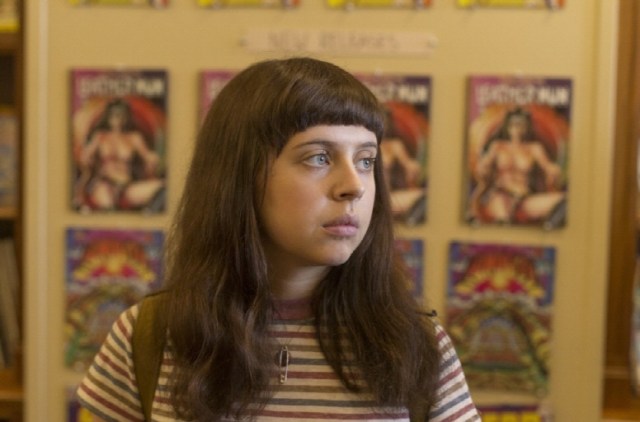
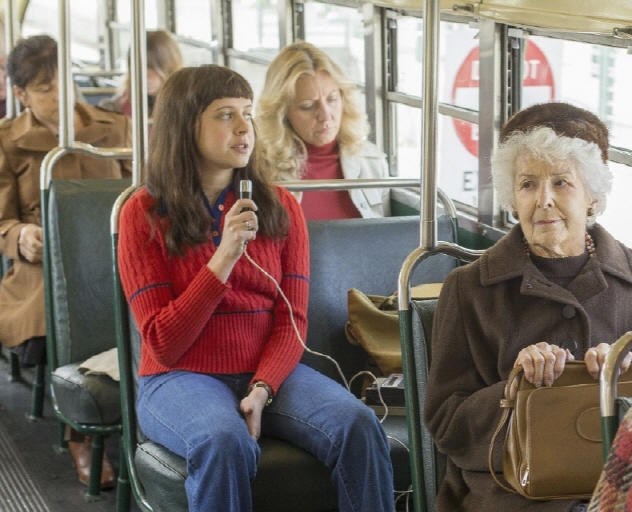
When we meet Minnie Goetze (Bel Powley) during the opening scene, this 15-year-old girl feels buoyed by the exciting sense of fulfillment. As she directly tells to us, she just has experienced her first sexual intercourse, and things certainly look different to her now as she reflects on how that memorable experience of lifetime happened to her under a circumstance which was not very inappropriate in many aspects.

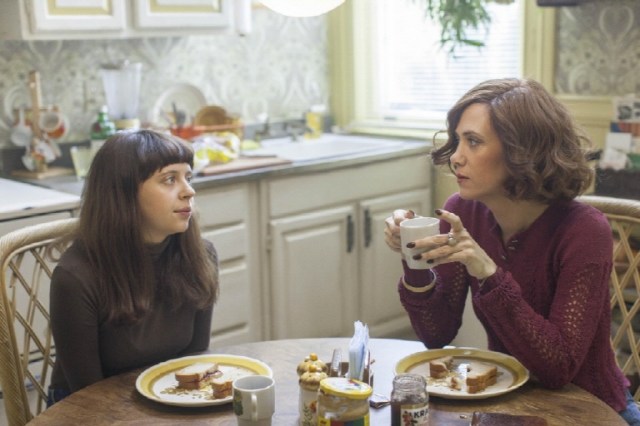
As Minnie is recording her private diary tape, we come to learn a bit about her family background. Her bohemian mother Charlotte (Kristen Wiig) has been enjoying her carefree lifestyle especially after her divorce with her second husband, and San Francisco during the 1970s is an ideal place for Charlotte and her equally fun-loving friends, who do not mind alcohol and drugs whenever they get any chance. It goes without saying that Charlotte is not someone who can get the Mother of the Year award, but she has managed to maintain a cozy domestic environment for herself and her two daughters, and Minnie and her little sister Gretel (Abigail Wait) have no problem with how frequently their mother enjoys herself inside and outside their home.

thediaryofateenagegirl02

Charlotte is currently in the relationship with a tall, handsome guy named Monroe (Alexander Skarsgård), and Minnie finds herself being infatuated with this hunky dude as her yearning to be liked and loved grows day by day. She often feels inadequate while looking at her changing body in the mirror, and we can easily guess the reason when she is with her close friend Kimmie (Madeleine Waters), who looks sassier and prettier in comparison.

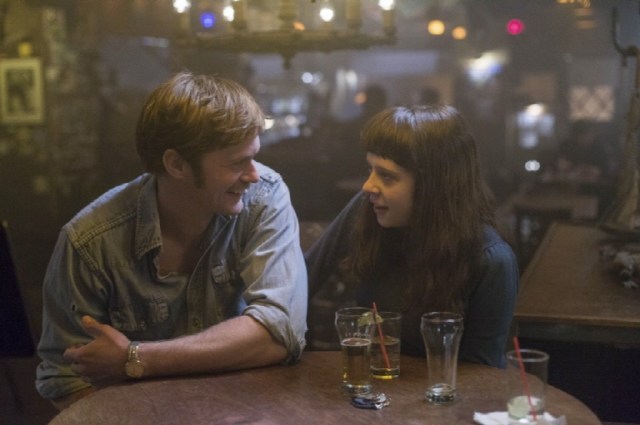
During one evening, Minnie and Monroe happen to go to a local bar together when Charlotte chooses to stay at home. As they talk and drink more with each other, Minnie comes to feel more attraction toward Monroe, and then she makes an active move toward Monroe, who may have some reservation but does not hide at all how his certain body part reacts to Minnie’s blatant act of flirting. While never overlooking the questionable aspects of their deviant interaction, this scene is handled with considerable emotional frankness, and it comes to us as one of the most humorous (and naughtiest) moments in the film thanks to the effortlessly balanced acting by Bel Powley and Alexander Skarsgård.

After having her first official copulation, Minnie continues her inappropriate relationship with Monroe while naturally hiding it from her mother, who sincerely encourages her to be more interested in boys while having no idea about how far her daughter has gone recently. When Minnie approaches to one of male classmates in her high school, she already has a clear idea of what she wants from the start, and she surely gets it while they have a little private time at his house.

thediaryofateenagegirl04

Meanwhile, we also observe the gradual growth of her artistic sensibility blooming inside her. She becomes interested in the works of underground comics artist Aline Kominsky, and Kominsky’s bold and provocative style, which is not so far from her future husband Robert Crumb’s works, inspires Minnie a lot as she tries to find her own style. The director Marielle Heller, who adapted Phoebe Gloeckner’s graphic novel “The Diary of a Teenage Girl: An Account in Words and Pictures” for her movie, inserts several witty animation sequences into the movie for reflecting her heroine’s bouncing artistic imagination which knows no limit or taboo. In case of one animation sequence featuring a big giant girl, we get the humorous reflection of how Minnie virtually emasculates her latest sex partner, and you may appreciate a little naughty touch at the end of the film.

Powley, a young British actress who had just started her movie acting career around the time when she was cast for the movie, is fabulous in what will be her career breakthrough point. Minnie is not exactly a good girl to say the least, but Powley’s engaging nuanced performance lets us understand what drives her character into all those risky behaviors, and we come to worry about Minnie especially when she is later struggling with the consequences resulted from her reckless acts. While Skarsgård is also fine as a flawed man who turns out to be more unreliable and selfish than expected, Kristen Wiig, who has kept advancing into more serious territories as shown from her recent works in “The Skeleton Twins” (2014) and “The Martian” (2015), brings human details into what could be a thankless caricature role, and Christopher Meloni shows his surprising comic side as Minnie’s fastidious ex-stepfather, who instantly senses what is going on between Minnie and Monroe when he incidentally drops by his ex-wife’s house.

“The Diary of a Teenager Girl” did a thoughtful and sensitive job of handling its potentially sensational subject, and the result is a lively coming-of-age drama with recognizable adolescent behaviors we can emphasize with. Like many of us, she did make mistakes, but she did learn something as recognizing the inner changes to affect her life for a long time. Does she really know now who she is as well as what she wants? She will see, no matter what will happen in her approaching future.
thediaryofateenagegirl01


Posted in Movies | Tagged , , , , | Leave a comment

Emelie (2015) ☆☆1/2(2.5/4): They get a wrong babysitter…

emelie04

There are a number of good things to be appreciated in “Emelie”, a creepy little thriller movie equipped with competent filmmaking skill and solid acting. While it is engaging to see how its first two acts steadily build up tension with the growing sense of danger and dread, the movie is ultimately marred by its weak third act, and that is really a shame considering what has been established so well during the preceding parts.

When their parents are about to go outside for having their own private time together, it looks just like another usual evening for Jacob (Joshua Rush), Sally (Carly Adams) and Christopher (Thomas Bair). Their babysitter will soon arrive with their father, and they will be under her supervision until their parents come back home later. Although their parents never meet her before while only knowing that she is a daughter of one of their neighbors, they are grateful that she is available for them in time, and she instantly gets her employers’ trust as soon as she enters their house.

But we already know from the very beginning that there is something sinister about ‘Anna’. As shown during the opening sequence, real Anna was suddenly ambushed on her way to home, and we have a pretty good idea on what happened to that ill-fated girl as noticing a tiny stain of blood on the sneaker of ‘Anna’, whose actual name is Emelie (Sarah Bolger) as revealed later in the story.

Most of the suspense in the movie is generated from how Emelie gradually reveals her hidden dark side in front of the kids she is supposed to take care of. At first, she lets the kids play freely in the living room, and the kids have no problem with playing a game of pretending as suggested by her. Even when the kids go a little too far, she does not stop them at all, as if she did not give a damn about what her employers will think about that.

emelie01

While they have a good time with this seemingly cool babysitter for a while, it does not take much time for the kids to come to sense something weird about her. At one point, she deliberately exposes her certain private biological happening to Jacob, and it goes without saying that this is something he will remember for the rest of his life. When she learns that Jacob has a pet snake, she virtually forces the kids to witness a very unpleasant side of nature, and then there comes a truly twisted moment involved with a certain VHS tape whose visual content is thankfully not shown to us during that moment.

As we watch more of her vicious behaviors, we cannot help but be curious about this possibly deranged babysitter, and Sarah Bolger, a young Irish actress who has built a solid acting career since her notable roles in “In America” (2003) and “The Spiderwick Chronicles” (2008), is compelling to watch for her subtle nuances of wickedness. Looking plain and normal on the surface, she is believable when her character hides her true nature in front of others, and then she deftly dials up the level of creepiness until her character’s unwholesome motive is finally revealed around the third act.

Unfortunately, that is the point where the movie begins to falter irrevocably. Despite Bolger’s commendable efforts, her character remains to be more or less than a stereotype from hell, and that may take you back to many other thrillers like “The Hand that Rocks the Cradle” (1992). While the running time of the movie is around 80 minutes, it often feels stretched out a bit too much, and that aspect is apparent especially when it occasionally shifts its focus to the kids’ parents, who absolutely have no idea about what is going on in their house while enjoying their posh dinner time outside.

emelie02

I also felt impatient with several contrived moments simply existing for the convenience of the plot. For example, when one character luckily has someone to help at one point, they choose to do a rather unwise thing instead of calling 911 right now because, well, that is necessary for the showdown moment to follow, and the movie even has its background darkened around that point without any plausible reason in the story. In case of the finale, it depends on too many coincidences to be believed, and the final minute of the movie feels like a cheap shot to say the least.

Nevertheless, the better parts of the movie show us that the director Michael Thelin, who wrote the story with his screenplay writer Richard Herbeck, is a filmmaker who knows how to engage us visually. The cinematography by Luca Del Puppo is slick and smooth as imbuing the nervous mood into the screen, and I was also amused by a few oddly anachronistic technical details (Although I spot a Wi-Fi receiver during one brief scene, other electronic equipments in the movie look like belonging to the late 1990s). Three young performers hold their own places well in front of their adult co-star, and we come to care about their characters’ safety thank to their unaffected acting.

I still think “Emelie” is a flawed film which could be better, but you will not forget Bolger’s performance after watching it. What she achieves here can be compared to Terry O’Quinn in “The Stepfather” (1987), and, like O’Quinn, she gives more than her movie deserves. I hope that this talented actress will get better chances in the future.

emelie05

Posted in Movies | Tagged , | Leave a comment

Eye in the Sky (2015) ☆☆☆(3/4): Dilemmas of modern drone warfare

eyeinthesky03

Through its gripping drama revolving around one tricky military operation, “Eye in the Sky” presents thought-provoking dilemmas of modern drone warfare without easy answers. If the ends can justify the means, how far can they go for preventing the next terror threat they cannot overlook at all? Can they possibly cross some legal/ethical lines just for that? And can they accept its possible collateral damages as well as its potential political repercussions?

After the opening scene unfolded in a poor neighborhood area near Nairobi, Kenya, the movie quickly moves its focus to a clandestine joint military operation in its preparation step. Some of high-level members of a local Islamic terrorist organization are going to have a secret meeting somewhere in Nairobi with two young recruits who have already been on the watchlist, and the purpose of this joint operation is ambushing and arresting them all right on the spot as soon as their meeting is confirmed.

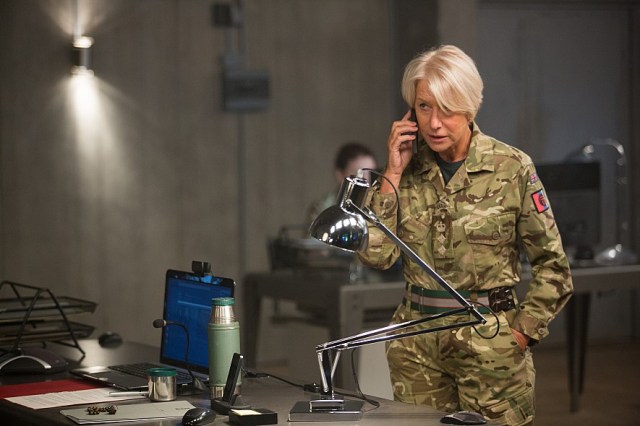
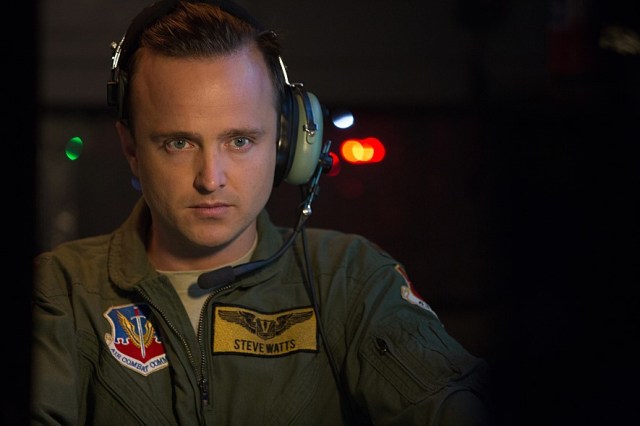
We see how the ongoing circumstance is being monitored from different locations around the world second by second. Katherine Powell (Helen Mirren), a British Colonel in the overall command of this operation, is bracing herself at her commanding post in UK as it seems quite possible that her long search for the targets will finally end within a few hours. At a US Air Force Base near Las Vegas, Lieutenant Steven Watts (Aaron Paul) and his partner Carrie Gershon (Phoebe Fox) are operating a MQ-9 reaper drone flying over Nairobi, and what is captured through the high-tech video camera of their drone is instantly analyzed by their co-working team in Hawaii.

eyeinthesky04

In Nairobi, a Kenyan army unit is ready for the call at a nearby base, and there is also an undercover surveillance team which keeps a very close eye on the site presumed to be the targets’ meeting place. The depiction of their surveillance technology in the film may not look that realistic to you, but I heard that it is actually closer to reality than we think. When I was watching the gut-chilling finale sequence of “Syriana” (2005), I hastily thought the military technology depicted during that sequence was a bit unrealistic, but then, what do you know, I began to hear about those targeted killings by US Army drones only a few years later.

In London, Lieutenant General Frank Benson (Alan Rickman) and several high-ranking British government officials are patiently watching the progress of the operation. Once two of their targets are spotted and then tracked down, everything seems to go well as planned, but then there comes an unexpected turn which changes the whole nature of the operation. It turns out that their targets are actually preparing for another terror, and, unfortunately, drone attack is the only possible way to stop these terrorists’ terrible plan under this changed circumstance.

While Colonel Powell believes the targets should be eliminated as soon as possible, the British government officials see the situation in different views, and they are concerned about whether there is anything illegal about their authorization of this targeted killing. As a matter of fact, two of their targets are technically British citizens, and the targeted killing of its citizens will not be a good publicity for the British government.

The screenplay by Guy Hibbert shows a wry sense of humor when its government official characters understandably hesitate at their frustrating decision point. The more they discuss about their imminent matter, the more they are aware of its enormous political risk. They eventually choose to seek the approval from their superiors, but their superiors are also reluctant to give their 100% approval despite the full support from the high-ranking US government officials, who are indubitably eager to erase several names around the top of their list of terrorists to be eliminated.

eyeinthesky02

In the meantime, the situation becomes more complicated than before as another unexpected factor comes into the picture. A little girl is selling bread near the site to be bombed, and that leads to another dilemma for everyone in the operation. Considering that their targets can leave the site at any point and then can cause far more damages and casualties, it can be argued that they should accept the unavoidable collateral damage represented by that girl, but then it can also be argued that the bombing will seriously damage their moral stance in the War on Terror. After all, which one will draw public attention more, a little girl’s tragic death or a prevented terror attempt?

The director Gavin Hood, a South African filmmaker who has been mainly known for his Oscar-winning film “Tsotsi” (2005), did a skillful job of juggling many different elements in Hibbert’s screenplay. The editing by Megan Gill is taut and succinct while never letting us get lost amid multiple plot threads, and it surely helps that many of the key characters in the film are played by recognizable performers like Helen Mirren, Aaron Paul, Barkhad Abdi, Jeremy Northam, Iain Glen, and Alan Rickman, an invaluable British actor who sadly passed away not long before the movie was released in US early in this year.

Because of their shared main subject, “Eye in the Sky” is automatically compared to Andrew Niccol’s “Good Kill” (2014), and I think the former is superior to the latter in many aspects. Driven by its thriller premise, it is more focused and thoughtful with a wider and more complex view on the subject, and it is also compelling to watch how its plot pieces come to gather together at its inevitable narrative endpoint. This is a smart, intelligent war film, and I think you should watch it for some thoughts regardless of your opinion on modern drone warfare.

eyeinthesky01

Posted in Movies | Tagged , , , | Leave a comment