The Queen of Crime (2016) ☆☆☆(3/4): Here comes Detective Mom

thequeenofcrime01

As a mystery thriller, South Korean film “The Queen of Crime” is pretty simple on the whole, but it is equipped with a brash, colorful heroine to remember. She may not be very smart as the detective character of the story, and she often annoys others around her as your typical meddler mom, but we come to root for this plucky, resourceful lady as she becomes determined to get to the bottom of a matter which may be a lot riskier than it seemed initially.

Park Ji-yeong, who previously appeared in “The Advocate: A Missing Body” (2015), plays Mi-kyeong, a middle-aged woman who runs a shabby beauty shop in her rural town where she often operates illegal facial operations for extra income. She has an adult son who is currently preparing for the state law examination in Seoul, and we see her boasting of her son Ik-soo (Kim Dae-hyeon) in front of her neighbors although he has not passed the examination yet.

When there are only a few days left before the examination day, her son calls. He has been living in a seedy building which houses many others preparing for the examination just like him, and he recently received a notice which says that he has to pay a water bill amounting to 1.2 million won (around $ 1,000). This is surely outrageous, but Ik-soo just wants to get rid of this distracting trouble as soon as possible, and he wants his mother to pay the bill instead of him.

However, Mi-kyeong decides to search for any possible way for avoiding this hefty payment. She instantly goes to Seoul, and she soon begins to snoop around the building as staying at her son’s room, although that is the last thing Ik-soo wants now. Like many of his fellow residents, he has been quite edgy and nervous as taking the final step toward the examination, and he cannot help but be exasperated by the overbearing presence of his busybody mom.

thequeenofcrime03

As Mi-kyeong delves more into the matter, she starts to notice suspicious things inside the building. Looking rusty and dilapidated at its every corner as if it were an ideal background for horror or noir thriller movie, this unspeakable low-rent building is managed by two hoods who do not care a lot about the maintenance of their building as long as they get paid by their tenants, and we also meet Gae-tae (Jo Bok-rae), a dim lackey who is often abused and disregarded by these goons. It looks like these three guys are hiding something behind their back, and Mi-kyeong’s suspicion is increased especially when she happens to glimpse their shady night business in the building.

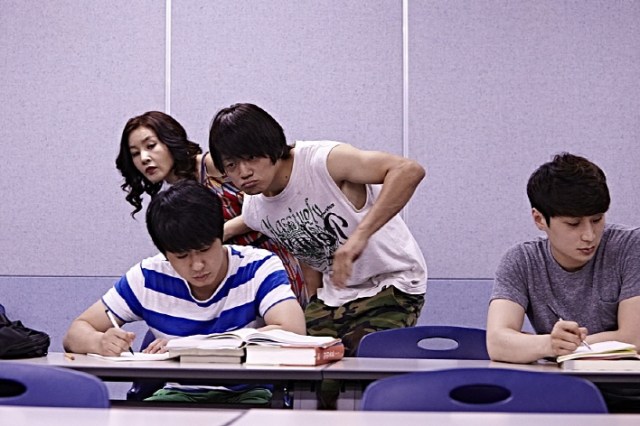
And there is an odd guy living right next to Ik-soo’s room. After learning that this guy’s room and Ik-soo’s room share the same water pipe, Mi-kyeong tries to contact that man, but he is usually absent, and nobody in the building knows anything about him except that he is one of those pathetic guys stuck in their limbo-like state as trying to pass the state law examination again and again for many years. These miserable guys can just give it up and try other ways for living their life, but, after all, it is not so easy for them to walk away from all the hard efforts they have put into those mind-boggling law books packed with myriad articles – and that slight but precious opportunity of social success represented by the examination.

Trying to reach to this mysterious guy in question, Mi-kyeong finds two tenants who may help her on that. Deok-goo (Baek Soo-jang), a nerdy guy who does not have much hope about what will probably be his last chance for passing the examination, gives her some useful tips for finding the guy, and Mi-kyeong promptly searches the neighborhood along with Gae-tae, who becomes a sort of assistant for her not long after their rather unpleasant encounter.
thequeenofcrime04

In case of Jin-sook (Esom), this young reclusive woman lives near to Ik-soo’s room and his elusive neighbor’s, and she tells Mi-kyeong what she witnessed during one night when she was occupied with her own business as usual in her room. Is it possible that whatever happened during that night is connected with that baffling water bill?

Although you can easily discern the answer for yourself after a certain plot point, the movie has other things to engage and entertain us along the narrative, and the director/writer Yee Yo-sup deftly goes back and forth between comedy and thriller as his heroine approaches closer to the answer. There is an amusing moment involved with a popular energy drink among people preparing for the examination, and then there comes a suspenseful sequence where Mi-kyeong attempts her own Nancy Drew adventure and then faces far more peril than expected.

As an indomitable lady who cannot be easily stopped at all in her bumpy pursuit of truth, Park Ji-yeong gives a lovable performance for which she will be remembered for a long time. Mi-kyeong is pesky and annoying at times, but we come to accept her and then like her as watching Mi-kyeong trying her best for what she thinks should be done. The supporting performers in the movie hold each own place around Park, and Jo Bok-rae and Baek Soo-jang especially have a lot fun with their broad but colorful characters.

While its third act goes into a darker area as predicted, “The Queen of Crime” still keeps its lightweight spirit intact, and I and other audiences including my parents had good laughs during the screening. To be frank with you, I recognized several traits shared between Mi-kyeong and my mother, who often does not leave me alone while I work or write movie reviews at our home. Did she see herself from Mi-kyeong, I wonder?

thequeenofcrime02

Posted in Movies | Tagged , , | 1 Comment

Worst Woman (2016) ☆☆☆1/2(3.5/4): Her Worst Day

worstwoman01

First, I must tell you that the young heroine of South Korean film “Worst Woman” is not as awful as you may surmise from its title. She merely happens to have a messy day which comes to throw her into a series of unlucky situations way over her head, and the movie gradually lets us observe her confusion and hesitation even as we are amused by how things go wrong for her during its funny moments. As the movie strolls with plenty of humor and sensitivity, we become more involved in this particularly problematic day of hers, and she eventually comes to us as someone who is not the worst woman in the world at all but a female with human foibles we come to emphasize with.

After the opening narration which sets the frame of the plot, we meet a Japanese writer named Ryohei (Ryo Iwase), who comes to Seoul on one late summer day for attending an event for his novel which was recently published in South Korea. He is supposed to meet his local publisher at some place in the Seochon area of Northern Seoul, but he soon finds himself lost on labyrinthal alleys as struggling to find the place in question.

Fortunately, he meets Eun-hee (Han Ye-ri), a young aspiring acting student who is on her way to the meeting with her actor boyfriend when she comes across Ryohei. Although she cannot speak Japanese, she and Ryohei can communicate with each other in English instead, so they soon find the place he has been looking for. It turns out that they arrive earlier than scheduled, so they agree to spend some time together, and Eun-hee does not seem to mind getting to know a little more about Ryohei although she is well aware of her imminent appointment. As they talk more with each other, they feel more connected with each other despite their clumsy English conversation, but it looks like their seemingly transient relationship can be developed into something more than that.

worstwoman02

Anyway, Eun-hee and Ryohei eventually part from each other, and Eun-hee hurriedly goes to her appointment place in Namsan Park. We meet her boyfriend Hyeon-oh (Kwon Yul), and it is apparent that he is not a very good boyfriend to say the least. Regardless of how much popular he or his current TV drama actually is, this self-absorbed guy is so occupied with securing his face and privacy that he is virtually advertising himself with his silly disguise, and we are not so surprised when he inadvertently blurts out something to exasperate her further during their subsequent quarrel.

It is revealed that Eun-hee once had a short relationship with a married guy when her relationship with Hyeon-oh became strained during last year. He is Woon-cheol (Lee Hee-joon), and he later comes into the picture when Eun-hee is alone by herself. He still wants to talk with her although their relationship was ended in a rather unpleasant way, but then his purpose turns out to be not exactly what it seemed at first.

While Eun-hee tries to deal with her increasingly complicated private matters with these two guys, the movie occasionally shifts its focus to Ryohei, who also goes through a number of humorous moments after finally meeting his publisher. Although his publisher is enthusiastic about the book event as an admirer of Ryohei’s novel, he reluctantly comes to admit an inconvenient truth to his favorite author, and it is followed by the hilariously awkward moment between Ryohei and the attendants of his book event, who, not so surprisingly, have never read his novel.

worstwoman03

As told to us via the opening narration in advance, the story of the movie is presented as a fiction written by Ryohei or someone else represented by him in the story, but the movie keeps focusing on its two main characters’ emotions and thoughts rather than drawing lines between reality and fiction. When Ryohei meets a woman who is genuinely interested in his novel, they have a serious conversation on the novel, and that moment leads to his quiet solitary musing on her sober-minded comment. During Eun-hee’s reluctant private conversation with Woon-cheol, her mind temporarily goes back to her nice time with him, and we can sense that she still has some feelings toward Woon-cheol, but that does not change the fact that he is no better than Hyeon-oh.

The screenplay by the director Kim Jong-gwan smoothly moves back and forth between its two plot threads, and Kim has talented performers to carry his movie. Han Ye-ri, who was one of the key characters in “Haemoo” (2014), effortlessly glides around different emotional modes in her likable performance, and she is terrific especially when her character recites a monologue which comes to her heart closer than before. Ryo Iwase, who previously appeared in “A Midsummer’s Fantasia” (2014), is gentle and amiable in his low-key performance, and Kwon Yul and Lee Hee-joon are fun to watch as their characters cause more headaches for Eun-hee.

While it is reminiscent of not only many of Hong Sang-soo’s films including “Hill of Freedom” (2014) but also other films such as “Gyeongju” (2014) and “A Midsummer’s Fantasia” (2014), “Worst Woman” has its own mood and personality as supported by dexterous direction and solid acting, and it also utilizes well its locations in the Seochon neighbourhood and Namsan Park. As the movie enters a less realistic area around the finale, the movie gives us a haunting poetic moment to remember, and we come to think more about the story itself while listening to its touching final words. It was indeed a hard day for her, and she does deserve such an ending like that – even if it exists only in somebody’s imagination.

worstwoman05

Posted in Movies | Tagged , , | 3 Comments

Keanu (2016) ☆☆☆(3/4): Isn’t it cute?

keanu01

If you have followed my inconsequential twitter account, you probably know that I have considerable affection toward cats. While I also like dogs to some degrees, I cannot help but look closer at cat whenever I happen to spot it outside, and the same thing can be said about many scene-stealing cats in movies such as that Persian cat belonging to James Bond’s most famous opponent or the difficult cat performer in François Truffaut’s “Day for Night” (1973). Even though I know well that cats are often haughty, sneaky, and ungrateful compared to dogs, my mind instantly responds whenever a cat appears on the screen, and I become delighted especially if it functions as something more than a mere background props.

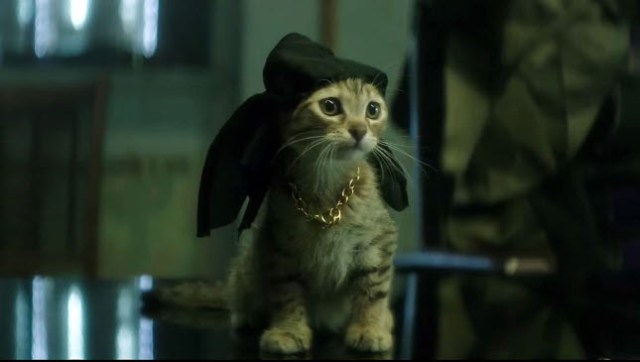
While my recent favorite ones are that adorable cat in “A Girl Walks Home Alone at Night” (2014) and the little kitten in “Mountain Cry” (2015), “Keanu” gives me another cat as memorable as them, and I must confess that, as my heart succumbed to its irresistible cuteness, I became more generous than usual to the movie. Although the movie is overlong and clunky due to its thin plot and broad characterization, it has several solid comic moments to enjoy at least, and it surely helps that the movie is supported by the undeniable comic chemistry between its two lead actors.

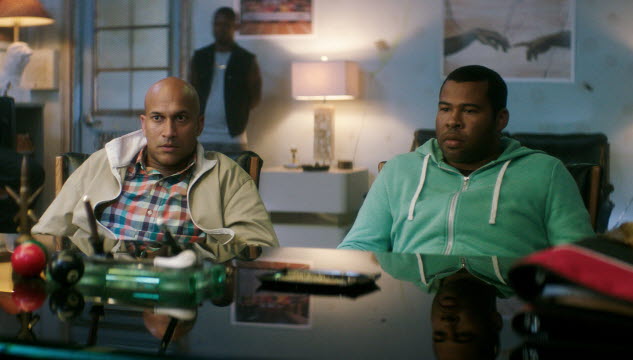
Keegan-Michael Key and Jordan Peele, who have mainly been known for their popular TV sketch series “Key and Peele”, play Clarence and Rell, two suburban black guys who have been close to each other as cousins/friends. In their introductory scene, Clarence is hurriedly driving to Rell’s residence because Rell has been seriously depressed by the recent breakup with his girlfriend, but then everything turns out to be all right for Rell when he finds an unexpected visitor in front of his house. It is just a little homeless kitten, but this small fellow instantly brightens up Rell’s melancholic heart, and he feels a lot better even before his cousin finally arrives.

Two weeks later, Clarence and Rell happen to have a chance to enjoy themselves together when Clarence’s wife and daughter are going to spend the weekend somewhere outside their house. Rell becomes more productive than usual thanks to his precious cat which was named Keanu by him right on the day of their encounter, and we get a good laugh from how he uses Keanu for making the parodic recreation of famous movie scenes such as that infamous torture scene in “Reservoir Dogs” (1992).

keanu03
But then something bad happens. While Rell and Clarence go out for watching a new action movie, somebody breaks into Rell’s house, and Rell is naturally distraught when he and Clarence find that Keanu is gone. When it looks like there is a slim but possible chance for getting back Keanu from whoever stole the cat, Rell becomes determined to do anything necessary for that, and Clarence reluctantly joins Rell even though he is well aware of the possible danger in their impromptu search for Keanu.

As they come into an area filled with dangerous criminals, they have to disguise themselves as tough hardcore guys, and the movie draws a substantial amount of laugh from when they try to emulate your average stereotype black thugs during their accidental encounter with a local drug lord named Cheddar (Method Man, who incidentally played a character named Calvin “Cheese” Wagstaff in the acclaimed TV series “The Wire”) and his gang members. Their silly bluff somehow works despite their clumsiness, and Cheddar and his gangs come to mistake Clarence and Rell for a pair of notorious assassins operating around their slum neighbourhood.

Using this classic comic situation of mistaken identity, the screenplay written by Peele and his co-writer Alex Rubens keeps throwing more gags into the plot, and some of them work while others don’t. I laughed during the payoff part of the sequence featuring the loony cameo appearance by a certain famous actress, but its meandering middle portion could be shortened for a tighter build-up process. When the third act of the movie becomes loud and violent as expected from the start, we get less laughs as violence and silliness jarringly clash with each other on the screen, and its finale feels contrived as literally coming back to its safe zone.

keanu02

Anyway, it is apparent that Key and Peele had a good time together in front of the camera. I came to notice them for the first time when they played a pair of earnest federal agents in the first season of TV series “Fargo”, and I was not so surprised to learn later that they have actually worked together for years. As shown from their funny sketches in “Key and Peele”, they are a wonderful comic duo, and that is why I could easily forgive their occasional moments of excess in their movie.

Above all, they let their tiny co-performer steal the show from them. Keanu was in fact played by seven different tabby cats during the shooting, but their performances are flawlessly seamed together for creating one believable feline character, and I really enjoyed watching Keanu doing other things besides looking cute as required.

If I could be absolutely impartial in my judgment, I would probably give “Keanu” 2.5 stars for its notably weak aspects including the under-utilization of good supporting performers like Nia Long, Luis Guzmán, Will Forte, Jason Mitchell, and Tiffany Haddish. However, as I said before, I cannot hardly be objective in front of its lovable cat character, so I add an extra half star to the rating despite my reservation. Maybe I am wrong in doing that, but, folks, you cannot judge me on that if you like cats as much as I do.

keanu05

Posted in Movies | Tagged , , , | Leave a comment

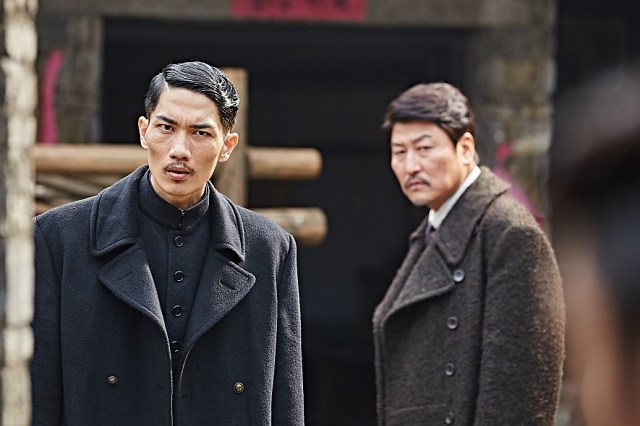
The Age of Shadows (2016) ☆☆☆(3/4): Comrade or Foe?

theageofshadows01

Apparently influenced by Jean-Pierre Melville’s great film “The Army of Shadows” (1969), South Korean film “The Age of Shadows” tells us a gray melancholic tale of underground organization members who must be very careful in every step for their dangerous operations, and the movie is dark, gritty, tense, and violent as demanded while giving us a number of visually gripping sequences along with a few unexpected moments of humor. Although its concoction of various elements is not entirely coherent, I enjoyed its better parts even while noticing its lesser parts, and that was enough to engage me during its 140-minute running time.

Its historical background is Korea during the 1920s, the middle of the Japanese Occupation era. After Korea was annexed to Japan in 1910, many Korean people participated in the independence movement inside and outside Korea in spite of the ruthless suppression of the Japanese police, and the opening sequence shows a member of Organization of Righteous Bravery attempting to sell an antique statue to a rich man who may finance the organization in exchange.

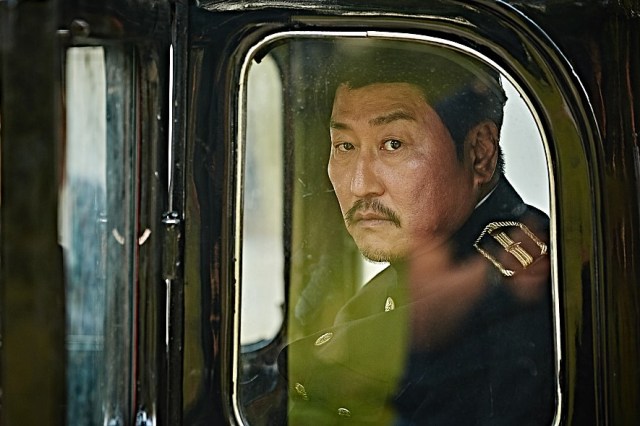
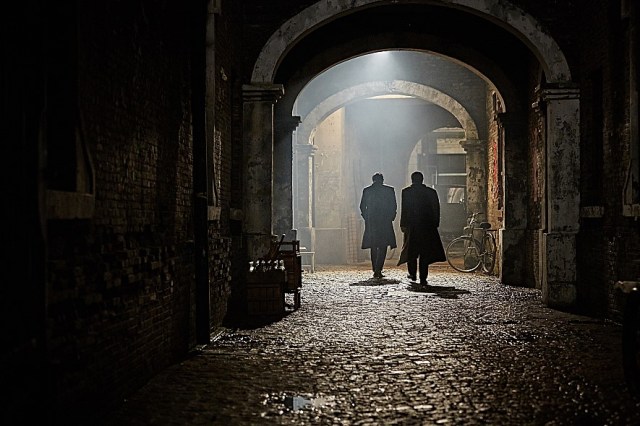
The deal does not go well when it turns out that the Japanese police is waiting for ambush in advance. Supervised by Lee Jeong-chool (Song Kang-ho), a Korean collaborator who was once associated with the independence movement but now is working as a police captain trusted by his Japanese boss, a group of military policemen swiftly pursue and then corner their target during a dynamic chase sequence unfolded around night alleys, which culminates to the final moment between Jeong-chool and the man he has known since their early years. They were once schoolmates, but now they are on opposite positions, and what will soon happen is clear to both of them as they are facing the inevitability of their circumstance.

theageofshadows03

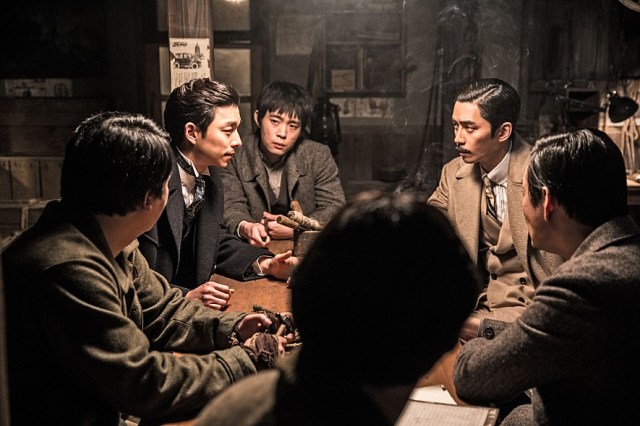
Because there are still other organization members out there and it looks like they are planning something big at present, Jeong-chool approaches closer to Kin Woo-jin (Gong Yoo), an antique dealer/photograph shop owner who is also one of the key members of the organization. When Woo-jin and other organization members flee to Shanghai after being informed of Jeong-chool’s pursuit, Jeong-chool is ordered to follow them to Shanghai for drawing their attention. He will not hide at all who he is, but he is going to disguise himself instead as someone who can be recruited by them for whatever they are planning to do.

But Woo-jin and his comrades also know that even before Jeong-chool arrives in Shanghai, and they have an idea on how to deal with Jeong-chool. They will let Jeong-chool come near to them, and then they will indirectly appeal to any conscience or doubt left inside him. After all, he is still a Korean no matter how much he tries to make himself look Japanese in front of his superiors, and double agents can always be swayed to one side or the other, even when they believe they are balancing themselves well on their thin gray middle line.

The movie has a little fun with how Jeong-chool and Woo-jin come closer to each other as spending more time together as school alumni. Both of them clearly know each other’s hidden intention right from the start, but they never say that loud while seemingly enjoying each other’s company on the surface, and it surely helps that Song Kang-ho and Gong Yoo are believable as their characters try to bait each other behind their seemingly casual appearance.

theageofshadows06Subsequently getting himself involved more than expected with what Woo-jin and other organization members are preparing, Jeong-chool also has to evade the suspicion of his police partner Hashimoto (Um Tae-goo), an ambitious guy who has his own plan for catching Woo-jin and other organization members. While Jeong-chool tries to tiptoe between both sides as much as possible, Hashimoto keeps chasing after his targets by any means necessary, and Jeong-chool finds himself in a very tricky circumstance when he and Hasimoto come to search for Woo-jin and his comrades on a train to Gyeongseong (it is the old name of Seoul, by the way).
The director Kim Ji-woon, who previously made his American directorial debut with “The Last Stand” (2013), is a competent filmmaker with keen eyes for style and mood, and I was often impressed by the stylish prowess shown in the movie. Its production design and costumes are excellent, and the cinematographer Kim Ji-young did a commendable job of establishing the moody atmosphere on the screen. I like the train sequence for its deft handling of suspense and humor, and a sequence propelled by Maurice Ravel’s “Boléro” on the soundtrack is dramatic enough to compensate for the rather predictable third act of the movie. As the director who made “I Saw the Devil” (2010), Kim does not step away from brutal moments of violence, and there are a couple of violent scenes to make you cringe for good reasons.

Song and Gong ably carry the movie with their good lead performances. Song’s engaging persona matches well to Gong’s more reserved appearance, and the uneasy relationship between their characters eventually becomes the emotional center of the movie. While Han Ji-min is sadly wasted in her thankless role, Um Tae-goo is suitably menacing although he tries a bit too hard at times (Too bad he did not grow enough mustache to twirl), and Lee Byung-hun and Park Hee-soon respectively provide small but crucial supporting performances.

“The Age of Shadows” was recently selected as the South Korean entry for the Best Foreign Language Film at the 2017 Academy Awards. I do not think the movie is the best South Korean movie of this year, but it is a well-made film to watch for its strong points none the less. The movie stumbles from time to time, but this interesting genre piece sticks to its gloomy mood to the very end while serving us entertaining moments, and I appreciate that.

theageofshadows02

Posted in Movies | Tagged , , | Leave a comment

Money Monster (2016) ☆☆1/2(2.5/4): A hostage situation on broadcast

moneymonster02

“Money Monster” tries a lot within its limited space and time. First, it tries to be a taut thriller revolving around an urgent circumstance which happens to be watched by millions of TV viewers second by second, and this premise works to some degrees during its first 30 minutes at least. Second, it attempts to handle relevant social issues associated with financial business, but it lacks enough edgy or bite for that, and it does not help that its weak plot is riddled with contrivances which demand too much of our suspension of belief around its mandatory climatic third act.

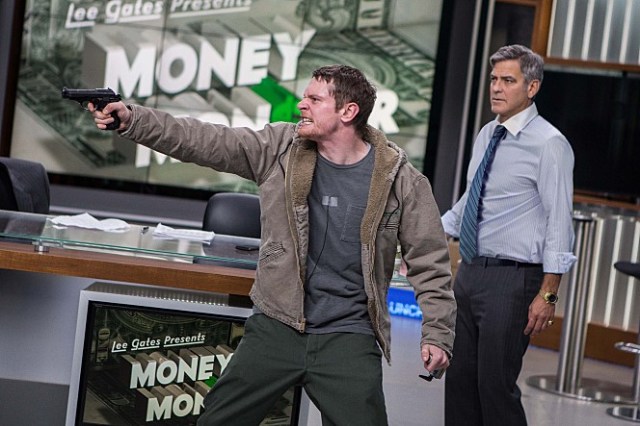
Lee Gates (George Clooney) is a financial expert who is the host of TV show ‘Money Monster’, and the opening scene shows him and his crew preparing for broadcasting the latest edition of his show. Although the stock of a big financial company he endorsed a month ago was suddenly plummeted yesterday due to some baffling glitch in its trading algorithm and caused the loss of no less than $800 million, Gates is ready to move away from his big misjudgment which surely depresses a lot of his viewers, and he is fully prepared to sell them another set of financial tips packaged with gaudy sensationalism.

However, this day turns out to be far more challenging than he thought. In the middle of the broadcast, a delivery guy comes into the studio without particularly noticed by anyone, and he soon takes Gates as his hostage right in front of the camera. Besides the gun he is willing to use at any point, this guy also forces Gates wear a jacket attached with bombs, and Gates and others in the studio including Gates’ producer Patty Fenn (Julia Roberts) become more nervous as they are told that the bombs can be detonated if they are not careful. Outside the studio building located not so far from Wall Street, a police team led by Captain Marcus Powell (Giancarlo Esposito) quickly arrives, and he and his men begin to search for any possible way to handle this tricky hostage situation without any serious collateral damage.

moneymonster03

The guy in the middle of the situation is a young man named Kyle Budwell (Jack O’Connell), who is pretty frank about his motivation right from when he wields his gun in front of Gates and others. Because of the sudden stock crash of IBIS Clear Capital, he lost all of his inherited money which could have changed his meager life if he had not followed Gates’ tip, and he is determined to get any apologetic words from Gates – or Walter Camby (Dominic West), the CEO of IBIS Clear Capital who was supposed to appear on the show for explanation.

While Gates tries to keep the situation stable at least for a while along with his reliable producer, they come to have reasonable suspicions on IBIS Clear Capital. Camby turns out to be somehow unavailable, so his chief communications officer Diane Lester (Caitriona Balfe) fills the spot instead, but she does not give any satisfying answer because she does not know much about what is really going on inside her company. In fact, she does not even know where the hell her boss is now.

As time is running out for its main characters, the screenplay by Alan Di Fiore, Jim Kouf, and Jamie Linden often swings back and forth between broad satire and serious drama, and this approach is not always successful. While there is a nice amusing surprise from Budwell’s pregnant girlfriend, a comic moment involved with a certain cream recently approved by FDA feels too silly and distracting instead of lightening up the tense situation a bit with its raunchy aspect. The director Jodie Foster, who has steadily established a modest directing career besides her fruitful acting career since her directorial debut work “Little Man Tate” (1991), does as much as she can for maintaining the tension level on the screen at least during the first half of the film, but the screenplay eventually chooses an easy and predictable way out for conveniently wrapping up everything during its last 20 minutes, and the finale is disappointingly lackadaisical in its incoherent mix of pathos and irony.

moneymonster05

As a charismatic but superficial TV personality, George Clooney perfectly fits in his role as expected. With his undeniable star presence, he can be showy and flamboyant as required, and he is also effective during more serious scenes such as when Gates tries really hard for making a persuasive point for not only the guy threatening him but also many of his viewers. Although she does not share the screen with her co-star much, Julia Roberts, who recently got a significant career boost thanks to her admirable Oscar-nominated work in “August: Osage County” (2013), is believable in her frequent interactions with Clooney, and we have no problem in believing that their characters have known and worked with each other for a long time.

In case of Jack O’Connell, a promising young British actor who impressed us a lot with a string of breakthrough performances in “Starred Up” (2013), “’71” (2014), and “Unbroken” (2014), he is unfortunately the weakest link in the cast, but this problem is not entirely his fault. Even if you can overlook his imperfect New York accent which occasionally betrays Cockney cadence, his character is as artificial as many other substantial supporting characters in the film, and he looks petulant and pathetic rather than menacing or sympathetic as a result.

As keeping noticing many of its glaring shortcomings, I also observed other few good things in “Money Monster” besides the solid chemistry between Clooney and Roberts. I liked how Giancarlo Esposito handles his thankless role with calm, no-nonsense attitude, and I also enjoyed a small but crucial supporting performance by Lenny Venito, who gradually gains our attention and sympathy as a cameraman who comes to find himself bravely rising to the occasion in a way he never imagined. Like Clooney and Roberts, these diligent veteran actors deserve better than this forgettable thriller stuff.

moneymonster01

Posted in Movies | Tagged , | Leave a comment

National Gallery (2014) ☆☆☆1/2(3.5/4): Another super work from Frederick Wiseman

nationalgallery01

“National Gallery” is as slow and austere as you can expect from a documentary film by Frederick Wiseman, a legendary American documentary director who has established his long, illustrious filmmaking career for nearly 50 years since his first work “Titicut Follies” (1967). While it just seems to look around its subject for 3 hours without any expository or interactive elements we usually expect from many conventional documentary films, this exquisite documentary film gradually lets us sense and follow its subtle but captivating flow of engaging and informative moments, and its whole picture assembled through these wonderful moments comes to us as a vivid, insightful presentation of one of the most valuable art museums in the world.

Its subject is the National Gallery in London, which was built by the British government in 1824 for the 38 paintings purchased from the heirs of John Julius Angerstein, an insurance broker who was also well-known as an art patron. Since its establishment, the museum has built up its considerable reputation as collecting more paintings, and it currently owns around 2,300 paintings dating from the mid-13th century to 1900, which put the museum on the prestigious rank belonging to a few other world-famous art museums including the Musée du Louvre and the Metropolitan Museum of Art.

After the opening scene showing the quiet early time in the museum, we soon see its halls and rooms being populated with many visitors during its opening hours. We often listen to their knowledgeable docents’ brief lectures as the camera looks closely at numerous works by various artists such as da Vinci, Michelangelo, Titian, Velázquez, Caravaggio, Vermeer, Holbein, Rembrandt, Rubens, van Gogh, Seurat, Cézanne, and Turner, and we come to learn a bit about the artistic details and values of these invaluable masterworks, while also marveled by their undeniable beauty which has been preserved for many years.

nationalgallery04

Although they are not directly introduced to us, several docents in the museum become familiar figures as we see more of their working time throughout the documentary. One guy passionately explains to young curious visitors about how he became interested in art, and, via one very good example, he demonstrates how a painting can convey so many things together. Personally, I was amused by an anecdote behind Holbein’s portrait of a Danish princess who could have been the fourth wife of King Henry VIII of England, and I became more interested in George Stubbs after learning about the painstaking efforts behind his fabulously dynamic painting “Whistlejacket”. Some paintings function as the window to that dark history of slavery during the 19th century, and we are reminded at one point that Angerstein’s enormous fortune, which was the origin of the museum, came from many insurance deals on slave ships.

Meanwhile, the other sections of the museum show us how museums do far more than merely exhibiting artworks on walls and floors. We observe a number of arts classes in the museum, and one of them shows us how the museum tries to reach even to blind people, who may be the last people you can imagine visiting galleries but, believe or not, can appreciate paintings in their own way as shown during one scene. In case of two individual drawing classes, how the students draw their nude model sketch through each own method takes me back to what one docent said before in the documentary: “The reason why I like art rather than math, although they are connected somehow, is that in art, you can be correct in lots of different ways, but in math, you can only really be right once, otherwise you’re wrong.”

Somewhere in the museum, we see a painting frame being carved and decorated, and then we watch several technicians in the conservation laboratory carefully working on the paintings in the need of restoration and preservation. In case of one Rembrandt painting, its restoration process happens to reveal an unexpected secret hidden behind the painting, and this finding wonderfully exemplifies why the restoration of an artwork is not just confined to the simple preservation of how it originally looked from the beginning. Everything from pigment to varnish is thoroughly considered during the restoration process, and we are also reminded that their restoration work is not permanent at all; paintings are bound to be deteriorated right from when they were created, and it is also important to leave some space for the further restoration in the future.

nationalgallery02

We also look at the occasional administration staff meetings of the museum. While they often disagree with each other due to their different opinions on budget and publicity, they all care a lot about how to run and promote their museum as dedicated professionals, and some of the results from their long, considerate discussions and preparations are shown in the documentary from time to time. A special da Vinci exhibition certainly draws lots of visitors as expected, and we see a long queue of people waiting outside the museum. It is then followed by two respective special exhibitions of Turner and Titian, and we see how these exhibitions contribute to the publicity of the museum while also shedding some new lights on familiar artworks at times. In case of Titian’s two paintings both of which feature Diana the goddess, they form an unmistakable thematic connection between them as being placed together, and this later resonates with a plain but sublime poem recital scene and an unadorned but gorgeous classic ballet performance around the end of the documentary.

Frederick Wiseman was not that familiar to me when I came across “Crazy Horse” (2011) in early 2012, which was about a Paris strip club famous for its colorful nude performances which are both aesthetically and erotically compelling to watch for good reasons. Even without any narration or interview to guide me, many interesting moments in that documentary were presented with underlying curiosity and fascination to engage my mind, and I came to appreciate more of Wiseman’s restrained but thoughtful approach when I later watched “At Berkeley” (2013), an unforgettable documentary film which is a 4-hour visual portrayal of how many things work and interact with each other within the small campus world of the University of California, Berkeley.

Wiseman, who will soon receive an Honorary Oscar for his exceptional lifetime achievement late in this year, did another superb job here in “National Gallery”. After spending 12 hours a day at the museum during almost every day of his 12-week shooting period, he worked on his raw footage amounting to no less than 170 hours, and the final result shown in the film effortlessly immersed me into a long but memorable experience worthy of my 3 hours. I must confess that I have never been to the National Gallery (shame on me!), but Wiseman’s documentary put me there at least during my viewing, and now I want to visit there more than before.

nationalgallery05

Posted in Movies | Tagged , , | Leave a comment

Truth (2015) ☆☆☆(3/4) : A report marred by devastating mistakes

truth01

They tried to report a truth, but then their minor mistakes ultimately eclipsed and muddled the main point of their report while resulting in considerable personal costs for everyone. Looking closely into the messy circumstance surrounding the flawed TV report on George W. Bush’s questionable military record, “Truth” gives us a bitter drama about the troubling trend of modern journalism which has only become worse since that, and that is why I often found its messages resonating although I was also distracted by its weak points to notice.

After the opening scene in which Mary Mapes (Cate Blanchett), the producer of CBS news program 60 Minutes Wednesday, visits a lawyer she is going to hire for her upcoming internal review panel, the movie goes back to 2004 April, which was one of her career highpoints. When the torture and prisoner abuse in the Abu Ghraib prison is reported by veteran anchor Dan Rather (Robert Redford) on her news program, this exposé further tarnishes the public image of the Bush administration which has already been pretty unpopular since the 2003 invasion of Iraq, and it looks like Bush will not succeed in getting re-elected in the upcoming US presidential election.

Meanwhile, Mapes and her crew come across what can be another scoop of the year. While searching for any connection between an oil company found by Bush and the bin Laden family, they find a more interesting thing in Bush’s past. During the 1970s, Bush could have been drafted and then sent to Vietnam like many other young Americans, but he came to serve as a pilot in the Texas Air National Guard instead, and it seems possible that he avoided going to Vietnam thanks to his father’s considerable political influence.

Via their thorough examination of Bush’s military record, they find several notable things to support this possibility. From the beginning, Bush did not have much previous experience or training for qualification, and he also had considerable difficulty in meeting minimal physical aptitude testing standards. Furthermore, he even went AWOL at some point, and this was somehow overlooked by his superiors.

truth03

Because there is not yet any definite evidence to prove that Bush got preferential treatment in the military, they begin to search for potential proofs, and that is how they come to encounter a retired military guy named Bill Burkett (Stacey Keach). He has a copy of revealing personal memos written by Bush’s military commander, and these documents look authentic as far as Mapes and her crew can see.

Although some of their experts have reasonable doubts on the authenticity of the documents, Mapes decides to do the coverage on them while getting the full support from Rather. Especially after one source who previously rejected her crew’s phone call confirms that these documents are real, everything seems to work out fine as Mapes and her crew hurriedly prepare for their report during a very short period of time, and they feel elated to see it broadcast on September 8th, 2004.

But then the situation is suddenly changed because of what they unwisely overlooked during the process. After the documents are shown on TV, several right-wing websites start to claim that they are forgery, and there are indeed a few suspicious things about the documents. It later turns out that Burkett is not so honest about how he managed to obtain the documents, and that gives more troubles for Mapes and her crew.

The screenplay by the director James Vanderbilt, which is based on Mapes’ nonfiction book “Truth and Duty”, works best when the movie calmly observes how things get worse for Mapes and her crew. While it looks like they can get the circumstance under control at first, they only find themselves more cornered as the attention of media and public is more focused onto their blunder rather than the veracity of Bush’s military record. While the US presidential election day is approaching, their apparently flawed but mostly reasonable report is continued to be lambasted by media, and Andrew Heyward (Bruce Greenwood), the president of CBS News, becomes more pressured to do something which will not be a good news for them at all.

truth02

As Mapes goes through what is probably the worst crisis in her life and career, Cate Blanchett is deft in the edgy presentation of her character’s increasingly agitated state. Although Rather and her caring husband Mark (John Benjamin Hickey) stand by her during this very difficult period, Mapes still feels like going back to the painful past associated with her abusive father, and she certainly becomes lousy and depressed as watching the eventual result of the US presidential election in 2004 November. She keeps trying to fight against her unfair situation, but she knows well that she is already losing, and that frustrates her even more.

While Robert Redford is fine in his effortless performance which interacts well with Blanchett’s during their scenes, many of other notable supporting performers in the movie are unfortunately under-utilized. As Mapes’ main crew members, Dennis Quaid, Topher Grace, and Elizabeth Moss do not have many things to do with their colorless roles, and Grace gets an unenviable job of handling a blatantly preachy scene at one point. Stacy Keach gives a brief but impressive performance as an ailing man who should have been more straightforward about his supposedly valuable documents, and Noni Hazlehurst has her own small moment as Burkett’s concerned wife.

Compared to “Spotlight” (2015), another recent drama about real-life journalists pursuing truth, “Truth” is a minor work in comparison. I must tell you that the movie is not entirely satisfying due to its several missteps including the frequent overuse of dramatic score which is particularly obvious during the closing sequence, but it is worthwhile to watch to some degrees, and it feels relevant especially considering the current media frenzy surrounding the US presidential election of this year. It is not without flaws, but its messages are delivered mostly well at least.

truth04

Posted in Movies | Tagged , , | Leave a comment

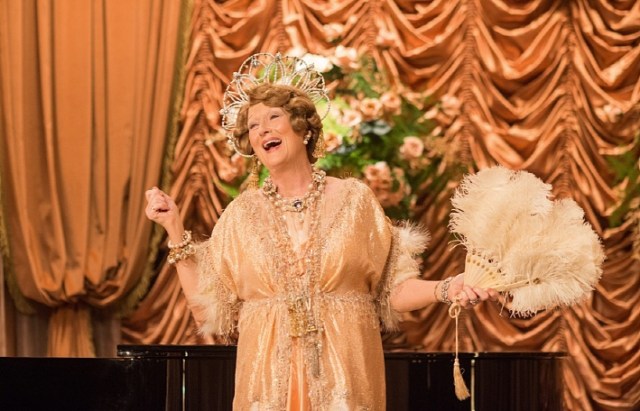
Florence Foster Jenkins (2016) ☆☆☆(3/4): No one can say that she didn’t sing…

florenceflorajenkins05

Florence Foster Jenkins (1868-1944) was quite an interesting woman for not only her sheer lack of talent but also her incredible obliviousness to that awful truth. It seemed she really believed she was a good singer, but it is apparent from the archival recordings of her performances that she was indeed a terrible one to say the least. Once you check out these recordings of hers available at websites including YouTube, you will instantly understand why it is said that Cole Porter, one of her notable fans, had to bang his cane into his foot for not laughing out loud during her performance. Yes, she was so bad that her singing was as impressive as those goofy crass cult films by Edward D. Wood Jr., and it is no wonder that Porter rarely missed her recital.

Stephen Frears’ new film “Florence Foster Jenkins” has a lot of fluffy fun with its undeniably fascinating human subject, and the result is a sweet, lighthearted period comedy with some poignancy and gravitas to balance its many uproarious moments. Thanks to its three amiable main performances, the movie smoothly glides along with big laughs for us, and we find ourselves liking and caring about its seemingly superficial main characters a lot as they rise to the occasion under their outrageous comic circumstance.

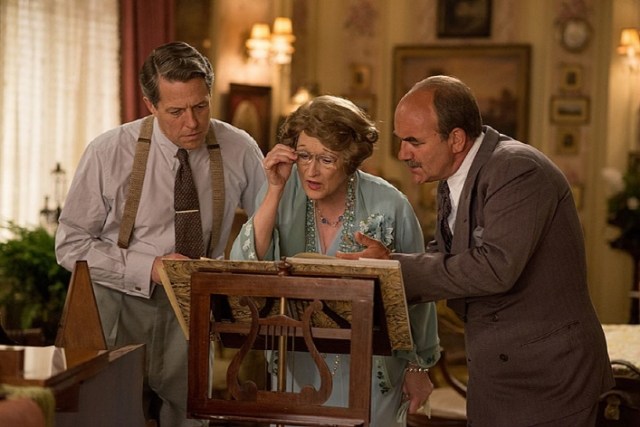
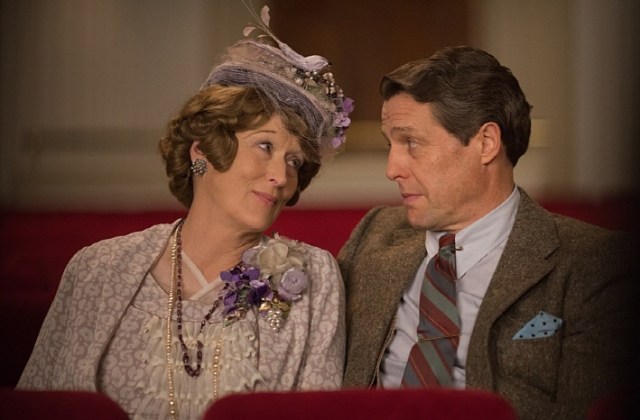
It is 1944 in New York City, and the ongoing war outside US feels like a gloomy but distant cloud in the affluent and luxurious world of Florence Foster Jenkins (Meryl Streep), one of the prominent socialites in New York City who is also the president of the Verdi Club, her own social organization for music lovers. The opening sequence in the film shows her private music stage show for the club members, and she does a fairly good job under the direction of St. Clair Bayfield (Hugh Grant), a washed-up Shakespearean actor who has lived with Jenkins as her de fact second husband/manager. While other performers handle singing parts, all she has to do is posing as instructed during each scene, and everyone is fine with that.

florenceflorajenkins01

But Jenkins is eager to sing in front of others as following her sincere passion toward music, and Bayfield cannot say no to her. While he is currently in the relationship with Kathleen Weatherley (Rebecca Ferguson from “Mission: Impossible – Rogue Nation” (2015)), he remains devoted to Jenkins none the less, and her happiness is always his No.1 priority. In fact, we later learn that his relationship with Weatherley is a practical arrangement in the sexless relationship between him and Jenkins, though he prefers to keep it under cover to his mistress’ frustration.

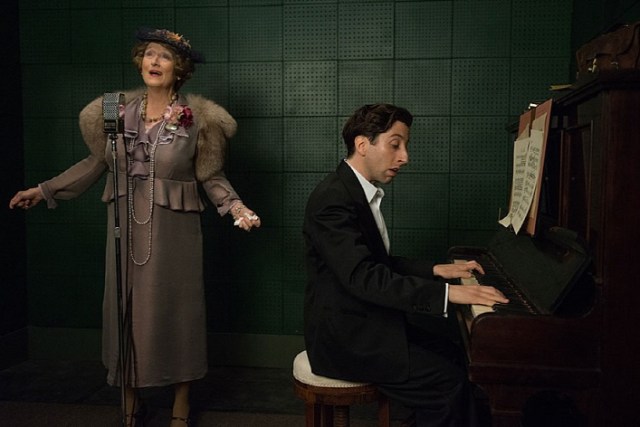
Several pianists soon come to Jenkin’s place of residence in a posh downtown hotel for the audition for the accompanist in her singing lesson, and that is how a young pianist named Cosmé McMoon (Simon Helberg) comes into the picture. He cannot believe his luck when he manages to earn Jenkins’ affection and esteem, but then he comes to behold his wealthy employer’s unforgettable singing ability, and Simon Helberg is hilariously tense and awkward as his character is trying to get his posture under control while also struggling to suppress a certain urge during this priceless scene.

In front of Helberg and her other co-performers, Meryl Streep is effortlessly impeccable as embodying her character’s atrocious singing and incorrigible earnestness. We all know that Streep is in fact a good singer as shown from “Mamma Mia” (2008) and “Into the Woods” (2014), but she is quite convincing enough to make us forget that at least for a while, and I must report to you that her singing scenes always drew giggles from me and other audiences during the screening.

florenceflorajenkins02

Although hopelessly unaware of her terrible singing, Jenkins comes to us as a good-natured old lady who simply enjoying herself with fulfilling her misguided lifelong aspiration, and Streep brings lots of gentle charm and humanity to her character. We cannot help but roll our eyes as watching Jenkins virtually butchering a number of familiar songs, but we also come to see modesty and good-will from a fragile but ebullient woman who is not so easily inhibited by her bad health, which was resulted from her syphilitic infection and the following poisonous medical treatments via arsenic and mercury (it has been speculated that they were the main reason for her aural insensitivity, by the way).

Hugh Grant, who notably looks older than before, is another delight in the movie. Classy, charming, and snobbish as usual, Grant gives a wry deadpan performance complementing Helberg’s neurotic acting, and he is surprisingly touching during the private scenes between Jenkins and Bayfield. They are not exactly conventional spouses, but their long relationship is deeper than it initially seemed, and that surprises even Bayfield himself, who, like McMoon, comes to worry more about Jenkins when her singing is getting more public expose than they have ever imagined. As shown during the climax part of the movie, Jenkins really performed at the Carnegie Hall on October 25, 1944, and it was definitely something to be remembered for everyone besides Jenkins herself.

Although Nicholas Martin’s screenplay is a bit heavy-handed as trying to draw more sympathy and cheer from us, “Florence Foster Jenkins” already earns our laughs and applauses mainly thanks Streep, Grant, and Helberg, and the movie is as enjoyable as Frears’ other small lovable comedy films such as “Mrs. Henderson Presents” (2005) and “Tamara Drewe” (2010). Boy, she cannot sing at all, but, what the hell, nobody can say that she did not sing, right?

Sidenote: Jenkins’ life story also partially inspired French comedy film “Marguerite” (2015), which has its own delightful comic elements including its lead actress Catherine Frot’s equally memorable comic performance.

florenceflorajenkins03


Posted in Movies | Tagged , , | Leave a comment

Ghostbusters (2016) ☆☆☆(3/4): Ladies are not afraid of ghost either

ghostbusters03

“Ghostbusters”, the reboot/remake of the 1984 film, attempts to do something different, and that should be respected although the result is not wholly different from what we saw from the 1984 film and its 1989 sequel. Again, we are treated with the cheery mix of comedy and horror as those scary ghosts begin to haunt around New York City, but then we have female lead characters in this time, and this interesting gender change indeed brings some fresh air, though the movie is not entirely successful enough to silence those petty misogynist/racist online trolls once for all.

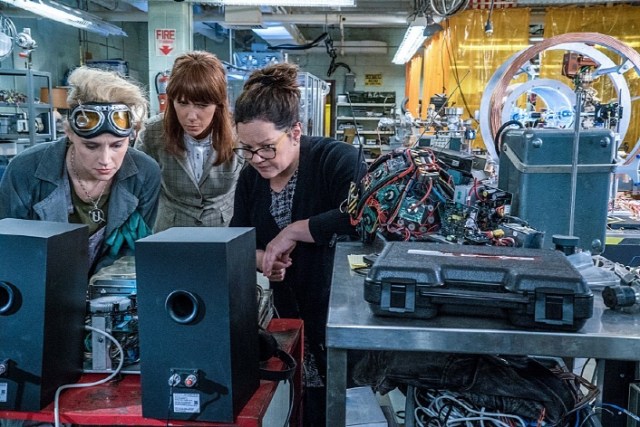
The first half of the movie revolves around how Dr. Erin Gilbert (Kristen Wiig) finds herself being associated again with her estranged friend/colleague Dr. Abigail “Abby” Yates (Melissa McCarthy). As a theoretical physics professor of the Columbia University, she has worked hard for years for gaining tenure, and she is now almost close to the point of fulfillment, but then she is dragged into an area she thought she left behind when she reluctantly takes Abby and Abby’s current colleague Dr. Jillian Holtzmann (Kate McKinnon) to a historical site which is apparently haunted by a real ghost. While the eventual incident at the site results in her discharge from the university, this genuine paranormal happening re-ignites Erin’s enthusiasm toward paranormal activities, so she comes to return to her good old research while working along with Abby and Jillian.

After managing to rent a tacky place right above some cheap Chinese restaurant, they hire two employees. One is Patty Tolan (Leslie Jones), a subway station employee who happens to witness another spooky case of ghost along with them and soon joins them as the fourth member of the team. While she is not a scientific professional, Patty shows her resourcefulness through her considerable knowledge about many historical places in New York City, and she also shows her pluck especially during the rock concert sequence which features the brief cameo appearance of a certain famous musician.

ghostbusters02

The other one is Kevin Beckman, a hunky bubblehead played by Chris Hemsworth with surprising wit and gusto. Hemsworth, who has recently tried to expand his acting range beyond that flat, boring knucklehead superhero character in the Marvel Comics Universe, is fun to watch whenever his character shows his incorrigible incompetence which is usually masked by his good-looking body, and his comic performance works as another amusing gender reversal in the film. Never overshadowing his female co-performers, he is willing to throw himself into silliness and outrageousness, and I got a few good chuckles from that.

As our heroines are testing the water in their new area along with a number of gadgets developed by Jillian, it becomes apparent that something sinister is going on around the city. There is a creepy guy named Rowan North (Neil Casey), and this megalomaniac is taking the first steps toward his vengeful secret plan for the city. Erin and her colleagues try to stop this as soon as possible, but then they become frustrated with local authorities including Mayor Bradley (Andy García), who wants to keep things hidden from citizens as much as possible.

The screenplay written by the director Paul Feig and his co-writer Katie Dippold throws many gags into their rather formularized plot, and some of them work while others don’t. While a running gag involved with a delivery guy feels repetitive, there are several comic elements which could be funnier if they were handled with more effective build-up process. I guess a reference to “The Exorcist” (1973) is mandatory if you are going to have a scene of demonic possession, but, though I did laugh during that scene, I could not help but think that it could have been more hilarious if they had tried more than expected laughs.

ghostbusters04

After all hell finally breaks loose in the city around its third act (is this a spoiler?), there comes a massive climatic sequence decorated with lots of CGIs on the screen. The special effects in the film surely look better that the dated ones in the 1984 film or the 1989 film, and it is certainly nice to see some of familiar ghost characters, but this sequence is not that thrilling mainly due to the one-dimensional villain character, who will not probably be remembered well like Gozer or Vigo the Carpathian.

But the movie remains buoyed by the spirited comic chemistry among its four leading actresses. While Kristen Wiig and Melissa McCarthy dial down a bit of their familiar comic persona, their two co-stars confidently demand our attention regardless of whether we like them or not. Kate McKinnon goes all the way to wield the odd mannerism of her quirky character who becomes sort of endearing despite her endlessly bizarre aspects, and Leslie Jones, who I sincerely hope will soon recover from all those nasty online attacks and insults she does not deserve at all, also holds her own place. As these talented actresses bounce around here and there together, several main cast members of the 1984 movie briefly appear in minor roles, and that is an extra fun for you if you are familiar with the 1984 film.

I do not think “Ghostbusters” is the best entertainment in the summer season of this year which has been lackluster compared to the previous seasons, and I must point out that Feig’s previous film “Spy” (2015) is funnier with more creativity, but the movie did its jobs despite its visible shortcomings to notice. Our ladies are not afraid of ghosts either, and they may be able to do better in next time.

ghostbusters01

Posted in Movies | Tagged , , , , | Leave a comment

Weiner (2016) ☆☆☆1/2(3.5/4): The second rise and fall of Weiner

weiner01

When Anthony Weiner attempted to run for the office of Mayor of New York City in 2013, he seemed to be on the way to a sort of redemptive comeback, and he actually had a very good chance for that. He had right people who could gladly help him, and the public was ready to accept him again even though everyone still remembered when he fell hard with lots of public humiliation a few years ago.

However, he found himself screwing up his second chance as being slapped with another public humiliation, and documentary film “Weiner” gives us a closer look at the progress of his absurd fall which was quite an unexpected Shakespearean narrative turn for its filmmakers. The directors Josh Kriegman and Elyse Steinberg were allowed to hang around Weiner and other campaign staffers from the very beginning of his campaign, and Weiner mostly let himself exposed in front of their camera except a few occasions in the documentary. It is compelling to watch how his seemingly promising campaign came to be collapsed because of his human foible, and it is also darkly amusing to observe how he got himself into another mess because he simply could not help himself despite his previous hard lesson.

As shown during the early part of the documentary, Weiner became a rising star of his party after he moved from the New York City Council to the U.S. House of Representatives in 1999. He was pretty good at drawing media attention to his savvy political activities in the House, and we see how he pulled out all the stops to lambast Republican congressmen voting against the 9/11 Health and Compensation Act in 2010. He consequently became a more prominent figure in Washington D.C. as everybody talked about him, and it certainly helped that his wife Huma Abedin was one of the most trusted aides of Hilary Clinton. In fact, Bill Clinton officiated at the wedding when Weiner and Abedin married in 2010.

weiner04

But then he was struck down by a scandal in 2011, and everything Weiner had accomplished was crumbled down as a result. When he sent a very inappropriate photograph to one of his many Twitter followers, it did not take much time for that photograph in question to be spread around the whole world, and he quickly became a national laughing stock. He probably intended it as a private joke, but we all know too well that there is no such thing like privacy on the Internet – especially if you are a well-known public figure who is always expected to show examples to others.

Eventually, after several denials and evasions, Weiner admitted his big mistake with a public apology, and he subsequently resigned as demanded while trying to recover from this disastrous scandal. Although she was apparently hurt by her husband’s indiscreet behavior, his pregnant wife stood by him anyway, and she supported him wholeheartedly when he reached for his second chance two years later.

Things seem hopeful as the camera looks around the Weiners’ apartment or the headquarters of his campaign for the upcoming Democratic Party primary for Mayor of New York City. With his wife and their young son around him, Weiner is confident about the primary although his past scandal is being brought into spotlight as everyone expected, and Abedin and other campaign staffers are ready for making his political comeback possible.

 Despite the initial skepticism around his campaign, it turned out voters were willing to give Weiner a second chance. As fiercely competing against other candidates, Weiner reached out to voters along with his intact enthusiasm, and many voters began to forgive his public misdemeanor. At one point, the documentary gives us a humorous moment which shows how his campaign was more exciting compared to the campaign of Bill de Blasio, the current Mayor of New York City.

weiner02

As his popularity in public kept going up and up to everyone’s surprise, there came another twist in 2013 July. It was revealed that Weiner corresponded with a 22-year old woman via a website called The Dirty while many explicit pictures and sexting messages were exchanged between them, and this was an unmitigated disaster to Weiner’s campaign mainly because it happened *after* his resignation as a congressman in 2011.

Weiner and his campaign staffers tried to get things under control, but the circumstance became more daunting as the chance of recovery was rapidly decreasing. While struggling to deal with her husband’s another trouble, Abedin also tries to suppress whatever is boiling inside her, and we can only guess from her hardened face how much she feels hurt and betrayed. During one scene, Weiner sincerely apologizes to his wife and campaign staffers, and he also tries hard to shift media attention away from his new scandal, but it turns out that he is his worst enemy, as shown from his catastrophic live interview with Lawrence O’Donnell.

In the end, “Weiner”, which received the US Grand Jury Prize at the Sundance Film Festival early in this year, culminates to an absurd climactic moment which did happen during the evening of election day, as alternatively captured by two cameras. It is rather amazing that Weiner let the filmmakers shoot what may be the most humiliating moment in his life, and he even agreed to be interviewed later. Musing on how he came to ruin his chance as disappointing himself as well as others around him, he looks fine for now, but I cannot help but think of one of my late friend Roger Ebert’s favorite lines from “Citizen Kane” (1941): “If it was anybody else, I’d say what’s going to happen to you would be a lesson to you. Only you’re going to need more than one lesson. And you’re going to get more than one lesson.”

weiner03

Posted in Movies | Tagged , , | Leave a comment