A Haunting Hitchhike (2017) ☆☆☆(3/4): In an unkind world

ahauntinghitchhike01

South Korean film “A Haunting Hitchhike” is the gloomy story of a young teenage girl struggling with harsh aspects of her unkind world. She simply hopes that things will get better for her, but she only finds herself facing more troubles on her way, and it is often poignant to see how she manages to maintain her dignity and strength although life still remains hard and difficult for her even at the end of the story.

In the beginning, we meet Jung-ae (Roh Jeong-eui), and we get a brief glimpse into her shabby daily life. Since her mother and sister left them some time ago, she and her father Young-ho (Kim Hak-sun) have lived alone in a poor neighborhood located somewhere in Seoul, but, as revealed later in the story, Young-ho has been terminally ill due to cancer, and there is not anyone to help them, though she has recently received several formal letters notifying her of where her mother is at present.

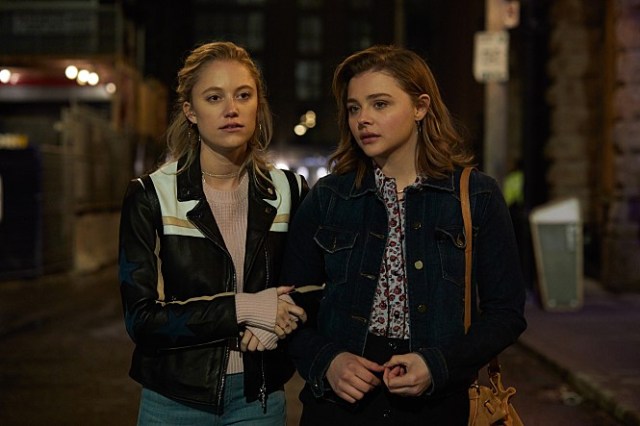
Meanwhile, Jung-ae’s school friend Hyo-jung (Kim Go-eun) came to know more about her father who left her and her mother when she was very young. Because the rural area where he seems to reside now happens to be near the place where Jung-ae’s mother is supposed to be staying, Hyo-jung and Jung-ae decide to take a trip together on one day, but they soon find themselves at the dead end shortly after arriving in that rural area, and then they get themselves into a possibly dangerous circumstance.

Fortunately, Jung-ae and Hyo-jung manage to save themselves in the end, and we subsequently see them being questioned by a couple of local cops at a local hospital. When one of these two cops shows his badge, Jung-ae notices that his name is identical to the name of Hyo-jung’s father, and she becomes more curious about that cop as he allows her to stay at his house for one night.

ahauntinghitchhike04

After Jung-ae eventually returns to her home, the situation keeps getting worse for her and her father. As he becomes far sicker than before, his doctor recommends more therapy, but neither Young-ho nor Jung-ae has insurance to cover the considerable cost of his cancer treatment, and he also gets fired from his menial job due to his illness. While fully accepting his approaching death, Young-ho only hopes that his daughter will be okay after he is gone, but then he cannot help but become quite frustrated when he comes to learn that they cannot be on welfare for a rather trivial reason.

With some assistance from Hyo-jung, Jung-ae tries to get any kind of help. At one point, she and Hyo-jung go to a small apartment belonging to someone Jung-ae knows, but, not so surprisingly, they soon receive a harsh response from that figure in question. When she subsequently goes to a place where her mother is supposed to stay, she receives another bad news, and that makes her more disappointed and frustrated than before.

Later in the story, Jung-ae comes to approach to that aforementioned cop because she had a brief moment of comfort and happiness at his place, but she is not totally honest with him, and it soon turns out that the cop and his family have their own trouble to deal with. The cop has a son, but he is angry about his son having been involved with some religious group, and the mood becomes quite awkward and tense when the cop and Jung-ae happen to have a dinner along with his son.

ahauntinghitchhike05

Although the story takes a sudden melodramatic turn during its last act, the movie keeps maintaining its calm, detached attitude while letting us more emotionally involved in Jung-ae’s increasingly depressing circumstance, and we are served with several quiet but powerful moments to remember. There is an infuriating scene where Jung-ae is unfairly treated by the police for a certain incident involved with her father, and then there is also a small touching moment showing Jung-ae and Hyo-jung reconfirming their friendship to each other.

Above all, the movie exemplifies well considerable talent of Roh Jeong-eui, who previously drew my attention via her scene-stealing supporting turn in “Phantom Detective” (2016). Deftly balancing her character well between vulnerability and resilience, Roh steadily holds our attention from the beginning to the end, and she is particularly good whenever she wordlessly conveys to us whatever is churning behind her character’s weary façade. In case of a few supporting performers around her, Park Hee-soon and Kim Hak-sun are solid in their respective supporting roles, and Kim Go-eun holds her own small spot well during her several scenes with Roh.

“A Haunting Hitchhike”, which was shown at the Busan International Film Festival in 2017 but was belatedly released in South Korea a few months ago, is the first feature film by director/writer Jeong Hee-Jae. Although I must point out that there have been many other gloomy South Korean independent films trying to present a hard realistic slice of life, her movie distinguishes itself via not only its sensitive storytelling but also its commendable lead performance, and it surely deserves to be mentioned along with other recent similar South Korean independent films such as “Steel Flower” (2015) and “February” (2017). In other words, this is another interesting South Korean movie of this year, and I recommend you to give it a chance someday.

ahauntinghitchhike03

Posted in Movies | Tagged , | Leave a comment

The Great Buster: A Celebration (2018) ☆☆☆1/2(3.5/4): The Great Stone Face

thegreatbusteracelebration01

As far as I remember, I only watched a few works of Buster Keaton (Shame on me!), but those films were more than enough to show me that he was an extraordinary silent movie star to be appreciated and admired. While willing to hurl himself into many different kinds of comic stunts which are still astounding to say the least, he was effortlessly funny and endearing with his constant deadpan appearance, and he is indeed a comic genius who deserves to be mentioned along with Charlie Chaplin and Harold Lloyd.

That was why I had considerable expectation when I was about to about to watch Peter Bogdanovich’s documentary film “The Great Buster: A Celebration” on the last day of the 20th Jeonju International Film Festival, and I am happy to report to you that it did not disappoint me at all. While it may not enlighten you much if you have some basic knowledge on Keaton’s life and career, the documentary did an admirable job of looking around Keaton’s life and career, and it surely reminded me again of Keaton’s undeniable talent and star quality.

At the beginning, the documentary focuses on Keaton’s early life. Both of his parents were vaudeville performers often working here and there around the country, and he was brought into his parents’ show business not long after he was born in the middle of their vaudeville tour in 1895. Thanks to his natural talent, it did not take much time for young Keaton to become another important part of his family show, and there is an amusing anecdote about how young Keaton was frequently put into a number of dangerous but popular acts on the stage by his parents, who could actually have been arrested for child abuse because of that.

thegreatbusteracelebration03

After learning a lot from his parents during those wild years, Keaton grew up to be a prominent vaudeville star during the 1910s, and then there came a crucial turning point for his career when he happened to meet his old friend/colleague Roscoe “Fatty” Arbuckle in New York City, 1917. He introduced Keaton to movie business, and Keaton was instantly drawn to it as discerning its considerable potentials. After the World War I, he made a number of silent comedy short films along with Arbuckle, and that was the period when he came to establish his singular stone face screen persona.

Keaton subsequently moved to Hollywood along with Arbuckle, and, after making several two-reel silent comedy films such as “One Week” (1920), he moved onto what is regarded as the pinnacle of his filmmaking career. After “Our Hospitality” (1923), there came a series of superb silent comedy feature films such as “The Navigator” (1924), “Sherlock Jr.” (1924), “The General” (1926), and “Steamboat Bill, Jr.” (1928), and they are all still pretty funny and amazing mainly thanks to Keaton’s uncanny comic timing which still tickles us a lot even at present.

While making these and other comedy films, Keaton did various kinds of stunts for himself, and the documentary tells us a bit about how fearless he was. Although he could have died or seriously injured, he kept throwing himself into those risky comic moments for inducing genuine laughs from his audiences, and you will be more amazed by how steadily he maintained his deadpan attitude in front of the camera despite numerous risk factors surrounding him on the set.

Shortly after making “Steamboat Bill, Jr.”, Keaton came to be under contract with MGM, but, as Chaplin and Lloyd warned him, that move turned out to be a disastrous turn for his life and career. Under the rigid movie studio system, he completely lost the artistic control over his following films, and he soon became frustrated and disillusioned while also struggling with his growing alcohol problem. Around the end of the 1930s, he became a mere contract player who only earned around 100 dollar per week, and that was really a big fall from his prime period when he earned around 4,000 dollar per week.

thegreatbusteracelebration02

Nevertheless, Keaton kept going on like a trouper, and things got a little better for him during the 1940-50s. While his personal life was stabilized thanks to his third wife who stayed beside him till his death in 1966, he did not hesitate to accept whatever was handed to him, and he even demonstrated that he was pretty good at playing serious roles. In Billy Wilder’s caustic classic black comedy film “Sunset Blvd” (1950), he was willing to appear along with several forgotten silent movie stars for generating an authentic moment of bitter laugh, and he later appeared along with Chaplin in Chaplin’s “Limelight” (1952), where he virtually stole the show from Chaplin even though he briefly appeared around the end of that film.

In the meantime, Keaton’s works were rediscovered by critics and audiences. He received an Honorary Oscar in 1960, and he was certainly touched to see his movies being wholeheartedly welcomed at the Venice Film Festival in 1965. During the last part of the documentary, Bogdanovich enthusiastically presents and analyzes some of Keaton’s best films one by one, and that certainly confirms to us again that timeless comic quality of Keaton’s works.

On the whole, “The Great Buster: A Celebration”, which received the Venezia Classici Award at the Venice Film Festival in last year, is an engaging and respectful tribute to Keaton’s life and career, and I was particularly entertained to see a bunch of various interviewees in the documentary, who are all quite willing to talk a lot about Keaton and his movies. In short, this is a pretty enjoyable documentary, and it will certainly make you to check out some of Keaton’s works as soon as possible.

thegreatbusteracelebration04

Posted in Movies | Tagged , , , , , | Leave a comment

Diane (2018) ☆☆☆(3/4): As she takes care of others

diane01

“Diane”, which won three awards including the one for Best Narrative Feature at the Tribeca Film Festival in last year and was recently shown at the Jeonju International Film Festival in this week, is a little character drama about one ordinary woman who has been quite accustomed to taking care of others around her. As calmly and sensitively observing small ups and downs of her melancholic daily routines, the movie gives us a plain but unforgettable slice of life, and it certainly helps that the movie is anchored well by a bunch of wonderful performances to be appreciated.

Mary Kay Place, a character actress who appeared in numerous films such as “The Rainmaker” (1997) and “Being John Malkovich” (1999), plays Diane, a middle-aged woman who has lived in some small town of Massachusetts for many years. While living alone in her house, her daily life mainly consists of several different things to do for her close relatives and neighbors, and we frequently see her going here and there in the town by her car throughout the film. At one point earlier in the film, she drops by a house belonging to one of her neighbors for giving back something she thinks she should have returned several months ago, and then we get a little sweet moment when the neighbor responds to Diane with same kind consideration.

Although she seems to feel good about being selfless for others, Diane has not been that happy in her private life. Her cousin Donna (Deirdre O’Connell) has been dying due to her terminal illness, and there is nothing Diane can do for Donna except often visiting Donna at a local hospital where she is going to spend her little remaining time. The mood is cheerful whenever Donna feels fine enough to play a card game with Diane, but both of them are well aware of how Donna’s medical condition gets worse day by day, and it later turns out that neither of them forgets a hurtful incident which happened between them a long time ago.

diane03

In case of Diane’s addict son Brian (Jake Lacy), he has been a major headache for her, but she keeps trying to help her son as much as possible despite her growing frustration and exasperation. When she happens to come to her son’s shabby place, she is not so pleased to see him hitting another bottom of his addiction, but she does not give up her son at all for a personal reason to be revealed later in the story, and she tries to persuade her son to go through another round of rehabilitation even though she knows that her son will not listen to her.

At least, things are not always gloomy for Diane, and we see how she is helped and supported by others around her. When she gets too drunk at a local bar just after going through another moment of frustration in her daily life, two people close to her instantly come to the bar for taking her back to her home, and that is one of the most touching moments in the film. When she suddenly gets quite exasperated while working at a place for homeless people, her co-worker/friend quickly intervenes in this situation, and we see how she tactfully has Diane calm down herself a bit.

And Diane comes to have some reflection on her life in private. Becoming more aware of her mortality via the eventual death of several old people around her, she begins to write down her feelings and thoughts, and we later get a surreal scene which seems to be the subconscious reflection of her old guilt over how she came to hurt not only Donna but also young Brian due to her rather selfish act at that time.

diane02

Although its story stumbles a bit during its last act, the movie keeps engaging us via its realistic mood and vivid characters, and director/writer Kent Jones, who has been mainly known as a film critic and the director the New York Film Festival and previously directed documentary feature film “Hitchcock/Truffaut” (2015), and his crew members did a competent job on the whole as constantly generating small human scenes to draw our attention. I particularly like a warm, lively scene where Diane and a group of other characters in the film talk a lot with each other during one evening, and I guarantee to you that you will be quite impressed by the palpable sense of life and personality during this scene.

It goes without saying that Place’s unadorned nuanced performance is the heart and soul of the film, but the other notable performers in the film have each own moment to shine, and they all are fabulous in their solid supporting performances. While Jake Lacy, who drew my attention via his supporting roles in “Obvious Child” (2014) and “Carol” (2015), reminds me again that he is indeed an interesting actor to watch, I was also delighted to watch Deirdre O’Connell, Glynnis O’Connor, Joyce Van Patten, Phyllis Somerville, Andrea Martin, and Estelle Parsons (Remember her Oscar-winning supporting turn in “Bonnie and Clyde” (1967)?), and they did not disappoint me at all as playing their respective supporting role with small fine human details to be observed.

Overall, “Diane” is worthwhile to watch for its thoughtful storytelling and superlative performances, and it certainly deserves more attention considering that it was unfortunately overlooked after it was released in US a few months ago. Although it initially looks modest on the surface, it will be a rewarding experience once you give it a chance, and you will not easily forget Diane and other characters in the film after it is over.

diane03

Posted in Movies | Tagged , , | 1 Comment

To Dust (2018) ☆☆☆(3/4): A deadpan Jewish comedy on body decomposition

todust03.jpg

As watching “To Dust”, a little comedy film which won the Narrative Audience Award at the Tribeca Film Festival in last year, I was reminded of that memorable quote from Errol Morris’ great documentary “Gates of Heaven” (1978): “Death is for the living and not for the dead.” While dryly and wryly observing how its two different main characters try to deal with death in a rather morbid way, the movie generates several nice deadpan moments to be savored for a dark sense of humor, and we certainly get some good laughs as also coming to reflect more on its gloomy subject which is undeniably connected to our life in one way or another.

Géza Röhrig, who was utterly unforgettable in Oscar-winning Hungarian film “Son of Saul” (2015), plays Shmuel, a married man living in some Orthodox Jewish neighborhood of New York City. At the beginning, Shmuel’s wife dies because of her sudden illness, and he is clearly devastated by her death even though he does not express much the grief and sadness churning inside him. Once her body is buried, he tries to keep going for his two young sons, but he finds himself still haunted by her death, and he also has a recurring dream of a certain part of her buried body transformed into something else due to its decomposition process.

As a deeply religious man, Shmuel believes that her soul will never depart to afterlife until her body is completely decomposed into dust, and that is how he comes to wonder a lot about how long that process will take. As he becomes more obsessed with that nagging question, he gets determined to get the definite answer, and that eventually leads him to a local community college science teacher named Albert (Matthew Broderick), who is certainly caught off guard when he is approached by Shmuel on one day.

todust02

After seeing how serious and desperate Shmuel is in his absurd search for answer, Albert tries to help him as much as he can, and we subsequently get a wry scene where he and Shmuel look into a certain scientific record on the decomposition process of a little dead pig under natural condition. You may cringe as watching a number of brief but unpleasant shots showing that decomposition process step by step, but you will be also reminded of how death is an undeniable fact of life right from the very beginning.

Even after watching that scientific record, Shmuel is not satisfied enough, and the screenplay by director Shawn Snyder and his co-writer Josh Crook gives us a series of humorously naughty moments as Shmuel comes to go further based on what he learned from Albert. At first, he tries to do his own experiment with the carcass of a dead pig, but he is still not that satisfied, so, to Albert’s horror and perplexity, he decides to attempt again with a living pig (As far as I know, no animal was harmed during the production of the film).

As finding himself inadvertently getting involved more with Shmuel, Albert understandably becomes more frustrated and exasperated, but he comes to care much about Shmuel nonetheless, so he comes to help Shmuel more than expected. Besides continuing to help Shmuel’s crude experiment on body decomposition, he later notifies Shmuel of a certain institute which may give Shmuel the answer he has yearned for, and Shmuel is certainly willing to go to that place along with him.

todust01

Meanwhile, the movie provides little additional laughs through a few supporting characters around Shmuel. While Shmuel’s old mother constantly urges him to get married again for his two children, Shmuel’s two young sons become more concerned about their father, and they come to believe that their father is haunted by the ghost of their mother and accordingly needs to be exorcised as soon as possible. When they eventually try to do their small ritual of exorcism at one point later in the film, we cannot help but amused by that, but we are also touched a bit by the sincerity behind their rather silly action, and then this moment becomes more dramatically effective than expected.

The movie depends a lot on its two lead performers, who ably complement each other via their contrasting appearance and personality. While looking less glum and intense than before, Röhrig, who once worked a kindergarten teacher and is also an active poet who has already published several Hungarian poetry collections, shows here another side of his unadorned acting talent, and the movie confirms to us that he is indeed an interesting performer to watch. In case of Matthew Broderick, he steadily stands by his co-performer while never overshadowing him at all, and he and Röhrig are effortless in their comic interaction on the screen.

On the whole, “To Dust” may require some patience from you at first due to its slow narrative pacing and somber mood, but it is fairly engaging thanks to its several good aspects besides the enjoyable duo performance from its two lead performers, and I particularly liked how the movie gives us a close look into the insular world of the Orthodox Jewish community in New York City via small cultural details which incidentally reminded of Joshua Z Weinstein’s “Menashe” (2017), another small comedy film set in the same ethnic background. In short, this is a modest but funny and thoughtful comedy film balanced well between humor and pathos, and it will certainly delight and amuse you if you have ever mused on matters of life and death.

todust04

Posted in Movies | Tagged , , | Leave a comment

Monrovia, Indiana (2018) ☆☆☆1/2(3.5/4): Americana observed by Frederick Wiseman

monroviaindiana01

I still remember well when I was going to Urbana-Champaign, Illinois by train during one morning of 2010 April. As the train passed through a number of rural regions of Illinois, my eyes were frequently fixed on roads, plains, and towns shown from the outside, and I could not help but curious about the life and people inside those sights rapidly passing by me.

That brief memory of mine came back to me when I was watching Frederick Wiseman’s new documentary film “Monrovia, Indiana” at the Jeonju International Film Festival during last evening. Although it is set in a different part of US, what is presented in the documentary evoked to me what I observed and felt from those rural regions of Illinois during that brief time, and I found myself more curious and engaged as appreciating a series of plain but memorable human moments in the documentary.

At first, the documentary begins with a number of obligatory shots showing the wide landscapes of Monrovia, a small town located in Indiana. Everything seems quiet and serene on those wide corn fields except the sound of the nature, but then we see several kinds of livestock animals including pigs, and the documentary later gives us a small amusing moment showing a little girl closely watching her daddy handling a pack of pigs.

During a part looking into one of local high schools, there is a scene showing a teacher enthusiastically telling a lot about how basketball has been important in Indiana. While the school has been known well for its prominent basketball team, there is even a gym named after a famous local basketball player who was an alumnus of the school, and that will probably remind you of “Hoosiers” (1986), that beloved basketball movie set in Indiana.

monroviaindiana06

As phlegmatically looking around the streets and buildings of Monrovia, the documentary shows various local business activities in the town. We see how ordered dishes are prepared at a local pizza shop. We see several people getting a haircut at barbershops. We see a big supermarket filled with many different groceries and products. We see a liquor store ready to sell various kinds of booze including beer and wine. And we also see a restaurant bar packed with local customers.

One of the most interesting moments in the documentary comes from a local gun store. As its owner and a customer casually talk about guns and dears to be shot, Wiseman sticks to his objective attitude as usual, and you may come to reflect on this moment a bit regardless of your opinion on gun control, which is unfortunately a sensitive issue in the American society even at present.

In the meantime, we also get some glimpses into how things get done by local administrators. During one long scene, we observe their heated debate on a construction project, and there is an amusing moment when one of them comes to use a certain word which sounds rather uncomfortable mainly thanks to the 2016 US Presidential Election. During a similar scene which later appears in the documentary, the local administrators try to handle the protest from a local resident, and we can sense considerable tension even though the camera simply observes them from the distance.

monroviaindiana07

The narrative flow of the documentary often seems aimless as it slowly moves from one moment to another, but we come to feel its subtle but steady build-up process under the surface thanks to Wiseman’s calm, thoughtful direction. As a number of certain places in the town are shown more than once, we become more immersed into the rhythm of daily life in Monrovia, and we eventually come to discern a big, vivid tapestry of its life and people as intended by Wiseman. While we surely get numerous beautiful moments showing the wide landscapes of Monrovia, the documentary also looks closely at the people of Monrovia from time to time, and you may notice how several scenes showing old people and their mundane conversations are subtly connected with two closing scenes of the documentary, which will certainly linger on your mind for a while.

As my mind actively was processing what was presented in the documentary, I was also reminded of how I got to know about Wiseman’s long career and legendary status. After encountering “Crazy Horse” (2011) around 7 years ago, I watched not only his debut film “Titicut Follies” (1967) but also his several recent works such as “At Berkeley” (2013) and “National Gallery” (2014), and that was more than enough for me to see that he is indeed one of the great American documentary filmmakers. While “Titicut Follies”, which looked into the Massachusetts Correctional Institution and its mentally disturbed inmates, does not lose any of its harrowing power even at present, “At Berkeley”, “National Gallery”, and “Ex Libris: The New York Public Library” (2015) showed me an active craftsman still at the peak of his mastery, and I was certainly glad when he received an Honorary Oscar in 2016.

Although it requires considerable patience like many of Wiseman’s other works, “Monrovia, Indiana” is still a rewarding experience on the whole, and I was impressed a lot by how effortlessly it induces curiosity and interest from the beginning to the end. In short, this is another sublime work from Wiseman, and you will not be disappointed if, like me, you admire his career and achievement during last 52 years.

monroviaindiana05

Posted in Movies | Tagged , , | Leave a comment

Winter Flies (2018) ☆☆☆1/2(3.5/4): Two boys driving a car

winterflies07

“Winter Flies”, which was selected Czech’s official submission to the Best Foreign Language Film at the 91th Academy Awards in last year and recently happened to be shown at the Jeonju International Film Festival in this month, is a modest but undeniably charming mix of road movie and coming-of-age comedy drama. While I already heard some good words before watching it yesterday, the movie turned out to be more likable and enjoyable than I thought, and I felt considerably refreshed when the light was turned on in the screening room after the movie was over.

During the opening scene, we see how two adolescent male heroes of the movie happen to hit the road together on one cold winter day. When he is doing a shooting game alone at a remote spot near a road while wearing a military outfit for camouflage, Heduš (Jan František Uher), a chubby awkward boy who dreams of joining the French Foreign Legion someday, comes across his friend Mára (Tomáš Mrvík), who is driving a stolen car along the road. Mainly because he is as eager to get away from their neighborhood as his friend, Heduš gladly joins Mára without hesitation, and that is the beginning of their journey.

As Mára and Heduš drive along roads without getting caught by the police, the movie accordingly gives us a series of small funny moments. We chuckle a bit when they make a fun of some guy with a shaggy dog whom they happen to encounter at one point, but then we are caught off guard by a rather nasty moment of animal cruelty, and we are amused and relieved when that dog comes to accompany Mára and Heduš in the end.

winterflies03

Not long after that happening, Mára and Heduš come across a young woman attempting hitchhike, and they allow her to join them because, well, she looks sexy and pretty and they naturally expect a lot from her as your average horny teenagers. While it is clear to us that she recently left her ex-boyfriend due to his physical abuse, that is the last thing to concern Mára and Heduš for now, and they certainly become more eager to approach to her when they and she subsequently spend the night together in the middle of a forest.

Of course, things do not go that well for our two naughty boys. There is a hilarious moment involved with a sleeping bag they have to share, and then there later comes another moment for good laughs when she tries to have a little private time with a man inside a cabin while Mára and Heduš are peeping on them outside the cabin. Although nothing much is revealed about her character, Eliška Křenková brings considerable life and personality to her character at least, and her presence certainly lingers around a subsequent scene where Mára and Heduš take care of their biological urge alone with a certain object belonging to her.

These and other several episodes in the film are intercut with a number of scenes showing Mára being held by two police officers in some local town. Although he looks determined not to tell anything, they are ready to goad and cajole him for having him divulge his name and a few other things. As spending time more with him, one of these police officers, who seems to be a jaded woman who has seen it all, shows some compassion to him, but that does not mean that she will always tolerate his brash and impertinent attitude, and she does not even hesitate to use a manipulative tactic for getting what she wants from Mára.

winterflies08

As the screenplay by Petr Pýcha keeps going back and forth between its two different time points, the movie steadily maintains its offbeat mix of melancholy and cheerfulness. The wintry atmosphere of the film is established well on the screen along with the sense of loneliness cinematographer Lukáš Milota, and I particularly like a brief but hauntingly poetic surreal scene showing Mára and Heduš’s car being driven by itself along the road. The score by Simon Holy, Monika Midriaková, and Pawel Szamburski lightens up the mood whenever our two naughty boys get themselves into another happening, and one of its most prominent moment comes from when Heduš shows more resourcefulness than expected later in the story.

As the center of the movie, Tomáš Mrvík and Jan František Uher, young non-professional actors who never acted before being cast for the movie, effectively complement each other with their characters’ different appearances and personalities. While Mrvík is especially terrific during a key dramatic scene showing his character’s aching vulnerability, Uher is equally convincing in his part, and their effortless interaction on the screen is always amusing and engaging to watch. Besides Křenková, a few other substantial performers in the film also hold their own small place well around Mrvík and Uher, and Lenka Vlasáková is wonderful as her police officer character tries to maintain her tactful no-nonsense attitude despite her increasing impatience with Mára.

“Winter Flies” is the third feature film of director Olmo Omerzu, who previously made “A Night Too Young” (2012) and “Family Film” (2015). I have not watched these two films of his yet, but, based on what I observed from “Winter Flies”, I can tell you at least that Omerzu is another talented filmmaker to watch, and it will be interesting to see where his growing filmmaking career will go during next several years. In short, this is one of better films I saw during this year, and I think you should check it out as soon possible.

winterflies01

Posted in Movies | Tagged , , | Leave a comment

A Bread Factory, Part Two (2018) ☆☆☆1/2(3.5/4): Art and Community (Continued)

abreadfactoryparttwo06

When I was about to watch “A Bread Factory, Part Two”, which luckily happens to be shown at the 20th Jeonju International Film Festival along with “A Bread Factory, Part One”, I had considerable expectation as reflecting on what I observed and experienced from “A Bread Factory, Part One”. As fluidly moving from one precious human moment to another during its 2-hour running time, the first half of director/writer Patrick Wang’s ambitious character drama engaged me a lot more than I expected thanks to its considerable wit, humor, and humanity, and its very last shot surely made me curious about what I might get from the following second half.

After resting a bit during the 20-minute intermission, I was fully prepared for watching “A Bread Factory, Part Two”, and it did not disappoint me at all during its 2-hour running time. While feeling relatively loose and scattershot in terms of narrative, the movie is still as engaging and compelling as its predecessor, and it is even willing to jump above its carefully established mood and background for injecting some joyous spirit into the screen.

The movie begins at the point not long after the climactic part of the previous film. Dorothea (Tyne Daly) and Greta (Elisabeth Henry), a middle-aged lesbian couple who has run a community arts center in a small town of New York State for 40 years, manage to survive what is probably the worst crisis for their community arts center. They continue to prepare for the upcoming stage performance of a classic Greek tragedy by Euripides, but there is one little problem. As shown during the last act of the previous film, a young girl who was supposed to play a key supporting part in the play has gone to California for a better career chance for her, and they need to find a replacement as soon as possible.

Fortunately, they quickly find someone who looks right for that part, and we subsequently watch that person rehearsing along with Greta, who is going to play the heroine of the play. Although the rehearsal does not go that well at first due to that person’s inexperience, things gradually get improved thanks to Greta and Dorothea’s gentle guidance, and there is a terrific moment when Greta helps that person with her admirable professionalism.

abreadfactorypartwo03

The movie also pays considerable attention to Max (Zachary Sayle), a high school kid who has virtually been the only employee of the local newspaper but then is suddenly tasked with taking care of the local newspaper for himself as shown at the last scene of the previous film. He tries as much as he can while also being helped and supported a bit by an old local critic, but he cannot help but feel pressured a lot, and he also comes to conflict with his parents, who are not so pleased when he decides to quit his high school for fully devoting himself to the management of the local newspaper.

When Max has another moment of doubt in private, that old critic guy tells him a certain old anecdote, which may not be true but still works as a nice pep talk for Max nonetheless. During that moment, the camera simply stares at that old critic guy for several minutes, but the result is one of the most captivating moments in the film, and we come to sense more of his good intention as listening more to his phlegmatic but engaging description of that anecdote.

Meanwhile, the mood of the town inexplicably becomes theatrical as numerous outsiders keep coming to the town, and the movie surprises us with a number of unexpected semi-musical scenes. We see a bunch of tourists singing and dancing along with their guide on streets, and then we meet a choir group singing about real estate business, who later give us an amusingly surreal moment when they cheerfully perform in Dorothea’s office.

abreadfactorypartwo01

As baffled by these and other strange happenings which may be reflecting the inevitable change coming into the town, Dorothea tries to keep going on as before, but there subsequently comes a moment where she has no choice but to accept what is already set to happen to her and Greta. Clearly seeing that the upcoming stage performance is going to be their last hurrah, they do their best as usual, and that leads to one of the most emotionally powerful moments in the film. As life and art resonate with each other on the stage, we are captivated by whatever is expressed through the characters performing on the stage, and then the movie generates more poignancy via two minor supporting characters, respectively.

As they were in the previous film, the cast members of the movie are impeccable on the whole. While never overshadowing the other cast members in the movie, Tyne Daly and Elisabeth Henry bring considerable life and personality to their respective characters, and I particularly enjoyed how they dexterously handle their characters’ long conversation scene on that Greek tragedy by Euripides. In case of several substantial supporting performers in the film including Zachary Sayle and Philip Kerr, they hold each own place well around Daly and Henry, and Brian Murray, who previously collaborated with Wang in “In the Family” (2011) and unfortunately passed away not long before the movie was released in US in 2018 October, steals the show again as an aging actor called ‘Sir Walter’.

Overall, “A Bread Factory, Part Two” is a lot more than a satisfying follow-up to “A Bread Factor, Part One”, and these two films confirm to me together that Wang is indeed a talented filmmaker to watch. As spending 4 hours of my life to them, I never felt bored at all, and I am willing to recommend them to you instead of “Avengers: Endgame” (2019). Yeah, that jumbo-size superhero flick may be an event to remember, but, believe me, you will have a more lasting experience with what Wang wants to present through his two masterworks.

abreadfactoryparttwo05

Posted in Movies | Tagged , | Leave a comment

A Bread Factory, Part One (2018) ☆☆☆1/2(3.5/4): Art and Community

abreadfactorypartone01

“A Bread Factory, Part One”, which fortunately happens to be shown at the 20th Jeonju International Film Festival along with “A Bread Factory, Part Two”, is a rich, colorful slice of life which is full of wonderful individual moments to be savored and appreciated. While it mainly revolves around an urgent matter of its two main characters, it takes its time for fully establishing its story, characters, and background for us, and we come to want more when we eventually arrive at its last shot.

At the beginning, we gradually get to know about the life of Dorothea (Tyne Daly) and Greta (Elisabeth Henry), a middle-aged lesbian couple who has run a community arts center for 40 years in a small town in New York state. Although their annual budget is rather modest and their shabby building, which was once a bread factory before they bought it, frequently needs more maintenance and repair, they have always worked hard for bringing art into the daily life of their neighbors, and they are currently planning for the stage performance of a classic Greek tragedy written by Euripides.

However, there is a serious trouble for their community arts center. A couple of hipster artists from China, named Ray (George Young) and May (Janet Hsieh), recently moved into the town, and they subsequently built their own center where they give your typical artsy modern performance day by day. Although I must confess that I really have no idea on what they are exactly trying to express via their performance, their performance is flashy and fancy enough to draw the attention of many people in the town, and it seems quite possible that the town administrators will decide to give their annual budget for community arts to Ray and May instead of Dorothea and Greta.

abreadfactorypartone03

While closely observing how Dorothea and Greta try to do as much as they can for saving their community arts center, the movie also lets us get to know a number of town residents. There is a seasoned local newspaper editor who comes to delve into who has been indirectly promoting Ray and May’s arts center, and some of the most amusing moments in the film come from her interactions with a high school kid who is virtually the sole employee of the local newspaper. In case of an aging actor called ‘Sir Walter’, it looks like he has been losing his touch like Albert Finney’s character in “The Dresser” (1983), but he still knows how to act, and we accordingly get a long but wonderful scene showing him getting gradually improved during a rehearsal session at the community arts center.

My personal favorite supporting character in the film is a young boy who has worked as a projectionist at the community arts center. When some female movie director is invited to the community arts center, he does not hesitate to tell her that he is a big fan of her works, and, as shown later from one funny moment, he certainly comes to learn a bit from her. During a crucial scene where he comes to learn about how his presence at the community arts center can cause an unintentional trouble for Dorothea and Greta, the camera just looks at him from behind, but his thoughts and feelings are clearly conveyed to us, and we later get another memorable moment in the film when Greta visits that boy’s house.

In the end, the story culminates to a town meeting where Dorothea, Greta, and their supporters try to persuade their town administrators not to stop supporting their community arts center, but the movie keeps maintaining its calm attitude even though the situation becomes quite more absurd and dramatic than we expected. While it may be rather hard for you to keep your face straight during several silly moments including the one involved with some art critic guy who wrote an embarrassingly flattering review on May and Ray’s performance, the movie never overlooks what is being at stake for Dorothea and Greta, and we certainly come to root for them as watching how they and some of their supporters handle the circumstance with no-nonsense pragmatism.

abreadfactoryparone05

The movie is the third feature film made by director/writer Patrick Wang, who previously impressed me with his remarkable debut feature film “In the Family” (2011). He is a talented filmmaker who knows how to engage and interest us via good storytelling, and I particularly admire how he deftly handles his characters while also generating the vivid, palpable sense of life on the screen. Through those small human moments among its numerous characters including Dorothea and Greta, the movie slowly has us immersed into their daily life, and they feel more like real living people to us as a result.

The cast members of the movie are uniformly good in their effortless ensemble performance. Tyne Daly and Elizabeth Henry are believable as two colorful women who have been inseparable from each other for many years, and I enjoyed how they ably complement each other whenever they happen to be on the screen together. In case of other substantial players in the film, they respectively have each own moment to shine, and the special mention goes to Brian Murray, who is constantly fun to watch whenever he appears on the screen.

On the whole, “A Bread Factory, Part One” did a very good job of preparing us for “A Bread Factory, Part Two”, and I felt quite satisfied in the end as reflecting more on how fluidly it moved from one precious moment to another without any misstep. This is another superb work from Wang, and I wholeheartedly urge you to watch it as soon as possible.

abreadfactorypartone04

Posted in Movies | Tagged , | Leave a comment

Tigers Are Not Afraid (2017) ☆☆☆1/2(3.5/4): A dark fairy tale amidst gangs and ghosts

tigersarenotafraid02

Mexican film “Tigers Are Not Afraid” is a dark fairy tale set between two different kinds of horror. While it gives us a chillingly realistic glimpse into a harsh and brutal world riddled with crime and violence everyday, it also has some creepy moments of supernatural horror, and it is alternatively compelling and harrowing to watch how the movie juxtaposes its stark crime drama with unadulterated innocence and spooky magic realism and then generates several emotionally powerful moments to strike you hard.

At first, we are introduced to a young school girl named Estrella (Paola Lara). Everything looks fine as she and her classmates are writing down each own fairy tale as instructed by their teacher, but their boisterous mood is suddenly disrupted by a bloody shooting incident outside the school, and we subsequently see her leaving the school early like other students as their school is temporarily closed down.

When Estrella arrives at her home where she has lived alone with her mother, she finds that her mother is disappeared for no particular reason, and we already have a pretty good idea on what happened to her mother. As told to us at the beginning of the film, thousands of innocent civilians were killed or vanished in Mexico due to the ongoing drug war which has continued for more than 10 years, and Estrella’s neighborhood is no exception as implied by a brief but meaningful shot showing several black ribbons hung outside buildings.

While desperately waiting for her mother, Estrella senses that her mother was probably taken away and then killed by local gang members. At one earlier point in the movie, we see her experiencing a surreal moment similar to one of the most memorable moments in Gabriel García Márquez’s great novel “One Hundred Years of Solitude”, and there later comes a ghostly moment involved with Three Wishes, which is incidentally one of the most common elements among fairy tales.

tigersarenotafraid01

Meanwhile, Estrella comes to get involved with a group of orphan kids led by a boy nicknamed El Shine (Juan Ramón López). Although the first encounter between El Shine and Estrella is not very pleasant to say the least, she soon becomes another member of his group, and she gets to know more about him and other kids in the group, who tragically lost their loved ones just like her and have seen pretty terrible things as they try to survive for themselves in their grim, unforgiving world.

And then the situation becomes quite dangerous for not only Estrella but also El Shine and his gangs. El Shine recently stole a gun and a smartphone as shown from the opening part of the film, and it turns out that there are some dangerous people searching for that smartphone, which is subsequently revealed to contain something which can expose the hidden connection between the local gang organization and a certain prominent local politician. After warned by her mother’s ghost in advance, Estrella tries to hide along with El Shine and other kids, but, of course, they only find themselves facing more dangers, and it looks like they do not have much chance of survival no matter how much they try.

While never looking away from the misery and horror in its young main characters’ circumstance, the movie occasionally gives us small intimate moments of innocence, and these moments make a striking contrast with a number of gut-wrenching scenes which are thankfully restrained as sticking to the limited viewpoint of our young characters in the film. As indirectly told to us in the middle of one tense and harrowing sequence, many heinous criminal activities such as human trafficking are pretty common incidents in their gloomy world, and we are chilled more as being reminded that what is shown in the film is not so far from what is going on in the Mexican society at present.

tigersarenotafraid04

It goes without saying that the movie is often uncomfortable to watch as having many moments showing its young main characters in grave danger, but director/writer Issa López strikes a right balance as mixing well fairy tale elements into the realistic background of her film, and we are served with a number of uncannily haunting moments tinged with mystery and poignancy. As we come to care about the young main characters in the film, we also come to believe these strange and spooky moments experienced by them, and that is the main reason why the final shot of the movie works despite a sudden change of mood.

López also draws the unadorned natural performances from her young main cast members, who, according to IMDB, mostly depended on improvisation while never being shown the script. While Paola Lara ably functions as the emotional anchor of the film we can hold onto, Juan Ramón López is commendable in his strong performance which took me back to Fernando Ramos da Silva in “Pixote” (1981), and several other young performers in the film including Hanssel Casillas and Rodrigo Cortes also hold well each own place around Lara and López.

Overall, “Tigers Are Not Afraid” is a small but unforgettable work to be admired for good reasons, and it is really a shame that the movie quickly fell under radar even though it was praised a lot by Stephen King and, not so surprisingly, Guillermo del Toro. If you liked del Toro’s “The Devil’s Backbone” (2001) and “Pan’s Labyrinth” (2006), you will not be disappointed at all with this overlooked gem, and you may also come to recommend to others around you.

tigersarenotafraid06

Posted in Movies | Tagged , , , , | 1 Comment

Ruben Brandt, Collector (2018) ☆☆☆1/2(3.5/4): An animation film about therapeutic heist

RubenBrandtCollector01

Hungarian animation feature film “Ruben Brandt, Collector” is a visual joy to behold. Freely and joyfully wielding its wacky, distinctive style across the screen, the film constantly dazzles us with numerous fantastic sights apparently inspired by many different artworks from the 19-20th century, and it is certainly one of more impressive animation films I watched during this year.

At the beginning, we see what has been troubling its psychiatrist hero, Dr. Ruben Brandt (voiced by Iván Kamarás), for many years. Due to some unknown reason, he has constantly suffered a number of different nightmares respectively associated with certain famous artworks such as Sandro Botticelli’s “The Birth of Venus”, and he still does not know how to handle this psychological malady of his even though it looks like the origin of his malady is involved with the mysterious research of his diseased father, who seemed to be as shady as the father of the troubled hero of “Peeping Tom” (1960).

Anyway, he has been a pretty good doctor who has helped his patients a lot at a comfortable institute managed by him. For his recent four patients who all happen to be professional criminals, he developed an appropriate individual art therapy for each of them, and they all are certainly very grateful to him while feeling a lot better than before. Discerning that their good doctor must need to face and then overcome the sources of his recurring nightmares, they decide to help him via gathering every famous artwork associated with his recurring nightmares, and they soon embark on their ambitious heist project along with Brandt, who has no qualms about being an accomplice to this good-willed crime because, well, he just needs to see those famous artworks together for a while.

RubenBrandtCollector03

As Brandt and his gangs steal those famous artworks one by one, they naturally draw lots of public attention while he is nicknamed as ‘the Collector’, and, not so surprisingly, there are a number of people eager to catch them. In case of a smart young detective, he becomes more determined to catch them after his accident encounter with one of them, and it does not take much time for him to discern the real purpose of his opponent. In case of a powerful Italian criminal boss, he sees a big opportunity as the enormous amount of bounty is put on the famous artworks stolen by Brandt and his gangs, and he has a bunch of guys ready to be at his service.

While things get a little more serious for its main characters during its second half, the film keeps hopping from one stylish moment to another. While the story is clearly set in the 21th century, the figures and backgrounds in the film are imbued with the styles and textures reminiscent of the artworks of the 20th century Cubism artists such as Pablo Picasso and Georges Braque, and it is also amusing to see how several prominent artworks appearing in the film are mixed with this distinctive modern animation style. I liked a wild sequence which is an irreverent cross between Boticelli’s aforementioned painting and a certain Disney animation film, and I also enjoyed the sequence featuring Edward Hopper’s “Nighthawks”, which was incidentally one of many memorable artworks I saw at the Art Institute of Chicago during one afternoon of 2010 April.

In addition, the film frequently throws a number of movie references to delight serious moviegoers like me. During one scene unfolded in the detective’s residence, we see a humorous nod to several various films via a rather morbid collection, and I must say that the film is probably the only movie where “Knife in the Water” (1962) and “First Blood” (1982) are referenced together. In addition, there are also a few scenes unfolded at a bar full of noirish touches, and I was particularly amused by those small ice pieces resembling a certain great filmmaker.

RubenBrandtCollector02

I must point out that the film stumbles a bit at times due to its rather thin narrative, but everything in the film is still held mostly well together under the skillful direction by director/co-writer Milorad Krstic, and we accordingly come to overlook its few shortcomings. Although the characters in the film are more or less than broad archetypes, they are depicted with style and personality at least, and I enjoyed a sort of triangle amidst Brandt, the detective, and one crucial female character in the story.

According to IMDB, Krstic made only one short animation film in 1995 before making “Ruben Brandt, Collector”, but his considerable talent is evident from its every frame. Besides steadily maintaining the wry and cheerful sense of humor throughout the film, he deftly handles several dynamic action sequences in the film, and its climactic part will not disappoint you at all with a busy action sequence featuring many different modern artworks including Andy Worhol’s “Double Elvis”. In case of the following finale, I must say that I was initially baffled for a while, but it made sense to me nonetheless as I reflected more on the rest of the film, and that accordingly made me want to watch the film again for appreciating its small subtle touches more.

Overall, “Ruben Brandt, Collector” is a terrific piece of work to be admired and enjoyed for its style and mood, and it definitely has more creativity and imaginations than many of those Hollywood digital animation feature films out there. Although it was rated R when it was released in US a few months ago, I think young audiences can also appreciate what it intends to do, and they will probably be more interested in art after watching it.

RubenBrandtCollector04

Posted in Movies | Tagged , , , , , | 1 Comment