Palmer (2021) ☆☆1/2(2.5/4): His new beginning with a queer kid

“Palmer”, which was released on Apple+ around the end of last month, could look refreshing if it came out, say, around 10 years ago. As a low-key drama about an ex-con who struggles to start his life again, it often rings true thanks to its humble but strong lead performance, but it also feels rather mild and predictable in case of handling a certain important gender issue involved with another main character in the story, and you may come to wish that it took a bolder attitude to that issue in question.

Justin Timberlake, who effectively dials down his usual charismatic presence here in this film, plays Eddie Palmer, who was once a promising college American football player but then ended up being incarcerated in a prison for more than 10 years due to some major felony. The movie opens with him returning to his rural hometown in Louisiana after his early release from the prison, and he comes to stay in the house of his grandmother Vivian (June Squibb), who raised him instead of his absent parents and still cares about him a lot despite his current status as an ex-con on parole.

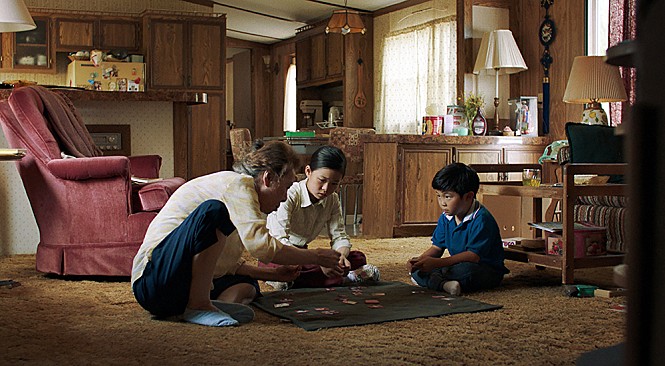
Right next to Vivian’s house, there is a mobile home resided by a young woman named Shelly (Juno Temple) and her little son Sam (Ryder Allen). Because Shelly is often absent as frequently spending too much time outside, Vivian usually takes care of Sam instead of his mother, and Palmer gradually gets accustomed to Sam’s occasional presence in the house. Although he happens to have a quick physical encounter with Shelley at one night, he does not seem to be particularly interested in befriending this little cheery boy, and he remains rather distant even when Sam comes to stay in Vivian’s house longer than expected after his mother suddenly disappears along with her latest boyfriend for no apparent reason.

Meanwhile, the movie observes Palmer’s ongoing employment problem. He must get a job as required by his parole, but, not so surprisingly, nobody is willing to hire him because of his criminal record, and many of town people still remember well what he committed. When he subsequently tries to be hired as a janitor in the local elementary school which Sam attends, the principal of the school understandably shows some reservation at first, but he decides to give Palmer the second chance he really needs, and Palmer soon begins to work under an old maintenance guy named Sibs (Lance E. Nichols).

As he does one job after another in the school, Palmer comes to meet Sam’s class teacher Maggie (Alisha Wainwright), and, of course, it does not take much time for them to be interested in spending more time with each other. As a caring teacher, Maggie is glad to see Sam having someone to lean on besides Vivian, and it looks like she does not care that much about Palmer’s dark past, though he hesitates to get closer to her as still struggling with his rehabilitation process.

Palmer also comes to spend more time with Sam after a small unexpected plot turn, and he becomes more aware of how atypical Sam is compared to many other boys around his age. Besides often enjoying having a little tea party with his close female classmate, this adorable kid is a big fan of a TV animation series full of bright colors and pretty princesses, and he is also eager to wear a dress and put some makeup on his face.

While Sam does not have much problem with his developing gender identity, some people around him are not so pleased to see him behaving like a girl outside. At one point, he is bullied at his school, but then, fortunately for him, Palmer comes to the rescue, and that certainly leads to more relationship development between them. Although the screenplay by Cheryl Guerriero is rather vague about what Palmer actually thinks about Sam’s gender identity, it gives Timberlake and his young co-star Ryder Allen a series of somber but sensitive scenes to play, and they are mostly convincing in the depiction of their characters’ growing emotional bond.

However, the story stumbles during its third act coupled with the expected return of Sam’s mother, who is no more than a convenient plot device and does have much human depth from the beginning. Unfortunately stuck in her thankless role, Juno Temple tries as much as she can here, but there is nothing she can do except looking alternatively pathetic and hysterical, and it is rather depressing for me to see this talented actress thoroughly wasted on the screen.

In case of several other supporting performers in the film, they are in relatively better positions while leaving some substantial impression on us. While June Squibb, a 91-year-old veteran actress who has been more notable since her Oscar-nominated supporting turn in “Nebraska” (2013), effortlessly conveys to us her character’s open-minded compassion and kindness, Alisha Wainwright brings some life and personality to her functional role, and Lance E. Nichols is also solid as Palmer’s no-nonsense boss.

Under director Fisher Stevens’ competent direction, “Palmer” is fairly watchable on the whole, but its several weak aspects including its blatant plot contrivance kept distracting me during my viewing. While I understand its good intentions in addition to appreciating a number of good things including Timberlake’s fine acting, it is a bit too mild to impress me enough on the whole, and I will just let you decide whether you will watch it or now.

Posted in Movies | Tagged , | Leave a comment

Dreamland (2019) ☆☆(2/4): And then he meets this dangerous woman…

“Dreamland”, which had a premiere at the Tribeca Film Festival in April 2019 but only got released in US around the end of last year, is a lackadaisical crime period drama which does not break no particular ground in its genre territory. While it occasionally shows that the folks behind and in front of the camera did try as much as they could, the movie frequently stumbles due to its weak narrative and characterization, and we come to observe the story and characters from the distance just like its narrator.

The narrator is a Texan woman named Phoebe Evans (Lola Kirke), and she reminisces about what happened to her older half-brother Eugene (Finn Cole) and their family during the early 1930s. Before Phoebe was born, Eugene’s parents settled in a remote rural town of Texas along with their little son, but Eugene’s parents subsequently became estranged to each other due to their personal matter as well as their difficult financial situation, and Eugene’s father eventually left his family on one day. It seemed he went to Mexico as reflected by a postcard sent to his young son later, but then he never contacted his young son or his wife, who came to marry a guy named George Evans (Travis Fimmel) not long after that.

Because George has worked as a deputy sheriff of the town, he can provide some financial stability to his family, and Eugene’s mother Olivia (Kerry Condon) appreciates that – especially when many of her neighbors struggle a lot with a long period of drought in their area. As their corn farms are seriously ruined by the drought and the following dust storms, most of town people find themselves on the verge of losing their homes and farms, and some of them including the family of Eugene’s best friend have already been considering leaving for California.

However, Eugene’s mind is usually occupied with numerous pulp magazines full of crime stories, and he is certainly excited when the town sheriff notifies to him and other town people that an infamous female bank robber named Allison Wells (Margot Robbie) is presumed to be somewhere around the town. A few days ago, Wells and her accomplice attempted to rob a bank located in a nearby town, but that led to a disastrous consequence as they subsequently had a shootout with the local police, and several civilians including a little young girl died in the end. While her accomplice was later found dead outside that town, Wells is still on the run, and a considerable amount of bounty is already put on her.

Although he has no idea on Wells’ whereabouts just like others, Eugene finds himself attracted toward a very slight but tempting possibility of finding her, and, what do you know, he later discovers that she is actually hiding in the barn of his family house. Because she has a serious physical injury, Wells requests him to help her, and, after an anxious moment of negotiation between them, Eugene decides to help her just because she may provide him not only lots of money but also a chance to go to Mexico and then find wherever his father is right now.

As he comes to help her more, Eugene naturally becomes more fascinated with Wells, and Wells is certainly willing to take advantage of that. As they talk more with each other, running away to Mexico along with her looks more plausible to him, so he comes to take more risks for her even though his stepfather and others are still looking for her as before.

We accordingly get several tense scenes including the one where young Phoebe (Darby Camp) attempts to go inside the barn due to her innocent curiosity, but the screenplay by Nicolaas Zwart does not generate much narrative momentum as languidly trudges from one expected plot turn to another, and it is also hampered by the lack of human depth in its two main characters. While Eugene is not a particularly interesting hero to hold our attention from the beginning, Wells remains to be a broad archetype as merely being swung back and forth between sympathy and suspicion, and that is why the third act where they can finally be more honest which each other does not work as well as intended.

In addition, director Miles Joris-Peyrafitte has many of key scenes in the film accompanied with blatant jump cuts, which are totally unnecessary in my trivial opinion. This visual choice is probably intended to show us more of our two main character’s thoughts and feelings, but the result only feels distracting while putting more distance between us and the story itself, and we are left with hollow impressions even during what is supposed to be a dramatically devastating moment around the end of the movie.

Anyway, the main cast members of the film mostly acquit themselves well despite being stuck with flat and uninteresting characters. While Finn Cole occasionally looks strained in his fairly diligent efforts, Margot Robbie, who also participated in the production of the movie, is uncannily reminiscent of Jessica Lange in “The Postman Always Rings Twice” (1981), and you may find yourself wishing that she could get a better femme fatale character someday. In case of Travis Fimmel, Garrett Hedlund, Kerry Condon, and Darby Camp, they are under-utilized in their thankless supporting roles, and Fimmel manages to leave some impression as a guy who has some decency despite not being a good father and deputy sheriff.

Overall, “Dreamland” surely evokes its many notable predecessors including, yes, “Bonny and Clyde” (1967), but it blandly fails in enlivening its story and characters enough to engage and entertain us. To be frank with you, it is already being evaporated in my mind without much regret, and I am already ready to move onto other films which may entertain me more.

Posted in Movies | Tagged , | Leave a comment

Fireball: Visitors from Darker Worlds (2020) ☆☆☆1/2(3.5/4): Of meteors and men

Documentary film “Fireball: Visitors from Darker Worlds”, which was released on Apple+ in last November, is alternatively sublime and amusing with its genuine interest and fascination in meteors. As hopping from one interesting place to another around the world, the documentary calmly and humorously explores how meteors have been associated with the history of the Earth as well as the humanity, and we are never bored mainly thanks to its co-director Werner Herzog’s inquisitive approach coupled with that distinctively quirky sense of deadpan humor of his.

After the opening scene showing the Day of the Dead festival in Merida, Mexico, Herzog and his co-director Clive Oppenheimer, a British volcanologist who previously collaborated with Herzog in two documentary films “Encounters at the End of the World” (2007) and “Into the Inferno” (2016), promptly begin to examine how meteors have influenced societies and cultures throughout the whole human history. For example, it is highly possible that the sacred black stone in Mecca, Saudi Arabia, which has been the keystone of one of the largest religions in the world for more than one thousand years, is actually a big meteor, and the documentary also shows us how a small meteor fallen on a small French village in 1492 led to the rise of one of the most powerful royal families in the European history. As a matter of fact, this incident generated so much fuss all around the Europe that, according to the remaining records, it even eclipsed what Christopher Columbus achieved in that year.

Thanks to Oppenheimer, Herzog could meet and interview various meteor experts in addition to going to a number of different crater sites such as Wolfe Creek Crater in Australia. In Oslo, Norway, they met a local jazz musician who is also an amateur expert on micro-meteor and meteor dust, and this dude is really enthusiastic as he and his close colleague, who incidentally has a very interesting life story of illness, show their small passion project on meteor dust, which is being poured upon the Earth a lot even at this point. On the surface, those tiny meteor dusts collected by them look rather inconsequential, but they soon show their hidden beauty through a specially designed camera equipment, and then we are told about how diverse they are in terms of shape and structure.

In case of Paul Steinhardt, some meteors provided valuable evidences for his longtime research on ‘quasi-crystal’. Thanks to the mathematical proof from recent Nobel laureate Sir Roger Penrose, Steinhardt came to find that quasi-crystal is indeed possible in theory, but he still needed the proofs from the nature. That consequently led to his long and arduous expedition in the middle of a remote wilderness area of Siberia, and, fortunately for him, that expedition turned out to be successful enough to support his theory.

The documentary later leads us into a heavily controlled storage room full of many different meteors, and we hear more about why they are so valuable for many different scientific researches. Mostly having been in the space for around 4.5 billion years, they can provide geological clues to how our planet was formed, and it is highly likely that meteors were involved with the early history of life on the Earth as they actually can function as vessels for organic materials such as amino acids and, yes, DNA.

In contrast, as many of us know, meteors can also be agents of destruction and extinction. Even a meteor of around 50 meters in its diameter can be quite more destructive than an average atomic bomb, and it is estimated that the mass global extinction of dinosaurs and many other species, which happened around 65 million years ago, was caused by an asteroid of around 10 kilometers in its diameter. As a matter of fact, the crater generated at that time was so massive that it was discovered only after the extensive geological mapping of a certain region of Mexico during the 1970s. Compared to what happened there 65 million years ago, the place in question looks so depressingly plain and mundane that Herzog’s deadpan narration cannot help but become a bit more sarcastic as the camera looks around here and there.

It goes without saying that the same thing might happen again in our future, and the documentary naturally moves onto the ongoing surveillance project at an observatory on a big and high mountain of Hawaii. Three experts who work there gladly explain and demonstrate how they work day by day, and you may be relieved to learn that 1) the sky is constantly being monitored even at this point and 2) there is actually a more plausible way to avert a global catastrophe than what is depicted in those several recent disaster flicks including “Deep Impact” (1998), which incidentally appears in the documentary more than once to our little amusement.

Herzog and Oppenheimer later go to a South Korean research station in Antarctic, whose vast ice plain has been a bountiful reservoir of meteors for many decades. While this part is surely reminiscent of what was shown in “Encounters at the End of the World”, the documentary provides us its own wonder and amusement, and I certainly got amused from time to time as observing a few Korean details within the research station (“We do not come here for kimchi and lobsters”, says Herzog at one point).

On the whole, “Fireball: Visitors from Darker Worlds” is another superb documentary from Herzog, a great filmmaker who has constantly given us interesting subjects to reflect on via his many acclaimed documentaries ranging from “Lessons of Darkness” (1992) to “Grizzly Man” (2005). While entertaining and amazing us with many interesting aspects of meteors, the documentary will make you reflect on our mere existence on the Earth more than before, and you may find yourself looking up toward the night sky with more wonder and curiosity after watching it.

Posted in Movies | Tagged , , | 1 Comment

Siberia (2020) ☆☆1/2(2.5/4): A cold, baffling journey of dreams and reflections

I admire how Abel Ferrara still keeps going even at present. Although his filmmaking career already passed its peek mainly represented by a number of acclaimed works including “King of New York” (1990), “Bad Lieutenant” (1992), and “The Funeral” (1996), he has continued to make his films during last 20 years, and his several recent films such as “Pasolini” (2014) and “Tommaso” (2019) showed us that he is still an interesting filmmaker to observe.

In case of his latest feature film “Siberia”, which was shown at the Berlin International Film Festival early in last year, Ferrara attempts an austere collage of dreams and reflections inside one lonely and isolated individual, and that is initially fascinating to some degree, but I am still debating with myself on whether the movies succeeds as much as intended. While it deserves to be compared with other similar films ranging from “Mulholland Drive” (2001) to “I’m Thinking of Ending Things” (2020), the movie often struggles to hold its center among a number of different moments to baffle or fascinate us, and that is a shame considering that it is equipped with another strong collaboration between Ferrara and one of the finest movie actors of our time.

At the beginning, we observe the stark and barren daily life of a middle-aged American dude named Clint (Willem Dafoe). Although the movie does not tell anything about how this taciturn guy came to reside alone in a shabby wooden bar located in the middle of some remote mountainous area of Siberia, he seems to be fine with his isolated life without much human connection, and we see him flatly serving his few customers from time to time. Most of these customers of his do not speak English at all, and, regardless of whether he actually understands at all what the hell they are talking about, the movie deliberately chooses not to provide English subtitle for emphasizing his isolated status to us further.

While nothing much happens in his world at first, the movie slowly lets us sense Clint’s anxiety and conflict via a series of offbeat moments. For instance, when he is talking a bit with some English-speaking customer trying to have some fun with an electronic slot machine in his bar, the movie suddenly interrupts this scene with the nightmarish moment involved with a bear attack, and we are naturally baffled by this. Is this simply a pigment of his imagination, or a traumatic reflection of whatever he experienced some time ago?

And there is also a weird scene involved with a mysterious pregnant Russian woman who happens to drop by the bar along with an old woman who is supposed to be her mother. After she shows her naked pregnant body right in front of Clint, they come to have a more intimate private time together, and this moment brings some warmth to the screen, but then it is soon followed by a bizarre moment which features lots of blood from that old woman.

It becomes more apparent to us that Clint is struggling with a sort of personal crisis, but he does not reveal much to us except when he phlegmatically confides to us on a certain childhood memory during the main title scene of the film. Although he and his father were not so close to each other for many years, he is still haunted by when he and his father went fishing outside, and he has clearly cherished a lot that moment of male bonding between him and his father.

Anyway, the movie subsequently takes a left turn as Clint decides to take a journey across the wintry mountainous area surrounding his place. He goes by a sled pulled by a bunch of Siberian husky dogs, and that may take you back to a certain recent Disney film where Willem Dafoe incidentally appears along with a pack of Siberian husky dogs amid the cold and snowy landscapes of Alaska.

Not so surprisingly, the movie does not clarify much what Clint is exactly searching for, but more odd dreamy moments pop out here and there around him. At one point, he witnesses an atrocious massacre executed by a bunch of Russian soldiers, and then he experiences a series of weird moments not long after he and his sled dogs come to spend a night in a big cave. During the second half, the movie boldly shuffles several different backgrounds, and you will be certainly baffled more as our hero suddenly finds himself in the middle of a desert area for no apparent reason later in the story.

To my disappointment and frustration, these and other elements in the movie do not coalesce well on the whole, but Dafoe, who previously collaborated with Ferrara in no less than five films including “Tommaso”, steadily carries the film as bringing enough human qualities to his rather abstract role. He is terrific especially when his character faces an old personal regret involved with his ex-girlfriend and their little kid, and that is one of a few moments in the film where everything is aligned with him well together to generate palpable emotions onto which we can hold for a while.

In conclusion, “Siberia” is not as successful as “Tommaso”, which also attempts to mix reality and dream in the mind of its troubled hero and, to be frank with you, is much more successful in addition to being quite playful and insightful. Considering several overlaps between these two films besides Dafoe, it will surely be interesting to watch them together, but I recommend you not to expect too much from “Siberia” even if you had a fun with “Tommaso” like I did. I was not so bored, but, folks, I was also quite frustrated, and my 2.5-star rating is more or less than a reflection of my mixed feeling toward the film.

Posted in Movies | Tagged , | Leave a comment

On the Record (2020) ☆☆☆(3/4): Another harrowing #MeToo era documentary

Documentary film “On the Record” is often chilling and devastating as listening to several female survivors who were sexually assaulted or abused by a man who is still regarded as one of the most influential figures in the American hip-hop music industry. Through their harrowing testimonies, the documentary illuminates not only the deep misogyny rooted inside the American hip-hop music industry but also the old history of the toxic cultural/social oppression on sexually abused African American females, and it surely reminds us that we still need to listen more to millions of survivors out there.

In late 2017, Russell Simmons, who has been mainly known as the co-founder of Def Jam Recordings, was accused of sexual abuse and assault by several female survivors who finally decided to step forward in public via major media reports, and the documentary mainly focuses on one of these female survivors. Her name is Drew Dixon, and the documentary alternates between her life and career story and when she decided to tell all to a reporter of the New York Times in late 2017. Although she is willing tell us a lot in front of the camera, she still feels unsure and nervous about whether she can endure the consequence of accusing Simmons of sexual assault in public, and her growing anxiety is palpable to us even though she does not signify much in front of the camera.

As Dixon reminisces about her early years, we get to know what a bright and promising young woman she was with lots of potentials. Like her dear mother who was incidentally the mayor of Washington D.C., young Dixon loved and enjoyed music by all her heart, and, not so surprisingly, she subsequently decided to go to New York City around the early 1990s for diving into the rapidly growing hip-hop music industry in the city.

Thanks to her spirit, intelligence, and diligence, it did not take much time for Dixon to be noticed by Simmons, who had just established that legendary record company of his at that point. Once she began to work in the Artists and repertoire (A&R) division of his record company as a new young executive producer, she was tasked with a number of big projects including a certain famous hip-hop documentary and the accompanying album, and some of you may be surprised to learn that she was the one who handled a certain milestone hit from Method Man and Mary J. Bilge.

After a number of big successful hits, it seemed that the sky was the only limit for Dixon’s music producer career, but her blossoming potential was irreversibly shattered by the very man responsible for her initial successes. When Simmons started to show very inappropriate behaviors to her, Dixon chose to put up with his loathsome indecency because that was exactly what she was expected to do, and then there came a terrible moment she does not remember that well. Once she belatedly realized that Simmons set her up, it was already too late for her, and she still feels very uncomfortable as remembering how her mind understandably went blank while her body was sexually violated by him.

Dixon told about this atrocious experience to a few friends and colleagues of hers later, but she eventually walked away from the Def Jam Recordings and then moved to Arista Records. Things looked better for her there at first, and she continued to produce more hits, but then the circumstance was quickly reversed with the arrival of a new boss who was not so different from Simmons. When she firmly refused his vile approach, this prick retaliated on her in many petty ways, and he even blocked her from recruiting Kanye West and John Legend during their early career years.

While Dixon was still feeling conflicted about her allegation against Simmons, several more African American women including Sil Lai Abrams and Sherri Hines came out in public for revealing what he committed to them respectively, and several experts interviewed for the documentary explain to us a bit on how many African American women sexually abused or assaulted by African American men can still be easily silenced. Besides their shame and trauma, they also usually have to deal with the possibility of contributing more to that racist image of sexually aggressive African American men, and they can be deemed as sort of traitors by their own African American communities, who are mostly concerned with maintaining the clean-cut public image of African American men and their longtime suffering. The documentary exemplifies this via the public plights of Desiree Washington and Anita Hill in the 1990s, and the injustices inflicted on them somehow reminded me of when Spike Lee recently chose to support and stand by Nate Parker, whose acting/filmmaking career was almost finished when it belatedly turned out that he was brought to a trial for allegedly raping a young woman many years ago.

Although Simmons still exerts considerable influence even at this point (It is possible that he was involved in one way or another with the sudden departure of Oprah Winfrey, who was initially the executive producer of the documentary, from the production of the documentary when it was about to be shown at the Sundance Film Festival early in last year), Dixon and other survivors do not flinch at all, and one of the most poignant moments in the documentary is when she and two other survivors come to have a moment of solidarity together. In addition, Dixon also finds new strength for restarting her life and career, and it is touching to see how she and several other survivors appearing in the documentary have been moving on with their respective lives during recent years.

“On the Record” is directed by Kirby Dick and Amy Ziering, who previously gave us “The Invisible War” (2012) and “The Hunting Ground” (2015). In my humble opinion, these three good documentaries powerfully work together as a sobering trilogy examining the festering rape culture in three different fields, and they will be certainly more relevant to us considering the ongoing changes brought out by the #MeToo era. Yes, there should be more changes for gender right and equality, but ladies will not be silent anymore no matter what will happen next.

Posted in Movies | Tagged , , , , , , | Leave a comment

Space Sweepers (2021) ☆☆☆(3/4): An uneven but likable South Korean space opera

South Korean film “Space Sweepers”, which was released on Netflix yesterday instead of getting released in South Korean theaters due to the ongoing COVID-19 pandemic, is a mixed bag consisting of familiar but enjoyable stuffs. While it is full of style, mood, and details which could look much better on big screen, the movie is often hampered by its rather clunky narrative and thin characterization, and I only observed its story and characters with mild interest during its first half, Fortunately, the movie eventually comes to get boosted and accelerated enough during its second half while cheerfully wielding its humor and spirit as before, and I came to forgive many of its many shortcomings to some degree as savoring its several entertaining moments.

During the opening scene, the movie quickly establishes your average dystopian world set in 2092. Due to the increase of global environment pollution during last several decades, the Earth has become nearly uninhabitable for humans and many other species without any chance of regeneration and recovery, and everyone on the planet is eager to move to a big space city floating around the Earth, but, alas, only a small number of selected people are allowed to reside there. Numerous other people who cannot afford that resort to keep trying to live on the Earth or working in the space between the Earth and that big space city, and many of people living in the space have earned their living via working as ‘space sweepers’, who take care of various kinds of small and big space trashes.

A Korean guy named Tae-ho (Song Joong-ki) is one of such people, and we see how things have been not that good for him and three other Korean space sweepers who have worked along with him for years. Although they are usually the ones who can snatch anything valuable in the space faster than many other space sweepers out there, their financial situation is desperate to say the least (Their shabby spaceship, named Victory, can be foreclosed by those bank guys at any chance, for example), and even their latest catch, which looks pretty lucrative on the surface, does not help much in the end.

And then they find something unexpected from their latest catch, a heavily damaged spacecraft which turns out to contain a little Korean girl named Kot-nim (Park Ye-rin). When they subsequently come to realize that this small cute girl is an important asset pursued by not only the people controlling that big space city but also some shadowy organization, Tae-ho and his gangs instantly discern an irresistible opportunity to get rich enough to change their current financial status, but, of course, it is soon revealed that they are in a situation which may be way over their head.

As Tae-ho and his gangs try to survive as well as get the money promised to them, the movie sometimes lets us savor the background details of its world and people. Thanks to a small translator device on their ear, many different characters in the movie freely talk with each other in each own language, and that brings some colorful touches to its decidedly shabby background where numerous kinds of people, cultures, languages are co-existing together without much problem, though I must point out that most of non-Korean characters in the film are more or less than broad ethnic stereotypes.

The screenplay by director/writer Jo Sung-hee frequently stumbles and trudges during its first half as trying too many things, and its predictable drama does not provide much surprise for us. It is not much a spoiler to tell you that the hyper-cuteness of Kot-nim is going to melt the jaded and hardened attitude of not only Tae-ho but also his gangs, who all, yes, turn out to have each own personal matter to deal with. No matter how much Tae-ho tries to stick to pursuing his business interest, we all know from the beginning that he is going to do the right thing in the end, and we are reminded of that again via an obligatory flashback scene showing his past.

Anyway, the movie eventually arrives in the expected climactic part coupled with lots of bangs and crashes as our four main characters go all the way for protecting and saving their little girl by any means necessary, and it does not disappoint us at all with a number of well-made action scenes. Although it is a shame that the villains in the film including the big bad one played by Richard Armitage are not that distinctive, what is being at stake for our main characters feels palpable to us at least, and we gladly come to accept a blatant deux ex machina moment around the end of the story.

The four main cast members in the movie dutifully carry the film as often imbuing their respective characters with the considerable sense of life and personality. Although he is the most colorless one in the bunch, Song Joong-ki, who previously collaborated with Jo in “A Werewolf boy” (2012), is complemented well by the feisty acting from Kim Tae-ri, who surely enjoys her every moment as your typical spunky spaceship captain. While Jin Seon-kyu is effective as a no-nonsense tough guy who turns out to be more caring than expected, Yoo Hae-jin has a lot of fun with his android character, and I was particularly amused by how his android character comes to have some serious thought on a longtime wish – and how that later leads to a little surprise for us.

Overall, “Space Sweepers” is not entirely without flaws, but this is another interesting work from Jo. While I did not like “A Werewolf Boy” enough despite having a certain degree of amusement, I enjoyed “End of Animal” (2011) and “Phantom Detective” (2015), and “Space Sweepers” is satisfying enough in terms of achievement and entertainment even though being one or two steps below “End of Animal” and “Phantom Detective”. Despite my reservation, I glad to see that somebody finally makes a solid space opera flick in South Korea, and I guess that is one forward step for more good South Korean space movies to come in the future.

Posted in Movies | Tagged , , , | Leave a comment

The Dig (2021) ☆☆☆(3/4): Their friendship over burial mounds

Netflix film “The Dig”, which was released on last Friday, is a low-key period drama mainly revolving around two different people who happened to get involved in one historic excavation of the 20th century England. While sensitively observing the development of their unlikely friendship, the movie also carefully follows the excavation process, and the overall result is a slow but engaging experience despite several weak aspects.

The excavation site in question is Sutton Hoo, a rural area which is located in Suffolk, England. Although this area had a number of large burial mounds which clearly suggested an old history behind them, it did not draw much attention as nothing much was dug up from the ground for several hundred years, and then the excavation of 1939 finally came to reveal what had been hidden under the ground for more than a thousand years.

The screenplay by Moira Buffini, which is based on John Preston’s historical novel of the same name, begins the story with the deal between a wealthy landowner named Edith Pretty (Carey Mulligan) and a local self-taught archaeologist-excavator Basil Brown (Ralph Fiennes). As a smart woman who has been interested in archaeology since she was young, Edith strongly believes that there is something worthwhile to be excavated somewhere below her estate in Sutton Hoo, and she is willing to hire Brown even though he seems ‘less qualified’ than others, but then Brown refuses her offer because he will not get paid enough for his valuable service. In the end, Edith agrees to increase his wage in addition to providing a closer spot to stay, and Brown soon embarks on the excavation along with a couple of local workers to assist him.

At first, the situation does not seem that promising to say the least. As looking around her estate along with her, Brown reminds Edith that she is not the first one to try to dig up anything from the ground, and he shows her a bit on where they should start at the beginning. As appreciating and respecting Brown’s insight and knowledge more, Edith comes to share more with him their common passion on discovering and preserving the past, and she is adamant about keeping hiring him even when a couple of fellows from a local museum request her to send him a seemingly more important spot which may need him more. After all, it is 1939, so they and many other local archaeologists are really running out of time and resource as the war is approaching day by day, and Sutton Hoo does not look that significant to them despite Edith and Brown’s insistence.

Of course, Brown finally comes to prove that Sutton Hoo does have something invaluable under the ground, and Edith is certainly delighted a lot by this wonderful discovery, but the situation subsequently becomes a little more complicated than they expected. Once Brown reported to the local museum what he has just found in Sutton Hoo, several archaeologists led by Dr. Charles Phillips (Ken Stott) come to Sutton Hoo, and Brown is naturally concerned about whether he will not receive the credits for his discovery, which gradually turns out to be quite more significant than expected as he and others carefully dig up the site step by step.

Although what they are excavating may not look that awesome on the surface, their following moments of discovery are more enough to convey to us how important those small artifacts excavated from the ground, which is revealed to be a bountiful burial site of the 7th century. As a matter of fact, a number of different artifacts found from this burial site revealed that the Anglo-Saxon culture of that period was actually more sophisticated than many archaeologists thought before this monumental discovery, and it goes without saying that these artifacts are some of the most valuable national treasures in Britain.

Meanwhile, that gloomy possibility of the war continues to increase outside, and that certainly concerns Edith a lot, who turns out to have a serious illness which may end her life at any point. While often feeling conflicted about how she should handle the matters involved with the discovery from her estate, she is also quite worried about the future of her young son Robert (Archie Barnes), who, as a bright young kid, has surely sensed what his widow mother has been hiding from him.

Leisurely rolling its story and characters under its calm pastoral mood mixed with some melancholy, the movie generates some nice human moments among its several good main cast members. Although she may be too young considering her real-life counterpart was 56 at that time, Carey Mulligan gracefully balances her character between aching vulnerability and firm determination, and Ralph Fiennes is as stoic as required while complementing well his co-star. In case of the supporting characters surrounding them, Lily James and Johnny Flynn are fairly good even though their romantic subplot does not seem that necessary to the story, and Ben Chaplin, Ken Stott, Archie Barnes, and Archie Barnes are also solid in their respective roles.

On the whole, “The Dig”, which is directed by Simon Stone, may not dig up any new ground in terms of story and characters, and it sometimes looks like trying a bit too hard especially during its chronologically jumbled finale, but it is still held well together by its good mood and the enjoyable performances from Mulligan and Fiennes. Yes, this is definitely a familiar stuff, but I had a good time with it anyway, so I will not grumble for now.

Posted in Movies | Tagged , , , , | Leave a comment

Once Were Brothers: Robbie Robertson and The Band (2019) ☆☆☆(3/4): A modest tribute to The Band

Daniel Roher’s documentary film “Once Were Brothers: Robbie Robertson and the Band” looks over the rather brief history of The Band, which was founded by Robbie Robertson and his four fellow musicians in 1968. Although its five members eventually came to part ways in 1977, their nine years of collaboration led to a number of influential works such as “The Weight”, and the documentary gives us a close look into their short but significant career peak mainly via the viewpoint of Robertson, who is incidentally the only living member besides Garth Hudson at this point.

At the beginning, the documentary examines Robertson’s early years via his own words and a bunch of archival photographs. Born on July 5th, 1943 in Toronto, Canada, Robertson was influenced a lot by his mother who often enjoyed music, and it did not take much time for him to show more interest and talent in music as he entered adolescence in the late 1950s. Around that time, rock and roll became a lot more prominent in US thanks to various popular musicians ranging from Chuck Berry to Elvis Presley, and Robertson, who already quit school for focusing more on music despite his mother’s concern, was certainly eager to be as good and popular as these iconic musicians someday.

A few years later, there came a chance Robertson could not possibly miss. A popular American musician named Ronnie Hawkins came to Toronto for a concert to be held there, and Hawkins and his band impressed Robertson enough to make him want to join Hawkins’ band. Once he noticed the considerable potential inside young Robertson, Hawkins let Robertson join his band, and Robertson found himself writing several songs to be performed by Hawkins and his band shortly after coming to US along with them.

Robertson was particularly close to one of the band members, and his name was Levon Helm. As playing a lot together, Robertson and Helm became more inseparable to each other as fellow musicians, and it did not take much time for them to consider making a band for themselves. As they continued to play more along with three other musicians Richard Manuel, Rick Danko, and Garth Hudson under Hawkins during next several years, the possibility of making a new band together looked more possible to all of them, and then they got an opportunity to test their potential when they were recommended to accompany Bob Dylan in his notorious concert tour during 1965-66.

As some of you know well, Dylan’s concert tour during 1965-66 was deemed to be pretty disastrous during that time. While he was quite popular for many folk songs willingly embraced by millions of young people out there, Dylan boldly decided to expand his musical range into rock and roll, and that move is regarded as a major turning point in his career at present, but it actually received lots of negative reactions throughout concerts. Despite getting lots of boos from his audiences every time, Dylan stuck to his guns anyway, and Robertson and his fellow musicians constantly stood by Dylan as fully demonstrating their skill and confidence on the stage.

After this valuable experience, Robertson and his fellow musicians became more confident than before, and they fortunately happened to meet someone to help them. Albert Grossman, who was Dylan’s longtime manager, suggested that they should spend some time in Woodstock, New York for further honing their talent, and they followed Grossman’s advice without any hesitation. As creating and playing more music together at a big pink house somewhere in Woodstock, they officially formed a band in the end, and they simply named it, yes, “The Band” after considering several other names.

When their iconic album “Music From Big Pink” came out in August 1968, their band became much more famous and successful than before, and Robertson and his fellow band members could not help but swept by their big success even while devoting themselves to their music as before. Although Robertson managed to stick to his stable family life, the other band members often drew themselves into drug and alcohol, and that led to several serious incidents which caused more strains inside the band. According to Robertson, he tried as much as he could for getting things under control, but he and his band members got more estranged from each other as time went by, and Helm, who was supposed to be his best friend in the bunch, became particularly resentful about not getting paid enough compared to Robertson,

The Band was inevitably disbanded in 1977, but Robertson and his band members could get a sort of last hurrah via their final attempt of unity in November 1976. Aptly called “The Last Waltz”, their last concert is vividly captured in the 1978 concert film of the same name directed by none other than Martin Scorsese, who incidentally serves as one of the executive producers of the documentary. The documentary only shows a few moments from that concert film, but it is apparent to us that this concert was quite bittersweet for Robertson and his band members, and then we become more aware of the absence of his band members in the documentary, who could provide some different viewpoints besides Robertson’s.

Overall, “Once Were Brothers: Robbie Robertson and The Band” may feel inherently biased as mostly siding with Robertson, but it still works as a modest tribute to The Band. As a guy who knew The Band only via “The Last Waltz”, I found it fairly informative and engaging, and I guess you will enjoy it more than me if you are familiar with The Band.

Posted in Movies | Tagged , , , | Leave a comment

Three Sisters (2020) ☆☆☆(3/4): Desperate Sisters

South Korean film “Three Sisters” may make you feel wince or cringe a lot at first. As revolving around three very different sisters who are all quite problematic in each own way, the movie is often darkly humorous and uncomfortable in the depiction of their respective miserable situations, but then they come to us as damaged human characters while we get to know more of them along the story, and it is actually cathartic to see what is inevitably sparked and revealed around the time when they finally gather together later in the movie.

They are Hee-sook (Kim Sun-young), Mi-yeon (Moon So-ri), and Mi-ok (Jang Yoon-ju), and the first act of the movie gradually establishes the considerable emotional distance among them. While Hee-sook has been quite distant to both Mi-yeon and Mi-ok especially after her failed marriage, Mi-yeon sometimes talks with Mi-ok on the phone, but she cannot help but annoyed every time because her younger sister usually rambles and whines a lot in addition to being pretty drunk, and there are a couple of amusingly uncomfortable scenes where Mi-yeon tries to finish her phone conversation with Mi-ok as soon as possible while seemingly indulging her as her ‘good’ older sister.

Mi-ok has aspired to be a successful writer someday, but she has been frequently mired in alcohol without much progress, and her husband and her stepson often have to tolerate her alcoholic temper a lot everyday. Although it is hard to imagine what he could possibly see from her before marrying her, Mi-ok’s husband, who takes care of many domestic stuffs instead of her when he is not working outside, willingly endures many capricious behaviors of hers, and he even dutifully waits for her outside while she is having some more drink with an old colleague of hers at a local bar.

At least, Mi-ok’s daily life is a bit more stable than the grim current status of Hee-sook, who has run a small shabby flower shop alone without any help from her rebellious adolescent daughter or her useless ex-husband. In contrast to Mi-ok’s tempestuous personality, Hee-sook is a meek and downtrodden woman who always apologizes a little too much, and her daughter usually regards her with cold annoyance while often being as selfish and self-absorbed as you can expect from her age.

In case of Mi-yeon, it looks like she has had a much better life along with her professor husband and their two little kids, but we soon begin to see the cracks behind her supposedly respectable façade. To many others in her Protestant church, she is an admirable deacon who also works as the conductor of the church choir, but all she cares about is impressing others as well as their pastor more, and her family has been pretty sick of that. At one point, she drives her daughter to tears just because her daughter refuses to pray along with her family before having a dinner, and she does not seem to feel any remorse about that as fervently sticking to her religious belief.

And we see how much Mi-yeon can go for covering any crack inside her family. When Mi-ok unexpectedly comes to church on one day, she hurriedly takes Mi-ok away from the church before Mi-ok talks more in front of the pastor and others in the church. When she happens to notice something suspicious between her husband and one of her choir members, she does not say anything about that, but, once she finally gets the confirmation on that, she surely shows us how ruthless and calculating she can be.

Mi-ok and her two sisters are certainly not someone with whom you want to be associated at any chance, but they are presented with recognizable human qualities, and we come to understand and emphasize with them more even though we still observe them from the distance. What occurs among them and several other family members of theirs during the last act of the film is predictably melodramatic to say the least, but it works mainly because we come to know how troubled and damaged they really are in many aspects, and it is touching to see how they subsequently manage to move onto a small moment of sisterly solidarity in the end.

Moreover, they are fabulously embodied by the three main performers of the movie, who ably carry each own part before generating a series of stupefying moments of emotional clashes together. Moon So-ri, who has steadily impressed us since her memorable performance in Lee Chang-dong’s “Oasis” (2002), is fearlessly convincing in her character’s gradual implosion along the narrative, and she also does not hesitate at all from the sheer nastiness of her character. Kim Sun-young is alternatively frustrating and heartbreaking in her several key scenes, and she is particularly good when her character reveals her darker side to us in the middle of the story. In case of Jang Yoon-ju, she is utterly uncompromising as willingly hurling herself into her spectacularly messy and unapologetic character, and her resulting performance is as edgy and brave as Charlize Theron in “Young Adult” (2011).

Overall, “Three Sisters” is not something you can casually watch just for entertainment, but it is often compelling thanks to its three frighteningly vivid and realistic main characters and the superlative performances behind them. You may still not like them much even at the end of the movie, but they deserve some empathy and understanding at least, don’t they?

Posted in Movies | Tagged , , , | 2 Comments

I Don’t Fire Myself (2020) ☆☆☆1/2(3.5.4): As she tries not to give up

South Korean independent film “I Don’t Fire Myself” is a plain but sobering social drama about one woman’s desperate struggle for her life and existence. Reminiscent of the comparable works of the Dardenne brothers and Ken Loach, the movie sharply examines systemic injustices including sex discrimination and labor exploitation as calmly following her long and difficult plight, and it surely earns a little glimmer of hope and optimism in the end while never overlooking that harsh reality surrounding her and others around her.

At the beginning, we gradually gather the gloomy situation of Jeong-eun (Yoo Da-in), a female employee of a big electricity company who is recently transferred to some remote rural beach area where she was supposed to supervise a small group of subcontractors working there. Right from her first day, she is not welcomed much by these subcontractors and their manager, and the manager even harshly reminds her that there is really nothing she can do except merely occupying a desk.

It is quite apparent that the company sent Jeong-eun there just for having her quit for herself instead of firing her. Although it seems that she is a fairly good employee, she has been mistreated a lot by the company for some unspecified reason, and a brief flashback scene shows her being stuck in a very humiliating position while openly ridiculed by several obnoxious male employees.

Understandably quite bitter about her circumstance, Jeong-eun drinks every night as showing the signs of your average high-functioning alcoholic, but she does not give up nonetheless. Haunted by the sad memories of her close female colleague who tumbled into a tragic end shortly after getting fired, she is determined to find any possible way to endure this situation before she may be transferred to back to the company one year later, and that is how she later comes to volunteer to work along with the subcontractors outside.

However, not so surprisingly, those field works assigned to the subcontractors turn out to be a lot more difficult and dangerous than Jeong-eun predicted. They are frequently demanded to work on those tall transmission towers and the thin transmission lines between them, and, like many of us would, Jeong-eun is soon paralyzed by the fear of height as looking up at one of those transmission towers. While the subcontractors easily climb up and then work there as usual, she helplessly remains on the ground, and even the medication she subsequently gets does not help her much – especially when she happens to be evaluated along with the subcontractors.

Because she may actually get fired due to her low evaluation score, Jeong-eun must solve this immediate problem as soon as possible, so she comes to request some help from one of the subcontractors, who is reluctant at first but comes to accept her request as she offers some extra money for his private lesson. Although she fumbles a lot at first, she becomes more accustomed to climbing up transmission tower and working there thanks to his good teaching, and there is a lovely peaceful moment when they spend some little time together while being safely tethered to transmission lines.

The screenplay by director Lee Tae-gyeom and his co-writer Kim Ja-un thankfully does not push these two main characters into conventional romance, while focusing on a genuine sense of compassion and solidarity developing between them instead. As watching more of how much he struggles to work and survive everyday just like his colleagues, Jeong-eun comes to see more of the cruel and heartless side of the company, which constantly pushes its subcontractors into more danger and competition in the name of efficiency and profit. Although they do not get paid enough compared to their numerous occupational risks, the subcontractors cannot possibly complain because that will definitely lead to losing their jobs, and they have no choice but to do whatever the company demands them to do at any point.

After an unexpected incident happens later in the story, the movie naturally becomes more tense than before as our heroine tries to do right things, and Yoo Da-in, who previously drew my attention for her unadorned but undeniably haunting performance in “Re-Enounter” (2010), is captivating as her character firmly sticks to her belief and integrity. In addition to palpably conveying to us her character’s fear and vulnerability, Yoo also did a fine job of depicting her character’s inner strength without overemphasizing it at all, and that is the main reason why the final scene beautifully and movingly works.

In case of the other main cast members in the film, they dutifully support Yoo as required. While Oh Jung-se is solid as a man who turns out to be more compassionate than he seems at first, Kim Sang-gyoo, Kim Do-gyun, and Park Ji-hong are also convincing as the other subcontractors in the film, and the special mention goes to Choi Ja-hye, who, as another close female colleague of Jeong-eun, imbues some spirit into her two short scenes with Yoo.

On the whole, “I Don’t Fire Myself” is unforgettable for how it thoughtfully and compassionately presents social issues via its engaging story and characters, and it reminds me again of what a wonderful actress Yoo really is. It is a shame that she has not appeared in movies that often during last 10 years despite her acclaimed performance in “Re-Encounter”, but she has lost none of her talent and presence yet, and she surely gives another performance to remember here. Yes, this is a rather tough stuff indeed, but you will forget neither her nor her character after watching it.

Posted in Movies | Tagged , , | 2 Comments