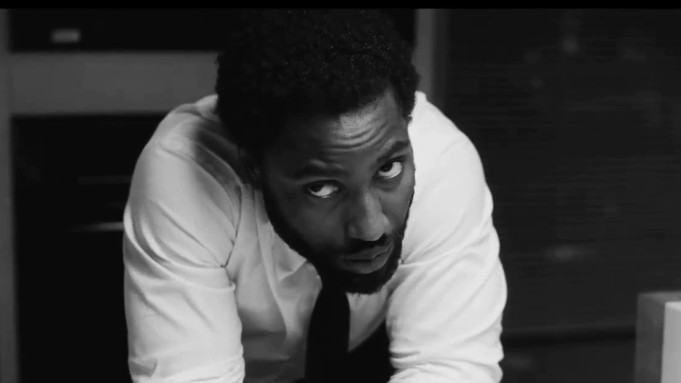
The White Tiger (2021) ☆☆☆(3/4): He’s ready to serve….

Ramin Bahrani’s new film “The White Tiger”, which was released on Netflix in last week, is an unnerving social class drama about one opportunistic hero ready to do anything for getting away from his very poor background. As slowly building up the envy and anger churning inside this dude, the movie alternatively engages and disturbs us with its broad but vivid look into the social inequality and injustice inside the Indian society, and we come to understand its unlikable hero more even when observing his dark journey from the distance.

The movie begins with its hero writing a letter to be supposedly sent to a certain prominent Chinese politician who is about to visit India in 2010, and we subsequently get to know how poor he was during his childhood years in a small village located somewhere in Laxmangarh. After distinguishing himself a lot at his shabby local elementary school, Balram Halwai (Adarch Gourav) fortunately received a chance to leave his village for more education, but, alas, he was eventually forced to quit his school because he was expected to work to earn more money for his big family just like his older brother.

Several years later, Balram is still stuck in the same place and occupation, but then he spots an opportunity when the rich landlord of the village, who is nicknamed “The Stork” (Mahesh Manjrekar), drops by the village for collecting the rents from many village people as usual. The Stork happens to be accompanied with his two sons, and Balram instantly senses that the Stork’s younger son Ashok (Rajkummar Rao), who recently returned to India along with his Indian American wife Pinky (Priyanka Chopra Jonas), is going to need someone to drive for him and his wife, though Ashok’s family already has a private driver of their own.

After managing to persuade his greedy grandmother to give him some money for driving lesson, Balram promptly goes to the local city where the Stork and his family live, and he gets hired once he succeeds in drawing the attention of the Stork and his sons. He cheerfully empathizes a lot on how happy and willing he is to serve Ashok, and, after checking Balram’s family background a bit for not only confirmation but also having him under their control, the Stork and his family eventually decide that Balram is good enough to be hired by them.

After that point, the movie smoothly moves along with its hero as he comes to solidify his status inside the Stork’s family. While the Stork and his older son often disregard Belram, Ashok and his wife sincerely want to be nice and cordial to Belram, but, not so surprisingly, they sometimes show condescension to Belram as casually talking with Belram. Belram does not mind this much, because he can accept anything from his employers as long as he is closer to their wealth and luxury.

When Ashok and his wife move to Delhi for his family business matters, Belram naturally follows them, and he comes to observe more from how the system is fixed from the start to benefit those people with power and money only. For example, a popular politician, who is supposed to be always serving for the country and its people on the surface, turns out to be as corrupt as expected, and the Stork and his family are ready to hand some dirty money to some other prominent party to beat that politician, when that politician’s blatant demand for bribery looks too much for them.

Not so angry about what he observes from his employers and their associates, Belram still hopes that serving Ashok and his wife may lead to success and prosperity for him someday, but he is reminded again and again of how he is still being stuck in his lower social/economic stratum. Even when he is with fellow private drivers in the neighborhood, he is often disregarded by them for his rural background, and his dream remains to be out of reach as before, no matter how much he is devoted to his employers.

And then, as already shown to us from the very beginning of the film, something quite serious happens. I will not go into details here, but I can tell you instead that incident makes Belram open his eyes more to the sobering truth about his relationship with his employers, who are ready to give him up as a scapegoat for getting away with what inadvertently happened.

As our hero warns us in advance, the mood becomes quite darker and more uncomfortable during the second half of the movie. Even after realizing how superficial his relationship with his employers really is, Belram chooses to continue to work for Ashok and his family, but he also becomes a lot more cynical than before, and then there later comes a situation of which he may take advantage for finally attaining what he has yearned for years.

As Belram constantly measures pros and cons on that, the movie, which is based on the novel of the same name by Arvind Adiga, gradually accumulates more tension, and Adarsh Gourav firmly holds our attention with his subtly intense performance. Although the supporting characters in the film are more or less than broad stereotypes, the other main cast members in the film including Rajkummar Rao and Mahesh Manjrekar are mostly solid on the whole, and Priyanka Chopra Jonas, who also served as the co-producer of the film, brings some warmth into the story despite being stuck in a rather thankless supporting role.

In conclusion, “The White Tiger” is competent enough to hold my attention despite its several weak points including its last act which arrives at the finale a little too quickly, and it is surely another interesting work from Bahrani, who has seldom disappointed me since he drew my attention for the first time via his first three feature films “Man Push Cart” (2005), “Chop Shop” (2007), and “Goodbye Solo” (2008). Although I must say that the movie did not engage me as much as these three excellent works of his, I still admire how Bahrani tries something different here in this film, so I recommend you to give it a chance someday.

Posted in Movies | Tagged , , | 2 Comments

One Night in Miami (2020) ☆☆☆1/2(3.5/4): Their night to remember

“One Night in Miami”, which was released on Amazon Prime in last week, humbly and thoughtfully presents a fictional account of one night meeting among four prominent real-life African American figures in the 1960s. Regardless of how much it is actually close to whatever happened among them on that night of February 1964, the movie is often compelling as closely observing the clashes of strong personalities and opinions, and it is also supported well by the uniformly strong performances from its four main cast members.

During the opening part set in 1963, the movie succinctly establishes its four different main characters and their respective current situations. While Cassius Clay (Eli Goree), who will be later known as, yes, Muhammad Ali, is rising toward the World Heavyweight Championship, Jim Brown (Aldis Hodge) has been going through the peak of his professional American football career, and Sam Cooke (Leslie Odom Jr.) has also been enjoying considerable success as a popular musician, but, as African Americans, they all face racism one way or another. In case of their friend Malcolm X (Kingsley Ben-Adir), he has fought against racism for years as one of the most prominent members of the Nation of Islam, but now he is considering leaving the Nation of Islam after frequently clashing with its leaders, and his dear wife is certainly concerned about that for good reasons.

The movie subsequently moves forward to February 25th, 1964, when these four men come to Miami, Florida for Clay’s title bout against defending champion Sonny Liston. After Clay’s surprising win over Liston during that evening, Malcolm takes not only Clay but also Cooke and Brown to his room in a modest hotel for African American folks, and his friends are not so pleased to learn that Malcolm wants to have a little serious time with them instead of celebrating Clay’s victory.

As four friends who have known each other for several years, these four guys seem to be willing to talk casually about anything, but the mood subsequently becomes more serious as Malcolm and Cooke come to clash over their different viewpoints. When Malcolm argues that Cooke does not use his artistic talent and influence enough for racial equality and other social justices, Cooke is not so pleased to say the least, and their following argument makes Clay and Brown nervous and awkward from time to time. While Clay, who was recently persuaded to convert to Islam by Malcolm, comes to have more doubt on his religious conversion which will soon be announced in public by himself, Brown comes to wonder whether he should be more serious about his possible acting career in Hollywood, and that certainly gives some amusement to his friends.

As the mood among them goes up and down more than once along the narrative, the screenplay by Kemp Powers, which is based on his acclaimed play of the same name, continues to generate sharp and witty moments from the dynamic interactions among its four main characters, and director Regina King, who has been mainly known for her distinguished acting career full of good performances including an Oscar-winning supporting turn in Barry Jenkins’ “If Beale Street Could Talk” (2018), did a commendable job of presenting these wonderful moments well on the screen. Although it sometimes shows its inherent stagy aspects, the movie seldom feels stiff or stuffy thanks to King’s competent direction, and we come to pay more attention to nuances and details observed from her four talented main cast members.

As having each own moments to shine, the four main cast members in the film are effortless in their ensemble performance. Considering Denzel Washington’s unforgettable performance in Spike Lee’s “Malcolm X” (1992), Kingsley Ben-Adir certainly had considerable risks and challenges right from the very beginning, but he is flawless in embodying his character’s fierce intelligence and charisma, and he is complemented well by the relatively more laid-back performance by Leslie Odom Jr., who has a couple of terrific moments for utilizing his well-known singing ability later in the story.

Compared to Ben-Adir and Odom, Eli Goree and Aldis Hodge are less showy, but they are also another important parts of the movie. While Goree ably moves back and forth between his character’s confidence and vulnerability, Hodge functions as a stable background for his fellow main cast members, and I also enjoyed the brief appearance of several notable performers including Lance Reddick, Michael Imperioli, and Beau Bridges.

The movie is the first feature film of King, who previously directed several TV drama series episodes before that. Although the overall result may look rather plain and modest on the surface, it is apparent that she really cares about the story and characters, and she surely demonstrates here another side of her talent. As a first-class performer, she certainly knows how to handle her cast members, and the four main cast members of the movie do deliver as much as she trusted them.

On the whole, “One Night in Miami” is a very engaging drama thanks to its skillful storytelling as well as its fabulous ensemble performance, and you will be entertained enough even if you do not have much background knowledge on its four real-life figures. You will surely see these dudes are indeed interesting people, and you may want to know more about them after the movie is over.

Posted in Movies | Tagged , , , | 2 Comments

Promising Young Woman (2020) ☆☆☆(3/4): Avenging Young Woman

“Promising Young Woman” is a darkly curious mix of comedy and noir thriller which will surely disturb you for good reasons. The movie is rather uneven and disjointed at times in handling relevant gender issues, and I still have some reservation on whether its final act works as well as intended, but the overall result is still compelling nonetheless thanks to not only its competent direction but also one of the most memorable performances of last year.

The movie begins with the captivating opening scene unfolded inside a nightclub during its busiest hour. After the camera looks around many drunken dudes and their body parts for a while, the movie comes to focus on a mundane conversation among three guys, and their attention is subsequently drawn to a young woman who is sitting alone and also looks quite inebriated. When one of these three guys eventually approaches to her, she does not seem to mind his approach that much, and then, after some talk between them, he comes to help her get a taxi ride to her residence.

Shortly after they get on the taxi, the guy suggests to this young woman that they should go together to his residence instead, and she accepts his offer without much hesitation. After he gives her some extra drink at his residence, the mood becomes a bit more serious as it is quite apparent to us that he is going to take advantage of her, but then the situation is suddenly turned upside down as she turns out to be quite sober with a twisted purpose behind her back.

Her name is Cassandra “Cassie” Thomas (Carey Mulligan), and we gradually get to know the current status of her life during the first act of the movie. Since she quit her medical school some years ago, she has lived in her parents’ cozy house for several years, and her parents hope that their dear daughter will move onto the next stage of her life sooner or later, but she does not seem to be so interested in that while continuing to work in a local coffee shop as usual.

Every night, Cassie goes to any local bar or nightclub for luring any potential male target to be intimidated and humiliated by her, and we come to learn that this is her private ritual of vengeance for her best friend, who also studied at that medical school before a certain horrible incident. Although that incident in question is not specified to us at first, you will easily guess what happened to Cassie’s best friend as watching Cassie intimidating her latest target with her cold, unforgiving anger and then giving a harsh lesson he will probably never forget.

Meanwhile, there comes a little unexpected change in Cassie’s life. When she is working in that local coffee shop as usual, she happens to encounter a good-looking lad named Ryan Cooper (Bo Burnham), and it soon turns out that he was one of her schoolmates in that medical school. Although she does not welcome him much, he keeps trying to come closer to her nonetheless, and she eventually comes to have a date with him.

As her life is brightened up by her growing relationship with Ryan, Cassie gradually finds herself becoming conflicted in more than one way. As reflected by a little sweet musical moment between them, Ryan surely looks like an ideal boyfriend for her future, but she does not give up that private ritual of vengeance at all while not telling anything to him, and that eventually leads to a serious trouble at one point later in the story.

In the meantime, her relationship with Ryan also brings back her to the past. Via Ryan’s casual remarks, Cassie comes to learn of the current status of the guy mainly responsible for what happened to her best friend, and that finally gives a clear direction for her vengeful mind. Besides that guy, she becomes quite determined to punish several other persons associated with the incident, and we accordingly get a series of unnerving moments including the one involved with a female administrator of her medical school.

The screenplay by director/writer/co-producer Emerald Fennell, who has been mainly known as the show-runner of British TV drama series “Killing Eve”, stumbles more than once during its last act due to several plot contrivances, but these and other notable weak aspects of the film are mostly compensated by its distinctive style and mood. Via its deliberately bright color scheme, the movie is constantly filled with the warped sense of reality, and we accept its several wild mood shifts along the plot to some degrees.

Above all, the movie is firmly held together by another strong performance from Carey Mulligan. Looking and feeling quite different from her lovely breakthrough performance in “An Education” (2009), Mulligan is utterly uncompromising and electrifying in her stark appearance, and she is also supported well by a number of different supporting performers including Bo Burnham, Allison Brie, Clancy Brown, Jennifer Coolidge, Laverne Cox, Connie Britton, Alfred Molina, and Molly Shannon.

On the whole, “Promising Young Woman” is not entirely without flaws, and its problematic handling of gender issues may bother you a lot, but I recommend it anyway because of its style, mood, and performance. Although it could be more coherent and focused in my humble opinion, Fennell makes a striking feature film debut on the whole, and I guess we can have expectation on what may come next from her during next several years.

Posted in Movies | Tagged , , | 1 Comment

Jimmy Carter: Rock & Roll President (2020) ☆☆☆1/2(3.5/4): He is a lot cooler than you may think…

Jimmy Carter was surely one of the most decent and admirable American Presidents in the 20th century. While his presidency was not entirely without faults and failures, he and his government certainly showed the better sides of the country to not only its people but also billions of people around the world, and, above all, he has still been regarded as a living symbol of faith and goodwill thanks to his numerous humanitarian activities during last four decades.

To be frank with you, I thought Carter was just a plain good person despite admiring his decency and integrity a lot, but Mary Warton’s documentary film “Jimmy Carter: Rock & Roll President” showed me that he has actually been as cool as, say, Barack Obama. Starting from how his unlikely political rise was begun in the 1970s, the documentary mainly explores his interesting associations with many prominent musicians during that period, and it is really inspiring to see him still being the ardent keeper of flame even though he had the 96th birthday several months ago.

Via a number of various interviewees including Carter himself, the documentary shows and tells us a bit about Carter’s humble early life in a small town of Georgia. Because more than 50% of the population of his hometown was African Americans, he was pretty familiar with their life and culture, and that made him regard them with far less bias and prejudice compared to many other Southerners during that time. As your average faithful Christian who also loves music a lot, he was particularly drawn to the gospel music performed at those African American churches of his hometown, and that led to his wholehearted embrace of other music genres including jazz, country, and rock and roll.

After getting more education and experience through college and the US Navy, Carter became more interested in civil and human rights, and that eventually made him go into local politics. Although he was not that well-known compared to his competitor when he ran for the gubernatorial election of Georgia in 1970, his modest campaign was boosted a lot by his close associations with various famous musicians ranging from Bob Dylan to the Allman Brothers Band, and he eventually became elected as the new governor of Georgia.

Right from the beginning, Carter was determined to bring some significant social changes into his state as he promised during his campaign, and the governor’s mansion was constantly filled with the fresh sense of change as he often invited his various musician friends. When he subsequently decided to give a shot to the upcoming 1976 US Presidential Election, they were all willing to support and promote his campaign, and there is a little touching episode on how he willingly stood by one of the members of the Allman Brothers Band when that member got himself into a legal problem associated with drug. He could have just distanced himself from that member because of the possibility of getting his campaign ruined, but he chose to be there for his close friend anyway, and that surely shows us what a man of integrity and compassion he was even at that time.

In the end, Carter became the Democratic candidate for the 1976 US Presidential Election, and, as all of you know, he came to win the election. During his inauguration, he showed warm and sincere appreciation to what his predecessor Gerard Ford had restored and maintained since Richard Nixon’s disgraceful resignation, and Ford gladly nodded to Carter’s praise. As watching this honorable moment of political transition, I could not help but reminded of how petty and dishonorable the current occupant of the White House has been to his rightful successor during last few months.

As he did during his gubernatorial years in Georgia, Carter invited many different musicians to the White House, and they willingly performed for him and many other politician guests. Some of these politician guests disagreed a lot with him on many issues, but they and others were all delighted and excited for a while along with Carter, and Carter even attempted to sing a bit in front of his guests during one evening.

Meanwhile, Carter and his government officials also worked really hard to bring more peace and stability into the world, though they did not always succeed. Against all odds, he pulled out a monumental diplomatic success from arranging the private meeting between Egyptian leader Anwar Sadat and Israeli Prime Minister Menachem Begin at Camp David in September 1978, but then there came the Iran hostage crisis in 1979, which unfortunately led to his landslide defeat to Ronald Reagan in the following 1980 US Presidential Election. Although he could have chosen more aggressive tactics for his political benefits during that time, he put the safety of the hostages above all else, and he was certainly happy to learn that the hostages were finally released on the very last day of his presidency.

After his White House period, Carter has kept going on as achieving more and more during last 41 years. Since establishing the Carter Center in 1982, he and his wife Rosalynn have passionately devoted themselves into a number of humanitarian activities including the eradication of Guinea worm in Africa, and he deservedly received the Nobel Peace Prize in 2002.

On the whole, “Jimmy Carter: Rock and Roll President” did an exemplary job of illuminating the cooler aspects of Carter’s life and career, and I will not deny that I often smiled with amusement and interest during my viewing. Although he recently had several health problems including a serious case of cancer in 2015, Carter still looks lively in front of the camera while effortlessly exuding his natural decency as usual, and I hope he will continue to spread more of his goodwill for a while at least.

Posted in Movies | Tagged , , , | 1 Comment

Totally Under Control (2020) ☆☆☆(3/4): Totally out of control

Documentary film “Totally Under Control” is alternatively sobering and infuriating for several good reasons. While it is disturbing to see the exponential spread of COVID-19 virus in US during last year, it is also exasperating to watch how this serious national health crisis has been exacerbated by President Donald J. Trump and his incompetent government, and, as far as I can see from the documentary, they nearly did everything wrong in their handling of the COVID-19 pandemic, which leads to the death of more than 350,000 Americans at this point.

In early 2020, Alex Gibney, who has been mainly known for several acclaimed documentaries including “Enron: The Smartest Guys in the Room” (2005) and “Taxi to the Dark Side” (2007), decided to make this documentary after his two friends got diagnosed with COVID-19 (One of them sadly died in the end, by the way), and he and his co-directors/co-producers Ophelia Harutyunyan and Suzanne Hillinger had to take considerable safety measures as shown at the beginning of the documentary. Once a special kit prepared by cinematographer Ben Bloodwell was sent to the interviewees in the documentary, the interviewees had a camera and a microphone connected to the Internet, and then they could have an interview with Gibney via online video communication.

Gibney interviewed a number of different experts and government officials including Dr. Rick Bright and Dr. Alex Greninger, and they all tell us how the US government and President Trump ignored the clear signs of danger at the beginning of 2020. Around that time, China was already being shaken by the ever-increasing scale of its COVID-19 outbreak, and many American experts in Centers for Disease Control and Prevention (CDC) had clearly discerned that the US government had to do anything for preventing COVID-19 from spreading into US, but President Trump and his government did not take their warnings that seriously just because nothing seemed to be alarming to them at that time. In the middle of January 2020, the first case of COVID-19 in US was reported, and, considering that COVID-19 virus is highly infectious, this suggested that there would be more cases to be popped up here and there, but President Trump did not listen at all while mostly occupied with maintaining status quo for his re-election.

Around February 2020, the situation became quite more alarming than before, but President Trump and his administration did not do that much while keeping assuring to the media and the public that everything was “totally under control”. Although his government did set up a special task force which included several high-ranking government officials ranging from U.S. Secretary of Health and Human Services Alex Azar to CDC Director Dr. Robert Redfield, but most of them did not have much experience in handling national outbreaks from the beginning, and it also later turned out the federal protocol for national outbreak had already been discarded just because it was made during the Barack Obama presidency.

As a consequence, the COVID-19 outbreak in US became far worse than expected during next several months. In last March, I decided to cancel my trip to US for attending the 2020 Ebertfest because the number of COVID-19 infection cases rose day by day in South Korea, but then, what do you know, the number of COVID-19 infection cases in US was rapidly increased during next several months, and I must confess that it felt morbidly ironic to me when the 2020 Ebertfest was canceled along with many other notable film festivals in US due to the following lockdown all over the country.

For stopping the COVID-19 outbreak from being spread more, more COVID-19 test kits and more personal protection equpiments (PPE) such as N95 mask should be supplied as soon as possible, but, unfortunately, the Trump administration made several catastrophic errors on these urgent matters. For example, it is very important to detect and then contain the infected as quickly as possible, but there was serious delay in supplying and distributing COVID-19 test kits, and the Trump administration also bungled a lot in case of the wide distribution of PPE products. President Trump and his government officials simply thought that it would be taken care of by free market mechanism without any intervention from them, but, not so surprisingly, this only led to the considerable price increase of PPE products to the frustration of many state governors, who all desperately needed PPE products as well as COVID-19 test kits.

And President Trump was still occupied with how he could win in the upcoming US Presidential election despite the ongoing COVID-19 pandemic. As many of you remember well, he irresponsibly spread a false claim about a certain medicine in public, and he and his government adamantly tried to have U.S. Food and Drug Administration (FDA) to do clinical tests on this medicine even though there is no reliable scientific evidence supporting its ability to cure COVID-19. In addition, he grossly underestimated the COVID-19 pandemic many times in front of his deplorable supporters who usually believe whatever he says, and it goes without saying that this led to more cases of infection in US.

Throughout the documentary, the disastrous situation in US is often compared to how briskly and efficiently the COVID-19 outbreak has been handled in South Korea. Right from when the first case of COVID-19 infection was reported, my government became quite ready to get things under control thanks to the existing government protocol on national outbreak, which was prepared shortly after the MERS outbreak in 2015. Once it turned out that the situation was much more serious than expected, the South Korean government gave full support to the production and distribution of COVID-19 test kits and PPE products, and I and other South Korean citizens willingly followed the instructions from our government, though our safety has been currently damaged by those despicable right-wing Christians who willfully disregard the government instructions just for power and money.

Considering that the COVID-19 pandemic is still continuing all around the world even at this point, “Totally Under Control”, which was incidentally released in US shortly after President Trump got himself infected in last October, is rather reserved about our uncertain future, but that is understandable in my humble opinion. To be frank with you, I am still not sure about when the situation is finally over, but things will never be same for us in the end, and we will surely remember and talk about this pandemic for many years.

Posted in Movies | Tagged , , , | Leave a comment

Kingdom of Silence (2020) ☆☆☆(3/4): A journalist who cared about his country

Showtime documentary film “Kingdom of Silence” glimpses into the life and career of Saudi Arabian journalist Jamal Khashoggi, whose brutal murder at the Saudi Arabian embassy in Istanbul, Turkey shocked many of us in October 2018. Mainly revolving around the interviews from various figures who knew Khashoggi, the documentary shows and tells us on how he evolved from a staunch supporter of the Saudi Arabian government to one of its most prominent critics while still deeply caring about his country and people, and that surely makes his death all the more tragic and alarming.

The early part of the documentary mainly focuses on how Khashoggi rose to prominence as a war correspondent during the Soviet–Afghan War in the 1980s. Because it was clear that the Soviet Union invaded Afghanistan for getting a chance to expand its geopolitical influence onto many oil-rich Arab countries including Saudi Arabia, Saudi Arabia and US, which has been its longtime business/political partner for many decades for since oil was found in Saudi Arabia in the 1950s, were certainly willing to support thousands of Muslim fighters gathering in Afghanistan, and Khashoggi drew lots of attention as busily reporting on those zealous Muslim fighters including a certain young man named Osama bin Laden.

Via a number of American foreign policy experts including Ben Rhodes and John O. Brennan, the documentary tells us how smoothly the US government, Saudi Arabia, and those Muslim fighters, called Mujaheddins, worked together during that time. Although the US government, who was headed by President Ronald Reagan during that time, did not like Mujaheddins that much, the Soviet Union was the common enemy for not only them but also Saudi Arabia, and Saudi Arabia gladly functioned as a mediator between the US government and Mujaheddins.

In the end, this unlikely alliance among three different groups led to the eventual evacuation of the Soviet Union army in February 1989, and a close friend of Khashoggi, who fought in the war along with those Muslim fighters, reminisces about how things looked optimistic and hopeful to the people of Afghanistan at that time – and how everything went pretty wrong shortly after that point. Afghanistan and its people came to suffer more upheavals before eventually tumbling into the reign of terror by Taliban during next several years, and that was around the time when bin Laden founded his infamous notorious terror organization after becoming more radicalized and fanatical than before.

What subsequently happened in New York City on September 11th, 2001 certainly devastated Khashoggi a lot, who came to change a lot of his political opinions as watching what was resulted from the sheer atrocity committed by a man who was once close to him. Because most of those terrible hijackers of the 9/11 incident were from Saudi Arabia, both the US government and the Saudi Arabian government were quite cautious about protecting their mutual political/business interest, and Khashoggi was willing to defend his government via his prominent position. As a result, he soon got some big support from several powerful members of the Saudi Arabian royal family.

And then there came the Arab Spring in 2011. Watching millions of young people openly demanding for freedom and democracy in Egypt and many other Arab countries, Khashoggi went through another change in his life and career, and he subsequently became a more active proponent of freedom of expression in his country. As a matter of fact, he actually tried to start a local TV news channel free of any government censorship as supported by one of his main backers in the Saudi Arabian royal family, but, alas, his TV news channel was shut down only after its very first day of broadcasting.

The main reason behind this absurd happening was from one big sudden political change inside Saudi Arabia. After Salman bin Abdulaziz Al Saud became the new king of Saudi Arabia in 2015, his son Mohammed bin Salman, a.k.a. MBS, was appointed as his deputy prime minister, and MBS soon commenced a series of political purges in addition to having a war with Yemen just for strengthening his and his immediate family’s political power further. Naturally, Khashoggi came to fear for what might happen to him, so he eventually fled to US in June 2017.

While subsequently finding himself separated from his world as well as his family, Khashoggi became quite lonely and depressed, but he eventually decided to express his political opinions in public more than before. He frequently published a number of critical articles on the Saudi Arabian government via the Washington Post, and that certainly led to more pressure and worry for him, but he was quite determined not to step back at all from the consequences of his risky political actions.

However, MBS and his Saudi Arabian government turned out to be quite willing to do anything for stopping Khashoggi, and the documentary gives us a chilling account of what happened to Khashoggi at the Saudi Arabian embassy in Istanbul on that horrible day. Although it was quite apparent that Khashoggi’s murder was ordered by MBS, President Donald J. Trump and his US government did not do anything at all just because, well, America comes first above all else.

On the whole, “Kingdom of Silence”, which is directed by Rick Rowley (He also served as the cinematographer of his documentary, by the way), is the engaging presentation of one passionate journalist, and I came to admire Khashoggi more than before. I have some doubt on whether those powerful people responsible for his death will be put on a trial in the end, but I hope his efforts and legacy will not be forgotten at least.

Posted in Movies | Tagged , , , , , | Leave a comment

Another Round (2020) ☆☆☆(3/4): Sensible Drinking?

Thomas Vinterberg’s latest film “Another Round”, which was selected as the Danish entry for Best International Feature Film Oscar in last year, cheerfully staggers along with its four different main characters who decide to give a little boost to their mundane life via constant daytime drinking. While they inevitably come to face the consequence of their ‘controlled’ drinking just like most of heavy drinkers out there, the movie never loses its balance between humor and drama in its risky staggering act, and it even manages to pull out a genuine feel-good last scene in the end.

At the beginning, the movie establishes how life and work have been uneventful and aimless for Martin (Mads Mikkelsen) and his three close colleagues in a high school he and they have worked for years. During his history class, Martin is so lackadaisical in his teaching that even his students notices his lack of passion, and they later request a meeting between him and their parents for reminding him that he really should teach and help them more for the upcoming examination to determine their next year. In case of his family, Martin and his wife Anika (Maria Bonnevie) have been estranged from each other for years as they are usually occupied with their respective jobs, and that makes him wonder whether he does not love her anymore.

Martin’s three close colleagues, Tommy (Thomas Bo Larsen), Peter (Lars Ranthe), and Nikolaj (Maganus Millang), have also been more aware of the growing ennui and frustration in their respective careers and lives, and they and Martin come to find some little solace from their dinner meeting for Nikolaj’s birthday at a local restaurant. As they drink and eat more, they become a little more relaxed and excited than usual, and Nikolaj, who incidentally teaches psychology, mentions an interesting theory by Norwegian psychiatrist Finn Skårderud, who argued that having a blood alcohol content of 0.05% can make humans more creative and relaxed. Although this theory sounds absurd at first, Martin later comes to consider constantly maintaining his blood alcohol content (BAC) level at 0.05% during daytime, and he soon embarks on his little drinking experiment behind his back.

With his BAC level at 0.05%, Martin certainly begins to show little signs of inebriety including a little difficulty in his pronunciation, but, what do you know, he find himself becoming more active than before in his history class, and he happily report this considerable change of his to his three colleagues. Eventually, they come to join Martin in this little drinking experiment, and Nikolaj is particularly excited as this might be a great opportunity for him to write an important research report.

Once they begin the drinking experiment together, the screenplay by Vinterberg and his co-writer Tobias Lindholm gives us a series of droll moments to amuse us. While Martin gradually becomes a more passionate and inspiring teacher for his students, he also actively tries to improve his relationship with his wife, and his wife is certainly surprised and delighted by that. In case of his three colleagues, Peter and Nikolaj find themselves more creative in their respective teaching methods, and Tommy, who is a physical education teacher, begins to work as the coach for a junior soccer team during his free time – and he surely motivates these little kids a lot while drinking again and again.

As their drinking experiment turns out to be much more positive than expected, Martin and his three colleagues soon consider increasing their BAC level a bit more, and nobody is against that at all because, well, they cannot resist having another round as becoming your typical drinker. So far, they all have managed to hide their drinking experiment behind their back, but they are approaching to more risks and dangers, and that is particularly evident from Tommy, who slowly begins to show the apparent signs of your average alcoholics.

It is not much of a spoiler to tell you that things will consequently be out of their control as they drink more and more, and then there comes a point where our four main characters must deal with what has been inadvertently caused by their drinking experiment. It goes without saying that they surely hit the bottom like any other drinkers out there, and the mood accordingly becomes more serious when a devastating incident happens later in the story.

Nevertheless, the movie somehow finds a way to bounce from that during the finale while never overlooking their hefty price of heavy drinking, and Mads Mikkelsen, who previously collaborated with Vinterberg in “The Hunt” (2012), is simply mesmerizing in expressing his character’s complicated feelings through a series of spontaneous physical movements on the screen. As Martin’s three colleagues, Thomas Bo Larsen, Lars Ranthe, and Magnus Millang have each own moment to shine around Mikkelsen, and Maria Bonnevie is also fine in her small but crucial supporting role.

Overall, “Another Round” feels relatively lightweight compared to Vinterberg’s recent previous works such as “Far from the Madding Crowd” (2015), and “Kursk” (2018), but it is an interesting comedy drama film supported well by the strong performance from Mikkelsen and several other cast members, and I appreciated its many moments as a guy who knows one or two things about drinking. Yes, drinking is indeed a vice from which I should stay away as much as I can, but I will not deny that I was entertained a lot during my viewing.

Posted in Movies | Tagged , , | 1 Comment

Mr. Jones (2019) ☆☆1/2(2.5/4): The price of reporting a truth

Agnieszka Holland’s new film “Mr. Jones” is an earnest period drama about a young reporter who struggled to maintain his professional integrity after coming to learn of a terrible injustice behind the Soviet Union government in the 1930s. While it surely chills and horrifies us a number of grim moments of human misery and suffering as expected, the movie often falters due to its uneven narrative and weak characterization, and I am not sure whether it succeeds as much as intended, though it does illuminate one of the most tragic incidents in the 20th century history.

Set in 1933, the movie presents its main subject mainly via the viewpoint of a real-life British journalist named Gareth Jones (James Norton), who drew lots of public attention for his successful interview with Adolf Hitler. Having closely observed Hitler during his interview, Jones fears that Hitler and his rising prominent political party will start another big war to disrupt the whole Europe, and he emphasizes to those old British politicians that the British government must cooperate more with the Soviet Union for stopping Hitler and Germany, but nobody takes his words that seriously.

At least, David Lloyd George (Kenneth Cranham), who was once a British Prime Minister and is also Jones’ current employer, shows some care and attention to Jones. Although he soon has to fire Jones. he gladly writes a recommendation letter for Jones, and he also even helps Jones a bit on getting a journalist visa for Jones’ upcoming travel to Moscow.

Because he succeeded in interviewing Hitler, Jones is confident that he will also succeed in accomplishing his latest aim: interviewing Joseph Stalin. It seems that Stalin’s Soviet Union government has achieved considerable economic/industrial advance during last several years, and Jones is eager to find and then report on how that is actually possible even though the Soviet government has had financial problems for many years.

Of course, Jones soon comes across several bad signs as he leaves for Moscow. Not long before his departure from London, he has a phone conversation with one of his fellow journalist colleagues who has already been in Moscow for a while, and this fellow seems to be delving into something big enough for newspaper headline, but, not so surprisingly, their phone conversation is cut off right before he is about to tell a bit more to Jones. When Jones finally arrives in a hotel in Moscow, he belatedly comes to learn that his colleague was killed under a very suspicious situation, and that makes Jones more curious about what interested his dead friend before his unfortunate death.

In the meantime, he also comes to see more of how much everything is limited or prohibited for him and other foreign journalists in Moscow under the total control of the Soviet Union government. For example, they are never allowed to go outside Moscow for themselves, and whatever they are going to write is bound to be scrutinized by those local authorities before getting published outside the Soviet Union.

Moreover, to Jones’ dismay, many of his peers do not mind this blatant suppression of journalistic freedom at all. In case of Walter Duranty (Peter Sarsgaard), a cynical Pulitzer-winning American journalist who has worked as a reporter of the New York Times in Moscow, has attained his fame and reputation via his positive reporting on the Soviet Union in addition to getting along well with a number of powerful figures in its government, and he has also been privileged enough to hold a routine private evening part full of vice and decadence.

As getting close to a female journalist named Ada Brooks (Vanessa Kirby), Jones gradually comes to learn of what his dead colleague tried to tell him at that time. It looks like something really serious is happening in Ukraine, so Jones decides to go there for himself, and he eventually manages to grab an opportunity to look here and there in Ukraine without anyone to follow or monitor him.

What he comes to witness there is pretty grim and despairing to say the least. The movie thankfully handles this part with some thoughtful restraint, and it never overlooks the horror inside a series of striking moments including a gut-chilling scene where Jones happens to encounter three hungry children who have depended on an unspeakable measure in the name of survival.

Sadly, the movie begins to go downhill after that narrative point, and the screenplay by Andrea Chalupa frequently stumbles and trudges during its last act, which involves with Jones’ long and frustrating struggle for getting his story reported more around the world. While the ending, which incidentally has a certain infamous figure associated with “Citizen Kane” (1941) as its deus ex machina, is too hurried, a recurring part involved with George Orwell (Joseph Mawle) feels too blatant and artificial in my trivial opinion.

Overall, “Mr. Jones” is a competent piece of work equipped with good period mood and several diligent performances from its main cast members, but I observed its story and characters with only mild interest. To be frank with you, I remember more of how cold the screening room was when I watched it this morning, and it is too bad that the movie is less palpable or memorable compared to that.

Posted in Movies | Tagged , , , | Leave a comment

Shadow in the Cloud (2020) ☆☆1/2(2.5/4): There is something on the bomber…

“Shadow in the Cloud” is a rather amusing mix of fantasy and war action film with some feminist touches to be appreciated. Although the resulting mix is not entirely successful on the whole, it is at least anchored well by the strong lead performance packed with enough pluck and spirit to hold our attention during its short running time (83 minutes), and I must confess that I came to chuckle more than once even while observing its several absurdly preposterous moments from the distance.

After the prologue scene which shows us a silly old-fashioned animation clip, the movie promptly throws us into the situation of its young heroine played by Chloë Grace Moretz. It is August 1943, and we see Moretz’s character hurriedly preparing for her departure from an air force base in Auckland, New Zealand, though the movie does not tell or show us the purpose of this departure of hers except her destination. Shortly after arriving at the air force base, she looks for a B-17 bomber supposed to take to her destination, and, what do you know, that B-17 bomber in question suddenly appears right in front of her.

Anyway, she instantly gets on this B-17 bomber, and its all-male crew members are not so pleased about having her on their bomber. Because she comes with a document showing that she is on some special mission as reflected by a mysterious bag in her possession, they do not object to her boarding on their plane, but their hostility mixed with blatant sexism is palpable to us as well as her, and we are not so surprised when she is demanded to sit inside a ball turret below the floor just because there is not any other spot for her to sit on the floor.

Anyway, though she has to step back a bit as she lets one of the crew members take care of that mysterious bag, our heroine is totally fine with sitting inside the ball turret, and we see how stuffy and vulnerable the ball turret is in many aspects. While its hatch should be unlocked on both sides, she is only protected by its cage of glass and metal, and it goes without saying that this space will be one of the most vulnerable spots on the bomber if the bomber is ever attacked by those Japanese fighters, though the captain of the bomber assures that there is not much possibility of getting attacked because they are far from front line regions.

And our heroine turns out to be have considerable grit and skills compared to the crew members of the bomber. After she happens to listen to how they casually make fun of her, she firmly reminds them that, as a member of the Women’s Auxiliary Air Force (WAAF), she is more qualified than any of them, though she still keeps her mouth shut about that mission supposed to be accomplished by her.

When she later comes to notice a couple of two suspicious things, the mood gradually becomes more tense. First, she briefly spots the presence of an enemy plane flying not so far from the bomber, but her report is promptly dismissed by the captain of the bomber, and he comes to suspect her and her mission more than before as she often emphasizes that her bag should not be opened at any chance.

In addition, she also witnesses a weird entity hanging on one of the wings of the plane, but, again, nearly everyone else on the bomber does not believe her at all – even when she is attacked by that entity in question and then it viciously damages the bomber step by step. The crew members of the bomber are certainly perplexed and scared by a series of inexplicable malfunctions in the bomber, but they continue to disregard her urgent warnings while desperately trying to figure out what the hell is going on.

This is clearly a cross between “Nightmare at 20,000 Feet” of American TV anthology series “The Twilight Zone” and your average World War II action movie, and director/co-writer Roseanne Liang, who did a lot of re-writing on the original screenplay written by Max Landis, keeps things rolling as increasing the level of tension. Although the story occasionally feels contrived, the movie never loses its narrative momentum as diligently juggling many different threats and dangers hurled toward its heroine and other characters, and it even willingly goes all the way for silliness during some of its action scenes, which are as goofy and outrageous as those Fast and Furious movies.

It is a shame that the finale is perfunctory compared to all those preposterous moments preceding it, but the movie is still supported fairly well by Moretz’s considerable presence and talent. Since her breakthrough turn in “Kick-Ass” (2010), Moretz has been one of the most interesting and exciting young actresses working in Hollywood, and she is quite convincing here as never overlooking what is being at stake for her character. Yes, several spectacular action scenes in the film are apparently based on a lot of CGI, but Moretz imbues them with real human reactions, and her expression of fear and anxiety surely reminds me again of my deep aversion to high places.

In conclusion, “Shadow in the Cloud” has a number of weak aspects which distracted me during my viewing (The supporting characters surrounding Moretz’ character are more or less than your typical war movie stock characters, for example), but it is not a total waste of time at all. I wish it went wilder with its outrageous story premise, but it has a fair share of entertainment at least, and you may give it a chance if you have lots of free time to spend.

Posted in Movies | Tagged , , , | Leave a comment

Pieces of a Woman (2020) ☆☆☆(3/4): After her devastating loss

Kornél Mundruczó’s new movie “Pieces of a Woman”, which was released on Netflix yesterday, starts so strongly that what follows after that point looks rather underwhelming in comparison. Fortunately, the movie is still carried well by a remarkable performance at its center, and that is more enough for me to overlook its several glaring weak aspects.

During the long prologue part preceding the eventual appearance of the title of the movie on the screen, the movie quickly establishes the ongoing important circumstance of Martha Weiss (Vanessa Kirby), a young company executive who has lived along with a construction worker named Sean Carson (Shia LaBeouf) for several years in Boston, Massachusetts. Because Martha will soon give birth to their daughter, Sean has been quite excited as shown from the very first shot of the film, and Martha surely expects a lot as getting much emotional support from many people around her including her family.

However, they are not exactly ready when the time finally comes to them during one evening. Once Martha suddenly feels the first sign of what she will have to endure for a while, she and Sean hurriedly call their hired midwife supposed to help them during her domestic delivery of their baby, but, alas, their midwife happens to be unavailable due to some other unexpected childbirth, so a substitute midwife comes to their house instead. Although they cannot wholly trust this substitute midwife, they have no choice at all for now, and the substitute wife promptly embarks on handling the situation as Martha is about to go through the most painful part of her ongoing biological process.

During this intense scene, Mundruczó and his cinematographer Benjamin Loeb steadily follow and observe these three main characters’ situation without interruption, and the result is quite impressive to say the least. As Loeb’s camera fluidly moves along with these three main characters without feeling intrusive at all, we become more emotionally involved in what is happening to Martha, and then we are all shocked as the circumstance eventually ends with a devastating outcome which is going to change not only Martha’s life but also two other persons’ life in one way or another.

Some time later, Marth looks fairly fine on the surface, but it goes without saying that her mind is still struggling with her loss and the following grief and devastation. Although the substitute midwife was subsequently put on a trial as being charged for malpractice and several other criminal offences, she does not particularly want to get involved with the trial, and she is even willing to donate her dead daughter as a specimen for medical school.

Due to her rather detached attitude, Martha clashes a lot with not only Sean but also her mother Elizabeth (Ellen Burstyn). While also going through his own grief and depression, Sean clings to a few memories of their daughter in contrast to Martha, and that certainly makes him and Martha more estranged from each other. In case of Elizabeth, she strongly believes that Martha must be more honest about whatever she has been trying to ignore and suppress since that incident, but she only comes to annoy her daughter more than before.

Although it calmly and sensitively depicts its heroine’s difficult and painful emotional journey along the plot, the screenplay by Kata Wéber, which was incidentally inspired by her own experience on losing her child with Mundruczó, is sometimes a little too heavy-handed at times. While a certain construction site involved with Sean feels blatantly symbolic as appearing more than once throughout the film, the eventual deterioration of Sean and Martha’s relationship is contrived due to deficient character development, and several notable supporting characters in the film including the ones played by Jimmie Fails (Remember “The Last Black Man in San Francisco” (2019)?) and Benny Safdie, who recently directed “Uncut Gems” (2019) along with his older brother Joshua Safdie, mostly remained underdeveloped on the whole.

Nevertheless, the movie is still held together well together by the terrific performance from Vanessa Kirby, who deservedly won the Best Actress award when the movie was shown at the Venice International Film Festival in last year. While she is simply astounding in the palpable depiction of her character’s emotionally intense state during that extended scene in the opening part of the film, Kirby is also quite captivating as ably conveying to us a devastated state of mind behind her character’s frigid façade during the rest of the film, and that is why a certain key scene is fairly effective despite feeling theatrical at times.

Although the other characters in the film besides Martha are relatively superficial, several other main cast members surrounding Kirby fill their respective spots as much as demanded, though not all of them are as good as required. Even if you can overlook his latest scandal, Shia LaBeouf is unfortunately the weakest link in the film, and that aspect is apparent whenever he is supposed to be a solid counterpart to Kirby. While Molly Parker, Iliza Shlesinger, and Sarah Snook are sadly under-utilized due to their mostly thankless roles, Ellen Burstyn makes the best of her certain key scene with Kirby, and I will not be surprised if she gets Oscar-nominated along with Kirby a few months later.

Although it is not wholly satisfying, “Pieces of a Woman” is relatively more engaging compared to Mundruczó’s previous misfire “Jupiter’s Moon” (2017), and I recommend it mainly for Kirby’s stellar performance. Since her Emmy-nominated supporting turn in the first and second season of Netflix TV drama series “The Crown”, she has drawn more attention from us as appearing in a number of notable films including “Mission: Impossible – Fallout” (2018), and I hope her acclaimed performance in “Pieces of a Woman” will lead her to more good things in her advancing acting career.

Posted in Movies | Tagged , | 1 Comment