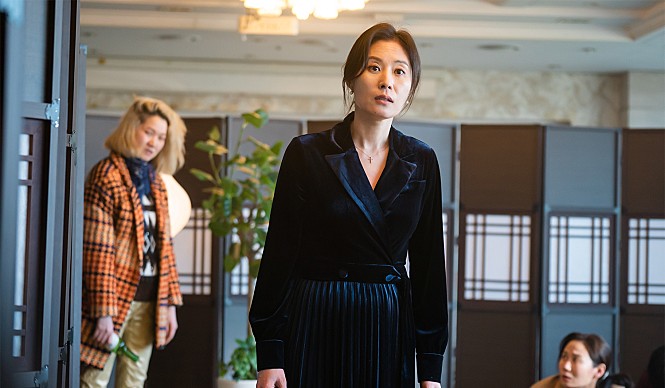
The Man Standing Next (2019) ☆☆1/2(2.5/4): It’s really hard for him to stand next to his big boss…

South Korean film “The Man Standing Next” is a slick and competent period drama film which does not go further than what I and many other South Korean audiences already know. Based on one of the major historical incidents in South Korean during the 1970s, the movie tries to look into an increasingly unstable political situation preceding that infamous incident, and it succeeds to some degree, but it is so enamored of period mood and details that it does not provide much of modern perspective to its historical subject.
Based on Kim Chung-sik’s novel “Chiefs of Namsan”, the movie mainly revolves around Kim Gyu-pyeong (Lee Byung-hun), who is a fictional version of Kim Jae-gyu. On October 26th, 1979, Kim, who was the head of the Korean Central Intelligence Agency (KCIA) at that time, shot President Park Chung-hee to death when they were having a night drinking party along with a few other high-ranking officials and two young ladies to entertain them, but the death of President Park, who ruled South Korea for 18 years since his coup d’état in 1961, was promptly followed by another coup d’état, and Kim was eventually executed shortly after that.

After the opening scene briefly showing that fateful night, we see the volatile circumstance surrounding President Park (Lee Sung-min) in September 1979. After going into exile for several years, his former KCIA director Park Yong-gak (Kwak Do-won), who is a fictionalized version of Kim Hyong-uk, decides to testify in front of the US congress for helping its current federal investigation of a massive bribery scandal involved with a bunch of American congressmen and the South Korean government, and President Park and his people have been quite nervous about how much Park will tell in public. As a matter of fact, Park has been actually writing a tell-all memoir, and President Park is certainly ready to suppress it by any means necessary, though he and his people cannot simply eliminate Park as fearing what the US government may do for retaliation.

As a guy who was once quite close to Park, Kim prefers to handle this problem as quietly and tactfully as possible, but President Park does not listen to him at all, and Kim has also been pressured a lot by his diminishing status in President Park’s inner circle. Officially, he is the No.2 working right below President Park, but Kwak Sang-cheon (Lee Hee-joon), the head of the president’s security team who is a fictional version of Cha Ji-chul, often behaves as if he is the most loyal and trusted member in President Park’s inner circle, and Kwak’s frequent arrogant behaviors often annoy and exasperate Kim day by day.

As Kim keeps trying to get things under control as much as he can, a certain temptation slowly grows in the corner of his frustrated mind. Although President Park remains regal and confident on the surface, his military regime has been imploding inside as the country continues to be shaken by the ever-increasing public demand for democracy, and it seems to be a matter of time before something finally happens to overthrow President Park and his military regime. While firmly sticking to his longtime loyalty to President Park as usual despite all those unkind words from President Park, Kim finds himself more tempted after having a secret meeting with Park, who even directly suggests to Kim that Kim should be the one to replace President Park.

What follows after that is not much of a surprise to anyone familiar with the modern Korean history, but director Woo Min-ho, who wrote the adapted screenplay along with Lee Ji-min, keeps things rolling as slowly building up tension and anxiety under the noirish period atmosphere of the film. In case of one of the key sequences unfolded in Paris, it is clearly reminiscent of those gray espionage films in the 1970s in terms of mood and style, and those impeccable suits of the main characters in the film will surely take you back to those melancholic criminal heroes of numerous classic French noir films including the ones directed by, yes, Jean-Pierre Melville. After all, President Park and his people were more or less than thugs just like many other dictators and their cronies around the world, and this stylish approach certainly makes sense.

However, the movie somehow lacks attitude and perspective while not giving me and other South Korean audiences any new insight on what inevitably happened among Kim, President Park, and a few others in their inner circle. As a result, the movie often merely feels like scratching the surface without delving much into what makes its characters tick, and its climactic part is not that dramatically impactful despite being well-executed on the whole.

Nevertheless, I was entertained by its mood, style, and performance to some degree. The production design by Cho Hwa-sung and Park Gyu-bin is top-notch in authentic period details, and cinematographer Go Rak-sun did a commendable job of filling the screen with cold and gloomy ambiance. In case of the main cast members, Lee Byung-hun is convincing in the gradual implosion behind his character’s stoic façade, and he is also supported well by a number of various performers including Lee Sung-min, Kwak Do-won, Lee Hee-joon, Kim So-jin, and Seo Hyun-woo, who is effective as the fictional version of a certain notorious real-life figure who is incidentally still well and alive to the chagrin of millions of South Korean people including me.

On the whole, “The Man Standing Next”, which was selected as the official submission of South Korea for Best International Feature Film Oscar several months ago, is better than Woo’s previous film “The Drug King” (2018) in more than one aspect, but its solemn genre exercise is less engaging compared to the barbed satire of Im Sang-soo’s “The President’s Last Bang” (2005), which is also about the assassination of President Park. I would rather recommend that film instead, but you may be interested in watching both of them, and I will not stop you from doing that.

Posted in Movies | Tagged , , , , , | Leave a comment

Voice of Silence (2020) ☆☆(2/4): Voice of incompetence

What an inane and messy bore South Korean film “Voice of Silence” is. Often dreary and unpleasant in its casual depiction of human evil and violence, the movie attempts to be not only an absurd crime noir drama but also a sentimental tale of redemption, but it unfortunately fails in both cases mainly due to its lackadaisical narrative and superficial characterization, and its incompetent tonal shifts along the narrative are often too jarring to say the least.

In the beginning, the movie lets us get to know how a guy named Chang-bok (Yoo Jae-myung) and his mute younger partner Tae-in (Yoo Ah-in) earn their living day by day. The opening scene shows them selling eggs at some rural marketplace, but their actual job is taking care of any bloody mess caused by a criminal organization for which they have worked for years, and we soon see how they handle their latest assignment. After getting a call from their direct boss, they go to a certain remote spot where their direct boss is waiting along with several thugs, and they wait for a while until some unfortunate dude is beaten to death by these thugs. Once this atrocity is finished, they promptly clean up the scene in addition to taking care of the body, which is later buried in their usual burial spot with some consideration.

Some time later, Chang-bok and Tae-in are called by their direct boss again, but it turns out that their direct boss wants them to do something different instead of cleaning up his mess as usual. He orders them to take someone from a certain place belonging to one of his criminal associates and then hold that person in question for a few days, and Chang-bok and Tae-in follow the order without asking much because, well, it is usually better for them to know less.

When Chang-bok and Tae-in subsequently go to that certain place in question where they are supposed to pick up that person in question, they belatedly come to realize that the situation is quite more serious than expected. That person in question turns out to be an 11-year-old girl, and this girl, named Cho-hee (Moon Seung-ah), was recently kidnapped by Chang-bok and Tae-in’s direct boss, who has been expecting to receive the ransom money from the girl’s father within several days.

Anyway, Chang-bok and Tae-in take the girl to a small shabby residence where Tae-in has lived with Moon-joo (Lee Ka-eun), a little girl who is supposed to be his sister. Although she is apparently confused and scared, it does not take much time for Cho-hee to get accustomed to her changed captive status, and, not so surprisingly, she also comes to befriend Moon-joo, who does not mind having a new friend at all while still quite oblivious to what is going on around her.

Meanwhile, the situation surrounding Cho-hee becomes more complicated than before. Around the time when her father finally agrees to give the ransom money for his daughter, Chang-bok and Tae-in’s direct boss happens to be eliminated for having caused too many troubles, and Chang-bok and Tae-in do not have any problem with taking care of his body. They are also instructed to keep Cho-hee in custody a few more days, and they consequently find themselves getting involved in this situation more than expected.

While adamantly not explaining much to us on what exactly is going on around its main characters, the movie dryly delves into several unpleasant moments as expected. In case of a scene where Chang-bok and Tae-in meet that criminal associate of their former direct boss, you may be chilled as Chang-bok and that criminal dude casually discuss on how to handle the situation surrounding Cho-hee and then get the random money as soon as possible, and then you may come to fear for what may happen to her in the end.

However, the movie often does not seem to be serious enough for this and other unpleasant moments. While Chang-bok is merely a slow-witted man helplessly stuck in a circumstance way over his head, those criminal figures with whom Chang-bok and Tae-in are associated are just seedy or pathetic, so we come to observe them from the distance without much care or attention, and that is why a certain major sequence later in the film does not work as well as intended. In case of the expected relationship development between Tae-in and Cho-hee, it is not so believable as the screenplay by director/writer Hong Eui-jung (This is her first feature film, by the way) pushes these two characters into one artificial sentimental moment to another, and a part involved with a local female police officer is particularly contrived and manipulative to my annoyance.

At least, the main cast members of the film try as much as they can. While Yoo Jae-myung and Yoo Ah-in are fairly effective in their respective roles, young performers Moon Seung-ah and Lee Ka-eun do more than holding their spots well amid their adult co-stars, and their effortless interactions on the screen bring some life and personality to the movie.

In conclusion, “Voice of Silence” regrettably fails in balancing itself among several different plot elements which do not gel together well on the whole, and I became offended more than once during my viewing instead of being emotionally involved in its story and characters. Believe me, there were numerous South Korean films much better than this misfire during last year, and I sincerely recommend you to watch them instead.

Posted in Movies | Tagged , , | 1 Comment

Me and Me (2019) ☆☆(2/4): A lazy and pointless labyrinth of nightmare (or whatever)

South Korean film “Me and Me” gave me one of the most boring experiences I have had during last several years. While it throws one strange moment after another throughout its convoluted plot, none of these odd moments sticks to the wall without providing any substance to its hopelessly barebone story and characters, and the overall result is a lazy and pointless labyrinth of nightmare which nearly bored me to death without much pleasure or satisfaction.

At first, the movie simply observes the daily life of a young teacher named Soo-hyeok (Bae Soo-bin) and his wife I-yeong (Cha Soo-yeon), who have resided in an old house located in some country village since he was recently transferred to a local elementary school. Although they do not have any kid between them, Soo-hyeok and his wife are simply happy together in their current residence, and that aspect is clearly shown from their cordial dinner scene.

Of course, it soon turns out that Soo-hyeok and his wife have a dark secret behind them. In the middle of the dinner, Soo-hyeok begins to hear his dead mother’s voice shortly after he reminisces a bit about his mother, and the voice comes from I-yeong, who, for some unknown reason, seems to be possessed by souls of dead people every night. At one point, she is possessed by the soul of an old real-life comedian, and she willingly teaches her husband a bit on how to look really funny in his clumsy dance.

Not so surprisingly, this secret of theirs is eventually revealed to one of village residents, who later has a pretty tough experience as I-yeong happens to be possessed by a famous real-life wrestler at that point. Soo-hyeok later manages to make this dude promise that he will not tell anything to others, but, what do you know, it does not take much time for others in the village to come to learn of I-yeong’s secret, and Soo-hyeok accordingly faces a very awkward situation because of that. Although his wife has not done anything wrong, others in the village want Soo-hyeok to keep her under more control, and I-yeong consequently finds herself imprisoned in the attic of her house every night.

Now this can be a nice setup for your average country noir thriller mixed with some possible supernatural elements, but director/writer Jung Jin-young, who has been mainly known for a number of his supporting performances in notable South Korean films including “Svaha: The Sixth Finger” (2019), suddenly turns everything upside down. After Soo-hyeok volunteers to be imprisoned along with his wife at one night, an unfortunate incident happens in their house, and a cop named Hyeong-goo (Cho Jin-woong) arrives for the investigation of the case. As this cop comes to sense something fishy about the case, everyone in the village naturally becomes nervous as pathetically trying to avoid any blame or responsibility, and we accordingly get a couple of cheap comic moments as they fumble more than once.

It does not take much time for Hyeong-goo to have a pretty good idea on what actually happened, but then the movie commits another big narrative flip as entering its second act along with Hyeong-goo, who suddenly finds himself in an inexplicably surreal situation beyond his understanding. The more he tries to get out of his baffling circumstance, the more it looks like there is no way out for him, and he naturally becomes more frustrated and exasperated as reminded again and again of his possibly grim status.

This new setup can be a good ground for comedy or drama or whatever, but, alas, the movie simply meanders along with Hyeong-goo without any sense of direction or logic. In addition, Hyeong-goo is a flat and uninteresting guy who merely swings back and forth between anger and frustration throughout the second act, and several other supporting characters in the story are more or less than broad caricatures on the whole while Soo-hyeok and I-yeong do not have much presence over this part due to their glaring lack of personality.

In the end, the movie does not explain anything at all to us as tediously slouching toward its lackluster finale which does not add much to the story and characters. No, I do not mind the lack of explanation itself at all, but Jung’s screenplay does not have any substance interesting enough to hold my attention, and the movie is even quite deficient in case of mood and style, though you may say that its plain presentation of its local background and characters is a sort of style and personality.

As I got disappointed more and more during my viewing, my mind, which had already got quite tired of its criminally insipid storytelling, kept going back to several better films out there, and now I am thinking of how much they succeed in each own way. While Harold Ramis’ classic comedy film “Groundhog Day” (1993) transcends its seemingly repetitive one-joke setup with sharp wit and profound moments of laughs, David Lynch’s surreal masterpiece “Mulholland Dr.” (2001) exuberantly dances along with its strikingly memorable characters as constantly implying the hidden sinister logics of its beautifully labyrinthian dreamland, and Jo Sung-hee’s underrated South Korean indepedent film “End of Animal” (2010) is filled with enough mood, personality, and imagination to distinguish itself even though we are frequently baffled over what the hell is going on around its unfortunate heroine.

Compared to these three films, “Me and Me” is a mediocre piece of dreck which is also pretty witness and unimaginative to the core, and it is really depressing to observe the fairly good efforts from its several main cast members including Cho Jin-woong, Bae Soo-bin, Lee Sun-bin, and Cha Soo-yeon, who manages to leave some substantial impression although the movie does not demand much from her except doing several voice imitations. These good performers do reach for anything interesting to hold our attention, but, folks, the movie does not support them at all from the very beginning, and that is all.

Posted in Movies | Tagged , , , | Leave a comment

Dear Santa (2020) ☆☆☆(3/4): Operation Santa

Although the holiday season of 2020 is over now, I must confess that I need some extra holiday cheer before officially beginning the first week of 2021, and Dana Nachman’s documentary film “Dear Santa” thankfully provided that to me. While it simply looks into one time-honored federal government program during the Christmas season in US, there are many good moments of human kindness and compassion, and that made me a bit less cranky than usual.

That federal government program in question is Operation Santa, which, as shown to us at the end of the documentary, has been quite active since it was founded in 1912. As many of you know, millions of kids in the country write letters to Santa Claus every year, and the United State Postal Service (USPS) willingly accepts many of these innocent letters and then has the public safely adopt some of them and make dreams come true for those kids who wrote adopted letters.

Steadily maintaining its deadpan approach along with many of its interviewees, the documentary observes each step of Operations Santa. At first, we see many different kids around the country writing each own personal letter to Santa Claus, and we cannot help but amused and touched by the sincerity of their letters. While many of them simply want toys or electronic gadgets, some of them want something a little more special than that, and I was particularly touched by the humble wish of a boy of some poor family in New York City, who just hopes that he and his family can enjoy a limousine ride on Christmas because they never experienced that before.

Meanwhile, you may notice how the documentary makes some points via its diverse presentation of modern American children in terms of race and gender. During a school meeting of young female students supervised by their teacher, I observed that two of the kids in the group are Muslims, and my eyes were also drawn to a young girl openly showing her sexuality via her attire and appearance. In case of one African American couple, they are totally fine with one of their children who is apparently a transgender kid, and that later resonates with the old letter of a little gay boy who simply wishes to be loved more for who he really is.

Meanwhile, the documentary shows and tells us how things get done in Operation Santa. Heaps of letters from millions of children in US are supposed to be delivered to that well-known Arctic spot where Santa Claus is supposed to live, but they are actually sent to many different USPS buildings around the country, and we see how thousands of letters are sorted out by ‘Elves’, who are actually, yes, the employees of USPS. Some of these employees gladly and seriously talk about their important mission as if they were real elves, and that is the main source of amusement in the documentary.

Once those numerous letters are thoroughly sorted out, they are given to the public, and many different people come and then rummage through piles of letters for finding any good kid to be cheered by them. Many of these civilians shown in the documentary have been quite passionate about Operation Santa, and a guy tells us a touching personal story on how much he was delighted to see his simple childhood wish fulfilled via Operation Santa. Never forgetting that kindness he received on that Christmas, he is always to ready to fulfill children’s wishes as much as he can whenever the holiday season begins, and we later see him busily going here and there for accomplishing his latest mission completely before Christmas comes.

And we see several other different decent people who have also never forgotten the true meaning of Christmas. In case of three middle-aged African American ladies in Chicago, they are not that affluent, but they are willing to do as much as they can for the upcoming Christmas, and they are amused by a boy who simply wants to have a bible as his Christmas present. In case of a bunch of laborers in New York City, they annually collect some money together for Operation Santa, and we later see them cheerfully handling many different presents to be delivered on Christmas.

The most poignant case in the documentary is a middle-aged woman who happened to lose her house just like many of her neighbors due to that catastrophic wildfire in California in 2018. Although she still feels saddened by the loss of her toy collection, she gladly participates in Operation Santa as before, and she looks brightened during her following preparation for those Christmas gifts to be given to some kids out there.

In the end, the documentary culminates to a series of feel-good moments as several kids in the documentary are excited and delighted to see their wishes coming true on Christmas. In case of one African American kid and his poor family, he receives a number of stuffs his family really needs, and you may find yourself smile a bit as watching his mother becoming a little emotional for this unexpected surprise.

Overall, “Dear Santa” is a likable documentary which will also be suitable for the holiday season of this year, and I was reminded again that there is still enough goodwill in the world despite how things have gotten worse during recent years. Yes, things have been quite bad especially during last year, but that does not mean at all that we may discard our goodwill and decency, and now I am ready to start the first week of 2021 with some more optimism.

Posted in Movies | Tagged , , , , | Leave a comment

Departures (2008) ☆☆☆☆(4/4): His new occupation

Japanese film “Departures”, which was re-released in South Korean theaters around the end of last year, touched me to laughs and tears more than once. When I watched it for the first time not long after it won the Best Foreign Language Film Oscar in early 2009, I did not expect much from the beginning, but then I soon found myself absorbed in its story and characters a lot more than expected. When I watched it again at the 2010 Ebertfest in next year, I was surprised to see how much it touched hundreds of audiences around me, and, again, I found myself automatically overwhelmed again by those genuinely human moments in the film. When I recently revisited it this afternoon, I was delighted to discover that it is still one of the most moving films about life and death, and I admired again how effortlessly and thoughtfully it shifts itself along the rich spectrum of many different emotions including joy and sadness.

At first, the movie merely seems to be about one unexpected personal struggle in the life of Daigo Kobayashi (Masahiro Motoki), a young cellist who belatedly comes to learn that his orchestra has been disbanded only after what turns out to be their latest public performance. While facing the impending financial difficulty resulted from that, Daigo comes to have more doubts on his music career which has been middling to say the least, and then his ever-supportive wife Mika (Ryōko Hirosue) suggests that they should go back to his hometown in Yamagata for a new start. Although he is initially reluctant, Daigo eventually agrees to his wife’s suggestion, and we soon see them moving into an old bar house belonging to his recently deceased mother.

When Daigo is looking into the advertisement section of a local newspaper for his ongoing job search on one day, he happens to notice an advertisement from some local company looking for someone willing to “assist departures”. Innocently assuming that that local company in question is a sort of tourist service company, Daigo subsequently visits that local company, but, what do you know, it turns out that the main business of that local company is preparing bodies for a ceremony known as “encoffinment”, and Daigo is aghast to discover that he will be hired as a “nōkanshi”, a traditional Japanese ritual mortician.

Daigo understandably declines to be hired after belatedly realizing what he actually applied for, but Sasaki (Tsutomu Yamazaki), a laid-back middle-aged man who is the boss of the company, promptly gives an offer he cannot possibly refuse, so he reluctantly agrees to be hired by Sasaki without telling anything to his wife. While he surely fumbles assignments a lot right from his very first day (There is a silly but undeniably hilarious scene where he has to assist his boss for shooting a certain educational video for their business field, for example), Daigo gradually finds himself getting more accustomed to his new occupation day by day, and, as already shown to us from the opening scene, he eventually becomes as professional and dedicated as required by his boss.

Through Daigo and his boss’ professional viewpoint, the movie calmly and courteously observes many different human reactions to death while dexterously balancing itself between humor and drama. In case of the opening scene, there is an unexpectedly humorous moment of surprise and embarrassment in the middle of the ceremony, but we subsequently get caught off guard by the surprisingly emotional aftermath from the grieving father of the dead person, who sincerely and tearfully thanks Daigo and Daigo’s boss for handling his kid’s body with care and respect. As watching this and many other emotional moments from his various clients, Daigo comes to discern more of how important his new profession really is, and he consequently feels far less shame about it than before.

Of course, there eventually comes a moment when Mika comes to learn of how her husband has earned money, but the screenplay by Kundō Koyama wisely takes its time for the expected resolution of its two main characters’ conflict. After listening to some words of wisdom from his boss, Daigo becomes more confident and less unsure about his new occupation in addition to playing a cello from time to time, and then there comes a sudden incident which lets his wife and several other supporting characters have an epiphanic moment of understanding and appreciation on his new occupation.

I initially thought another plot turn later in the movie was rather contrived, but I still remember well the undeniable emotional power of the following scene on me and many other audiences during the screening at the Virginia Theater of Urbana-Champaign, Illinois on the third day of the 2010 Ebertfest. Yes, a certain visual touch during this scene is unabashedly sentimental, but it sublimely works in the context of what has been steadily and thoughtfully built up during the rest of the story, and then the very last shot of the film will remind you of how we all are with death in the midst of life.

Under the skillful direction of director Yōjirō Takita, whom I was honored to meet when he was invited to the 2010 Ebertfest, the main performers of the film leave indelible impressions on us in each own way. While Masahiro Motoki dutifully holds the center via his plain but sensitive performance, the other main performers including Ryōko Hirosue, Kimiko Yo, Kazuko Yoshiyuki, and Tsutomu Yamazaki are also solid on the whole, and Yamazaki is especially wonderful as a no-nonsense boss who surely knows a lot about life and death via his particular set of skills.

Although it has been more than 10 years since it came out, “Departures” has not lost any of its emotional power in my trivial opinion, and I am still in awe for its numerous profoundly humane moments to be admired and appreciated for their simple but graceful presentation on the screen. Yes, this is basically a tearjerker which is quite sentimental and melodramatic to the core, but it is also one of the best human comedy drama films during last 20 years, and it surely earns all the laughs and tears in the story.

Posted in Movies | Tagged , , , , , | Leave a comment

In the Mood for Love (2000) ☆☆☆1/2(3.5/4): That sublime restraint in their romance

It is always more interesting to observe lovers desperately held in restraint and hesitation, and Wong Kar-wai’s 2000 film “In the Mood for Love”, whose recent 4K restoration version happened to be re-released in South Korea a few days ago, is a definite example of that. The two lead characters in the film are surely well aware of the growing mutual feelings between them, but these two lonely people still hesitate to get closer to each other while never directly expressing their secret love to each other. Along with the lush and poetic style and mood of the film, their complicated romantic situation certainly elevates their story far above many simple-minded romance films out there, and we are both touched and saddened by the inevitable end of their graceful affair.

At the beginning, the movie succinctly establishes how Su Li-zhen (Maggie Cheung), who is also known as Mrs. Chan, and Chow Mo-wan (Tony Leung) happen to be accidental neighbors in one old neighborhood of Hong Kong, 1962. While both of them are fairly affluent middle-class people, they can only afford to rent a small apartment room due to the rising value of real estate in Hong Kong (It is still quite expensive to live in Hong Kong, you know), and we soon see them moving into their respective apartment rooms shortly after visiting their respective landlords.

While Mr. Chow works as a journalist, Mrs. Chan has been employed as the secretary of some company executive, and both of them are married without having any child, so both of them can freely work without much interference from their respective spouses, who are incidentally not shown to us a lot throughout the film. While Mrs. Chan’s husband is frequently absent due to running his business outside, Mr. Chow’s wife usually works late at her workplace, and both Mr. Chow and Mrs. Chan often find themselves alone in their respective current residences.

As Mr. Chow and Mrs. Chan slowly get accustomed to their new neighborhood, the movie presents a series of poetic repetitive moments to be absorbed and savored. We see them often individually walking up or down the shabby concrete stair of their apartment building. We see them separately walking down to an old noodle shop for buying a dinner for themselves at times. We also see them passing by each other during these and other daily routines. Nothing significant seems to be happening between them on the surface, but we cannot help but look at them closer as cinematographers Christopher Doyle and Mark Lee Ping Bin’s camera intensely focuses on these two beautiful people from time to time, and, whenever the gorgeous main theme by Shigeru Umebayashi is played on the soundtrack, we cannot help but wonder whether they are simply recognizing each other as new neighbors.

And then they happen to meet together at a restaurant during one evening. Recently becoming more aware of their respective spouses’ glaring daily absence, Mr. Chow and Mrs. Chen have suspected that their respective spouses have been cheating on them, and they soon find themselves confiding a bit of their doubts and concerns to each other. As they tentatively talk more and more, it does not take much time for them to confirm their respective spouses’ infidelity, and they also come to realize that their respective spouses have actually been having an affair together behind their back.

However, while not so surprised by this revelation, Mr. Chow and Mrs. Chen are not that upset to learn of their respective spouses’ affair. Showing more sympathy and compassion to each other, they gradually come to sense the romantic feeling grown between them, but they also know well that they should be discreet about this romantic feeling of theirs as much as they can because of not only those busybody neighbors of theirs but also their own high moral standard. At one point, Mrs. Chen says, “For us to do the same thing would mean we are no better than they are.”

Although they let themselves mired more in this exquisite romantic agony of theirs while admitting almost nothing to each other, Mr. Chow and Mrs. Chen cannot help but enjoy being with each other. When they happen to be stuck together in Mr. Chow’s room as their neighbors are boisterously playing ma-jong outside the room, their mood is a bit awkward at first, but it becomes more apparent to us that they are slyly savoring this extending private moment of theirs. Later in the story, they decide to go to a hotel for avoiding getting noticed by their neighbors, but they still maintain the distance between themselves because, well, they are simply content with being alone together.

Of course, there fatefully comes a point where Mr. Chow and Mrs. Chen will have to make each own decision on their adamantly unrequited romance, and then the movie accordingly hops from one bittersweet moment to another without never losing any of its grace and beauty. Although the last scene unfolded in Cambodia several years later feels a bit jarring at first, it eventually fits to the overall narrative arch of our two lead characters, and the movie is also held well together by its two charismatic lead performers, who effortlessly embody the deep sense of affection and yearning as sensitively revolving around each other throughout the film.

I must confess that I am still not that enthusiastic about many of Wong’s works such as “Chungking Express” (1994) and “The Grandmaster” (2013), but I admire his distinctive mood and style at least, and I can assure you that “In the Mood for Love” is the culmination of what he has steadily attempted to do during last 33 years since his first feature film “As Tears Go By” (1988). In my humble opinion, the movie is deceptively simple but undeniably sublime in its haunting romantic tale, and it was really a pleasure for me to see it on a big screen at last.

Posted in Movies | Tagged , | Leave a comment

Evaporated (2019) ☆☆☆1/2(3.5/4): Since his daughter was vanished

South Korean documentary film “Evaporated” is shrouded in somber desperation and frustration right from the beginning. Closely observing a father’s longtime search for his vanished daughter, the documentary calmly and sensitively observes that overwhelming psychological burden on not only him but also his other family members, and it also makes some subtle but powerful points on the serious failure of the social system in helping not only his family but also many other unfortunate families out there in the South Korean society.

The main human subject of the documentary is a middle-aged man named Choi Yong-jin, and the early part of the documentary shows us how he has still been looking for his vanished second daughter Joon-won, who was suddenly gone missing from a playground near her home during the afternoon of April 4th, 2000. As shown from their respective interviews, not only Choi but also his other family members still remember well when they belatedly came to realize Joon-won’s disappearance around the following evening, and that was the beginning of a very long nightmare which is still hovering over their lives even at this point.

Of course, once it was apparent that something terrible might have happened to Joon-won, her father instantly reported to the police, and this case was soon widely reported on the media, but the police as well as her father could not find anything helpful for the following investigation. During next several years, Choi and his family had frequently received heaps of phone calls from here and there, but many of them turned out to be merely mean frank calls, and that surely broke their heart more.

Although the hope of finding his missing daughter has been decreased year by year, Choi has never given up his private investigation as reflected by his several small old notebooks full of clues and tips he managed to gather during more than 10 years. He still believes that he may discover something important among these rather unreliable pieces of information, and the documentary patiently follows his recent searches during last several years. Via an unexpected anonymous phone call, he recently came across another small possibility of finding Joon-won, and we see him visiting some island located around the southwestern coast of South Korea more than once. He diligently asks here and there around the island for more possible clues, but he is only reminded of how much time has passed since his daughter’s missing, so he comes to explore some other possibilities in the meantime.

However, those other possibilities do not lead him to anywhere either. At one point, Choi comes to wonder whether his missing daughter got herself unluckily involved with some juvenile delinquents in their neighborhood in Seoul, so he subsequently attempts to delve into this possibility for a while, but, not so surprisingly, he soon finds himself reaching to a dead end again, while still having no idea on what really happened to his daughter.

At least, there comes an unexpected help from the police around 2017. The detective newly assigned to the case seems to be really interested in helping Choi, and he has a very plausible theory on what happened to Choi’s missing daughter. In the detective’s theory, Choi’s missing daughter might be kidnapped for being raised up as somebody else’s daughter, and all he and his colleagues will have to do is doing some extensive search on a bunch of dubious birth records in Seoul and other cities.

However, this approach also does not produce much result, and Choi becomes quietly frustrated again. He surely understands that the detective and other cops have tried their best, and he does appreciate their efforts, but their efforts are bound to be discarded away when some other detectives come to take over the case later. He will keep trying as before, but he remains isolated without much support in his ongoing search, and there is a small quiet but harrowing moment later in the documentary as he comes to let out a bit of his longtime pain and frustration in front of the camera.

Meanwhile, the documentary also observes how Choi’s other family members have been damaged and devastated as much as him. His wife, who is not shown to us much throughout the documentary, left him a long time ago because she could not stand the seemingly endless pain and suffocation in her family anymore, and his two other daughters have been dealing with each own emotional scars from Joon-won’s disappearance for years. While Joon-won’s younger sister Joon-hyeon, who was only a little baby at that time, was less affected by Joon-won’s disappearance than her other family members in comparison, Joon-won’s older sister Joon-seon has struggled a lot with lots of anxiety and depression, and, though they are still living together in their old shabby apartment, she and her father have been quite estranged from each other as reflected by a number of revealing shots captured from their melancholic daily life.

As firmly sticking to its restrained attitude, “Evaporated” continues to engage us with many achingly bleak moments observed from its main human subjects, and director Kim Sung-min, who willingly spent no less than 6 years for financing and shooting the documentary, did a commendable job of never letting his documentary fall into cheap sensationalism or sentimentalism. Yes, this is a rather depressing experience to say the least, but its haunting last scene will linger on your mind for a while, and you may come to reflect more on its quiet but urgent social message.

Posted in Movies | Tagged , , , , , | Leave a comment

A Sun (2019) ☆☆☆(3/4): Ordinary People

Taiwanese film “A Sun”, which was selected as Taiwan’s entry for the Best International Feature Film Oscar in this year, is a sprawling family drama with many ups and downs throughout its slow but engaging narrative. Although some of its melodramatic moments do not entirely work, the movie still never loses the human dimension of its story and characters, and we come to care more about its seemingly simple main characters as they come to show more of each own pain and struggle along the story.

The story mainly revolves around one family living in Taipei. A-Wen (Chen Yi-Wen), who works as a driving instructor, and his hairdresser wife Qin (Samantha Ko) have two sons, and they particularly have lots of expectation on their older son A-Hao (Greg Hsu), who is your typical model son and is currently preparing for his upcoming medical school entrance examination along with many other students. In contrast, their younger son A-ho (Wu Chien-ho) has been nothing but a troublemaker for many years, and the opening scene strikes us with a shocking moment of violence involved with him and his more problematic friend.

When his younger son is soon arrested and then charged with what he and his friend committed, A-Wen is certainly becomes angry and furious although he has not expected anything from his younger son. When his wife asks him to say something during the following trial, he is not so willing to do that, and he eventually tells the judge presiding over the case that his younger son deserves to be punished for what he has done.

Anyway, A-ho comes to receive a lighter sentence compared to his friend because he was technically an accessory in their felony, and we soon see him sent to a correctional facility for juvenile delinquents outside Taipei. Not so surprisingly, his father still does not give a damn about him, but his mother often visits him because, well, she still cares about him as his mother.

While A-ho is going through a series of rough moments as he frequently clashes with several inmates with whom he happens to share a room, his family faces a couple of serious matters outside because of him. On one day, Qin is visited by a young girl around A-ho’s age and the girl’s legal guardian, and it turns out that the girl has been pregnant with A-ho’s child. While Qin is trying to deal with this matter, A-wen has to deal with the father of the victim of A-ho and his friend’s felony, and his unflappable position on their issue subsequently leads to a silly comic moment which feels rather jarring compared to the phlegmatic overall tone of the film.

In contrast, an unexpected incident involved with A-Hao is effectively devastating because we already come to sense what has been slowly accumulated inside him. He is a kind and thoughtful lad who has surely been loved and adored by his parents, but, as reflected by a tale told to his accidental friend by him at one point, he has often felt isolated and suffocated as constantly aware of his parents’ affection and expectation on him, and there is no one to whom he can confide on that.

Even after that narrative point, the movie steadily maintains its leisurely narrative flow, and the screenplay by the director/co-writer Chung Mong-hong (He also handled the cinematography of his movie as Nagao Nakashima, by the way) and Chang Yao-sheng tentatively observes its main characters’ respective emotional damages and their following healing process. While Qin decides to take care of A-ho’s pregnant girlfriend in addition to teaching some hairdressing skill to her, A-ho comes to have more reflection on his longtime emotional issues, and he is ready for a second chance when he is about to be released from his correctional facility a few years later, though, not so surprisingly, it is very difficult for him to get a job due to his criminal record. Initially quite uncomfortable about A-ho’s return, A-wen is eventually reminded of what he should do via a little personal moment with A-Hao, and he and his younger son later have a sort of reconciliation between them.

During its last act, the movie takes another plot turn, and the mood becomes quite tense and melodramatic as A-wen and A-ho suddenly find themselves facing the consequences of their respective choices in the past. Although this part feels a bit too heavy-handed at times, the movie still holds our attention as before thanks to Chung’s skillful direction, and his four main cast members are uniformly excellent on the whole. While Chen Yi-wen is the most compelling one in the bunch as a father stoically but palpably mired in complicated feelings and thoughts on his two different sons, Samantha Ko steadily holds the ground for her fellow cast members via her stable performance, and Wu Chien-ho and Greg Hsu are convincing as two very different sons in the story.

Although it was quietly released on Netflix several months ago, “A Sun” recently happens to draw considerable attention as receiving lots of praises from a number of American critics including Peter Debruge of Variety, who incidentally named it the best film of 2020. While I am not so enthusiastic about the film compared to them, the movie engaged me more than expected in addition to reminding me a lot of similar other drama films such as Robert Redford’s Oscar-winning film “Ordinary People” or Trey Edward Shults’ “Waves” (2019), and that is more than enough for me to recommend to you this rather overlooked film.

Posted in Movies | Tagged , , , , | Leave a comment

Sylvie’s Love (2020) ☆☆☆(3/4): A little old-fashioned romance set in Harlem

“Sylvie’s Love”, which was released on Amazon Prime in last week, is a little old-fashioned romance tale which is more charming and engaging than you may think. Mainly set in New York City during the 1950-60s, the movie presents your average tale of two star-crossed lovers, but it engages us with its good mood and details, and then it touches us via the genuine sense of love felt from its two main characters.

After the prologue scene which shows an accident reunion between a young married African woman named Sylvie Parker (Tessa Thompson) and her ex-lover Robert Halloway (Nnamdi Asomugha), the movie moves back to when they happened to come across each other for the first time in 1957. As a struggling jazz musician in Harlem at that time, Robert had been looking for any job to earn some money, and he happened to notice a sign in front of a small local record shop, and that was how he came to meet Sylvie, who was taking care of the shop during her father’s temporary absence.

While she has aspired to be a TV producer someday as frequently watching TV shows, Sylvie also knows a lot about jazz music thanks to her father, who was once a promising jazz musician but chose to give up his music career for supporting his family. As she and Robert enthusiastically exchange their common knowledge on jazz music, their mutual attraction is palpable to us, and that is also apparent to her father, who instantly hires Robert although he was actually reluctant to hire anyone before that.

Robert later invites Sylvie to a place where he and his colleagues have played, and his considerable potential as a jazz musician is evident to not only her but also others watching his performance at the spot. As a matter of fact, there is a rich Caucasian woman who has been watching his performance for a while, and, as an avid jazz enthusiast, she is quite willing to help him and his colleagues advance more in their music career.

When this unexpected backer of his later arranges a new contract with some famous jazz club in Paris, Robert is certainly excited, and he expects Sylvie to go along with him, but there is one problem. As Sylvie told him from the beginning, she has a fiancé who will return once he finishes his military service in South Korea, and her mother fully expects her to marry her fiancé, who is incidentally quite an ideal suitor as the son of a rich and respectable family.

Eventually, Sylvie decides not to leave along with Robert, so they bid farewell shortly before his eventual departure, but she subsequently finds herself becoming pregnant with his child. Fortunately, her fiancé still loves her despite that, and we later see her alternating between her housework and a menial job in some big TV broadcasting company five years later.

When she happens to get a chance for participating in the production of one popular TV show, Sylvie is naturally delighted, but that puts some strain on her relationship with her husband, who wants her to be happy but is usually occupied with his company work. At one point, he expects her to prepare a dinner for not only them but also his Caucasian boss and the boss’ wife, but she is unfortunately busy with her new job right now, and we get a little laugh when she luckily manages to find a way to solve this problem at once.

However, Sylvie is not so happy with the current status of her life, and that is when she come across Robert again. After performing along with his colleagues in Paris, Robert has been a bit more famous than before, and Sylvie is certainly glad to see how things have been going well for him during last several years. Although they are supposed to spend a brief time together just for a little talk, Sylvie soon finds herself swept by the rekindled passion inside her, and so does Robert, who does not say no when she later appears in front of his hotel room.

As the screenplay by director/writer/co-producer Eugene Ashe leisurely proceeds from one expected narrative point from another, the movie keeps holding our attention via its several strong elements. Its bright and lovely period background and details are authentic enough to evoke those old American classic movies in the 1950-60s, and this aspect is further accentuated by the cinematography by Declan Quinn, who deliberately imbued the screen with grainy texture as shooting the movie on 16mm film.

Above all, the movie depends a lot on the good chemistry between its two lead performers. Tessa Thompson, who has steadily advanced since her breakout supporting turn in “Dear White People” (2014), gives a likable performance as a young woman who becomes more confident and independent via her bumpy emotional journey, and she and Nnamdi Asomugha, who also participated in the production of the movie, click well together during their several key scenes in the film. They are also supported well by a number of good supporting characters around him, and Lance Reddick, Ryan Michelle Bathe. Aja Naomi King, and Eva Longoria bring some colorful personality to their respective roles.

On the whole, “Sylvie’s Love” may not be that fresh in terms of story and characters, but its earnest storytelling mostly works thanks to Ashe’s competent direction as well as the solid efforts from its main cast members. Yes, it is quite typical in many aspects, but it is surely a suitable product to warm you a bit during these cold winter days.

Posted in Movies | Tagged , , , | Leave a comment

Giving Voices (2020) ☆☆☆(3/4): Young students channeling August Wilson’s legacy

Netflix documentary film “Giving Voices”, which was released in last week, follows a number of different participants of one significant annual cultural event commemorating and enlivening the legacy of one of the greatest American playwrights in our modern time. Simply following the progress of the event through its several participants, the documentary did a solid job of presenting its human subjects with respect and admiration, and this surely reminds us of the importance of racial/cultural representation in US.

The playwright in question is August Wilson, who was called the “theater’s poet of black America” for a number of monumental plays including “Fences” and “Ma Rainey’s Black Bottom”. Although he died at the age of 60 in 2005, he is still regarded as one of the giants in American modern literature, and I must tell you that one of the prominent Broadway theaters was actually renamed the August Wilson Theatre shortly after his death (It is the first Broadway theater to bear the name of an African American, by the way).

Since it was founded a few years after Wilson’s death, the August Wilson monologue competition has been steadily advancing with more participants, and the early part of the documentary gives some glimpses into how those young participants prepare for the competition. Each of them selects a monologue from Wilson’s plays, and then, after lots of preparation and practice, they will perform each own selected monologue in front of several judges to evaluate their performance.

Before the national competition to be held on Broadway in the New York City, the participants must pass the regional competition held in their respective cities, and the documentary later introduces to us different young students who respectively have each own background and personality. In case of an African American lad named Freedom, he has been quite passionate about acting since he played a small supporting part in one of Shakespeare’s plays, and his deep love of acting is evident from the walls of his art high school dormitory room. In case of an African American girl named Nia, her aspiration for acting has always been supported by her mother despite their economic hardship during recent years, and the same thing can be said about Gerardo, a Latino boy who is simply following his childhood dream with considerable dedication.

The most memorable figure among the participants shown in the documentary is probably Cody, an African American lad who had a fair share of gloomy experiences as living in an urban slum area of Chicago. Although his high school does not have a drama class, his interest in acting has been encouraged a lot by his supportive English teacher, and both of them are surely delighted when Cody later passes the primary competition preceding the regional one where only 20 contestants can participate.

The documentary subsequently gives us a series of clips showing the regional competitions held around various cities in US, and you will notice how enthusiastically and passionately those contestants try really hard in front of their judges. Yes, they are all nervous around the time when they are about to enter the stage together and then deliver each own selected monologue one by one, but they go all the way with Wilson’s rough poetry when time comes for them, and I must say that I was very impressed by some of the performances shown in the documentary. They bring bits of their own experience and personality to Wilson’s words for making these words feel alive and exciting on the stage, and their good efforts may make you want to see any of Wilson’s plays performed on stage someday.

Wilson’s plays are revered for not only their artistic qualities but also their cultural significance, and several prominent performers including Viola Davis, who incidentally participated in the production of the documentary as one of its executive producers, and Denzel Washington willingly talk about why Wilson’s work have been so important to millions of African Americans including them. Through his acclaimed plays about various African American characters, Wilson contributed a lot to the cultural representation of African Americans in US, and his works still resonate with the present status of the American society because, despite lots of social changes, the American society is still not a very good place for its African American citizens due to that lingering social virulence of racism and social inequality.

Wilson was really serious and passionate about giving cultural voices to African American people, and he was particularly dedicated to completing the Pittsburgh Cycle, which consists of 10 different plays ambitiously exploring the African American culture and society during the 20th century. Around the time when he was about to finish the last play of this series, he was diagnosed with terminal liver cancer, but he chose to focus more on completing his last work instead of getting any medical treatment, and he did complete it shortly before his death.

Directed by James D. Stern and Fernando Villena, “Giving Voices” is an engaging documentary which not only gives a wide look into a valuable American cultural event but also informs us enough on the significance of August Wilson’s plays, and I was entertained and moved by the passion felt from those young participants shown in the documentary. Sure, it goes without saying that not all of them will be actors in the future, but they all are touched by Wilson’s enduring art in one way or another, and they will certainly be the keepers and givers of the flames ignited by his works.

Posted in Movies | Tagged , , , , | Leave a comment