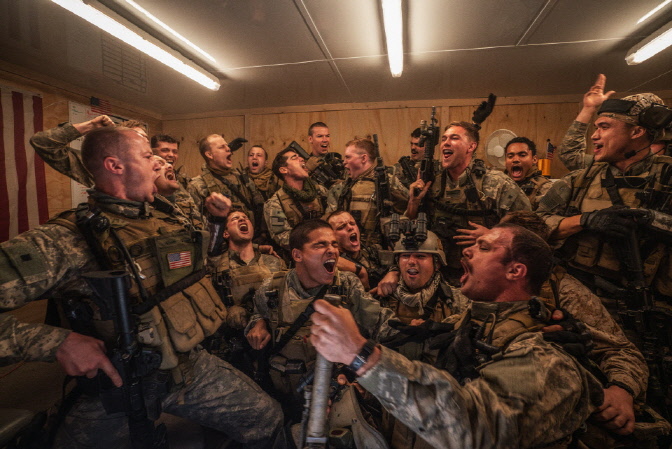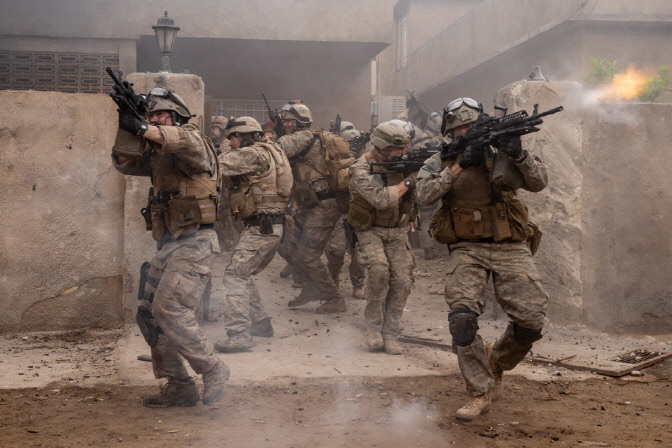
2025 film “Warfare”, which belatedly came to South Korean movie theaters yesterday, attempts to do nothing more than presenting warfare itself on the screen. Based on the testimonies of a bunch of U.S. Navy SEAL platoon members on one intense warfare during the Iraq War in the 2000s, the movie is inherently limited by its rather narrow perspective, but the result is quite tense and realistic at times thanks to its competent direction, and that is more than enough to forget its several weak aspects.
After the brief opening scene introducing those soldier characters in the story together, the movie promptly throws us into their latest mission without much background information. Except the location of their operation site, we do not get much explanation on why they are sent there or what they are exactly going to do there, but, as observing how they smoothly and casually execute the first step of their mission, we come to sense that this is just another usual mission to be handled by them.
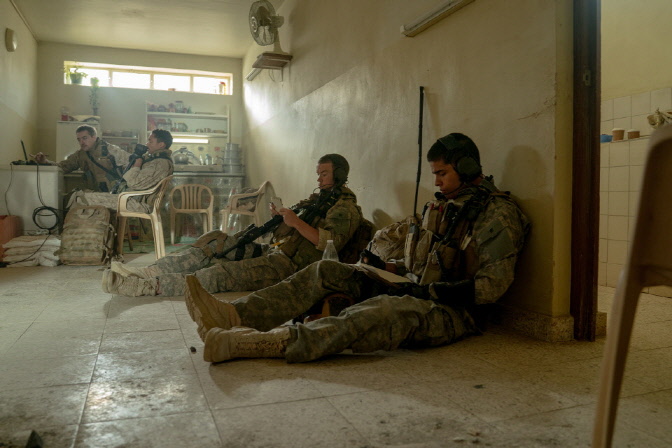
For the members of Alpha One Platoon, their latest mission looks pretty simple. In the middle of one night, they quietly break into a civilian house along with their two local interpreters, and then they swiftly set up their post inside the house before the following morning. Outside the house, everything seems to be fine and normal on the surface, but they begin to notice one little suspicious thing after another, and the mood becomes more tense while they patiently and watchfully monitor the surrounding area. Their enemies can be anywhere, and the possibility of getting attacked becomes more palpable to them even though nothing serious has not happened yet.
Needless to say, there eventually comes a sudden attack from their enemies, and all hell breaks loose upon them within a few seconds. The movie did a good job of vividly illustrating this sudden shock and awe experienced by the main characters, and you will observe how many of them struggle to recover from their resulting physical and psychological trauma while also desperately trying to handle their increasingly urgent situation. No, this is not your usual war flick at all, and we are reminded more of their fear as well as their vulnerability when they must defend themselves more before getting any real chance of survival.
While keeping everything real and authentic on the screen as much as possible, directors/writer Alex Garland and Ray Mendoza, who was incidentally one of these platoon members and also previously worked for Garland as a military adviser in Garland’s previous film “Civil War” (2024), occasionally add a bit of stylistic touch. When the platoon members in the film are unexpectedly ambushed by an improvised explosive device (IED), the mood becomes rather surrealistic as they try to process the resulting traumas of theirs during the brief but unnervingly confusing aftermath, and that makes a striking contrast with when they subsequently try to handle the serious physical injuries of some of them (The movie is dedicated to one of these injured soldiers, by the way).
As the movie constantly limits itself within their perspective, we can only get informed as much as them about what the hell is really going on outside their temporary post. Sure, they frequently communicate with their base for requesting more help or assistance, but you will not understand much of whatever is said on the communication line – even while you will sense more of confusion and chaos surrounding them with more attacks from their hidden enemies.
This storytelling approach actually contributes to both strong and weak points of the movie. On the one side, the movie thankfully avoids any unnecessary sensationalism or jingoism, and it often regards the platoon members in the movie as a mere group even while closely observing their traumas and struggles throughout the story. Sure, you may notice several notable main cast members including D’Pharaoh Woon-A-Tai, Will Poulter, Cosmo Jarvis, Noah Centineo, Joseph Quinn, Kit Connor, Michael Gandolfini, and Charles Melton, but none of them overshadows the less recognizable cast members in the film, and they all simply focus on making their military characters’ situation look and feel more realistically convincing to us. Thanks to their good joint efforts, there are several very intense moments which will definitely make you wince more than once, and we accordingly get more engaged even though we never get to know that much about their characters.
On the other side, the narrow narrative focus of the movie leaves some blind spots to notice. While the movie is rather vague about the goal of the military mission in the story, those hidden enemies in the film are pretty anonymous to say the least, but the movie wisely avoids any gratuitous “shoot-them-up” catharsis at least. In case of those unfortunate local civilians who happen to be stuck with the platoon members in the story, the movie mostly remains distant to them, but, as shown around the end of the story, it shows a bit of sympathy to them as well as those two local interpreters.
Overall, “Warfare” is a well-made war drama film packed with enough intensity and realism to hold our attention, but I also must point out that it does not bring any particular new or fresh to its genre territory. During last two decades, we have had plenty of notable Iraq War films ranging from “Hurt Locker” (2008) to “American Sniper” (2014), and “Warfare” looks like aiming a little too modestly in my humble opinion. I admire its strong points enough for recommendation, but, folks, I doubt whether I will still remember it several years later.