As many of you know well, Robin Hardy’s 1973 film “The Wicker Man” has a pretty complicated history. Not long before it was released in movie theaters in UK at that time, the movie, whose initial running time was around 100 minutes, was trimmed down to 87 minutes, and it was believed for many years that those trimmed materials were lost forever. Nevertheless, as the movie gradually gained more appreciation and admiration during next several decades, there were a series of attempts on restoration, which accordingly led to several different versions including the 2013 “Final Cut” version approved by Hardy himself, who incidentally died in 2016.
I saw the 2001 “Director’s Cut” version, which is probably the version closest to the original version in its 99-minute running time, around 20 years ago, and I noticed that the 2013 version, whose 4K restoration edition was released in South Korean theaters a few days ago, is not exactly the completely restored version. While the main story itself remains mostly intact, the 2013 version, whose running time is 95 minutes, is relatively shorter in its prologue part, which gives us a brief glimpse into its policeman hero’s uptight Christian background before he goes by seaplane to some remote Scottish island for his latest case.
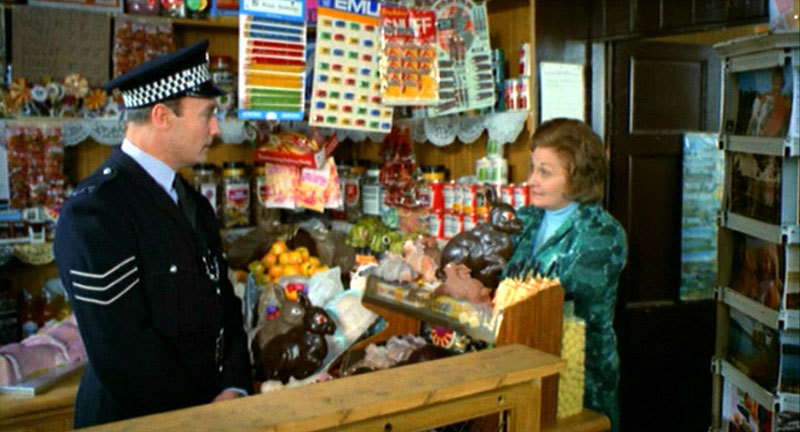
He is Sergeant Neil Howie (Edward Wooward), and his mission seems to be simple at first. A letter was sent to the West Highlands Constabulary, and it was about the mysterious disappearance of some young girl living on that island. Right after arriving at the island, he begins his inquiry around the island, but it does not take much time for him to notice that the residents of the islands are interfering with his investigation in one way or another. No matter how persistently he asks questions about that missing girl, they do not give any clear answer to him at all, and even her family do not help him much.
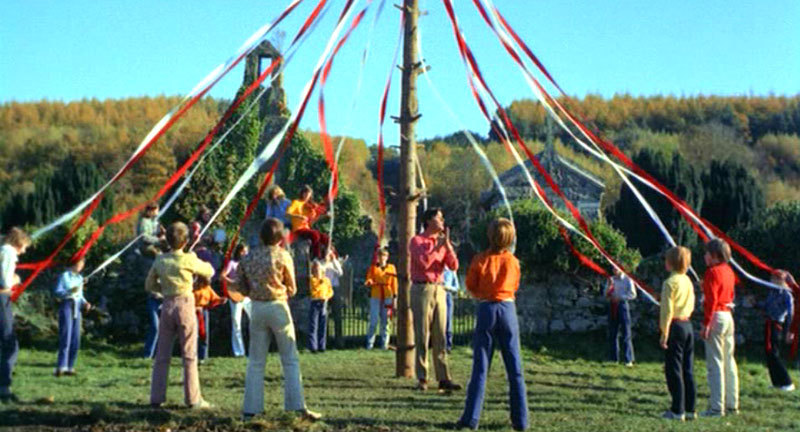
In addition, he cannot help but quite baffled by the apparently pagan lifestyle in the island. Its Christian church has been empty and abandoned for years, and it becomes more apparent to him and us that the residents of the island have been following some older religion under Lord Summerisle (Christopher Lee). For instance, they frequently sing naughty folk songs associated with sex and nature, and they are also very, very, very frank to their children about the sexual aspects of their upcoming spring celebration to be held a few days later.
Needless to say, these and many other things on the island annoy and disturb Sergeant Howie a lot. After all, he is a devout Christian dude with a considerable degree of sexual repression as indirectly implied by the prologue scene, and he is certainly repulsed and confounded a lot by the pagan belief in the island, but he also finds himself quite tempted as the beautiful young daughter of the local innkeeper often flirts with him. At one point in the middle of the story, she actively attempts to seduce him from the room right next to his staying spot, and we get a darkly amusing moment as he desperately clings onto his Christian faith for not being defeated by her blatant act of seduction.
Meanwhile, he gets closer to whatever Lord Summerisle and many other residents of the island are hiding from him. Something is definitely going to happen on the day of that local spring celebration, and this seems to be involved with that missing girl in question. He becomes more determined to find and then save her from whatever may happen to her, but, of course, he only finds himself more cornered by his increasingly insidious opponents on the island.

During its final act, the screenplay by Anthony Shaffer, which is inspired by David Pinner’s 1967 novel “Ritual”, throws more odd and weird things onto the screen. As the local spring celebration is started, Sergeant Howie lets himself thrown into more danger, and the movie cheerfully swings back and forth between dark humor and offbeat horror as its hero walks toward its inevitable finale. I will not go into details here, but I can tell you at least that 1) the finale remains quite impressive and striking as before and 2) you will be chilled more by the inexorable narrative logic behind that.
Although his character is not particularly sympathetic or likable to say the least, Edward Woodward brings considerable intensity to his role, and we become engaged in whatever may happen next along the story, even though we observe his character’s zealous pursuit of truth and justice from the distance. On the opposite, Christopher Lee, who is no stranger to horror genre considering that he once played a certain iconic horror figure, has a lot of fun with his deliberately theatrical character, and he delightfully goes over the top as his character presides over what eventually occurs along with many other island residents.
On the whole, “The Wicker Man” is quite memorable for its decidedly morbid mix of folk horror and absurd comedy despite being rather incomplete even at present. Like some other notable British horror films in the 1970s such as Nicholas Roeg’s “Don’t Look Now” (1973), it has influenced a number of subsequent genre films ranging from Edgar Wright’s “Hot Fuzz” (2007) to Ari Astor’s “Midsommar” (2019), and its strikingly weird moments will certainly linger on your mind for a long time, no matter whichever version you watch. I am glad to experience it along with many other audiences at a local arthouse movie theater yesterday, and I guess it keeps growing on me as usual while continuing to influence more genre works in the future.