Jules (2023) ☆☆(2/4): The Old Man and the Alien

My late mentor/friend Roger Ebert hated, hated, hated what he usually called “the Idiot Plot”, and here is his own definition: “A story in which every problem and conflict would be resolved in five minutes, if not for the fact that every character is a complete idiot.” There are several glaring moments of the Idiot Plot in Marc Turtletaub’s sappy SF fable movie “Jules”, and I am willing to bet my $100 that Ebert would roast these idiotic moments without any hesitation.

First, let me describe to you the most annoying example in the bunch. At one point, Milton (Ben Kingsley), the hero of the story, is suddenly visited by his concerned daughter who does not believe at all that he has an alien in his house. For avoiding more misunderstanding, all he should do is simply letting her inside the house and then showing his extraterrestrial guest, but, no, he simply lets her leave after arguing with her a bit, and that is all.

If the story and characters were more realistic and believable, that might not be much of a problem at all. Milton lives alone in a quite rural town of Pennsylvania which does not seem to have many residents besides him, and the town and its residents look like the stock characters from your average American sitcom. His big and comfortable house, which is located in a rather remote spot outside the town, also has a large backyard, and you may wonder how he has maintained this place fairly well even though it seems there is no housekeeper or gardener visiting this place.

I know, I know, I know. The movie does not intend to be very realistic from the beginning, and that is particularly evident when Milton’s another usual night is suddenly interrupted by the crashing of a UFO (Unidentified Flying Object) on his backyard. He naturally calls 911 at one, but, not so surprisingly, his call is promptly disregarded, and nobody pays much attention to him when he talks about that UFO at a routine town council meeting.

Meanwhile, an alien creature happens to crawl out of that UFO and then collapses in front of the backdoor of Milton’s house. While quite flabbergasted to say the least, Milton tries his best for taking care of this alien creature, and this alien creature, which is later named “Jules” (Jade Quon), looks like getting slowly accustomed to being his guest, though there is not much communication between them from the beginning.

What follows next is the cross between “E.T. the Extra-Terrestrial” (1982) and “Cocoon” (1985). Milton’s two old busybody neighbors, Joyce (Jane Curtin) and Sandy (Harriet Samsom Harris), later get involved in his tricky situation, and they all agree to keep their alien visitor in secret as much as possible, while also wondering how to help their alien visitor. While looking rather detached all the time, Jules looks mostly quiet and gentle, and Milton and his two neighbors are certainly brightened up by their unexpected friend.

Of course, things soon get more complicated for several reasons. Milton’s daughter begins to suspect that her father is hiding something serious, and that leads to the aforementioned moment of misunderstanding between them. Furthermore, Jules is also being pursued by those government agents, and we see lots of agents checking on millions of phone calls in the area surrounding Milton’s town (How the hell could possibly they overlook that 911 call from Milton, I wonder?).

All these and other things in the story are pretty familiar to say the least, but the movie does not bring anything particularly new to its conventional genre territory. While you may get some dark amusement from a little special power of Jules or what kind of fuel that flying saucer actually needs (You may be quite disgusted if you are an animal lover, by the way), the movie does not go further with these morbid details for avoiding any unpleasant moment, and it only becomes sappier instead while Milton later comes to confront the growing possibility of mental deterioration. 

The main performers of the film try their best with their rather thin roles. Ben Kingsley, an intelligent actor who has been usually dependable for more than 40 years since his Oscar-winning performance in “Gandhi” (1982), conveys well to us his aging character’s melancholic existence, and we can easily discern why his character accepts Jules into his house without much fear or hesitation. While Jane Curtin, whom I still fondly remember for her supporting turn in TV comedy series “The 3rd Rock from the Sun”, brings some humor to her functional supporting part, Harriet Sansom Harris, whom you may remember for her scene-stealing appearances in TV comedy series “Frasier”, also manages to acquit herself well, and Jade Quon, who has been mainly known for her stunt performances in a number of recent blockbuster films such as “The Hunger Games” (2012), holds her own small place well even though she is simply required to occupy the screen throughout the movie.       

In conclusion, “Jules” is disappointing in its big failure to engage us in terms of story and characters, and it only makes me want to revisit “E.T. the Extra-Terrestrial” as soon as possible. Just like “Jaws” (1975) did everything a shark movie can possibly do and then made many subsequent shark movies nearly pointless, “E.T. the Extra-Terrestrial” remains on the top of its genre even at present while also making its many imitators look inconsequential and forgettable, and I am sure that “Jules” will be also forgotten within a few years.

Posted in Movies | Tagged , , , | Leave a comment

Shine (2023) ☆☆1/2(2.5/4): A slow story in the island

South Korean film “Shine” is curiously somber and distant in terms of story and character. While it seems to care about its main characters at times, it also often observes them from the distance without delving that much into whatever they think or feel behind their phlegmatic appearance, and the result is not interesting enough to hold our interest during its 2-hour running time.

The story is set in one small village located in Jeju Island, and the early part of the movie focuses on the melancholic sadness and grief of an adolescent girl named Ye-seon (Jang Hae-geum), who has recently lost her dear grandmother. Although her grandmother was under the good care of two kind local nuns of a local Catholic church before she eventually passed away, Ye-seon cannot help but miss her grandmother because there is no adult figure to stay around her in their little house.

At least, there are several persons who really care about Ye-seon’s welfare. Her schoolmate/best friend Da-hee (Chae Yo-won) tries to cheer up Ye-seon a bit, and we later see Da-hee and two other friends of theirs visiting Ye-seon’s residence, but Ye-seon does not seem to welcome them much as putting more distance between them. In case of those two nuns, Sister Rafaella (Jang Sun) and Sister Stella (Jang Eun-kyung), they also check on Ye-seon from time to time, but they also feel some distance between them between her despite their sincere efforts of reaching closer to her.

In the end, Ye-seon comes to open her heart a bit at one night, and things get a bit better as winter is over and then summer begins on the island. Ye-seon becomes a bit more spirited than before as hanging around with her friends more than before, and they later come to have a little mountain picnic time along with Sister Rafaella and Stella, who gladly accompany them as their chaperones (We never get to know about the parents of Ye-seon’s friends, by the way).

And there comes an unexpected change into Ye-seon’s daily life. We see a little girl suddenly coming out of the church and being led to Ye-seon’s house, and both Ye-seon and Da-hee are certainly suddenly surprised to see this little girl. While they do not know anything about this little girl, they decide to take care of her instead of whoever abandoned her, and they even lie to Sister Rafaella and Stella as pretending that that little girl is the daughter of Ye-seon’s currently absent uncle.

However, Sister Rafaella and Stella have some reservation about what Ye-seon told her, especially after they try to reach to Ye-seon’s absent uncle for a matter involved with Ye-seon’s future. Nonetheless, they do not have any problem in helping Ye-seon taking care of that little girl, who seems to be totally fine with being under the care of Ye-seon and others around her.

Of course, the situation soon becomes a bit more complicated for the reason some of you already have guessed. After coming to learn that it is not all right to let Ye-seon take care of that little girl, Sister Rafaella and Stella become quite conflicted about what to do about her problematic circumstance, and Ye-seon also comes to face the emotional consequence of her rather unwise action later in the story.

This sounds like a nice setup for melodramatic moments to come, but the movie adamantly keeps everything in a distant low-key tone. While the camera looks like more interested in capturing those lovely locations of Jeju Island than focusing on the main characters, the main cast members stick to their understated mode without conveying that much to us, and it may take some time for you to gather the relationships among the main characters in the story.

Although this restrained storytelling approach is admirable to some degree, the movie unfortunately ends up scratching the surface without really letting us get to know its main characters. While Ye-seon often feels too distant and passive as the center of the story, the other main characters around her are also rather flat and superficial, and a little moment involved with a visiting photographer feels redundant without much purpose, except for emphasizing how soothing the village really is.

I can only appreciate how Jang Hae-geum and several other main cast members fill their under-developed roles as much as possible. While Jang manages to bring some life and personality to her character, Jang-sun and Jung Eun-kyung did a decent job of embodying their characters’ wholesome kindness, and Chae Yo-won also has her own small moment despite her seemingly thankless supporting role.

“Shine” is the fifth feature of director/writer Park Suk-young, who drew my attention for his two previous films “Steel Flower” (2015) and “Ash Flower” (2016). While these two films are engaging for solid storytelling and strong characters to remember, “Shine” feels relatively less impressive despite showing some technical competence, and it only reminds me of what a nice place Jeju Island is. Although I visited there for a few days of family vacation months ago, and I am now willing to visit there soon again just for checking several locations shown in “Shine”. but I seriously doubt whether that is enough for making me re-evaluate the movie later.

Posted in Movies | Tagged , , , | Leave a comment

A Song of Korean Factory Girls (2024) ☆☆☆(3/4): The oral history of Korean factory girls in Japan

South Korean documentary film “A Song of Korean Factory Girls” illuminates the relatively unknown history of many young Korean women who had to work in Japan during the Japanese colonial period in the early 20th century. As the documentary calmly presents a series of various testimonies from the past, we come to learn a bit more about their sad and painful past, and we are also touched by how they endured and then prevailed despite their utterly grim and harsh reality.

At first, the documentary gives us some background information on how these young women came to Osaka, Japan not long after Korea was colonized by Japan in 1910. They were mostly from poor families, and they all desperately needed any possible way to earn the money to support their dear families. When they heard about those cotton mill factory jobs in Osaka, they certainly hesitated at first for understandable reasons, but they eventually went there because it seemed that there was not any other good option for them in Korea.

Of course, they all came to realize that they were more or less than second-rate laborers to be exploited in one way or another. During that time, the Japanese industry had been boosted a lot since its rapid modernization in the late 19th century. As growing bigger and bigger, many factories in the country naturally needed any cheaper worker available to them, and they preferred South Korean workers simply because South Korean workers were much cheaper than Japanese ones.

At one point, the documentary shows us the location of one of the biggest cotton mill factories in Osaka. The factory is not operating anymore, and the location looks a lot different now, but there are still the remains of the past, nonetheless. We see the big red brown brick walls surrounding the factory, and we can only guess how things were really grim for those South Korean female workers in the factory. Even when they were not working, they were usually not allowed to go outside, and they were also frequently mistreated a lot by their Japanese supervisors and a group of Korean collaborators who were often worse than Japanese people.

The testimonies by several young Korean female workers, which are read by the actresses playing them on the screen, are quite heartbreaking to say the least. Besides having to endure the frequent overtime works in their factory, they were not fed that well on the whole, and the living condition of their factory dormitory was very poor in many aspects. While there was not enough place for everyone, the hygiene of their dormitory was virtually non-existent, and that caused many outbreaks of contagious diseases within the group, which often led to the unfortunate demise of some of them.

Of course, the Japanese supervisors of the factory were well aware of the poor working and living condition of the Korean female workers, but they simply disregarded the Korean female workers’ petitions while mistreating the Korean female workers more and more. When the Korean female workers finally started to protest the ongoing unfair treatment on them, the Japanese supervisors and their Korean collaborators did not hesitate to oppress the Korean female workers by any means necessary, and, not so surprisingly, the local police also helped this brutal suppression.

One of the most poignant moments in the documentary comes from when it looks around a local cemetery where many Korean female workers might have been buried. While the factory allowed them a little proper funeral service, their death was certainly devastating to their dear families, and there is one particularly sorrowful episode about a Korean mother who could not help but wail a lot in front of her deceased daughter’s grave.

Nevertheless, the Korean female workers in Osaka tried their best for not only their survival but also maintaining their national identity. Although many of them were uneducated girls who did not know at all how to write or read in Korean, they actually tried a bit of self-teaching together for corresponding more with their families in Korea via letters, and that certainly boosted their spirit to some degree even though their passionate attempt was subsequently squashed by the Japanese supervisors. They also did not hesitate to cook and eat anything edible enough for them, and it is rather ironic that their humble personal dishes, which were made from the internal organs of pig and cow thrown to them for free during that time, are pretty popular in Japan at present.

Above all, many of them came to settle and then raise their families in the city, and we meet a few remaining survivors who casually reminisce about how things were hard and difficult for them during that time. Later in the documentary, we get some brief glimpses on how these very old ladies have moved on during next several decades since that that time, and it is really moving to observe how they will prevail as usual before their eventual death.

Overall, “A Song of Korean Factory Girls” is an engaging documentary which presents well another important historical part of the Japanese colonization period, and director/writer Lee Won-sik handles the subject of his documentary with enough respect and thoughtfulness. Although it could delve more into its subject, it made me more interested in its subject, and I guess that is what a good documentary can do.

Posted in Movies | Tagged , , , , | Leave a comment

Revolver (2024) ☆☆☆(3/4): She simply wants to get paid as promised…

South Korean film “Revolver” is a dry but wryly engaging mystery noir thriller which keeps its attitude as straight as possible along with its lead actress. While it takes some time for us to discern the rather complicated situation around its criminal heroine, the movie steadily holds our attention thanks to its competent direction and the strong performance from the lead actress, and it also shows some dark sense of humor as several criminal characters around its heroine clumsily try to deal with her in one way or another.

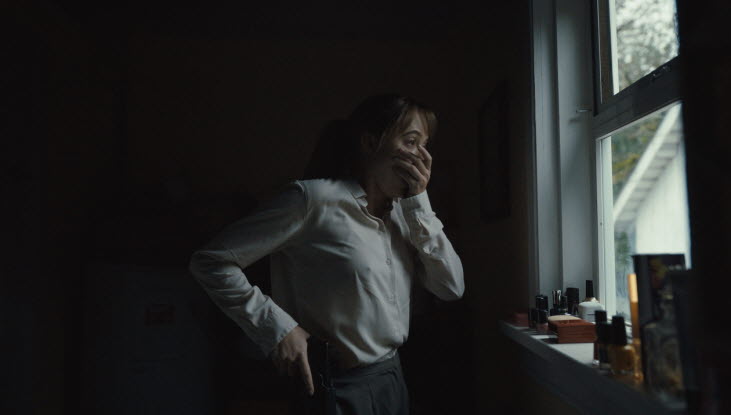
Jeon Do-yeon, who has been one of the most interesting actresses working in South Korea for more than 25 years, plays Soo-yeong, a female ex-cop who has just finished her 2-year prison sentence. As shown from a series of flashback scenes early in the film, she and several other cops had committed a number of serious cases of bribery, but then they and their criminal associates were on the verge of getting arrested and then charged for their crimes due to some unfortunate incident. After some persuasion, Soo-yeong agreed to take the fall alone by herself in exchange for the considerable financial compensation she will receive after her prison sentence.

However, when she is finally released from the prison, it does not take much time for her to realize that she is not going to be paid as promised. Nobody is waiting for her outside, and a certain close colleague of hers, who was supposed to hand out some money and a nice apartment to Soo-yeong later, was killed under a very suspicious circumstance not long before her release.

Naturally, Soo-yeong starts to search for any possible way to get her promised compensation, and we get to know more about the big criminal picture surrounding her. She and her fellow dirty cops were involved with some powerful criminal organization willing to bribe them a lot at that time, so she must go for several key figures in this criminal organization, and she is quite determined for going all the way to the top if that is required.

Meanwhile, the movie throws more pieces of information on her ongoing situation. It seems that that deceased colleague of hers was trying to blackmail the criminal organization, and whatever he planned before his ‘suicide’ was involved with a certain person who has been incidentally gone missing for a while. As Soo-yeong delves more into this possibly criminal matter, those key figures of the criminal organization are not so pleased to say the least, and they are ready to stop her if that is really necessary.

Because of its very title, you may expect the movie to go for a lot of action like “John Wick” (2014), but the screenplay by director/writer Oh Seung-wook, who previously collaborated with Jeon in “The Shameless” (2015), focuses more on mood and character instead. As its flawed heroine tries to find any clue for her increasingly risky private investigation, a number of colorful criminal figures accordingly pop out here and there around her, and that surely contributes extra personality to the story. While you may sometimes scratch your head as trying to understand everything in the story (Full Disclosure: I did), the movie keeps us engaged via building up more mood and tension along the story, and you can at least get some clear idea of where the story and its heroine are heading.

Above all, Jeon diligently carries the film to the end with her stoically unflappable attitude. While we never get to know that much about Soo-yeong except her serious criminal past, Jeon ably fills her taciturn character with enough life and presence, and she is also convincing in a couple of brutal action scenes where her character shows more of the steely toughness behind her detached façade. Yes, Jeon is basically following the time-honored playbook established by many different actors ranging from Lee Marvin to Keanu Reeves for many years, but she brings her own touches to her archetype role nonetheless, and the result is another distinctive performance to be added to her long and illustrious acting career.

Around Jeon, Oh assembles a bunch of interesting performers to watch. While Ji Chang-wook, Kim Jun-han, Kim Jong-soo, and Jung Man-sik are well-cast in their substantial supporting parts, Jeon Hye-jin, Lee Jung-jae, and Jung Jae-young are also solid in their brief but effective appearances, and the special mention goes to Lim Ji-yeon, who effortlessly steals every moment as a wily young lady who must balance herself well among Soo-yeong and several other key figures for her survival and benefit. Yes, her character is not exactly trustworthy, but she is quite frank about that from the very beginning, and it is fun to observe how her character playfully interacts with Soo-yeong as your average moll character. No, they do not look like being sexually attracted to each other on the surface, but you may sense some homoerotic subtext beneath their uneasy but fascinating alliance along the story.

Overall, “Revolver” may require your patience due to its rather slow narrative pacing and frequently murky storyline, but it is a more satisfying work compared to “The Shameless”, which bored me a lot as being merely and solemnly mired in the gloomy misery of its two lead characters. “Revolver” is also quite moody and solemn in many aspects, but it is sometimes darkly amusing in addition to having enough mood and personality to be appreciated, and the result is one of more enjoyable genre products of this year.
Posted in Movies | Tagged , , , | 1 Comment

Brother (2022) ☆☆☆1/2(3.5/4): Memories of his big brother 

Canadian film “Brother” surprises me for being more sensitive and thoughtful than I expected. On the surface, it may look typical as another black slum neighborhood drama film, but it comes to show more heart and soul as its introverted hero struggles to deal with his past and present along the story, and it is really poignant for us to observe and understand how much he is haunted by the memories of his dear big brother.

At first, the movie, which is mainly set in the 1990s, gradually establishes the history between a young black man named Michael (Lamar Johnson) and his older brother Francis (Aaron Pierre). They grew up together under their single Jamaican mother Ruth (Marsha Stephanie Blake), and a series of early flashback scenes show us how often Michael leaned on his older brother even they were just little young boys. When they grow up more later, Francis becomes a big, hulking dude who is virtually a father figure/protector to his younger brother, and Michael, who always looks rather timid whenever he is with his older brother, still depends a lot on his older brother while not so sure about what to do about his life.

And we see how things can be pretty harsh in their black slum neighborhood in the Scarborough district of Toronto, Ontario. Like many other black people in their neighborhood, their mother is frequently absent due to her demanding menial job, and she is often too exhausted to pay attention to them even when she is at their little apartment. Outside their little residence, many criminal incidents occur day by day, and it goes without saying that the local police are not so nice to any young black man out there.

Not so surprisingly, Francis wants to get out of his neighborhood as soon as possible, but that inadvertently causes a conflict between him and his mother, who is not so pleased at all when he suddenly decides to quit his high school for pursuing the career of a rap music producer. While he eventually moves out of his family residence, Francis remains close to his younger brother as before, and Michael sincerely hopes that things will eventually work out well for his older brother.

 We already know well that things did not go that well for them, as the movie often moves forward to how Michael tries to move on without his older brother several years later. While stuck in a plain part-time job as his older brother once was, Michael also has to deal with taking care of his increasingly senile mother, but he cannot help but feel lost as being more aware of his older brother’s absence, and he is not even consoled much by his old sweetheart Aisha (Kiana Madeira), who returned to their neighborhood shortly before her father’s death. Understanding well how painful it is to lose a loved one, she generously attempts to help him dealing with his anger and grief, but Michael still hesitates to do that, and this causes a big conflict between them.

As frequently going back and forth between several different time periods, the screenplay by director/writer Clement Virgo, which is based on the novel of the same name by David Chariandy, reveals more depth in terms of story and characters. While we come to see that Ruth has had a fair share of frustration and exasperation as trying to support and raise her two boys alone by herself, Francis turns out to have a little soft and sensitive side behind his confidently masculine side, and that is evident particularly after he and his younger brother get their hearts broken by the rejection of someone who may be their biological father.

These and other personal moments are often alternated with the grim moments of the harsh reality surrounding the main characters. There is an intense scene when Michael and Francis happen to confront a bunch of local thugs, and the mood becomes quite tense when Francis shows these thugs that he is definitely not someone they can mess with. In case of several scenes involved with police brutality, the movie does not pull any punch at all, and we see how traumatic these infuriating moments are to both Francis and Michael.

The movie is supported well by the two very good performances from Lamar Johnson and Aaron Pierre, who gradually come to us as the heart and soul of the film. While Johnson, who recently drew more attention thanks to his Emmy-nominated guest appearance in HBO TV drama film “The Last of Us”, diligently holds the center with his earnest performance, Pierre, who recently appeared in Barry Jenkins’ acclaimed TV miniseries “The Underground Railroad”, is equally solid in his nuanced acting, and they did an effortless job of embodying the long history between their characters. As Francis and Michael’s long-suffering mother, Marsha Stephanie Blake has several strong moments to remember, and Kiana Madeira brings some warmth to the story as her character tries her best for the man she still cares about.                    

In conclusion, “Brother” is a rather tough stuff, but it handles its story and character with enough sensitivity and thoughtfulness, and you will be moved by a little glimpse of hope around the end of the film. Considering that it was quickly released and then gone in US in last year, this little but impressive piece of work deserves some more attention in my humble opinion, and I assure you that you will not forget it easily after it is over.

Posted in Movies | Tagged , , | Leave a comment

Carmen (2022) ☆☆☆1/2(3.5/4): As they run away together

I am not sure whether I understood everything in “Carmen”, but that did not bother me at all during my viewing. Mainly driven by a series of musical dance sequences, the movie presents a very familiar type of story with its own distinctive mood and style, and it surely helps that it is supported well by the presence and talent of its two talented lead performers.

The movie opens with the striking prologue scene set in the middle of a barren field located on the Mexican side of the Mexico-US border. As a pair of thugs are coming for a certain purpose, one middle-aged woman begins her defiant flamenco dance in front of her shabby residence, and she remains unflappable in her dance movement even when one of these thugs threatens her with a gun and then eventually kills her.

This dead woman turns out to be the mother of a young woman named Carmen (Melissa Barrera). While grieving a lot for her mother’s death, Carmen immediately embarks on a journey across the border for meeting an old friend of her mother who incidentally resides in LA, and we soon see her crossing the border along with several other people.

On the other side of the border, we get to know a bit about a young ex-marine named Aidan (Paul Mescal). While still struggling to the post-traumatic stress disorder (PTSD) from his war experiences, he reluctantly agrees to join a militia group patrolling around the border, and then he and his new colleagues come across Carmen and other illegal immigrants in the middle of one night. Unfortunately, a shootout immediately occurs, and Aidan finds himself running away along with Carmen after killing one of the militia group members for saving her.

Around that point, the movie naturally comes to follow the footsteps of its numerous seniors ranging from “Bonny and Clyde” (1967) to “Queen & Slim” (2019). While evading the following pursuit of those law enforcement guys together, Carmen and Aidan become more drawn to each other, but both of them hesitate to get closer to each other for each own reason, and that leads to an interesting romantic tension to observe.  

This mutual attraction between our two accidental lovers is more intensified as the movie goes through one musical dance sequence after another. When they happen to drop by an amusement park at one night, Carmen joins a bunch of dancers at one spot, and what follows next is mesmerizing enough to hold your attention even though you do not totally understand its points. As the camera of cinematographer Jörg Widmer fluidly and dexterously moves here and there around the dancing figures, whatever is expressed by their physical movement on the screen is vividly conveyed to us, and this wonderful visual moment is further enhanced by the boldly impressive score by Nicholas Britell, who became more prominent thanks to his Oscar-nominated work in Barry Jenkins’ “Moonlight” (2016).

When Aidan and Carman eventually arrive in LA and then goes to where her mother’s friend works as a dancer, the movie does not disappoint us as providing more song and dance scenes to be appreciated. Encouraged a lot by her mother’s friend, Carmen tries a bit of song and dance on the stage, and, what do you know, she turns out to be a fairly good dancer just like her mother was, and that leads to another impressive musical dance scene to remember. 

I must tell you that the screenplay by director Benjamin Millepied (He is the ex-husband of Natalie Portman, by the way) and his co-writers Alexander Dinelaris Jr. and Loïc Barrère is inspired to some degree by Bizet’s opera of the same name, but you do not have to be familiar with that famous opera piece, because the screenplay is a sort of “complete re-imagining” which do not follow much of the story and characters of Bizet’s opera. Although a portion of Bizet’s opera is incorporated into the soundtrack, the songs in the movie are the original ones respectively written by Britell and several other musicians, and these songs function well as the effective components of the narrative of the film.

The two lead performers are fabulous as generating enough chemistry between them. Melissa Barrera, who has been mainly known for several recent horror films including Matt Bettinelli-Olpin and Tyler Gillett’s “Scream” (2022), demonstrates the other side of her considerable talent here in this movie, and her quiet but passionate performance is complemented well by the more reserved acting by Paul Mescal, who has been one of the new exciting young talents to watch since his Oscar-nominated turn in Charlotte Wells’ “Aftersun” (2022). Around them, Rossy de Palma, who has been a frequent actress in many of Pedro Almodóvar’s movies, steals the show everytime, and Tracy “The DOC” Curry, a well-known American raper who incidentally composed one original song for another song and dance sequence in the film, is also excellent in his brief appearance.

On the whole, “Carmen” is definitely not something conventional, so it may take some time for you to get accustomed to how it is about, but it will be quite a rewarding experience once you go along with how its narrative is freely driven by music, dance, and the emotions behind them. In short, this is one of the more distinctive works during last several years, and I wholeheartedly recommend you to take a chance with it someday.

Posted in Movies | Tagged , , , , | Leave a comment

Will You Please Stop, Please (2024) ☆☆☆(3/4): How she endures at her workplace

South Korean independent film “Will You Please Stop, Please” is often painfully funny as following the ongoing hardships of its rather meek heroine. While usually quite busy with doing one task after another at her workplace, she finds herself cornered into more fatigue and desperation day by day, and that is not so far from what many young working people in South Korea have to endure everyday. Nevertheless, instead of merely resorting to despair and frustration, the movie shows some sense of humor and spirit as she keeps struggling for better days to come, and it certainly earns its optimistic closing scene.

The story, which consists of five separate chapters, begins with how things are usually hectic for Hye-in (Kim Yeon-kyo), a young woman who has worked for 5 years at a small publishing company associated with some big Buddhist temple. As the youngest member in the company, she is always the one expected to take care of many small and big tasks, and the opening chapter humorous depicts her one particularly busy day. At first, it seems that all she will have to do is going to a local post office for sending a book to one of their most prominent customers, but then more tasks come upon her, and that surely pressures her a lot before her working hour is eventually over.

Hye-in works under the two senior employees, who do not look like caring that much about their junior employee’s feelings but are still capable of supporting her to some degree when that seems necessary. At one point, they decide to have a little lunch together in their office, but their little private time happens to be interrupted by a certain senior male employee. As he behaves like your average free-range male rude in front of Hye-in and her senior employees, Hye-in naturally feels quite embarrassed, but she does not dare to express her displeasure, and then there comes a point where her senior employees finally come to decide that enough is enough.

Meanwhile, Hye-in and her senior employees soon come to have another busy period as they are about to publish the monthly magazine of their temple. Again, Hye-in is tasked with a lot of tasks including those usual editing and proofreading jobs, and there is a darkly humorous moment when what she worked on for several hours is irreversibly obliterated by a sudden computer error. If you have ever had such a stressful experience like that, you will surely understand how frustrating it is for her.

While often getting quite exasperated at her workplace, Hye-in tries to find some peace and comfort via the routine group activities inside the temple, though that is not always successful to our little amusement. As shown from the opening scene, her mind is sometimes so stressed out that her mind often gets sleepy or distracted, and that leads to another amusing moment to tickle us.

In the end, there comes an unexpected moment when she happens to do some overtime work at one night. Regardless of whether this moment is real or imagined, Hye-in comes to find some strength for keeping moving on no matter whatever she is expected to do next, though she still feels that her job is as thankless as ever.

Naturally, Hye-in considers quitting her job at times, but, of course, that is not so easy to do to say the least. Whenever her little wage is transferred to her bank account, most of her wage is quickly gone due to not only her scholarship loan but many other things she has to pay every month, and that makes her more reflective about where her life is going now. Just like her senior employees, she attempts to be more productive during her free time, but she is often too exhausted to do anything else after her working hour, and that makes her all the more despaired than before.

Around the end of the story, there comes a sort of breaking point for our very frustrated heroine, but the screenplay by Heisong still maintains its lightweight sense of humor. When Hye-in and her senior employees have to deal with one particularly rude customer of theirs, Hye-in comes to have a little moment of inner conflict, and the movie does not hesitate to go for some surreal touches during that scene. When Hye-in’s senior employees later come to show more support for her, this scene becomes surprisingly touching, and we certainly come to cheer for their little but precious moment of solidarity.

The main cast members give engaging performances under the competent direction of director Kim Eun-young, who makes a feature film debut here. While Kim Yeon-kyo ably carries the film with her fine comic performance, Jang Liu and Son Ye-won have each own moment as Hye-in’s senior employees, and Lim Ho-jun and Kim Geum-soon also have a little fun with their rather unpleasant supporting characters.

In conclusion, “Will You Please Stop, Please” is enjoyable for its sharply humorous moments, and it does not waste any of its rather short running time (63 minutes). I must tell you that there have already been a lot of South Korean independent films about how it is often difficult for young people to live and work in the South Korean society, but this movie distinguishes itself a bit as showing some hope and optimism, and that is surely something to be cherished in my trivial opinion.

Posted in Movies | Tagged , , , | Leave a comment

The Wonder (2014) ☆☆☆(3/4): An intimate drama of one rural family

Alice Rohrwacher’s second feature film “The Wonder”, which was somehow released in South Korean theaters a few days ago, is a small but intimate drama of one rural family to observe. While we do not get to know everything about the family in the film, they come to us as vivid and interesting persons nonetheless, and you will be impressed by the considerable realism on the screen.

In the beginning, the movie gradually introduces us to a German guy named Wolfgang (Sam Louwyck) and his several family members including his wife Angelica (Alba Rohrwacher, who is incidentally the director’s older sister). They live in a shabby house at a remote spot located in the middle of some rural region of Italy, and Wolfgang and Angelica have been trying to earn their living via their modest farm business, though they have also struggled a lot with their constant financial problem.

Wolfgang and Angelica have four young daughters, and the eldest one, Gelsomina (Alexandra Maria Lungu), is naturally expected to handle a lot of domestic stuffs, especially when she is alone with her younger sisters. For example, she often has to help her father’s beekeeping work, and the movie accordingly presents a series of realistic moments as she and her father work together on those thousands of honeybees day by day.

And then there comes two small changes into Gelsomina and her family’s daily life. When she and her younger sisters are having a fun time along with their father at a nearby lakeside spot, their innocuous playtime is interrupted by the sudden appearance of a stranger approaching them. This person in question happens to be one of the crew members of some popular TV show focusing on “most traditional families”, and Gelsomina and her younger sisters cannot help but become fascinated with the female host of this TV show, who instantly mesmerizes them with her graceful beauty accentuated further by her lovely costume. Because it seems her and her family can be good candidates, Gelsomina come to consider making her family participating in this TV show, but her father does not approve of that at all as a stubborn guy who does not welcome any interference to his little farm business.

However, due to his ongoing financial problem, he has no choice but to compromise a bit. Without telling his wife at all in advance, he decided to let a juvenile delinquent named Martin (Luis Huilca Logrono) stay in their house for getting some money. Although she is not so pleased about her husband’s decision, Anglica eventually agrees to his decision because they really need money now, and then we see Martin gradually becoming a part of their household even though being not so communicative from the beginning.

Leisurely rolling its main characters along the story, the movie slowly immerses us into their daily life, and the resulting verisimilitude is often impressive to say the least. While it is a bit too frustrating as we do not get much background information on its main characters, what they feel and think are clearly conveyed to us even when they do not talk much, and that is particularly evident when Martin begins to ignite some sexual curiosity from the girls in the house. While still quiet and reticent as before, he comes to draw more attention from them as days go by, and we are not so surprised by what happens later between him and one of the girls in the middle of one night.

In the end, the story reaches to a sort of climax when the family luckily get a chance to appear in the TV show (Is this a spoiler?), but, again, the movie takes its time for vividly capturing the emotional undercurrents among its main characters. This may require more patience from you, but it is still a rewarding experience to be appreciated, and I especially like how the ending is touchingly presented with a bit of magic realism.

These and many other lovely moments in the film are skillfully presented on the screen with a substantial amount of unadorned beauty. Rohrwacher and her cinematographer Hélène Louvart, who would collaborate with Rohrwacher more in “Happy as Lazzaro” (2018) and “La chimera” (2023), shot the movie on 16mm film, and the result is quite admirable for the natural poetic qualities. While it often feels raw and rough on the surface, the movie is constantly tinged with enough sensitivity and lyricism, and we are drawn more to the mood and details even though the movie trudges a bit from time to time.

Rohrwacher also draws the solid performances from its main cast members. While young performers Alexandra Maria Lungu gradually takes the center of the movie with her earnest acting, several other main cast members including Sam Louwyck, Alba Rohrwacher, Sabine Timoteo, Agnese Graziani, and Luis Huilca Logrono are also excellent in their respective parts, and Monica Bellucci is perfectly cast as that beautiful TV show host.

In conclusion, “The Wonder”, which won the Grand Prix award when it was shown at the Cannes Film Festival in 2014, is worthwhile to watch for its thoughtful handling of mood, story, and characters, and it also reminds us of how far Rohrwatcher has advanced after it came out. Although it is relatively less impressive than “Happy as Lazzaro” or “La chimera”, it is still interesting enough to recommend, and I am certainly glad to get a chance to watch it on a big screen.

Posted in Movies | Tagged , , | Leave a comment

Pilot (2024) ☆☆1/2(2.5/4): A pilot in drag

South Korean film “Pilot” does not convince me enough with its drag comedy. Right from its first drag scene, I could not help but aware of its artificial aspects as the camera, which can be quite glaringly objective as many of you know, clearly shows that this is no more than a mere drag performance, and that reminds me again of how drag comedy can be a lot more difficult and challenging than it seems.

Oh, it goes without saying that Cho Jung-seok, who has been more prominent thanks to his goofy supporting turn in “Architecture 101” (2012), is not a bad actor at all. As a matter of fact, he is well-qualified considering that he previously performed the lead character in a stage performance of “Hedwig and the Angry Inch” several years ago, and he surely puts lots of efforts here for making his hero’s female disguise look as convincing as possible, but, alas, I did not believe that his character actually could fool many others around him. To be frank with you, I often kept myself from shouting at others around me during my viewing: “He still looks like a man, folks!”.

The early part of the film establishes how Cho’s character, Jung-woo, suddenly becomes quite desperate. He is a leading pilot of some prominent airline who has been a popular public figure after appearing in a local TV talk show, but then his rising status crumbles down due to a very unpleasant incident which occurs during a big company drinking meeting. When he unwisely makes a very insensitive comment on the female colleagues at the meeting, somebody records it and then discloses it in public, and now he becomes one of the most unpopular figures in the country.

As a result, Jung-woo quickly gets fired, and, not surprisingly, no other airline wants to hire him. In addition, his wife, who has been tired of being disregarded by him day and day, leaves him along with their little son, and he has no choice but to move to a little apartment where he bought for his mother and younger sister. While his mother is mostly absent due to a little private hobby of hers, his younger sister, Jung-mi (Han Sun-hwa), is mainly occupied with promoting her makeup skills on the Internet, and she turns out to be a considerable help when, after getting drunk a bit, Jung-woo impulsively decides to search for a new job as a woman.

What follows next is very predictable to say the least. Yes, Jung-woo is surprised and delighted to see that his female disguise works better than expected, though his female disguise is a bit too transparent in my humble opinion. Yes, as “Jung-mi”, he gets employed mainly because the female head executive of the same airline company he once worked for happens to want to employ more female pilots out there. Yes, while inadvertently drawing the attention of one of his ex-colleagues, he also gradually gets friendly with a female pilot named Seul-ki (Lee Joo-myoung), and the situation becomes more complicated as Jung-woo finds himself attracted to Seul-ki.

The movie, which is incidentally based on Swedish comedy film “Cockpit” (2012), naturally provides a series of absurd moments as Jung-woo tries to maintain his female disguise in front of many others around him, but many of these scenes feel rather contrite in addition to reminding us too much of several other notable drag comedy films out there. While “Tootsie” (1982) instantly comes to our mind right from the beginning, we later get a sequence which is not so far from the similar one in “Mrs. Doubtfire” (1993), but the movie is often deficient in wit and humor compared to these and other senior comedy films, and it only resorts more to silly gags and jokes from its hero’s female disguise.

Of course, the movie also tries to handle several gender issues as Jung-woo struggles to present himself well as “Jung-mi”, but, despite its good intentions, the result is clumsy at best and confused at worst. While Jung-woo surely comes to learn a lot about how men like him can be quite rude and insensitive to women, this does not change an inconvenient fact that he virtually snatches the position intended for woman. In case of his relationship with Seul-ki, the movie thankfully does not push them into conventional romance, but it does not seem to know that well what to do with their developing relationship along the story, and their situation becomes merely muddled when Seul-ki turns out to have some important matter behind her back.

Furthermore, several main cast members surrounding Cho are mostly under-utilized due to their flat supporting parts, though they try their best for filling their respective spots. While Lee Joo-myoung brings some life and personality to her rather thankless role, Ha Sun-hwa and Oh Min-ae have some fun with their more colorful supporting roles. and it is a shame that the movie does not utilize more of their considerable comic talent.

Overall, “Pilot”, directed by Kim Han-gyul (She previously directed “Crazy Romance” (2019), by the way), does not succeed enough to make me laugh a lot, but it may work better for you as long as you can go along with its lead performer’s female disguise more than I could. After all, I am just your average cranky movie reviewer who is more fastidious about how and what movie is about, and I let you decide whether you can spend some free time on this mildly enjoyable product.

Posted in Movies | Tagged , , , , | Leave a comment

Attila Marcel (2013) ☆☆☆(3/4): A Proustian tale presented by Sylvain Chomet

As watching Sylvain Chomet’s live action film “Attila Marcel”, which was somehow re-released in South Korean theaters in last week, I could not help but wonder whether it worked better it were an animation film. In my inconsequential opinion, many of the colorfully whimsical touches here and there in the movie could be more impressive if they were presented in animation, and, after all, Chomet already delighted us a lot with his own distinctive animation style in his two Oscar-nominated animation films “The Triplets of Belleville” (2003) and “The Illusionist” (2010). Sure, it is quite clear that Chomet has a fun with making his first live action film, and the result is fairly enjoyable on the whole, but I still have some reservation on whether the movie works as well as intended.

The story mainly revolves around Paul (Guillaume Gouix), a mute young Parisian pianist who has lived with his two aristocratic aunts for many years since his parents died under some unfortunate circumstance when he was very young. As a matter of fact, that incident in question is so traumatizing that he has been incapable of speaking, and he usually focuses on honing his piano performance skill whenever he is not working at a dance class managed by his aunts.

Paul and his aunts have resided in a big and cozy apartment full of old stuffs besides one grand piano which has been the center of his daily life, and we observe how domineering both of his two aunts can be to their nephew. They frequently behave like your average overprotecting parents, but they always make sure that their nephew’s daily life is consistently maintained everyday, and they also tolerate his several quirky sides including the nearly obsessive fondness of chouquettes, a small French patisserie which looks a bit like cookie on the surface.

And then, of course, there comes an unexpected change into Paul’s seemingly repetitive daily life. Via a blind man who has worked as a piano tuner for him and his aunts, he happens to encounter Madame Proust (Anne Le Ny), a middle-aged woman living below his apartment. When he enters her smaller apartment, he is caught off guard by how she made her apartment into a little secret garden of hers, but then he soon finds himself quite soothed by the enchanting qualities of her garden, and, above all, he finds herself drawn to the magical power of her special tea, which is incidentally handed to him with pieces of madeleines.

Now some of you are probably reminded of French novelist Marcel Proust’s magnum opus “In Search of Lost Time”, which was incidentally one of the most important novels in my adolescent period along with James Joyce’s “Ulysses”. Despite reading all of it twice during that time, I cannot tell you whether I totally get this masterpiece even at present, but I still remember lots of things vividly remembered by its hero, and that is probably the whole damn point of that fascinatingly sprawling novel.

Anyway, just like that tea and madeleines initiates a long stream of memories from the mind of the hero of “In Search of Lost Time”, Madame Proust’s special tea served with madeleines awakens the repressed childhood memories somewhere inside Paul’s consciousness. Although he was only 2 not long before his parents passed away, he could somehow vividly remember his parents more than before, and their several happy moments in the past are accompanied with a series of colorful musical scenes. While they were not exactly a perfect couple, Paul’s parents passionately and sincerely loved each other nonetheless, and their deep trust and love are wildly and amusingly depicted when they are going to perform a rather risky act of entertainment together in front of their cheering audiences.

It is not much of a spoiler to tell you that the story subsequently gets darker as Paul’s mind eventually approaches closer to the origin of his personal trauma, but that is where Chomet’s screenplay begins to stumble more than once. While the mood becomes quite melodramatic as expected during the last act, the whimsical style of the movie sometimes prevents it from generating more necessary gravitas for the story, and its main characters remains merely broad and cartoonish without much human depth for engaging us more. In case of a subplot involved with the possible romance between Paul and a certain adopted Chinese girl, this feels rather under-developed to my disappointment, and the movie is not that successful when it attempts for more laughs via the racial prejudice of Paul’s aunts.

Anyway, the main cast members are solid in their respective parts. Besides playing Paul’s father in the flashback scenes, Guillaume Gouix brings some poignancy to Paul’s isolated status, and Anne Le Ny is believable with the aura of your average spiritual healer. Bernadette Lafont and Hélène Vincent are as boisterous as required by their comic supporting roles, and Fanny Touron is also solid as Paul’s spirited mother.

In conclusion, “Attila Marcel” is not as impressive as Chomet’s previous works, but I recommend it mainly because it has enough visual goodies to hold your attention at least for a while. Although he has been not so active after “Attila Marcel” for more than 10 years, Chomet is currently working on the biopic of Marcel Pagnol which may come out in the next year, and I sincerely hope that I will be more engaged and entertained by his next work.

Posted in Movies | Tagged , , | Leave a comment