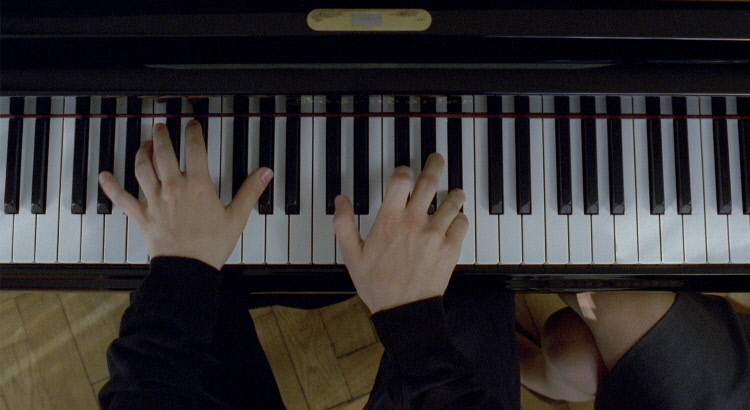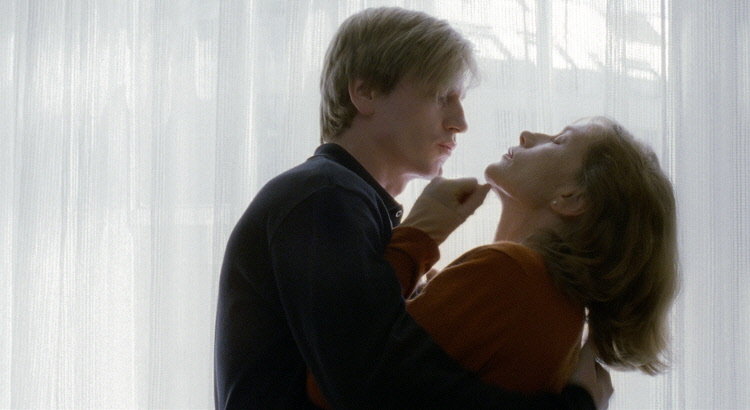
Michael Hanake’s 2001 film “The Piano Teacher”, which was released in South Korean theaters in last week, is a truly disturbing observation of one very, very, very twisted lady. While we never really fully understand her even at the very end of the story, the movie still works as a cold but undeniably compelling character study driven by its skillful direction as well as its two brave lead performances to admire.
The story, which is based on the novel of the same name by Austrian Nobel Prize winner Elfriede Jelinek, mainly revolves around Erika Kohut (Isabelle Huppert), a fortysomething woman who works as a piano professor at the Vienna Music Conservatory. She lives with her old mother in a small apartment, and the opening part shows the apparently toxic relationship between them. Her mother, played by Annie Girardot, is quite domineering and possessive to say the least, and Erika certainly hates her mother for that, but she remains stuck with her mother even after clashing with her mother a lot over a rather petty matter.
In contrast to this troubling aspect of her private life, Erika has been known as a frigidly strict teacher who always demands perfection from her students. We observe how strictly she handles some of her students, and she does not show any sympathy or compassion at all when one of them struggles to meet her high standards.
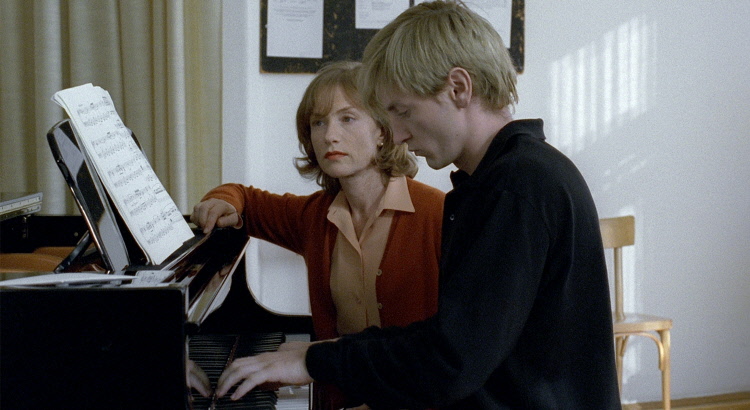
On one day, Erika encounters a young college student named Walter Klemmer (Benoît Magimel). While his major is engineering, he is also fairly good at playing piano, and he is really eager to study under Erika. Although she is not so interested at first, Erika gradually finds herself attracted to Walter as he eventually begins to study under her, and Walter is apparently well aware of that even though she does not signify much on the surface.
As things get more tense between them, the movie shows more of how morbid Erika’s sexual desire and taste are. Probably because of the sexually repressive influence from her mother, she often does some weird and disturbing behaviors just for her private sexual pleasure, and we naturally become more uncomfortable as observing more of her twisted sides. For example, she sometimes visits a local pornography shop for a certain kind of sexual activity which will unnerve many of you for a good reason. Later in the story, she goes to a drive-in theater during one evening for a certain sexual purpose, and the following voyeuristic act of hers is another moment of shock and repulsion for us.
While adamantly refusing to explain its heroine, the movie gives us some hints from Erika’s very unhealthy relationship with her mother. Having lived together for so many years, they often look like a bickering couple, and they even sleep together on the same bed. Nevertheless, they always present themselves as respectable figures in front of others, and it is clear that Haneke has some nasty fun with their hypocrisy.
As Walter keeps trying to approach closer to her, Erika eventually decides to take a chance with him, but, not so surprisingly, she is soon painfully reminded that everything can always be under her control. So far, she has controlled her loony sexual desire on her own deranged but strict terms just like she strictly handles the piano performance of her students, but now she needs to be less controlling and more opened for this desirable young man – and, unfortunately, that is something she is nearly incapable of.
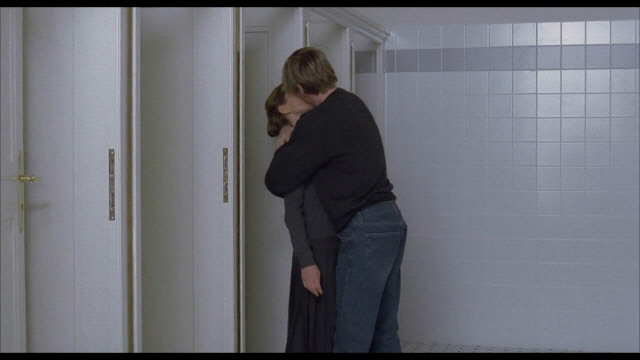
While its heroine struggles with getting her sexual desire under her control again, the movie serves us a number of nasty and disconcerting moments. We gasp when Erika commits an utterly cruel thing to one of her students just because Walter seems to get a bit closer to this student, and then we are all the more unnerved when Erika tries to go further with Walter.
Around that narrative point, the movie becomes more uncompromising in the examination of its heroine’s sexual struggle, and Isabelle Huppert, who has always been a peerless master of twisted humanity during last several decades, gives a fearless performance to remember. Willingly throwing herself into all the baffling abnormalities and contradictions inside her character without any hesitation, Huppert is constantly captivating throughout the film, and we become more fascinated with Erika even while observing her from the distance without much care or sympathy.
On the opposite, Benoît Magimel, who won the Best Actor award for this movie at the Cannes Film Festival (The movie also won the Best Actress award for Huppert and the Grand Prix for Haneke, by the way), did more than complementing his co-star. While being relatively more opened than Huppert, Magimel also shows considerable commitment as their characters push or pull each other along the story, and he is particularly effective when Walter comes to show much more nastiness and cruelty than expected due to his accumulating anger and frustration caused by Erika. In the end, both Walter and Erika come to have a hurtful lesson associated with that famous phrase: “Be careful what you wish for, you just might get it.”
In conclusion, “The Piano Teacher” is one of the notable achievements in Haneke’s interesting filmmaking career. Although I still loath “Funny Games” (1997) and its 2007 American remake, he also gave us several great films such as “Caché” (2005), “The White Ribbon” (2009), and “Amour” (2012) at least, and it is a shame that he has been not so active since “Happy End” (2017). Considering the misanthropy observed from many of his works, he does not seem to like people that much, but he expresses that with a lot of skill and artistry, and that is sort of admirable in my humble opinion.