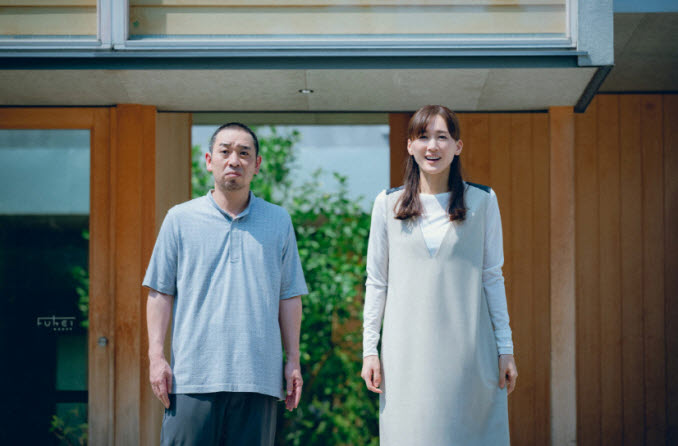
Hirokazu Kore-eda’s latest film “Sheep in the Box”, which was released in South Korean theaters not long after premiered at the Cannes Film Festival, approaches to its intriguing science fiction materials as gently and humanely as you can expect from him. As a matter of fact, it is actually a little too gentle to go further with its supposedly intriguing story premise, and it is quite disappointing for me to observe how it eventually fizzles as becoming too maudlin and contrived during its last act.
At the beginning, the story, which is set in the slightly futuristic world, introduces us to Otone (Haruka Ayase) and Kensuke (Daigo Yamamoto), a fairly affluent middle-class couple who lost their 7-year-old son two years ago due to some unfortunate incident. Although they have managed to go on with their life since that sad happening, both of them often cannot help but feel the lingering absence of their son between them, and then Otone is approached by a prominent AI robot company willing to provide a certain service for free. This company can make a humanoid AI robot based on their son and the memories of him, and they are told that this can actually provide them a chance to process their loss and grief.
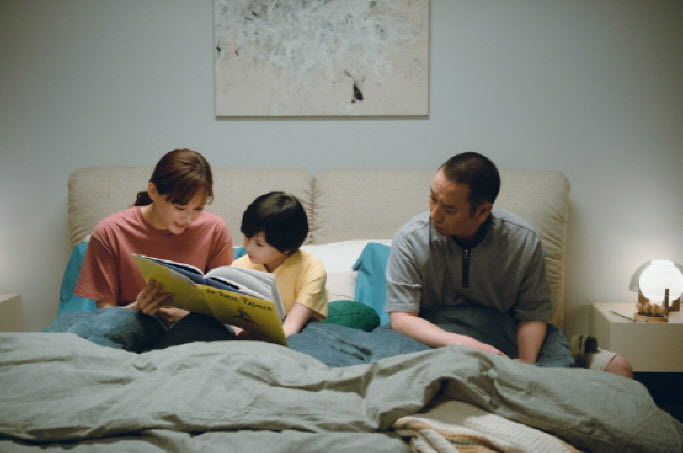
While Kensuke is understandably reluctant, Otone eventually decides to request an AI robot version of their son after seeing how real a humanoid AI robot can be. Although it is well aware of its mechanical nature, the AI robot version of their son really talks and acts like him, and Otone soon gets more accustomed to this robot in contrast to Kensuke, who makes it clear to the robot that he does not want to be called “father” at all.

What follows next is a series of small episodic moments depicting how the robot gradually becomes a part of Otone and Kensuke’s domestic life. It acquires more information on their son as spending more time with them, and Otone, who is incidentally an architect, is more impressed by the robot when it shows some appreciation on the process of her latest project. Although there is still considerable distance between him and the robot, Kensuke allows it to be introduced to his work colleagues, and there is a brief but interesting moment between the robot and an old worker willing to share a bit of his expertise with it.
Needless to say, both Otone and Kensuke later become all the more conflicted about the robot. Even though they know that it is more or less than an object onto which they project each own human feelings, the robot really feels like their son to them at times, and that accordingly makes them face their pain and sorrow from losing him at that time. While Otone confronts the guilt of not being always there for her son due to her work, Kensuke turns out to have his own guilt behind his rather brusque appearance, and there is a sad scene where he desperately tries to get anything about his son’s death from the memories of his son stored in the robot.
Kore-eda’s screenplay unfortunately stumbles when it later attempts to show what the robot thinks and “feels”. Not long after meeting a bunch of other robots not so different from it, the robot embarks on a little project of his own without telling anything to Otone or Kensuke, and we are later served with a half-baked idea on how AI can learn humanity and creativity from us. Kore-eda seems quite sincere and serious about this, but, having seen too much of the negative aspects of AI during last several years, I cannot help but think of that familiar phrase: “Isn’t it pretty to think so….”
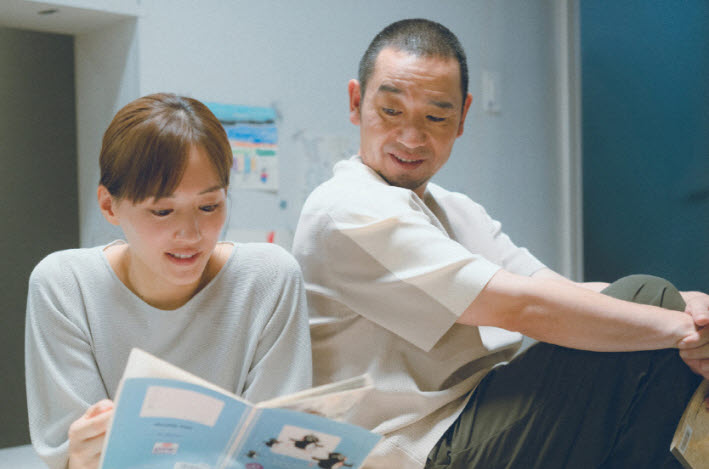
Furthermore, the finale does not work as well as intended while leaving us with a lot of shallow impression. In fact, I am now reminded more of how some notable science fiction movies and TV series did a much better job on those tricky possibilities between us and AI. Needless to say, Steven Spielberg’s “A.I. Artificial Intelligence” (2001) did a far more interesting and powerful job in the same genre territory, and the same thing can be said about recent American TV drama series “Alien: Earth”. While both of them impressed me for fresh and intriguing science fiction ideas, “Sheep in the Box” sadly does not have anything new to intrigue or impress me, and I was only mildly amused by its rather heavy-handed references on Antoine De Saint-Exupéry’s classic novella “The Little Prince”.
Although Kore-eda frequently struggles with the science fiction elements of his story, the movie is strewn with those distinctive artistic touches from him at least. As usual, he often uses trains or their recognizable sounds for little but precious poetic effects, and he also shows some skill and competence as usual in handling a number of child performers in the film. Although he is often limited by his under-written part, young performer Rimu Kuwaki holds his own place fairly well among his two adult co-stars, and Haruka Ayase and Daigo Yamamoto are effective in their modest but earnest performance.
In conclusion, “Sheep in the Box” is not a total dud at all, but it is still a major letdown considering how Kore-eda has steadily impressed us during more than 30 years since his remarkable first feature film “Mabrosi” (1995). Except “The Third Murder” (2017), all of his subsequent films are good or excellent in my humble opinion, and I would rather recommend any of them instead. Sure, the movie does have all the characteristics shown from many of his works, but it regrettably fails to generate enough interest or emotion from its very familiar genre elements, and I can only hope that Kore-eda will soon bounce from this passable misfire.