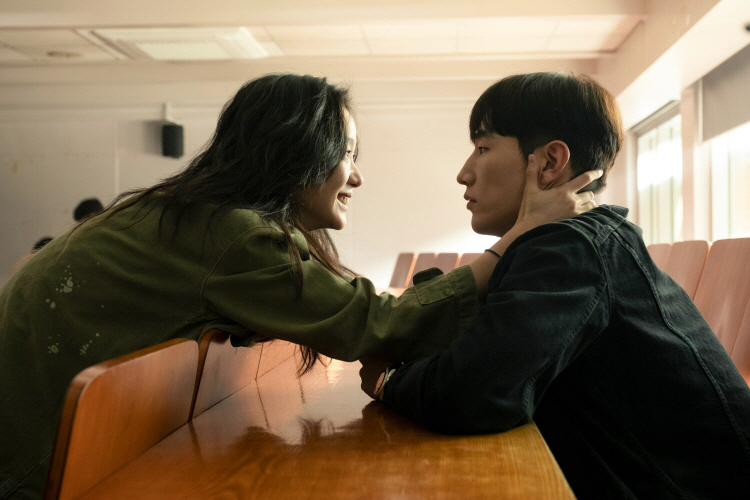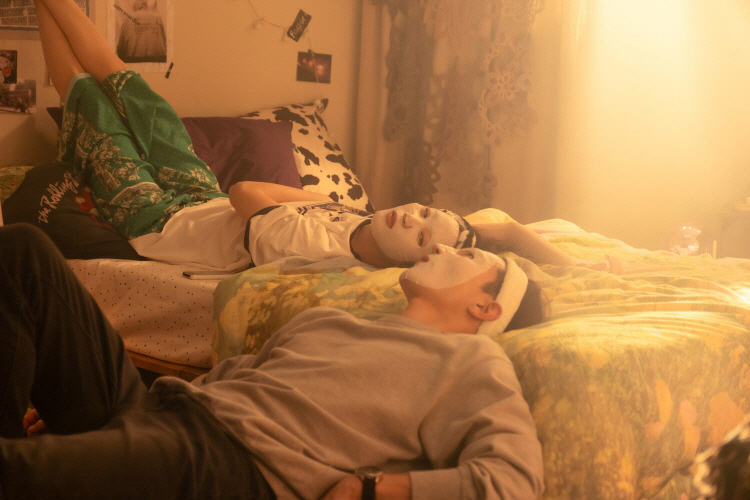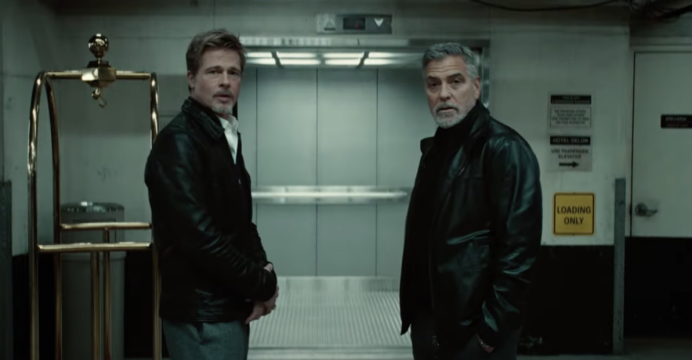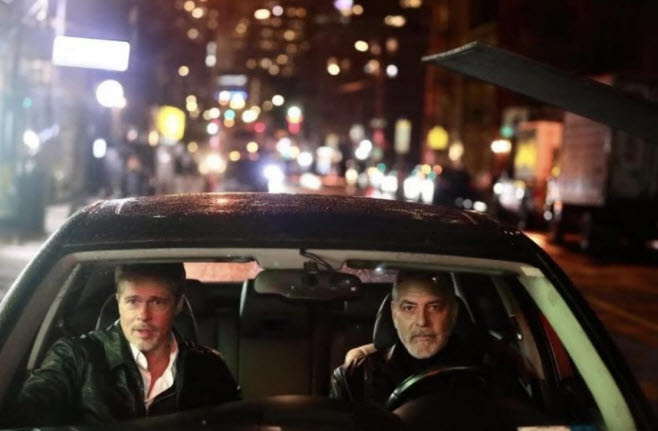
Attila Marcel (2013) ☆☆☆(3/4): A Proustian tale presented by Sylvain Chomet

As watching Sylvain Chomet’s live action film “Attila Marcel”, which was somehow re-released in South Korean theaters in last week, I could not help but wonder whether it worked better it were an animation film. In my inconsequential opinion, many of the colorfully whimsical touches here and there in the movie could be more impressive if they were presented in animation, and, after all, Chomet already delighted us a lot with his own distinctive animation style in his two Oscar-nominated animation films “The Triplets of Belleville” (2003) and “The Illusionist” (2010). Sure, it is quite clear that Chomet has a fun with making his first live action film, and the result is fairly enjoyable on the whole, but I still have some reservation on whether the movie works as well as intended.

The story mainly revolves around Paul (Guillaume Gouix), a mute young Parisian pianist who has lived with his two aristocratic aunts for many years since his parents died under some unfortunate circumstance when he was very young. As a matter of fact, that incident in question is so traumatizing that he has been incapable of speaking, and he usually focuses on honing his piano performance skill whenever he is not working at a dance class managed by his aunts.

Paul and his aunts have resided in a big and cozy apartment full of old stuffs besides one grand piano which has been the center of his daily life, and we observe how domineering both of his two aunts can be to their nephew. They frequently behave like your average overprotecting parents, but they always make sure that their nephew’s daily life is consistently maintained everyday, and they also tolerate his several quirky sides including the nearly obsessive fondness of chouquettes, a small French patisserie which looks a bit like cookie on the surface.

And then, of course, there comes an unexpected change into Paul’s seemingly repetitive daily life. Via a blind man who has worked as a piano tuner for him and his aunts, he happens to encounter Madame Proust (Anne Le Ny), a middle-aged woman living below his apartment. When he enters her smaller apartment, he is caught off guard by how she made her apartment into a little secret garden of hers, but then he soon finds himself quite soothed by the enchanting qualities of her garden, and, above all, he finds herself drawn to the magical power of her special tea, which is incidentally handed to him with pieces of madeleines.

Now some of you are probably reminded of French novelist Marcel Proust’s magnum opus “In Search of Lost Time”, which was incidentally one of the most important novels in my adolescent period along with James Joyce’s “Ulysses”. Despite reading all of it twice during that time, I cannot tell you whether I totally get this masterpiece even at present, but I still remember lots of things vividly remembered by its hero, and that is probably the whole damn point of that fascinatingly sprawling novel.

Anyway, just like that tea and madeleines initiates a long stream of memories from the mind of the hero of “In Search of Lost Time”, Madame Proust’s special tea served with madeleines awakens the repressed childhood memories somewhere inside Paul’s consciousness. Although he was only 2 not long before his parents passed away, he could somehow vividly remember his parents more than before, and their several happy moments in the past are accompanied with a series of colorful musical scenes. While they were not exactly a perfect couple, Paul’s parents passionately and sincerely loved each other nonetheless, and their deep trust and love are wildly and amusingly depicted when they are going to perform a rather risky act of entertainment together in front of their cheering audiences.

It is not much of a spoiler to tell you that the story subsequently gets darker as Paul’s mind eventually approaches closer to the origin of his personal trauma, but that is where Chomet’s screenplay begins to stumble more than once. While the mood becomes quite melodramatic as expected during the last act, the whimsical style of the movie sometimes prevents it from generating more necessary gravitas for the story, and its main characters remains merely broad and cartoonish without much human depth for engaging us more. In case of a subplot involved with the possible romance between Paul and a certain adopted Chinese girl, this feels rather under-developed to my disappointment, and the movie is not that successful when it attempts for more laughs via the racial prejudice of Paul’s aunts.

Anyway, the main cast members are solid in their respective parts. Besides playing Paul’s father in the flashback scenes, Guillaume Gouix brings some poignancy to Paul’s isolated status, and Anne Le Ny is believable with the aura of your average spiritual healer. Bernadette Lafont and Hélène Vincent are as boisterous as required by their comic supporting roles, and Fanny Touron is also solid as Paul’s spirited mother.

In conclusion, “Attila Marcel” is not as impressive as Chomet’s previous works, but I recommend it mainly because it has enough visual goodies to hold your attention at least for a while. Although he has been not so active after “Attila Marcel” for more than 10 years, Chomet is currently working on the biopic of Marcel Pagnol which may come out in the next year, and I sincerely hope that I will be more engaged and entertained by his next work.

Posted in Movies | Tagged , , | Leave a comment

Before Sunrise (1995) ☆☆☆1/2(3.5/4): When Jesse and Céline Met

Richard Linklater’s “Before Sunrise”, the first movie of his Before trilogy which was incidentally re-released in South Korea in a few weeks ago, is charming and delightful as before. While it surely feels all the more poignant now thanks to the presence of the two following films, the movie itself is packed with many interesting moments shining with humor, charm, and intelligence, and I soon found my spirit refreshed within the first several minutes when I revisited it a local movie theater today.  

At the beginning, we get a seemingly typical case of Meet Cute moment on a train which is about to pass through Vienna, Austria. One middle-aged couple suddenly argue with each other in German for some unspecified reason, and that annoys a young French woman who happens to be not so far from them. In the end, she moves to a nearby empty seat where she can read her book with less annoyance, and that happens to draw the attention a young American man on the opposite side of her new seat. 

They are Céline (Julie Delpy) and Jesse (Ethan Hawke), and they soon find themselves talking a lot with each other in English once Jesse clumsily attempts to approach to Céline. Despite being total strangers to each other, they enjoy each other’s company nonetheless as sensing more of the mutual attraction between them, and Jesse eventually suggests that Céline should stay along with him in Vienna for one night before he takes a plane to US in the next morning. While initially hesitating a bit, Céline agrees to do that, and she and Jesse begin to wander freely around here and there as time casually passes by in Vienna.   

As they experience a various number of locations and people, Jessie and Céline talk more and more with each other, and a series of spontaneous conversations between them reveal more of themselves not only to each other but also us. While they are different in many aspects including their respective nationalities and backgrounds, both of them are smart persons who have been more aware of their life and existence, and their conversations are alternatively sincere and amusing as they constantly exchange their different views and opinions on the world surrounding them. While Céline is more adventurous and optimistic, Jesse is more reserved and skeptic in comparison, but both of them do have some hope and dream about their future, and their youthful moments in the film will touch you more if you remember how they eventually got aged step by step in “Before Sunset” (2004) and “Before Midnight” (2013).

Their mutual attraction becomes more evident to us as well as themselves as their minds engage more and more in their intelligent interactions, but Jesse and Céline are also well aware of how transient their current moment is. Instead, they playfully revolve around each other while still not entirely sure about whether they can come closer to each other, and how they verbally push and pull each other throughout the film reminds me again of how foreplay can sometimes be more romantic than whatever may come after that. 

Under Linklater’s unobtrusive direction, the movie effortlessly flows along with its two main characters while peppering their romantic story with occasional episodic moments popping up around them. I was amused by when Jesee and Céline happen to encounter of a pair of local amateur actors who gladly invite them to their upcoming evening performance, and I smiled a bit when a certain old palm reader ignites another engaging conversation between Céline and Jesse at one point in the middle of the film. In case of one particular homeless guy who turns out to be a poet, this quirky dude will not disappoint you at all when he quickly presents an impromptu piece of poetry as requested by Jesse and Céline.

Above all, the movie is always buoyed by the talent and presence of its two lead performers. Ethan Hawke, who was a new promising actor to watch at that time thanks to his several notable films including Ben Stiller’s “Reality Bites” (1994), ably fills his character with enough wit and likability, and his good performance here in this film solidified his advancing acting career. Julie Delpy, who was right after her memorable performance in Krzysztof Kieślowski’s “Three Colours: White” (1994) at time, brings a lot of warmth and spirit to her role, and that is the main reason why she is still fondly remembered for this movie even at this point. 

These two talented performers effectively complement each other, and it is quite compelling to observe how naturally they interact with each other on the screen. We really feel like watching and listening to two real persons actually having interesting conversations between them, and, folks, that is definitely something we cannot experience at a movie theater everyday. Regardless of how much they actually improvised upon the screenplay by Linklater and his co-writer Kim Krizan on the set, Delpy and Hawke deftly maintain a considerable level of spontaneity from the beginning to the end, and the result is as good as, say, André Gregory and Wallace Shawn in Louis Malle’s “My Dinner with Andre” (1981).

While it can be regarded as a standalone work, “Before Sunrise” is also the wonderful beginning of its trilogy, and my admiration toward Linklater and his two lead performers grows more after my recent viewing. If you have not seen the movie yet, I will let you discover for yourself what eventually happens between Céline and Jesse in the end, and all I can tell you is that their last scene in the film felt more resonant to me as I reflected more on what I watched from the following two movies many years ago. As a matter of fact, I am already ready for “Before Sunset”, I am sure that I will have another refreshing experience when it is re-released in South Korean theaters in the next month.

Posted in Movies | Tagged , | Leave a comment

Jinju’s Pearl (2022) ☆☆☆(3/4): Save the old cafe

South Korean independent film “Jinju’s Pearl” is a simple but intimate drama to be appreciated for several good reasons. Although it stumbles more than once due to the uneven mix of comedy and melodrama during its last act, the movie works whenever it simply and calmly regards the locations of one local city in South Korea, and you come to understand and empathize more with what its heroine and several other characters sincerely try to preserve.

That local city in question is Jinju, and the first act of the movie establishes how its heroine comes to this little but considerably historic city. Her name is also incidentally Jin-ju (Lee Ji-hyun), and she is an aspiring young filmmaker who is about to shoot her first movie, but there comes an unexpected big trouble. A certain old cafe in Seoul was chosen for the main location of her movie, but it suddenly undergoes construction without any notification to her in advance, and Jin-ju becomes quite desperate because of being a week away from the first day of the shooting.

At least, it looks like there may be a quick solution for her big trouble. As suggested by a senior of hers, Jin-ju goes to Jinju where she can probably find not only some other old cafe but also several alternative locations for her movie. As she is guided by a colleague of her senior here and there around the city, it seems that she can actually make her movie there, but she still cannot find any suitable old cafe for her movie, and her guide does not help her much before eventually going away due to some personal matter.

After wandering around in an old neighborhood for some time, Jin-ju comes across the one which can be quite ideal for her movie. Although it looks very plain and shabby, this cafe is filled with a sense of long history with several old posters and paintings on the walls, and that is exactly how she wants the fictional cafe in her movie to look and feel on the screen.

However, Jin-ju soon comes to learn that this cafe will be under construction a few days later because its current owner recently handed it to the next owner. Several local artists who have been its longtime customers are not so pleased about this as the cafe has been their main gathering spot, but it looks like there is really nothing they can do about this immediate change, and that makes them all the more frustrated.

Nevertheless, these artists are determined to try as much as possible for saving and preserving the cafe, and so is Jin-ju, who becomes more motivated as discerning more of how the cafe has been precious for her accidental colleagues for many years. They may look rather silly and inconsequential, but they are also sincere and passionate in their attempt to preserve their dear old place, and Jin-ju understands their feelings well for a person reason to be revealed later in the story.

As Jin-ju and her accidental colleagues try in one way or another, the movie takes its time for observing more of the various locations in Jinju, which is incidentally the homonym of ‘pearl’ in Korean. As it leisurely looks around the locations and people of the city, the movie immerses us more into the local atmosphere of the city, and we come to understand more of why it is sometimes really important to preserve old places for not only mere nostalgia but also history preservation.

And we also come to see how the situation is a bit more complicated than expected. While he has been an old friend to those local artists, the current owner of the cafe has no choice but to give up his failing cafe business, and that certainly makes him feel more conflicted as his artist friends protest more and more. In case of the new owner, who will be revealed later in the story, he is not heartless or thoughtless at all, and, as shown from his subsequent conversation with Jin-ju, he simply chooses whatever will be best for the cafe in his viewpoint.

When Jin-ju and her accidental colleagues become all the more desperate later in the film, the movie tries a little too hard for pulling our heartstrings, and the finale does not work as well as intended as a result. Fortunately, it still holds our attention thanks to the competent direction of director/writer Kim Rok-kyung, and he also draws a quiet but strong performance from his lead actress. As the main emotional center of the movie, Lee Ji-hyun, who played a small supporting role in Kim’s previous film “Festival” (2020), did a good job of carrying the film with her earnest performance, and she is also supported well by several main cast members including Moon Sun-yong, Kim Jin-mo, Lim Ho-jun, and Lee Jeong-eun, who also worked under the director in “Festival”.

In conclusion, “Jinju’s Peral” is another modest but solid work from its director, and it made me more reflective about those old places in my hometown city Jeonju. It is rather overrated as a city for tourism in my humble opinion, but it does have some old valuable places which still mean a lot to me, and now I am thinking of a very old mosque on the east side of my hometown city. Although I mistook it for a bathhouse when I saw it for the first time in the early 1990s, I have been proud of my hometown city having such an old interesting place to admire and cherish, and I will certainly provide some help and support for maintaining and preserving this special place more.

Posted in Movies | Tagged , , | Leave a comment

The King of Comedy (1982) ☆☆☆1/2(3.5/4): A classic comedy of embarrassment

Congratulations, Mr. Rupert Pupkin. You are definitely one of the creepiest movie antiheroes in the history of cinema, but you and your little “comedy” movie, Martin Scorsese’s “The King of Comedy”, have somehow persisted for more than 40 years, despite being weirdly not “funny” on the surface. You are truly incorrigible as being so obtuse to a series of painful rejections along your story. You are utterly delusional as being so absorbed in your loony obsession with fame. You are truly pathetic even as you seem to fulfill your crazy goal at last. Nevertheless, you remain in our collective memory even though most of us think your movie is neither comic nor tragic in any conventional way. 

 Pupkin is played by Robert De Niro, who gives a one-of-kind performance which feels quite different from whatever he did later in a bunch of comedy films such as “Analyze This” (1999) during last 25 years. Those films show that he can be fairly funny, but his performance in “The King of Comedy” is not exactly something which can be merely described as funny. Here is a hopelessly isolated character rather chillingly incapable of having any kind of meaningful communication with several others who unfortunately happen to be around him, and we usually wince a lot whenever he attempts to be funny or social to them. Along with the movie, De Niro’s performance deliberately blocks any possibility of pity or empathy from us, and Pupkin comes to feel more like a case study to observe with more horror and embarrassment on the way.

Pupkin’s target of obsession is a popular late-night TV talk show host named Jerry Langford (Jerry Lewis), who has already been quite accustomed to being pursued by many fanatic fans not so different from Pupkin. As a matter of fact, we see him caught off guard by the sudden ambush of one of his more deranged fans, and that is how Pupkin comes to have a little private conversation with Langford as Langford is returning to his apartment. As Pupkin clumsily tries to impress Langford more, it is quite evident to us that Langford distances himself from Pupkin as much as possible, and we get all the more embarrassed as observing more of how much Pupkin is oblivious to Langford’s increasing annoyance.

Mainly for getting rid of Pupkin, Langford makes a little inconsequential promise in the end, but, alas, this leads to more delusion in Pupkin’s troubled mind, and then the movie begins to blur the line between reality and delusion. As his delusion is getting bloated more and more, Pupkin’s pathetic reality is much more obvious to us, and we get a small bitter laugh whenever Pupkin’s self-absorbed state is disrupted by the voice of his annoyed mother from the upstairs (It is actually the voice of Scorsese’s mother, by the way).

At least, Pupkin gets a likely chance for admiration via Rita Keene (Diahnne Abbott), a young black female bartender who was one of Pupkin’s schoolmates during his high school years. Probably because of their old time’s sake, she lets him have a dinner date with her, and he gladly boosts himself a lot in front of her, but she is just mildly amused while noticing more of what is going on right behind his back. A certain guy sitting alone in the background is quietly listening to everything and then silently making a fun of Pupkin, but Scorsese makes an interesting visual choice here. As the camera keeps focusing on Pupkin and Keene, that minor supporting figure remains in the background all the time. Consequently, a sense of embarrassment slowly dawns upon us as we gradually come to discern what is really going on, and we cringe more as watching how Pupkin’s date night ends unsuccessfully. 

Meanwhile, Pupkin is getting rejected again and again by Langford and his associates, but, not so surprisingly, he still does not understand his grim and pathetic situation at all. This eventually results in one of the most painfully embarrassing moments in the film, which still made me wince a lot as I revisited the movie yesterday. Pupkin willfully comes into a private space of Langford along with Keene, and Langford is certainly not so amused to say the least. Even when Keene belatedly comes to realize that Pupkin lied to her, Pupkin remains obtuse to Langford’s growing anger and annoyance, and we are all more embarrassed before Langford finally decides that enough is enough.

Curiously, Scorsese presents this supposedly big comic moment as dryly as possible just like many other key scenes in the film. The camera of his cinematographer Fred Schuler often sticks to static positions, and it usually maintains the distance from the main characters while mostly avoiding close-ups throughout the movie. In addition, the spaces occupied by the main characters frequently feel empty and barren without much sense of life. Langford’s apartment and country house look more like under-furnished art galleries than real human places to live, and New York City in the film is presented as a bland and uncaring urban environment where its main characters are isolated in one way or another. Yes, New York City shown in “Taxi Driver” (1976) may feel like a very unpleasant nightmare at times, but it is full of life and personality at least, and “The Comedy of King” is often devoid of that.

The screenplay by Paul D. Zimmerman seems to go for a cathartic punchline when Pupkin and a fellow fanatic fan kidnap Langford later in the story, but, again, Scorsese adamantly restrains himself and the movie. When Pupkin finally gets the chance of presenting himself on TV, Scorsese and his longtime editor Thelma Schoonmaker simply cut to the aftermath, and the movie continues to stick to its hero’s delusional viewpoint as before. We do see him appearing on TV later, but we are never sure about the audience reactions, and the same thing can be said about the ending, which may be as delusional as the final scene in “Taxi Driver”.

It is well known that Scorsese was not exactly in a good condition when he was making the movie at that time. While his third marriage was over, he was also quite physically exhausted after making “Raging Bull” (1980) and two other works within a rather short period of time, and he was even not fully recovered yet when the production of “The King of Comedy” began. This probably explains why the movie is less visually lively and kinetic compared to many of his works in addition to often feeling dry and distant, but the result is still memorable in some ways, and that surely says a lot about his immense filmmaking talent.

Now I wonder whether the movie can be regarded as a sort of apology to “Taxi Driver” just like Brian De Palma’s “Carlito’s Way” (1993) is to “Scarface” (1983). As many of you know, “Taxi Driver” was controversial especially when it got associated with the assassination attempt of President Ronald Reagan in 1981, and Scorsese might have intended to present “The King of Comedy” as the comically straight-jacketed version of “Taxi Driver”. While Travis Bickel, the equally pathetic hero of “Taxi Driver” who is also played by De Niro, gets some emotional ventilation via his very violent act in the end, Pupkin looks destined to be stuck in his delusional mind without any emotional catharsis even at the end of the story, and that makes him all the more pathetic and chilling than before.    

Although De Niro’s performance is the main show, the three other main cast members in the film show considerable commitment in their substantial supporting parts. While he is usually remembered for those wacky comedy films such as “The Nutty Professor” (1963), Jerry Lewis ably dials down his comic persona here for playing an aloof counterpart to De Niro, and the result is one of his best performances. As Pupkin’s possible love interest, Diahnne Abbott holds her own place well during her several key scenes, and Sandra Bernhard is simply unforgettable as a woman who may be a lot more toxic and dangerous than Pupkin. These three performers and De Niro are quite convincing in the lack of any genuine communication between them, and Roger Ebert aptly points out that in his 1983 review; “…because nobody listens in this film; everybody’s just waiting for the other person to stop talking so they can start.” He might as well be describing what is happening on the Internet everyday. Sigh.

On the whole, “The King of Comedy” is one of those movies you cannot easily like but then cannot help but remember at times, and its status has surely been growing during last several decades. As we get more accustomed to comedy of embarrassment thanks to many other comedy films and TV series such as “The Office”, the movie becomes more, uh, accessible to us, and it garnered much more attention as being a major influence on “Joker” (2019) along with “Taxi Driver” (Whether that movie can be regarded as the 21st century heir to both of these two Scorsese movies is another matter to discuss).

By the way, I heard from one of my online acquaintances that there have actually been lots of people who identified themselves a lot with Pupkin, and I was both horrified and amused by that. I understand to some degree why some people can identify themselves too much with Travis Bickle or Arthur Fleck in “Joker”, but Rupert Pupkin? Are you serious? Considering how Pupkin can be regarded as someone more dangerous and degenerate than Bickle or Fleck, now I am seriously wondering whether this is another sign of the ongoing human devolution in our time.

Posted in Movies | Tagged , , , , , | Leave a comment

Deadpool & Wolverine (2024) ☆☆1/2(2.5/4): An IP smorgasbord, shall we say.

As you probably remember, I belong to a minor group of audiences who feel that Deadpool is a pretty annoying superhero dude. I understand well that he is often incapable of not being your typical wisecracking loudmouth, but I do not think he is particularly interesting or amusing, and this impression of mine was only solidified more and more as I endured “Deadpool” (2016) and its 2018 sequel. Sure, you may laugh for a nearly endless series of self-aware jokes and winks, but, folks. I always get tired of him within a few minutes without much care or attention.

And the same thing can be said about “Deadpool & Wolverine”, one of the most shameless IP (Intellectual Property) smorgasbord I have ever seen during several recent years. Relentlessly throwing many IP jokes from the beginning to the end, the movie will surely please you to some degree if you remember every movie mentioned or ridiculed throughout the film, but there is not any really fresh substance for us, and this only reminds us more of our growing ennui with the excessive supply of superhero films at present.

This is quite evident from the decidedly violent and naughty opening sequence which may not amuse you if you admire a lot how “Logan” (2017) magnificently ends the story of its titular hero. I will not go into details for not spoiling any entertainment of yours, but this cheerfully gory and irreverent sequence surely shows us that nearly nothing is ever really serious in the MCU (Marvel Cinematic Universe) flicks – even when there are lots of blood and violence enough to be rated R.

Of course, Deadpool / Wade Wilson (Ryan Reynolds) gladly and casually tells us how he ends up in such a messy (and bloody) situation. Not long after what happened in “Deadpool 2” (2018), he decided to live a less eventful life, and things have been fairly good for him for a while, but then he happens to get involved with the people of TVA (Time Variance Agency), which prominently appears in one of numerous MCU TV series out there (I am sure most of you will know which one I am referring to, by the way). Right after taken to TVA, Deadpool meets a high-ranking agent played by Matthew Macfadyen, and that is how he comes to learn that he must do another superhero adventure again.

However, Deadpool needs someone very important for saving his world, and that person in question is none other than James “Logan” Howlett / Wolverine (Hugh Jackman). Although Logan did die as shown in “Logan”, Deadpool has many other options for his person mission because, well, the movie is another MCU multiverse flick, and you will probably get some laughs as Deadpool searches for any suitable version of Wolverine for his mission.

Around the narrative point where Deadpool supposedly finds the right Wolverine (Is this a spoiler?), the movie keeps sprinkling more and more IP jokes onto the screen with a number of very, very, very self-conscious ones. Not long after Wolverine and Deadpool are hurled into a barren world which sometimes looks like a cross between the Phantom Zone in “Superman” (1978) and the vast wasteland background of “Mad Max: Fury Road” (2015) and its recent sequel, we are introduced to not only the main villain played by Emma Corrin but also a bunch of familiar MCU superhero figures, and Deadpool and the movie certainly do no miss the chance to make fun of these figures at all.

While Deadpool and Wolverine try to save the day before it is too late for almost everyone in the multiverse, the movie naturally peppers the story with several action sequences as required, but these sequences are forgettable at best and mediocre at worst. I have often complained about how the action scenes in many other MCU movies do not feel dramatically or emotionally impactful enough to engage us, but “Deadpool & Wolverine” shows the bottom of this banality despite having heaps of superhero figures to play with. In case of one particular action sequence during the climactic part, it looks as smooth and fast as demanded, but the result feels so confusing and lackadaisical that you will lose the focus of your attention as trying to follow whatever is happening across the screen.

At least, the movie is supported well by the humorously mismatched duo performance by Ryan Reynolds and Hugh Jackman, both of whom surely know well how to play their respective characters. While Jackman brings some gravitas to the movie in addition to being a committed counterpart to his co-star, Reynolds willingly throws himself into lots of gags and jokes, and you may appreciate his comic talent to some degree even if you already got tired of his character just like me. Although the villain characters in the film are not so memorable as you can expect from your average MCU flick, Corrin and Macfadyen have some little fun with their supporting parts, and Macfadyen is especially good during his first scene with Reynolds early in the film.

On the whole, “Deadpool & Wolverine”, directed by Shawn Levy, does not change much of my inconsequential opinion on one of its two titular characters, but, considering the reactions of the audiences around me, you may enjoy it more than me. No matter how much Deadpool makes fun of the movie and its production company, this is still a movie solely for more money to grab, and I will surely have to endure him again if it earns enough for the production company to greenlight whatever will come next.

Posted in Movies | Tagged , , , | Leave a comment

Despicable Me 4 (2024) ☆☆1/2(2.5/4): As passable as it gets

Animation film “Despicable Me 4” is as passable as it gets. While I do not deny that I chuckled more than once during my viewing and it is better than “Despicable Me 3” (2017), the film is pretty much like another routine variation of what has been served to us since “Despicable Me” (2010), and you may be more generous to the film if you have more affection toward its decidedly ridiculous main characters.

As usual, Gru (voiced by Steve Carell), a former supervillain turned a prominent Anti-Villain League (AVL) agent, happens to have another big problem to handle while trying to be more accustomed to his happy domestic life. While attending the reunion ceremony held at a certain infamous school where he once studied as a future villain, he successfully arrests a notorious supervillain named Maxime Le Mal (voiced by Will Ferrell), but Maxime subsequently escapes from the prison, and Gru has no choice but to hide along with his family in some nice suburban neighborhood.  

Of course, despite disguising himself as a solar panel salesman Chet Cunningham (His family members also get each own alias for safety, by the way), Gru cannot help but look awkward and weird to an affluent couple living right next to the safe house for Gru and his family, and then he also finds himself blackmailed by that couple’s young daughter, who instantly recognizes Gru right from the very first day. Zealously aspiring to be a supervillain just like Gru once did, Poppy Prescott (voiced by Joey King) demands that Gru help and assist her in accomplishing a certain ambitious criminal project of hers, and Gru cannot possibly say no to her, though he soon finds himself excited a lot by being bad again.

Meanwhile, the movie busily juggles several other narrative lines mainly for making us less bored. Just like her husband, Lucy (voiced by Kristen Wiig) feels strained about being a different person, and that leads to a hilariously disastrous moment at a local hair salon. In case of Gru’s three stepchildren, they also struggle a lot in one way or another, and there is a silly little moment involved with a boorish karate teacher who does not respect his pupils much.

And there are, yes, the Minions, who all are voiced by Pierre Coffin, the co-director of “Despicable Me” and its two following sequels. I found them rather tiresome as they became more and more ubiquitous during last 14 years, but they are still fairly amusing as they get themselves involved into one ridiculous slapstick moment after another. Here in this film, they become the official assets of AVL due to Gru and his family’s temporary absence, and the five selected ones are subjected to a top-secret experiment which turns them into superheroes, though that does not improve their intelligence that much as shown from one funny sequence where they attempt to do some public service.

As the Minions accordingly keep stealing the show as before, the other parts of the film become less engaging in comparison. While a subplot involved with Gru and his baby son is predictable to the core, the part involved with Maxime and his snarky girlfriend Valentina (voiced by Sofía Vergara) often feels perfunctory, though Will Farrell tries to chew every moment of his as gleefully as possible for more amusement for us. At one point early in the point, we see his supervillain character is surrounded by his own minions, and it is a shame that his minions are not utilized more (I would not mind at all if they had a big climactic battle with the Minions, you know).

In the end, lots of things busily happen across the screen during the last 20 minutes as expected, and that is where the film becomes all the less interesting, but Steve Carell and several other voice cast members still hold our attention with their good efforts. While he is quite accustomed to his role now, Carell is still capable of imbuing his character with enough zaniness to tickle us, and Kristen Wigg, Sofía Vergara, and Joey King have each own small fun even though they are occasionally limited by their thankless supporting parts. Although I miss how she and Carell complement well in “Despicable Me 2” (2013), Wigg brings some wit to one outrageous comic moment which cheerfully parodies a certain famous moment in “Terminator 2: Judgment Day” (1991), and Joey King is spirited whenever her adolescent character cannot help but become gleeful about being bad. 

 In conclusion, “Despicable Me 4”, directed by Chris Renaud, is enjoyable to some degree, but it does not satisfy me enough on the whole, and I must confess that my mind kept doing a rating math while I was watching it with a friend of mine at a local movie theater yesterday. For being more entertaining than “Despicable Me 3”, I certainly should rate “Despicable Me 4” higher, but I also happened to give 2.5 stars out of 4 to both “Despicable Me” and “Despicable Me 2”. Therefore, I have to give “Despicable Me 4” only 2.5 stars mainly because it does not surpass the first two Despicable Me films or those two Minions flicks.

Anyway, considering how much the series has been critic-proof during all those years, my rating or opinion is certainly meaningless if you are already ready to laugh and then move onto the next sequel, which definitely will come as “Despicable Me 4” has earned a lot more than its production budget at this point. I must remind you that there are a number of much better and more meaningful animations films during this year (I particularly want to recommend “Robot Dreams” (2023) and “Inside Out 2” (2024) first), but we all sometimes need to get some brainless fun, right?

Posted in Movies | Tagged , , | Leave a comment

Love Lies Bleeding (2024) ☆☆☆(3/4): A lesbian crime noir film on steroid

“Love Lies Bleeding” is a little crime noir film which tries some interesting variation on its genre elements. As its two different female main characters pull or push each other in their dangerous erotic liaison, the movie occasionally jolts us via several nasty moments of violence and blood, and it even enters the realm of fantasy around the end of its bumpy narrative.

The movie, which is set in 1989, begins with a rather unnerving opening shot to remember, and then we get to know Lousie “Lou” Langston (Kristen Stewart), a young single lesbian woman who has worked as a gym manager in a little town located in some remote desert area. As she goes through another mundane day at the gym, Lou happens to notice a female stranger doing some exercise, and it does not take much time for them to get quite closer to each other when they later come across each other.

That female stranger in question is Jaqueline “Jackie” Cleaver (Katy O’Brien), a young promising bodybuilder who has been going to Las Vegas for participating in an upcoming bodybuilding competition to be held several days later. Because she needs some money for going to Las Vegas, Jackie gets herself employed at a local shooting range owned by Lou’s father Lou Sr. (Ed Harris), and Lou does not mind that much as she and her father have been estranged from each other for some time due to an unspecified reason (No, he has no problem at all with his daughter being a lesbian).

As they become more intimate with each other, Jackie suggests that Lou should leave for Las Vegas along with her, but Lou hesitates for an understandable reason. Her sister Beth (Jena Malone) has been constantly abused by her crummy husband JJ (Dave Franco), so Lou must stand by her as much as she can, though there is really nothing she can do for protecting her sister or stopping JJ, who incidentally works for Lou Sr.

Meanwhile, things are getting a little more complicated for Lou after she is approached by an FBI agent. Lou Sr. is actually a powerful crime boss dominating over the area, and FBI has been looking for anyone who can tell anything useful for their investigation on Lou Sr. Although they have not gotten anyone yet, they hope that Lou will eventually speak against her father due to that personal matter between them.

In addition, there is also steroid, which usually comes handy in Lou’s gym. Lou gladly provides steroid to Jackie, and Jackie surely experiences a considerable degree of muscular enhancement as she pushes herself further with more steroid injection. I must say that the depiction of steroid in the film is rather exaggerated but I must also admit that it is a bit amusing to see how it functions like a can of spinach does for Popeye.

All these and other elements in the story sometimes do not gel together that well in the screenplay by director Ross Glass and her co-writer Weronika Tofilska, and several sudden plot turns can be too jarring for you, but the movie keeps us engaged via the increasingly troubling relationship between Lou and Jackie. As going through a sort of steroid rage, Jackie often becomes unpredictable, and Lou finds herself in an unenviable position of taking care of the mess caused by her lover. She feels quite frustrated to say the least, but she is still attracted to Jackie nonetheless, and, like many lead characters of crime noir films, she desperately wants to believe that there is still a way out for her and her lover.

It surely helps that the movie is fueled by the solid chemistry between its two lead performers. Kristen Stewart, who has successfully transformed herself into one of the most dependable actresses working in Hollywood during the last 10 years, flawlessly embodies her character’s loneliness and frustration, and we can see how much her character is accustomed to taking care of the mess caused by others around her even before Jackie comes into her little world. On the opposite, Katy O’Brien, whom you may notice for her supporting role in TV drama series “The Mandalorian”, effectively complements her co-star while bringing considerable authenticity to her role (She was actually a professional bodybuilder before beginning her acting career, by the way), and she also handles well several tricky scenes later in the film where her character is driven to more rage and violence thanks to her steroid injection

Stewart and O’Brien are also supported well by a number of good performers who bring some life and personality to their archetype noir characters. While Jena Malone and Anna Baryshnikov do more than required by their rather thankless supporting parts, Dave Franco is suitably obnoxious as Lou’s despicable brother-in-law, and Ed Harris, an ever-radiable veteran actor who has seldom disappointed us during last 40 years, has a juicy fun with his crusty villain role whenever he enters the screen.

On the whole, “Love Lies Bleeding” feels occasionally uneven but ultimately quite impressive as it goes wild along with its two lead characters under Glass’ skillful direction. Just like her previous film “Saint Maud”, the movie is not something you can casually watch on Sunday afternoon, but you will not easily forget its intense moments, and you may be more interested in what Glass will show us next.

Posted in Movies | Tagged , , , | 1 Comment

Immaculate (2024) ☆☆1/2(2.5/4): Another Catholic horror flick of this year

“Immaculate” is a little too eager to give shock and awe for us. Right from the very first scene, we can instantly discern whatever we will behold in the end, and the movie has a substantial amount of spooky insidiousness around the screen, but it does not build the story and characters well enough to make us care and fear for its unfortunate heroine. As a result, we only come to observe her increasingly disturbing circumstance from the distance, and that is why its finale feels rather weak despite some striking moments of horror and violence to remember.

The story mainly revolves around Sister Cecilia (Sydney Sweeney), a young innocent American Catholic novice who comes to Italy for officially becoming a nun at some old Catholic convent outside Rome. Mainly because of the spiritual experience caused by a nearly fatal accident she had a long time ago, she sincerely believes that the purpose of her life is serving the God, and she thinks she is ready to do that for the rest of her life after making an official vow at the convent.

However, of course, things already look suspicious even without the creepy soundtrack mainly driven by the ominous score by Will Bates. When Sister Cecilia arrives at the convent, nearly everyone at the convent including its Mother Superior is courteous to her, but we quickly sense something fishy from a certain young nun, who seems quite determined to dislike her right from her first day at the convent. Under the strict order of the Mother Superior, every nun under her supervision should serve not only their God but also those old and dying nuns under their care, and Sister Cecillia is still not daunted at all, though she squirms in case of slaughtering a chicken for cooking.

After she officially becomes a convent member, everything seems to be going fairly well for Sister Cecilia, but then, what do you know, something strange happens to her. Not long after she has an odd and disturbing experience via a little old artifact associated with Jesus, she comes to notice a certain change in her body, and that leads to quite an unexpected discovery which is soon known to everyone in the convent. While baffled a lot about how the hell that could happen to her, Sister Cecilia has no choice but to go along with whatever she is told to do during next several months, and she certainly comes to get more attention from others in the convent.

So far, I have been trying not to tell too much, but I think you will easily guess what is going on around our heroine if you are a seasoned moviegoer who has seen a number of similar female occult horror films ranging from “Rosemary’s Baby” (1968) to “The First Omen” (2024), which incidentally came out also in this year and curiously overlaps with “Immaculate” in more than one aspect. Like “Immaculate”, “The First Omen” is also about a young American Catholic novice coming to Italy and then finds herself trapped inside a truly diabolical conspiracy, and it naturally shares several relevant female issues with “Immaculate” in terms of story and characters.

However, in my trivial opinion, “Immaculate” is one or two steps below “The Frist Omen”, though they will certainly make an interesting double feature show together. While both of them are shrouded in lots of religious creepiness as required, the latter takes some time for story and character development before going all the way for shock and awe later, and the former is relatively blunter and clumsier in its tactics for shock and awe without enough narrative development. For example, we do not get to know or care that much about its heroine even when she desperately struggles for a way out later in the film, and, to make matters worse, many of the supporting characters around them are more or less than your average stock horror characters.

At least, the movie will not disappoint you when it throws more horror and violence across the screen during its last act, and you may be amused a bit by the truly preposterous aspects of the conspiracy surrounding its heroine. When she is told that there is an old catacomb right below the convent early in the film, you know she is destined to explore this underground place sooner or later, and it is a shame that the movie does not utilize this underground place more.

Even though I observed the movie with decreasing interest, I admire how committed Sydney Sweeney looks on the screen – and how versatile she really is. Since she received more attention thanks to her Emmy-nominated turn in HBO drama series “Euphoria”, Sweeney impressed us more with “Reality” (2023) and “Anyone but You” (2023) in last year, and now she demonstrates here that she can be a competent horror movie heroine. Even when the movie stumbles more than once, she diligently carries the movie with more emotional intensity, and she is utterly uncompromising especially when her character makes a drastic choice which feels like a defiant antithetical answer to “Rosemary’s Baby”.

In conclusion, “Immaculate”, directed by Michael Mohan, does not satisfy me enough for recommendation, but it is not entirely boring thanks to its several good elements including Sweeney’s strong screen presence. So far, she has not yet found a movie which can fully utilize her considerable potential, but I am sure that she will continue to advance as before, and I sincerely hope that there will be better movies to come into her promising career.

Posted in Movies | Tagged , , , , | Leave a comment

Black Barbie: A Documentary (2024) ☆☆☆(3/4): Hidden Figures behind the Black Barbie

When I saw Greta Gerwig’s enormous hit film “Barbie” in last year, I instantly noticed how racially diverse the Barbie (and Ken) characters in the film are. We now take that for granted, but Netflix documentary film “Black Barbie: A Documentary”, which was released a few weeks ago, reminds us that there have actually been lots of efforts for that during several decades, and those hidden African American female figures behind these important efforts surely have interesting stories to tell for us.

The origin of the documentary is Beulah Mae Mitchell, who is an aunt of director/writer/co-producer Lagueria Davis and was also a key figure behind the first black dolls from Mattel. After coming to learn about her aunt’s very interesting professional career, Davis decided to delve more into her aunt’s considerable but rather overlooked contribution, and her aunt gladly put herself in front of the camera just like many different figures interviewed for the documentary.

At first, Mitchell and several other older African American interviewees including US Representative Maxine Waters reminisce about the serious absence of black dolls during their childhood mainly due to racial prejudice. During that time, many of toy companies in US only cared about their majority white customers, and we see a number of raggedy homemade black dolls which were the only alternatives for those little black kids during that time.

When Ruth Hadler, the co-founder of Mattel, presented the first Barbie doll in the late 1950s, it was surely regarded as an industrial breakthrough besides becoming a sort of role model for many white kids out there, and many other Barbie dolls naturally followed during next several years, but, alas, there was not still any doll for black kids. As they were often stuck with white dolls, many black kids came to have a serious problem of low self-esteem, and that was eventually proven by Dr. Kenneth and Mamie Clark, an African American psychologist couple who brought more public awareness to this glaring social issue via their alarming research result from black kids.

Fortunately, Hadler was quite open-minded about any new business opportunity. She often came to her company factories where Mitchell and numerous African American employees busily work, and she gladly took their advice while also getting some of them promoted. Mitchell was one of such fortunate employees, and, though she was well aware of the main reason of her unlikely promotion (She was one of a very few black persons at her new workplace, you know), she was determined to do her best for the company as well as many black kids out there, and her diligent efforts eventually led to the production of black dolls.

However, that was not enough at all, because there was still no black Barbie doll. While they were indeed a breakthrough for black kids ready to buy dolls just looking like themselves, those manufactured black dolls were just presented as Barbie’s black friends, and one of them was even presented as Barbie’s nanny who is also incidentally her best friend (Please don’t ask me how the hell that is possible).

Nevertheless, Mitchell’s efforts opened the door for another notable African American female figure to enter Mattel. Right from her first day at Mattel, Kitty Black Perkins was determined to make a Black Barbie, and she and Mitchell instantly bonded with each other. Eventually, the first black Barbie doll came out in the early 1980s, but, as Mattel frankly admits to Davis, there was not enough promotional effort for this supposedly revolutionary doll, which was quickly forgotten as the time passed.

At least, the progress was done bit by bit during next 40 years, and the efforts of Mitchell and Perkins were passed to their junior Stacey McBride-Irby. As McBride-Irby and other African American employees of Mattel tried harder, Mattel came to embrace more racial diversity in their products than before, though, as pointed out by several experts interviewed in the documentary, there are still some problems to be resolved sooner or later.

However, black and other colored Barbie dolls have become more common than before, and a group of famous figures ranging from Shonda Rhimes, who incidentally serves as one of the executive producers of the documentary, to Ibtihaj Muhammad willingly tell us about how much they feel honored about being the models for new black Barbie dolls. As the women who have showed that black girls can do anything, these remarkable ladies are inarguably the ideal inspirations for new black Barbie dolls, and Rhimes tells a little amusing episode about how the Barbie doll version of herself was made.

Under Davis’ competent direction, “Black Barbie: A Documentary” is both engaging and informative as illuminating the longtime efforts behind the racial diversity of Barbie dolls, and it is worthwhile to check out especially if you appreciated the considerable racial diversity shown in Gerwig’s movie. Yes, there should be more progress in the future, but the road to progress is being built and then continued even at this point, and I sincerely hope that my little niece, who is about to have her first birthday in this year, will have a lot more options for her future dolls when she grows up enough to be more aware of herself.

Posted in Movies | Tagged , , , | Leave a comment

Escape (2024) ☆☆1/2(2.5/4): An old-fashioned South Korean thriller

South Korean film “Escape” is something I might enjoy more around, say, 30 years ago. During that time, I was an avid consumer of those grim horror stories about North Korea, and I must say that the movie is curiously not so far from them in terms of mood, story, and characters. As our hero desperately tries to escape from one of the worst countries in the world, the movie throws lots of exaggerated villainy into the story, and we are supposed to root for him more as he gets closer and closer to the demarcation line between South and North Korea despite lots of risky obstacles in front of him.

At first, we get to know how a young North Korean soldier named Gyu-nam (Lee Je-hoon) has prepared for escape for some time. He has been in a military base not so far from the demarcation line, and he sneaks out of the base every night for checking out the location of numerous mines in the zone preceding the demarcation line. Now he is almost near the final stage of his plan, and all he will have to do is finding the right time for his escape to South Korea.

However, of course, there comes an unexpected trouble via Dong-hyuk (Hong Xa-bin), one of the soldiers in the base who also wants to escape to South Korea. As Dong-hyuk subsequently tries to escape, Gyu-nam finds himself in a very risky situation where he can be executed along with Dong-hyuk, and then things become more complicated when an officer from the National Security Department suddenly comes down to the base to everyone’s surprise.

This officer in question is Hyun-sang (Koo Kyo-hwan), and it gradually turns out that he has a hidden personal motive behind his back. Besides saving Gyu-nam from his current trouble, Hyun-sang will have Gyu-nam closer to him for their old time’s sake while also making him into a hero to be decorated, and that is certainly not something Guy-name wants. 

Although it spends almost the half of its running time (96 minutes) for establishing the story and characters, the movie quickly moves onto a series of intense moments of action and suspense as Gyu-nam tries to escape again (Is this a spoiler?). Hyun-sang and his cronies frantically and ruthlessly pursue Gyu-nam, but, to my little amusement, they always underestimate Gyu-nam in one way or another. For instance, there is a certain key moment where Hyun-sang can instantly kill Gyu-nam right now, but then he hesitates for a few seconds, and then, what do you know, Gyu-nam quickly takes advantage of that and then keeps running away from his opponents. 

Around that narrative point, we are supposed to care more about Gyu-nam’s attempt to escape, but the movie fails to present him as an engaging human character to observe and care about. While there is a brief flashback scene showing his family background, that feels rather perfunctory in my inconsequential opinion, and he consequently feels as broad and bland as many other characters in the story, who are more or less than your average totalitarian stock figures.

Despite his rather thin character, Lee Je-hoon, who has steadily advance since his two memorable performances in “Bleak Night” (2010) and “The Front Line” (2011), looks as committed as required on the screen, and that may be enough for you to hold your disbelief during several nearly unbelievable scenes in the film including the one where he runs fast across the mine field without any caution at all. As a fellow soldier who happens to be involved with Gyu-nam, Hong Xa-bin has a lot more stuffs to do compared to his previous film “Hopeless” (2023), and his earnest acting comes to earn more pity and sympathy from us.

However, these two actors’ efforts are often eclipsed by the neurotic villain performance by Koo Kyo-hwan, who is constantly on the verge of going over the top but never loses his focused attitude at all even during the expectedly melodramatic finale. As the movie shows more of Hyun-Sang along the story, we get to know more of the growing anxiety and frustration behind his dapper appearance, and you may be also amused by some kind of emotional undercurrent between him and a certain minor character. As the main villain of the story, he is hateful in every aspect except having a mustache to twirl, but we come to understand more of what makes him tick at least, and that certainly makes him the most interesting figure in the story.    

 The movie is directed by Lee Jong-pil, who previously directed “Samjin Company English Class” (2020). Compared to that lightweight female comedy film, “Escape” feels quite different as an intense male thriller film, and you can clearly discern that Lee tries something different here, though the result is not entirely successful. He and his crew members including cinematographer Kim Sung-an and editor Lee Kang-hee surely put considerable efforts on the screen, but their efforts still cannot compensate enough for the weak aspects of the screenplay by Kwon Seong-hwi and Kim Woo-geun including the overtly sentimental epilogue scene, which feels rather jarring compared to the rest of the film.

In conclusion, “Escape” works to some degree, but I got often distracted by its glaring flaws during my viewing. Considering that it is a fairly competent genre product, you may not mind its weak points if you ever happen to come across it via cable TV or streaming service on one boring Sunday afternoon, and I will not stop you from watching it.

Posted in Movies | Tagged , , , , | Leave a comment