Looper (2012) ☆☆☆(3/4) : A SF thriller with clever loopholes

There is nothing particularly new about one of the time-honored traditions in science fictions in new SF thriller “Looper”, but this smart film cleverly finds good ways to deal with its subject, and I like it. Its law of causality is a little too shaky to explain as its collateral paradoxes are accumulated along the plot, but the movie pulls out an engaging drama from its conventional premise like pulling rabbit from hat, and its finale works with its inexorable time travel logics as everything is gathered together in the end.

It is 2044, and it seems that the American society is still going through a hard time probably due to the continuing economic depression. Poverty is seen everywhere around the streets in spite of notable technology advancement, and the city is infested with crime as the people are willing to do anything for their living. In case of Joe(Joseph Gordon-Levitt), he operates as a ‘looper’, whose job is killing the targets sent from 2074 by a gang organization he belongs to.

The time travel is not developed yet in 2044, but it becomes possible around in the future. Not so surprisingly, it is quickly banned probably due to lots of troubles ensuing from that, but gangsters illegally use time travel device to dispose the bodies, which are, according to the narration, impossible to eliminate due to some highly advanced tracking technique at that time point(I’d love to hear about that). What Joe and the other loopers have to do at their time point is simple; they wait at their remote work places when the time comes, shoot the bound and hooded targets suddenly appearing out of nowhere in front of them as scheduled, and then quickly get rid of the bodies.
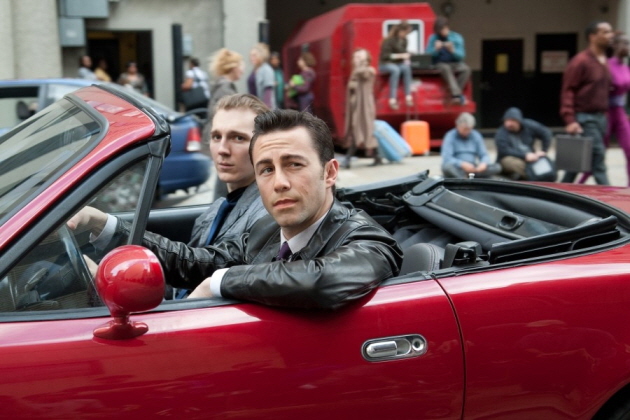
They are usually paid with bars of silver strapped to the executed, but they know well that there will be the time when they are paid with bars of gold instead. This means that the contract is expired and the organization has sent looper’s older self to ‘close the loop’ for leaving no loose ends. The loopers are usually guys at dead ends with no hope(well, who would choose such an unpleasant job like that unless they have no choice?), but it is surely depressing for anyone to get the message that your time is limited even though the remaining time is 30 years. It is a long time, you know how fast the time flies.

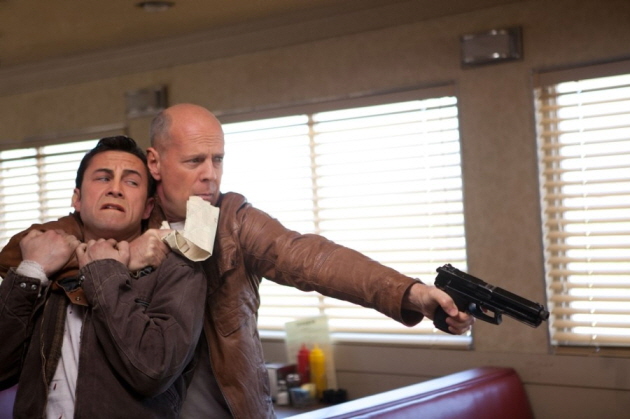
As his fellow loopers getting gold bars one by one, Joe follows his work schedule as usual. He waits on the field outside the city, does his job with no mistake, and spends some time at a restaurant nearby. But, on one day, an unexpected thing happens. This time, a guy is sent without a hood on his head, and it is none other than his older self(Bruce Willis), who manages to get away from his younger self as Joe is flabbergasted by this surprise. Because he fails to do his job, Joe soon finds himself chased by the organization, and he must close his loop as soon as possible for saving his position.

The movie dutifully deals with the paradoxes and contradictions in time travel as Joe tries to solve his problem. There is a scene where Joe and older Joe have a private conversation, and their situation is interesting. Older Joe is determine to do something to save his wife in the future regardless of what will happen to him ‘at present’ due to his breaking of the loop, but he cannot kill Joe because his existence depends on him. In case of Joe, it is more or less than committing suicide in advance, but at least he can live for 30 years – or can’t he?

Though the movie does not give us an entirely clear explanation about the mechanism behind its rather flexible timeline, the story gets more compelling as Joe tries to stop Older Joe while evading the henchmen from the organization lead by a volatile and impulsive guy named Kid Blue(Noah Segan). The interaction between present and future is a very familiar story element thanks to many other films about time travel, but the movie gives several nice touches to its conventions, such as how Joe summons his older self to a place for their talk.
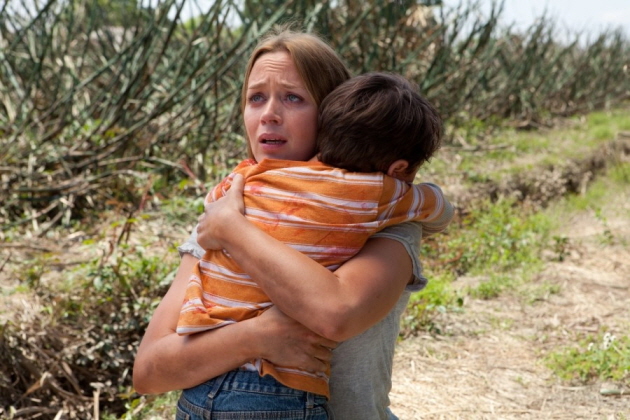
Meanwhile, as a part of his plan to stop and kill his older self, Joe comes into the life of Sara(Emily Blunt), a young woman living with her young son in a farmhouse in the middle of the field. She does not trust him at first, but, of course, they gradually get close to each other as the time goes by, and that makes an interesting parallel with the poignancy in Older Joe’s struggle to preserve his precious memories with his wife, which can be affected by not only his actions but also his younger self’s actions. He wants to kill a younger self of the Rainmaker, the guy responsible for his wife’s death in the future, and it is quite possible that Sara’s young son is the Rainmaker. But can his murder justified for preventing the future which has not happened yet in 2044?

The actors bring considerable conviction to the story. Joseph Gordon-Levitt has been steadily building his career with the series of critically acclaimed films, and he scores again with a dependable performance in spite of wearing a little too awkward prosthetic makeup for resembling his co-star. Bruce Willis brings dramatic weight and pathos to Gordon-Levitt’s older alter ego, so you can see that Older Joe is someone not easy to be stopped even though he can be killed. While Emily Blunt is a warm presence in the story as a strong-willed woman with some secret, Paul Dano and Jeff Daniels are also good as the underworld members in the story. Dano is neurotic as Joe’s fellow looper who gets frantic about his own messy circumstance, and Jeff Daniels is restrained as a crime lord who prefers reasonable persuasion rather than unnecessary violence when he has to take care of his business matters.

The director/writer Rian Johnson made an impressive debut with his first film “Brick” in 2005. That was an amusing combination between high school teenager drama and crime drama wrapped in film noir style, and, again, Johnson shows that he is a talented storyteller good at playing with genres. While it does not break any new ground in its genre, “Looper” knows how to handle and sticks to its rules, and it brings out its surprise from the story even when we think it is predictable. I still think its logics feel a bit murky, but let’s say the movie somehow finds good loopholes and it succeeds nicely while entertaining me.
Posted in Movies | Tagged , , , | 1 Comment

Frankenweenie (2012) ☆☆☆(3/4) : He’s alive!

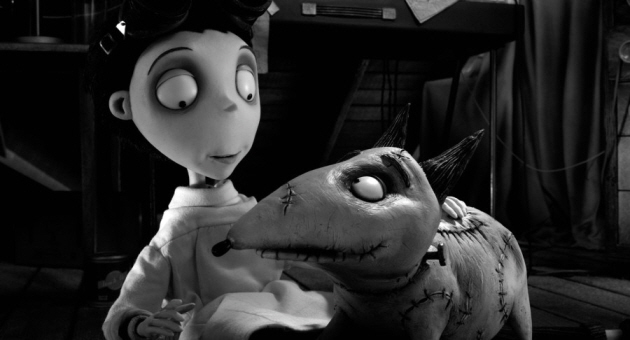
Tim Burton’s “Frankenweenie” is a dark, moody, and innocent animation inspired by old classic horror films such as “Frankenstein”(1931). True to its source of inspiration, it is a black-and-white stop motion animation decorated with quirky imagination and morbid but sweet humor, and its story has a small touching aspect at its center which will come close to some of you.

The animation is based on Burton’s short live action film with the same name which was made during his early career when he was working at Disney. After that short film was completed, Burton was fired by Disney at that time because it was thought that the finished work was too scary for young audiences. But now he works with Disney to expand his original idea into a full-length animation feature, and the result is as odd and imaginative as you can expect from Burton.

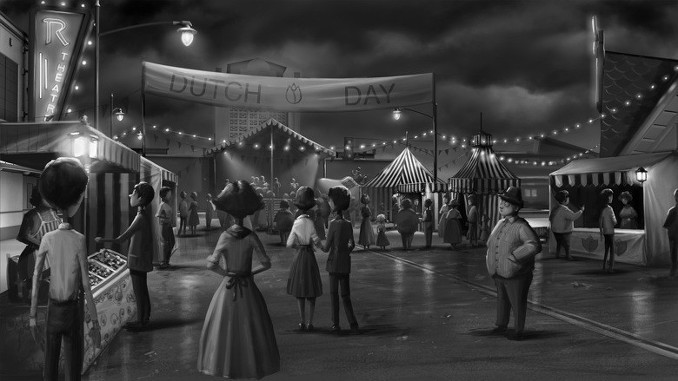
The story is a humorous parody/homage of the Frankenstein story. Again, our hero’s name is Victor Frankenstein(voiced by Charlie Tahan), but, this time, he is a smart little boy living with his worrisome parents Mr. and Mrs. Frankenstein(voiced by Catherine O’Hara and Martin Short, respectively). They live in a town named New Holland, and it looks like a grim version of that colorful suburbia in “Edward Scissorhands”(1990). Its grotesque residents look as gloomy and pale as their town, and, when the town festival is held later in the story, they do not look like having a fun. The town song is sung so cheerlessly and joylessly that you may be surprised to see that nobody kills himself during the performance.

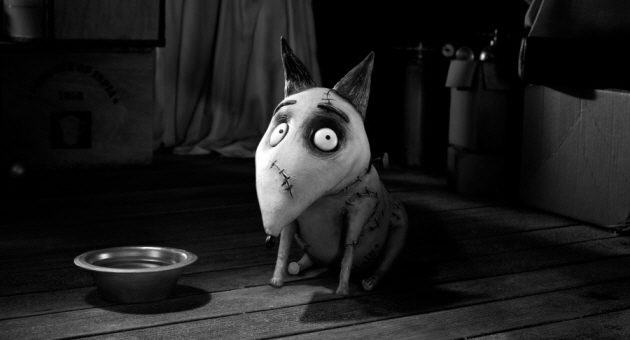
Victor is not daunted by such a depressing environment like that. He is lonely and has little interest in getting along with the other kids at his school, but he has a dear friend Sparky, a little dog friendly and loyal to him. However, unfortunately, Sparky is hit by a car on one day, and he is buried in a pet cemetery drenched with spooky gothic darkness as Victor is devastated by this loss.

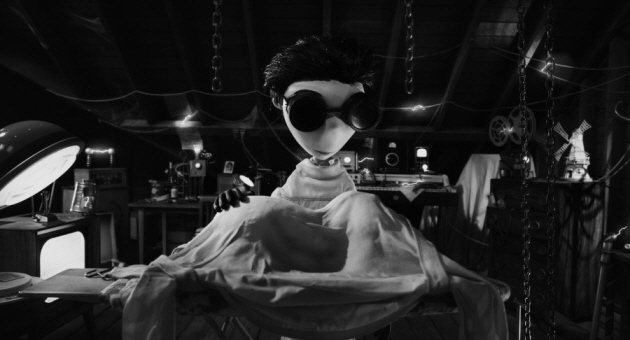
But, not long after that, he gets a good idea during the science class at his school. His new science teacher Mr. Rzykruski(voiced by Martin Landau), who behaves as if he were a Vincent Price academy graduate, shows his students dead frog being re-animated by electricity, and Victor applies the lesson to his private experiment for getting his friend back from death. His own experiment site in the attic has many familiar gadgets ready to be operated with buzzing sparks, and there is also a big table to be lifted high above the roof for receiving the required amount of electricity from the lightning in the sky, which happens quite often in his unusual town.

As he hopes, Sparky successfully gets re-animated as a good old doggie eager to please his master as before, though his appearance is a little different than before to say the least(considering that he has been dead at least for two days, I wonder whether he is a lot smellier than before). While happy to get his dog back again, Victor tries to hide his experiment and its amazing result from his parents and others as much as he can, but soon almost everyone in the town comes to see that the experiment is spinning out of control.

For his story, Tim Burton created the wonderful background to be appreciated through the first-rate set designs and, above all, the painstaking production of stop-motion animation. Three large sound stages were built for this animation, and the crews went through meticulous process on these sound stages for making their animation frame by frame with these small but delicate puppets for more than a year. The result is less smooth than average digital animation, but, like other good stop-motion animation, it is capable of bringing out admiration and wonder from you – especially if you know how much time and effort it takes to make one minute of stop-motion animation.

And the animation is fun to watch as a horror comedy peppered with the references of many old horror films. After learning about Victor’s success, his schoolmates unwisely attempt to reproduce his first result with many other dead pets, and the circumstance becomes more frantic as a consequence. As a experienced graduate who has been trained as a researcher, I know that there are always variations during multiple trials, but I must say there are too many variations in this case; I was particularly amused by an outrageously funny homage to Japanese monster movies during the climax accompanied with a bunch of freaky results.

Catherine O’Hara, Martin Short, and others provide good voice performances to their puppet characters. When I saw the character voiced by Winona Ryder, I could not help but think of her previous collaboration with Tim Buron in “Beetlejuice”(1988), where she appeared a moody girl as depressed and neurotic as her character in this animation(by the way, her name is Elsa van Helsing – and she has a cute poodle willing to be the Bride of Frankenstein).

Tim Burton previously produced “The Nightmare Before Christmas”(1993), which has solidified its status as a classic stop-motion animation since its release, and directed later “Corpse Bride”(2005), which was also a good one. I do not think “Frankenweenie” is as good as these two animations, but it is an enjoyable animation despite its rather thin plot thanks to its humor and energy. This is an animation which the adult audiences will probably enjoy more than their children, but the young audiences may also enjoy it as a spooky but sweet tale about a boy and his beloved living dead dog.

Posted in Movies | Tagged , , , , , , | Leave a comment

Take This Waltz (2011) ☆☆☆(3/4) : It’s hard not to follow heart…

Sometimes people find themselves in the difficult circumstance where heart is in conflict with brain. The heroine of “Take This Waltz” feels an urge to follow her heart, but she is not so sure about how to deal with it. It goes without saying that she should make a sensible choice in her tricky situation, but, as we know, it is hard not to follow heart even when brain strongly advises not to do that, and that makes her and others around her unhappy.

She is a young married woman named Margot(Michelle Williams), who works as a freelance writer. During her business trip, she meets Daniel(Luke Kirby), and they are attracted to each other during their conversation on the plane to Toronto. Margot later tells him that she is married, so it could have remained as a brief flirt between them, but she has never imagined that Daniel is actually her neighbour. After the plane arrives at the airport, they get a ride together because they live in the same neighbourhood, and, what do you know, he lives right across the street from her home.

Margot has lived with her husband Lou(Seth Rogen) for nearly five years in their cozy house in some nice neighborhood of Toronto. Although paying a lot of attention to his work at the kitchen for the cook book to be published, Lou has been a kind, caring husband to her. They start their morning with a warm, playful talk on their bed, and they are comfortable with each other in the house filled with many colorful objects here and there. As far as I can remember, the only shabby spot in their house is the bathroom where they have a little ‘problem’ with shower.

Watching their house and other equally nice-looking houses, I frequently wondered how they can afford to live in such a good neighbourhood as a couple of writers who do not seem to earn a lot of money through their jobs. Come to think of it, Daniel is also leading a comfortable solitary life of his own even though his main occupation besides artistic activities is merely a rickshaw driver operating in a tourist area(and he pulls his rickshaw by himself while running along the streets!).

This premise may not sound so realistic, but I appreciated that the director/writer Sarah Polley imbues her story with the warm, intimate atmosphere maintained well by the performances and the production design. The daily life of Lou and Margot is sort of realistically ideal, and we immediately accept them as a couple who have been accustomed to each other for years. Their neighbourhood looks like a good place where you can raise your children while growing old together with your spouse; besides a beach nearby, there are also a swimming pool and a movie theater, which are incidentally two important elements in my daily life.

But there is also the plain reality beneath these pretty sights, and it is mainly represented by the unspoken gentle ennui between Margot and Lou. They still like each other, but Margot feels something is missing in their stable life, so she finds herself increasingly attracted to Daniel even though she knows it is a wrong thing. She goes outside, and she spends a lot of time with him at various places while Lou keeps being happily occupied with developing the new cuisines for chicken. Daniel wants her, and so does she, but she is conflicted about what she should do. Lou vaguely senses something is wrong with her, but he is at a loss when she suddenly lets out her frustration in front of him.

It is not easy to sympathize with Margot because she does several unwise things while hesitating between two generous men, but Michelle Williams’ performance makes us understand her character with some degrees of empathy. As shown in her notable independent films such as “Wendy and Lucy”(2008) and “Blue Valentine”(2010), Williams is one of few actresses who can look simultaneously plain, sweet, and pretty, and that aspect of hers works well in the film while the movie realistically captures the small moments of daily life such as the swimming lesson Margot and her sister-in-law Geraldine(Sarah Silverman) attend along with a group of middle-aged ladies. Their shower scene, featuring full frontal nudities, does not look gratuitous much, and it actually accentuates a truth about life imparted by one of the ladies.

Williams is supported well by her co-performers. Although his character is limited by the story, Luke Kirby is likable as a decent man who tactfully pursues a woman he desires for. Sarah Silverman is also good as Margot’s sister-in-law struggling with alcoholism; there is a crucial scene around the ending where Geraldine points out what Margot has done, and Silverman does not step into overacting while adhering to her character’s flaw. As he did in “Funny People”(2009), Seth Rogen effectively sheds his usual comic persona, and he does a better job by immersing himself into an amiable ordinary guy who is understandably oblivious to his wife’s trouble. When he has the anniversary night with Margot, Lou gladly accepts a rickshaw ride from Daniel, while not sensing at all that Daniel is indirectly courting his wife through the ride.

“Take This Waltz” has romantic moments, but its hard look at romance is far from being sentimental. As shown in one dreamy sequence in the movie, passion is merely a temporary thing, and it is bound to be dissipated in the end no matter how long you can have a fun with it. Nevertheless, probably because of a part of our nature programmed somewhere in our genome, we sometimes cannot help ourselves from trying to fill the void in our life even though it is usually futile or ruinous to do that. As one song says, love is indeed drug; once you get hooked, it is hard to cope with it, and there is always a price for that.

Posted in Movies | Tagged , , , | Leave a comment

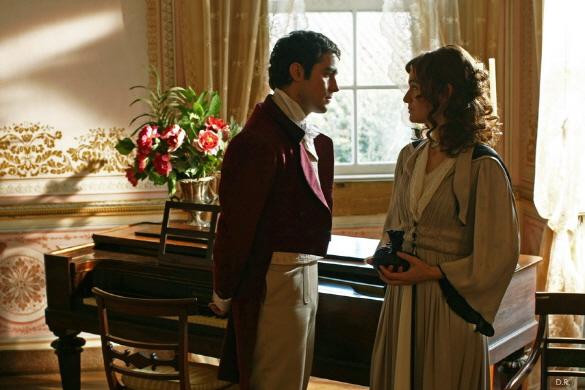
Mysteries of Lisbon (2010) ☆☆☆1/2(3.5/4): A sumptuous labyrinth of stories and secrets

A young boy curious about his birth, A priest with the long past behind him. A countess who gets involved in a doomed affair and then trapped in an unhappy marriage. A count who commits cruelty out of his frustrated love. A criminal who accidentally gets a chance of lifetime to change his social status. A vengeful society woman who manipulates others to gall the man she is obsessed with. They might look like the characters randomly selected from several different books, but they are all the denizens of one big, labyrinthine tale which slowly reveals how their lives are interconnected or intertwined with each other a lot more than we thought at first.

Raúl Ruiz’s gorgeous period drama “Mysteries of Lisbon”(2010), based on the 19th Portuguese novel with the same name by Camilo Castelo Branco, has a lot of space for handling such a complex plot like that. Many things are told throughout its long running time(272 minutes), and it is easy to get lost and confused, but it is also pleasure to watch how the plot is thickened to unfold the stories and accompanying secrets behind them. This is like reading a big book full of interesting things to tell; there is one story at the beginning, and then there are other interesting stories coming from inside and outside. When its first half was over, I wanted more while tickled by another possibilities (“Another secret?” – “You’ll get your answers later”), and then I was very satisfied with its second half.

The story is initiated with a 14-year-old boy in Lisbon who knows nothing about his parents. Unlike his classmates, João(João Luís Arrais) does not have surname, and we see him teased by the classmates in his boarding school because of that. He has been raised and taught by generous Father Dinis(Adriano Luz), who has not told anything to João though he seems to knows a lot about the boy’s parents and, possibly, more.

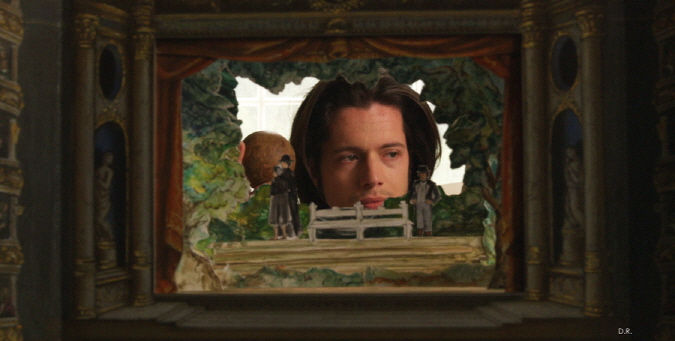
On one day, an incident becomes a key to unravel the mystery. João suddenly gets ill, and he sees a beautiful lady visiting him on sickbed in his fevered haze. It was not a hallucination, because he finds her gift, a miniature theater, on the table when he regains his consciousness in the next morning. Not long after that, Father Dinis takes him to a big manor, and João gradually learns that he is the illegitimate son of the Countess of Santa Bárbara(Maria João Bastos), who has been treated badly by her cruel husband the Count of Santa Bárbara(Albano Jerónimo) in their loveless marriage. After meeting her son again, the countess finally decides to get away from her husband – and she later tells João the story about her ill-fated romance in the past.

And that is just a mere start for the series of stories to be unfolded along with lots of characters introduced here and there in front of our dazzled(or disoriented) eyes. Some of them casually appear and then disappear forever while the others exit and then appear again with some surprises. For instance, a certain character seemingly looks like one of the background characters in one scene during the first half, but he comes back in the second half with a big secret involved with the birth of one main character.

Speaking of ‘secret behind birth’, which persistently has remained as one of major clichés in many TV soap dramas, we can say that “Mysteries of Lisbon” are stuffed with soap drama materials like that. When we see young lovers’ romance blocked by the customs of their high society, we know that, propelled by lust and passion between them, they are destined to the melodramatic tragedy waiting for them from the start. Most of the characters depicted in the film are as thick as the cardboard figures in the miniature theater, and the movie constantly emphasizes that aspect to us by introducing several scenes through that miniature theater belonging to João.

But they are the vivid fragments mirroring our nature, and how they and their stories are deftly handled in the movie reminds me of the works of the 19th European novelists, who usually chronicled the life of their heroes from the beginning to the end as the stage to be filled by broad but colorful characters. I am not familiar with the works of Camilo Castelo Branco(despite his impressive bibliography, his novels have not been introduced to US, let alone South Korea), but I recalled Dickens’ classic novels and how he confidently manipulated his wonderful stories with many clichés including implausible coincidences as he juggled many memorable caricatures of his. You will probably not remember every character in the movie, but you will certainly remember the more colorful members such as Alberto de Magalhães(Ricardo Pereira), a shady rich man with many secrets in his past including the connection with João a long time ago, and Elisa de Montfort(Clotilde Hesme), an obsessive and cunning woman who behaves as if she were the heroine of the 19th century version of “Fatal Attraction”(Don’t worry, the people in this era are too sophisticated to boil a rabbit).

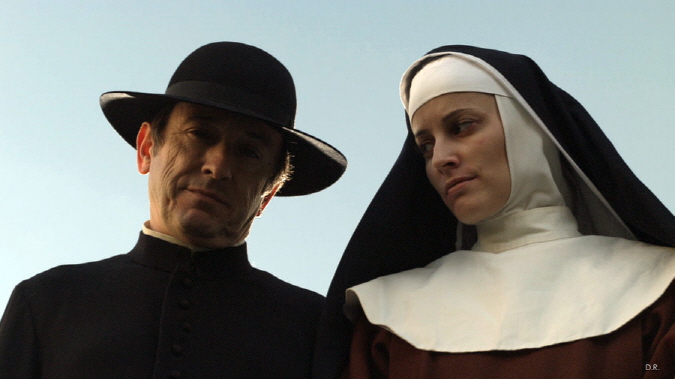
It goes without saying that the most interesting character in the film is Father Dinis, who harbors his own secrets and others’ behind his restrained attitude and plain appearance. As it turns out that he is connected with most of the characters in the story in one way or others like Mr. Jaggers in “Great Expectations”, he gradually becomes an omnipresent figure hovering over the other characters while being drawn to another hidden facts in his life and others’ to be observed.

We naturally become very curious about this unbelievably ubiquitous man, and then we get an ominous scene where João goes into the forbidden room out of curiosity and faces his benevolent teacher’s interesting past represented by his alter egos in the room. The camera calmly looks around the room, and it subtly implies that there are more hidden things in Father Dinis’ past and we will see some of them later.

Although he made more than 100 films before his death while admired as one of the most interesting and innovative fillmmakers in the world, the director Raúl Ruiz(1941-2011) was not well known to the South Korean audiences including me around the time when I became a little more serious about movies. Before watching “Mysteries of Lisbon”, one of his last works, I only saw “Klimt”(2006), and that movie was not a pleasant experience. Although I liked John Malkovich’s sardonic lead performance as Gustav Klimt(I fondly remember the scene where he smashed a piece of cake onto his opponent’s face) and several dreamy images, but I could not relate well to the movie due to the lack of focus. I remember I sarcastically quoted the lyric of a Broadway musical number when I talked about that movie at that time, and I still think it summarizes the movie pretty well: “I’m drowning, I’m drowning here! I’m going down for the last time. I see my whole life flashing before my eyes!”

In case of “Mysteries of Lisbon”, though I needed the second viewing for completely sorting out the relationships between the main characters as well as their plotlines, I was rarely bored in spite of some confusions. The main storyline is frequently interrupted by flashbacks, but there is the sense of fun whenever the movie slips into the past to tell another story. There is also a wry dark humor, and it mostly comes from the people who rigidly behave according to the codes in their society. The sense of honor turns out to be nothing but superficial in front of a man who does not give a damn about it in one comical moment. The women are so admired in their society that the men unwisely think they can own their hearts, and that always becomes the source of misery in the end. The Count is not a bad man but a pitiful man who makes himself more miserable by making others around him miserable.

The movie is visually compelling thanks to Ruiz’s masterful direction. The production design and costumes are excellent, and the cinematographer André Szankowsk’s camera lingers or slowly moves around during many longtake sequences to immerse us into the high society world where eyes and ears are everywhere around its members. There are always the gossips shared behind their backs during social gatherings, and, even when it looks like a private conversation between two people, there is usually someone outside the room, who is usually a servant or a maid silently serving them while hearing and observing everything.

The movie is playful about that aspect. At one moment, the camera looks at two characters in the bedroom while moving as if it were an observer hiding behind the curtains. I especially liked an odd shot in one scene, which shows many people intently looking upon a certain character’s behavior at the ground floor from upstairs(but I am not sure about what they can come to know from doing that).

As we enjoy the plot, it grows on and on. When João(now he is played by Afonso Pimentel) later returns to Lisbon as a young nobleman with a personal agenda fueled by his naive passion, he only finds his life as a mere addition to the vast intricate tapestry he has not been aware of. The time has passed as he wanders due to his discouragement followed by one big revelation. He becomes older and weaker as the time goes by. Marcel Proust would understand very well how João feels about the time lost and what he tries to do in the end before it is too late for him.

“Mysteries of Lisbon” is a sumptuous visual ride if you prepare yourself for its long but tantalizing tale. Compared to the epic panorama of stories it has built, its finale may be relatively anti-climactic or disappointing to some of you, but at least it can make you look back what you have seen from the movie and reflect on it for a while. Come to think of it, it brings to my mind that, no matter how vastly it is unfolded, every story inevitably arrives at the point where it has to get resolved and finished – and folded back to its origin.

Posted in Movies | Tagged , , , , | 1 Comment

Moonrise Kingdom (2012) ☆☆☆1/2(3.5/4) : Their little deadpan romance

“Moonrise Kingdom” is as charming and innocent as Wes Anderson’s film can be. As a picturesque tale about a little romantic elopement, the movie has that sweet aspect we have seen from such films as “Melody”(1971) and “Small Change”(1976) along with that distinctive deadpan attitude we have observed from Anderson’s previous works. The characters are more or less than caricatures and their world has artificial qualities, but there is something sad and melancholic beneath their quirky personalities and comic circumstances, and that makes that little romance at the center of the story both endearingly real and magical.

The warped reality of the movie is apparent right from its background, which is a remote island probably somewhere around the New England area during 1965. It is not that big, but it is big enough for the entire cast of the film, who seem to be only inhabitants of this serene island. In case of Suzy Bishop(Kara Hayward), a smart girl who reminds me a lot of my childhood filled with various books, she lives with her untypical family in the house with a lighthouse at the one end of island. They are not so close to each other, but they have been accustomed to being stuck with each other while having each own place in their house, whose interior is as tidy and orderly as dollhouse.

This certainly looks artificial, but Anderson draws our attention with precise composition and loving little details sprinkled throughout the screen as we are amused by the oddness inside his characters. For instance, Suzy’s mother, Mrs. Bishop(Frances McDormand), uses a megaphone to call her daughter and three little sons from downstairs when dinner is ready for them. When we see Scout Master Ward(Edward Norton) for the first time, he is busily handling his little scouts in the camp in a way a little too exemplary and diligent; I especially like his no-nonsense response to a tree house misguidingly constructed by his scouts.

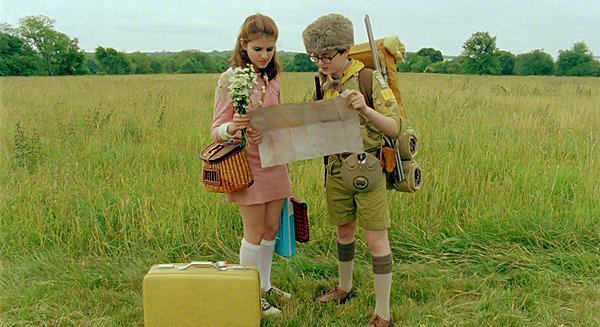
One of Ward’s scouts is Sam(Jared Gilman), an introverted orphan boy with quiet sincerity behind his big glasses. It turns out that he and Suzy have been secretly corresponding with each other through letters since they had a chance encounter between them a year ago, and they have recently decided to have their private time as little lovers without telling anyone. When they meet at their rendezvous spot, they are adequately prepared; as a good scout, Sam knows how to get to a certain place in the island, and Suzy brings books to read along with her little kitten and a record player.

They arrive at a little cove. Sam exemplarly sets the tent for them, and Suzy nicely sets the mood for them, and they have a happy time together as a boy and a girl in love. They may be too young for the adult matters in romantic relationship, but they are smart kids who have no confusion about the mutual feelings between them while admitting their limit as kids(“I love you but you don’t know what you’re talking about.” – “I love you, too,”). As they spend more time together, their cove becomes special enough to get its new name besides its original bland name.

They probably know that the time is short for them even though they manage to hide from the adults in the island. Mrs. Bishop worry about her missing daughter, and Mr. Bishop(Bill Murray) is as detached as Murray can be while also deeply concerned about Suzy. The local sheriff Captain Sharp(Bruce Willis) try to find Sam and Suzy, and so does Scout Master Ward, who leads his scouts to search for their missing member(these scout boys are so eager to capture Sam that they even bring an axe and a bow during their search). Later, as our narrator(Bob Balaban) forecasts, a big storm is coming to the island as the climax, and there also comes a woman from Social Services(Tilda Swinton), who, as a strict bureaucrat, is very determined to get Sam back to a ‘juvenile refuge’, which can be as bad as a Dickensian orphanage.

All these things in the movie are handled well with the calm deadpan approach by the director/co-writer Wes Anderson. His characters never reach for laughs while being serious about their circumstance no matter how much they look offbeat or whimsy. The movie maintains a dry, detached attitude to its story, but there are also understated emotions in its detachment, which are glimpsed through the adult characters grounded in their melancholic reality. The movie is also exquisite to look at thanks to the deft use of color tones on the screen, and the cinematographer Robert D. Yeoman does an excellent job of providing appropriate ambience to the story, which is enhanced further by the memorable soundtrack mainly consisting of Benjamin Britten’s classic pieces and Hank William’s songs and Alexandre Desplat’s intimate score.

The performers adjust their performances well to the deadpan atmosphere of the movie. While Bill Murray is born to be in Anderson’s movies with his usual detached persona(It is their sixth collaboration), the other actors including Bruce Willis, Edward Norton, Frances McDormand, Tilda Switon, Jason Schwartzman, Harvey Keitel, and Bob Balaban give nice offbeat performances as the interesting denizens of Anderson’s whimsy world. As the main hero and the main heroine of the movie, Kara Hayward and Jared Gilman share a precious little chemistry while never looking too cute or too precocious, and they deftly balance themselves well between being funny and being sincere.

“Moonrise Kingdom” is basically a fantasy tale with a fair share of implausible moments. But, like any other good fantasy tales, it is grounded in the believable reality and convincing characters to pull us into its heart, and it leaves us some touching truth about love in our life. As implied in its finale, romantic moment never lasts long, and it eventually goes away into somewhere in our memories – but something else can be grown and extended from that as we move on in our life.

Posted in Movies | Tagged , , , , , , , | 1 Comment

Ted (2012) ☆☆☆(3/4) : He isn’t as cute as he looks

I usually watched trailers with open mind, but, in case of the trailer of “Ted”, I was unsure about whether its premise would work. Think about it; a living teddy bear who behaves like a mean stand-up comedian frequently shocking you with vulgar behaviors? And he has been the best friend to a 35-year-old guy since they were young? This can be too preposterous to be accepted in the movie unless it is really funny instead of being merely outrageous and offensive.

However, it turns out that “Ted” is on the way of becoming one of the funniest movies I have seen in this year. The movie is indeed outrageous and offensive thanks to its teddy bear character who does lots of dirty and unpleasant things while hurling a ton of barbed words to the people around him, but its constant supply of small gags and big laughs made me and the other audiences entertained rather than insulted, and I could not help but laugh along with the audiences around me as my eyes were incredulous about what was going in the film.

How did this teddy bear become alive? Well, we are told about that through the narration by Patrick Stewart in the opening sequence, which is seemingly genial and avuncular enough to be used in Christmas movies but equally acerbic and sarcastic like a sweet candy with sour core inside. When he was young, John Bennett was the least popular kid in his neighbourhood(even a bullied Jewish boy did not like him). He was lonely because of that, but he had his loving parents at least, and they gave him a nice Christmas present, a teddy bear which could be his good friend to be beside him when he slept at night. During their first night, he wished his Ted to be alive and become his best friend forever, and, on the next morning, what do you know, his wish did come true(The narrator explains, “Now if there’s one thing you can be sure of, it’s that nothing is more powerful than a young boy’s wish.”). Ted became alive and, as we see in the main title sequence consisting of funny photos and home videos, they indeed have been the best friend to each other since that miracle.

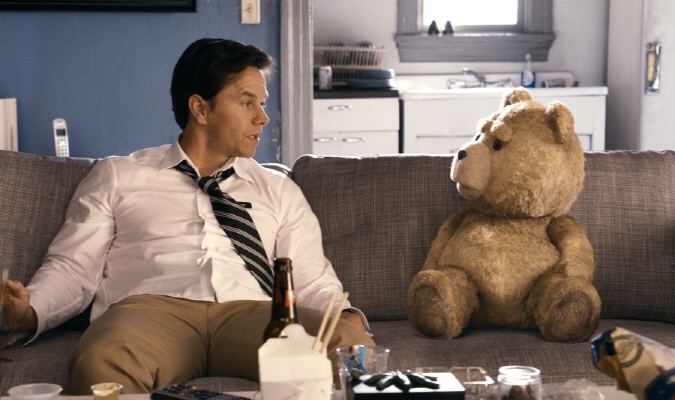
It sounds like a happy ending, but it isn’t. Many years have passed, and John(Mark Wahlberg) becomes an adult, but he has been stuck in the arrested development state with his dear buddy, who looks a little worn-out but speaks like a dude who has been spending lots of time on his couch with booze and drugs. Ted became a big sensation when he appears in front of people(he even appeared in Johnny Carson’s Show), but, like many short-term celebrities before and after him, he went into obscurity while causing many troubles including being arrested for narcotic possession.

John has a job, but he is definitely not the most eligible bachelor in his city. He is a mere employee working at a rental car company, and that is not much of a good sign for the guy who has already passed his 35th birthday. But it does not matter to John, because he is happy to be with Ted as long as they can drink beer and smoke pot while watching their favorite movie “Flash Gordon”(1980), which is the emblem of their sweet childhood to them.

It is rather amazing to see a beautiful and talented girl like Lori(Mila Kunis) somehow maintaining the relationship with a likable but immature guy like John for almost four years despite the presence of a trash-talking teddy bear between them, but Mila Kunis plays her character as a nice girl with warm understanding and patience. She knows how important Ted is to a guy she loves, but now she decides that enough is enough. She gives him an ultimatum; it is her or Ted.

The story may look silly on the page, but the movie presents the triangle between the main characters in a convincing way with the help from good CGI and good comic performances. Ted looks as realistic as ordinary teddy bears you can find in stores while also believable as a living creature walking and talking with the others in the movie. Wahlberg and Kunis interact well with Ted on the screen, and I could accept that their characters were dealing with a real problem in their daily life.

The director/co-producer/co-writer Seth MacFarlane, who also provides the voice of Ted with good comic timing and balance, makes a hilarious comedy based on its one-joke promise which could have been easily fizzled within few minutes. I only watched his popular TV animation show “The Family Guy” partially, but I remember watching a very funny sequence where its hero keeps fighting with a big chicken while neither of them is aware of the surrounding circumstance getting messier step by step due to their increasingly intense duel.

The same thing can be said about “Ted”. As the comic moments are kept being thrown to us throughout its running time, some of them are directed and accumulated in unexpected ways to culminate into big laughs. When John promises to Lori that he will not get involved with Ted, we instantly see that he will eventually let her down, but that moment comes with something he cannot possibly refuse due to his understandable weakness, and that is further developed into a manic situation involved with Sam J. Jones, who has a lot of fun with his cult image from “Flash Gordon”, and one hell of aggressive duck. There is also a creepy dad(Giovanni Ribisi) who has been obsessed with Ted since he was young and is determined to do anything to bring Ted to his spoiled son(Aedin Mincks), and his unhealthy obsession is sort of hilariously disturbing.

“Ted” gleefully brandishes its vulgarity and impertinence, and it successfully gets away with its misdemeanors through its effectively outrageous comedy which rarely loses its steam except when it is relatively mellow during its third act as a bromance movie. One of the amusing things in the movie is that Ted had sexual relationships with many women in the past including a certain famous singer who makes a cameo appearance in the film. Please don’t ask me about how the hell this horny little bear is anatomically capable of having intercourse with woman, because I did not see anything notable between his legs during my viewing.


Sidenote: “Ted” richly deserves its R rating for many good reasons, and it also receives 19 rating in South Korean while being released as “19 Bear Ted”. Thankfully, our children are strictly blocked from 19-rated films at the theaters in South Korea. MPAA, please take a note in this.

Posted in Movies | Tagged , | Leave a comment

Brave (2012) ☆☆☆(3/4) : She deserves her next adventures

I have never imagined the day will come – the day when I struggle to find any way possible to talk about a Pixar animation. I cannot deny that “Brave” is a good animation film which can be enjoyed by children as well as adults, but it lacks a certain level of distinctiveness and creativeness we have witnessed from the previous Pixar animations. Fortunately for us, this weakness is not a serious problem, but I could not help but think about how better the other Pixar animations are as I was enjoying its good moments consisting of your average medieval fantasy elements.

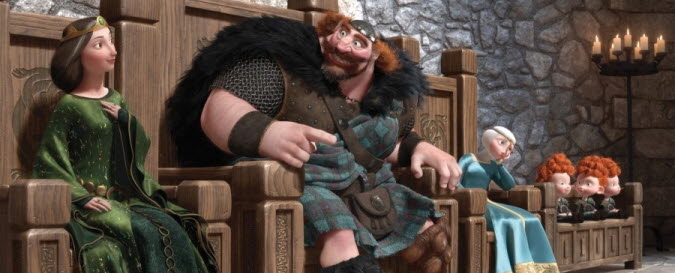
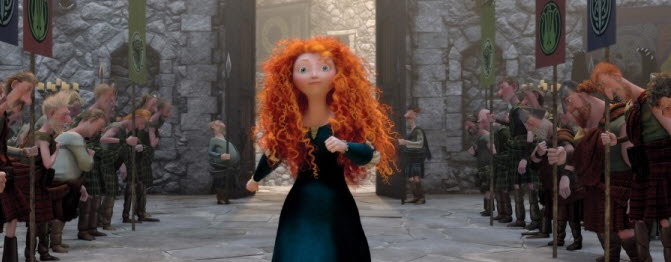
But, folks, let’s look at its good elements, which are the main reasons I recommend it to you despite my reservation. Our heroine is a young princess named Merida(voiced by Kelly Macdonald), and she is determined not to be your typical princess(in these days, that is typical, you know). Even when she was very young, she was quite a lively little girl, and she knew what she wanted when she received a bow from her big daddy, King Fergus(voiced by Billy Connolly).

The time has passed, and Merida, still plucky as usual, is now an adolescent girl who is old enough to marry someone chosen for her. Of course, as a rebellious girl who prefers to go outside, ride her beloved horse, and shoot arrows with her bow, she clashes with her mother Elinor(voiced by Emma Thompson), who sincerely wants her daughter to get married to some suitable guy. Although I can understand Eilnor’s intentions, I must say the prospects are not bright for Merida: none of three potential suitors looks valid for several good reasons(you may be amused to see that one of them is named MacGuffin, the son of Lord MacGuffin).

After a big quarrel with her mother in the evening, Merida runs out of the castle and then is led into the forest by mysterious blue lights. She eventually comes across the house of an old witch(voiced by Julie Walters). Once finding that she is not just a nutty woodworker, Merida asks her to provide a spell to change her mother, and a witch gladly provides what Merida wishes for as soon as she is paid. I bet that famous phrase “Be careful for what you wish for, you might get it.” never occurs to Merida, even when the witch says something right before they are quickly parted.

And she does get it; the spell indeed works in a short time, and her mother is changed – into a big bear. Merida naturally regrets about what she has done, but it is not easy for her to solve this serious trouble. Luckily for her, there is a way to remove the spell, but the time is pretty short for her and her mother. Furthermore, her father, who lost one of his legs due to a bear attack in the past, is certainly not the man who will welcome a bear in his castle.

So Merida and her mother must get out of the castle, and, yes, they spend the time together in the forest as a girl and her beastly mom. Although her mother cannot talk, they manage to communicate with each other through several gestures. It occurred to me that it could be easier for Merida’s mom if she just wrote what she tried to say to her daughter with her pointy nails, but it cannot be denied that the wordless exchanges between them provide some good laughs to the audiences.

I found the story a little too typical and predictable, but there are nice individual scenes in “Brave”. We can understand Merida’s view and her mother’s, and there is a sad moment when Elinor regrets about being too harsh to her daughter during their quarrel. The barrier between them is more apparent after Elinor’s transformation, but they gradually confirm to each other that how much they love and care about each other despite the disagreement between them.

The animation is lovely to watch. You do not need unnecessary 3D glasses to appreciate the fine details in its gorgeous depiction of the Highlands on the big screen, and Patrick Doyle’s score is effective while being appropriately Scottish. I was constantly amused whenever Merida’s little triplet brothers, as spirited as her big sisters, did something mischievous or helpful, and I liked King Fergus, a big tough guy who is also as soft as any good dad can be. I’d love to hear about how he met his wife, who looks timid beside him but can be quite authoritative when her husband and other men behave like a bunch of immature big boys in the hall.

But my reservation remains because of its relative blandness. Even the lesser Pixar animations like “Cars 2”(2011) had some distinctive qualities(I liked that animation film unlike many of you, by the way), and they were surely better than at least half of the other contemporary animations made during their time. I even wondered whether I could have recognized “Brave” as a Pixar animation if the Pixar logo had been not shown at the beginning of the screening. I could have mistaken it for a new Dreamwork animation I had not heard of it. And I do not think the filmmakers did not fully utilize the potentials inside their story.

But I guess I must objectively judge it, above all, based on whether it is an enjoyable animation or not, and “Brave” is a product well-made enough to be recommended. Its story is so typical that I grasped for any fresh expressions to describe it, but Merida is a brave heroine I cared about, and I think she really deserves her next adventures. There have been some worry about whether the glorious days of the Pixar animation were over due to the recent commercial failure of “Cars 2”, but “Brave” shows that they can still make a good animation even at their blandest mode.

Sidenote: There is a small scene after the end credit is finished. It is not important, but you may enjoy it.

Posted in Movies | Tagged , , , , , | Leave a comment

The ruthless avian campus gangs strike again (09/23/12)


They were caught by my camera while extorting snacks from innocent citizens.

Posted in Photos | Tagged , | Leave a comment

Cats on the autumn days

                         
They were ready for new photos…
Posted in Photos | Tagged , | Leave a comment

Once Upon a Time in Anatolia (2011) ☆☆☆1/2(3.5/4) : Long night’s journey into day

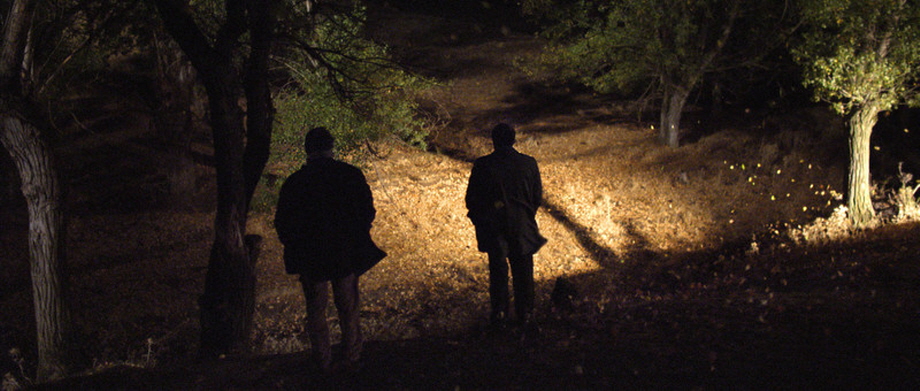
It is quite a long night for them. They have been going around the wide area for hours, but they have not yet found what they are looking for. The sky gets darker, and they become more bored, tired, and frustrated in the deepening darkness. The wind blows ominously, the reeds on the field are shaken by the wind, and they begin to reflect on themselves as the search is being fruitlessly continued in front of their eyes.

What happens on the surface during the first half of Nuri Bilge Ceylan’s haunting film “Once Upon a Time in Anatolia” can be simply summarized like that. Nothing much happens in the movie except few small unexpected things, and they do not make much difference to how the murder case will be closed. We do not know exactly how or why the murder happened, but there is no reasonable doubt about its two suspects. The first suspect has already given and signed a full confession about their murder, and all the local police need is the victim’s body buried somewhere outside the town.

It sounds simple, but the problem is, the suspects don’t know well where they buried the body. The first suspect, named Kenan(Firat Tanis), was inebriated when he buried the body. His dim accomplice does not remember a lot about that although he was not drunk at that time. Kenan said there were a fountain and a ‘round tree’ near the burial site, but that information helps little, because there are many places with fountain in the area and they all look pretty much same. Whenever it seems that they finally find the site, they are at a wrong place.

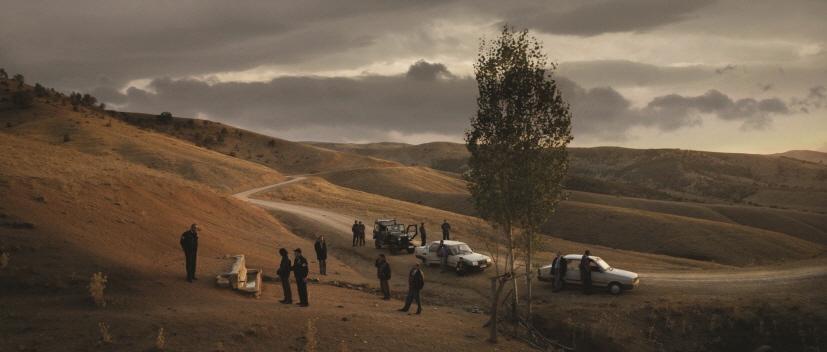
The movie observes this frustrating procedure in a languid pace which may test your patience. After its opening sequence slowly approaching to the victim and the suspects at their drinking party before the crime was committed, we get a static long shot of the field under the darkening sky. We soon see the three cars coming along a winding road. They stop at one spot near a fountain with a tall, slender tree next to it. The people get out of the cars, and the first suspect is asked whether this place is a right place or not while everybody else is waiting. They go back into their cars and move to another place, but, again, it’s a wrong place. Watching their search going on and on with this repeated pattern, I could not help but think of that silly story about an ineffectual general who keeps misleading his soldiers to wrong hills and discouraging them with his befuddlement(“I think it’s not here….”).

As the cars goes through the darkness descending upon the vast rural landscape of Anatolia, the movie looks at the people inside the vehicles more closely. There are a prosecutor(Taner Birsel) who leads the investigation, a police chief(Yilmaz Erdogan) who is getting impatient with the vague memory of his suspects, and a doctor(Muhammet Uzuner) who will examine the body not found yet. They are accompanied with a courthouse clerk, a police officer, drivers, soldiers, diggers with shovels, and, of course, two handcuffed suspects.

We observe several trivial things about these people while going along with them. The police chief and his men talk about yogurt and a government official they know. The cars are temporarily stopped because the prosecutor needs to relieve his bladder as he did several times before(it is suggested that he have a problem with his prostate). While the police chief and others continue their mundane conversation in their car, the first suspect remains silent in the middle with his darkened face, filled with guilt and remorse.

They stop at another place. The driver who works for the police chief confides to the doctor how hard and thankless his job has been. The doctor muses on the life which will be ultimately surrounded by cold darkness while the world will remain just the same as before. As they let out their thoughts, the camera stares at their backs or their wordless faces; they do have a conversation, but it looks as if they conveyed their private thoughts and emotions only to us.

We also get one intriguing tale, told by the prosecutor to the doctor. It is about a woman who told her husband, supposedly one of the prosecutor’s friends, that she would die five months later and died exactly on that day not long after giving birth to her child. As a rational man, the doctor has a good explanation for her death. After taking more with the prosecutor, he also gets a pretty good idea about what the prosecutor tries to seek through telling that strange story to him. As the story filled with subtle touches and opaque feelings, the movie wisely avoids an easy resolution in their interactions; later in the story, it is clear that both of them know exactly what they are talking about, although they never acknowledge it to each other except during one short moment.

Slowly and leisurely moving his story outside the conventions of its genre for more than 140-min, the director/co-writer Nuri Bilge Ceylan finds the space and time wide enough to focus on his characters and their surrounding environment, which are beautifully captured by the cinematographer Gökhan Tiryaki. Appreciating the notably contrasting looks of the landscapes of Anatolia on day and night, we also feel how much this long night’s journey into day is affecting the characters through the weariness shown in their faces. The police chief, who turns out to be more vulnerable and wearier than we thought, goes through the complex emotions toward the first suspect as he and others come to learn a little more things about their case. When they stop by the village chief’s house for a quick meal around the dawn(it is about AM 4:00 when they arrive), the electricity goes out, and the village chief’s pretty young daughter appears from darkness with a lamp and cups of tea on the tray. Everyone in the room bewilderingly looks at her face as if she were an angel in this memorably gorgeous moment. They later talk about how she will grow old alone in her village where almost all of young people have moved out to cities.

The morning approaches along with their reality as the second part of the movie begins, and, this is not much a spoiler, they finally find the body at some place. The body is exhumed and examined under the formal procedures. They have a small humorous moment when the prosecutor describes the body with an amusing remark. They have a trouble with loading the body into the trunk of one of the cars, but they manage to bring the body to the town hospital. The town has just started waking up, and its atmosphere in the early morning and the looks of exhausted doctor may be intimate to you if you had the experience of working all night as the night going away and the day coming from the horizon.

There are still more works to do for the prosecutor and the doctor and others. We see the victim’s wife and her son. They angrily look at the first suspect, who feels more remorseful because of his personal reason. Regardless of whether what he believes is true or not, he committed a terrible thing to that little boy, and he knows that too well. The doctor discovers something notable during the autopsy, but, for some unidentified reason, he decides to ignore it. It is not clear whether it is because of something he seems to see from outside the window or merely because of his exhaustion, but it is apparent that small fact will only complicate the procedure while not changing anything in the case.

“Once Upon a Time in Anatolia” deservedly won the Grand Jury Prize at the Cannes Film Festival in the last year. It is indeed one of those ‘slow’ films, but the movie was a rewarding experience although I lost some of my patience due to its slow progression during my first viewing. Even when watching the characters from the distance, it cares about the characters, and I was drawn to their circumstance. I liked the way their humanity can be glimpsed through the small gestures like offering a biscuit, and I began to like some of the people in the movie as the time goes by. I did not understand or know everything about them, but I could understand how they feel throughout the story even when they do not say anything(Ceylan said in one interview: “I think the human face is the most beautiful landscape. The face tells you everything. It’s the only way to get to the truth because, most of the time, the words we say are not true. We have a tendency to deceive others to protect ourselves.”).

In the end, as the final scene suggests, the life will go on as usual for them – and they will probably look back on what they went through during that night from time to time. In the middle of their search, one character says to the other that they will probably regard their long journey as one of the amusing episodes in their life. Maybe they will begin like this: “Once upon a time in Anatolia, I was…”

Posted in Movies | Tagged , , | Leave a comment