Point Blank (2010) ☆☆☆(3/4) : Passable but efficient

pointblank01As revisiting French action thriller film “Point Blank”, I thought about how familiar a certain thriller premise is. In many thriller films like this one, an ordinary guy suddenly finds himself being blackmailed to do something not so good while the clock is ticking toward the deadline put upon him, and he must do that as soon as possible – or he will lose his loved one being held as hostage by bad guys.

I also wonder about whether such a scheme can actually work in real life, but this is indeed a nice thriller premise to be recycled again and again, and “Point Blank” recycles it well enough for our brief entertainment. While there is nothing new to impress seasoned audiences like me in the movie, that does not mean that I was bored while watching it. Its story may be a little too thin to distinguish itself from other countless action thriller films I watched before, but it nicely works with efficiency and speed like a well-oiled machine, and its short running time(84 minutes including the end credit) quickly passes as it runs along several good action sequences.

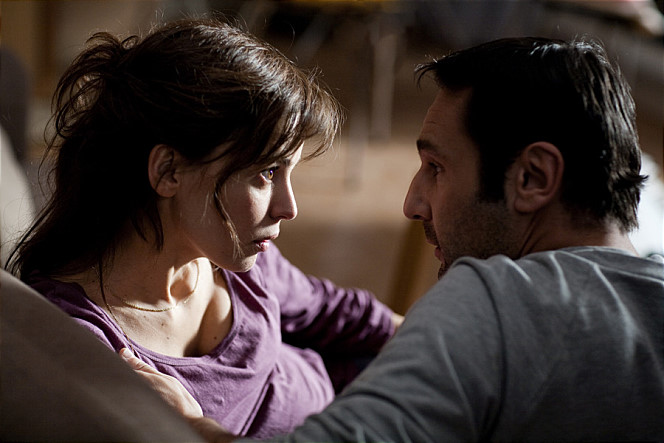
The ordinary hero in this case is Samuel Pierret(Gilles Lellouche), a young married nurse who has been leading a plain but happy life when all hell breaks loose upon him on one day. After incidentally saving an unidentified patient at the hospital, someone breaks into his apartment in the next morning, and Samuel faces a very difficult situation when he regains his consciousness after being hit on his head by that intruder. His dear pregnant wife Nadia(Elena Anaya) has been kidnapped, and the kidnapper soon demands him to get that mysterious patient out of the hospital in exchange of his wife.
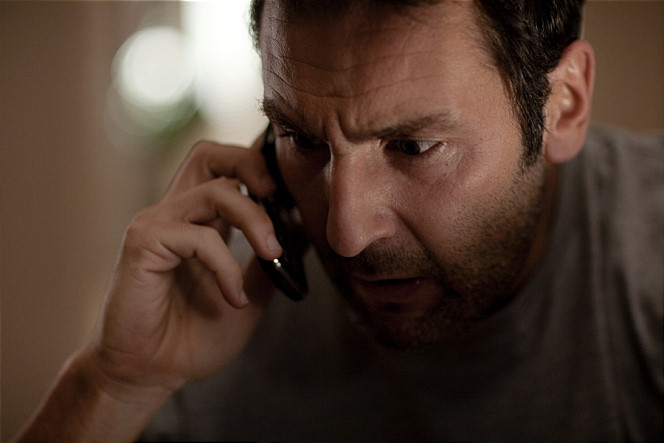
pointblank03 As shown to us during the opening chase sequence, that patient is a man chased by some guys, and we later learn that he is also a criminal pursued by the police. That makes the situation more difficult for Samuel, but he knows he must do anything to save his wife, and he finds himself committing things he has never imagined before. When he sees there is no alternative for him at one point, he makes a pretty bold move, and that is just the beginning of his risky plight.

Now I should be more careful about describing the movie to you because I do not want to spoil your entertainment. As the movie gets accelerated during its first act, we are introduced to several supporting characters whose main function in the story is chasing after Samuel and the patient, and each of them has a good motive behind their pursuit. Although he is still a patient barely recovering from his wound, Hugo Sartet(Roschdy Zem) is a tough criminal determined to survive by any means necessary, and we can sense a certain amount of tension growing between him and Samuel as they try to evade the pursuit. They cannot trust each other for good reasons, and both of them are ready to take any chance for getting more advantages.

As maintaining its quick pace, the director/co-screenplay writer Fred Cavayé keeps his movie rolling along the plot. There are a couple of obligatory scenes for explaining the ongoing circumstance to us, but the movie seldom loses its urgency. The action sequences in the film are briskly handled as the characters run or move a lot, but they never feel confusing because we are well aware of where the characters are and where they are heading to. There is a ferocious sequence which begins from one small place in some building and then is eventually expanded to a wider space outside the building, and the main pleasure of this sequence is how smoothly it is progressed from one point to the other point along with the characters in it.
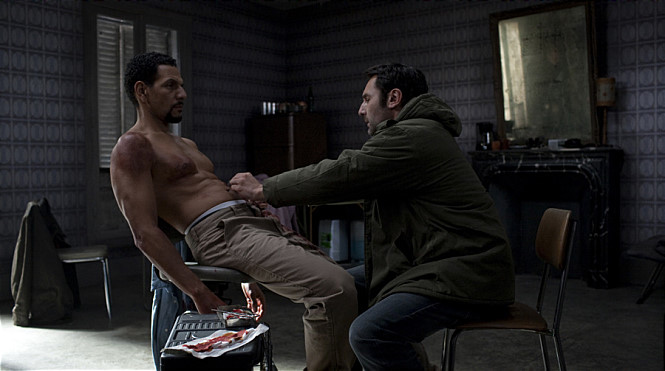
pointblank02The main job of the actors in the film is always looking believable in their scenes, and they did it well on the whole. Gilles Lellouche does not lose his everyman quality even when his character does a perilous action between two buildings(I dearly hope I will never be forced to do such a thing like that), and Roschdy Zem is also effective as a contrasting figure in the story. While initially antagonizing with each other, Samuel and Hugo eventually depend on each other for their mutual survival in the end, but the movie never overplays their reluctant partnership; they just happen to have no choice other than that, and that is all as far as we can see. As Samuel’s wife, Elena Anaya does a little more than merely playing a helpless captive(one of her scenes may not be easy to watch for pregnant audiences), and Gérard Lanvin, Mireille Perrier, and Claire Pérot are all convincing as substantial police characters.

When I watched the film in late 2011, I gave it 2.5 stars in spite of its commendable aspects because I thought it was just another plain action thriller film to be watched and discarded. That impression is not changed much even at this point, but I come to more like its economic handling of story and characters, and I also find that its well-made action sequences are still enjoyable to watch. It is not an excellent one to be sure, but it is a competent one made by the people who really knew what they were making.

By the way, I recently learned that the upcoming South Korean film “The Target”(2014) is a remake version of “Point Blank”(yes, that was the main reason why I watched it again). I only encountered its trailer, and I do not have lots of expectation for this remake version which is considerably longer than the original version, but I’d rather keep my mind opened before watching it.
pointblank04


Posted in Movies | Tagged , , , , , , | Leave a comment

Only God Forgives (2013) ☆1/2(1.5/4) : The stylish dud of this year

onlygodforgives01 As I became depressed during my viewing of “Only God Forgives”, my mind was transported to when I read one of those entertainingly scathing movie reviews included in my late friend/mentor Roger Ebert’s book “I Hated, Hated, Hated This Movie”. In his review on Roman Polanski’s “Diary of Forbidden Dreams”(1972), he wrote, “There’s probably a level of competence beneath which bad directors cannot fall. No matter how dreary their imaginations, how stupid their material, how inept their actors, how illiterate their scripts, they’ve got to come up with something that can at least be advertised as a motion picture, released and forgotten. But a talented director is another matter. If he’s made several good films, chances are that sooner or later someone will give him the money to make a supremely bad one.”

As I have heard lots of negative buzz around the film since its premiere at the Cannes Film Festival in last year, I knew I had to prepare myself for whatever I would get from “Only God Forgives”, but this is a truly bad film which, as Ebert said, can only happen in the career of a talented director like Nicholas Winding Refn. It has all the elements ready to be stylish and striking, and this is a visually good-looking film on the surface, but nothing in the film sticks in my mind after I watched it. Its ponderous story bored me infinitely as its flat, emotionless characters trudge along it as if they knew they are condemned to it, and its gaudy but lifeless mood is occasionally broken by a number of very brutal scenes which weirdly feel like mediocre truism rather than dramatic punctuations.
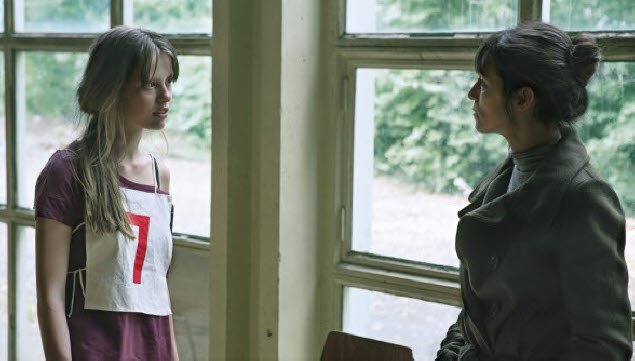
Ryan Gosling, who more successfully collaborated with Refn in the director’s previous film “Drvie”(2011), plays Julian, a young American drug dealer running a muay thai club in Bangkok as his front business. As a match is being held in the ring during the opening scene, he and his associates including his brother Billy(Tom Burke) work on their main business as usual, and we see how their operation is managed smoothly for them outside the ring while others paying attention to what is going inside the ring.

onlygodforgives03 Things could go on like that for everyone, but then something unexpected happens later. For whatever reasons he had in his mind, Billy rapes a young prostitute and then savagely kills her, and Chang(Vithaya Pansringarm), a corrupt but authoritative cop with the moral code of his own, immediately arrives at the murder scene where Billy is held by Chang’s men. When poor girl’s father is brought to the scene, Chang lets him do what should be done for his dead daughter, so Billy is killed by the girl’s father, who is also punished by Chang for pushing her daughter into prostitution.

Julian seems to be rather unaffected by his brother’s death, probably because he has already been troubled and confused enough behind his aloof face which signifies nothing except despairing emptiness. We see him wandering around dark corridors filled with ominous red light, and we also observe his relationship with Mai(Yayaying Rhatha Phongam), a prostitute girl who provides him a kinky form of pleasure when they are together in a private room; he ties himself to the chair, and then he just watches her as she begins her erotic movements right in front of him.

And then his mother Crystal(Kristin Scott Thomas with blond hair) comes to Bangkok, and she wants more than getting Billy’s body back to US. When Julian and Mai have a dinner with her at some fancy restaurant, Crystal blatantly insults her son from the start, and this bitter, manipulative woman surely knows how to push her son’s emotional buttons with apparently incestuous nuances. Although she utters lines as monotonously as her co-actors, Kristin Scott Thomas ably delivers a number of ludicrous lines handed to her, and the moment when her character makes a blatant comment on her boys’ certain body part may elicit some unintentional laugh from some of you for a good reason.

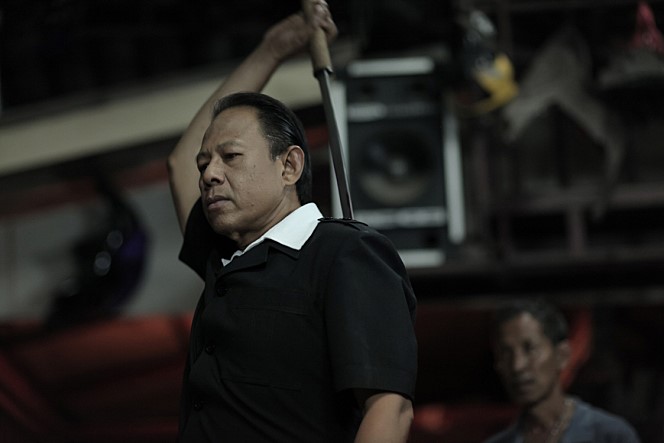
onlygodforgives02 As it was sort of announced through Julian’s hallucination/dream scene, things get worse when Crystal decides she has to do something for her revenge and Chang ruthlessly responds to that, and we accordingly get several nasty moments involved with various types of mayhem to make you cringe. While sometimes using his sharp sword swiftly, Chang knows other ways to punish or torture his targets, and there is a very brutal scene in which a man is ruthlessly pierced with several sticks and then is horribly maimed in a way reminiscent of that infamous shot from Luis Buñuel’s “Un Chien Andalou”(1929). As I watched Chang drawing out his sword in front of his terrified targets, I began to wonder about how he could keep that sharp object on his back all the time, but I guess that is not an important thing to know in the movie.

The director/screenplay writer Nicholas Winding Refn has made a number of gritty but engaging films, and I enjoyed some of them, but “Only God Forgives” is unfortunately devoid of the substance to induce my interest compared to “Drive” or “Bronson”(2008), which were as stylish as this film. Thanks to Refn’s cinematographer Larry Smith, each scene in the film is vivid and colorful as the seedy, lurid sights of the criminal underworld inside Bangkok, but they are more or less than a random series of slick images cobbled together by its abstract story stripped of any human interest, and the characters are as lively as mannequins in department store. They do talk at times, but they do not reveal anything besides what is apparent to us from the beginning, and we are left with nothing much around its predictable ending which does not look as fateful as it wants to be.

Although only four months of this year have passed, I can say that “Only God Forgives” will probably be the most stylish dud in my moviegoing experience of this year. At the end of the film, Refn dedicates his film to none other than Alejandro Jodorowsky, and I sort of understood his reason as considering the common elements shared between Jodorowsky’s great cult film “Santa Sangre”(1989) and Refn’s film. The difference is, while Jodorowsky’ film still can strike me on emotional levels with its many memorable images to be remembered, “Only God Forgives” just stinks with no lasting impression. Now I think I get the meaning of the title now, folks.

onlygodforgives05

Posted in Movies | Tagged , , | Leave a comment

The Amazing Spider-Man 2 (2014) ☆☆1/2(2.5/4) : The amazingly entangled Spider-Man

theamazingspierman203 Flying along its redundant pathway like its predecessor did two years ago, “The Amazing Spider-Man 2” frequently goes up and down in its uneven plot hampered by too many things stuffed into it. While I did care about some of them, I began to lose my interest whenever the other problematic things appeared, and I cannot erase my dissatisfaction in spite of its good parts. To be frank with you, if there had been some sort of MRI machine which can monitor the degree of my interest during the screening, it could have fluctuated as much as our Spidey does above the streets of Manhattan in the film.
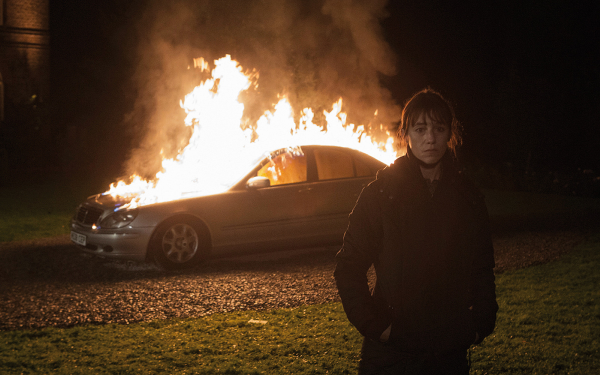
After saving New York from a big danger as depicted in the previous film, Peter Parker(Andrew Garfield) has been enjoying his role as the friendly superhero neighbour of New Yorkers. Whether it is a bunch of Russian gangs hijacking a truck containing plutonium or a nerdy boy needed to be rescued from bullying, he is always ready to use his superpower, and he feels good about that, but he also finds it difficult to manage his normal life while being active as Spider-Man. He is very late for his high school graduation ceremony at one point because he was busy with another usual superhero work, and it is also not so easy for him to hide his newly acquired identity from his dear aunt May(Sally Field) as living with her under the same roof.

At least, he does not have to hide anything from his girlfriend Gwen Stacy(Emma Stone), but things have been pretty complicated between them. Right before his death, her late father asked Peter to stay away from Gwen for protecting her, and that has bothered Peter a lot although both want to continue their relationship. Gwen eventually decides to break away from Peter for relieving his guilt, and she seriously begins to consider leaving New York for her study, but, as shown during one humorously awkward scene in which they meet each other as ‘friends’, they only come to find their mutual feeling remained same as before.

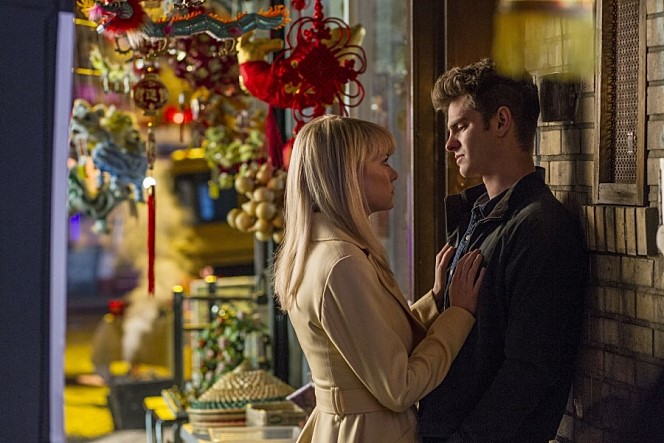
theamazingspierman201 The movie works best when it focuses on their relationship matter. The director Marc Webb, who previously directed wonderful romantic comedy film “(500) Days of Summer”(2009), brings some genuine feelings to their private scenes, and Garfield and Stone are engaging to watch thanks to their good chemistry between them. While many of us already have a pretty good idea about their eventual decisions in the end, they are a likable romantic couple we can care about, and there is a nice romantic scene on the Brooklyn Bridge in which Peter and Gwen fully admit how they feel about each other despite all these complications in their relationship.

Meanwhile, New York happens to face another big danger. After a very unfortunate laboratory accident, Max Dillon, a pathetic Oscorp Industries employee who is broadly played by Jamie Foxx with big glasses and distracting overbite, is transformed into a powerful electromagnetic entity who looks like Dr. Manhattan’s distant cousin. He is initially scared and confused about what has happened to his body, but, after experiencing how unkindly NYPD responds to a blue guy like him, it does not take much time for him to become a vengeful supervillain determined to get rid of the superhero he once worshipped. His main plan for that is taking control of New York through the network of electricity lines provided by his company, and I must say that is quite a modest one considering his superpower ability to go and appear anywhere as bundles of electromagnetic pulses to be transported. If he can seize the system so quickly like that, why not going for, say, the World Wide Web?

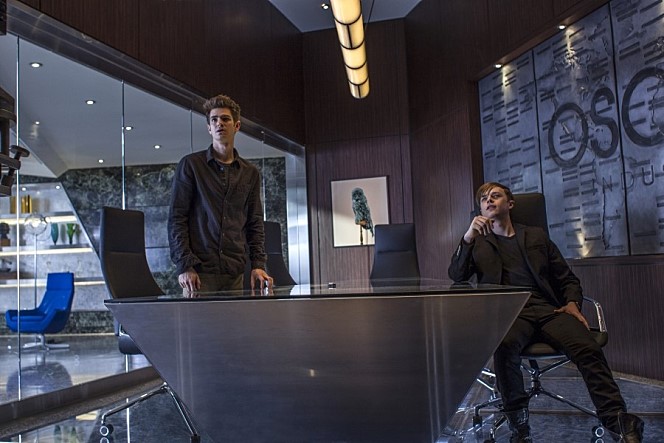
We are also introduced to another trouble associated with the Oscorp Industries. After its shady CEO Norman Osborn(Chris Cooper) died, his young son Harry Osborn(Dane DeHaan) immediately becomes the new CEO of the company, and he soon faces two problems threatening his new position; like his father did, he begins to suffer an inherent viral disease which will soon take away his life, and the board members led by Donald Menken(Colm Feore) are looking for any excuse to fire him.

After discovering what his estranged father has done for finding a way to cure the family disease, Harry realizes that Spider-Man may help him, and Peter finds himself in a difficult circumstance when his childhood friend pleads for a possible chance to cure his illness. He wants to help his friend, but he also knows that what Harry asks for can possibly be fatal, so he is reluctant about that even though he is aware of how desperate his friend is.

theamazingspierman202 There are many other things I have not described yet, including the mystery involved with a secret biological study of Peter’s father who disappeared along with his wife under a suspicious circumstance, the conspiracy inside the Oscorp Industries, and, above all, a mysterious bad guy who appears again at the end of the movie like he did before in the previous film. All could have been juggled well, but the screenplay feels messy, incoherent, and half-baked as busily going around its multiple storylines, and the expected climactic sequence is not as powerful as intended in spite of some surprise it throws to us in the end.

I appreciated the technical aspects of its big, spectacular CGI action scenes, and I was excited for a while as watching Spider-Man joyously going up and down among those Manhattan skyscrapers, but I was disappointed to see good actors like Jamie Foxx, Dane DeHaan, and Paul Giamatti being wasted in their stock villain roles. As many of you know, superhero movies are as good as their villains, and none of these bad guys in the film is not particularly interesting or memorable; that is one of the main reasons why its big climax seriously lacks dramatic flavor or tension despite being decorated with all the sound and the fury which can be expected from a big-budgeted blockbuster film.

When I watched “The Amazing Spider-Man”(2012), I enjoyed it while having reservation and concern over this rebooted franchise, and its sequel sadly confirms my concern at that time although it has several good aspects I liked as disappointed with it. After finding his own area to be explored in the previous film, Andrew Garfield comfortably wears his role with more ease and confidence, and he is convincing even when his character is entangled with the web of the weak story. I hope he will get a better story to hang on when his character goes out again for whatever comes next.

theamazingspierman205

Posted in Movies | Tagged , | 1 Comment

Campus animals (2014/04/22)

                     
Geese, cats, and one rabbit.
Posted in Photos | Tagged , , , | 1 Comment

Nymphomaniac: Vol. II (2013) ☆☆1/2(2.5/4) : ….and her therapy will end.

nymphomaniac201 Now we arrive at “Nymphomaniac: Vol. II”, the second part of Lars von Trier’s another challenging work to talk and discuss about. As its exhausted heroine warned us previously, this is a darker territory compared to its first part which was relatively playful at times despite its uncomfortable subject. While the conversation between her and a man intrigued by her wild, tormented sex life is continued as before, we finally see how she went through downward spiral and then eventually hit the bottom, and that is certainly not a very cheerful sight to observe – and we are less amused here as a consequence.

As described in “Nymphomaniac Vol. I”, young Joe(Stacy Martin) had sex with many men as boldly pursuing the orgasm she experienced for the first time when she was just a little girl. At the beginning of “Nymphomaniac Vol. II”, older Joe(Charlotte Gainsbourg) describes that precious moment of carnal ecstasy during one sunny afternoon, and Seligman(Stellan Skarsgård), who has attentively and actively listened to her life story throughout the previous film, promptly interprets her experience as a fascinatingly unholy version of religious experience. In contrast to Jesus surrounded by two holy spirits, she was surrounded by Valeria Messalina and the Whore of Babylon, two notorious evil women of lust. Does it mean that she was preordained to her own twisted martyrdom?

At the end of “Nymphomaniac Vol. I”, Joe reunited with Jerôme(Shia LaBeouf) and then reached to the peak of her sex life as having another sex with him. She was happy at first, but that was the beginning of her downturn. She soon finds that she no longer feels pleasure from sex because her private part suddenly begins to feel numb. She tries a very naughty prank with several spoons when she and Jerôme are having a meal at a restaurant(Udo Kier briefly appears as a waiter during that scene), but that is still not enough for her, and she naturally becomes frustrated.

nymphomaniac604-tt-width-604-height-410 With Jerôme’s encouragement, Joe tries to find a way to regain her pleasure while maintaining her housewife live with her young son(now she is played by Gainsbourg from this point). At one point, she spots a guy among a group of African immigrant workers on the street, and then she finds herself being between him and the other African guy who comes along with him to a hotel room where she was waiting for him. In the previous film, we were served with the montage of various photos of male genitalia, and now we are served with a rather amusing shot of Gainsbourg surrounded by two black erected penises here in this film, which look like arguing with each other as much as their owners who suddenly begin to argue with each other when they and Joe are trying to have a sex. Whatever you think of this explicit sequence, it is surely something we do not see everyday.

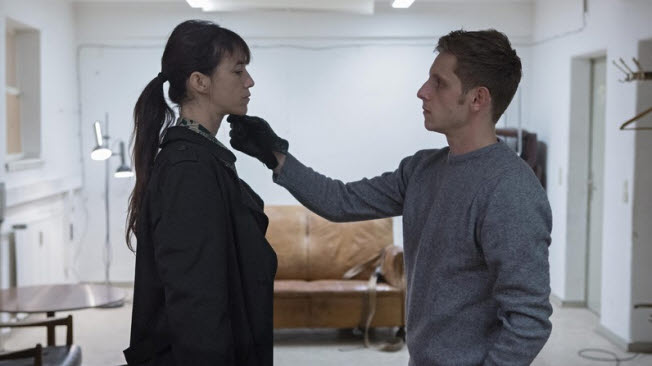
And then she is introduced to a perverted sex therapy service run by a courteous guy who is also quite brutal whenever he begins his sadomasochistic job on his female client, and she finds herself getting addicted to this as going through several experiences both humiliating and painful. Like many cases of addicts, she always gets what she wants in the end, and pain and humiliation mean almost nothing to her whenever she feels satisfied. With Gainsbourg ready to endure any inconvenience to be inflicted upon her, Jamie Bell gives a chillingly compelling performance as her sadistic service guy, and their disturbing scenes are effectively presented in the stark background while Seligman observes how Joe’s ordeals can be compared to the sufferings of the Christ.

As she is going for more and more, her life is accordingly disrupted and destroyed. Jerôme, still played by LaBeouf even at this point, finally leaves her, and she loses her son as a result, and then she is ordered to attend sex addict meeting. When she is advised to get rid of anything to remind her of sex, she instantly sets herself on that task, but her attempt only shows how her life is barren and lonely when devoid of anything sexual.

nymphomaniac202 That point resonates with an earlier scene in which Seligman confesses to her that he is an asexual virgin. Like Joe has been filling her life with orgasmic sensation, he has been stuffing his life with books, and that is probably the reason why he remains to be calm and detached while listening to her story packed with many lurid details. He looks intrigued as pensively analyzing her history of sexual activities as her amateur analyst, and he is also horrified by Joe’s downward spiral, but does he really understand her at all?

After finally concluding that she can accept her nymphomania as a part of who she is, Joe walks out of her sex addict meeting and then delves into crime. She begins to work as debt collector for a loan shark played by Willem Dafoe, and it turns out that her sexual experience is useful for her new occupation; in case of one ‘client’ played by Jean-Marc Barr, Joe smartly exposes his deep secret like a wily interrogator, and, after finishing her business to do, she give some, uh, reward to this humiliated guy she comes to pity despite his disgusting sexuality.

Meanwhile, after being advised to have a protégé by her boss, Joe approaches to a young girl(Mia Goth) as recommended, and they soon get closer to each other than expected. Because of the hard life experiences during her childhood, this young girl does not mind being recruited and then exploited, and Joe begins to care about her as teaching her through their field work.

nymphomaniac204 We eventually witness how their relationship leads Joe to a violent fateful confrontation involved with them and the other certain character, and then we are slapped with the ending which feels like a mean, vicious slap on our face while nearly undermining what has been said right before that. Like foreplay is usually more fun than main play, “Nymphomaniac Vol. II” is less interesting than its predecessor as going down into more despair and more babbles, and its 2 hours frequently feel tedious, but I found myself admiring von Trier’s wild, audacious attempt as well as a number of striking scenes supported by brave performances.

There is a bleakly beautiful scene showing Joe and a crooked tree alone in the gray landscape, and I think that tells a lot about what von Trier tries to express through his uneven but compelling story. Some of us are drawn to the dark pit of empty loneliness as driven and tormented by their destructive impulses, and we may not help them at all from the start, but, as fellow human beings, maybe we can understand them at least while learning more about what makes us tick in such miserable ways sometimes.

I give 2.5 stars to “Nymphomaniac Vol. II” because the movie is less satisfying than the first one, but, in my small opinion, these two movies are recommendable if you are really ready for something challenging. When I had a little talk with my fellow critic Michael Mirasol several days ago, he said he felt sorry for Lars von Trier’s tortured artistic soul while appreciating the unflinching attitude of his films. As still scratching my head a bit after experiencing his another dark work, I agree with him more now.

Nymphomaniac

Posted in Movies | Tagged , , , | 1 Comment

Nymphomaniac: Vol. I (2013) ☆☆☆(3/4) : Her therapy begins…

nymphomaniac102 Ready to disturb, intrigue, provoke, and impress us with its penetrating presentation of a dark side of human nature, the first part of Lars von Trier’s controversial work “Nymphomaniac” is surprisingly cheerful and amusing at times while working as a moody, nihilistic contemplation on its despairing subject. It announces in advance that we should brace ourselves for what it is going to show and tell, but it also playfully tantalizes us with its morbid sense of humor, and we are literally hooked by what is being dangled in front of us like a fly fishing bait.

The story starts with a beaten woman left unconscious on a gloomy alley during one night. Fortunately, a man named Seligman(Stellan Skarsgård) discovers her when he is returning to his home, and he kindly takes her to the house after she regains her consciousness. When she feels a little better as resting on the bed, Joe(Charlotte Gainsbourg) reveals that she is a nymphomaniac, and that is the beginning of their long night’s journey into day; she confides to Seligman about how ‘bad’ she has been in her whole life, and he is ready to listen to whatever she wants to tell him.

The movie moves chapter by chapter as showing how Joe was destined to her self-destructive lifestyle from the beginning. Even when she was very young, Joe already discovered what she could do with her private part. When she reaches adolescence, young Joe(Stacy Martin) and her best friend(Sophie Kennedy Clark) actively begin their sexual adventure not long after Joe loses her virginity through a young mechanic named Jerôme(Shia LaBeouf), who later becomes one of the main characters in Joe’s story through a couple of unbelievable coincidences.

nymphomaniacvolume1photo4
 As her life story being told and shown to us, the movie frequently stops and moves back to Joe and Seligman in their ponderous but weirdly interesting conversation on how her story can be interpreted. Sometimes wondering whether her story is really true or not because of its rather implausible aspects, Seligman, a well-read man filled with lots of knowledge he has absorbed from books, makes some comments on fly fishing, geometry, Fibonacci numbers, Edgar Allen Poe, and many other things during his phlegmatic musing on Joe’s life story, but Joe does not seem to be impressed or enlightened by that while maintaining her tired detachment as before.

Their interactions feel a little too monotonous, but the movie becomes as playful as Roman Polanski’s “Bitter Moon”(1992) while having a sly fun with Joe’s continuing story which seems to be gradually influenced by the ongoing feedback between Joe and Seligman. Joe’s first intercourse is remembered with the numbers of pumping motion made during Jerôme’s two penetration acts, and we are reminded that they are Fibonacci numbers. The scene in which Joe parks Jerôme’s car is literally presented with a geometric style as the camera looks down upon the car, and Joe and her best friend’s rebellious sex circle joined by other girls is musically interpreted as a sort of Satanic cabal just because they used tritone in their ritual music.

One of the most amusing moments in the movie comes from the one-upmanship game between Joe and her best friend on train. They lure their targets with a simple question about lavatory at first, but they soon go up to the higher levels because it is more fun to them. At one level, they throw a number of questions beginning with “wh” to their targets; at the other level, they disguise themselves as someone to be consoled, which turns out to be a more tempting bait for their catches. To her delight, Joe finds that guys are ready to ‘console’ her in lavatory – even when she just says that she is sad because her dear ‘dwarf hamster’ died.

nymphomaniac-vol-1-top-10 Of course, the sex scenes in the movie are quite explicit, but they feel neither erotic nor stimulating even though there are many shots featuring male and female genitalia in full disclosure. Like Joe and Seligman, the movie observes its sex scenes from the distance in its clinical view, and its unflinching attitude toward its subject is maintained well as it goes wildly around black comedy and serious drama. The scene featuring Uma Thruman as an angry wife who storms into Joe’s apartment is simply hilarious while Thuman’s character is making the situation more absurd with more people in the space, and the forest scene between young Joe and Joe’s father(Christian Slater, who finally appears in a good film after many years of his inexplicable career downturn) feels warm and sensitive in contrast. Lars von Trier may be too cruel to his characters at times in many of his works, but he has some decency at least to present the part involved with Joe and her dying father in black-and-white film, and I must confess that I was relieved a lot during one particular moment involved with a soiled hospital bed.

Charlotte Gainsbourg and Stellan Skarsgård are well-known as von Trier’s usual collaborators, but they take a backseat in their curiously colorless performances. I guess that was an intentional acting choice; Joe is numb and empty at that point as a world-weary woman who has seen it all, and Seligman is just mildly interested in her story as trying to understand and persuade her that she is not a bad woman as she thinks, and that is all they will express through their faces as they talk and talk through their long night.

nymphomaniac104 In contrast, Stacy Martin, a young Franco-English actress who made a debut with this film, has a lot more things to do in the movie, and she is very convincing while bravely hurling herself into many moments which would be quite challenging to any talented actress. She and her co-actors are ready to do anything for their director, and they bring absolute conviction to the film even when it feels silly and outrageous. Regardless of what you think about his recent odd behaviors, Shia LaBeouf gives a good performance in his scenes with Martin, and Uma Thurman virtually steals the show even though she appears only in one scene.

As self-consciously pointed out through its artificial narrative structure, “Nymphomaniac Vol. I” is more or less than a bait, or a foreplay, for what will be presented to us later, but it is a compellingly intellectual examination of sexuality and destructive impulse associated with it. I really have no idea about what’s inside Lars von Trier’s mind, but, as proved again in this challenging piece of work, he is a master provocateur who never bores us while shocking and provoking us with bold attempts to be appreciated.

nymphomaniac105


Posted in Movies | Tagged , , | Leave a comment

Han Gong-ju (2013) ☆☆☆1/2(3.5/4): “I didn’t do anything wrong.”

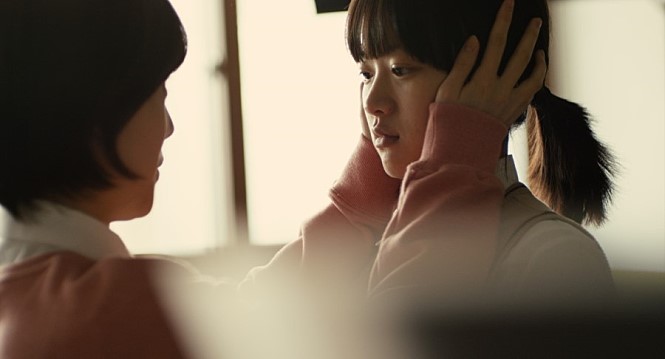
Hangonju02 She is the one who should be helped and protected, but she is left in pain and confusion instead, and she does not even know how to deal with her gloomy situation while not wholly understanding it in her helpless position. Through its close, intimate observation of its ill-fated heroine, South Korean film “Han Gong-ju” slowly lets us get to know about what is behind her detached face, and it is really devastating to watch at times as we are watching her silent suffering. While there are some glimmers of hope around the story, this is ultimately a sad, harrowing drama about a girl trying to cope alone with what happened to her, and it shakes us hard with her deep emotional pain as we sympathize with her.

For some vague reason not explained enough in the beginning, Han Gong-ju(Cheon Woo-hee) is transferred to the other high school through the help from a teacher of her former high school. She has parents, but neither of them can take care of her at present, so the teacher takes Gong-ju to his mother’s house. Ms. Lee(Lee Yeong-lan) is not so pleased about letting a stranger into her house, but she agrees to provide a shelter for Gong-ju, who stays in an old room which once belonged to the teacher.

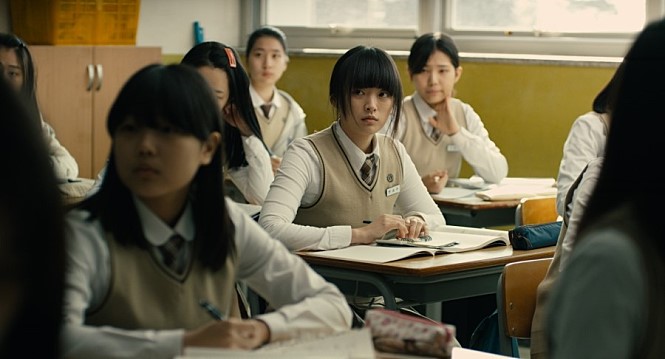
She goes to her new school, and she soon gets a friend even though she is not much interested in socializing with others. Eun-hee(Jeong In-seon), one of her new classmates, openly offers her friendship to Gong-ju, and they get a little closer to each other even though Gong-ju does not tell much about herself to Eun-hee and other classmates. When they happen to find on one day that Gong-ju has a natural talent in music, they manage to make her join their music activity, but Gong-ju still maintains her guarded attitude, which certainly confounds and frustrates Eun-hee and others every time.

Hangonju04 As the series of the flashback scenes are unfolded one by one along the main plot, we gradually learn what happened to Gong-ju before being transferred to her new school. I will not describe her secret in details for not spoiling your experience, but I can say that the director/writer Lee Su-jin did an admirable job of avoiding sensationalism which is usually associated with the subject of his story. There are a couple of scenes which may be emotionally grueling to watch for some of you, but they are handled with commendable restraint and tactfulness, and we can clearly sense what is going on even though we do not see a lot on the screen during these gut-wrenching moments.

While we know more about Gong-ju, we naturally feel pity to her, but Lee Su-jin’s screenplay presents her not as a mere object to be pitied but as a vivid character we come to deeply care about. As revealed through the flashbacks scenes, she was a lively teenager girl with hope and dream, but her bright spirit was cruelly trampled by an unspeakable act during that fateful night, and she has been feeling hurt, confused, and embarrassed about it. She has no one to talk with about it, and she does not want to even think about it.

Getting a little accustomed to her new environment day by day, Gong-ju tries to move forward at least. She begins to learn swimming probably because it makes her feel a little better. There is still a considerable gap between her and Eun-hee, but Gong-ju becomes a little more opened to Eun-hee and other classmates as getting along with them. Ms. Lee initially looks like an ungenerous middle-aged lady when Gong-ju spends her first day at Ms. Lee’s house, but she turns out to have a good heart inside her jaded appearance. While not asking anything about Gong-ju’s situation, Ms. Lee begins to care about her, and there is a small brief moment in the bathroom which reveals how much they have gotten close to each other although they do not directly show it.

Hangonju01 However, as some of you have already feared, things get pretty bad for Gong-ju later in the story, and we cannot help but feel angry about the ordeal she does not deserve at all from the very beginning. The cops handling the case were incompetent and inconsiderate while ignoring how much devastated she was at that time, and her father or her mother was no great help to her either when she was desperately in the need of help and support – and they later break her heart again while disregarding her pain.

And there are a truly despicable bunch of people whom you should see for yourself. Although they only appear in the opening scene and the other important scene later in the film, they surely make a striking impression on us through their blatant ignorance of what happened to Gong-ju, and we witness how heartless ordinary people can be in the name of family. I guess they may have their own pain resulted by that incident, but they let themselves be oblivious to the far bigger pain of a girl who needs to be consoled and supported after enduring a horrible experience, and that makes them as monstrous as the perpetrators. The movie is loosely inspired by a real-life incident which shocked the South Korean society and ignited following discussions several years ago, and it is chilling to think that some of the perpetrators managed to get away with their crime and have lived freely while the victim is still suffering from the injustice even at this point.

Lee Su-jin, who made a directorial debut with this film, handles his story with care and confidence while steadily maintaining his low-key approach to story and characters. Although it is a little confusing to us at first, we never get lost in its emotional narrative thanks to his skillful handling of images and sounds, and he also draws good performances from his cast. Cheon Woo-hee, a young South Korean actress who previously appeared in “Sunny”(2011) and “Elegant Lies”(2013), deserves praises for her beautifully nuanced performance which is crucial in making Gong-ju into a three-dimensional character at the center of the story; even when she is silent, she effortlessly conveys us the thoughts and emotions churning inside her character, and her performance is always believable and engaging while never reaching for our attention.

Cheon is supported well by her co-performers. While Jeong In-seon is amiable as a kind girl trying to accept a friend she cannot understand well, Kim So-yeong plays Gong-ju’s close friend in the flashback scenes, and Lee Young-lan is colorful as a woman who is kinder to Gong-ju than most of other adults in the movie despite her flaws and limits. The movie is not entirely without humor, and there is an awkward scene where her son and Gong-ju have a dinner with Ms. Lee and her boyfriend at a Chinese restaurant; while her son feels rather embarrassed about it, she does not feel any shame about pursuing her desire, and this active lady surely knows how to handle her man.

Hangonju03 Since it was shown at the Busan International Film Festival in last year, the movie has been continuously praised and admired by many people who watched it. It has recently garnered top prizes at several international film festivals, and it also received good reactions from such prominent figures as Martin Scorsese(“I have a lot to learn from this movie and I can’t wait to see Lee Su-jin’s next film”) and Marion Cortillard(“So much detail and the actress was amazing.”).

Thanks to the increased public interest by word of mouth, the movie luckily gets a wider theatrical release than expected in South Korea, so I and other audiences got an opportunity to watch it at the local movie theater on its release date. As horrified by what she went through, I felt lots of sympathy and concern toward Gong-ju even when she was withdrawn into her tormented mind, and I noticed that a woman sitting next to me was crying as the movie approaching to its inevitable point.

“Han Gong-ju” is a small but powerful work which is also one of the best South Korean films of this year. The movie induces us to have immense empathy toward its heroine through its sensitive and thoughtful portrayal of her emotional scars she wants to hide, and its haunting finale makes us think about how unfairly she is treated by the harsh society which stigmatizes her rather than protecting her. Her confused reply to a minor supporting character during one scene is still lingering on my mind: “I didn’t do anything wrong.”

Sidenote: As my acquaintance Pierce Conran pointed out in his review, the full name of the heroine means “one princess” when it is phonetically translated in Korean. What a sadly ironic title it is.

Hangonju05

Posted in Movies | Tagged , , , | 3 Comments

Grand Piano (2013) ☆☆☆(3/4) : A deadly comeback concert

small_grandpiano03 While many thriller movies try to play audiences like piano, “Grand Piano” tries to play not only its audiences but also a real piano at the center of its plot. Its premise is preposterous to say the least, but this is a tense thriller with style and gusto flourishing within its limited space, and I enjoyed it for that in spite of its relatively unsatisfying ending. Once it begins its performance, it grabs us with mounting suspense to tighten our heartstrings, and we willingly go along with it as long as it plays us well.

The piano in question belongs to a respected composer who was the mentor of Tom Selznick(Elijah Wood), a wunderkind pianist who has never played in public since he suffered a bout of mental breakdown on the stage. At that time, Selznick was playing his teacher’s infamous concerto “La Cinquette”, which was nicknamed “the unplayable piece” because it requires tremendous techniques to its player like, say, Rachmaninoff’s piano concerto No. 3. It is said that only very few talented pianists in the world can play it perfectly without missing a note, and Selznick was one of them until that unfortunate incident happened five years ago.

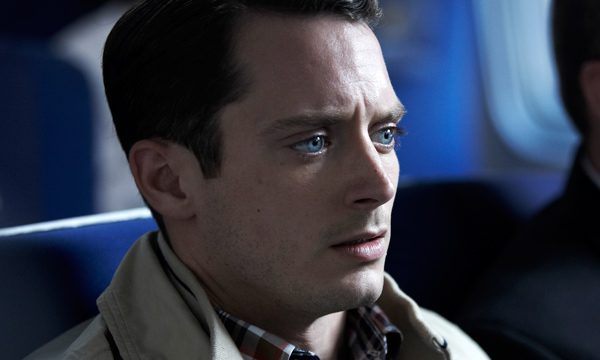
Now, with the caring help of his actress wife Emma(Kerry Bishé), he is about to make a comeback at the concert hall in Chicago, but the circumstance is not that ideal, and he is already nervous about the possibility of another public disgrace even before his plane lands at the airport. As soon as he gets off the plane, he has to go to the concert hall immediately while changing his clothes in the limousine, and he also has to endure a brief radio interview which painfully reminds him of his last concert performance. His mentor died a year ago, but his presence is felt around the concert hall through his big photo in the poster -and his beloved grand piano sent from Switzerland to be played for this special occasion.

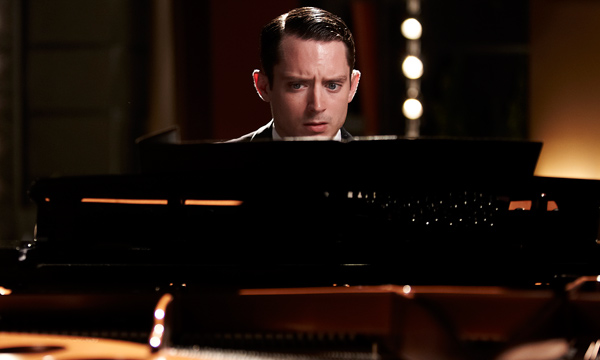
grandpiano04 Still feeling pressured despite the support from the people around him, Selznick manages to climb onto the stage without having stage fright, and everything seems to be going well as he plays the first piece for the concert, but he suddenly finds himself in a serious trouble. In the middle of the performance, he comes across an ominous message written in bright red on his sheet music: “Play one wrong note and you die.”

As I think more about it, this is not a very practical warning to a pianist who is very, very nervous from the beginning, but Selznick manages to hold himself while not drawing any particular attention from his audiences as demanded, and he gradually realizes how dangerous this threat is as talking with some mysterious guy through an earpiece given to him. Hiding somewhere inside the building, this guy is ready to shoot Selznick with his rifle if Selznick does not follow his demand, and Selznick is driven into more panic because his dear wife can also be killed if he is not careful about his demeanor as well as his performance.

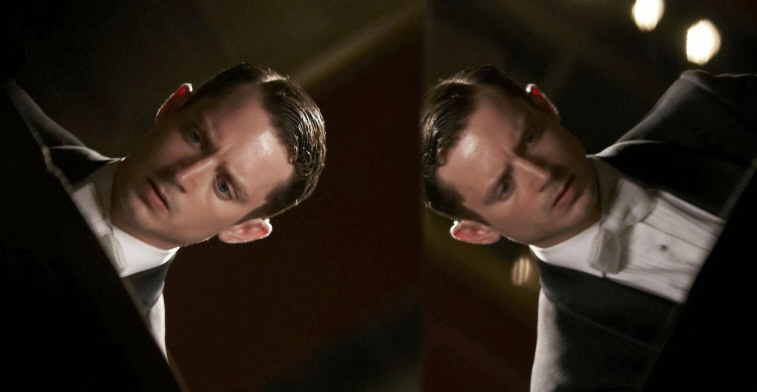
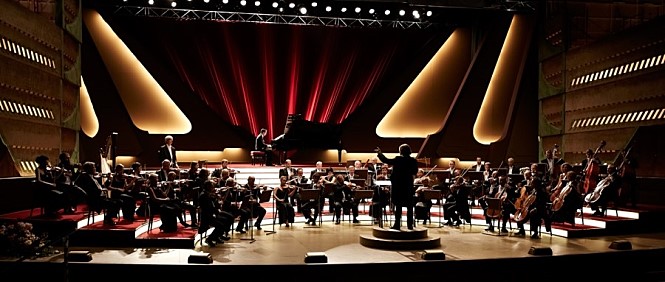
The movie stays inside the concert hall building during most of its short running time, and the director Eugenio Mira keeps the tension being accumulated while bringing some nice stylish touches to his film. With the orchestra vigorously performing on the stage, the camera sometimes makes sweeping movement as looking around the fabulous interiors of the concert hall, and the music on the soundtrack is as well-played as you can expect from a first-rate symphony concert. There is also a smooth split screen sequence reminiscent of Brian De Palma’s thriller films, and I like the way Mira effortlessly initiates this sequence without distracting our attention.

small_grandpiano05 Such a thriller movie like this always need a good performance we can hold onto, and Elijah Wood does a solid job as required as the hero struggling to survive a deadly circumstance forced upon him. Looking believable during the performance scenes thanks to his rigorous preparation before the shooting, Wood is terrific to watch as his character continues to sweat and tremble more and more under increasing mental pressure. While the other actors around Wood are mostly stuck with thankless roles, John Cusack has a small fun with his villain character; taunting and goading Wood’s character like a cat playing with a mouse, Cusack imbues vicious menace into his voice performance, and that is another crucial element for the suspense in the film.

As I said earlier, the movie is not entirely without flaws. As approaching to its third act, the movie begins to lose its tension after a hidden motive is eventually revealed, and it also goes a little too long after the climactic moment in which Selznick has no choice but to play “La Cinquette”. Its last scene is a letdown compared to the other parts, and you may notice several implausible things in Damien Chazelle’ screenplay as you look back on it.

Anyway, the movie is a solid thriller good enough to compensate for its visible weaknesses which could be far more glaring if it were not for the filmmakers’ skill and passion put behind the film. The dynamic interactions between Wood and Cusack are tightly handled on the screen to captivate our attention from the beginning to the end, and the composer Victor Reyes provides a concerto piece which is played as dramatically and thrillingly as the Storm Cloud Cantata in Alfred Hitchcock’s “The Man Who Knew Too Much”(1934) and its 1956 remake version(and it really sounds like a very difficult piece which would overwhelm any talented pianist). The movie is not a perfect performance, but it is an entertaining one which deserves some applause in the end.

grandpiano07

Posted in Movies | Tagged , , | Leave a comment

A Touch of Sin (2013) ☆☆☆(3/4) : Anger and despair below rapid social change

atouchofsin01 Through its sad, bleak stories, Jia Zhangke’s “A Touch of Sin” shows anger and despair below a rapid social change China has been going through. While their society is certainly changing, the main characters in the movie hardly receive any benefit from that progress, and they are at the bottom of the harsh world where survival of the wealthiest is mercilessly applied on most people. Some of them inevitably explode with their anger in the end, but nothing is changed for them or others, and the wheels of their society keep turning on as before.

After the opening scene coupled with an unexpected violent moment, the movie begins its first story with Dahai(Jiang Wu), a rural coal miner with no bright future. The coal mine in his town is recently sold to a wealthy business man who was once his schoolmate, but it seems the head of the town and his few associates are only the ones receiving the benefit from that big deal, and Dahai has been pretty pissed about it.

That business man visits to the town on one day, and we get a dryly amusing sight of the town people welcoming him at the airport as if he were a high-ranking government official. Dahai tries to protest to him as soon as his old schoolmate gets off his private jet, but he is only reminded of how helpless he is in front of a man with money and influence. He is savagely beaten by several goons right on the spot, and he is paid for his injury later on the condition that he will keep his mouth shut.

After getting out of the hospital, Dahai visits her sister’s home, and then something clicks in his mind. As calmy observing how his impulsive decision is ultimately led to a very dark outcome, the movie strikes us with the series of shocking violence reminiscent of Takeshi Kitano’s films. This violent sequence is surely cringe-inducing, but it has a certain sense of futility further enhanced by its detached but meditative mood.

atouchofsin03 The second story is about another compelling case of violence. San Zhou(Wang Baoqiang) is a migrant worker who has been drifting around the country since he left his hometown and family, and we see him returning to his hometown for his aging mother’s birthday party. While welcomed by his other brothers, he also meets his wife and young son, but he does not know how to reconnect with them. It has been long years since their separation, and all he can do for them is giving them the money he earned.

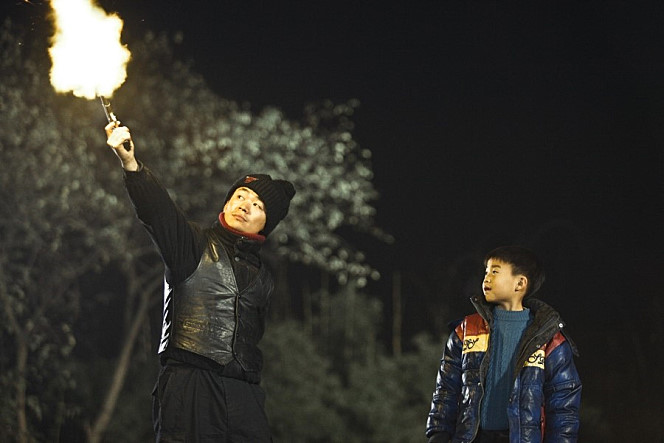
He later gets a chance to spend some time with his young son during the evening full of firecracker noises around them. He casually shows his kid a gun he acquired from somewhere, and then he shoots toward the sky just for entertaining him. We already know this is not the first time he uses it, and what he eventually commits with this gun is presented in a tense, gut-chilling sequence at the end of his story.

After that, the movie changes its course and then places its focus on the hard life of Xiao Yu(Jia Zhanke’s wife Zhao Tao), a young woman who works as a receptionist at some massage/sauna shop in an urban area and is not very happy with her job and life. Her private relationship with a married guy has been a small consolation to her, but we can see that this guy will never leave his wife no matter how sincerely he talks to Xiao Yu.

Unfortunately, things get pretty bad for Xiao Yu. The relationship with her lover is shattered when his wife learns about that, and this furious woman cruelly punishes her with two guys who come along with her. While she is trying to recover from this hurtful moment, she comes across a couple of very rude customers, and that results in a brutal moment of violence bitterly followed by its irreversible aftermath.

atouchofsin04 The fourth story follows another young worker who is also not very fortunate. After an unlucky accident happened to his co-worker, Xiao Hui(Luo Lanshan) runs from his factory because his boss demands him to fill the injured guy’s place with no payment for him. He moves to the south region, and he quickly finds a new job at the place where wealthy middle-aged guys are entertained by young female employees every evening. During one scene, girls are marching in uniform in front of their clients, and they all are ready to be called after their show(each one is numbered on their uniform).

While getting comfortable with his new job, Xiao Hui begins to like one of these girls, but his innocent love is soon crushed when he realizes how jaded this nice girl actually is. To her or any other female employees, prostitution is an daily work they willingly put themselves into for earning money, and the scene involved with her latest client is handled with cold objectivity even though it looks a little funny due to their silly roleplaying(She plays a train attendant, and he plays the chairman to be, uh, served by her).

These four stories, which are partially inspired by recent real-life incidents in China, are barely connected with each other, but the director/writer Jia Zhangke, who received Best Screenplay Award at the Cannes Film Festival in last year, lets us realize the common themes shared between them and muse on what they reflect. In any human society, injustice and inequality always generate anger and resentment inside their victims, and, as shown in the film, these desperate people are sometimes driven or pushed toward violence. They are left with far more misery and far less hope as a consequence, and we feel sad to see that there are not any other options in their despairing circumstance.

atouchofsin02 The movie demands you some patience for its slow pace, and some of its parts do not work well(its symbolic scene with a abused horse feels too obvious, for instance), but, like Jia’s previous films “Still Life”(2006) and “24 City”(2008), the movie is interesting to watch as a contemplative observation on the modern Chinese society which has been stuck in its contradictory state between communism and capitalism since its first step toward modernization and globalization. I am not as enthusiastic as other critics praising it, but I did not lose interest during my viewing, and I think it is a recommendable experience to talk and discuss about.

By the way, the title of the movie was inspired by Taiwanese martial arts film “A Touch of Zen”(1971). After his movie was shown at the Cannes Film Festival, Jia Zhangke was asked about what kind of sin the title of his movie refers to, and he replied, “It’s about how we tolerate injustice, the gap between the rich and the poor. More than anything I think silence is a sin.” As far as I can see from his films, he is certainly not silent about what he saw from his society as a voice of conscience, and I admire him for that.

Sidenote:
In spite of its critical attitude, the movie was not banned by the Chinese government – and it was actually co-produced by a production company backed the government. I guess that is a small sign of change, though the movie has not yet gotten a full approval for domestic release.

atouchofsin05


Posted in Movies | Tagged | Leave a comment

The Lunchbox (2013) ☆☆☆(3/4) : An accidental romance through lunch delivery

thelunchbox02 While it is a pretty familiar story we have encountered before, “The Lunchbox” is mixed with enough spices to give it a distinctive flavor to appreciate. Vividly bringing us into its local background, it comes to us as a heartfelt tale about two people who happen to be connected with each other in an unexpected way, and it is touching to see how their respective lives are changed through their mutual relationship which may not last long.

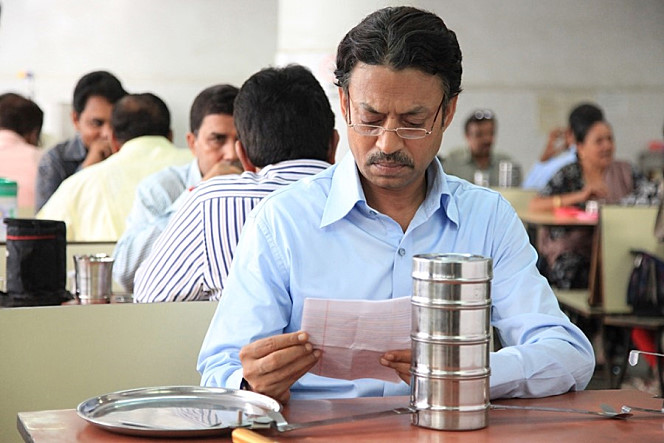
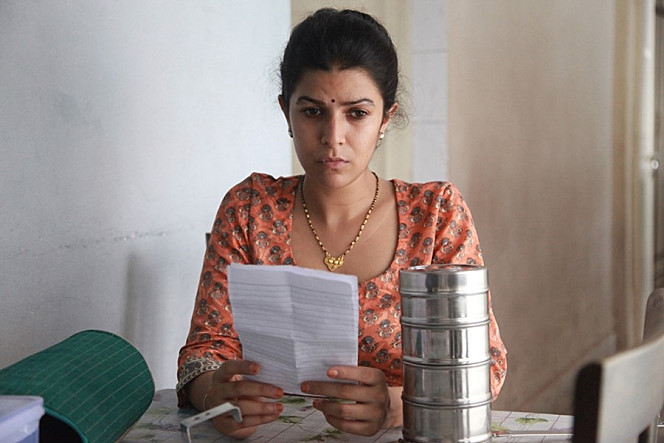
The opening scene shows a young housewife named Ila(Nimrat Kaur) going through her mundane morning routine. Her husband has already left for work, and her young daughter is soon going to leave for school, and now she has to prepare the lunch for her husband. We see each component of the lunch being prepared and then put into a stainless steel lunchbox, which is then put into a green lunch bag ready to be collected by a delivery man.

While reading several articles on the movie, I came to learn that lots of lunchboxes are delivered like that in Mumbai, and it was interesting for me to get some direct glimpses on how this delivery system works. A delivery man, “dabbawala”, collects a bunch of lunch bags along with the one from Ila’s house in her neighbourhood, and then he joins other dabbawalas at the train station, who also carry many lunch bags to be delivered. After they are sent to the downtown area by train, these lunch bags immediately go through another transaction process, and they all are delivered to their respective recipients around the lunchtime.

Considering the average number of lunchboxes transacted everyday in Mumbai is more than 100,000, it is not surprising that Ila’s lunchbox is delivered to a wrong person by mistake. Saajan Fernandes(Irrfan Khan), a middle-aged man who is about to retire from his company where he has worked for 35 years. He is confounded to see that the lunch he receives is quite different from the ones he ordered from his usual restaurant, but, after having tasting a little of it, he quickly eats it all with satisfaction.

thelunchbox01When the lunchbox is returned to her home, Ila is happy to see its empty state, but she soon realizes there was a mistake. Her husband Rajeev(Nakul Vaid), who received Saajan’s lunchbox instead, does not talk much about it when he comes home in the evening, and Ila quickly infers from his brief remark that the lunchbox was sent to a wrong person. When she prepares another lunch, she puts a note for appreciation in the lunchbox, and that is the beginning of her relationship with Saajan. It is just a small exchange of notes at first, but then they begin to write long letters to each other, and they become closer to each other as the lunchbox goes back and forth between them everyday.

This is surely a common romantic promise we have seen from other films(“Charing Cross Road 84”(1987) came into my mind as I was watching the movie), the director/writer Ritesh Batra makes his story work even though his two main characters are mostly separated from each other in the movie. While the interactions between them are confined within the written words read by the actors, we get to know more about them as they respectively go through their daily lives, and we come to slowly sense how their lives are affected by their relationship. Frustrated with her estranged relationship with her husband, Illa is grateful to know that someone is appreciating her cooking efforts, and Saajan becomes more aware of how lonely and barren his life has been since his dear wife’s death. He has lived alone in his house for years, and he felt no problem with that, but now he feels something missing in his house as interacting with a nice woman he has not yet met in person.

The movie eventually leads its main characters to a certain point expected right from the budding of their relationship. Ila learns that her husband does not love her anymore, and she and Saajan see the possibility of living together somewhere as talking more with each other, but both of them are not quite sure about whether that can be possible. They have certainly felt good as sharing thoughts and feelings through their letters, but will that feeling last long even after they meet each other for the first time?

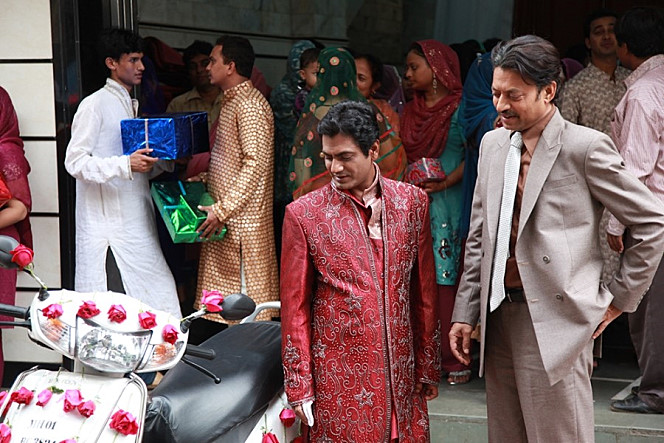
thelunchbox06 Batra’s screenplay wisely sidesteps melodramatic clichés during its last act, and it also provides us warm, humorous moments as handling its two likable main characters with respect and care. Nawazuddin Siddiqui, who plays a young employee who will replace Saajan after working with him for a while, is one of the major sources of humor in the movie; he initially looks like an ingratiating puppy trying too hard to get approval, but you cannot help but like this overly eager guy as getting to know a bit more about him and his life. I also enjoyed the conversation scenes between Ila and an old neighbour living upstairs; we never see that old lady while they talk through windows, but she becomes a sort of endearing presence as she gives Ila some help and advice for cooking.

The success of the movie depends a lot on its two lead actors, and their separate performances work along well with each other despite the constant physical gap between them on the screen. Irrfan Khan, a veteran Indian actor I happened to notice for the first time in Mira Nair’s “The Namesake”(2006), conveys a slow, gradual change inside his character through his quiet, soulful performance, and Nimrat Kaur, a young lovely Indian stage actress at the beginning of her film career, is also convincing as a woman opening her eyes to another potential in her life through the accidental friendship with a stranger.

“The Lunchbox” received the Critics Week Viewers Choice Award at the Cannes Film Festival in last year, and it deserves the award as a warm, sensitive crowd-pleasing film. As a guy who enjoyed several recent visits to an Indian chain restaurant in my town, I was a bit disappointed to see that the movie did not show its dishes a lot, but its drama works thanks to thoughtful direction and good performances, and I enjoyed it despite the uncomfortable screening condition I had to endure during last Sunday afternoon. I am mildly satisfied with it at present, but it may deserve a second chance like its good characters.

thelunchbox04

Posted in Movies | Tagged , , | 1 Comment