Land Ho! (2014) ☆☆☆(3/4) : Two aging tourists in Iceland

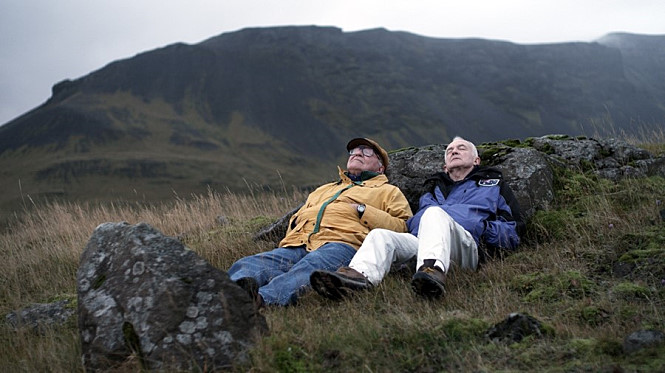
landho03 Sometimes, two real characters interacting with each other can be a far more interesting sight than usual CGI spectacles, and “Land Ho!” can be a prime example of that. While it is just a simple story about two old guys on their brief tour around Iceland, this sweet little comedy constantly tickles us with humor and intimacy as we come to know about them, and it even feels a bit poignant around the ending although nothing particularly dramatic happens along their pleasant journey.

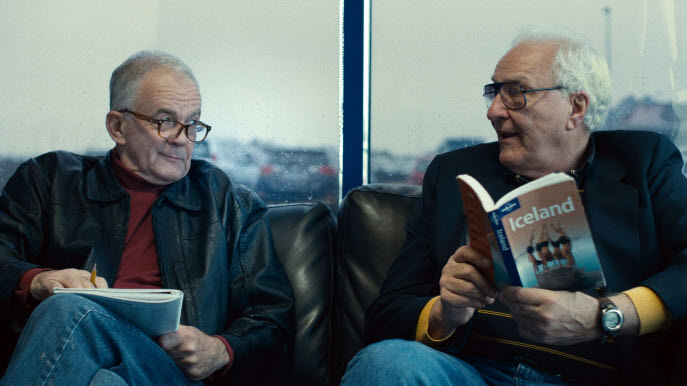
Mitch (Earl Lynn Lenson) and Colin (Paul Eenhoorn) have been good friends for many years since they became close through Mitch’s marriage to Colin’s sister. Mitch, who is a retired surgeon, was divorced from his wife several years ago, but he is still on good terms with his ex-brother-in-law, and we see Colin visiting Mitch’s house at the beginning. When they are having a dinner together, Mitch suddenly suggests to Colin that they go to Iceland for having some fun together, and Colin reluctantly follows his friend’s plan, for Mitch has already bought plane tickets for them while taking care of their trip plan in advance.

They soon arrive in Reykjavík, Iceland, and we see more of their contrasting personalities. More outgoing than his friend, Mitch can be sometimes a bit tiresome in his jolly, gregarious attitude, but he is a good-natured guy who can always brighten up your mood whenever he is around you. While Colin looks shy and introverted in comparison, he is a gentle guy of reserved common sense, and, as observing their conversations, we come to sense how his calm attitude complements his friend’s bouncy nature.
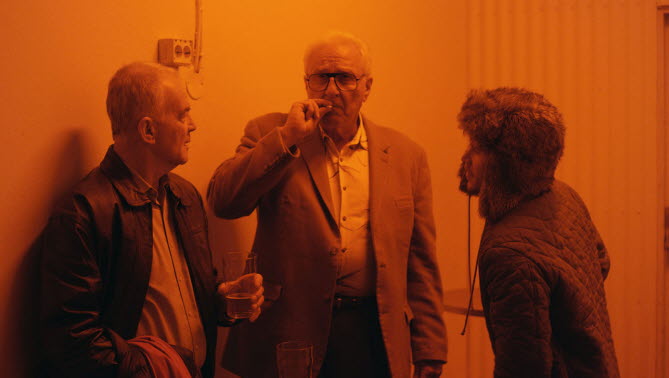
landho05 This sounds like a familiar set-up for comedy, but the movie wisely avoids usual clichés as leisurely hanging around these guys, and a good example can be shown when Mitch’s young female relative Ellen (Karrie Crouse) and her friend Janet(Elizabeth McKee) come to spend one day with Mitch and Colin. It does not take much time for this foursome to form a rapport between them, and their dinner scene at some first-class restaurant is laced with warm liveliness; everyone is really enjoying each other’s company during dinner, and we are also treated with the occasional tasty shots of their dinner course being prepared and served one by one. When they go to a night club with their ladies after their dinner, Mitch and Colin feel older than usual as watching young people dancing from the distance, but then they find something to be amused about, and everyone comes to spend a fairly good night on the whole while nothing serious happens.

And I also like a small scene in which Mitch comes across a young couple at the lobby of a hotel. At one point during their pleasant conversation, Mitch whispers a small personal advice to one of them, and it is delivered with sincerity and a bit of naughtiness to amuse you. Yes, it is indeed a familiar advice you have probably heard before, but it feels like being delivered from real life experience, and we nod with a smile to his words.

There are many other small moments of low-key comedy throughout the film, and the directors/writers Aaron Katz and Martha Stephens ably draw tiny but genuine laughs from these moments as freely rolling their characters along their planned tour route. Although it was shot with a small budget during a shooting period less than 3 weeks, the movie looks fabulous with those beautiful landscapes of Iceland, and they are as good as you can expect from any nice travelogue film. We see the falls spectacular to watch for its icy grandeur, and then there is a geyser which occasionally ejaculates its water in the air in front of amazed tourists. At an outdoor hot spring, Mitch and Colin come across a Canadian woman named Nadine (Alice Olivia Clarke), and the movie handles this scene with the right balance between humor and sensitivity as Colin becomes a little more opened than before during his private time with Nadine.
landho04
 The movie shines with such nice character moments like that while showing its quirky sense of humor, and I was not that surprised to know that David Gordon Green participated in its production as one of the executive producers. Like his recent work “Prince Avalanche” (2013), the movie is driven by the dynamics between two different characters, and it also has a wonderfully authentic atmosphere established from gorgeous nature landscapes.

Its distinctive charm mainly comes from a likable duo performance from its two lead actors. Right from their first scene, Earl Lynn Nelson and Paul Eenhoorn feel natural as two guys who have spent lots of time with each other, and they have a good chemistry to engage our attention. When Mitch and Colin happen to lose their way during one darkening evening, we only see their faint outline on the screen, but we cannot help but be more amused by their mild bickering as they try to find a way back to their staying place.

“Land Ho!” is a treat too good to overlooked, and it is refreshing to see a comedy which generates good laughs from the deep understanding of its characters instead of pushing them into predictable plot. This is a charming and relaxing comedy where the journey itself matters more than its destinations, and there is also something touching about these two guys who will move on together like they have for many years. They are old indeed, but there is still time for these boys, you know.

landho06

Posted in Movies | Tagged , | Leave a comment

God’s Pocket (2014) ☆☆(2/4) : Before the Funeral

godspocket02 Some movies can be interesting as simply showing talented actors doing what they can do their roles, but that is not the case with “God’s Pocket”, which strangely feels tedious and lifeless in spite of its talented performers assembled on the screen. Most of them did nothing bad in the film, and we can see that they are indeed talented actors to watch, but, alas, they are stuck in a disappointing film which could have been more interesting or humorous in its shabby depiction of a bunch of lowlife characters.

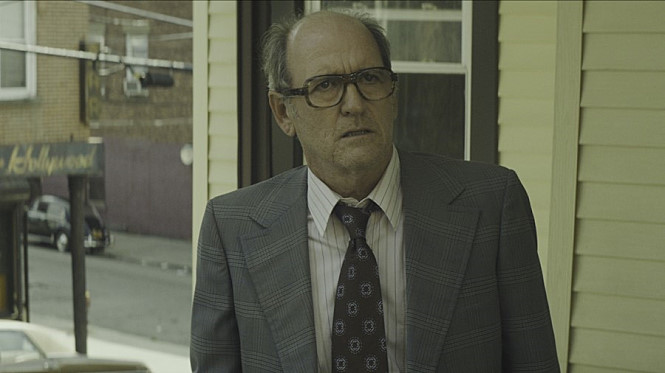
After the opening scene which shows a young man’s funeral as accompanied with the dry narration by newspaper columnist Richard Shellburn (Richard Jenkins), the movie depicts what happened during last several days in a seedy working class neighborhood of Philadelphia, which is nicknamed “God’s Pocket”. A dead young man in question is Leon Hubbard (Caleb Landry Jones), and we see how he dies because of a sudden ‘accident’ at his workplace where he is an insufferable eyesore to everyone including his sullen boss. When the cops arrive at the accident scene, every employee supports their boss’ false testimony, and the cops see no problem with that, though they could sense something suspicious if they looked closer into the scene.

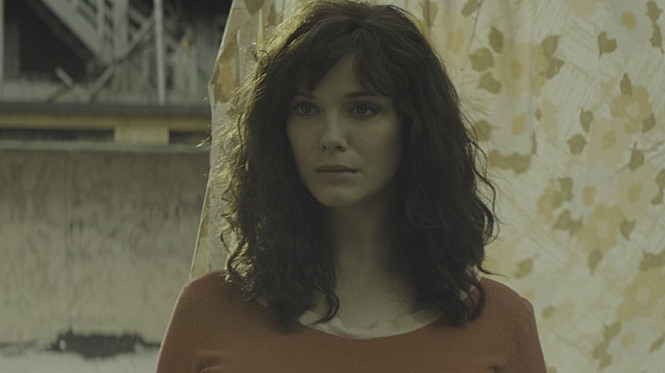
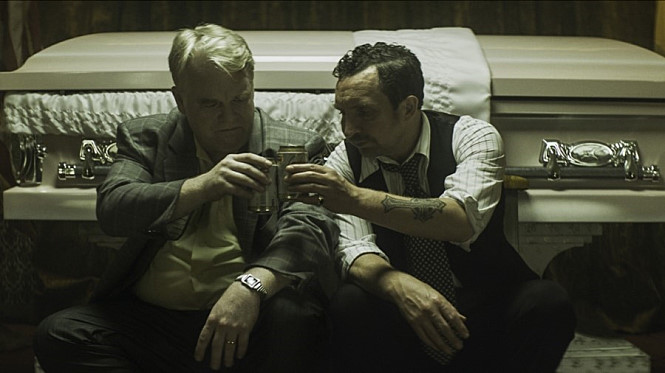
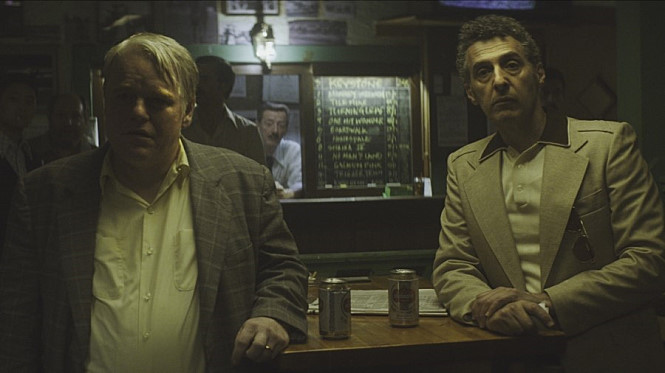
Leon’s mother Jeanie (Christina Hendricks) and her second husband Mickey Scarpato (late Philip Seymour Hoffman, who also participated in the production of the film) react to the news of their son’s death in different ways. Although Leon is not exactly a model son, Jeanie is devastated by this news, and she somehow comes to believe that her son’s death was not a simple accident as told to her. In case of Mickey, he does not care that much about his pathetic stepson, but he makes arrangements for Leon’s burial anyway as Leon’s stepfather, and everyone at a neighborhood bar located right across the street from his house is willing to help him a bit through their small financial contributions.

godspocket04 And we also see Mickey’s shady meat business with his friend Arthur ‘Bird’ Capezio (John Turturro), who also operates a flower shop with his old aunt as his front business. Arthur has been in a difficult financial situation due to his gambling debt to a local mobster they are associated with, and we have a mildly amusing moment in which Arthur gives Mickey their recently stolen meat instead of $700 he owes to his friend just because he is short of cash at present.

Meanwhile, Jeanie keeps expressing her doubts on her son’s death, so Mickey asks Arthur to help him on this problem, and Arthur asks their mob associate to look into the case. This matter initially looks like something easy to be taken care of, but then there comes a striking moment of violence later in the film when two mobster guys make a surprise visit on Leon’s boss.

The first-time director John Slattery, who adapted the screenplay with Alex Metcalf from Peter Dexter’s novel, sets an appropriate tone for the background of his movie, and the moody ambience of lowlife is always around his plain characters, but the movie fails in generating enough level of interest to make us involved with the story. Its plot turns are mostly dull and lackluster without much surprise, and one crucial scene in the middle of the movie exemplifies well what is wrong with the film. While we can clearly see how that scene will end from its very beginning, its depiction of an ironic reversal of fortune feels so bland and inconsequential that you may even not recognize how that will affect the characters in that scene, whose flat resigned attitude makes it like a trivial bad luck to be forgotten on the next day.

godspocket05 The movie takes another bizarre turn later as Mickey clashes with a local mortician Smiling’ Jack Moran (Eddie Marsan), who adamantly demands Mickey to pay him before Leon’s funeral. What happens next is surely outrageous as being full of potential for black comedy, but the movie pushes it along the plot so inertly that what happens as a consequence in the end does not feel much like a surprise at all in spite of its weirdness.

It is all the more disappointing considering that Slattery gathered several good actors for his film. Slattery, who has recently been more notable as one of main supporting characters in TV series “Mad Men”, drew fine performances from some of the cast members, but his actors simply trudge along with the movie while wasted by their thankless roles. Philip Seymour Hoffman, who died not long after the premiere of the film at the Sundance Film Festival early in this year, is suitably cast as a tired and frustrated hero mired in his own melancholic existence, and he occasionally brings some common sense to his character. While Christina Hendricks, Edie Marsan, and John Turturro acquit themselves well to some degrees despite their thin roles, Caleb Landry Jones is stuck with a lousy job of playing someone for whom you will not feel sorry at all, and Richard Jenkins, a dependable veteran actor who can do wonder with miscellaneous roles, injects a small dose of dry humor to the movie as an alcoholic newspaperman on his downturn.

“God’s Pocket” is not a total disaster, but it is still a flaccid and uninteresting film which does not leave much impression when it is over. It does not fully develop the absurdities inside its characters’ situations, and its inane pace further accentuates its problems while making us as frustrated as its characters. Like its seedy bar full of unlikable losers, this is a sort of film you may look into with curiosity but never want to go back again for sensible reasons.

godspocket01

Posted in Movies | Tagged , , , | Leave a comment

Omar (2013) ☆☆☆1/2(3.5/4) : An informer tiptoeing between both sides

omar02 While working as a thriller with its taut, suspenseful moments, Palestinian film “Omar” looks below an ongoing conflict through its fully-realized characters and their gloomy, desperate drama. As observing the characters stuck in an impossible situation full of gray morality and constant danger, the movie generates a number of powerful moments from its gripping plot, and we come to think about the harsh political reality reflected through its human story as understanding and caring about its characters.

When we see its young hero Omar (Adam Bakri) in the opening scene, this young Palestinian baker living around the West Bank area is about to deal with one daily difficulty in his life – a big separation wall which has separated him from his childhood friends living behind the wall. When no one is around him, he quickly begins to climb along the wall with a rope put upon it in advance, and then he is almost shot by someone when he is about to go over the wall. He does this risky climbing again and again throughout the film, and we come to see that he is pretty much accustomed to that kind of danger.

We meet his two close friends Tarek (Iyad Hoorani) and Amjad (Samer Bisharat), and it does not take much time for us to see that there is something going on between Omar and Tarek’s younger sister Nadia (Leem Lubany). Because this is the world still governed by old traditions, Omar and Nadia have to hide their mutual feelings in front of others until their relationship is officially recognized to proceed to formal marriage, but that does not stop these young lovers from showing affection to each other when nobody is looking at them. They sometimes exchange notes between them, and they frequently meet each other in the corners of buildings and alleys, and they usually dream about their happy life as a couple, though it is something beyond their reach in the world they inhabit.

omar04 The conflict between Israel and Palestine is not mentioned often in the film, but we feel it as an oppressing fact of life hovering over everyone in the film. At one point, Omar is stopped by three Israeli soldiers not long after he went through another perilous climbing, and their vicious harassment on him makes Omar more angry and frustrated about the hardships in his world which seem to have no end in sight for him and other Palestinian people.

We see that Omar and his friends have been preparing themselves as fighters, but they look rudimentary at best during the training at their shabby private place, though it looks like they are connected to some local brigades. Believing that they are doing something for their oppressed people and country as freedom fighters, they attempt a small surprise attack on an Israeli military camp without much thoughts on what can be resulted, and it turns out that they are going to pay the price far bigger than imagined. Because a soldier was killed as a consequence, the Israeli Police swiftly respond to this incident, and, unlike his more fortunate friends, Omar is quickly captured and then incarcerated in a prison.

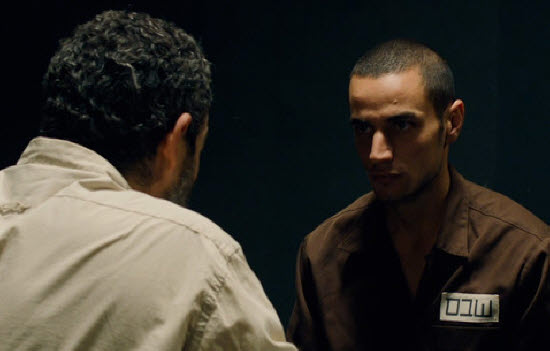
After the brutal, unforgiving interrogation in a room shrouded in stark darkness, Omar’s dire circumstance becomes worse when he finds himself trapped by Agent Rami (Waleed Zuaiter, who also worked as one of the producers of the film), a willy man who initially approaches to Omar as a fellow Palestinian prisoner and then gets what he exactly wants for forcing Omar to become an informer. It was just a simple sentence causally coming out of Omar’s mouth during their secretly recorded conversation, but that is more than enough to get Omar imprisoned for at least 90 years, and Omar has no choice but to become Rami’s informer in the end.

As soon as he is released from the prison, Omar sees that he is an expendable pawn sandwiched between both sides. Although his friends are glad about his release, his relationship with them is now a lot different from what it used to be, and his friends and others are more aware of the possibility of betrayal. Tarek, who becomes a more prominent figure after that incident, is convinced that there is an informer around him, so Omar must be more careful as tiptoeing on the line between his friends and Rami, who can haul Omar back to the prison at any time if he thinks Omar is no longer useful to him.

omar05 Quietly accumulating suspense along its tense plot whose turns come with surprise and complexity, the movie generates a palpable sense of suffocation which is mainly represented by the separation wall and narrow alleys, and it also has a couple of good chase sequences as Omar frantically tries to evade people chasing after him. These sequences may look simple, but we see Omar running away with real risks as the camera follows after him in its swift, fluid movement coupled with judicious editing, and I must say that several shots in the film made me curious about the safety measures during its shooting.

Nevertheless, this is a movie mainly driven by story and characters, and the director/writer Hany Abu-Assad, who previously directed Oscar-nominated film “Paradise Now” (2005), deftly handles a number of plot turns in his story while not losing its human dimension. Like “Paradise Now” has a fair share of humor and warmth despite being a very dark film involved with suicidal bombing, “Omar” is occasionally amusing or intimate as focusing on its characters, and there is even a small moment of black humor when Omar says something barely audible to his savage interrogator.

The main cast members, most of whom made a debut in this film, look natural and effortless in their performances. Adam Bakri instantly comes to us as a likable young hero we can root for, and he and his co-actress Leem Lubany play well with each other in their different scenes. While Samer Bisharat and Iyad Hoorani are competent in their supporting roles, Waleed Zuaiter is particularly good during his scenes with Bakri; Rami can be merciless, but he is simply a man doing his job as ordered, and we come to sense that he sort of likes Omar even though Omar is still more or less than an asset to be exploited.

I happened to watch “Omar” with Israeli film “Bethlehem” (2013), and I was intrigued by how these two overlapping films, both of which were coincidentally made during the same year, complement each other through their different perspectives. “Omar”, which received Special Jury Award at the Cannes Film Festival in last year and then was deservedly Oscar-nominated in the Best Foreign Language Film category early in this year, is more successful than the latter in my opinion, but both of them are honest about the maddening complexity inside the conflict between Israel and Palestine, and they clearly perceive that there is no simple solution at all for this messy problem which has only been getting worse and worse in these days. Whatever will happen in the end, we can only hope things may get better someday.

omar03

Posted in Movies | Tagged , , | Leave a comment

Bethlehem (2013) ☆☆☆(3/4) : A police procedural around both sides

bethlehem01 Israeli film “Bethlehem” sometimes loses its focus on the relationship between its two different characters as looking around many other things in the story. Its story is inherently engaging as a tense drama mixed with current topics, and there are a number of good character moments, but, unfortunately, the movie somehow gets lost and feels choppy at times whenever it looks away from its main characters.

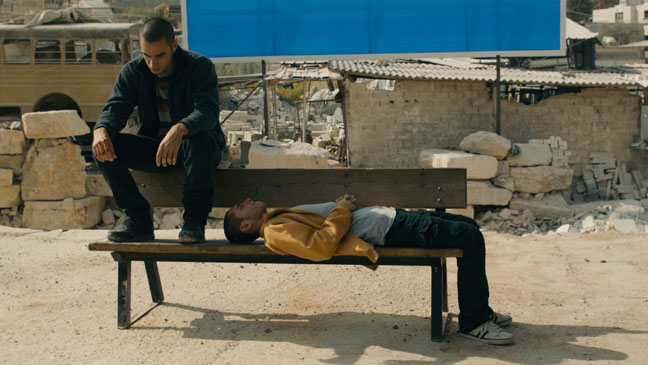
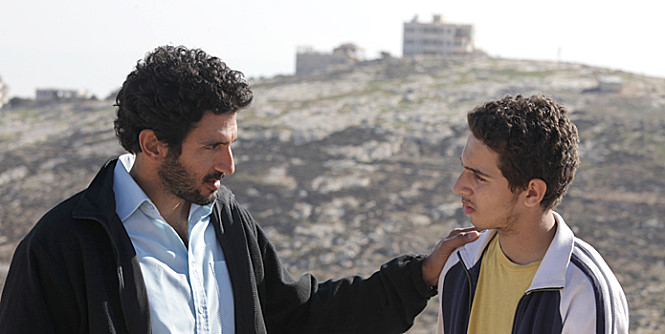
The movie revolves around an Israeli Secret Service officer and a Palestinian teenager who has been one of his main informers. Razi (Tsahi Halevi) recruited Sanfur (Shadi Mar’i) around 2 years ago under some circumstance, and Sanfur has managed to hide this fact from others around him while being very useful to his handler. Because he is the younger brother of the leader of al-Aqsa Martyrs’ Brigades, Sanfur can get the information for Razi without drawing any possible suspicion, and Razi depends more on him especially when Sanfur’s brother goes into hiding after claiming in public that he is responsible for a recent bombing in Tel Aviv.

We see Razi taking Sanfur to a safe place where they can talk, and we sense a certain bond between them as Razi coaxes his disgruntling informer with fatherly tactfulness. While it goes without saying that he is basically pushing Sanfur to more dangerous work to do for his mission, Razi really cares about Sanfur, and he worries about the uncertain future waiting for Sanfur; he may be turned into someone like his militant brother someday because of his harsh, violent environment without much hope, and that is surely the last thing Razi wants.

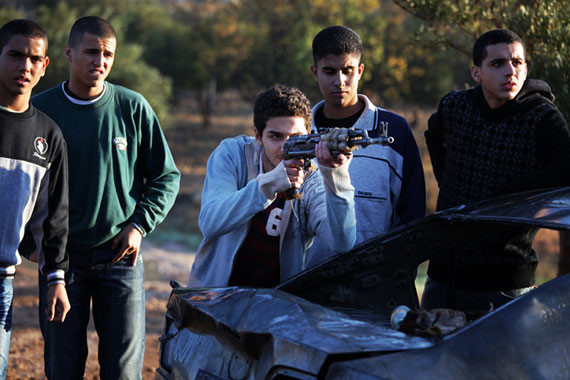
bethlehem02 To Sanfur, Razi is the only man he can openly talk with in the world where gun and violence are mundane parts of daily life. This tough but vulnerable teenager is always pressured by his brother’s reputation, and the opening scene shows him prompted to do a dangerous act of impulsive bravado by other boys during their target practice with a rifle. At his home, which is seriously damaged by a recent visit from Israeli soldiers, he does not get along well with his aging father, and his father has no idea about what his son is doing behind his back while worrying about him like any concerned father would.

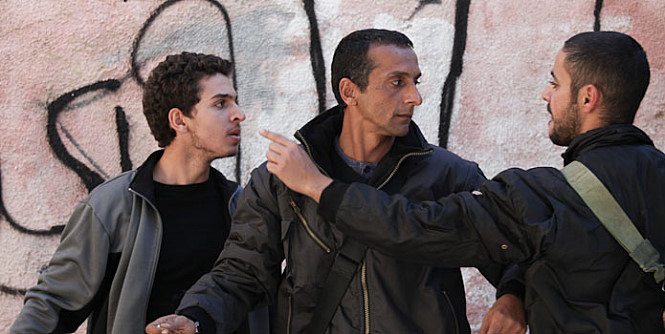
Meanwhile, the movie also looks around several other characters on both sides. While Razi’s direct boss and colleagues at the headquarters are determined to capture Sanfur’s brother by any means necessary, there are some shifts within Sanfur’s neighbourhood as the leader position of Sanfur’s brother becomes empty for now. Badawi (Hitham Omari), who has been No.2 of the group, is ready to fill that position, but local authorities and some other key members of al-Aqsa Martyrs’ Brigades are not so enthusiastic about that. It seems that there has been the possibility of temporary cease-fire, and a volatile militant like Badawi is certainly someone they do not want in their negotiation process.

While the movie does not take sides as going back and forth both sides, the chaos and desperation inside Palestine provide more memorable moments in the film. Besides being cornered by the Israeli force everyday, its society is also being cracked and divided inside, and local authorities care mostly about their position and benefit rather than public safety and order. We also witness the regional competition between al-Aqsa Martyrs’ Brigades and Hamas, and the movie gives us a darkly absurd moment at the hospital when the members of both militant groups clash with each other literally over a dead body to be honored.

bethlehem03 The director Yuval Adler, who also wrote the screenplay with his co-writer Ali Wakad, made a solid debut with this film on the whole (the movie won Fedeora Award at the Venice Film Festival in last year and was selected as Israel’s official submission to Best Foreign Film Oscar in the same year). Steadily maintaining the realistic tone for his story, he also made several nice scenes filled with simmering tension, and one of them is involved with Razi and his men almost closing on their main target. They have finally cornered their target who happens to be trapped inside a building, but then they must hurry due to angry local people gathering outside, and things become more and more intense along with shouts, bullets, grenades, and stones.

The movie becomes less interesting when Razi and Sanfur get separated from each other around its unfocused second act, but it thankfully focuses again on their uneasy relationship during the expected third act, and the main cast, which mainly consists of first-time actors, did a commendable job of embodying their characters. Lead actors Tsahi Halevi and Shadi Mar’i are believable in the shifting dynamics between their characters, and a few warm moments in the film are generated by their genuine human interaction on the screen. Razi and Sanfur may sincerely care about each other, but there is always uncertainty in their relationship, and then everything comes to an unavoidable point where they must deal with their urgent matter of loyalties in one way or another way.

“Bethlehem” is a competent drama which deserves to be watched for several reasons besides its hot issues, but I was also distracted by its occasional lack of focus and its other flaws. Despite that problem, I sort of recommend it with reservation mainly because of “Omar” (2013), a better film I happened to watch right after this film. I think “Omar” is more focused and powerful in its handling of a similar story subject, but I will not deny the value of “Bethlehem” as a good companion piece to “Omar”, and you will probably have a little enlightening time on their subject as watching them together.

bethlehem05

Posted in Movies | Tagged , , | Leave a comment

The Rover (2014) ☆☆☆(3/4) : Across a heartless apocalyptic world

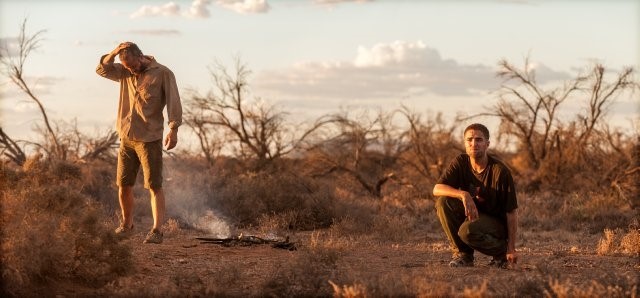
therover01  “The Rover” is an atypical film putting far more emphasis on mood and background than story and character. When you read its simple synopsis, you may expect something like Mad Max movies, but, though it has a similar type of apocalyptic background, it is mainly driven by its uneasy atmosphere as requiring some patience from you. You will probably be disappointed by its anti-climactic finale if you expect an action thriller film, but you may be satisfied instead if you know exactly what you are going to get from this movie.

Its story is set in a wasteland area located somewhere in the middle of Australia. The time is not specific, and we are only informed at the beginning that some big social/economic collapse happened ten years ago. While it is not clear whether that collapse was local or global, we occasionally get the glimpses of its effects throughout the film. Modern civilization is not entirely collapsed while public safety and order are maintained a bit by patrolling soldiers, but the palpable sense of desolation is always around people who seem to forget the purpose of life they had once a long time ago, and that is further accentuated by barren landscapes and shabby empty houses.

When we meet Eric (Guy Pearce) in his car during the opening scene, this reticent guy does not reveal much about where he is going, let alone who he is (in fact, his name is never mentioned in the film except during the end credits). We see him stopping by a bar which is also a gas station, and we can only guess about what is going on his troubled mind as he spends a little quiet time at the bar where there is no one except him and its owners.

And then a trouble suddenly happens. Three criminals running away from their crime scene have an accident right in front of the bar while they are quarreling with each other for some matter during their frantic drive. They manage to survive without any serious injury, but their truck seems to be broken, so they quickly get into Eric’s car and then promptly drive away from the scene as Eric begins to realize what is going on outside.

therover03 Fortunately for Eric, the truck left by these criminals turns out to be all right, so he quickly chases after them by that truck, and we get one of the tense scenes in the film as Eric approaches to the guys in his stolen car. It is apparent that, for some unknown reason, Eric is determined to get his car back by any means necessary, and we can see that he is ready to walk right into possible danger if that is required.

He fails in his first attempt, and he later finds himself waking up with the truck besides him, but then he happens to encounter Rey (Robert Pattinson), a half-wit lad who is young brother of one of the criminals. Rey was left alone to die on the crime scene due to his serious injury, but he manages to survive and then he comes across his brother’s truck – and Eric. Because Rey tells him that he knows where his brother and his accomplices go, Eric continues his journey with this unstable young man, who is not only untrustworthy but also may not merely be coerced to help him.

Watching their gloomy journey across the unforgiving world which can be utterly heartless, I could not help but think of Cormac McCarthy’s novels “Blood Meridian” and “The Road”, which are the harrowing depiction of extreme human conditions driven to despair and madness on merciless badlands. Almost everyone in this world looks like being pickled in each own desperation, and life and death do not mean much in their world, as reflected by the occasional bursts of violence in the film. Some may deserve what they get while others do not at all, but the world goes on without much care, and so do its people.

therover02 Such bleakness is well exemplified by a short conversation scene between Eric and a minor supporting character played by Nash Edgerton (he is the co-writer Joel Edgerton’s older brother). We are not entirely sure about whether what Eric tells to the other is true or not, but Guy Pierce is captivating to watch as revealing humanity inside his wretched character. He a single-minded man as callous and ruthless as the world he inhabits, and his remaining human side is disgusted by what he has become as much as we are.

On the opposite, Robert Pattinson, who has assiduously been trying to leave behind his stiff acting in Twilight films, hurls himself into a challenging role, and he holds himself up well as complementing Pierce’s gritty performance. Rey is not smart, but he is not as stupid as he seemed at first, and we gradually come to sense the possibility that he also has his own plan behind his awkward nervousness. Pattinson is especially good during the climax scene as his character becomes confused and conflicted about what he is soon going to do: did he decide to do that from the very beginning or is he just influenced by his interactions with Eric?

The director/co-writer David Michôd previously made an impressive debut with “Animal Kingdom” (2010), a memorable mixture of crime and family drama which was also one of my favorite films in 2010. “The Rover” is not a better film, but I like the way he sets the atmosphere for his film at the beginning and then push it all the way under his austere direction, and the main actors carry their film well with their solid performances. As I said above, this is not a movie for everyone, but you may admire how it handles its materials with some stark sights to linger on you after its somber, wordless ending.

therover04

Posted in Movies | Tagged , | 2 Comments

Early winter in the campus (2014/12/06)

Winter arrives with cold weather and they don’t miss anything to eat.


Posted in Photos | Tagged , , | 1 Comment

Late autumn in the campus (2014/11/27)

Autumn was going away, and animals were hungry….
Posted in Photos | Tagged , , | 1 Comment

Exodus: Kings and Gods (2014) ☆☆(2/4) : It happens as we saw before

exodus05  Despite some interesting touches to muse on, “Exodus: Kings and Gods” feels bland while bringing very little to a story familiar to many of us. Like Darren Aronofsky’s “Noah” (2014), the movie attempts a modern reinterpretation of its biblical tale, but it is frequently hampered by its weak, deficient drama, and that was the main reason why I found myself not caring a lot about what was going on the screen as dully waiting for its promised spectacles which are more or less than its obligatory window dressing.

It is around 3,000 years ago in ancient Egypt, and the movie duly informs us at the beginning that thousands of Hebrew people were taken away from their homeland Kanaan by Egyptians. Many of them were forced into slave labor for those huge architectures including pyramids, and their slavery has continued for more than 400 years.

The movie begins its story around the point when Moses (Christian Bale, who certainly looks slimmer than his recent Oscar-nominated turn in “American Hustle” (2013)) comes to learn about the secret of his birth. Because he was raised as the son of King Seti’s sister Bithiah (Hiam Abbass), Moses has never had any doubt about his true identity while being loyal to King Seti (John Turturro, who unexpectedly looks regal and majestic) and his kingdom, and King Seti clearly perceives that Moses has more right stuff than his own son Rhamses (Joel Edgerton with shaved head and eyeliner), though, as the aging king admits during his private talk with Moses, his wish is not possible at all.

exodus07  What happens next is not so different from what was depicted in Cecil B. DeMille’s “The Ten Commandments” (1955) or animation film “The Prince of Egypt” (1998). Moses happens to meet an old Hebrew man named Nun (Ben Kingsley), and what Nun reveals to Moses during their secret encounter inevitably arrives at the ears of Rhamses later, who has just become the new king after his father’s recent death. Although Rhamses does not want to eliminate Moses in spite of his personal jealousy(after all, they grew up with each other like brothers), he has no choice but to banish Moses once that inconvenient truth eventually comes out in front of him and others.

After managing to survive his long, hard journey across badlands, Moses walks across the Red Sea (no, he is not helped by God in this time), and then he settles in a village where he begins a new life with Nefertari (Golshifteh Farahani), a lovely young lady he came across when he had just arrived in the village. It does not take much time for them to become husband and wife, and they soon have their own son while Moses works as one of village shepherds.

The most intriguing part of the movie is when Moses encounters God at a big, ominous mountain near the village, and that is where the movie tries more to be different from other religious epic films. His first encounter scene accompanied with the burning bush is drenched in a moody tone with a certain degree of creepiness, and God, who approaches to him with the appearance of a young boy, does not look like a good-willed entity, considering how he pushes Moses to follow his holy command.

exodus04 Moses comes back to Egypt for his people as God told him, and he soon begins his rebellion against Rhamses and his kingdom. He gathers and trains his people, and we see them participating in partisan activities including burning oil warehouses. Although I have no idea on how they become effective fighters so quickly under Moses’ leadership within a short time, they make enough headaches for Rhamses, who will not let Moses and his people go for good reasons (it is not easy to give up a free labor force of more than 400 thousand people, you know) and responds to the rebellion with drastic measures including sudden massive attacks on Hebrew districts.

Anyway, it is God who steals the show in the end, and there are a number of big moments as the series of well-known disasters are mercilessly poured upon Rhamses and other unfortunate Egyptian people one by one. I sort of enjoyed how the Nile River is turned red after one gruesome moment involved with a bunch of deranged crocodiles, and the following disasters, which get nice logical explanation except that infamous final disaster, are more vivid and urgent than what is shown in DeMille’s 1955 film thanks to the advance of special effects. We also look more closely at lots of subsequent damages around the kingdom and its people, and God accordingly looks more disturbing while justifying his wrathful acts like an angry child ready to squash more ants.

I saw an interesting potential as Moses comes to have doubts on his God’s ruthless acts, but the movie keeps presenting expected things without much surprise or interest. Moses’ initial atheistic attitude is destined to be discarded from the beginning, and, though he is presented here as an understandable bad guy, we all know that Rhamses will never change his decision until that fateful point. The Red Sea sequence during its climax part feels dragged in spite of all the efforts for creating tension, and what is shown during this sequence lacks awe and wonder compared to what we recently saw from “Interstellar” (2014).

exodus01  The main actors of the film are mostly wasted due to flat characterization. Christian Bale and Joel Edgerton did as much as they could do, but this is not their best moment, and the other notable performers including Aaron Paul, Ben Bendelsohn, and Sigourney Weaver are stuck with thankless roles which do not give them many things to do except delivering lines as required.

The movie is directed by Ridley Scott, who is no stranger to epic period drama films as shown in “Gladiator” (2000), “Kingdom of Heaven” (2005), and “Robin Hood” (2010). He and his crew did an impeccable job on the technical level, and the movie looks good during its 2.5 hours with wide shots overlooking on cities and landscapes, but it ultimately fizzles as trudging on its predetermined path. While hurrying itself from one narrative point to the other, the movie does not give enough space for its characters to breathe and come alive, and I frequently noticed some narrative gaps needed to be filled.

Although I disliked “Noah” (2014), its bold attempt was something to be appreciated, and, as still remembering the striking visual moments from its disjointed result, I sometimes wonder whether I was too harsh on that film. In case of “Exodus: Gods and Kings”, I really doubt whether I will be able to remember this passable misfire in the next year to come.

 Sidenote: The movie is dedicated to late Tony Scott.

exodus06

Posted in Movies | Tagged , , | 2 Comments

Cold in July (2014) ☆☆1/2(2.5/4) : A well-made Texan noir with some holes

coldinjuly02 Many of you have probably heard about that amusing anecdote behind classic noir film “The Big Sleep” (1946). Because the plot of Raymond Chandler’s equally famous novel is so convoluted, the director Howard Hawks and his screenplay writers were confused about who killed that chauffeur guy, so they sent a telegram to Chandler to get an answer, but even Chandler did not have the answer either (“They sent me a wire … asking me, and dammit I didn’t know either”).

While that infamous plot hole in question did not prevent “The Big Sleep” from being recognized as one of the great noir films from its era, I was constantly bothered by a couple of certain plot holes in “Cold in July”, which is, in objective view, a well-made noir film which also has a number of unexpected narrative turns to surprise and entertain you. The movie is rich in its local atmosphere to hold your attention, and it also has good performances to impress you, but its imperfections are a little too glaring for me to ignore even during the second watching which made me appreciate more the skills put behind the screen.

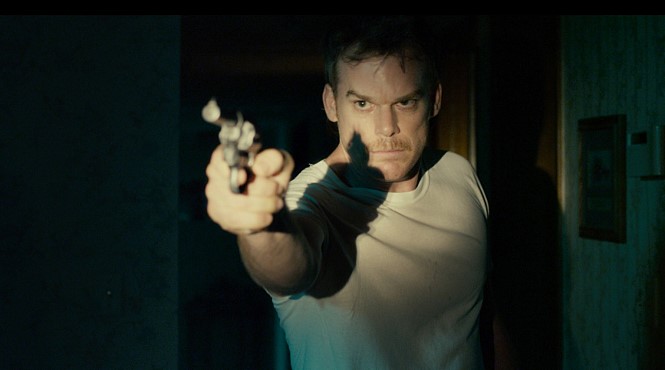
Like many noir films, the movie begins with its ordinary hero who suddenly happens to face something of which he has never been aware in his normal life. It is 1989 in Texas, and Richard Dane (Michael C. Hall), an average family guy running a frame shop in his hometown, is awakened by his wife Anne (Vinessa Shaw) during one night because she has just heard something strange in their house. It looks like someone has broken into the house, so Richard quietly and nervously loads a gun inherited from his father, and then he comes across a burglar at the living room. More agitated than before, Richard initially is at a loss, but, when the clock chimes right at that moment, he inadvertently pulls the trigger, and the burglar is instantly killed as a result.

coldinjuly06 The local police arrive at the scene not long after that while Richard and Ann still feel shaken by what happened to them. Ray Price (Nick Damici – he wrote the adapted screenplay with the director Jim Mickie, which is based on Joe R. Lansdale’s novel), a local cop in the charge of this case, assures Richard that there will be no serious problem, for it is pretty clear that Richard shot that burglar in an act of self-defense. In addition, he also notifies to Richard that the burglar is actually a wanted man, which will surely make Richard’s situation less problematic.

Richard tries to start the next day like any other day in his life, but it turns out to be not as easy as he thought. The news about what happened in his house has already been spread around the town, and everyone looks at him with awkward interest, and he is still trying to process what happened during last night. He and his wife clean up the mess in their living room and then get rid of blood-stained furnitures, but they do not look that relaxed even after everything is cleaned. They saw how fragile their normal domestic life can be, and they are now more aware of the possibility of another domestic disturbance.

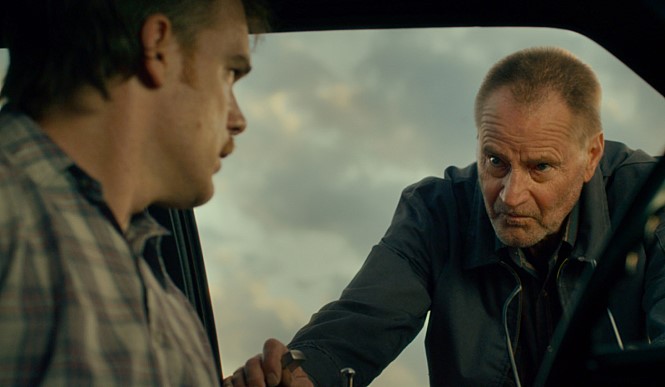
And that possibility gets quickly increased when Richard learns about Ben Russel (Sam Shepard), the father of the dead man. Ben has just been paroled after long years of imprisonment, and it seems that he is very angry about what happened to the son he has yearned to meet for a long time. Richard encounters Ben by coincidence when he comes to see the burial of Ben’s son at a local cemetery, and, through his subtle menace, Ben makes no secret about his animosity toward the man who killed his son.

Their situation soon becomes something not so far from “Cape Fear” (1962) as it looks like Ben is slowly preparing for his personal revenge on Richard and his family, and it eventually culminates to a tense sequence unfolded in and around Richard’s house during one murky rainy night. With the calm but palpable suspense accentuated by Jeff Grace’s synthesizer-driven score which clearly emulates John Carpenter’s edgy scores for his thriller films, we come to feel as nervous as the characters on the screen because of what may happen in the end.

coldinjuly03You may think I describe almost everything about the plot, but what I have described above so far is more or less the starting point for the journey into darkness for Richard and Ben, who unexpectedly become allies after Richard begins to sense that there is something very fishy about the whole situation. Along with private detective Jim Bob (Don Johnson), a longtime friend of Ben, they search for the answers for them, and that leads to the discovery which disturbs all of them for good reasons.

The director Jim Mickie previous made “Stake Land”(2010) and “We Are What We Are” (2013), and both of them were good horror films which showed his deftness in establishing mood and background. In case of “Cold in July”, he did a nice job again in a different territory as providing suitable ambience and period details for his noir drama. The cinematography by Ryan Samul frequently injects the sense of agitation to the screen in its unstable position, and you may be amused by a number of props reflecting the background of the movie (do you remember how big a mobile phone was during the 1980s?).

Mickie also drew engaging performances from his three talented main actors. Michael C. Hall, who is famous for recent TV series “Dexter”, is completely different from his serial killer character in that TV series as a normal guy deeply affected by his unintentional killing, and Sam Shepard gives an understated performance as a tough, taciturn ex-con full of personal guilt and anger. The most fun in the movie comes from Don Johnson; right from his colorful entrance scene, he has all the juicy fun he can have with his role, and then he slowly reveals intelligence and tactfulness inside his folksy character who turns out to be more clever and thoughtful than expected.

But, still, I hesitates to recommend “Cold in July” to you due to underdeveloped characterization and other flaws. I enjoyed its mood and plot to some degrees, but I felt unsatisfied because of the aforementioned plot holes remained untouched even in the end (one of them is particularly noticeable mainly because it is associated with the motive of a main character). Considering that lots of things can be permitted and tolerated in noir films, maybe you can be less bothered by these plot problems than me – and you may enjoy it more than me.

coldinjuly04

Posted in Movies | Tagged , , , | Leave a comment

The Babadook (2014) ☆☆☆1/2(3.5/4) : Be careful of what you read

thebabadook01 “The Babadook” is a horror movie about something wicked lurking around somewhere, and it is quite an effective one. Slowly building up the sense of dread around its ominous background, the movie works as the harrowing drama of a strained human relationship, and then it terrifies us a lot as this relationship is being pushed to dark, sinister territories under its malevolent undertone. Because we understand well at that point how helpless and vulnerable its main characters are, we begin to fear for whatever may happen to them eventually, and they are indeed approaching to a certain point step by step while they become more trapped by their terrifying circumstance.

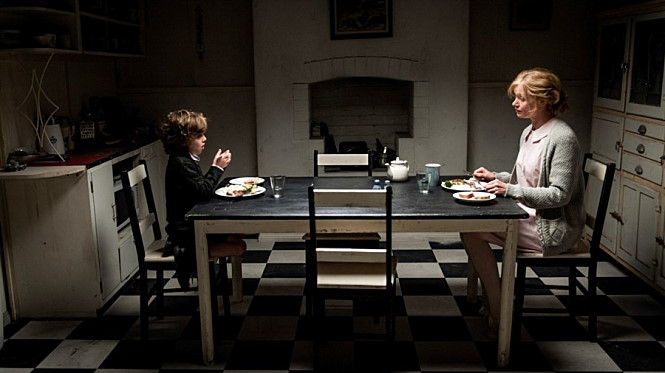
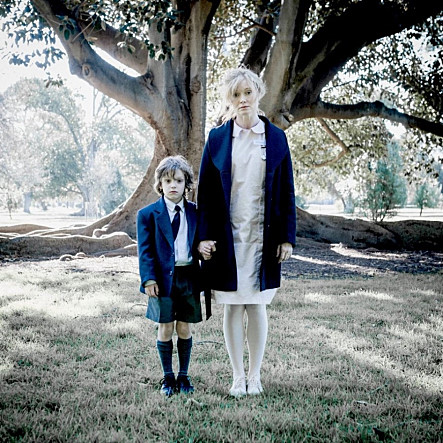
To Amelia (Essie Davis), the life has been very hard and difficult during last several years. She lost her dear husband Oskar (Benjamin Winspear) 7 years ago, and she has been raising her young son Samuel (Noah Wiseman) alone in their melancholic suburban house whose Victorian interior design is full of gray pastel tone besides a shabby basement currently storing her deceased husband’s relics. I must say this is not an ideal place for raising kid, but I guess the house was not expensive for her and her husband when they bought it.

Amelia currently works as an orderly in some nursing home, but her job does not look that stable or satisfying, and she already looks very stressful and exhausted mainly due to her son who looks like having some sort of hyperactivity disorder. We later learn that he keeps making troubles at his school due to his monster story and his hand-made weapons for fighting against the monster, and Amelia does not know what to do with her troublemaking son while still grieving about her husband’s death. He was killed by an unfortunate accident which happened during their drive to the hospital, and that fact sometimes makes her distant to her own son, whose very presence always reminds her of what happened right before his birth.

thebabadook02 At least, she has been trying her best in spite of frustration and exhaustion accumulating inside her mind. She stands by her son when school teachers tell her that he needs to be monitored, and she reads him storybooks whenever he asks before his bedtime, and she tries to tolerate many of his hyperactive behaviors which surely drive any normal parent crazy within less than 30 minutes. At one point, he innocently tries something dangerous at the playground while his mother is being distracted for a while, and I can assure you that this moment will surely make any parental audiences gasp in horror.

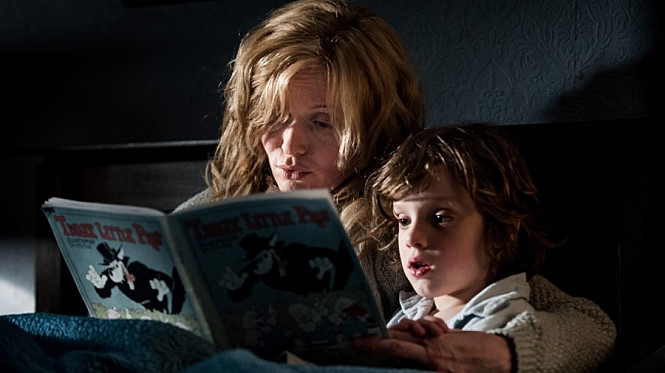
And then strange things begin to happen in her daily life which already feels like a horror film of its own as fear and anxiety pressuring her day by day. During one night, Amelia happens to read a storybook titled “Mister Babadook” to Samuel, and this storybook, which was placed in the bookshelf along with other storybooks, does not look so suitable for any children right from its first pages. Its black-and-white illustrations of a bogeyman named Babadook are very disturbing to say the least, and its seemingly simple story feels more like an insidious prophecy as Amelia turns its pages, and its last blank pages ominously suggests something bad to happen sooner or later.

Amelia initially dismisses it as a merely creepy book, but then it turns out that the monster with which her son has been obsessed is none other than Babadook, and he really seems to believe its existence. Amelia thinks it is just his imaginary monster, but she starts to sense something around her and her son. As she begins to hear weird sounds during nights, she gets more nervous and exhausted while not having enough sleep, and her increasingly fragile mind becomes more susceptible to a mysterious influence which might be hovering around her.

thebabadook03 The movie is based on a short film made by the first-time director/writer Jennifer Kent in 2005, and she did a terrific job here with her modest budget which was later supplemented with Kickstarter funding. She understands well the value of mood and suspense, and she deftly increases the level of tension on the screen as things are getting more disturbing around her two main characters. It is just a trivial matter of simple sounds and flickering light bulbs, but then it gradually looks like Babadook does exist as more scary things happen along the plot, and then we find ourselves suddenly hurled into a dark, moody claustrophobic terror unfolded inside the house which becomes increasingly isolated from the outside world. As focusing more on its heroine’s repressed anger, desperation, and frustration about to be ignited within the closed space, the movie clearly shows the influence from “The Shining” (1980), and there are a couple of horrific moments which may remind you of that classic horror film by Stanley Kubrick.

Good horror films usually have the characters we come to know and worry about, and Essie Davis and her young co-star Noah Wiseman are convincing as mother and son struggling with each own troubles in their distant state. Davis’s performance is a solid platform for the horror to come upon her character, and we seldom lose our sympathy toward Amelia even she is driven to extreme points to deeply disturb and frighten us. Wiseman is annoying as required in the beginning, but then we come to understand his viewpoint as the plot progresses, and I wonder about how the whole circumstance in the film would look to him. While concentrating on the fearful dynamics between its two main characters, the movie sometimes reminds us of the reality outside their closed space, and it is mainly represented by the minor supporting performers including Hayley McElhinney, Barbara West, and Daniel Henshall.

“The Babadook” is a very good horror film which taps into human fears we can relate to and then unsettles us as amplifying them through its horror elements. It is skillful in the handling of a number of shocks amidst its constant, steady flow of tension, and it also has several nice touches including its uneasy last scene which somehow took me back to the final sequence of David Lynch’s “Blue Velvet” (1986). Be careful of what you read – you may get a lesson which will never go away from you.

thebabadook05

Posted in Movies | Tagged , , | Leave a comment