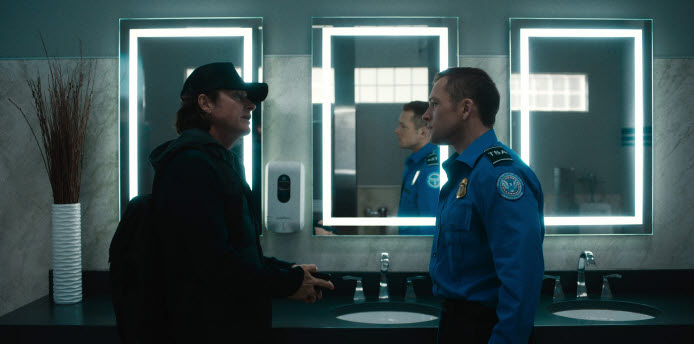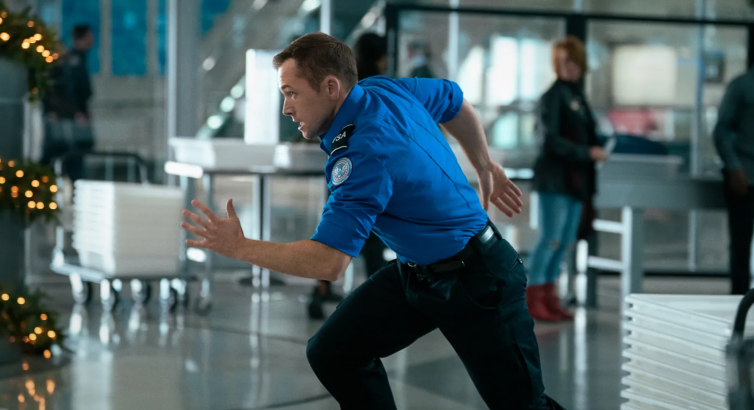
Trap (2024) ☆☆1/2(2.5/4): He gets trapped…

M. Night Shyamalan’s latest film “Trap” seems willing to be trapped along with its hero for a while during its first half. As its hero tries to get away from his increasingly claustrophobic circumstance, the movie steadily dials up and down the level of tension for our entertainment, and we gladly go along with its naughty fun, but then the movie lets down us a lot as suddenly loosening its tight grip on us during its problematic second part. 

At the beginning, we meet Cooper (Josh Hartnett), an ordinary family guy who is taking his adolescent daughter to a big concert of a famous pop singer named Lady Raven (Saleka Night Shyamalan, who is Shaymalan’s another daughter besides that filmmaker daughter of his). While his daughter is quite excited about the concert just like many other young fans entering the stadium where that concert will be soon held, Cooper understandably looks rather disinterested in contrast, and he gets more distracted when he comes across the annoying mother of one of his daughter’s schoolmates.

Meanwhile, as going inside the stadium, Cooper begins to notice something odd. There are lots of security guards and police officers placed here and there inside the stadium, and it also becomes clear to him that the stadium is heavily surrounded by more police officers outside. When he later asks a stadium employee about what is going on, the employee tells him that the police is looking for a notorious local serial killer nicknamed “the Butcher”, who has already killed no less than 12 people.

Cooper becomes quite alarmed for a good reason, because, well, he is actually the one the police is searching for. As a matter of fact, this is not much of a spoiler because his true identity is revealed within the first 10 minutes of the movie, and its promotion poster does not even hide this ‘surprise twist’ at all as shown from the tagline (“30,000 fans. 300 cops. 1 serial killer. No escape.”).

As the camera of cinematographer Sayombhu Mukdeeprom, who previously did a stellar job in Luca Guadagnino’s “Challengers” (2024) early in this year, fluidly follow its evil hero. the movie accordingly attempts to build up suspense as Cooper attempts to evade the police search in one way or another. While he manages to remain one or two steps ahead the police for now, his opponents keep getting closer to him minute by minute as blocking almost all of possible way outs inside the stadium, and he must also pay some attention to his daughter, who slowly begins to sense something wrong about her father even though her mind is mostly occupied with the ongoing concert.    

However, instead of bringing more tension to this intense cat-and-mouse game, Shyamalan’s screenplay takes a left turn in the middle of the story. I will not go into details here, but I can tell you instead that the movie shifts its focus from Cooper around that point, and that is where the movie unfortunately comes to lose its narrative momentum. It provides several competent moments including an unnerving sequence where a certain supporting character must be very careful about whatever Cooper may do next in front of her and others at the spot, but these moments are less thrilling compared to the claustrophobic suspense of the first half, and the eventual finale is pretty contrived to say the least.       

Nevertheless, the movie is carried fairly well by the commendable efforts from Josh Hartnett, who seems to be about to have an unexpected career resurgence as appearing in a number of recent notable films including Christopher Nolan’s “Oppenheimer” (2023). Although I still remember how forgettable he was Michael Bay’s disastrous war drama film “Pearl Harbor” (2001), he is a good actor capable of many other things including Ridley Scott’s “Black Hawk Down” (2001), and he shows here that he can be alternatively charming and cunning as he was in Tim Blake Nelson’s “O” (2001). Although Cooper is quite an unpleasant character to say the least, Hartnett steadily holds our attention as his character smartly handles one obstacle after another while busily keeping looking for any possible way out, and he also bring some sense of dark humor to his character at times. 

In contrast to Hartnett’s diligent efforts, most of the other cast members in the movie simply fill their respective spots without much to do. Ariel Donoghue is suitably plucky for her role, but she becomes quite under-utilized as her character is eventually put aside later in the story. Although two certain famous pop singers appear to support her, Saleka Night Shyamalan is still not as charismatic as, say, Taylor Swift or Beyoncé, and she struggles more than once when her character becomes more substantial along the story. While Alison Pill is mostly stuck with her thankless role, Hayley Mills, a British actress who has been mainly known for the 1960 Disney film “Pollyanna” (She received the Academy Juvenile Award for that, by the way), brings a little touch of class to the film even though her character is more or less than a tool for several obligatory moments of exposition.

In conclusion, “Trap” is not entirely a failure mainly thanks to Hartnett’s compelling performance and Shyamalan’s competent direction, but the movie could be tauter and more intense in my trivial opinion. Sure, this is not as bad as “The Last Airbender” (2010) or “After Earth” (2013), but Shyamalan can do better than this considering some of his several recent works such as “Knock at the Cabin” (2023), and I can only hope that he will soon move onto better things to come after this flawed genre piece.

Posted in Movies | Tagged , , | Leave a comment

The Watchers (2024) ☆☆(2/4): They are being watched…

“The Watchers” looks promising with an interesting story promise shrouded in a good mood and background. As the nervous score by Abel Korzeniowski is swirling on the soundtrack with the heroine going to some very remote area, we can clearly sense that something bad is going to happen sooner or later, so we naturally come to have some expectation, but, alas, the movie does not deliver as much as it promised at the beginning.

Dakota Fanning, who unfortunately has not fully used her considerable talent yet despite her breakthrough turn in “I Am Sam” (2001), plays Mina, a young American girl who has lived in a rural town of Ireland for some time due to a personal reason to be revealed later in the story. She is currently working in a small pet shop, but she does not seem that interested in doing her job as shown from her first scene in the movie, and she does not even respond to the call from her sister living in US.

On one day, Mina is requested to deliver a little precious bird to a certain spot far away from the town. As she drives her car down the road which lead will lead to that spot, cinematographer Eli Arenson vividly captures the vast green scenery of the rural areas of Ireland, and the sense of isolation becomes more palpable as Mina’s car eventually enters some big and wide forest area.

Not so surprisingly, her car suddenly has a serious problem, and Mina soon finds herself getting lost in the forest as trying to get out of the region as soon as possible. As the night is coming, she begins to sense something scary somewhere inside the forest, and, of course, her growing fear turns out to be quite true once the sun goes down.

Fortunately, Mina comes across a shelter at the last minute, where three other people have already been stuck. They are Ciara (Georgina Campbell), Madeline (Olwen Fouéré), and Daniel (Oliver Finnegan), and they tell her about a few rules for surviving day by day. First, though they can be outside during daytime, they must be inside their shelter, which is called “the Coop”, at any chance after the sunset due to the mysterious scary entities called “the Watchers”. Second, they must present themselves in front of the mirrored window to be observed by the Watchers every night, because the Watchers want to watch them for some unknown reason.

While still befuddled by her rather unbelievable circumstance, Mina gradually gets herself accustomed to that as getting to know a bit more about her fellow prisoners, and she and they also try to find any possible way out for them, though that seems quite impossible for good reasons. For example, the forest region surrounding the Coop is too wide to escape from before the sunset, and, above all, the Coop and the forest region are completely isolated from the world outside.

In addition, Mina comes to witness more of how insidious the Watchers are. It becomes more apparent to her (and us) that the Watchers have a certain nasty motive, and she and her fellow prisoners become more desperate as the Watchers come to threaten them more than before. While these disturbing creatures are rarely shown on the screen, the various sounds they make outside the Coop unnerve Mina and her fellow prisoners in one way or another, even though they cannot see whatever is happening outside the Coop (Several scenes in the film surely remind you a bit of the similar scenes in Alfred Hitchcock’s “The Birds” (1963), by the way).

However, the screenplay by Ishana Night Shyamalan, which is based on the novel of the same name by A. M. Shine, often stumbles in case of plot and character development. While it tries to give more character background to its heroine, Mina and several other characters in the story feel mostly flat and bland, and we do not care that much about whatever may happen to them, even though they come across an unexpected possibility of survival later in the story. Some of you may be surprised by this plot turn, but this makes the story all the more preposterous than before, and the eventual finale feels rather overlong despite another plot turn you may easily expect in advance.

The main cast members try as much as possible with their respective parts. Where she has a few moments where she flexes her acting muscle, Fanning often finds herself limited by her mediocre character, and the same thing can be said about Georgina Campbell and Oliver Finnegan. In case of Olwen Fouéré, this Irish veteran actress has a bit more things to do as her character becomes more crucial along the story, and we become engaged to some degree whenever she steals the show.

On the whole, “The Watchers” is dissatisfying in more than one aspect, and that is a shame because Shyamalan, who is, yes, one of the daughters of M. Night Shyamalan (He also participated in the production of the film, by the way), shows some potential here especially during the first half of the movie. She is not a bad filmmaker at all, but I sincerely wish that she may advance a lot more from this failure, and I will be surely glad if she eventually makes her father proud as much as David Cronenberg has been proud of his filmmaker son Brandon Cronenberg these days.

Posted in Movies | Tagged , , , | Leave a comment

By the Stream (2024) ☆☆1/2(2.5/4): A minor misfire from Hong Sang-soo

South Korean independent film “By the Stream”, which is another film from Hong Sang-soo during this year after “A Traveler’s Needs” (2023), sadly did not engage me much as frequently feeling rather thin and vague in terms of story and character. While it is a bit interesting for being Hong’s another notable work mainly driven by female characters, the movie merely plods from one moment to another without much intrigue or amusement for me, and it only ends up being a disappointing misfire compared to the lightweight charm of “A Traveler’s Needs”.

At first, we are introduced to a young female college lecturer named Jeon-im (Kim Min-hee) and her middle-aged uncle. Jeon-im’s several female students have been preparing for a little skit for the upcoming skit competition in their college, but the guy supervising her students had to be let go due to his inappropriate behavior with some of her students. Because only 10 days are left at present, Jeon-im needs anyone who can supervise her students instead, and she requests her visiting uncle to do the job mainly because he was once quite famous as an actor/director before getting blacklisted for some unspecified reason.

Fortunately, Jeon-im’s uncle is willing to take the job, and we see how he works along with Jeon-im’s female students, who are all eager to work under him even though what they are going to do will be quite different from what they have prepared up to that point. He quickly comes to click well with these students, and Jeon-im is certainly relieved to see how her students enthusiastically collaborate with her uncle.

Meanwhile, Jeon-im introduces her uncle to Professor Jeong (Jo Yoon-hee) mainly because Professor Jeong turns out to be a big fan of his works. When Jeon-im and her uncle come to her office, Professor Jeong cannot help but show more admiration to him, but she and Jeon-im’s uncle somehow never delve much into how he became blacklisted at that time (It is only said that he made some very sensitive comments which must have angered many influential figures in his field).

Anyway, they all eventually go to a little nearby restaurant which happens to be located by a local stream, and, like many of Hong’s movie characters, they drink and talk a lot for a while. Although their conversation often feels a bit too superficial without revealing that much about themselves, the performers fill this conversation with considerable spontaneity at least, and you may wonder whether they actually drank during the shooting just like many performers allegedly did during the shooting of Hong’s films.

On the next day, Jeon-im comes across that guy fired by her, and we are accordingly served with a comic moment of pettiness you can expect from Hong’s works. As he attempts to get employed again by Jeon-im, he keeps trying to avoid his responsibility for whatever happened between him and some of her female students, and, not so surprisingly, there comes a point where Jeon-im comes to draw the line between her and this pathetic dude.

While the situation becomes a bit more absurd when this guy appears again later in the story, the new skit by Jeon-im’s uncle goes through its short but smooth preparation. Although the movie is adamantly very ambiguous about what his skit is really about, Hong’s camera simply watches Jeon-im’s female students performing together on the stage without any interruption, and I must say that this is surely something we do not usually get from Hong’s movies.

However, Hong’s screenplay sadly fails to develop these young female characters more along the story. When one of them turns out to be quite close to the aforementioned dude, this moment looks so dim in its nocturnal background that we are not very sure about which of these young ladies is the one associated with him. Around the last act of the film, Jeon-im’s uncle encourages them to express their respective feelings about themselves at their little celebration party, but their words mostly feel bland and perfunctory, and we still remain distant to them despite the earnest efforts from the four good actresses playing them (They are Kang So-yi, Park Han-bit-na-ra, Oh Yoon-soo, and Park Mi-so, by the way).

In case of several other main cast members, who are incidentally Hong’s usual collaborators, they have more materials to handle in comparison. Kwon Hae-hyo, who has virtually been Hong’s alter ago as appearing in a number of Hong’s recent films including “Walk Up” (2022), is effortless in his several comic moments in the film, and he and Jo Yoon-hee, who previously appeared along with Kwon in “A Traveler’s Need”, did a good job of suggesting whatever is being exchange between their characters beneath the surface. Kim Min-hee, who received the Best Performance Award when the movie was shown at the Locarno Film Festival in last month, ably fills her rather broad role with her own charm and presence, and I wish the movie explored more of her character’s modest but intriguing artistic activity, which is incidentally associated with the title of the film to some degree.

In conclusion, “By the Stream” is not as enjoyable as “A Traveler’s Need”, and that reminds me again of how I have become relatively less engaged in Hong’s works during last several years. It is admirable that he continues to try new stuffs, but the result feels rather shallow to me like “In Water” (2023) or “In Our Day” (2023), and I am already quite ready to move onto whatever he will give us in the next year.

Posted in Movies | Tagged , , | 1 Comment

Sing Sing (2023) ☆☆☆1/2(3.5/4): As they prepare for another show in their prison

It is always fascinating for me to observe different people and lives via good movies, and “Sing Sing” is one of such terrific films. Although most of its main characters are quite different from me in many aspects, I observed their collective artistic efforts with considerable interest and fascination, and I was touched a lot by how they try to endure and prevail under their imprisoned status – and how the movie illustrates their little drama with a lot of human understanding and empathy.

The main background of the story is Sing Sing Maximum Security Prison, which is located in the New York state of US. At the beginning, we see John “Divine G” Whitfield (Colman Domingo) and his fellow inmates doing a little stage performance together as the members of Rehabilitation Through the Arts (RTA) program, and they all are delighted and excited as they finish their latest project pretty well on the whole, though they will soon have to go back to their respective cells after taking off those stage costumes and then wearing their prison uniforms.

Anyway, Divine G and his fellow RTA members are already ready for another show to come while supervised by their civilian director Brent Buell (Paul Raci) as usual, and we are a bit amused as they discuss about what they will do next. After some heated discussion, it is eventually decided that they are going to do something more lightweight, and Buell is willing to provide a little comic science fiction play he wrote some time ago.

What follows next is how Divine G and the other RTA members prepare for their new show during next several days. After reading Buell’s play (It is titled “Breakin’ the Mummy’s Code”, by the way), Divine G, Buell, and several other RTA members hold the audition, and we watch each of their colleagues trying their best for getting the roles they respectively want to play.

One of the RTA members going through the audition is Clarence “Divine Eye” Maclin, who incidentally plays himself here just like many of the cast members of the film. Although he did not seem that interested in acting when he was recruited by Divine G, Divine Eye gradually comes to show more interest and passion as being often encouraged more by Divine G and the other RTA members, and he eventually gets himself cast as a certain key character in Buell’s play, though Divine G is not that pleased with that for an understandable reason.

Nonetheless, Divine G keeps things rolling for the group along with Buell, who may be a little annoyed at times but still respects Divine G’s leadership. Whenever Divine Eye struggles in one way or another, Divine G and the other RTA members are always willing to help and support Divine Eye, and there is a little poignant moment when one of them shows more of himself to cool down Divine Eye a bit in the middle of their rehearsal.

And we also observe more of why Divine G and his colleagues have been so passionate about their theater program for years. Most of them have been incarcerated for many years without much hope for getting released from the prison someday, and we come to understand that their artistic activities have been a sort of personal therapy process for themselves. Plainly but vividly conveying to us their despairing status of imprisonment throughout the film, the cinematography by Pat Scola, who shot the movie on the 16mm film in 1.66:1 ratio, sometimes sticks very close to the main cast members of the movie, and we come to pay more attention to their expressive faces, which often give us the glimpses of their life stories even when they do not seem to signify that much on the surface.

It goes without saying that the movie depends a lot on its main cast members, and director/co-writer/co-producer Greg Kwedar, who wrote the screenplay with co-producer Clint Bently (It was developed from the story written by them, Maclin, and Whitfield himself, which is based on Buell’s aforementioned play and John H. Richardson’s 2005 Esquire article “The Sing Sing Follies”), draws stellar natural performances from his cast members. Needless to say, Colman Domingo, who has been more prominent thanks to his recent Oscar-nominated performance in Netflix film “Rustin” (2022), surely draws our attention first with another superlative performance to watch, but he does not overshadow at all his fellow cast members, who are all convincing as filing their respective parts with enough life and personality to observe. Maclin, who is a definite standout in the bunch, and his fellow RTA members click well together whenever they pull or push each other during a number of key scenes among them, and Paul Raci, who has been more notable thanks to the well-deserved Oscar nomination for his wonderful supporting turn in “Sound of Metal” (2020), and Sean San José flawlessly get themselves mingled into the ensemble even though they are professional actors just like Domingo.

Overall, “Sing Sing” is one of the most impressive movies of this year due to its considerable emotional power, and it will move you a lot while also making you reflect more on that transformative power of art – especially when it shows a series of archival footage clips of the various stage performances from Whitfield, Maclin, and their fellow RTA members. To be frank with you, I have no idea on how much the movie itself is close to their real-life stories, but it sublimates their real-life stories into something quite memorable mainly thanks to their active joint participation in its production, and it is surely something you should check it out as soon as possible.

Posted in Movies | Tagged , , , | 2 Comments

Ghostlight (2024) ☆☆☆1/2(3.5/4): A personal healing via art

“Ghostlight” is a modest but extraordinary human drama about the surprising healing power of art. Mainly revolving around one plain man’s struggle to understand and process his anger and grief via one unlikely artistic opportunity, the movie comes to show a lot of compassion and understanding to not only him but also several other characters in the story, and we are eventually touched a lot as observing how much he gets better around the end of the movie.    

At the beginning, the movie slowly and subtly establishes how things have been quite depressing for a construction worker named Dan Mueller (Keith Kupferer). He and his wife Sharon (Tara Mallen, who is incidentally Kupferer’s real-life wife) have been estranged from each other for a certain issue to be revealed later in the story, and we also come to gather that this certain issue in question also puts a lot of strain on his relationship with his adolescent daughter Daisy (Katherine Mallen Kupferer, who is, yes, Kupferer and Mallen’s real-life daughter).

 On one day, Mueller happens to have a little clash with some very rude driver when he is working outside, and then he is approached by an actress named Rita (Dolly de Leon, who looks quite different from her breakthrough supporting turn in Ruben Östlund’s Oscar-nominated film “Triangle of Sadness” (2022)). She and several other performers are preparing for a little local stage production of William Shakespeare’s “Romeo and Juliet”, and, after seeing what has just happened to Mueller, Rita thinks he needs some positive influence for dealing with whatever he is struggling with.    

All Mueller has to do is reading a few lines for Rita, who is going to play Juliet, and her fellow performers, but then he finds himself getting involved into their stage production much more than expected. He comes to show more interest in acting, and he even asks a bit about that to his daughter, who incidentally has a fair amount of stage experience due to the extracurricular activity in her school. Thanks to his daughter, he come to learn about how to memorize lines efficiently, and he also comes to learn from his new colleagues that acting is much more than memorizing lines.  

When the actor who is going to play Romeo suddenly quits due to his petty problem with looking intimate with Rita, that leads to an unexpected breakout for Mueller. After he shows much more of the personal grief behind his taciturn attitude, Rita and her colleagues console him a lot, and then he finds himself being cast as the new Romeo for their stage production.

Meanwhile, Sharon and Daisy come to suspect that something fishy is going on behind him, especially after they happen to witness and then misunderstand a little private moment between him and Rita. Fortunately, the screenplay by directors Kelly O’Sullivan and Alex Thompson, who previously collaborated with each other as the lead actress/writer and the director in “Saint Frances” (2019), is too thoughtful to resort to “Idiot Plot”, a term popularized by my late friend/mentor Roger Ebert. Instead of wasting its running time on any contrived situation of misunderstanding and obliviousness between Mueller and his wife and daughter, the story goes straight to a quick moment of resolution among them, and we get a bit more amused as his wife and daughter provide more help and support than expected.

However, the movie never overlooks their lingering anger and grief associated with their big personal loss. I will not go into details here, but there is a good reason why “Romeo and Juliet” resonates a lot with Mueller’s grieving mind, and we are not so surprised when Muller finds it quite difficult to do the rehearsal on that famous climactic scene of “Romeo and Juliet”.

As the quiet but ultimately harrowing center of the story, Keith Kupferer is particularly good when his character struggles to hold himself for what is supposed to be a very important moment for himself and his family later in the story. As Mueller is trying to depict what is probably the most painful moment in his whole life, Kupferer is dexterous in his character’s dynamic emotional shifts, and the result is devastating to say the least. Considering that he has been relatively unknown despite starting his movie acting career 20 years ago, the movie is certainly Kupferer’s big breakthrough moment, and his superb performance here in this film may led to better things to come in his career.

Around Kupferer, O’Sullivan and Thompson assemble a number of engaging performers to watch. While Tara Mallen and Katherine Mallen Kupferer always click well with Kupferer in their interactions on the screen, their unadorned natural supporting performance is another crucial factor in the dramatic effectiveness of the climactic part of the film. Dolly de Leon and several other performers playing Rita’s colleagues are believable in their occasional moments of collective positive vibe, and they certainly make a good counterpart to the dark emotional issues surrounding Muller and his family.   

On the whole, “Ghostlight”, whose title refers to a theatrical tradition that calls for a single bulb to remain lit on a stage even when the rest of the theater is literally (and figuratively) dark, is an earnest but powerful piece of work which distinguishes itself a lot via its sensitive and thoughtful handling of story and characters, and its somber but moving final shot, which subtly suggests a bit of hope and optimism, will linger on your mind for a while after it is over. In my inconsequential opinion, this little precious gem is really too good to be overlooked, and I assure you that you will agree that it is also one of the best films of this year.

Posted in Movies | Tagged , , , , , , | 1 Comment

His Three Daughters (2024) ☆☆☆1/2(3.5/4): As they wait for their father’s death

Netflix film “His Three Daughters”, which was released a few days ago, trusts its main cast members for going up and down within its modest but intense chamber family drama, and I enjoyed that a lot. As its three main characters clash with each other in one way or another, we get to know about them as well as their troubled relationships, and it surely earns all the emotions unfolded along the story.

The movie opens with a rather awkward private conversation among three sisters: Katie (Carrie Coon), Rachel (Natasha Lyonne), and Christina (Elizabeth Olsen). Their ailing father, who has been taken care of by Rachel during last several years, seems to be going through the last few days of his life, and Katie and Christina, who have respectively lived away from Rachel and their father, come to Rachel and their father’s old apartment for having their last moment with him.

As they are merely waiting for their father’s death which may come sooner or later, we gradually gather some personal details about them. While Katie is often frigid as taking care of several matters including making her father sign a Do Not Resuscitate (DNR), Christina is usually trying to make the situation less unpleasant for everyone including herself, and Rachel, who is incidentally the daughter of their father’s second wife (Both of his two wives already died, by the way), does not look that responsible as frequently smoking marijuana, though it is undeniable that she is the one who has always stood by their father during his ongoing period of illness.

It goes without saying that Katie does not approve much of how Rachel has responded to their ongoing circumstance, and that naturally becomes the main source of tension along the story. As they frequently conflict with each other over one matter of another, Christina is always the one who must calm down her two sisters, but then there eventually comes a point where she almost runs out of her patience.

Meanwhile, several other people come and go as they continue to wait for their father’s death. A hospice worker and a nurse make a routine visit on their father, and both of these figures show some care and compassion to them and their father as seasoned professionals. As a matter of fact, the hospice worker carefully suggests to them that an “accident” can happen to shorten their father’s ongoing pain before his eventual death, but they decide to keep waiting instead of doing such a questionable thing like that.

Another crucial supporting character in the story is Rachel’s boyfriend, who drops by her residence for giving some comfort and consolation. Like us, he instantly discerns the emotional distance between Rachel and her two stepsisters, and he sharply points out to Katie and Christina that Rachel actually feels more pain and grief for having been with their father all the time.

The third act of the story becomes melodramatic as the three sisters come to express more anger, sadness, and resentment among them, but the movie never loses its control as immersing us more into their situation. While looking a bit static at first, the cinematography by Sam Levy gradually becomes fluid in its subtle movements, and we come to observe more of the accumulating emotional tension among the main characters.

The screenplay by director/writer/editor/co-producer Azazel Jacobs also did a splendid job of fleshing out its main characters more along the narrative. While Katie turns out to have held a lot of frustration with her own life behind her rather haughty façade, Christina is revealed to have her own personal doubt behind her sunny attitude, Rachel comes to show more thoughtfulness behind her rather messy appearance.

In case of the finale, I will not tell you anything except that I really admire how effortlessly Jacobs and his main cast members deliver the emotional high point of the story. At first, I thought the movie showed a bit too much of what is going on among its main characters, but, what do you know, there comes an unexpectedly sublime moment to behold, and you will surely appreciate the emerging poignancy behind it.

The three main cast members of the film are all terrific in each own way. While Carrie Coon, who has steadily risen since I and many others noticed her substantial supporting turn in David Fincher’s “Gone Girl” (2014), ably imbues enough humanity to her rather edgy character, Nathasha Lyonne, who has been more notable thanks to her breakthrough turn in Netflix TV series “Orange Is the New Black”, is splendid as slowly revealing her character’s complex emotional issues, and Elizabeth Olsen, who is capable of doing many other things besides those Marvel Cinematic Universe (MCU) products, is equally excellent as deftly holding her own place between her two co-starts. In case of several minor supporting performers in the movie, Jovan Adepo, Rudy Galvan, Jose Febus, and Jasmine Bracey are all solid in their respective parts, and the special mention goes to Jay O. Sanders, who has a fabulous showstopper moment later in the story.

In conclusion, “His Three Daughters” is quite compelling thanks to its skillful handling of story, mood, and characters, and Jacobs, who previously drew my attention for “Terri” (2011) but disappointed me a bit in “French Exit” (2020), and his crew and cast members surely deserve to be praised for their superlative result. In short, this is one of the better movies from Netflix during this year, and I wholeheartedly recommend you to check it out as soon as possible.

Posted in Movies | Tagged , , , | 1 Comment

Hundreds of Beavers (2022) ☆☆☆1/2(3.5/4): The Trouble with Beavers

“Hundreds of Beavers” is a little quirky independent film which never stopped amusing or surprising me. Steadily building up its comic momentum along its hilariously loony narrative, the movie provides a series of very funny and creative moments to be savored, and it will certainly linger on your mind for a long time along with those many beavers in the movie.

The movie, which is set in somewhere in the northwestern region of US during the 19th century, begins with a musical sequence humorously introducing an applejack salesman named Jean Kayak (Ryland Brickson Cole Tews, who wrote the screenplay along with director/editor Mike Cheslik in addition to serving as a co-producer) – and how his big orchard is unfortunately destroyed not long before snowy winter comes. Naturally becoming quite cold and hungry, Kayak desperately tries to find any possible option for his survival, and the movie serves us a number of broad but amusing slapstick moments reminiscent of those old silent film comedy films including Charlie Chaplin’s “The Gold Rush” (1925). Despite the frequent absence of dialogues, the comic setup of these moments is clearly and precisely conveyed to us, and the movie always finds something to surprise or amuse us as its hero fails to achieve his goal again and again.

Anyway, after numerous silly but uproarious incidents of trials and errors, Kayak manages to survive, and then he comes to work as a fur trapper after getting some help from some other fur trapper. As he subsequently becomes a bit more skillful in hunting those furry creatures out there, he finds himself very attracted to the young and beautiful daughter of a local merchant, who, of course, does not approve of this at all even while dealing with Kayak as usual.

Like many heroes of the silent comedy films of Buster Keaton, Kayak certainly gets quite determined to get the merchant’s approval of marrying his pretty daughter, and we soon see how he concocts a number of funny and clever plans to catch a lot more of those furry animals out there. His usual targets are beavers, but, what do you know, those beavers turn out to be rather challenging targets as they are building something huge on a nearby river, and there are even two certain beavers investigating on a series of killings committed by him (How they look like is another big laugh in the film, by the way).

As far as I can remember, more than 300 beavers are killed on and off the screen in the film, but I assure you that you do not have to worry at all even if you are an ardent animal lover. All the animal figures in the film are not real as being played by the actors wearing animal suits or presented via animation, and this silly surreal touch is actually more enhanced by the grainy black and white film style of the movie. At first, this certainly looks outrageous to us, but we somehow come to accept this as being more amused by a considerable amount of humor and wit behind this. While the movie gleefully pushes its premise and style further, we are more impressed in addition to being more tickled than before, and you will not mind at all even when the movie throws several hilariously gruesome moments later in the story.

In the end, everything culminates to a big clash between our hero and hundreds of beavers trying to do much more than stopping him. I will not tell you anything about what they are willing to do to him, but I can tell you instead that they can be as unpleasant and disturbing as those big parakeets in Hayao Miyazaki’s recent Oscar-winning animation film “The Boy and the Heron” (2023).

According to the Wikipedia, its production budget was only $150,000, but the movie does not look that cheap at all as Cheslik, who incidentally made a feature film debut here and after previously making several short films, and his small crew members tried as much as they could with their small budget. You will instantly see how Cheslik added low-budget special effects here and there in the film, but the overall result is not only effective but also serves well the surreal comic style of the movie on the whole, and I particularly enjoyed the sheer comic lunacy of the climax sequence where our hero is frantically running away from hundreds of beavers.

Once the shooting was completed in early 2020, Cheslik and his small crew members had to go through a rather long period of post-production before the film was eventually premiered at Fantastic Fest in 2022. The movie subsequently got more attention as being shown at several other film festivals, and then it received a video on demand (VOD) release in US early in this year. So far, it has drawn lots of positive responses from audiences and critics. and that is how it came to draw my attention several weeks ago. Although I was a bit tired at last night, my mind soon got stimulated by its quirky style and naughty sense of humor, and I and a friend of mine had a really fun time together as getting constantly amused throughout our viewing.

In conclusion, “Hundreds of Beavers” is a truly singular comic piece of work to be admired and appreciated, and it is definitely something worthwhile to check out if you are really looking for something fresh and different. In short, this is one of the most impressive films of this year in addition to being one of the funniest ones I have ever seen during last several years, and I am already ready to revisit it someday for getting more laughs.

Posted in Movies | Tagged , , , | 1 Comment

Thelma (2024) ☆☆☆(3/4): One spirited old lady

The most marvelous thing about “Thelma” is how its lead actress makes the movie more special in addition to being perfectly cast for her titular role. Although she is soon going to have the 95th birthday, June Squibb has been more prominent than before as one of the most dependable character actresses in Hollywood since her late Oscar-nominated breakthrough turn in Alexander Payne’s “Nebraska” (2013), and now she gladly takes the center at last as bringing a lot of heart and spirit to the film.

At the beginning, we get to know a bit about the daily life of Squibb’s character. Although she is over 90, Thelma does not have much problem with living alone in her residence located somewhere in a suburban neighborhood around LA. While her daughter and son-in-law are usually too busy to pay much attention to her, her adult grandson Daniel (Fred Hechinger) is the one who occasionally comes to her house and handles his grandmother’s daily matters because, well, there is nothing much to do for him besides that at present, and there is an amusing moment when he patiently guides her on how to use the Internet with her computer.

On one day, Thelma receives a call supposedly from her grandson, which urgently requests her to send a substantial amount of cash as the bail to get him out of a county jail as soon as possible. Needless to say, this turns out to be a voice-phishing scam, and she belatedly comes to realize that not long after sending the money via mail. While consoled a bit by her family members, she soon becomes determined to locate that voice-phishing criminal, and, fortunately, there is the address for a certain P.O. box where her cash was sent.

However, Thelma still needs a bit of extra help, so she looks for any friend who may help her, but she is reminded again of how her life has been getting smaller and emptier. Many of her friends were gone in one way or another, but a certain close friend of hers is still alive and well in a local facility for old people. That person in question is Ben (Richard Roundtree), and he happens to have an electronic 2-person scooter. Despite his initial reluctance, he eventually joins Thelma’s rather risky quest, and Thelma surely feels a little more excited for having her friend behind her.

As these two characters are slowly moving toward their final destination, the movie takes some time for more character development. At one point, Thelma and Ben drop by an old friend of theirs for a certain hidden purpose, and the mood becomes humorous when Thelma is trying to find something upstairs while Ben is buying time downstairs, but they also notice how things have been depressingly static and barren for their friend, who simply seems to be spending her whole day in her living room sofa.

While being reminded more of her approaching mortality, Thelma is not daunted at all because she is willing to go for more as enjoying her life, and we get a few comic scenes where she and Ben have to be a little more physically active. Although she is not as virile as Tom Cruise at all, Squibb demonstrates here that she can be quite feisty and spirited just like my grandmother who is also over 90 now, and we laugh more whenever her character seems to recognize someone in the past just like many old persons often do.

Meanwhile, the movie sometimes shifts its focus to Thelma’s family members including her grandson, who are certainly alarmed when she goes out for her little mission without telling them anything about that. Although this part feels rather perfunctory, the movie shows some care to these supporting characters as they come to show more sincerity as trying to locate where the hell Thelma is now. As Thelma’s daughter and son-in-law, Parker Posey and Clark Gregg provide extra humor to the film, and Fred Hechinger is also fine in his earnest supporting performance. Although Daniel may be your average slacker, he really cares a lot about his grandmother, and he also becomes a bit more serious about where his life has been going.

In the end, the story arrives at the expected climactic part along with Thelma and Ben, but the screenplay by director/writer/editor Josh Margolin does not hurry the story and characters at all even at that point. I will not go into details here for not spoiling the fun from the brief but effective appearance from a certain recognizable actor, but I can tell you instead that Squibb deftly holds the center to the end with the steady support from Richard Roundtree, who sadly passed away in last year.

Overall, “Thelma” is a small but charming comedy film which reminds me again of how fortunate I and many other moviegoers have been for watching Squibb appearing here and there in a number of various notable films such as Martin Scorsese’ “The Age of Innocence” (1993) and Todd Haynes’ “Far from Heaven” (2002). Believe or not, she actually began her acting career in 1948, and she only started to appear in movies after she made a debut in Woody Allen’s “Alice” (1990). According to Internet Movie Database (IMDB), she already has three new films to be added to her long filmography, and I sincerely hope that she will keep moving on during several more years at least while putting more dent on the ageism in Hollywood show business.

Posted in Movies | Tagged , , | 1 Comment

The Nature of Love (2023) ☆☆☆(3/4): Her messy pursuit of romance

Canadian French film “The Nature of Love” is about one intelligent adult woman’s messy pursuit of romance. As following the ups and downs in its heroine’s romance story, the movie makes some sharp points on love and relationship, and the result is alternatively humorous and poignant before eventually reaching to the inevitable point where she must be really honest about her feelings.

At the beginning, the movie observes how things are mostly stable and comfortable for Sophie (Magalie Lépine-Blondeau), a forty-something lady who has taught philosophy at some university in Montreal, Canada. She has lived with a guy named Xavier (Francis-William Rhéaume) during last several years, and we see that both of them have been pretty fine with their current married life. Although they use separate bedrooms in their apartment, they are quite frank about themselves to each other, and there is an amusing scene where Sophie teasingly asks her husband whether he was really attracted to a certain young woman they met via a close friend of theirs.

And then there comes an unexpected moment of sexual attraction for Sophie on one day. When she comes to their country house outside the city, she encounters a hunky local handyman named Sylvain (Pierre-Yves Cardinal), and she cannot help but attracted more to him as he casually points out many stuffs to be fixed in the country house. After their first meeting, she cannot help but think more and more of this handsome dude, and then, what do you know, Sylvain turns out to be quite attracted to her, too.

Once they confirm their mutual attraction to each other, Sophie and Sylvain let themselves driven more by it, and we are accordingly served with several carnal moments between them. As they spend more time together, they become more fixated on each other, and this bothers Sophie a lot. Although she and Xavier actually agreed to be flexible about their relationship, her feelings toward Sylvain only get stronger day by day, and there eventually comes a point where she spills out everything in front of her husband, who is not that surprised but feels quite hurt nonetheless when Sophie tells him that she will soon leave him for Sylvain. 

For a while, Sophie feels really happy and excited to be around Sylvain, but, not so surprisingly, it does not take much time for her to see more of Sylvain’s less attractive sides. For example, Sylvain is your average working-class dude who is far less sophisticated than Sophie, and we become more aware of the considerable social/cultural gap between him and Sophie – especially when they happen to have a dinner with his family at one point. In addition, Sylvain also can be quite rude and harsh to Sophie over petty matters, and that is more than enough to make her very disillusioned about their relationship.

While its heroine comes to struggle over her matters of heart in one way or another, the screenplay by director/writer Monia Chokri, who also incidentally played Sophie’s best friend in the film, observes her increasingly messy circumstance with more humor and understanding. We get some laughs as she makes several unwise choices along the story, but we also come to understand her confusion and conflict more. Yes, she simply wants more romance and excitement in her life, and you will surely emphasize with her more if you have ever been as messy as her in your pursuit of love and relationship (Full Disclosure: I have been in such a state more than once during last several years since I came out as a gay in 2016). 

In the end, everything in the story culminates to the climactic scene where our heroine should make a big decision for herself, and I admire how deftly Chokri handles this crucial moment. While nothing is directly expressed across the screen, a small action made by our heroine feels quite dramatic nonetheless, and we can clearly sense her silent but firm decision on her life.

The movie depends a lot on the romantic mood generated between its two lead performers, who often spark the screen with the palpable chemistry between them. As the center of the film, Magalie Lépine-Blondeau is engaging as flawlessly illustrating her character’s complex feelings during several key scenes of hers in the film, and she is complemented well throughout the film by Pierre-Yves Cardinal, whom you may remember for his solid supporting performance in Xavier Dolan’s “Tom at the Farm” (2013). As Sophie’s less-than-perfect husband, Francis-William Rhéaume holds his own place well around the story, and he is especially good when his character desperately attempts to get closer to his ex-wife later in the story.

In conclusion, “The Nature of Love” is pretty familiar in terms of story and characters, but its story is presented well with enough intelligence and emotion in addition to giving us some valuable insights on love and relationship, which remind me of what my late mentor/friend Roger Ebert wrote in his review on Woody Allen’s “Husbands and Wives” (1992): “True love involves loving another’s imperfections, which are the parts that tend to endure.” Like the main characters of that incisively funny but painful comedy film, Sophie comes to learn that hard truth around the end of the story, but I think she will be eventually okay even though many things remain very uncertain around her. At least, she has now a full control on her life and herself as before, doesn’t she?

Posted in Movies | Tagged , | Leave a comment

Transformers One (2024) ☆☆☆(3/4): One of better Transformers flicks

Animation feature film “Transformers One” is one of the better Transformers flicks during last 17 years. Yes, I did not like most of those Transformers movies except a very few cases including “Bumblebee” (2018), so this may not sound like much of a compliment (I still shudder at how much I suffered due to “Transformers: Revenge of the Fallen” (2009) and several following pointless sequels, by the way), but I must tell you that “Transformers One” leaps way, way, way beyond the dreadfully low standard of these awful products at least.  

The early part of the film quickly establishes the history of the alien planet where its main characters and many other robots live. For many ‘cycles’, most of them have worked as miners because their underground city constantly needs a precious energy source after a big battle with some other alien race, and they all certainly hope that their current leader, Sentinel Prime (voiced by Jon Hamm), will eventually find a certain invaluable item outside and then free them from their relentlessly demanding mining work someday. 

However, a young robot named Orion Pax (voiced by Chris Hemsworth) is not someone who will just wait for any possible salvation. Quite determined to find any clue which may lead him to that invaluable item in question, Orion is ready to try anything for his ultimate goal, and he frequently causes new headaches for his two close colleagues D-16 (voiced by Brian Tyree Henry) and Elita-1 (voiced by Scarlett Johansson).

When a big annual race is about to be held in the city, Orion comes to have a rather impulsive plan for proving himself more to others including Sentinel Prime. He participates in that race along with D-16 without telling anything to D-16 in advance, and we accordingly get the first main action sequence in the film, which feels quite frantic at first but seldom gets us confused thanks to the strong visual sense of direction.    

Anyway, Orion and D-16 consequently get themselves demoted to a more miserable job, and that is the beginning of their little adventure outside their city. Thanks to a little help from their accidental robot friend, they soon find themselves exploring the surface of their planet along with him and Elita-1, who reluctantly joins their quest for that invaluable item.

Now the story feels pretty much like your average dystopian tale, and the screenplay by Eric Pearson, Andrew Barrer, and Gabriel Ferrari is rather predictable in the following narrative development, but director Josh Cooley, who received an Oscar for his previous animation film “Toy Story 4” (2019), and his crew members fill the screen with small and big background details to be appreciated. While the result may not look that impressive compared to the standard of Pixar or Ghibli animation films, the film is actually packed with much more style and personality compared to many of live action Transformers flicks, and it surely reminds me again that the Transformer robots are more suitable for animation than live action film. In my reviews on many of recent Transformers movies, I frequently complained that I could not hardly distinguish one robot from another except Optimus Prime and Bumblebee. In contrast, the robot characters in “Transformers One” are much more colorful with enough detail and personality to be appreciated, and I was particularly amused by a herd of robot deer shown during the middle of the film (How do they eat and live, I wonder?).

Above all, the movie gives us the story and characters we can actually care about. While Orion’s narrative often feels conventional, it is engaging to watch how he is changed via his earnest quest for proving himself, and the story also becomes a bit more gripping for the dramatic character arc of D-16, who becomes quite different after he and his colleagues later come to learn about how they and many other robots have been deceived and exploited for a long time. The film inevitably goes for a lot of action during its last act, but we remain engaged in the story and characters nonetheless, and that is the main reason why the finale works even though it was pre-determined from the very beginning.

Furthermore, the robot characters in the film sound relatively more individual as the main voice cast members are allowed to bring more spirit to their respective roles. While Chris Hemsworth did a commendable job of sounding both noble and earnest with some sense of humor, Scarlett Johansson, Keegan-Michael Key, Jon Hamm, Steve Buscemi, and Laurence Fishburne are also solid in their game efforts, and Brian Tyree Henry, who has steadily risen as one of the most dependable actors in Hollywood during last several years, is an inarguable standout as powerfully illustrating his character’s narrative with a devastating sense of classic tragedy.

On the whole, “Transformers One” surprised me for being much more entertaining than expected. Yes, this is still a standard origin story, but the overall result is definitely a significant improvement compared to many Transformers flicks at least, and it is even more recommendable than several forgettable animation films of this year including, say, “Despicable Me 4” (2024). While I still have some reservation at this point, I am glad to see that there is a bit of hope and potential in its franchise at last, so I guess I can have some expectation on whatever may come next after this solid piece of entertainment.

Posted in Movies | Tagged , , , | Leave a comment