


While geese were walking around the campus, cats were having a lazy rest…
 “The Selfish Giant” is a tough film to watch from the start. Like others surrounding them, its two young heroes are hopelessly stuck in their grim, harsh world at the fringe of society, and it is really depressing to watch them being drifted to the future with no hope or happiness. The movie is not entirely without warmth or humor, but this is ultimately a gloomy film packed with desperation and sadness, and it will strike you hard with a number of powerful emotional wallops generated from its stark realism.
As mentioned at the beginning of its end credits, the movie was inspired by Oscar Wilde’s famous fable “The Selfish Giant”, but you will not see much of the similarity between that gentle fable and the movie itself, though a number of connections can be easily made between them. While it does not look bad at first, an impoverished neighbourhood of Bradford, Northern England is as barren as the selfish giant’s solitary garden on winter days, and its people are mostly at the bottom of their life while struggling to make a living through any possible ways or just idling away with their passing miserable days. Nobody seems to have proper job, and it looks like collecting and selling scraps is the only way to earn some money to live through another hard day.
The movie observes this shabby life through Arbor (Conner Chapman) and Swifty (Shaun Thomas), two different young boys who have been always close to each other and have sort of complemented each other as a contrasting duo. Arbor is a short and hot-tempered boy who clearly has some behavioral problem (he has been medicated for that), and Swifty is a taller and chubbier boy with gentle, passive attitude which makes him an easy target for bullying at their school. Whenever watching them hanging around together, you cannot help but think of many famous mismatched duos such as Laurel and Hardy – or George and Lenny in John Steinbeck’s “Of Mice and Men”.
 We see how their close friendship has been a respite from their unhappy life. Arbor’s addict brother Martin (Elliott Tittensor) always brings troubles into Arbor’s home, and their mother Michelle (Rebecca Manley) looks already exhausted and overwhelmed by the hardships in her daily life, and the same thing can be said about Swifty’s mother (Siobhan Finneran), who also looks doomed in her domestic life filled with her crummy husband and a bunch of their kids. Both of these tired mothers sincerely want their sons to get a better chance of life denied to themselves, but, to their despair, life does not go well for them and their sons again; Arbor is expelled from the school after his latest trouble caused by his attempt to protect Swifty from bullying kids, and Swifty may go along with his friend if that is what he wants.
They begin to collect scraps to earn money for themselves, and then they get involved with Kitten (Sean Gilder), a local scrap dealer who is not as cute as his nickname suggests. He lends them his horse and cart for collecting more scraps, but he always demands the fee for that while making sure that he gets enough profit from the scraps collected by the boys. Like other unscrupulous scrap dealers in his neighbourhood, he is willing to use any chance to earn extra profit no matter how unethical and illegal it is, and he makes Arbor and Swifty steal expensive electric cables from nearby railways and power utilities, just because they are suitable as minors to be exploited (As told to Arbor at one point, stealing cables is a serious crime, but minors will be punished lightly even if they get caught).
And he also sees another chance of profit from Swifty when he finds that Swifty has a natural talent in handling horses. There is an impressive sequence which shows his horse competing with the other horse during an illegal harness racing on the highway, and the movie patiently builds the tension and excitement along the race course as closely watching these poor animals and their handlers virtually being pushed by the loud, cheering crowd on following vehicles. You may have some worry while watching this sequence, but, as far as I heard from others, no animal was harmed or endangered during the shooting.
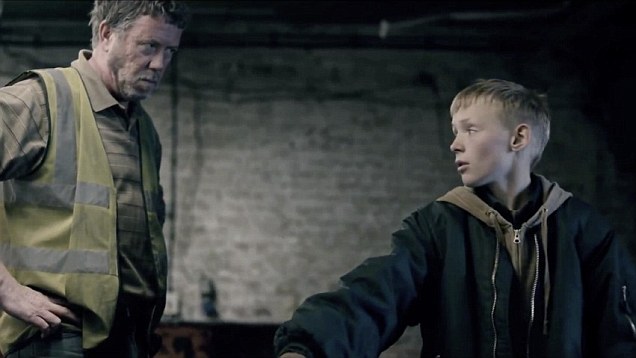 The movie is the first feature film by the director/writer Clio Barnard, and she shows here that she is a talented director to watch. Through the modest but admirable realistic approach reminiscent of Ken Loach’s works and other British kitchen sink dramas, she lets us be involved in her story and characters, and we gradually see the indirect social commentary behind them. The failure of the system is evident as we observe things through the viewpoint of her characters, and their gray environment represented by tall power transmission towers and imposing power plant buildings constantly reminds us of the hopelessness of their life condition which promises nothing but the depressing inevitability to come. They hope that they want to go up with their own life, but, as you know, life is not as easy as they think, and the harsh reality of their life is bound to strike them in one way or another.
Its young lead actors, who had no previous acting experience, are simply superlative thanks to not only their unadulterated performances but also the natural chemistry between them. Conner Chapman is terrific as a compelling mix of defiance and innocence; Arbor is a tough kid who can hold his brash attitude in front of two visiting policeman during one amusing scene, but we can still see a little vulnerable boy behind his cocky swaggers. Shaun Thomas is equally good as bringing pathos and poignancy to his gentle character, and he is especially wonderful when Swifty quietly struggles with his conflicting emotions right after an incident which he believes his friend is responsible for. Chapman and Thomas are supported well by the adult actors surrounding them; Sean Guilder has his own moment when his unlikable character has to accept the consequence of his heartless action, Rebecca Manley and Siobhan Finneran are also commendable as the mothers with many things to worry about besides their problematic sons.
Like many of its senior films, “The Selfish Giant” has a sudden dramatic plot turn to strike both its characters and the audiences around its third act. I was not so surprised by that, but then the movie surprised me with the resulting emotional resonance which stayed on my mind very long after it was over. As I said before, this movie is a hard stuff, but it is a very well-made film with considerable power and realism, and that makes it quite worthwhile to watch in spite of its gloomy subject.

 After watching “Black Coal, Thin Ice”, a haunting noir film from China, you will probably want a hot cup of coffee to warm you. Besides its mystery plot involved with a grisly murder case which casts a long shadow over its main characters, the movie slowly draws our attention with its stark ambience of cold winter nights, and we come to sense that life is indeed hard and difficult for them even without that murder case. There are familiar elements here and there in its rather simple plot, but the movie calmly rolls them with its own distinctive sense of place and people, and it is sometimes poignant to watch little tentative moments of emotions surrounded by its harsh, chilly landscapes.
The prologue part, which makes a sharp contrast to the rest of the film for its sunny summer mood, begins with a dismembered body part being transported to somewhere by a truck along with its load. Not long after it is found and reported to the local police, more body parts are discovered all over the wide area surrounding the city, and Detective Zhang Zilli (Liao Fan) and his partner and other cops cannot find any clear motive behind this horrible murder. The victim turns out to be an ordinary guy with no particular aspect to notice, and his wife gives them no help either while looking devastated by this awful news.
Nevertheless, Zhang and others eventually reaches to the point where they have potential suspects, but then the case is unexpectedly closed due to a very unfortunate incident which changes Zhang’s life forever. Feeling guilty about what happened, Zhang decides to quit his position even though no one blames him for that, and then we are treated with an impressive camerawork which makes a smooth, effortless transition from that point to the other point to take us to one cold, snowy night. Five years have passed, and Zhang becomes an overweight alcoholic loser now (Liao Fan actually gained around 20 kg (44 pounds) for his role), and we see him leading his shabby daily life as a lousy security guard usually late for his work.
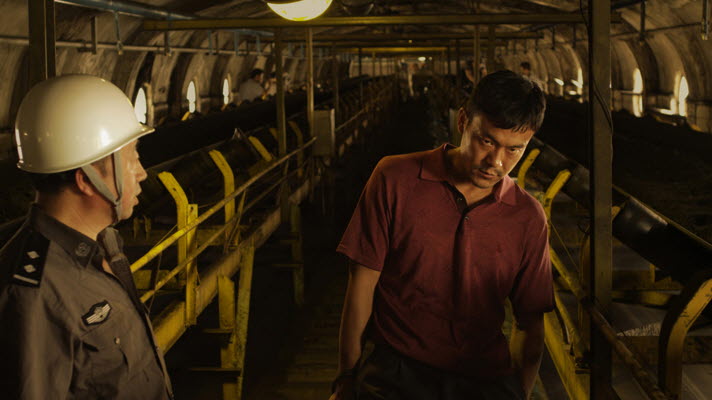 And then something comes to perk him up when he is going through his another usual miserable day. He happens to encounter his former partner, who is now promoted to captain, and he tells Zhang about a couple of murders which may be connected with their old case. The victims’ bodies were dismembered and scattered around as before, and there is a horribly humorous scene where an outraged diner customer tells cops how shocked he was to find something which was certainly not what he ordered.
The focus of the investigation has been turned to Wu Zhizehn (Gwei Lun-Mei), who is none other than the first victim’s wife and were also rather close to both of two recent victims. This quiet, enigmatic woman seems to know something about the murders, and Zhang decides to participate in the investigation for finding anything helpful for his former partner’s investigation. He approaches to her as another customer at a dry cleaner shop where she has worked for years, and then he begins to follow her to detect any suspicious sign.
It quickly turns out that she is well aware of his presence behind her, but then he comes more closely to her as someone who can be the next victim on the line. As Zhang and his former partner become more watchful, Zhang and Wu spend more time together, and they later have a nice time on an outdoor rink during one evening despite his clumsy skating skill. It looks like Zhang comes to like her and that feeling might be mutual, but there is always uneasiness in their guarded attitude – even when they can be a little open to each other at one point.
Meanwhile, the movie makes it clear to us that there is really a mysterious killer who may strike again, and it slowly accumulates low-key tension under its calm surface as danger becomes more apparent. The crisp cinematography by Dong Jinsong effectively sets the unnerving mood through thoughtful scene composition and lightings, and the movie glimmers with bleak beauty whenever its characters walk on the streets covered with snow and lighted by neon signs during their cold dark nights.
 The actors give the performances correctly measured to the restrained tone of the film while conveying what is possibly held behind their jaded, haggard faces. Liao Fan, who received Best Actor award at the Berlin International Film Festival early in this year (the director/writer Yi’nan Diao received Golden Bear award at the festival), is constantly engaging to watch as a flawed hero who willingly grabs a chance to redeem himself a bit at least; he may be going down to the bottom, but Zhang is determined not to go down that easily, and we come to see something admirable in his dogged pursuit. Liao has a memorable scene right before the closing sequence of the movie, and the complex feelings inside his character are touchingly portrayed through his physical gestures as the camera observes him from the distance.
Gwei Lun-Mei is also competent as a woman who may hide more than she suggests; there is a crucial moment reminiscent of a certain famous scene from “The Third Man” (1949), and what is being exchanged between Zhang and Wu is clear to us even though they do not say a lot during that moment. As “the third man” in the story, Wang Xuebing generates enough menace while maintaining his mundane appearance, and Wang Jingchun and Yu Ailei hold their places well as the other substantial supporting characters in the film.
I heard later that the running time of the movie was initially more than 3 hours. I could see a number of gaps in its clunky narrative, and I felt confused at times during my viewing (I am still figuring out the exact role of a certain small note in the middle of the story, for example), but the movie resolves most of its plot well while working as a solid noir film with its style, mood, and performance. I must say I am not as enthusiastic as its eager supporters, but, anyway, it is a good arthouse film to admire for its strong points.
Sidenote: The Chinese title of the movie is “Daylight Fireworks”, which, according to the director, makes a symbolic contrast to its English title. Even if you do not understand what he means, you will understand its meaning around the end of the film.

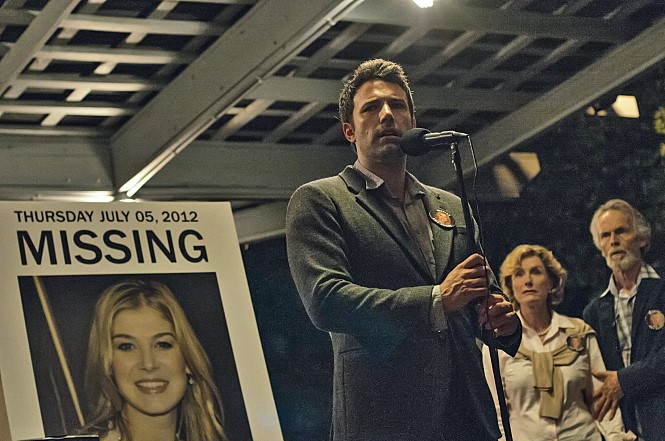 Something does not feel good right from the beginning of “Gone Girl”, a gripping top-notch thriller which gradually and chillingly reveals its nasty and insidious cards behind its back step by step with icy, merciless precision. Considering its dark, disturbing materials including deceit, betrayal, obsession, manipulation, and (possibly) murder, this can be a very unpleasant experience, but the movie is fiendishly spellbinding from its uneasy opening scene to its gut-chilling finale which will make you look back at its very beginning, and it is also viciously amusing in its wry social commentary on the rampage of sensationalism on the media.
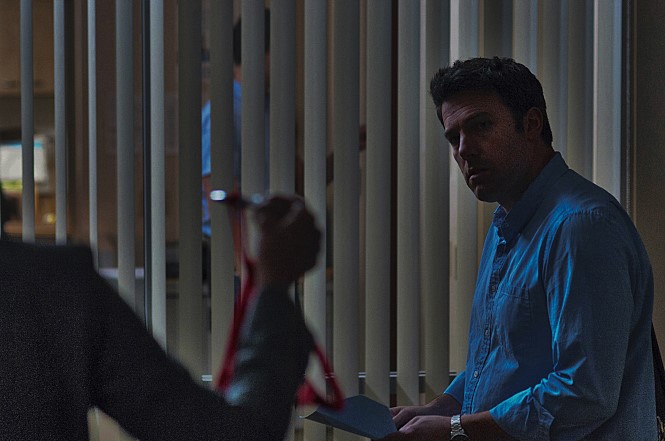
In the early morning of July 5th, everything seems normal to Nick Dunne (Ben Affleck). We see him going out of a suburban house where he lives with his wife Amy (Rosamund Pike), and then we see him having some talk with his twin sister Margo (Carrie Coon) at a local bar which they run together. It is the 5th anniversary of Nick and Amy’s wedding, and Amy seems to be preparing a surprise gift for her husband as before, but it looks like Nick is not particularly excited about what kind of surprise Amy has been planning for him.
Well, he gets a surprise when he returns to his home. Amy is vanished with no apparent reason, and there are a number of suspicious signs suggesting that something bad happened to her during his absence. Police investigation is quickly started, and Amy’s concerned parents immediately fly from New York to participate in the search, but Nick looks rather strained even though he seems to be willing to step into the media spotlight along with his parents-in-law for finding his missing wife. He surely looks distraught because of what happened, but does he really love his wife as he says in front of others?
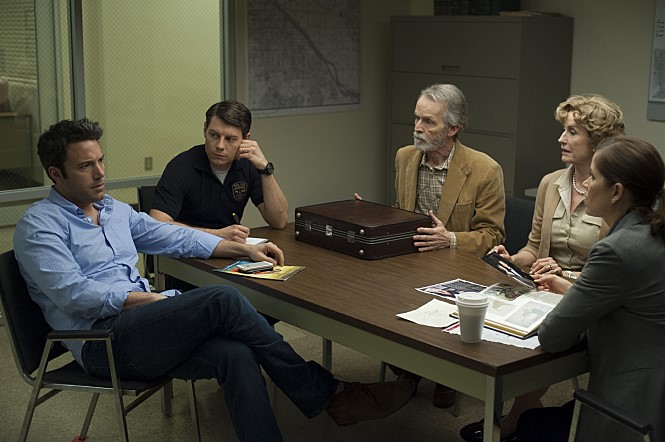 As the reasonable doubts on Nick’s sincerity are slowly accumulated through the ongoing investigation led by Detective Rhonda Boney (Kim Dickens) and the media frenzy begins to swirl around Nick as a result, the movie occasionally goes back to Nick and Amy’s past through Amy’s diary. When they met each other for the first time, something did click between them and they got married not long after that, but their happiness was soon disrupted when they lost their jobs due to an economic recession. They later moved to Nick’s hometown in Missouri because of his ailing mother, and then it is slowly revealed to us that their domestic life was not as ideal as it looked on the surface.
Now I must be more careful at this point because I may reveal or suggest spoilers unintentionally despite my efforts, so I recommend you to stop reading my review and watch this terrific thriller to be admired and appreciated for its first-rate handling of its deviously twisty plot and increasingly foreboding atmosphere. Yes, it is surely full of surprises and secrets to be dropped upon us and I correctly predicted some of them, but the movie never loses its tight grip on the audiences throughout its long running time which is nearly 150 minutes, and it constantly makes us agitated about what will happen next.
And it also becomes morbidly funny as observing Nick’s dramatic plight on the media. He is initially presented as an unfortunate husband desperate to get his wife back and naturally receives sympathy from others, but then, once the level of suspicion passes threshold level at a certain point, almost everyone looks at him with suspicion even though there is no direct evidence to link him with his wife’s missing. More frustrated and more desperate than ever, Nick comes to realize that how he looks in front of cameras does matter, and he rises to the occasion during one crucial scene where he must be absolutely discreet about what to tell – and what not to tell.
 Gillian Flynn’s screenplay, which is based on her bestseller novel, is a tricky one due to its multiple storylines and unreliable viewpoints, but the director David Fincher and his usual technical collaborators skillfully handle Flynn’s screenplay, and we rarely get confused or distracted even when we do not wholly understand what is exactly going on. While the slick, clinical cinematography by Jeff Cronenweth injects the ominous undertone into the screen, the editing by Kirk Baxter, who won two consecutive Oscars for Fincher’s previous works “The Social Network” (2010) and “The Girl with the Dragon Tattoo” (2011), plays us like piano through its precise cuts and steady pace, and the murky, ambient noises created by Trent Reznor and Atticus Ross further amplify the sense of churning uncertainty beneath the screen.
The actors in the movie are convincing in their pitch-perfect performances. While Ben Affleck gives an understated but effective performance not so far from Harrison Ford in “Presumed Innocent” (1990), his co-star Rosamund Pike elevates what could have been a thankless role into something both alluring and interesting enough to hover around the film even when she is not on the screen. Carrie Coon is solid as Nick’s sister who decides to stand by her brother despite her own doubts, Kim Dickens brings a tough, no-nonsense attitude to her detective character, and Missi Pyle has a delicious fun with her loathsome character which is clearly inspired by Nancy Grace. Neil Patrick Harris and Tyler Perry are also well-cast in their against-the-type roles; Harris is unexpectedly creepy as one of Amy’s former boyfriends, and Perry is surprisingly engaging as Tanner Bolt, a Johnnie Cochran-like celebrity lawyer hired to guide Nick along the risky path of establishing positive public images on the media.
Through his memorable films such as “Se7en” (1995) and “Zodiac” (2007), David Fincher has shown his affinity to dark, uncomfortable subjects, and he did another masterful job here in “Gone Girl” as exploring his usual grim territory. I was excited by its skills and performances, and I was also entertained by its unexpected plot turns even though I realized a number of holes in the plot after watching it. I must admit that the movie can be a feel-bad film for certain audiences for good reasons, but this is a thriller film which really knows how to grab our attention through pure thrill and suspense, and the result is one of the most entertaining movies of this year.
 As preparing for the last steps of my graduate course at the Korean Advanced Institute of Science and Technology in these days, I sometimes feel a bit wistful about my long years at KAIST. The day when I entered the campus as an undergraduate student in 2000 still feels like yesterday to me, but almost 15 years have passed now, and, as a guy who is about to become 32, I notice faint wrinkles on my forehead whenever I look into my bathroom mirror in the morning. Time seemed far slower when I was young, but now I become more aware of its rapid one-way flow day by day. The more I recognize the changes around and inside me, the more I reflect on how I came to arrive at where I am now, while also wondering what will happen next in my inconsequential life which has been drifted along the stream of time faster than I expected.
When I watched Richard Linklater’s “Boyhood”, I experienced a similar feeling as alternatively amused and touched by its vivid, realistic depiction of life through the passage of time. Consisting of the series of episodes observed from its young hero’s maturation process during 12 years, the movie did a remarkable job of showing how life is shaped and changed over the course of time, and its long life journey is a truly absorbing experience as we muse on how much its young hero and others around him have been changed compared to when they were introduced to us in the beginning. We consider all these years they went through, and we come to see many recognizable human elements from their life story, and then we look back on ourselves and our life. Things are always bound to be changed through time in our life, and, as powerfully presented in this intimate but epic coming-of-age drama, so are we human beings.
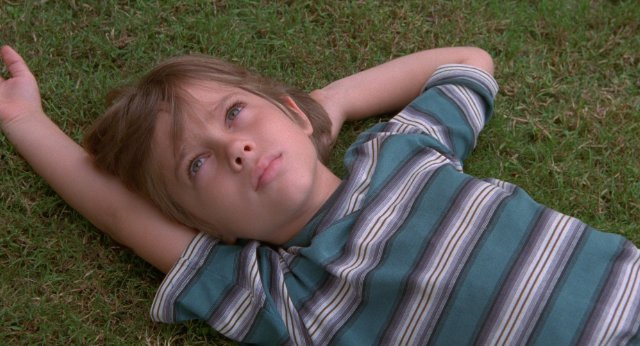
When we meet Mason (Ellar Coltrane) during the opening scene, he is a 6-year-old boy beginning his first year at the school. He and his spunky older sister Samantha (Lorelei Linklater, who is Linklater’s daughter) is currently living with their recently divorced mother, and Olivia (Patricia Arquette) has been struggling to lead her own life as trying to support her kids as a single parent. For completing her college education and getting better opportunities, she decides to move to Huston, and her kids are not so enthusiastic to hear that news from her because that means they will say farewells to their neighbourhood friends – and that is just the beginning of their drifting life around several cities of Texas during the next 12 years.
 Although Olivia makes some academic/professional progresses as she hoped, we comes to see that she is not very good at providing a stable domestic environment for her kids – especially in case of choosing her men. She marries a college professor not long after she attends his class, and she looks happy to have a new husband while Mason and Samantha get along well with their stepfather’s children, but their good years do not last long mainly due to his alcoholism. Like his rather bullying attitude to his stepchildren as well as his own kids, it merely looks like a small problem Mason and the other family members can live with at first, but then the circumstance becomes quite serious for them as his stepfather’s drinking habit becomes worse, and that leads to the most tense moment in the movie. Olivia finally leaves him with her kids, and then she marries another guy a few years later, but, though he looks better than her second ex-husband at first, this guy turns out to be not so different from her previous husband.
Meanwhile, Mason and Samantha steadily maintains the relationship with their father. As he frankly admits, Mason Sr. (Ethan Hawke) could not be a good husband to Olivia due to his carefree lifestyle mainly represented by his classic sports car, and we can only guess how bitterly their marriage was terminated in the past, but he really likes to be with his kids although it is clear that he still needs to grow up more. He looks more like a big boy to play with for his kids (not many responsible dads play bowling with their kids after smoking marijuana, you know), and we get a small funny scene when he attempts to have an honest conversation with Mason and Samantha. He mostly fumbles and embarrasses himself in front of his kids, but, at least, nobody will say that he did not try.
And we see Mason gradually entering adolescent years. He starts to show his artistic sensibility occasionally glimpsed during his early years, and we see his increasing interest in photography, which was initiated by a camera given to him by his second stepfather. Like many teenagers around his age, he dabbles in alcohol and drugs at times, and he later begins a serious relationship with one of the girls in his high school.
It is already well known that the director Richard Linklater shot the movie with his actors bit by bit over the period of 12 years, and that particularly reminds me of Michael Winterbottom’s “Everyday” (2012), which was a similar cinematic experiment in smaller scale. The most interesting thing in “Everyone” was watching its child actors really growing up through passing years on the screen, and the same thing can be said about “Boyhood”, which presents more wondrous changes through its bigger scope. The lead actor Ellar Coltrane was 7 at the beginning of the production, and we cannot help but notice how much he looks different when he eventually grows up to be a young lad at the beginning of his first college year. Mason is certainly changed in many aspects as going through 12 years, but there are some remaining traits from his early years, and you can still sense that smart, inquisitive child who saw things a little differently unlike others.
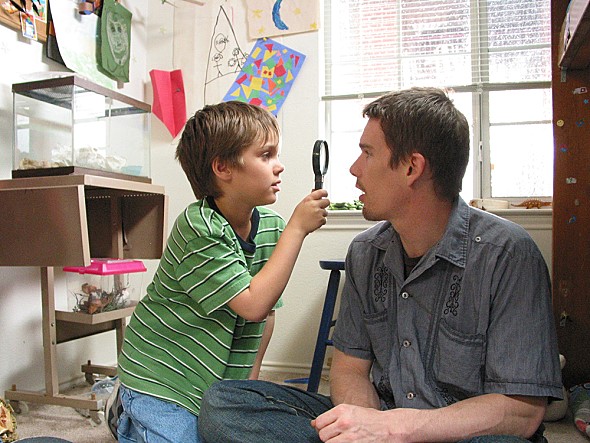
In spite of its discontinuous production process, the film moves flawlessly from one scene to the other scene thanks to an excellent editing job by Sandra Adair, and it is further smoothened by its organic storytelling improvised through the close collaboration between Linklator and his main actors. The obvious narrative signposts such as the second Iraq War, Obama’s 2008 presidential election campaign, and Lady Gaga are incorporated into the movie as naturally as other small period details, and I was especially amused by certain details associated with technological developments (when is the last time you saw a CRT computer monitor, for example?).
As Mason is approaching to the end of his boyhood which will lead to his next chapter of his life, we come to realize that the movie is also about the separate life journeys of his mother and father. As getting older and a little wiser, Mason Sr. comes closer to his kids, and he even becomes an average family man after his second marriage, which was probably something he never imagined during his good old casual days. He becomes a thoughtful and helpful father to his teenage son, and the scene in which he imparts some wisdom to Mason during their hiking in the forest took me back to how frequently I and my father had frank conversations as climbing a mountain near my hometown (and we still do that whenever we get a chance).
And it is poignant to see Olivia’s hard efforts slowly coming to fruition despite many frustrations in her life. While she made regretful mistakes including her disappointing marriages, she keeps moving on, and she eventually finds herself on the other side of lecture room after finally getting her master degree – and we can say she did everything for her children as a good mother. Hawke and Arquette have a nice moment between them during the house party scene after Mason’s high school graduation, and we see two people more at ease with each other than before; both had a fair share of disappointments from their failed relationship, but now they feel happy and proud to see their son on the verge of adulthood.
Watching the actors becoming older on the screen, I reflected on how I have become familiar with Linklator’s works during last 10 years. While I enjoyed “School of Rock” (2003), I somehow did not notice its director, and then “Before Sunset” (2004) took me to “Before Sunrise” (1995). While “Waking Life” (2001) is a very intriguing dream-like parade of ideas which can still baffles and fascinates me, “Bernie” (2011) is a bizarre, hilarious black comedy fueled by one of Jack Black’s best performances, and “Before Midnight” (2013) is a fantastic experience for anyone who enjoyed “Before Sunrise” and “Before Sunset” like me.
 His movies are usually smart and intelligent while sprinkled with offbeat spirit, and “Boyhood” is no exception. The conversation scene between Mason and his friends and a couple of older boys turns out to be wittier than expected although they are accompanied with several cans of beer, and I also like a long conversation scene between Mason and Mr. Turlington (Tom McTigue), a teacher giving Mason a terse lecture which sounds a little too harsh at first but then is turned into something more like a sincere advice. Like Mason, I thought I was trying hard during my graduate years, but my adviser professor always gave me a similar lecture like that. Looking back from this point, I think I should have tried harder with more focus as he demanded – it really could have prevented me from wasting a lot of my precious time.
I think the movie feels a bit dragged around its ending, and I became a little impatient during that part, but this flaw does not seriously damage its monumental achievement on the whole. Like Michael Apted’s the Up documentary series, the movie superbly and hauntingly captures that fleeting movement of time in our life, and it equally recognizes bitterness and hopefulness from that aspect. During my developmental biology class, I learned that our cells are equipped with same potency during the early developmental stages, but they are all eventually differentiated into different types of cells which will respectively contribute to our daily biological activities, and there is usually no going back as they are bound to age and die. Everyone in the movie gets older in the end, and there are many things they will never get back in their life, but, as told to Mason by one supporting character during the final scene, life can sometimes amaze us with unexpected things, and I guess that is a reason good enough for why we have to keep going in our life, even if it has no meaning at all from the beginning.
Late Roger Ebert used to tell that, after watching a great film called “Fargo” (1996), his partner Gene Siskel told him, “This is the reason why I go to the movies.” I believe I saw something great from “Boyhood”, and I am willing to tell you that this is the reason why I go to the movies. This is a boy’s life specifically, but you will see yourself as looking into his life.

 “Salmon Fishing in the Yemen” is not as whimsy or outrageous as its odd title suggests, and that was a little disappointment for me. The movie is a mild, pleasant comedy, and there is nothing wrong with that, but, considering the rich potential of satire inside its amusing premise, I cannot help but wonder whether it could have pushed itself further for more laughs and amusements. After all, a film about salmon fishing in the middle of desert is surely something we do not see everyday, isn’t it?
That outrageous idea comes from Sheikh Muhammed (Amr Waked), a Yemeni prince willing to realize his ‘vision’. He enjoys salmon fly fishing at his estate in the Scotland Highlands so much that he becomes determined to introduce it to his people, and he is planning to spend at least 50 million pounds for that. There are probably many better ways to spend such a huge amount of money for his country, but I guess anyone has a right to throw away his money as he wants no matter how much it is.
At the beginning, we see his financial adviser Harriet Chetwode-Talbot (Emily Blunt) approaching to Dr. Alfred Jones (Ewan McGregor) for technical advices. Not so surprisingly, Dr. Jones initially thinks the project is ‘fundamentally unfeasible’ for a number of good reasons, but, as spending more time with Harriet and the Sheikh, he gradually comes to believe that this preposterous folly can be succeeded if they try under a right condition. It goes without saying that the environment in Yemen may not be appropriate for salmons to inhabit and reproduce, but enough amount of water can be provided through a big dam built for irrigation (it does rain in Yemen although it is not quite often), and transporting 10,000 salmons to Yemen can be easily done once they are secured.
 The most amusing part in the movie comes from how the people in the British government respond to this absurdity, and Kristin Scott Thomas simply steals the show as Patricia Maxwell, British Prime Minister’s no-nonsense press secretary. As looking for any chance to improve their public image (while a disastrous mosque bombing has just happened in Afghanistan, their Foreign Secretary gets himself into a damaging sex scandal), Maxwell recognizes a good possibility from the Sheikh’s project, so she immediately persuades the Prime Minister to support the project in public even though she probably knows well how absurd and impractical it is. While constantly maintaining her usual prim attitude, Thomas always brings a dry sense of humor into her scenes, and the movie becomes a little more satirical whenever she appears on the screen.
However, the movie focuses more on a developing relationship between Dr. Jones and Harriet, and what we get here is your average British romance in which both sides hold their feelings even when it looks apparent that there is something going back and forth between them. As they spend more time together as colleagues, Dr. Jones and Harriet come to like each other more than before, but then there are some complications which put the distance between them. While Dr. Jones has been increasingly estranged from his wife Mary (Rachael Stirling), he is rather reluctant to end their lifeless marriage like his wife. Harriet becomes distraught when she learns that her current boyfriend Robert (Tom Mison) was possibly killed during a covert military mission in Afghanistan, but she also finds herself drawn to Dr. Jones as he clumsily but kindly consoles and comforts her.
Meanwhile, in spite of several setbacks including a funny backlash from angry British anglers and an assassination attempt by a Yemeni terrorist group which is not so pleased with how the Sheikh tries to change their nation, things are getting done step by step. A stream is created in a dry desert valley, and heaps of salmons are brought and ready to be released into the stream, and Dr. Jones and Harriet hope that those salmons can swim upstream along the stream even though they are not wild ones.
 In case of the Sheikh, this amiable guy sincerely wishes for something good to be achieved through his project, but the movie never clarifies what he exactly reaches for, and, though speaking like a wise man with good will, he sometimes look like a misguided man who wastes a chunk of his wealth just because he can. There are a few moments of absurd humor in the film such as the Sheikh’s servants wearing both keffiyeh and kilt at his countryside estate, but the screenplay by Simon Beaufoy, which is based on Paul Torday’s novel, sticks to its mild attitude while satirizing no one, and the movie never goes deep into the social/political matters glimpsed behind its story. The social inequality in Yemen is merely implied during one brief scene, and a local terrorist group is more or less than a plot element required for the big scene later in the story.
Since “My Life as a Dog” (1985), which was his international breakthrough, the director Lasse Hallström has steadily stayed in the mainstream of Hollywood while making a number of solid works such as “What’s Eating Gilbert Grape?” (1993), “The Cider House Rules” (1999) and “Chocolat” (2000). Although “Salmon Fishing in the Yemen” is not as good as them, the movie is not without enjoyable things, and Ewan McGregor and Emily Blunt has a nice low-key chemistry between them to engage us.
But the movie still feels a little too mild and passable for me to recommend it to you. I have not read Torday’s novel, but I heard from others that the novel was a satire, and I think the movie could have worked better if it had been equipped with more edges. As a romantic comedy film, it is gentle and likable, and you can spend a fairly good time with its warm, soft mood, but the movie seems to forget how silly it is to introduce salmons into an artificial ecosystem which has no other aquatic animals from the start. That is an inherently funny story material indeed, but the movie only dips its feet into its premise, and that is all we can see.

 Right from its evocative opening shot, “The Immigrant” takes us into the era when many poor, desperate people struggled hard in a world which was not as generous to them as they hoped. They might have some bright hopes about their new life in America as greeted by the Statue of Liberty and the landscape of New York, but they soon faced harsh reality when they got off from their ships in Ellis Island, and that was just the beginning of their long, hard journey toward settlement in their new country.
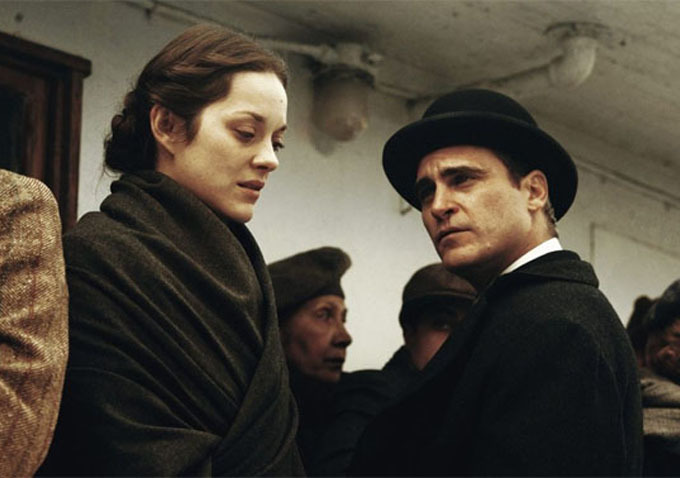
When Ewa Cybulska (Mario Cotillard) arrives in New York with her sister Magda (Angela Sarafyan) and other immigrants, this young Polish woman finds herself in a very difficult situation beyond her control. Her sister is taken away from her by customs officers because she is diagnosed to have tuberculosis and has to be quarantined for several months, and then she is told that the address given to her by her aunt living in New York is non-existent.
While she becomes desperate and helpless as being put into detention which may lead to deportation in the worst case, Bruno Weiss (Joaquin Phoenix), a small-time impresario who already set his eyes on Ewa as looking around the customs for any good-looking women to be exploited by him, approaches to her with an offer she cannot refuse. For getting her sister back, she need money for bribing authorities, and he can give her a chance to earn her money if she agrees to work under his supervision.
 Bruno has already been handling a number of women, and we see these women going through another seedy night at a night club just for entertaining its drunken, lecherous customers. Ewa is forced to appear on the stage with others at one point, and then she is tumbled into a more degrading circumstance when Bruno brokers a small private meeting between her and a young guy whose father reminds me of that amusing line from “Paint Your Wagon” (1969): “Grace, I give you the boy. Give me back the man.”
As a faithful Catholic woman, Ewa feels guilty about her moral degradation, but this seemingly fragile woman is determined to survive and see her sister again, and she gradually reveals her indomitable spirit inside her. She needs Bruno for getting what she wants, so she lets herself used by him, but she maintains her own dignity in spite of what she has to endure for her survival. The movie usually sticks to her viewpoint, and it mostly steps back from the unsavory details in the story while suggesting enough about her torments and humiliations.
While maintaining its restrained attitude like that, the movie works as a splendid window to a bygone era. The cinematographer Darius Khondji did a fabulous job of setting the rich atmosphere of lights and shadows on the screen which will remind you of those old photographs from the early 20th Century, and the production design by Happy Massee and the costume design by Patricia Norris deserve praises for their painstaking details. The somber score by Christopher Spelman always stands back from the foreground, but it is also crucial in setting the tone of the movie while never interrupting its slow but steady narrative flow.
 And Marion Cotillard, a talented French actress who has moved forward with more stellar performances since her well-deserved Oscar win for “La Vie en Rose” (2007), gives another good performance to watch here in this film. Even though she did not have much time to prepare herself for a considerable amount of Polish dialogues in the film, she masterfully handles both English and Polish dialogues with a natural accent to be admired (According to my Polish acquaintance Michał Oleszczyk, she really did a good job as far as he could hear), and she effortlessly moves around the wide range of emotions through her expressive face which is reminiscent of many graceful melodrama heroines of classic silent films around the 1910-20s.
In opposite to Cotillard, Joaquin Pheonix, who previously collaborated with the director/co-screenplay writer James Gray in three films, gives an intense portrayal of a conflicted man who becomes not only more despicable but also more pitiful to us. Not so surprisingly, Bruno has certain feelings toward Ewa, and that torments him more as he is reminded again and again that he will never win her heart – even when she chooses to stick to him for a practical reason. His wild temper is always a source of troubles for both of them, and we can clearly see the sign of an upcoming trouble when Emil (Jeremy Renner, who is also good in his rather functional role), Bruno’s cousin who works as Orlando the Magician, appears. Emil comes to care a lot about Ewa, and Bruno naturally becomes jealous of what is going on between Eva and Emil although Ewa is not willing to go along with Emil because of her apparent reason.
What eventually happens later in the story feels contrived to say the least, but the movie holds itself well even at that point, and then it arrives at the haunting finale appropriate for its somber storytelling. I heard that the movie was inspired by the recollections from James Gray’s grandparents who came to America during the 1920s, and Gray says the movie is “my most personal and autobiographical film to date”. I really do not know how much autobiographical his film actually is, but this is a solid period drama not only imbued with care and details and but also supported by excellent lead performances, and that already makes it into something worthwhile to watch.


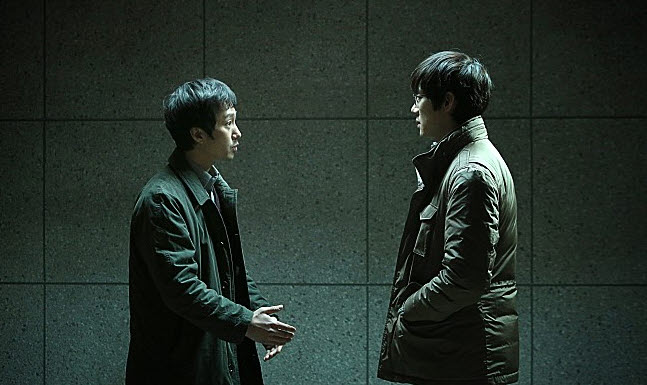 South Korean film “Whistle Blower” gave me and other audiences an odd experience to talk about. Although it emphasizes that its story is entirely fictional, I and others knew too well that it was inspired by a big academic scandal which shook the whole nation a few years ago. Many things including its characters are fictional indeed, but we could not help but think of that real-life incident still vividly remembered by us.
Around 2005, Dr. Hwang Woo-suk of South Korea published two research articles in the academic journal Science, and he quickly drew lots of attention from many scientists all over the world after the publication of his articles. He claimed that he succeeded in cloning embryonic stem cells for the first time, and that certainly catapulted him into the top position of his field while many South Korean people became very proud of his research achievement.
However, his ‘achievement’ got quickly crumbled when it was scrutinized by others including my long-suffering adviser professor and other biology professors of KAIST later in that year. Despite many accusations and protests from Dr. Hwang’s unquestioning supporters, it became more apparent that there were really serious fabrications in his stem cell data, and Science eventually withdrew Dr. Hwang’s articles as it was confirmed that Dr. Hwang was guilty of fabrication and other ethical misconducts in his increasingly questionable research.
 The story of the movie mainly revolves around Yoon Min-cheol(Park Hae-il), the producer of a local TV report program not so far from “60 Minutes”. While looking for any good news material as usual, he comes upon a possible scoop on the illegal ovum purchase behind a famous infertility clinic in Seoul, but then he learns that the clinic is closely involved with Dr. Lee Jang-hwan(Lee Kyeong-yong), who is the fictional counterpart of Dr. Hwang in the film.
Because of Dr. Lee’s increasing fame and influence, Min-cheol and his colleagues clearly see that they must be very careful about their investigation as much as they can. Dr. Lee has already become a big national hero boasted and supported by South Korean people and media, and we see Dr. Lee going through several important public events as a prominent public figure. He gives a nice motivation speech for many young hopeful students during one scene, and then we watch him emphasizing to government officials on how much his stem cell cloning research can go further to help those hopeless patients who cannot possibly be happier to hear what he promises to them.
While being aware of the possible big risk, Min-cheol decides to go for whatever truth he may find at the end of his investigation, but, as you already know, the truth is far more shocking than he expected. Not long after he approaches to a young researcher who once worked directly under Dr. Lee but resigned from his position right before the publication of Dr. Lee’s article, Min-cheol comes to learn from him that there was no cloned stem cell from the beginning. Although there is no evidence to prove that, Min-ho(Yoo Yeon-seok) sincerely swears to Min-cheol that he is telling the truth, and Min-cheol comes to believe him despite his initial disbelief on this unbelievable revelation.
 He and I-seul(Song Ha-yoon), a plucky rookie reporter who happens to work under him, dig more deeply. As they learn more about the lies behind Dr. Lee’s glorious media image, they feel more risk in their secret investigation. When he hears about what they are doing, Dr. Lee pulls some strings to be protected, and Min-cheol and others around him soon find themselves cornered into a very difficult circumstance. Many people become very angry just because they dare to have a doubt about Dr. Lee, and I can assure you that what is depicted in the film is not an exaggerated mass hysteria; lots of South Korean people were really furious about what MBC, the real-life counterpart of the TV broadcasting company in the film, was going to broadcast at that time, and MBC had to endure lots of backlash until the situation became more favorable enough to fully expose Dr. Hwang’s fraud on TV.
Because a number of notable similarities, “Whistle Blower” will certainly remind you of Michael Mann’s “The Insider”(1999), another movie inspired by a real-life story about people struggling to get the truth known in public. While it is not better than that terrific film, the director Lim Soon-rye moves its rather simple plot with efficient pace, and the actors in the film did a competent job as the parts of the story. While Park Hae-il gives an earnest lead performance as a seasoned journalist hero with some idealism inside his heart, Yoo Yeon-seok is also solid as a conflicted whistle blower who worry more about others than himself, and Lee Kyeong-young, a veteran South Korean actor who becomes ubiquitous especially in this year, is well cast as a shady man who comes to realize that he has gone too far with his lies. One small private scene of his may make you feel a little sorry for his despicable character, but that does not change the undeniable fact that he committed an academic crime which is going to tarnish his career forever – and he does deserve what he gets in the end.
Like Dr. Haruko Obokata, who also got herself into her own big academic scandal due to the fabrication of her ‘revolutionary’ cell research, Dr. Hwang Woo-suk became a disgraceful figure in his field after his scandal, but, believe or not, this shameless fraud has been somehow allowed and financed to do more researches in South Korea as reported in a recent New York Time article. He went back to his usual animal cloning, and I remember well when it was reported three years ago that he successfully cloned a certain ‘endangered species’ called coyote. What a silly rotten joke he was.
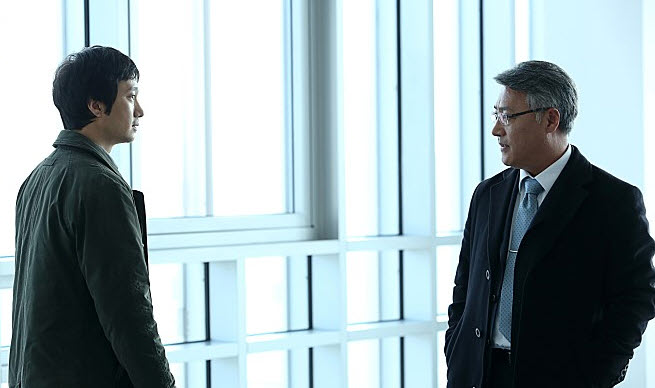
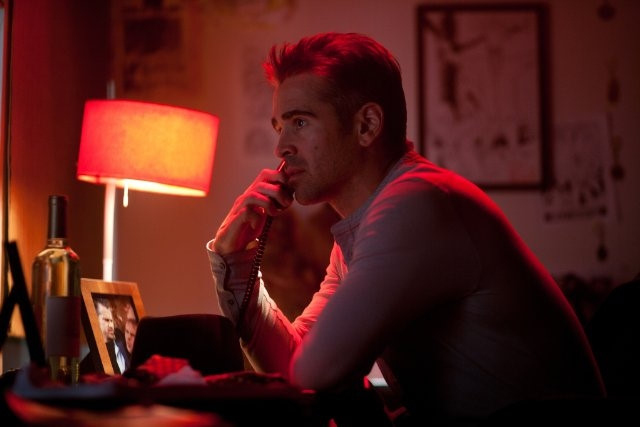 “Seven Psychopaths” is about one funny screenplay writing process which is cheerfully juxtaposed with absurd humor and striking violence to shock you and then amuse you. As we follow its convoluted plot, it becomes apparent to us that it is dancing on the line between fiction and reality, and the movie, which is full of shocks and surprises I don’t dare to reveal, has lots of fun with many things including its inherent flaws which richly deserve the consequent self-criticism later in its story.
The title of the movie comes from an unfinished screenplay which has so far nothing but its very title at present. Marty(Colin Farrell), a struggling Hollywood screenplay writer who has a little problem with drinking(but he says he is not an alcoholic), has been trying to write a story about seven psychopaths, but this poor guy is still going nowhere without any good material for his idea, and he becomes more desperate as drinking more.
While Marty tries to fill his screenplay, the movie presents a number of odd, colorful characters one by one. His actor friend Billy Bickle(Sam Rockwell), who may remind you of the hero of “Taxi Driver”(1976) due to his last name, is willing to provide several good ideas of his to Marty, but then Marty finds himself being tumbled into a complicated situation mainly because of Billy’s part-time criminal business with his partner Hans(Christopher Walken). Billy and Hans steal pet dogs to get reward money from caring owners looking for their dogs, and their latest kidnapped dog, a cute shih tzu dog named Bonny, turns out to be owned by Charlie(Woody Harrelson), a vicious mob boss who will stop at nothing for getting back his dear dog. Considering his violent temper which makes an ironic contrast with his incorrigible affection toward his pet, Charlie may inspire a nice psychopath character for Marty’s screenplay – if Marty is lucky enough to get out of this dangerous trouble.
 As the plot of the movie thickens, Marty’s screenplay also goes through development with more potentials. We get the moody story of a repentant killer who has been followed by someone patiently waiting for vengeance since his murder, and then we are introduced to a Vietnamese priest who is about to reach to the end of his vengeful journey. Some unknown guy keeps killing high-ranking gang members, and, as this case draws the attention of the local media, Billy suggests to Marty that this killer can be an interesting story material. In the case of a mysterious old guy named Zachariah(Tome Waits), his very violent life story comes with one of the most morbidly humorous scene in the film; I will not go into details for not spoiling your fun, but let’s say its sheer bizarreness will induce a couple of big laughs from you.
Because of its quirky mix of humor and violence, the movie surely reminds you a lot of the works by Quentin Tarantino and the Coen Brothers, but it has its own music to play, and the director/screenplay writer Martin McDonagh, who previously made a terrific directorial debut with “In Bruges”(2008), deftly tickles us with his playful game between reality and fiction. If you pay some attention to a number of details in the film such as how two different characters share similar mannerisms while indirectly mirroring each other at times, you will probably wonder whether the certain scenes in the movie are imagined during Marty’s ongoing writing process.
The movie frankly admits that aspect to us with ample humor from the beginning, and it even goes further during its second half as the story(or Martin’s screenplay, perhaps) switches its gear to a more contemplative mode which can be described as an existential brainstorming for Marty and others(and McDonagh, probably). The characters were introduced and then established, and then the plot has been developed nicely despite its visible problems which are thoughtfully and amusingly pointed out at one point, and now it really needs a good way to take care of everything which has been unfolded on its table.
 During the second viewing of the film at last night, I appreciated more how McDonagh’s clever screenplay masterfully leads its story and characters into unexpected territories and then neatly goes back to where it started for the required ending. Humor and drama are always intertwined with each other in the interactions between its characters, and one of the good examples is an atypical case of Mexican Standoff during its climax part, which comes with a poignant outcome as following its inexorable logics.
The actors in the movie are enjoyable to watch, and they wonderfully capture the sly humor in McDonagh’s smart, self-conscious dialogues. While Colin Farrell, who previously collaborated with McDonagh in “In Bruges”, is a sane, likable center of the story, we have a bunch of interesting actors like Sam Rockwell, Christopher Walken, and Woody Harrelson, Michael Stuhlbarg, Michael Pitt, Zeljko Ivanek, Harry Dean Stanton, and Tom Waits. Through his irrepressible performance, Rockwell proves again that he is one of the most valuable character actors working in Hollywood, and Walken, who can easily switch between comedy and drama in his own uncanny screen presence, is particularly good during the scene involved with his character’s suggestion for Marty’s screenplay. That suggestion feels a little too preposterous when we reflect on it later, but Walken makes it work through his convincing delivery, so we can believe it for a while at least.
I must mention that good actresses like Abbie Cornish, Gabourey Sidibe, and Olga Kurylenko do not have many things to do in contrast while being merely treated as expendable secondary characters in the film, but I guess that aspect is intended as one of the jokes on its ‘flawed’ plot, and “Seven Psychopaths” is entertaining enough to overlook its minor ‘flaws’. Maybe it really needs more rewriting, but it is still a fun experience with that adorable dog you’d love to pat.


![Light Show [Explored 2026-10-09]](https://live.staticflickr.com/65535/55578539818_958ce4fa9c_s.jpg "Light Show [Explored 2026-10-09]")


