Peninsula (2020) ☆☆☆(3/4): Welcome to Korean zombieland

South Korean film “Peninsula”, a sequel to director/co-writer Yeon Sang-ho’s “Train to Busan” (2016), is a typical mix of action movie and zombie horror flick. Although, as I told you many times before, I have been rather tired of zombies these days, the movie at least provides several well-made action scenes while throwing lots of zombies into the screen as required, and it also has human characters we can easily care about despite its overtly melodramatic moments.

In the beginning, the movie shows and tells us what happened not long after the ending of “Train to Busan”. At first, Busan looked like a safe haven for those lucky survivors from that terrible zombie plague epidemic which swept across most of South Korea within one day, but, alas, Busan also became infested with zombies in the end, and, after the last ship for refugees departed from the port of Busan, South Korea has been totally blocked from the rest of the world during next 4 tears.

Many of South Korean refugees were sent to Hong Kong, and one of them is Jung-seok (Gang Dong-won), a young military officer who tried to escape along with his sister and her family but only came to save no one except himself and his brother-in-law. While he is going through his another bitter day in Hong Kong, a bunch of local gangsters approach to him, and he soon finds himself being with several other South Korean refugees including his brother-in-law. Because a considerable amount of valuable things has remained intact and untouched in South Korea, these gangsters looked for any golden opportunity and then almost succeeded in getting their target transported from Seoul to the port of Inchon, but, unfortunately, their plan went wrong somehow, and now they want Jung-seok and other South Koreans to locate a truck containing their target and then bring it to the port, where their ship will be waiting for a while.

Although a huge reward is offered for this dangerous mission, Jung-seok is not so interested at first, but, of course, he is eventually persuaded by his brother-in-law, and he and other South Koreans soon arrive at the port after the ship manages to go through the blockade surrounding the south part of the Korean Peninsula (North Korea has been protected well thanks to their heavily guarded border, by the way). All they have to do is driving to a certain spot in the middle of Seoul where the truck was detected for the last time, and everything goes fairly well as they finally arrive at that spot in question.

Of course, the situation soon turns out to be more perilous than expected thanks to those zombies lurking here and there inside the city. Although those zombies are usually quiet in darkness, they swiftly respond to any sound or light, and Jung-seok and his colleagues certainly know well that they must be careful as much as possible. Yes, it is apparent that most of zombies on the screen are CGI figures, but the movie still chills us with its stark and gloomy atmosphere hovering over Jung-seok and his colleagues, and there is a gruesome moment which suddenly reveals the presence of hundreds of zombies locked inside a certain stuffy space.

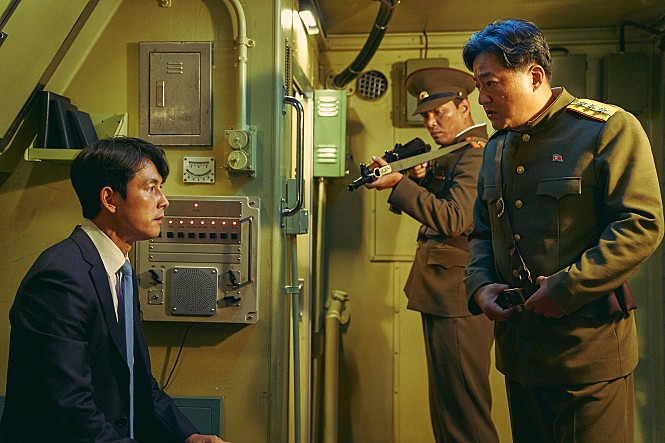
Things get complicated more as it is subsequently revealed that, as already shown to us via the trailer of the movie, there are two different group of survivors in the city. In case of a military unit which has gone rogue not long after South Korea was overwhelmed by the zombie epidemic, its seedy leader happens to discover that their latest catch, which is none other than that truck in question, contains an opportunity to get out of South Korea right now. Without telling anything to his second-in-command dude who often enjoys thrusting out a group of helpless survivors to zombies for a twisted entertainment for him and his cronies, the leader tactfully embarks on his escape plan, but then Jung-seok attempts to retrieve that truck along with a woman named Min-jung (Lee Jung-hyun) and a few persons who have been under her care and protection.

Because he actually came across Min-jung during that urgent time in South Korea, Jung-seok feels another guilt in addition to the one involved with his sister’s family, but Min-jung clearly sees what matters most to her and others right now, and the movie soon gets accelerated by her steely determination. Not only she but also her two young daughters turn out to be pretty bold and brave in handling their respective vehicles, and the climactic part of the movie gives us a gritty and intense vehicle action sequence which is apparently influenced by George Miller’s Mad Max movies.

Like “Train to Busan”, the movie becomes quite sappy around the finale, and that is rather jarring compared to the rest of the film, but the main performers still hold the film together well. While Gang Dong-won dutifully holds the ground like Tom Hardy did in “Mad Max: Fury Road” (2015), Lee Jung-hyun, Lee Ye-won, and Lee Re are convincing in their strong and colorful performance, and the other notable supporting performers including Kwon Hae-hyo, Kim Min-jae, Koo Kyo-hwan, and Kim Do-yoon are also well-cast in their respective supporting roles.

Although it is less fresh and distinctive compared to “Train to Busan” as automatically reminiscent of many other similar horror action movies featuring zombies, “Peninsula”, which was supposed to be shown at the 2020 Cannes Film Festival before the festival was canceled due to the ongoing COVID-10 pandemic, still works well enough to engage and entertain me during its 116-minute running time. It may be a bit bland in terms of style and personality, but it compensates for that with a good amount of solid action and drama, so I will not grumble for now.

Posted in Movies | Tagged , , , , | Leave a comment

The Beach House (2019) ☆☆1/2(2.5/4): A little foggy horror film on the beach

Right from the very beginning, “The Beach House” announces to us that something bad is going to happen, and it surely delivers a fair share of terror and dread as expected. While it is rather superficial in terms of story and characters, the movie held my attention to some degree until its predictable last act, and I appreciated the skills and efforts put into its good moments even though it did not satisfy me enough in the end.

During its first act, the movie simply feels like your average chamber drama. When Emily (Liana Liberato) and her boyfriend Randall (Noah Le Gros) arrive at a beach house belonging to Randall’s father during one off-season day, everything looks quiet and peaceful on the beach and its surrounding area, and Randall earnestly hopes that their private time in this house will help them mending their estranged relationship.

However, shortly after they enter the house, Randall and Emily come to realize that the house has been actually occupied by an older couple named Jane (Maryann Nagel) and Mitch (Jake Weber), who turn out to be old friends of Randall’ father. As revealed later in the story, Mitch brought his wife to this spot due to her deteriorating health condition, but, so far, she and Mitch seem to be having a good time together in the house, and they gladly ask Randall and Jane to stay longer in the house for a dinner.

Emily and Randall accept this invitation despite some initial hesitation, and we get to know a bit about their estranged relationship as they come to spend more time with Mitch and Jane. While Emily is preparing for going to graduate school for more learning, Randall believes that there is more to learn in the world outside, and this difference in their viewpoints generates some nervous awkwardness when they talk about themselves in front of Jane and Mitch during the following dinner.

Anyway, the mood still remains cordial and jovial among the people in the house. When they subsequently run out of alcohol, Randall suggests that they should try a certain kind of edible marijuana product, and the others agree to that, though Mitch is understandably concerned about whether that will be good for his ailing wife.

Once they all ingest that marijuana product in question, they soon feel trippy as music is played in the background, and then they come to behold something very weird. At first, they see millions of tiny but shiny particles being blown from the ocean, and then the area around the house becomes quite foggy just like that creepy key sequence in John Carpenter’s “The Fog” (1980).

In the next morning, everything seems to look normal again under the sunny blue sky, but it does not take much time for Emily to discern that something bad is happening around her and others. After looking for his wandering wife at last night, Mitch still does not come back, but Randall is not so particularly concerned about that as suffering from his hangover, and Emily becomes more nervous as trying to have some rest on the beach along with her boyfriend.

It is not much of a spoiler to tell you that Emily and Randall belatedly come to discover how bad their situation really is, but the movie serves us several effective moments of horror as steadily maintaining their increasingly isolated circumstance. For example, I like how it gradually dials up the level of tension as phlegmatically watching one character slowly walking into the sea, and I must confess that I was really caught off guard by the following grisly payoff moment.

During its last act, the movie unfortunately comes to lose some of its taut suspense, but director/writer Jeffrey A. Brown and his crew members including cinematographer Owen Levelle keep things rolling before the final scene of the movie, which may leave you flabbergasted but mostly fits with the increasingly baffling and terrifying mood of the film. Although there are a few expository moments as required, the movie remains rather vague about the increasing danger along the story, and that certainly exacerbates the sense of chaos and panic surrounding its main characters.

I wish the movie depicted its main characters with more depth and personality, but its four main cast members fill their respective spots as much as they can at least. While Liana Liberto is solid as the main center of the film, Noah Le Gros is effective as her counterpart, and Maryann Nagel and Jake Weber hold their small spots around Liberto and Le Gros as subtly conveying to us their characters’ long relationship history.

Probably because I recently watched “Sea Fever” (2019), which is a little better in my inconsequential opinion, “The Beach House” did not engage me as much as I expected, but I admire its good mood and competent filmmaking at least. Although its rather thin story idea is stretched out a bit too far for its 88-running time, the movie clearly shows us that Brown, who previously made two short films before making a feature film debut here, is a talented filmmaker with considerable potential, and I sincerely hope that the movie will lead to him to better things in the future.

Posted in Movies | Tagged , , , | Leave a comment

Archive (2020) ☆☆1/2(2.5/4): A guy and his three robots

“Archive” reminds us of many other recent similar SF flicks but never distinguishes itself enough in my humble opinion. While its story promise was intriguing enough to draw my attention when I watched its trailer a few weeks ago, the movie fails to be something truly complex and compelling, and I must tell you that, though I followed its story and characters with some curiosity and patience, it let me down more with its disappointingly contrived finale.

Theo James, who also participated in the production of the film, plays George Almore, a young and brilliant robot engineer who has lived and worked alone in some high-tech factory/laboratory located somewhere in a remote rural area of Japan. Although it seems he has been there for more than a year without any direct contact with the outside world, he does not look that lonely at all because he is mainly occupied with his private project with the assistance from his two robots.

As the plot progresses bit by bit with occasional outdoor shots of chilly landscapes, we get to know his troubled state of mind via a series of flashback scenes. Before coming to this isolated spot, he was married to a loving woman named Jules (Stacy Martin), but, alas, a terrible accident happened, and now George often makes a phone call to a big electronic data storage device in his living room, through which he can communicate with her ‘archived’ consciousness.

We later come to learn that there is a certain technical limit on this artificial status of her, and that is why George is so obsessed with his ongoing personal project. Although his project is bound to violate a number of corporation laws, he does not care about that at all simply because he wants to bring back his wife to his world, and he does not tell anything to his direct boss when he gives a routine report to his direct boss as usual.

It is gradually revealed that George’s two robots are the stepping stones for his project. He has been trying to make a humanoid robot equipped with artificial intelligence, and the final result of his project is going to be a vessel to which everything stored in that archival device will be transferred in the end. While the first robot was not so successful with relatively low intelligence, the second robot is vastly improved in comparison, and now George is about to move onto making the third robot, which may be as successful as he hopes while resembling far more of his dear wife than the second robot.

Of course, once George starts to make his third robot, the situation becomes a little more complicated than before. There is an unexpected visit from two guys sent from a company which provided him that archival device, and you may sense that there is something fishy during this moment, because one of these two guys is played by none other than Toby Jones, a British character actor who always attracts our attention with his oddball quality.

Meanwhile, the movie observes the expected moments of tension between George and his second robot, who seems to be not so pleased about what is going on between George and his latest creation. While being a less developed version of George’s wife, the second robot, which is usually called J2 and sometimes looks like a pirate copy version of that sinister robot in “I Am Mother” (2019), wants to be closer to George as programmed, and there is a little creepy moment when J2 surreptitiously glimpses on a private moment between George and the third robot, which comes to look more humanized step by step but, yes, also struggles to deal with those emotional memories of Jane.

Now you can see that the movie is entering the territories of “Solaris” (1972) and “Ex Machina” (2014), but the screenplay by director/writer Gavin Rothery merely trudges from one predictable narrative point to other without much dramatic momentum. While there is some dramatic conflict between George and J2, this soon gets fizzled out to our disappointment, and the same thing can be said about the increasingly strained relationship between George and J3. Just like J2, J3 also wants to be closer to him even after coming to learn more of the purpose of her existence, and it seems George feels a bit happier when J3 is around him, but, not so surprisingly, he turns out to have some reservation somewhere inside his mind.

And we are frequently reminded that something is not so quite right around George. With the ominous score by Steven Price, the cinematography by Laurie Rose steadily generates the nervous atmosphere around our hero, and the movie mostly maintains the palpable sense of isolation on the screen except during those flashback scenes and a few other scene including the one between George and a sinister security expert sent from the corporation George has worked for.

I do not dare to go into details on how the story eventually ends, but I can tell you instead that I came to reflect more on many artificial aspects of the movie with more dissatisfaction. While James tried his best to carry the movie with his low-key performance, his character is not particularly deep enough to engage us, and he is sometimes overshadowed by Stacy Martin, who relatively shows more personality as shuffling between her multiples roles in the story.

On the whole, “Archive” is a well-made genre piece in terms of technical aspects, but it does not feel that fresh or engaging enough for me, and it will not surprise you much if you are a seasoned moviegoer like me. To be frank with you, I would rather recommend you to watch “Solaris” or “Ex Machina” instead, and I assure you that you will have a more productive time with either of them.

Posted in Movies | Tagged , , | 1 Comment

The Old Guard (2020) ☆☆☆(3/4): A fairly refreshing superhero flick from Netflix

Netflix movie “The Old Guard”, which was released on last Friday, is a fairly refreshing superhero flick which actually tries a number of different things within its by-the-numbers origin story. While it is rather predictable at times, the movie is rich and engaging in terms of story and characters, and it also surely provides us some well-made action sequences to be savored.

At first, the movie, which is based on the comic book of same name by Greg Rucka and Leandro Fernández, looks like another average action flick featuring a bunch of mercenaries. Under the strong leadership of a woman named Andy (Charlize Theron), three other persons including her right-hand guy Booker (Matthias Schoenaerts) gather together, and they soon prepare for another dangerous task, which is given to them by an ex-CIA operative named James Copley (Chiwetel Ejiofor).

During the following sequence, we see how Andy and her group swiftly sneak into the target site and then quickly try to accomplish their task, but, alas, they soon find themselves in a trap which exposes their true identity. For some unknown reason still mysterious even to them, they cannot possibly get killed, and they surely surprise their opponents shortly after getting shot a lot. They look like being dead, but they soon regain their consciousness as their bodies get automatically healed, and then they promptly take care of their opponents.

It subsequently turns out that there is someone quite eager to delve into the secret of the immortality of Andy and her men. Steven Merrick (Harry Melling), an obnoxious lad who also happens to be the CEO of a powerful global pharmaceutical company, wants to capture Andy and her bunch by any means necessary, and he is certainly looking for getting another big fat profit from whatever can be extracted from them.

While clearly discerning that they should be a lot more careful than before, Andy and her people begin to experience something familiar to all of them. Whenever somebody turns out to be immortal somewhere in the world, they have a telepathic dream on that person in question, and that person is a young US marine soldier named Nile Freeman (KiKi Layne), who is naturally perplexed about how the hell she did not die despite getting seriously injured in the middle of her latest mission.

Although her colleagues think they should stay low as much as possible, Andy decides to find and then recruit their new colleague right now, and we soon see her approaching to Nile, who has been quite confused as being ostracized from others around her in addition to having a recurring dream on Andy and other immortals. Although their first encounter is not so pleasant to say the least, Nile eventually comes to accept her new status, and she eventually agrees to go along with Andy to a safe house where the other immortals are waiting for her.

During its middle part, the movie lets us get to know its main characters more. While they all can be mortal someday as reflected by one brief flashback scene involved with one of Andy’s former colleagues, there is still no way of knowing when that will happen, and they have no choice but to move on from one battle to another while distancing themselves from mortals. They want to believe that they have contributed some good to the world as fighting for justice, but Andy frankly admits at one point that she has a growing doubt as getting tired of more injustices and miseries around the world.

And they have had no one but each other for many decades. In case of Joe (Marwan Kenzari) and Nicky (Luca Marinelli), they have been lovers for several hundred years, and it is really poignant to see these two tough dudes sincerely confirming their strong and ever-lasting love to each other later in the story, which surely beats anything in those Twilight flicks or any superficial moment of token sexual minority characters in major superhero flicks.

In the end, the movie moves back onto its action mode as expected, but it steadily holds our attention via its competent presentation of physical actions on the screen, and director Gina Prince-Bythewood, who previously drew my attention with “The Secret Life of Bees” (2008) and “Beyond the Lights” (2014), and her crew members including cinematographers Tami Reiker and Barry Ackroyd and editor Terilyn A. Shropshire make sure that every physical movement is accompanied with palpable impact. The result is intense enough on the whole, and we come to care about Andy and her colleagues more thanks to some brief personal moments amidst actions.

While Charlize Theron, who also participated in the production of the film, is no stranger to action films as already shown from “Mad Max: Fury Road” (2015) and “Atomic Blonde” (2017), Matthias Schoenaerts, Marwan Kenzari, and Luca Marianelli are also believable as action movie characters, and KiKi Layne, who was memorable in “If Beale Street Could Talk” (2018), strongly demonstrates another side of her considerable talent. On the opposite, Chiwetel Ejiofor imbues some gravitas to his functional supporting character, and Harry Melling is well-cast in his villainous role, while, to my small amusement, dutifully following a certain villain cliché during the finale.

Overall, “The Old Guard” is entertaining as bringing some fresh air into its genre, and I am glad that Netflix is already planning a sequel, which is already suggested right before the end credits of the movie. Prince-Bythewood and her cast and crew members did a solid job of setting the ground for whatever will come next, and I guess I can have some expectation on that.

Posted in Movies | Tagged , , , | Leave a comment

Never Rarely Sometimes Always (2020) ☆☆☆1/2(3.5/4): Her urgent matter to deal with

Here is a little but extraordinary film you must watch right now. Phlegmatically observing a desperate and frustrating journey of two adolescent girls seeking abortion, Eliza Hittman’s latest film “Never Rarely Sometimes Always” will hit you hard with several restrained but undeniably powerful moments to haunt you, and I admire how it non-judgmental storytelling approach subtly lets the audiences reflect on its sensitive and relevant subjects.

During its first act, the movie slowly establishes how things have been not so good for Autumn Callahan (Sidney Flanigan), a 17-year-old female high school student in a rural town of Pennsylvania. As implied by one humiliating moment during her music performance in the middle of her high school event, her private life has been rather messy, and there is no one for her to talk or discuss with. While her mother is usually busy with supporting the family, her father is your average useless bum, and he does not even give a damn about why his daughter does not feel well after that humiliating moment.

Like her best friend Skylar (Talia Ryder), Autumn works in a local supermarket, and they have to deal with some rude males at their workplace. At one point, a male customer blatantly tries to flirt with Skylar, and you may wince as she tries to remain professional in front of this prick. When their worktime is over, they also endure a minor moment of sexual harassment due to their creepy male boss, and we come to gather from this very uncomfortable moment that they have tolerated this loathsome dude for a long time.

Meanwhile, Autumn discovers that she has a serious problem to deal with right now. After sensing some significant change in her body, she visits a local woman’s clinic, and, not so surprisingly, she comes to find that she has been pregnant. She is notified that it has been around 10 weeks since she got pregnant, and she is willing to have an abortion as soon as possible, but she is only told that she should consider the other options including adaption. In fact, her doctor even shows her one of those terrible anti-abortion videos just for persuading Autumn to change her mind.

Nevertheless, as a girl who clearly feels and knows that she cannot have or raise a baby under her difficult situation, Autumn tries to find any possible way to have an abortion. Unfortunately, the state law demands that she should get the consent from her parents first, and telling her parents about her pregnancy is the last thing she wants to do right now. Becoming more desperate than before, she even tries a few crude ways of inducing abortion, but, of course, she miserably fails.

In the end, the only option for Autumn is going to New York City, where she may easily have a legal abortion due to its more progressive state law. After stealing some money from their workplace, Autumn and Skylar, who instantly stands by her once she discovers her best friend’s pregnancy, get on a bus to New York City, and that is the beginning of their journey, which, as some of you have already guessed, turns out to be longer than they imagined.

Although the environment for her abortion is surely better in New York City, Autumn soon comes across a series of serious setbacks. It turns out that she cannot have an abortion right now because of not only her actual physical condition but also a long series of legal and medical procedures, and she and Skylar understandably become more frustrated and exasperated while trying to stay longer in the city despite their decreasing finance.

While their situation eventually becomes more despairing during its last act, the movie is at least far from that gloomy hellish world of illegal abortion depicted in Romanian film “4 Weeks, 3 Months and 2 Days” (2007), which also incidentally revolves around two young women desperately seeking an abortion for one of them. Although strictly sticking to their legal and medical procedures, the people at an abortion clinic in New York City are compassionate and sympathetic at least, and there is a very good scene where a social worker tactfully handles Autumn while throwing rather hard questions one by one as demanded by her procedure. During this scene where the title of the movie is frequently mentioned, the camera of cinematographer Hélène Louvart, who previously collaborated with Hittman in “Beach Rats” (2017), mostly stares at Autumn’s face from its static position, but we still can sense that she is receiving some compassion and understanding from that social worker even while struggling to answer to some of those hard questions given to her.

Hittman and her crew members deftly establish the unadorned realistic background along with considerable verisimilitude, and she also draws two strong performances from her two main performers, who diligently carry the film together through their rich natural performance. While newcomer Sidney Flanigan deserves to be compared with Jennifer Lawrence in “Winter’s Bone” (2010) or Thomasin McKenzie in “Leave No Trace” (2018), her fellow newcomer Talia Ryder is also terrific as complementing well her co-star, and it is often touching to see how their characters keep standing by each other as going some ups and downs along the story.

On the whole, “Never Rarely Sometimes Always”, which won the Special Jury Award for Neo-Realism when it had a premiere at the Sundance Film Festival early in this year and then also won the Silver Bear Grand Jury Prize at the Berlin International Film Festival, is unforgettable in many aspects. With this movie and “Beach Rats”, Hittman demonstrates that she is indeed a very talented filmmaker, and I will be excited to see her next career moves in the future.

Posted in Movies | Tagged , , | 1 Comment

Saint Frances (2019) ☆☆☆(3/4): Her complicated summer days of babysitting

The heroine of “Saint Frances” often feels uncertain and confused as trying to deal with several complicated matters of her ongoing life, and I like the movie for observing her and her life matters with forthright honesty and a bit of sweet sense of humor. Never resorting to any cheap laugh or sentimentality, the movie engages us as depicting the human complexity of her and several other characters around her, and it is often alternatively funny and poignant as we get to know and understand them more.

In the opening scene, we see her listening to some guy who seems to be trying to impress and woo her at a party. As he rambles about a recent dream of his, Bridget (Kelly O’Sullivan) patiently listens him, but, alas, his interest in her is quickly turned off when she flatly reveals to him later that she is 34 and has earned her living via a rather menial job. Apparently quite embarrassed, he eventually walks away from her, but, fortunately, she soon comes to draw the attention of some other guy, and they become more serious about each other after their subsequent night sex.

Meanwhile, there comes a small change in Bridget’s life. She applies for a babysitting job, and we soon see her visiting one suburban house for her job interview. Her potential employers are a lesbian couple named Annie (Lily Mojekwu) and Maya (Charin Alvarez), and they need someone to take care of their 6-year-old daughter Frances (Ramona Edith Williams), because Annie has been busy with her work outside while Maya has been occupied with taking care of their second child who was born not so long ago.

When Bridget meets Frances for the first time during her job interview, Frances, who has been rather sulky as she has not gotten much attention from her parents, does not welcome Bridget much, and Bridget does not expect much because there are some other candidates for the job, but, what do you know, she is later notified that she is hired. Although she is not exactly an expert in babysitting, she is ready to handle her tasks because, well, she gets paid more than when she worked in a restaurant.

Of course, her time with Frances turns out to be more demanding than expected. As your average plucky troublemaker, Frances frequently gives Bridget problems to be handled, and that is probably the main reason why Bridget decides to have an abortion when she later discovers that she is pregnant. Besides her difficult financial situation, she thinks she cannot possibly be a good mother, and her boyfriend willingly stands by her decision after learning about her pregnancy.

However, her subsequent abortion turns out to be a little more complicated than expected. While it is easily done by taking some abortion pill, she later goes through a few side effects including occasional bleeding, and that makes her feel more uncertain about the aftermath of her abortion. Although her boyfriend tries to be more supportive, he unintentionally hurts her feeling at one point, and then her attention is drawn to some older guy who teaches music to Frances and other kids.

In the meantime, she also comes to see more of the strained relationship between her two employers. As Annie is frequently absent due to her busy work, Maya feels more isolated as struggling more with her postpartum depression, but she does not talk about her problem to Annie or anyone else, and that accordingly puts more distance between Annie and Maya. As a matter of fact, France has also sensed what has been going on between her parents, and there is a touching moment when she throws a discreet question to Bridget not long after witnessing the latest clash between her parents.

Not hurrying itself at all, the movie leisurely rolls from one episodic moment to another as deftly eliciting humor or poignancy from the painfully human sides of its main characters. While often feeling like her life has been going nowhere, Bridget comes to realize via her employers that life is messy without any perfect answer for that, and we are amused and touched as observing how she tries her best for not only herself but also others about whom she comes to care more than expected. In case of Frances, she is not a clichéd child character at all from the start, and her parents come to show more of their humanity through each own personal matters with which we can empathize just like Bridget.

Like any good film mainly driven by characters, the movie depends a lot on its main cast members, who are all solid in their respective roles. Kelly O’Sullivan, who also wrote the screenplay, balances her character well between comedy and drama, and she is particularly wonderful when her character tries to articulate her complex feelings later in the movie. Young performer Ramon Edith Williams holds her own place well besides O’Sullivan, and Lily Mojekwu and Charin Alvarez have each own moment to shine when their characters respectively become more honest about their emotional matters.

On the whole, “Saint Frances”, which won the Audience Award and the Special Jury Award at the SXSW Film Festival early in last year, is worthwhile to watch thanks to its sensitive storytelling and enjoyable performances, and director Alex Thompson, who previously made a number of short films, makes a solid feature film debut here. He and O’Sullivan demonstrate here that they are major talents to watch, and I will certainly be interested in whatever will come from them during next several years.

Posted in Movies | Tagged , , , , | Leave a comment

Mucho Mucho Amor: The Legend of Walter Mercado (2020) ☆☆☆(3/4): Meet Walter Mercado

Netflix documentary film “Mucho Mucho Amor: The Legend of Walter Mercado” looks around the life and career of Walter Mercado, who was an iconic cultural figure for 120 million Latino TV viewers around the world. Although I must confess that I never heard of him before encountering a review on the documentary, I do not think I will ever forget this flamboyant man who joyously enjoyed his life and career as simply being himself from the beginning to the end.

After showing another daily life of Mercado in Puetro Rico, 2019, the documentary moves back to his early years. Born to a poor rural family in Ponce, Puerto Rico, 1932, he knew well he was different from other boys as your average oddball, and his mother encouraged his artistic sensibility as often emphasizing to him that being different is a gift to be cherished. Once discerning that his rural neighborhood was not for him at all, young Mercado eventually moved to the urban area of Puetro Rico, and, as a young and handsome lad with some androgynous aura, he soon found some success as a stage actor.

He subsequently became more prominent as appearing in a number of local TV drama series, and then there came an accidental chance which changed his life and career forever. When Mercado was invited to one TV show, he was asked to perform in front of the camera, and he talked about what interested him most besides acting: astrology. Although he simply rambled about many astrological stuffs for around 15 minutes, but the result became an unexpected hit among local TV viewers, and then he found himself suddenly becoming a major local TV star.

The documentary details how his unlikely success was possible at that time. While he certainly drew lots of attention with his theatrical attitude and gesture, Mercado earnestly presented his vivacious and likable personality in front of the camera, and the local TV viewers simply loved him for that. In addition, he happened to get associated with several right persons including Bill Bakula, who approached to Mercado with a number of good ideas for improving Mercado’s TV show and then eventually became his manager.

As his popularity reached toward the top, Mercado frequently wielded his flamboyant personality, and some of the most entertaining moments in the documentary come from a series of archival video clips from his beloved TV show. Usually wearing shiny and colorful costumes specially made for himself, he effortlessly held the attention of his numerous TV viewers with a charming mix of oddness and ambiguous sexuality, and that certainly made an indelible impression on many of them.

As the popularity of Mercado’s TV show was subsequently expanded all around Central and South American countries, everyone was interested in his personal life, which he has always kept to himself for many decades. Although it is quite apparent from his very distinctive attitude and appearance that he is a sexual minority person, he had neither admitted nor denied his sexuality in public, and everyone went along with that because, well, they did not need the answer from the beginning.

Anyway, Mercado’s TV show continued to become more popular during next several decades, and several interviewers including Lin-Manuel Miranda willingly tell us how his TV show was a big and important part of their early lives. To them, Mercado’s show felt like a lively and transgressive defiance against their conservative Catholic background, and they were all impressed in one way or another by how willing he was to cross boundaries and smash taboos while still embraced and adored by many fans out there as usual.

During its second half, the documentary briefly delves into how Mercado came to stop appearing on TV after 2006. It belatedly turned out that Bakula had exploited Mercado’s fame and popularity in many ways, and Mercado had no choice but to sue Bakula when he did not get paid anymore. Although he eventually won at the court, this legal dispute hurt Mercado a lot, and he even had a serious case of heart attack two days after his legal win.

During next 13 years, Mercado had lived quietly in his cozy residence located in Puerto Rico, but his spirit remained intact as shown from his interview clips in the documentary. Despite being 87 in 2019, he is willing to live more for enjoying his life more, and his longtime assistance Willy Acosta dutifully stands by him as talking care of his boss’s daily routines (No, they are simply a boss and an assistant, as far as shown from the documentary).

Although Mercado sadly died before having his 88th birthday, his last year gave him lots of delight as he was reminded of how much he and his TV show are still cherished by many people out there. In the scene showing his private meeting with Miranda and Miranda’s father, he is quite touched to learn how important his TV show was to Miranda and his grandmother. When he later attends a ceremony for honoring his TV show at a museum in Miami, Florida, everyone loves to see and greet him, and that is certainly another high point in his life and career.

In conclusion, “Mucho Mucho Amor: The Legend of Walter Mercado”, whose title is derived from one of Mercado’s catchphrases in his TV shows, is a good documentary which is both informative and engaging, and directors Kareem Tabsch and Christina Constantini present their interesting human subject with lots of affection and respect. I still do not give a damn about astrology, but I think Mercado is an admirable man who is also interesting to watch, and you will surely agree to that after watching this enjoyable documentary.

Posted in Movies | Tagged , , , | Leave a comment

Trolls World Tour (2020) ☆☆1/2(2.5/4): Here come more trolls

Animation feature film “Trolls World Tour”, which is an expected sequel to “Trolls” (2016), is packed with lots of colorful and fluffy stuffs in addition to various of types of music as required. During its first 30 minutes, I enjoyed its bright colors and lively musical moments to some degree, but I eventually got tired just like when I eat one whole packet of Skittles, and my mind phlegmatically followed its thin narrative without much care or attention, while occasionally brightened a bit by its fairly competent soundtrack.

The story starts at the point not long after the happy ending of “Trolls”. As some of you probably remember, our plucky troll heroine Poppy (voiced by Anna Kendrick) became the Queen of her troll kingdom after heroically saving it and its trolls along with her accidental friend Branch (voiced by Justin Timberlake), and she is eager to go through another fun and joyful day of music and dance along with many other trolls except Branch, who can sing and dance but still remains over-cautious as before.

And then there comes an unexpected letter sent from a region beyond the kingdom. It turns out that there are other kinds of trolls out there, and Poppy’s father reluctantly reveals an ancient secret hidden from Poppy and many other trolls for a very long time. Once upon a time, there were six different clans of trolls which respectively represented six different music genres, and they harmoniously co-existed together at first, but there later came a dispute which eventually resulted in the mutual separation of these six clans.

The dispute at that time was involved with six powerful magical strings, which were respectively taken by each clan in the aftermath of that dispute. When these magical strings are used together for music performance, they can exert a significant power over every troll at the performer’s will, and that is why they have been coveted by Barb (Rachel Bloom), a sour and ambitious queen who is the leader of the Hard Rock Trolls. As shown from the prologue scene, she has already invaded the marine kingdom of the Techno Trolls and then acquired their magical string, and now she is ready to invade the other Troll kingdoms.

Despite the warning from her father and Branch, Poppy does not suspect much as reading that letter which was incidentally sent by Barb. She innocently thinks she and Barb can be good friends together, so she instantly embarks on her journey toward the Hard Rock kingdom along with Branch, who agrees to accompany her because, well, he has not yet confessed his growing affection to Poppy.

As Poppy, Branch, and some other trolls bounce from one spot to another, the film provides several good moments of different musical flavors as demanded. At one point, Poppy and Branch arrive in the kingdom of the Country Trolls, and, to our little amusement, they belatedly come to realize that they and their music are not so welcomed by Delta Dawn (voiced by Kelly Clarkson) and other Country trolls, who prefer to perform your average country music song filled with lots of bitterness and melancholy.

At least, Poppy and Branch later come to get an expected help from a troll name Hickory (voiced by Sam Rockwell). Although Branch has some reservation on this laid-back troll dude from the beginning, Hickory turns out to be useful for them in more than one occasion, so Branch lets Hickory accompany him and Poppy in their ongoing journey.

Besides alternating between Poppy and Branch’s journey and Barb’s nearly unstoppable pursuit of musical power, the film also pays some attention to a subplot involved with one of Poppy’s close troll colleagues. What is eventually revealed later in the story along with the kingdom of Funk Trolls is contrived to say the least, but you may enjoy the amusing cameo voice performances from Mary J. Bilge and George Clinton.

In the end, everything in the story culminates to a big and predictable action/musical climax sequence, and you may get more tired or excited, depending on your tolerance on bright colors and chirpy music. Sure, I do not mind good music regardless of its genre (I often prefer classic music and film score, by the way), and I am also well aware of the importance in tolerance and acceptance, but I must say that the soundtrack of the film often feels tiresome in its adamantly bright and fluffy package.

Anyway, the main voice cast members try to energizes the film as much as they can. While Anna Kendrick and Justin Timberlake complement each other well, Rachel Bloom has some juicy fun as the main villain of the story, and Sam Rockwell and Kelly Clarkson also bring a substantial amount of humor and personality to their thankless supporting roles.

Competently handled by director Walt Dohrn, “Troll World Tour” is not a bad animation film at all, but I cannot recommend it because I saw several better ones during this year. For example, there is a French animation film called “Marona’s Fantastic Tale” (2019), and it is not only more colorful and imaginative but also more impressive and touching on the whole. I will not stop you from watching “Trolls World Tour” if you really enjoyed “Trolls”, but I would rather strongly recommend to watch “Marona’s Fantastic Tale” right now.

Posted in Movies | Tagged , , , , | Leave a comment

Resistance (2020) ☆☆1/2(2.5/4): A mime artist fighting against Nazi

“Resistance” looks into the early years of Marcel Marceau during World War II, and the result is fairly watchable while not distinguishing itself much from many other similar World War II movies out there. Sure, I am glad to learn a bit about Marceau’s brave deeds during that very dangerous time when he could have got killed, but the movie simply moves from one predictable narrative point to another, and that is a little disappointing in my inconsequential opinion.

After two prologue parts which are respectively set in 1938 and 1945, the movie shows how everything felt fine and well for young Marcaeu, played by Jesse Eisenberg, and his family and friends in Strasbourg, France in late 1938. Because the city happens to be right next to the border between France and Nazi Germany, many people in the city have been nervous as observing the increasing menace from Nazi Gemany and its dangerous leader, but Marceau is usually occupied with performing a mime at a local cabaret, and his Jewish father, who wants his son to take over their family business someday, is not so pleased about that.

On one day, Marceau is asked to handle the transfer of German Jewish orphans on the border along with others including his older brother Allain (Félix Moati). Although he is not particularly interested in doing this important thing, Marceau soon finds himself doing a bit more than expected when some of these German Jewish orphans, most of whom lost their parents due to the ongoing persecution on Jewish people in Nazi Germany, really need to be cheered up.

The German Jewish orphans are all taken to a nearby castle which is going to function as a temporary orphanage for them, but Allain and his colleagues are still concerned about these unfortunate kids’ uncertain future. Everyone senses that Hitler and Nazi Germany will start a war sooner or later, and it goes without saying that Strasbourg will not be safe for the German Jewish orphans once France gets involved in the war.

Allain and his colleagues try to find an alternative as soon as possible, but the war is eventually begun in the very next year, and Nazi Germany sweeps into France in 1940 after swiftly invading the Netherlands and Belgium. Marceau and his family left Strasbourg in advance, and so did the German Jewish orphans, but now they all get stuck in Lyon, a city located in the center of Vichy France.

While still trying to protect their German Jewish children as much as possible, Marceau, Alain, and his neighborhood friend Emma (Clémence Poésy) also join the French Jewish Resistance along with Marceau’s cousin Georges (Géza Röhrig), and we get a tense sequence where Marceau and his comrades must evade the watchful eyes of those Nazi German soldiers at the train station. Although they soon have a serious setback, they all manage to get away from the scene thanks to Marceau’s quick improvisation, and that certainly exasperates Kalus Barbie (Matthias Schweighöfer), a high-ranking Gestapo agent in the charge of catching French Resistance members in Lyon.

As relentlessly cornered by Barbie later, Marceau and his colleagues naturally become quite helpless and frustrated, but Marceau manages to stay cool as musing on how they can win. Yes, they can kill some Nazi bastards for retaliation, but that is rather meaningless and unproductive and Marceau has a better idea for more productive revenge. Besides those Jewish orphans under their care and protection, many other Jewish orphans keep coming to them, and Marceau proposes that they should take these poor children to Switzerland in small groups.

Of course, that is certainly not an easy thing to do, considering how much Barbie and his men try to catch Marceau and his comrades by any means necessary. At one point, Barbie, who is a real-life figure once known as “the Butcher of Lyon”, brutally attempts to coerce one of Marceau’s comrades, and you can clearly sense that person will soon be broken down in front of an impossible situation.

Eventually, the movie arrives at the narrative point where Marceau and his comrades try to bring a group of Jewish orphans to Switzerland, and we get a series of predictable moments of suspense when they and their Jewish orphans must maintain their disguise without any mistake. Thanks to director/writer/co-producer Jonathan Jakubowicz and his crew members, the mood is often quite tense on the screen, but there is also a darkly humorous moment when Marceau must balance himself well between two different urgent matters to deal with.

I must point out that Jakubowicz’s screenplay is rather superficial and perfunctory in terms of characterization, but his main cast members fill their spots as much they can at least. While Eisenberg is alternatively nerdy and intense as required, Clémence Poésy, Matthias Schweighöfer, Félix Moati, and Géza Röhrig are adequately cast in their functional roles, and Ed Harris and Édgar Ramírez do not have much to do in their thankless cameo appearance in the film.

Overall, “Resistance” is an earnest war dram film made with considerable skill and good intention, but it did not impress me much, and my mind was often taken back to some better World War II films ranging from “Army of Shadows” (1969) to “Black Book” (2006). No, I did not feel like wasting my time, but I still think the movie could be more distinctive and interesting considering its fascinating human subject, and, with some disappointment lingering in my mind, I am ready to move on next films to watch.

Posted in Movies | Tagged , , , , , | Leave a comment

Marona’s Fantastic Tale (2019) ☆☆☆1/2(3.5/4): A dog’s life

French animation feature film “Marona’s Fantastic Tale” is a remarkable piece of work to be admired and appreciated for many good reasons. While there is a certain undercurrent of sadness and melancholy around its story and characters, the film often dazzles and exalts us with a series of fantastic visual moments, and then it somehow brings out genuine poignancy as heading toward its predetermined finale along with its canine heroine.

The story begins with the unfortunate death of a female dog of mixed breed, who is called Marona (voiced by Lizzie Brocheré) at this point. As she is dying on the ground, Marona’s fading mind comes to reflect on her whole life from the beginning to the end, and she accordingly begins to tell us about how she was moved from one owner to another throughout her whole life.

At first, Marona was one of the nine love puppies born between an arrogant male dog of pure breed and a gentle female dog of mixed breed, and she was called ‘Nine’ simply because she was the youngest one in the bunch. While she was happy along with her other siblings under their mother’s loving care, Marona was soon taken to the owner of her father, who, not so surprisingly, did not pay much attention to her right from the first day with her.

Anyway, her father’s owner eventually comes to abandon Marona, who helplessly wanders around here and there in the city until she happens to be taken to a young struggling acrobat named Manoe (voiced by Bruno Salomone). Although his attic residence looks small and shabby to say the least, Manole sincerely takes care of Marona, and Manora, who is now called Ana at this point, is just happy to receive lots of love and attention from her new owner. She often watches Manole going through a number of smooth and graceful physical movements, and these moments are vividly and colorfully presented on the screen via stylish animation style. While many objects and human figures in the film are broadly simplified or exaggerated, they are undeniably memorable to say the least, and the overall result often feels like being immersed into a series of wild modern art paintings.

While Manole becomes more attached to Marona day by day, Marona comes to discern that her presence has unintentionally prevented Manole from moving onto the next possible step of his career, so she decides to leave Manole’s residence on one day. Again, she aimlessly wanders around in the city, and then she finds a spot which looks good as a temporary shelter for her, and that is how she comes to encounter Istvan (voiced by Thierry Hancisse), a hulking dude who turns out to be quite soft-hearted in contrast. While Istvan and other workers busily work at the spot which happens to be a new construction site, the film switches onto a different animation style represented by numerous straight lines and various geometrical objects, and we later get a brief nightmarish moment which terrifies Marona before she is eventually taken to Istvan’s apartment.

Now called “Sara”, Marona tries to get accustomed to her new owner, but, of course, her new situation turns out to be as problematic as the previous one. Istvan initially thinks that Marona will be a good companion for his ailing mother, but, alas, that leads to a disastrous outcome which makes him send his mother to a facility for old people in the end. When he begins to live with his girlfriend after that, it is quite apparent to us from the beginning that she is your average self-absorbed lady, and she quickly gets tired of raising Marona with her boyfriend even though she promises to him that she will take care of Marona as well as she can.

When his girlfriend finally suggests that they should get rid of Marona, Istvan naturally objects to that, but it does not take much time for his girlfriend to persuade him to do that, and Marona is not so surprised at all. At least, she is subsequently found by a young girl named Solange (voiced by Nathalie Boutefeu), who stubbornly insists to her single mother and grumpy grandfather that they should keep Marona in their small apartment.

However, Solange turns out to be not an ideal dog owner just like Marona’s previous owners. As growing up more, she is often distracted by many other things in her adolescent life, and, to our little amusement, Marona finds herself getting more care and attention from Solange’s mother and grandfather, who begrudgingly admits to himself (and us) at one point later in the story that he actually cares a lot about Marona, though she has not been on good terms with his equally grumpy cat.

As steadily sticking to her canine heroine’s viewpoint as much as possible, director/writer Anca Damia lets us emphasize more with her canine heorine along the story, and that is why the expected finale is delivered with a considerable emotional effect for us. Thanks to Damia’s thoughtful restraint, this part does not look as horrible as you think, but its tragic aspect is still clearly conveyed to us nonetheless, and you will come to feel more compassion to many pet dogs out there when the film is over.

On the whole, “Marona’s Fantastic Tale” is alternatively exciting and touching due to its first-rate cell animation style as well as its empathetic storytelling, and it surely surpasses whatever I saw from many of digital animation products I saw during recent years. In my humble opinion, this is one of the best animation films of this year, and I strongly recommend you not to miss this small but precious gem.

Posted in Movies | Tagged , , | 1 Comment